Quantum Machine
Learning Algorithms
For Anomaly Detection
SHORT STORY ASSIGNMENT
Jayasurya Murali
Section 47 CMPE
255
Quantum Computers
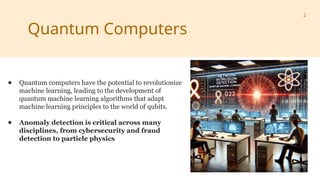
● Quantum computers have the potential to revolutionize
machine learning, leading to the development of
quantum machine learning algorithms that adapt
machine learning principles to the world of qubits.
● Anomaly detection is critical across many
disciplines, from cybersecurity and fraud
detection to particle physics
2
Applications of Anomaly Detection
The applications of anomaly detection span various cybersecurity domains such as
● Malware Detection
● Intrusion Detection
● Endpoint Detection
● Phishing Detection
● Advanced Persistent Threat (APT)
3
Existing Algorithms for Anomaly
Detection
Different algorithms or combinations of them are used for these purposes such as
● Naive Bayes method
● Support Vector Machines (SVM)
● Decision Trees
● Deep Neural Networks
4
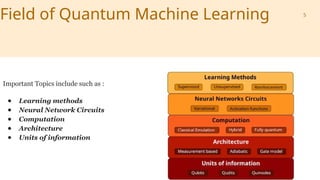
Field of Quantum Machine Learning
Important Topics include such as :
● Learning methods
● Neural Network Circuits
● Computation
● Architecture
● Units of information
5
Basics Of Quantum Computing
Basic terms in Quantum Computing are
● Qubits
● Qudits
● Qumodes
● Superposition & Entanglement
● Quantum Gates & Circuits
6
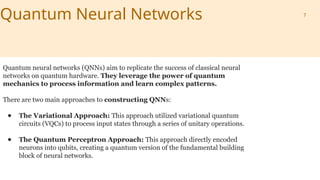
Quantum Neural Networks
Quantum neural networks (QNNs) aim to replicate the success of classical neural
networks on quantum hardware. They leverage the power of quantum
mechanics to process information and learn complex patterns.
There are two main approaches to constructing QNNs:
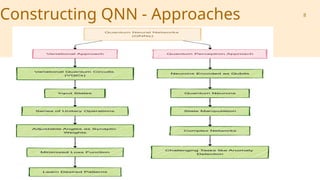
● The Variational Approach: This approach utilized variational quantum
circuits (VQCs) to process input states through a series of unitary operations.
● The Quantum Perceptron Approach: This approach directly encoded
neurons into qubits, creating a quantum version of the fundamental building
block of neural networks.
7
Constructing QNN - Approaches 8
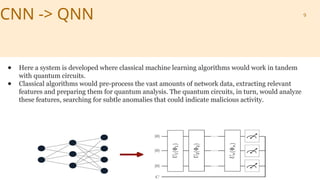
CNN -> QNN
● Here a system is developed where classical machine learning algorithms would work in tandem
with quantum circuits.
● Classical algorithms would pre-process the vast amounts of network data, extracting relevant
features and preparing them for quantum analysis. The quantum circuits, in turn, would analyze
these features, searching for subtle anomalies that could indicate malicious activity.
9
Quantum Supervised Learning
Quantum algorithms learn from labeled data to classify anomalies.
Examples include:
● Quantum Feed-forward Neural Networks
● Quantum Support Vector Machines (SVMs)
● Quantum restricted Boltzmann Machine
10
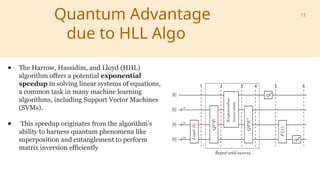
Quantum Advantage
due to HLL Algo
● The Harrow, Hassidim, and Lloyd (HHL)
algorithm offers a potential exponential
speedup in solving linear systems of equations,
a common task in many machine learning
algorithms, including Support Vector Machines
(SVMs).
● This speedup originates from the algorithm’s
ability to harness quantum phenomena like
superposition and entanglement to perform
matrix inversion efficiently
11
Quantum Unsupervised Learning
Quantum algorithms learn from unlabeled data to identify patterns and deviations.
Examples include as below :
● Quantum Generative Adversarial Networks (QGANs)
● Quantum Auto-encoders
● Amplitude estimation-based methods
● Quantum Kernels for one-class SVM
12
Critical Understanding
● For example in applying quantum machine learning algorithms for anomaly
detection in Cyber security , classical algorithms would pre-process the
vast amounts of network data, extracting relevant features and preparing
them for quantum analysis. The quantum circuits, in turn, would
analyze these features, searching for subtle anomalies that could
indicate malicious activity.
● With this hybrid approach, combining classical and quantum
computation, would be particularly well-suited for anomaly detection.
This was because quantum computers excelled at tasks like sampling from
complex probability distributions and performing optimization, which were
crucial for identifying deviations from normal network behavior.
13
Conclusion
Quantum machine learning represents a transformative leap in addressing complex
challenges like anomaly detection across diverse domains, including cybersecurity,
fraud prevention, and scientific research. By leveraging the unique principles of
quantum mechanics — such as superposition, entanglement, and quantum speed-ups
— quantum algorithms have shown potential to outperform classical approaches in
both supervised and unsupervised learning tasks.
Techniques like quantum neural networks, quantum support vector machines, and
hybrid algorithms combining classical preprocessing with quantum analysis illustrate
the growing synergy between classical and quantum paradigms
14
Thank
YOU

Quantum Machine Learning Algorithms For Anomaly Detection (1).pptx

  • 1.
    Quantum Machine Learning Algorithms ForAnomaly Detection SHORT STORY ASSIGNMENT Jayasurya Murali Section 47 CMPE 255
  • 2.
    Quantum Computers ● Quantumcomputers have the potential to revolutionize machine learning, leading to the development of quantum machine learning algorithms that adapt machine learning principles to the world of qubits. ● Anomaly detection is critical across many disciplines, from cybersecurity and fraud detection to particle physics 2
  • 3.
    Applications of AnomalyDetection The applications of anomaly detection span various cybersecurity domains such as ● Malware Detection ● Intrusion Detection ● Endpoint Detection ● Phishing Detection ● Advanced Persistent Threat (APT) 3
  • 4.
    Existing Algorithms forAnomaly Detection Different algorithms or combinations of them are used for these purposes such as ● Naive Bayes method ● Support Vector Machines (SVM) ● Decision Trees ● Deep Neural Networks 4
  • 5.
    Field of QuantumMachine Learning Important Topics include such as : ● Learning methods ● Neural Network Circuits ● Computation ● Architecture ● Units of information 5
  • 6.
    Basics Of QuantumComputing Basic terms in Quantum Computing are ● Qubits ● Qudits ● Qumodes ● Superposition & Entanglement ● Quantum Gates & Circuits 6
  • 7.
    Quantum Neural Networks Quantumneural networks (QNNs) aim to replicate the success of classical neural networks on quantum hardware. They leverage the power of quantum mechanics to process information and learn complex patterns. There are two main approaches to constructing QNNs: ● The Variational Approach: This approach utilized variational quantum circuits (VQCs) to process input states through a series of unitary operations. ● The Quantum Perceptron Approach: This approach directly encoded neurons into qubits, creating a quantum version of the fundamental building block of neural networks. 7
  • 8.
    Constructing QNN -Approaches 8
  • 9.
    CNN -> QNN ●Here a system is developed where classical machine learning algorithms would work in tandem with quantum circuits. ● Classical algorithms would pre-process the vast amounts of network data, extracting relevant features and preparing them for quantum analysis. The quantum circuits, in turn, would analyze these features, searching for subtle anomalies that could indicate malicious activity. 9
  • 10.
    Quantum Supervised Learning Quantumalgorithms learn from labeled data to classify anomalies. Examples include: ● Quantum Feed-forward Neural Networks ● Quantum Support Vector Machines (SVMs) ● Quantum restricted Boltzmann Machine 10
  • 11.
    Quantum Advantage due toHLL Algo ● The Harrow, Hassidim, and Lloyd (HHL) algorithm offers a potential exponential speedup in solving linear systems of equations, a common task in many machine learning algorithms, including Support Vector Machines (SVMs). ● This speedup originates from the algorithm’s ability to harness quantum phenomena like superposition and entanglement to perform matrix inversion efficiently 11
  • 12.
    Quantum Unsupervised Learning Quantumalgorithms learn from unlabeled data to identify patterns and deviations. Examples include as below : ● Quantum Generative Adversarial Networks (QGANs) ● Quantum Auto-encoders ● Amplitude estimation-based methods ● Quantum Kernels for one-class SVM 12
  • 13.
    Critical Understanding ● Forexample in applying quantum machine learning algorithms for anomaly detection in Cyber security , classical algorithms would pre-process the vast amounts of network data, extracting relevant features and preparing them for quantum analysis. The quantum circuits, in turn, would analyze these features, searching for subtle anomalies that could indicate malicious activity. ● With this hybrid approach, combining classical and quantum computation, would be particularly well-suited for anomaly detection. This was because quantum computers excelled at tasks like sampling from complex probability distributions and performing optimization, which were crucial for identifying deviations from normal network behavior. 13
  • 14.
    Conclusion Quantum machine learningrepresents a transformative leap in addressing complex challenges like anomaly detection across diverse domains, including cybersecurity, fraud prevention, and scientific research. By leveraging the unique principles of quantum mechanics — such as superposition, entanglement, and quantum speed-ups — quantum algorithms have shown potential to outperform classical approaches in both supervised and unsupervised learning tasks. Techniques like quantum neural networks, quantum support vector machines, and hybrid algorithms combining classical preprocessing with quantum analysis illustrate the growing synergy between classical and quantum paradigms 14
  • 15.