For any help regarding Computer Network Assignment Help
Visit :- https://www.computernetworkassignmenthelp.com/ ,
Email :- support@computernetworkassignmenthelp.com or
Call us at :- +1(315) 557-6473
Introduction
Welcome to our presentation focusing on complex problems in
quantum teleportation and superdense coding. This presentation,
prepared by the experts at ComputerNetworkAssignmentHelp.com,
aims to provide detailed solutions to advanced problems in
computer networks and quantum mechanics.
In this session, we will explore various problems, including the
teleportation protocol and the probability distribution of qubits, as
well as delve into the principles of superdense coding with qutrits.
Our objective is to demonstrate that the values of the qubits Alice
sends to Bob are independent of the state of the qubit being
transmitted, and to show the mapping between Alice's
measurements and Bob's corrections.
Through this presentation, we hope to offer valuable insights and
practical solutions that will assist students in understanding and
solving their computer network assignments.
https://www.computernetworkassignmenthelp.com/
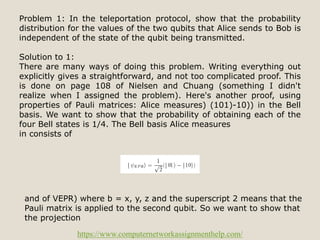
Problem 1: In the teleportation protocol, show that the probability
distribution for the values of the two qubits that Alice sends to Bob is
independent of the state of the qubit being transmitted.
Solution to 1:
There are many ways of doing this problem. Writing everything out
explicitly gives a straightforward, and not too complicated proof. This
is done on page 108 of Nielsen and Chuang (something I didn't
realize when I assigned the problem). Here's another proof, using
properties of Pauli matrices: Alice measures) (101)-10)) in the Bell
basis. We want to show that the probability of obtaining each of the
four Bell states is 1/4. The Bell basis Alice measures
in consists of
and of VEPR) where b = x, y, z and the superscript 2 means that the
Pauli matrix is applied to the second qubit. So we want to show that
the projection
https://www.computernetworkassignmenthelp.com/
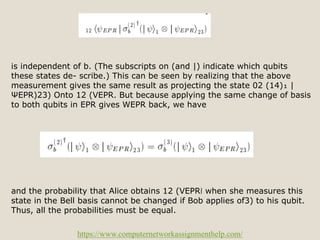
is independent of b. (The subscripts on (and |) indicate which qubits
these states de- scribe.) This can be seen by realizing that the above
measurement gives the same result as projecting the state 02 (14)₁ |
ΨEPR)23) Onto 12 (VEPR. But because applying the same change of basis
to both qubits in EPR gives WEPR back, we have
and the probability that Alice obtains 12 (VEPR❘ when she measures this
state in the Bell basis cannot be changed if Bob applies of3) to his qubit.
Thus, all the probabilities must be equal.
https://www.computernetworkassignmenthelp.com/
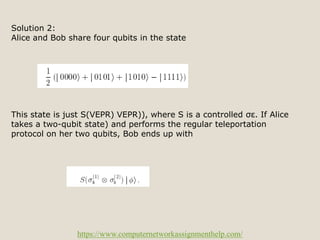
Solution 2:
Alice and Bob share four qubits in the state
This state is just S(VEPR) VEPR)), where S is a controlled σε. If Alice
takes a two-qubit state) and performs the regular teleportation
protocol on her two qubits, Bob ends up with
https://www.computernetworkassignmenthelp.com/
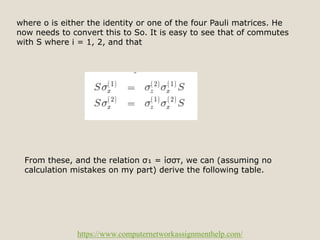
where o is either the identity or one of the four Pauli matrices. He
now needs to convert this to So. It is easy to see that of commutes
with S where i = 1, 2, and that
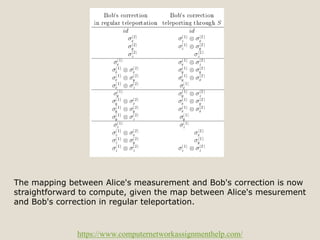
From these, and the relation σ₁ = ίσστ, we can (assuming no
calculation mistakes on my part) derive the following table.
https://www.computernetworkassignmenthelp.com/
The mapping between Alice's measurement and Bob's correction is now
straightforward to compute, given the map between Alice's mesurement
and Bob's correction in regular teleportation.
https://www.computernetworkassignmenthelp.com/
Problem 3:
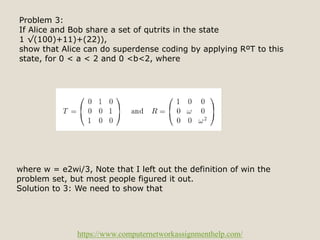
If Alice and Bob share a set of qutrits in the state
1 √(100)+11)+(22)),
show that Alice can do superdense coding by applying RºT to this
state, for 0 < a < 2 and 0 <b<2, where
where w = e2wi/3, Note that I left out the definition of win the
problem set, but most people figured it out.
Solution to 3: We need to show that
https://www.computernetworkassignmenthelp.com/
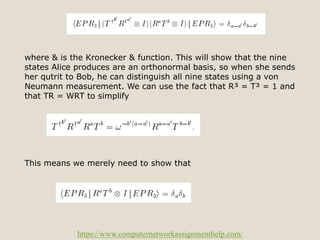
where & is the Kronecker & function. This will show that the nine
states Alice produces are an orthonormal basis, so when she sends
her qutrit to Bob, he can distinguish all nine states using a von
Neumann measurement. We can use the fact that R³ = T³ = 1 and
that TR = WRT to simplify
This means we merely need to show that
https://www.computernetworkassignmenthelp.com/
for 0 ab 2. If b≠ 0, then RT I EPR3) is a superposition of basis states
of the form ij) for i ≠ j, and so has inner product 0 with EPR3). If b
= 0, then
and the inner product of this with | EPR3) is (1+wa+w²a)/3, which if we
choose w = 2/3 is 1 if a 0, and 0 if a = 1, 2.
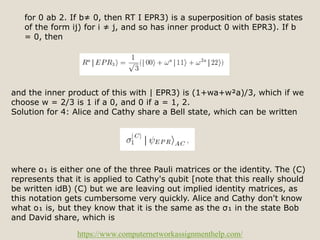
Solution for 4: Alice and Cathy share a Bell state, which can be written
where o₁ is either one of the three Pauli matrices or the identity. The (C)
represents that it is applied to Cathy's qubit [note that this really should
be written idB) (C) but we are leaving out implied identity matrices, as
this notation gets cumbersome very quickly. Alice and Cathy don't know
what o₁ is, but they know that it is the same as the σ₁ in the state Bob
and David share, which is
https://www.computernetworkassignmenthelp.com/
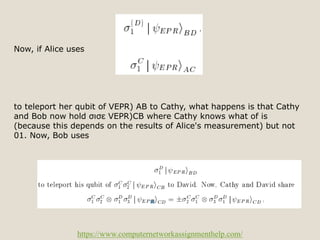
Now, if Alice uses
to teleport her qubit of VEPR) AB to Cathy, what happens is that Cathy
and Bob now hold σισε VEPR)CB where Cathy knows what of is
(because this depends on the results of Alice's measurement) but not
01. Now, Bob uses
where we can interchange the two pairs of Pauli matrices because
any two Pauli ma- trices either commute or anticommute. But since
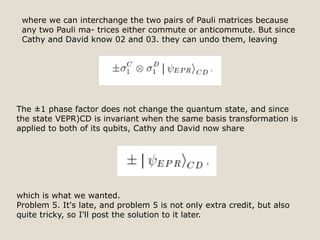
Cathy and David know 02 and 03. they can undo them, leaving
The ±1 phase factor does not change the quantum state, and since
the state VEPR)CD is invariant when the same basis transformation is
applied to both of its qubits, Cathy and David now share
which is what we wanted.
Problem 5. It's late, and problem 5 is not only extra credit, but also
quite tricky, so I'll post the solution to it later.
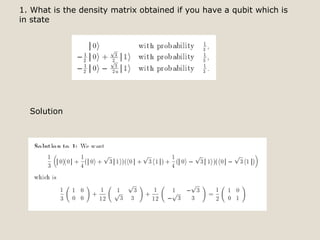
1. What is the density matrix obtained if you have a qubit which is
in state
Solution
https://www.computernetworkassignmenthelp.com/
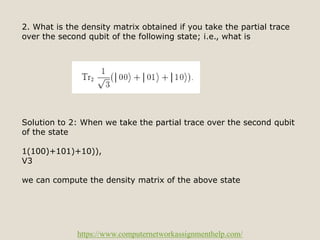
2. What is the density matrix obtained if you take the partial trace
over the second qubit of the following state; i.e., what is
Solution to 2: When we take the partial trace over the second qubit
of the state
1(100)+101)+10)),
V3
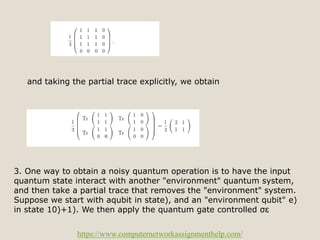
we can compute the density matrix of the above state
https://www.computernetworkassignmenthelp.com/
and taking the partial trace explicitly, we obtain
3. One way to obtain a noisy quantum operation is to have the input
quantum state interact with another "environment" quantum system,
and then take a partial trace that removes the "environment" system.
Suppose we start with aqubit in state), and an "environment qubit" e)
in state 10)+1). We then apply the quantum gate controlled σε
https://www.computernetworkassignmenthelp.com/
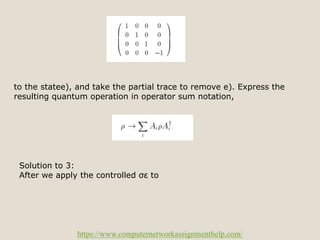
to the statee), and take the partial trace to remove e). Express the
resulting quantum operation in operator sum notation,
Solution to 3:
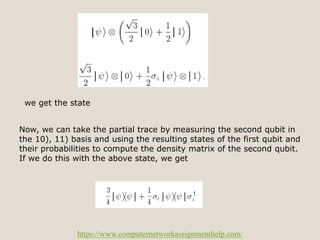
After we apply the controlled σε to
https://www.computernetworkassignmenthelp.com/
Now, we can take the partial trace by measuring the second qubit in
the 10), 11) basis and using the resulting states of the first qubit and
their probabilities to compute the density matrix of the second qubit.
If we do this with the above state, we get
we get the state
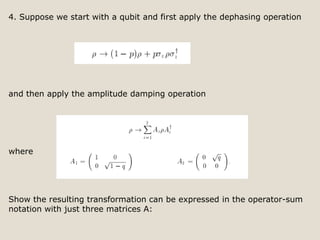
4. Suppose we start with a qubit and first apply the dephasing operation
and then apply the amplitude damping operation
where
Show the resulting transformation can be expressed in the operator-sum
notation with just three matrices A:
https://www.computernetworkassignmenthelp.com/
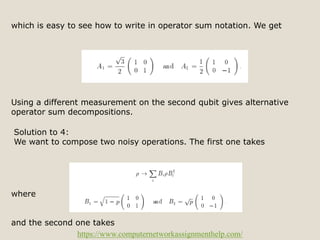
which is easy to see how to write in operator sum notation. We get
Using a different measurement on the second qubit gives alternative
operator sum decompositions.
Solution to 4:
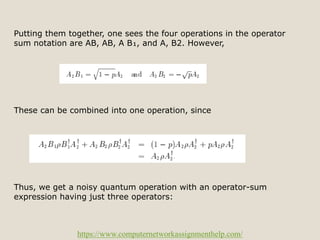
We want to compose two noisy operations. The first one takes
where
and the second one takes
https://www.computernetworkassignmenthelp.com/
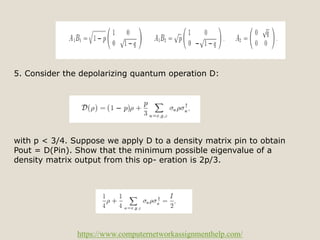
Putting them together, one sees the four operations in the operator
sum notation are AB, AB, A B₁, and A, B2. However,
These can be combined into one operation, since
Thus, we get a noisy quantum operation with an operator-sum
expression having just three operators:
https://www.computernetworkassignmenthelp.com/
5. Consider the depolarizing quantum operation D:
with p < 3/4. Suppose we apply D to a density matrix pin to obtain
Pout = D(Pin). Show that the minimum possible eigenvalue of a
density matrix output from this op- eration is 2p/3.
https://www.computernetworkassignmenthelp.com/
Solution to 5:
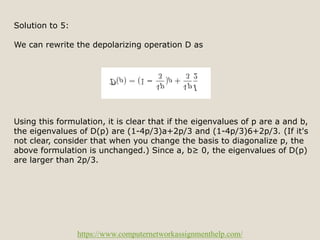
We can rewrite the depolarizing operation D as
Using this formulation, it is clear that if the eigenvalues of p are a and b,
the eigenvalues of D(p) are (1-4p/3)a+2p/3 and (1-4p/3)6+2p/3. (If it's
not clear, consider that when you change the basis to diagonalize p, the
above formulation is unchanged.) Since a, b≥ 0, the eigenvalues of D(p)
are larger than 2p/3.

Quantum Computing: Your University Assignment Solution!

  • 1.
    For any helpregarding Computer Network Assignment Help Visit :- https://www.computernetworkassignmenthelp.com/ , Email :- support@computernetworkassignmenthelp.com or Call us at :- +1(315) 557-6473
  • 2.
    Introduction Welcome to ourpresentation focusing on complex problems in quantum teleportation and superdense coding. This presentation, prepared by the experts at ComputerNetworkAssignmentHelp.com, aims to provide detailed solutions to advanced problems in computer networks and quantum mechanics. In this session, we will explore various problems, including the teleportation protocol and the probability distribution of qubits, as well as delve into the principles of superdense coding with qutrits. Our objective is to demonstrate that the values of the qubits Alice sends to Bob are independent of the state of the qubit being transmitted, and to show the mapping between Alice's measurements and Bob's corrections. Through this presentation, we hope to offer valuable insights and practical solutions that will assist students in understanding and solving their computer network assignments. https://www.computernetworkassignmenthelp.com/
  • 3.
    https://www.computernetworkassignmenthelp.com/ Problem 1: Inthe teleportation protocol, show that the probability distribution for the values of the two qubits that Alice sends to Bob is independent of the state of the qubit being transmitted. Solution to 1: There are many ways of doing this problem. Writing everything out explicitly gives a straightforward, and not too complicated proof. This is done on page 108 of Nielsen and Chuang (something I didn't realize when I assigned the problem). Here's another proof, using properties of Pauli matrices: Alice measures) (101)-10)) in the Bell basis. We want to show that the probability of obtaining each of the four Bell states is 1/4. The Bell basis Alice measures in consists of and of VEPR) where b = x, y, z and the superscript 2 means that the Pauli matrix is applied to the second qubit. So we want to show that the projection
  • 4.
    https://www.computernetworkassignmenthelp.com/ is independent ofb. (The subscripts on (and |) indicate which qubits these states de- scribe.) This can be seen by realizing that the above measurement gives the same result as projecting the state 02 (14)₁ | ΨEPR)23) Onto 12 (VEPR. But because applying the same change of basis to both qubits in EPR gives WEPR back, we have and the probability that Alice obtains 12 (VEPR❘ when she measures this state in the Bell basis cannot be changed if Bob applies of3) to his qubit. Thus, all the probabilities must be equal.
  • 5.
    https://www.computernetworkassignmenthelp.com/ Solution 2: Alice andBob share four qubits in the state This state is just S(VEPR) VEPR)), where S is a controlled σε. If Alice takes a two-qubit state) and performs the regular teleportation protocol on her two qubits, Bob ends up with
  • 6.
    https://www.computernetworkassignmenthelp.com/ where o iseither the identity or one of the four Pauli matrices. He now needs to convert this to So. It is easy to see that of commutes with S where i = 1, 2, and that From these, and the relation σ₁ = ίσστ, we can (assuming no calculation mistakes on my part) derive the following table.
  • 7.
    https://www.computernetworkassignmenthelp.com/ The mapping betweenAlice's measurement and Bob's correction is now straightforward to compute, given the map between Alice's mesurement and Bob's correction in regular teleportation.
  • 8.
    https://www.computernetworkassignmenthelp.com/ Problem 3: If Aliceand Bob share a set of qutrits in the state 1 √(100)+11)+(22)), show that Alice can do superdense coding by applying RºT to this state, for 0 < a < 2 and 0 <b<2, where where w = e2wi/3, Note that I left out the definition of win the problem set, but most people figured it out. Solution to 3: We need to show that
  • 9.
    https://www.computernetworkassignmenthelp.com/ where & isthe Kronecker & function. This will show that the nine states Alice produces are an orthonormal basis, so when she sends her qutrit to Bob, he can distinguish all nine states using a von Neumann measurement. We can use the fact that R³ = T³ = 1 and that TR = WRT to simplify This means we merely need to show that
  • 10.
    https://www.computernetworkassignmenthelp.com/ for 0 ab2. If b≠ 0, then RT I EPR3) is a superposition of basis states of the form ij) for i ≠ j, and so has inner product 0 with EPR3). If b = 0, then and the inner product of this with | EPR3) is (1+wa+w²a)/3, which if we choose w = 2/3 is 1 if a 0, and 0 if a = 1, 2. Solution for 4: Alice and Cathy share a Bell state, which can be written where o₁ is either one of the three Pauli matrices or the identity. The (C) represents that it is applied to Cathy's qubit [note that this really should be written idB) (C) but we are leaving out implied identity matrices, as this notation gets cumbersome very quickly. Alice and Cathy don't know what o₁ is, but they know that it is the same as the σ₁ in the state Bob and David share, which is
  • 11.
    https://www.computernetworkassignmenthelp.com/ Now, if Aliceuses to teleport her qubit of VEPR) AB to Cathy, what happens is that Cathy and Bob now hold σισε VEPR)CB where Cathy knows what of is (because this depends on the results of Alice's measurement) but not 01. Now, Bob uses
  • 12.
    where we caninterchange the two pairs of Pauli matrices because any two Pauli ma- trices either commute or anticommute. But since Cathy and David know 02 and 03. they can undo them, leaving The ±1 phase factor does not change the quantum state, and since the state VEPR)CD is invariant when the same basis transformation is applied to both of its qubits, Cathy and David now share which is what we wanted. Problem 5. It's late, and problem 5 is not only extra credit, but also quite tricky, so I'll post the solution to it later.
  • 13.
    1. What isthe density matrix obtained if you have a qubit which is in state Solution
  • 14.
    https://www.computernetworkassignmenthelp.com/ 2. What isthe density matrix obtained if you take the partial trace over the second qubit of the following state; i.e., what is Solution to 2: When we take the partial trace over the second qubit of the state 1(100)+101)+10)), V3 we can compute the density matrix of the above state
  • 15.
    https://www.computernetworkassignmenthelp.com/ and taking thepartial trace explicitly, we obtain 3. One way to obtain a noisy quantum operation is to have the input quantum state interact with another "environment" quantum system, and then take a partial trace that removes the "environment" system. Suppose we start with aqubit in state), and an "environment qubit" e) in state 10)+1). We then apply the quantum gate controlled σε
  • 16.
    https://www.computernetworkassignmenthelp.com/ to the statee),and take the partial trace to remove e). Express the resulting quantum operation in operator sum notation, Solution to 3: After we apply the controlled σε to
  • 17.
    https://www.computernetworkassignmenthelp.com/ Now, we cantake the partial trace by measuring the second qubit in the 10), 11) basis and using the resulting states of the first qubit and their probabilities to compute the density matrix of the second qubit. If we do this with the above state, we get we get the state
  • 18.
    4. Suppose westart with a qubit and first apply the dephasing operation and then apply the amplitude damping operation where Show the resulting transformation can be expressed in the operator-sum notation with just three matrices A:
  • 19.
    https://www.computernetworkassignmenthelp.com/ which is easyto see how to write in operator sum notation. We get Using a different measurement on the second qubit gives alternative operator sum decompositions. Solution to 4: We want to compose two noisy operations. The first one takes where and the second one takes
  • 20.
    https://www.computernetworkassignmenthelp.com/ Putting them together,one sees the four operations in the operator sum notation are AB, AB, A B₁, and A, B2. However, These can be combined into one operation, since Thus, we get a noisy quantum operation with an operator-sum expression having just three operators:
  • 21.
    https://www.computernetworkassignmenthelp.com/ 5. Consider thedepolarizing quantum operation D: with p < 3/4. Suppose we apply D to a density matrix pin to obtain Pout = D(Pin). Show that the minimum possible eigenvalue of a density matrix output from this op- eration is 2p/3.
  • 22.
    https://www.computernetworkassignmenthelp.com/ Solution to 5: Wecan rewrite the depolarizing operation D as Using this formulation, it is clear that if the eigenvalues of p are a and b, the eigenvalues of D(p) are (1-4p/3)a+2p/3 and (1-4p/3)6+2p/3. (If it's not clear, consider that when you change the basis to diagonalize p, the above formulation is unchanged.) Since a, b≥ 0, the eigenvalues of D(p) are larger than 2p/3.