Quantitative Literacy
Through Social Science:
Don’t Be Afraid of Data!
International Conference on College
      Teaching and Learning
           April 11, 2012

        Linda Detterman
         Lynette Hoelter
     ICPSR, Univ. of Michigan
Session Outline
• Defining “quantitative literacy (QL)” and
  “data”
• Why the emphasis on quantitative
  literacy?
• “But, I teach English…
  – …. I don‟t „do‟ data”
  – …. my students don‟t „do‟ data”
  – …. what does quantitative literacy mean
    for me?”
• Tools for incorporating data in the
  classroom
• Evidence of effectiveness from
  social sciences
Defining Quantitative
Literacy/Reasoning, Numeracy
   “Statistical literacy, quantitative literacy, numeracy --Under
   the hood, it is what do we want people to be able to do: Read
   tables and graphs and understand English statements that
   have numbers in them. That‟s a good start,” said Milo
   Schield, a professor of statistics at Augsburg College and a
   vice president of the National Numeracy Network.

   Shield was dismayed to find that, in a survey of his new
   students, 44 percent could not read a simple 100 percent row
   table and about a quarter could not accurately interpret a
   scatter plot of adult heights and weights.

   Chandler, Michael Alison. What is Quantitative
     Literacy?, Washington Post, Feb. 5, 2009
• Skills learned & used within a context
• Skills:
  – Reading and interpreting tables or graphs
    and to calculating percentages and the like
  – Working within a scientific model
    (variables, hypotheses, etc.)
  – Understanding and critically evaluating
    numbers presented in everyday lives
  – Evaluating arguments based on data
  – Knowing what kinds of data might be useful
    in answering particular questions
• For a straightforward definition/skill
  list, see Samford University‟s (not social
  science specific)
What do we mean by “data”?
• Definitions differ by context. Data can be:
  – Citing another author who supports your point
  – Analysis of newspaper articles, blogs, Twitter
    feeds, commercials, etc. looking for themes
  – The result of an in-depth interview or observation
  – Information from medical tests, experiments, and
    other “scientific” exercises
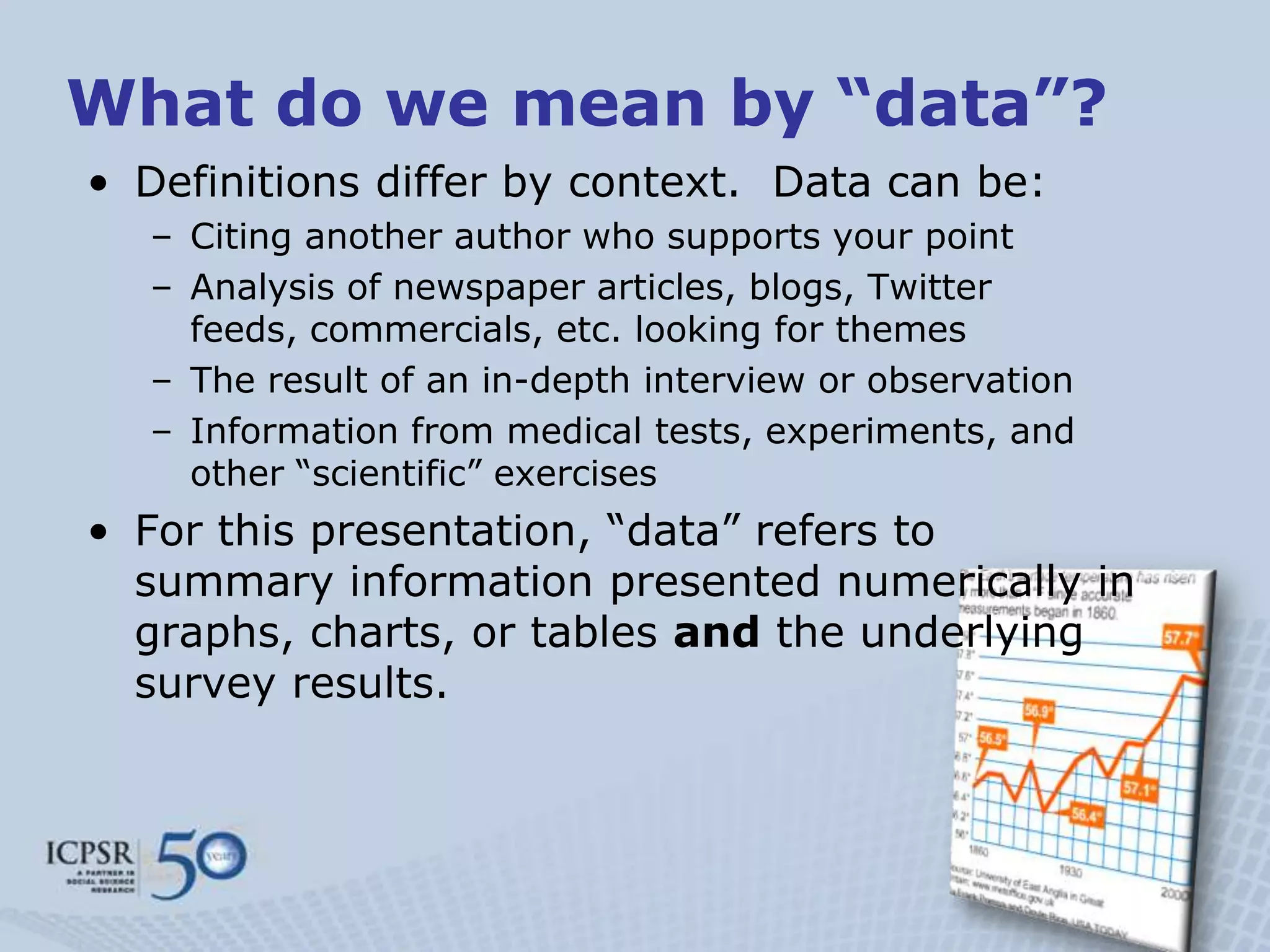
• For this presentation, “data” refers to
  summary information presented numerically in
  graphs, charts, or tables and the underlying
  survey results.
From Where Do Data Come?
• Administrative records (e.g., human
  resource files, police records)
• Census and other government data
  collections
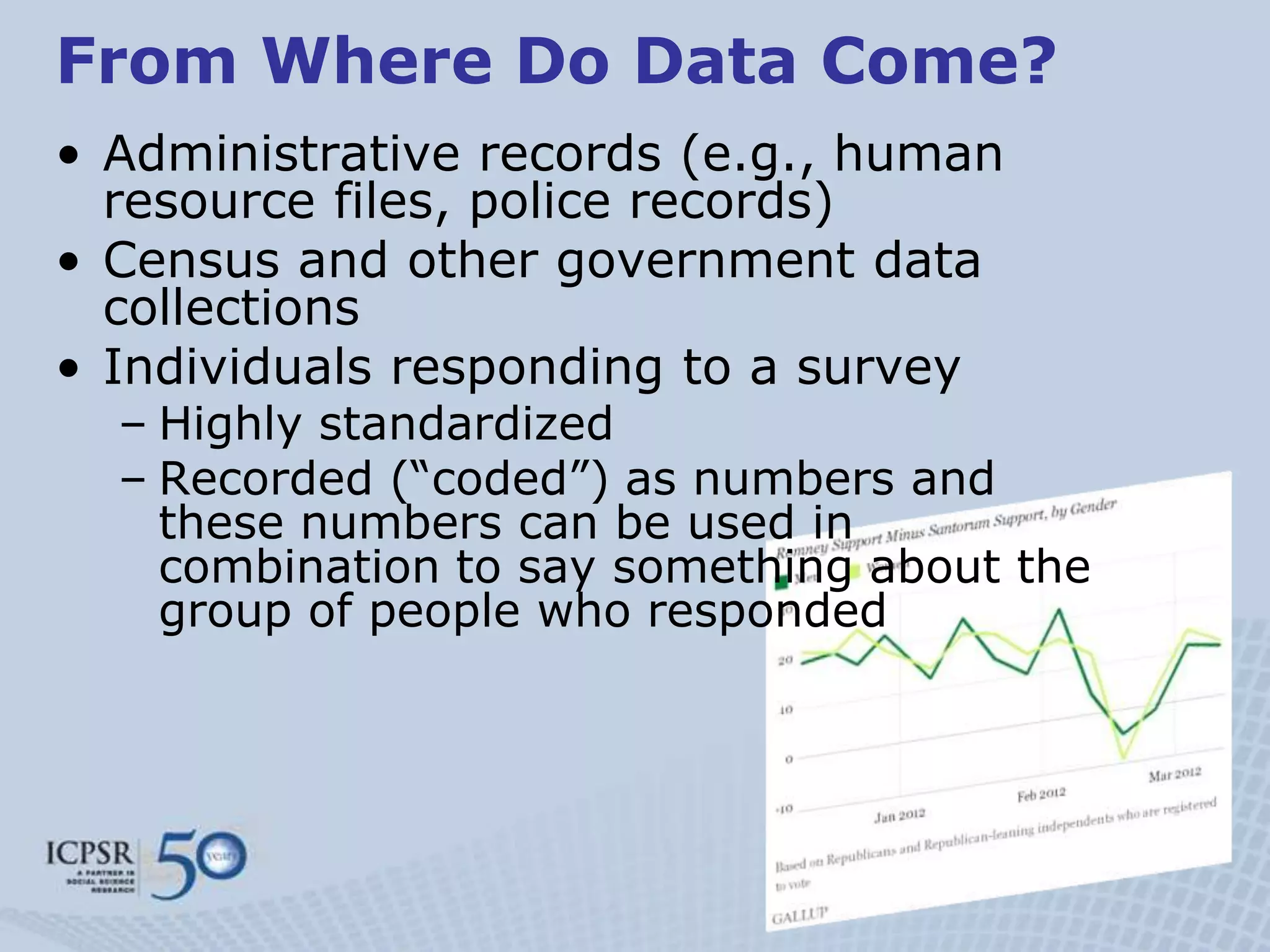
• Individuals responding to a survey
  – Highly standardized
  – Recorded (“coded”) as numbers and
    these numbers can be used in
    combination to say something about the
    group of people who responded
Why is QL Important?
• Critical for a democratic society (Steen
  2001)
  – Informed citizenry – must be able to make
    sense of information coming from multiple
    sources.
  – “The wall of ignorance between those who
    are quantitatively literate and those who
    are not can threaten democratic culture.
  – Quantitative literacy largely determines an
    individual‟s capacity to control his or her
    quality of life and to participate effectively
    in social decision-making” (MAA 2004: xii)
Importance (Con’t)
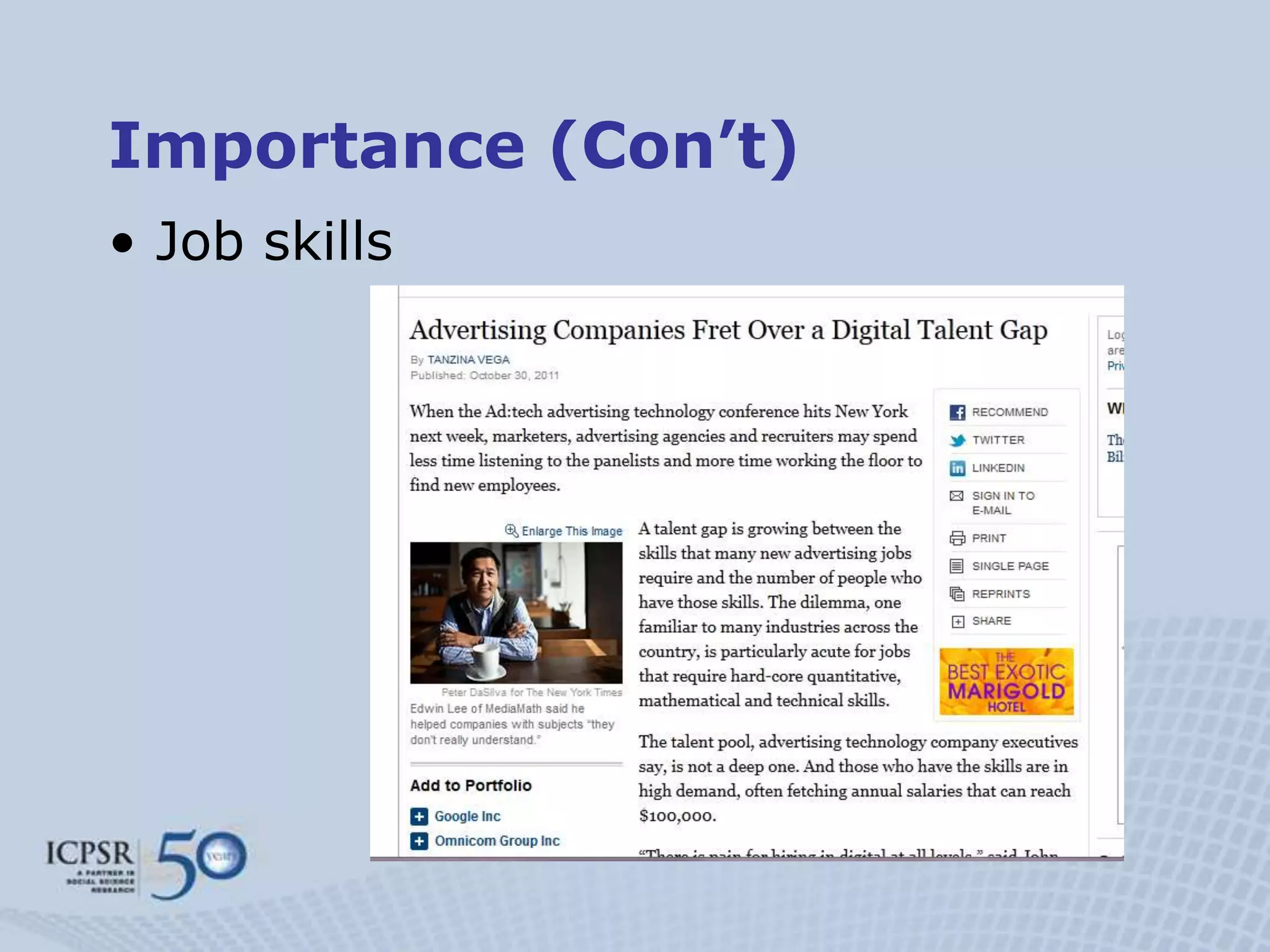
• Job skills
Why QL Across the Curriculum?
• “Quantitative literacy largely determines an individual‟s
  capacity to control his or her quality of life and to
  participate effectively in social decision-making.
• Educational policy and practice have fallen behind the
  rapidly changing data-oriented needs of modern
  society, and undergraduate education is the appropriate
  locus of leadership for making the necessary changes
• QL is not about „basic skills‟ but rather, like reading and
  writing, is a demanding college-level learning
  expectation that cuts across the entire undergraduate
  curriculum
• The current calculus-driven high school curriculum is
  unlikely to produce a quantitatively literate student
  population” (MAA 2004:xii)
QL Outside of Math/Statistics
• Other disciplines provide context for
  numbers, giving them meaning
• More repetition of skills, better
  learning
• Inclusion in multiple settings reduces
  student anxiety
• Teacher anxiety can be reduced with
  tools (pre-made
  exercises, interpretations given)
How to Include Data
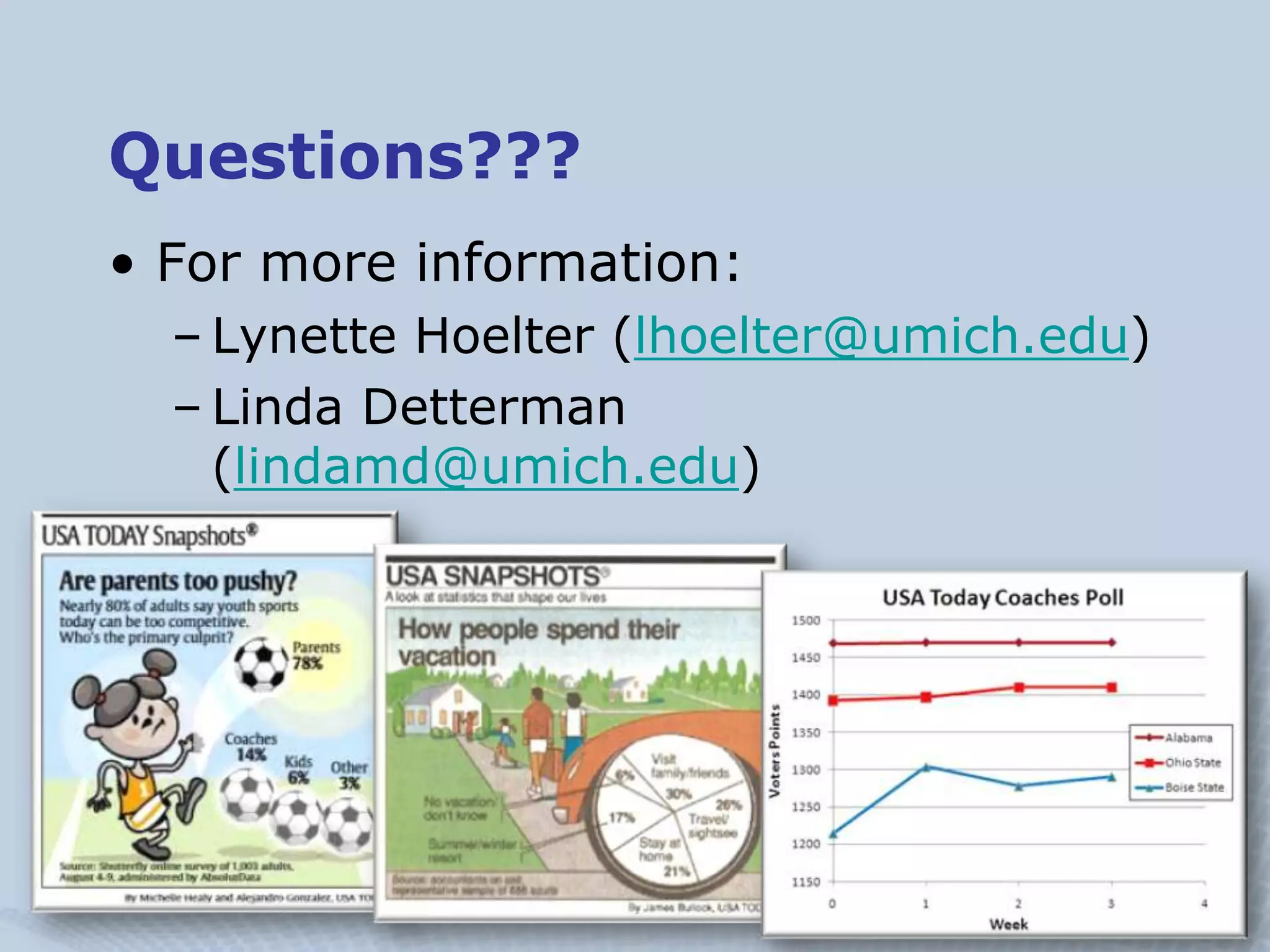
• Start class with a data-based news article
• Have students interpret charts/graphs from
  popular media and critique news articles
• Require empirical evidence to support claims
  in essays
• Question banks and exercises allow students
  to work with surveys and the resulting data
• Have students collect data
• Engage students by having them find
  maps, graphs, or other data that provide
  examples of course content.
Tools for Faculty
• Data archives
  – Public opinion
  – Topic-specific archives
• Quantitative news blogs
• Pre-made exercises, pedagogical
  examples
• Collections of resources
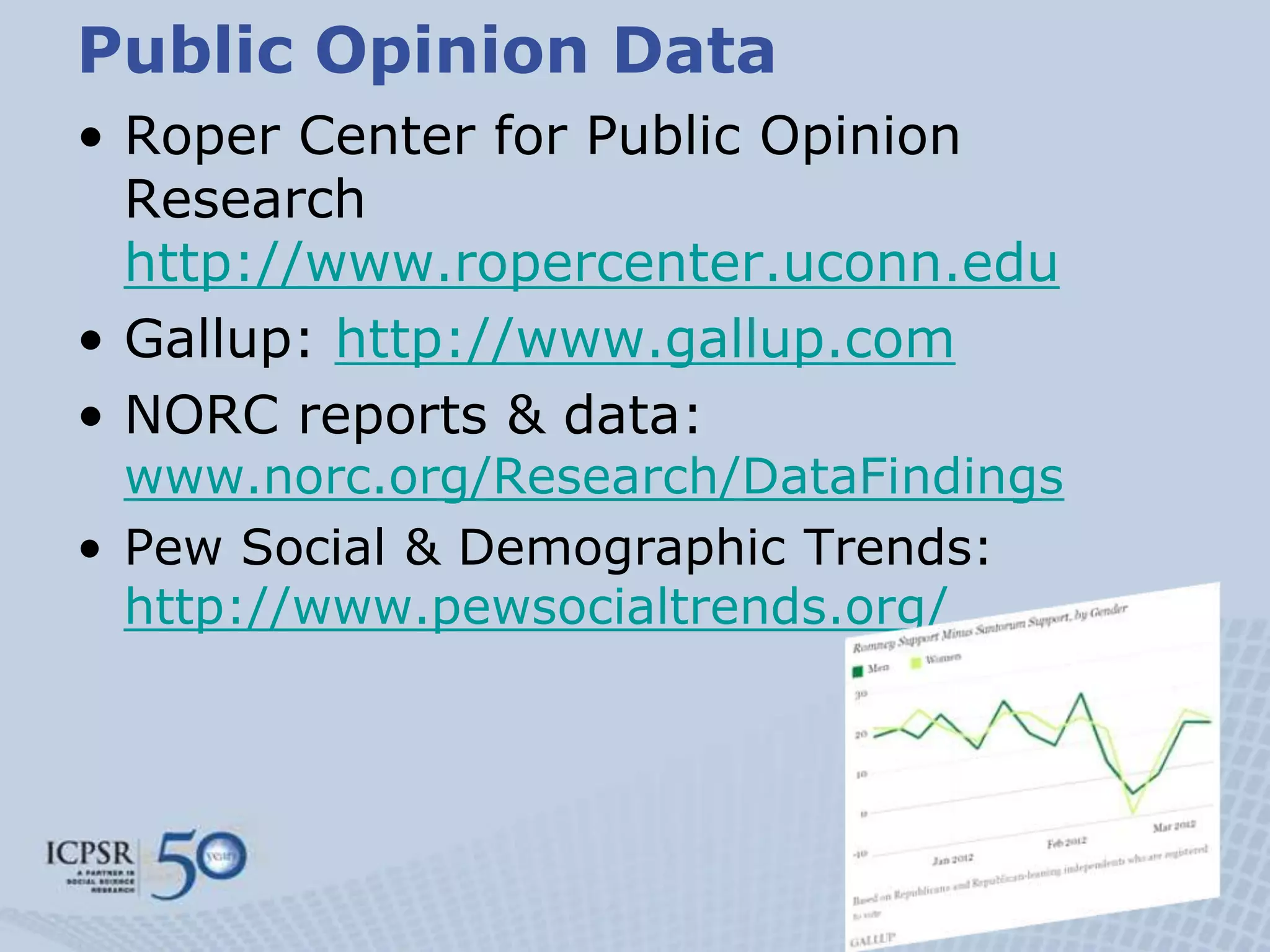
Public Opinion Data
• Roper Center for Public Opinion
  Research
  http://www.ropercenter.uconn.edu
• Gallup: http://www.gallup.com
• NORC reports & data:
  www.norc.org/Research/DataFindings
• Pew Social & Demographic Trends:
  http://www.pewsocialtrends.org/
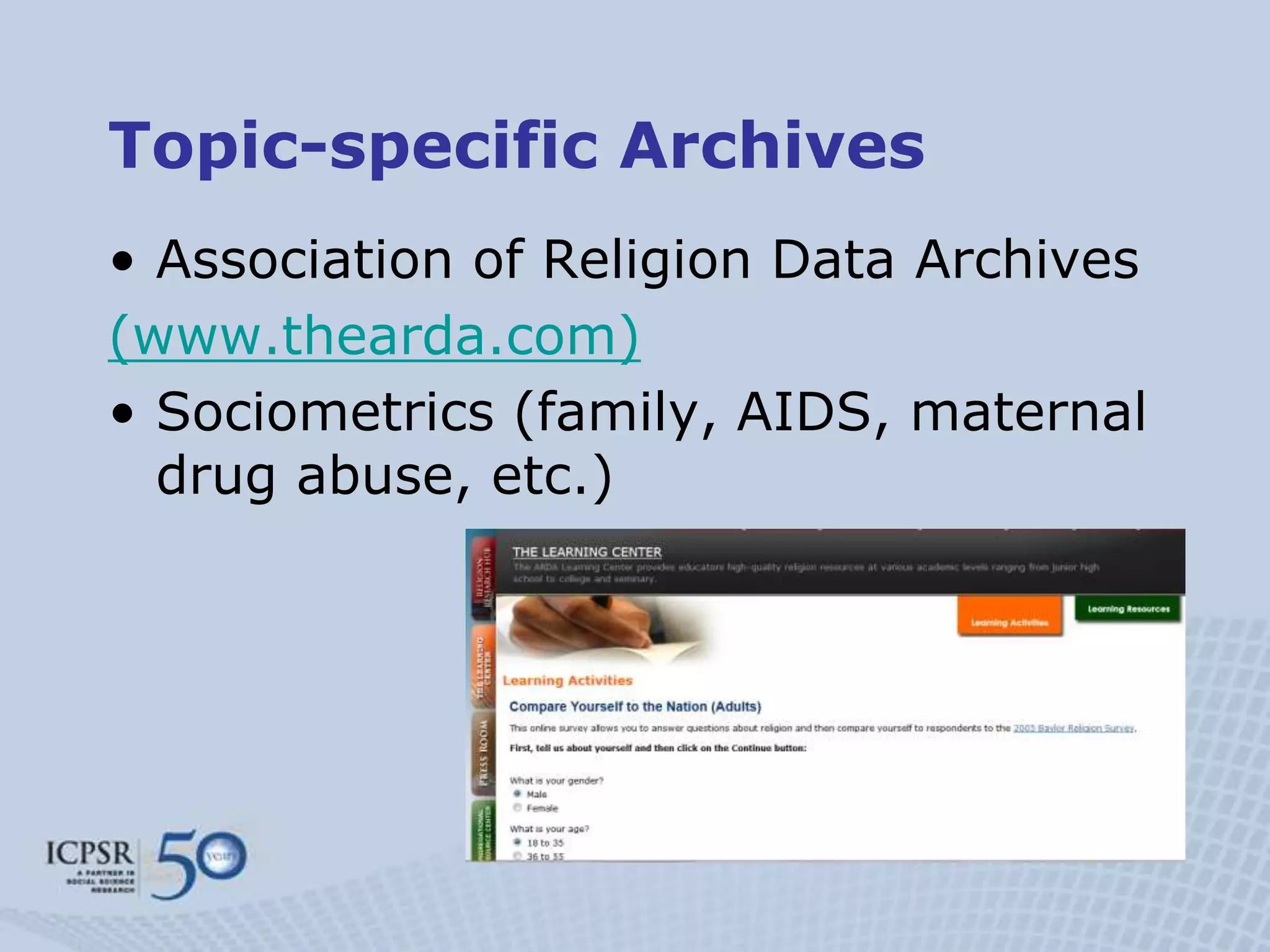
Topic-specific Archives
• Association of Religion Data Archives
(www.thearda.com)
• Sociometrics (family, AIDS, maternal
  drug abuse, etc.)
News Blogs & Quick Facts
• TeachingWithData.org – Data in the
  News
• U.S. Census Newsroom
• Other government sources;
  organizations – beware of credibility
Collections of Resources
• Science Education Resource Center
  (Carleton College – pedagogical
  materials)
• TeachingWithData.org
• ICPSR
  – Online Learning Center
  – Modules
  – Tools (SSVD, Bibliography, SDA)
Arguments and Evidence from
Social Sciences
• Increased learning
  – Makes course content relevant to students
  – Emphasizes substantive points
  – Higher student engagement (typically)
• Better sense of field
  – Less disconnect between substantive and
    technical courses
  – Learn how social scientists actually work
More Arguments/Evidence

• Provides students with marketable
  skills
  – ASA survey – statistical knowledge
    most widely represented on resumes
  – Enhances writing and critical thinking
How might you use
survey or other data in
YOUR course? Other
ideas? Challenges?
Questions???
• For more information:
  – Lynette Hoelter (lhoelter@umich.edu)
  – Linda Detterman
    (lindamd@umich.edu)

Quantitative Literacy: Don't be afraid of data (in the classroom)!

  • 1.
    Quantitative Literacy Through SocialScience: Don’t Be Afraid of Data! International Conference on College Teaching and Learning April 11, 2012 Linda Detterman Lynette Hoelter ICPSR, Univ. of Michigan
  • 2.
    Session Outline • Defining“quantitative literacy (QL)” and “data” • Why the emphasis on quantitative literacy? • “But, I teach English… – …. I don‟t „do‟ data” – …. my students don‟t „do‟ data” – …. what does quantitative literacy mean for me?” • Tools for incorporating data in the classroom • Evidence of effectiveness from social sciences
  • 3.
    Defining Quantitative Literacy/Reasoning, Numeracy “Statistical literacy, quantitative literacy, numeracy --Under the hood, it is what do we want people to be able to do: Read tables and graphs and understand English statements that have numbers in them. That‟s a good start,” said Milo Schield, a professor of statistics at Augsburg College and a vice president of the National Numeracy Network. Shield was dismayed to find that, in a survey of his new students, 44 percent could not read a simple 100 percent row table and about a quarter could not accurately interpret a scatter plot of adult heights and weights. Chandler, Michael Alison. What is Quantitative Literacy?, Washington Post, Feb. 5, 2009
  • 4.
    • Skills learned& used within a context • Skills: – Reading and interpreting tables or graphs and to calculating percentages and the like – Working within a scientific model (variables, hypotheses, etc.) – Understanding and critically evaluating numbers presented in everyday lives – Evaluating arguments based on data – Knowing what kinds of data might be useful in answering particular questions • For a straightforward definition/skill list, see Samford University‟s (not social science specific)
  • 5.
    What do wemean by “data”? • Definitions differ by context. Data can be: – Citing another author who supports your point – Analysis of newspaper articles, blogs, Twitter feeds, commercials, etc. looking for themes – The result of an in-depth interview or observation – Information from medical tests, experiments, and other “scientific” exercises • For this presentation, “data” refers to summary information presented numerically in graphs, charts, or tables and the underlying survey results.
  • 6.
    From Where DoData Come? • Administrative records (e.g., human resource files, police records) • Census and other government data collections • Individuals responding to a survey – Highly standardized – Recorded (“coded”) as numbers and these numbers can be used in combination to say something about the group of people who responded
  • 7.
    Why is QLImportant? • Critical for a democratic society (Steen 2001) – Informed citizenry – must be able to make sense of information coming from multiple sources. – “The wall of ignorance between those who are quantitatively literate and those who are not can threaten democratic culture. – Quantitative literacy largely determines an individual‟s capacity to control his or her quality of life and to participate effectively in social decision-making” (MAA 2004: xii)
  • 8.
  • 9.
    Why QL Acrossthe Curriculum? • “Quantitative literacy largely determines an individual‟s capacity to control his or her quality of life and to participate effectively in social decision-making. • Educational policy and practice have fallen behind the rapidly changing data-oriented needs of modern society, and undergraduate education is the appropriate locus of leadership for making the necessary changes • QL is not about „basic skills‟ but rather, like reading and writing, is a demanding college-level learning expectation that cuts across the entire undergraduate curriculum • The current calculus-driven high school curriculum is unlikely to produce a quantitatively literate student population” (MAA 2004:xii)
  • 10.
    QL Outside ofMath/Statistics • Other disciplines provide context for numbers, giving them meaning • More repetition of skills, better learning • Inclusion in multiple settings reduces student anxiety • Teacher anxiety can be reduced with tools (pre-made exercises, interpretations given)
  • 11.
    How to IncludeData • Start class with a data-based news article • Have students interpret charts/graphs from popular media and critique news articles • Require empirical evidence to support claims in essays • Question banks and exercises allow students to work with surveys and the resulting data • Have students collect data • Engage students by having them find maps, graphs, or other data that provide examples of course content.
  • 12.
    Tools for Faculty •Data archives – Public opinion – Topic-specific archives • Quantitative news blogs • Pre-made exercises, pedagogical examples • Collections of resources
  • 13.
    Public Opinion Data •Roper Center for Public Opinion Research http://www.ropercenter.uconn.edu • Gallup: http://www.gallup.com • NORC reports & data: www.norc.org/Research/DataFindings • Pew Social & Demographic Trends: http://www.pewsocialtrends.org/
  • 14.
    Topic-specific Archives • Associationof Religion Data Archives (www.thearda.com) • Sociometrics (family, AIDS, maternal drug abuse, etc.)
  • 15.
    News Blogs &Quick Facts • TeachingWithData.org – Data in the News • U.S. Census Newsroom • Other government sources; organizations – beware of credibility
  • 16.
    Collections of Resources •Science Education Resource Center (Carleton College – pedagogical materials) • TeachingWithData.org • ICPSR – Online Learning Center – Modules – Tools (SSVD, Bibliography, SDA)
  • 17.
    Arguments and Evidencefrom Social Sciences • Increased learning – Makes course content relevant to students – Emphasizes substantive points – Higher student engagement (typically) • Better sense of field – Less disconnect between substantive and technical courses – Learn how social scientists actually work
  • 18.
    More Arguments/Evidence • Providesstudents with marketable skills – ASA survey – statistical knowledge most widely represented on resumes – Enhances writing and critical thinking
  • 19.
    How might youuse survey or other data in YOUR course? Other ideas? Challenges?
  • 20.
    Questions??? • For moreinformation: – Lynette Hoelter (lhoelter@umich.edu) – Linda Detterman (lindamd@umich.edu)