www.compliantfqhc.com
Continuous Compliance Series- It’s not JUST an OSV Prep
COMPLIATRIC WEBINAR SERIES
Presented by: Michelle Layton BSN, MBA
michellel@infidiumhs.com
Chapter 10 – Quality
Improvement/Assurance
Chapter 21 – FederalTort Claims Act
(FTCA)
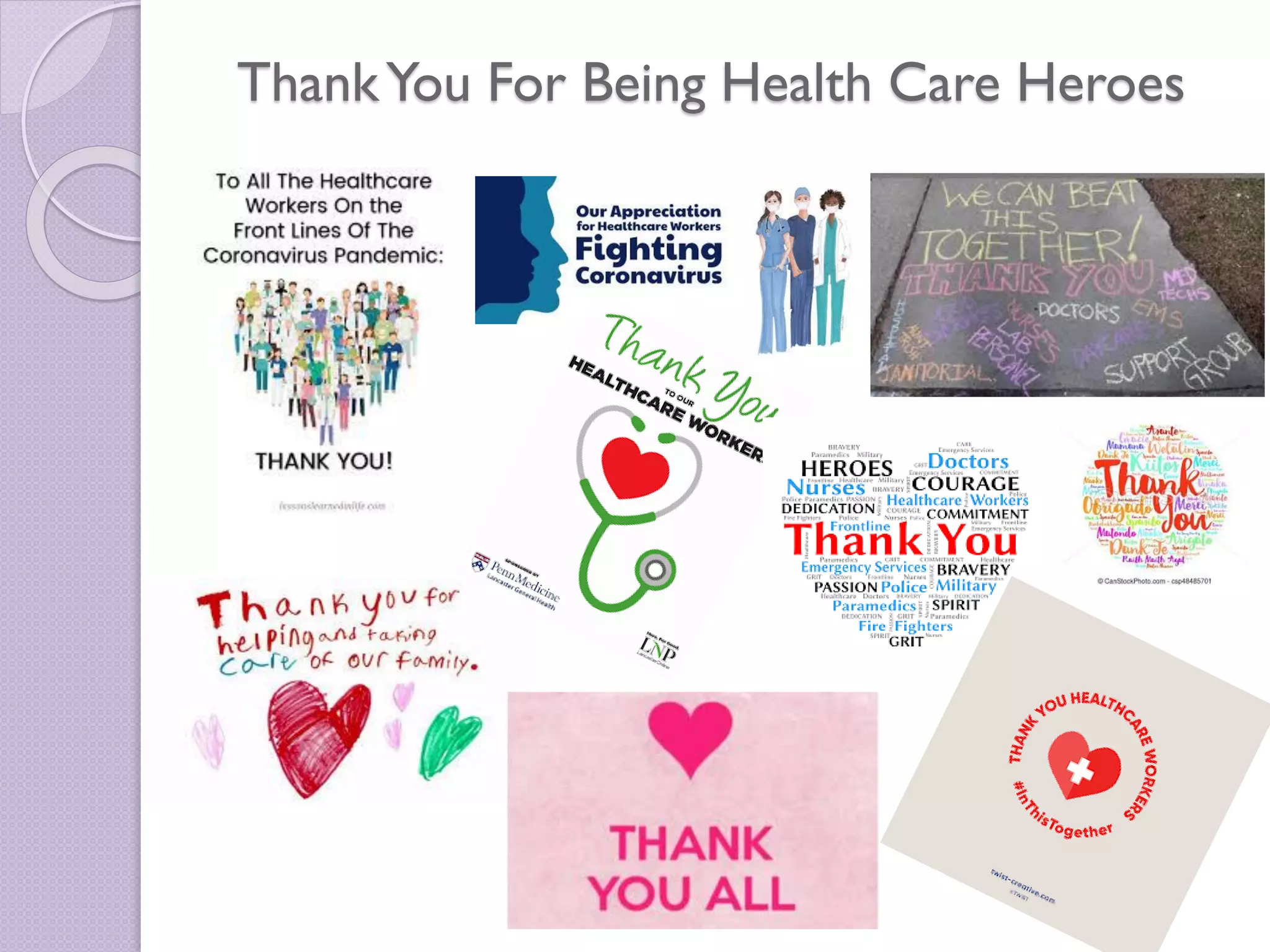
ThankYou For Being Health Care Heroes
Disclaimers
 This presentation is not endorsed by Management Strategists Consulting
Group (MSCG)
 This presentation is not endorsed by Health Resources Services
Administration (HRSA) or the Bureau of Primary Health Care (BPHC).
 Not employed by MSCG or BPHC
 Independent Consultant who is contracted to conduct Operational Site Visits
(OSV), provide Technical Assistance and assist health centers with
preparation for their OSV
 This information should not be considered legal advice
 Refer to your HRSA Project Officer for specific questions
Confidentiality Notice: This document is confidential and contains proprietary information and intellectual property
of Infidium Healthcare Solutions. Neither this document nor any of the information contained herein may be
reproduced or disclosed under any circumstances without the express written permission of the aforementioned
party.
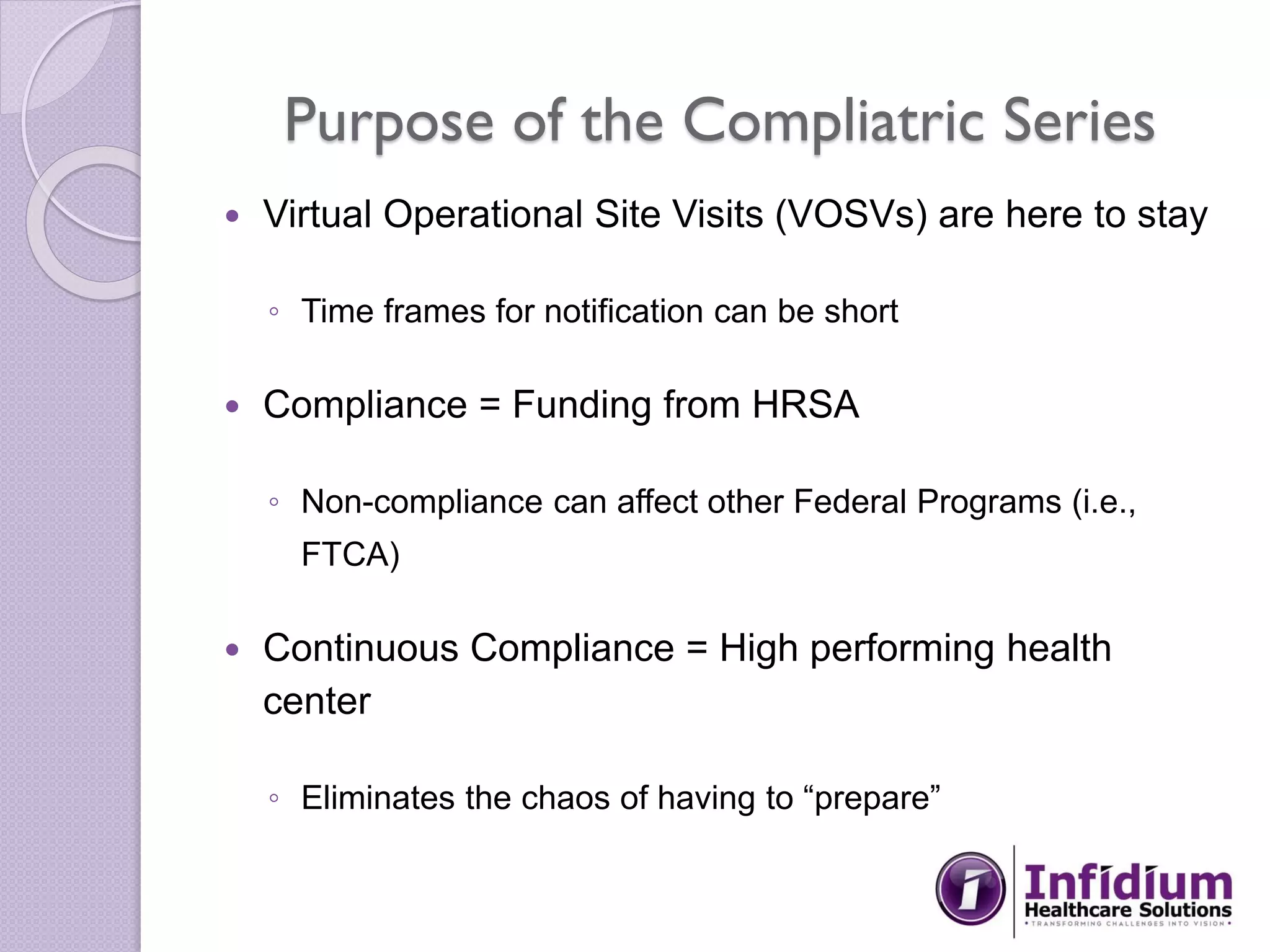
Purpose of the Compliatric Series
 Virtual Operational Site Visits (VOSVs) are here to stay
◦ Time frames for notification can be short
 Compliance = Funding from HRSA
◦ Non-compliance can affect other Federal Programs (i.e.,
FTCA)
 Continuous Compliance = High performing health
center
◦ Eliminates the chaos of having to “prepare”
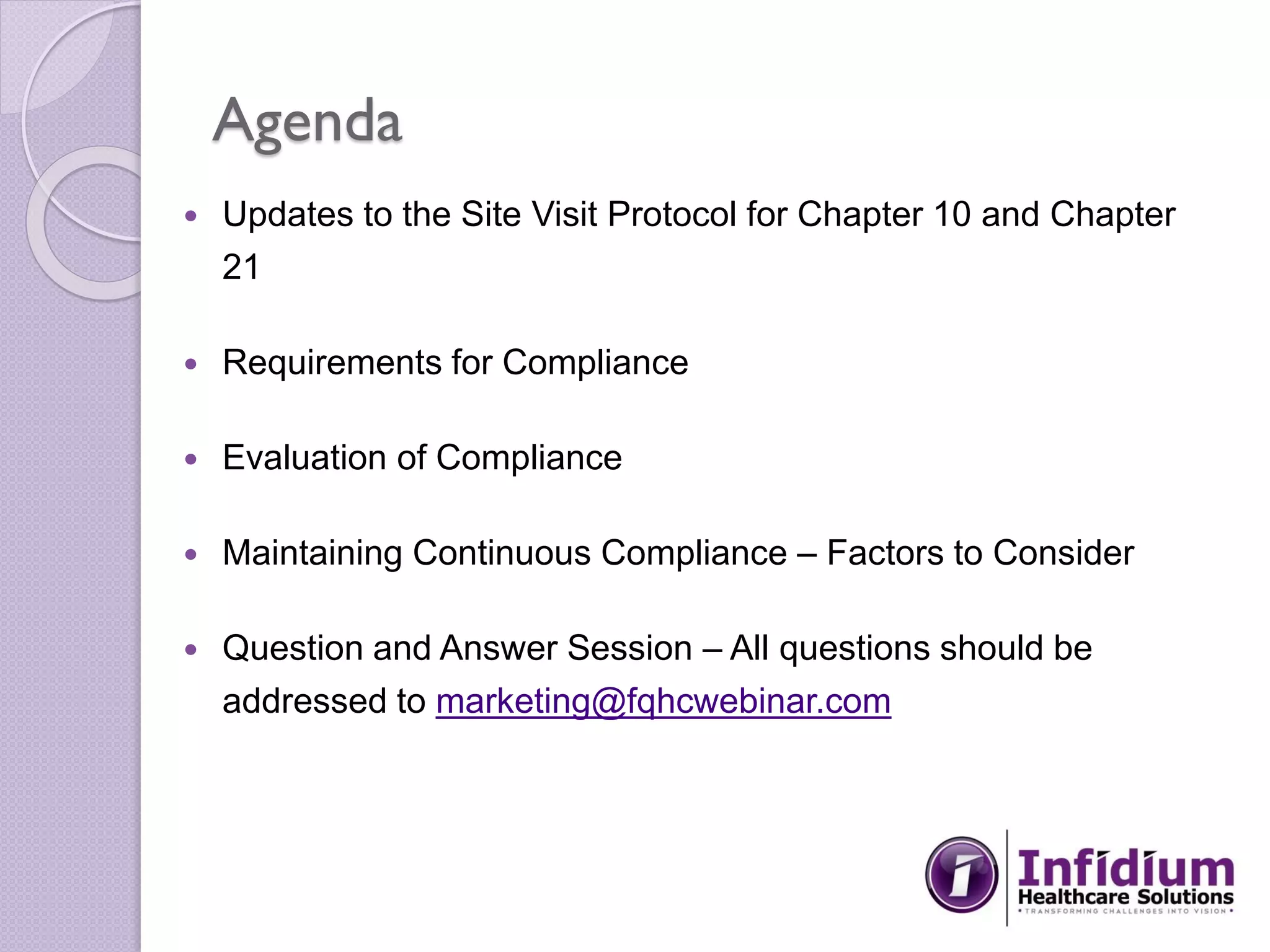
Agenda
 Updates to the Site Visit Protocol for Chapter 10 and Chapter
21
 Requirements for Compliance
 Evaluation of Compliance
 Maintaining Continuous Compliance – Factors to Consider
 Question and Answer Session – All questions should be
addressed to marketing@fqhcwebinar.com
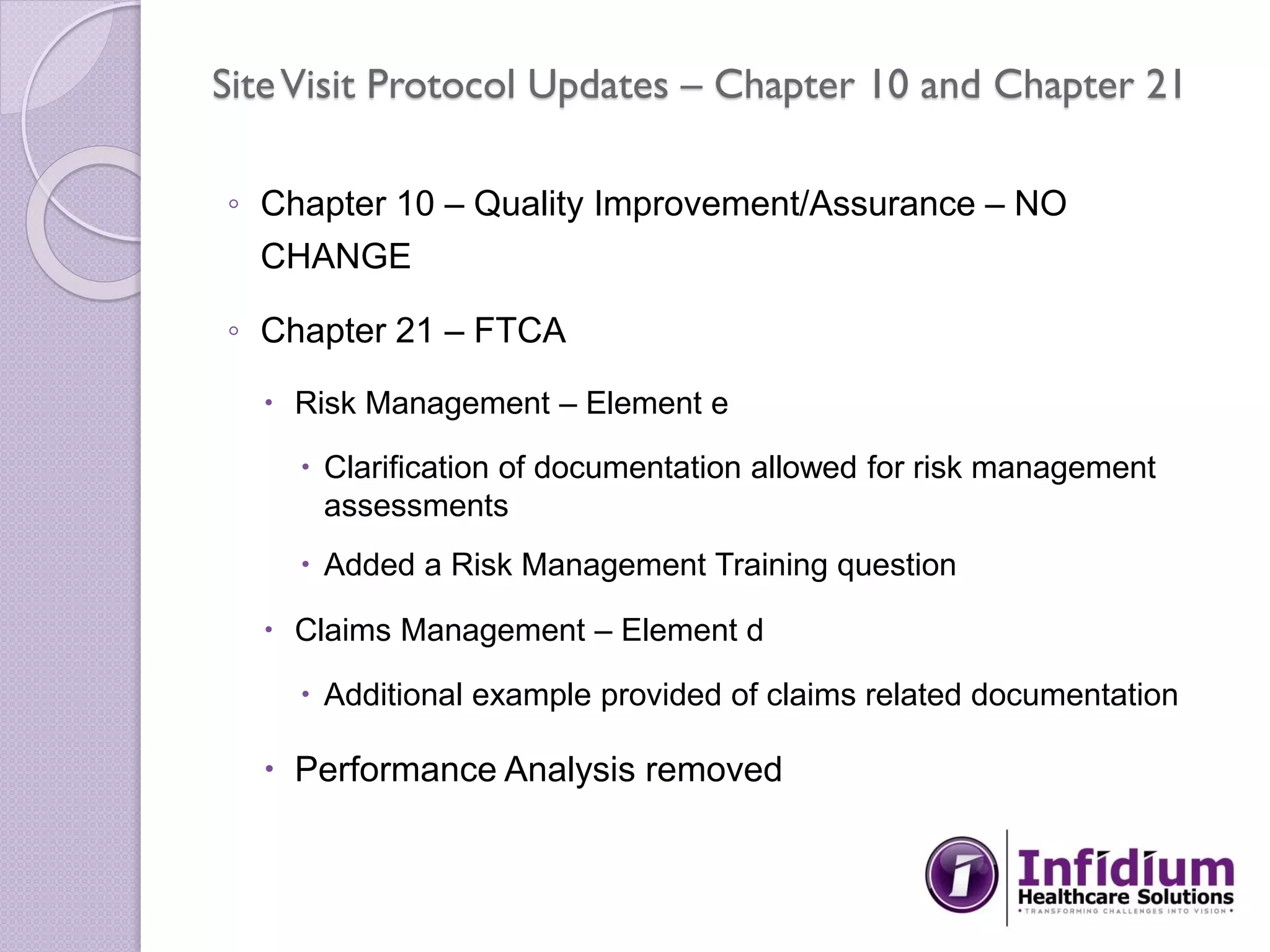
SiteVisit Protocol Updates – Chapter 10 and Chapter 21
◦ Chapter 10 – Quality Improvement/Assurance – NO
CHANGE
◦ Chapter 21 – FTCA
 Risk Management – Element e
 Clarification of documentation allowed for risk management
assessments
 Added a Risk Management Training question
 Claims Management – Element d
 Additional example provided of claims related documentation
 Performance Analysis removed
Chapter 10
Quality Improvement/Assurance
Requirements for Compliance
 The health center must have a board approved policy(ies)
that establish the QI/QA Program. The QI/QA Program must
address the following:
◦ The quality and utilization of health center services;
◦ Patient satisfaction and patient grievance processes; and
◦ Patient safety, including adverse events
 The QI/QA Policy is often titled the QI/QA Plan
◦ Naming of the document is at the discretion of the health center
 The health center designates an individual(s) to oversee the
QI/QA Program, established by the board approved
policy(ies)
Requirements for Compliance
 The Health Center must have QI/QA Procedures or Processes in place
that address the following:
◦ Adhering to current evidence-based clinical guidelines, standards of care and
standards of practice
◦ Identifying, analyzing and addressing patient safety and adverse events,
including the implementation of follow-up actions
◦ Assessing patient satisfaction
◦ Hearing and resolving patient grievances
◦ Completion of periodic QI/QA assessments a minimum of quarterly
◦ Producing and sharing reports on QI/QA to support decision-making and
oversight
Requirements for Compliance
 The health center’s physicians or other licensed health care professionals
must conduct QI/QA assessments a minimum of quarterly, using data
systematically collected from patient health records.
 The health center must maintain a retrievable health record for each
patient. The format and content of the health record must be consistent
with Federal and State Laws and Requirements.
 The health center must have systems in place for protecting the
confidentiality of patient information and safeguarding information against
loss, destruction or unauthorized use, in accordance with federal and
state requirements
Evaluation of Compliance
 Review of Documentation
◦ Policy that establishes the QI/QA Program (QI Plan and
Work Plan)
◦ QI Job Descriptions
◦ QI Policies and Procedures (Peer Review, Patient
Satisfaction, etc.)
◦ Procedures for maintaining the confidentiality/security of
patient health records
◦ Procedures that support tracking of events and grievances
Evaluation of Compliance
 Review of Documentation (cont.)
◦ QI Reporting Calendar (can be part of work plan)
◦ QI/QA Meeting Minutes
◦ Implementation of Plan, Do, Study, Act (PDSA) Cycles
◦ Board of Directors Meeting Minutes
◦ Quarterly Reports (UDS Measures, Patient Satisfaction,
Patient Grievances, etc.)
◦ 5-10 patient samples demonstrating the ability to generate
a visit note or summary of care
Evaluation of Compliance
 Interviews with staff to verify the following:
◦ Roles and responsibilities of QI/QA positions
 The health center determines who the appropriate
individuals are for interviews
 Medical Director, Dental Director, Director of Quality
◦ QI/QA reporting structure
◦ Mechanisms and processes utilized to support reporting
Evaluation of Compliance
The QI/QA Plan (QI/QA Policy) must address the following for all
services in scope:
◦ Quality and utilization of services
◦ Patient satisfaction and grievances
◦ Patient safety, including adverse events
◦ The use of evidence based clinical guidelines/standards of care
◦ The completion of quarterly assessments, including but not limited to:
 UDS clinical performance metrics
 Peer Review
 Patient Satisfaction
 Patient Complaints
◦ Confidentiality of Patient Information
Evaluation of Compliance
Peer Review must be completed:
◦ On a “routine and regular basis”
 Considered a quarterly assessment per the Site Visit Protocol
◦ Between providers within the same specialty who are similarly
credentialed
◦ In all clinical areas within the health center’s scope of project (i.e.,
Medical, Dental, Behavioral Health, OB)
◦ Using an industry standard tool that clearly evaluates the quality of
services provided and does not only perform administrative review
◦ Using a blinded methodology that ensures confidentiality of patient
information
Maintaining Continuous Compliance
Factors to Consider
Chapter 10
Factors to Consider
 The following must be board approved to ensure compliance
◦ QI/QA Plan
◦ QI/QA Policies (Patient Satisfaction, Peer Review, Complaints,
etc.)
 If the above are not board approved, they are considered
non-compliant under Chapter 19, Board Authority
 QI/QA reports must be provided to the Board of Directors on a
routine and regular basis for the purposes of management
decision making. Active discussion must be clearly
documented in the Board of Directors Meeting Minutes
Factors to Consider
 An annual evaluation of the previous year’s QI/QA Program
should be completed and presented to the Board of Directors
 When presenting quality data to the Board of Directors,
consider the following:
◦ Language and literacy levels of the board members
◦ Knowledge base (i.e., health care industry)
◦ Format and presentation of reports
 Best practice demonstrates reports show trending and
benchmarking against internal goals, state averages and
national averages
Chapter 21
Federal Tort Claims Act (FTCA)
Requirements for Compliance
 The FTCA review during the Operational Site Visit does NOT
factor into compliance
 The FTCA review is only completed for health centers that are
currently FTCA deemed
 FTCA may consider the reviewer responses to this section during
the deeming/redeeming process
 Unresolved conditions for non-compliance in the areas of Chapter
5 – Clinical Staffing and Chapter 10 - QI/QA may impact deeming
status
Requirements for Compliance
Risk Management
 The health center must implement an ongoing health care Risk
Management Program to reduce the risk of adverse outcomes that could
possibly result in medical malpractice or other health or health related
litigation. The Risk Management Plan must address the following:
◦ Risk management across all services in scope
◦ Risk management training for all health center staff
◦ Completion of quarterly risk management assessments
◦ Annual reporting of risk management activities to the Board of
Directors
Requirements for Compliance
Risk Management
 The health center must have Risk Management Procedures that address
the following:
◦ Areas/activities of highest risk including but not limited to:
 Referral Tracking
 Laboratory and Diagnostic Test Tracking
 Hospital Tracking
 Documenting, analyzing and addressing clinically related complaints and
“near misses”
 Setting and tracking progress related to annual risk management goals
 Implementation of an annual Risk Management Training Plan
 Completion of an annual risk management report for the board and key
management staff
Requirements for Compliance
Risk Management
 The health center must provide reports to the board and key
management staff on risk management activities, as well as any
follow-up actions that have been implemented
 The health center must have a Risk Management Training Plan
and documented proof of completion by staff
 The health center must have an individual who oversees and
coordinates risk management activities. This individual must
complete risk management training annually
Requirements for Compliance
Claims Management
 The health center must have a claims management process for
addressing any potential or actual health or health-related claims,
including medical malpractice claims. The process ensures:
◦ Preservation of all health center documentation related to actual or
potential claims or complaints (i.e., medical records, diagnostic test
results, billing records)
◦ Any summons received by the health center or its providers is promptly
sent to the HHS, in accordance with the process prescribed by HHS
and the FTCA Health Center Policy Manual
Requirements for Compliance
Claims Management
 The health center must have designated individual(s) who is responsible
for management and processing of claims related activities and is the
point of contact.
 The health center must inform patients of its deemed status via website,
promotional materials or within an area in the health center that is visible
to patients.
 If the health center has a history of claims, it must demonstrate it:
◦ Cooperated with the Attorney General, as described in the FTCA
Health Center Policy Manual
◦ Implemented steps to mitigate the risk of similar claims in the future
Evaluation of Compliance
 Review of documentation:
◦ Most recent HRSA-approved deeming application
◦ Risk Management Policies (i.e., Referral Tracking, Hospital Tracking,
Incident Reports, etc.)
◦ Claims Management Policies and Procedures
◦ Risk Management Training Plan
◦ Documentation of completed training
◦ Quarterly Risk Management Assessments (2)
Evaluation of Compliance
 Review of documentation (cont.)
◦ Committee Meeting Minutes
 QA/QI Minutes
 Risk Management Minutes
 Board of Directors Meeting Minutes
 Examples of communicating deemed status (i.e., website, patient
handout)
 Documentation of corrective action for each closed claim within
the past five years
Evaluation of Compliance
 Staff interviews with Risk Management and Claims Management
Staff to verify process
 Discussion with designated staff to verify activities implemented in
response to any closed claims in the last five years
 Collection of narrative responses to Questions #5, #6 and #9 of
the HRSA Site Visit Protocol
Evaluation of Compliance
 Risk Management Policies and Procedures must address the
following for all services in the health center’s scope of project:
◦ Areas of high risk
◦ Clinically related complaints, incidents and “near misses” reported by
health center patients, staff and other individuals
◦ Claims Management
◦ Risk Management Training for health center staff
 Obstetrics, Infection Control, HIPAA
◦ Quarterly Risk Assessments
◦ Annual reporting to the Board of Directors
Maintaining Continuous Compliance
Factors to Consider
Chapter 21
Factors to Consider
 Risk Management can be a component of the QI/QA Program
 Simplify Risk Management Training and incorporate it into the
Annual Staff Training Plan
 Health centers who do NOT provide Prenatal, Intrapartum and
Postpartum Care directly are NOT required to complete risk
management training for relevant staff on obstetrical services
 Risk Management Assessments MUST be completed quarterly
with a report to the Board of Director a minimum of annually
Resources
Additional Resources
Compliatric
https://www.compliatric.com/
HRSA Health Center Compliance Manual
HRSA Compliance Manual
HRSA SiteVisit Protocol
HRSA 2021 SiteVisit Protocol: Summary of Updates
HRSA Summary of Updates
ECRI QI and RM Resources
ECRI
Questions & Answers
Michelle Layton BSN, MBA
Infidium Healthcare Solutions, LLC
michellel@infidiumhs.com

Compliatric Continuous Compliance Series Chapters 10 and 21

  • 1.
    www.compliantfqhc.com Continuous Compliance Series-It’s not JUST an OSV Prep COMPLIATRIC WEBINAR SERIES Presented by: Michelle Layton BSN, MBA michellel@infidiumhs.com
  • 2.
    Chapter 10 –Quality Improvement/Assurance Chapter 21 – FederalTort Claims Act (FTCA)
  • 3.
    ThankYou For BeingHealth Care Heroes
  • 4.
    Disclaimers  This presentationis not endorsed by Management Strategists Consulting Group (MSCG)  This presentation is not endorsed by Health Resources Services Administration (HRSA) or the Bureau of Primary Health Care (BPHC).  Not employed by MSCG or BPHC  Independent Consultant who is contracted to conduct Operational Site Visits (OSV), provide Technical Assistance and assist health centers with preparation for their OSV  This information should not be considered legal advice  Refer to your HRSA Project Officer for specific questions Confidentiality Notice: This document is confidential and contains proprietary information and intellectual property of Infidium Healthcare Solutions. Neither this document nor any of the information contained herein may be reproduced or disclosed under any circumstances without the express written permission of the aforementioned party.
  • 5.
    Purpose of theCompliatric Series  Virtual Operational Site Visits (VOSVs) are here to stay ◦ Time frames for notification can be short  Compliance = Funding from HRSA ◦ Non-compliance can affect other Federal Programs (i.e., FTCA)  Continuous Compliance = High performing health center ◦ Eliminates the chaos of having to “prepare”
  • 6.
    Agenda  Updates tothe Site Visit Protocol for Chapter 10 and Chapter 21  Requirements for Compliance  Evaluation of Compliance  Maintaining Continuous Compliance – Factors to Consider  Question and Answer Session – All questions should be addressed to marketing@fqhcwebinar.com
  • 7.
    SiteVisit Protocol Updates– Chapter 10 and Chapter 21 ◦ Chapter 10 – Quality Improvement/Assurance – NO CHANGE ◦ Chapter 21 – FTCA  Risk Management – Element e  Clarification of documentation allowed for risk management assessments  Added a Risk Management Training question  Claims Management – Element d  Additional example provided of claims related documentation  Performance Analysis removed
  • 8.
  • 9.
  • 10.
    Requirements for Compliance The health center must have a board approved policy(ies) that establish the QI/QA Program. The QI/QA Program must address the following: ◦ The quality and utilization of health center services; ◦ Patient satisfaction and patient grievance processes; and ◦ Patient safety, including adverse events  The QI/QA Policy is often titled the QI/QA Plan ◦ Naming of the document is at the discretion of the health center  The health center designates an individual(s) to oversee the QI/QA Program, established by the board approved policy(ies)
  • 11.
    Requirements for Compliance The Health Center must have QI/QA Procedures or Processes in place that address the following: ◦ Adhering to current evidence-based clinical guidelines, standards of care and standards of practice ◦ Identifying, analyzing and addressing patient safety and adverse events, including the implementation of follow-up actions ◦ Assessing patient satisfaction ◦ Hearing and resolving patient grievances ◦ Completion of periodic QI/QA assessments a minimum of quarterly ◦ Producing and sharing reports on QI/QA to support decision-making and oversight
  • 12.
    Requirements for Compliance The health center’s physicians or other licensed health care professionals must conduct QI/QA assessments a minimum of quarterly, using data systematically collected from patient health records.  The health center must maintain a retrievable health record for each patient. The format and content of the health record must be consistent with Federal and State Laws and Requirements.  The health center must have systems in place for protecting the confidentiality of patient information and safeguarding information against loss, destruction or unauthorized use, in accordance with federal and state requirements
  • 13.
  • 14.
    Evaluation of Compliance Review of Documentation ◦ Policy that establishes the QI/QA Program (QI Plan and Work Plan) ◦ QI Job Descriptions ◦ QI Policies and Procedures (Peer Review, Patient Satisfaction, etc.) ◦ Procedures for maintaining the confidentiality/security of patient health records ◦ Procedures that support tracking of events and grievances
  • 15.
    Evaluation of Compliance Review of Documentation (cont.) ◦ QI Reporting Calendar (can be part of work plan) ◦ QI/QA Meeting Minutes ◦ Implementation of Plan, Do, Study, Act (PDSA) Cycles ◦ Board of Directors Meeting Minutes ◦ Quarterly Reports (UDS Measures, Patient Satisfaction, Patient Grievances, etc.) ◦ 5-10 patient samples demonstrating the ability to generate a visit note or summary of care
  • 16.
    Evaluation of Compliance Interviews with staff to verify the following: ◦ Roles and responsibilities of QI/QA positions  The health center determines who the appropriate individuals are for interviews  Medical Director, Dental Director, Director of Quality ◦ QI/QA reporting structure ◦ Mechanisms and processes utilized to support reporting
  • 17.
    Evaluation of Compliance TheQI/QA Plan (QI/QA Policy) must address the following for all services in scope: ◦ Quality and utilization of services ◦ Patient satisfaction and grievances ◦ Patient safety, including adverse events ◦ The use of evidence based clinical guidelines/standards of care ◦ The completion of quarterly assessments, including but not limited to:  UDS clinical performance metrics  Peer Review  Patient Satisfaction  Patient Complaints ◦ Confidentiality of Patient Information
  • 18.
    Evaluation of Compliance PeerReview must be completed: ◦ On a “routine and regular basis”  Considered a quarterly assessment per the Site Visit Protocol ◦ Between providers within the same specialty who are similarly credentialed ◦ In all clinical areas within the health center’s scope of project (i.e., Medical, Dental, Behavioral Health, OB) ◦ Using an industry standard tool that clearly evaluates the quality of services provided and does not only perform administrative review ◦ Using a blinded methodology that ensures confidentiality of patient information
  • 19.
  • 20.
    Factors to Consider The following must be board approved to ensure compliance ◦ QI/QA Plan ◦ QI/QA Policies (Patient Satisfaction, Peer Review, Complaints, etc.)  If the above are not board approved, they are considered non-compliant under Chapter 19, Board Authority  QI/QA reports must be provided to the Board of Directors on a routine and regular basis for the purposes of management decision making. Active discussion must be clearly documented in the Board of Directors Meeting Minutes
  • 21.
    Factors to Consider An annual evaluation of the previous year’s QI/QA Program should be completed and presented to the Board of Directors  When presenting quality data to the Board of Directors, consider the following: ◦ Language and literacy levels of the board members ◦ Knowledge base (i.e., health care industry) ◦ Format and presentation of reports  Best practice demonstrates reports show trending and benchmarking against internal goals, state averages and national averages
  • 22.
    Chapter 21 Federal TortClaims Act (FTCA)
  • 23.
    Requirements for Compliance The FTCA review during the Operational Site Visit does NOT factor into compliance  The FTCA review is only completed for health centers that are currently FTCA deemed  FTCA may consider the reviewer responses to this section during the deeming/redeeming process  Unresolved conditions for non-compliance in the areas of Chapter 5 – Clinical Staffing and Chapter 10 - QI/QA may impact deeming status
  • 24.
    Requirements for Compliance RiskManagement  The health center must implement an ongoing health care Risk Management Program to reduce the risk of adverse outcomes that could possibly result in medical malpractice or other health or health related litigation. The Risk Management Plan must address the following: ◦ Risk management across all services in scope ◦ Risk management training for all health center staff ◦ Completion of quarterly risk management assessments ◦ Annual reporting of risk management activities to the Board of Directors
  • 25.
    Requirements for Compliance RiskManagement  The health center must have Risk Management Procedures that address the following: ◦ Areas/activities of highest risk including but not limited to:  Referral Tracking  Laboratory and Diagnostic Test Tracking  Hospital Tracking  Documenting, analyzing and addressing clinically related complaints and “near misses”  Setting and tracking progress related to annual risk management goals  Implementation of an annual Risk Management Training Plan  Completion of an annual risk management report for the board and key management staff
  • 26.
    Requirements for Compliance RiskManagement  The health center must provide reports to the board and key management staff on risk management activities, as well as any follow-up actions that have been implemented  The health center must have a Risk Management Training Plan and documented proof of completion by staff  The health center must have an individual who oversees and coordinates risk management activities. This individual must complete risk management training annually
  • 27.
    Requirements for Compliance ClaimsManagement  The health center must have a claims management process for addressing any potential or actual health or health-related claims, including medical malpractice claims. The process ensures: ◦ Preservation of all health center documentation related to actual or potential claims or complaints (i.e., medical records, diagnostic test results, billing records) ◦ Any summons received by the health center or its providers is promptly sent to the HHS, in accordance with the process prescribed by HHS and the FTCA Health Center Policy Manual
  • 28.
    Requirements for Compliance ClaimsManagement  The health center must have designated individual(s) who is responsible for management and processing of claims related activities and is the point of contact.  The health center must inform patients of its deemed status via website, promotional materials or within an area in the health center that is visible to patients.  If the health center has a history of claims, it must demonstrate it: ◦ Cooperated with the Attorney General, as described in the FTCA Health Center Policy Manual ◦ Implemented steps to mitigate the risk of similar claims in the future
  • 29.
  • 30.
    Evaluation of Compliance Review of documentation: ◦ Most recent HRSA-approved deeming application ◦ Risk Management Policies (i.e., Referral Tracking, Hospital Tracking, Incident Reports, etc.) ◦ Claims Management Policies and Procedures ◦ Risk Management Training Plan ◦ Documentation of completed training ◦ Quarterly Risk Management Assessments (2)
  • 31.
    Evaluation of Compliance Review of documentation (cont.) ◦ Committee Meeting Minutes  QA/QI Minutes  Risk Management Minutes  Board of Directors Meeting Minutes  Examples of communicating deemed status (i.e., website, patient handout)  Documentation of corrective action for each closed claim within the past five years
  • 32.
    Evaluation of Compliance Staff interviews with Risk Management and Claims Management Staff to verify process  Discussion with designated staff to verify activities implemented in response to any closed claims in the last five years  Collection of narrative responses to Questions #5, #6 and #9 of the HRSA Site Visit Protocol
  • 33.
    Evaluation of Compliance Risk Management Policies and Procedures must address the following for all services in the health center’s scope of project: ◦ Areas of high risk ◦ Clinically related complaints, incidents and “near misses” reported by health center patients, staff and other individuals ◦ Claims Management ◦ Risk Management Training for health center staff  Obstetrics, Infection Control, HIPAA ◦ Quarterly Risk Assessments ◦ Annual reporting to the Board of Directors
  • 34.
  • 35.
    Factors to Consider Risk Management can be a component of the QI/QA Program  Simplify Risk Management Training and incorporate it into the Annual Staff Training Plan  Health centers who do NOT provide Prenatal, Intrapartum and Postpartum Care directly are NOT required to complete risk management training for relevant staff on obstetrical services  Risk Management Assessments MUST be completed quarterly with a report to the Board of Director a minimum of annually
  • 36.
  • 37.
    Additional Resources Compliatric https://www.compliatric.com/ HRSA HealthCenter Compliance Manual HRSA Compliance Manual HRSA SiteVisit Protocol HRSA SiteVisit Protocol HRSA 2021 SiteVisit Protocol: Summary of Updates HRSA Summary of Updates ECRI QI and RM Resources ECRI
  • 38.
  • 39.
    Michelle Layton BSN,MBA Infidium Healthcare Solutions, LLC michellel@infidiumhs.com