Concepts
In orderto construct theories, one needs some
smaller components or what is called the "basic
building blocks of theory,” namely, concepts.
Concepts, then, are symbolic or abstract elements
representing objects, properties, or features of
objects, processes, or phenomenon
Concepts may communicate ideas or introduce
particular perspectives, or they may be a means for
casting a broad generalization.
In terms of ideas, concepts are important because
they are the foundation of communication & thought
Concepts provide a means for people to let others
know what they are thinking, and allow information to
be shared.
2.
IDEAS AND THEORY
Aresearch project has to start somewhere
typically, the starting point is an idea.
Ideas may originate from a particular problem or
situation one actually experiences
ideas may come from information you hear but
may not actually experience yourself
There are two important points to consider:
◦ ideas promote potential research endeavors.
◦ One may realize that the world is a research laboratory,
and that you merely need to open your eyes and ears
to the sensory reality that surrounds all of us to find
numerous ideas for research.
3.
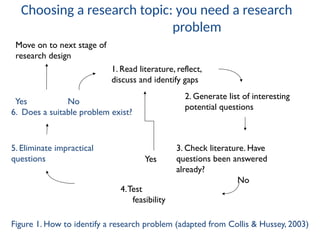
Choosing a researchtopic: you need a research
problem
1. Read literature, reflect,
discuss and identify gaps
2. Generate list of interesting
potential questions
3. Check literature. Have
questions been answered
already?
No
4.Test
feasibility
Yes
Move on to next stage of
research design
Yes No
6. Does a suitable problem exist?
5. Eliminate impractical
questions
Figure 1. How to identify a research problem (adapted from Collis & Hussey, 2003)
4.
Literature Review
• Afterdeveloping a rough idea for research, you
begin to examine how others have already thought
about and researched the topic.
– located the relevant reference
– begin reading about the topic
– You need to continue trying to expand the literature
search
– As you are doing this literature searching, keep records
on which pieces of literature you have obtained and
notes about what each one says.
5.
FRAMING RESEARCH PROBLEMS
•Research problems drive the research process
• Thus it is important to frame or formulate a clear
research problem statement.
• Remember, the research process begins with an
idea and only a rough notion of what is to be
researched.
• As you read and collect information from the
literature, these rough questions must become
clearer and theoretically more refined
6.
Operational Definition
To ensurethat everyone is working with the same
definition & mental image, you will need to
conceptualize and operationalize the term.
This process is called operationally defining a
concept.
Operational definitions concretize the intended
meaning of a concept in relation to a particular
study and provide some criteria for measuring the
empirical existence of that concept
In operatively defining a term or concept, you
begin by declaring the term to mean whatever you
want it to mean throughout the research
7.
When to useQualitative research
• When the problem needs to be explored.
• To study a group, population which is marginalized,
their voices were unheard, silenced,
• When the issues is un investigated or poorly
investigated and to identify variables to be measured
• When quantitative methods and measures do not fit
with the research question and objectives. Example
like interactions with people or to capture sensitive issues,
lived experiences, uniqueness.
8.
When to useQualitative research
When variables cannot be quantified like feelings
When variables are best understood in their natural
settings
When variables are studied over real time- like events
When studying intimate details of roles, processes, and
groups
When the paramount objective is “understanding”
•When we need a complex, detail and holistic
understanding of the issue or
•When we want to understand the context or settings in
which participants in a study addresses the problem.
9.
When to useQualitative research
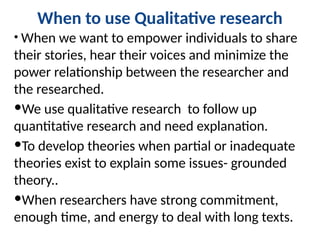
• When we want to empower individuals to share
their stories, hear their voices and minimize the
power relationship between the researcher and
the researched.
We use qualitative research to follow up
quantitative research and need explanation.
To develop theories when partial or inadequate
theories exist to explain some issues- grounded
theory..
When researchers have strong commitment,
enough time, and energy to deal with long texts.
10.
Types of QualitativeResearch and Data Collection Methods
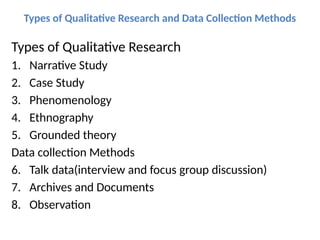
Types of Qualitative Research
1. Narrative Study
2. Case Study
3. Phenomenology
4. Ethnography
5. Grounded theory
Data collection Methods
6. Talk data(interview and focus group discussion)
7. Archives and Documents
8. Observation
11.
DESIGNING PROJECTS
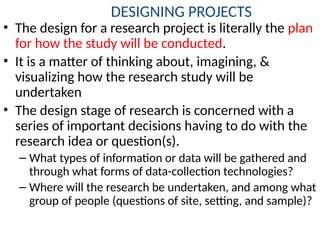
• Thedesign for a research project is literally the plan
for how the study will be conducted.
• It is a matter of thinking about, imagining, &
visualizing how the research study will be
undertaken
• The design stage of research is concerned with a
series of important decisions having to do with the
research idea or question(s).
– What types of information or data will be gathered and
through what forms of data-collection technologies?
– Where will the research be undertaken, and among what
group of people (questions of site, setting, and sample)?
12.
Designing projects (2)
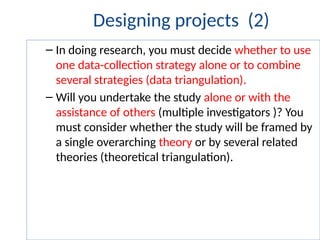
–In doing research, you must decide whether to use
one data-collection strategy alone or to combine
several strategies (data triangulation).
– Will you undertake the study alone or with the
assistance of others (multiple investigators )? You
must consider whether the study will be framed by
a single overarching theory or by several related
theories (theoretical triangulation).
13.
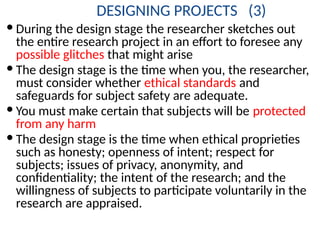
DESIGNING PROJECTS (3)
During the design stage the researcher sketches out
the entire research project in an effort to foresee any
possible glitches that might arise
The design stage is the time when you, the researcher,
must consider whether ethical standards and
safeguards for subject safety are adequate.
You must make certain that subjects will be protected
from any harm
The design stage is the time when ethical proprieties
such as honesty; openness of intent; respect for
subjects; issues of privacy, anonymity, and
confidentiality; the intent of the research; and the
willingness of subjects to participate voluntarily in the
research are appraised.
14.
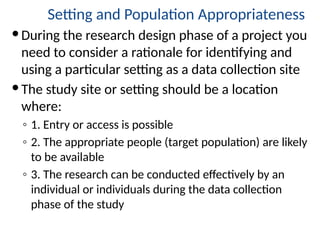
Setting and PopulationAppropriateness
During the research design phase of a project you
need to consider a rationale for identifying and
using a particular setting as a data collection site
The study site or setting should be a location
where:
◦ 1. Entry or access is possible
◦ 2. The appropriate people (target population) are likely
to be available
◦ 3. The research can be conducted effectively by an
individual or individuals during the data collection
phase of the study
15.
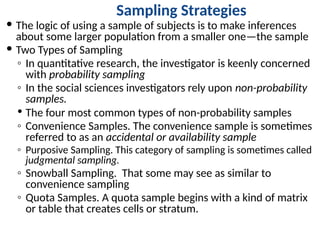
Sampling Strategies
Thelogic of using a sample of subjects is to make inferences
about some larger population from a smaller one—the sample
Two Types of Sampling
◦ In quantitative research, the investigator is keenly concerned
with probability sampling
◦ In the social sciences investigators rely upon non-probability
samples.
The four most common types of non-probability samples
◦ Convenience Samples. The convenience sample is sometimes
referred to as an accidental or availability sample
◦ Purposive Sampling. This category of sampling is sometimes called
judgmental sampling.
◦ Snowball Sampling. That some may see as similar to
convenience sampling
◦ Quota Samples. A quota sample begins with a kind of matrix
or table that creates cells or stratum.
16.
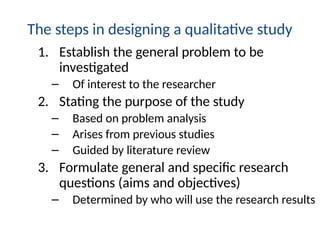
The steps indesigning a qualitative study
1. Establish the general problem to be
investigated
– Of interest to the researcher
2. Stating the purpose of the study
– Based on problem analysis
– Arises from previous studies
– Guided by literature review
3. Formulate general and specific research
questions (aims and objectives)
– Determined by who will use the research results
17.
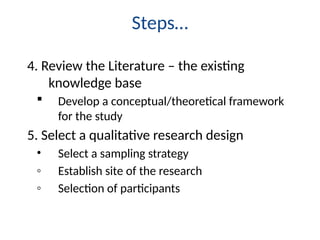
Steps…
4. Review theLiterature – the existing
knowledge base
Develop a conceptual/theoretical framework
for the study
5. Select a qualitative research design
• Select a sampling strategy
◦ Establish site of the research
◦ Selection of participants
18.
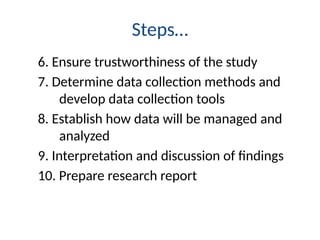
Steps…
6. Ensure trustworthinessof the study
7. Determine data collection methods and
develop data collection tools
8. Establish how data will be managed and
analyzed
9. Interpretation and discussion of findings
10. Prepare research report