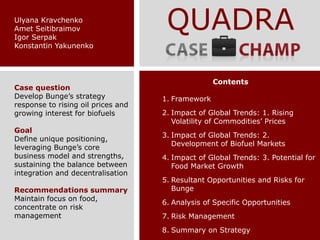
Ulyana Kravchenko
Amet Seitibraimov
Igor Serpak
                                     QUADRA
Konstantin Yakunenko


                                                   Contents
Case question
Develop Bunge’s strategy            1. Framework
response to rising oil prices and
growing interest for biofuels       2. Impact of Global Trends: 1. Rising
                                       Volatility of Commodities’ Prices
Goal
                                    3. Impact of Global Trends: 2.
Define unique positioning,
                                       Development of Biofuel Markets
leveraging Bunge’s core
business model and strengths,       4. Impact of Global Trends: 3. Potential for
sustaining the balance between         Food Market Growth
integration and decentralisation
                                    5. Resultant Opportunities and Risks for
Recommendations summary                Bunge
Maintain focus on food,
                                    6. Analysis of Specific Opportunities
concentrate on risk
management                          7. Risk Management
                                    8. Summary on Strategy
Framework

                      Rising Volatility of Commodities’ Prices

                             Development of Biofuel Markets

                              Potential of Food Market Growth


                                             Bunge


                   Risks                                          Opportunities


                                    Recommendations

Ulyana Kravchenko ■ Amet Seitibraimov ■ Igor Serpak ■ Konstantin Yakunenko
Impact of Global Trends:
1. Rising Volatility of Commodities’ Prices

 • As agricultural commodities became inputs for
   fuel production, markets for energy and
   agricultural commodities converge. This adds
   volatility to the food supply chain.


               Energy                   Transmission                 Agriculture
               market                   of volatility                    market


 Ulyana Kravchenko ■ Amet Seitibraimov ■ Igor Serpak ■ Konstantin Yakunenko
Impact of Global Trends:
      2. Development of Biofuel Markets

• We view that biofuel market is positioned to
  develop thanks to both
      – advancement in technologies and
      – favourable influences from three groups of interests.

          Politicians                   Environmentalists                    Businesses

  Alleviate dependence on          Protection of                   New investment options
   oil                               environment:                    Higher prices on markets
  Develop new industries              promotion of less             with inelastic demand
  Satisfy economic                     intensive usage of oil        (food, fuel), which
   interests of electorate             promotion of                  generates higher profits
  Promote politically-                 alternative “green”
   beneficial low prices of             fuels
   oil and food
  Promote environmental
   protection


Ulyana Kravchenko ■ Amet Seitibraimov ■ Igor Serpak ■ Konstantin Yakunenko
Impact of Global Trends:
     3. Potential for Food Market Growth

                        Potential for food market growth


                                                           Due to impact of biofuel
   Due to internal potential
                                                                   market


 Growing population (1.35% p.a.)                       Because of growing biofuels market,
 Growing income (1.40% p.a.)                            agricultural lands are diverted from
 Increase in meat and fish                              food production. Therefore, unmet
  consumption among 83% of world                         demand on the food market will
  population (due to increasing                          drive food prices higher
  demand for feedstock
  requirements)


 Ulyana Kravchenko ■ Amet Seitibraimov ■ Igor Serpak ■ Konstantin Yakunenko
Resultant Opportunities and Risks
                  for Bunge
                                                         Risks (direct losses or lost
           Opportunities
                                                            profit opportunities)


 Increase in food production to                        Counterparty defaults on
  meet growing demand                                    contracts due to prices
 Higher revenues and profits                            volatility
  due to growing food prices and                        Distortions of supply due to
  inelastic demand                                       government export restrictions
 Emergence of new customer                             High levels of tied working
  segment for agribusiness                               capital due to high prices and
  (biofuels producers)                                   long shipment times
 Entry to emerging biofuel                             Governmental intervention to
  market                                                 food market pricing mechanism
                                                         (e.g. in response to food riots)


 Ulyana Kravchenko ■ Amet Seitibraimov ■ Igor Serpak ■ Konstantin Yakunenko
Analysis of Specific Opportunities
    State          Products                                   Pros                                           Cons                       Conclusion

                                1. Low-cost                                                 1. Overpriced assets
                                2. Idle lands                                               2. Increasing compeition
    Brazil    Sugar farming for 3. Strong local presence                                    3. US trade barriers eliminate cost
                                                                                                                                          Reject
(origination)     ethanol                                                                   advantage
                                                                                            4. Required backward integration into
                                                                                            farming

                                  1. Low-cost
                                  2. Idle lands
                                  3. Export potential growth thanks to US refocus on corn
    Brazil
              Soybeans farming                                                                                                            Accept
(origination)                  4. Expected twofold growth of China's import
                                  5. Strong local presence
                                  6. Leveraging of fertilisers production

                                  1. Expected twofold growth of China's imports             1. Uncertainty regarding government's
   China           Soybeans                                                                 regulation of market consolidation
                                                                                                                                          Accept
(destination)      crushing
                                  2. Likely to decrease reliance on local counterparties


                                  1. Competitive advantage against other oil brands         1. R&D-related risks
R&D (food)                                                                                                                               Intensify
                                  2. Creation of new products

                                  1. Growing market of oils                                 1. Underdeveloped infrastructure,            1. Divest
                                                                                            ethical practices, tax policies             production
                 Vegetable oil
    India                                                                                   2. Lack of transparency                      2. Export
                   (trading,
(destination)                                                                                                                          unbranded oil
                  production)
                                                                                            3. Underdeveloped market of branded
                                                                                            oils

                                  1. Low costs of production                                1. Different kinds of plantation-farming
                     Palm oil                                                               environments
 Malaysia,       (production, +
                                  2. Growing demand from Europe                             2. Unfamiliar political systems               Reject
 Indonesia      input for biofuel
                   production)    3. Option to sell as input to biofuel production          3. Different business models


    Ulyana Kravchenko ■ Amet Seitibraimov ■ Igor Serpak ■ Konstantin Yakunenko
Risk Management


• We recommend acquisition of crushers in China,
  key destination country, …
      – … (in addition to existent traders) so as to alleviate the
        risk of counterparties’ defaults due to both price
        volatility and long shipment. Therefore, price volatility
        on commodities markets will have limited impact on
        physical deliveries and the group’s consolidated
        financials.
                                     100-days transit time
                              + Volatility on commodities markets
                                 + Small-capitalisation players              Traders in
                                                                               China
                              = Risk of local counterparties’ default
            Elevator in
               Brazil
                                         Forward integration to              Crushers in
                                            mitigate the risk                  China


Ulyana Kravchenko ■ Amet Seitibraimov ■ Igor Serpak ■ Konstantin Yakunenko
Summary on Strategy


• Focus on food
      – Concentrate on exports of soybeans from Brazil, as the low-
        cost producer, to China. Engagement into soybean
        “farming”.
      – Divest production of branded oils in India. Maintain exports
        to India.
      – Reject risky expansions to Malaysia, Indonesia.
      – Reject entry into non-core and intervention-dependent
        sugar-and-ethanol business in Brazil.
      – Intensify R&D of healthy soy products.

• Focus on risk management
      – Build on-the-ground presence in China, including
        acquisition of crushers, to mitigate the buyers’ default risk.


Ulyana Kravchenko ■ Amet Seitibraimov ■ Igor Serpak ■ Konstantin Yakunenko

Quadra (online round)

  • 1.
    Ulyana Kravchenko Amet Seitibraimov IgorSerpak QUADRA Konstantin Yakunenko Contents Case question Develop Bunge’s strategy 1. Framework response to rising oil prices and growing interest for biofuels 2. Impact of Global Trends: 1. Rising Volatility of Commodities’ Prices Goal 3. Impact of Global Trends: 2. Define unique positioning, Development of Biofuel Markets leveraging Bunge’s core business model and strengths, 4. Impact of Global Trends: 3. Potential for sustaining the balance between Food Market Growth integration and decentralisation 5. Resultant Opportunities and Risks for Recommendations summary Bunge Maintain focus on food, 6. Analysis of Specific Opportunities concentrate on risk management 7. Risk Management 8. Summary on Strategy
  • 2.
    Framework Rising Volatility of Commodities’ Prices Development of Biofuel Markets Potential of Food Market Growth Bunge Risks Opportunities Recommendations Ulyana Kravchenko ■ Amet Seitibraimov ■ Igor Serpak ■ Konstantin Yakunenko
  • 3.
    Impact of GlobalTrends: 1. Rising Volatility of Commodities’ Prices • As agricultural commodities became inputs for fuel production, markets for energy and agricultural commodities converge. This adds volatility to the food supply chain. Energy Transmission Agriculture market of volatility market Ulyana Kravchenko ■ Amet Seitibraimov ■ Igor Serpak ■ Konstantin Yakunenko
  • 4.
    Impact of GlobalTrends: 2. Development of Biofuel Markets • We view that biofuel market is positioned to develop thanks to both – advancement in technologies and – favourable influences from three groups of interests. Politicians Environmentalists Businesses  Alleviate dependence on  Protection of  New investment options oil environment:  Higher prices on markets  Develop new industries  promotion of less with inelastic demand  Satisfy economic intensive usage of oil (food, fuel), which interests of electorate  promotion of generates higher profits  Promote politically- alternative “green” beneficial low prices of fuels oil and food  Promote environmental protection Ulyana Kravchenko ■ Amet Seitibraimov ■ Igor Serpak ■ Konstantin Yakunenko
  • 5.
    Impact of GlobalTrends: 3. Potential for Food Market Growth Potential for food market growth Due to impact of biofuel Due to internal potential market  Growing population (1.35% p.a.)  Because of growing biofuels market,  Growing income (1.40% p.a.) agricultural lands are diverted from  Increase in meat and fish food production. Therefore, unmet consumption among 83% of world demand on the food market will population (due to increasing drive food prices higher demand for feedstock requirements) Ulyana Kravchenko ■ Amet Seitibraimov ■ Igor Serpak ■ Konstantin Yakunenko
  • 6.
    Resultant Opportunities andRisks for Bunge Risks (direct losses or lost Opportunities profit opportunities)  Increase in food production to  Counterparty defaults on meet growing demand contracts due to prices  Higher revenues and profits volatility due to growing food prices and  Distortions of supply due to inelastic demand government export restrictions  Emergence of new customer  High levels of tied working segment for agribusiness capital due to high prices and (biofuels producers) long shipment times  Entry to emerging biofuel  Governmental intervention to market food market pricing mechanism (e.g. in response to food riots) Ulyana Kravchenko ■ Amet Seitibraimov ■ Igor Serpak ■ Konstantin Yakunenko
  • 7.
    Analysis of SpecificOpportunities State Products Pros Cons Conclusion 1. Low-cost 1. Overpriced assets 2. Idle lands 2. Increasing compeition Brazil Sugar farming for 3. Strong local presence 3. US trade barriers eliminate cost Reject (origination) ethanol advantage 4. Required backward integration into farming 1. Low-cost 2. Idle lands 3. Export potential growth thanks to US refocus on corn Brazil Soybeans farming Accept (origination) 4. Expected twofold growth of China's import 5. Strong local presence 6. Leveraging of fertilisers production 1. Expected twofold growth of China's imports 1. Uncertainty regarding government's China Soybeans regulation of market consolidation Accept (destination) crushing 2. Likely to decrease reliance on local counterparties 1. Competitive advantage against other oil brands 1. R&D-related risks R&D (food) Intensify 2. Creation of new products 1. Growing market of oils 1. Underdeveloped infrastructure, 1. Divest ethical practices, tax policies production Vegetable oil India 2. Lack of transparency 2. Export (trading, (destination) unbranded oil production) 3. Underdeveloped market of branded oils 1. Low costs of production 1. Different kinds of plantation-farming Palm oil environments Malaysia, (production, + 2. Growing demand from Europe 2. Unfamiliar political systems Reject Indonesia input for biofuel production) 3. Option to sell as input to biofuel production 3. Different business models Ulyana Kravchenko ■ Amet Seitibraimov ■ Igor Serpak ■ Konstantin Yakunenko
  • 8.
    Risk Management • Werecommend acquisition of crushers in China, key destination country, … – … (in addition to existent traders) so as to alleviate the risk of counterparties’ defaults due to both price volatility and long shipment. Therefore, price volatility on commodities markets will have limited impact on physical deliveries and the group’s consolidated financials. 100-days transit time + Volatility on commodities markets + Small-capitalisation players Traders in China = Risk of local counterparties’ default Elevator in Brazil Forward integration to Crushers in mitigate the risk China Ulyana Kravchenko ■ Amet Seitibraimov ■ Igor Serpak ■ Konstantin Yakunenko
  • 9.
    Summary on Strategy •Focus on food – Concentrate on exports of soybeans from Brazil, as the low- cost producer, to China. Engagement into soybean “farming”. – Divest production of branded oils in India. Maintain exports to India. – Reject risky expansions to Malaysia, Indonesia. – Reject entry into non-core and intervention-dependent sugar-and-ethanol business in Brazil. – Intensify R&D of healthy soy products. • Focus on risk management – Build on-the-ground presence in China, including acquisition of crushers, to mitigate the buyers’ default risk. Ulyana Kravchenko ■ Amet Seitibraimov ■ Igor Serpak ■ Konstantin Yakunenko