Qn 1 – Final Accounts
one approach
Gabrielle Moran
11th September 2010
Prior to Final Accounts
 Double Entry including accruals/prepayments
to simple P&L and Balance Sheet
 Incomplete records
 Control Accounts – Subsidiary Books
 Depreciation and Disposal
 Correction of Errors
 Bank Reconciliations
Double Entry
 Two aspects to all transactions
 Matching of Debits and Credits
Double Entry
Accounts Purpose
Asset
Record what the firm owns and what is owed to the firm.
e.g. Vans A
/C,
Premises A
/C,
Cash A
/C,
Debtors A
/C
Liability
Record what the firm owes.
e.g. Loan A
/C,
Bank Overdraft A
/C
, Creditors A
/C
Expense
Record the firm’s day to day running expenses.
e.g. WagesA
/C,,
Insurance A
/C,
Purchases A
/C
Revenue
Record day to day income earned by the firm
e.g. Sales A
/C,
Rent Received A
/C,
Commission A
/C
Summary of possible entries
Debit Credit
 Asset  Asset
 Liability  Liability
 Expense  Expense
 Revenue  Revenue
Asset A
/C
Debit (Increase) Buying asset for cash or on credit
Lodging money to the bank
Selling goods on credit
Credit (Decrease) Selling asset for cash or on credit
Withdrawing money from bank
Debtors paying what they owe
Liability A
/C
Debit (Decrease) Paying off part or all what is owed
Credit (Increase) Increasing the amount borrowed
Buying goods on credit
Expense A
/C
Debit (Increase) Paying an expense
Increasing the amount previously recorded
Credit (Decrease) Decreasing the amount previously recorded
Revenue A
/C
Debit (Decrease) Decreasing the amount received previously
recorded
Credit (Increase) Record revenue received
Increasing the amount received previously
recorded
4 Questions to ask
Thus with every transaction you come across you
need to decide:
1. What are the two accounts involved?
2. Which type of account is each one?
3. Does the transaction cause an increase or
decrease in each account?
4. Therefore is it a Dr or Cr?
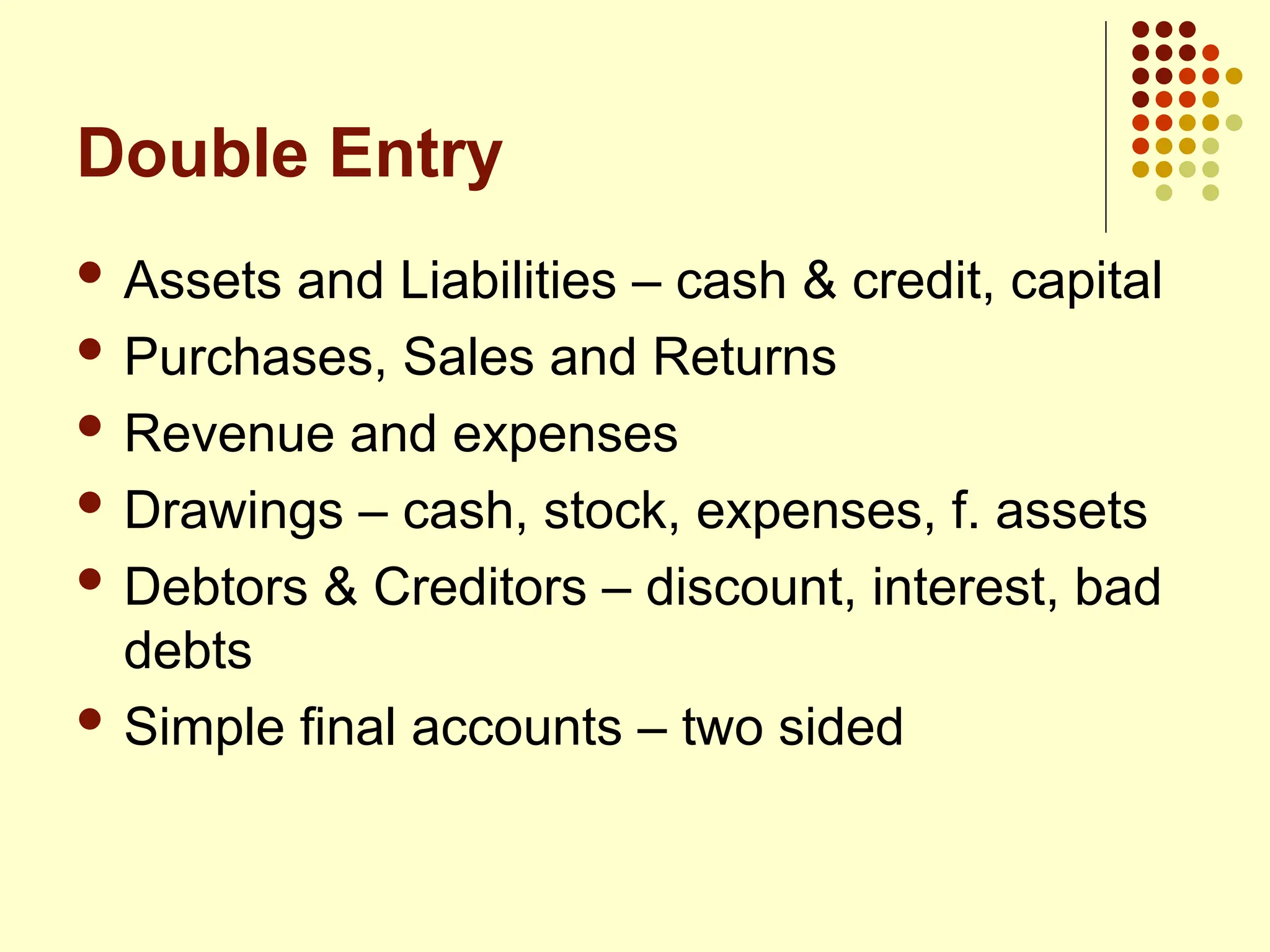
Double Entry
 Assets and Liabilities – cash & credit, capital
 Purchases, Sales and Returns
 Revenue and expenses
 Drawings – cash, stock, expenses, f. assets
 Debtors & Creditors – discount, interest, bad
debts
 Simple final accounts – two sided
Bringing it all together
At the end of the financial year the Revenue and
Expense Accounts are brought together in the
FINAL ACCOUNTS to ascertain the firm’s profit for
the year.
Asset and Liability Accounts are listed in the
BALANCE SHEET to ascertain the firm’s worth on
a particular date (usually the last day of the
financial year).
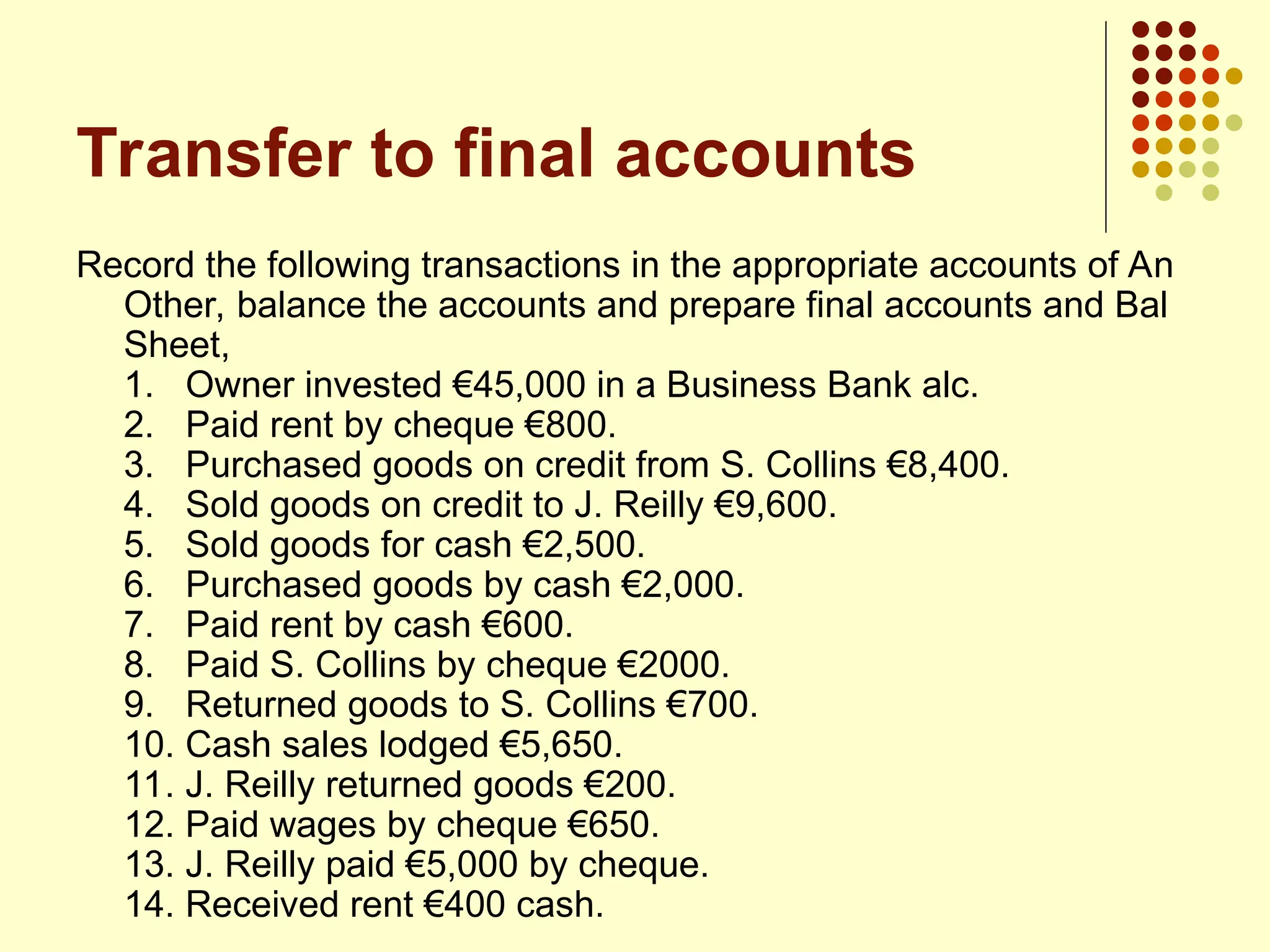
Transfer to final accounts
Record the following transactions in the appropriate accounts of An
Other, balance the accounts and prepare final accounts and Bal
Sheet,
1. Owner invested €45,000 in a Business Bank alc.
2. Paid rent by cheque €800.
3. Purchased goods on credit from S. Collins €8,400.
4. Sold goods on credit to J. Reilly €9,600.
5. Sold goods for cash €2,500.
6. Purchased goods by cash €2,000.
7. Paid rent by cash €600.
8. Paid S. Collins by cheque €2000.
9. Returned goods to S. Collins €700.
10. Cash sales lodged €5,650.
11. J. Reilly returned goods €200.
12. Paid wages by cheque €650.
13. J. Reilly paid €5,000 by cheque.
14. Received rent €400 cash.
Trading Profit and Loss a/c for year ended x/x/09
Rent 1400 Sales 17750
Purchases 10400 P Returns 700
S Returns 200 Rent Rec 400
Wages 650
Balance c/d 6200
18550 18550
Balance b/d 6220
Final Accounts – D Entry
Moving towards “normality”
 Split Trading from P & L
 Trial Balance
 Vertical Approach
Subsidiary Books
 Source documents
 List
 Reduce entries in accounts in nominal ledger
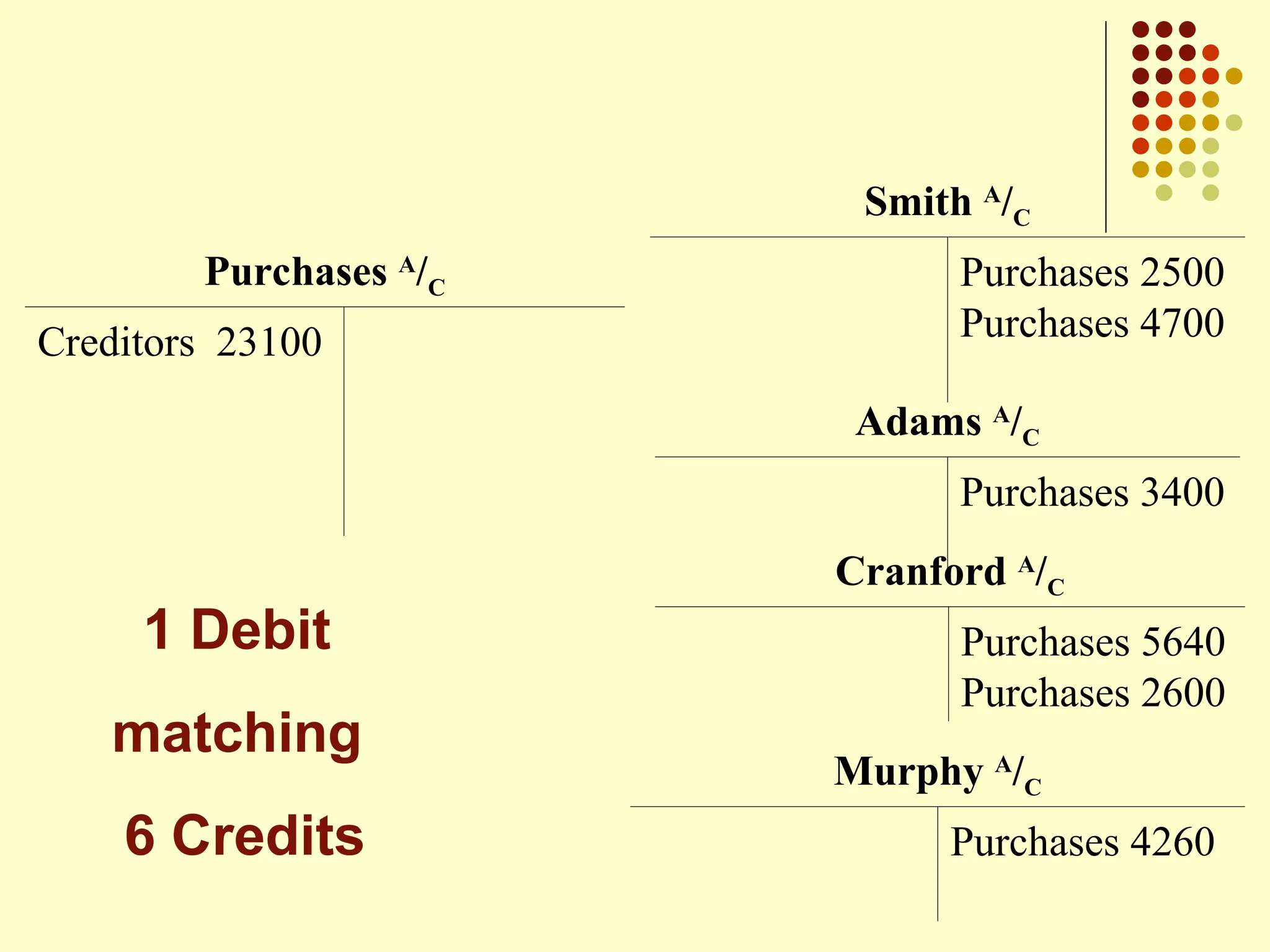
Purchases A
/C
Smith 2500
Adams 3400
Cranford 5640
Murphy 4260
Smith 4700
Cranford 2600
Adams A
/C
Purchases 3400
Smith A
/C
Purchases 2500
Purchases 4700
Cranford A
/C
Purchases 5640
Purchases 2600
Murphy A
/C
Purchases 4260
Purchases Book
Date Details Inv No Amount
Smith 2500
Adams 3400
Cranford 5640
Murphy 4260
Smith 4700
Cranford 2600
23100
Purchases A
/C
Creditors 23100
Adams A
/C
Purchases 3400
Smith A
/C
Purchases 2500
Purchases 4700
Cranford A
/C
Purchases 5640
Purchases 2600
Murphy A
/C
Purchases 4260
1 Debit
matching
6 Credits
Stage 1 Stage 2 Stage 3 Stage 4
Source Documents Subsidiary Books Ledger
Double Entry
Final Accounts
Balance Sheet
Invoices
[credit purchases and
sales]
Sales Book
Purchases Book Post these
transactions
using
Double Entry
Rules
Transfer
from the
Ledger to
ascertain
Profit for
the Year and
the Net
Worth of the
Company at
a point in
time
Credit Notes
Sales Returns Book
Purchases Returns
Book
Cheque Payments Cheque Payments Book
Receipts Cash Receipts Book
Anything Else General Journal
Recording Transactions
Sequence
 Prepayments & Accruals
 Bad Debts Provision
 Simple Incomplete – ord level
 Control Accounts – Subsidiary Books
 Depreciation and Disposal
 Bank Reconciliations
 Final Accounts – ord level building
adjustments
Adding adjustments to ord
Qns
 Writing off some closing stock
 Goods on sale or return
 Bad debts recovered
 Adjusting BDP
 Building extension to premises – own labour
and materials
 Built in accruals and prepayments
Adjustments
 Hardest Part is sorting the English
 Read a Little Talk a Little
 Use Dr Cr grid
 Make out the accounts
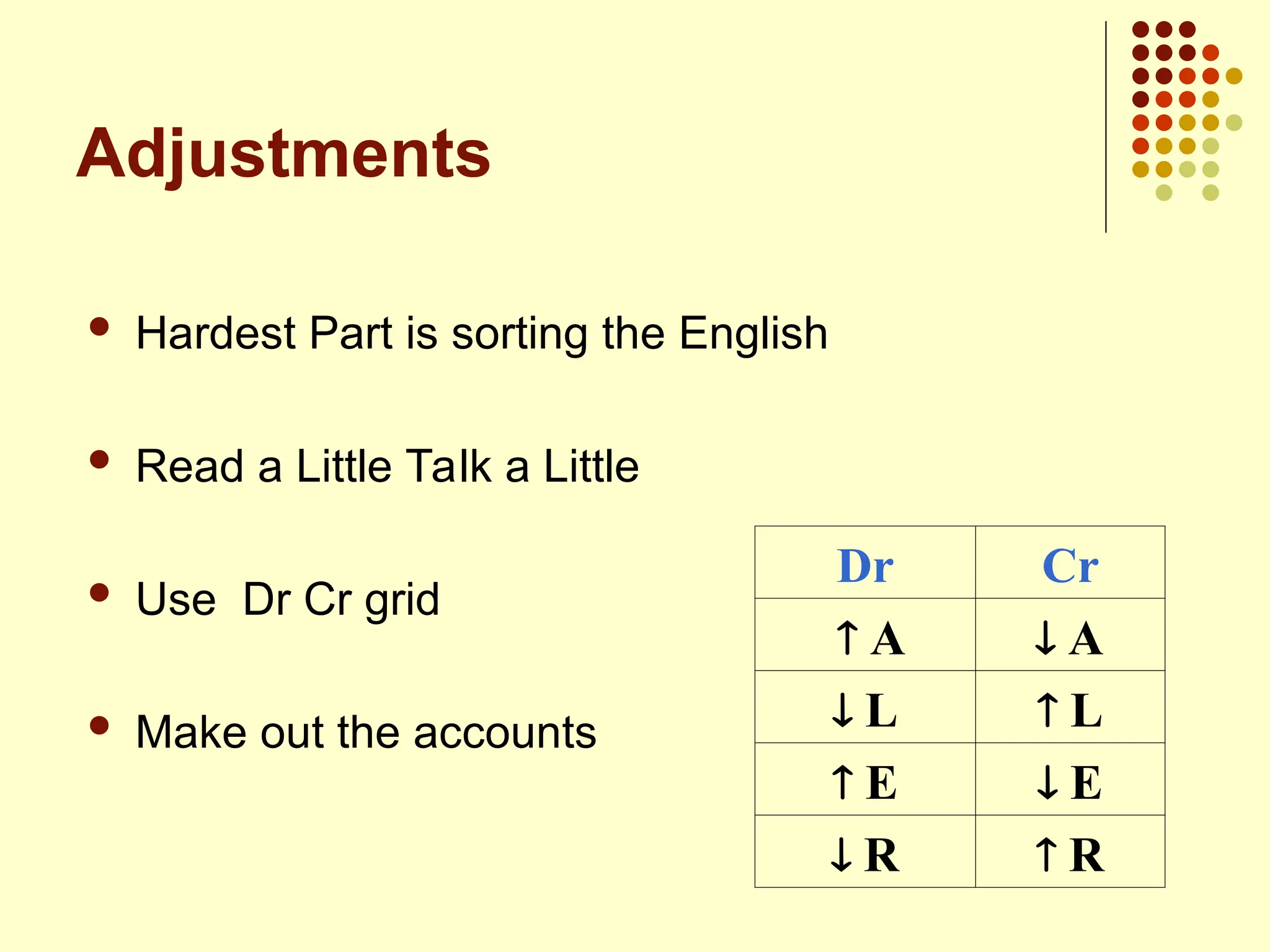
Dr Cr
 A  A
 L  L
 E  E
 R  R
Read a little, Talk a little
Students put in pairs/triads
Students read an adjustment silently
Then they stop and ask each other questions
such as:
What information have we
got here?
What did you get from
that?
What sense do you make
of it?
Both team-mates share / integrate their
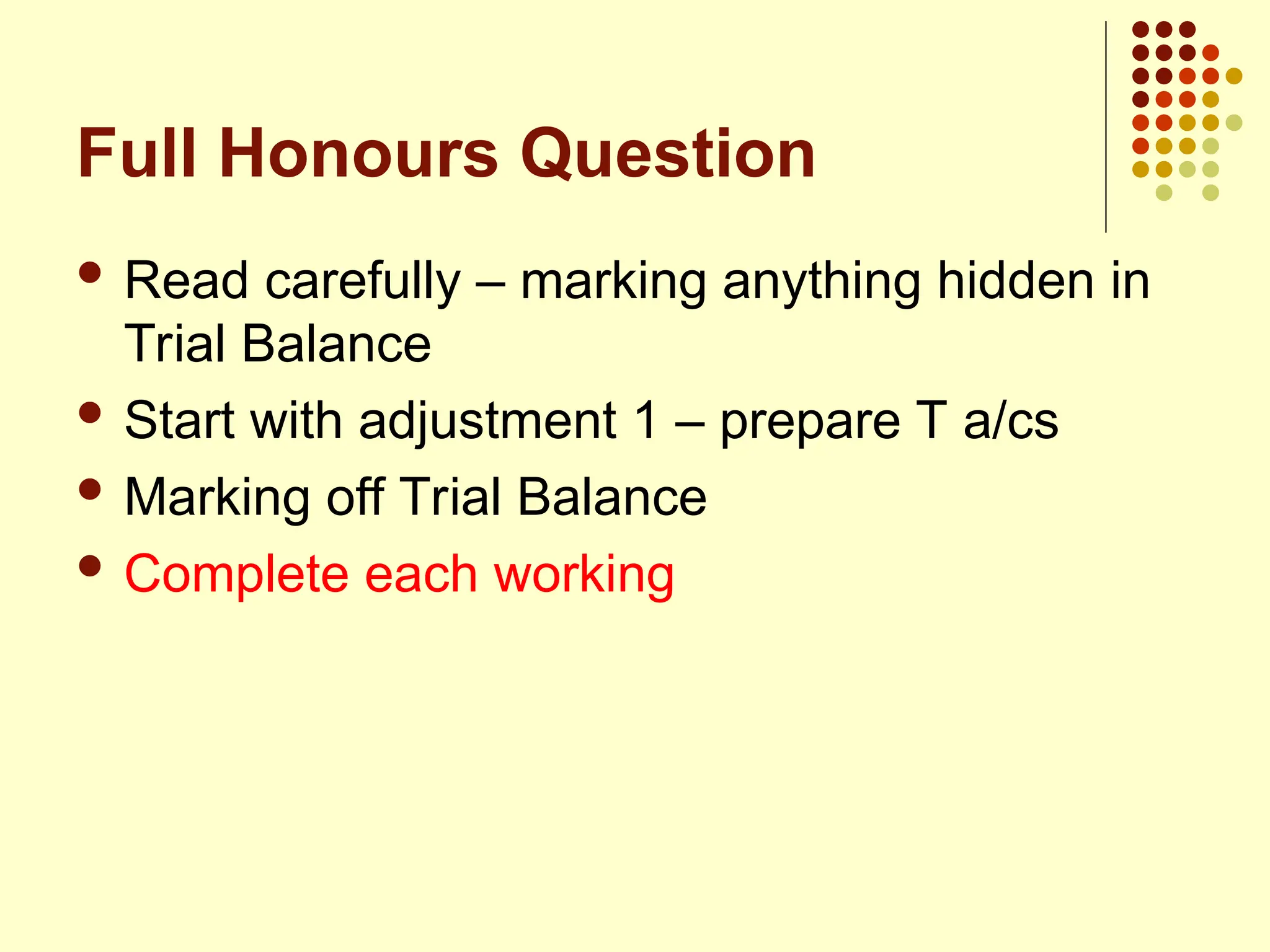
Full Honours Question
 Read carefully – marking anything hidden in
Trial Balance
 Start with adjustment 1 – prepare T a/cs
 Marking off Trial Balance
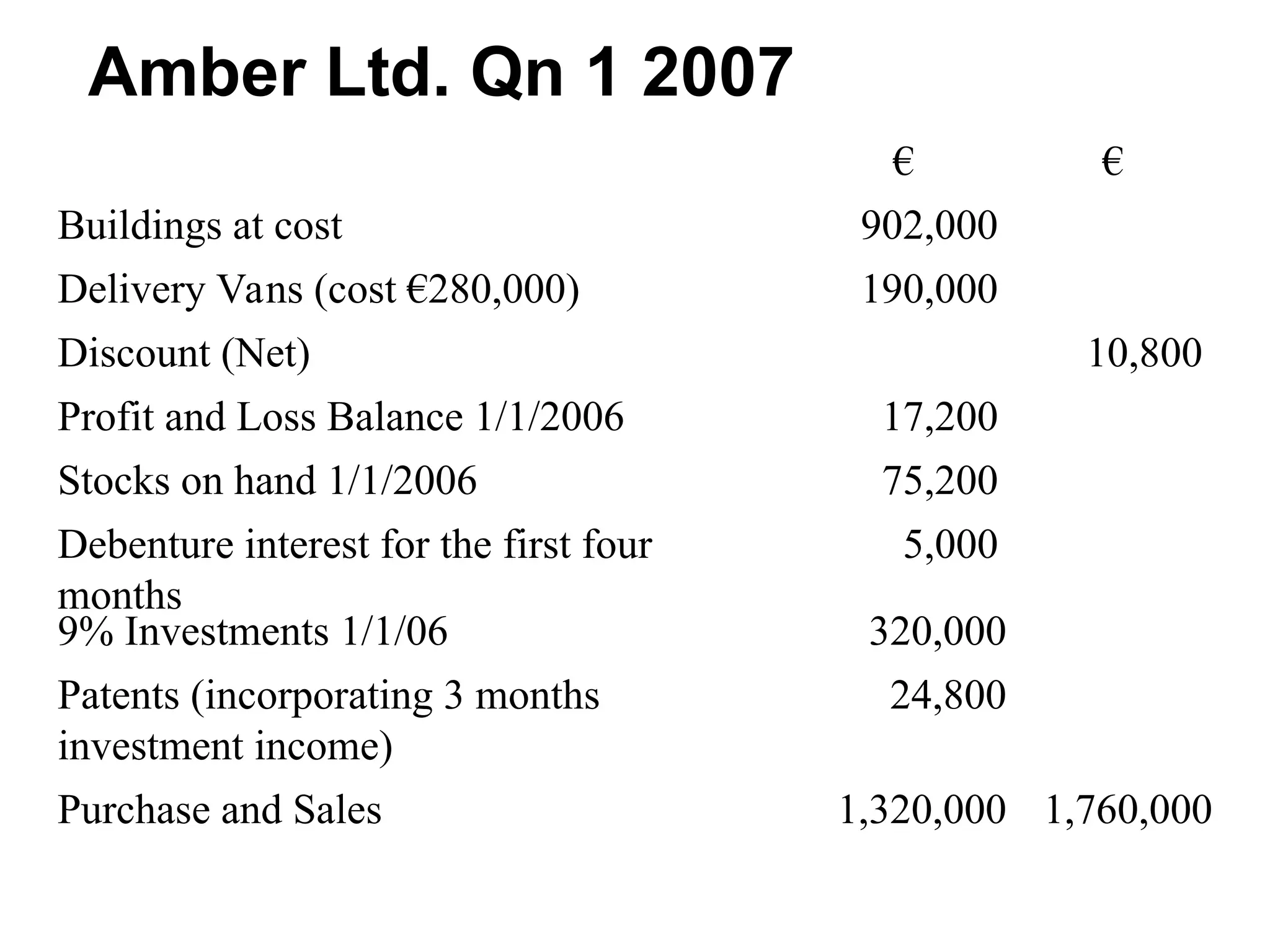
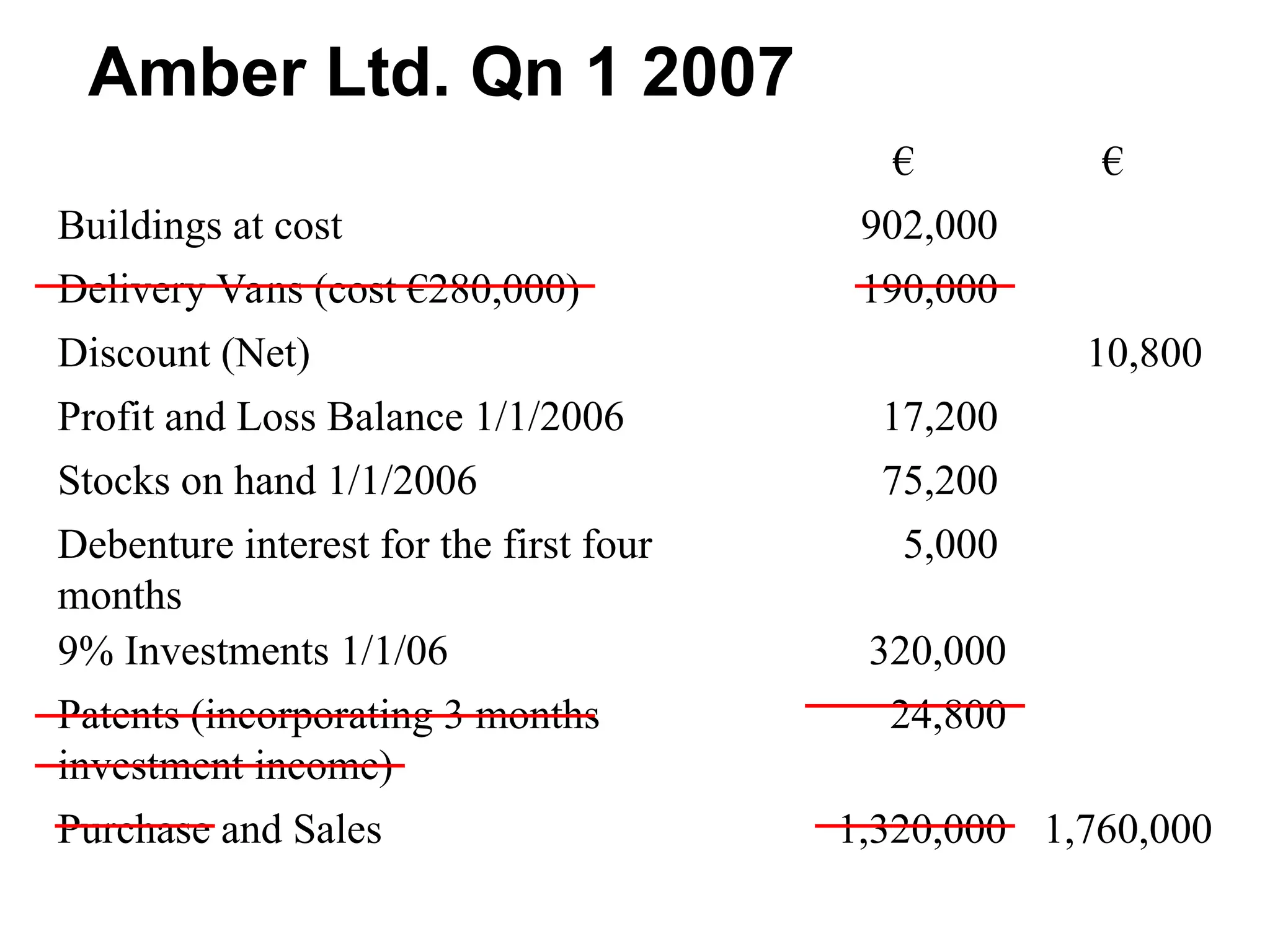
€ €
Buildings at cost 902,000
Delivery Vans (cost €280,000) 190,000
Discount (Net) 10,800
Profit and Loss Balance 1/1/2006 17,200
Stocks on hand 1/1/2006 75,200
Debenture interest for the first four
months
5,000
9% Investments 1/1/06 320,000
Patents (incorporating 3 months
investment income)
24,800
Purchase and Sales 1,320,000 1,760,000
Amber Ltd. Qn 1 2007
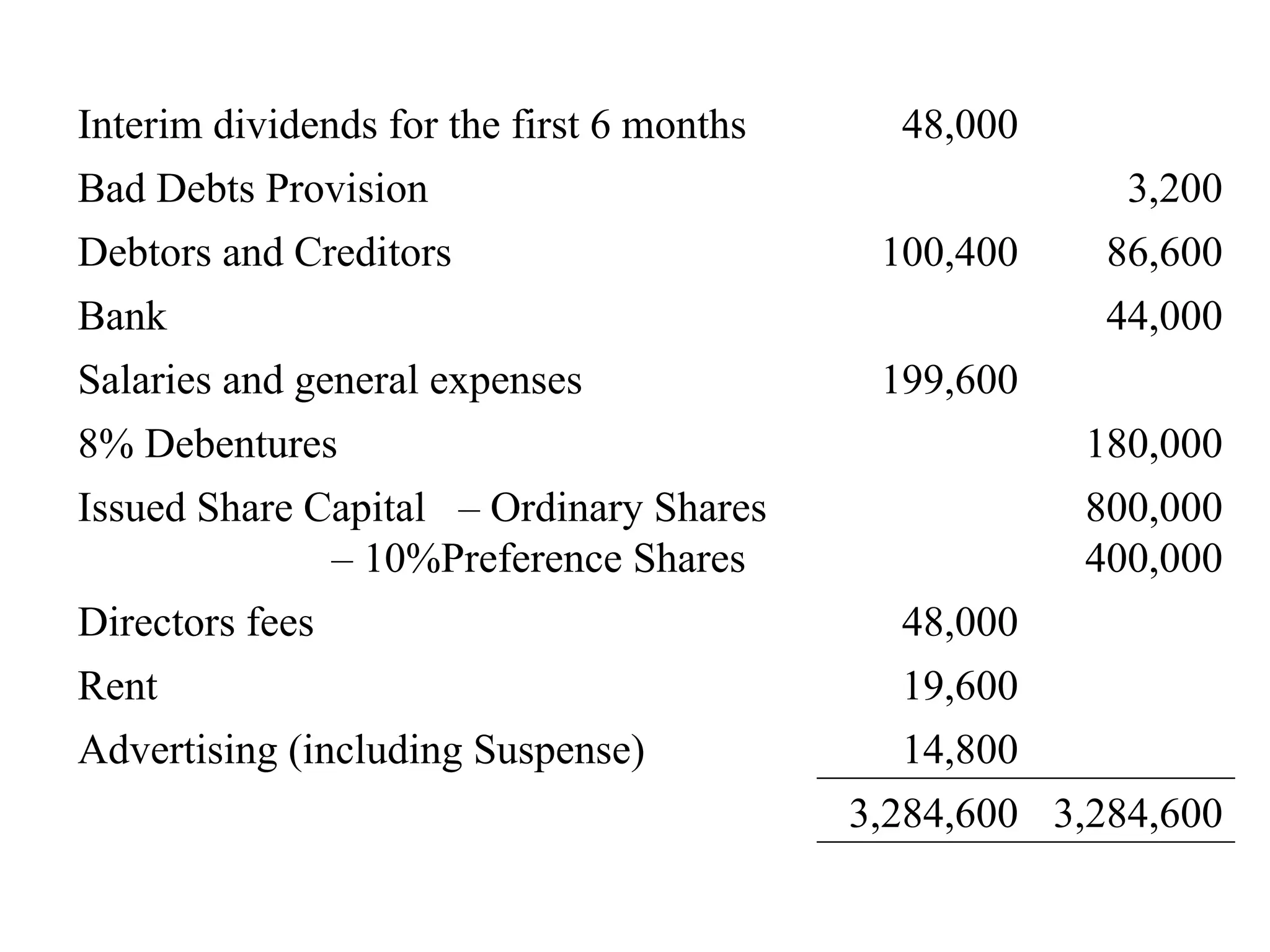
Interim dividends for the first 6 months 48,000
Bad Debts Provision 3,200
Debtors and Creditors 100,400 86,600
Bank 44,000
Salaries and general expenses 199,600
8% Debentures 180,000
Issued Share Capital – Ordinary Shares
– 10%Preference Shares
800,000
400,000
Directors fees 48,000
Rent 19,600
Advertising (including Suspense) 14,800
3,284,600 3,284,600
1 Stock 31/12/06 85200 – 4000 =
2
Patents a/c
Bal b/d 24800 P & L 6400
Inv Inc 7200
3
320,000 X 9% = 28,800
28,800 X ¼ =7200
Investment Income a/c
P & L 28800 Inv Inc 7200
Bal c/d 21600
(24800 + 7200) / 5
= 6400
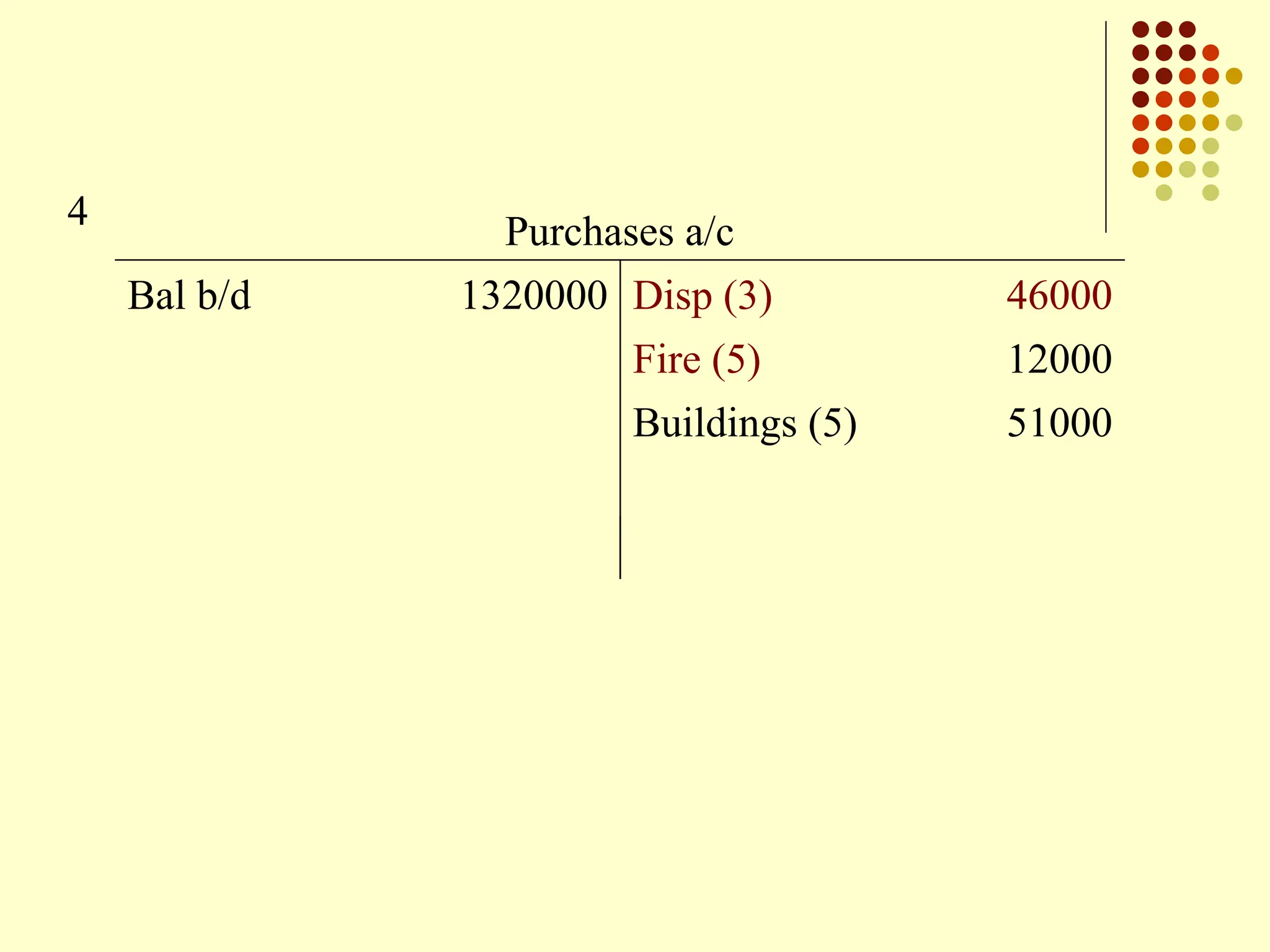
Purchases a/c
Bal b/d 1320000 Disp (3) 46000
Fire (5) 12000
Buildings (5) 51000
4
€ €
Buildings at cost 902,000
Delivery Vans (cost €280,000) 190,000
Discount (Net) 10,800
Profit and Loss Balance 1/1/2006 17,200
Stocks on hand 1/1/2006 75,200
Debenture interest for the first four
months
5,000
9% Investments 1/1/06 320,000
Patents (incorporating 3 months
investment income)
24,800
Purchase and Sales 1,320,000 1,760,000
Amber Ltd. Qn 1 2007
€ €
Buildings at cost 902,000
Delivery Vans (cost €280,000) 190,000
Discount (Net) 10,800
Profit and Loss Balance 1/1/2006 17,200
Stocks on hand 1/1/2006 75,200
Debenture interest for the first four
months
5,000
9% Investments 1/1/06 320,000
Patents (incorporating 3 months
investment income)
24,800
Purchase and Sales 1,320,000 1,760,000
Amber Ltd. Qn 1 2007
Full Honours Question
 Read carefully – marking anything hidden in
Trial Balance
 Start with adjustment 1 – prepare T a/cs
 Marking off Trial Balance
 When adjustments are done -- Trial Balance
looks like this
€ €
Buildings at cost 902,000
Delivery Vans (cost €280,000) 190,000
Discount (Net) 10,800
Profit and Loss Balance 1/1/2006 17,200
Stocks on hand 1/1/2006 75,200
Debenture interest for the first four
months
5,000
9% Investments 1/1/06 320,000
Patents (incorporating 3 months
investment income)
24,800
Purchase and Sales 1,320,000 1,760,000
Amber Ltd. Qn 1 2007
Interim dividends for the first 6 months 48,000
Bad Debts Provision 3,200
Debtors and Creditors 100,400 86,600
Bank 44,000
Salaries and general expenses 199,600
8% Debentures 180,000
Issued Share Capital – Ordinary Shares
– 10% Preference Shares
800,000
400,000
Directors fees 48,000
Rent 19,600
Advertising (including Suspense) 14,800
3,284,600 3,284,600
Full Honours Question
 Read carefully – marking anything hidden in
Trial Balance
 Start with adjustment 1 – prepare T a/cs
 Marking off Trial Balance
 Complete each working
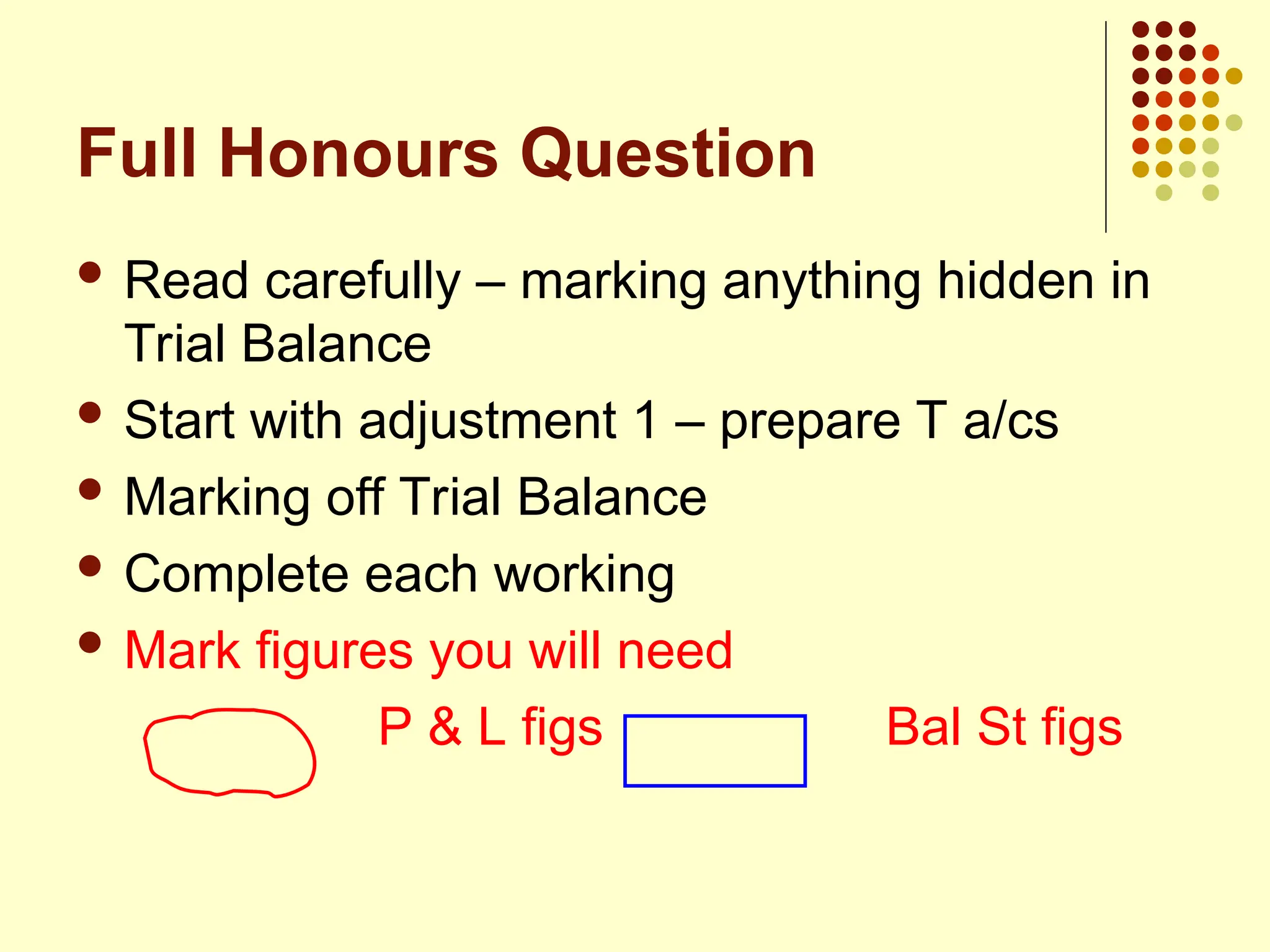
Full Honours Question
 Read carefully – marking anything hidden in
Trial Balance
 Start with adjustment 1 – prepare T a/cs
 Marking off Trial Balance
 Complete each working
 Mark figures you will need
P & L figs Bal St figs
1 Stock 31/12/06 85200 – 4000 = 81,200
2
Patents a/c
Bal b/d 24800 P & L 6400
Inv Inc 7200
3
320,000 X 9% = 28,800
28,800 X ¼ =7200
Investment Income a/c
P & L 28800 Inv Inc 7200
Bal c/d 21600
(24800 + 7200) / 5
= 6400
Purchases a/c
Bal b/d 1320000 Disp (3) 46000
Fire (5) 12000
Buildings (5) 51000
Trading 1211000
1320000 1320000
4
Full Honours Question
 Read carefully – marking anything hidden in
Trial Balance
 Start with adjustment 1 – prepare T a/cs
 Mark off Trial Balance
 Complete each working
P & L figs Bal St figs
 Enter figures in accounts calculating as you go
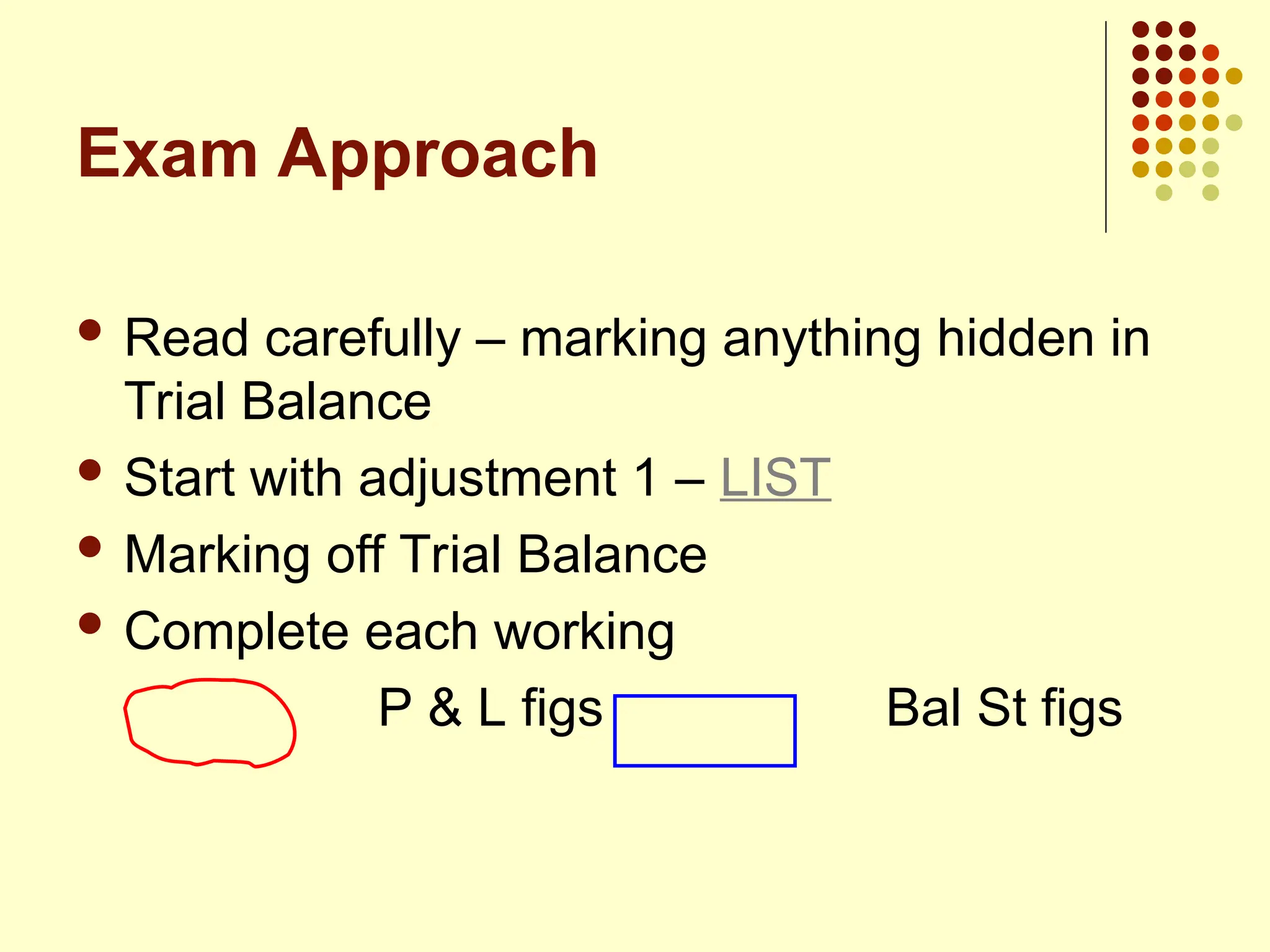
Exam Approach
 Read carefully – marking anything hidden in
Trial Balance
 Start with adjustment 1 – LIST
 Marking off Trial Balance
 Complete each working
P & L figs Bal St figs
Exam Approach contd
 Prepare Template Accounts
Template Trading Profit and Loss a.doc
Exam Approach
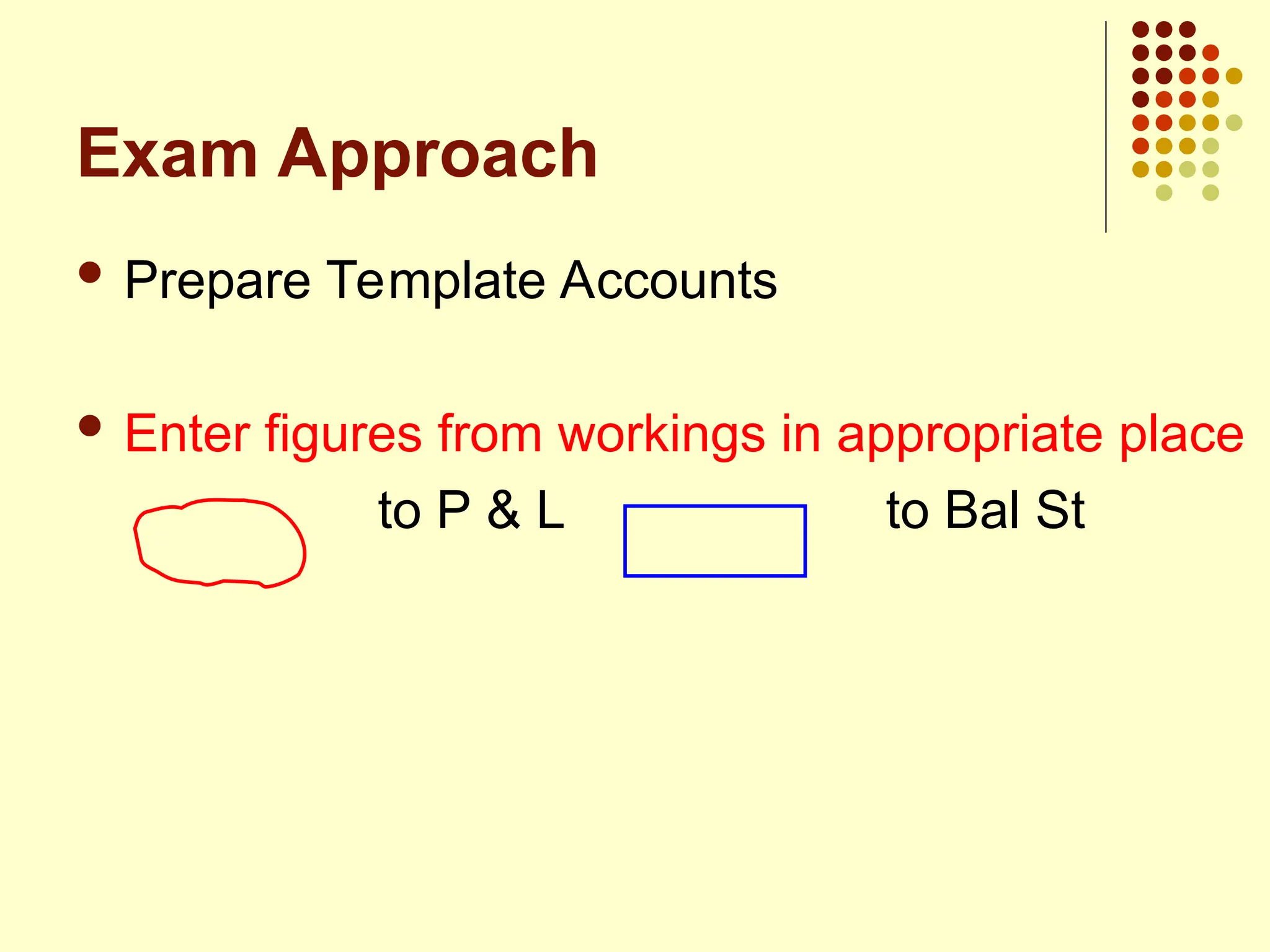
 Prepare Template Accounts
 Enter figures from workings in appropriate place
to P & L to Bal St
Exam Approach
 Prepare Template Accounts
 Enter figures from workings in appropriate place
to P & L to Bal St
 Enter remaining figures from Trial Balance
not struck out
Exam Approach
 Prepare Template Accounts
 Enter figures from workings in appropriate place
to P & L to Bal St
 Enter remaining figures from Trial Balance
not struck out
 Perform calculations (or not!!)
Qn 1_0.ppt for bba mba and commerce students

Qn 1_0.ppt for bba mba and commerce students

  • 1.
    Qn 1 –Final Accounts one approach Gabrielle Moran 11th September 2010
  • 2.
    Prior to FinalAccounts  Double Entry including accruals/prepayments to simple P&L and Balance Sheet  Incomplete records  Control Accounts – Subsidiary Books  Depreciation and Disposal  Correction of Errors  Bank Reconciliations
  • 3.
    Double Entry  Twoaspects to all transactions  Matching of Debits and Credits
  • 4.
    Double Entry Accounts Purpose Asset Recordwhat the firm owns and what is owed to the firm. e.g. Vans A /C, Premises A /C, Cash A /C, Debtors A /C Liability Record what the firm owes. e.g. Loan A /C, Bank Overdraft A /C , Creditors A /C Expense Record the firm’s day to day running expenses. e.g. WagesA /C,, Insurance A /C, Purchases A /C Revenue Record day to day income earned by the firm e.g. Sales A /C, Rent Received A /C, Commission A /C
  • 5.
    Summary of possibleentries Debit Credit  Asset  Asset  Liability  Liability  Expense  Expense  Revenue  Revenue
  • 6.
    Asset A /C Debit (Increase)Buying asset for cash or on credit Lodging money to the bank Selling goods on credit Credit (Decrease) Selling asset for cash or on credit Withdrawing money from bank Debtors paying what they owe Liability A /C Debit (Decrease) Paying off part or all what is owed Credit (Increase) Increasing the amount borrowed Buying goods on credit Expense A /C Debit (Increase) Paying an expense Increasing the amount previously recorded Credit (Decrease) Decreasing the amount previously recorded Revenue A /C Debit (Decrease) Decreasing the amount received previously recorded Credit (Increase) Record revenue received Increasing the amount received previously recorded
  • 7.
    4 Questions toask Thus with every transaction you come across you need to decide: 1. What are the two accounts involved? 2. Which type of account is each one? 3. Does the transaction cause an increase or decrease in each account? 4. Therefore is it a Dr or Cr?
  • 8.
    Double Entry  Assetsand Liabilities – cash & credit, capital  Purchases, Sales and Returns  Revenue and expenses  Drawings – cash, stock, expenses, f. assets  Debtors & Creditors – discount, interest, bad debts  Simple final accounts – two sided
  • 9.
    Bringing it alltogether At the end of the financial year the Revenue and Expense Accounts are brought together in the FINAL ACCOUNTS to ascertain the firm’s profit for the year. Asset and Liability Accounts are listed in the BALANCE SHEET to ascertain the firm’s worth on a particular date (usually the last day of the financial year).
  • 10.
    Transfer to finalaccounts Record the following transactions in the appropriate accounts of An Other, balance the accounts and prepare final accounts and Bal Sheet, 1. Owner invested €45,000 in a Business Bank alc. 2. Paid rent by cheque €800. 3. Purchased goods on credit from S. Collins €8,400. 4. Sold goods on credit to J. Reilly €9,600. 5. Sold goods for cash €2,500. 6. Purchased goods by cash €2,000. 7. Paid rent by cash €600. 8. Paid S. Collins by cheque €2000. 9. Returned goods to S. Collins €700. 10. Cash sales lodged €5,650. 11. J. Reilly returned goods €200. 12. Paid wages by cheque €650. 13. J. Reilly paid €5,000 by cheque. 14. Received rent €400 cash.
  • 11.
    Trading Profit andLoss a/c for year ended x/x/09 Rent 1400 Sales 17750 Purchases 10400 P Returns 700 S Returns 200 Rent Rec 400 Wages 650 Balance c/d 6200 18550 18550 Balance b/d 6220 Final Accounts – D Entry
  • 12.
    Moving towards “normality” Split Trading from P & L  Trial Balance  Vertical Approach
  • 13.
    Subsidiary Books  Sourcedocuments  List  Reduce entries in accounts in nominal ledger
  • 14.
    Purchases A /C Smith 2500 Adams3400 Cranford 5640 Murphy 4260 Smith 4700 Cranford 2600 Adams A /C Purchases 3400 Smith A /C Purchases 2500 Purchases 4700 Cranford A /C Purchases 5640 Purchases 2600 Murphy A /C Purchases 4260
  • 15.
    Purchases Book Date DetailsInv No Amount Smith 2500 Adams 3400 Cranford 5640 Murphy 4260 Smith 4700 Cranford 2600 23100
  • 16.
    Purchases A /C Creditors 23100 AdamsA /C Purchases 3400 Smith A /C Purchases 2500 Purchases 4700 Cranford A /C Purchases 5640 Purchases 2600 Murphy A /C Purchases 4260 1 Debit matching 6 Credits
  • 17.
    Stage 1 Stage2 Stage 3 Stage 4 Source Documents Subsidiary Books Ledger Double Entry Final Accounts Balance Sheet Invoices [credit purchases and sales] Sales Book Purchases Book Post these transactions using Double Entry Rules Transfer from the Ledger to ascertain Profit for the Year and the Net Worth of the Company at a point in time Credit Notes Sales Returns Book Purchases Returns Book Cheque Payments Cheque Payments Book Receipts Cash Receipts Book Anything Else General Journal Recording Transactions
  • 18.
    Sequence  Prepayments &Accruals  Bad Debts Provision  Simple Incomplete – ord level  Control Accounts – Subsidiary Books  Depreciation and Disposal  Bank Reconciliations  Final Accounts – ord level building adjustments
  • 19.
    Adding adjustments toord Qns  Writing off some closing stock  Goods on sale or return  Bad debts recovered  Adjusting BDP  Building extension to premises – own labour and materials  Built in accruals and prepayments
  • 20.
    Adjustments  Hardest Partis sorting the English  Read a Little Talk a Little  Use Dr Cr grid  Make out the accounts Dr Cr  A  A  L  L  E  E  R  R
  • 21.
    Read a little,Talk a little Students put in pairs/triads Students read an adjustment silently Then they stop and ask each other questions such as: What information have we got here? What did you get from that? What sense do you make of it? Both team-mates share / integrate their
  • 22.
    Full Honours Question Read carefully – marking anything hidden in Trial Balance  Start with adjustment 1 – prepare T a/cs  Marking off Trial Balance
  • 23.
    € € Buildings atcost 902,000 Delivery Vans (cost €280,000) 190,000 Discount (Net) 10,800 Profit and Loss Balance 1/1/2006 17,200 Stocks on hand 1/1/2006 75,200 Debenture interest for the first four months 5,000 9% Investments 1/1/06 320,000 Patents (incorporating 3 months investment income) 24,800 Purchase and Sales 1,320,000 1,760,000 Amber Ltd. Qn 1 2007
  • 24.
    Interim dividends forthe first 6 months 48,000 Bad Debts Provision 3,200 Debtors and Creditors 100,400 86,600 Bank 44,000 Salaries and general expenses 199,600 8% Debentures 180,000 Issued Share Capital – Ordinary Shares – 10%Preference Shares 800,000 400,000 Directors fees 48,000 Rent 19,600 Advertising (including Suspense) 14,800 3,284,600 3,284,600
  • 25.
    1 Stock 31/12/0685200 – 4000 = 2 Patents a/c Bal b/d 24800 P & L 6400 Inv Inc 7200 3 320,000 X 9% = 28,800 28,800 X ¼ =7200 Investment Income a/c P & L 28800 Inv Inc 7200 Bal c/d 21600 (24800 + 7200) / 5 = 6400
  • 26.
    Purchases a/c Bal b/d1320000 Disp (3) 46000 Fire (5) 12000 Buildings (5) 51000 4
  • 27.
    € € Buildings atcost 902,000 Delivery Vans (cost €280,000) 190,000 Discount (Net) 10,800 Profit and Loss Balance 1/1/2006 17,200 Stocks on hand 1/1/2006 75,200 Debenture interest for the first four months 5,000 9% Investments 1/1/06 320,000 Patents (incorporating 3 months investment income) 24,800 Purchase and Sales 1,320,000 1,760,000 Amber Ltd. Qn 1 2007
  • 28.
    € € Buildings atcost 902,000 Delivery Vans (cost €280,000) 190,000 Discount (Net) 10,800 Profit and Loss Balance 1/1/2006 17,200 Stocks on hand 1/1/2006 75,200 Debenture interest for the first four months 5,000 9% Investments 1/1/06 320,000 Patents (incorporating 3 months investment income) 24,800 Purchase and Sales 1,320,000 1,760,000 Amber Ltd. Qn 1 2007
  • 29.
    Full Honours Question Read carefully – marking anything hidden in Trial Balance  Start with adjustment 1 – prepare T a/cs  Marking off Trial Balance  When adjustments are done -- Trial Balance looks like this
  • 30.
    € € Buildings atcost 902,000 Delivery Vans (cost €280,000) 190,000 Discount (Net) 10,800 Profit and Loss Balance 1/1/2006 17,200 Stocks on hand 1/1/2006 75,200 Debenture interest for the first four months 5,000 9% Investments 1/1/06 320,000 Patents (incorporating 3 months investment income) 24,800 Purchase and Sales 1,320,000 1,760,000 Amber Ltd. Qn 1 2007
  • 31.
    Interim dividends forthe first 6 months 48,000 Bad Debts Provision 3,200 Debtors and Creditors 100,400 86,600 Bank 44,000 Salaries and general expenses 199,600 8% Debentures 180,000 Issued Share Capital – Ordinary Shares – 10% Preference Shares 800,000 400,000 Directors fees 48,000 Rent 19,600 Advertising (including Suspense) 14,800 3,284,600 3,284,600
  • 32.
    Full Honours Question Read carefully – marking anything hidden in Trial Balance  Start with adjustment 1 – prepare T a/cs  Marking off Trial Balance  Complete each working
  • 33.
    Full Honours Question Read carefully – marking anything hidden in Trial Balance  Start with adjustment 1 – prepare T a/cs  Marking off Trial Balance  Complete each working  Mark figures you will need P & L figs Bal St figs
  • 34.
    1 Stock 31/12/0685200 – 4000 = 81,200 2 Patents a/c Bal b/d 24800 P & L 6400 Inv Inc 7200 3 320,000 X 9% = 28,800 28,800 X ¼ =7200 Investment Income a/c P & L 28800 Inv Inc 7200 Bal c/d 21600 (24800 + 7200) / 5 = 6400
  • 35.
    Purchases a/c Bal b/d1320000 Disp (3) 46000 Fire (5) 12000 Buildings (5) 51000 Trading 1211000 1320000 1320000 4
  • 36.
    Full Honours Question Read carefully – marking anything hidden in Trial Balance  Start with adjustment 1 – prepare T a/cs  Mark off Trial Balance  Complete each working P & L figs Bal St figs  Enter figures in accounts calculating as you go
  • 37.
    Exam Approach  Readcarefully – marking anything hidden in Trial Balance  Start with adjustment 1 – LIST  Marking off Trial Balance  Complete each working P & L figs Bal St figs
  • 38.
    Exam Approach contd Prepare Template Accounts Template Trading Profit and Loss a.doc
  • 39.
    Exam Approach  PrepareTemplate Accounts  Enter figures from workings in appropriate place to P & L to Bal St
  • 40.
    Exam Approach  PrepareTemplate Accounts  Enter figures from workings in appropriate place to P & L to Bal St  Enter remaining figures from Trial Balance not struck out
  • 41.
    Exam Approach  PrepareTemplate Accounts  Enter figures from workings in appropriate place to P & L to Bal St  Enter remaining figures from Trial Balance not struck out  Perform calculations (or not!!)