

QlikView Projects in Agile Environment
By Saleha Amin
Agenda
ď‚§Understanding Agile
ď‚§Limitations of Agile
ď‚§Challenges in implementing Agile in QlikView environment
ď‚§Reuse of QVDs
ď‚§Implementing Agile: Cultural Shift, Business Engagement, Decentralize BI
ď‚§Key Takeaways
ď‚§Q & A
Disclaimer
ď‚§The material discussed in this presentation is my own observations and
do not represent the practices promoted by Agile Alliance or Hologic
Agile Manifesto
ď‚§Individuals and interactions over processes and tools
ď‚§Working software over comprehensive documentation
ď‚§Customer collaboration over contract negotiation
ď‚§Responding to change over following a plan
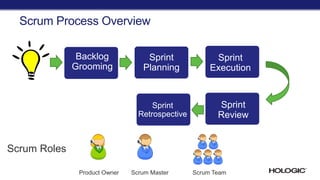
Scrum Process Overview
Sprint
Retrospect
ive
Backlog
Grooming
Sprint
Planning
Sprint
Execution
Sprint
Review
Sprint
Retrospective
Scrum Roles
Product Owner Scrum Master Scrum Team
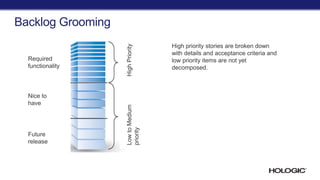
Required
functionality
Nice to
have
Future
release
High priority stories are broken down
with details and acceptance criteria and
low priority items are not yet
decomposed.
HighPriorityLowtoMedium
priority
Backlog Grooming
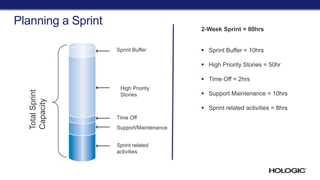
High Priority
Stories
Sprint related
activities
Support/Maintenance
Sprint Buffer
Time Off
Planning a Sprint
TotalSprint
Capacity
2-Week Sprint = 80hrs
ď‚§ Sprint Buffer = 10hrs
ď‚§ High Priority Stories = 50hr
ď‚§ Time Off = 2hrs
ď‚§ Support Maintenance = 10hrs
ď‚§ Sprint related activities = 8hrs
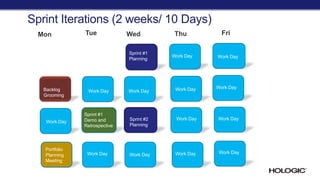
Sprint Iterations (2 weeks/ 10 Days)
Mon Tue Wed Thu Fri
Sprint #1
Planning
Work Day Work Day
Work Day Work Day Work Day Work Day
Sprint #2
Planning
Sprint #1
Demo and
Retrospective
Backlog
Grooming
Work Day
Work Day Work Day Work Day Work Day
Work Day
Work Day Work Day
Work Day Work Day Work Day Work Day
Portfolio
Planning
Meeting
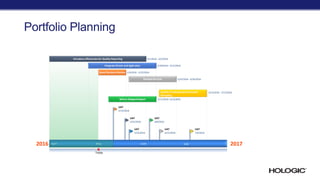
Portfolio Planning
2016 April May June July 2017
Today
UAT
7/6/2016
UAT
6/15/2016
UAT
6/8/2016
UAT
5/25/2016
UAT
5/22/2016
UAT
5/14/2016
5/11/2016- 6/12/2016Where-Shipped Report
6/15/2016 - 7/17/2016Quality Trending and Instrument
Reliability
5/25/2016 - 6/26/2016Related Records
5/4/2016 - 5/22/2016Quest Business Review
5/28/2016 - 6/12/2016Integrate Oracle and Agile data
4/1/2016 - 6/5/2016Introduce efficiencies for Quality Reporting
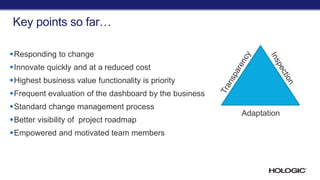
Key points so far…
ď‚§Responding to change
ď‚§Innovate quickly and at a reduced cost
ď‚§Highest business value functionality is priority
ď‚§Frequent evaluation of the dashboard by the business
ď‚§Standard change management process
ď‚§Better visibility of project roadmap
ď‚§Empowered and motivated team members
Work Day
Adaptation
Myths about Agile process
ď‚§ A development fad
ď‚§ Complete absence of process and change control resulting in ad-hoc changes and
endless scope creeps
ď‚§ There is no documentation in agile
ď‚§ Must be implemented by the book
Example User Story: As a business analyst, I want a QlikView dashboard that gives me the
current count of all instruments so I can improve inventory management
Steps in implementing Agile Methodology
1) Evaluate the gaps in your current process
ď‚§ Prioritize requirements
ď‚§ Engage customers
ď‚§ Stakeholder participation
ď‚§ Project Duration
ď‚§ Change Control
ď‚§ User Adoption
2) Set reasonable expectations on how agile will help you fill those gaps
3) Start with a small, focused project with high business engagement
4) Once implemented, do frequent health check
Gaps in our process
ď‚§Lack of a standard project management process
ď‚§Polarized teams
ď‚§How to choose a platform for a particular business request, ex: QlikView,
OBI, or Discoverer
ď‚§All requests were on ad-hoc basis
ď‚§No standard way to inform business about the status of their request
ď‚§No standard triage process
Common concerns when implementing Agile
ď‚§What tool to use?
ď‚§Does the team need to go through formal agile training?
ď‚§Who takes the role of the product owner?
ď‚§How is a scrum master different from a project manager?
ď‚§What should be the duration of a sprint?
ď‚§Too many meetings
Implementing Agile in BI
ď‚§In real world when we are implementing agile, first we need to create the
ecosystem for Agile to thrive. There are several key points to keep in
consideration
- Reuse and maintainability
- Cultural shift
- Decentralize BI- Hybrid model
- Business engagement
Re-use and maintainability
ď‚§ Introduce plug and play in Qlikview development
ď‚§ No logic in the ETL layer so QVDs could be used across various QlikView
applications
ď‚§ Avoid building LAYOUTS with tightly-coupled database schemas
ď‚§ Data models should be extensible with minimum re-work
ď‚§ Ability to create rule based components, so a change in one component
can trigger changes to all applications that used this component
ď‚§ Ability to automate routine tasks
Challenge
Designing and coding for reuse takes longer, and under the pressure of
project deadlines and resource constraints, most developers
don’t do this
Cultural Shift
ď‚§Empowered, self organizing teams
ď‚§Plan driven to value driven development
ď‚§Embrace change
ď‚§Encourage innovation
ď‚§Management trusts the team and team takes ownership
ď‚§Frequent communication of organizational goals and priorities
Decentralize BI- Use a hybrid model
ď‚§Centralized BI eventually becomes the bottleneck
ď‚§Divide responsibilities between central and departmental teams depending on
your organization’s structure and culture
ď‚§Operations and governance controlled by the IT the rest lies with the business
ď‚§IT and Business have different priorities; finding alignment is a challenge
Schlegel, Kurt, Frank Buytendijk, and Dan Sommer. "Create a Centralized and Decentralized Organizational Model
for Business Intelligence." (2014). Gartner. Web.
Challenges with Agile
ď‚§Simple but not easy
ď‚§Maintaining the rhyme of sprints
ď‚§Agile at team level but not enterprise level
Lack of BRD there is nothing to go back to…dig into your inbox.
ď‚§Customer keeps on changing their request
ď‚§Challenge with globally distributed teams
ď‚§Resources are not 100% dedicated on a single project
ď‚§Frequent requirement changes and intensive collaboration can be
stressful on the team
What the future holds
ď‚§BI shift from being IT centric to business centric
ď‚§Empowering business users to create their own BI apps
ď‚§Optimally 80% of BI initiative should be self service
ď‚§It is ok to loosen control on non mission-critical BI apps to promote self
service
Boris Evelson. "Build An Agile BI Organization." Forrester. 5 Feb. 2015.
Web
Q/A

QlikView projects in Agile Environment

  • 1.
    QlikView Projects inAgile Environment By Saleha Amin
  • 2.
    Agenda ď‚§Understanding Agile ď‚§Limitations ofAgile ď‚§Challenges in implementing Agile in QlikView environment ď‚§Reuse of QVDs ď‚§Implementing Agile: Cultural Shift, Business Engagement, Decentralize BI ď‚§Key Takeaways ď‚§Q & A
  • 3.
    Disclaimer ď‚§The material discussedin this presentation is my own observations and do not represent the practices promoted by Agile Alliance or Hologic
  • 4.
    Agile Manifesto ď‚§Individuals andinteractions over processes and tools ď‚§Working software over comprehensive documentation ď‚§Customer collaboration over contract negotiation ď‚§Responding to change over following a plan
  • 5.
  • 6.
    Required functionality Nice to have Future release High prioritystories are broken down with details and acceptance criteria and low priority items are not yet decomposed. HighPriorityLowtoMedium priority Backlog Grooming
  • 7.
    High Priority Stories Sprint related activities Support/Maintenance SprintBuffer Time Off Planning a Sprint TotalSprint Capacity 2-Week Sprint = 80hrs ď‚§ Sprint Buffer = 10hrs ď‚§ High Priority Stories = 50hr ď‚§ Time Off = 2hrs ď‚§ Support Maintenance = 10hrs ď‚§ Sprint related activities = 8hrs
  • 8.
    Sprint Iterations (2weeks/ 10 Days) Mon Tue Wed Thu Fri Sprint #1 Planning Work Day Work Day Work Day Work Day Work Day Work Day Sprint #2 Planning Sprint #1 Demo and Retrospective Backlog Grooming Work Day Work Day Work Day Work Day Work Day Work Day Work Day Work Day Work Day Work Day Work Day Work Day Portfolio Planning Meeting
  • 9.
    Portfolio Planning 2016 AprilMay June July 2017 Today UAT 7/6/2016 UAT 6/15/2016 UAT 6/8/2016 UAT 5/25/2016 UAT 5/22/2016 UAT 5/14/2016 5/11/2016- 6/12/2016Where-Shipped Report 6/15/2016 - 7/17/2016Quality Trending and Instrument Reliability 5/25/2016 - 6/26/2016Related Records 5/4/2016 - 5/22/2016Quest Business Review 5/28/2016 - 6/12/2016Integrate Oracle and Agile data 4/1/2016 - 6/5/2016Introduce efficiencies for Quality Reporting
  • 10.
    Key points sofar… Responding to change Innovate quickly and at a reduced cost Highest business value functionality is priority Frequent evaluation of the dashboard by the business Standard change management process Better visibility of project roadmap Empowered and motivated team members Work Day Adaptation
  • 11.
    Myths about Agileprocess ď‚§ A development fad ď‚§ Complete absence of process and change control resulting in ad-hoc changes and endless scope creeps ď‚§ There is no documentation in agile ď‚§ Must be implemented by the book Example User Story: As a business analyst, I want a QlikView dashboard that gives me the current count of all instruments so I can improve inventory management
  • 12.
    Steps in implementingAgile Methodology 1) Evaluate the gaps in your current process ď‚§ Prioritize requirements ď‚§ Engage customers ď‚§ Stakeholder participation ď‚§ Project Duration ď‚§ Change Control ď‚§ User Adoption 2) Set reasonable expectations on how agile will help you fill those gaps 3) Start with a small, focused project with high business engagement 4) Once implemented, do frequent health check
  • 13.
    Gaps in ourprocess ď‚§Lack of a standard project management process ď‚§Polarized teams ď‚§How to choose a platform for a particular business request, ex: QlikView, OBI, or Discoverer ď‚§All requests were on ad-hoc basis ď‚§No standard way to inform business about the status of their request ď‚§No standard triage process
  • 14.
    Common concerns whenimplementing Agile ď‚§What tool to use? ď‚§Does the team need to go through formal agile training? ď‚§Who takes the role of the product owner? ď‚§How is a scrum master different from a project manager? ď‚§What should be the duration of a sprint? ď‚§Too many meetings
  • 15.
    Implementing Agile inBI ď‚§In real world when we are implementing agile, first we need to create the ecosystem for Agile to thrive. There are several key points to keep in consideration - Reuse and maintainability - Cultural shift - Decentralize BI- Hybrid model - Business engagement
  • 16.
    Re-use and maintainability Introduce plug and play in Qlikview development  No logic in the ETL layer so QVDs could be used across various QlikView applications  Avoid building LAYOUTS with tightly-coupled database schemas  Data models should be extensible with minimum re-work  Ability to create rule based components, so a change in one component can trigger changes to all applications that used this component  Ability to automate routine tasks Challenge Designing and coding for reuse takes longer, and under the pressure of project deadlines and resource constraints, most developers don’t do this
  • 17.
    Cultural Shift ď‚§Empowered, selforganizing teams ď‚§Plan driven to value driven development ď‚§Embrace change ď‚§Encourage innovation ď‚§Management trusts the team and team takes ownership ď‚§Frequent communication of organizational goals and priorities
  • 18.
    Decentralize BI- Usea hybrid model Centralized BI eventually becomes the bottleneck Divide responsibilities between central and departmental teams depending on your organization’s structure and culture Operations and governance controlled by the IT the rest lies with the business IT and Business have different priorities; finding alignment is a challenge Schlegel, Kurt, Frank Buytendijk, and Dan Sommer. "Create a Centralized and Decentralized Organizational Model for Business Intelligence." (2014). Gartner. Web.
  • 19.
    Challenges with Agile Simplebut not easy Maintaining the rhyme of sprints Agile at team level but not enterprise level Lack of BRD there is nothing to go back to…dig into your inbox. Customer keeps on changing their request Challenge with globally distributed teams Resources are not 100% dedicated on a single project Frequent requirement changes and intensive collaboration can be stressful on the team
  • 20.
    What the futureholds ď‚§BI shift from being IT centric to business centric ď‚§Empowering business users to create their own BI apps ď‚§Optimally 80% of BI initiative should be self service ď‚§It is ok to loosen control on non mission-critical BI apps to promote self service Boris Evelson. "Build An Agile BI Organization." Forrester. 5 Feb. 2015. Web
  • 21.