Chemical
Testing
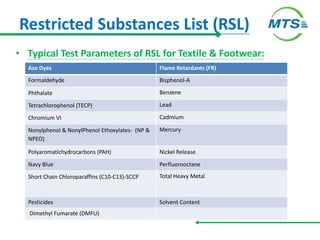
Restricted Substances List (RSL)
• Typical Test Parameters of RSL for Textile & Footwear:
Azo Dyes Flame Retardants (FR)
Formaldehyde Bisphenol-A
Phthalate Benzene
Tetrachlorophenol (TECP) Lead
Chromium VI Cadmium
Nonylphenol & NonylPhenol Ethoxylates- (NP &
NPEO)
Mercury
Polyaromatichydrocarbons (PAH) Nickel Release
Navy Blue Perfluorooctane
Short Chain Chloroparaffins (C10-C13)-SCCP Total Heavy Metal
Pesticides Solvent Content
Dimethyl Fumarate (DMFU)
AZO DYES
Azo dyes are one of the commonly used chemical classes of dyestuffs
„
Azo dyes allow colours with outstanding fastness.
„
About 60-70% of the dyes used nowadays are azo dyes.
„
About 5 % of the garments tested in our labs contain forbidden amines:
•dark blue, red, orange and black colors,
•printings, very often red, black, brown colours
Some of these dyes are proven or suspected carcinogenic.
„
A list of 22 amines classified by the EU or the MAK Commission as human
carcinogens
„
The use of azo dyes that may cleave to one of the 22 potentially carcinogenic
aromatic amines are banned according to the 19th amendment of Directive
76/769/EEC on dangerous substances. Also as per EU 2002/61
TEST METHOD: EN 14362-1 :2012,LFGB 64B.82.02.9 & ISO/TS 17234 (Leather)
„
Failures on Tie&Dye articles, Accessories like Embroidery Threads, Tapes, Laces, Twill tapes,
Prints, Col.s like – Black, Pink, Olive, Red, Browns
„
Solution:There are dyestuffs available in the market which do not release any of the listed aromatic amines.
AZO DYES
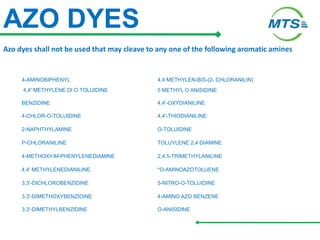
Azo dyes shall not be used that may cleave to any one of the following aromatic amines
„
4-AMINOBIPHENYL 4,4 METHYLEN-BIS-(2- CHLORANILIN)
4,4' METHYLENE DI O TOLUIDINE 5 METHYL O ANISIDINE
„
BENZIDINE 4,4'-OXYDIANILINE
„
4-CHLOR-O-TOLUIDINE 4,4'-THIODIANILINE
„
2-NAPHTHYLAMINE O-TOLUIDINE
„
P-CHLORANILINE TOLUYLENE 2,4 DIAMINE
„
4-METHOXY-M-PHENYLENEDIAMINE 2,4,5-TRIMETHYLANILINE
„
4,4' METHYLENEDIANILINE *O-AMINOAZOTOLUENE
„
3,3'-DICHLOROBENZIDINE 5-NITRO-O-TOLUIDINE
„
3,3'-DIMETHOXYBENZIDINE 4-AMINO AZO BENZENE
„
3,3'-DIMETHYLBENZIDINE O-ANISIDINE
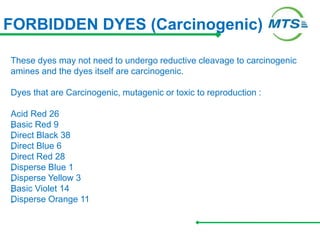
FORBIDDEN DYES (Carcinogenic)
These dyes may not need to undergo reductive cleavage to carcinogenic
amines and the dyes itself are carcinogenic.
Dyes that are Carcinogenic, mutagenic or toxic to reproduction :
Acid Red 26
„
Basic Red 9
„
Direct Black 38
„
Direct Blue 6
„
Direct Red 28
„
Disperse Blue 1
„
Disperse Yellow 3
„
Basic Violet 14
„
Disperse Orange 11
7
FORBIDDEN DYES – (Allergic)
Generally used to dye synthetic materials polyester and polyamide fibers and have a sensitizing
potential. A list of 22 dyes are prohibited as per OKO-TEX 100 spec.
„
Disperse Blue 1 Disperse Yellow 9
„
Disperse Yellow 39 Disperse Yellow 49
„
Disperse Orange 1 Disperse Orange 3
„
Disperse Orange 37/76 Disperse Brown 1
„
Disperse Red 1 Disperse Red 11
„
Disperse Red 17 Disperse Yellow 3
„
Disperse Blue 3 Disperse Blue 7
„
Disperse Blue 26 Disperse Blue 35
„
Disperse Blue 102 Disperse Blue 106
„
Disperse Blue 124 Disperse Yellow 1
„
Disperse Yellow 23 Disperse Orange 149
Failures: Accessories like Satin Tapes, Poly Blended Fabrics, Embroidery threads – Col. Black, Pink, Browns
Solution:
Nowadays there are disperse dyestuffs available in the market that are certified non-allergenic.
8
Formaldehyde
Usage
Formaldehyde resins can be used as glazing agents, dye-fixing,anti-creasing and anti-
shrinking agents in the finishing process and sometimes to improve color fastness.
Bonding agents used in dyeing and printing may also contain formaldehyde. The application of
formaldehyde primarily contains cotton, viscose, linen and their blends with synthetic fibers.
Tanning and re-tanning agent in leather goods
Hazard
Formaldehyde is irritating to tissues when it comes into direct contact with them. In addition,
formaldehyde is probably carcinogenic to humans.
Test Method : DIN EN ISO 14184-1:2011, ISO 17226-2-2008
Failures : Prints – Flock, Pigment Prints, Embroidery Backing, Non woven backing, Flets,
Pigment prints, Adhesives, Glues.
SOLUTION:
Technically possible to replace finishing agents by substances that comply with the standard.
Finishing for Class I products is still a problem, so avoid Formaldehyde finishing for Class I
products.
PHTHALATES
Usage
Phthalates are mainly used as plasticizers in PVC. Addition of plasticisers in various amounts
generates materials with an important versatility of properties that lead to the use of PVC.
Hazard
Certain Phthalates as well as their metabolites and degradation products can cause adverse
effects on human health in particular on liver and kidney.
TESTMETHOD: Solvent Extraction/CPSC-GC-MS
Failures: Flock Prints, Sticker Prints, Transfer Prints, Plastisole, High density prints,
Assessories like Sequins, PVC Decorative, PVDC, PU, Silicone, Soft Plastic, vinyl,
Synthetic Leather material, Antique/Enamel print Coating.
How to comply with the requirement:
Phthalate softener concentrations normally cover the range of 10% to 40%. Therefore:Avoid PVC
material and avoid PVC material softened with Phthalates
PCP Content
Usage
PentaChloro Phenol (PCP) is used as an active substance in algaecides, fungicides, disinfectants, in
leather protection and as a preservative agent.
They are used as wood preservatives, impregnation agent for textiles, bactericide in tanning and paper
pulp industries. PCP was one of the most used biocide in wood, textile, leather and paper industries.
Hazard
PCP is a very toxic substance. PCP and its salts are highly toxic for aquatic systems and are persistent in
the environment. PCP enters our body through breathing and skin contact.
PCP cause harmful effects on the liver, kidneys, blood, lungs, nervous system, immune system and
gastrointestinal tract.
Products containing PCP may form highly toxic substances when they are incinerated.
Test Method
Printed Polyester :LMBG B 82.02-08 plus
KOH Extn.
Textiles and leather :LMBG B 82.02-08
Failures: Polyester Prints, Finished Yarn dyed Checks – Multi, Linens, cols – White, Beige and
leather materials
Where they can be found?
Fungicide
Very often in leather products as Preservative
Natural fibres,natural/synthetic blends
Warp size and printing paste
TeCP Content
Usage
Tetrachlorophenol and its compounds are used in the preservation of wood; to
impregnate fibers in heavy duty textiles, clothing and furniture; as a bactericide in
tanning and the paper pulp industry; in pesticides and as a sterilizing agent.
Tetrachlorophenol can be used to prevent fungal growth and decay by bacteria. In textile
industry, TeCP is mostly used for preservation finishing.
Hazard
Possible carcinogen, harmful effects on liver, kidneys, blood, lungs and nervous system
on long term exposure to low concentration
Test Method
Printed Polyester :LMBG B 82.02-08
plus KOH Extn.)
Textiles and leather :LMBG B 82.02-08
Chromium (VI)
Usage
Chromium VI is generally produced by industrial processes. It is mainly used for chrome
plating,manufacture of dyes and pigments, leather tanning and wood preserving. It is
also find applications as pigments for floor covering products.
Hazard
A WHO determined that chromium VI is human carcinogen. Long term exposure to
chromium can increase the risk of lung cancer.Skin contact with certain chromium VI
compounds can cause skin ulcers.
Test Method: DIN 53314
SOLUTION:
The Chrome (VI) formation is a complicated chemical reaction, according to
research studies it can epend on the following factors:Fatliquoring agents
containing unsaturated fatty acids increased Chrome (VI) rmation. => Selection of
Fatliqors is important! Vegetable re-tanning agents decreased Chrome (VI)
formation in athers exposed to extreme heat and UVradiation.
ALKYL PHENOL AND ITS
ETHOXYLATES
USAGE:
APEO's or alkylphenylethoxylatyes (best known are NPEOs or nonylphenonlethoxylates) are a
group of organic substances composed of an alkyl group usually branched(nonyl,octyl) , phenyl ring
and a chain of ethoxy-group. Main usage of these subtances are in Textiles and leather as surface
active agents in different detergents, which may be used in production. Also as dispersing and
emulsifying agents in textile chemicals as well as impregnation agents in printing process
Compounds to be analysed: Nonyl Phenol(NP) Octyl Phenol(OP) Nonyl Phenol Ethoxylate(NPEO)
Octyl Phenol Ethoxylate(OPEO)
HAZARD:
The main characteristics of these substances are their persistence ( i.e. they are very difficult to
degrade in nature), and their hormone disruptive properties . NPEO's which contain 2-11 ethoxylate
groups are judged to be toxic to aquatic organisms.
Requirement:
According to directive 2003/53/EC , Limit for NPEO & NP is 0.1% by mass.
According to directive 2003/53/EC , alkylphenolethoxylates "Nonylphenol Ethoxylates (NPEO) &
Nonylphenol (NP)" are restricted in industrial processesAccording to Directive 67/548/EEC, no
alkylphenolethoxylates can be used in surfactants because it is classified as carcinogenic,
mutagenic .
Test method:
Solvent Extraction/ Analysis using LC-MS
POLYCYCLIC AROMATIC HYDROCARBONS
(PAH’S)
They are one of the most widespread organic pollutants.
In addition to their presence in fossil fuels they are also formed by incomplete
combustion of carbon-containing fuels such as wood, coal, diesel, fat,
tobacco, or incense PAH contaminations have been found in rubber but
also in various plastics.
Navy Blue
NAVY BLUE IS A DYE USED IN TEXTILE AND LEATHER.
SHORT CHAIN CHLORINATED PARAFFINS
USAGE:
SCCP are used as softeners in colors, lacquers, fitting materials, coatings. Also used
as flame retardant for plastics, carpet backing, plasticizers in rubber, paints, adhesives.
Minor uses are as a softening agent in leather industry, impregnation agent in textile
industry
HAZARD:
These compounds are toxic, skin irritant and potential pollution to the environment
Test method:
Solvent Extraction/Analysis using GC-MS
Requirement:
100mg/kg
PESTICIDES
USAGE:
Pesticides are used to kill or control harmful or undesirable organisms. 3 most
common type of banned pesticides are organochlorine pesticides, organophosphorous
and carbamates.
HAZARD:
These pesticides can be absorbed by human body through skin. These are
biooccumulative. Pesticides like BHC’s, DDT’s, Aldrin, Dieldrin, Carbaryl, Toxaphene.
Methoxychlor, etc are carcinogenic and can damage the liver and central nervous
system
Test method:
Solvent extraction/ Analysis using GC-MS, GC-ECD,LC-MS
Requirement (In direct contact with skin):
OKO-TEX 100 has listed 54 banned pesticides with requirement of 1 ppm (0.5ppm for
baby wear)
DIMETHYL FUMARATE
It is used by producers as a biocide to kill moulds that may cause
furniture or shoe leather to deteriorate during storage and transportation
in a humid climate.
DMFU IS WIDELY USED TO INHIBIT MOLD GROWING. THUS, IT
CAN BE ADDED ON OR ACCOMPANIED WITH
THE LEATHER PRODUCTS I.E. BOOTS, SHOES, BELT,
ACCESSORIES, AND FURNITURE …ETC FOR PREVENTING
MOLD GROWING WHILE THEY ARE IN STORAGE AND
TRANSPORT. DMFU IS A VOLATILE SUBSTANCE IN
NATURE WHICH MAKES IT LIKELY TO CONTAMINATE PRODUCTS
IN THE VICINITY AND PERMANENTLY
PERMEATE FINISHED PRODUCTS EXPOSED TO IT
FLAME RETARDANTS
USAGE:
Flame retardants are used in textiles and leathers to reduce their flammability
HAZARD:
These flame retardants can be absorbed by human body through skin. These are highly
persistent and are carcinogenic, reprotoxic and has effects on immune system and
nervous system
Test method:
Solvent extraction/ Analysis using GC-MS, LC-MS
Requirement :
TRIS, TEPA, PBB, Penta BDE, Octa BDE should not be used
Bisphenol-A
BPA IS A KEY MONOMER IN PRODUCTION OF POLYCARBONATE (PC)
PLASTIC AND EPOXY RESINS (I.E. POLYSULFONE). AND THEY ARE
COMMONLY USE ON FEEDING BOTTLES AND REUSABLE DRINKING
BOTTLES.
BPA-based plastic is clear and tough, and is used to make a variety of
common consumer goods (such as baby and water bottles, sports equipment,
and CDs and DVDs) and for industrial purposes, like lining water pipes.
 Epoxy resins containing BPA are used as coatings on the inside of many food
and beverage cans. It is also used in making thermal paper such as that used in
sales receipts
Benzene
USAGE:
BENZENE IS AN ORGANIC CHEMICAL COMPOUND AND A KNOWN
CARCINOGEN. IT IS A NATURAL CONSTITUENT OF CRUDE. IT IS AN
IMPORTANT INDUSTRIAL SOLVENT AND PRECURSOR IN THE
PRODUCTION OF DRUGS, PLASTICS, SYNTHETIC RUBBER, AND DYES.
HAZARD:
These compounds causes potential air pollution to the environment and health
hazards to people. Some solvents are highly toxic and carcinogenic solvents.
SOURCES:
They are used in batch dyeing of synthetic fibers to promote the absorption and
diffusion of dyes into the fibre under low temperature conditions.
Excellent Solvents for paints, glues, polymers:Benzene, Toluene,
Xylene, Methyl-ethyl-ketone (MEK)
SOLUTION:
Benzene should no longer be used on a technical scale! Water- based, Toluene-
free adhesive applications are available in the market! VOC are volatile, let them
evaporate from finished products before packaging!
LEAD
It is a soft, metal, also considered to be one of the heavy metals.
Lead is a poisonous metal that can damage nervous connections (especially
in young children)
Any Removable Charm, Beads, Chain, Link, Pendaint or other Attachment to
adult
Test Method:
follow CPSC-CH-E1003
CPSC-CH-E-1002
CPSC-CH-E-1001-08
Cadmium
Usage
Cadmium and cadmium compounds are used as dying agent (Particularly in the colors red,
orange,yellow and green). The prime use is in the manufacture of brilliant red, orange and yellow
pigments. Cadmium is still being used as pigment and stabilizer in plastics/PVC. Cadmium
regulation covers packaging materials, clothing, accessories, imitation leather
Hazard
A build up of cadmium in the kidney over prolonged period may result in kidney damage and
abnormal renal function.
Test Method :
EN 1122 (Plastic and Prints), US EPA 30505 OR 3051/ACID DIGESTION AND ICP ANALYSIS.
SOLUTION:
•Usage of certified raw materials!
•Recycled materials (for Logos!!) must be checked carefully!
Mercury
It is also called quicksilver is a heavy metal.
 Mercury is liquid at or near room temperature and pressure.
MERCURY IS USED PRIMARILY FOR THE MANUFACTURE OF
INDUSTRIAL CHEMICALS OR FOR ELECTRICAL
AND ELECTRONIC APPLICATIONS.
Mercury exposure at high levels can harm the brain, heart, kidneys, lungs
and immune system.
Test Method :
3051/ACID DIGESTION AND ICP ANALYSIS
Nickel Release
Usage
Nickel is a hard, silvery-white metal. Most Nickel is used to impart a range of
properties including durability, in preference to more expensive alternatives into a
range of products including jewellery, zips, straps, rivets, etc
NICKEL OFTEN COMBINED WITH OTHER METALS TO CREATE ALLOYS WITH
INCREASED HARDNESS AND RESISTANCE TO CORROSION
Hazard
Skin contact with metal containing Nickel as well as other metals plated with Nickel
such as jewelry etc. The most common adverse health effect of Nickel in human is an
allergic reaction to Nickel. The serious effect of Nickel is Cancer of lung and nasal
sinus.
The EU directive makes it illegal to sell a product which comes into prolonged contact
with skin and releases more than 0.5 mcg/cm²/week of Nickel
Method
EN 12472+EN 1811; or EN 12471
PERFLUORINATED CHEMICALS
They are organofluorine compounds and are often used as surfactants.
 Like other fluorocarbons it repels water.
 PFOS is the main ingredient in many stain repellent finishes.
Also used as: binder in non-woven fabrics to enhance dyeing; wetting agents to
improve coverage and penetration of substances; achieve finish-on-yarn
uniformity; water resistance; oil resistant coatings on textiles, leather, and other
materials.
These chemicals are persistent, bioaccumulative and poisonous to mammals.
Heavy metals
USAGE:
Heavymetals are found in dyestuffs and can be used as dye-fixationagents. They also occur in
natural fibres like cotton as the plants can absorb the heavymetals from soil.
HAZARD:
These heavymetals can be absorbed by human body throught perspiration. These are
biooccumulative. Some of the elements are toxic, carcinogen, can affect the central nervous
system, immune system and kidneys.
Test method:
Extraction using Acidic perspiration solution prepared as ISO 105 E04/ Analysis by ICP-MS
Requirement (In direct contact with skin):
Antimony(30ppm), Arsenic(1ppm), Lead(1ppm), Chromium(2ppm), Cobalt(2ppm),
Copper(50ppm), Nickel(4ppm), Mercury(0.02ppm), Cadmium(0.1ppm)
The above requirement varies for baby wear, in direct contact with skin, with no direct contact with
skin and decoration material
Solvent Content
USAGE:
VOC’s are often used as solvents in many industrial processes, especially in the
printing, dying and surface finishing processes organic chemicals with low
boiling points, typically below 200 o C, and high vapor pressure, strong, peculiar
and “non-product specific”
HAZARD:
These compounds causes potential air pollution to the environment and health
hazards to people. Some solvents are highly toxic and carcinogenic solvents.
SOURCES:
They are used in batch dyeing of synthetic fibers to promote the absorption and
diffusion of dyes into the fibre under low temperature conditions.
Excellent Solvents for paints, glues, polymers:Benzene, Toluene,
Xylene, Methyl-ethyl-ketone (MEK)
SOLUTION:
Benzene should no longer be used on a technical scale! Water- based, Toluene-
free adhesive applications are available in the market! VOC are volatile, let them
evaporate from finished products before packaging!
Thank You

Qindau ppt1_modern testing service india

  • 2.
  • 3.
    Restricted Substances List(RSL) • Typical Test Parameters of RSL for Textile & Footwear: Azo Dyes Flame Retardants (FR) Formaldehyde Bisphenol-A Phthalate Benzene Tetrachlorophenol (TECP) Lead Chromium VI Cadmium Nonylphenol & NonylPhenol Ethoxylates- (NP & NPEO) Mercury Polyaromatichydrocarbons (PAH) Nickel Release Navy Blue Perfluorooctane Short Chain Chloroparaffins (C10-C13)-SCCP Total Heavy Metal Pesticides Solvent Content Dimethyl Fumarate (DMFU)
  • 4.
    AZO DYES Azo dyesare one of the commonly used chemical classes of dyestuffs „ Azo dyes allow colours with outstanding fastness. „ About 60-70% of the dyes used nowadays are azo dyes. „ About 5 % of the garments tested in our labs contain forbidden amines: •dark blue, red, orange and black colors, •printings, very often red, black, brown colours Some of these dyes are proven or suspected carcinogenic. „ A list of 22 amines classified by the EU or the MAK Commission as human carcinogens „ The use of azo dyes that may cleave to one of the 22 potentially carcinogenic aromatic amines are banned according to the 19th amendment of Directive 76/769/EEC on dangerous substances. Also as per EU 2002/61 TEST METHOD: EN 14362-1 :2012,LFGB 64B.82.02.9 & ISO/TS 17234 (Leather) „ Failures on Tie&Dye articles, Accessories like Embroidery Threads, Tapes, Laces, Twill tapes, Prints, Col.s like – Black, Pink, Olive, Red, Browns „ Solution:There are dyestuffs available in the market which do not release any of the listed aromatic amines.
  • 5.
    AZO DYES Azo dyesshall not be used that may cleave to any one of the following aromatic amines „ 4-AMINOBIPHENYL 4,4 METHYLEN-BIS-(2- CHLORANILIN) 4,4' METHYLENE DI O TOLUIDINE 5 METHYL O ANISIDINE „ BENZIDINE 4,4'-OXYDIANILINE „ 4-CHLOR-O-TOLUIDINE 4,4'-THIODIANILINE „ 2-NAPHTHYLAMINE O-TOLUIDINE „ P-CHLORANILINE TOLUYLENE 2,4 DIAMINE „ 4-METHOXY-M-PHENYLENEDIAMINE 2,4,5-TRIMETHYLANILINE „ 4,4' METHYLENEDIANILINE *O-AMINOAZOTOLUENE „ 3,3'-DICHLOROBENZIDINE 5-NITRO-O-TOLUIDINE „ 3,3'-DIMETHOXYBENZIDINE 4-AMINO AZO BENZENE „ 3,3'-DIMETHYLBENZIDINE O-ANISIDINE
  • 6.
    FORBIDDEN DYES (Carcinogenic) Thesedyes may not need to undergo reductive cleavage to carcinogenic amines and the dyes itself are carcinogenic. Dyes that are Carcinogenic, mutagenic or toxic to reproduction : Acid Red 26 „ Basic Red 9 „ Direct Black 38 „ Direct Blue 6 „ Direct Red 28 „ Disperse Blue 1 „ Disperse Yellow 3 „ Basic Violet 14 „ Disperse Orange 11
  • 7.
    7 FORBIDDEN DYES –(Allergic) Generally used to dye synthetic materials polyester and polyamide fibers and have a sensitizing potential. A list of 22 dyes are prohibited as per OKO-TEX 100 spec. „ Disperse Blue 1 Disperse Yellow 9 „ Disperse Yellow 39 Disperse Yellow 49 „ Disperse Orange 1 Disperse Orange 3 „ Disperse Orange 37/76 Disperse Brown 1 „ Disperse Red 1 Disperse Red 11 „ Disperse Red 17 Disperse Yellow 3 „ Disperse Blue 3 Disperse Blue 7 „ Disperse Blue 26 Disperse Blue 35 „ Disperse Blue 102 Disperse Blue 106 „ Disperse Blue 124 Disperse Yellow 1 „ Disperse Yellow 23 Disperse Orange 149 Failures: Accessories like Satin Tapes, Poly Blended Fabrics, Embroidery threads – Col. Black, Pink, Browns Solution: Nowadays there are disperse dyestuffs available in the market that are certified non-allergenic.
  • 8.
    8 Formaldehyde Usage Formaldehyde resins canbe used as glazing agents, dye-fixing,anti-creasing and anti- shrinking agents in the finishing process and sometimes to improve color fastness. Bonding agents used in dyeing and printing may also contain formaldehyde. The application of formaldehyde primarily contains cotton, viscose, linen and their blends with synthetic fibers. Tanning and re-tanning agent in leather goods Hazard Formaldehyde is irritating to tissues when it comes into direct contact with them. In addition, formaldehyde is probably carcinogenic to humans. Test Method : DIN EN ISO 14184-1:2011, ISO 17226-2-2008 Failures : Prints – Flock, Pigment Prints, Embroidery Backing, Non woven backing, Flets, Pigment prints, Adhesives, Glues. SOLUTION: Technically possible to replace finishing agents by substances that comply with the standard. Finishing for Class I products is still a problem, so avoid Formaldehyde finishing for Class I products.
  • 9.
    PHTHALATES Usage Phthalates are mainlyused as plasticizers in PVC. Addition of plasticisers in various amounts generates materials with an important versatility of properties that lead to the use of PVC. Hazard Certain Phthalates as well as their metabolites and degradation products can cause adverse effects on human health in particular on liver and kidney. TESTMETHOD: Solvent Extraction/CPSC-GC-MS Failures: Flock Prints, Sticker Prints, Transfer Prints, Plastisole, High density prints, Assessories like Sequins, PVC Decorative, PVDC, PU, Silicone, Soft Plastic, vinyl, Synthetic Leather material, Antique/Enamel print Coating. How to comply with the requirement: Phthalate softener concentrations normally cover the range of 10% to 40%. Therefore:Avoid PVC material and avoid PVC material softened with Phthalates
  • 10.
    PCP Content Usage PentaChloro Phenol(PCP) is used as an active substance in algaecides, fungicides, disinfectants, in leather protection and as a preservative agent. They are used as wood preservatives, impregnation agent for textiles, bactericide in tanning and paper pulp industries. PCP was one of the most used biocide in wood, textile, leather and paper industries. Hazard PCP is a very toxic substance. PCP and its salts are highly toxic for aquatic systems and are persistent in the environment. PCP enters our body through breathing and skin contact. PCP cause harmful effects on the liver, kidneys, blood, lungs, nervous system, immune system and gastrointestinal tract. Products containing PCP may form highly toxic substances when they are incinerated. Test Method Printed Polyester :LMBG B 82.02-08 plus KOH Extn. Textiles and leather :LMBG B 82.02-08 Failures: Polyester Prints, Finished Yarn dyed Checks – Multi, Linens, cols – White, Beige and leather materials Where they can be found? Fungicide Very often in leather products as Preservative Natural fibres,natural/synthetic blends Warp size and printing paste
  • 11.
    TeCP Content Usage Tetrachlorophenol andits compounds are used in the preservation of wood; to impregnate fibers in heavy duty textiles, clothing and furniture; as a bactericide in tanning and the paper pulp industry; in pesticides and as a sterilizing agent. Tetrachlorophenol can be used to prevent fungal growth and decay by bacteria. In textile industry, TeCP is mostly used for preservation finishing. Hazard Possible carcinogen, harmful effects on liver, kidneys, blood, lungs and nervous system on long term exposure to low concentration Test Method Printed Polyester :LMBG B 82.02-08 plus KOH Extn.) Textiles and leather :LMBG B 82.02-08
  • 12.
    Chromium (VI) Usage Chromium VIis generally produced by industrial processes. It is mainly used for chrome plating,manufacture of dyes and pigments, leather tanning and wood preserving. It is also find applications as pigments for floor covering products. Hazard A WHO determined that chromium VI is human carcinogen. Long term exposure to chromium can increase the risk of lung cancer.Skin contact with certain chromium VI compounds can cause skin ulcers. Test Method: DIN 53314 SOLUTION: The Chrome (VI) formation is a complicated chemical reaction, according to research studies it can epend on the following factors:Fatliquoring agents containing unsaturated fatty acids increased Chrome (VI) rmation. => Selection of Fatliqors is important! Vegetable re-tanning agents decreased Chrome (VI) formation in athers exposed to extreme heat and UVradiation.

  • 13.
    ALKYL PHENOL ANDITS ETHOXYLATES USAGE: APEO's or alkylphenylethoxylatyes (best known are NPEOs or nonylphenonlethoxylates) are a group of organic substances composed of an alkyl group usually branched(nonyl,octyl) , phenyl ring and a chain of ethoxy-group. Main usage of these subtances are in Textiles and leather as surface active agents in different detergents, which may be used in production. Also as dispersing and emulsifying agents in textile chemicals as well as impregnation agents in printing process Compounds to be analysed: Nonyl Phenol(NP) Octyl Phenol(OP) Nonyl Phenol Ethoxylate(NPEO) Octyl Phenol Ethoxylate(OPEO) HAZARD: The main characteristics of these substances are their persistence ( i.e. they are very difficult to degrade in nature), and their hormone disruptive properties . NPEO's which contain 2-11 ethoxylate groups are judged to be toxic to aquatic organisms. Requirement: According to directive 2003/53/EC , Limit for NPEO & NP is 0.1% by mass. According to directive 2003/53/EC , alkylphenolethoxylates "Nonylphenol Ethoxylates (NPEO) & Nonylphenol (NP)" are restricted in industrial processesAccording to Directive 67/548/EEC, no alkylphenolethoxylates can be used in surfactants because it is classified as carcinogenic, mutagenic . Test method: Solvent Extraction/ Analysis using LC-MS
  • 14.
    POLYCYCLIC AROMATIC HYDROCARBONS (PAH’S) Theyare one of the most widespread organic pollutants. In addition to their presence in fossil fuels they are also formed by incomplete combustion of carbon-containing fuels such as wood, coal, diesel, fat, tobacco, or incense PAH contaminations have been found in rubber but also in various plastics.
  • 15.
    Navy Blue NAVY BLUEIS A DYE USED IN TEXTILE AND LEATHER.
  • 16.
    SHORT CHAIN CHLORINATEDPARAFFINS USAGE: SCCP are used as softeners in colors, lacquers, fitting materials, coatings. Also used as flame retardant for plastics, carpet backing, plasticizers in rubber, paints, adhesives. Minor uses are as a softening agent in leather industry, impregnation agent in textile industry HAZARD: These compounds are toxic, skin irritant and potential pollution to the environment Test method: Solvent Extraction/Analysis using GC-MS Requirement: 100mg/kg
  • 17.
    PESTICIDES USAGE: Pesticides are usedto kill or control harmful or undesirable organisms. 3 most common type of banned pesticides are organochlorine pesticides, organophosphorous and carbamates. HAZARD: These pesticides can be absorbed by human body through skin. These are biooccumulative. Pesticides like BHC’s, DDT’s, Aldrin, Dieldrin, Carbaryl, Toxaphene. Methoxychlor, etc are carcinogenic and can damage the liver and central nervous system Test method: Solvent extraction/ Analysis using GC-MS, GC-ECD,LC-MS Requirement (In direct contact with skin): OKO-TEX 100 has listed 54 banned pesticides with requirement of 1 ppm (0.5ppm for baby wear)
  • 18.
    DIMETHYL FUMARATE It isused by producers as a biocide to kill moulds that may cause furniture or shoe leather to deteriorate during storage and transportation in a humid climate. DMFU IS WIDELY USED TO INHIBIT MOLD GROWING. THUS, IT CAN BE ADDED ON OR ACCOMPANIED WITH THE LEATHER PRODUCTS I.E. BOOTS, SHOES, BELT, ACCESSORIES, AND FURNITURE …ETC FOR PREVENTING MOLD GROWING WHILE THEY ARE IN STORAGE AND TRANSPORT. DMFU IS A VOLATILE SUBSTANCE IN NATURE WHICH MAKES IT LIKELY TO CONTAMINATE PRODUCTS IN THE VICINITY AND PERMANENTLY PERMEATE FINISHED PRODUCTS EXPOSED TO IT
  • 19.
    FLAME RETARDANTS USAGE: Flame retardantsare used in textiles and leathers to reduce their flammability HAZARD: These flame retardants can be absorbed by human body through skin. These are highly persistent and are carcinogenic, reprotoxic and has effects on immune system and nervous system Test method: Solvent extraction/ Analysis using GC-MS, LC-MS Requirement : TRIS, TEPA, PBB, Penta BDE, Octa BDE should not be used
  • 20.
    Bisphenol-A BPA IS AKEY MONOMER IN PRODUCTION OF POLYCARBONATE (PC) PLASTIC AND EPOXY RESINS (I.E. POLYSULFONE). AND THEY ARE COMMONLY USE ON FEEDING BOTTLES AND REUSABLE DRINKING BOTTLES. BPA-based plastic is clear and tough, and is used to make a variety of common consumer goods (such as baby and water bottles, sports equipment, and CDs and DVDs) and for industrial purposes, like lining water pipes.  Epoxy resins containing BPA are used as coatings on the inside of many food and beverage cans. It is also used in making thermal paper such as that used in sales receipts
  • 21.
    Benzene USAGE: BENZENE IS ANORGANIC CHEMICAL COMPOUND AND A KNOWN CARCINOGEN. IT IS A NATURAL CONSTITUENT OF CRUDE. IT IS AN IMPORTANT INDUSTRIAL SOLVENT AND PRECURSOR IN THE PRODUCTION OF DRUGS, PLASTICS, SYNTHETIC RUBBER, AND DYES. HAZARD: These compounds causes potential air pollution to the environment and health hazards to people. Some solvents are highly toxic and carcinogenic solvents. SOURCES: They are used in batch dyeing of synthetic fibers to promote the absorption and diffusion of dyes into the fibre under low temperature conditions. Excellent Solvents for paints, glues, polymers:Benzene, Toluene, Xylene, Methyl-ethyl-ketone (MEK) SOLUTION: Benzene should no longer be used on a technical scale! Water- based, Toluene- free adhesive applications are available in the market! VOC are volatile, let them evaporate from finished products before packaging!
  • 22.
    LEAD It is asoft, metal, also considered to be one of the heavy metals. Lead is a poisonous metal that can damage nervous connections (especially in young children) Any Removable Charm, Beads, Chain, Link, Pendaint or other Attachment to adult Test Method: follow CPSC-CH-E1003 CPSC-CH-E-1002 CPSC-CH-E-1001-08
  • 23.
    Cadmium Usage Cadmium and cadmiumcompounds are used as dying agent (Particularly in the colors red, orange,yellow and green). The prime use is in the manufacture of brilliant red, orange and yellow pigments. Cadmium is still being used as pigment and stabilizer in plastics/PVC. Cadmium regulation covers packaging materials, clothing, accessories, imitation leather Hazard A build up of cadmium in the kidney over prolonged period may result in kidney damage and abnormal renal function. Test Method : EN 1122 (Plastic and Prints), US EPA 30505 OR 3051/ACID DIGESTION AND ICP ANALYSIS. SOLUTION: •Usage of certified raw materials! •Recycled materials (for Logos!!) must be checked carefully!
  • 24.
    Mercury It is alsocalled quicksilver is a heavy metal.  Mercury is liquid at or near room temperature and pressure. MERCURY IS USED PRIMARILY FOR THE MANUFACTURE OF INDUSTRIAL CHEMICALS OR FOR ELECTRICAL AND ELECTRONIC APPLICATIONS. Mercury exposure at high levels can harm the brain, heart, kidneys, lungs and immune system. Test Method : 3051/ACID DIGESTION AND ICP ANALYSIS
  • 25.
    Nickel Release Usage Nickel isa hard, silvery-white metal. Most Nickel is used to impart a range of properties including durability, in preference to more expensive alternatives into a range of products including jewellery, zips, straps, rivets, etc NICKEL OFTEN COMBINED WITH OTHER METALS TO CREATE ALLOYS WITH INCREASED HARDNESS AND RESISTANCE TO CORROSION Hazard Skin contact with metal containing Nickel as well as other metals plated with Nickel such as jewelry etc. The most common adverse health effect of Nickel in human is an allergic reaction to Nickel. The serious effect of Nickel is Cancer of lung and nasal sinus. The EU directive makes it illegal to sell a product which comes into prolonged contact with skin and releases more than 0.5 mcg/cm²/week of Nickel Method EN 12472+EN 1811; or EN 12471
  • 26.
    PERFLUORINATED CHEMICALS They areorganofluorine compounds and are often used as surfactants.  Like other fluorocarbons it repels water.  PFOS is the main ingredient in many stain repellent finishes. Also used as: binder in non-woven fabrics to enhance dyeing; wetting agents to improve coverage and penetration of substances; achieve finish-on-yarn uniformity; water resistance; oil resistant coatings on textiles, leather, and other materials. These chemicals are persistent, bioaccumulative and poisonous to mammals.
  • 27.
    Heavy metals USAGE: Heavymetals arefound in dyestuffs and can be used as dye-fixationagents. They also occur in natural fibres like cotton as the plants can absorb the heavymetals from soil. HAZARD: These heavymetals can be absorbed by human body throught perspiration. These are biooccumulative. Some of the elements are toxic, carcinogen, can affect the central nervous system, immune system and kidneys. Test method: Extraction using Acidic perspiration solution prepared as ISO 105 E04/ Analysis by ICP-MS Requirement (In direct contact with skin): Antimony(30ppm), Arsenic(1ppm), Lead(1ppm), Chromium(2ppm), Cobalt(2ppm), Copper(50ppm), Nickel(4ppm), Mercury(0.02ppm), Cadmium(0.1ppm) The above requirement varies for baby wear, in direct contact with skin, with no direct contact with skin and decoration material
  • 28.
    Solvent Content USAGE: VOC’s areoften used as solvents in many industrial processes, especially in the printing, dying and surface finishing processes organic chemicals with low boiling points, typically below 200 o C, and high vapor pressure, strong, peculiar and “non-product specific” HAZARD: These compounds causes potential air pollution to the environment and health hazards to people. Some solvents are highly toxic and carcinogenic solvents. SOURCES: They are used in batch dyeing of synthetic fibers to promote the absorption and diffusion of dyes into the fibre under low temperature conditions. Excellent Solvents for paints, glues, polymers:Benzene, Toluene, Xylene, Methyl-ethyl-ketone (MEK) SOLUTION: Benzene should no longer be used on a technical scale! Water- based, Toluene- free adhesive applications are available in the market! VOC are volatile, let them evaporate from finished products before packaging!
  • 29.