Equivalent Ratios andTables
Students will be able to:
Write equivalent ratios.
Determine the unknown terms in equivalent ratios and
tables.
Plot equivalent ratios in a coordinate plane.
3.
Equivalent Ratios andTables
Key Vocabulary:
Ratio
Equivalent Ratio
Ratio Table
Scale Up/Down
Coordinate Plane
4.
Equivalent Ratios
Remember thata ratio is a comparison of two quantities
and each ratio can be written in another way.
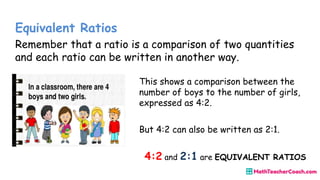
This shows a comparison between the
number of boys to the number of girls,
expressed as 4:2.
But 4:2 can also be written as 2:1.
4:2 and 2:1 are EQUIVALENT RATIOS
5.
How do wewrite equivalent ratios?
Equivalent ratios can be determined by SCALING
UP or SCALING DOWN a ratio.
6.
SCALING UP ARATIO
We scale up a ratio by a scale factor, which
means multiplying each term of the ratio by a
given scale factor.
Sample Problem 1:
Whichamong the following is an equivalent
ratio of 3:5? Give all possible answers.
a. 6:15 b. 9:10 c. 6:10
d. 12:20 e. 45:75
11.
Sample Problem 2:
Whichamong the following is an equivalent
ratio of 36:18? Give all possible answers.
a. 1:2 b. 4:2 c. 2:1
d. 12:6 e. 6:12
12.
Finding the UnknownTerm in Equivalent Ratios
Example: Find the unknown term in the equivalent
ratios 12:16 and 6:x
13.
Method 1:
Step 1:Express the equivalent ratios as fractions.
Step 2: Cross multiply
12x = 96
Step 3: Solve for the unknown
X = 8
14.
Method 2:
Step 1:Equate the equivalent ratios
12:16 = 6:x
Step 2: Multiply the inner terms and the outer terms.
12 : 16 = 6 : x
Here, 16 and 6 are the inner terms and 12 and x are the outer terms.
(12)(x) = (16)(6)
12x = 96
X = 8
Method 1:
Step 1:Express the equivalent ratios as fractions.
Step 2: Cross multiply
225 = 5X
Step 3: Solve for the unknown
45 = X
21.
Method 2:
Step 1:Equate the equivalent ratios
12:16 = 6:x
Step 2: Multiply the inner terms and the outer terms.
12 : 16 = 6 : x
Here, 16 and 6 are the inner terms and 12 and x are the outer terms.
(12)(x) = (16)(6)
12x = 96
X = 8