In what ways does your media product
 use, develop or challenge forms and
 conventions of real media products?


            By Saskia Calliste
Theorists/Theories Applied to Our Music Video


Andrew Goodwin has several theories in relations to the conventions of music
videos. Our music video uses, develops and challenges certain conventions of
music videos for the specific genre that we have chosen. One being that the
narrative is rarely complete. This where our music video especially develops
conventions as we complete the majority if not all of our narrative while just
leaving the fate of the three characters to interpretation.
Our music video in some ways develops the conventions of Steve Archer in
relation to cutting between narrative and performance. Although in the
performance shots in our video a band is not present, we do use close ups of
the lip syncing.
Simon Frith's 3 typologies of performance, narrative and conceptual are all
present in our music video. The one we explored the most was the narrative
which coincides with Goodwin's relationship between the lyrics and the
visuals. The conceptual typology is shown the least in our video but is shown
through the character of the ominous attacker who you do not see throughout
the whole video. In one scene you see a controlling hand who is supposed to be
the ominous male character but the whole male presence in the video is a
How We Use Conventions?

Our music product uses certain conventions of typical music videos for
the genre like the choice of song. It is common in the pop/hip-hop genre
to have singing mixed with rapping. In this respect we also challenge
conventions by not seeing the rapper rap on those parts of the song
and have instead swapped them for the narrative. Goodwin states
that there is a relationship between the visuals and the lyrics,
which we have allowed to happen through the substitutions of
the rap for the narrative. The only artist you see is who we
appointed as the main artist where she sings the chorus and bridges
and who you sees many close-ups of during and after the narrative. We
have challenged conventions by allowing the chorus artist to take full
responsibility of the song to the extent of having it on the album which
we display later on the Digipak. Another way we develop conventions is
through the style of artist that we chose. The fact that part of the song is
sung by a choir, their voices went with the image of the artist we chose.
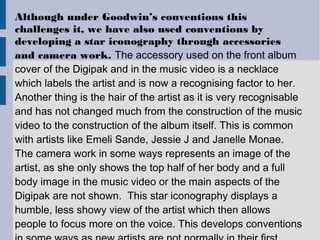
Although under Goodwin’s conventions this
challenges it, we have also used conventions by
developing a star iconography through accessories
and camera work. The accessory used on the front album
cover of the Digipak and in the music video is a necklace
which labels the artist and is now a recognising factor to her.
Another thing is the hair of the artist as it is very recognisable
and has not changed much from the construction of the music
video to the construction of the album itself. This is common
with artists like Emeli Sande, Jessie J and Janelle Monae.
The camera work in some ways represents an image of the
artist, as she only shows the top half of her body and a full
body image in the music video or the main aspects of the
Digipak are not shown. This star iconography displays a
humble, less showy view of the artist which then allows
people to focus more on the voice. This develops conventions
How We Develop/Challenge Conventions?


Using a song where the rap is the dominant feature of the song, we have
developed conventions by using the rap portion of the song to portray the
narrative and having the contributing artist take full responsibility for the song.
We portray this by only show the artist when the singing parts come on; this is
expressed further on the Digipak, where we pass the song of as the artists own
and say that the rapper on the track is the feature.
Another way we have developed conventions is simply by using a narrative.
Although this is not completely uncommon, it’s quite uncommon for the narrative
of a song to be followed word by word especially in the pop/hip-hop genre. The
fact that the narrative is on quite a serious issue, this is also uncommon with 21 st
century music in the charts as they normally contain meanings of love, sex,
drugs and dancing in clubs with women. Women are normally a main feature of
many music videos in the genre. Although our music video contains women,
they are portrayed in a very different way. Under the theories of Goodwin,
he states that reference to voyeurism is present, particularly in the
portrayal of women. The portrayal of women in our genre shows them us
vulnerable and easily manipulated. This is how our video challenges
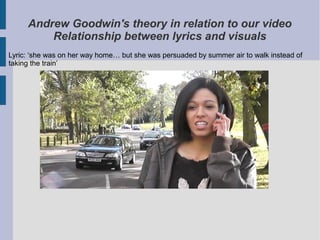
Andrew Goodwin's theory in relation to our video
         Relationship between lyrics and visuals
Lyric: ‘she was on her way home… but she was persuaded by summer air to walk instead of
taking the train’
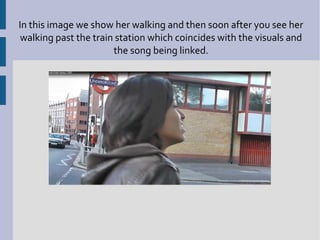
In this image we show her walking and then soon after you see her
 walking past the train station which coincides with the visuals and
                       the song being linked.
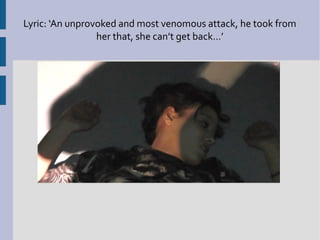
Lyric: ‘An unprovoked and most venomous attack, he took from
                 her that, she can’t get back…’
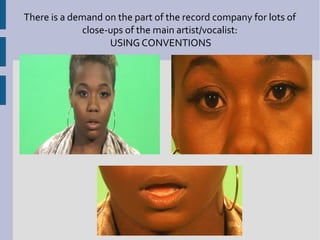
There is a demand on the part of the record company for lots of
             close-ups of the main artist/vocalist:
                   USING CONVENTIONS
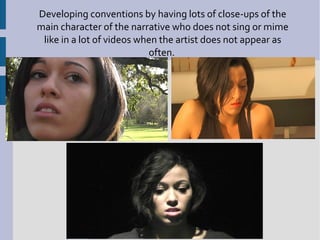
Developing conventions by having lots of close-ups of the
main character of the narrative who does not sing or mime
 like in a lot of videos when the artist does not appear as
                           often.
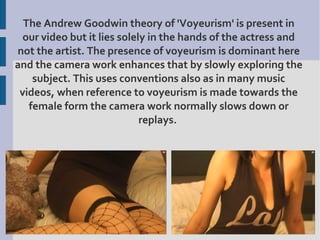
The Andrew Goodwin theory of 'Voyeurism' is present in
  our video but it lies solely in the hands of the actress and
not the artist. The presence of voyeurism is dominant here
and the camera work enhances that by slowly exploring the
    subject. This uses conventions also as in many music
 videos, when reference to voyeurism is made towards the
   female form the camera work normally slows down or
                             replays.

Q1

  • 1.
    In what waysdoes your media product use, develop or challenge forms and conventions of real media products? By Saskia Calliste
  • 2.
    Theorists/Theories Applied toOur Music Video Andrew Goodwin has several theories in relations to the conventions of music videos. Our music video uses, develops and challenges certain conventions of music videos for the specific genre that we have chosen. One being that the narrative is rarely complete. This where our music video especially develops conventions as we complete the majority if not all of our narrative while just leaving the fate of the three characters to interpretation. Our music video in some ways develops the conventions of Steve Archer in relation to cutting between narrative and performance. Although in the performance shots in our video a band is not present, we do use close ups of the lip syncing. Simon Frith's 3 typologies of performance, narrative and conceptual are all present in our music video. The one we explored the most was the narrative which coincides with Goodwin's relationship between the lyrics and the visuals. The conceptual typology is shown the least in our video but is shown through the character of the ominous attacker who you do not see throughout the whole video. In one scene you see a controlling hand who is supposed to be the ominous male character but the whole male presence in the video is a
  • 3.
    How We UseConventions? Our music product uses certain conventions of typical music videos for the genre like the choice of song. It is common in the pop/hip-hop genre to have singing mixed with rapping. In this respect we also challenge conventions by not seeing the rapper rap on those parts of the song and have instead swapped them for the narrative. Goodwin states that there is a relationship between the visuals and the lyrics, which we have allowed to happen through the substitutions of the rap for the narrative. The only artist you see is who we appointed as the main artist where she sings the chorus and bridges and who you sees many close-ups of during and after the narrative. We have challenged conventions by allowing the chorus artist to take full responsibility of the song to the extent of having it on the album which we display later on the Digipak. Another way we develop conventions is through the style of artist that we chose. The fact that part of the song is sung by a choir, their voices went with the image of the artist we chose.
  • 4.
    Although under Goodwin’sconventions this challenges it, we have also used conventions by developing a star iconography through accessories and camera work. The accessory used on the front album cover of the Digipak and in the music video is a necklace which labels the artist and is now a recognising factor to her. Another thing is the hair of the artist as it is very recognisable and has not changed much from the construction of the music video to the construction of the album itself. This is common with artists like Emeli Sande, Jessie J and Janelle Monae. The camera work in some ways represents an image of the artist, as she only shows the top half of her body and a full body image in the music video or the main aspects of the Digipak are not shown. This star iconography displays a humble, less showy view of the artist which then allows people to focus more on the voice. This develops conventions
  • 5.
    How We Develop/ChallengeConventions? Using a song where the rap is the dominant feature of the song, we have developed conventions by using the rap portion of the song to portray the narrative and having the contributing artist take full responsibility for the song. We portray this by only show the artist when the singing parts come on; this is expressed further on the Digipak, where we pass the song of as the artists own and say that the rapper on the track is the feature. Another way we have developed conventions is simply by using a narrative. Although this is not completely uncommon, it’s quite uncommon for the narrative of a song to be followed word by word especially in the pop/hip-hop genre. The fact that the narrative is on quite a serious issue, this is also uncommon with 21 st century music in the charts as they normally contain meanings of love, sex, drugs and dancing in clubs with women. Women are normally a main feature of many music videos in the genre. Although our music video contains women, they are portrayed in a very different way. Under the theories of Goodwin, he states that reference to voyeurism is present, particularly in the portrayal of women. The portrayal of women in our genre shows them us vulnerable and easily manipulated. This is how our video challenges
  • 6.
    Andrew Goodwin's theoryin relation to our video Relationship between lyrics and visuals Lyric: ‘she was on her way home… but she was persuaded by summer air to walk instead of taking the train’
  • 7.
    In this imagewe show her walking and then soon after you see her walking past the train station which coincides with the visuals and the song being linked.
  • 8.
    Lyric: ‘An unprovokedand most venomous attack, he took from her that, she can’t get back…’
  • 9.
    There is ademand on the part of the record company for lots of close-ups of the main artist/vocalist: USING CONVENTIONS
  • 10.
    Developing conventions byhaving lots of close-ups of the main character of the narrative who does not sing or mime like in a lot of videos when the artist does not appear as often.
  • 11.
    The Andrew Goodwintheory of 'Voyeurism' is present in our video but it lies solely in the hands of the actress and not the artist. The presence of voyeurism is dominant here and the camera work enhances that by slowly exploring the subject. This uses conventions also as in many music videos, when reference to voyeurism is made towards the female form the camera work normally slows down or replays.