STRINGS
Represents a sequence of characters.
• Expressions creating strings:
 This is a string.
 This is a string.
"This is a string."
'This is a string.'
"""This is a
string covering
multiple lines."""
 This is a
string covering
multiple lines.
• The + operator can be used to concatenate strings:
 This is a string!
+
"This is " 'a string!'
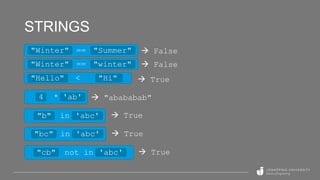
STRINGS
==
"Winter" "Summer"  False
==
"Winter" "winter"
<
"Hello" "Hi"
 False
 True
*
4 'ab'  "abababab"
in
"b" 'abc'  True
in
"bc" 'abc'  True
not in
"cb" 'abc'  True
STRINGS ARE SEQUENCES
A string is a sequence of characters.
• Each character in the string has an index.
abc a b c
=
0 1 2
Index:
• Expression retrieving a character at specified index:
[ ]
<str-expr> <index-expr>
"abc"[0]
"abc"[1]
"abc"[2]
 a
 b
 c
len("abc")  3
-3 -2 -1
ITERATING OVER STRINGS
name = "Alice"
for i in range(len(name)):
print(str(i) +" "+ name[i])
A
l
i
c
e
name = "Alice"
for c in name:
print(c)
0 A
1 l
2 i
3 c
4 e
EXAMPLE
reverse("abc")  cba
reverse("12345")  54321
def reverse(string):
reversed = ""
for c in string:
reversed = c + reversed
return reversed
def sum(numbers):
sum = 0
for n in numbers:
sum = sum + n
return sum
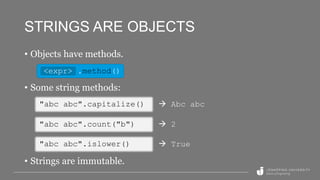
STRINGS ARE OBJECTS
• Objects have methods.
.method()
<expr>
• Some string methods:
"abc abc".capitalize()
"abc abc".count("b")
"abc abc".islower()
 Abc abc
 2
 True
• Strings are immutable.
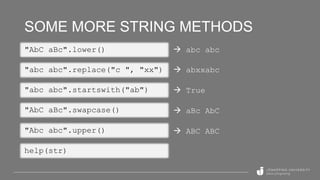
SOME MORE STRING METHODS
"AbC aBc".lower()
"abc abc".replace("c ", "xx")
"abc abc".startswith("ab")
"AbC aBc".swapcase()
"Abc abc".upper()
 abc abc
 abxxabc
 True
 aBc AbC
 ABC ABC
help(str)
SLICING
Extracting a sub sequence of a sequence.
[: ]
<seq-expr> <expr>
[:]
<seq-expr>
name = "Alice"
 "Alice"
name[:]
[ :]
<seq-expr> <expr>
 "ice"
name[2:]
 "Al"
name[:2]
Indexes: 01234
SLICING
Extracting a sub sequence of a sequence.
[ : ]
<seq-expr> <expr> <expr>
name[1:3]  "li"
[ : : ]
<seq-expr> <expr> <expr>
name[1:4:2]  "lc"
<expr>
name[::2]  "Aie"
name[2::2]  "ie"
name[-2::]  "ce"
name[3:1:-1]  "ci"
name[::-1]  "ecilA"
name = "Alice"
Indexes: 01234

python-strings.pptx

  • 1.
    STRINGS Represents a sequenceof characters. • Expressions creating strings:  This is a string.  This is a string. "This is a string." 'This is a string.' """This is a string covering multiple lines."""  This is a string covering multiple lines. • The + operator can be used to concatenate strings:  This is a string! + "This is " 'a string!'
  • 2.
    STRINGS == "Winter" "Summer" False == "Winter" "winter" < "Hello" "Hi"  False  True * 4 'ab'  "abababab" in "b" 'abc'  True in "bc" 'abc'  True not in "cb" 'abc'  True
  • 3.
    STRINGS ARE SEQUENCES Astring is a sequence of characters. • Each character in the string has an index. abc a b c = 0 1 2 Index: • Expression retrieving a character at specified index: [ ] <str-expr> <index-expr> "abc"[0] "abc"[1] "abc"[2]  a  b  c len("abc")  3 -3 -2 -1
  • 4.
    ITERATING OVER STRINGS name= "Alice" for i in range(len(name)): print(str(i) +" "+ name[i]) A l i c e name = "Alice" for c in name: print(c) 0 A 1 l 2 i 3 c 4 e
  • 5.
    EXAMPLE reverse("abc")  cba reverse("12345") 54321 def reverse(string): reversed = "" for c in string: reversed = c + reversed return reversed def sum(numbers): sum = 0 for n in numbers: sum = sum + n return sum
  • 6.
    STRINGS ARE OBJECTS •Objects have methods. .method() <expr> • Some string methods: "abc abc".capitalize() "abc abc".count("b") "abc abc".islower()  Abc abc  2  True • Strings are immutable.
  • 7.
    SOME MORE STRINGMETHODS "AbC aBc".lower() "abc abc".replace("c ", "xx") "abc abc".startswith("ab") "AbC aBc".swapcase() "Abc abc".upper()  abc abc  abxxabc  True  aBc AbC  ABC ABC help(str)
  • 8.
    SLICING Extracting a subsequence of a sequence. [: ] <seq-expr> <expr> [:] <seq-expr> name = "Alice"  "Alice" name[:] [ :] <seq-expr> <expr>  "ice" name[2:]  "Al" name[:2] Indexes: 01234
  • 9.
    SLICING Extracting a subsequence of a sequence. [ : ] <seq-expr> <expr> <expr> name[1:3]  "li" [ : : ] <seq-expr> <expr> <expr> name[1:4:2]  "lc" <expr> name[::2]  "Aie" name[2::2]  "ie" name[-2::]  "ce" name[3:1:-1]  "ci" name[::-1]  "ecilA" name = "Alice" Indexes: 01234