Python Session - 3
Anirudha Anil Gaikwad
gaikwad.anirudha@gmail.com
Escape Sequence
Data Types
Conversion between data types
Operators
What you learn
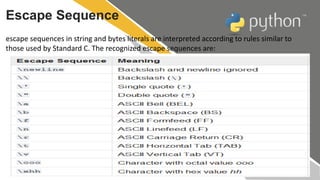
Escape Sequence
escape sequences in string and bytes literals are interpreted according to rules similar to
those used by Standard C. The recognized escape sequences are:
Data types in Python
Python Numbers
Python List
Python Tuple
Python Strings
Python Set
Python Dictionary
Every value in Python has a datatype. Since everything is an object in Python programming,
data types are actually classes and variables are instance (object) of these classes.
Python Numbers (Data Types)
Integers, floating point numbers and complex numbers falls under Python numbers
category. They are defined as int, float and complex class in Python.
 Integers can be of any length, it is only limited by the memory available.
 A floating point number is accurate up to 15 decimal places. Integer and floating points
are separated by decimal points. 1 is integer, 1.0 is floating point number.
 Complex numbers are written in the form, x + yj, where x is the real part and y is the
imaginary part
We can use the type() function to know which class a variable or a value belongs to and
the isinstance() function to check if an object belongs to a particular class.
a = 5
print(a, "is of type", type(a))
a = 2.0
print(a, "is of type", type(a))
a = 1+2j
print(a, "is complex number?", isinstance(1+2j,complex))
Python Numbers (Data Types)
Python List (Data Types)
List is an ordered sequence of items. It is one of the most used datatype in Python and is
very flexible. All the items in a list do not need to be of the same type.Lists are mutable,
meaning, value of elements of a list can be altered.
Declaring a list is pretty straight forward. Items separated by commas are enclosed within
brackets [ ]. a = [1, 2.2, 'python']
We can use the slicing operator [ ] to extract an item or a range of items from a list. Index
starts form 0 in Python.
a = [5,10,15,20,25,30,35,40]
# a[2] = 15
print("a[2] = ", a[2])
# a[0:3] = [5, 10, 15]
print("a[0:3] = ", a[0:3])
# a[5:] = [30, 35, 40]
print("a[5:] = ", a[5:])
Python Tuple (Data Types)
Tuple is an ordered sequence of items same as list.The only difference is that tuples are
immutable. Tuples once created cannot be modified.
Tuples are used to write-protect data and are usually faster than list as it cannot change
dynamically.
It is defined within parentheses () where items are separated by commas.
t = (5,'program', 1+3j)
We can use the slicing operator [] to extract items but we cannot change its value.
t = (5,'program', 1+3j)
# t[1] = 'program'
print("t[1] = ", t[1])
# t[0:3] = (5, 'program', (1+3j))
print("t[0:3] = ", t[0:3])
# Generates error
# Tuples are immutable
t[0] = 10
Python Strings (Data Types)
String is sequence of Unicode characters. We can use single quotes or double quotes to
represent strings. Multi-line strings can be denoted using triple quotes, ''' or """.
s = "This is a string"
s = '''a multiline
Like list and tuple, slicing operator [ ] can be used with string. Strings are immutable.
s = 'Hello world!'
# s[4] = 'o'
print("s[4] = ", s[4])
# s[6:11] = 'world'
print("s[6:11] = ", s[6:11])
# Generates error
# Strings are immutable in Python
s[5] ='d'
Set is an unordered collection of unique items. Set is defined by values separated by
comma inside braces { }. Items in a set are not ordered.
We can perform set operations like union, intersection on two sets. Set have unique values.
They eliminate duplicates.
Since, set are unordered collection, indexing has no meaning. Hence the slicing operator []
does not work.
Python Set (Data Types)
a = {5,2,3,1,4}
# printing set variable
print("a = ", a)
# data type of variable a
print(type(a))
Python Dictionary (Data Types)
Dictionary is an unordered collection of key-value pairs.
It is generally used when we have a huge amount of data. Dictionaries are optimized for
retrieving data. We must know the key to retrieve the value.
In Python, dictionaries are defined within braces {} with each item being a pair in the form
key:value. Key and value can be of any type.
d = {1:'value','key':2}
print(type(d))
print("d[1] = ", d[1]);
print("d['key'] = ", d['key']);
# Generates error
print("d[2] = ", d[2]);
Conversion between data types
We can convert between different data types by using different type conversion functions
like int(), float(), str() etc.
>>> set([1,2,3])
{1, 2, 3}
>>> tuple({5,6,7})
(5, 6, 7)
>>> list('hello')
['h', 'e', 'l', 'l', 'o']
>>> dict([[1,2],[3,4]])
{1: 2, 3: 4}
>>> dict([(3,26),(4,44)])
{3: 26, 4: 44}
Operators in python
 Operators are special symbols in Python that carry out arithmetic or logical computation.
The value that the operator operates on is called the operand.
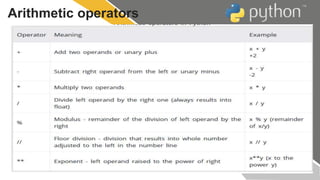
1) Arithmetic operators
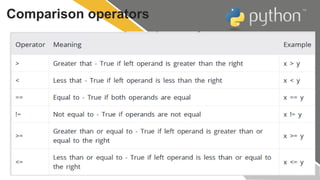
2) Comparison operators
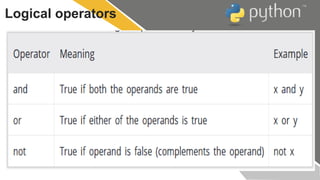
3) Logical operators
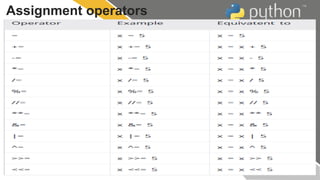
4) Assignment operators
5) Bitwise operators
6) Identity operators
7) Membership operators Special operators
Arithmetic operators
Comparison operators
Logical operators
Assignment operators
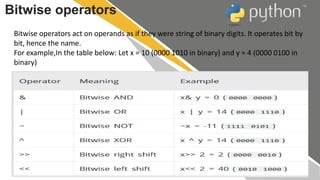
Bitwise operators
Bitwise operators act on operands as if they were string of binary digits. It operates bit by
bit, hence the name.
For example,In the table below: Let x = 10 (0000 1010 in binary) and y = 4 (0000 0100 in
binary)
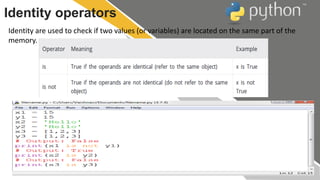
Identity operators
Identity are used to check if two values (or variables) are located on the same part of the
memory.
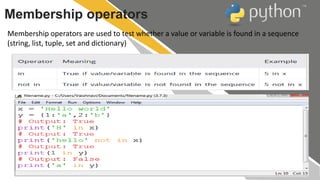
Membership operators
Membership operators are used to test whether a value or variable is found in a sequence
(string, list, tuple, set and dictionary)
T H A N K S

Python Session - 3

  • 1.
    Python Session -3 Anirudha Anil Gaikwad gaikwad.anirudha@gmail.com
  • 2.
    Escape Sequence Data Types Conversionbetween data types Operators What you learn
  • 3.
    Escape Sequence escape sequencesin string and bytes literals are interpreted according to rules similar to those used by Standard C. The recognized escape sequences are:
  • 4.
    Data types inPython Python Numbers Python List Python Tuple Python Strings Python Set Python Dictionary Every value in Python has a datatype. Since everything is an object in Python programming, data types are actually classes and variables are instance (object) of these classes.
  • 5.
    Python Numbers (DataTypes) Integers, floating point numbers and complex numbers falls under Python numbers category. They are defined as int, float and complex class in Python.  Integers can be of any length, it is only limited by the memory available.  A floating point number is accurate up to 15 decimal places. Integer and floating points are separated by decimal points. 1 is integer, 1.0 is floating point number.  Complex numbers are written in the form, x + yj, where x is the real part and y is the imaginary part
  • 6.
    We can usethe type() function to know which class a variable or a value belongs to and the isinstance() function to check if an object belongs to a particular class. a = 5 print(a, "is of type", type(a)) a = 2.0 print(a, "is of type", type(a)) a = 1+2j print(a, "is complex number?", isinstance(1+2j,complex)) Python Numbers (Data Types)
  • 7.
    Python List (DataTypes) List is an ordered sequence of items. It is one of the most used datatype in Python and is very flexible. All the items in a list do not need to be of the same type.Lists are mutable, meaning, value of elements of a list can be altered. Declaring a list is pretty straight forward. Items separated by commas are enclosed within brackets [ ]. a = [1, 2.2, 'python'] We can use the slicing operator [ ] to extract an item or a range of items from a list. Index starts form 0 in Python. a = [5,10,15,20,25,30,35,40] # a[2] = 15 print("a[2] = ", a[2]) # a[0:3] = [5, 10, 15] print("a[0:3] = ", a[0:3]) # a[5:] = [30, 35, 40] print("a[5:] = ", a[5:])
  • 8.
    Python Tuple (DataTypes) Tuple is an ordered sequence of items same as list.The only difference is that tuples are immutable. Tuples once created cannot be modified. Tuples are used to write-protect data and are usually faster than list as it cannot change dynamically. It is defined within parentheses () where items are separated by commas. t = (5,'program', 1+3j) We can use the slicing operator [] to extract items but we cannot change its value. t = (5,'program', 1+3j) # t[1] = 'program' print("t[1] = ", t[1]) # t[0:3] = (5, 'program', (1+3j)) print("t[0:3] = ", t[0:3]) # Generates error # Tuples are immutable t[0] = 10
  • 9.
    Python Strings (DataTypes) String is sequence of Unicode characters. We can use single quotes or double quotes to represent strings. Multi-line strings can be denoted using triple quotes, ''' or """. s = "This is a string" s = '''a multiline Like list and tuple, slicing operator [ ] can be used with string. Strings are immutable. s = 'Hello world!' # s[4] = 'o' print("s[4] = ", s[4]) # s[6:11] = 'world' print("s[6:11] = ", s[6:11]) # Generates error # Strings are immutable in Python s[5] ='d'
  • 10.
    Set is anunordered collection of unique items. Set is defined by values separated by comma inside braces { }. Items in a set are not ordered. We can perform set operations like union, intersection on two sets. Set have unique values. They eliminate duplicates. Since, set are unordered collection, indexing has no meaning. Hence the slicing operator [] does not work. Python Set (Data Types) a = {5,2,3,1,4} # printing set variable print("a = ", a) # data type of variable a print(type(a))
  • 11.
    Python Dictionary (DataTypes) Dictionary is an unordered collection of key-value pairs. It is generally used when we have a huge amount of data. Dictionaries are optimized for retrieving data. We must know the key to retrieve the value. In Python, dictionaries are defined within braces {} with each item being a pair in the form key:value. Key and value can be of any type. d = {1:'value','key':2} print(type(d)) print("d[1] = ", d[1]); print("d['key'] = ", d['key']); # Generates error print("d[2] = ", d[2]);
  • 12.
    Conversion between datatypes We can convert between different data types by using different type conversion functions like int(), float(), str() etc. >>> set([1,2,3]) {1, 2, 3} >>> tuple({5,6,7}) (5, 6, 7) >>> list('hello') ['h', 'e', 'l', 'l', 'o'] >>> dict([[1,2],[3,4]]) {1: 2, 3: 4} >>> dict([(3,26),(4,44)]) {3: 26, 4: 44}
  • 13.
    Operators in python Operators are special symbols in Python that carry out arithmetic or logical computation. The value that the operator operates on is called the operand. 1) Arithmetic operators 2) Comparison operators 3) Logical operators 4) Assignment operators 5) Bitwise operators 6) Identity operators 7) Membership operators Special operators
  • 14.
  • 15.
  • 16.
  • 17.
  • 18.
    Bitwise operators Bitwise operatorsact on operands as if they were string of binary digits. It operates bit by bit, hence the name. For example,In the table below: Let x = 10 (0000 1010 in binary) and y = 4 (0000 0100 in binary)
  • 19.
    Identity operators Identity areused to check if two values (or variables) are located on the same part of the memory.
  • 20.
    Membership operators Membership operatorsare used to test whether a value or variable is found in a sequence (string, list, tuple, set and dictionary)
  • 21.
    T H AN K S