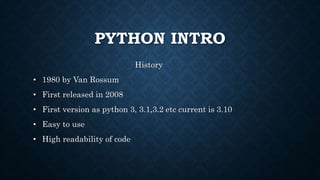
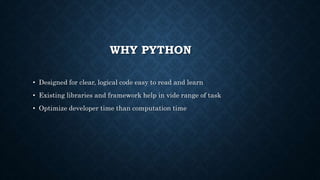
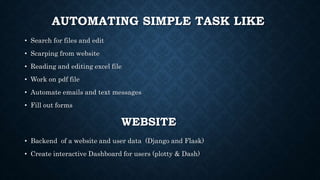
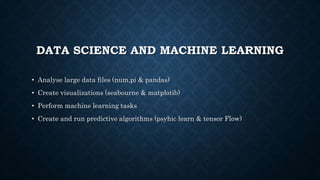
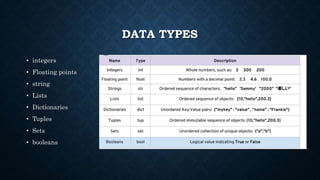
Python was created by Guido van Rossum in 1980 and the first version was released in 2008. It is designed to be an easy to read programming language that optimizes developer time over computation time. Python can be used to automate simple tasks like building websites using frameworks like Django and Flask, create dashboards using Plotly and Dash, scrape data from websites, read and edit Excel and PDF files, and automate emails. It is also widely used for data science and machine learning tasks like analyzing large datasets with libraries like NumPy, creating visualizations with Matplotlib and Seaborn, and building predictive models with Scikit-learn and TensorFlow. Python supports basic data types like integers, floats, strings, lists, dictionaries,


![[DSC Europe 25] Josip Saban - Career building for data professionals.pptx](https://cdn.slidesharecdn.com/ss_thumbnails/zroflcttkm1vmli0txea-josip-saban-career-building-for-data-professionals-260123083019-587cdb8c-thumbnail.jpg?width=640&height=640&fit=bounds)


![[DSC Europe 25] Borko Kozomora - Optimizing business workflows with advances ...](https://cdn.slidesharecdn.com/ss_thumbnails/hbgekyb0txw0xpo4yfml-borko-kozomora-leading-ai-transformation-260122103838-cc29ee38-thumbnail.jpg?width=640&height=640&fit=bounds)


![[DSC Europe 25] Milos Belcevic - Product Professional's Journey to Full-Stack...](https://cdn.slidesharecdn.com/ss_thumbnails/1zovd6fgsycdg4wvgvls-milos-belcevic-product-professionals-journey-to-full-stack-product-developer-260123083019-d993120d-thumbnail.jpg?width=640&height=640&fit=bounds)
