Python is a general-purpose, dynamic, high-level, and interpreted programming
language. It supports Object Oriented programming approach to develop
applications. It is simple and easy to learn and provides lots of high-level data
structures.
Python is an easy-to-learn yet powerful and versatile scripting language, which
makes it attractive for Application Development.
With its interpreted nature, Python's syntax and dynamic typing make it an ideal
language for scripting and rapid application development.
Python supports multiple programming patterns, including object-oriented,
imperative, and functional or procedural programming styles.
Python is not intended to work in a particular area, such as web programming. It is a
multipurpose programming language because it can be used with web, enterprise,
3D CAD, etc.
We don't need to use data types to declare variable because it is dynamically typed,
so we can write a=10 to assign an integer value in an integer variable.
Python makes development and debugging fast because no compilation step is
included in Python development, and the edit-test-debug cycle is very fast.
Python has many web-based assets, open-source projects, and a vibrant community.
Learning the language, working together on projects, and contributing to the Python
ecosystem are all made very easy for developers.
Because of its straightforward language framework, Python is easier to understand
and write code in. This makes it a fantastic programming language for novices.
Additionally, it assists seasoned programmers in writing clearer, error-free code.
Python is an open-source, cost-free programming language. It is utilized in several
sectors and disciplines as a result.
In Python, code readability and maintainability are important. As a result, even if the
code was developed by someone else, it is easy to understand and adapt by some
other developer.
Python has many third-party libraries that can be used to make its functionality
easier. These libraries cover many domains, for example, web development, scientific
computing, data analysis, and more.
Python Basic Syntax
Python is a case-sensitive language, which means that uppercase and lowercase
letters are treated differently. For example, 'name' and 'Name' are two different
variables in Python.
In Python, comments can be added using the '#' symbol. Any text written after the '#'
symbol is considered a comment and is ignored by the interpreter.
Instead of Semicolon as used in other languages, Python ends its statements with a NewLine
character.
There is no use of curly braces or semicolon in Python programming language. It is English-
like language. But Python uses the indentation to define a block of code. Indentation is
nothing but adding whitespace before the statement when it is needed.
Why learn Python?
Python provides many useful features to the programmer. These features make it the
most popular and widely used language. We have listed below few-essential features
of Python.
o Easy to use and Learn: Python has a simple and easy-to-understand syntax,
unlike traditional languages like C, C++, Java, etc., making it easy for
beginners to learn.
o Expressive Language: It allows programmers to express complex concepts in
just a few lines of code or reduces Developer's Time.
o Interpreted Language: Python does not require compilation, allowing rapid
development and testing. It uses Interpreter instead of Compiler.
o Object-Oriented Language: It supports object-oriented programming,
making writing reusable and modular code easy.
o Open Source Language: Python is open source and free to use, distribute
and modify.
o Extensible: Python can be extended with modules written in C, C++, or other
languages.
o Learn Standard Library: Python's standard library contains many modules
and functions that can be used for various tasks, such as string manipulation,
web programming, and more.
o GUI Programming Support: Python provides several GUI frameworks, such
as Tkinter and PyQt, allowing developers to create desktop applications easily.
o Integrated: Python can easily integrate with other languages and
technologies, such as C/C++, Java, and . NET.
o Embeddable: Python code can be embedded into other applications as a
scripting language.
o Dynamic Memory Allocation: Python automatically manages memory
allocation, making it easier for developers to write complex programs without
worrying about memory management.
o Wide Range of Libraries and Frameworks: Python has a vast collection of
libraries and frameworks, such as NumPy, Pandas, Django, and Flask, that can
be used to solve a wide range of problems.
o Versatility: Python is a universal language in various domains such as web
development, machine learning, data analysis, scientific computing, and more.
o Large Community: Python has a vast and active community of developers
contributing to its development and offering support. This makes it easy for
beginners to get help and learn from experienced developers.
o Career Opportunities: Python is a highly popular language in the job market.
Learning Python can open up several career opportunities in data science,
artificial intelligence, web development, and more.
o High Demand: With the growing demand for automation and digital
transformation, the need for Python developers is rising. Many industries seek
skilled Python developers to help build their digital infrastructure.
o Increased Productivity: Python has a simple syntax and powerful libraries
that can help developers write code faster and more efficiently. This can
increase productivity and save time for developers and organizations.
o Big Data and Machine Learning: Python has become the go-to language for
big data and machine learning. Python has become popular among data
scientists and machine learning engineers with libraries like NumPy, Pandas,
Scikit-learn, TensorFlow, and more.
Where is Python used?
Python is a general-purpose, popular programming language, and it is used in
almost every technical field. The various areas of Python use are given below.
o Data Science: Data Science is a vast field, and Python is an important
language for this field because of its simplicity, ease of use, and availability of
powerful data analysis and visualization libraries like NumPy, Pandas, and
Matplotlib.
o Desktop Applications: PyQt and Tkinter are useful libraries that can be used
in GUI - Graphical User Interface-based Desktop Applications. There are better
languages for this field, but it can be used with other languages for making
Applications.
o Console-based Applications: Python is also commonly used to create
command-line or console-based applications because of its ease of use and
support for advanced features such as input/output redirection and piping.
o Mobile Applications: While Python is not commonly used for creating mobile
applications, it can still be combined with frameworks like Kivy or BeeWare to
create cross-platform mobile applications.
o Software Development: Python is considered one of the best software-
making languages. Python is easily compatible with both from Small Scale to
Large Scale software.
o Artificial Intelligence: AI is an emerging Technology, and Python is a perfect
language for artificial intelligence and machine learning because of the
availability of powerful libraries such as TensorFlow, Keras, and PyTorch.
o Web Applications: Python is commonly used in web development on the
backend with frameworks like Django and Flask and on the front end with
tools like JavaScript and HTML.
o Enterprise Applications: Python can be used to develop large-scale
enterprise applications with features such as distributed computing,
networking, and parallel processing.
o 3D CAD Applications: Python can be used for 3D computer-aided design
(CAD) applications through libraries such as Blender.
o Machine Learning: Python is widely used for machine learning due to its
simplicity, ease of use, and availability of powerful machine learning libraries.
o Computer Vision or Image Processing Applications: Python can be used for
computer vision and image processing applications through powerful libraries
such as OpenCV and Scikit-image.
o Speech Recognition: Python can be used for speech recognition applications
through libraries such as SpeechRecognition and PyAudio.
o Scientific computing: Libraries like NumPy, SciPy, and Pandas provide
advanced numerical computing capabilities for tasks like data analysis,
machine learning, and more.
o Education: Python's easy-to-learn syntax and availability of many resources
make it an ideal language for teaching programming to beginners.
o Testing: Python is used for writing automated tests, providing frameworks like
unit tests and pytest that help write test cases and generate reports.
o Gaming: Python has libraries like Pygame, which provide a platform for
developing games using Python.
o IoT: Python is used in IoT for developing scripts and applications for devices
like Raspberry Pi, Arduino, and others.
o Networking: Python is used in networking for developing scripts and
applications for network automation, monitoring, and management.
o DevOps: Python is widely used in DevOps for automation and scripting of
infrastructure management, configuration management, and deployment
processes.
o Finance: Python has libraries like Pandas, Scikit-learn, and Statsmodels for
financial modeling and analysis.
o Audio and Music: Python has libraries like Pyaudio, which is used for audio
processing, synthesis, and analysis, and Music21, which is used for music
analysis and generation.
o Writing scripts: Python is used for writing utility scripts to automate tasks like
file operations, web scraping, and data processing.
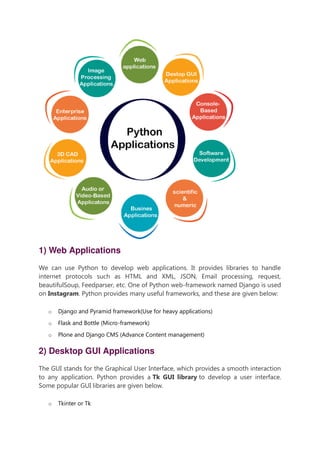
Python Applications
Python is known for its general-purpose nature that makes it applicable in almost
every domain of software development. Python makes its presence in every
emerging field. It is the fastest-growing programming language and can develop any
application.
Here, we are specifying application areas where Python can be applied.
1) Web Applications
We can use Python to develop web applications. It provides libraries to handle
internet protocols such as HTML and XML, JSON, Email processing, request,
beautifulSoup, Feedparser, etc. One of Python web-framework named Django is used
on Instagram. Python provides many useful frameworks, and these are given below:
o Django and Pyramid framework(Use for heavy applications)
o Flask and Bottle (Micro-framework)
o Plone and Django CMS (Advance Content management)
2) Desktop GUI Applications
The GUI stands for the Graphical User Interface, which provides a smooth interaction
to any application. Python provides a Tk GUI library to develop a user interface.
Some popular GUI libraries are given below.
o Tkinter or Tk
o wxWidgetM
o Kivy (used for writing multitouch applications )
o PyQt or Pyside
AD
3) Console-based Application
Console-based applications run from the command-line or shell. These applications
are computer program which are used commands to execute. This kind of
application was more popular in the old generation of computers. Python can
develop this kind of application very effectively. It is famous for having REPL, which
means the Read-Eval-Print Loop that makes it the most suitable language for the
command-line applications.
Python provides many free library or module which helps to build the command-line
apps. The necessary IO libraries are used to read and write. It helps to parse
argument and create console help text out-of-the-box. There are also advance
libraries that can develop independent console apps.
4) Software Development
Python is useful for the software development process. It works as a support
language and can be used to build control and management, testing, etc.
o SCons is used to build control.
o Buildbot and Apache Gumps are used for automated continuous compilation and
testing.
o Round or Trac for bug tracking and project management.
5) Scientific and Numeric
This is the era of Artificial intelligence where the machine can perform the task the
same as the human. Python language is the most suitable language for Artificial
intelligence or machine learning. It consists of many scientific and mathematical
libraries, which makes easy to solve complex calculations.
Implementing machine learning algorithms require complex mathematical
calculation. Python has many libraries for scientific and numeric such as Numpy,
Pandas, Scipy, Scikit-learn, etc. If you have some basic knowledge of Python, you
need to import libraries on the top of the code. Few popular frameworks of machine
libraries are given below.
o SciPy
o Scikit-learn
o NumPy
o Pandas
o Matplotlib
6) Business Applications
Business Applications differ from standard applications. E-commerce and ERP are an
example of a business application. This kind of application requires extensively,
scalability and readability, and Python provides all these features.
Oddo is an example of the all-in-one Python-based application which offers a range
of business applications. Python provides a Tryton platform which is used to develop
the business application.
7) Audio or Video-based Applications
Python is flexible to perform multiple tasks and can be used to create multimedia
applications. Some multimedia applications which are made by using Python
are TimPlayer, cplay, etc. The few multimedia libraries are given below.
o Gstreamer
o Pyglet
o QT Phonon
8) 3D CAD Applications
The CAD (Computer-aided design) is used to design engineering related architecture.
It is used to develop the 3D representation of a part of a system. Python can create a
3D CAD application by using the following functionalities.
o Fandango (Popular )
o CAMVOX
o HeeksCNC
o AnyCAD
o RCAM
9) Enterprise Applications
Python can be used to create applications that can be used within an Enterprise or an
Organization. Some real-time applications are OpenERP, Tryton, Picalo, etc.
10) Image Processing Application
Python contains many libraries that are used to work with the image. The image can
be manipulated according to our requirements. Some libraries of image processing
are given below.
o OpenCV
o Pillow
o SimpleITK
o
AD
Python Popular Frameworks and Libraries
Python has wide range of libraries and frameworks widely used in various fields such
as machine learning, artificial intelligence, web applications, etc. We define some
popular frameworks and libraries of Python as follows.
o Web development (Server-side) - Django Flask, Pyramid, CherryPy
o GUIs based applications - Tk, PyGTK, PyQt, PyJs, etc.
o Machine Learning - TensorFlow, PyTorch, Scikit-learn, Matplotlib, Scipy, etc.
o Mathematics - Numpy, Pandas, etc.
o BeautifulSoup: a library for web scraping and parsing HTML and XML
o Requests: a library for making HTTP requests
o SQLAlchemy: a library for working with SQL databases
o Kivy: a framework for building multi-touch applications
o Pygame: a library for game development
o Pytest: a testing framework for Python
o Django REST framework: a toolkit for building RESTful APIs
o FastAPI: a modern, fast web framework for building APIs
o Streamlit: a library for building interactive web apps for machine learning and
data science
o NLTK: a library for natural language processing
o TensorFlow - It is an artificial intelligence library which allows us to create
large scale AI based projects.
o Django - It is an open source framework that allows us to develop web
applications. It is easy, flexible, and simple to manage.
o Flask - It is also an open source web framework. It is used to develop
lightweight web applications.
o Pandas - It is a Python library which is used to perform scientific
computations.
o Keras - It is an open source library, which is used to work around the neural
network.
Python History and Versions
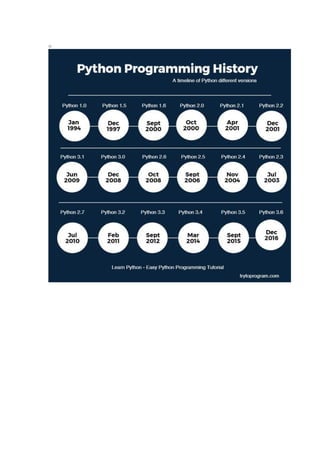
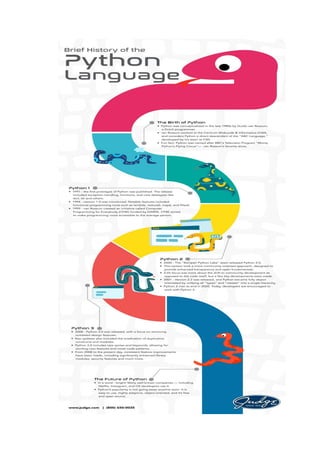
o Python laid its foundation in the late 1980s.
o The implementation of Python was started in December 1989 by Guido Van
Rossum at CWI in Netherland.
o In February 1991, Guido Van Rossum published the code (labeled version 0.9.0) to
alt.sources.
 In 1994, Python 1.0 was released with new features like lambda, map, filter, and
reduce. Functional programming tools (lambda, map, filter, and reduce).
 Support for complex numbers.
 Functions with keyword arguments.
o
o Python 2.0 added new features such as list comprehensions, garbage collection
systems.
o On December 3, 2008, Python 3.0 (also called "Py3K") was released. It was designed
to rectify the fundamental flaw of the language.
o ABC programming language is said to be the predecessor of Python language, which
was capable of Exception Handling and interfacing with the Amoeba Operating
System.
o The following programming languages influence Python:
o ABC language.
o Modula-3
The programming language in which Python is said to have succeeded is
ABC Programming Language. He had already helped to create ABC
earlier in his career and he had seen some issues with ABC but liked
most of the features. After that what he did was really very clever. He
had taken the syntax of ABC, and some of its good features. It came with
a lot of complaints too, so he fixed those issues completely and had
created a good scripting language that had removed all the flaws. The
inspiration for the name came from BBC’s TV Show – ‘Monty Python’s
Flying Circus’, as he was a big fan of the TV show
History of Python: Story behind the name
Often people assume that the name Python was written after a snake. Even the
logo of Python programming language depicts the picture of two snakes, blue
and yellow. But, the story behind the naming is somewhat different.
Back in the 1970s, there was a popular BBC comedy tv show called Monty
Python’s Fly Circus and Van Rossum happened to be the big fan of that show. So
when Python was developed, Rossum named the project ‘Python’.
Strat Programming with Python
To start programming with python, we have to know some more information.
I.e, installation of python software and execution procedure of python
program or script.
There are two major Python versions, those are Python 2 and Python 3.
Python 2 and 3 are quite different. This tutorial uses Python 3, because it
more semantically correct and supports newer features.
For installation of python software procedure go through ✍ Python
Installation Tutorial
After successful installation of python software we can able interpret or
execute python script / program.
Python provides us the two ways to run a python script:
 Using Interactive interpreter prompt
 Using a script file
⇨Using Interactive interpreter prompt:
Python provides us the feature to execute the python statement one by one
at the interactive prompt. It is preferable in the case where we are
concerned about the output of each line of our python program.
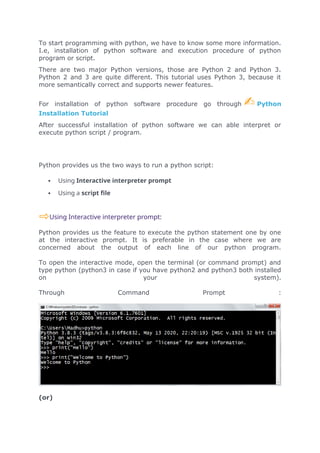
To open the interactive mode, open the terminal (or command prompt) and
type python (python3 in case if you have python2 and python3 both installed
on your system).
Through Command Prompt :
(or)
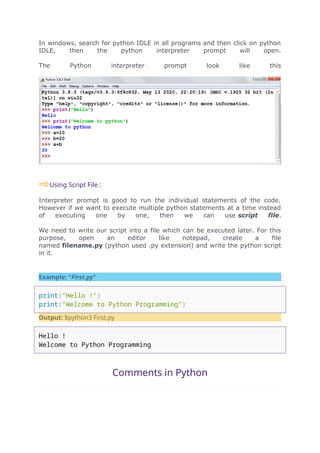
In windows, search for python IDLE in all programs and then click on python
IDLE, then the python interpreter prompt will open.
The Python interpreter prompt look like this
⇨Using Script File :
Interpreter prompt is good to run the individual statements of the code.
However if we want to execute multiple python statements at a time instead
of executing one by one, then we can use script file.
We need to write our script into a file which can be executed later. For this
purpose, open an editor like notepad, create a file
named filename.py (python used .py extension) and write the python script
in it.
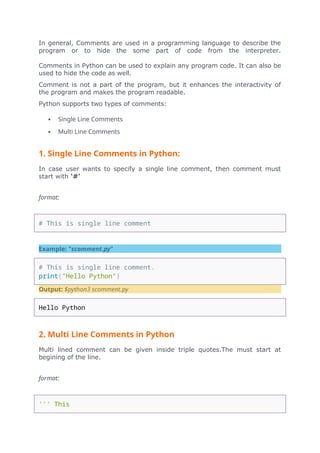
Example: "First.py"
print("Hello !")
print("Welcome to Python Programming")
Output: $python3 First.py
Hello !
Welcome to Python Programming
Comments in Python
In general, Comments are used in a programming language to describe the
program or to hide the some part of code from the interpreter.
Comments in Python can be used to explain any program code. It can also be
used to hide the code as well.
Comment is not a part of the program, but it enhances the interactivity of
the program and makes the program readable.
Python supports two types of comments:
 Single Line Comments
 Multi Line Comments
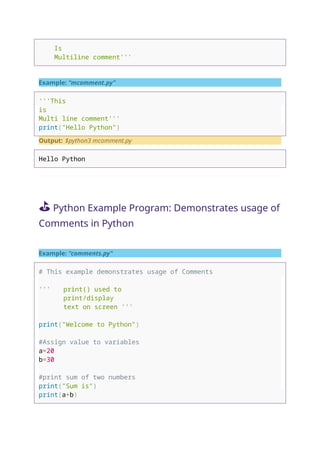
1. Single Line Comments in Python:
In case user wants to specify a single line comment, then comment must
start with ‘#’
format:
# This is single line comment
Example: "scomment.py"
# This is single line comment.
print("Hello Python")
Output: $python3 scomment.py
Hello Python
2. Multi Line Comments in Python
Multi lined comment can be given inside triple quotes.The must start at
begining of the line.
format:
''' This
Is
Multiline comment'''
Example: "mcomment.py"
'''This
is
Multi line comment'''
print("Hello Python")
Output: $python3 mcomment.py
Hello Python
⛳ Python Example Program: Demonstrates usage of
Comments in Python
Example: "comments.py"
# This example demonstrates usage of Comments
''' print() used to
print/display
text on screen '''
print("Welcome to Python")
#Assign value to variables
a=20
b=30
#print sum of two numbers
print("Sum is")
print(a+b)

Python notes for beginners - in simple sentences

  • 1.
    Python is ageneral-purpose, dynamic, high-level, and interpreted programming language. It supports Object Oriented programming approach to develop applications. It is simple and easy to learn and provides lots of high-level data structures. Python is an easy-to-learn yet powerful and versatile scripting language, which makes it attractive for Application Development. With its interpreted nature, Python's syntax and dynamic typing make it an ideal language for scripting and rapid application development. Python supports multiple programming patterns, including object-oriented, imperative, and functional or procedural programming styles. Python is not intended to work in a particular area, such as web programming. It is a multipurpose programming language because it can be used with web, enterprise, 3D CAD, etc. We don't need to use data types to declare variable because it is dynamically typed, so we can write a=10 to assign an integer value in an integer variable. Python makes development and debugging fast because no compilation step is included in Python development, and the edit-test-debug cycle is very fast. Python has many web-based assets, open-source projects, and a vibrant community. Learning the language, working together on projects, and contributing to the Python ecosystem are all made very easy for developers. Because of its straightforward language framework, Python is easier to understand and write code in. This makes it a fantastic programming language for novices. Additionally, it assists seasoned programmers in writing clearer, error-free code. Python is an open-source, cost-free programming language. It is utilized in several sectors and disciplines as a result. In Python, code readability and maintainability are important. As a result, even if the code was developed by someone else, it is easy to understand and adapt by some other developer. Python has many third-party libraries that can be used to make its functionality easier. These libraries cover many domains, for example, web development, scientific computing, data analysis, and more. Python Basic Syntax
  • 2.
    Python is acase-sensitive language, which means that uppercase and lowercase letters are treated differently. For example, 'name' and 'Name' are two different variables in Python. In Python, comments can be added using the '#' symbol. Any text written after the '#' symbol is considered a comment and is ignored by the interpreter. Instead of Semicolon as used in other languages, Python ends its statements with a NewLine character. There is no use of curly braces or semicolon in Python programming language. It is English- like language. But Python uses the indentation to define a block of code. Indentation is nothing but adding whitespace before the statement when it is needed. Why learn Python? Python provides many useful features to the programmer. These features make it the most popular and widely used language. We have listed below few-essential features of Python. o Easy to use and Learn: Python has a simple and easy-to-understand syntax, unlike traditional languages like C, C++, Java, etc., making it easy for beginners to learn. o Expressive Language: It allows programmers to express complex concepts in just a few lines of code or reduces Developer's Time. o Interpreted Language: Python does not require compilation, allowing rapid development and testing. It uses Interpreter instead of Compiler. o Object-Oriented Language: It supports object-oriented programming, making writing reusable and modular code easy. o Open Source Language: Python is open source and free to use, distribute and modify. o Extensible: Python can be extended with modules written in C, C++, or other languages. o Learn Standard Library: Python's standard library contains many modules and functions that can be used for various tasks, such as string manipulation, web programming, and more. o GUI Programming Support: Python provides several GUI frameworks, such as Tkinter and PyQt, allowing developers to create desktop applications easily.
  • 3.
    o Integrated: Pythoncan easily integrate with other languages and technologies, such as C/C++, Java, and . NET. o Embeddable: Python code can be embedded into other applications as a scripting language. o Dynamic Memory Allocation: Python automatically manages memory allocation, making it easier for developers to write complex programs without worrying about memory management. o Wide Range of Libraries and Frameworks: Python has a vast collection of libraries and frameworks, such as NumPy, Pandas, Django, and Flask, that can be used to solve a wide range of problems. o Versatility: Python is a universal language in various domains such as web development, machine learning, data analysis, scientific computing, and more. o Large Community: Python has a vast and active community of developers contributing to its development and offering support. This makes it easy for beginners to get help and learn from experienced developers. o Career Opportunities: Python is a highly popular language in the job market. Learning Python can open up several career opportunities in data science, artificial intelligence, web development, and more. o High Demand: With the growing demand for automation and digital transformation, the need for Python developers is rising. Many industries seek skilled Python developers to help build their digital infrastructure. o Increased Productivity: Python has a simple syntax and powerful libraries that can help developers write code faster and more efficiently. This can increase productivity and save time for developers and organizations. o Big Data and Machine Learning: Python has become the go-to language for big data and machine learning. Python has become popular among data scientists and machine learning engineers with libraries like NumPy, Pandas, Scikit-learn, TensorFlow, and more. Where is Python used? Python is a general-purpose, popular programming language, and it is used in almost every technical field. The various areas of Python use are given below. o Data Science: Data Science is a vast field, and Python is an important language for this field because of its simplicity, ease of use, and availability of
  • 4.
    powerful data analysisand visualization libraries like NumPy, Pandas, and Matplotlib. o Desktop Applications: PyQt and Tkinter are useful libraries that can be used in GUI - Graphical User Interface-based Desktop Applications. There are better languages for this field, but it can be used with other languages for making Applications. o Console-based Applications: Python is also commonly used to create command-line or console-based applications because of its ease of use and support for advanced features such as input/output redirection and piping. o Mobile Applications: While Python is not commonly used for creating mobile applications, it can still be combined with frameworks like Kivy or BeeWare to create cross-platform mobile applications. o Software Development: Python is considered one of the best software- making languages. Python is easily compatible with both from Small Scale to Large Scale software. o Artificial Intelligence: AI is an emerging Technology, and Python is a perfect language for artificial intelligence and machine learning because of the availability of powerful libraries such as TensorFlow, Keras, and PyTorch. o Web Applications: Python is commonly used in web development on the backend with frameworks like Django and Flask and on the front end with tools like JavaScript and HTML. o Enterprise Applications: Python can be used to develop large-scale enterprise applications with features such as distributed computing, networking, and parallel processing. o 3D CAD Applications: Python can be used for 3D computer-aided design (CAD) applications through libraries such as Blender. o Machine Learning: Python is widely used for machine learning due to its simplicity, ease of use, and availability of powerful machine learning libraries. o Computer Vision or Image Processing Applications: Python can be used for computer vision and image processing applications through powerful libraries such as OpenCV and Scikit-image. o Speech Recognition: Python can be used for speech recognition applications through libraries such as SpeechRecognition and PyAudio.
  • 5.
    o Scientific computing:Libraries like NumPy, SciPy, and Pandas provide advanced numerical computing capabilities for tasks like data analysis, machine learning, and more. o Education: Python's easy-to-learn syntax and availability of many resources make it an ideal language for teaching programming to beginners. o Testing: Python is used for writing automated tests, providing frameworks like unit tests and pytest that help write test cases and generate reports. o Gaming: Python has libraries like Pygame, which provide a platform for developing games using Python. o IoT: Python is used in IoT for developing scripts and applications for devices like Raspberry Pi, Arduino, and others. o Networking: Python is used in networking for developing scripts and applications for network automation, monitoring, and management. o DevOps: Python is widely used in DevOps for automation and scripting of infrastructure management, configuration management, and deployment processes. o Finance: Python has libraries like Pandas, Scikit-learn, and Statsmodels for financial modeling and analysis. o Audio and Music: Python has libraries like Pyaudio, which is used for audio processing, synthesis, and analysis, and Music21, which is used for music analysis and generation. o Writing scripts: Python is used for writing utility scripts to automate tasks like file operations, web scraping, and data processing. Python Applications Python is known for its general-purpose nature that makes it applicable in almost every domain of software development. Python makes its presence in every emerging field. It is the fastest-growing programming language and can develop any application. Here, we are specifying application areas where Python can be applied.
  • 6.
    1) Web Applications Wecan use Python to develop web applications. It provides libraries to handle internet protocols such as HTML and XML, JSON, Email processing, request, beautifulSoup, Feedparser, etc. One of Python web-framework named Django is used on Instagram. Python provides many useful frameworks, and these are given below: o Django and Pyramid framework(Use for heavy applications) o Flask and Bottle (Micro-framework) o Plone and Django CMS (Advance Content management) 2) Desktop GUI Applications The GUI stands for the Graphical User Interface, which provides a smooth interaction to any application. Python provides a Tk GUI library to develop a user interface. Some popular GUI libraries are given below. o Tkinter or Tk
  • 7.
    o wxWidgetM o Kivy(used for writing multitouch applications ) o PyQt or Pyside AD 3) Console-based Application Console-based applications run from the command-line or shell. These applications are computer program which are used commands to execute. This kind of application was more popular in the old generation of computers. Python can develop this kind of application very effectively. It is famous for having REPL, which means the Read-Eval-Print Loop that makes it the most suitable language for the command-line applications. Python provides many free library or module which helps to build the command-line apps. The necessary IO libraries are used to read and write. It helps to parse argument and create console help text out-of-the-box. There are also advance libraries that can develop independent console apps. 4) Software Development Python is useful for the software development process. It works as a support language and can be used to build control and management, testing, etc. o SCons is used to build control. o Buildbot and Apache Gumps are used for automated continuous compilation and testing. o Round or Trac for bug tracking and project management. 5) Scientific and Numeric This is the era of Artificial intelligence where the machine can perform the task the same as the human. Python language is the most suitable language for Artificial intelligence or machine learning. It consists of many scientific and mathematical libraries, which makes easy to solve complex calculations. Implementing machine learning algorithms require complex mathematical calculation. Python has many libraries for scientific and numeric such as Numpy, Pandas, Scipy, Scikit-learn, etc. If you have some basic knowledge of Python, you need to import libraries on the top of the code. Few popular frameworks of machine libraries are given below.
  • 8.
    o SciPy o Scikit-learn oNumPy o Pandas o Matplotlib 6) Business Applications Business Applications differ from standard applications. E-commerce and ERP are an example of a business application. This kind of application requires extensively, scalability and readability, and Python provides all these features. Oddo is an example of the all-in-one Python-based application which offers a range of business applications. Python provides a Tryton platform which is used to develop the business application. 7) Audio or Video-based Applications Python is flexible to perform multiple tasks and can be used to create multimedia applications. Some multimedia applications which are made by using Python are TimPlayer, cplay, etc. The few multimedia libraries are given below. o Gstreamer o Pyglet o QT Phonon 8) 3D CAD Applications The CAD (Computer-aided design) is used to design engineering related architecture. It is used to develop the 3D representation of a part of a system. Python can create a 3D CAD application by using the following functionalities. o Fandango (Popular ) o CAMVOX o HeeksCNC o AnyCAD o RCAM
  • 9.
    9) Enterprise Applications Pythoncan be used to create applications that can be used within an Enterprise or an Organization. Some real-time applications are OpenERP, Tryton, Picalo, etc. 10) Image Processing Application Python contains many libraries that are used to work with the image. The image can be manipulated according to our requirements. Some libraries of image processing are given below. o OpenCV o Pillow o SimpleITK o AD Python Popular Frameworks and Libraries Python has wide range of libraries and frameworks widely used in various fields such as machine learning, artificial intelligence, web applications, etc. We define some popular frameworks and libraries of Python as follows. o Web development (Server-side) - Django Flask, Pyramid, CherryPy o GUIs based applications - Tk, PyGTK, PyQt, PyJs, etc. o Machine Learning - TensorFlow, PyTorch, Scikit-learn, Matplotlib, Scipy, etc. o Mathematics - Numpy, Pandas, etc. o BeautifulSoup: a library for web scraping and parsing HTML and XML o Requests: a library for making HTTP requests o SQLAlchemy: a library for working with SQL databases o Kivy: a framework for building multi-touch applications o Pygame: a library for game development o Pytest: a testing framework for Python o Django REST framework: a toolkit for building RESTful APIs o FastAPI: a modern, fast web framework for building APIs
  • 10.
    o Streamlit: alibrary for building interactive web apps for machine learning and data science o NLTK: a library for natural language processing o TensorFlow - It is an artificial intelligence library which allows us to create large scale AI based projects. o Django - It is an open source framework that allows us to develop web applications. It is easy, flexible, and simple to manage. o Flask - It is also an open source web framework. It is used to develop lightweight web applications. o Pandas - It is a Python library which is used to perform scientific computations. o Keras - It is an open source library, which is used to work around the neural network. Python History and Versions o Python laid its foundation in the late 1980s. o The implementation of Python was started in December 1989 by Guido Van Rossum at CWI in Netherland. o In February 1991, Guido Van Rossum published the code (labeled version 0.9.0) to alt.sources.  In 1994, Python 1.0 was released with new features like lambda, map, filter, and reduce. Functional programming tools (lambda, map, filter, and reduce).  Support for complex numbers.  Functions with keyword arguments.
  • 11.
  • 13.
    o Python 2.0added new features such as list comprehensions, garbage collection systems. o On December 3, 2008, Python 3.0 (also called "Py3K") was released. It was designed to rectify the fundamental flaw of the language. o ABC programming language is said to be the predecessor of Python language, which was capable of Exception Handling and interfacing with the Amoeba Operating System. o The following programming languages influence Python: o ABC language. o Modula-3 The programming language in which Python is said to have succeeded is ABC Programming Language. He had already helped to create ABC earlier in his career and he had seen some issues with ABC but liked most of the features. After that what he did was really very clever. He had taken the syntax of ABC, and some of its good features. It came with a lot of complaints too, so he fixed those issues completely and had created a good scripting language that had removed all the flaws. The inspiration for the name came from BBC’s TV Show – ‘Monty Python’s Flying Circus’, as he was a big fan of the TV show History of Python: Story behind the name Often people assume that the name Python was written after a snake. Even the logo of Python programming language depicts the picture of two snakes, blue and yellow. But, the story behind the naming is somewhat different. Back in the 1970s, there was a popular BBC comedy tv show called Monty Python’s Fly Circus and Van Rossum happened to be the big fan of that show. So when Python was developed, Rossum named the project ‘Python’. Strat Programming with Python
  • 14.
    To start programmingwith python, we have to know some more information. I.e, installation of python software and execution procedure of python program or script. There are two major Python versions, those are Python 2 and Python 3. Python 2 and 3 are quite different. This tutorial uses Python 3, because it more semantically correct and supports newer features. For installation of python software procedure go through ✍ Python Installation Tutorial After successful installation of python software we can able interpret or execute python script / program. Python provides us the two ways to run a python script:  Using Interactive interpreter prompt  Using a script file ⇨Using Interactive interpreter prompt: Python provides us the feature to execute the python statement one by one at the interactive prompt. It is preferable in the case where we are concerned about the output of each line of our python program. To open the interactive mode, open the terminal (or command prompt) and type python (python3 in case if you have python2 and python3 both installed on your system). Through Command Prompt : (or)
  • 15.
    In windows, searchfor python IDLE in all programs and then click on python IDLE, then the python interpreter prompt will open. The Python interpreter prompt look like this ⇨Using Script File : Interpreter prompt is good to run the individual statements of the code. However if we want to execute multiple python statements at a time instead of executing one by one, then we can use script file. We need to write our script into a file which can be executed later. For this purpose, open an editor like notepad, create a file named filename.py (python used .py extension) and write the python script in it. Example: "First.py" print("Hello !") print("Welcome to Python Programming") Output: $python3 First.py Hello ! Welcome to Python Programming Comments in Python
  • 16.
    In general, Commentsare used in a programming language to describe the program or to hide the some part of code from the interpreter. Comments in Python can be used to explain any program code. It can also be used to hide the code as well. Comment is not a part of the program, but it enhances the interactivity of the program and makes the program readable. Python supports two types of comments:  Single Line Comments  Multi Line Comments 1. Single Line Comments in Python: In case user wants to specify a single line comment, then comment must start with ‘#’ format: # This is single line comment Example: "scomment.py" # This is single line comment. print("Hello Python") Output: $python3 scomment.py Hello Python 2. Multi Line Comments in Python Multi lined comment can be given inside triple quotes.The must start at begining of the line. format: ''' This
  • 17.
    Is Multiline comment''' Example: "mcomment.py" '''This is Multiline comment''' print("Hello Python") Output: $python3 mcomment.py Hello Python ⛳ Python Example Program: Demonstrates usage of Comments in Python Example: "comments.py" # This example demonstrates usage of Comments ''' print() used to print/display text on screen ''' print("Welcome to Python") #Assign value to variables a=20 b=30 #print sum of two numbers print("Sum is") print(a+b)