1
2
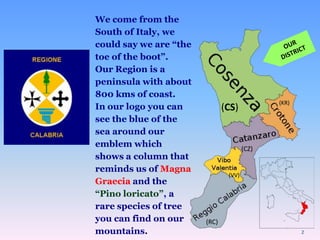
We come from the
South of Italy, we
could say we are “the
toe of the boot”.
Our Region is a
peninsula with about
800 kms of coast.
In our logo you can
see the blue of the
sea around our
emblem which
shows a column that
reminds us of Magna
Graecia and the
“Pino loricato”, a
rare species of tree
you can find on our
mountains.
(CS)
(CZ)
(RC)
(KR)
(VV)
3
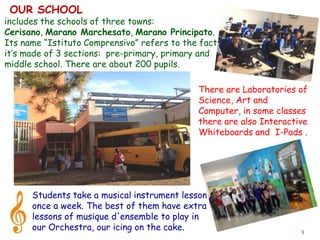
includes the schools of three towns:
Cerisano, Marano Marchesato, Marano Principato.
Its name “Istituto Comprensivo” refers to the fact
it’s made of 3 sections: pre-primary, primary and
middle school. There are about 200 pupils.
Students take a musical instrument lesson
once a week. The best of them have extra
lessons of musique d'ensemble to play in
our Orchestra, our icing on the cake.
There are Laboratories of
Science, Art and
Computer, in some classes
there are also Interactive
Whiteboards and I-Pads .
OUR SCHOOL
4
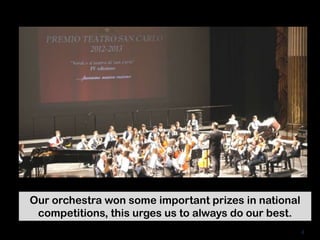
Our orchestra won some important prizes in national
competitions, this urges us to always do our best.
5
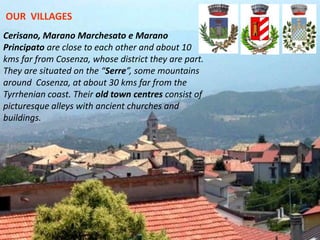
Cerisano, Marano Marchesato e Marano
Principato are close to each other and about 10
kms far from Cosenza, whose district they are part.
They are situated on the “Serre”, some mountains
around Cosenza, at about 30 kms far from the
Tyrrhenian coast. Their old town centres consist of
picturesque alleys with ancient churches and
buildings.
OUR VILLAGES
6
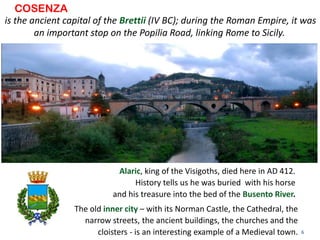
is the ancient capital of the Brettii (IV BC); during the Roman Empire, it was
an important stop on the Popilia Road, linking Rome to Sicily.
COSENZA
The old inner city – with its Norman Castle, the Cathedral, the
narrow streets, the ancient buildings, the churches and the
cloisters - is an interesting example of a Medieval town.
Alaric, king of the Visigoths, died here in AD 412.
History tells us he was buried with his horse
and his treasure into the bed of the Busento River.
7
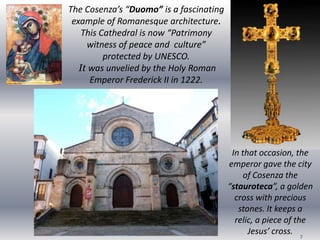
The Cosenza’s “Duomo” is a fascinating
example of Romanesque architecture.
This Cathedral is now “Patrimony
witness of peace and culture”
protected by UNESCO.
It was unvelied by the Holy Roman
Emperor Frederick II in 1222.
In that occasion, the
emperor gave the city
of Cosenza the
“stauroteca”, a golden
cross with precious
stones. It keeps a
relic, a piece of the
Jesus’ cross.
8
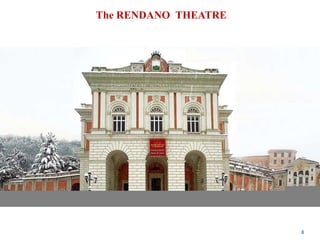
The
Rendano,
The RENDANO THEATRE
9
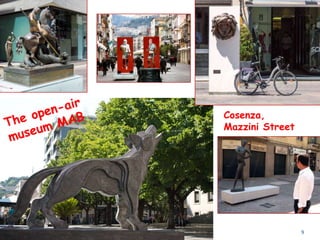
Cosenza,
Mazzini Street
10
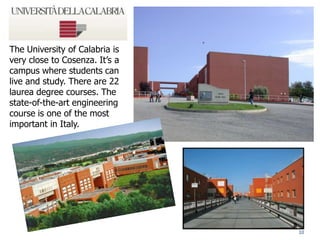
The University of Calabria is
very close to Cosenza. It’s a
campus where students can
live and study. There are 22
laurea degree courses. The
state-of-the-art engineering
course is one of the most
important in Italy.
11
O
U
R
R
E
G
I
O
N
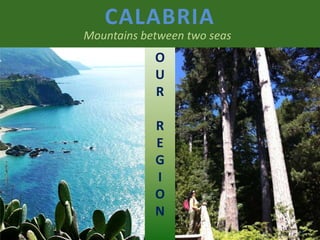
CALABRIA
Mountains between two seas
12
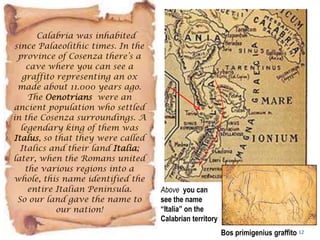
Calabria was inhabited
since Palaeolithic times. In the
province of Cosenza there’s a
cave where you can see a
graffito representing an ox
made about 11.000 years ago.
The Oenotrians were an
ancient population who settled
in the Cosenza surroundings. A
legendary king of them was
Italus, so that they were called
Italics and their land Italia;
later, when the Romans united
the various regions into a
whole, this name identified the
entire Italian Peninsula.
So our land gave the name to
our nation!
Bos primigenius graffito
Above you can
see the name
“Italia” on the
Calabrian territory
13
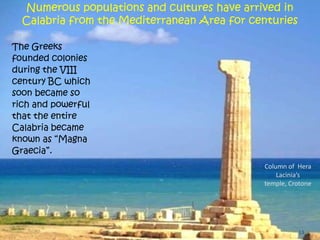
The Greeks
founded colonies
during the VIII
century BC which
soon became so
rich and powerful
that the entire
Calabria became
known as “Magna
Graecia”.
Numerous populations and cultures have arrived in
Calabria from the Mediterranean Area for centuries
Column of Hera
Lacinia’s
temple, Crotone
14
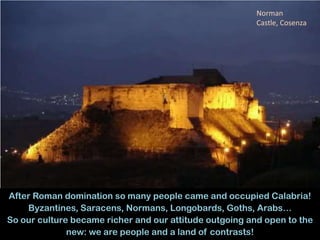
After Roman domination so many people came and occupied Calabria!
Byzantines, Saracens, Normans, Longobards, Goths, Arabs…
So our culture became richer and our attitude outgoing and open to the
new: we are people and a land of contrasts!
Norman
Castle, Cosenza
15
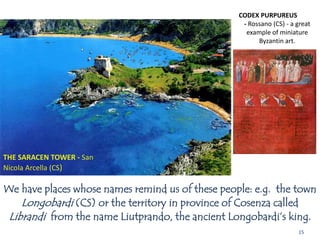
CODEX PURPUREUS
- Rossano (CS) - a great
example of miniature
Byzantin art.
We have places whose names remind us of these people: e.g. the town
Longobardi (CS) or the territory in province of Cosenza called
Librandi from the name Liutprando, the ancient Longobardi’s king.
THE SARACEN TOWER - San
Nicola Arcella (CS)
16
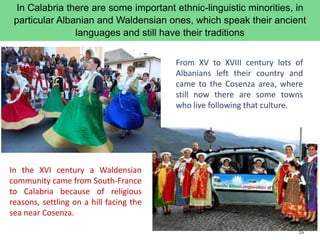
In Calabria there are some important ethnic-linguistic minorities, in
particular Albanian and Waldensian ones, which speak their ancient
languages and still have their traditions
From XV to XVIII century lots of
Albanians left their country and
came to the Cosenza area, where
still now there are some towns
who live following that culture.
In the XVI century a Waldensian
community came from South-France
to Calabria because of religious
reasons, settling on a hill facing the
sea near Cosenza.
17
ALARICO,IMAGEFROMITSSEAL
18
There are also some volcanoes, mainly
estinguished.
One is into the sea in front of our
Tyrrhenian coast: it is the Marsili, it’s 3000
metres high and it’s alive…
19
In Calabria there are hot mineral
springs, particularly in the Cosenza
district. The most important is called “Terme
Luigiane”: its water has the highest grade of
precious minerals in Europe, so that people
come here to care of their health and beauty.
Nymphes Cavern – Cerchiara
(Cosenza, Pollino Park)
20
We have 3 National Parks that represent
the largest mountainous area in the South of
Italy : Pollino, Sila, Aspromonte where you
can find lots of animal and flora species.
Our region is
not so rich
and there
aren’t so
many
industries.
So the
principal
source of our
economy is
the beauty of
our
landscapes.
Calabria
has lots of
hills and its
mountains
are quite
high until
about
2000
metres.
21
Calabria
The wolf is the symbol of
Cosenza football team
because Sila was its habitat
in the past.
Sila is about 30 Kms from
Cosenza. There you can trek, fish
trouts, ski, go horse-riding…
Enjoy it all the year round!
22
Because of
its long and
quite narrow
shape, no
place in
Calabria is
more than
50 Kms far
from the sea.
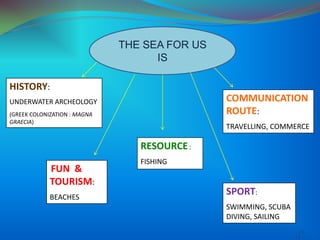
RESOURCE:
FISHING
HISTORY:
UNDERWATER ARCHEOLOGY
(GREEK COLONIZATION : MAGNA
GRAECIA)
COMMUNICATION
ROUTE:
TRAVELLING, COMMERCE
FUN &
TOURISM:
BEACHES
THE SEA FOR US
IS
SPORT:
SWIMMING, SCUBA
DIVING, SAILING
23
23
HISTORY
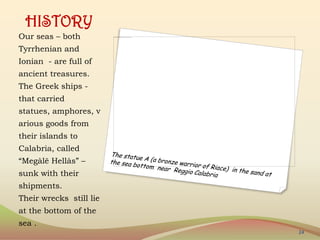
Our seas – both
Tyrrhenian and
Ionian - are full of
ancient treasures.
The Greek ships -
that carried
statues, amphores, v
arious goods from
their islands to
Calabria, called
“Megàlē Hellàs” –
sunk with their
shipments.
Their wrecks still lie
at the bottom of the
sea .
24
These two big bronze statues were casually found in
1972 by a diver at about 250 metres from Riace coast
(Reggio Calabria) at a depth of about 7 metres.
They date back to 480 BC and are
one of the most beautiful examples
of the Greek perfection in Classical
Art.
HISTORY
25
Near Crotone, an ancient city founded
by the Greeks, there is THE LARGEST
ITALIAN PROTECTED MARINE AREA –
about 15000 hectares – , a real
archeological marine field where you
can see how our sea is rich of
priceless treasures.
26
HISTORY
The Bretti and Sea
Museum of Cetraro
– 55 kms far from
Cosenza – contains
objects , such as
amphores found in
the wrecks lying in
the sea nearby.
COMMUNICATION ROUTE
We’ve always used the sea as a convenient way to move for
, travelling and yachting
In Calabria
there’s an
important
port
container in
Gioia Tauro
(Reggio
Calabria).
trading
27
If you want to go from Calabria to Sicily you have to take a
ferryboat. Do you know it’s possible going by train? But there’s
no tunnel under the water level, you can enter the ship staying
in your coach train!
COMMUNICATION ROUTE
28
Near to Cosenza, there’s
a little prize winning
shipyard, Mistral
Barche, that builds boats
from design to the
COMMUNICATION ROUTE
29
Diamante (CS)
Fishing has always been an important activity for the
Calabrian people.
The Medi rranean sea
gi ves us a l ot of
seaf ood, most of al l
t he “LI TTLE BLUE FI SH”:
anchovi es, sardi ne, mac
kerel s...
I t i s al so pl ent y of
sea
breams, shri mps, mul l et
s and, i n part i cul ar i n
t he Sout h
Cal abri a, and
30
LAMPARA
Their coloured stripes refer to their
owner and tell how many years they
are involved with the sea
PARANZA
The lamps are needed to lure fish
during the nocturnal fishing
SPATARA
It’s a very special boat, very tall and
long, used for fishing the swordfish
Anchovies
31
The Sila’s forest has been giving
the wood used to build boats
since the ancient Greek and
Roman times. It gave also the
“pece brettia”, the tar for covering
and waterproof ships.

The “maestri d’ascia” (masters
in using axe), especially at the
Ionian seaside near
Cosenza, still build fishing
boats proceeding in an ancient
way. 32
Statue of San Francesco di
Paola, into the Tyrrhenian sea, in
front of Paola (Cosenza)
In Calabria there are Scuba
Diving centres
33
An important diving centre is
in Paola, 35 kms from
Cosenza, where Piero Greco
founded an important
association for teaching
people with Down syndrome and
the blind people to dive. It’s
the only example in Europe of
such a significant activity.
34
Swimming, divi
ng, snorkelling
are pleasant
activities you can
enjoy in our seas
and especially in
the water of our
Marine Parks, like
that of Belmonte
Calabro, 60 kms far
from Cosenza:
the Regional
Around it, at a depth of about 56 metres , there’s the
black coral, (anthipatella subpinnata) a tropical species
very rare in the Mediterranean Sea; its name refers
to the colour of its skeleton which is black.
Marine Park of Isca Rocks
35
36
37
38
Lots of immigrants
arrive to Italy from
Africa and the Middle
East using old boats
(called “carrette del
mare”) and facing a
dangerous and
difficult voyage of
Hope. They arrive
exhausted, thirsty and
hungry in very bad
hygenic conditions.
Some women give
birth to their babies
on the boat.
Sea: a means of hope, a travel for the change
39
Calabria: a land which receives and helps .
Calabria is used to
accepting
strangers , so
there are lots of
volunteers and
important centres
to receive and
host them.
“Sant’Anna”, in
Crotone, was an
air force base
camp and now it is
the biggest
“Centro di
accoglienza” in
Europe.
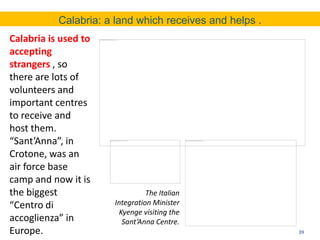
The Italian
Integration Minister
Kyenge visiting the
Sant’Anna Centre.

Pwp italy comenius long version

  • 1.
  • 2.
    2 We come fromthe South of Italy, we could say we are “the toe of the boot”. Our Region is a peninsula with about 800 kms of coast. In our logo you can see the blue of the sea around our emblem which shows a column that reminds us of Magna Graecia and the “Pino loricato”, a rare species of tree you can find on our mountains. (CS) (CZ) (RC) (KR) (VV)
  • 3.
    3 includes the schoolsof three towns: Cerisano, Marano Marchesato, Marano Principato. Its name “Istituto Comprensivo” refers to the fact it’s made of 3 sections: pre-primary, primary and middle school. There are about 200 pupils. Students take a musical instrument lesson once a week. The best of them have extra lessons of musique d'ensemble to play in our Orchestra, our icing on the cake. There are Laboratories of Science, Art and Computer, in some classes there are also Interactive Whiteboards and I-Pads . OUR SCHOOL
  • 4.
    4 Our orchestra wonsome important prizes in national competitions, this urges us to always do our best.
  • 5.
    5 Cerisano, Marano Marchesatoe Marano Principato are close to each other and about 10 kms far from Cosenza, whose district they are part. They are situated on the “Serre”, some mountains around Cosenza, at about 30 kms far from the Tyrrhenian coast. Their old town centres consist of picturesque alleys with ancient churches and buildings. OUR VILLAGES
  • 6.
    6 is the ancientcapital of the Brettii (IV BC); during the Roman Empire, it was an important stop on the Popilia Road, linking Rome to Sicily. COSENZA The old inner city – with its Norman Castle, the Cathedral, the narrow streets, the ancient buildings, the churches and the cloisters - is an interesting example of a Medieval town. Alaric, king of the Visigoths, died here in AD 412. History tells us he was buried with his horse and his treasure into the bed of the Busento River.
  • 7.
    7 The Cosenza’s “Duomo”is a fascinating example of Romanesque architecture. This Cathedral is now “Patrimony witness of peace and culture” protected by UNESCO. It was unvelied by the Holy Roman Emperor Frederick II in 1222. In that occasion, the emperor gave the city of Cosenza the “stauroteca”, a golden cross with precious stones. It keeps a relic, a piece of the Jesus’ cross.
  • 8.
  • 9.
  • 10.
    10 The University ofCalabria is very close to Cosenza. It’s a campus where students can live and study. There are 22 laurea degree courses. The state-of-the-art engineering course is one of the most important in Italy.
  • 11.
  • 12.
    12 Calabria was inhabited sincePalaeolithic times. In the province of Cosenza there’s a cave where you can see a graffito representing an ox made about 11.000 years ago. The Oenotrians were an ancient population who settled in the Cosenza surroundings. A legendary king of them was Italus, so that they were called Italics and their land Italia; later, when the Romans united the various regions into a whole, this name identified the entire Italian Peninsula. So our land gave the name to our nation! Bos primigenius graffito Above you can see the name “Italia” on the Calabrian territory
  • 13.
    13 The Greeks founded colonies duringthe VIII century BC which soon became so rich and powerful that the entire Calabria became known as “Magna Graecia”. Numerous populations and cultures have arrived in Calabria from the Mediterranean Area for centuries Column of Hera Lacinia’s temple, Crotone
  • 14.
    14 After Roman dominationso many people came and occupied Calabria! Byzantines, Saracens, Normans, Longobards, Goths, Arabs… So our culture became richer and our attitude outgoing and open to the new: we are people and a land of contrasts! Norman Castle, Cosenza
  • 15.
    15 CODEX PURPUREUS - Rossano(CS) - a great example of miniature Byzantin art. We have places whose names remind us of these people: e.g. the town Longobardi (CS) or the territory in province of Cosenza called Librandi from the name Liutprando, the ancient Longobardi’s king. THE SARACEN TOWER - San Nicola Arcella (CS)
  • 16.
    16 In Calabria thereare some important ethnic-linguistic minorities, in particular Albanian and Waldensian ones, which speak their ancient languages and still have their traditions From XV to XVIII century lots of Albanians left their country and came to the Cosenza area, where still now there are some towns who live following that culture. In the XVI century a Waldensian community came from South-France to Calabria because of religious reasons, settling on a hill facing the sea near Cosenza.
  • 17.
  • 18.
    18 There are alsosome volcanoes, mainly estinguished. One is into the sea in front of our Tyrrhenian coast: it is the Marsili, it’s 3000 metres high and it’s alive…
  • 19.
    19 In Calabria thereare hot mineral springs, particularly in the Cosenza district. The most important is called “Terme Luigiane”: its water has the highest grade of precious minerals in Europe, so that people come here to care of their health and beauty. Nymphes Cavern – Cerchiara (Cosenza, Pollino Park)
  • 20.
    20 We have 3National Parks that represent the largest mountainous area in the South of Italy : Pollino, Sila, Aspromonte where you can find lots of animal and flora species. Our region is not so rich and there aren’t so many industries. So the principal source of our economy is the beauty of our landscapes. Calabria has lots of hills and its mountains are quite high until about 2000 metres.
  • 21.
    21 Calabria The wolf isthe symbol of Cosenza football team because Sila was its habitat in the past. Sila is about 30 Kms from Cosenza. There you can trek, fish trouts, ski, go horse-riding… Enjoy it all the year round!
  • 22.
    22 Because of its longand quite narrow shape, no place in Calabria is more than 50 Kms far from the sea.
  • 23.
    RESOURCE: FISHING HISTORY: UNDERWATER ARCHEOLOGY (GREEK COLONIZATION: MAGNA GRAECIA) COMMUNICATION ROUTE: TRAVELLING, COMMERCE FUN & TOURISM: BEACHES THE SEA FOR US IS SPORT: SWIMMING, SCUBA DIVING, SAILING 23 23
  • 24.
    HISTORY Our seas –both Tyrrhenian and Ionian - are full of ancient treasures. The Greek ships - that carried statues, amphores, v arious goods from their islands to Calabria, called “Megàlē Hellàs” – sunk with their shipments. Their wrecks still lie at the bottom of the sea . 24
  • 25.
    These two bigbronze statues were casually found in 1972 by a diver at about 250 metres from Riace coast (Reggio Calabria) at a depth of about 7 metres. They date back to 480 BC and are one of the most beautiful examples of the Greek perfection in Classical Art. HISTORY 25
  • 26.
    Near Crotone, anancient city founded by the Greeks, there is THE LARGEST ITALIAN PROTECTED MARINE AREA – about 15000 hectares – , a real archeological marine field where you can see how our sea is rich of priceless treasures. 26 HISTORY The Bretti and Sea Museum of Cetraro – 55 kms far from Cosenza – contains objects , such as amphores found in the wrecks lying in the sea nearby.
  • 27.
    COMMUNICATION ROUTE We’ve alwaysused the sea as a convenient way to move for , travelling and yachting In Calabria there’s an important port container in Gioia Tauro (Reggio Calabria). trading 27
  • 28.
    If you wantto go from Calabria to Sicily you have to take a ferryboat. Do you know it’s possible going by train? But there’s no tunnel under the water level, you can enter the ship staying in your coach train! COMMUNICATION ROUTE 28
  • 29.
    Near to Cosenza,there’s a little prize winning shipyard, Mistral Barche, that builds boats from design to the COMMUNICATION ROUTE 29 Diamante (CS)
  • 30.
    Fishing has alwaysbeen an important activity for the Calabrian people. The Medi rranean sea gi ves us a l ot of seaf ood, most of al l t he “LI TTLE BLUE FI SH”: anchovi es, sardi ne, mac kerel s... I t i s al so pl ent y of sea breams, shri mps, mul l et s and, i n part i cul ar i n t he Sout h Cal abri a, and 30
  • 31.
    LAMPARA Their coloured stripesrefer to their owner and tell how many years they are involved with the sea PARANZA The lamps are needed to lure fish during the nocturnal fishing SPATARA It’s a very special boat, very tall and long, used for fishing the swordfish Anchovies 31
  • 32.
    The Sila’s foresthas been giving the wood used to build boats since the ancient Greek and Roman times. It gave also the “pece brettia”, the tar for covering and waterproof ships.  The “maestri d’ascia” (masters in using axe), especially at the Ionian seaside near Cosenza, still build fishing boats proceeding in an ancient way. 32
  • 33.
    Statue of SanFrancesco di Paola, into the Tyrrhenian sea, in front of Paola (Cosenza) In Calabria there are Scuba Diving centres 33
  • 34.
    An important divingcentre is in Paola, 35 kms from Cosenza, where Piero Greco founded an important association for teaching people with Down syndrome and the blind people to dive. It’s the only example in Europe of such a significant activity. 34
  • 35.
    Swimming, divi ng, snorkelling arepleasant activities you can enjoy in our seas and especially in the water of our Marine Parks, like that of Belmonte Calabro, 60 kms far from Cosenza: the Regional Around it, at a depth of about 56 metres , there’s the black coral, (anthipatella subpinnata) a tropical species very rare in the Mediterranean Sea; its name refers to the colour of its skeleton which is black. Marine Park of Isca Rocks 35
  • 36.
  • 37.
  • 38.
    38 Lots of immigrants arriveto Italy from Africa and the Middle East using old boats (called “carrette del mare”) and facing a dangerous and difficult voyage of Hope. They arrive exhausted, thirsty and hungry in very bad hygenic conditions. Some women give birth to their babies on the boat. Sea: a means of hope, a travel for the change
  • 39.
    39 Calabria: a landwhich receives and helps . Calabria is used to accepting strangers , so there are lots of volunteers and important centres to receive and host them. “Sant’Anna”, in Crotone, was an air force base camp and now it is the biggest “Centro di accoglienza” in Europe. The Italian Integration Minister Kyenge visiting the Sant’Anna Centre.