House of Commons
Science and Technology
Committee

Scientific Publications:
Free for all?
Tenth Report of Session 2003-04

Volume I: Report


                                  HC 399-I
House of Commons
Science and Technology
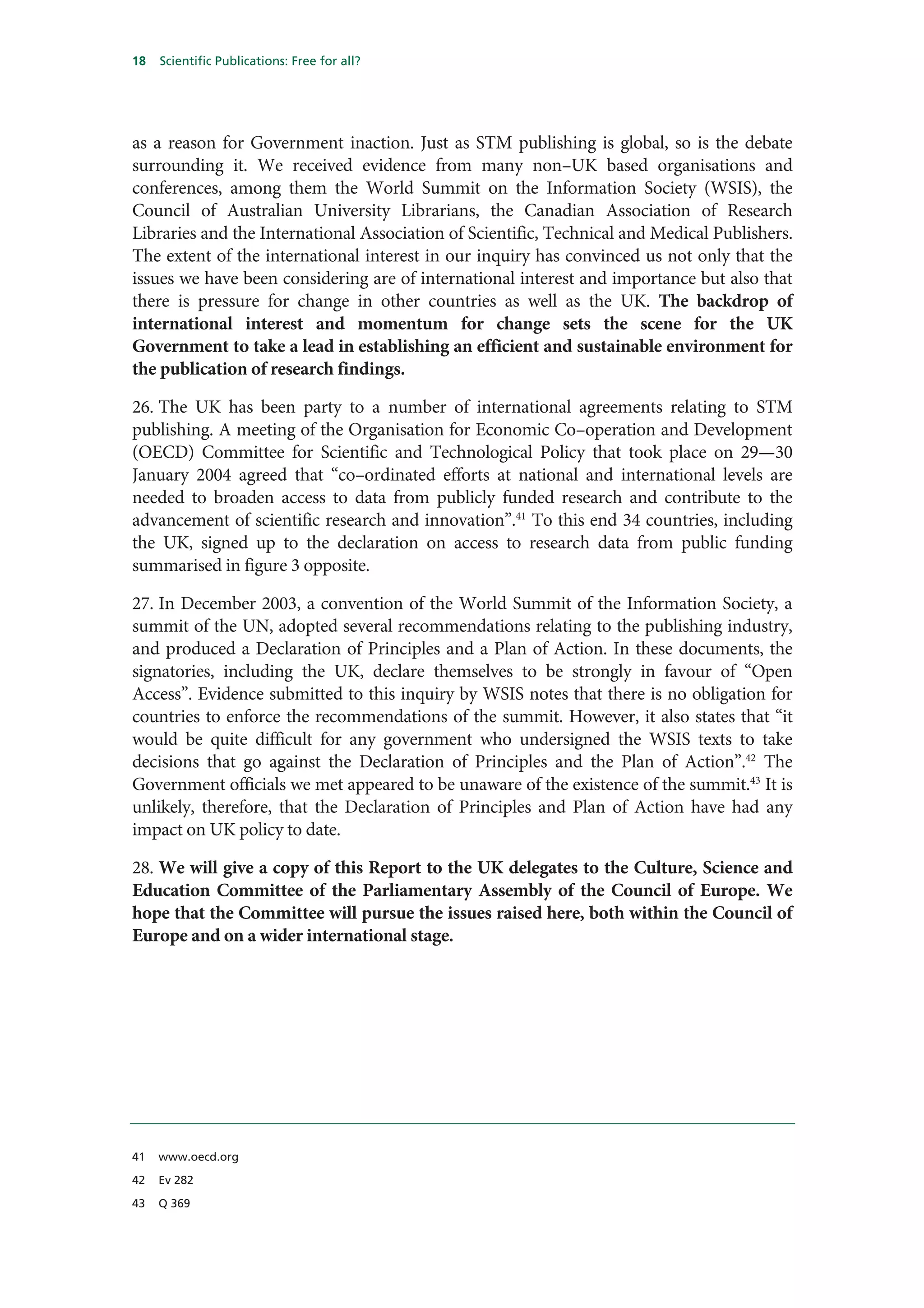
Committee

Scientific Publications:
Free for all?
Tenth Report of Session 2003-04

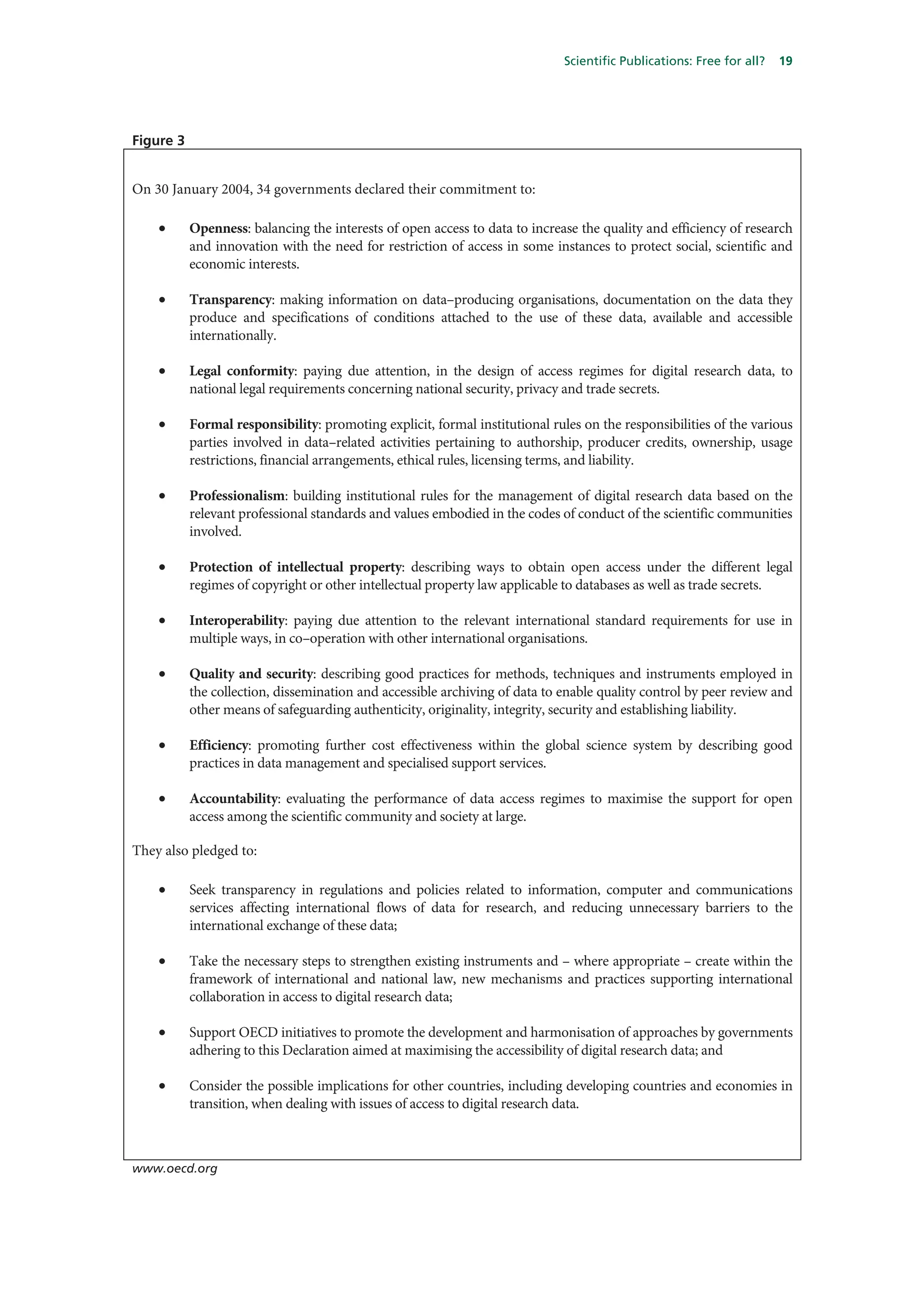
Volume I: Report

Report together with proceedings of the Committee


Ordered by the House of Commons
to be printed Wednesday 7 July 2004


                                                          HC 399-I
                                          Published on 20 July 2004
                             by authority of the House of Commons
                              London: The Stationery Office Limited
                                                              £0.00
The Science and Technology Committee

The Science and Technology Committee is appointed by the House of Commons
to examine the expenditure, administration, and policy of the Office of Science
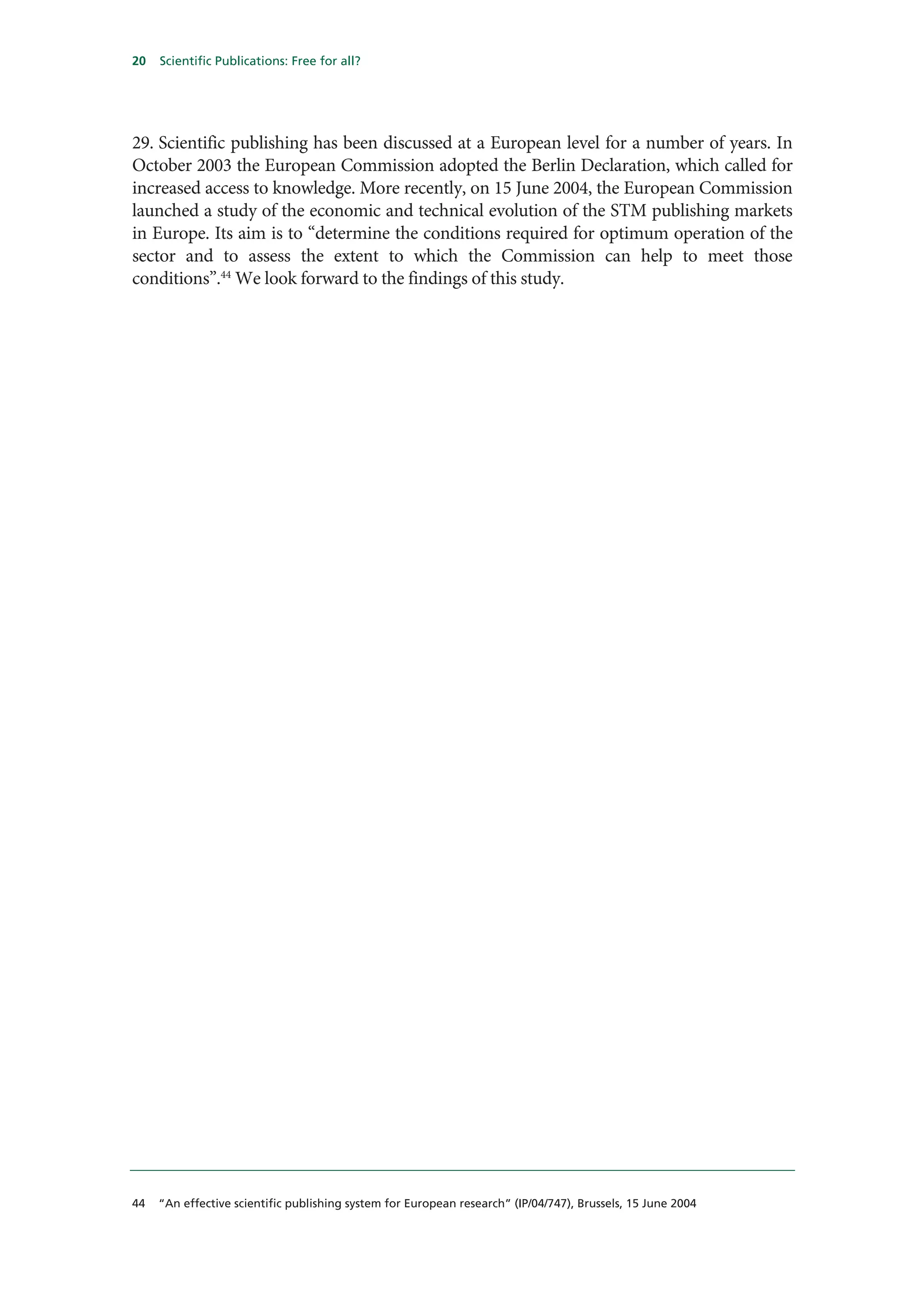
and Technology and its associated public bodies


Current membership
Dr Ian Gibson MP (Labour, Norwich North) (Chairman)
Paul Farrelly MP (Labour, Newcastle-under-Lyme)
Dr Evan Harris MP (Liberal Democrat, Oxford West & Abingdon)
Mr Tom Harris MP (Labour, Glasgow Cathcart)
Dr Brian Iddon MP (Labour, Bolton South East)
Mr Robert Key MP (Conservative, Salisbury)
Mr Tony McWalter MP (Labour, Hemel Hempstead)
Dr Andrew Murrison MP (Conservative, Westbury)
Geraldine Smith MP (Labour, Morecambe and Lunesdale)
Bob Spink MP (Conservative, Castle Point)
Dr Desmond Turner MP (Labour, Brighton Kemptown)

Powers
The Committee is one of the departmental select Committees, the powers of
which are set out in House of Commons Standing Orders, principally in SO
No.152. These are available on the Internet via www.parliament.uk

Publications
The Reports and evidence of the Committee are published by The Stationery
Office by Order of the House. All publications of the Committee (including press
notices) are on the Internet at
www.parliament.uk/parliamentary_committees/science_and_technology_commit
tee.cfm. A list of Reports from the Committee in the present Parliament is
included at the back of this volume.

Committee staff
The current staff of the Committee are, Chris Shaw (Clerk), Emily Commander
(Second Clerk), Alun Roberts (Committee Specialist); Hayaatun Sillem
(Committee Specialist), Ana Ferreira (Committee Assistant); Robert Long (Senior
Office Clerk), and Christine McGrane (Committee Secretary)

Contacts
All correspondence should be addressed to the Clerk of the Science and
Technology Committee, Committee Office, 7 Millbank, London SW1P 3JA. The
telephone number for general inquiries is: 020 7219 2793; the Committee’s e-
mail address is: scitechcom@parliament.uk
Scientific Publications: Free for all?    1


Contents
Report                                                                                          Page


    Summary                                                                                           3

1   Introduction                                                                                      5

2   Background                                                                                        7
        Terminology                                                                                   7
        Scientific, technical and medical publishing: an overview                                     9
             Why publish?                                                                             9
             The publishing process                                                                  10
             Peculiarities of the market                                                             10
             A mixed market                                                                          12
        New developments                                                                             14
             Digitisation                                                                            14
        The role of the Government                                                                   16
        The international context                                                                    17

3   Accessibility of research                                                                        21
        Patterns of access                                                                           21
        Researchers and practitioners                                                                23
        Teachers and students                                                                        24
        The public                                                                                   25
        The developing world                                                                         27

4   The cost of journal provision                                                                    29
        Journal pricing                                                                              29
        Bundling                                                                                     32
             The impact of bundling on libraries                                                     32
             Value for money?                                                                        34
        Triple payment?                                                                              37
        Cost of publication                                                                          38
        VAT                                                                                          43
        Competition issues                                                                           45

5   Intelligent procurement                                                                          49
        Library funding                                                                              49
        Purchasing power                                                                             52
             Libraries                                                                               52
             The role of the academic                                                                54

6   Self–archiving: Institutional repositories                                                       56
        What is a repository?                                                                        56
            The current situation                                                                    56
        Next steps                                                                                   58
            Copyright                                                                                62
2   Scientific Publications: Free for all?


                Costs                                            64
                The UK in the international context              66
            Implications                                         67
                Peer review and institutional repositories       67
                Networking and standards                         68
            The impact of repositories on the main players       69
                Libraries                                        69
                Publishers                                       70

7     Should the author pay?                                     72
            What is the author–pays model?                       72
                Sustainability and costs: the evidence so far    72
            Benefits of the author–pays model                    75
                Extending access?                                76
            Practicalities                                       78
                Ability to pay                                   78
                Peer review in an author–pays system             80
                Free–riders                                      82
                Impact on learned and professional societies     83
            Government action                                    85
            Conclusions on the author–pays publishing model      87

8     Archives                                                   89
            The digital problem                                  89
            Legal deposit                                        90

9     Integrity of the publishing process                        94
            Peer review                                          94
            The Research Assessment Exercise                     95

10 Conclusion                                                    97

      Conclusions and recommendations                            98


Formal Minutes                                                  108

Witnesses                                                       109

List of Written Evidence                                        110
Scientific Publications: Free for all?   3


Summary
Academic libraries are struggling to purchase subscriptions to all the journal titles needed
by their users. This is due both to the high and increasing journal prices imposed by
commercial publishers and the inadequacy of library budgets to meet the demands placed
upon them by a system supporting an ever increasing volume of research. Whilst there are
a number of measures that can be taken by publishers, libraries and academics to improve
the provision of scientific publications, a Government strategy is urgently needed.

This Report recommends that all UK higher education institutions establish institutional
repositories on which their published output can be stored and from which it can be read,
free of charge, online. It also recommends that Research Councils and other Government
funders mandate their funded researchers to deposit a copy of all of their articles in this
way. The Government will need to appoint a central body to oversee the implementation
of the repositories; to help with networking; and to ensure compliance with the technical
standards needed to provide maximum functionality. Set–up and running costs are
relatively low, making institutional repositories a cost–effective way of improving access to
scientific publications.

Institutional repositories will help to improve access to journals but a more radical solution
may be required in the long term. Early indications suggest that the author–pays
publishing model could be viable. We remain unconvinced by many of the arguments
mounted against it. Nonetheless, this Report concludes that further experimentation is
necessary, particularly to establish the impact that a change of publishing models would
have on learned societies and in respect of the “free rider” problem. In order to encourage
such experimentation the Report recommends that the Research Councils each establish a
fund to which their funded researchers can apply should they wish to pay to publish. The
UK Government has failed to respond to issues surrounding scientific publications in a
coherent manner and we are not convinced that it would be ready to deal with any changes
to the publishing process. The Report recommends that Government formulate a strategy
for future action as a matter of urgency.

The preservation of digital material is an expensive process that poses a significant
technical challenge. This Report recommends that the British Library receives sufficient
funding to enable it to carry out this work. It also recommends that work on new
regulations for the legal deposit of non–print publications begins immediately. Failure to
take these steps would result in a substantial breach in the intellectual record of the UK.

The market for scientific publications is international. The UK cannot act alone. For this
reason we recommended that the UK Government act as a proponent for change on the
international stage and lead by example. This will ultimately benefit researchers across the
globe.
Scientific Publications: Free for all?   5


1 Introduction
1. This Committee is appointed by the House of Commons to examine the expenditure,
administration and policy of the Office of Science and Technology (OST) and its associated
bodies. As well as its role in advising the Chief Scientific Advisor and the Director General
of the Research Councils on the allocation of the Science Budget, OST has a role in
overseeing science and technology policy across Government. The Committee has a
similarly broad remit.

2. The scientific, technical and medical publishing industry has recently come under
intense scrutiny. Whilst the volume of research output and the price of scientific journals
has been steadily increasing – one respected source cites average journal price increases of
58% between 1998 and 2003 – library budgets have seen funding decreases.1 As a
consequence, the ability of libraries to purchase journals has come under severe pressure.
This phenomenon is often dubbed the “serials crisis”. The Government has an interest in
ensuring that public money invested in scientific research is translated into outputs that
benefit the public. The Government invests significantly in scientific research, the output
of which is, for the most part, published in research articles. Subscription prices to journals
vary – we have been quoted figures from £87 to £2,843 per annum for a range of individual
journals of differing quality.2 Many libraries subscribe to thousands of journals each year.
Yet whilst libraries are struggling to purchase journals, scientific, technical and medical
publishers’ profit margins remain exceptionally high compared with the rest of the
publishing industry — as much as 34% at the operating level in the case of Reed Elsevier,
the market leader.3 There is mounting concern that the financial benefits from the
Government’s substantial investment in research are being diverted to an excessive degree
into the pockets of publishers’ shareholders.

3. Technology has made it possible to envisage a fundamental change to the way scientific
articles are published. By removing some of the non–editorial overheads associated with
print publications, digitisation makes it relatively cheap to set up and run new journals.
The internet makes it feasible, in theory, for readers to access the articles they need online,
without charge. Several publishing models based around the central concept of free online
access have emerged: collectively their proponents form the “Open Access” movement.
The future of the scientific publishing industry has yet to be determined in the light of
these new developments.

4. We announced our inquiry into scientific publications on 10 December 2003. Our aim
was to examine the provision of scientific journals to the academic community and wider
public. We wanted to establish whether the market for scientific publications was working
well; how trends in journal pricing affected libraries and other users; the impact that new
publishing trends would have on the scientific process; and what provisions were in place
to support a secure national archive. We also looked at the risk to the integrity of journals
posed by scientific fraud and malpractice, particularly in the light of recent publishing


1   The Chartered Institute of Library and Information Professionals, Ev 411

2   Nature Publishing Group, Price List 2004, www.npg.nature.com

3   Q 80
6   Scientific Publications: Free for all?


trends. Our inquiry tapped into an already lively public debate. In 2002, the Office of Fair
Trading conducted an informal consultation on the market for scientific, technical and
medical journals. Its report concluded that no further action should be taken at present but
that further action might be required in future.4 In January 2003 the Wellcome Trust, the
UK’s biggest single funder outside Government of medical research, published an analysis
of the scientific publishing market and publicly adopted a pro–Open Access stance.5 Many
other organisations have also been prompted into a consideration of the issues, some
taking up the Open Access cause, some defending the interests of the existing commercial
publishers and others remaining neutral. The arguments on all sides have been aired
extensively in the media and online. The Committee has received an unprecedented
volume of letters expressing support for its decision to conduct the inquiry. Many
individuals and organisations volunteered to give oral evidence to the inquiry:
unfortunately it was not possible to see everyone in the time available.

5. In the course of our inquiry we held four oral evidence sessions with Government; the
Research Councils; commercial, not–for–profit and author–pays publishers; libraries and
academics. The transcripts of these sessions are published with this Report, along with the
150 written submissions we received in response to our call for evidence and as answers to
supplementary questions. We visited the British Library at St Pancras and Reed Elsevier’s
Holborn offices in London and took part in a seminar on scientific publishing hosted by
the Wellcome Trust. We would like to place on record our thanks to all those who
contributed to this inquiry, by giving evidence or by assisting us on our visits. We would
also like to thank our specialist advisers: David Worlock, the Chairman of Electronic
Publishing Services Limited; and Professor Michael Elves, formerly the Director of the
Office of Scientific and Educational Affairs at Glaxo Wellcome plc.


4    Office of Fair Trading, The market for scientific, technical and medical journals (OFT 396), September 2002, p 21

5    The Wellcome Trust, Economic analysis of scientific research publishing, January 2003. A second report was
     published in 2004: The Wellcome Trust, Costs and Models in scientific research publishing, April 2004.
Scientific Publications: Free for all?   7


2 Background
Terminology
6. Recent developments in scientific publishing have given rise to a vast quantity of new
terminologies. For clarity, an outline of the terminology used in this Report is given below:

    •    Scientific publications: for the purposes of this Report, scientific publications can
         be taken to mean articles reporting scientific, technical and medical (STM)
         research in published journals. Where monographs and other types of literature
         are considered they will be referred to separately. The market for journals in the
         social sciences, arts and humanities has different characteristics and is not
         considered here.

    •    Article: for consistency, the constituent parts of a journal are referred to as articles
         throughout this report. An article is taken to be the document produced by
         researchers as a record of their research findings. Many journals also contain
         review articles and “news and views”. For the purposes of this Report, this type of
         material is not implied by the term “article” unless explicitly stated. Articles are
         frequently also referred to as papers within the scientific community.

    •    Subscriber–pays: the most prevalent publishing model. Authors submit articles to
         journals, usually free of charge, although sometimes the author is required to pay
         page charges or supplements for colour figures.6 The publishers send the articles
         out for peer review. Those articles that are deemed to be of a sufficiently high
         standard are edited and published. The journal is then sold to readers, usually by
         means of a subscription. Commercial, learned and professional society and
         academic publishers all currently use this model, although some of them are also
         experimenting with the author–pays model.

    •    Author–pays: an emerging publishing model. Authors or, more usually, their
         research funders pay to publish their article in a journal. The publishers send the
         articles out for peer review. Those articles that are deemed to be of a sufficiently
         high standard are edited and published. The journal is disseminated free of charge,
         primarily via the internet, although sometimes in paper form too. In some cases the
         author, or funder, pays a submission fee in advance of the publication fee in order
         to cover the administrative costs of processing their article, whether or not it is
         accepted for publication. Author–pays publishing is often referred to as open
         access publishing.

    •    Open Access movement: supports the principle that the published output of
         scientific research should be available, without charge, to everyone. The movement
         embraces both author–pays publishing models and self–archiving. The term
         “Open Access” will only be used in the broad context of the wider movement, not
         as a synonym for the author–pays publishing model or self–archiving, for the
         purposes of this Report.


6   A colour figure can be taken to mean, in this context, a colour illustration, photograph, chart, graph, table etc.
8   Scientific Publications: Free for all?


     •    Self–archiving: authors publish articles in journals, but deposit a copy of each
          article in a personal, institutional or other repository, where it can be freely
          accessed via the internet.

     •    Institutional repositories: online archives set up and managed by research
          institutions to house articles published by authors at the institutions involved. Such
          repositories can accept articles either before or after publication (pre–print
          repositories and post–print repositories): the timing of the deposit in relation to
          publication has copyright implications.

     •    Commercial publishers: publishers that provide goods and services for a financial
          return. Globally, Reed Elsevier, John Wiley and Springer Verlag are three of the
          largest publishers in this category.

     •    Learned and professional society publishers: attempt to produce a return for the
          societies of which they are part. Profit is usually re–invested in other society
          activities, such as education support and conferences. With university presses,
          learned and professional society publishers are sometimes collectively referred to as
          not–for–profit publishers.

     •    University presses “try to make a return for their host institutions but see
          themselves as producing high quality work in return for profit, rather than
          concentrating on the production of profit by means of publishing”.7 For the
          purposes of this Report and in accordance with convention, unless specifically
          singled out, university presses are classed with society publishers.8

     •    Page charges: charges levied on the author within the subscriber–pays publishing
          model. Charges are usually calculated according to the number of pages in the
          article, although publishers sometimes charge a supplement for colour figures. Not
          all publishers impose page charges.

     •    Bundling: the practice of selling a subscription to a group of (usually digital)
          journals in a package, or “bundle”. The package is negotiated between the publisher
          and the purchaser. Typically the price of the bundle will be lower than the
          combined price of all the journals, and will be capped for the duration of the
          subscription. Publishers often include their entire collection in the bundle.
          Bundling deals are sometimes referred to as the big deal.

     •    Legal deposit: publishers and distributors in the United Kingdom and Ireland have
          a legal obligation to deposit published print material in the six legal deposit
          libraries that collectively maintain the national published archive of the British
          Isles. The legislation is soon to be extended to cover digital publications.

The focus of this Report is primarily on the provision of STM journals to the academic
community as this accounts for the spending of significant amounts of public money
through libraries and the higher education system. It should be noted, however, that many
users of such journals also work within industry, Government and other organisations.

7    The Wellcome Trust, Economic analysis of scientific research publishing, p 17

8    See, for example, OFT, p 5
Scientific Publications: Free for all?   9


Scientific, technical and medical publishing: an overview

Why publish?
7. In the scientific, technical and medical fields, publication is an integral part of the
research process. Researchers publish their findings in order to ensure widespread
dissemination of their work, primarily within a community of their peers, where it will be
discussed, assessed and built upon. Publication has the potential to enhance the reputation
of the author, support applications for research funding and aid promotion prospects: the
Publishers Association explained that “publication and effective dissemination to the peer
community are absolutely vital to researchers in terms of tenure and the capacity to attract
research grants and university funding”.9 In the UK, university departments are assessed by
their research output in the Research Assessment Exercise (RAE) for the purposes of
allocating universities’ block grants. As one of the main indicators of the level and quality
of research output, the publication of journal articles is of great importance to researchers
and their institutions. The impact of the RAE on the market for scientific publications will
be discussed in paragraphs 208—210 of this Report. The above factors all provide authors
with a strong incentive to ensure that the publishing process is functioning well.

8. Whilst most researchers would agree with the group of academics who stated that
“inaccessible research may as well not have been conducted at all”, there is some dispute
about whether wide or targeted dissemination of research findings is most important.10
The Securing a Hybrid Environment for Research Preservation and Access (SHERPA)
Project told us that “researchers give their articles to journals in order to achieve ‘impact’
not income. They want to be influential in their field so that their work will be cited by
colleagues. It is therefore in authors’ interests that their work should be disseminated as
widely as possible”.11 The Royal Society of Chemistry, however, argued that “most authors
care where their work is seen and who it is seen by far more than they care about how
many people have seen it. Quality wins hands down over quantity where authors are
concerned about readership”.12 This dispute goes to the core of the question of who should
pay for scientific publications: those who argue in favour of the widest possible
dissemination tend to be more receptive to the author–pays model of publishing; those
who prefer targeting publications at a small, selected audience tend to be more content to
maintain the status quo.

9. There are, of course, reasons for the publication of research findings other than the
career and reputational motivations of authors. Science is an ever–evolving discipline.
Without access to the latest research findings, researchers would find themselves lagging
behind or repeating work that had already been carried out elsewhere. Axiope Limited, a
small software company that advocates the sharing of primary research data as well as
research findings, explained how researchers build upon research being carried out by their
peers: “those who collect the initial data see it being used in ways they had never dreamed
of. The other users are able to do research that would have been impossible without


9    Ev 96

10   Ev 440

11   Ev 215

12   Ev 209
10   Scientific Publications: Free for all?


publication of the data”.13 Many witnesses also outlined the benefits of publishing research
findings, particularly from medical research, for the general public. Dr Virginia Barbour
told us that: “the free flow of scientific information is essential; not only to other
researchers and physicians, but also to an increasingly medically sophisticated public”.14
Publishing thus serves two “public good” purposes: it makes the research process more
efficient and it helps to inform the public of developments in the scientific, technical and
medical fields.

The publishing process
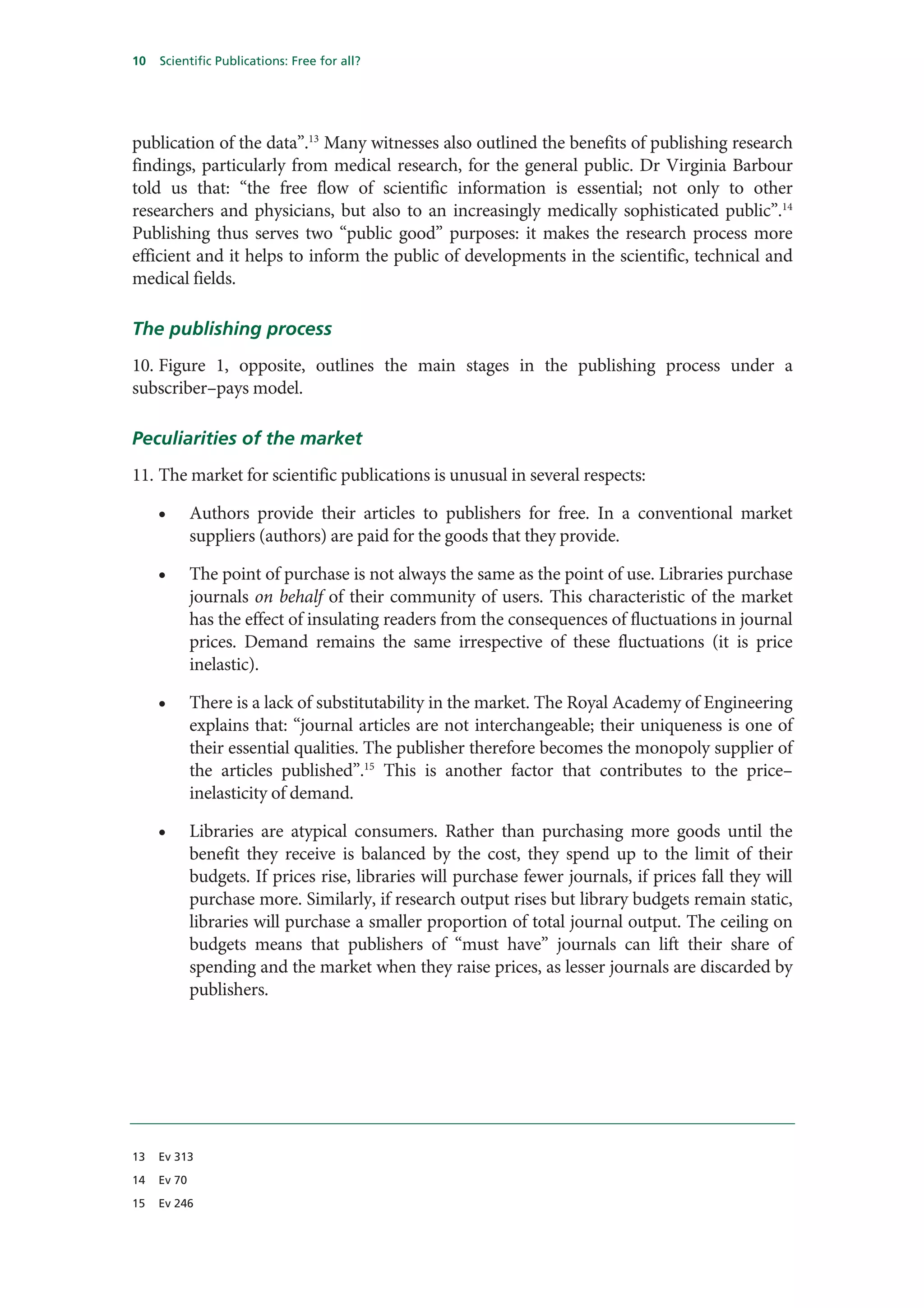
10. Figure 1, opposite, outlines the main stages in the publishing process under a
subscriber–pays model.

Peculiarities of the market
11. The market for scientific publications is unusual in several respects:

     •       Authors provide their articles to publishers for free. In a conventional market
             suppliers (authors) are paid for the goods that they provide.

     •       The point of purchase is not always the same as the point of use. Libraries purchase
             journals on behalf of their community of users. This characteristic of the market
             has the effect of insulating readers from the consequences of fluctuations in journal
             prices. Demand remains the same irrespective of these fluctuations (it is price
             inelastic).

     •       There is a lack of substitutability in the market. The Royal Academy of Engineering
             explains that: “journal articles are not interchangeable; their uniqueness is one of
             their essential qualities. The publisher therefore becomes the monopoly supplier of
             the articles published”.15 This is another factor that contributes to the price–
             inelasticity of demand.

     •       Libraries are atypical consumers. Rather than purchasing more goods until the
             benefit they receive is balanced by the cost, they spend up to the limit of their
             budgets. If prices rise, libraries will purchase fewer journals, if prices fall they will
             purchase more. Similarly, if research output rises but library budgets remain static,
             libraries will purchase a smaller proportion of total journal output. The ceiling on
             budgets means that publishers of “must have” journals can lift their share of
             spending and the market when they raise prices, as lesser journals are discarded by
             publishers.


13   Ev 313

14   Ev 70

15   Ev 246
Scientific Publications: Free for all?   11


Figure 1

The Publishing Process

Researcher submits an article to a journal. The choice of journal may be determined by:

   •       The journal’s audience: is it the appropriate audience for the article?

   •       The journal’s prestige: it is well known? Is it often cited?

The author is unpaid, but may pay “page charges” (see terminology)

The journal selects two or more appropriate experts to peer review the article, without
payment

The peer reviewers assess:

   •       The quality of the research and the way it is reported

   •       The relevance of the article to the journal’s readership

   •       Its novelty and interest

   •       Its content, structure and language

Feedback from the reviewers determines whether or not the article is accepted. Acceptance
rates vary from journal to journal

The rejected article is returned to the author or

The accepted article is passed to the editors employed by the publishers, either in–house or
freelance

The editors ensure that:

   •       The language of the article is clear and unambiguous (particularly if it has been
           produced by a non–native speaker)

   •       The standard style of nomenclature is adhered to

   •       Illustrative material is of a sufficiently high standard

Editors also establish live links in the electronic version to the references cited and to other
material such as data sets

12. Where a journal exists in both paper and digital formats, the article is sent to the printer
to produce a paper copy, and will be formatted for the online version of the journal
12   Scientific Publications: Free for all?


     •    The career and reputational motivations that drive researchers to publish ensure
          that they seek to publish in the most prestigious journal in their field, irrespective
          of that journal’s price. Hence Professor Sir Keith O’Nions’ observation that “I think
          it will be a very long time before a journal like Nature loses its immense prestige as
          a place to publish anywhere, for anybody in the world, even though it is a profit–
          making organisation”.16

As Professor Spier from the University of Surrey told us: “scientific publications are not a
commodity. They do not wax and wane in value as do the markets in silver or oil. Each
publication constitutes an element in a self–supporting and growing entity that is the body
of knowledge”.17 The peculiarities listed above mean that the market for scientific
publications is not subject to the same market forces that influence markets for other
goods, such as clothes or cars. The purchasers, libraries, are caught between the demands
of readers on the one hand and of publishers on the other. The inelasticity of demand from
their readers for access to journals leaves them with very little purchasing power when
dealing with the publishers.

A mixed market
13. The total UK publishing industry has a turnover of at least £18.4 billion, making it the
second largest publishing industry in Europe. It has more than 8,000 companies employing
approximately 164,000 people.18 Statistics on the UK STM publishing sector are less
meaningful because STM publishing is international in scope. Researchers read articles
published abroad that have some bearing on their work. The vast majority of STM journals
are published in the English language: journals published in the US have the largest share
of the market. The International Association of Scientific, Technical & Medical Publishers
estimated that there are currently over 2,000 STM publishers worldwide, between them
publishing over 1.2 million articles per year via approximately 16,000 journals.19 UK based
STM publishers include Reed Elsevier, Nature Publishing Group, Oxford University Press,
Blackwell and T & F Informa.

14. Globally, in the STM field, the biggest commercial publishers by market share are Reed
Elsevier, Thomson ISI, Springer, John Wiley and T & F Informa. Statistics on market
shares are often given separately for the scientific and technical, and the medical markets
because some of the larger publishers are more active in one of these fields than the other.
For the purposes of this Report, however, unless otherwise specified, all statements and
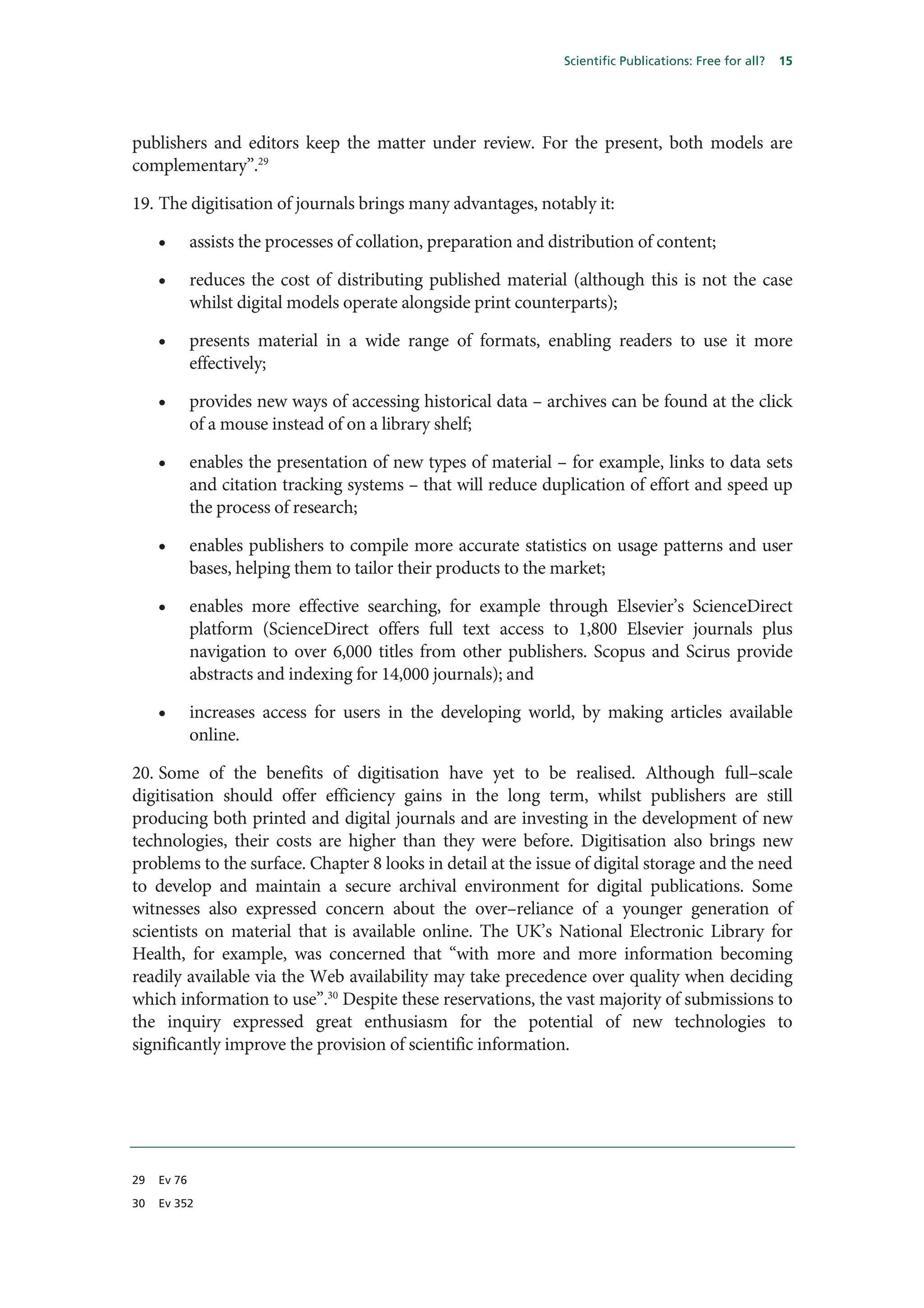
statistics quoted apply across the entirety of the STM sector. Figure 2, opposite, breaks
down the STM information market by percentage of market share. The American
Chemical Society, with a 3.6% share of the market, is the only society publisher that is able
to feature in terms of market share alongside the major commercial players.


16   Q 357

17   Ev 231

18   www.dti.gov.uk

19   Ev 318
Scientific Publications: Free for all?   13


Figure 2
                       Global Market Shares of STM Publishers, 2003


                                                                 Reed Els evier
                                                                 28.2%
               Other
               33.6%


                                                                  Thomson
Taylor & Francis                                                  9.5%
           3.6%
 Blackwell Publishing
                3.6%                                     Wolters Kluwer
                                                         9.4%
                        American
                        Chemical     John Wiley
                                                   Springer
                        Society      3.9%
                                                   4.7%
                        3.6%

EPS Ltd, June 2004

15. The Association of Learned and Professional Society Publishers (ALPSP) estimated
that there are currently 9,250 peer–reviewed journals published globally by learned
societies, professional associations and university presses.20 They range from the very small,
with an output of only one journal of narrow interest, to the very large, such as the
American Chemical Society in the US or the Institute of Physics Publishing (IoPP) in the
UK. Many society publishers simply aim to cover the costs of their publishing activities,
which serve to disseminate the work of society members. Those that make a surplus are
bound by their charitable status to re–invest the money in the society’s activities. A number
of submissions pointed out that, were the publishing operations of learned societies to
cease, many would struggle to survive. The British Pharmacological Society, for example,
told us that “in 2002—03 we spent over £850,000 on promoting and advancing
pharmacology. Nearly £800,000 of this came from our publishing activities. Without this
income we should either have to raise funds in a different way or cease to provide most of
our current activities”.21 The impact of changes to the market on learned societies are
considered in detail in paragraphs 178—182 of this Report.

16. An increasing number of learned societies use the large commercial publishing houses
to publish their journals, often because the costs of keeping such a small–scale operation in
house would be greater than the income received. Blackwell Publishing, for example,
publishes a number of journals on behalf of societies, including the Society for Applied
Microbiology, which described itself as having “a good, long standing relationship” with


20   Ev 88

21   Ev 221
14   Scientific Publications: Free for all?


Blackwell.22 John Wiley stated that “about a third of our journals are published on behalf of
or in affiliation with learned societies – we proactively work with our society partners to
develop their titles in the light of scientific progress, as new disciplines emerge and research
foci shift”.23 In most cases, pricing policy is determined by the society, rather than the
publisher. The Mammal Society noted that the trend towards outsourcing society
publishing activities helped societies to gain a foothold in the market where, otherwise,
they would be “incapable of protecting their market against aggressive marketing by the
large publishers”.24 Nonetheless, several learned societies have resisted the transfer of their
publishing activities to commercial outfits. The British Entomological and Natural History
Society, for example, felt that outsourcing tended to increase the power of commercial
publishers to raise prices.25

New developments
17. In very recent years, Government investment in scientific research has increased
dramatically. Increased research volume has generated increased outputs, often in the form
of scientific articles. The Publishers Association told us that 84% of the 65,000 articles
originating in the UK in 2002 derived from publicly–funded research.26 In the UK, the
Society of College, National and University Libraries (SCONUL) have reported that “the
mean number of journal titles received by its member libraries in 1993—94 was 3,976; the
nearest equivalent figure for 2001—02 is 6,489”.27 Over the same period, library budgets
have suffered within academic institutions. Most submissions agreed with the Association
for Information Management (Aslib) that library budgets “have not been keeping pace
with the rapid changes which have been taking place in journal publishing, the increased
costs, and the significant growth in output of research material”.28 Library funding is dealt
with in Chapter 5 of this Report. The growing disparity between the growth in research
output and the money available to purchase journals has meant that libraries have had to
cut subscriptions in order to keep within their budgets. This, in turn, forces publishers to
lift prices of certain journals to cover overheads, creating a vicious circle and difficulties in
accessing such journals.

Digitisation
18. The market for scientific publications has undergone a technological transformation in
recent years. The change is most immediately apparent in the number of journals that are
now available in digital form. Although most digital journals are published alongside a
print version, it is becoming increasingly likely that some journals will be published in
digital form only. Many already have digital–only sections. Mr David A. Rew, a Consultant
Surgeon at Southampton University Hospitals, notes that “there are some areas of science,
for example high energy physics and astrophysics, where this may well be the case, and all

22   Ev 189

23   Ev 129

24   Ev 157

25   Ev 160

26   Ev 97

27   Ev 305

28   Ev 328
Scientific Publications: Free for all?   15


publishers and editors keep the matter under review. For the present, both models are
complementary”.29

19. The digitisation of journals brings many advantages, notably it:

     •       assists the processes of collation, preparation and distribution of content;

     •       reduces the cost of distributing published material (although this is not the case
             whilst digital models operate alongside print counterparts);

     •       presents material in a wide range of formats, enabling readers to use it more
             effectively;

     •       provides new ways of accessing historical data – archives can be found at the click
             of a mouse instead of on a library shelf;

     •       enables the presentation of new types of material – for example, links to data sets
             and citation tracking systems – that will reduce duplication of effort and speed up
             the process of research;

     •       enables publishers to compile more accurate statistics on usage patterns and user
             bases, helping them to tailor their products to the market;

     •       enables more effective searching, for example through Elsevier’s ScienceDirect
             platform (ScienceDirect offers full text access to 1,800 Elsevier journals plus
             navigation to over 6,000 titles from other publishers. Scopus and Scirus provide
             abstracts and indexing for 14,000 journals); and

     •       increases access for users in the developing world, by making articles available
             online.

20. Some of the benefits of digitisation have yet to be realised. Although full–scale
digitisation should offer efficiency gains in the long term, whilst publishers are still
producing both printed and digital journals and are investing in the development of new
technologies, their costs are higher than they were before. Digitisation also brings new
problems to the surface. Chapter 8 looks in detail at the issue of digital storage and the need
to develop and maintain a secure archival environment for digital publications. Some
witnesses also expressed concern about the over–reliance of a younger generation of
scientists on material that is available online. The UK’s National Electronic Library for
Health, for example, was concerned that “with more and more information becoming
readily available via the Web availability may take precedence over quality when deciding
which information to use”.30 Despite these reservations, the vast majority of submissions to
the inquiry expressed great enthusiasm for the potential of new technologies to
significantly improve the provision of scientific information.


29   Ev 76

30   Ev 352
16   Scientific Publications: Free for all?


The role of the Government
21. The UK Government’s interest in STM publishing derives from a variety of its
functions. The Government funds a significant proportion of the research carried out in
the UK. Through the Higher Education Funding Council for England (HEFCE), the
Department for Education and Skills (DfES) pays a block grant to UK universities, which
contributes to the full economic costs of research and teaching and from which a
substantial proportion of university library funding derives. The Department for Culture,
Media and Sport (DCMS) funds the British Library, which is one of the six legal deposit
libraries in the UK and Ireland charged with maintaining an archive of all the material
published in the UK and Ireland. It also funds national museums which conduct their own
research and house their own libraries. The Department of Trade and Industry (DTI)
supports the UK publishing industry as one of its business support activities.

22. It is not clear to us that the roles of the Office of Science and Technology (OST) and
DTI are synchronised on the issue of scientific publications. Through the Research
Councils, OST has a duty of care to the UK research community. As articulated by
Research Councils UK (RCUK) this duty includes the conviction that “the peer reviewed
and published output of their funded research must be made available as widely and
rapidly as possible to academic and other communities”.31 Through its Digital Content and
Publishing Unit, DTI has business relations responsibility for the publishing sector: its “key
function is to promote the competitiveness of the sector through dialogue with key
companies and intermediaries to ensure that government policies provide an environment
for these industries to succeed”.32 It cannot simply be assumed that research will thrive,
that publishing will succeed and that the UK taxpayer will get best value for money in the
same environment. As the Royal Society of Chemistry pointed out, some of the changes
being proposed to further the aims of the research community could have ramifications for
the publishing sector: “UK plc has much to lose from destabilising its very successful
journal publishing industry in terms of employment, exports and revenues to the
Exchequer”.33 We attempted to pursue the issue of this potential conflict of interests with
the Director General of the Research Councils (DGRC), Professor Sir Keith O’Nions, when
he gave oral evidence to us on behalf of both OST and DTI on 5 May. Sir Keith told us that
“in terms of perception of a conflict of interest, I do not think I have one”. 34 As the session
unfolded we began to suspect that the DGRC was unconcerned about a conflict of interest
because he could not really speak on behalf of the publishing interests represented by DTI.
It is discouraging that the Government does not yet appear to have given much
consideration to balancing the needs of the research community, the taxpayer and the
commercial sectors for which it has responsibility.

23. During the course of our inquiry it became clear to us that the issue of scientific
publications is extremely low on the Government’s agenda. Professor Sir Keith O’Nions
told us that “the feeling in DTI and OST at the moment is probably that a middle–ground
level playing field is the right position for us to be”. 35 We suspect that the “middle–ground

31   Ev 293

32   www.dti.gov.uk

33   Ev 210

34   Q 328

35   Q 328
Scientific Publications: Free for all?   17


level playing field” approach is a consequence of the scant attention given by Government
thus far to the task of formulating a strategy or a policy on scientific publications. Rama
Thirunamachandran from HEFCE told us that “I think we do need a strategic approach
nationally to harness all our research information resources to best use”.36 We can only
agree with him, although we were somewhat concerned that a strategy had not already
been put in place. The DGRC observed that “the interest that your Committee has taken in
this subject has given some stimulus and momentum to broader debates in Government”.37
We welcome this debate within Government but find it worrying that it has taken a select
committee inquiry to stimulate a joined–up approach to this important issue.

24. This Report draws a clear distinction between the activities of Government and those of
private industry. Although the inquiry has required us to examine the publishing industry
in some depth it is not our intention to make recommendations to private sector
companies. We can, however, make recommendations to Government and its associated
bodies. Several memoranda expressed the view that Government had no role to play in the
field of STM publishing at all. The Royal Society of Chemistry, for example, noted that “it is
the competitive and well–functioning market, and not governments, that must choose
which business models and which publishers are best equipped to stay apace of the ever–
increasing demand for information exchange”.38 Our investigations, however, have led us
to believe that there are several areas in which Government could take action to improve
the operation of the market for STM publications to the benefit of the research and student
community as well as the public more generally. We are convinced that the amount of
public money invested in scientific research and its outputs is sufficient to merit
Government involvement in the publishing process. Indeed, we would be very
surprised if Government did not itself feel the need to account for its investment in the
publishing process. We were disappointed by how little thought has been given to the
issues within Government thus far and hope that this Report will prove to be a catalyst
for change.

The international context
25. Throughout the course of this inquiry, the Committee has been mindful that the issues
it has been exploring are international in scope. The UK STM publishing industry,
although a significant sector within the UK, represents only a fraction of the global market.
As the Association of Learned and Professional Society Publishers (ALPSP) told us “the
majority of UK authors are published in non–UK journals, and the majority of UK journal
sales are to non–UK customers”.39 The British Pharmacological Society warned us that
“any actions by the British Government will affect only the British market, and may have
unintended consequences for the health of British science and UK–based journals”.40 These
“unintended consequences”, which will be explored in paragraphs 188—189, are indeed
vitally important considerations for the UK Government when it decides how to act.
Nonetheless, we cannot agree with those submissions that cite the international dimension

36   Q 10

37   Q 351

38   Ev 209 (

39   Ev 449

40   Ev 229
18   Scientific Publications: Free for all?


as a reason for Government inaction. Just as STM publishing is global, so is the debate
surrounding it. We received evidence from many non–UK based organisations and
conferences, among them the World Summit on the Information Society (WSIS), the
Council of Australian University Librarians, the Canadian Association of Research
Libraries and the International Association of Scientific, Technical and Medical Publishers.
The extent of the international interest in our inquiry has convinced us not only that the
issues we have been considering are of international interest and importance but also that
there is pressure for change in other countries as well as the UK. The backdrop of
international interest and momentum for change sets the scene for the UK
Government to take a lead in establishing an efficient and sustainable environment for
the publication of research findings.

26. The UK has been party to a number of international agreements relating to STM
publishing. A meeting of the Organisation for Economic Co–operation and Development
(OECD) Committee for Scientific and Technological Policy that took place on 29—30
January 2004 agreed that “co–ordinated efforts at national and international levels are
needed to broaden access to data from publicly funded research and contribute to the
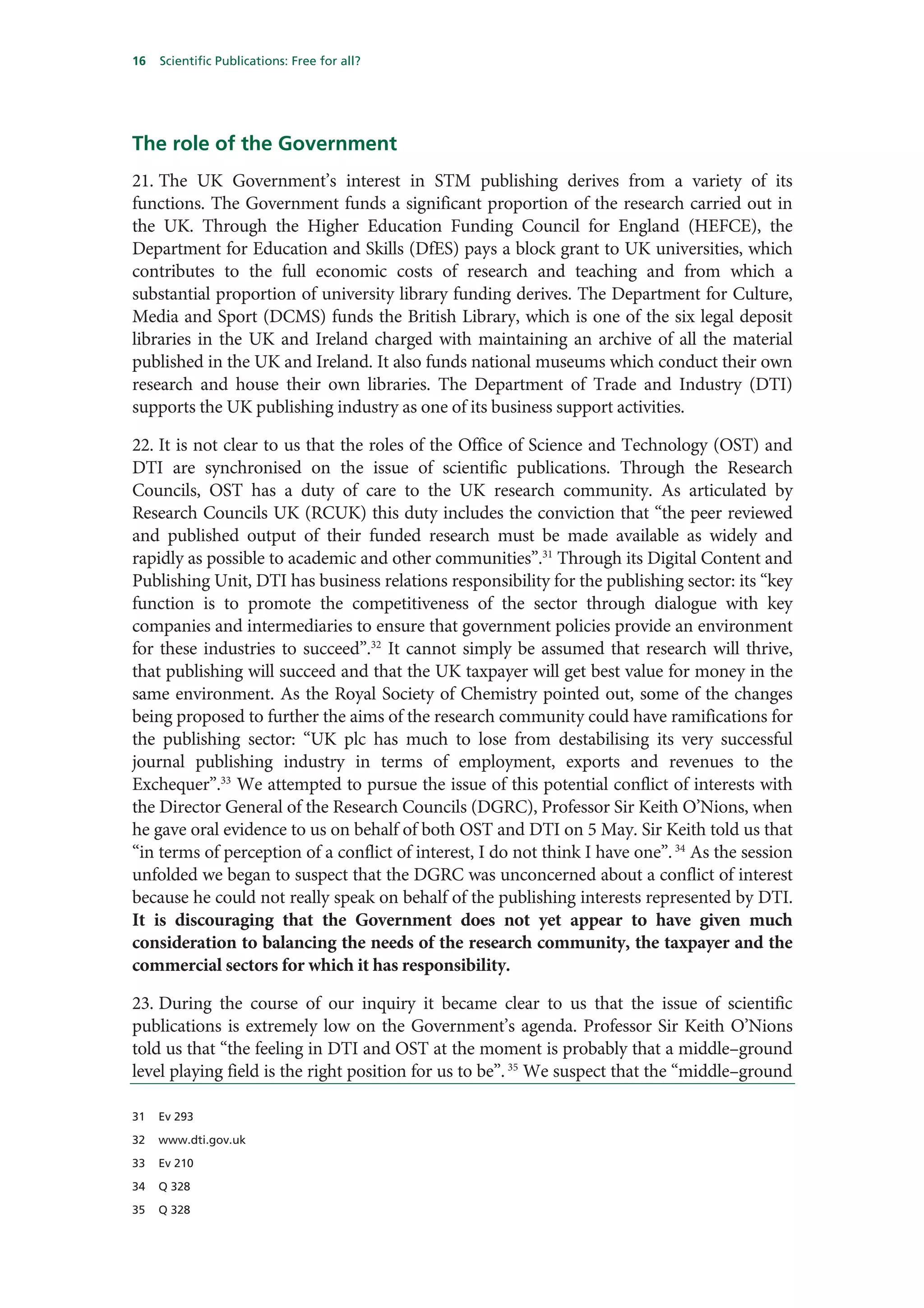
advancement of scientific research and innovation”.41 To this end 34 countries, including
the UK, signed up to the declaration on access to research data from public funding
summarised in figure 3 opposite.

27. In December 2003, a convention of the World Summit of the Information Society, a
summit of the UN, adopted several recommendations relating to the publishing industry,
and produced a Declaration of Principles and a Plan of Action. In these documents, the
signatories, including the UK, declare themselves to be strongly in favour of “Open
Access”. Evidence submitted to this inquiry by WSIS notes that there is no obligation for
countries to enforce the recommendations of the summit. However, it also states that “it
would be quite difficult for any government who undersigned the WSIS texts to take
decisions that go against the Declaration of Principles and the Plan of Action”.42 The
Government officials we met appeared to be unaware of the existence of the summit.43 It is
unlikely, therefore, that the Declaration of Principles and Plan of Action have had any
impact on UK policy to date.

28. We will give a copy of this Report to the UK delegates to the Culture, Science and
Education Committee of the Parliamentary Assembly of the Council of Europe. We
hope that the Committee will pursue the issues raised here, both within the Council of
Europe and on a wider international stage.


41   www.oecd.org

42   Ev 282

43   Q 369
Scientific Publications: Free for all?   19


Figure 3


On 30 January 2004, 34 governments declared their commitment to:

    •      Openness: balancing the interests of open access to data to increase the quality and efficiency of research
           and innovation with the need for restriction of access in some instances to protect social, scientific and
           economic interests.

    •      Transparency: making information on data–producing organisations, documentation on the data they
           produce and specifications of conditions attached to the use of these data, available and accessible
           internationally.

    •      Legal conformity: paying due attention, in the design of access regimes for digital research data, to
           national legal requirements concerning national security, privacy and trade secrets.

    •      Formal responsibility: promoting explicit, formal institutional rules on the responsibilities of the various
           parties involved in data–related activities pertaining to authorship, producer credits, ownership, usage
           restrictions, financial arrangements, ethical rules, licensing terms, and liability.

    •      Professionalism: building institutional rules for the management of digital research data based on the
           relevant professional standards and values embodied in the codes of conduct of the scientific communities
           involved.

    •      Protection of intellectual property: describing ways to obtain open access under the different legal
           regimes of copyright or other intellectual property law applicable to databases as well as trade secrets.

    •      Interoperability: paying due attention to the relevant international standard requirements for use in
           multiple ways, in co–operation with other international organisations.

    •      Quality and security: describing good practices for methods, techniques and instruments employed in
           the collection, dissemination and accessible archiving of data to enable quality control by peer review and
           other means of safeguarding authenticity, originality, integrity, security and establishing liability.

    •      Efficiency: promoting further cost effectiveness within the global science system by describing good
           practices in data management and specialised support services.

    •      Accountability: evaluating the performance of data access regimes to maximise the support for open
           access among the scientific community and society at large.

They also pledged to:

    •      Seek transparency in regulations and policies related to information, computer and communications
           services affecting international flows of data for research, and reducing unnecessary barriers to the
           international exchange of these data;

    •      Take the necessary steps to strengthen existing instruments and – where appropriate – create within the
           framework of international and national law, new mechanisms and practices supporting international
           collaboration in access to digital research data;

    •      Support OECD initiatives to promote the development and harmonisation of approaches by governments
           adhering to this Declaration aimed at maximising the accessibility of digital research data; and

    •      Consider the possible implications for other countries, including developing countries and economies in
           transition, when dealing with issues of access to digital research data.


www.oecd.org
20   Scientific Publications: Free for all?


29. Scientific publishing has been discussed at a European level for a number of years. In
October 2003 the European Commission adopted the Berlin Declaration, which called for
increased access to knowledge. More recently, on 15 June 2004, the European Commission
launched a study of the economic and technical evolution of the STM publishing markets
in Europe. Its aim is to “determine the conditions required for optimum operation of the
sector and to assess the extent to which the Commission can help to meet those
conditions”.44 We look forward to the findings of this study.


44   “An effective scientific publishing system for European research” (IP/04/747), Brussels, 15 June 2004
Scientific Publications: Free for all?   21


3 Accessibility of research
Patterns of access
30. Some individuals subscribe to journals that they regularly read. For those seeking access
to an article in a journal to which they do not subscribe, the first place they would look
would be their library. Most researchers are affiliated to an academic institution or private
sector company that carries subscriptions to a number of journals. Access can also be
gained through local libraries or one of the six UK legal deposit libraries. If the journal is
not available through the library, the articles required by the user can be obtained through
an inter–library loan; through the British Library’s Document Supply Service, run from
Boston Spa; or on a pay–per–view basis from a publisher. All of the above methods require
payment on the part of the user: the British Library’s Document Supply Service generates a
margin for the British Library; inter–library loans are exchanges of content between
libraries and do not generate a margin. The British Library currently charges £8.65 for an
inter–library loan: the user’s library decides how much of that cost to pass on to the user.45
Articles purchased on a pay–per view basis cost anything from £5 to £30. The variety of
available methods used to access journals means that overall access levels are high. John
Wiley & Sons stated that “the vast majority of people who want to access our material can
do so with ease”. It estimated that only 10% of potential users are unable to gain access to
its material, for whatever reason.46

31. The British Library’s Document Supply Service supplies over 1.8 million scientific
articles a year, over 90% of which are supplied within 48 hours.47 In December 2003 it
introduced a Secure Electronic Delivery service that “gives access to 100 million documents
which can now be delivered electronically to researchers’ desktops”.48 In their evidence, the
Consortium of University Research Libraries (CURL) and SCONUL stressed the
importance of “a continuation of [the British Library’s] comprehensive document supply
service, serving the information requirements of scholars and researchers”.49 With the
relatively modest prices involved, particularly when compared to the price of pay–per–
view, the Document Supply Service provides a cost–effective method for the reader to gain
access to articles in journals to which they or their library do not subscribe. Nonetheless,
the British Library told us that the financial viability of this service had been threatened by
the advent of bundling deals that give subscribers access to the entirety of a publishers’
catalogue, thus reducing the need for Document Supply. As discussed in paragraphs 56—
68 of this Report, although bundling deals increase the range of journals to which a user
has access, they do not necessarily offer value for money. The British Library’s Document
Supply Service is an efficient and cost–effective method of providing access to articles
in scientific journals. The decline in demand for Document Supply notwithstanding,
we are persuaded that the service provides a valuable alternative route for users who


45   Q 271. Note that the inter-library loan is not the same as the British Library’s Document Supply Service.

46   Ev 131

47   Q 272

48   Ev 356

49   Ev 127
22   Scientific Publications: Free for all?


would not otherwise have access to the journals that they needed. We recommend that
the Government takes steps to protect the service.

32. The digitisation of journal provision has altered patterns of access. Many submissions
complained that the market had not yet adapted to the digital environment. There is some
evidence that subscriptions to digital journals are still being predicated on the model used
for subscriptions to print journals. Publishers traditionally sold libraries a set number of
copies of each issue of print journals as part of the terms of their subscription. All library
users were able to read those print copies within the library precincts. Some publishers
have used the same numerical basis for subscriptions to their digital journals, providing
libraries with a limited number of digital “copies” of each title. The Eastern Confederation
of Library and Knowledge Services Alliance (ECLaKSA) told us that “the publishers
control access to the journal titles by single IP address recognition. […] This in turn means
that libraries can only provide access to a limited number of users via one PC”.50 The
University of Hertfordshire echoed this complaint, writing that pricing is “based on the
number of simultaneous users with significant differentials between single user and even
low numbers (4–5) of concurrent users, when in practice actual usage patterns and service
requirements fluctuate at different times of day from no one using the materials to a
number of concurrent users”.51 The Joint Information Systems Committee (JISC) is a body
jointly established by the four UK higher education funding bodies and the Learning and
Skills Council to provide strategic guidance, advice and opportunities to use ICT to
support teaching, learning, research and administration. One of its functions is to
undertake initiatives for the licensing of electronic journals on behalf of the higher and
further education sectors. We are not convinced that the publisher practice of granting
each subscriber access to a set number of digital “copies” of a journal is either effective
or necessary. We recommend that the Joint Information Systems Committee strongly
argues the case against such restrictive practices when it negotiates the terms for the
next national site licence with publishers.

33. The digital environment enables access to research findings in a range of formats other
than the traditional article. Digital articles can include video clips and links to sets of
primary data. We heard from Dr Nigel Goddard of Axiope Limited, a spinout from
Edinburgh University that provides the tools needed for researchers to manage and share
their primary research data, about the advantages of making primary data sets available
with research findings: “[researchers] see the possibilities for using it to share information
within collaborations. […] the example to look at is the genomic project where scientists
did contribute their data to a community wide database and as a result […] we have
transformed biomedical science completely”.52 It is envisaged that the sharing of primary
data would prevent unnecessary repetition of experiments and enable scientists to build
directly on each others’ work, creating greater efficiencies and productivity in the research
process. From 1 October 2003, the National Institutes of Health (NIH) in the US adopted a
requirement for the data from all its research grants to a value in excess of $500,000 to be
published. In the UK, the Medical Research Council (MRC) states that it expects all MRC–
funded researchers “to make their research data available in a timely and responsible

50   Ev 212

51   Ev 314

52   Q 200
Scientific Publications: Free for all?   23


manner to the scientific community for subsequent research with as few restrictions as
possible”.53 However, Dr Goddard told us that relatively few researchers exploited the new
technologies to make their research data available and concluded that this was partly due to
a lack of incentives within the system.54 We congratulate the Medical Research Council
on its support of the principle that primary research data should be made available to
the scientific community for subsequent research. We recommend that the Research
Councils consider providing funds to enable researchers to publish their primary data
alongside their research findings, where appropriate.

Researchers and practitioners
34. Many researchers are affiliated to an academic institution and thus have access to all
the journals subscribed to by their library. Some benefit from subscriptions purchased by
their company. As a consequence, researchers tend to be satisfied with current levels of
journal access. Such contentment is not an accurate reflection of the state of the market for
scientific publications. The problems with the market are experienced, not by academics,
but by librarians, who do the buying and manage the budgets. This issue is discussed in
further detail in paragraphs 102—107 of this Report.

35. We received evidence that there are already two classes of library: those that can afford
to maintain subscriptions, and those that cannot. The Scholarly Publishing and Resources
Coalition (SPARC) Europe stated that “papers describing research funded by UK tax–
payers can only be accessed by those lucky enough to work at an institution that can afford
subscriptions to the relevant journals”.55 Yet this is a concern that does not appear to have
filtered through to the majority of academics. One academic, Professor Williams of the
University of Liverpool, even argued that “there is no reason at all why all Higher
Education Institutions should have the same access to scientific publications. Not all
institutions work at the cutting edge of science, technology and medicine, and many do not
need access to the highest quality science publications”.56 We disagree. As Dr Matthew
Cockerill of BioMed Central stated, “it is unjustifiably elitist to proclaim that none but
those working at major well–funded institutions have the capacity to benefit from having
access to the scientific literature”.57 All researchers, regardless of the nature of their
institution, should be granted access to the scientific journals they need to carry out
their work effectively.

36. Several memoranda outlined problems of access to digital journals for NHS users and
other medical practitioners. When libraries subscribed to journals in print, NHS users were
able to use their local academic library to gain access to the journals that they needed.
Digital access has proved more restrictive for this particular group of users. Michael
Worton from University College London (UCL) told us that UCL had a history of joint
working with the NHS. All its biomedical libraries are currently, or are about to become,
joint higher education (HE)/NHS libraries. Yet “NHS staff using HE libraries are precluded


53   www.mrc.ac.uk

54   Q 200

55   Ev 161

56   Ev 225

57   Ev 185
24   Scientific Publications: Free for all?


from access to electronic resources purchased by HE as a condition of the licence which
HE signs from the commercial publisher. Consequently, the NHS has to purchase many of
the same resources for the use of its staff”.58 Matthew Cockerill from BioMed Central
agrees that “subscription barriers do significantly limit the access of NHS researchers and
staff to online research, even when that research has been funded and carried out by the
NHS”.59 The NHS in England and Wales has taken steps to implement its own central
procurement procedure. It recently signed a major deal with three information providers
to provide electronic knowledge resources for the NHS nationally for at least the next three
years. The resources are being purchased as part of the National Core Content Project
funded by the NHS Workforce Development Confederations. Although the deals will be
an improvement on the current situation, it would be more efficient for the NHS and HE
to implement joint procurement procedures. We recommend that the Joint Information
Systems Committee and the NHS work together to implement joint procurement
procedures that reflect the close working patterns of NHS and the higher education
sector and represent value for money for both.

Teachers and students
37. Although journals are an essential tool for researchers, they are increasingly also being
used for teaching purposes. The University of Hertfordshire, which has a strong emphasis
on teaching, reported that digital licensing arrangements were rarely satisfactory for the
purposes of teaching and learning. It told us that approximately 50% of publishers
“prohibit, through their licensing terms, the circulation of their material to groups of
students over university networks in such an intranet environment”.60 This was a particular
problem for the University of Hertfordshire because of its need to import journal articles
into its digital “Managed/Virtual Learning Environment”. Part of the difficulty was
perceived to lie with “the piecemeal approach dictated by the inconsistency of publishers’
licences, makes it difficult for librarians to advise on what is permissible and for lecturers to
know what they may and may not use in conjunction with their online handouts and
learning materials”.61

38. The Publishers Licensing Society is mandated by publishers to authorise the Copyright
Licensing Agency to issue licences for the limited photocopying and scanning of printed
copyright material, including for teaching purposes. However, the licences do not cover the
reproduction of digital material: this is negotiated on an individual basis between the
purchaser and the publisher within the terms of the digital journal licence.62 In 1993, the
Follett Report, on library provision, concluded that “publishers need to recognise that the
use and manipulation of copyright material is inevitable in higher education, and that it is
by no means always unreasonable or illegitimate. They must be pragmatic”.63 Although the
situation with regard to print journals has improved, it is frustrating for university teaching
staff that they are prevented from making optimum use of the teaching resources available

58   Ev 192

59   Ev 185

60   Ev 475

61   Ev 476

62   Ev 321

63   Joint Funding Council's Libraries Review Group: Report (The Follett Report), December 1993, para 250
Scientific Publications: Free for all?   25


to them in the form of digital journals. Teaching is a crucial university function.
Universities should be permitted, within reason, to derive maximum value from the
digital journals to which they subscribe by using them for legitimate teaching purposes.
We recommend that future licensing deals negotiated by the Joint Information Systems
Committee explicitly include provisions to enable journal articles, whether print or
digital, to be used for teaching purposes.

The public
39. The public is increasingly seeking access to research findings through scientific
journals. In particular, patients want to inform themselves about medical conditions and
treatments that affect them. Dr Virginia Barbour, formerly Molecular Medicine Editor at
The Lancet, saw this as a positive development because reading research articles could be a
useful antidote to lurid reporting of research findings in the press: “even more serious
broadsheet newspapers tend to prefer sensational news rather than dull but worthy
research”. She notes that the practice of “making information available only for a high fee
at the point of access has the most severe repercussions for one particular group of end–
users; patients”.64 It is difficult to find fault with the aim of fostering a more scientifically
literate public. Nonetheless, in oral evidence we heard dissenting voices. Dr John Jarvis of
John Wiley told us “let us be careful because this rather enticing statement that everybody
should be able to see everything could lead to chaos. Speak to people in the medical
profession, and they will say the last thing they want are people who may have illnesses
reading this information, marching into surgeries and asking things”.65 We understand
that many journal articles are esoteric and, by their very nature, inaccessible to large
swathes of the public. Nonetheless, we cannot see what damage could be done by allowing
the public to examine the articles for themselves. Unlike Dr Jarvis, the possibility of better–
informed patients “marching into surgeries and asking things” does not fill us with horror.
We are convinced that it is better that the public should be informed by peer–reviewed
research than by pressure groups or research as it is reported in the media.

40. It is not for either publishers or academics to decide who should, and who should
not, be allowed to read scientific journal articles. We are encouraged by the growing
interest in research findings shown by the public. It is in society’s interest that public
understanding of science should increase. Increased public access to research findings
should be encouraged by publishers, academics and Government alike.

41. In theory, members of the public have recourse to the same channels for journal access
as researchers. They can gain access through personal subscriptions; through their local,
perhaps local university, library; by using inter–library loans or document supply; or on a
pay–per–view basis. Personal subscriptions to journals can be prohibitively expensive for
the individual: Blackwell cited an average subscription price for an individual STM journal
of £500.66 Nature Publishing Group cited rates from £87 to £2,843.67 Pay–per–view is also
relatively expensive, as is shown above.


64   Ev 70

65   Q 19

66   Unprinted answers to supplementary questions from Blackwell Publishing

67   Nature Publishing Group, Price List 2004, www.npg.nature.com
26   Scientific Publications: Free for all?


42. The commercial publishers we met told us that journal articles were readily available
through public libraries. Sir Crispin Davis, Chief Executive of Reed Elsevier told us that
“any member of the public can access any of our content by going into a public library and
asking for it”. Dr Jarvis of Wiley agreed with him.68 These statements were contested by
Vitek Tracz of BioMed Central who set down a challenge: “try it. I do not advise you to try
it”.69 Our experience tells us that, whilst it is in theory possible for members of the public to
gain access to specific journal articles via their public library, such libraries do not tend to
stock a wide range of journal titles. However, public libraries can obtain photocopies of
articles on behalf of the user, assuming that the user has the bibliographic and searching
tools available to enable them to identify articles that they need. If they do not have access
to the article itself, it is unlikely that they will have access to the relevant search tools. Even
if the user is able to identify the article that they need, it can take as long as a week to arrive.
This is acceptable only if the user does not need the article immediately. It is also likely that
public libraries would be unable to cope with more than the occasional request. We are not
convinced that journal articles are consistently available to members of the public
through public libraries.

43. Much of the problem with public access to journals seems to be a consequence of
digitisation. Brian Stuart McBeth, a non–university user of the Bodleian Library in Oxford,
informed us that “institutions are bound by restrictive licence terms negotiated and entered
into by the Department of Education with Athens [see below]. The terms are explicit in
that access is only authorised to current students and members of the staff of the
University”.70 The Athens Access Management System was originally designed and
developed by the National Institute of Statistical Sciences to provide “single sign–on” to
information services for the UK HE sector. The service is supported by JISC. Its use by
some publishers and libraries to limit the number of library users able to read digital
journals to university members only means that some other “bona fide readers […] are
denied access to online journals”.71 The University of East Anglia is dissatisfied with the
limitations imposed on its provision of journals to the public, writing that it is “restricted in
giving access […] in our regional role as a major source for detailed scientific
information/education to the public. […] Hardcopy allowed equal access (provided you
could understand it), online presupposes privileged access”.72 In oral evidence Di Martin
from the University of Hertfordshire and Peter Fox from the University of Cambridge
agreed that licensing arrangements for digital journals meant that “walk–in” library users
had more restricted journal access than they did with paper journals.73

44. The digitisation of journals has enabled both publishers and libraries to monitor usage
levels, but it has also given them the means to police usage more closely. Some users who
could legitimately gain access to print publications through their library are now prevented
from accessing the digital version of the same journals by restrictive access agreements.
Digitisation should facilitate, not restrict access. We recommend that the next national

68   Qq 65, 19

69   Q 160

70   Ev 421

71   As above

72   Ev 204

73   Qq 234-8
Scientific Publications: Free for all?   27


site licence negotiated by the Joint Information Systems Committee explicitly provides
for all library users without an Athens password to access the digital journals stocked
by their library.

The developing world
45. Whilst libraries in the developed world are struggling to purchase access to all the
scientific publications they need, subscriptions are prohibitively expensive for institutions
in the developing world. One witness, Paul Pinter, told us that this could lead to “an
increasing marginalisation of science and scientists in poorer countries, with a growing gulf
in technological proficiency and economic development between rich and poor”.74 It is
vitally important that the technological gap between developing and developed countries is
narrowed. Scientific journals have a key role to play in ensuring that this takes place.

46. There are a number of schemes designed to give free, or very low cost, access to
journals to developing countries. Three of the most well–known are:

     •       The Health Inter–Network Access to Research Initiative (HINARI) provides free
             or nearly free access to the major journals in biomedical and related social sciences
             to public institutions in developing countries. The scheme incorporates over 2,000
             journals from 28 publishers, including: Blackwell, Elsevier Science, the Harcourt
             Worldwide STM Group, Wolters Kluwer International Health & Science, Springer
             Verlag and John Wiley. Public institutions in two lists of countries, based on GNP
             per capita, can sign up for HINARI. Institutions in countries with GNP per capita
             below $1,000 are eligible for free access to the literature. Institutions in countries
             with GNP per capita between $1,000–$3,000 are eligible for access at reduced
             prices.

     •       The Access to Global Online Research in Agriculture (AGORA) scheme,
             sponsored by the Food and Agriculture Organization of the United Nations, and
             launched in October 2003, provides access to more than 400 key journals in food,
             nutrition, agriculture and related biological, environmental and social sciences.

     •       The International Network for the Availability of Scientific Publications (INASP)
             is a co–operative network of partners, established in 1992, aiming to improve
             world–wide access to information. Its Programme for the Enhancement of
             Research Information (PERI) provides access to over 5,000 full text online STM,
             social science and humanities journals.

47. Publishers are to be commended for signing up to laudable schemes such as
HINARI, AGORA and INASP–PERI. We hope that the provision of free and low–cost
access to scientific publications for institutions and researchers in developing countries
will continue to be a significant aspect of the way that they conduct their businesses.

48. There is some concern that digital journals are inaccessible to developing countries,
which may not have the technological infrastructure to receive and distribute them
effectively. Sir Crispin Davis told us that moving to a digital–only environment “would


74   Ev 67
28   Scientific Publications: Free for all?


have the result of reducing accessibility to scientific research because it is only available on
the internet. […] globally it would exclude over 50% of scientists”.75 We are not convinced
that this is the case. The distribution of paper copies of journals is expensive and requires
extensive logistical infrastructure. Digital provision may, in fact, be more suited to the
needs of developing countries because it is cheaper and more immediate. Dr Harold
Varmus, of the Public Library of Science (PloS) told us that “while not every worker may
have a desktop computer, every institution has a desktop computer and you can download
the appropriate articles. […] in a place like Bamako in Mali […] where there is almost no
access to papers unless you travel to France or the States, this is a revolutionary change
which they welcome with open arms”.76 On a recent visit to Malawi we heard that Malawi
had a small but significant and growing level of ICT infrastructure. The development of
ICT capacity was seen as key to enabling researchers to accede to research networks via the
internet. By using the internet, researchers in the developing world became more aware of
the range of articles being published in their field. ICT also facilitated access to journals,
providing that they were affordable. The relatively low levels of ICT in the developing
world comparative to the West is not an argument against digital journals, rather it
highlights the need for further development of ICT capacity to fully exploit the potential of
digital technologies. This issue is explored further in paragraphs 160—1679. The
digitisation of journals has the potential to greatly increase access to research findings
for researchers in the developing world.


75   Q 65

76   Q 180
Scientific Publications: Free for all?   29


4 The cost of journal provision
Journal pricing
49. Journal prices are important because they have an impact on access to publicly–funded
research findings. If libraries and other subscribers can no longer afford to maintain
journal subscriptions, some users may be denied access to the publications that they need,
or at least access will become more difficult. Rising STM journal prices also have an impact
on the library’s provision of other information. In order to afford subscriptions, libraries
may have to cut back on their provision of monographs, textbooks and other types of
material, including publications in the arts, humanities and social sciences.77

50. None of the evidence we received disputed the fact that journal prices have risen very
steeply over the past decade, although some witnesses and memoranda contested the
extent to which they had risen and had varying views about whether or not such increases
were justified. The average price of an academic journal rose by 58% between 1998 and
2003, compared to a UK retail price index increase of 11% over the same period.78 For the
different period between 1990 and 2000, Blackwell’s Periodical Price Indexes show an
increase in average journal price of 184.3% in medical journals and 178.3% in science and
technology journals.79 The Chartered Institute of Library and Information Professionals
(CILIP) reported that “between 1996—97 and 2000—01 the information resource budget
of UK university libraries has decreased by 29% in real terms, while the average journal
price over the same time period increased by 41%. The proportion of university library
information resource expenditure on journals has increased from 47% to 52%, but this
increase has failed to maintain the actual number of journal subscriptions”.80 Although all
these statistics refer to different periods of time, a clear pattern emerges of increasing prices
against decreasing library budgets. Evidence we received from the American Association of
Law Libraries and a group of other contributors told us that, in the US, the typical research
library was forced to cut the number of journals to which it subscribed by 7% and to cut
book purchases by 17% between 1986 and 2000.81 Publishers frequently justify increasing
prices on the basis of rising costs. This is discussed in paragraphs 71—83.

51. There were some discrepancies in the pricing data presented to us. We heard from
Imperial College London that they had “recently received an invoice for our subscription
to the Nature e–journal bundle, renewal for which falls due in June 2004. Our bill for the
14 titles making up the core of the collection has increased by 52%”. Nature Publishing
Group (NPG) justified the increase on the basis that their e–journals had originally been
underpriced and the high cost of making them COUNTER compliant.82 Imperial argued
that “neither of these seems to us, or to other library colleagues, to justify the level of

77   See, for example, memoranda submitted by the George Green Library, University of Nottingham, Ev 213, and the
     National Library of Scotland, Ev 250

78   Ev 121

79   www.swetsblackwell.com

80   Ev 411

81   Ev 166

82   COUNTER (Counting Online Usage of Networked Electronic Resources) is an international initiative designed to
     facilitate the recording and exchange of online usage statistics. Publishers can opt to sign up to its Code of Practice.
30   Scientific Publications: Free for all?


increase being proposed”.83 Despite the evidence of substantial year–on–year price
increases, Reed Elsevier insisted that their prices were decreasing in real terms: “average
cost for a retrieved article for UK users of ScienceDirect has fallen from £4.57 to £1.69 since
2001, a reduction of 63%. We estimate the cost to customers per article downloaded will be
less than £1 within two years”.84 Blackwell Publishing told us that the price per article of
their published content stood at only £0.025.85

52. The low and falling prices quoted by Reed Elsevier and Blackwell can be explained by
differences in reporting methods. Three main factors are at play:

     i.   Journals are frequently sold by publishers in bundles. Publishers typically include a
          core of titles within the bundle, with some or all of the remainder of their catalogue
          included for an extra sum of money. Thus, for a library that purchases the entire
          bundle, the price per article is significantly less than it would be if they were to
          purchase each journal separately. However, the library does not necessarily need or
          want all the journals included in addition to the core journals in the bundle. The
          price per article is low partly because libraries are paying for some material that is
          neither needed nor used. This is discussed further in paragraphs 56—68.

     ii. The back catalogue is sometimes a factor in the calculation used to ascertain the
         price per article of a publisher’s content. Access to this is often included in the total
         price for a journal bundle. In many cases, the library has already paid a
         subscription for the original print or digital copy of each of the journals included in
         the back catalogue. The inclusion of the back catalogue in calculations of price per
         article thus distorts perceptions of how much subscribers pay for new journal
         articles. Access to back issues is discussed in paragraph 61.

     iii. The volume of scientific articles has increased greatly in the past decade, both in
          terms of the total number of articles and journals and in terms of length per article.
          In oral evidence, Professor Sir Keith O’Nions told us that “value for money is
          increasing, given the total volume of published material is increasing”.86
          Nonetheless, increasing volume means that, were prices to remain constant, the
          price per article would appear to drop. The Public Library of Science (PLoS) told us
          that “many publishers justify subscription rates to potential subscribers in terms of
          the number of articles their journals contain, thereby creating an economic
          incentive for restricted–access journals to publish more papers”.87

Quoting the price per article conceals the mounting price paid by libraries for access to
STM journals. Libraries have a limited budget. This means that, even when the price per
article is reduced, if the total price of journal subscriptions rises, libraries are unable to
maintain subscriptions.


83   Ev 440

84   Ev 193

85   Ev 306

86   Q 337

87   Ev 452
Scientific Publications: Free for all?   31


53. Citing prices in units based on the individual article does not reflect the difficult
situation faced by libraries and other subscribers to STM journals. We recommend that
the Joint Information Systems Committee develop an independent set of measures,
agreed by subscribers and publishers alike, to monitor trends in journal pricing. This
will help exert pressure on the publishing industry to self–regulate more effectively and
will give libraries and other users greater knowledge when they are deciding which
subscriptions to take. In the US, the Performance Assessment Links in Science (PALS)
venture works with publishers, authors and libraries on guidelines for self regulation
within the publishing industry.

54. Discontent surrounding journal price increases has tended to focus on the high profit
margins relative to other sectors that are enjoyed by some publishers. Reed Elsevier, for
example, makes an operating profit of 34%, with profits after tax totalling nearer 17%.88
Wiley had an operating profit of 29% in the first half of 2003.89 These figures are
substantially higher than the average operating profit of 22% across the academic,
educational and professional publishing sector as a whole90 and the average surplus of 17%
cited for learned and professional society publishers.91 Referring to the cost–justification
argument employed by many publishers the Museums, Libraries and Archives Council
told us that “while libraries accept there is an element of truth in these assertions, they do
not believe they justify what they perceive as the large margins on journal publishing,
especially for scientific, technical and medical journals where the prices are much higher
than in other subjects and far outweigh the higher costs of colour printing and complex
mathematical character sets”.92 It is not for us to pronounce on the acceptability of the
profit margins secured by private sector companies. Nonetheless, high publisher profit
margins need to be set against the context of faltering library budgets and an
impending crisis in STM journals provision. Cancelled journal subscriptions due to
pressures on library budgets will have a negative impact on publishers. It is thus in
everybody’s interest for profit margins to be kept at a reasonable and sustainable level.
We urge publishers to act on the recommendations of this Report to address these
issues.

55. It may, of course, be of benefit to the UK’s trade balance if, in a global industry, UK–
based publishing houses record high profit margins year on year. Nonetheless, as the
George Green Library at the University of Nottingham pointed out, such profits “should be
seen in the context of where the money has come from (often the public purse) and how it
is used (invested or distributed to shareholders)”.93 We sought a Government view on the
relationship between the public money spent on research and high publisher profit
margins. Professor Sir Keith O’Nions told us in oral evidence that “I am not going to
express a view on whether their profits are reasonable or unreasonable. It is a matter for
Government, to decide whether it is an industry it chooses to regulate or not regulate”.94

88   Q 80

89   Wolters Kluwer: 16.3%; Thomson: 24.5%

90   EPS Market Monitor June 2004

91   Ev 448

92   Ev 348

93   Ev 213

94   Q 337
32   Scientific Publications: Free for all?


We were baffled by this response, particularly because Sir Keith himself appeared before us
as a representative of Government. Government invests a significant amount of money
in scientific research, the outputs of which are expressed in terms of journal articles. It
is accountable for this expenditure to the public. We were dismayed that the
Government showed so little concern about where public money ended up.

Bundling
56. Many of the major commercial publishers sell their journals in “bundles”, also known
as “the big deal”. A bundle is a non–negotiable group of journals that is supplied to the
buyer at a fixed cost over a fixed period. Many publishers include all their journals within
the bundle. In 2003 JISC completed negotiations on a national licensing deal, the National
Electronic Site Licence Initiative (NESLi2). NESLi2 is a model licence for electronic access
to journals negotiated to meet the needs specified by the UK library and user community.
This is discussed in paragraphs 102—105.

57. The majority of bundling deals are struck with the larger commercial publishing
houses. However, several organisations, including the Association of Learned and
Professional Society Publishers (ALPSP), have created multi–publisher packages to help
smaller publishers to compete with the bundles offered by large commercial publishers.
Some learned society publishers also offer modest bundled deals: the IoPP, for example,
offers an “all–journal” pack containing all 40 of its journals at a discounted rate.

58. Bundling deals were initially attractive to libraries because of a shortage of library funds
for subscriptions. This led libraries to form consortia, taking out joint subscriptions to a
wide range of journals packaged together in order to meet all of their growing and very
different needs. SPARC Europe noted that “Big Deals are initially attractive to libraries as
they allow the library to extend the range of material that they can offer to their
researchers”.95 In written evidence Blackwell Publishing states that “the big deal and its
variants are based on the low cost delivery to more readers with online systems and have
enabled libraries greatly to improve access to journals”.96 Martin Richardson of Oxford
University Press told us that bundling deals offered greater economies of scale.97

The impact of bundling on libraries
59. There is widespread discontent amongst libraries with bundling. The most common
complaint was that bundling did not allow libraries to tailor their journal collection to the
needs of their community. Professor Robert Cahn, a semi–retired academic from
Cambridge University, told us that “almost all libraries are being forced (the word is not
too strong) to subscribe for a huge basket of many hundreds of journals published by one
and the same publisher; they cannot pick and choose”.98 Cambridge University Library
reported that “libraries have to make cancellations elsewhere to finance the ‘big deal
scheme’, thus putting the smaller journal publishers (learned societies and university


95   Ev 162

96   Ev 305

97   Q 121

98   Ev 81
Scientific Publications: Free for all?   33


presses) and the publishers of monographs at a more disadvantageous situation in the
publishing market”.99 This occurs because library budgets are finite and do not increase in
line with journal price increases, forcing libraries to choose between journal providers
when the budget is under strain.

60. Publishers deny that bundling deals lack flexibility. Sir Crispin Davis of Reed Elsevier
told us that libraries “are free to choose whatever they wish”.100 Blackwell Publishing offers
flexible bundles, with a core of titles and the remainder on a pay–per–view basis. Dr
Charkin of Nature Publishing Group envisaged even greater flexibility in future:
“flexibility, I am sure, is going to come”.101 Whilst no library is forced to subscribe to a
bundled deal, it is clear that many bundles make the most of the high reputation of some of
their headline journals when negotiating subscription rates. Procurement for Libraries told
us that “publishers can offer libraries a stark choice: pay a much higher fee for the ‘big deal’
or cancel. Few academic libraries will be able to refuse the ‘big deals’, because they contain
so many must–have titles”.102 Although it would theoretically be possible for libraries to
subscribe individually to the “must–have titles” contained within the bundle, we suspect
that the cost of doing so is prohibitive, even where the library decides not to subscribe to
the majority of lower–impact journals within the bundle. Answers to supplementary
questions by Blackwell Publishing demonstrate that it is the most popular, core titles
within the bundle that are the most expensive: “a typical UK university would subscribe to
150 of our journals at a cost of £75,000. Our standard deal is online access to an additional
500 titles for £7,995”.103 Thus, although there is no compulsion for libraries to subscribe to
bundled deals, there is no financial incentive for them to do otherwise whilst the cost of the
individual core titles remains high.

61. We learned that many libraries had fallen foul of tough cancellation clauses for bundled
deals. The Council for the Central Laboratory of the Research Councils (CCLRC)
complained that the no–cancellation clauses attached to their multi–year multi–journal
deals with Elsevier and the American Chemical Society had “led to uneven cancellation of
titles to make the budget balance. The result is that the little–used Elsevier and ACS titles
must remain in our portfolio when the more popular titles by other publishers are
cancelled”.104 The hazards of cancelling a bundled digital subscription also have
consequences for continuing future access to journals covered by the subscription. The
University of East Anglia noted that “many publishers are still failing to guarantee
perpetual access to online archives covering the active years of a subscription, so that
cancelling an online journal subscription brings the risk of losing the archive”.105 This view
was reinforced by Peter Fox of Cambridge University Library who told us that, whereas
paper journals remained on a library’s shelf after the expiry of a subscription, “if you
subscribe to an electronic version of that journal only and cease to subscribe, almost always


99   Ev 371

100 Q 64

101 Q 46

102 Ev 152

103 Unprinted answers to supplementary questions from Blackwell Publishing.

104 Ev 299

105 Ev 203
34   Scientific Publications: Free for all?


you lost access to everything that you have paid for in the past”.106 The risk of losing the
archive is a disincentive for libraries to move to digital–only provision. It is unreasonable
for publishers to deny libraries access to back issues to which they had previously
subscribed when they cancel bundled subscriptions. Publishers should make the relevant
back issues available either on CD ROM or via a discrete section of their website accessed
by username and password. We recommend that the Joint Information Systems
Committee ensure that provision for continuing access in the event of cancellation to
articles published during the subscription period is written into its next national
licensing deal.

Value for money?
62. The arguments for and against bundling turn on the question of value for money. Two
measures are used to guage the value of a particular journal to the user community: level
(volume) of usage and impact factor. Usage statistics have only become available since the
provision of journals in digital format; they are obtained by counting the number of
downloads from each online journal. Impact factors are “a measure of the frequency with
which the ‘average article’ in a journal has been cited in a particular year. The impact factor
will help you evaluate a journal’s relative importance, especially when you compare it to
others in the same field”.107

63. One of the main justifications given by publishers for raising the price of electronic
journal bundles is evidence of substantial demand for those journals to which libraries had
not previously subscribed that are now included in the bundle. Martin Richardson of
Oxford University Press (OUP) told us that “there are increasing amounts of usage coming
from the journals which are participating in these schemes and lower cost per usage across
the board”.108 In written evidence Blackwell Publishing stated that, as a consequence of
bundling, publishers “report annual doubling of usage”.109 Reed Elsevier supplied statistics
for usage growth between 2001 and 2003 for a representative selection of journals. These
are reproduced in figure 4, opposite:

64. There are a number of countervailing arguments that have influenced our
interpretation of the usage statistics cited by publishers as a factor in bundle price increases.
Firstly, before journals were available electronically, publishers had no equivalent means of
measuring usage patterns: citation indexes assessed the impact of a particular journal but
could not determine how many times it had been read but not cited. As there is no
comparator, it would be impossible to prove that electronic journal bundles have generated
an increase in usage. Indeed, some of the evidence we have received contests the claim that
bundling has increased usage across the entire spectrum of bundled journals. The
Geological Society of London stated that “libraries are paying ever more substantial
amounts of money for journals packages that contain titles they do not even want”.110
Procurement for Libraries reported that, “at the University of North Carolina, 28% of


106 Q 231

107 www.isinet.com

108 Q 122

109 Ev 306

110 Ev 62
Scientific Publications: Free for all?        35


ScienceDirect titles accounted for 75% of downloads; 85% of subscribers to the Emerald
“big deal” viewed less than 5% of the available titles. Such usage seems to replicate hard–
copy patterns”.111 These statistics suggest that only a very small proportion of bundled
journals are widely used. This does not necessarily contradict the statistics cited by Reed
Elsevier: usage rates can show a marked increase whilst still remaining very low relative to
the market as a whole. If, for example, a journal was downloaded 100 times in 2001, an
increase of 450% would only signify a total of 450 downloads in 2003. Increased usage does
not necessarily indicate significantly increased demand for non–core titles.
Figure 4
                  Usage growth for Reed Elsevier Journals between 2001 and 2003

650%
                                             Full Text Article usage for (a selection of) journals with a High and Low Impact
                                                        Factor in the UK: Percentage growth from 2001 to 2003
550%
                                                                                                                 High IF journals
                                                                                                                 Low IF journals
450%


350%


250%


150%


50%


         0           2              4                  6              8                 10             12             14             16
-50%
                                                                                                                           ScienceDirect
                                                                                             O
               Ce


                                                                                                                           Usage Research
                                                                                                                 Ph
                             G


                                          M


                                                                              Nu
                                                               Ne


                                                                                              rg
                              en


                                           at


                                                                                                                           Elsevier, Amsterdam
                 ll B


                                                                                                                  ar
                                                                               cle
                                                                  u


                                                                                               an
                                               er
                              er


                                                                 ro


                                                                                                                           MB:6/4/2004
                                                                                                                    m
                                                 ia


                                                                                   ar
                    io


                                                                                                 ic
                               al


                                                                  sc


                                                                                                                     ac
                                                  ls
                    lo


                                                                                                   Ch
                                                                                     ph
                                                                      ie
                                   M


                                                                                                                      olo
                        gy


                                                    Sc


                                                                      nc
                                    ed


                                                                                        ys


                                                                                                      em
                                                       ie


                                                                                                                          gy
                                                                          e
                                    ici


                                                                                         ics


                                                                                                        ist
                                                       nc
                                        ne


                                                                                                            ry
                                                           e


Ev 474

65. Secondly, as is explained in paragraph 60 bundled journal deals are squeezing journals
published by smaller publishers out of libraries. The effect of this is that all the journals in
the bundle, including the lesser known titles, are disproportionately well exposed to the
library’s community of users. It is therefore impossible to determine the relative value of
non–core titles within a bundle by comparing their usage rates to those of non–core
journals that are not given similar exposure through inclusion in a bundle. Procurement
for Libraries likens the disproportionate exposure of some journals to a “vicious circle: the
journals in ‘big deals’ have higher and higher impact factors, to the detriment of journals
outside ‘big deals’”.112 The same is inevitably true of usage rates. Bundles provide a
mechanism by which publishers can raise the profile, the usage and ultimately the impact
of their lesser–known journals through increased exposure to the academic community.
This in turn provides increased justification for including them in the bundle and for


111 Ev 152. Emerald is predominantly a publisher in the economics, business and social science fields.

112 As above
36   Scientific Publications: Free for all?


raising prices. The usage and citation statistics for these journals should be interpreted
within the context of their high levels of visibility, particularly when escalating usage of low
impact journals is cited as a justification for bundle price increases.

66. Finally, as they currently operate, libraries cannot pass the costs of increased journal
prices due to increased usage on to the end user. The library has a fixed budget, regardless
of how many and how often people use its resources. By employing usage statistics to help
determine or justify prices, publishers are effectively penalising libraries for disseminating
subscribed content widely within their user communities. Increasing usage rates do not
equate to an increased ability for libraries to pay for journal bundles. The recent
availability of usage statistics should not be used as a justification for publishers to raise
their prices.

67. Usage does not equate to usefulness. Niche journals publish research of minority
interest that is nonetheless of great importance to those who work in the field. The
relatively low usage rates and impact factors of such journals do not reflect their value to
their, sometimes very small, communities of readers. It is therefore very important that
access to journals with lower usage rates and impact factors continues to be provided to the
communities that need them. However, bundling ensures that those niche journals that are
contained within the large–scale journal bundles offered by the bigger commercial
publishers are sometimes provided at the expense of the unbundled niche journals
published by smaller publishers. As Procurement for Libraries explains: “we have replaced
must–have titles with must–have publishers”.113 This is not in the best interests of the
communities that libraries serve because it does not reflect their individual needs.
Although libraries may aspire to provide access to every scientific journal, they cannot
afford to do this. It is inevitable that difficult choices between a number of journals
with lower usage rates and impact factors will have to be made. Nonetheless, these
decisions should be made in response to local user needs rather than as a side effect of
bundling. In chapter 5 we discuss the ways in which collaborative library procurement
procedures at a national level can be tailored to accommodate local needs.

68. We were told in oral evidence that bundling deals were on their way out. Bob Campbell
of Blackwell Publishing said that “in our view it is a transitional model and we are moving
to different sorts of pricing models”.114 The recent market analysis by Credit Suisse First
Boston describes a likely consequence of “unbundling” subscription deals: “less well–
regarded journals tend to have fewer papers submitted to them and consequently have
higher profit margins [because rejecting papers costs more money]. What this means is
that if libraries are successful at unbundling Reed Elsevier’s low–impact–factor journals, it
is likely to have a disproportionately negative impact on margins”.115 Current levels of
flexibility within the journal bundle do not present libraries with value for money.
Whilst we accept that unbundling STM information carries risks for the main
commercial publishers, only when flexible bundled deals are made available will
libraries achieve value for money on their subscriptions. Furthermore, although we
recognise that bundled deals may be advantageous to libraries in certain circumstances,


113 As above

114 Q 45

115 Credit Suisse First Boson, Scientific, Technical and Medical Publishing, April 2004, p 4
Scientific Publications: Free for all?   37


we are concerned about the potential impact bundling may have on competition, given
limited library budgets and sustained STM journal price growth. For a discussion of
competition issues, see paragraphs 90—94.

Triple payment?
69. It has been argued that public money is used at three stages in the publishing process:
to fund the research project; to pay the salaries of academics who carry out peer review for
no extra payment; and to fund libraries to purchase scientific publications. As one of our
submissions asked, “what other business receives the goods that it sells to its customers
from those same customers, a quality control mechanism provided by its customers, and a
tremendous fee from those same customers?”116 A 2004 report by the investment bank
Credit Suisse First Boston concluded that “we would expect governments (and taxpayers)
to examine the fact that they are essentially funding the same purchase three times”.117
There is evidence that, if not the Government, its associated bodies are uneasy about the
current situation. Research Councils UK (RCUK) told us that they were “concerned that
the output from publicly funded research is handed free of charge to commercial
organisations that appear increasingly to make it more difficult to gain access to
publications derived from the same research”.118 Many libraries share the University of
Hertfordshire’s view that, because research has already been paid for from public funds, the
money spent on journal subscriptions is essentially used to “buy this material back”.119 Of
course, the university is not simply buying its own research back; it is paying for the service
that publishers provide and for access to research carried out in other institutions across
the globe. Nonetheless, there is cause for concern if libraries are no longer able to afford to
pay to access the published record of research findings, including that of their own
institutions.

70. Under the terms of their contract no researchers are explicitly required to carry out
peer review. Nonetheless, they are encouraged to do so by their institutions and funding
bodies, and such activity yields dividends for their own reputations and that of their
departments. Our 2002 Report, The Work of the Engineering and Physics Research Council,
noted that EPSRC offered modest incentives for university departments whose researchers
carried out peer review work for the Research Council. Under the terms of the scheme,
departments are paid £35 per review carried out by a staff member. We concluded that “the
introduction of modest incentives for peer reviewers is an imaginative way of rewarding
the contribution of peer reviewers to scientific endeavour”.120 By carrying out reviews,
researchers add value to the services provided by publishers. Whilst it would be
inappropriate to pay reviewers personally, some recognition, made to their department, of
the value of their contribution would be welcomed, particularly in view of the fact that
many researchers are paid from public funds. Publishers should publicly acknowledge
the contribution of unpaid peer reviewers to the publishing process. We recommend


116 Ev 64

117 CSFB, p 3

118 Ev 294

119 Ev 190

120 Ninth Report of the Science and Technology Select Committee, Session 2002—03, The Work of the Engineering and
    Physical Sciences Research Council (HC 936), p 22
38   Scientific Publications: Free for all?


that they provide modest financial rewards to the departments in which the reviewers
are based. These rewards could be fed back into the system, helping to fund seminars or
further research.

Cost of publication
71. Journal price rises are frequently justified by publishers on the basis of high costs.121 In
order to assess this argument we sought to obtain an accurate breakdown of the costs of
publication. We were hampered in this task by the diversity of the STM journals market:
each journal has a set of individual traits that heavily influence the costs involved in its
production, making generalization extremely difficult. In addition, we received mutually
contradictory analyses from various publishers. For example, Nature Publishing Group
(NPG) told us that “NPG adds value to the research it publishes” through substantial
investment “in editorial IT systems, developmental editing, and the commissioning of
related editorial material to provide context to the original peer reviewed papers it
publishes”.122 This claim, made in similar terms by other commercial publishers, was flatly
contradicted by Vitek Tracz of BioMed Central who told us that “I think that the role of
publishers in the process of publishing scientific papers is wildly, incredibly exaggerated
and overblown, completely out of proportion”.123 Both NPG and BioMed Central have a
business interest in the way that the costs of publication are presented, which largely
explains the difference in their evidence to us. In the light of such discrepancies in costs
and reporting of costs, what follows is not a detailed cost analysis but is intended to provide
a framework within which such analyses, carried out elsewhere, can be assessed.124

72. In our inquiry we focused on the cost per article of publishing STM research findings.
This cost is variable because of a number of factors, particularly variations in rejection
rates. Nonetheless it is possible to make some generalisations. Although there are problems
with the Wellcome Trust’s comparison of the costs of author–pays and subscriber–pays
business models, which will be discussed in paragraph 146, we found the basic analysis of
the costs of traditional subscriber–pays journal publishing that was given in their April
2004 report on Costs and business models in scientific publishing to be very helpful. The
figures that they produced for this are given in table 1 opposite.


121 See, for example, written evidence from the Publishers’ Association, Ev 101

122 Ev 466

123 Q 182

124 See, for example, The Wellcome Trust, Costs and business models in scientific publishing
Scientific Publications: Free for all?   39


Table 1

Cost element                                  Good–to–high–quality               Medium–quality
                                              journal (cost in £*)               journal (cost in £*)

First copy costs per article                                           820                                  410

Other fixed costs per article                                            80                                   40

Variable costs per article                                             600                                  330

Total costs per article                                              1,500                                  780
                                                                       125
Costs are converted from the US$ cited by the Wellcome Trust.
The Wellcome Trust, Costs and business models in scientific publishing, p 15

First copy costs are the costs involved in making an article ready for publication. Other
fixed costs relate to journals, but not individual articles, for example reviews, editorials and
marketing, and to other non–product related costs. Variable costs vary according to
output, and relate to the costs of subscription management, sales and distribution.

73. Amongst witnesses to the inquiry it was almost unanimously agreed that the area in
which publishers added the greatest value to the publishing process was peer review. Peer
review is a quality control mechanism used to allocate research grants and other awards as
well as to decide which articles meet the standard required for publication. In publishing,
experts in a given field are identified by the publisher, and sometimes the author, and are
invited to review the article in question in terms of the quality of the research and the
manner in which it is reported. Peer review is administered by the publisher and is
perceived to be crucial to the integrity of the scientific process.

74. We heard some concerns that publishers tended to overstate the costs of peer review in
order to justify high prices. As the Association of Learned and Professional Societies
(ALPSP) told us “referees are rarely if ever paid, other than by covering their expenses;
most journal boards feel that payment could risk tainting the process”.126 Given the lack of
author payment the principle costs of peer review are associated with its administration
and with the establishment of a network of contacts to supply the necessary experts. Again,
we experienced a wide variation in estimations of the cost of peer review. The Public
Library of Science (PLoS) told us that “for our future PLoS community journals (with
staffing and publication standards similar to most society journals), we estimate that peer
review will cost no more than US$200 [£100] per article”.127 Blackwell Publishing, however,
told us that peer review cost an estimated £264 per accepted article, with the amount rising
to £372 if editorial honoraria were taken into consideration.128 NPG told us that peer
review represented 66% of the total publishing costs per published article.129 This compares
to the 13% cited by Blackwell (based on a total publishing cost of £2, 091 per article).130


125 Currency conversion rate used throughout the Report: 1 USD = 0.551288 GBP

126 Ev 87

127 Ev 453

128 Unprinted answers to supplementary questions from Blackwell Publishing.

129 Ev 465

130 Unprinted answers to supplementary questions from Blackwell Publishing.
40   Scientific Publications: Free for all?


75. Any analysis of the costs of peer review is complicated by two factors. Firstly, journals
have different rejection rates. For a widely–read journal such as Nature, the rejection rate
can be as high as 90%, although ALPSP told us that a figure lower than 50% was more
common.131 This partly explains the discrepancy in costs cited by different publishers. Peer
review costs more for a journal with a higher rejection rate because more articles are
reviewed per article published. This variable makes it difficult to generalise about the costs
of peer review. Nonetheless, the Wellcome Trust reports that “Rowland (2002) estimates
reviewing costs at $200 [£110] per article published. Tenopir and King estimate review
costs to be $20 [£11] per article reviewed. At $20 per article reviewed, a rejection rate of
90% would result in a reviewing cost of $200 per article published”.132 The rate of £11 per
article reviewed strikes us as an acceptable basis for an analysis of costs.

76. The second complicating factor is that the costs that can reasonably be covered by the
term “peer review” are nebulous and difficult to define. For example, NPG includes the
costs of staff (43%), overseas travel (1%), editorial IT systems (2%), layout and design (3%),
general administration (11%) and publishing and management (6%), within the total 66%
of its costs that it attributes to peer review.133 Although all these elements relate to the
production of peer reviewed content, some of them cannot strictly be said to relate to the
peer review process itself. We suspect that the costs of peer review are lower than is implied
by the major publishers. This view is reinforced by the Wellcome Trust’s recent cost
analysis, which concludes that the figures for peer review “appear relatively low on the
basis of perceptions reported in interviews with key figures in the publishing world”.134 We
do not doubt the central importance of peer review to the STM publishing process.
Nonetheless, we note a tendency for publishers to inflate the cost to them of peer review
in order to justify charging high prices. This lack of transparency about actual costs
hampers informed debate about scientific publishing.

77. Publishers have invested significantly in technologies designed to enhance the
functionality of the journals they publish in a digital environment. This has inevitably
added to their costs. Elsevier, for example, has invested £200 million in its online journal
platform.135 ScienceDirect is the world's largest electronic collection of STM full text and
bibliographic information. It contains all Elsevier journals as well as some journals
published by other companies. In written evidence, Reed Elsevier told us that
“ScienceDirect allows users to perform complex searches and to retrieve full text articles, to
link to other articles cited, to export content to local databases and citation management
software, and to receive alerts when new journal issues are released”.136 The Biochemical
Society told us that “publishers need to make profits […] to support the massive
investment in new hardware and software systems, and processes, such as the provision of
technical support for electronic journals, necessary to stay in business”.137 Publishers have
also invested collaboratively to create a unique identity system for articles (DOI), a

131 Ev 87

132 The Wellcome Trust, Costs and business models in scientific publishing, pp 11-12

133 Ev 465

134 The Wellcome Trust, Costs and business models in scientific publishing, p 12

135 Q 72 and Ev 193

136 As above

137 Ev 177
Scientific Publications: Free for all?   41


collaborative search system (Cross Search) and a system for tracking articles throughout
their online history (Cross–Ref). The technological advances funded by publishers were
generally welcomed by academics. Professor Williams from Liverpool University told us
that “I run a very large research group, I look at the functionality of my laboratories at the
present time and I think they have been enhanced enormously in the last five years. My
staff, my post–docs, my students have immense access to a wide variety of publications
with tremendous facility. Comparing that to five years ago, the time saved in technology is
very, very significant”.138 Most users would agree that publishers have acted in their best
interests by investing in enhanced functionality.

78. We applaud the development by publishers of new technologies for digital journals.
Innovative products such as ScienceDirect have brought increased functionality to
researchers and users, making journals a more valuable research tool.

79. The advent of the digital journal has been expensive for publishers. Not only have they
had to invest in the technology to make the provision of journals in digital format possible,
many publishers have also had to produce journals in both print and digital formats
simultaneously. Nonetheless, as publishers move towards a digital–only model, the costs
associated with electronic publication should reduce accordingly. They will no longer have
to sustain dual publishing formats. Whilst there will always be costs associated with
maintaining and updating digital publishing technologies, it is generally accepted that
digital publication is cheaper than print production overall. As the Chartered Institute of
Library and Information Professionals (CILIP) told us, “to the publisher the cost of
providing electronic access to all titles is virtually zero”.139 The market report by Credit
Suisse First Boston concluded that “in the longer term, we anticipate that costs savings
accruing from digital–only distribution (we estimate that printing and distribution costs
are 15% of total costs), partly offset by increased technology expenses, should also provide
some support to margins”.140 In addition, technological developments bring increased
revenue for publishers. The UK’s National Electronic Library for Health told us that
publishers “are creating ‘value–added products’ whose main aim is not primarily to meet
the needs of librarians and users but to inter–link their own products”.141 Whilst we cannot
agree that interlinkage is the only incentive for publishers to develop new products, it
certainly does yield this benefit, making visible sections of a publisher’s content that would
otherwise have had a very low profile. Technology improves functionality for users of STM
journals but it also reinforces a publisher’s profitability. We are persuaded that the costs
to publishers associated with digitisation will reduce over time. Consequently, we
would no longer expect these costs to be used as a justification for steep increases in
prices. In the meantime we are concerned that financially powerful STM publishers
may be using their strength during this digital transition period to make excessive
profits whilst the going is good. Competition issues are addressed in paragraphs 90 to 94.

80. It is worth noting that some costs associated with the digitisation of journals should not
be included within the price of a particular journal. In answers to supplementary questions,


138 Q 276

139 Ev 411

140 CSFB, p 5

141 Ev 351
42   Scientific Publications: Free for all?


ALPSP made a clear distinction between the publication costs of digital journals, included
in the subscription price, and the costs of retrodigitisation, the digitisation of the back
catalogue: “those publishers which have articulated comprehensive retrodigitalisation plans
have treated these direct costs as quite separate from ongoing publishing, and indeed have
priced the resulting back volume collections quite separately from ongoing
subscriptions”.142 We believe that publishers should make it clear to subscribers what
services and costs are and are not covered by the overall subscription price, enabling
libraries and other users to weigh up the costs and benefits of taking out the
subscription. We urge the Joint Information Systems Committee and other buying
bodies to press for greater transparency in this area.

81. The argument that increased journal prices are caused by rising publisher costs is
undermined by variations in price growth rates across the sector. Several memoranda
highlighted the difference in price between commercial and society journals. Professor
Robert Cahn told us that, in his experience, “this price explosion is considerably greater for
journals published by the big international commercial publishers than it is for journals
published by professional societies”.143 In oral evidence Dr Julia King of IoPP told us that
“we are not Elsevier and we are not as pushy, we do not hike our prices up as much”.144
Sally Morris of ALPSP added that “there have been quite a lot of published studies
comparing the prices of commercial and non–commercial publishers in different subject
areas and they all seem to show that on average non–commercial publishers have lower
prices”.145

82. On 1 March 2004 we heard oral evidence from a group of commercial publishers that
the price differential could be explained by a difference in costs. Dr John Jarvis of Wiley
told us that society publishers do not have to “build the kind of infrastructure which
commercial publishers have had to build. It has been the commercial publishers over the
past five years who have been very delighted and excited to do it”. He also referred to the
“enormous costs that many commercial publishers have put into transitioning a business
from 1997, a total print business through the mail to a highly efficient digital business”.146
The idea that commercial publishers bear the burden of technological advances in
publishing was disputed by Dr King of IoPP:

         “Some of the things the learned society publishers and smaller publishers have done
        have driven the larger publishers to move forward faster in the electronic medium.
        The Institute of Physics was the first publisher to get all of its journals available on
        line long before some of the larger commercial publishers did. Sometimes you see the
        smaller, more agile publishers driving innovation, even though they may not have
        the same sorts of funds to spend as some of our larger colleagues.”147


142 Ev 447

143 Ev 80

144 Q 96

145 Q 99

146 Q 31

147 Q 129
Scientific Publications: Free for all?   43


Commercial publishers tend to have larger profit margins than society publishers. It is
reasonable to assume that higher levels of investment in technology and innovation can be
expected from publishers making high profits and having substantial cash reserves.
Nonetheless we do not accept the argument that learned societies have been slow to invest
in this area and are not convinced that investment in new technologies on its own explains
the significant price differential.

83. In its 2002 report, The market for scientific, technical and medical journals, The Office
of Fair Trading (OFT) reported that it was “not persuaded by this cost justification
argument”.148 It is difficult to assess how a publisher’s costs relate to the prices that they
charge because of variations in costs between journals and variations in methods of
reporting costs between publishers. Nonetheless, the significantly lower prices charged by
society publishers for their journals suggest that publishing costs are being overplayed by
some commercial publishers. Commercial publishers enjoy significant profit margins of up
to 34%. This would appear to belie the argument that the main driver of price increases is
cost. Like the Office of Fair Trading, we are not entirely convinced by the cost–
justification argument employed by publishers to explain rising prices. Publishers
undoubtedly add value to the scientific process, but they also profit from it.

VAT
84. When the UK introduced VAT in 1973, it signed up to the general agreements that
covered the application of VAT throughout the Common Market. Under these and
successive agreements the UK has been able to maintain zero–rate VAT reliefs for certain
specified goods, including printed publications, which were also exempt from the purchase
tax that preceded VAT. Digital publications, however, still incur the full rate of 17.5%
VAT.

85. The differential treatment of print and digital publications for tax purposes was widely
criticised in the evidence we received. The University of Hertfordshire noted that “the
significant cost difference for the same content in a different format is anomalous and a
disincentive to widespread availability of scholarly information to UK higher education”.149
Libraries and publishers alike complained that the VAT charged on digital publications
was hampering any move towards a digital–only environment. The Scottish Confederation
of University and Research Libraries (SCURL) argued that, from a library perspective, “the
application of VAT to electronic publications has added an additional burden and is a
disincentive to move to electronic only access”.150 Blackwell Publishing agreed: “library
overheads could be greatly reduced by complete migration to online–only journals, but
there is currently no financial incentive as libraries have to pay full VAT on online
subscriptions”.151 We heard in oral evidence that VAT amounted to 5% of the University of
Hertfordshire’s total information provision budget.152 Some publishers offer discounts on
their digital publications in order to compensate for the VAT charged on them. Although


148 OFT, p 10

149 Ev 314

150 Ev 325

151 Ev 306

152 Q 242
44   Scientific Publications: Free for all?


this measure reduces the impact of the problem for libraries, it does make it difficult for
publishers with a large digital output to compete on equal terms. ALPSP noted that VAT
was helping to maintain high publishing costs: “the cost savings (up to 20–25%) which
might be realised by the abandonment of print would be welcomed by publishers, but the
current VAT situation means that most of the saving is negated”.153

86. Many witnesses called for Government action on the issue of VAT. RCUK stated that
“the Government should consider rectifying this anomaly if it wishes to create a level
playing field in the publications market.”.154 Aslib argued that “the UK should lobby the EU
for parity on the VAT applicable to paper and electronic formats”.155 Another suggestion,
made by the Publishers Association, was that “the Government should consider allowing
relief to be attached to the UK based institutional recipients of essential scientific
information to be used for educational purposes, if not to the content itself”.156 Given the
unanimity of these calls, made by parties that found it difficult to agree on most of the
other issues raised by this inquiry, we were surprised by the Government’s lacklustre
approach to the issue. All that the three departments involved in compiling the
Government evidence, DTI, DfES and DCMS, could muster in response to the problem
was a bald statement that “VAT liability for electronic works but not for printed works is
an issue that has been raised by all sides”.157 In oral evidence, however, we learnt that DTI
had made representations to HM Customs and Excise on the issue.158 It is not enough for
the Government departments involved to declare themselves to be aware of the
problems surrounding the imposition of VAT on digital, but not print, publications.
As the issue is so critical to the adequate provision of scientific publications and to
reaping the full anticipated benefits from digitisation, we recommend that DTI, DfES
and DCMS all make a strong case to HM Customs and Excise for a change to the
existing VAT regime.

87. We asked HM Customs and Excise for a note explaining why print and digital
publications were subject to different VAT regimes and what measures, if any, it intended
to take to alter the situation. In response it cited two reasons why the VAT regime could
not be changed. Firstly, whilst the terms of the existing agreements “allow the UK to retain
one of the most wide–ranging and generous packages of zero rate VAT reliefs anywhere in
the EU, they also prevent us from introducing any new ones”.159 We do not understand
why the terms of existing agreements should “prevent” the introduction of new VAT
reliefs. The EU is constantly adapting its regulations to meet the changing needs of its
members. The UK Government has lobbied the EU for change on many occasions, and it
strikes us as odd that it should neglect to do so now on an issue that is so important for the
effective functioning of the UK research community.


153 Ev 92

154 Ev 294

155 Ev 328

156 Ev 102

157 Ev 381

158 Q 352

159 Ev 426
Scientific Publications: Free for all?   45


88. The note from HM Customs and Excise also states that the technical differences
between print and digital publications preclude their being included in the same category
for tax purposes:

       “CD–ROMs and internet–based material often include search facilities, audio and
       video recordings, internet links and games or other interactive content, which are
       neither characteristic of, nor possible for a printed paper product. These differences
       not only mean that it would be impossible to bring digital publications within the
       existing zero rate for printed publications, but also make it reasonable to consider
       digital and printed publications separately, and on their own merits, when
       determining tax treatment.”160

Whilst we accept that the format of print and digital publications is different, we fail to see
why this should be a barrier to subjecting digital publications to the same zero rate VAT
relief as print publications. As HM Customs and Excise states in its note, the zero rate of
VAT currently applies to a range of goods and services, including food, children’s clothes
and public transport fares, all of which have distinct characteristics: their dissimilarity to
each other has not been an obstacle to their similar treatment for tax purposes.
Furthermore, a consideration of digital publications “on their own merits” need not
prevent them from being granted VAT relief. We recommend that HM Customs and
Excise make strong and immediate representations within the European Commission
to bring about the introduction of a zero rate VAT relief for digital journals, in line
with the zero rate currently charged on print journals.

89. We understand that the solution we have proposed will take time to implement. Given
the urgency of the problem, a quicker remedy is clearly required in the immediate term. In
oral evidence, Frederick Friend of JISC suggested that HM Customs and Excise should
“allow libraries exemption. […] Already there is a precedent for medical equipment which
universities can identify themselves and then be given exemption from VAT. […] it would
not contravene European regulations, if that exemption were extended to electronic
information”.161 Given that such an exemption would benefit both libraries and
publishers and would not contravene existing EU regulations, we see no obstacle to its
implementation. Other countries have already taken steps in this direction: in Sweden, for
example, Government and municipal educational, health and other institutions which do
not themselves charge VAT pay the VAT on scientific publications but subsequently have
it repaid in full by the State.162 We recommend that HM Customs and Excise exempt
libraries from the VAT currently payable on digital publications whilst it negotiates for
a more permanent solution within the EU.

Competition issues
90. Much of the written evidence to this inquiry raised concerns about the competitiveness
of the market for scientific publications. The Authors Licensing and Collecting Society
(ALCS), for example, told us that “the current dominance of the scientific journals market


160 Ev 426-7

161 Q 242

162 http://www.rsv.se/broschyrer/552b/index.html
46   Scientific Publications: Free for all?


by an increasingly small and monopolistic group of global conglomerates (Reed Elsevier et
al) has a significant effect on individuals, on research, and on users”.163 Consistently high
profit margins would suggest that competition within the market is poor. The majority of
such concerns related to Reed Elsevier, which, according to Electronic Publishing Services
Limited, currently has a 25.8% share of the total STM information provision market.164

91. In 2001, the proposed acquisition of Harcourt General Inc by Reed Elsevier plc was
referred to the Competition Commission under the merger provisions of the Fair Trading
Act 1973. The Competition Commission concluded in its report by a majority of two to
one that the merger was unlikely to operate against the public interest and the merger
proceeded as planned. The dissenting member of the Commission, Mr J.D.S. Stark, set out
his reasons for diverging from the consensus in a supplementary note to the report. He
concluded that the merger would result in:

a) “Higher prices for access to STM journals in electronic or print form than would
   otherwise have been the case; and

b) More restrictions on the development of other mechanisms to facilitate access to STM
   journals via other, non–Elsevier, portals than would otherwise have been the case”.165

The report also stated that “the inquiry has brought to light a number of features of the
market for STM journals that are unusual and may benefit from further examination”.166
Accordingly, the Office of Fair Trading (OFT) announced an informal consultation on the
market for STM journals, and published a report in September 2002. The report concluded
that no further action should be taken at present; that further action may be needed in
future “if competition fails to improve, or should additional significant information come
to light”; and that action might best be taken at an international level.167

92. Several witnesses were strongly opposed to the view that the market is not competitive
and thought that Government should not intervene under any circumstances. The Royal
Society of Chemistry told us that “publishers should continue to innovate with their
products and services, should compete to publish the best work, and should charge prices
which are regulated by the market not by Government”.168 Reed Elsevier is itself a fierce
advocate of regulation by market forces. In written evidence, it stated that “the government
should continue to allow market dynamics to ensure that publishers continue to meet the
needs of scientific research communities effectively and efficiently”.169 In oral evidence Sir
Crispin Davis, the Chief Executive Officer, told us that his company had not taken
advantage of its market position to raise prices: “I think […] we have been a moderating
influence on pricing in this industry over the last five years”.170 We note that Reed Elsevier

163 Ev 458

164 EPS Market Monitor, Scientific, Technical & Medical (STM) Information: Market Trends and Industry Performance,
    Issue 3, vol 1, June 2004

165 Competition Commission, Reed Elsevier plc and Harcourt General, Inc: A report on the proposed merger (Cm 5186),
    July 2001, p 26

166 Competition Commission, p 4

167 OFT, p 21

168 Ev 208

169 Ev 197

170 Q 73
Scientific Publications: Free for all?   47


have moderated their price rises and kept percentage increases in single digits, although we
do have some reservations about the way in which prices are reported, as is detailed earlier
in this chapter. Nonetheless, we agree with the findings of both the Competition
Commission and OFT that there are certain characteristics of the STM journals market
that make a conventional assessment of how well it is functioning difficult. The Wellcome
Trust explains that “this market does not behave conventionally. It is not well positioned to
deliver the benefits of unfettered free markets and if left as it is could produce outcomes
which are in the interests of very few”.171 The peculiarities of the market become crucial to
an understanding of how well it is functioning.

93. Neither journal prices nor a breakdown of publishing houses by market share is
sufficient by itself to understand the concerns raised by the reports of both the
Competition Commission and OFT. It is the interrelation of these two factors that gives
most cause for concern. The Competition Commission report commented that price
competition does not occur in the STM journal market: “if a very well–regarded but
expensive journal increases its price further, it is the cheaper, but less–well regarded
journals in the same field that are cancelled, so that the subscription to the leading journal
can be maintained. This means that a publisher sometimes has the potential to increase his
market share by raising his prices”.172 This feature of the market is well illustrated by a
graph based on an analysis by Credit Suisse First Boston. See figure 5, below:
Figure 5
                                           Impact of price increases on available library budgets
                           4

                          3.5
                                     Number of units per price increase at different
                                     starting market shares
                           3
Units of library budget


                          2.5

                           2

                          1.5

                           1

                          0.5

                           0
                                5%   10%       15%       20%       25%       30%       35%        40%        45%        50%
                                                           Percentage of market share

Credit Suisse First Boston, Scientific, Technical and Medical Publishing, p26

Reed Elsevier typically accounts for 30–50% of library acquisitions budgets.173 If a library
has a nominal budget of 100 units, a 3% increase in budget would give it 3 additional units
to spend. Figure 5 shows how many of those extra units Reed Elsevier would take if it

171 Wellcome Trust, Costs and business models in scientific research publishing, p 9

172 Competition Commission, p 15

173 CSFB, p 25
48   Scientific Publications: Free for all?


increased its prices by a rate of 6.85% from a number of starting positions, expressed as
percentages of the total library budget.174 At a 30% share of the library’s budget, Reed
Elsevier would take just over 2 of the units. At a 50% share, it would take 3.4 units, 0.4 units
more than the library’s budget increase allowed. Thus, because library budgets generally
have a fixed ceiling, by increasing prices, the publisher with the largest share of the
budget can gain an even greater share and may also force other publishers out of the
budget altogether.

94. Currently, the potential for large publishers to increase their share of library budgets,
combined with a lack of library purchasing power (see chapter 5), a lack of substitutability
and the reluctance of academics to engage with the issue, ensure that theoretically there is
nothing to prevent Reed Elsevier and other large publishing companies from raising their
prices still higher. Even where such publishers impose only minimal price increases, the
negative impact upon the library budget is substantial. These factors have led us to agree
with OFT “that there is evidence that the market for STM journals may not be working
well”.175 Whilst there is no new evidence relating to competition to report, OFT did make
provision to re–examine the situation “if competition fails to improve”.176 It is certainly the
case that the industry is in flux. Reed Elsevier and other publishers are facing increased
competition from other information service providers. In April 2004 Google, for example,
announced a deal with MIT and 16 other universities worldwide to provide keyword
searching across the scholarly content held within the repositories at these institutions.177
The intervention of large companies offering navigational tools is a potential threat to
publishing companies such as Reed Elsevier that offer similar services. It remains to be seen
how these developments will affect the market but it is important not to exaggerate the
threat that digitisation poses to the leading STM publishers against the opportunities it
offers to cement market leadership. It is, for example, the case that the digital revolution is
a factor in causing smaller publishers to sell out, further increasing concentration in the
industry. We find it hard to disagree with Mr Stark’s minority opinion, published as part of
the recent Competition Commission report into the merger of Reed Elsevier and Harcourt
General, about the potentially damaging impact of such mergers on pricing. We
recommend that the Government Response to this Report provides information on the
measures being taken by the Office of Fair Trading to monitor the market for STM
journals. We urge the Office of Fair Trading to commit to biennial public reporting on
the state of the market, including how STM publication prices are developing; how
prices change following mergers and acquisitions in the sector and the impact of
bundling deals upon competition.


174 Q 64. Crispin Davis told us that Reed Elsevier had increased its prices by between 6.2—7.5% per year over the last
    five years. Figure 5 thus assumes an average yearly price increase of 6.85%.

175 OFT, p 21

176 As above

177 EPS Market Insight, “Google and OAI: New Effort to Search Across University Repositories”, April 2004
Scientific Publications: Free for all?   49


5 Intelligent procurement
Library funding
95. Restrictions on academic library funding have greatly exacerbated problems with the
provision of scientific publications. Library funding has declined as a proportion of total
university budgets. John Cox, an independent publishing consultant, told us that, in the
1970s, library expenditure accounted for 4% of total university spend compared to 3%
currently. These figures are in stark contrast to the 3% year on year increase in the output
of scientific articles.178 More recently, “the libraries’ share of total UK university funding
[…] declined from 3.1% in 1998–99 to 2.8% in 2001–02 in the old [pre–1992] universities,
and from 3.8% to 3.6% in the new [post–1992] universities”.179 Not only has library
funding declined as a proportion of overall institutional spend, it has not kept pace with
either research output or journal prices. The Chartered Institute of Library and
Information Professionals (CILIP) told us that, whilst between 1996–07 and 2000–01 the
average journal price increased by 41%, over the same period the information resource
budget of UK university libraries decreased by 29% in real terms.180 Journal prices are
increasing by rates of up to 10.6% per year.181 The downward trend in academic library
funding, both in real terms and within institutions, is of serious concern.

96. The mechanisms used to allocate library funding make it difficult to verify the accuracy
of these statistics. Higher education institutions receive funds from a range of sources, both
public and private. For many of these institutions, the block grant from HEFCE, provided
under the terms of the Dual Support System, is a significant element, but the proportions
vary within the broad range of 10–60%. Libraries are funded from the university's general
funds, of which HEFCE's contribution from the block grant is one element. HEFCE does
not ring fence funds for library provision. The Follett Report published in 1993 noted that
“the principle which therefore underlies the allocation of almost all funding related to the
provision of research libraries in HE [higher education] is that it is for the individual
institutions to decide how to allocate resources to meet these needs, from within the
general funds available to them”. The report concluded that this flexibility was necessary
because it enabled institutions “to distribute funding internally as they think best and helps
to ensure responsiveness to local needs”.182 Whilst we are concerned that the library’s share
of the overall university budget is in decline, we recognise that UK higher education
institutions are currently under severe financial pressure on all sides. The decline in library
funding may well reflect added financial pressures elsewhere in the university’s budget.
Universities need to have the freedom to prioritise to meet the various demands placed
upon them. We agree that universities should be able to allocate their budgets locally in
response to the needs of their teaching and research communities.


178 Ev 134

179 Ev 100-101

180 Ev 411

181 The Library & Information Statistics Unit (LISU), Loughborough University, “Library & Information Statistics Tables”,
    2003

182 The Follett Report, paras 216-17
50   Scientific Publications: Free for all?


97. We asked HEFCE what proportion of the block grant was spent on library provision.
Rama Thirunamachandran told us that “ultimately HEFCE funds are less than half of what
the totality of the university sector’s general income is; so it is difficult to specify exactly
how much of HEFCE’s money might be going to libraries, but UK university libraries
spend about £400 million”.183 We found this vagueness difficult to accept. HEFCE is the
public body responsible for distributing funds to higher and further education institutions
in support of research and teaching needs. In order to be able to allocate its funds, HEFCE
has to be aware of the nature and extent of these needs, as well as the extent to which they
are currently being met. The library is an invaluable component of an institution’s teaching
and research provision: the cost of the services that it provides form part of the full
economic costs of research. At the very least, HEFCE should make itself aware of the
financial pressures facing academic libraries when it calculates the funding to be allocated
through the block grant. It cannot do this unless it takes an active interest in library
budgets. HEFCE funds a recently–formed think tank, the Higher Education Policy
Institute (HEPI). HEPI states that one of its roles is “to inform policy makers (notably civil
servants and politicians, journalists and academic decision makers) and the wider public
about the issues, relevant experience and research”.184 We believe that HEPI would be well
placed to conduct research into current library funding and future funding needs. It is
unacceptable that HEFCE has shown so little interest in library budgets. We
recommend that it commission a study from HEPI to ascertain both current library
funding levels and library funding needs. The results of this study could be used to
inform the allocation of the block grant.

98. Although it would not be appropriate for HEFCE to ring fence funding within the
block grant, it does have a role in offering guidance to universities about how the money
might be spent. In the revised version of its Strategic Plan, HEFCE states that “to ensure
that our funding is put to good use, we will identify opportunities arising from the funding
relationship to offer advice and guidance to the sector, often through the sharing of good
practice from within the sector itself”.185 The severe pressures faced by academic libraries
present an opportunity for HEFCE to put this into practice. HEFCE has a valuable role to
play in advising universities on library funding requirements. We recommend that
HEFCE establish a code of good practice for library funding that universities can draw
upon when allocating their budgets.

99. Periodicals account for 25% of the average library acquisitions budget, or a total of 10%
of the average total academic library budget. Increases in research output and journal
prices put pressure on the area of the budget dedicated to STM serials. All of the libraries
who submitted evidence told us that they had to reduce the number of journal
subscriptions they took each year. The British Library told us that, of their subscriptions,
“some 7,000 [STM journal] titles were cancelled in 1998/99 and 1,300 humanities and
social science titles were cancelled in 1996–98.186 The British Library receives free copies of
all UK–based journals under legal deposit legislation, thus these figures relate to
subscriptions to journals published abroad. Other areas of the acquisitions budget are also

183 Q 337

184 www.hepi.ac.uk

185 Higher Education Funding Council for England, Strategic Plan, 2003-08, revised 2004 edition, p 7

186 Ev 355
Scientific Publications: Free for all?   51


under pressure: spending on books in particular is down. Table 2 below illustrates this
trend:
Table 2

(£ sterling)                       Information provision 2000–2001              Information provision 2001–2002

                                     Universities           HE colleges            Universities             HE Colleges

                                     Old        New                               Old          New

Periodicals spend per user*       51.58          26.60                 19.63       52.98        28.41                  20.65

Average cost of periodicals       127.42         79.68                 77.55     111.10°        77.04                  67.22

Book spend per user*              26.79          23.23                 21.87       25.03        22.10                  23.96

Average cost of books             19.74          17.21                 13.32      15.65°        17.17                  14.23
*User = students, academic staff and external users. °Copyright deposit items free.
Loughborough University, the Library Information and Statistics Unit (LISU), www.lboro.ac.uk

From 2000—01 to 2001—02, the periodicals spend per user increased by 3% in pre–1992
universities, 7% in post–1992 universities and 5% in higher education colleges – an average
increase of 5%. By contrast, book spend per user over the same period decreased by 7% in
pre–1992 universities and 5% in post–1992 universities, although it increased by 10% in
higher education colleges. The average decrease in book spend in universities was 6%. The
average cost of both books and periodicals was down, although, for periodicals this may
reflect an increase in bundled deals: see paragraphs 56—68 for an explanation of bundle
pricing policy. Pressure on library journal acquisitions budgets has resulted in cancelled
subscriptions and has contributed to a decline in book purchasing. This compromises
the library’s ability to provide the full range of services required by its user community.

100. Some of the evidence we received argued that the pressure on library budgets could be
reduced through efficiency savings. Bob Campbell of Blackwell Publishing told us that
“most of the cost in the information system is directly related to the library and its
overheads – about two thirds – while expenditure on publications is at most one third”.187
This figure is borne out by evidence from Cambridge University Library, for whom 60% of
the library budget is spent on non–acquisitions related goods and services.188 However,
some of the evidence we received questioned whether these proportions represent system
inefficiencies. Aslib told us that the exponential growth in information to be processed and
managed required an increasing number of staff with specialist information management
skills.189 Similarly, Cambridge University Library told us that, “whilst the provision of
materials for readers’ use is the single most important role of a university library, the
library also provides many other services that cannot simply be described as overheads”.
This added value includes:

    •     “the work essential to selecting, acquiring, cataloguing, negotiating licences and
          making available to readers the books, journals and electronic resources they need


187 Ev 306

188 Ev 461

189 Ev 330
52   Scientific Publications: Free for all?


     •    assistance to users of the collections, in the form of direct help across the desk,
          web–based support, e–mail help–desks, and training sessions for users at all levels
          from undergraduate to research professor

     •    the provision of borrowing, photocopying and other imaging services, document
          delivery between libraries, etc

     •    management of the collections – the provision of adequate storage facilities,
          preservation and repair; and growing use of digital storage; without these the
          materials will not be available for future generations”.190

Accordingly, 52% of Cambridge University Library’s budget is spent on staff.

101. It is commonly asserted that, by switching to a digital–only environment, libraries
could make significant efficiency gains. As is explained in paragraphs 84—89 above,
however, libraries are unlikely to make this transition whilst VAT is charged on digital
publications. Digitisation also incurs some added costs for the library. Digital archiving,
discussed at greater length in chapter 8, is time–consuming and expensive. In addition, the
advent of digital licences has greatly complicated the originally very simple subscription
model. The Research Council Libraries & Information Consortium (RESCOLINC) told us
that “the variety of pricing models that exist within the market makes it very time–
consuming for library staff to investigate all of the options and to manage the access
agreements arising out of any deals”.191 The University of Hertfordshire has seen an overall
increase in its information provision budget, but has had to make staff cuts in order to
finance re–structuring designed to increase the emphasis on digital materials.192 It is
unreasonable to expect libraries to deliver improved services with less resources. There is
undoubtedly some scope for libraries to make efficiency savings, as there is for most
organisations. Nonetheless, the valuable services provided by the library are expensive
and staff–intensive. It is unlikely that libraries will have more to spend on acquisitions
until they see an increase in budgets.

Purchasing power

Libraries
102. The Joint Information Systems Committee (JISC) has undertaken a national initiative
for the licensing of electronic journals on behalf of the higher and further education and
research communities: the second National Electronic Site Licence Initiative (NESLi2). The
initiative will run from 2003—06. It follows the three year Pilot Site Licence Initiative
(1995—1997) and the original NESLi deal (1998—2001). The key features of NESLi2 are as
follows:

     •    use of the Model NESLi2 licence for journals;


190 Ev 461

191 Ev 334

192 Ev 476
Scientific Publications: Free for all?   53


    •     a clearly defined list of publishers to seek agreements with, based on feedback from
          the community;

    •     an independent and experienced negotiation agent;

    •     pre–defined criteria to assist the negotiation process; and

    •     flexible order channels and access routes.193

103. The purpose of NESLi2 is to “increase access and to get better value for money” in the
procurement of digital journals.194 In oral evidence, Frederick Friend, from JISC, told us
that the initiative had “increased access to a limited extent, but it is quite labour–intensive
in terms of negotiation, both national negotiations and at local level as well”.195 This was a
matter of some concern for us. Considerable time and resources are invested in
negotiations for the national licensing deal. The allocation of these resources would be
called into question if it could not be proved that NESLi2 was providing value for money
for academic libraries in the UK.

104. The limited success of NESLi2 seems to be due, in part, to the attitude adopted by
some of the libraries. Di Martin from the University of Hertfordshire told us that “from
our perspective, certainly where a publisher has adopted the model licence terms that have
been agreed nationally, it has made it much easier to manage and deliver those journals to
our staff and students”.196 Nonetheless she stated that “the deal that has been put forward
now for higher education, if we were to move to that, would give us much fewer options
and we would have to take a set package”.197 National licence deals are negotiated in an
attempt to secure the maximum benefits for the greatest number of libraries. As Frederick
Friend reported, they involve intense negotiation at a local, as well as a national, level. They
work by attracting a critical mass of library support, which, in combination, gives the
negotiator greater leverage with the publisher. The Follett Report observed that, “although
when compared with the US market UK purchasing power is small, within this country
higher education institutions have a potentially powerful role as buyers, and there is
arguably significant scope for negotiated price discounts”.198 Each library that opts out of
the deal significantly reduces that scope. Whilst we accept that it is important that
libraries are responsive to local needs, opting out of national licensing deals negotiated
with those needs in mind only makes the situation faced by libraries worse.

105. The success of national licensing deals has also been hampered by the fragmented way
in which they are negotiated. Procurement for Libraries, an umbrella group representing
the seven higher education regional purchasing consortia for libraries, the Research
Council Libraries' Consortium and the British Library, told us that “NESLi2, JISC
Collections and Eduserv Chest seem to negotiate agreements for the same type of content.
Arrangements made previously under NESLI have cut across agreements negotiated by the


193 www.nesli2.ac.uk

194 Q 240. Frederick Friend.

195 Q 241

196 Q 232

197 Q 222

198 The Follett Report, para 129
54   Scientific Publications: Free for all?


regional consortia and have cost libraries money in terms of forfeited discounts”.199
National licensing deals have the potential to deliver significantly more value for money
and have the advantage of combining the purchasing power of all UK academic libraries.
Nonetheless, they seem to have been implemented in a haphazard way. Since it would
appear that all the libraries, regional consortia and national bodies are striving towards the
same goal, it would make sense for them to agree a common strategy. We recommend that
the Joint Information Systems Committee negotiate with libraries, regional purchasing
consortia and other national bodies responsible for procurement to agree a common
strategy. Only by combining their resources will they be able to negotiate a licensing
deal that secures national support and brings real benefits.

The role of the academic
106. Problems with procurement cannot be wholly attributed to libraries and the
organisations that negotiate on their behalf. It is one of the peculiarities of the market
outlined in paragraph 11 that “researchers are cushioned from the real cost of
publication”.200 The Council of Australian University Libraries (CAUL) told us that
“academic staff are generally not responsible for expenditures: finding funds to pay for
journal subscriptions is the ‘library’s problem’”.201 The evidence we received suggested that
the reverse was true. Frederick Friend told us that “ultimately we are in the hands of our
academic community, and if the academic community do not back the library up in saying
‘no’, then the library alone could not take action”.202 This message was reinforced
throughout the evidence we received. The Open University, for example, argued that “the
locus of power lies with the senior academics who control the publication of the
journals”.203 This is because, as end users, academics constitute the audience that publishers
are keen to please.

107. Some of the academics we spoke to held themselves aloof from the problems being
explored by this inquiry. This position was typified by Save British Science, a pressure
group with the aim of promoting science within the UK, which stated:

        “The market in scientific publication should not […] be looked at in terms of what is
        cheapest for researchers or what makes most money for publishers, but at what gives
        the widest range of researchers access to the widest range of scientific ideas, coupled
        with appropriate information about the degree to which those ideas have been tested.
        […] Whether or not individual libraries are hampered by ‘big deals’ and whether or
        not publishing companies are making big profits are not therefore the most
        appropriate questions.”204

This is a surprising position. Research does not take place in a vacuum: it is reliant on
funding mechanisms for its survival. Meeting the needs of researchers costs money, and


199 Ev 154

200 Public Library of Science, Ev 273

201 Ev 362

202 Q 224

203 Ev 323

204 Ev 373
Scientific Publications: Free for all?   55


the more value for money that can be achieved, the more effectively those needs can be
met. By refusing to engage with the issues, academics are curbing the ability of libraries to
negotiate satisfactory deals with publishers. Publishers will not be persuaded to change
their pricing policies if the end users profess themselves to be satisfied with the status quo.
We suspect that the indifference of many academics to the difficulties faced by the libraries
is exacerbating the serials crisis. It is disappointing that many academics are content to
ignore the significant difficulties faced by libraries. Until they start to see the provision
of journals as, in part, their problem, the situation will not improve.
56   Scientific Publications: Free for all?


6 Self–archiving: Institutional repositories
What is a repository?
108. Self–archiving serves two main purposes: it allows authors to disseminate their
research articles for free over the internet, and it helps to ensure the preservation of those
articles in a rapidly evolving electronic environment. It is one of the two pillars of the Open
Access movement, as they were outlined in a memorandum from Professor Stevan Harnad
of Southampton University:

     •    Authors publish articles in open–access journals; and

     •    Authors self–archive articles publicly on their own or their university's website.205

For self–archiving to be fully effective at disseminating and preserving research articles,
they need to be accessible from a single search point. This role can be fulfilled by
institutional repositories — online archives set up and managed by research institutions to
house articles published by authors at those institutions. Academics would deposit a copy
of each of their research articles in the repository, usually after, but sometimes prior to,
publication. The articles would become freely available on the internet. Articles that had
been peer reviewed and accepted for publication would be distinguished by the quality
hallmark of the journal in which they were published.

The current situation
109. JISC and the Consortium of University Research Libraries (CURL) jointly fund the
Securing a Hybrid Environment for Research Preservation and Access (SHERPA) project,
a development project that is investigating the future of research communication and
publication. SHERPA is initiating the development of openly accessible institutional
repositories. A recent informal survey of the members of SCONUL showed that 17 of the
51 respondents had already established institutional repositories, with a further 13
expecting to do so in the forseeable future, making an estimated total institutional
participation rate of 59%.206 In answers to supplementary questions, JISC told us that 20
institutions were currently participating in the SHERPA project. The collective experience
of these institutions would be made available to all higher and further education
institutions through “presentations and reports and materials such as copyright advice to
be made available on the project web–site”.207 JISC also funds the Focus on Access to
Institutional Resources (FAIR) programme, which has been developed to create the
mechanisms and supporting services to allow the archiving process to prosper and to
facilitate the building of online “places” for the deposit of material.208 In the US, the Digital
Library Research Group at Cornell University and the Corporation for National Research
Initiatives (CNRI) have conducted research into the design and development of


205 Ev 440

206 Ev 478

207 Ev 463

208 www.jisc.ac.uk
Scientific Publications: Free for all?   57


infrastructures for digital repositories. The purpose of the research was to achieve the
interoperability and extensibility of digital library systems.

110. When we began this inquiry, 83% of publishers allowed authors to self–archive after
publication. The number of publishers willing to accept articles after they had already been
archived was substantially lower. Nature was praised in written evidence for allowing
authors to post articles published in the journal on institutional repositories in the PDF
format used by publishers.209 This journal was perceived to be an exception. The situation
has, however, changed substantially during the course of our inquiry. On 3 June 2004 Reed
Elsevier announced that authors published in their journals would now be allowed to post
the final text of their articles on a personal or institutional website without seeking specific
prior permission from the publisher. This change in policy has a number of conditions
attached to it: authors must provide a link to the publisher’s website; they must not use
their posting for commercial purposes; they must not put their articles in central academic
databases; and, “to preserve the integrity of the official record of publication, the final
published version as it appears in the journal (PDF and HTML) will continue to be
available only on an Elsevier site”.210

111. Elsevier’s shift in policy has been welcomed by many, notably by Professor Stevan
Harnad, one of the most vocal advocates of the principles of Open Access.211 Nonetheless,
author-pays publishers have denounced the action taken by Elsevier as a “cynical piece of
public relations”: the Committee itself found that the timing of the announcement,
approximately one month before the publication of this Report, was unlikely to be
coincidental.212 Several serious limitations to Elsevier’s new policy on self–archiving have
also been identified. The policy allows the publication of a text–only version of the research
article. However, research articles now contain many features as well as text, including
diagrams, photographs, video clips, links to research data and to cited works. Many readers
will still need to access the publisher’s version of the article, in PDF or HTML, that is
posted on the publisher’s own site, in order to take advantage of these enhanced features
and tools. For this they, or their library, will still have to pay. In addition, Elsevier’s ban on
authors posting articles on “central databases” reduces the potential visibility of the self–
archived article. As Deborah Cockerill of BioMed Central stated, “this kind of archiving is
in many ways useless to the majority of scientists, mainly because no one will know that the
copies exist at all or where to find them”.213 The extent of the limitations to the new policy
is confirmed by Elsevier’s own conviction that the change will not have an impact on the
company’s revenues.214

112. Elsevier is no sudden convert to Open Access. The company has seen the direction
of trends in publishing and has acted accordingly to minimise criticism of its current
policies. We are in little doubt that Elsevier timed the announcement of its new policy

209 The Council for the Central Laboratory of the Research Councils, Ev 299

210 Elsevier, press release, 3 June, 2004, www.elsevier.com

211 “I, for one, am prepared to stoutly defend Elsevier on all these counts, and to say that one could not have asked for
    more, and that the full benefits of open access require not one bit more – from the publisher”.
    http://www.ecs.soton.ac.uk/~harnad

212 “Reed allows academics free web access”, The Guardian, 3 June, 2004

213 As above

214 As above.
58   Scientific Publications: Free for all?


on self–archiving to pre–empt the publication of this Report. It is good news that our
inquiry has prompted such a high profile endorsement of increased access to research
papers. Nonetheless, there are a number of serious constraints to self–archiving in the
model proposed by Elsevier.

Next steps
113. Institutional repositories have the potential greatly to increase the speed, reach and
effectiveness of the dissemination of research findings: the Wellcome Trust notes in a
Report that “the existence of a central archive could transform the market. Access to all UK
publications would be possible and would act as a brake on excessive pricing”.215 They
would benefit authors, readers and institutions: authors would see their articles made
available to a wider audience; readers would be able to access articles free of charge over the
internet; and institutions would benefit from having an online platform on which to
display their funded research. The Scholarly Publishing and Academic Resources Coalition
(SPARC) Europe told us that repositories would be “cumulative and perpetual, ensuring
ongoing access to material within them”.216 The necessity for establishing and maintaining
a secure archive for the preservation of digital material is discussed in chapter 8.

114. The publishing environment in the UK is not yet ready to deliver these benefits.
Institutional repositories will only generate increased access to UK research findings if:

     •    all publishers allow their authors to self–archive without constraint (see paragraph
          111);

     •    all UK research institutions establish and maintain repositories; and

     •    all UK academics deposit copies of their articles in their institution’s repository.

Reed Elsevier’s June announcement shifts some of the burden of change from publishers to
research institutions and the academics that work within them.

115. Repositories have the potential to yield benefits for the institutions that house them by
making their research more visible and helping them to construct a “brand” identity. Yet,
when SCONUL carried out its informal survey of member organisations, it found that
approximately 40% of academic institutions neither had an institutional repository nor any
plans to create one. The current participants in the SHERPA project tend, for the most
part, to be research intensive institutions. Nonetheless, institutions with less of a research
focus also stand to benefit from the enhanced profile that repositories would bring. We
were thus surprised to discover that some institutions have adopted a “wait and see”
approach to repositories. The University of Hertfordshire, for example, told us that it “does
not currently have an institutional e–print repository. We are aware that repositories have
been set up recently by a number of universities and we are monitoring this trend. If this
arrangement becomes the practice amongst our peers, then we will also set one up”.217 It is
not clear why the University of Hertfordshire needs to wait until there is a critical mass of


215 The Wellcome Trust, Economic analysis of scientific research publishing, p 25

216 Ev 163

217 Ev 476
Scientific Publications: Free for all?   59


repositories before itself proceeding. Institutional repositories will only yield maximum
benefits to the research community if all institutions are prepared to participate. We are
concerned that insufficient incentives are in place to allow this to happen. Institutions
need an incentive to set up repositories. We recommend that the requirement for
universities to disseminate their research as widely as possible be written into their
charters. In addition, SHERPA should be funded by DfES to allow it to make grants
available to all research institutions for the establishment and maintenance of
repositories.

116. Even those institutions that have established a repository still face the challenge of
persuading academic authors to self–archive. ALPSP told us that “although more than 50%
of publishers permit authors to self–archive their own articles in either preprint or
publishing form, an extremely small proportion of authors are actually doing so”.218
SHERPA posited an explanation: “the main challenge at the moment is not setting up the
repositories per se but populating them. Academics do not currently have many major
incentives to archive their material (or at least they are unaware of the benefits of
repositories)”.219 We found this to be true. It was clear to us that the main focus of
academics was on the initial publication of their articles in a recognised journal and that
subsequent self–archiving was relatively low on their list of priorities. We found it
worrying that academics did not take an interest in what happens to their research after it
has been published.

117. The lack of awareness about, and enthusiasm for, repositories amongst academics can
largely be ascribed to the nature of their motivations for publication. The panel of
academics who gave oral evidence to us on 21 April 2004 unanimously agreed that the
most important consideration for them was being published in the right place. Professor
Williams and Professor Fry agreed that this meant publication in high impact journals.
Professor Crabbe added that the emphasis placed on impact factors by academics was a
direct consequence of the measures used in the RAE (see paragraphs 208—210). Professor
Hitchin told us that the journal’s speciality was the determining factor in his decision on
where to publish.220 For varying reasons, all four academics emphasised the importance of
publishing in certain selected journals within their field. Institutional repositories cannot
currently compete with the incentives that publication in such journals provides.
Academics have no financial incentives to self–archive. Neither does self–archiving bring
with it the promise of prestige and enhanced reputation offered by known quality journals.
The Scholarly Publishing and Academic Resources Coalition (SPARC) Europe posited that
“a requirement to deposit would accelerate work already being carried out in the UK to
develop additional repositories”.221 We agree. Academic authors currently lack sufficient
motivation to self–archive in institutional repositories. We recommend that the
Research Councils and other Government funders mandate their funded researchers to
deposit a copy of all their articles in their institution’s repository within one month of
publication or a reasonable period to be agreed following publication, as a condition of
their research grant. An exception would need to be made for research findings that are

218 Ev 91

219 Ev 478

220 Qq 285-6

221 Ev 166
60   Scientific Publications: Free for all?


deemed to be commercially sensitive. Self–archiving has copyright implications: see
paragraphs 121—127.

118. Institutional repositories cannot alone capture all the articles generated by publicly–
funded research in the UK. A number of provisions would need to be made to remedy this
situation:

     •    Many researchers are funded by organisations other than the Research Councils,
          and would not therefore be covered by their mandate. Some of these organisations
          have shown themselves to be in favour of widening access to scientific publications.
          The Wellcome Trust, for example, “encourages researchers to maximize the
          opportunities to make their results available for free” and has announced that it
          will “encourage and support the formation of […] free–access repositories for
          research papers”.222 We recommend that institutional repositories are able to
          accept charitably- and privately–funded research articles from authors within
          the institution, providing that the funder has given their consent for the author
          to self–archive in this way.

     •    Many researchers, for example within the private sector, are not attached to higher
          education institutions and consequently may not have automatic access to an
          institutional repository. Whilst institutions would, in theory, be able to accept
          research articles produced elsewhere, in practice this seems unlikely, particularly if
          institutions viewed repositories as a showcase for their own work. In order to
          house articles in this category, a central repository would be required. The
          University of Hertfordshire recommends that “the British Library should have a
          major role in setting up and running national e–print repositories and open access
          archives [and] in the co–ordination of the development of any discipline-based
          repositories”.223 Given its existing legal deposit function, to be explored in chapter
          8, we agree that the British Library would be well placed to carry out this role. We
          understand that it has already begun to establish a repository.224 We recommend
          that DCMS provide adequate funds for the British Library to establish and
          maintain a central online repository for all UK research articles that are not
          housed in other institutional repositories.

     •    Many research findings are “negative” and consequently do not get published
          because they are not deemed to have made any progress. This issue is of particular
          concern in medical fields, where the non–publication of, for example, negative
          clinical trials could have an impact on public health. It is also important in other
          fields, however: the publication of negative research findings has the potential to
          save duplication of effort by other researchers. Unlike journals, institutional
          repositories would not be subject to the commercial imperative to publish only
          research that obviously advances scientific knowledge. This presents a new
          opportunity for the publication of negative results. Institutional repositories
          should accept for archiving articles based on negative results, even when

222 “Scientific publishing: A position statement by the Wellcome Trust in support of open access publishing”,
    www.wellcome.ac.uk

223 Ev 316

224 Ev 478
Scientific Publications: Free for all?   61


         publication of the article in a journal is unlikely. This accumulated body of
         material would be a useful resource for the scientific community. It could help
         to prevent duplication of research and, particularly in the field of clinical
         research, would be in the public interest. Articles containing negative findings
         should be stored within a dedicated section of the repository to distinguish
         them from other articles.

119. Whilst we commend JISC and SHERPA for the work that they have carried out to
develop functional institutional repositories within the UK, we were surprised by the
lacklustre approach of Government to this issue. Institutional repositories have the
potential to vastly improve access to scientific publications and to increase the impact of
UK research. Several witnesses saw the realisation of this potential as a role for
Government. The Chartered Institute of Library and Information Professionals (CILIP),
for example, argued that “Government should do whatever is in its power to persuade all
UK publishers to support self–archiving and all research institutions to set up open–access
archives”.225 Although the Director General of the Research Councils, Professor Sir Keith
O’Nions told us that “in effect, they [repositories] are funded by use of government funds”,
the Government’s approach to institutional repositories has been largely exploratory and
lacking in any coherent strategy.226 Sir Keith told us that “I do not think we have fully
researched and understood all the implications of these changing models”.227 This lack of
direction may have contributed to the reluctance of some institutions to establish
repositories. The University of Hertfordshire, for example, urged “ the development and
implementation of a national strategy”, implying a current lack of one.228 A Government
strategy is essential to driving forward the process of establishing effective institutional
repositories.

120. Self–archiving is a cross–departmental issue. It is DTI’s responsibility to work with
publishers to encourage them to allow self–archiving. Any Research Council mandate for
authors to self–archive would need to be implemented through RCUK. Through HEFCE
and its derivative bodies, such as JISC and SHERPA, DfES has a role to play in persuading
and assisting institutions to establish and maintain repositories and in establishing
guidelines and standards. The British Library relies on grant–in–aid from DCMS. It would
need additional funding to set up and manage a central UK repository to capture articles
not deposited elsewhere. We have no confidence that these departments are currently
working together on this issue. Their collective written evidence was remarkable for its lack
of direction. In oral evidence, neither of the two Government witnesses appeared to know
what was being done in other departments. In order for institutional repositories to
achieve maximum effectiveness, Government must adopt a joined–up approach. DTI,
OST, DfES and DCMS should work together to create a strategy for the
implementation of institutional repositories, with clearly defined aims and a realistic
timetable.


225 Ev 412

226 Q 382

227 Q 409

228 Ev 477
62   Scientific Publications: Free for all?


Copyright
121. Institutional repositories have copyright implications. A recent analysis of publisher
copyright agreements with authors found that “90% of agreements asked for copyright
transfer and 69% asked for it prior to refereeing the paper. 75% asked authors to warrant
that their work had not been previously published although only two explicitly stated that
they viewed self–archiving as prior publication. 28.5% of agreements provided authors
with no usage rights over their own paper. Although 42.5% allowed self–archiving in some
format, there was no consensus on the conditions under which self–archiving could take
place”.229 These statistics are now out of date, particularly in the context of the recent
announcement made by Reed Elsevier, but they are sufficient to show a mixed approach to
copyright that is potentially confusing for authors. BioMed Central criticised the current
copyright situation as “cumbersome and sub–optimal”.230 A greater degree of consistency
is desirable in copyright agreements, from publishers, but also from Government,
institutions and academics, who have the power to influence the terms on which
copyright agreements are established.

122. In oral evidence, Jane Carr of the Authors Licensing and Collecting Society (ALCS)
read out a typical copyright agreement, telling us that “the practice of assignment by some
publishers takes away all the rights of an author, if I can quote ‘Without limitation, any
form of electronic exploitation, distribution or transmission, not known or invented in the
future, all other intellectual property rights in such contributions…’ and so on”.231 Such
agreements limit the ways in which authors can use articles that they have produced,
including for teaching purposes. Not all publishers are so restrictive. We heard in oral
evidence that Nature Publishing Group, for example, allowed authors to license, rather
than sign away, their copyright to the publisher.232 Under the terms of a licensing
agreement, authors retain ownership of the copyright on their article. The publisher is
licensed to use it for the purposes of publication and re–sale. The author, on the other
hand, is permitted to use the article in other ways, for example, by depositing it in an
institutional repository. Some publishers have hidden disincentives for authors to enter
into licensing agreements. Jane Carr quoted an ALCS member who had reported that “‘the
only journal I challenged over assigning copyright agreed to assign it to me as long as I
understood that they would not publish me again. Academic publishing is, from an
author’s perspective, a complete rip–off’”.233 As has already been explained, authors rely on
publication to further their career goals and are likely to be reluctant to take any action that
would jeopardise their future relationship with a publisher. Acting as individuals, they thus
have only limited power to influence the copyright agreement that they sign.

123. As was the case more generally, we found that many academics were disengaged from
the issue of copyright assignment. A memorandum from DTI, DfES and DCMS stated that
“Author’s copyright is an issue that may not be fully understood by Authors, and an aura


229 Elizabeth Gadd, Charles Oppenheim and Steve Probets, “The impact of copyright ownership on academic author
    self-archiving”, May 2003, www.lboro.ac.uk

230 Ev 173

231 Q 300

232 Q 58

233 Q 300
Scientific Publications: Free for all?   63


of misinformation often surrounds the process”.234 All of the academics we heard in oral
evidence on 21 April felt that publishers played a useful role in the management of
copyright.235 Professor Williams told us that “as an editor, one of my concerns is people
trying to publish it twice with slight modifications, but I have no problem with the
copyright issue there and it does not impede my teaching at all”.236 In its closing statement,
ALCS suggested a reason for academic lack of concern about copyright: “because scientific
authors may be less concerned about personal financial return (due to research and
publication being part of their salaried position or grant money) they are largely unaware
of the substantial secondary rights incomes currently available”.237 As has been
demonstrated above, many academics do not show much enthusiasm for self–archiving
either. The assignment of all rights to publishers has little personal impact on the author.
This is hampering any change to a system where authors, and the public that funds them,
retain the rights to research findings, which in turn limits the accessibility of scientific
publications to academics, teachers and the wider public.

124. Publishers can impose restrictions on the ways in which those articles for which they
own the copyright can be used. The assignment of copyright to the publisher can thus
prove to be a barrier to the effective functioning of institutional repositories, as is the case
with Reed Elsevier (see paragraphs 110—112). This has led many advocates of the self–
archiving system to call for it to be made mandatory for publicly–funded UK authors to
retain the copyright on their articles, entering into copyright licensing agreements similar
to those used by Nature Publishing Group. SHERPA argued that “since the taxpayer funds
the majority of the research in UK institutions, government could kick–start open–access
at the funding stage. Firstly, OST funding agencies could prevent the copyright of work
they have funded being given away by researchers”.238 This message was reinforced by
SPARC Europe in written evidence: “requiring that authors retain copyright will ensure
that reuse of the material, within accepted scholarly and educational practices, will be
safeguarded”.239 As is outlined above, individual academics lack the power to insist on their
retention of copyright. Collectively, however, authors are too valuable a commodity for
publishers to risk alienating them by refusing to allow them to retain copyright. Any
change to the existing copyright provisions would have to be centrally instigated and
supported in order for it to be successful.

125. As with many of the issues surrounding the publication of STM journal articles, any
change to existing copyright provisions could be problematic if it were implemented at a
national level only. If UK authors were mandated to retain the copyright on their articles,
this could put them at a disadvantage internationally, as some publishers might select in
their place non–UK authors who were still willing to assign all rights. If papers were
selected for publication on the basis of quality alone, this ought not to occur. Given
evidence of current publisher practices, however, we cannot be entirely confident that the
copyright status of authors would be ignored when the publisher decided which articles to

234 Ev 384

235 Q 300

236 Q 303

237 Ev 457

238 Ev 217

239 Ev 166
64   Scientific Publications: Free for all?


accept and which to decline. Such issues present difficulties for the reform of the current
system. Nonetheless they should not in themselves be allowed to prevent a move towards a
more effective system of self–archiving.

126. The issue of copyright is crucial to the success of self–archiving. We recommend
that, as part of its strategy for the implementation of institutional repositories,
Government ascertain what impact a UK–based policy of author copyright retention
would have on UK authors. Providing that it can be established that such a policy
would not have a disproportionately negative impact, Research Councils and other
Government funders should mandate their funded researchers to retain the copyright
on their research articles, licensing it to publishers for the purposes of publication. The
Government would also need to be active in raising the issue of copyright at an
international level.

127. In managing their copyright, publishers provide authors with a service. The provision
of a service was used in evidence to justify the assignment of all rights to publishers. Dr
Jarvis of Wiley told us that “if your author’s work is then stolen or changed, what
publishers can do because of their scale and their research is to do something about that.
Individual authors would find it very difficult”.240 Items of intellectual property other than
copyright, such as patents, are often retained and managed by higher education institutions
or their industrial partners. This suggests that institutions already have the capacity and
expertise to manage intellectual property rights. Rama Thirunamachandran, from HEFCE,
reported that “institutions, as part of their knowledge transfer activities, are supported to
have experts who in other areas support patents and licensing arrangements and so on.
Many of the larger institutions would have some in–house expertise which could be used
to support authors on copyright and related licensing issues”.241 It is logical to extend the
institution’s intellectual property management role to incorporate copyright. We
recommend that higher education institutions are funded to enable them to assume
control of copyright arising from their research. In order to carry out this function they
will need in–house expertise and dedicated staff.

Costs
128. One of the main advantages of institutional repositories is that they are relatively
cheap to set up and maintain, offering a cost–effective solution to some of the problems in
scientific publishing. SHERPA told us that:

        “in the short–term, the costs of setting up open–access repositories are minimal.
        Universities already have good IT infrastructure in place – local area networks which
        connect to the internet and widespread use of computer workstations. Given this
        provision, the connection cost and use of repositories is absorbed within existing
        overheads, so accessing the material is effectively free.”242


240 Q 59

241 Q 407

242 Ev 217
Scientific Publications: Free for all?   65


We asked SHERPA to supply us with an analysis of the costs of establishing institutional
repositories across the UK higher education sector, based on its experience to date. This is
given in table 3 below:
Table 3

                                Cost per HE institution              Total cost (based on 131
                                                                     current HE institutions
                                                                     in the UK)

Installation costs

Server                                                £1,500                                 £196,500

Software                                                     £0                                       £0

Installation (5 days)                                   £600                                   £78,600

Customisation (15 days)                               £1,800                                 £235,800

Total installation costs                              £3,900                                £510,900

Ongoing maintenance costs (per 3 years)

Technical support               Absorbed by existing IT              Absorbed by existing IT
                                services                             services

Supported archiving service                          £90,000                             £11,790,000

Upgrades/migrations                                   £3,900                                 £510,900

Digital preservation            Significant costs (applies           Significant costs (applies
                                to all digital objects)              to all digital objects)

                                                    £93,900                             £12,300,900
Ev 479

129. Points of note within SHERPA’s cost analysis include:

a) The software for installing repositories can be freely downloaded from the internet.

b) SHERPA reported that currently the most significant cost involved in establishing
   repositories is “in advocacy – promoting the service and persuading academics to
   deposit articles in the repository”.243 It also noted that this cost would be removed if
   there was a mandate for authors to deposit articles in institutional repositories.

c) Several institutions have already established repositories (20 currently participate in the
   SHERPA project). The installation costs for them would, therefore, be nil.


243 Ev 477
66   Scientific Publications: Free for all?


d) SHERPA told us that the technical maintenance costs could be “easily absorbed into an
   HEI’s [higher education institution’s] standard web services maintenance”.244 There
   would, however, be some significant additional technical costs that would need to be
   centrally absorbed. This issue is discussed in paragraphs 136—137 below.

e) The cost of populating the repository would vary according to the model selected by
   the institution. The task could be carried out by authors themselves using a specially
   designed web interface, taking an estimated 1–2 hours of their time per year. We would
   not, however, recommend this model, as it would mean that deposits would receive
   only minimal supervision and regulation. The importance of regulation is discussed in
   paragraphs 132—137, below. It could be overseen at an institutional level by one
   member of staff at a cost of up to £30,000 per year. The final option would be for one
   member of staff in each department to be responsible for depositing articles. In this way
   the costs would effectively be absorbed by the institution.

f) The preservation of digital content represents the largest cost of an institutional
   repository and cannot, at this stage, be quantified. Nonetheless, this is a problem that
   applies to all electronic resources, not simply the repositories themselves. This will be
   discussed in chapter 8 of this Report.

It should be noted here that the cost of applying consistent technical standards to
institutional repositories is not referred to in this analysis. As is noted in paragraphs 136—
137, these standards are key to ensuring the maximum functionality of repositories.
SHERPA will need to take account of these costs when it applies for funding from JISC.

130. SHERPA’s analysis confirms the statement made by Procurement for Libraries that
“an investment, small in relation to the annual spend by HE [higher education] on
scholarly journals, would create an infrastructure of institutional repositories within
HE”.245 The cost to the taxpayer of establishing and maintaining an infrastructure of
institutional repositories across UK higher education would be minimal, particularly in
proportion to the current total UK higher education spend. When the cost is weighed
against the benefits they would bring, institutional repositories plainly represent value
for money.

The UK in the international context
131. Articles derived from research conducted in the UK currently account for 3.3% of the
world’s total output.246 UK academics read a considerably larger number of articles in their
field than are accounted for by this small proportion that originate in the UK. If the UK
science base is to compete internationally, its researchers need access to scientific
publications on a global scale. The establishment of a network of institutional repositories
within the UK will, therefore, provide researchers with free access to only a fraction of the
articles that they need to read. If the UK were to stand alone on this issue, the impact of
institutional repositories on the provision of scientific publications would be limited.
Having taken the step of funding and supporting institutional repositories, the UK

244 As above.

245 Ev 151

246 Ev 194
Scientific Publications: Free for all?   67


Government would need to become an advocate for them at a global level. If all
countries archived their research findings in this way, access to scientific publications
would increase dramatically. We see this as a great opportunity for the UK to lead the
way in broadening access to publicly–funded research findings and making available
software tools and resources for accomplishing this work.

Implications

Peer review and institutional repositories
132. The importance of peer review to the scientific process is discussed in paragraphs
204—207. There is some concern that, by allowing the deposit of articles prior to
publication, institutional repositories will facilitate access to a substantial volume of articles
that have not been peer reviewed and validated by the scientific community. This is
perceived to be a problem in particular for students, who may be accustomed to using
internet search engines to find articles rather than resorting to quality–assured journals.
Professor Fry told us that “you can use the internet to gain access to that literature and have
a certain degree of overview but you should always read the primary literature, whether it is
reviews which are refereed or if it is written papers which are refereed”.247 It is of concern
that institutional repositories could facilitate access to articles that have not been peer
reviewed for members of the public, who may not be able to differentiate between articles
of varying quality; and interest and lobby groups, who may seek to use unvalidated
material for lobbying, campaigning or political purposes without it being clear either to
them or to third parties that it has not been peer reviewed. The need for the public to have
access to scientific publications is discussed in paragraphs 39—44.

133. Existing projects suggest that concern about the maintenance of peer review in an
open archival environment might be exaggerated. A repository in the physical sciences,
arXiv, allows authors to deposit articles prior to publication. The archive is unrefereed but
screened by teams of experts. Professor Hitchin of Oxford University told us that he was a
regular user of arXiv: “a journal puts a quality and accuracy assessment on its contents, but
in practical terms as often as not I still download from the arXiv instead of going to the
library to look at the journal”. For him, the main advantage of this site was its speed: “the
refereeing process takes time, and science sometimes cannot wait for that”. Professor
Williams of the University of Liverpool disagreed: “I do not think science is moving so fast
we cannot make the peer review. […] I am very much against having discussion pages on
the internet to determine how good a paper is, it is not a substitute for a good quality peer
review”.248 This statement goes against the insistence of the other academics that we spoke
to that science is “self–policing”. Professor Crabbe told us that “it only takes […] one bad
paper in a journal for that journal to get a very bad reputation”.249 It is generally accepted
that the scientific research process has inbuilt self–regulatory mechanisms that have been
broadly successful at maintaining high standards to date. The community that reads a
particular article is generally the same as the community that has produced and reviewed
it. Nonetheless, as is discussed in paragraphs 39—44, a growing proportion of journal

247 Q 297

248 Q 297

249 Q 308
68   Scientific Publications: Free for all?


readings derive from the public, who are less well placed than the academic community to
differentiate between articles of differing quality. There is a risk that a small proportion of
the readers downloading articles from an archive would be unduly influenced by a poor
quality article. There is, therefore, a need for quality indicators to be present. This is
discussed below.

134. Some memoranda expressed the view that authors might abuse their ability to retain
copyright by altering the scientific record after their article had been published. The Royal
Society of Chemistry told us that “the control of the scientific record moves towards the
authors rather than an organisation with industry–wide standards for archiving, with
potential loss of version control. Once an article is published it should be out of the control
of the author otherwise they can change it or remove it”.250 Similarly, Reed Elsevier noted
that the signing over of copyright to the publisher “may actually be a useful system for
ensuring that several different versions of a paper do not end up on the Internet”.251 We
share the conviction expressed by these organisations that it is important that research
articles are authenticated. Nonetheless, the existence of a number of versions of the same
article is not damaging in itself providing that a system is in place to differentiate between
published and prior, or subsequent versions. By providing a unique and persistent identity
for each article, the Digital Object Identifier system (DOI) helps to ensure that each article
can be authenticated as complete and unaltered. This system would be an important
element of any project to create a network of reliable institutional repositories. Nonetheless
a more immediately visible system may also be required. The University of Hertfordshire
suggested the “assignment of a universally recognised quality assured ‘kitemark’ to denote
the proven refereed e–publication”.252 The Research Councils agreed. In oral evidence
Professor John Wood, Chief Executive of CCLRC, told us that “certainly there need to be
kite marks of certain types in order to allow people to assess what the quality of that output
would be, whether it is a journal or just an e–form in some form, it needs to have a quality
standard attached to it”.253

135. Peer review is a key element in the publishing process and should be a pillar of
institutional repositories. We recommend that SHERPA agree a “kite mark” with
publishers that can be used to denote articles that have been published in a peer–
reviewed journal. Upon publication, articles in repositories should be allocated the
kitemark and marked with the date and journal of publication by the staff member
responsible for populating the repository. Authors depositing articles in institutional
repositories should also be required to declare their funding sources in order to reduce
the risk of conflicts of interest occurring.

Networking and standards
136. The establishment of institutional repositories would enable users to gain free access
to research articles stemming from each institution’s work. However, the existence of many
separate, un–networked repositories would make searches cumbersome and would greatly


250 Ev 211

251 Ev 240

252 Ev 316

253 Q 396
Scientific Publications: Free for all?   69


reduce the visibility and accessibility of the articles contained within them. The Knowledge
Management Committee of West Dorset General Hospitals NHS Trust reported that “free
or subsidized content may be little better than no content when it is difficult to access or
does not provide quick, efficient access to useful information”.254 For this reason, it is
essential that institutional repositories are networked, to allow cross searches and,
eventually, access to all of them from a single source. SPARC Europe stated that this would
ensure that “the material deposited within them will be fully searchable and retrievable,
with search engines treating the separate archives as one”.255 The process of networking will
need to be centrally managed, to ensure consistency and standards across the repositories.
We recommend that the Government appoints and funds a central body, based on
SHERPA, to co–ordinate the implementation of a network of institutional repositories.

137. The central regulatory body for institutional repositories would play a vital role in
ensuring that technical standards were consistent across all the archives. Common
standards for metadata, persistent identity and data harvesting would all be essential to
ensuring that the repositories could be inter–linked and cross–searched. Work is already
being carried out in this area. For example, the Open Archives Initiative (OAI), originating
in the US, “develops and promotes interoperability standards that aim to facilitate the
efficient dissemination of content”.256 It invites anyone to participate in the interoperability
framework defined in its Open Archives Metadata Harvesting Protocol (OAI–PMH),
which has been designed to be easy to implement. SHERPA told us that “when repositories
are set up using the OAI–PMH […], they can be searched in a seamless way. Users may
not even be aware that they are searching the contents of multiple repositories. The actual
location of the content is in this sense irrelevant, as long as it is in an OAI–compliant
repository”.257 DTI, DfES and DCMS stated that “Government can play an important role
in ensuring that all parties agree suitable technical standards. Along with the OAI, a
number of other organisations are committed to ensuring common standards”.258 A
Government–established central body would play a major role in implementing
technical standards across institutional repositories to ensure maximum functionality
and interoperability.

The impact of repositories on the main players

Libraries
138. The role of the library is in transition as the nature of the information it provides
changes. In December 1993, the Follett Report, commissioned by the four higher education
funding councils, stated that “the emphasis will shift away from the library as a place, away
from the books and periodicals it holds, and towards the information to which it can
provide access. Information management will be directed towards giving access to
information rather than storing it, and it will be possible to provide access to it in many


254 Ev 148

255 Ev 163

256 www.openarchives.org

257 Ev 478

258 Ev 384
70   Scientific Publications: Free for all?


different ways”.259 This shift in emphasis is already taking place in many institutions. The
establishment of institutional repositories would accelerate the process by eventually
providing libraries with a viable alternative to subscribing to journal articles that they can
no longer afford. This does not mean that the function of libraries would decrease, merely
that it would change. Libraries would play a crucial role in helping readers to gain access to
the articles they needed from the repositories. As is explained above, staff resources are
needed to facilitate the population of the repositories. Library staff no longer required to
manage subscriptions and print collections could usefully undertake this new role.

Publishers
139. It is not envisaged that institutional repositories would have a significant impact on
publishers in the early stages of their implementation. SHERPA told us that “the empirical
evidence from the physics community shows that arXiv has not undermined journals.
Physicists continue to submit their work to peer–reviewed journals as well as contribute to
arXiv. Authors continue to value the quality control function the journals provide but also
the rapid and wide dissemination that arXiv provides”.260 The academic community values
several functions of the traditional journal very highly. Foremost amongst these is peer
review. A report published by the Wellcome Trust notes that, in repositories, “articles
could be individually kite–marked but readers would not have the sense of perspective and
orientation which a journal gives and, without the journal, search costs for readers would
be much higher”.261 Readers also value the subject–specific groupings of articles provided
by journals, and the access that they provide to research conducted around the world. All
this suggests that, in the immediate term, institutional repositories would not damage the
business model on which traditional journals are predicated and that subscriptions would
be maintained.

140. As institutional repositories become more technically sophisticated and prevalent on a
global scale, the negative impact on publishers is likely to increase. It is possible that journal
prices would rise further as libraries cut subscriptions to journals that they no longer
needed because the same content was readily accessible through institutional repositories.
Steep increases in price would not be sustainable in the long term, threatening the survival
of the current business model for subscriber–pays publishing. For this reason we anticipate
that publishers will need to move into different areas of information provision, for example
investment in navigation systems that will overarch the repositories, or the database
publishing market, which already accounts for 33% of total global expenditure on science
information. We recommend that DTI works with UK publishers to establish how the
industry might evolve in an environment where other business models flourished
alongside the subscriber–pays model. Government also needs to become an intelligent
procurer, outsourcing some of the technical work involved in establishing and
maintaining institutional repositories to publishers who already have the relevant
infrastructure and expertise in place.


259 The Follett Report, p 81

260 Ev 217

261 Wellcome Trust, Costs and business models in scientific research publishing, p 16
Scientific Publications: Free for all?   71


141. Some of the processes embedded within the subscriber–pays model will continue to
be required. As in the conventional model, the success of institutional repositories will
partly rely on the quality assurance given by peer review. We see institutional repositories
as operating alongside the publishing industry. In the immediate term they will enable
readers to gain free access to journal articles whilst the publishing industry experiments
with new publishing models, such as the author–pays model.
72   Scientific Publications: Free for all?


7 Should the author pay?
What is the author–pays model?
142. Growing frustration with the STM journals market has led to the emergence of the
author–pays publishing model. Under this system, the costs of publishing are met by the
author, rather than the reader or subscriber. Articles would undergo the same peer review
process as is employed in the current system. Once published, they would be available
online, free of charge, to anyone. It is a common misconception that the author would have
to meet the publication costs personally.262 In practice, however, either the research funder
or the research institution would pay the fee. Surveys that suggest that up to 50% of authors
would not be prepared to pay a publication fee thus miss the point.

143. Memoranda submitted to this inquiry have tended to focus on the arguments for and
against the author–pays publishing model rather than the wider issues surrounding
scientific publications. During oral evidence we found it difficult, at times, to persuade
witnesses to answer questions on any other subject. To a certain extent we found that the
eagerness of parties either to promote or condemn the system of author payments
hampered a more sophisticated discussion of the issues involved. For the Government
either to endorse or dismiss the new publishing model would be too simplistic. Without
any Government action, some authors are already choosing to publish in journals that
use author payments to recover costs. Author–pays publishing is a phenomenon that
has already arrived: it is for the Government and others to decide how best to respond.

Sustainability and costs: the evidence so far
144. Current author–pays publishers argue that the existing publishing model is based on a
print environment that has been superseded by digitisation. The Public Library of Science
(PLoS) argued that, “when each copy of a journal represented a significant cost for printing
and distribution, it made sense for recipients to pay for each copy delivered. With the
Internet now the most effective and widely used medium for communicating the results of
scientific research, charging for use is now economically irrational and limiting access to
subscribers is needlessly restrictive”.263 They argue that the author–pays model is more
sustainable than the subscriber–pays model in the long term: “by treating the costs of
publication as costs of research and including funds in research grants, monies available for
publication will scale with publication expenses”.264 Both PLoS and the Wellcome Trust
also maintain that the author–pays publishing model costs less than the current model
overall.265

145. There is only limited evidence on which to base an assessment of whether or not the
author–pays publishing model is sustainable or cheaper in the long term. This is largely
because author–pays publishing is a recent phenomenon. In total, author–pays publishing


262 Q 164, Vitek Tracz

263 Ev 270

264 As above.

265 Ev 275 and Wellcome Trust, Costs and business models in scientific research publishing, p 2
Scientific Publications: Free for all?   73


currently represents approximately 5% of the total journals market.266 BioMed Central was
established in 2001. PLoS has been publishing its journal, PLoS Biology, since October
2003. Several other publishers have been conducting selective author–pays experiments.
IoPP, for example, created one of the first journals to adopt this model, the New Journal of
Physics, in 1998. More recently, Oxford University Press (OUP) announced that “there
remains a dearth of factual information […] to support the arguments about the potential
advantages and disadvantages of Open Access publishing. During the course of 2004 we
therefore intend to run a series of experiments to test a range of business models”.267 It
created a new author–pays journal, Evidence–based Complementary and Alternative
Medicine, that was first published in June 2004. In addition, from July 2004, its Journal of
Experimental Botany has levied a publication charge.

146. Very few independent studies into the sustainability of the new publishing model have
been conducted to date. Experiments tend to be carried out at the level of individual
publishers, and the results are not always shared. In April 2004, the Wellcome Trust
published a report produced by SQW, independent economic consultants, on Costs and
business models in scientific research publishing. The report concluded that author–pays
publishing was not only more sustainable than subscriber–pays but also that it cost up to
30% less overall.268 This is debatable: although the analysis of the costs cited by the
Wellcome Trust appears to be sound, some costs are missing. For example, author–pays
publishers would need sales forces to negotiate with research funders to pay fees on behalf
of their researchers; they would also need a system for tracking and collecting all those fees.
We do not have any evidence to enable us to assess these costs relative to the costs of selling
subscriptions, collecting subscription fees and negotiating licences that are currently
incurred by subscriber–pays publishers. Many publishers and other organisations have
been quick to discredit the calculations on which the report was based. Sally Morris, Chief
Executive of ALPSP, stated in the British Medical Journal that “it is suggested that
publishing costs could be reduced by up to 30% by a move to Open Access. This is
nonsense; most of the saving would be due to a move to online–only. Indeed, reduction of
publishing revenues by 30% would put many very valuable journals out of business”.269 The
stance of both the Wellcome Trust’s report and the critiques of it may in part be motivated
by the agendas of those concerned. Without further evidence it is impossible to accept as
authoritative any of the cost analyses of author–pays publishing that have been carried out
to date.

147. Growing frustration with the STM journals market has led to the emergence of the
author–pays publishing model. Under this system, the costs of publishing are met by the
author, rather than the reader or subscriber. Articles would undergo the same peer review
process as is employed in the current system. Once published, they would be available
online, free of charge, to anyone. It is a common misconception that the author would have
to meet the publication costs personally.270 In practice, however, either the research funder


266 Q 328

267 Oxford University Press, “Experimenting with Open Access publishing”, www3.oup.co.uk

268 Wellcome Trust, Costs and business models in scientific research publishing, p 2

269 The British Medical Journal, 8 May, 2004;328:1094

270 Q 164, Vitek Tracz
74   Scientific Publications: Free for all?


or the research institution would pay the fee. Surveys that suggest that up to 50% of authors
would not be prepared to pay a publication fee thus miss the point.

148. Subscriber–pays publishers quoted us higher costs per article. Wiley told us that
$1,500 (£825) would be the lowest putative cost per article, claiming that, for prestigious
journals the cost would be much higher: “it is likely that a wholesale shift to a supply–side
model as opposed to the current demand–side model would lead to higher article fees
being required for the best journals since rejection rates are higher and quality processing
would still command a premium”.271 Reed Elsevier told us that “even the highest article fees
charged by Open Access publishers today ($1,500) cover only about 40% – 60% of the
estimated total costs to publish an article of the quality that researchers are used to
today”.272 Nature Publishing Group gave us the highest estimate, stating that the cost of
publishing in Nature would be $10,000–$30,000 (£5,500—£16,500) per article published
because of its 90% rejection rate.273 Professor Fry, who opposes author–pays publishing,
told us that publication costs would add 8% per year to grant costs, based on a cost of
£3,500 per article.274 Such high figures were contested by author–pays publishers. PloS, for
example, told us “although many publishers have claimed that they would need to charge
authors in excess of $4,000 (£2,200) to support journals by author payment, this discussion
has been hampered by a lack of information sharing about the real nature of these costs”.275

149. We suspect that the costs per article of author–pays publishing supplied to us by
commercial publishers are exaggerated. Many opponents of author–pays publishing claim
that the existence of subsidies demonstrates that the author-pays model is not financially
viable on a long–term basis. However, PLoS told us that subsidies were only necessary as
an initial investment to give the new publishing model its impetus: “we do not expect to be
in profit for another 4–5 years but it is unlikely that other publishers would have to bear
similar costs once open access is accepted as a credible publishing model”.276 In addition,
not all journal costs would need to be met by author payments. BioMed Central generates
other sources of revenue from: subscription access to commissioned articles; sales of paper
copies of journals to libraries; advertising and sponsorship; and a range of subscription–
based services, including literature reviews and evaluation, databases, and other software
research aids.277 All these factors would reduce the charge levied on authors.

150. Given the variety and provenance of the figures that we have received, it is clear that
little is yet known of the costs involved in author–pays publishing. An understanding of
these costs would be necessary before the UK embarked on any large–scale
implementation of this business model because of their implications for research funders.
We agree with the Director General of the Research Councils that “I do not think we have
sufficient analysis of this and understanding of it in a sector that is still significantly less
than 5 per cent and is being subsidised”.278 The evidence produced so far suggests that the

271 Ev 130

272 Ev 194

273 Q 8

274 Ev 147

275 Ev 146

276 Ev 276

277 www.biomedcentral.com

278 Q 359
Scientific Publications: Free for all?   75


author–pays model could be viable. We recommend that Government mobilise the
different interest groups to support a comprehensive independent study into the costs
associated with author–pays publishing. The study could be used to inform
Government policy and strategy.

Benefits of the author–pays model
151. One of the consequences of the author–pays publishing model is that it would change
the role and function of libraries. Author–pays publishing moves the costs of publication
rather than removing them from the system entirely. Any transition to an author–pays
model would entail the transfer of some of the library’s funds to the research funders to
enable them to meet publication costs. Although libraries would no longer face the
mounting strain of increasing journal price increases, they would have a reduced overall
budget.

152. The removal of the library from the funding equation would have the added benefit of
bringing academics into the transaction. As is outlined in paragraphs 11 and 106—107,
academics do not pay for the journals they read under the current system. The cost of a
journal is not a factor in their decision about where to publish or what to read, separating
demand from price in the STM journals market. Under an author–pays model, the cost of
publication would become a consideration for the academic because it would derive from
their research grants. This would make it difficult for journals to compete if they raised
their charges beyond what were perceived to be reasonable levels. An article posted on a
Nature discussion forum notes that, under this model, “an author, deciding where to
publish, is likely to consider different journals of similar quality as close substitutes”.279 As a
report by the Wellcome Trust explains: “for economic efficiency, it is better for individuals
to incur the true cost of their activities. They will then modify their behaviour in some way
so that the costs they incur from those actions is in some measure balanced by the benefit
they receive”.280 This argument has been used by some to back up claims that the pressure
to keep author charges down would reduce quality (rejecting papers costs money). This is
examined in paragraphs 169—174.

153. SPARC Europe told us that author–pays publishing was intrinsically sustainable: “[it]
provides a financial model that scales with increases in research funding”.281 This compares
favourably with the current situation in which research funding increases at a greater rate
than the funds made available for libraries to purchase research output in the form of
scientific publications.

154. It is important here to sound a note of caution. Many of the arguments posed in
favour of author–pays publishing have a strong ideological streak. As an example of the
ideological language used by the Open Access movement, PloS posited that “publications
describing publicly funded research belong in the public domain, where they can do the
greatest good for science and humanity”.282 Whilst we would endorse this principle

279 Theodore C. Bergstrom and Carl T. Bergstrom, “Can ‘author-pays’ journals compete with ‘reader pays’?”, 20 May
    2004, www.nature.com

280 The Wellcome Trust, Costs and business models in scientific publishing, p 18

281 Ev 165

282 Ev 270
76   Scientific Publications: Free for all?


wholeheartedly, there are practical considerations that must also be understood. These
considerations are explored in the remainder of this chapter.

Extending access?
155. Author–pays publishing is shaped by the perception that the current publishing
model limits and inhibits access to scientific publishing. By making journal articles free at
the point of use, author–pays publishers hope to solve this problem. Nonetheless, there
have been claims that, because the new publishing model relies on the internet for its
delivery, it has the effect of restricting access to those who are able to access and use a
computer. In oral evidence, Sir Crispin Davis told us that “open access would today have
the result of reducing accessibility to scientific research because it is only available on the
internet […] “this would exclude some 20–25 per cent of scientists; globally it would
exclude 50 per cent of scientists”.283 We are not convinced by this argument for a number
of reasons. Firstly, very few researchers would now be able to work without the aid of a
computer, suggesting that the vast majority of journal readers would have ready access to
online journals. Secondly, in the developed world, even those who do not own a computer
can gain access to one, in particular through public libraries. Thirdly, for the reasons
outlined in paragraphs 45—48, online journals provide the developing world with a
cheaper and more efficient means of obtaining scientific information, even when the
number of computers available is limited.

156. Author–pays publishing would bring the greatest potential increase in access for
groups of users that do not habitually subscribe to journals or belong to subscribing
institutions. Virginia Barbour, formerly Molecular Medicine Editor at The Lancet told us
that patients in particular would benefit: “everyone should be able to read freely the
primary research (often funded by public agencies) upon which decisions concerning their
health care are made”.284 The departmental evidence also identified groups of users that
would experience increased access, writing that “free access to research papers via the
internet would be particularly useful for key groups such as women taking career breaks.
Constant developments within many subjects mean that people on career breaks may often
lose touch with the major developments in their subject”.285 Encouraging a public that is
more scientifically literate and assisting women in their pursuit of successful careers in
scientific research have been two of the Committee’s longstanding concerns. We
support, in principle, any measure that seeks to further these aims.

157. It is still too early to tell whether or not author–pays publishing has had the effect of
increasing access to scientific publications. BioMed Central reports a higher usage rate for
its articles than that for articles published in subscriber–pays journals.286 Since January
2004 OUP has published its Nucleic Acids Research database on an author–pays basis. It
reported that “during the six months following initial publication, the full–text of Database
issue articles were, on average, downloaded 52% more frequently than the average number
of full–text downloads of other [subscriber–pays] articles published in NAR”. OUP


283 Q 65

284 Ev 71

285 Ev 381

286 Ev 126
Scientific Publications: Free for all?   77


cautions that “it is difficult to be sure whether this difference is solely due to the absence of
access restrictions or whether the Database issue would have generated higher than average
access use had access been restricted to subscribers”.287 Nonetheless, OUP’s recent
announcement that it would extend the author charge to all sections of Nucleic Acids
Research suggests that OUP is confident that the experiment has been successful.288 There
is also conflicting evidence. IoPP, for example reports that “the electronic readership of
NJP [New Journal of Physics] is not significantly higher than our regular subscription
journals”.289

158. A recent study by Thomson ISI, a private sector information provider, examined the
citation rates of author–pays journals compared to their subscriber–pays competitors. It
found that they “are cited at a level that indicates they compete favourably with similar
journals in their field” but also that “the wide distribution of these OA journals has not yet
been shown to have any appreciable effect on their appearance in lists of cited references in
other journals”.290 This is not surprising for two reasons. Firstly, citation rates are
indicators, albeit imperfect, of a journal’s usefulness to the research community, not
primarily its accessibility. Given that author–pays publishing is likely to increase access for
users, such as patients, who are unlikely to cite the material that they read in other journals,
it is not surprising that they have not shown a marked increase in citation rates. Secondly,
author–pays journals are relatively new. It takes time for new journals to achieve
recognition and, consequently, citations. That author–pays journals are able to compete
with subscriber–pays journals in terms of citations is an encouraging indication of high
levels of quality.

159. Although early indications are positive, it is too early to assess the impact that
author–pays publishing has had on access to scientific publications.

Access for researchers in the developing world
160. On a recent visit to Malawi we heard from the Forestry Research Institute of Malawi,
part of the University of Malawi, and others that researchers currently have only very
limited print journal resources. The internet has the potential to vastly increase the number
and range of journal articles available to them but they are unable to afford subscription
charges. A shift towards free online access, via the author–pays publishing model, would
greatly increase access to journal articles for researchers in developing countries.

161. There are concerns that, by transferring the costs of the system from readers to
authors in the developing world, the author–pays model would reduce the visibility of
research generated there because of the inability of many authors to pay the publication
fee. Blackwell Publishing told us that “the author charge is a barrier to publication which
will favour richer countries and organisations and make it difficult to publish a journal
with authors from, say Eastern Europe and the Developing World”.291 Currently publishers


287 Oxford University Press, “Experimenting with Open Access publishing”, www3.oup.co.uk

288 www3.oup.co.uk

289 Ev 310

290 Thomson ISI, The Impact of Open Access Journals, April 2004, pp 2, 10

291 Ev 306
78   Scientific Publications: Free for all?


operate a number of admirable schemes to facilitate access to scientific publications in
poorer countries. We see no reason why such schemes could not be adapted to meet the
needs of an author–pays publishing model, with publishers paying for authors from the
developing world to publish, rather than to read, articles. Whereas researchers in
developing countries need access to as large a proportion of global research output as
possible, the proportion of published articles originating in such countries is currently very
small. In addition, many research projects in the developing world are either funded by or
carried out in collaboration with partners in developed countries who can afford to pay
publication charges. Developing countries would therefore be disadvantaged less by paying
publication charges for a very small number of authors than they would be by buying
subscriptions to all the journals that they need. By the same token, publishers could assist
developing countries most efficiently by paying their publication fees and granting them
free online access to journals.

162. The author–pays publishing model would be extremely advantageous to
researchers in developing countries, enabling them to keep abreast of research
conducted elsewhere. Financially, author charges would be less burdensome to
researchers in the developing world than current subscription rates. If the author–pays
model were to prevail, publishers, Government agencies and other donors would need
to adapt existing schemes, such as HINARI, AGORA and INASP–PERI, to meet the
demands of the altered cost recovery model.

Practicalities

Ability to pay
163. Publishing costs money. The author–pays publishing model transfers costs from the
end user to the producer. There is some concern that, just as currently there are people
who cannot afford to pay to read scientific journals, there are also those who would not be
able to afford to publish in them. This is not a factor of the author’s personal financial
situation. As Vitek Tracz noted in oral evidence, “people imagine that the situation is that
we suddenly ask authors to take some money from their petty cash, or away from their
children and give it to some publisher who is going to publish them. That is not at all the
situation. […] Just as, most commonly, scientists do not have to subscribe, so most
commonly scientists do not have to pay personally”.292 If it were made clear to authors that
publication costs would be met by their research funder, it is likely that their reluctance to
pay would be significantly reduced.

164. RCUK observed that there was already a need for scientists to pay some publishing
fees.293 In order to give researchers a free choice of the journal in which they publish,
funding to pay those fees will need to be formally identified. We believe that such funding
should originate with the research funder, not the institution. By making publication costs
a proportion of total research costs, this would facilitate effective planning and budgeting.
Were research institutions to pay for publication costs, they would not be able to scale the
model in the same way, leading to budgetary uncertainty. In oral evidence, the DGRC told

292 Q 164

293 Ev 296-7
Scientific Publications: Free for all?   79


us that “we are considering the possibility of making funds available to those authors that
wish to go the open–access route, so they are in no sense penalised against other routes”.294
We were glad to hear that the Government has recognised the need for funds to be made
available for authors who choose to publish in an author–pays journal. Given that author–
pays publishing represents a growing proportion of the market, the Government will need
to move swiftly from considering the issue to taking action. Currently, only 5% of all
publishing takes place using the author–pays model. The funding needed to facilitate this
activity at present is, therefore, limited. Were the practice to become more widespread, the
amount of funding needed would increase. Such increases would, however, be balanced by
savings in the library budget.

165. We recommend that the Research Councils each establish a fund to which their
funded researchers can apply should they wish to publish their articles using the
author–pays model. The Research Councils will need to be funded by OST to take
account of this increase in costs. We hope that industry, charity and other Government
funders will consider similar measures. The issue of free–riders in the publishing system
will be discussed in paragraphs 175—177.

166. Publication costs paid by public funding bodies would not cover the costs of all
potential authors. The City University Centre for Information Behaviour and the
Evaluation of Research (CIBER) told us that not all funding sources are acknowledged,
making it difficult for the funding bodies to pay for publication. According to their
statistics, 35% of published articles currently have no financial acknowledgements, “either
explicit or implicit from their corporate addresses”.295 The author payment may also prove
difficult for charitably–funded researchers, because the charity may not have the extra
funds available to cover publication costs. Differential levels of funding between disciplines
further complicate the situation. ALPSP stated that “the financial feasibility of Open Access
may well vary between disciplines; in some areas, particularly in the sciences, research is
expensive, research grants are accordingly large, and a few thousand pounds to publish a
couple of articles may make little difference to the total sum funded. In other areas,
however, such as the humanities, research is relatively inexpensive and grants are therefore
small or even non–existent”.296 Professor Hitchin of Oxford University noted a problem
with mathematics in particular.297 Research Councils for disciplines that require only
limited funding should be funded to enable them to pay for publication costs where
necessary.

167. All witnesses agreed that the ability of the author to pay should not be a factor in the
publisher’s decision about which articles to publish. At the moment, author–pays
publishers waive author charges for those that cannot afford them. PloS told us that “if an
author cannot pay, then the fee must be waived, if the peer review process judges that the
article is worthy of publication”.298 PLoS editors are currently “blind” to the author’s
financial situation when making decisions about acceptances and rejections. In its author–


294 Q 330

295 Ev 78

296 Ev 91

297 Ev 72

298 Ev 275
80   Scientific Publications: Free for all?


pays experiment with the Nucleic Acids Research database, OUP found that, out of a total of
142 articles, 90% of authors paid the publication charge. Of the 14 authors that were
granted a waiver, four were from developing countries and the remainder were from
developed countries, but lacked sufficient funding to pay the charge.299 If these statistics are
indicative of general trends, under an author–pays model, the 90% of authors that pay
would be subsidising the waiver for the 10% of authors that did not. This would inevitably,
but slightly, push up the amount charged to paying authors.

168. The variation in the ability of authors to pay to publish is an important factor in any
consideration of the author–pays model. It would not, however, have a significant adverse
impact on the likely success of such a model were it to be implemented on a national or
international scale. Were it to adopt the author–pays model, the UK Government
eventually would make savings in the budgets currently allocated to libraries (see
paragraphs 188 to 189 for an explanation of the costs to the UK of the implementation of
the author-pays system if other countries did not follow suit). These savings would need to
be redirected to research funders to enable them to meet the costs of publication. As PloS
told us in answers to supplementary questions, “the best defence against a bias towards
well–funded disciplines is for the funding agencies and research institutions who will
primarily fund open access publishing to allocate sufficient funds to all disciplines to cover
their publication costs”.300 By a similar token, Government should encourage charitable
and private sector funders to meet the publication costs of their funded researchers where
applicable.

Peer review in an author–pays system
169. Many memoranda expressed concern that the author–pays publishing model would
compromise the integrity of peer review. This was the position adopted by all of the
commercial publishers that we spoke to on 1 March. It can be summed up by a statement
made by the Publishers Association that “once financial or any other type of patronage is
introduced, independence and objectivity [are] compromised”.301 This argument was
dismissed by Harold Varmus, of PloS, in oral evidence as “rubbish […]We have reviewers
who make the determinations about what we are going to accept, who have no direct
interest in the fate of our journal, but the most important thing is that we, as publishers of
open access journals, want our journals to be high quality. It is the only way we are going to
succeed”.302 Peer review is carried out by academics who are unpaid and whose reputation
is influenced by their participation in the peer review process. In both the subscriber–pays
and the author–pays publishing models, the process of reviewing articles for publication is,
and needs to remain, independent of the mechanisms used by publishers to recover costs.
We would envisage this remaining the case even if our recommendation in paragraph 70
were to be implemented by publishers.

170. The success of the journal is a key factor in understanding the impact of author–pays
publishing on peer review. As is outlined in paragraphs 7—9 above, in order to further


299 Oxford University Press, “Experimenting with Open Access publishing”, www3.oup.co.uk

300 Ev 454

301 Ev 306

302 Q 165
Scientific Publications: Free for all?   81


their career and disseminate their research to the most distinguished peer audience
possible, academics seek to publish in journals that have high impact factors and are well
regarded in their field. The academics that we spoke to agreed that, generally speaking, a
journal would struggle to survive if the standards of the articles that it accepted for
publication were low. Professor Crabbe told us that “science is a relatively close–knit area
and within the field if something is wrong then people talk and if the journal does not
instantly produce some sort of retraction or correction then people just will not go to
publish in that journal”.303 This statement outlines two main principles: firstly that the
scientific community is itself able to assess the merits of published articles; and secondly,
that currently if a journal is perceived to be substandard it will be less successful. CURL
told us that “the survival and growth of the BMC [BioMed Central] journals will depend, as
with all journals, on the quality of submissions accepted and the number of citations to
articles in their journals. This discipline should ensure that peer review remains stringent:
acceptance of articles based on ability to pay will very quickly prove self–defeating”.304 Both
PloS and BioMed Central told us that they wanted to publish successful journals. Whilst
this may be true for the higher end of the market, in theory, if author–pays publishing were
to become the dominant model, there is a risk that some parts of the market would be able
to produce journals quickly, at high volume and with reduced quality control and still
succeed in terms of profit, if not reputation. Such journals would cater for those academics
for whom reputation and impact were less important factors than publication itself. This
situation may take some time to develop because it is unlikely to occur whilst the author–
pays journals are still striving to prove their worth in a mixed market.

171. We heard that payment for publication gave publishers a financial incentive to publish
more articles because of the need to cover fixed costs, irrespective of the quantity or quality
of submissions received. Sir Crispin Davis, for example, told us that “if you are receiving
potential payment for every article submitted there is an inherent conflict of interest that
could threaten the quality of the peer review system”.305 Blackwell Publishing told us that,
by contrast, “the subscription based model favours rejection, which is especially important,
for example, in clinical medicine, where the risks associated with publishing substandard
material are higher”.306 It should be noted that subscriber–pays publishers also have an
incentive to publish ever greater numbers of research articles, because, as is shown in
paragraph 52 of this Report, increases in the volume of articles are used to justify price
increases. For the reasons outlined above, we believe that the publishing process needs to
have inbuilt checks and balances that would mitigate against the acceptance of an
increasing volume of substandard articles.

172. In order to succeed, most author–pays publishers, like everyone else, will have to
publish articles of a high quality. It is not, therefore, within the interest of journals at
the higher end of the market to lessen the rigour of peer review. Nonetheless, there is a
risk that lower quality journals might seek to reduce their quality threshold in order to
generate profit. Were the author–pays publishing model to prevail it would be vital to


303 Q 321

304 Ev 126

305 Q 65

306 Ev 307
82   Scientific Publications: Free for all?


ensure that peer review was not compromised in order to retain confidence in the
integrity of the publishing process.

173. The stringency of peer review, a potential strength of author–pays publishing, has also
created problems for author–pays publishers when determining their payment models.
John Cox Associates, a publishing consultancy, noted that in the author–pays model,
because of the need to peer review every article, successful authors would be paying for the
processing of unsuccessful articles: “if the author whose paper is accepted for publication
bears the whole cost of publication, this means that he/she bears the cost of processing
papers that are rejected; it seems inequitable that a successful author should bear the costs
involved in dealing with others whose work is judged not to be worthy of publication. This
will result in the most prestigious journals being the most expensive”.307 The Biochemical
Society also noted that “The Biochemical Journal, along with many other journals has a
rejection rate of 60%. It seems invidious that the authors of accepted papers should
subsidise authors of rejected papers”.308 A 90% rejection rate is the reason given by Nature
Publishing Group for its very high estimate of the publication charge for accepted articles.

174. The payment model is easily adapted to subvent this inequality. Under a revised
system, authors would pay a small fee upon submission of their article in order to cover the
costs of peer review. If their article were accepted, they would then pay a second fee to
cover the costs of publication. Neither PloS nor BioMed Central employ this system. Vitek
Tracz explained that, in the case of BioMed Central “the reason we do not do it is because
we are still a young industry and we worry that if we start charging for submission it will be
harder for us to persuade authors to do it”.309 This is probably true in a mixed market in
which authors have the choice of publishing in a journal which charges no fee. The
reluctance of authors to pay a submission fee would largely be overcome, however, if funds
were made available for this purpose by the research funder. It is also worth noting that a
submission fee might act as a disincentive to authors submitting articles speculatively, with
little confidence that they will be published. This would reduce the need to reject so many
articles and, in turn, reduce costs. The introduction of a submission fee would be an
important step towards ensuring the quality of scientific publications and we strongly
recommend that author–pays publishers introduce this system.

Free–riders
175. A substantial proportion of the total number of journal readings derives from the
industrial and corporate sectors. Reed Elsevier, for example, estimates that 25% of its
revenue and 20% of annual global STM journal spending derives from these sectors.310 The
Pharma Documentation Ring described the usefulness of journals to pharmaceutical
companies: “new drugs, new cures against diseases can only be successfully and efficiently
developed when the present scientific knowledge is easily available and reliable. […]
Scientific publications are a key resource for pharmaceutical research”.311 Companies pay


307 Ev 140

308 Ev 179

309 Q 167

310 Q 65; Ev 200

311 Ev 423
Scientific Publications: Free for all?   83


substantially more for access to publications than public sector organisations, which are
usually given discounted rates. Yet, for various reasons, the proportion of published articles
that originates from the industrial and commercial sectors is much lower than the
proportion of articles that they read. As a consequence of this discrepancy, the Biochemical
Society told us that, “in the open–access world it would appear that the only real winners
are going to be corporate pharmaceutical companies who would no longer have to pay to
access information”.312 There is concern that author–pays publishing would allow
companies to become free–riders in the publishing process.

176. The author–pays publishers that we took evidence from were unable to suggest a
satisfactory solution to this problem. PloS told us that the commercial sector “pay their
taxes, the taxes go to government, the government agencies pay for publication and want
the industries to see the results of research because one of the reasons we do medical
research is to support industrial efforts in making new products which help to improve the
health of the nation”.313 This is true: giving industry access to research findings can have
significant benefits for the economy and would assist the transfer of knowledge between
academia and industry. It might also have the effect of attracting increased industry
funding into research. Nonetheless, there are practical implications of allowing the
commercial and industrial sectors to read the output from scientific research free of charge.
PloS argued that “we have never relied on subscription revenues and thus no explicit
measure needs to be put in place to deal with their loss”.314 It is indisputable, however, that
a significant proportion of publishing costs are currently paid for by industry. Even though
they are disputed, publishing costs do not fall below a minimum level whatever the
publishing model. If industrial subscriptions are taken out of the system, the publishing
process will be substantially less well off. Even taking into account a reduction in publisher
profit margins, this would mean that the UK was paying more overall to publish articles
than it would pay to read them.

177. The commercial and industrial sectors currently contribute significant funds to
the publishing process through payments for journal subscriptions. Much of this
money would be lost to the system if an author–pays model were to prevail. This is one
of the key issues that needs to be addressed before the wholescale transition to an
author–pays model can be supported. Government, publishers and industry need to
work together to identify a solution to this problem in order to avoid a
disproportionate increase in the amount of money that Government invests directly or
indirectly in the publishing process.

Impact on learned and professional societies
178. Learned societies use income generated by their publishing activities to subsidise other
society activities, such as conferences, maintaining professional standards and supporting
education in schools. Many learned societies expressed concern that the author–pays
model would jeopardise their publishing income and, ultimately, their other activities. The
British Pharmacological Society told us that “In 2002—3 we spent over £850,000 on


312 Ev 179

313 Q 179

314 Ev 451
84   Scientific Publications: Free for all?


promoting and advancing pharmacology. Nearly £800,000 of this came from our
publishing activities. Without this income we should either have to raise funds in a
different way or cease to provide most of our current activities”.315 Similarly, the
Biochemical Society reported that it generated between £500,000 and £750,000 from
publishing. This surplus, “the so–called ‘science dividend’ supports its other charitable
objectives and it is not clear how these vital activities could continue to take place if the
Biochemical Society was unable to continue funding them”.316 These concerns are based on
the perception that the author–pays model would generate a reduced publishing surplus.
Indeed, it is one of the stated objectives of the Open Access movement that publisher profit
margins should be reduced. ALPSP told us that “one estimate is that surpluses in excess of
12% would be likely to be reduced. In the above survey, median surplus was 17%,
representing 33% of society income”.317 On the basis of these figures, learned societies
could lose up to 10% of their income in a move to the author–pays publishing model.

179. The transition to an author–pays publishing model involves substantial one–off costs
and continuing subsidies until the journal in question reaches revenue stage. IoPP told us
that, since 1998, it had been subsidising its New Journal of Physics at a rate of £100,000 per
annum. It also stated that, at $560 per article, it had not been charging authors full costs:
“we have found authors reluctant to pay. Even if all authors paid, we would need a far
higher page charge in order for the journal to cover its costs”.318 Smaller societies
publishing less–prestigious journals might find it difficult to attract authors with a more
substantial publication charge. They would also be more likely to struggle with the levels of
investment committed by IoPP to its author–pays project.

180. Learned societies are greatly valued by the academic and wider research
community. It is of concern to us that learned societies could stand to lose a substantial
portion of their income in a move to the author–pays publishing model. This is another
key issue that proponents of the author–pays model need to address.

181. Journal subscriptions are frequently provided as one of the benefits of membership to
a learned society. The Geological Society told us of its concern that “if free or discounted
subscription to these journals is one of the benefits of society membership, open access will
negate this reason for membership – if you can read the journal for free, why join the
Society? The likely decline in Society membership would be a fatal blow for many societies
resulting in their closure”.319 Just as, in the commercial sector, it is intended that author
payments would replace subscription charges, the loss of some learned society members
would in part be compensated for by the publication charge levied on authors. Moreover, it
is clear that free subscriptions are a major, but not the only benefit given to members by
learned societies. We heard from Professor Fry that “it is absolutely vital for science in
Britain and the world today to have strong learned societies”. He added that “conferences,
which are largely supported by the learned societies, are absolutely vital”.320 If learned


315 Ev 229

316 Ev 175

317 Ev 448

318 Ev 310

319 Ev 63

320 Q 280
Scientific Publications: Free for all?   85


societies are valued by their communities, which we believe to be the case, members are
likely to remain loyal irrespective of the publishing model employed by their society.

182. The author–pays model would yield some benefits for learned societies. By facilitating
a wider dissemination of their journals than is currently possible, it would raise their
international profile. The Society for Experimental Biology also told us that a change in
publishing model would encourage societies to innovate: “an author pays open access
model will put pressure on societies to keep publication costs of primary research to a
minimum and provide incentives to explore other sources of income. Adding value to the
sections of the journals which remain under subscription control such as reviews and
special issues will not only provide income to support the activities of the society but also
fulfil the society’s objectives in promoting and communicating science”.321 Some learned
societies also house a library. Like academic and public libraries, these libraries are
adversely affected by rises in subscription prices. The Institution of Civil Engineers stated
that “premium prices for e–journals are making it very difficult for specialist libraries such
as ourselves to maintain our subject coverage. […] Permitting learned societies to accede to
academic networks which are essentially publicly funded would help us to continue to fulfil
our role as laid out in our charter to promote engineering science”.322 These would all be
encouraging developments, but further analysis will need to be carried out to assess to what
extent they would offset losses elsewhere.

Government action
183. We received many calls for publishing in an author–pays journal to be made
mandatory under the terms of research grants awarded from public funds. The World
Summit on the Information Society (WSIS), for example, argued that “concerning the
policy that should be adopted by funding entities, it is clear that because of sheer inertia, or
because of fear of retribution from publishers, a compulsory policy must be adopted”.323
Whilst we do not believe that there is sufficient evidence to support the implementation of
a Government mandate, we do not see this as an excuse for the current lack of any
coherent Government policy on author–pays publishing.

184. In oral evidence, the DGRC told us that a decision in favour of the author–pays model
would be “a pretty brave decision” for a government to take at this stage.324 Some
Government agencies have been less cautious, however. The Food Standards Agency was
recently reported to be “moving towards actively supporting open access publication of the
research it commissions”.325 Similarly, JISC has implemented two schemes to encourage
experimentation with the author–pays publishing model. In December 2003, it announced
a funding programme to offer short–term funding, or seed money, of £150,000 to
publishers to make journals freely available on the internet using open access models. In a
press release it announced that “the money is to encourage them to switch ‘from the
traditional subscription method to a model where authors have to pay to have papers


321 Ev 227

322 Ev 268

323 Ev 292

324 Q 354

325 “Food Standards Agency gives solid support to open access”, Research Fortnight, 23 June 2004
86   Scientific Publications: Free for all?


published’. The result of this is that research journals will become freely available on the
web for everyone in further and higher education and beyond to benefit from”. 326 In June
2003, JISC announced a membership deal with BioMed Central. Under the terms of the
deal, from 1 July 2003, article–processing charges were waived for all UK higher education
staff when publishing in any of BioMed Central’s journals. The deal cost £85,000 in the first
year, and will cost £80,000 next year.327 We strongly support further experimentation
with the author–pays publishing model. In the short term Government may need to
provide limited financial assistance to encourage publishers and institutions to take
part in what, for them, may be an expensive process. We applaud the Joint Information
Systems Committee for providing funding for this purpose so far and hope that it will
continue to do so.

185. A wholescale transition to the author–pays publishing model would have profound
implications for current funding structures, necessitating the transfer of funds between
DfES and OST. Much of the evidence agrees that the author–pays publication model will
become more prevalent, even if it does not replace the current publishing model, in the UK
and globally. It is therefore likely that the UK STM publishing market will have to sustain a
mixed economy for some time. This would be likely to prove costly for publishers, research
funders and libraries alike. Given the scale of the financial impact of the new publishing
model, whether or not it prevails, we expected that the Government would have conducted
impact assessments and formulated a strategy. In oral evidence, Government agreed that
this was a necessary step. The DGRC told us that “there ought to be a policy put together
jointly between DfES, OST/DTI and DCMS”.328 We agree wholeheartedly. There is,
however, scant evidence as yet of the departments involved working together on this issue.
Author–pays publishing is a growing phenomenon. Its implementation on any scale
will have important consequences for current funding structures and the UK
publishing industry. So far the Government has shown little inclination to address this
issue.

186. Government has not shown much evidence of a joined–up approach to the
challenges posed by changes to the model for scientific publishing. Whilst the central
departments have been slow to respond to the author–pays publishing model, at least
two Government–funded bodies have given public support to it. This creates
unnecessary confusion. We recommend that it formulate a coherent strategy as a
matter of urgency.

187. This inquiry took place against the backdrop of an already lively debate. It soon
became apparent to us, however, that discussions mostly tended to take place within
separate interest groups. The relative lack of discussion between these groups has hindered
any assessment of the potential impact of the author–pays publishing model and has
prevented any sort of consensus view from emerging. Government has a role to play in
bringing together policy–makers, funding bodies, publishers, librarians and academics to
discuss the issues in a constructive way.


326 www.jisc.ac.uk

327 Ev 462

328 Q 349
Scientific Publications: Free for all?   87


Can the UK act alone?
188. The UK writes more articles than it reads. As a consequence of this, Reed Elsevier
claims that a Government mandate for open access would be against the UK’s financial
interests: “while Britain’s spending on journal subscriptions currently amounts to 3.3% of
the world’s total, UK researchers contribute a much higher 5% of all articles published
globally. As a result, we estimate that the UK Government, foundations, universities and
researchers could together pay 30–50% more for STM journals in an Open Access system
than they do today”.329 This statement can, of course, be inverted. Compared to its share of
global STM research, the UK is currently paying proportionally less to access the research
findings of other countries. Countries with lower research outputs, particularly in the
developing world, are, on the other hand, paying proportionally more to access the same
findings, a phenomenon which acts as a brake on further development. One of the main
advantages of an author–pays system is that publication costs would scale with research
costs: countries which invest greater amounts in research would pay more to see that
research translated into outputs. Author–pays publishing would ensure that countries were
paying an amount for publication that was commensurate with their total research spend.
We are satisfied that, by scaling publication with research costs, the author–pays
publishing model would ensure a fairer global distribution of the costs of publishing
research findings.

189. A more immediate problem is the impact on the UK of a hybrid global publications
market. Author–pays and subscriber–pays publishing models are alternatives: costs are
met through publication or subscription charges. If the UK were to adopt a policy in favour
of author–pays publishing, it would be at a financial disadvantage unless others acted in the
same way. By acting alone, the UK would assume the full costs of publication for all its
publicly–funded researchers. The resulting articles would be exported abroad where they
could be read free of charge. This would increase the impact of UK research. Yet UK
scientists also need access to global research. Thus the UK would still have to pay for
subscriptions to journal articles originating abroad. We asked PloS how it would respond
to this problem. It answered that “if the UK were the only country to make such a mandate,
it would also have to pay to access the works of scientists from other countries, but this
would be a separate expense for a different purpose”.330 This answer does not alter the fact
that, by paying both to publish and to read articles, the UK would be investing greater
sums in the publishing process than is currently the case. The UK would put itself at a
financial disadvantage internationally if it were to act alone in mandating publicly–
funded researchers to publish in author–pays journals.

Conclusions on the author–pays publishing model
190. The arguments for the author–pays publishing model are in many ways attractive
despite some difficulties which require resolution, and we believe that its implementation
would yield many benefits for the global research community. The endeavours of author–
pays publishers such as PLoS and BioMed Central to widen access to scientific publications
are admirable and they are to be commended for the vigour with which they have pursued


329 Ev 194

330 Ev 452
88   Scientific Publications: Free for all?


their aims. We have recommended that funds be made available from Research Council
budgets for those authors that wish to do so to publish in journals that impose publication
charges.

191. We are satisfied that the implementation of an author–pays publishing model would
not compromise peer review at the higher end of the market because it would not be in the
interests of the publishers concerned to allow this to happen. We do, however, have
concerns about free–riders and the potential impact of the new publishing model on
learned societies. For this reason, we have recommended that the Government conduct a
study and facilitate further experiments to ascertain what the likely impact of the author–
pays publishing model will be. We hope that, subject to the resolution of these problems,
the conditions can be created so that the author–pays model and other new publishing
models can be allowed to flourish, to demonstrate whether or not they are sustainable and
to confer their anticipated benefits. This aspiration should be viewed in the context of the
current situation, which, as we have explained, is unsatisfactory. We have recommended
that Government prepare for change in the formulation of a comprehensive strategy.
Scientific Publications: Free for all?   89


8 Archives
The digital problem
192. Archiving, whilst it has always been costly and time–consuming, was at least a
straightforward process in a print environment. In theory, digitisation makes archiving
more efficient: digital archives take up less space; they are less at risk from fire, flood and
theft; and they are easily searchable from a single point of access. Yet digital archives pose a
substantial technical challenge. Digital publications are not identifiably “items” in the way
that print publications are. Especially in the ephemeral environment of the internet, digital
articles can be difficult to track. Furthermore, the technologies used to create and read
digital journal articles are quickly superseded. This rapid rate of change makes preservation
difficult: archives have to be continually updated, or their articles migrated to new formats,
to ensure their continuing readability. We heard that the preservation on paper of print
outs of digital journal articles would be insufficient. Julia Morris of IoPP told us that “you
cannot print the New Journal of Physics because you cannot use the three–dimensional
images and the video, some of the things which are really crucial to explaining some of the
very complex concepts in the papers”.331 Witnesses on all sides agreed that a secure central
archive for digital publications was essential to ensuring that today’s research findings were
not lost to the future. The development of this archive and the evolving technologies
needed to maintain it is an expensive process.

193. Several memoranda make the point that usage is an effective way of ensuring
preservation. In oral evidence, Vitek Tracz told us that “as long as the data is available and
used and appears in many places, as long as it is used, it tends to be preserved. Formats
change and users adapt and change their format. Usage is the key to preservation of
data”.332 This is frequently used as an argument for the author–pays publishing model,
which, by disseminating research as widely as possible, attempts to increase usage. As
archives that are open, institutional repositories would also help to ensure that data is used.
Institutional repositories should be a key component of any long–term strategy to
ensure the preservation of digital publications.

194. In the UK, the British Library plays a central role in the development of systems and
technologies to secure the long–term preservation of digital content. With JISC, the British
Library co–founded the Digital Preservation Coalition. The aim of the coalition is to secure
the preservation of digital resources in the UK and to work with others internationally to
secure the global digital memory and knowledge base.333 The British Library is also
collaborating with higher education institutions on pilot projects under the JISC FAIR
programme (see paragraph 109 of this Report). The Library is currently developing a
digital object management system intended to ensure the long–term preservation and
access for digital material.334 Many publishers have also invested substantially in developing
archives for their own digital publications. These parallel projects act as a useful safety net,


331 Q 126

332 Q 198

333 www.dpconline.org

334 Ev 357
90   Scientific Publications: Free for all?


although they would be vulnerable in the event of company collapse. We heard that “one of
the crucial things is that it is preserved in more than one place, so that if a disaster should
befall the British Library or anywhere else, that is not the only electronic copy; that is a vital
aspect to electronic preservation”.335

195. The British Library proposes to invest £12 million over the next four years in
addressing the challenges posed by the preservation of digital material. To this end it
intends to build up substantial in–house expertise.336 It is “seeking specific recognition
from Government of this particular funding requirement in the forthcoming Spending
Review and would welcome the Committee's endorsement of that requirement”.337 In
making this request, the Library has strong support from all sides. Sally Morris of ALPSP
told us that “a great many publishers are looking to the British Library as being the primary
source of long–term preservation of electronic material, want to work very closely with
them, want to be sure that they have the funds to do it, which is going to be a big question
mark”.338 Similarly, the Royal Society of Chemistry told us that “sadly, the incorrectly held
view that electronic = free or cheap to deal with, that is often levelled at publishers, is in
danger of affecting the consideration of the British Library’s funding requests”.339 If this is
true, it is of some concern to the Committee. The preservation of the national intellectual
record is crucial for the maintenance of a strong research base in years to come.

196. The British Library has a crucial role to play in the preservation of digital
publications, both strategically and practically. This is an expensive process. Whilst the
publication of this Report is too late to have any influence on funding decisions made
as part of the 2004 Spending Review, we strongly support the British Library’s call for
extra funding in recognition of the work that it has carried out in this capacity. Failure
of the Government to give adequate funding to the British Library could result in the
loss of a substantial proportion of the UK’s scientific record.

Legal deposit
197. Legal deposit is the act of depositing published material in designated libraries or
archives. Publishers and distributors in the United Kingdom and Ireland have a legal
obligation to deposit published material in the six legal deposit libraries which collectively
maintain the national published archive of the British Isles. The six legal deposit libraries
are:

     •    The British Library

     •    Bodleian Library, Oxford

     •    Cambridge University Library

     •    National Library of Scotland


335 Q 127

336 Q 262

337 Ev 357

338 Q 123

339 Ev 211
Scientific Publications: Free for all?   91


    •    Library of Trinity College Dublin

    •    National Library of Wales

198. The purpose of the system of legal deposit is to “ensure that the nation's published
output (and thereby its intellectual record and future published heritage) is collected
systematically and as comprehensively as possible, both in order to make it available to
current researchers within the libraries of the legal deposit system and to preserve the
material for the use of future generations of researchers”.340 Until recently, legal deposit
legislation covered only print publications. A substantial and growing proportion of
published output in the UK, however, is in digital format. In recognition of this change, the
Legal Deposit Libraries Act 2003 enabled the Secretary of State for Culture, Media and
Sport to make regulations extending the system of legal deposit to non–print material. As
an interim arrangement, in January 2000 a Voluntary Code of Practice was established
between the deposit libraries and three bodies representing publishers, the Publishers
Association, ALPSP and the Periodical Publishers Association, to provide for the voluntary
deposit of digital publications. Under the Code, publishers are requested and encouraged
to deposit their digital publications but are not obliged to do so.

199. Under the terms of the Legal Deposit Libraries Act 2003, DCMS is responsible for
drawing up the regulations requiring the deposit of non–print material. Each set of
regulations will be made subject to a public consultation. One of the assurances given by
DCMS to the publishing community during the passage of the Act was that no regulations
would be made until the department had appointed a Legal Deposit Advisory Panel,
comprised of members of the publishing and library communities and independent
experts. In the Government’s submission it is noted that “DCMS is consulting on setting
up the Advisory Panel and aims to have it in place by the end of 2004. Work on regulations
can begin then and legal deposit of non–print material is likely to start in 2005”.341 Since
the current arrangements for the deposit of non–print material are voluntary only, the
speed at which this process can be carried out is extremely important. In answers to
supplementary questions, the British Library told the Committee that it hoped that we
would “encourage Government to ensure that the Advisory Panel is set up without undue
delay”.342 It is vital that work on regulations for the legal deposit of non–print
publications begins as soon as possible. We cannot understand why DCMS has not yet
established the Legal Deposit Advisory Panel. We recommend that they appoint the
panel and begin preliminary work on the regulations at official level immediately.

200. Whereas print publications are relatively easy to define and to trace, these processes
are more complicated in a digital environment. The British Library has attempted to define
non–print publications, using the following categories:

    •    Publications accessed over the internet, e.g. electronic journals;

    •    Websites;

    •    Publications on media other than paper, such as microfilm or fiche; and

340 www.bl.uk

341 Ev 382

342 Ev 458
92   Scientific Publications: Free for all?


     •    “Hand–held” electronic publications on media such as CD–ROM or DVD.343

This list is not exhaustive, and is likely to expand as new technologies bring to light new
formats and possibilities. One of the issues that needs to be addressed in the regulations is
how they can capture digital publications that are not easily categorised or defined as such.
Similarly, the British Library noted in answers to supplementary questions, that, “in the
making of Regulations, it will be necessary to arrive at a definition of a United Kingdom
publication, especially in an online environment, which simultaneously recognises the
need for an appropriate territorial limitation […] but also prevents any significant ‘deposit
gap’ opening up in respect of material which could legitimately be regarded as constituting
part of the UK’s intellectual and cultural record”.344 We recommend that the first task of
the Advisory Panel is to establish definitions of a digital publication and a UK
publication that are flexible enough to capture material from a range of sources in a
range of formats.

201. In order for a print publication to be accessible from all six legal deposit libraries, a
copy of it has to be deposited separately in each library. This is not the case for digital
publications. In its memorandum the Government noted that “the establishment of a
secure network between the deposit libraries […] would allow access to non–print material
from any of the deposit libraries, following the deposit of just one copy. The details of how
such a network may operate […] would be subject to consultation and be covered in the
regulations”.345 The existence of a secure network between the legal deposit libraries
would create greater efficiencies in the deposit system and would have the potential to
increase access to deposited material. We recommend that provisions for such a
network are made in the regulations with these two aims in mind. The deposit libraries
should be funded to establish the network.

202. Legal deposit collections are not intended to be a means for readers to obtain free
access to publications as an alternative to using existing supply channels. Print publications
that have been deposited under current legislation are available to readers within the
buildings of the relevant deposit library. In addition, as is discussed in paragraphs 30—31,
the British Library currently operates a Document Supply Service whereby readers can pay
a small fee to be sent articles that they need on request. Digital technology offers the
deposit libraries the option of delivering deposited articles direct to the reader’s desktop.
There is concern amongst the deposit libraries, however, that the regulations for deposit
are likely to prohibit such arrangements. Cambridge University Library told us that the
regulations “will restrict access to the legal deposit versions of electronic journals, probably
to just one workstation within each legal deposit library building”.346 The National Library
of Wales told us that “the Act and its Regulations will prohibit the networking of legal
deposit material outside the walls of the LDLs themselves. (This is a particularly severe
restriction in the case of the National Library of Wales because of its remote geographical
location.)”347 Whilst we agree with the British Library that “a judicious balance must be


343 www.bl.uk

344 Ev 458

345 Ev 383

346 Ev 372-3

347 Ev 280
Scientific Publications: Free for all?   93


struck between the national interest (which requires access) on the one hand and the
protection of the legitimate economic interests of the publishing industry on the other”, it
would be disappointing if the deposit libraries were not able to exploit the technology
available to improve access to non–print publications.348 We recommend that the
regulations make provision for the deposit libraries to deliver digital articles remotely
to desktops on the same payment basis as Document Supply.

203. It was brought to our attention that, because the deposit of non–print items is
currently carried out on a voluntary basis only, the deposit libraries will have potentially
significant gaps in their holdings by the time that the new regulations come into force.
There is no bibliographic control of UK publications that would allow the libraries to be
certain of the extent of these omissions. Nonetheless, the British Library told us that:

    •    “Of hand–held electronic publications the Library was already receiving a high
         proportion of published output, possibly in the region of 75%

    •    For electronically–delivered publications (mostly electronic serials) coverage was
         much less good with the BL receiving a smaller proportion of all published output,
         ie possibly as much as 45–50%”.349

As the National Library of Scotland told us, these gaps could present considerable expense
to the libraries: “in this interim period if publishers are unwilling to deposit voluntarily, the
Library will be required to pay for material it received free when it was in print form, or
else cease to take it and accept having significant gaps in its holdings”.350 Gaps of up to
60% in the deposit of electronically–delivered publications, including STM journals,
represent a significant breach in the intellectual record. It is imperative that work on
recovering and purchasing the missing items begins immediately. The six deposit
libraries will need additional funding to do this.


348 Ev 357

349 Ev 459

350 Ev 252
94   Scientific Publications: Free for all?


9 Integrity of the publishing process
Peer review
204. Many of the arguments in the debate on scientific publications focus on the issue of
peer review: do new developments in the publishing market put it at risk? As is outlined in
paragraphs 169—174, we have concluded that they must not. A factor in this debate is the
scientific community’s capacity for self–policing. All of the academics that we spoke to
were confident that they could determine the quality of a research article for themselves.
This stands to reason given the fact that it is the same academics who carry out the
function of peer review. Ironically it is this facility for self–regulation that calls peer review
into question. If academics can distinguish a good article from a bad one by themselves,
why do they need another academic to carry out this function for them? From this
argument stems the view that peer review is unnecessarily censorious.

205. There are at least three strong arguments, however, for keeping the system of peer
review intact. Firstly, volume. As has already been outlined, academics are producing more
research articles than ever before: output increases by approximately 3% per year. Whilst
academics might have the acumen to determine which of these articles are worth reading,
they probably do not have the time to search through the entire output in order to achieve
this. The peer review services provided by publishers act as a filter, saving academics time
and thus also saving public money. Secondly, peer review gives successful articles a mark of
distinction that helps to provide a measure of the academic’s and their department’s level
of achievement. As Procurement for Libraries notes, for the academic, “scholarly
publishing in academic journals is essentially about validation of results through the
editorial and peer–review process”.351 We heard that the main motivations for academics to
publish were career, funding and reputation–based. These incentives to publish would be
significantly reduced were the mark of achievement conferred by passing successfully
through the peer review process to be abandoned. Thirdly, peer review gives the lay reader
an indication of the extent to which they can trust each article (see paragraph 132).

206. The usefulness of peer review to the scientific process is not a guarantee of its quality.
We wrote to the Editors of four high–profile journals, Cell, The Lancet, Science and Nature,
to ascertain what measures they used to ensure the integrity of the peer review process.
Collectively the Editors cited the following measures:

     •    Authors are given the opportunity to exclude from consideration any reviewers
          who are affected by a potential conflict of interest;

     •    Reviewers are given the opportunity to disqualify themselves on the basis of a
          conflict of interest;

     •    Articles are sent to a number of reviewers, for example, Cell uses three reviewers
          per article and The Lancet uses four. This allows for the moderation of their
          findings;


351 Ev 153
Scientific Publications: Free for all?   95


    •    Editors track all the reviews submitted by a particular reviewer for consistency.
         Any comments that are judged to be unduly harsh or lenient within that context
         are noted;

    •    Editors evaluate all claims of reviewer bias or misconduct and appropriate action is
         taken; and

    •    Journals have a formal appeals procedure available for all rejected articles.352

207. In addition, peer reviewers have no responsibility for making the final decision about
which articles are published, and most of them are unpaid, ensuring that they retain a
degree of detachment from the publishing process. All of the above measures attempt to
minimise the risk of a compromise to the peer review system. However, as Richard Horton,
Editor–in–Chief of The Lancet, pointed out in his response, “these processes rely on the
integrity of the individuals involved, and we rely on trust between editors, reviewers, and
authors”.353 As is the case with any process, peer review is not an infallible system and to
a large extent depends on the integrity and competence of the people involved and the
degree of editorial oversight and quality assurance of the peer review process itself.
Nonetheless we are satisfied that publishers are taking reasonable measures to main
high standards of peer review. Peer review is an issue of considerable importance and
complexity and the Committee plans to pursue it in more detail in a future inquiry.

The Research Assessment Exercise
208. The Research Assessment Exercise (RAE) is used as a means of implementing a policy
of selective funding for universities. It aims to measure the quality of research in different
departments, rewarding excellence where it occurs and encouraging its development
elsewhere. The rating awarded to a department by the RAE helps to determine levels of
funding. As one of the most readily identifiable and quantifiable research outputs, journal
articles are a key measure used by the RAE. What follows is a brief analysis of the impact of
the RAE on STM publishing trends. We will examine wider issues concerning the RAE in a
forthcoming Report.354

209. Publication enhances career and reputation in a general sense: academics do not
publish their research findings simply because of the RAE. As Rama Thirunamachandran
pointed out in oral evidence, “if you look at other countries which do not have an RAE,
people still want to publish in Nature”.355 Nonetheless, we received evidence to suggest that
the measures used in the RAE distorted authors’ choice of where to publish. Although RAE
panels are supposed to assess the quality of the content of each journal article submitted for
assessment, we reported in 2002 that “there is still the suspicion that place of publication
was given greater weight than the papers’ content”.356 This is certainly how the RAE was
perceived to operate by the panel of academics we saw on 21 April. Professor Williams told


352 Ev 427-8

353 Ev 430

354 HC 586. See also the Second Report of the Science and Technology Committee, Session 2001—02, The Research
    Assessment Exercise (HC 507)

355 Q 397

356 Second Report of the Science and Technology Committee, Session 2001—02, p 17
96   Scientific Publications: Free for all?


us that he chose to publish in journals with high impact factors because “that is how I am
measured every three years or every five years; RAE or a review, it is the quality of the
journals on that list”.357 Similarly Professor Crabbe stated that “the driver is finance. The
driver is the Research Assessment Exercise. Impact factors, the half–life of journals are
what drives us, I am afraid”.358 In both oral and written evidence, HEFCE denied that
journal impact factors formed the basis for an assessment of the quality of articles
submitted to the RAE.

210. Whether or not RAE panels use journal impact factors as an indication of the quality
of the articles that they assess, the perception that this is the case causes a bias amongst UK
authors towards journals with higher impact factors. This in turn increases the journal’s
impact factor still further. In this way, regrettably, the RAE indirectly supports a hierarchy
of journals, making it difficult for new and little–known journals, including — because
they have appeared only recently — some author–pays journals, to compete. The Open
University told us that “Government should encourage the RAE to develop new quality
indicators so that articles published in new open access journals can be evaluated in an
even–handed manner in the Research Assessment Exercise”.359 However, the current
system, which does not formally take account of impact factors, should already ensure that
this is the case. The perception that the RAE rewards publication in journals with high
impact factors is affecting decisions made by authors about where to publish. We urge
HEFCE to remind RAE panels that they are obliged to assess the quality of the content
of individual articles, not the reputation of the journal in which they are published.


357 Q 285

358 Q 286

359 Ev 323
Scientific Publications: Free for all?   97


10 Conclusion
211. Provision of STM journals in the UK is unsatisfactory. This is due to a combination of
publishers’ pricing policy and the inadequacy of library budgets to meet the demands
placed upon them by a system supporting an ever increasing volume of research. Despite
evidence that they are adding value to the scientific process, publishers are not as
transparent as they could be about their publication costs. The practice of some of the
larger commercial publishers of “bundling” content together to be sold as one product is
having a negative impact on smaller publishers and on the ability of libraries to purchase
the journals required by their communities. On the purchasing side, HEFCE has not
proved itself to be ready to respond to the problem of insufficient library budgets. We have
concluded that change on all sides is necessary as a matter of urgency. The digitisation of
the market place, with all its attendant benefits and possibilities, presents the ideal
opportunity for the UK to make that change.

212. We have recommended that the UK Government fund the establishment of an inter–
linked network of institutional repositories on which all research articles originating in the
UK should be deposited and can be read for free. SHERPA has already carried out some
valuable work in this area and needs to be funded to enable it to play a central role in the
future. In order to ensure that the repositories are well–populated, we have recommended
that Research Councils mandate their funded researchers to deposit copies of all their
articles in this way. Universities and other research institutions will need to build up their
capacity to manage the copyright that might in future be retained by authors as a result of
this system. We conclude that these are the essential first steps in the direction of a more
fundamental change to the way in which researchers publish their findings.

213. Rigorous quality assurance of the research that is disseminated is key to the integrity
of science publishing, research and academia. It is vital that steps be taken to protect and
enshrine the process of rigorous and independent peer review whatever the mode of
dissemination or the publishing model used.

214. We have seen much to praise in the author–pays publishing model and the principles
on which it has been established. Nonetheless, the UK still has insufficient understanding
of the impact that this model would have, particularly on learned societies and in respect of
the free rider problem, for us to recommend its wholesale adoption. Instead we have
recommended a period of further experimentation. The Government has failed to respond
to issues surrounding scientific publications in a coherent manner and we are not
convinced that it would be ready to deal with any changes to the publishing process. We
have recommended that it formulate a strategy for future action.

215. The market for STM journals is international. The UK cannot act alone. For this
reason we have recommended that the UK Government act as a proponent for change on
the international stage and lead by example. This will ultimately benefit researchers across
the globe.
98   Scientific Publications: Free for all?


Conclusions and recommendations
1.      It is discouraging that the Government does not yet appear to have given much
        consideration to balancing the needs of the research community, the taxpayer and
        the commercial sectors for which it has responsibility. (Paragraph 22)

2.      We are convinced that the amount of public money invested in scientific research
        and its outputs is sufficient to merit Government involvement in the publishing
        process. Indeed, we would be very surprised if Government did not itself feel the
        need to account for its investment in the publishing process. We were disappointed
        by how little thought has been given to the issues within Government thus far and
        hope that this Report will prove to be a catalyst for change. (Paragraph 24)

3.      The backdrop of international interest and momentum for change sets the scene for
        the UK Government to take a lead in establishing an efficient and sustainable
        environment for the publication of research findings. (Paragraph 25)

4.      We will give a copy of this Report to the UK delegates to the Culture, Science and
        Education Committee of the Parliamentary Assembly of the Council of Europe. We
        hope that the Committee will pursue the issues raised here, both within the Council
        of Europe and on a wider international stage. (Paragraph 28)

5.      The British Library’s Document Supply Service is an efficient and cost–effective
        method of providing access to articles in scientific journals. The decline in demand
        for Document Supply notwithstanding, we are persuaded that the service provides a
        valuable alternative route for users who would not otherwise have access to the
        journals that they needed. We recommend that the Government takes steps to
        protect the service. (Paragraph 31)

6.      We are not convinced that the publisher practice of granting each subscriber access
        to a set number of digital “copies” of a journal is either effective or necessary. We
        recommend that the Joint Information Systems Committee strongly argues the case
        against such restrictive practices when it negotiates the terms for the next national
        site licence with publishers. (Paragraph 32)

7.      We congratulate the Medical Research Council on its support of the principle that
        primary research data should be made available to the scientific community for
        subsequent research. We recommend that the Research Councils consider providing
        funds to enable researchers to publish their primary data alongside their research
        findings, where appropriate. (Paragraph 33)

8.      All researchers, regardless of the nature of their institution, should be granted access
        to the scientific journals they need to carry out their work effectively. (Paragraph 35)

9.      We recommend that the Joint Information Systems Committee and the NHS work
        together to implement joint procurement procedures that reflect the close working
        patterns of NHS and the higher education sector and represent value for money for
        both. (Paragraph 36)
Scientific Publications: Free for all?   99


10.   Teaching is a crucial university function. Universities should be permitted, within
      reason, to derive maximum value from the digital journals to which they subscribe
      by using them for legitimate teaching purposes. We recommend that future licensing
      deals negotiated by the Joint Information Systems Committee explicitly include
      provisions to enable journal articles, whether print or digital, to be used for teaching
      purposes. (Paragraph 38)

11.   It is not for either publishers or academics to decide who should, and who should
      not, be allowed to read scientific journal articles. We are encouraged by the growing
      interest in research findings shown by the public. It is in society’s interest that public
      understanding of science should increase. Increased public access to research
      findings should be encouraged by publishers, academics and Government alike.
      (Paragraph 40)

12.   We are not convinced that journal articles are consistently available to members of
      the public through public libraries. (Paragraph 42)

13.   Digitisation should facilitate, not restrict access. We recommend that the next
      national site licence negotiated by the Joint Information Systems Committee
      explicitly provides for all library users without an Athens password to access the
      digital journals stocked by their library. (Paragraph 44)

14.   Publishers are to be commended for signing up to laudable schemes such as
      HINARI, AGORA and INASP–PERI. We hope that the provision of free and low–
      cost access to scientific publications for institutions and researchers in developing
      countries will continue to be a significant aspect of the way that they conduct their
      businesses. (Paragraph 47)

15.   The digitisation of journals has the potential to greatly increase access to research
      findings for researchers in the developing world. (Paragraph 48)

16.   We recommend that the Joint Information Systems Committee develop an
      independent set of measures, agreed by subscribers and publishers alike, to monitor
      trends in journal pricing. This will help exert pressure on the publishing industry to
      self–regulate more effectively and will give libraries and other users greater
      knowledge when they are deciding which subscriptions to take. (Paragraph 53)

17.   It is not for us to pronounce on the acceptability of the profit margins secured by
      private sector companies. Nonetheless, high publisher profit margins need to be set
      against the context of faltering library budgets and an impending crisis in STM
      journals provision. Cancelled journal subscriptions due to pressures on library
      budgets will have a negative impact on publishers. It is thus in everybody’s interest
      for profit margins to be kept at a reasonable and sustainable level. We urge
      publishers to act on the recommendations of this Report to address these issues.
      (Paragraph 54)

18.   Government invests a significant amount of money in scientific research, the outputs
      of which are expressed in terms of journal articles. It is accountable for this
      expenditure to the public. We were dismayed that the Government showed so little
      concern about where public money ended up. (Paragraph 55)
100   Scientific Publications: Free for all?


19.     We recommend that the Joint Information Systems Committee ensure that
       provision for continuing access in the event of cancellation to articles published
       during the subscription period is written into its next national licensing deal.
       (Paragraph 61)

20.    Increasing usage rates do not equate to an increased ability for libraries to pay for
       journal bundles. The recent availability of usage statistics should not be used as a
       justification for publishers to raise their prices. (Paragraph 66)

21.    Although libraries may aspire to provide access to every scientific journal, they
       cannot afford to do this. It is inevitable that difficult choices between a number of
       journals with lower usage rates and impact factors will have to be made. Nonetheless,
       these decisions should be made in response to local user needs rather than as a side
       effect of bundling. (Paragraph 67)

22.     Current levels of flexibility within the journal bundle do not present libraries with
       value for money. Whilst we accept that unbundling STM information carries risks
       for the main commercial publishers, only when flexible bundled deals are made
       available will libraries achieve value for money on their subscriptions. Furthermore,
       although we recognise that bundled deals may be advantageous to libraries in certain
       circumstances, we are concerned about the potential impact bundling may have on
       competition, given limited library budgets and sustained STM journal price growth.
       (Paragraph 68)

23.    Publishers should publicly acknowledge the contribution of unpaid peer reviewers to
       the publishing process. We recommend that they provide modest financial rewards
       to the departments in which the reviewers are based. These rewards could be fed
       back into the system, helping to fund seminars or further research. (Paragraph 70)

24.    We do not doubt the central importance of peer review to the STM publishing
       process. Nonetheless, we note a tendency for publishers to inflate the cost to them of
       peer review in order to justify charging high prices. This lack of transparency about
       actual costs hampers informed debate about scientific publishing. (Paragraph 76)

25.    We applaud the development by publishers of new technologies for digital journals.
       Innovative products such as ScienceDirect have brought increased functionality to
       researchers and users, making journals a more valuable research tool. (Paragraph 78)

26.    We are persuaded that the costs to publishers associated with digitisation will reduce
       over time. Consequently, we would no longer expect these costs to be used as a
       justification for steep increases in prices. In the meantime we are concerned that
       financially powerful STM publishers may be using their strength during this digital
       transition period to make excessive profits whilst the going is good (Paragraph 79)

27.    We believe that publishers should make it clear to subscribers what services and costs
       are and are not covered by the overall subscription price, enabling libraries and other
       users to weigh up the costs and benefits of taking out the subscription. We urge the
       Joint Information Systems Committee and other buying bodies to press for greater
       transparency in this area. (Paragraph 80)
Scientific Publications: Free for all?   101


28.   Like the Office of Fair Trading, we are not entirely convinced by the cost–
      justification argument employed by publishers to explain rising prices. Publishers
      undoubtedly add value to the scientific process, but they also profit from it.
      (Paragraph 83)

29.   It is not enough for the Government departments involved to declare themselves to
      be aware of the problems surrounding the imposition of VAT on digital, but not
      print, publications. As the issue is so critical to the adequate provision of scientific
      publications and to reaping the full anticipated benefits from digitisation, we
      recommend that DTI, DfES and DCMS all make a strong case to HM Customs and
      Excise for a change to the existing VAT regime. (Paragraph 86)

30.   We recommend that HM Customs and Excise make strong and immediate
      representations within the European Commission to bring about the introduction of
      a zero rate VAT relief for digital journals, in line with the zero rate currently charged
      on print journals. (Paragraph 88)

31.    We recommend that HM Customs and Excise exempt libraries from the VAT
      currently payable on digital publications whilst it negotiates for a more permanent
      solution within the EU. (Paragraph 89)

32.   Because library budgets generally have a fixed ceiling, by increasing prices, the
      publisher with the largest share of the budget can gain an even greater share and may
      also force other publishers out of the budget altogether. (Paragraph 93)

33.   We recommend that the Government Response to this Report provides information
      on the measures being taken by the Office of Fair Trading to monitor the market for
      STM journals. We urge the Office of Fair Trading to commit to biennial public
      reporting on the state of the market, including how STM publication prices are
      developing; how prices change following mergers and acquisitions in the sector and
      the impact of bundling deals upon competition. (Paragraph 94)

34.   We agree that universities should be able to allocate their budgets locally in response
      to the needs of their teaching and research communities. (Paragraph 96)

35.   It is unacceptable that HEFCE has shown so little interest in library budgets. We
      recommend that it commission a study from HEPI to ascertain both current library
      funding levels and library funding needs. The results of this study could be used to
      inform the allocation of the block grant. (Paragraph 97)

36.   HEFCE has a valuable role to play in advising universities on library funding
      requirements. We recommend that HEFCE establish a code of good practice for
      library funding that universities can draw upon when allocating their budgets.
      (Paragraph 98)

37.   Pressure on library journal acquisitions budgets has resulted in cancelled
      subscriptions and has contributed to a decline in book purchasing. This
      compromises the library’s ability to provide the full range of services required by its
      user community. (Paragraph 99)
102   Scientific Publications: Free for all?


38.    There is undoubtedly some scope for libraries to make efficiency savings, as there is
       for most organisations. Nonetheless, the valuable services provided by the library are
       expensive and staff–intensive. It is unlikely that libraries will have more to spend on
       acquisitions until they see an increase in budgets. (Paragraph 101)

39.    Whilst we accept that it is important that libraries are responsive to local needs,
       opting out of national licensing deals negotiated with those needs in mind only
       makes the situation faced by libraries worse. (Paragraph 104)

40.    We recommend that the Joint Information Systems Committee negotiate with
       libraries, regional purchasing consortia and other national bodies responsible for
       procurement to agree a common strategy. Only by combining their resources will
       they be able to negotiate a licensing deal that secures national support and brings real
       benefits. (Paragraph 105)

41.    It is disappointing that many academics are content to ignore the significant
       difficulties faced by libraries. Until they start to see the provision of journals as, in
       part, their problem, the situation will not improve. (Paragraph 107)

42.    Elsevier is no sudden convert to Open Access. The company has seen the direction of
       trends in publishing and has acted accordingly to minimise criticism of its current
       policies. We are in little doubt that Elsevier timed the announcement of its new
       policy on self–archiving to pre–empt the publication of this Report. It is good news
       that our inquiry has prompted such a high profile endorsement of increased access to
       research papers. Nonetheless, there are a number of serious constraints to self–
       archiving in the model proposed by Elsevier. (Paragraph 112)

43.    Institutions need an incentive to set up repositories. We recommend that the
       requirement for universities to disseminate their research as widely as possible be
       written into their charters. In addition, SHERPA should be funded by DfES to allow
       it to make grants available to all research institutions for the establishment and
       maintenance of repositories. (Paragraph 115)

44.    Academic authors currently lack sufficient motivation to self–archive in institutional
       repositories. We recommend that the Research Councils and other Government
       funders mandate their funded researchers to deposit a copy of all their articles in
       their institution’s repository within one month of publication or a reasonable period
       to be agreed following publication, as a condition of their research grant. An
       exception would need to be made for research findings that are deemed to be
       commercially sensitive. (Paragraph 117)

45.    We recommend that institutional repositories are able to accept charitably- and
       privately–funded research articles from authors within the institution, providing that
       the funder has given their consent for the author to self–archive in this way.
       (Paragraph 118)

46.    We recommend that DCMS provide adequate funds for the British Library to
       establish and maintain a central online repository for all UK research articles that are
       not housed in other institutional repositories. (Paragraph 118)
Scientific Publications: Free for all?   103


47.   Institutional repositories should accept for archiving articles based on negative
      results, even when publication of the article in a journal is unlikely. This accumulated
      body of material would be a useful resource for the scientific community. It could
      help to prevent duplication of research and, particularly in the field of clinical
      research, would be in the public interest. Articles containing negative findings should
      be stored within a dedicated section of the repository to distinguish them from other
      articles. (Paragraph 118)

48.   In order for institutional repositories to achieve maximum effectiveness,
      Government must adopt a joined–up approach. DTI, OST, DfES and DCMS should
      work together to create a strategy for the implementation of institutional
      repositories, with clearly defined aims and a realistic timetable. (Paragraph 120)

49.   A greater degree of consistency is desirable in copyright agreements, from
      publishers, but also from Government, institutions and academics, who have the
      power to influence the terms on which copyright agreements are established.
      (Paragraph 121)

50.   The issue of copyright is crucial to the success of self–archiving. We recommend
      that, as part of its strategy for the implementation of institutional repositories,
      Government ascertain what impact a UK–based policy of author copyright retention
      would have on UK authors. Providing that it can be established that such a policy
      would not have a disproportionately negative impact, Research Councils and other
      Government funders should mandate their funded researchers to retain the
      copyright on their research articles, licensing it to publishers for the purposes of
      publication. The Government would also need to be active in raising the issue of
      copyright at an international level. (Paragraph 126)

51.   We recommend that higher education institutions are funded to enable them to
      assume control of copyright arising from their research. In order to carry out this
      function they will need in–house expertise and dedicated staff. (Paragraph 127)

52.   The cost to the taxpayer of establishing and maintaining an infrastructure of
      institutional repositories across UK higher education would be minimal, particularly
      in proportion to the current total UK higher education spend. When the cost is
      weighed against the benefits they would bring, institutional repositories plainly
      represent value for money. (Paragraph 130)

53.   Having taken the step of funding and supporting institutional repositories, the UK
      Government would need to become an advocate for them at a global level. If all
      countries archived their research findings in this way, access to scientific publications
      would increase dramatically. We see this as a great opportunity for the UK to lead
      the way in broadening access to publicly–funded research findings and making
      available software tools and resources for accomplishing this work. (Paragraph 131)

54.   Peer review is a key element in the publishing process and should be a pillar of
      institutional repositories. We recommend that SHERPA agree a “kite mark” with
      publishers that can be used to denote articles that have been published in a peer–
      reviewed journal. Upon publication, articles in repositories should be allocated the
      kitemark and marked with the date and journal of publication by the staff member
104   Scientific Publications: Free for all?


       responsible for populating the repository. Authors depositing articles in institutional
       repositories should also be required to declare their funding sources in order to
       reduce the risk of conflicts of interest occurring. (Paragraph 135)

55.    We recommend that the Government appoints and funds a central body, based on
       SHERPA, to co–ordinate the implementation of a network of institutional
       repositories. (Paragraph 136)

56.    A Government–established central body would play a major role in implementing
       technical standards across institutional repositories to ensure maximum
       functionality and interoperability. (Paragraph 137)

57.    We recommend that DTI works with UK publishers to establish how the industry
       might evolve in an environment where other business models flourished alongside
       the subscriber–pays model. Government also needs to become an intelligent
       procurer, outsourcing some of the technical work involved in establishing and
       maintaining institutional repositories to publishers who already have the relevant
       infrastructure and expertise in place. (Paragraph 140)

58.     We see institutional repositories as operating alongside the publishing industry. In
       the immediate term they will enable readers to gain free access to journal articles
       whilst the publishing industry experiments with new publishing models, such as the
       author–pays model. (Paragraph 143)

59.    For the Government either to endorse or dismiss the new publishing model would
       be too simplistic. Without any Government action, some authors are already
       choosing to publish in journals that use author payments to recover costs. Author–
       pays publishing is a phenomenon that has already arrived: it is for the Government
       and others to decide how best to respond. (Paragraph 144)

60.    The evidence produced so far suggests that the author–pays model could be viable.
       We recommend that Government mobilise the different interest groups to support a
       comprehensive independent study into the costs associated with author–pays
       publishing. The study could be used to inform Government policy and strategy.
       (Paragraph 150)

61.    Encouraging a public that is more scientifically literate and assisting women in their
       pursuit of successful careers in scientific research have been two of the Committee’s
       longstanding concerns. We support, in principle, any measure that seeks to further
       these aims. (Paragraph 156)

62.    Although early indications are positive, it is too early to assess the impact that
       author–pays publishing has had on access to scientific publications. (Paragraph 159)

63.    The author–pays publishing model would be extremely advantageous to researchers
       in developing countries, enabling them to keep abreast of research conducted
       elsewhere. Financially, author charges would be less burdensome to researchers in
       the developing world than current subscription rates. If the author–pays model were
       to prevail, publishers, Government agencies and other donors would need to adapt
Scientific Publications: Free for all?   105


      existing schemes, such as HINARI, AGORA and INASP–PERI, to meet the demands
      of the altered cost recovery model. (Paragraph 162)

64.   We recommend that the Research Councils each establish a fund to which their
      funded researchers can apply should they wish to publish their articles using the
      author–pays model. The Research Councils will need to be funded by OST to take
      account of this increase in costs. We hope that industry, charity and other
      Government funders will consider similar measures. (Paragraph 165)

65.   Research Councils for disciplines that require only limited funding should be funded
      to enable them to pay for publication costs where necessary. (Paragraph 166)

66.   In order to succeed, most author–pays publishers, like everyone else, will have to
      publish articles of a high quality. It is not, therefore, within the interest of journals at
      the higher end of the market to lessen the rigour of peer review. Nonetheless, there is
      a risk that lower quality journals might seek to reduce their quality threshold in order
      to generate profit. Were the author–pays publishing model to prevail it would be
      vital to ensure that peer review was not compromised in order to retain confidence
      in the integrity of the publishing process. (Paragraph 172)

67.   The introduction of a submission fee would be an important step towards ensuring
      the quality of scientific publications and we strongly recommend that author–pays
      publishers introduce this system. (Paragraph 174)

68.   The commercial and industrial sectors currently contribute significant funds to the
      publishing process through payments for journal subscriptions. Much of this money
      would be lost to the system if an author–pays model were to prevail. This is one of
      the key issues that needs to be addressed before the wholescale transition to an
      author–pays model can be supported. Government, publishers and industry need to
      work together to identify a solution to this problem in order to avoid a
      disproportionate increase in the amount of money that Government invests directly
      or indirectly in the publishing process. (Paragraph 177)

69.   Learned societies are greatly valued by the academic and wider research community.
      It is of concern to us that learned societies could stand to lose a substantial portion of
      their income in a move to the author–pays publishing model. This is another key
      issue that proponents of the author–pays model need to address. (Paragraph 180)

70.   We strongly support further experimentation with the author–pays publishing
      model. In the short term Government may need to provide limited financial
      assistance to encourage publishers and institutions to take part in what, for them,
      may be an expensive process. We applaud the Joint Information Systems Committee
      for providing funding for this purpose so far and hope that it will continue to do so.
      (Paragraph 184)

71.   Author–pays publishing is a growing phenomenon. Its implementation on any scale
      will have important consequences for current funding structures and the UK
      publishing industry. So far the Government has shown little inclination to address
      this issue. (Paragraph 185)
106   Scientific Publications: Free for all?


72.    Government has not shown much evidence of a joined–up approach to the
       challenges posed by changes to the model for scientific publishing. Whilst the central
       departments have been slow to respond to the author–pays publishing model, at least
       two Government–funded bodies have given public support to it. This creates
       unnecessary confusion. We recommend that it formulate a coherent strategy as a
       matter of urgency. (Paragraph 186)

73.    We are satisfied that, by scaling publication with research costs, the author–pays
       publishing model would ensure a fairer global distribution of the costs of publishing
       research findings. (Paragraph 188)

74.    The UK would put itself at a financial disadvantage internationally if it were to act
       alone in mandating publicly–funded researchers to publish in author–pays journals.
       (Paragraph 189)

75.    Institutional repositories should be a key component of any long–term strategy to
       ensure the preservation of digital publications. (Paragraph 193)

76.    The British Library has a crucial role to play in the preservation of digital
       publications, both strategically and practically. This is an expensive process. Whilst
       the publication of this Report is too late to have any influence on funding decisions
       made as part of the 2004 Spending Review, we strongly support the British Library’s
       call for extra funding in recognition of the work that it has carried out in this
       capacity. Failure of the Government to give adequate funding to the British Library
       could result in the loss of a substantial proportion of the UK’s scientific record.
       (Paragraph 196)

77.    It is vital that work on regulations for the legal deposit of non–print publications
       begins as soon as possible. We cannot understand why DCMS has not yet established
       the Legal Deposit Advisory Panel. We recommend that they appoint the panel and
       begin preliminary work on the regulations at official level immediately. (Paragraph
       199)

78.    We recommend that the first task of the Advisory Panel is to establish definitions of
       a digital publication and a UK publication that are flexible enough to capture
       material from a range of sources in a range of formats. (Paragraph 200)

79.    The existence of a secure network between the legal deposit libraries would create
       greater efficiencies in the deposit system and would have the potential to increase
       access to deposited material. We recommend that provisions for such a network are
       made in the regulations with these two aims in mind. The deposit libraries should be
       funded to establish the network. (Paragraph 201)

80.    We recommend that the regulations make provision for the deposit libraries to
       deliver digital articles remotely to desktops on the same payment basis as Document
       Supply. (Paragraph 202)

81.    Gaps of up to 60% in the deposit of electronically–delivered publications, including
       STM journals, represent a significant breach in the intellectual record. It is
       imperative that work on recovering and purchasing the missing items begins
Scientific Publications: Free for all?   107


      immediately. The six deposit libraries will need additional funding to do this.
      (Paragraph 203)

82.   As is the case with any process, peer review is not an infallible system and to a large
      extent depends on the integrity and competence of the people involved and the
      degree of editorial oversight and quality assurance of the peer review process itself.
      Nonetheless we are satisfied that publishers are taking reasonable measures to main
      high standards of peer review. (Paragraph 207)
108   Scientific Publications: Free for all?


Formal Minutes
                                          Wednesday 7 July 2004


                                               Members Present

                                           Dr Ian Gibson, in the Chair


                         Paul Farrelly                       Mr Robert Key
                         Dr Evan Harris                      Mr Tony McWalter
                         Dr Brian Iddon                      Dr Desmond Turner


The Committee deliberated.

Draft Report (Scientific Publications), proposed by the Chairman, brought up and read.

Ordered, That the draft Report be read a second time, paragraph by paragraph.

Paragraphs 1 to 220 read and agreed to.

Resolved, That the Report be the Tenth Report of the Committee to the House.

Ordered, That the Chairman do make the Report to the House.

Ordered, That the Appendices to the Minutes of Evidence taken before the Committee be
reported to the House.

Ordered, That the provisions of Standing Order No. 134 (Select Committees (reports)) be
applied to the Report.


                                                     [Adjourned till Monday 12 July at Four O’Clock.
Scientific Publications: Free for all?   109


Witnesses
Monday 1 March 2004                                                                          Page

Mr Robert Campbell, President, Blackwell Publishing, Mr Richard
Charkin, Nature Publishing Group, Macmillan Limited, and Dr John
Jarvis, Senior Vice President, Europe, Managing Director, Wiley Europe
Limited                                                                                            Ev 1

Mr Crispin Davis, Chief Executive Officer, and Mr Arie Jongejan, Chief                             Ev 9
Executive Officer, Science and Technology, Reed Elsevier


Monday 8 March 2004

Dr Julia King, Chief Executive, Institute of Physics (IoP), Mrs Sally
Morris, Chief Executive, Association of Learned and Professional Society
Publishers (ALPSP), and Mr Martin Richardson, Managing Director,
Journals Division, Oxford University Press (OUP)                                               Ev 14

Dr Nigel Goddard, Principal Investigator, Axiope Project, Mr Vitek
Tracz, Chairman, Current Science Group, BioMed Central, and Dr Harold                          Ev 21
E Varmus, President and CEO, Public Library of Science (PLoS)


Wednesday 21 April 2004

Mrs Lynne Brindley, Chief Executive, The British Library, Mr Peter Fox,
University Librarian, Cambridge University, Mr Frederick J Friend, Joint
Information Systems Committee, and Ms Di Martin, Dean, Learning and
Information Services, University of Hertfordshire                                              Ev 32

Mrs Jane Carr, Chief Executive, Authors’ Licensing & Collecting Society,
Professor M James C Crabbe, Head, School of Animal and Microbial
Sciences, University of Reading, Professor John C Fry, Professor of
Microbial Ecology, Cardiff University, Professor Nigel J Hitchin,
Professor of Mathematics, University of Oxford, and Professor David F                          Ev 39
Williams, Professor of Tissue Engineering, University of Liverpool


Wednesday 5 May 2004

Professor Sir Keith O’Nions, Director General of the Research
Councils, Mr Rama Thirunamachandran, Director of Research and
Knowledge Transfer, Higher Education Funding Council for England, and
Professor John Wood, Research Councils UK                                                      Ev 48
110   Scientific Publications: Free for all?


List of Written Evidence
1     Geological Society of London                                                    Ev 61
2     Dr Jean Pierre L Bayley, Leiden University, Netherlands                         Ev 64
3     Professor Adrian P Sutton, University of Oxford                                 Ev 64
4     Professor Neil H Mendelson, University of Arizona                               Ev 65
5     Paul Pinter                                                                     Ev 66
6     Electronic Publishing Trust for Development                                     Ev 67
7     Professor Thomas Elbert, University of Konstanz, Germany                        Ev 69
8     Dr Virginia Barbour                                                             Ev 70
9     Andrew Vickers, Medical Researcher, Memorial Sloan-Kettering Cancer Center, US Ev 71
10 Dr Jules J Berman                                                                  Ev 71
11 Professor N J Hitchin, University of Oxford                                        Ev 72
12 Professor James Crabbe, University of Reading                                      Ev 73
13 Peter Howgate                                                                      Ev 73
14 Mr David A Rew                                                                     Ev 75
15 Centre for Information Behaviour and the Evaluation of Research (CIBER), City
University                                                                            Ev 78
16 Biological Procedures Online, Canada                                               Ev 79
17 Professor Robert W Cahn, University of Cambridge                                   Ev 80
18 Professional Engineering Publishing Limited, (subsidiary of the Institution of
Mechanical Engineers)                                                                 Ev 82
19 Association of Learned and Professional Society Publishers (ALPSP)          Ev 85, Ev 447
20 Publishers Association                                                             Ev 95
21 Nature Publishing Group                                                    Ev 105, Ev 464
22 European Association for Health Information and Libraries                         Ev 106
23 International Union of Crystallography                                            Ev 107
24 British Trust for Ornithology                                                     Ev 119
25 The Consortium of University Research Libraries (CURL) and the Society of College,
National and University Libraries (SCONUL)                                         Ev 121
26 John Wiley & Sons                                                                 Ev 128
27 John Cox Associates Ltd                                                           Ev 132
28 Royal College of Psychiatrists                                                    Ev 141
29 Professor John C Fry, Cardiff University                                          Ev 145
30 Knowledge Management Committee, West Dorset General Hospitals NHS Trust Ev 147
31 Professor Robert Boucher, University of Sheffield                                 Ev 149
32 Procurement for Libraries                                                         Ev 151
33 British Journal of Surgery Society Ltd                                            Ev 155
34 Linnean Society of London                                                         Ev 155
35 Mammal Society                                                                    Ev 156
36 British Entomological and Natural History Society                                 Ev 158
37 The Scholarly Publishing and Academic Resources Coalition (SPARC) Europe          Ev 160
38 American Association of Libraries, American Library Association, Association of
Academic Health Sciences Libraries, Association of College & Research Libraries, Medical
Scientific Publications: Free for all?   111


Library Association, Public Knowledge, and The Scholarly Publishing and Academic
Resources Coalition (SPARC)                                                                   Ev 166
39 British Ecological Society                                                                 Ev 168
40 Engineers Professors Council                                                               Ev 169
41 BioMed Central Limited                                                           Ev 170, Ev 450
42 Biochemical Society                                                                        Ev 175
43 BioMed Central                                                                             Ev 181
44 Society for Applied Microbiology                                                           Ev 188
45 University College, London                                                                 Ev 190
46 Reed Elsevier                                                                    Ev 193, Ev 473
47 Library, University of East Anglia                                                         Ev 202
48 Royal Society of Chemistry                                                                 Ev 206
49 Eastern Confederation of Library Knowledge Services Alliance (ECLaKSA)                     Ev 212
50 George Green Library, University of Nottingham                                             Ev 213
51 The Securing a Hybrid Environment for Research Preservation and Access (SHERPA)
Project                                                                      Ev 214, 477
52 NHS National Core Content Project Team                                                     Ev 220
53 University Library, University of Abertay, Dundee                                          Ev 221
54 Professor D F Williams, University of Liverpool                                            Ev 224
55 Society for Experimental Biology                                                           Ev 226
56 British Pharmacological Society                                                            Ev 228
57 Physiological Society                                                                      Ev 230
58 Professor Ray Spier, University of Surrey                                                  Ev 230
59 Professor Michael Ashburner, University of Cambridge                                       Ev 232
60 Society of Chemical Industry                                                               Ev 236
61 Institute of Biology                                                                       Ev 239
62 Royal Academy of Engineering                                                               Ev 246
63 The National Library of Scotland                                                           Ev 249
64 The Royal Society                                                                          Ev 254
65 Canadian Association of Research Libraries                                                 Ev 260
66 QinetiQ                                                                                    Ev 265
67 Institution of Civil Engineers                                                             Ev 267
68 Public Library of Science (PLoS)                                                 Ev 269, Ev 451
69 National Library of Wales                                                                  Ev 279
70 World Summit on the Information Society (WSIS)                                             Ev 281
71 Research Councils UK (RCUK)                                                      Ev 293, Ev 472
      Council for the Central Laboratory of the Research Councils (CCLRC)                     Ev 298
      Medical Research Council (MRC)                                                          Ev 300
      Particle Physics and Astronomy Research Council (PPARC)                                 Ev 301
72 Ann Okerson, Yale University                                                               Ev 302
73 Blackwell Publishing                                                                       Ev 305
74 Institute of Physics                                                             Ev 308, Ev 456
75 Dr Robert Cannon, Dr Nigel Goddard and Dr Fred Howell, Axiope Limited                      Ev 312
76 University of Hertfordshire                                                      Ev 314, Ev 474
77 Royal Pharmaceutical Society of Great Britain                                              Ev 316
78 International Association of Scientific, Technical and Medical Publishers                  Ev 318
112   Scientific Publications: Free for all?


79 Authors’ Licensing & Collecting Society (ALCS)                            Ev 319, Ev 457
80 Copyright Licensing Agency (CLA)                                                  Ev 320
81 Open University                                                                   Ev 322
82 Scottish Confederation of University and Research Libraries (SCURL)               Ev 324
83 The Association for Information Management (Aslib)                                Ev 327
84 Research Council Libraries & Information Consortium (RESCOLINC)                   Ev 333
85 Society for General Microbiology                                                  Ev 335
86 London Mathematical Society                                                       Ev 337
87 Professor Robin A Weiss, University College, London                               Ev 340
88 Royal Astronomical Society                                                        Ev 341
89 Museums, Libraries and Archives Council (MLA)                                     Ev 346
90 National Electronic Library for Health (NELH)                                     Ev 351
91 Institute of Food Research                                                        Ev 352
92 British Library                                                           Ev 354, Ev 458
93 International Council for Scientific and Technical Information (ICSTI)            Ev 358
94 NHS Library and Knowledge Development Network Purchasing Group (CAUL)             Ev 360
95 Council of Australian University Librarians                                       Ev 361
96 University of Oxford                                                              Ev 363
97 Knowledge Services Group, NHS Education for Scotland                              Ev 366
98 Institute of Food Science and Technology                                          Ev 368
99 John Innes Centre                                                                 Ev 369
100 Cambridge University Library                                             Ev 371, Ev 460
101 Save British Science Society (SBS)                                               Ev 373
102 Society for Endocrinology                                                        Ev 374
103 Department of Trade and Industry (DTI), Department for Education and Skills (DfES)
and Department for Culture, Media and Sport (DCMS)                        Ev 381, Ev 454
104 Dr Alexei Koudinov                                                               Ev 386
105 Oxford University Press (OUP)                                            Ev 396, Ev 462
106 Sir Brian Follett                                                                Ev 398
107 Stephen Godfree, Leaf Coppin Technical Publishers                                Ev 399
108 World Cancer Research Fund International                                         Ev 399
109 North Carolina State University Libraries                                        Ev 400
110 Chartered Society of Physiotherapy                                               Ev 402
111 Joint Information Systems Committee (JISC)                               Ev 404, Ev 462
112 Professor A Neil Barclay, University of Oxford                                   Ev 409
113 Chartered Institute of Library and Information Professionals (CILIP)             Ev 410
114 Victoria University of Manchester and the University of Manchester Institute of Science
and Technology                                                                        Ev 413
115 Jonathan Cowie                                                                   Ev 415
116 Dr Brian Stuart McBeth                                                           Ev 421
117 Professor Nancy Rothwell, University of Manchester                               Ev 421
118 Pharma Documentation Ring                                                        Ev 422
119 HM Customs and Excise                                                            Ev 426
120 Dr Emilie Marcus, Editor, Cell, and Executive Editor, Cell Press                 Ev 426
121 Donald Kennedy, Editor-in-Chief, Science                                         Ev 428
122 Richard Horton, Editor-in-Chief, Lancet                                          Ev 429
Scientific Publications: Free for all?   113


123 Dr Philip Campbell, Editor-in-Chief, Nature                                              Ev 433
124 Dr Christopher Walker                                                                    Ev 438
125 Higher Education Funding Council for England (HEFCE)                           Ev 438, Ev 467
126 Imperial College Library                                                                 Ev 439
127 Professor Stevan Harnard, University of Southampton                                      Ev 440
114   Scientific Publications: Free for all?


Reports from the Science and Technology Committee since 2001


Session 2003-04

First Report        Annual Report 2003                                                            HC 169

Second Report       Chief Executive of the Medical Research Council: Introductory Hearing         HC 55
                    (Reply HC 629)

Third Report        The Work of the Biotechnology and Biological Sciences Research Council        HC 6
                    (Reply HC 526 )

Fourth Report       Office of Science and Technology: Scrutiny Report 2003 (Reply HC 588)         HC 316

Fifth Report        Too Little too late? Government Investment in Nanotechnology (Reply HC 650) HC 56

Sixth Report        Within REACH: the EU’s new chemicals strategy                                 HC 172

Seventh Report      Director General for Higher Education: Introductory Hearing                   HC 461

Eighth Report       The Work of the Council for the Central Laboratory of the Research Councils   HC 462

Ninth Report        Director General for the Research Councils: Introductory Hearing              HC 577


Session 2002–03

First Report        The Work of the Particle Physics and Astronomy Research Council               HC 161
                    (Reply HC 507)

Second Report       Annual Report 2002                                                            HC 260

Third Report        The Work of the Medical Research Council (Reply Cm 5834)                      HC 132

Fourth Report       Towards a Non-Carbon Fuel Economy: Research, Development and                  HC 55
                    Demonstration (Reply HC 745)

Fifth Report        The Work of the Natural Environment Research Council (Reply HC 1161)          HC 674

Sixth Report        UK Science and Europe: Value for Money? (Reply HC 1162)                       HC 386

Seventh Report      Light Pollution and Astronomy (Reply HC 127, 2003-04)                         HC 747

Eighth Report       The Scientific Response to Terrorism (Reply Cm 6108)                          HC 415

Ninth Report        The Work of the Engineering and Physical Sciences Research Council            HC 936
                    (Reply HC 169, 2003-04)


Session 2001-02

First Report        Cancer Research – A Follow-Up (Reply Cm 5532)                                 HC 444

Second Report       The Research Assessment Exercise (Reply HC 995)                               HC 507

Third Report        Science Education from 14 to 19 (Reply HC 1204)                               HC 508

Fourth Report       Developments in Human Genetics and Embryology (Reply Cm 5693)                 HC 791

Fifth Report        Government Funding of the Scientific Learned Societies (Reply HC 53)          HC 774

Sixth Report        National Endowment for Science, Technology and the Arts: A Follow-Up          HC 1064
                    (Reply HC 276)

Seventh Report      The Office of Science and Technology: Scrutiny Report 2002 (Reply HC 293)     HC 860

Eighth Report       Short-Term Research Contracts in Science and Engineering (Reply HC 442)       HC 1046

Publication of open access

  • 1.
    House of Commons Scienceand Technology Committee Scientific Publications: Free for all? Tenth Report of Session 2003-04 Volume I: Report HC 399-I
  • 3.
    House of Commons Scienceand Technology Committee Scientific Publications: Free for all? Tenth Report of Session 2003-04 Volume I: Report Report together with proceedings of the Committee Ordered by the House of Commons to be printed Wednesday 7 July 2004 HC 399-I Published on 20 July 2004 by authority of the House of Commons London: The Stationery Office Limited £0.00
  • 4.
    The Science andTechnology Committee The Science and Technology Committee is appointed by the House of Commons to examine the expenditure, administration, and policy of the Office of Science and Technology and its associated public bodies Current membership Dr Ian Gibson MP (Labour, Norwich North) (Chairman) Paul Farrelly MP (Labour, Newcastle-under-Lyme) Dr Evan Harris MP (Liberal Democrat, Oxford West & Abingdon) Mr Tom Harris MP (Labour, Glasgow Cathcart) Dr Brian Iddon MP (Labour, Bolton South East) Mr Robert Key MP (Conservative, Salisbury) Mr Tony McWalter MP (Labour, Hemel Hempstead) Dr Andrew Murrison MP (Conservative, Westbury) Geraldine Smith MP (Labour, Morecambe and Lunesdale) Bob Spink MP (Conservative, Castle Point) Dr Desmond Turner MP (Labour, Brighton Kemptown) Powers The Committee is one of the departmental select Committees, the powers of which are set out in House of Commons Standing Orders, principally in SO No.152. These are available on the Internet via www.parliament.uk Publications The Reports and evidence of the Committee are published by The Stationery Office by Order of the House. All publications of the Committee (including press notices) are on the Internet at www.parliament.uk/parliamentary_committees/science_and_technology_commit tee.cfm. A list of Reports from the Committee in the present Parliament is included at the back of this volume. Committee staff The current staff of the Committee are, Chris Shaw (Clerk), Emily Commander (Second Clerk), Alun Roberts (Committee Specialist); Hayaatun Sillem (Committee Specialist), Ana Ferreira (Committee Assistant); Robert Long (Senior Office Clerk), and Christine McGrane (Committee Secretary) Contacts All correspondence should be addressed to the Clerk of the Science and Technology Committee, Committee Office, 7 Millbank, London SW1P 3JA. The telephone number for general inquiries is: 020 7219 2793; the Committee’s e- mail address is: scitechcom@parliament.uk
  • 5.
    Scientific Publications: Freefor all? 1 Contents Report Page Summary 3 1 Introduction 5 2 Background 7 Terminology 7 Scientific, technical and medical publishing: an overview 9 Why publish? 9 The publishing process 10 Peculiarities of the market 10 A mixed market 12 New developments 14 Digitisation 14 The role of the Government 16 The international context 17 3 Accessibility of research 21 Patterns of access 21 Researchers and practitioners 23 Teachers and students 24 The public 25 The developing world 27 4 The cost of journal provision 29 Journal pricing 29 Bundling 32 The impact of bundling on libraries 32 Value for money? 34 Triple payment? 37 Cost of publication 38 VAT 43 Competition issues 45 5 Intelligent procurement 49 Library funding 49 Purchasing power 52 Libraries 52 The role of the academic 54 6 Self–archiving: Institutional repositories 56 What is a repository? 56 The current situation 56 Next steps 58 Copyright 62
  • 6.
    2 Scientific Publications: Free for all? Costs 64 The UK in the international context 66 Implications 67 Peer review and institutional repositories 67 Networking and standards 68 The impact of repositories on the main players 69 Libraries 69 Publishers 70 7 Should the author pay? 72 What is the author–pays model? 72 Sustainability and costs: the evidence so far 72 Benefits of the author–pays model 75 Extending access? 76 Practicalities 78 Ability to pay 78 Peer review in an author–pays system 80 Free–riders 82 Impact on learned and professional societies 83 Government action 85 Conclusions on the author–pays publishing model 87 8 Archives 89 The digital problem 89 Legal deposit 90 9 Integrity of the publishing process 94 Peer review 94 The Research Assessment Exercise 95 10 Conclusion 97 Conclusions and recommendations 98 Formal Minutes 108 Witnesses 109 List of Written Evidence 110
  • 7.
    Scientific Publications: Freefor all? 3 Summary Academic libraries are struggling to purchase subscriptions to all the journal titles needed by their users. This is due both to the high and increasing journal prices imposed by commercial publishers and the inadequacy of library budgets to meet the demands placed upon them by a system supporting an ever increasing volume of research. Whilst there are a number of measures that can be taken by publishers, libraries and academics to improve the provision of scientific publications, a Government strategy is urgently needed. This Report recommends that all UK higher education institutions establish institutional repositories on which their published output can be stored and from which it can be read, free of charge, online. It also recommends that Research Councils and other Government funders mandate their funded researchers to deposit a copy of all of their articles in this way. The Government will need to appoint a central body to oversee the implementation of the repositories; to help with networking; and to ensure compliance with the technical standards needed to provide maximum functionality. Set–up and running costs are relatively low, making institutional repositories a cost–effective way of improving access to scientific publications. Institutional repositories will help to improve access to journals but a more radical solution may be required in the long term. Early indications suggest that the author–pays publishing model could be viable. We remain unconvinced by many of the arguments mounted against it. Nonetheless, this Report concludes that further experimentation is necessary, particularly to establish the impact that a change of publishing models would have on learned societies and in respect of the “free rider” problem. In order to encourage such experimentation the Report recommends that the Research Councils each establish a fund to which their funded researchers can apply should they wish to pay to publish. The UK Government has failed to respond to issues surrounding scientific publications in a coherent manner and we are not convinced that it would be ready to deal with any changes to the publishing process. The Report recommends that Government formulate a strategy for future action as a matter of urgency. The preservation of digital material is an expensive process that poses a significant technical challenge. This Report recommends that the British Library receives sufficient funding to enable it to carry out this work. It also recommends that work on new regulations for the legal deposit of non–print publications begins immediately. Failure to take these steps would result in a substantial breach in the intellectual record of the UK. The market for scientific publications is international. The UK cannot act alone. For this reason we recommended that the UK Government act as a proponent for change on the international stage and lead by example. This will ultimately benefit researchers across the globe.
  • 9.
    Scientific Publications: Freefor all? 5 1 Introduction 1. This Committee is appointed by the House of Commons to examine the expenditure, administration and policy of the Office of Science and Technology (OST) and its associated bodies. As well as its role in advising the Chief Scientific Advisor and the Director General of the Research Councils on the allocation of the Science Budget, OST has a role in overseeing science and technology policy across Government. The Committee has a similarly broad remit. 2. The scientific, technical and medical publishing industry has recently come under intense scrutiny. Whilst the volume of research output and the price of scientific journals has been steadily increasing – one respected source cites average journal price increases of 58% between 1998 and 2003 – library budgets have seen funding decreases.1 As a consequence, the ability of libraries to purchase journals has come under severe pressure. This phenomenon is often dubbed the “serials crisis”. The Government has an interest in ensuring that public money invested in scientific research is translated into outputs that benefit the public. The Government invests significantly in scientific research, the output of which is, for the most part, published in research articles. Subscription prices to journals vary – we have been quoted figures from £87 to £2,843 per annum for a range of individual journals of differing quality.2 Many libraries subscribe to thousands of journals each year. Yet whilst libraries are struggling to purchase journals, scientific, technical and medical publishers’ profit margins remain exceptionally high compared with the rest of the publishing industry — as much as 34% at the operating level in the case of Reed Elsevier, the market leader.3 There is mounting concern that the financial benefits from the Government’s substantial investment in research are being diverted to an excessive degree into the pockets of publishers’ shareholders. 3. Technology has made it possible to envisage a fundamental change to the way scientific articles are published. By removing some of the non–editorial overheads associated with print publications, digitisation makes it relatively cheap to set up and run new journals. The internet makes it feasible, in theory, for readers to access the articles they need online, without charge. Several publishing models based around the central concept of free online access have emerged: collectively their proponents form the “Open Access” movement. The future of the scientific publishing industry has yet to be determined in the light of these new developments. 4. We announced our inquiry into scientific publications on 10 December 2003. Our aim was to examine the provision of scientific journals to the academic community and wider public. We wanted to establish whether the market for scientific publications was working well; how trends in journal pricing affected libraries and other users; the impact that new publishing trends would have on the scientific process; and what provisions were in place to support a secure national archive. We also looked at the risk to the integrity of journals posed by scientific fraud and malpractice, particularly in the light of recent publishing 1 The Chartered Institute of Library and Information Professionals, Ev 411 2 Nature Publishing Group, Price List 2004, www.npg.nature.com 3 Q 80
  • 10.
    6 Scientific Publications: Free for all? trends. Our inquiry tapped into an already lively public debate. In 2002, the Office of Fair Trading conducted an informal consultation on the market for scientific, technical and medical journals. Its report concluded that no further action should be taken at present but that further action might be required in future.4 In January 2003 the Wellcome Trust, the UK’s biggest single funder outside Government of medical research, published an analysis of the scientific publishing market and publicly adopted a pro–Open Access stance.5 Many other organisations have also been prompted into a consideration of the issues, some taking up the Open Access cause, some defending the interests of the existing commercial publishers and others remaining neutral. The arguments on all sides have been aired extensively in the media and online. The Committee has received an unprecedented volume of letters expressing support for its decision to conduct the inquiry. Many individuals and organisations volunteered to give oral evidence to the inquiry: unfortunately it was not possible to see everyone in the time available. 5. In the course of our inquiry we held four oral evidence sessions with Government; the Research Councils; commercial, not–for–profit and author–pays publishers; libraries and academics. The transcripts of these sessions are published with this Report, along with the 150 written submissions we received in response to our call for evidence and as answers to supplementary questions. We visited the British Library at St Pancras and Reed Elsevier’s Holborn offices in London and took part in a seminar on scientific publishing hosted by the Wellcome Trust. We would like to place on record our thanks to all those who contributed to this inquiry, by giving evidence or by assisting us on our visits. We would also like to thank our specialist advisers: David Worlock, the Chairman of Electronic Publishing Services Limited; and Professor Michael Elves, formerly the Director of the Office of Scientific and Educational Affairs at Glaxo Wellcome plc. 4 Office of Fair Trading, The market for scientific, technical and medical journals (OFT 396), September 2002, p 21 5 The Wellcome Trust, Economic analysis of scientific research publishing, January 2003. A second report was published in 2004: The Wellcome Trust, Costs and Models in scientific research publishing, April 2004.
  • 11.
    Scientific Publications: Freefor all? 7 2 Background Terminology 6. Recent developments in scientific publishing have given rise to a vast quantity of new terminologies. For clarity, an outline of the terminology used in this Report is given below: • Scientific publications: for the purposes of this Report, scientific publications can be taken to mean articles reporting scientific, technical and medical (STM) research in published journals. Where monographs and other types of literature are considered they will be referred to separately. The market for journals in the social sciences, arts and humanities has different characteristics and is not considered here. • Article: for consistency, the constituent parts of a journal are referred to as articles throughout this report. An article is taken to be the document produced by researchers as a record of their research findings. Many journals also contain review articles and “news and views”. For the purposes of this Report, this type of material is not implied by the term “article” unless explicitly stated. Articles are frequently also referred to as papers within the scientific community. • Subscriber–pays: the most prevalent publishing model. Authors submit articles to journals, usually free of charge, although sometimes the author is required to pay page charges or supplements for colour figures.6 The publishers send the articles out for peer review. Those articles that are deemed to be of a sufficiently high standard are edited and published. The journal is then sold to readers, usually by means of a subscription. Commercial, learned and professional society and academic publishers all currently use this model, although some of them are also experimenting with the author–pays model. • Author–pays: an emerging publishing model. Authors or, more usually, their research funders pay to publish their article in a journal. The publishers send the articles out for peer review. Those articles that are deemed to be of a sufficiently high standard are edited and published. The journal is disseminated free of charge, primarily via the internet, although sometimes in paper form too. In some cases the author, or funder, pays a submission fee in advance of the publication fee in order to cover the administrative costs of processing their article, whether or not it is accepted for publication. Author–pays publishing is often referred to as open access publishing. • Open Access movement: supports the principle that the published output of scientific research should be available, without charge, to everyone. The movement embraces both author–pays publishing models and self–archiving. The term “Open Access” will only be used in the broad context of the wider movement, not as a synonym for the author–pays publishing model or self–archiving, for the purposes of this Report. 6 A colour figure can be taken to mean, in this context, a colour illustration, photograph, chart, graph, table etc.
  • 12.
    8 Scientific Publications: Free for all? • Self–archiving: authors publish articles in journals, but deposit a copy of each article in a personal, institutional or other repository, where it can be freely accessed via the internet. • Institutional repositories: online archives set up and managed by research institutions to house articles published by authors at the institutions involved. Such repositories can accept articles either before or after publication (pre–print repositories and post–print repositories): the timing of the deposit in relation to publication has copyright implications. • Commercial publishers: publishers that provide goods and services for a financial return. Globally, Reed Elsevier, John Wiley and Springer Verlag are three of the largest publishers in this category. • Learned and professional society publishers: attempt to produce a return for the societies of which they are part. Profit is usually re–invested in other society activities, such as education support and conferences. With university presses, learned and professional society publishers are sometimes collectively referred to as not–for–profit publishers. • University presses “try to make a return for their host institutions but see themselves as producing high quality work in return for profit, rather than concentrating on the production of profit by means of publishing”.7 For the purposes of this Report and in accordance with convention, unless specifically singled out, university presses are classed with society publishers.8 • Page charges: charges levied on the author within the subscriber–pays publishing model. Charges are usually calculated according to the number of pages in the article, although publishers sometimes charge a supplement for colour figures. Not all publishers impose page charges. • Bundling: the practice of selling a subscription to a group of (usually digital) journals in a package, or “bundle”. The package is negotiated between the publisher and the purchaser. Typically the price of the bundle will be lower than the combined price of all the journals, and will be capped for the duration of the subscription. Publishers often include their entire collection in the bundle. Bundling deals are sometimes referred to as the big deal. • Legal deposit: publishers and distributors in the United Kingdom and Ireland have a legal obligation to deposit published print material in the six legal deposit libraries that collectively maintain the national published archive of the British Isles. The legislation is soon to be extended to cover digital publications. The focus of this Report is primarily on the provision of STM journals to the academic community as this accounts for the spending of significant amounts of public money through libraries and the higher education system. It should be noted, however, that many users of such journals also work within industry, Government and other organisations. 7 The Wellcome Trust, Economic analysis of scientific research publishing, p 17 8 See, for example, OFT, p 5
  • 13.
    Scientific Publications: Freefor all? 9 Scientific, technical and medical publishing: an overview Why publish? 7. In the scientific, technical and medical fields, publication is an integral part of the research process. Researchers publish their findings in order to ensure widespread dissemination of their work, primarily within a community of their peers, where it will be discussed, assessed and built upon. Publication has the potential to enhance the reputation of the author, support applications for research funding and aid promotion prospects: the Publishers Association explained that “publication and effective dissemination to the peer community are absolutely vital to researchers in terms of tenure and the capacity to attract research grants and university funding”.9 In the UK, university departments are assessed by their research output in the Research Assessment Exercise (RAE) for the purposes of allocating universities’ block grants. As one of the main indicators of the level and quality of research output, the publication of journal articles is of great importance to researchers and their institutions. The impact of the RAE on the market for scientific publications will be discussed in paragraphs 208—210 of this Report. The above factors all provide authors with a strong incentive to ensure that the publishing process is functioning well. 8. Whilst most researchers would agree with the group of academics who stated that “inaccessible research may as well not have been conducted at all”, there is some dispute about whether wide or targeted dissemination of research findings is most important.10 The Securing a Hybrid Environment for Research Preservation and Access (SHERPA) Project told us that “researchers give their articles to journals in order to achieve ‘impact’ not income. They want to be influential in their field so that their work will be cited by colleagues. It is therefore in authors’ interests that their work should be disseminated as widely as possible”.11 The Royal Society of Chemistry, however, argued that “most authors care where their work is seen and who it is seen by far more than they care about how many people have seen it. Quality wins hands down over quantity where authors are concerned about readership”.12 This dispute goes to the core of the question of who should pay for scientific publications: those who argue in favour of the widest possible dissemination tend to be more receptive to the author–pays model of publishing; those who prefer targeting publications at a small, selected audience tend to be more content to maintain the status quo. 9. There are, of course, reasons for the publication of research findings other than the career and reputational motivations of authors. Science is an ever–evolving discipline. Without access to the latest research findings, researchers would find themselves lagging behind or repeating work that had already been carried out elsewhere. Axiope Limited, a small software company that advocates the sharing of primary research data as well as research findings, explained how researchers build upon research being carried out by their peers: “those who collect the initial data see it being used in ways they had never dreamed of. The other users are able to do research that would have been impossible without 9 Ev 96 10 Ev 440 11 Ev 215 12 Ev 209
  • 14.
    10 Scientific Publications: Free for all? publication of the data”.13 Many witnesses also outlined the benefits of publishing research findings, particularly from medical research, for the general public. Dr Virginia Barbour told us that: “the free flow of scientific information is essential; not only to other researchers and physicians, but also to an increasingly medically sophisticated public”.14 Publishing thus serves two “public good” purposes: it makes the research process more efficient and it helps to inform the public of developments in the scientific, technical and medical fields. The publishing process 10. Figure 1, opposite, outlines the main stages in the publishing process under a subscriber–pays model. Peculiarities of the market 11. The market for scientific publications is unusual in several respects: • Authors provide their articles to publishers for free. In a conventional market suppliers (authors) are paid for the goods that they provide. • The point of purchase is not always the same as the point of use. Libraries purchase journals on behalf of their community of users. This characteristic of the market has the effect of insulating readers from the consequences of fluctuations in journal prices. Demand remains the same irrespective of these fluctuations (it is price inelastic). • There is a lack of substitutability in the market. The Royal Academy of Engineering explains that: “journal articles are not interchangeable; their uniqueness is one of their essential qualities. The publisher therefore becomes the monopoly supplier of the articles published”.15 This is another factor that contributes to the price– inelasticity of demand. • Libraries are atypical consumers. Rather than purchasing more goods until the benefit they receive is balanced by the cost, they spend up to the limit of their budgets. If prices rise, libraries will purchase fewer journals, if prices fall they will purchase more. Similarly, if research output rises but library budgets remain static, libraries will purchase a smaller proportion of total journal output. The ceiling on budgets means that publishers of “must have” journals can lift their share of spending and the market when they raise prices, as lesser journals are discarded by publishers. 13 Ev 313 14 Ev 70 15 Ev 246
  • 15.
    Scientific Publications: Freefor all? 11 Figure 1 The Publishing Process Researcher submits an article to a journal. The choice of journal may be determined by: • The journal’s audience: is it the appropriate audience for the article? • The journal’s prestige: it is well known? Is it often cited? The author is unpaid, but may pay “page charges” (see terminology) The journal selects two or more appropriate experts to peer review the article, without payment The peer reviewers assess: • The quality of the research and the way it is reported • The relevance of the article to the journal’s readership • Its novelty and interest • Its content, structure and language Feedback from the reviewers determines whether or not the article is accepted. Acceptance rates vary from journal to journal The rejected article is returned to the author or The accepted article is passed to the editors employed by the publishers, either in–house or freelance The editors ensure that: • The language of the article is clear and unambiguous (particularly if it has been produced by a non–native speaker) • The standard style of nomenclature is adhered to • Illustrative material is of a sufficiently high standard Editors also establish live links in the electronic version to the references cited and to other material such as data sets 12. Where a journal exists in both paper and digital formats, the article is sent to the printer to produce a paper copy, and will be formatted for the online version of the journal
  • 16.
    12 Scientific Publications: Free for all? • The career and reputational motivations that drive researchers to publish ensure that they seek to publish in the most prestigious journal in their field, irrespective of that journal’s price. Hence Professor Sir Keith O’Nions’ observation that “I think it will be a very long time before a journal like Nature loses its immense prestige as a place to publish anywhere, for anybody in the world, even though it is a profit– making organisation”.16 As Professor Spier from the University of Surrey told us: “scientific publications are not a commodity. They do not wax and wane in value as do the markets in silver or oil. Each publication constitutes an element in a self–supporting and growing entity that is the body of knowledge”.17 The peculiarities listed above mean that the market for scientific publications is not subject to the same market forces that influence markets for other goods, such as clothes or cars. The purchasers, libraries, are caught between the demands of readers on the one hand and of publishers on the other. The inelasticity of demand from their readers for access to journals leaves them with very little purchasing power when dealing with the publishers. A mixed market 13. The total UK publishing industry has a turnover of at least £18.4 billion, making it the second largest publishing industry in Europe. It has more than 8,000 companies employing approximately 164,000 people.18 Statistics on the UK STM publishing sector are less meaningful because STM publishing is international in scope. Researchers read articles published abroad that have some bearing on their work. The vast majority of STM journals are published in the English language: journals published in the US have the largest share of the market. The International Association of Scientific, Technical & Medical Publishers estimated that there are currently over 2,000 STM publishers worldwide, between them publishing over 1.2 million articles per year via approximately 16,000 journals.19 UK based STM publishers include Reed Elsevier, Nature Publishing Group, Oxford University Press, Blackwell and T & F Informa. 14. Globally, in the STM field, the biggest commercial publishers by market share are Reed Elsevier, Thomson ISI, Springer, John Wiley and T & F Informa. Statistics on market shares are often given separately for the scientific and technical, and the medical markets because some of the larger publishers are more active in one of these fields than the other. For the purposes of this Report, however, unless otherwise specified, all statements and statistics quoted apply across the entirety of the STM sector. Figure 2, opposite, breaks down the STM information market by percentage of market share. The American Chemical Society, with a 3.6% share of the market, is the only society publisher that is able to feature in terms of market share alongside the major commercial players. 16 Q 357 17 Ev 231 18 www.dti.gov.uk 19 Ev 318
  • 17.
    Scientific Publications: Freefor all? 13 Figure 2 Global Market Shares of STM Publishers, 2003 Reed Els evier 28.2% Other 33.6% Thomson Taylor & Francis 9.5% 3.6% Blackwell Publishing 3.6% Wolters Kluwer 9.4% American Chemical John Wiley Springer Society 3.9% 4.7% 3.6% EPS Ltd, June 2004 15. The Association of Learned and Professional Society Publishers (ALPSP) estimated that there are currently 9,250 peer–reviewed journals published globally by learned societies, professional associations and university presses.20 They range from the very small, with an output of only one journal of narrow interest, to the very large, such as the American Chemical Society in the US or the Institute of Physics Publishing (IoPP) in the UK. Many society publishers simply aim to cover the costs of their publishing activities, which serve to disseminate the work of society members. Those that make a surplus are bound by their charitable status to re–invest the money in the society’s activities. A number of submissions pointed out that, were the publishing operations of learned societies to cease, many would struggle to survive. The British Pharmacological Society, for example, told us that “in 2002—03 we spent over £850,000 on promoting and advancing pharmacology. Nearly £800,000 of this came from our publishing activities. Without this income we should either have to raise funds in a different way or cease to provide most of our current activities”.21 The impact of changes to the market on learned societies are considered in detail in paragraphs 178—182 of this Report. 16. An increasing number of learned societies use the large commercial publishing houses to publish their journals, often because the costs of keeping such a small–scale operation in house would be greater than the income received. Blackwell Publishing, for example, publishes a number of journals on behalf of societies, including the Society for Applied Microbiology, which described itself as having “a good, long standing relationship” with 20 Ev 88 21 Ev 221
  • 18.
    14 Scientific Publications: Free for all? Blackwell.22 John Wiley stated that “about a third of our journals are published on behalf of or in affiliation with learned societies – we proactively work with our society partners to develop their titles in the light of scientific progress, as new disciplines emerge and research foci shift”.23 In most cases, pricing policy is determined by the society, rather than the publisher. The Mammal Society noted that the trend towards outsourcing society publishing activities helped societies to gain a foothold in the market where, otherwise, they would be “incapable of protecting their market against aggressive marketing by the large publishers”.24 Nonetheless, several learned societies have resisted the transfer of their publishing activities to commercial outfits. The British Entomological and Natural History Society, for example, felt that outsourcing tended to increase the power of commercial publishers to raise prices.25 New developments 17. In very recent years, Government investment in scientific research has increased dramatically. Increased research volume has generated increased outputs, often in the form of scientific articles. The Publishers Association told us that 84% of the 65,000 articles originating in the UK in 2002 derived from publicly–funded research.26 In the UK, the Society of College, National and University Libraries (SCONUL) have reported that “the mean number of journal titles received by its member libraries in 1993—94 was 3,976; the nearest equivalent figure for 2001—02 is 6,489”.27 Over the same period, library budgets have suffered within academic institutions. Most submissions agreed with the Association for Information Management (Aslib) that library budgets “have not been keeping pace with the rapid changes which have been taking place in journal publishing, the increased costs, and the significant growth in output of research material”.28 Library funding is dealt with in Chapter 5 of this Report. The growing disparity between the growth in research output and the money available to purchase journals has meant that libraries have had to cut subscriptions in order to keep within their budgets. This, in turn, forces publishers to lift prices of certain journals to cover overheads, creating a vicious circle and difficulties in accessing such journals. Digitisation 18. The market for scientific publications has undergone a technological transformation in recent years. The change is most immediately apparent in the number of journals that are now available in digital form. Although most digital journals are published alongside a print version, it is becoming increasingly likely that some journals will be published in digital form only. Many already have digital–only sections. Mr David A. Rew, a Consultant Surgeon at Southampton University Hospitals, notes that “there are some areas of science, for example high energy physics and astrophysics, where this may well be the case, and all 22 Ev 189 23 Ev 129 24 Ev 157 25 Ev 160 26 Ev 97 27 Ev 305 28 Ev 328
  • 19.
    Scientific Publications: Freefor all? 15 publishers and editors keep the matter under review. For the present, both models are complementary”.29 19. The digitisation of journals brings many advantages, notably it: • assists the processes of collation, preparation and distribution of content; • reduces the cost of distributing published material (although this is not the case whilst digital models operate alongside print counterparts); • presents material in a wide range of formats, enabling readers to use it more effectively; • provides new ways of accessing historical data – archives can be found at the click of a mouse instead of on a library shelf; • enables the presentation of new types of material – for example, links to data sets and citation tracking systems – that will reduce duplication of effort and speed up the process of research; • enables publishers to compile more accurate statistics on usage patterns and user bases, helping them to tailor their products to the market; • enables more effective searching, for example through Elsevier’s ScienceDirect platform (ScienceDirect offers full text access to 1,800 Elsevier journals plus navigation to over 6,000 titles from other publishers. Scopus and Scirus provide abstracts and indexing for 14,000 journals); and • increases access for users in the developing world, by making articles available online. 20. Some of the benefits of digitisation have yet to be realised. Although full–scale digitisation should offer efficiency gains in the long term, whilst publishers are still producing both printed and digital journals and are investing in the development of new technologies, their costs are higher than they were before. Digitisation also brings new problems to the surface. Chapter 8 looks in detail at the issue of digital storage and the need to develop and maintain a secure archival environment for digital publications. Some witnesses also expressed concern about the over–reliance of a younger generation of scientists on material that is available online. The UK’s National Electronic Library for Health, for example, was concerned that “with more and more information becoming readily available via the Web availability may take precedence over quality when deciding which information to use”.30 Despite these reservations, the vast majority of submissions to the inquiry expressed great enthusiasm for the potential of new technologies to significantly improve the provision of scientific information. 29 Ev 76 30 Ev 352
  • 20.
    16 Scientific Publications: Free for all? The role of the Government 21. The UK Government’s interest in STM publishing derives from a variety of its functions. The Government funds a significant proportion of the research carried out in the UK. Through the Higher Education Funding Council for England (HEFCE), the Department for Education and Skills (DfES) pays a block grant to UK universities, which contributes to the full economic costs of research and teaching and from which a substantial proportion of university library funding derives. The Department for Culture, Media and Sport (DCMS) funds the British Library, which is one of the six legal deposit libraries in the UK and Ireland charged with maintaining an archive of all the material published in the UK and Ireland. It also funds national museums which conduct their own research and house their own libraries. The Department of Trade and Industry (DTI) supports the UK publishing industry as one of its business support activities. 22. It is not clear to us that the roles of the Office of Science and Technology (OST) and DTI are synchronised on the issue of scientific publications. Through the Research Councils, OST has a duty of care to the UK research community. As articulated by Research Councils UK (RCUK) this duty includes the conviction that “the peer reviewed and published output of their funded research must be made available as widely and rapidly as possible to academic and other communities”.31 Through its Digital Content and Publishing Unit, DTI has business relations responsibility for the publishing sector: its “key function is to promote the competitiveness of the sector through dialogue with key companies and intermediaries to ensure that government policies provide an environment for these industries to succeed”.32 It cannot simply be assumed that research will thrive, that publishing will succeed and that the UK taxpayer will get best value for money in the same environment. As the Royal Society of Chemistry pointed out, some of the changes being proposed to further the aims of the research community could have ramifications for the publishing sector: “UK plc has much to lose from destabilising its very successful journal publishing industry in terms of employment, exports and revenues to the Exchequer”.33 We attempted to pursue the issue of this potential conflict of interests with the Director General of the Research Councils (DGRC), Professor Sir Keith O’Nions, when he gave oral evidence to us on behalf of both OST and DTI on 5 May. Sir Keith told us that “in terms of perception of a conflict of interest, I do not think I have one”. 34 As the session unfolded we began to suspect that the DGRC was unconcerned about a conflict of interest because he could not really speak on behalf of the publishing interests represented by DTI. It is discouraging that the Government does not yet appear to have given much consideration to balancing the needs of the research community, the taxpayer and the commercial sectors for which it has responsibility. 23. During the course of our inquiry it became clear to us that the issue of scientific publications is extremely low on the Government’s agenda. Professor Sir Keith O’Nions told us that “the feeling in DTI and OST at the moment is probably that a middle–ground level playing field is the right position for us to be”. 35 We suspect that the “middle–ground 31 Ev 293 32 www.dti.gov.uk 33 Ev 210 34 Q 328 35 Q 328
  • 21.
    Scientific Publications: Freefor all? 17 level playing field” approach is a consequence of the scant attention given by Government thus far to the task of formulating a strategy or a policy on scientific publications. Rama Thirunamachandran from HEFCE told us that “I think we do need a strategic approach nationally to harness all our research information resources to best use”.36 We can only agree with him, although we were somewhat concerned that a strategy had not already been put in place. The DGRC observed that “the interest that your Committee has taken in this subject has given some stimulus and momentum to broader debates in Government”.37 We welcome this debate within Government but find it worrying that it has taken a select committee inquiry to stimulate a joined–up approach to this important issue. 24. This Report draws a clear distinction between the activities of Government and those of private industry. Although the inquiry has required us to examine the publishing industry in some depth it is not our intention to make recommendations to private sector companies. We can, however, make recommendations to Government and its associated bodies. Several memoranda expressed the view that Government had no role to play in the field of STM publishing at all. The Royal Society of Chemistry, for example, noted that “it is the competitive and well–functioning market, and not governments, that must choose which business models and which publishers are best equipped to stay apace of the ever– increasing demand for information exchange”.38 Our investigations, however, have led us to believe that there are several areas in which Government could take action to improve the operation of the market for STM publications to the benefit of the research and student community as well as the public more generally. We are convinced that the amount of public money invested in scientific research and its outputs is sufficient to merit Government involvement in the publishing process. Indeed, we would be very surprised if Government did not itself feel the need to account for its investment in the publishing process. We were disappointed by how little thought has been given to the issues within Government thus far and hope that this Report will prove to be a catalyst for change. The international context 25. Throughout the course of this inquiry, the Committee has been mindful that the issues it has been exploring are international in scope. The UK STM publishing industry, although a significant sector within the UK, represents only a fraction of the global market. As the Association of Learned and Professional Society Publishers (ALPSP) told us “the majority of UK authors are published in non–UK journals, and the majority of UK journal sales are to non–UK customers”.39 The British Pharmacological Society warned us that “any actions by the British Government will affect only the British market, and may have unintended consequences for the health of British science and UK–based journals”.40 These “unintended consequences”, which will be explored in paragraphs 188—189, are indeed vitally important considerations for the UK Government when it decides how to act. Nonetheless, we cannot agree with those submissions that cite the international dimension 36 Q 10 37 Q 351 38 Ev 209 ( 39 Ev 449 40 Ev 229
  • 22.
    18 Scientific Publications: Free for all? as a reason for Government inaction. Just as STM publishing is global, so is the debate surrounding it. We received evidence from many non–UK based organisations and conferences, among them the World Summit on the Information Society (WSIS), the Council of Australian University Librarians, the Canadian Association of Research Libraries and the International Association of Scientific, Technical and Medical Publishers. The extent of the international interest in our inquiry has convinced us not only that the issues we have been considering are of international interest and importance but also that there is pressure for change in other countries as well as the UK. The backdrop of international interest and momentum for change sets the scene for the UK Government to take a lead in establishing an efficient and sustainable environment for the publication of research findings. 26. The UK has been party to a number of international agreements relating to STM publishing. A meeting of the Organisation for Economic Co–operation and Development (OECD) Committee for Scientific and Technological Policy that took place on 29—30 January 2004 agreed that “co–ordinated efforts at national and international levels are needed to broaden access to data from publicly funded research and contribute to the advancement of scientific research and innovation”.41 To this end 34 countries, including the UK, signed up to the declaration on access to research data from public funding summarised in figure 3 opposite. 27. In December 2003, a convention of the World Summit of the Information Society, a summit of the UN, adopted several recommendations relating to the publishing industry, and produced a Declaration of Principles and a Plan of Action. In these documents, the signatories, including the UK, declare themselves to be strongly in favour of “Open Access”. Evidence submitted to this inquiry by WSIS notes that there is no obligation for countries to enforce the recommendations of the summit. However, it also states that “it would be quite difficult for any government who undersigned the WSIS texts to take decisions that go against the Declaration of Principles and the Plan of Action”.42 The Government officials we met appeared to be unaware of the existence of the summit.43 It is unlikely, therefore, that the Declaration of Principles and Plan of Action have had any impact on UK policy to date. 28. We will give a copy of this Report to the UK delegates to the Culture, Science and Education Committee of the Parliamentary Assembly of the Council of Europe. We hope that the Committee will pursue the issues raised here, both within the Council of Europe and on a wider international stage. 41 www.oecd.org 42 Ev 282 43 Q 369
  • 23.
    Scientific Publications: Freefor all? 19 Figure 3 On 30 January 2004, 34 governments declared their commitment to: • Openness: balancing the interests of open access to data to increase the quality and efficiency of research and innovation with the need for restriction of access in some instances to protect social, scientific and economic interests. • Transparency: making information on data–producing organisations, documentation on the data they produce and specifications of conditions attached to the use of these data, available and accessible internationally. • Legal conformity: paying due attention, in the design of access regimes for digital research data, to national legal requirements concerning national security, privacy and trade secrets. • Formal responsibility: promoting explicit, formal institutional rules on the responsibilities of the various parties involved in data–related activities pertaining to authorship, producer credits, ownership, usage restrictions, financial arrangements, ethical rules, licensing terms, and liability. • Professionalism: building institutional rules for the management of digital research data based on the relevant professional standards and values embodied in the codes of conduct of the scientific communities involved. • Protection of intellectual property: describing ways to obtain open access under the different legal regimes of copyright or other intellectual property law applicable to databases as well as trade secrets. • Interoperability: paying due attention to the relevant international standard requirements for use in multiple ways, in co–operation with other international organisations. • Quality and security: describing good practices for methods, techniques and instruments employed in the collection, dissemination and accessible archiving of data to enable quality control by peer review and other means of safeguarding authenticity, originality, integrity, security and establishing liability. • Efficiency: promoting further cost effectiveness within the global science system by describing good practices in data management and specialised support services. • Accountability: evaluating the performance of data access regimes to maximise the support for open access among the scientific community and society at large. They also pledged to: • Seek transparency in regulations and policies related to information, computer and communications services affecting international flows of data for research, and reducing unnecessary barriers to the international exchange of these data; • Take the necessary steps to strengthen existing instruments and – where appropriate – create within the framework of international and national law, new mechanisms and practices supporting international collaboration in access to digital research data; • Support OECD initiatives to promote the development and harmonisation of approaches by governments adhering to this Declaration aimed at maximising the accessibility of digital research data; and • Consider the possible implications for other countries, including developing countries and economies in transition, when dealing with issues of access to digital research data. www.oecd.org
  • 24.
    20 Scientific Publications: Free for all? 29. Scientific publishing has been discussed at a European level for a number of years. In October 2003 the European Commission adopted the Berlin Declaration, which called for increased access to knowledge. More recently, on 15 June 2004, the European Commission launched a study of the economic and technical evolution of the STM publishing markets in Europe. Its aim is to “determine the conditions required for optimum operation of the sector and to assess the extent to which the Commission can help to meet those conditions”.44 We look forward to the findings of this study. 44 “An effective scientific publishing system for European research” (IP/04/747), Brussels, 15 June 2004
  • 25.
    Scientific Publications: Freefor all? 21 3 Accessibility of research Patterns of access 30. Some individuals subscribe to journals that they regularly read. For those seeking access to an article in a journal to which they do not subscribe, the first place they would look would be their library. Most researchers are affiliated to an academic institution or private sector company that carries subscriptions to a number of journals. Access can also be gained through local libraries or one of the six UK legal deposit libraries. If the journal is not available through the library, the articles required by the user can be obtained through an inter–library loan; through the British Library’s Document Supply Service, run from Boston Spa; or on a pay–per–view basis from a publisher. All of the above methods require payment on the part of the user: the British Library’s Document Supply Service generates a margin for the British Library; inter–library loans are exchanges of content between libraries and do not generate a margin. The British Library currently charges £8.65 for an inter–library loan: the user’s library decides how much of that cost to pass on to the user.45 Articles purchased on a pay–per view basis cost anything from £5 to £30. The variety of available methods used to access journals means that overall access levels are high. John Wiley & Sons stated that “the vast majority of people who want to access our material can do so with ease”. It estimated that only 10% of potential users are unable to gain access to its material, for whatever reason.46 31. The British Library’s Document Supply Service supplies over 1.8 million scientific articles a year, over 90% of which are supplied within 48 hours.47 In December 2003 it introduced a Secure Electronic Delivery service that “gives access to 100 million documents which can now be delivered electronically to researchers’ desktops”.48 In their evidence, the Consortium of University Research Libraries (CURL) and SCONUL stressed the importance of “a continuation of [the British Library’s] comprehensive document supply service, serving the information requirements of scholars and researchers”.49 With the relatively modest prices involved, particularly when compared to the price of pay–per– view, the Document Supply Service provides a cost–effective method for the reader to gain access to articles in journals to which they or their library do not subscribe. Nonetheless, the British Library told us that the financial viability of this service had been threatened by the advent of bundling deals that give subscribers access to the entirety of a publishers’ catalogue, thus reducing the need for Document Supply. As discussed in paragraphs 56— 68 of this Report, although bundling deals increase the range of journals to which a user has access, they do not necessarily offer value for money. The British Library’s Document Supply Service is an efficient and cost–effective method of providing access to articles in scientific journals. The decline in demand for Document Supply notwithstanding, we are persuaded that the service provides a valuable alternative route for users who 45 Q 271. Note that the inter-library loan is not the same as the British Library’s Document Supply Service. 46 Ev 131 47 Q 272 48 Ev 356 49 Ev 127
  • 26.
    22 Scientific Publications: Free for all? would not otherwise have access to the journals that they needed. We recommend that the Government takes steps to protect the service. 32. The digitisation of journal provision has altered patterns of access. Many submissions complained that the market had not yet adapted to the digital environment. There is some evidence that subscriptions to digital journals are still being predicated on the model used for subscriptions to print journals. Publishers traditionally sold libraries a set number of copies of each issue of print journals as part of the terms of their subscription. All library users were able to read those print copies within the library precincts. Some publishers have used the same numerical basis for subscriptions to their digital journals, providing libraries with a limited number of digital “copies” of each title. The Eastern Confederation of Library and Knowledge Services Alliance (ECLaKSA) told us that “the publishers control access to the journal titles by single IP address recognition. […] This in turn means that libraries can only provide access to a limited number of users via one PC”.50 The University of Hertfordshire echoed this complaint, writing that pricing is “based on the number of simultaneous users with significant differentials between single user and even low numbers (4–5) of concurrent users, when in practice actual usage patterns and service requirements fluctuate at different times of day from no one using the materials to a number of concurrent users”.51 The Joint Information Systems Committee (JISC) is a body jointly established by the four UK higher education funding bodies and the Learning and Skills Council to provide strategic guidance, advice and opportunities to use ICT to support teaching, learning, research and administration. One of its functions is to undertake initiatives for the licensing of electronic journals on behalf of the higher and further education sectors. We are not convinced that the publisher practice of granting each subscriber access to a set number of digital “copies” of a journal is either effective or necessary. We recommend that the Joint Information Systems Committee strongly argues the case against such restrictive practices when it negotiates the terms for the next national site licence with publishers. 33. The digital environment enables access to research findings in a range of formats other than the traditional article. Digital articles can include video clips and links to sets of primary data. We heard from Dr Nigel Goddard of Axiope Limited, a spinout from Edinburgh University that provides the tools needed for researchers to manage and share their primary research data, about the advantages of making primary data sets available with research findings: “[researchers] see the possibilities for using it to share information within collaborations. […] the example to look at is the genomic project where scientists did contribute their data to a community wide database and as a result […] we have transformed biomedical science completely”.52 It is envisaged that the sharing of primary data would prevent unnecessary repetition of experiments and enable scientists to build directly on each others’ work, creating greater efficiencies and productivity in the research process. From 1 October 2003, the National Institutes of Health (NIH) in the US adopted a requirement for the data from all its research grants to a value in excess of $500,000 to be published. In the UK, the Medical Research Council (MRC) states that it expects all MRC– funded researchers “to make their research data available in a timely and responsible 50 Ev 212 51 Ev 314 52 Q 200
  • 27.
    Scientific Publications: Freefor all? 23 manner to the scientific community for subsequent research with as few restrictions as possible”.53 However, Dr Goddard told us that relatively few researchers exploited the new technologies to make their research data available and concluded that this was partly due to a lack of incentives within the system.54 We congratulate the Medical Research Council on its support of the principle that primary research data should be made available to the scientific community for subsequent research. We recommend that the Research Councils consider providing funds to enable researchers to publish their primary data alongside their research findings, where appropriate. Researchers and practitioners 34. Many researchers are affiliated to an academic institution and thus have access to all the journals subscribed to by their library. Some benefit from subscriptions purchased by their company. As a consequence, researchers tend to be satisfied with current levels of journal access. Such contentment is not an accurate reflection of the state of the market for scientific publications. The problems with the market are experienced, not by academics, but by librarians, who do the buying and manage the budgets. This issue is discussed in further detail in paragraphs 102—107 of this Report. 35. We received evidence that there are already two classes of library: those that can afford to maintain subscriptions, and those that cannot. The Scholarly Publishing and Resources Coalition (SPARC) Europe stated that “papers describing research funded by UK tax– payers can only be accessed by those lucky enough to work at an institution that can afford subscriptions to the relevant journals”.55 Yet this is a concern that does not appear to have filtered through to the majority of academics. One academic, Professor Williams of the University of Liverpool, even argued that “there is no reason at all why all Higher Education Institutions should have the same access to scientific publications. Not all institutions work at the cutting edge of science, technology and medicine, and many do not need access to the highest quality science publications”.56 We disagree. As Dr Matthew Cockerill of BioMed Central stated, “it is unjustifiably elitist to proclaim that none but those working at major well–funded institutions have the capacity to benefit from having access to the scientific literature”.57 All researchers, regardless of the nature of their institution, should be granted access to the scientific journals they need to carry out their work effectively. 36. Several memoranda outlined problems of access to digital journals for NHS users and other medical practitioners. When libraries subscribed to journals in print, NHS users were able to use their local academic library to gain access to the journals that they needed. Digital access has proved more restrictive for this particular group of users. Michael Worton from University College London (UCL) told us that UCL had a history of joint working with the NHS. All its biomedical libraries are currently, or are about to become, joint higher education (HE)/NHS libraries. Yet “NHS staff using HE libraries are precluded 53 www.mrc.ac.uk 54 Q 200 55 Ev 161 56 Ev 225 57 Ev 185
  • 28.
    24 Scientific Publications: Free for all? from access to electronic resources purchased by HE as a condition of the licence which HE signs from the commercial publisher. Consequently, the NHS has to purchase many of the same resources for the use of its staff”.58 Matthew Cockerill from BioMed Central agrees that “subscription barriers do significantly limit the access of NHS researchers and staff to online research, even when that research has been funded and carried out by the NHS”.59 The NHS in England and Wales has taken steps to implement its own central procurement procedure. It recently signed a major deal with three information providers to provide electronic knowledge resources for the NHS nationally for at least the next three years. The resources are being purchased as part of the National Core Content Project funded by the NHS Workforce Development Confederations. Although the deals will be an improvement on the current situation, it would be more efficient for the NHS and HE to implement joint procurement procedures. We recommend that the Joint Information Systems Committee and the NHS work together to implement joint procurement procedures that reflect the close working patterns of NHS and the higher education sector and represent value for money for both. Teachers and students 37. Although journals are an essential tool for researchers, they are increasingly also being used for teaching purposes. The University of Hertfordshire, which has a strong emphasis on teaching, reported that digital licensing arrangements were rarely satisfactory for the purposes of teaching and learning. It told us that approximately 50% of publishers “prohibit, through their licensing terms, the circulation of their material to groups of students over university networks in such an intranet environment”.60 This was a particular problem for the University of Hertfordshire because of its need to import journal articles into its digital “Managed/Virtual Learning Environment”. Part of the difficulty was perceived to lie with “the piecemeal approach dictated by the inconsistency of publishers’ licences, makes it difficult for librarians to advise on what is permissible and for lecturers to know what they may and may not use in conjunction with their online handouts and learning materials”.61 38. The Publishers Licensing Society is mandated by publishers to authorise the Copyright Licensing Agency to issue licences for the limited photocopying and scanning of printed copyright material, including for teaching purposes. However, the licences do not cover the reproduction of digital material: this is negotiated on an individual basis between the purchaser and the publisher within the terms of the digital journal licence.62 In 1993, the Follett Report, on library provision, concluded that “publishers need to recognise that the use and manipulation of copyright material is inevitable in higher education, and that it is by no means always unreasonable or illegitimate. They must be pragmatic”.63 Although the situation with regard to print journals has improved, it is frustrating for university teaching staff that they are prevented from making optimum use of the teaching resources available 58 Ev 192 59 Ev 185 60 Ev 475 61 Ev 476 62 Ev 321 63 Joint Funding Council's Libraries Review Group: Report (The Follett Report), December 1993, para 250
  • 29.
    Scientific Publications: Freefor all? 25 to them in the form of digital journals. Teaching is a crucial university function. Universities should be permitted, within reason, to derive maximum value from the digital journals to which they subscribe by using them for legitimate teaching purposes. We recommend that future licensing deals negotiated by the Joint Information Systems Committee explicitly include provisions to enable journal articles, whether print or digital, to be used for teaching purposes. The public 39. The public is increasingly seeking access to research findings through scientific journals. In particular, patients want to inform themselves about medical conditions and treatments that affect them. Dr Virginia Barbour, formerly Molecular Medicine Editor at The Lancet, saw this as a positive development because reading research articles could be a useful antidote to lurid reporting of research findings in the press: “even more serious broadsheet newspapers tend to prefer sensational news rather than dull but worthy research”. She notes that the practice of “making information available only for a high fee at the point of access has the most severe repercussions for one particular group of end– users; patients”.64 It is difficult to find fault with the aim of fostering a more scientifically literate public. Nonetheless, in oral evidence we heard dissenting voices. Dr John Jarvis of John Wiley told us “let us be careful because this rather enticing statement that everybody should be able to see everything could lead to chaos. Speak to people in the medical profession, and they will say the last thing they want are people who may have illnesses reading this information, marching into surgeries and asking things”.65 We understand that many journal articles are esoteric and, by their very nature, inaccessible to large swathes of the public. Nonetheless, we cannot see what damage could be done by allowing the public to examine the articles for themselves. Unlike Dr Jarvis, the possibility of better– informed patients “marching into surgeries and asking things” does not fill us with horror. We are convinced that it is better that the public should be informed by peer–reviewed research than by pressure groups or research as it is reported in the media. 40. It is not for either publishers or academics to decide who should, and who should not, be allowed to read scientific journal articles. We are encouraged by the growing interest in research findings shown by the public. It is in society’s interest that public understanding of science should increase. Increased public access to research findings should be encouraged by publishers, academics and Government alike. 41. In theory, members of the public have recourse to the same channels for journal access as researchers. They can gain access through personal subscriptions; through their local, perhaps local university, library; by using inter–library loans or document supply; or on a pay–per–view basis. Personal subscriptions to journals can be prohibitively expensive for the individual: Blackwell cited an average subscription price for an individual STM journal of £500.66 Nature Publishing Group cited rates from £87 to £2,843.67 Pay–per–view is also relatively expensive, as is shown above. 64 Ev 70 65 Q 19 66 Unprinted answers to supplementary questions from Blackwell Publishing 67 Nature Publishing Group, Price List 2004, www.npg.nature.com
  • 30.
    26 Scientific Publications: Free for all? 42. The commercial publishers we met told us that journal articles were readily available through public libraries. Sir Crispin Davis, Chief Executive of Reed Elsevier told us that “any member of the public can access any of our content by going into a public library and asking for it”. Dr Jarvis of Wiley agreed with him.68 These statements were contested by Vitek Tracz of BioMed Central who set down a challenge: “try it. I do not advise you to try it”.69 Our experience tells us that, whilst it is in theory possible for members of the public to gain access to specific journal articles via their public library, such libraries do not tend to stock a wide range of journal titles. However, public libraries can obtain photocopies of articles on behalf of the user, assuming that the user has the bibliographic and searching tools available to enable them to identify articles that they need. If they do not have access to the article itself, it is unlikely that they will have access to the relevant search tools. Even if the user is able to identify the article that they need, it can take as long as a week to arrive. This is acceptable only if the user does not need the article immediately. It is also likely that public libraries would be unable to cope with more than the occasional request. We are not convinced that journal articles are consistently available to members of the public through public libraries. 43. Much of the problem with public access to journals seems to be a consequence of digitisation. Brian Stuart McBeth, a non–university user of the Bodleian Library in Oxford, informed us that “institutions are bound by restrictive licence terms negotiated and entered into by the Department of Education with Athens [see below]. The terms are explicit in that access is only authorised to current students and members of the staff of the University”.70 The Athens Access Management System was originally designed and developed by the National Institute of Statistical Sciences to provide “single sign–on” to information services for the UK HE sector. The service is supported by JISC. Its use by some publishers and libraries to limit the number of library users able to read digital journals to university members only means that some other “bona fide readers […] are denied access to online journals”.71 The University of East Anglia is dissatisfied with the limitations imposed on its provision of journals to the public, writing that it is “restricted in giving access […] in our regional role as a major source for detailed scientific information/education to the public. […] Hardcopy allowed equal access (provided you could understand it), online presupposes privileged access”.72 In oral evidence Di Martin from the University of Hertfordshire and Peter Fox from the University of Cambridge agreed that licensing arrangements for digital journals meant that “walk–in” library users had more restricted journal access than they did with paper journals.73 44. The digitisation of journals has enabled both publishers and libraries to monitor usage levels, but it has also given them the means to police usage more closely. Some users who could legitimately gain access to print publications through their library are now prevented from accessing the digital version of the same journals by restrictive access agreements. Digitisation should facilitate, not restrict access. We recommend that the next national 68 Qq 65, 19 69 Q 160 70 Ev 421 71 As above 72 Ev 204 73 Qq 234-8
  • 31.
    Scientific Publications: Freefor all? 27 site licence negotiated by the Joint Information Systems Committee explicitly provides for all library users without an Athens password to access the digital journals stocked by their library. The developing world 45. Whilst libraries in the developed world are struggling to purchase access to all the scientific publications they need, subscriptions are prohibitively expensive for institutions in the developing world. One witness, Paul Pinter, told us that this could lead to “an increasing marginalisation of science and scientists in poorer countries, with a growing gulf in technological proficiency and economic development between rich and poor”.74 It is vitally important that the technological gap between developing and developed countries is narrowed. Scientific journals have a key role to play in ensuring that this takes place. 46. There are a number of schemes designed to give free, or very low cost, access to journals to developing countries. Three of the most well–known are: • The Health Inter–Network Access to Research Initiative (HINARI) provides free or nearly free access to the major journals in biomedical and related social sciences to public institutions in developing countries. The scheme incorporates over 2,000 journals from 28 publishers, including: Blackwell, Elsevier Science, the Harcourt Worldwide STM Group, Wolters Kluwer International Health & Science, Springer Verlag and John Wiley. Public institutions in two lists of countries, based on GNP per capita, can sign up for HINARI. Institutions in countries with GNP per capita below $1,000 are eligible for free access to the literature. Institutions in countries with GNP per capita between $1,000–$3,000 are eligible for access at reduced prices. • The Access to Global Online Research in Agriculture (AGORA) scheme, sponsored by the Food and Agriculture Organization of the United Nations, and launched in October 2003, provides access to more than 400 key journals in food, nutrition, agriculture and related biological, environmental and social sciences. • The International Network for the Availability of Scientific Publications (INASP) is a co–operative network of partners, established in 1992, aiming to improve world–wide access to information. Its Programme for the Enhancement of Research Information (PERI) provides access to over 5,000 full text online STM, social science and humanities journals. 47. Publishers are to be commended for signing up to laudable schemes such as HINARI, AGORA and INASP–PERI. We hope that the provision of free and low–cost access to scientific publications for institutions and researchers in developing countries will continue to be a significant aspect of the way that they conduct their businesses. 48. There is some concern that digital journals are inaccessible to developing countries, which may not have the technological infrastructure to receive and distribute them effectively. Sir Crispin Davis told us that moving to a digital–only environment “would 74 Ev 67
  • 32.
    28 Scientific Publications: Free for all? have the result of reducing accessibility to scientific research because it is only available on the internet. […] globally it would exclude over 50% of scientists”.75 We are not convinced that this is the case. The distribution of paper copies of journals is expensive and requires extensive logistical infrastructure. Digital provision may, in fact, be more suited to the needs of developing countries because it is cheaper and more immediate. Dr Harold Varmus, of the Public Library of Science (PloS) told us that “while not every worker may have a desktop computer, every institution has a desktop computer and you can download the appropriate articles. […] in a place like Bamako in Mali […] where there is almost no access to papers unless you travel to France or the States, this is a revolutionary change which they welcome with open arms”.76 On a recent visit to Malawi we heard that Malawi had a small but significant and growing level of ICT infrastructure. The development of ICT capacity was seen as key to enabling researchers to accede to research networks via the internet. By using the internet, researchers in the developing world became more aware of the range of articles being published in their field. ICT also facilitated access to journals, providing that they were affordable. The relatively low levels of ICT in the developing world comparative to the West is not an argument against digital journals, rather it highlights the need for further development of ICT capacity to fully exploit the potential of digital technologies. This issue is explored further in paragraphs 160—1679. The digitisation of journals has the potential to greatly increase access to research findings for researchers in the developing world. 75 Q 65 76 Q 180
  • 33.
    Scientific Publications: Freefor all? 29 4 The cost of journal provision Journal pricing 49. Journal prices are important because they have an impact on access to publicly–funded research findings. If libraries and other subscribers can no longer afford to maintain journal subscriptions, some users may be denied access to the publications that they need, or at least access will become more difficult. Rising STM journal prices also have an impact on the library’s provision of other information. In order to afford subscriptions, libraries may have to cut back on their provision of monographs, textbooks and other types of material, including publications in the arts, humanities and social sciences.77 50. None of the evidence we received disputed the fact that journal prices have risen very steeply over the past decade, although some witnesses and memoranda contested the extent to which they had risen and had varying views about whether or not such increases were justified. The average price of an academic journal rose by 58% between 1998 and 2003, compared to a UK retail price index increase of 11% over the same period.78 For the different period between 1990 and 2000, Blackwell’s Periodical Price Indexes show an increase in average journal price of 184.3% in medical journals and 178.3% in science and technology journals.79 The Chartered Institute of Library and Information Professionals (CILIP) reported that “between 1996—97 and 2000—01 the information resource budget of UK university libraries has decreased by 29% in real terms, while the average journal price over the same time period increased by 41%. The proportion of university library information resource expenditure on journals has increased from 47% to 52%, but this increase has failed to maintain the actual number of journal subscriptions”.80 Although all these statistics refer to different periods of time, a clear pattern emerges of increasing prices against decreasing library budgets. Evidence we received from the American Association of Law Libraries and a group of other contributors told us that, in the US, the typical research library was forced to cut the number of journals to which it subscribed by 7% and to cut book purchases by 17% between 1986 and 2000.81 Publishers frequently justify increasing prices on the basis of rising costs. This is discussed in paragraphs 71—83. 51. There were some discrepancies in the pricing data presented to us. We heard from Imperial College London that they had “recently received an invoice for our subscription to the Nature e–journal bundle, renewal for which falls due in June 2004. Our bill for the 14 titles making up the core of the collection has increased by 52%”. Nature Publishing Group (NPG) justified the increase on the basis that their e–journals had originally been underpriced and the high cost of making them COUNTER compliant.82 Imperial argued that “neither of these seems to us, or to other library colleagues, to justify the level of 77 See, for example, memoranda submitted by the George Green Library, University of Nottingham, Ev 213, and the National Library of Scotland, Ev 250 78 Ev 121 79 www.swetsblackwell.com 80 Ev 411 81 Ev 166 82 COUNTER (Counting Online Usage of Networked Electronic Resources) is an international initiative designed to facilitate the recording and exchange of online usage statistics. Publishers can opt to sign up to its Code of Practice.
  • 34.
    30 Scientific Publications: Free for all? increase being proposed”.83 Despite the evidence of substantial year–on–year price increases, Reed Elsevier insisted that their prices were decreasing in real terms: “average cost for a retrieved article for UK users of ScienceDirect has fallen from £4.57 to £1.69 since 2001, a reduction of 63%. We estimate the cost to customers per article downloaded will be less than £1 within two years”.84 Blackwell Publishing told us that the price per article of their published content stood at only £0.025.85 52. The low and falling prices quoted by Reed Elsevier and Blackwell can be explained by differences in reporting methods. Three main factors are at play: i. Journals are frequently sold by publishers in bundles. Publishers typically include a core of titles within the bundle, with some or all of the remainder of their catalogue included for an extra sum of money. Thus, for a library that purchases the entire bundle, the price per article is significantly less than it would be if they were to purchase each journal separately. However, the library does not necessarily need or want all the journals included in addition to the core journals in the bundle. The price per article is low partly because libraries are paying for some material that is neither needed nor used. This is discussed further in paragraphs 56—68. ii. The back catalogue is sometimes a factor in the calculation used to ascertain the price per article of a publisher’s content. Access to this is often included in the total price for a journal bundle. In many cases, the library has already paid a subscription for the original print or digital copy of each of the journals included in the back catalogue. The inclusion of the back catalogue in calculations of price per article thus distorts perceptions of how much subscribers pay for new journal articles. Access to back issues is discussed in paragraph 61. iii. The volume of scientific articles has increased greatly in the past decade, both in terms of the total number of articles and journals and in terms of length per article. In oral evidence, Professor Sir Keith O’Nions told us that “value for money is increasing, given the total volume of published material is increasing”.86 Nonetheless, increasing volume means that, were prices to remain constant, the price per article would appear to drop. The Public Library of Science (PLoS) told us that “many publishers justify subscription rates to potential subscribers in terms of the number of articles their journals contain, thereby creating an economic incentive for restricted–access journals to publish more papers”.87 Quoting the price per article conceals the mounting price paid by libraries for access to STM journals. Libraries have a limited budget. This means that, even when the price per article is reduced, if the total price of journal subscriptions rises, libraries are unable to maintain subscriptions. 83 Ev 440 84 Ev 193 85 Ev 306 86 Q 337 87 Ev 452
  • 35.
    Scientific Publications: Freefor all? 31 53. Citing prices in units based on the individual article does not reflect the difficult situation faced by libraries and other subscribers to STM journals. We recommend that the Joint Information Systems Committee develop an independent set of measures, agreed by subscribers and publishers alike, to monitor trends in journal pricing. This will help exert pressure on the publishing industry to self–regulate more effectively and will give libraries and other users greater knowledge when they are deciding which subscriptions to take. In the US, the Performance Assessment Links in Science (PALS) venture works with publishers, authors and libraries on guidelines for self regulation within the publishing industry. 54. Discontent surrounding journal price increases has tended to focus on the high profit margins relative to other sectors that are enjoyed by some publishers. Reed Elsevier, for example, makes an operating profit of 34%, with profits after tax totalling nearer 17%.88 Wiley had an operating profit of 29% in the first half of 2003.89 These figures are substantially higher than the average operating profit of 22% across the academic, educational and professional publishing sector as a whole90 and the average surplus of 17% cited for learned and professional society publishers.91 Referring to the cost–justification argument employed by many publishers the Museums, Libraries and Archives Council told us that “while libraries accept there is an element of truth in these assertions, they do not believe they justify what they perceive as the large margins on journal publishing, especially for scientific, technical and medical journals where the prices are much higher than in other subjects and far outweigh the higher costs of colour printing and complex mathematical character sets”.92 It is not for us to pronounce on the acceptability of the profit margins secured by private sector companies. Nonetheless, high publisher profit margins need to be set against the context of faltering library budgets and an impending crisis in STM journals provision. Cancelled journal subscriptions due to pressures on library budgets will have a negative impact on publishers. It is thus in everybody’s interest for profit margins to be kept at a reasonable and sustainable level. We urge publishers to act on the recommendations of this Report to address these issues. 55. It may, of course, be of benefit to the UK’s trade balance if, in a global industry, UK– based publishing houses record high profit margins year on year. Nonetheless, as the George Green Library at the University of Nottingham pointed out, such profits “should be seen in the context of where the money has come from (often the public purse) and how it is used (invested or distributed to shareholders)”.93 We sought a Government view on the relationship between the public money spent on research and high publisher profit margins. Professor Sir Keith O’Nions told us in oral evidence that “I am not going to express a view on whether their profits are reasonable or unreasonable. It is a matter for Government, to decide whether it is an industry it chooses to regulate or not regulate”.94 88 Q 80 89 Wolters Kluwer: 16.3%; Thomson: 24.5% 90 EPS Market Monitor June 2004 91 Ev 448 92 Ev 348 93 Ev 213 94 Q 337
  • 36.
    32 Scientific Publications: Free for all? We were baffled by this response, particularly because Sir Keith himself appeared before us as a representative of Government. Government invests a significant amount of money in scientific research, the outputs of which are expressed in terms of journal articles. It is accountable for this expenditure to the public. We were dismayed that the Government showed so little concern about where public money ended up. Bundling 56. Many of the major commercial publishers sell their journals in “bundles”, also known as “the big deal”. A bundle is a non–negotiable group of journals that is supplied to the buyer at a fixed cost over a fixed period. Many publishers include all their journals within the bundle. In 2003 JISC completed negotiations on a national licensing deal, the National Electronic Site Licence Initiative (NESLi2). NESLi2 is a model licence for electronic access to journals negotiated to meet the needs specified by the UK library and user community. This is discussed in paragraphs 102—105. 57. The majority of bundling deals are struck with the larger commercial publishing houses. However, several organisations, including the Association of Learned and Professional Society Publishers (ALPSP), have created multi–publisher packages to help smaller publishers to compete with the bundles offered by large commercial publishers. Some learned society publishers also offer modest bundled deals: the IoPP, for example, offers an “all–journal” pack containing all 40 of its journals at a discounted rate. 58. Bundling deals were initially attractive to libraries because of a shortage of library funds for subscriptions. This led libraries to form consortia, taking out joint subscriptions to a wide range of journals packaged together in order to meet all of their growing and very different needs. SPARC Europe noted that “Big Deals are initially attractive to libraries as they allow the library to extend the range of material that they can offer to their researchers”.95 In written evidence Blackwell Publishing states that “the big deal and its variants are based on the low cost delivery to more readers with online systems and have enabled libraries greatly to improve access to journals”.96 Martin Richardson of Oxford University Press told us that bundling deals offered greater economies of scale.97 The impact of bundling on libraries 59. There is widespread discontent amongst libraries with bundling. The most common complaint was that bundling did not allow libraries to tailor their journal collection to the needs of their community. Professor Robert Cahn, a semi–retired academic from Cambridge University, told us that “almost all libraries are being forced (the word is not too strong) to subscribe for a huge basket of many hundreds of journals published by one and the same publisher; they cannot pick and choose”.98 Cambridge University Library reported that “libraries have to make cancellations elsewhere to finance the ‘big deal scheme’, thus putting the smaller journal publishers (learned societies and university 95 Ev 162 96 Ev 305 97 Q 121 98 Ev 81
  • 37.
    Scientific Publications: Freefor all? 33 presses) and the publishers of monographs at a more disadvantageous situation in the publishing market”.99 This occurs because library budgets are finite and do not increase in line with journal price increases, forcing libraries to choose between journal providers when the budget is under strain. 60. Publishers deny that bundling deals lack flexibility. Sir Crispin Davis of Reed Elsevier told us that libraries “are free to choose whatever they wish”.100 Blackwell Publishing offers flexible bundles, with a core of titles and the remainder on a pay–per–view basis. Dr Charkin of Nature Publishing Group envisaged even greater flexibility in future: “flexibility, I am sure, is going to come”.101 Whilst no library is forced to subscribe to a bundled deal, it is clear that many bundles make the most of the high reputation of some of their headline journals when negotiating subscription rates. Procurement for Libraries told us that “publishers can offer libraries a stark choice: pay a much higher fee for the ‘big deal’ or cancel. Few academic libraries will be able to refuse the ‘big deals’, because they contain so many must–have titles”.102 Although it would theoretically be possible for libraries to subscribe individually to the “must–have titles” contained within the bundle, we suspect that the cost of doing so is prohibitive, even where the library decides not to subscribe to the majority of lower–impact journals within the bundle. Answers to supplementary questions by Blackwell Publishing demonstrate that it is the most popular, core titles within the bundle that are the most expensive: “a typical UK university would subscribe to 150 of our journals at a cost of £75,000. Our standard deal is online access to an additional 500 titles for £7,995”.103 Thus, although there is no compulsion for libraries to subscribe to bundled deals, there is no financial incentive for them to do otherwise whilst the cost of the individual core titles remains high. 61. We learned that many libraries had fallen foul of tough cancellation clauses for bundled deals. The Council for the Central Laboratory of the Research Councils (CCLRC) complained that the no–cancellation clauses attached to their multi–year multi–journal deals with Elsevier and the American Chemical Society had “led to uneven cancellation of titles to make the budget balance. The result is that the little–used Elsevier and ACS titles must remain in our portfolio when the more popular titles by other publishers are cancelled”.104 The hazards of cancelling a bundled digital subscription also have consequences for continuing future access to journals covered by the subscription. The University of East Anglia noted that “many publishers are still failing to guarantee perpetual access to online archives covering the active years of a subscription, so that cancelling an online journal subscription brings the risk of losing the archive”.105 This view was reinforced by Peter Fox of Cambridge University Library who told us that, whereas paper journals remained on a library’s shelf after the expiry of a subscription, “if you subscribe to an electronic version of that journal only and cease to subscribe, almost always 99 Ev 371 100 Q 64 101 Q 46 102 Ev 152 103 Unprinted answers to supplementary questions from Blackwell Publishing. 104 Ev 299 105 Ev 203
  • 38.
    34 Scientific Publications: Free for all? you lost access to everything that you have paid for in the past”.106 The risk of losing the archive is a disincentive for libraries to move to digital–only provision. It is unreasonable for publishers to deny libraries access to back issues to which they had previously subscribed when they cancel bundled subscriptions. Publishers should make the relevant back issues available either on CD ROM or via a discrete section of their website accessed by username and password. We recommend that the Joint Information Systems Committee ensure that provision for continuing access in the event of cancellation to articles published during the subscription period is written into its next national licensing deal. Value for money? 62. The arguments for and against bundling turn on the question of value for money. Two measures are used to guage the value of a particular journal to the user community: level (volume) of usage and impact factor. Usage statistics have only become available since the provision of journals in digital format; they are obtained by counting the number of downloads from each online journal. Impact factors are “a measure of the frequency with which the ‘average article’ in a journal has been cited in a particular year. The impact factor will help you evaluate a journal’s relative importance, especially when you compare it to others in the same field”.107 63. One of the main justifications given by publishers for raising the price of electronic journal bundles is evidence of substantial demand for those journals to which libraries had not previously subscribed that are now included in the bundle. Martin Richardson of Oxford University Press (OUP) told us that “there are increasing amounts of usage coming from the journals which are participating in these schemes and lower cost per usage across the board”.108 In written evidence Blackwell Publishing stated that, as a consequence of bundling, publishers “report annual doubling of usage”.109 Reed Elsevier supplied statistics for usage growth between 2001 and 2003 for a representative selection of journals. These are reproduced in figure 4, opposite: 64. There are a number of countervailing arguments that have influenced our interpretation of the usage statistics cited by publishers as a factor in bundle price increases. Firstly, before journals were available electronically, publishers had no equivalent means of measuring usage patterns: citation indexes assessed the impact of a particular journal but could not determine how many times it had been read but not cited. As there is no comparator, it would be impossible to prove that electronic journal bundles have generated an increase in usage. Indeed, some of the evidence we have received contests the claim that bundling has increased usage across the entire spectrum of bundled journals. The Geological Society of London stated that “libraries are paying ever more substantial amounts of money for journals packages that contain titles they do not even want”.110 Procurement for Libraries reported that, “at the University of North Carolina, 28% of 106 Q 231 107 www.isinet.com 108 Q 122 109 Ev 306 110 Ev 62
  • 39.
    Scientific Publications: Freefor all? 35 ScienceDirect titles accounted for 75% of downloads; 85% of subscribers to the Emerald “big deal” viewed less than 5% of the available titles. Such usage seems to replicate hard– copy patterns”.111 These statistics suggest that only a very small proportion of bundled journals are widely used. This does not necessarily contradict the statistics cited by Reed Elsevier: usage rates can show a marked increase whilst still remaining very low relative to the market as a whole. If, for example, a journal was downloaded 100 times in 2001, an increase of 450% would only signify a total of 450 downloads in 2003. Increased usage does not necessarily indicate significantly increased demand for non–core titles. Figure 4 Usage growth for Reed Elsevier Journals between 2001 and 2003 650% Full Text Article usage for (a selection of) journals with a High and Low Impact Factor in the UK: Percentage growth from 2001 to 2003 550% High IF journals Low IF journals 450% 350% 250% 150% 50% 0 2 4 6 8 10 12 14 16 -50% ScienceDirect O Ce Usage Research Ph G M Nu Ne rg en at Elsevier, Amsterdam ll B ar cle u an er er ro MB:6/4/2004 m ia ar io ic al sc ac ls lo Ch ph ie M olo gy Sc nc ed ys em ie gy e ici ics ist nc ne ry e Ev 474 65. Secondly, as is explained in paragraph 60 bundled journal deals are squeezing journals published by smaller publishers out of libraries. The effect of this is that all the journals in the bundle, including the lesser known titles, are disproportionately well exposed to the library’s community of users. It is therefore impossible to determine the relative value of non–core titles within a bundle by comparing their usage rates to those of non–core journals that are not given similar exposure through inclusion in a bundle. Procurement for Libraries likens the disproportionate exposure of some journals to a “vicious circle: the journals in ‘big deals’ have higher and higher impact factors, to the detriment of journals outside ‘big deals’”.112 The same is inevitably true of usage rates. Bundles provide a mechanism by which publishers can raise the profile, the usage and ultimately the impact of their lesser–known journals through increased exposure to the academic community. This in turn provides increased justification for including them in the bundle and for 111 Ev 152. Emerald is predominantly a publisher in the economics, business and social science fields. 112 As above
  • 40.
    36 Scientific Publications: Free for all? raising prices. The usage and citation statistics for these journals should be interpreted within the context of their high levels of visibility, particularly when escalating usage of low impact journals is cited as a justification for bundle price increases. 66. Finally, as they currently operate, libraries cannot pass the costs of increased journal prices due to increased usage on to the end user. The library has a fixed budget, regardless of how many and how often people use its resources. By employing usage statistics to help determine or justify prices, publishers are effectively penalising libraries for disseminating subscribed content widely within their user communities. Increasing usage rates do not equate to an increased ability for libraries to pay for journal bundles. The recent availability of usage statistics should not be used as a justification for publishers to raise their prices. 67. Usage does not equate to usefulness. Niche journals publish research of minority interest that is nonetheless of great importance to those who work in the field. The relatively low usage rates and impact factors of such journals do not reflect their value to their, sometimes very small, communities of readers. It is therefore very important that access to journals with lower usage rates and impact factors continues to be provided to the communities that need them. However, bundling ensures that those niche journals that are contained within the large–scale journal bundles offered by the bigger commercial publishers are sometimes provided at the expense of the unbundled niche journals published by smaller publishers. As Procurement for Libraries explains: “we have replaced must–have titles with must–have publishers”.113 This is not in the best interests of the communities that libraries serve because it does not reflect their individual needs. Although libraries may aspire to provide access to every scientific journal, they cannot afford to do this. It is inevitable that difficult choices between a number of journals with lower usage rates and impact factors will have to be made. Nonetheless, these decisions should be made in response to local user needs rather than as a side effect of bundling. In chapter 5 we discuss the ways in which collaborative library procurement procedures at a national level can be tailored to accommodate local needs. 68. We were told in oral evidence that bundling deals were on their way out. Bob Campbell of Blackwell Publishing said that “in our view it is a transitional model and we are moving to different sorts of pricing models”.114 The recent market analysis by Credit Suisse First Boston describes a likely consequence of “unbundling” subscription deals: “less well– regarded journals tend to have fewer papers submitted to them and consequently have higher profit margins [because rejecting papers costs more money]. What this means is that if libraries are successful at unbundling Reed Elsevier’s low–impact–factor journals, it is likely to have a disproportionately negative impact on margins”.115 Current levels of flexibility within the journal bundle do not present libraries with value for money. Whilst we accept that unbundling STM information carries risks for the main commercial publishers, only when flexible bundled deals are made available will libraries achieve value for money on their subscriptions. Furthermore, although we recognise that bundled deals may be advantageous to libraries in certain circumstances, 113 As above 114 Q 45 115 Credit Suisse First Boson, Scientific, Technical and Medical Publishing, April 2004, p 4
  • 41.
    Scientific Publications: Freefor all? 37 we are concerned about the potential impact bundling may have on competition, given limited library budgets and sustained STM journal price growth. For a discussion of competition issues, see paragraphs 90—94. Triple payment? 69. It has been argued that public money is used at three stages in the publishing process: to fund the research project; to pay the salaries of academics who carry out peer review for no extra payment; and to fund libraries to purchase scientific publications. As one of our submissions asked, “what other business receives the goods that it sells to its customers from those same customers, a quality control mechanism provided by its customers, and a tremendous fee from those same customers?”116 A 2004 report by the investment bank Credit Suisse First Boston concluded that “we would expect governments (and taxpayers) to examine the fact that they are essentially funding the same purchase three times”.117 There is evidence that, if not the Government, its associated bodies are uneasy about the current situation. Research Councils UK (RCUK) told us that they were “concerned that the output from publicly funded research is handed free of charge to commercial organisations that appear increasingly to make it more difficult to gain access to publications derived from the same research”.118 Many libraries share the University of Hertfordshire’s view that, because research has already been paid for from public funds, the money spent on journal subscriptions is essentially used to “buy this material back”.119 Of course, the university is not simply buying its own research back; it is paying for the service that publishers provide and for access to research carried out in other institutions across the globe. Nonetheless, there is cause for concern if libraries are no longer able to afford to pay to access the published record of research findings, including that of their own institutions. 70. Under the terms of their contract no researchers are explicitly required to carry out peer review. Nonetheless, they are encouraged to do so by their institutions and funding bodies, and such activity yields dividends for their own reputations and that of their departments. Our 2002 Report, The Work of the Engineering and Physics Research Council, noted that EPSRC offered modest incentives for university departments whose researchers carried out peer review work for the Research Council. Under the terms of the scheme, departments are paid £35 per review carried out by a staff member. We concluded that “the introduction of modest incentives for peer reviewers is an imaginative way of rewarding the contribution of peer reviewers to scientific endeavour”.120 By carrying out reviews, researchers add value to the services provided by publishers. Whilst it would be inappropriate to pay reviewers personally, some recognition, made to their department, of the value of their contribution would be welcomed, particularly in view of the fact that many researchers are paid from public funds. Publishers should publicly acknowledge the contribution of unpaid peer reviewers to the publishing process. We recommend 116 Ev 64 117 CSFB, p 3 118 Ev 294 119 Ev 190 120 Ninth Report of the Science and Technology Select Committee, Session 2002—03, The Work of the Engineering and Physical Sciences Research Council (HC 936), p 22
  • 42.
    38 Scientific Publications: Free for all? that they provide modest financial rewards to the departments in which the reviewers are based. These rewards could be fed back into the system, helping to fund seminars or further research. Cost of publication 71. Journal price rises are frequently justified by publishers on the basis of high costs.121 In order to assess this argument we sought to obtain an accurate breakdown of the costs of publication. We were hampered in this task by the diversity of the STM journals market: each journal has a set of individual traits that heavily influence the costs involved in its production, making generalization extremely difficult. In addition, we received mutually contradictory analyses from various publishers. For example, Nature Publishing Group (NPG) told us that “NPG adds value to the research it publishes” through substantial investment “in editorial IT systems, developmental editing, and the commissioning of related editorial material to provide context to the original peer reviewed papers it publishes”.122 This claim, made in similar terms by other commercial publishers, was flatly contradicted by Vitek Tracz of BioMed Central who told us that “I think that the role of publishers in the process of publishing scientific papers is wildly, incredibly exaggerated and overblown, completely out of proportion”.123 Both NPG and BioMed Central have a business interest in the way that the costs of publication are presented, which largely explains the difference in their evidence to us. In the light of such discrepancies in costs and reporting of costs, what follows is not a detailed cost analysis but is intended to provide a framework within which such analyses, carried out elsewhere, can be assessed.124 72. In our inquiry we focused on the cost per article of publishing STM research findings. This cost is variable because of a number of factors, particularly variations in rejection rates. Nonetheless it is possible to make some generalisations. Although there are problems with the Wellcome Trust’s comparison of the costs of author–pays and subscriber–pays business models, which will be discussed in paragraph 146, we found the basic analysis of the costs of traditional subscriber–pays journal publishing that was given in their April 2004 report on Costs and business models in scientific publishing to be very helpful. The figures that they produced for this are given in table 1 opposite. 121 See, for example, written evidence from the Publishers’ Association, Ev 101 122 Ev 466 123 Q 182 124 See, for example, The Wellcome Trust, Costs and business models in scientific publishing
  • 43.
    Scientific Publications: Freefor all? 39 Table 1 Cost element Good–to–high–quality Medium–quality journal (cost in £*) journal (cost in £*) First copy costs per article 820 410 Other fixed costs per article 80 40 Variable costs per article 600 330 Total costs per article 1,500 780 125 Costs are converted from the US$ cited by the Wellcome Trust. The Wellcome Trust, Costs and business models in scientific publishing, p 15 First copy costs are the costs involved in making an article ready for publication. Other fixed costs relate to journals, but not individual articles, for example reviews, editorials and marketing, and to other non–product related costs. Variable costs vary according to output, and relate to the costs of subscription management, sales and distribution. 73. Amongst witnesses to the inquiry it was almost unanimously agreed that the area in which publishers added the greatest value to the publishing process was peer review. Peer review is a quality control mechanism used to allocate research grants and other awards as well as to decide which articles meet the standard required for publication. In publishing, experts in a given field are identified by the publisher, and sometimes the author, and are invited to review the article in question in terms of the quality of the research and the manner in which it is reported. Peer review is administered by the publisher and is perceived to be crucial to the integrity of the scientific process. 74. We heard some concerns that publishers tended to overstate the costs of peer review in order to justify high prices. As the Association of Learned and Professional Societies (ALPSP) told us “referees are rarely if ever paid, other than by covering their expenses; most journal boards feel that payment could risk tainting the process”.126 Given the lack of author payment the principle costs of peer review are associated with its administration and with the establishment of a network of contacts to supply the necessary experts. Again, we experienced a wide variation in estimations of the cost of peer review. The Public Library of Science (PLoS) told us that “for our future PLoS community journals (with staffing and publication standards similar to most society journals), we estimate that peer review will cost no more than US$200 [£100] per article”.127 Blackwell Publishing, however, told us that peer review cost an estimated £264 per accepted article, with the amount rising to £372 if editorial honoraria were taken into consideration.128 NPG told us that peer review represented 66% of the total publishing costs per published article.129 This compares to the 13% cited by Blackwell (based on a total publishing cost of £2, 091 per article).130 125 Currency conversion rate used throughout the Report: 1 USD = 0.551288 GBP 126 Ev 87 127 Ev 453 128 Unprinted answers to supplementary questions from Blackwell Publishing. 129 Ev 465 130 Unprinted answers to supplementary questions from Blackwell Publishing.
  • 44.
    40 Scientific Publications: Free for all? 75. Any analysis of the costs of peer review is complicated by two factors. Firstly, journals have different rejection rates. For a widely–read journal such as Nature, the rejection rate can be as high as 90%, although ALPSP told us that a figure lower than 50% was more common.131 This partly explains the discrepancy in costs cited by different publishers. Peer review costs more for a journal with a higher rejection rate because more articles are reviewed per article published. This variable makes it difficult to generalise about the costs of peer review. Nonetheless, the Wellcome Trust reports that “Rowland (2002) estimates reviewing costs at $200 [£110] per article published. Tenopir and King estimate review costs to be $20 [£11] per article reviewed. At $20 per article reviewed, a rejection rate of 90% would result in a reviewing cost of $200 per article published”.132 The rate of £11 per article reviewed strikes us as an acceptable basis for an analysis of costs. 76. The second complicating factor is that the costs that can reasonably be covered by the term “peer review” are nebulous and difficult to define. For example, NPG includes the costs of staff (43%), overseas travel (1%), editorial IT systems (2%), layout and design (3%), general administration (11%) and publishing and management (6%), within the total 66% of its costs that it attributes to peer review.133 Although all these elements relate to the production of peer reviewed content, some of them cannot strictly be said to relate to the peer review process itself. We suspect that the costs of peer review are lower than is implied by the major publishers. This view is reinforced by the Wellcome Trust’s recent cost analysis, which concludes that the figures for peer review “appear relatively low on the basis of perceptions reported in interviews with key figures in the publishing world”.134 We do not doubt the central importance of peer review to the STM publishing process. Nonetheless, we note a tendency for publishers to inflate the cost to them of peer review in order to justify charging high prices. This lack of transparency about actual costs hampers informed debate about scientific publishing. 77. Publishers have invested significantly in technologies designed to enhance the functionality of the journals they publish in a digital environment. This has inevitably added to their costs. Elsevier, for example, has invested £200 million in its online journal platform.135 ScienceDirect is the world's largest electronic collection of STM full text and bibliographic information. It contains all Elsevier journals as well as some journals published by other companies. In written evidence, Reed Elsevier told us that “ScienceDirect allows users to perform complex searches and to retrieve full text articles, to link to other articles cited, to export content to local databases and citation management software, and to receive alerts when new journal issues are released”.136 The Biochemical Society told us that “publishers need to make profits […] to support the massive investment in new hardware and software systems, and processes, such as the provision of technical support for electronic journals, necessary to stay in business”.137 Publishers have also invested collaboratively to create a unique identity system for articles (DOI), a 131 Ev 87 132 The Wellcome Trust, Costs and business models in scientific publishing, pp 11-12 133 Ev 465 134 The Wellcome Trust, Costs and business models in scientific publishing, p 12 135 Q 72 and Ev 193 136 As above 137 Ev 177
  • 45.
    Scientific Publications: Freefor all? 41 collaborative search system (Cross Search) and a system for tracking articles throughout their online history (Cross–Ref). The technological advances funded by publishers were generally welcomed by academics. Professor Williams from Liverpool University told us that “I run a very large research group, I look at the functionality of my laboratories at the present time and I think they have been enhanced enormously in the last five years. My staff, my post–docs, my students have immense access to a wide variety of publications with tremendous facility. Comparing that to five years ago, the time saved in technology is very, very significant”.138 Most users would agree that publishers have acted in their best interests by investing in enhanced functionality. 78. We applaud the development by publishers of new technologies for digital journals. Innovative products such as ScienceDirect have brought increased functionality to researchers and users, making journals a more valuable research tool. 79. The advent of the digital journal has been expensive for publishers. Not only have they had to invest in the technology to make the provision of journals in digital format possible, many publishers have also had to produce journals in both print and digital formats simultaneously. Nonetheless, as publishers move towards a digital–only model, the costs associated with electronic publication should reduce accordingly. They will no longer have to sustain dual publishing formats. Whilst there will always be costs associated with maintaining and updating digital publishing technologies, it is generally accepted that digital publication is cheaper than print production overall. As the Chartered Institute of Library and Information Professionals (CILIP) told us, “to the publisher the cost of providing electronic access to all titles is virtually zero”.139 The market report by Credit Suisse First Boston concluded that “in the longer term, we anticipate that costs savings accruing from digital–only distribution (we estimate that printing and distribution costs are 15% of total costs), partly offset by increased technology expenses, should also provide some support to margins”.140 In addition, technological developments bring increased revenue for publishers. The UK’s National Electronic Library for Health told us that publishers “are creating ‘value–added products’ whose main aim is not primarily to meet the needs of librarians and users but to inter–link their own products”.141 Whilst we cannot agree that interlinkage is the only incentive for publishers to develop new products, it certainly does yield this benefit, making visible sections of a publisher’s content that would otherwise have had a very low profile. Technology improves functionality for users of STM journals but it also reinforces a publisher’s profitability. We are persuaded that the costs to publishers associated with digitisation will reduce over time. Consequently, we would no longer expect these costs to be used as a justification for steep increases in prices. In the meantime we are concerned that financially powerful STM publishers may be using their strength during this digital transition period to make excessive profits whilst the going is good. Competition issues are addressed in paragraphs 90 to 94. 80. It is worth noting that some costs associated with the digitisation of journals should not be included within the price of a particular journal. In answers to supplementary questions, 138 Q 276 139 Ev 411 140 CSFB, p 5 141 Ev 351
  • 46.
    42 Scientific Publications: Free for all? ALPSP made a clear distinction between the publication costs of digital journals, included in the subscription price, and the costs of retrodigitisation, the digitisation of the back catalogue: “those publishers which have articulated comprehensive retrodigitalisation plans have treated these direct costs as quite separate from ongoing publishing, and indeed have priced the resulting back volume collections quite separately from ongoing subscriptions”.142 We believe that publishers should make it clear to subscribers what services and costs are and are not covered by the overall subscription price, enabling libraries and other users to weigh up the costs and benefits of taking out the subscription. We urge the Joint Information Systems Committee and other buying bodies to press for greater transparency in this area. 81. The argument that increased journal prices are caused by rising publisher costs is undermined by variations in price growth rates across the sector. Several memoranda highlighted the difference in price between commercial and society journals. Professor Robert Cahn told us that, in his experience, “this price explosion is considerably greater for journals published by the big international commercial publishers than it is for journals published by professional societies”.143 In oral evidence Dr Julia King of IoPP told us that “we are not Elsevier and we are not as pushy, we do not hike our prices up as much”.144 Sally Morris of ALPSP added that “there have been quite a lot of published studies comparing the prices of commercial and non–commercial publishers in different subject areas and they all seem to show that on average non–commercial publishers have lower prices”.145 82. On 1 March 2004 we heard oral evidence from a group of commercial publishers that the price differential could be explained by a difference in costs. Dr John Jarvis of Wiley told us that society publishers do not have to “build the kind of infrastructure which commercial publishers have had to build. It has been the commercial publishers over the past five years who have been very delighted and excited to do it”. He also referred to the “enormous costs that many commercial publishers have put into transitioning a business from 1997, a total print business through the mail to a highly efficient digital business”.146 The idea that commercial publishers bear the burden of technological advances in publishing was disputed by Dr King of IoPP: “Some of the things the learned society publishers and smaller publishers have done have driven the larger publishers to move forward faster in the electronic medium. The Institute of Physics was the first publisher to get all of its journals available on line long before some of the larger commercial publishers did. Sometimes you see the smaller, more agile publishers driving innovation, even though they may not have the same sorts of funds to spend as some of our larger colleagues.”147 142 Ev 447 143 Ev 80 144 Q 96 145 Q 99 146 Q 31 147 Q 129
  • 47.
    Scientific Publications: Freefor all? 43 Commercial publishers tend to have larger profit margins than society publishers. It is reasonable to assume that higher levels of investment in technology and innovation can be expected from publishers making high profits and having substantial cash reserves. Nonetheless we do not accept the argument that learned societies have been slow to invest in this area and are not convinced that investment in new technologies on its own explains the significant price differential. 83. In its 2002 report, The market for scientific, technical and medical journals, The Office of Fair Trading (OFT) reported that it was “not persuaded by this cost justification argument”.148 It is difficult to assess how a publisher’s costs relate to the prices that they charge because of variations in costs between journals and variations in methods of reporting costs between publishers. Nonetheless, the significantly lower prices charged by society publishers for their journals suggest that publishing costs are being overplayed by some commercial publishers. Commercial publishers enjoy significant profit margins of up to 34%. This would appear to belie the argument that the main driver of price increases is cost. Like the Office of Fair Trading, we are not entirely convinced by the cost– justification argument employed by publishers to explain rising prices. Publishers undoubtedly add value to the scientific process, but they also profit from it. VAT 84. When the UK introduced VAT in 1973, it signed up to the general agreements that covered the application of VAT throughout the Common Market. Under these and successive agreements the UK has been able to maintain zero–rate VAT reliefs for certain specified goods, including printed publications, which were also exempt from the purchase tax that preceded VAT. Digital publications, however, still incur the full rate of 17.5% VAT. 85. The differential treatment of print and digital publications for tax purposes was widely criticised in the evidence we received. The University of Hertfordshire noted that “the significant cost difference for the same content in a different format is anomalous and a disincentive to widespread availability of scholarly information to UK higher education”.149 Libraries and publishers alike complained that the VAT charged on digital publications was hampering any move towards a digital–only environment. The Scottish Confederation of University and Research Libraries (SCURL) argued that, from a library perspective, “the application of VAT to electronic publications has added an additional burden and is a disincentive to move to electronic only access”.150 Blackwell Publishing agreed: “library overheads could be greatly reduced by complete migration to online–only journals, but there is currently no financial incentive as libraries have to pay full VAT on online subscriptions”.151 We heard in oral evidence that VAT amounted to 5% of the University of Hertfordshire’s total information provision budget.152 Some publishers offer discounts on their digital publications in order to compensate for the VAT charged on them. Although 148 OFT, p 10 149 Ev 314 150 Ev 325 151 Ev 306 152 Q 242
  • 48.
    44 Scientific Publications: Free for all? this measure reduces the impact of the problem for libraries, it does make it difficult for publishers with a large digital output to compete on equal terms. ALPSP noted that VAT was helping to maintain high publishing costs: “the cost savings (up to 20–25%) which might be realised by the abandonment of print would be welcomed by publishers, but the current VAT situation means that most of the saving is negated”.153 86. Many witnesses called for Government action on the issue of VAT. RCUK stated that “the Government should consider rectifying this anomaly if it wishes to create a level playing field in the publications market.”.154 Aslib argued that “the UK should lobby the EU for parity on the VAT applicable to paper and electronic formats”.155 Another suggestion, made by the Publishers Association, was that “the Government should consider allowing relief to be attached to the UK based institutional recipients of essential scientific information to be used for educational purposes, if not to the content itself”.156 Given the unanimity of these calls, made by parties that found it difficult to agree on most of the other issues raised by this inquiry, we were surprised by the Government’s lacklustre approach to the issue. All that the three departments involved in compiling the Government evidence, DTI, DfES and DCMS, could muster in response to the problem was a bald statement that “VAT liability for electronic works but not for printed works is an issue that has been raised by all sides”.157 In oral evidence, however, we learnt that DTI had made representations to HM Customs and Excise on the issue.158 It is not enough for the Government departments involved to declare themselves to be aware of the problems surrounding the imposition of VAT on digital, but not print, publications. As the issue is so critical to the adequate provision of scientific publications and to reaping the full anticipated benefits from digitisation, we recommend that DTI, DfES and DCMS all make a strong case to HM Customs and Excise for a change to the existing VAT regime. 87. We asked HM Customs and Excise for a note explaining why print and digital publications were subject to different VAT regimes and what measures, if any, it intended to take to alter the situation. In response it cited two reasons why the VAT regime could not be changed. Firstly, whilst the terms of the existing agreements “allow the UK to retain one of the most wide–ranging and generous packages of zero rate VAT reliefs anywhere in the EU, they also prevent us from introducing any new ones”.159 We do not understand why the terms of existing agreements should “prevent” the introduction of new VAT reliefs. The EU is constantly adapting its regulations to meet the changing needs of its members. The UK Government has lobbied the EU for change on many occasions, and it strikes us as odd that it should neglect to do so now on an issue that is so important for the effective functioning of the UK research community. 153 Ev 92 154 Ev 294 155 Ev 328 156 Ev 102 157 Ev 381 158 Q 352 159 Ev 426
  • 49.
    Scientific Publications: Freefor all? 45 88. The note from HM Customs and Excise also states that the technical differences between print and digital publications preclude their being included in the same category for tax purposes: “CD–ROMs and internet–based material often include search facilities, audio and video recordings, internet links and games or other interactive content, which are neither characteristic of, nor possible for a printed paper product. These differences not only mean that it would be impossible to bring digital publications within the existing zero rate for printed publications, but also make it reasonable to consider digital and printed publications separately, and on their own merits, when determining tax treatment.”160 Whilst we accept that the format of print and digital publications is different, we fail to see why this should be a barrier to subjecting digital publications to the same zero rate VAT relief as print publications. As HM Customs and Excise states in its note, the zero rate of VAT currently applies to a range of goods and services, including food, children’s clothes and public transport fares, all of which have distinct characteristics: their dissimilarity to each other has not been an obstacle to their similar treatment for tax purposes. Furthermore, a consideration of digital publications “on their own merits” need not prevent them from being granted VAT relief. We recommend that HM Customs and Excise make strong and immediate representations within the European Commission to bring about the introduction of a zero rate VAT relief for digital journals, in line with the zero rate currently charged on print journals. 89. We understand that the solution we have proposed will take time to implement. Given the urgency of the problem, a quicker remedy is clearly required in the immediate term. In oral evidence, Frederick Friend of JISC suggested that HM Customs and Excise should “allow libraries exemption. […] Already there is a precedent for medical equipment which universities can identify themselves and then be given exemption from VAT. […] it would not contravene European regulations, if that exemption were extended to electronic information”.161 Given that such an exemption would benefit both libraries and publishers and would not contravene existing EU regulations, we see no obstacle to its implementation. Other countries have already taken steps in this direction: in Sweden, for example, Government and municipal educational, health and other institutions which do not themselves charge VAT pay the VAT on scientific publications but subsequently have it repaid in full by the State.162 We recommend that HM Customs and Excise exempt libraries from the VAT currently payable on digital publications whilst it negotiates for a more permanent solution within the EU. Competition issues 90. Much of the written evidence to this inquiry raised concerns about the competitiveness of the market for scientific publications. The Authors Licensing and Collecting Society (ALCS), for example, told us that “the current dominance of the scientific journals market 160 Ev 426-7 161 Q 242 162 http://www.rsv.se/broschyrer/552b/index.html
  • 50.
    46 Scientific Publications: Free for all? by an increasingly small and monopolistic group of global conglomerates (Reed Elsevier et al) has a significant effect on individuals, on research, and on users”.163 Consistently high profit margins would suggest that competition within the market is poor. The majority of such concerns related to Reed Elsevier, which, according to Electronic Publishing Services Limited, currently has a 25.8% share of the total STM information provision market.164 91. In 2001, the proposed acquisition of Harcourt General Inc by Reed Elsevier plc was referred to the Competition Commission under the merger provisions of the Fair Trading Act 1973. The Competition Commission concluded in its report by a majority of two to one that the merger was unlikely to operate against the public interest and the merger proceeded as planned. The dissenting member of the Commission, Mr J.D.S. Stark, set out his reasons for diverging from the consensus in a supplementary note to the report. He concluded that the merger would result in: a) “Higher prices for access to STM journals in electronic or print form than would otherwise have been the case; and b) More restrictions on the development of other mechanisms to facilitate access to STM journals via other, non–Elsevier, portals than would otherwise have been the case”.165 The report also stated that “the inquiry has brought to light a number of features of the market for STM journals that are unusual and may benefit from further examination”.166 Accordingly, the Office of Fair Trading (OFT) announced an informal consultation on the market for STM journals, and published a report in September 2002. The report concluded that no further action should be taken at present; that further action may be needed in future “if competition fails to improve, or should additional significant information come to light”; and that action might best be taken at an international level.167 92. Several witnesses were strongly opposed to the view that the market is not competitive and thought that Government should not intervene under any circumstances. The Royal Society of Chemistry told us that “publishers should continue to innovate with their products and services, should compete to publish the best work, and should charge prices which are regulated by the market not by Government”.168 Reed Elsevier is itself a fierce advocate of regulation by market forces. In written evidence, it stated that “the government should continue to allow market dynamics to ensure that publishers continue to meet the needs of scientific research communities effectively and efficiently”.169 In oral evidence Sir Crispin Davis, the Chief Executive Officer, told us that his company had not taken advantage of its market position to raise prices: “I think […] we have been a moderating influence on pricing in this industry over the last five years”.170 We note that Reed Elsevier 163 Ev 458 164 EPS Market Monitor, Scientific, Technical & Medical (STM) Information: Market Trends and Industry Performance, Issue 3, vol 1, June 2004 165 Competition Commission, Reed Elsevier plc and Harcourt General, Inc: A report on the proposed merger (Cm 5186), July 2001, p 26 166 Competition Commission, p 4 167 OFT, p 21 168 Ev 208 169 Ev 197 170 Q 73
  • 51.
    Scientific Publications: Freefor all? 47 have moderated their price rises and kept percentage increases in single digits, although we do have some reservations about the way in which prices are reported, as is detailed earlier in this chapter. Nonetheless, we agree with the findings of both the Competition Commission and OFT that there are certain characteristics of the STM journals market that make a conventional assessment of how well it is functioning difficult. The Wellcome Trust explains that “this market does not behave conventionally. It is not well positioned to deliver the benefits of unfettered free markets and if left as it is could produce outcomes which are in the interests of very few”.171 The peculiarities of the market become crucial to an understanding of how well it is functioning. 93. Neither journal prices nor a breakdown of publishing houses by market share is sufficient by itself to understand the concerns raised by the reports of both the Competition Commission and OFT. It is the interrelation of these two factors that gives most cause for concern. The Competition Commission report commented that price competition does not occur in the STM journal market: “if a very well–regarded but expensive journal increases its price further, it is the cheaper, but less–well regarded journals in the same field that are cancelled, so that the subscription to the leading journal can be maintained. This means that a publisher sometimes has the potential to increase his market share by raising his prices”.172 This feature of the market is well illustrated by a graph based on an analysis by Credit Suisse First Boston. See figure 5, below: Figure 5 Impact of price increases on available library budgets 4 3.5 Number of units per price increase at different starting market shares 3 Units of library budget 2.5 2 1.5 1 0.5 0 5% 10% 15% 20% 25% 30% 35% 40% 45% 50% Percentage of market share Credit Suisse First Boston, Scientific, Technical and Medical Publishing, p26 Reed Elsevier typically accounts for 30–50% of library acquisitions budgets.173 If a library has a nominal budget of 100 units, a 3% increase in budget would give it 3 additional units to spend. Figure 5 shows how many of those extra units Reed Elsevier would take if it 171 Wellcome Trust, Costs and business models in scientific research publishing, p 9 172 Competition Commission, p 15 173 CSFB, p 25
  • 52.
    48 Scientific Publications: Free for all? increased its prices by a rate of 6.85% from a number of starting positions, expressed as percentages of the total library budget.174 At a 30% share of the library’s budget, Reed Elsevier would take just over 2 of the units. At a 50% share, it would take 3.4 units, 0.4 units more than the library’s budget increase allowed. Thus, because library budgets generally have a fixed ceiling, by increasing prices, the publisher with the largest share of the budget can gain an even greater share and may also force other publishers out of the budget altogether. 94. Currently, the potential for large publishers to increase their share of library budgets, combined with a lack of library purchasing power (see chapter 5), a lack of substitutability and the reluctance of academics to engage with the issue, ensure that theoretically there is nothing to prevent Reed Elsevier and other large publishing companies from raising their prices still higher. Even where such publishers impose only minimal price increases, the negative impact upon the library budget is substantial. These factors have led us to agree with OFT “that there is evidence that the market for STM journals may not be working well”.175 Whilst there is no new evidence relating to competition to report, OFT did make provision to re–examine the situation “if competition fails to improve”.176 It is certainly the case that the industry is in flux. Reed Elsevier and other publishers are facing increased competition from other information service providers. In April 2004 Google, for example, announced a deal with MIT and 16 other universities worldwide to provide keyword searching across the scholarly content held within the repositories at these institutions.177 The intervention of large companies offering navigational tools is a potential threat to publishing companies such as Reed Elsevier that offer similar services. It remains to be seen how these developments will affect the market but it is important not to exaggerate the threat that digitisation poses to the leading STM publishers against the opportunities it offers to cement market leadership. It is, for example, the case that the digital revolution is a factor in causing smaller publishers to sell out, further increasing concentration in the industry. We find it hard to disagree with Mr Stark’s minority opinion, published as part of the recent Competition Commission report into the merger of Reed Elsevier and Harcourt General, about the potentially damaging impact of such mergers on pricing. We recommend that the Government Response to this Report provides information on the measures being taken by the Office of Fair Trading to monitor the market for STM journals. We urge the Office of Fair Trading to commit to biennial public reporting on the state of the market, including how STM publication prices are developing; how prices change following mergers and acquisitions in the sector and the impact of bundling deals upon competition. 174 Q 64. Crispin Davis told us that Reed Elsevier had increased its prices by between 6.2—7.5% per year over the last five years. Figure 5 thus assumes an average yearly price increase of 6.85%. 175 OFT, p 21 176 As above 177 EPS Market Insight, “Google and OAI: New Effort to Search Across University Repositories”, April 2004
  • 53.
    Scientific Publications: Freefor all? 49 5 Intelligent procurement Library funding 95. Restrictions on academic library funding have greatly exacerbated problems with the provision of scientific publications. Library funding has declined as a proportion of total university budgets. John Cox, an independent publishing consultant, told us that, in the 1970s, library expenditure accounted for 4% of total university spend compared to 3% currently. These figures are in stark contrast to the 3% year on year increase in the output of scientific articles.178 More recently, “the libraries’ share of total UK university funding […] declined from 3.1% in 1998–99 to 2.8% in 2001–02 in the old [pre–1992] universities, and from 3.8% to 3.6% in the new [post–1992] universities”.179 Not only has library funding declined as a proportion of overall institutional spend, it has not kept pace with either research output or journal prices. The Chartered Institute of Library and Information Professionals (CILIP) told us that, whilst between 1996–07 and 2000–01 the average journal price increased by 41%, over the same period the information resource budget of UK university libraries decreased by 29% in real terms.180 Journal prices are increasing by rates of up to 10.6% per year.181 The downward trend in academic library funding, both in real terms and within institutions, is of serious concern. 96. The mechanisms used to allocate library funding make it difficult to verify the accuracy of these statistics. Higher education institutions receive funds from a range of sources, both public and private. For many of these institutions, the block grant from HEFCE, provided under the terms of the Dual Support System, is a significant element, but the proportions vary within the broad range of 10–60%. Libraries are funded from the university's general funds, of which HEFCE's contribution from the block grant is one element. HEFCE does not ring fence funds for library provision. The Follett Report published in 1993 noted that “the principle which therefore underlies the allocation of almost all funding related to the provision of research libraries in HE [higher education] is that it is for the individual institutions to decide how to allocate resources to meet these needs, from within the general funds available to them”. The report concluded that this flexibility was necessary because it enabled institutions “to distribute funding internally as they think best and helps to ensure responsiveness to local needs”.182 Whilst we are concerned that the library’s share of the overall university budget is in decline, we recognise that UK higher education institutions are currently under severe financial pressure on all sides. The decline in library funding may well reflect added financial pressures elsewhere in the university’s budget. Universities need to have the freedom to prioritise to meet the various demands placed upon them. We agree that universities should be able to allocate their budgets locally in response to the needs of their teaching and research communities. 178 Ev 134 179 Ev 100-101 180 Ev 411 181 The Library & Information Statistics Unit (LISU), Loughborough University, “Library & Information Statistics Tables”, 2003 182 The Follett Report, paras 216-17
  • 54.
    50 Scientific Publications: Free for all? 97. We asked HEFCE what proportion of the block grant was spent on library provision. Rama Thirunamachandran told us that “ultimately HEFCE funds are less than half of what the totality of the university sector’s general income is; so it is difficult to specify exactly how much of HEFCE’s money might be going to libraries, but UK university libraries spend about £400 million”.183 We found this vagueness difficult to accept. HEFCE is the public body responsible for distributing funds to higher and further education institutions in support of research and teaching needs. In order to be able to allocate its funds, HEFCE has to be aware of the nature and extent of these needs, as well as the extent to which they are currently being met. The library is an invaluable component of an institution’s teaching and research provision: the cost of the services that it provides form part of the full economic costs of research. At the very least, HEFCE should make itself aware of the financial pressures facing academic libraries when it calculates the funding to be allocated through the block grant. It cannot do this unless it takes an active interest in library budgets. HEFCE funds a recently–formed think tank, the Higher Education Policy Institute (HEPI). HEPI states that one of its roles is “to inform policy makers (notably civil servants and politicians, journalists and academic decision makers) and the wider public about the issues, relevant experience and research”.184 We believe that HEPI would be well placed to conduct research into current library funding and future funding needs. It is unacceptable that HEFCE has shown so little interest in library budgets. We recommend that it commission a study from HEPI to ascertain both current library funding levels and library funding needs. The results of this study could be used to inform the allocation of the block grant. 98. Although it would not be appropriate for HEFCE to ring fence funding within the block grant, it does have a role in offering guidance to universities about how the money might be spent. In the revised version of its Strategic Plan, HEFCE states that “to ensure that our funding is put to good use, we will identify opportunities arising from the funding relationship to offer advice and guidance to the sector, often through the sharing of good practice from within the sector itself”.185 The severe pressures faced by academic libraries present an opportunity for HEFCE to put this into practice. HEFCE has a valuable role to play in advising universities on library funding requirements. We recommend that HEFCE establish a code of good practice for library funding that universities can draw upon when allocating their budgets. 99. Periodicals account for 25% of the average library acquisitions budget, or a total of 10% of the average total academic library budget. Increases in research output and journal prices put pressure on the area of the budget dedicated to STM serials. All of the libraries who submitted evidence told us that they had to reduce the number of journal subscriptions they took each year. The British Library told us that, of their subscriptions, “some 7,000 [STM journal] titles were cancelled in 1998/99 and 1,300 humanities and social science titles were cancelled in 1996–98.186 The British Library receives free copies of all UK–based journals under legal deposit legislation, thus these figures relate to subscriptions to journals published abroad. Other areas of the acquisitions budget are also 183 Q 337 184 www.hepi.ac.uk 185 Higher Education Funding Council for England, Strategic Plan, 2003-08, revised 2004 edition, p 7 186 Ev 355
  • 55.
    Scientific Publications: Freefor all? 51 under pressure: spending on books in particular is down. Table 2 below illustrates this trend: Table 2 (£ sterling) Information provision 2000–2001 Information provision 2001–2002 Universities HE colleges Universities HE Colleges Old New Old New Periodicals spend per user* 51.58 26.60 19.63 52.98 28.41 20.65 Average cost of periodicals 127.42 79.68 77.55 111.10° 77.04 67.22 Book spend per user* 26.79 23.23 21.87 25.03 22.10 23.96 Average cost of books 19.74 17.21 13.32 15.65° 17.17 14.23 *User = students, academic staff and external users. °Copyright deposit items free. Loughborough University, the Library Information and Statistics Unit (LISU), www.lboro.ac.uk From 2000—01 to 2001—02, the periodicals spend per user increased by 3% in pre–1992 universities, 7% in post–1992 universities and 5% in higher education colleges – an average increase of 5%. By contrast, book spend per user over the same period decreased by 7% in pre–1992 universities and 5% in post–1992 universities, although it increased by 10% in higher education colleges. The average decrease in book spend in universities was 6%. The average cost of both books and periodicals was down, although, for periodicals this may reflect an increase in bundled deals: see paragraphs 56—68 for an explanation of bundle pricing policy. Pressure on library journal acquisitions budgets has resulted in cancelled subscriptions and has contributed to a decline in book purchasing. This compromises the library’s ability to provide the full range of services required by its user community. 100. Some of the evidence we received argued that the pressure on library budgets could be reduced through efficiency savings. Bob Campbell of Blackwell Publishing told us that “most of the cost in the information system is directly related to the library and its overheads – about two thirds – while expenditure on publications is at most one third”.187 This figure is borne out by evidence from Cambridge University Library, for whom 60% of the library budget is spent on non–acquisitions related goods and services.188 However, some of the evidence we received questioned whether these proportions represent system inefficiencies. Aslib told us that the exponential growth in information to be processed and managed required an increasing number of staff with specialist information management skills.189 Similarly, Cambridge University Library told us that, “whilst the provision of materials for readers’ use is the single most important role of a university library, the library also provides many other services that cannot simply be described as overheads”. This added value includes: • “the work essential to selecting, acquiring, cataloguing, negotiating licences and making available to readers the books, journals and electronic resources they need 187 Ev 306 188 Ev 461 189 Ev 330
  • 56.
    52 Scientific Publications: Free for all? • assistance to users of the collections, in the form of direct help across the desk, web–based support, e–mail help–desks, and training sessions for users at all levels from undergraduate to research professor • the provision of borrowing, photocopying and other imaging services, document delivery between libraries, etc • management of the collections – the provision of adequate storage facilities, preservation and repair; and growing use of digital storage; without these the materials will not be available for future generations”.190 Accordingly, 52% of Cambridge University Library’s budget is spent on staff. 101. It is commonly asserted that, by switching to a digital–only environment, libraries could make significant efficiency gains. As is explained in paragraphs 84—89 above, however, libraries are unlikely to make this transition whilst VAT is charged on digital publications. Digitisation also incurs some added costs for the library. Digital archiving, discussed at greater length in chapter 8, is time–consuming and expensive. In addition, the advent of digital licences has greatly complicated the originally very simple subscription model. The Research Council Libraries & Information Consortium (RESCOLINC) told us that “the variety of pricing models that exist within the market makes it very time– consuming for library staff to investigate all of the options and to manage the access agreements arising out of any deals”.191 The University of Hertfordshire has seen an overall increase in its information provision budget, but has had to make staff cuts in order to finance re–structuring designed to increase the emphasis on digital materials.192 It is unreasonable to expect libraries to deliver improved services with less resources. There is undoubtedly some scope for libraries to make efficiency savings, as there is for most organisations. Nonetheless, the valuable services provided by the library are expensive and staff–intensive. It is unlikely that libraries will have more to spend on acquisitions until they see an increase in budgets. Purchasing power Libraries 102. The Joint Information Systems Committee (JISC) has undertaken a national initiative for the licensing of electronic journals on behalf of the higher and further education and research communities: the second National Electronic Site Licence Initiative (NESLi2). The initiative will run from 2003—06. It follows the three year Pilot Site Licence Initiative (1995—1997) and the original NESLi deal (1998—2001). The key features of NESLi2 are as follows: • use of the Model NESLi2 licence for journals; 190 Ev 461 191 Ev 334 192 Ev 476
  • 57.
    Scientific Publications: Freefor all? 53 • a clearly defined list of publishers to seek agreements with, based on feedback from the community; • an independent and experienced negotiation agent; • pre–defined criteria to assist the negotiation process; and • flexible order channels and access routes.193 103. The purpose of NESLi2 is to “increase access and to get better value for money” in the procurement of digital journals.194 In oral evidence, Frederick Friend, from JISC, told us that the initiative had “increased access to a limited extent, but it is quite labour–intensive in terms of negotiation, both national negotiations and at local level as well”.195 This was a matter of some concern for us. Considerable time and resources are invested in negotiations for the national licensing deal. The allocation of these resources would be called into question if it could not be proved that NESLi2 was providing value for money for academic libraries in the UK. 104. The limited success of NESLi2 seems to be due, in part, to the attitude adopted by some of the libraries. Di Martin from the University of Hertfordshire told us that “from our perspective, certainly where a publisher has adopted the model licence terms that have been agreed nationally, it has made it much easier to manage and deliver those journals to our staff and students”.196 Nonetheless she stated that “the deal that has been put forward now for higher education, if we were to move to that, would give us much fewer options and we would have to take a set package”.197 National licence deals are negotiated in an attempt to secure the maximum benefits for the greatest number of libraries. As Frederick Friend reported, they involve intense negotiation at a local, as well as a national, level. They work by attracting a critical mass of library support, which, in combination, gives the negotiator greater leverage with the publisher. The Follett Report observed that, “although when compared with the US market UK purchasing power is small, within this country higher education institutions have a potentially powerful role as buyers, and there is arguably significant scope for negotiated price discounts”.198 Each library that opts out of the deal significantly reduces that scope. Whilst we accept that it is important that libraries are responsive to local needs, opting out of national licensing deals negotiated with those needs in mind only makes the situation faced by libraries worse. 105. The success of national licensing deals has also been hampered by the fragmented way in which they are negotiated. Procurement for Libraries, an umbrella group representing the seven higher education regional purchasing consortia for libraries, the Research Council Libraries' Consortium and the British Library, told us that “NESLi2, JISC Collections and Eduserv Chest seem to negotiate agreements for the same type of content. Arrangements made previously under NESLI have cut across agreements negotiated by the 193 www.nesli2.ac.uk 194 Q 240. Frederick Friend. 195 Q 241 196 Q 232 197 Q 222 198 The Follett Report, para 129
  • 58.
    54 Scientific Publications: Free for all? regional consortia and have cost libraries money in terms of forfeited discounts”.199 National licensing deals have the potential to deliver significantly more value for money and have the advantage of combining the purchasing power of all UK academic libraries. Nonetheless, they seem to have been implemented in a haphazard way. Since it would appear that all the libraries, regional consortia and national bodies are striving towards the same goal, it would make sense for them to agree a common strategy. We recommend that the Joint Information Systems Committee negotiate with libraries, regional purchasing consortia and other national bodies responsible for procurement to agree a common strategy. Only by combining their resources will they be able to negotiate a licensing deal that secures national support and brings real benefits. The role of the academic 106. Problems with procurement cannot be wholly attributed to libraries and the organisations that negotiate on their behalf. It is one of the peculiarities of the market outlined in paragraph 11 that “researchers are cushioned from the real cost of publication”.200 The Council of Australian University Libraries (CAUL) told us that “academic staff are generally not responsible for expenditures: finding funds to pay for journal subscriptions is the ‘library’s problem’”.201 The evidence we received suggested that the reverse was true. Frederick Friend told us that “ultimately we are in the hands of our academic community, and if the academic community do not back the library up in saying ‘no’, then the library alone could not take action”.202 This message was reinforced throughout the evidence we received. The Open University, for example, argued that “the locus of power lies with the senior academics who control the publication of the journals”.203 This is because, as end users, academics constitute the audience that publishers are keen to please. 107. Some of the academics we spoke to held themselves aloof from the problems being explored by this inquiry. This position was typified by Save British Science, a pressure group with the aim of promoting science within the UK, which stated: “The market in scientific publication should not […] be looked at in terms of what is cheapest for researchers or what makes most money for publishers, but at what gives the widest range of researchers access to the widest range of scientific ideas, coupled with appropriate information about the degree to which those ideas have been tested. […] Whether or not individual libraries are hampered by ‘big deals’ and whether or not publishing companies are making big profits are not therefore the most appropriate questions.”204 This is a surprising position. Research does not take place in a vacuum: it is reliant on funding mechanisms for its survival. Meeting the needs of researchers costs money, and 199 Ev 154 200 Public Library of Science, Ev 273 201 Ev 362 202 Q 224 203 Ev 323 204 Ev 373
  • 59.
    Scientific Publications: Freefor all? 55 the more value for money that can be achieved, the more effectively those needs can be met. By refusing to engage with the issues, academics are curbing the ability of libraries to negotiate satisfactory deals with publishers. Publishers will not be persuaded to change their pricing policies if the end users profess themselves to be satisfied with the status quo. We suspect that the indifference of many academics to the difficulties faced by the libraries is exacerbating the serials crisis. It is disappointing that many academics are content to ignore the significant difficulties faced by libraries. Until they start to see the provision of journals as, in part, their problem, the situation will not improve.
  • 60.
    56 Scientific Publications: Free for all? 6 Self–archiving: Institutional repositories What is a repository? 108. Self–archiving serves two main purposes: it allows authors to disseminate their research articles for free over the internet, and it helps to ensure the preservation of those articles in a rapidly evolving electronic environment. It is one of the two pillars of the Open Access movement, as they were outlined in a memorandum from Professor Stevan Harnad of Southampton University: • Authors publish articles in open–access journals; and • Authors self–archive articles publicly on their own or their university's website.205 For self–archiving to be fully effective at disseminating and preserving research articles, they need to be accessible from a single search point. This role can be fulfilled by institutional repositories — online archives set up and managed by research institutions to house articles published by authors at those institutions. Academics would deposit a copy of each of their research articles in the repository, usually after, but sometimes prior to, publication. The articles would become freely available on the internet. Articles that had been peer reviewed and accepted for publication would be distinguished by the quality hallmark of the journal in which they were published. The current situation 109. JISC and the Consortium of University Research Libraries (CURL) jointly fund the Securing a Hybrid Environment for Research Preservation and Access (SHERPA) project, a development project that is investigating the future of research communication and publication. SHERPA is initiating the development of openly accessible institutional repositories. A recent informal survey of the members of SCONUL showed that 17 of the 51 respondents had already established institutional repositories, with a further 13 expecting to do so in the forseeable future, making an estimated total institutional participation rate of 59%.206 In answers to supplementary questions, JISC told us that 20 institutions were currently participating in the SHERPA project. The collective experience of these institutions would be made available to all higher and further education institutions through “presentations and reports and materials such as copyright advice to be made available on the project web–site”.207 JISC also funds the Focus on Access to Institutional Resources (FAIR) programme, which has been developed to create the mechanisms and supporting services to allow the archiving process to prosper and to facilitate the building of online “places” for the deposit of material.208 In the US, the Digital Library Research Group at Cornell University and the Corporation for National Research Initiatives (CNRI) have conducted research into the design and development of 205 Ev 440 206 Ev 478 207 Ev 463 208 www.jisc.ac.uk
  • 61.
    Scientific Publications: Freefor all? 57 infrastructures for digital repositories. The purpose of the research was to achieve the interoperability and extensibility of digital library systems. 110. When we began this inquiry, 83% of publishers allowed authors to self–archive after publication. The number of publishers willing to accept articles after they had already been archived was substantially lower. Nature was praised in written evidence for allowing authors to post articles published in the journal on institutional repositories in the PDF format used by publishers.209 This journal was perceived to be an exception. The situation has, however, changed substantially during the course of our inquiry. On 3 June 2004 Reed Elsevier announced that authors published in their journals would now be allowed to post the final text of their articles on a personal or institutional website without seeking specific prior permission from the publisher. This change in policy has a number of conditions attached to it: authors must provide a link to the publisher’s website; they must not use their posting for commercial purposes; they must not put their articles in central academic databases; and, “to preserve the integrity of the official record of publication, the final published version as it appears in the journal (PDF and HTML) will continue to be available only on an Elsevier site”.210 111. Elsevier’s shift in policy has been welcomed by many, notably by Professor Stevan Harnad, one of the most vocal advocates of the principles of Open Access.211 Nonetheless, author-pays publishers have denounced the action taken by Elsevier as a “cynical piece of public relations”: the Committee itself found that the timing of the announcement, approximately one month before the publication of this Report, was unlikely to be coincidental.212 Several serious limitations to Elsevier’s new policy on self–archiving have also been identified. The policy allows the publication of a text–only version of the research article. However, research articles now contain many features as well as text, including diagrams, photographs, video clips, links to research data and to cited works. Many readers will still need to access the publisher’s version of the article, in PDF or HTML, that is posted on the publisher’s own site, in order to take advantage of these enhanced features and tools. For this they, or their library, will still have to pay. In addition, Elsevier’s ban on authors posting articles on “central databases” reduces the potential visibility of the self– archived article. As Deborah Cockerill of BioMed Central stated, “this kind of archiving is in many ways useless to the majority of scientists, mainly because no one will know that the copies exist at all or where to find them”.213 The extent of the limitations to the new policy is confirmed by Elsevier’s own conviction that the change will not have an impact on the company’s revenues.214 112. Elsevier is no sudden convert to Open Access. The company has seen the direction of trends in publishing and has acted accordingly to minimise criticism of its current policies. We are in little doubt that Elsevier timed the announcement of its new policy 209 The Council for the Central Laboratory of the Research Councils, Ev 299 210 Elsevier, press release, 3 June, 2004, www.elsevier.com 211 “I, for one, am prepared to stoutly defend Elsevier on all these counts, and to say that one could not have asked for more, and that the full benefits of open access require not one bit more – from the publisher”. http://www.ecs.soton.ac.uk/~harnad 212 “Reed allows academics free web access”, The Guardian, 3 June, 2004 213 As above 214 As above.
  • 62.
    58 Scientific Publications: Free for all? on self–archiving to pre–empt the publication of this Report. It is good news that our inquiry has prompted such a high profile endorsement of increased access to research papers. Nonetheless, there are a number of serious constraints to self–archiving in the model proposed by Elsevier. Next steps 113. Institutional repositories have the potential greatly to increase the speed, reach and effectiveness of the dissemination of research findings: the Wellcome Trust notes in a Report that “the existence of a central archive could transform the market. Access to all UK publications would be possible and would act as a brake on excessive pricing”.215 They would benefit authors, readers and institutions: authors would see their articles made available to a wider audience; readers would be able to access articles free of charge over the internet; and institutions would benefit from having an online platform on which to display their funded research. The Scholarly Publishing and Academic Resources Coalition (SPARC) Europe told us that repositories would be “cumulative and perpetual, ensuring ongoing access to material within them”.216 The necessity for establishing and maintaining a secure archive for the preservation of digital material is discussed in chapter 8. 114. The publishing environment in the UK is not yet ready to deliver these benefits. Institutional repositories will only generate increased access to UK research findings if: • all publishers allow their authors to self–archive without constraint (see paragraph 111); • all UK research institutions establish and maintain repositories; and • all UK academics deposit copies of their articles in their institution’s repository. Reed Elsevier’s June announcement shifts some of the burden of change from publishers to research institutions and the academics that work within them. 115. Repositories have the potential to yield benefits for the institutions that house them by making their research more visible and helping them to construct a “brand” identity. Yet, when SCONUL carried out its informal survey of member organisations, it found that approximately 40% of academic institutions neither had an institutional repository nor any plans to create one. The current participants in the SHERPA project tend, for the most part, to be research intensive institutions. Nonetheless, institutions with less of a research focus also stand to benefit from the enhanced profile that repositories would bring. We were thus surprised to discover that some institutions have adopted a “wait and see” approach to repositories. The University of Hertfordshire, for example, told us that it “does not currently have an institutional e–print repository. We are aware that repositories have been set up recently by a number of universities and we are monitoring this trend. If this arrangement becomes the practice amongst our peers, then we will also set one up”.217 It is not clear why the University of Hertfordshire needs to wait until there is a critical mass of 215 The Wellcome Trust, Economic analysis of scientific research publishing, p 25 216 Ev 163 217 Ev 476
  • 63.
    Scientific Publications: Freefor all? 59 repositories before itself proceeding. Institutional repositories will only yield maximum benefits to the research community if all institutions are prepared to participate. We are concerned that insufficient incentives are in place to allow this to happen. Institutions need an incentive to set up repositories. We recommend that the requirement for universities to disseminate their research as widely as possible be written into their charters. In addition, SHERPA should be funded by DfES to allow it to make grants available to all research institutions for the establishment and maintenance of repositories. 116. Even those institutions that have established a repository still face the challenge of persuading academic authors to self–archive. ALPSP told us that “although more than 50% of publishers permit authors to self–archive their own articles in either preprint or publishing form, an extremely small proportion of authors are actually doing so”.218 SHERPA posited an explanation: “the main challenge at the moment is not setting up the repositories per se but populating them. Academics do not currently have many major incentives to archive their material (or at least they are unaware of the benefits of repositories)”.219 We found this to be true. It was clear to us that the main focus of academics was on the initial publication of their articles in a recognised journal and that subsequent self–archiving was relatively low on their list of priorities. We found it worrying that academics did not take an interest in what happens to their research after it has been published. 117. The lack of awareness about, and enthusiasm for, repositories amongst academics can largely be ascribed to the nature of their motivations for publication. The panel of academics who gave oral evidence to us on 21 April 2004 unanimously agreed that the most important consideration for them was being published in the right place. Professor Williams and Professor Fry agreed that this meant publication in high impact journals. Professor Crabbe added that the emphasis placed on impact factors by academics was a direct consequence of the measures used in the RAE (see paragraphs 208—210). Professor Hitchin told us that the journal’s speciality was the determining factor in his decision on where to publish.220 For varying reasons, all four academics emphasised the importance of publishing in certain selected journals within their field. Institutional repositories cannot currently compete with the incentives that publication in such journals provides. Academics have no financial incentives to self–archive. Neither does self–archiving bring with it the promise of prestige and enhanced reputation offered by known quality journals. The Scholarly Publishing and Academic Resources Coalition (SPARC) Europe posited that “a requirement to deposit would accelerate work already being carried out in the UK to develop additional repositories”.221 We agree. Academic authors currently lack sufficient motivation to self–archive in institutional repositories. We recommend that the Research Councils and other Government funders mandate their funded researchers to deposit a copy of all their articles in their institution’s repository within one month of publication or a reasonable period to be agreed following publication, as a condition of their research grant. An exception would need to be made for research findings that are 218 Ev 91 219 Ev 478 220 Qq 285-6 221 Ev 166
  • 64.
    60 Scientific Publications: Free for all? deemed to be commercially sensitive. Self–archiving has copyright implications: see paragraphs 121—127. 118. Institutional repositories cannot alone capture all the articles generated by publicly– funded research in the UK. A number of provisions would need to be made to remedy this situation: • Many researchers are funded by organisations other than the Research Councils, and would not therefore be covered by their mandate. Some of these organisations have shown themselves to be in favour of widening access to scientific publications. The Wellcome Trust, for example, “encourages researchers to maximize the opportunities to make their results available for free” and has announced that it will “encourage and support the formation of […] free–access repositories for research papers”.222 We recommend that institutional repositories are able to accept charitably- and privately–funded research articles from authors within the institution, providing that the funder has given their consent for the author to self–archive in this way. • Many researchers, for example within the private sector, are not attached to higher education institutions and consequently may not have automatic access to an institutional repository. Whilst institutions would, in theory, be able to accept research articles produced elsewhere, in practice this seems unlikely, particularly if institutions viewed repositories as a showcase for their own work. In order to house articles in this category, a central repository would be required. The University of Hertfordshire recommends that “the British Library should have a major role in setting up and running national e–print repositories and open access archives [and] in the co–ordination of the development of any discipline-based repositories”.223 Given its existing legal deposit function, to be explored in chapter 8, we agree that the British Library would be well placed to carry out this role. We understand that it has already begun to establish a repository.224 We recommend that DCMS provide adequate funds for the British Library to establish and maintain a central online repository for all UK research articles that are not housed in other institutional repositories. • Many research findings are “negative” and consequently do not get published because they are not deemed to have made any progress. This issue is of particular concern in medical fields, where the non–publication of, for example, negative clinical trials could have an impact on public health. It is also important in other fields, however: the publication of negative research findings has the potential to save duplication of effort by other researchers. Unlike journals, institutional repositories would not be subject to the commercial imperative to publish only research that obviously advances scientific knowledge. This presents a new opportunity for the publication of negative results. Institutional repositories should accept for archiving articles based on negative results, even when 222 “Scientific publishing: A position statement by the Wellcome Trust in support of open access publishing”, www.wellcome.ac.uk 223 Ev 316 224 Ev 478
  • 65.
    Scientific Publications: Freefor all? 61 publication of the article in a journal is unlikely. This accumulated body of material would be a useful resource for the scientific community. It could help to prevent duplication of research and, particularly in the field of clinical research, would be in the public interest. Articles containing negative findings should be stored within a dedicated section of the repository to distinguish them from other articles. 119. Whilst we commend JISC and SHERPA for the work that they have carried out to develop functional institutional repositories within the UK, we were surprised by the lacklustre approach of Government to this issue. Institutional repositories have the potential to vastly improve access to scientific publications and to increase the impact of UK research. Several witnesses saw the realisation of this potential as a role for Government. The Chartered Institute of Library and Information Professionals (CILIP), for example, argued that “Government should do whatever is in its power to persuade all UK publishers to support self–archiving and all research institutions to set up open–access archives”.225 Although the Director General of the Research Councils, Professor Sir Keith O’Nions told us that “in effect, they [repositories] are funded by use of government funds”, the Government’s approach to institutional repositories has been largely exploratory and lacking in any coherent strategy.226 Sir Keith told us that “I do not think we have fully researched and understood all the implications of these changing models”.227 This lack of direction may have contributed to the reluctance of some institutions to establish repositories. The University of Hertfordshire, for example, urged “ the development and implementation of a national strategy”, implying a current lack of one.228 A Government strategy is essential to driving forward the process of establishing effective institutional repositories. 120. Self–archiving is a cross–departmental issue. It is DTI’s responsibility to work with publishers to encourage them to allow self–archiving. Any Research Council mandate for authors to self–archive would need to be implemented through RCUK. Through HEFCE and its derivative bodies, such as JISC and SHERPA, DfES has a role to play in persuading and assisting institutions to establish and maintain repositories and in establishing guidelines and standards. The British Library relies on grant–in–aid from DCMS. It would need additional funding to set up and manage a central UK repository to capture articles not deposited elsewhere. We have no confidence that these departments are currently working together on this issue. Their collective written evidence was remarkable for its lack of direction. In oral evidence, neither of the two Government witnesses appeared to know what was being done in other departments. In order for institutional repositories to achieve maximum effectiveness, Government must adopt a joined–up approach. DTI, OST, DfES and DCMS should work together to create a strategy for the implementation of institutional repositories, with clearly defined aims and a realistic timetable. 225 Ev 412 226 Q 382 227 Q 409 228 Ev 477
  • 66.
    62 Scientific Publications: Free for all? Copyright 121. Institutional repositories have copyright implications. A recent analysis of publisher copyright agreements with authors found that “90% of agreements asked for copyright transfer and 69% asked for it prior to refereeing the paper. 75% asked authors to warrant that their work had not been previously published although only two explicitly stated that they viewed self–archiving as prior publication. 28.5% of agreements provided authors with no usage rights over their own paper. Although 42.5% allowed self–archiving in some format, there was no consensus on the conditions under which self–archiving could take place”.229 These statistics are now out of date, particularly in the context of the recent announcement made by Reed Elsevier, but they are sufficient to show a mixed approach to copyright that is potentially confusing for authors. BioMed Central criticised the current copyright situation as “cumbersome and sub–optimal”.230 A greater degree of consistency is desirable in copyright agreements, from publishers, but also from Government, institutions and academics, who have the power to influence the terms on which copyright agreements are established. 122. In oral evidence, Jane Carr of the Authors Licensing and Collecting Society (ALCS) read out a typical copyright agreement, telling us that “the practice of assignment by some publishers takes away all the rights of an author, if I can quote ‘Without limitation, any form of electronic exploitation, distribution or transmission, not known or invented in the future, all other intellectual property rights in such contributions…’ and so on”.231 Such agreements limit the ways in which authors can use articles that they have produced, including for teaching purposes. Not all publishers are so restrictive. We heard in oral evidence that Nature Publishing Group, for example, allowed authors to license, rather than sign away, their copyright to the publisher.232 Under the terms of a licensing agreement, authors retain ownership of the copyright on their article. The publisher is licensed to use it for the purposes of publication and re–sale. The author, on the other hand, is permitted to use the article in other ways, for example, by depositing it in an institutional repository. Some publishers have hidden disincentives for authors to enter into licensing agreements. Jane Carr quoted an ALCS member who had reported that “‘the only journal I challenged over assigning copyright agreed to assign it to me as long as I understood that they would not publish me again. Academic publishing is, from an author’s perspective, a complete rip–off’”.233 As has already been explained, authors rely on publication to further their career goals and are likely to be reluctant to take any action that would jeopardise their future relationship with a publisher. Acting as individuals, they thus have only limited power to influence the copyright agreement that they sign. 123. As was the case more generally, we found that many academics were disengaged from the issue of copyright assignment. A memorandum from DTI, DfES and DCMS stated that “Author’s copyright is an issue that may not be fully understood by Authors, and an aura 229 Elizabeth Gadd, Charles Oppenheim and Steve Probets, “The impact of copyright ownership on academic author self-archiving”, May 2003, www.lboro.ac.uk 230 Ev 173 231 Q 300 232 Q 58 233 Q 300
  • 67.
    Scientific Publications: Freefor all? 63 of misinformation often surrounds the process”.234 All of the academics we heard in oral evidence on 21 April felt that publishers played a useful role in the management of copyright.235 Professor Williams told us that “as an editor, one of my concerns is people trying to publish it twice with slight modifications, but I have no problem with the copyright issue there and it does not impede my teaching at all”.236 In its closing statement, ALCS suggested a reason for academic lack of concern about copyright: “because scientific authors may be less concerned about personal financial return (due to research and publication being part of their salaried position or grant money) they are largely unaware of the substantial secondary rights incomes currently available”.237 As has been demonstrated above, many academics do not show much enthusiasm for self–archiving either. The assignment of all rights to publishers has little personal impact on the author. This is hampering any change to a system where authors, and the public that funds them, retain the rights to research findings, which in turn limits the accessibility of scientific publications to academics, teachers and the wider public. 124. Publishers can impose restrictions on the ways in which those articles for which they own the copyright can be used. The assignment of copyright to the publisher can thus prove to be a barrier to the effective functioning of institutional repositories, as is the case with Reed Elsevier (see paragraphs 110—112). This has led many advocates of the self– archiving system to call for it to be made mandatory for publicly–funded UK authors to retain the copyright on their articles, entering into copyright licensing agreements similar to those used by Nature Publishing Group. SHERPA argued that “since the taxpayer funds the majority of the research in UK institutions, government could kick–start open–access at the funding stage. Firstly, OST funding agencies could prevent the copyright of work they have funded being given away by researchers”.238 This message was reinforced by SPARC Europe in written evidence: “requiring that authors retain copyright will ensure that reuse of the material, within accepted scholarly and educational practices, will be safeguarded”.239 As is outlined above, individual academics lack the power to insist on their retention of copyright. Collectively, however, authors are too valuable a commodity for publishers to risk alienating them by refusing to allow them to retain copyright. Any change to the existing copyright provisions would have to be centrally instigated and supported in order for it to be successful. 125. As with many of the issues surrounding the publication of STM journal articles, any change to existing copyright provisions could be problematic if it were implemented at a national level only. If UK authors were mandated to retain the copyright on their articles, this could put them at a disadvantage internationally, as some publishers might select in their place non–UK authors who were still willing to assign all rights. If papers were selected for publication on the basis of quality alone, this ought not to occur. Given evidence of current publisher practices, however, we cannot be entirely confident that the copyright status of authors would be ignored when the publisher decided which articles to 234 Ev 384 235 Q 300 236 Q 303 237 Ev 457 238 Ev 217 239 Ev 166
  • 68.
    64 Scientific Publications: Free for all? accept and which to decline. Such issues present difficulties for the reform of the current system. Nonetheless they should not in themselves be allowed to prevent a move towards a more effective system of self–archiving. 126. The issue of copyright is crucial to the success of self–archiving. We recommend that, as part of its strategy for the implementation of institutional repositories, Government ascertain what impact a UK–based policy of author copyright retention would have on UK authors. Providing that it can be established that such a policy would not have a disproportionately negative impact, Research Councils and other Government funders should mandate their funded researchers to retain the copyright on their research articles, licensing it to publishers for the purposes of publication. The Government would also need to be active in raising the issue of copyright at an international level. 127. In managing their copyright, publishers provide authors with a service. The provision of a service was used in evidence to justify the assignment of all rights to publishers. Dr Jarvis of Wiley told us that “if your author’s work is then stolen or changed, what publishers can do because of their scale and their research is to do something about that. Individual authors would find it very difficult”.240 Items of intellectual property other than copyright, such as patents, are often retained and managed by higher education institutions or their industrial partners. This suggests that institutions already have the capacity and expertise to manage intellectual property rights. Rama Thirunamachandran, from HEFCE, reported that “institutions, as part of their knowledge transfer activities, are supported to have experts who in other areas support patents and licensing arrangements and so on. Many of the larger institutions would have some in–house expertise which could be used to support authors on copyright and related licensing issues”.241 It is logical to extend the institution’s intellectual property management role to incorporate copyright. We recommend that higher education institutions are funded to enable them to assume control of copyright arising from their research. In order to carry out this function they will need in–house expertise and dedicated staff. Costs 128. One of the main advantages of institutional repositories is that they are relatively cheap to set up and maintain, offering a cost–effective solution to some of the problems in scientific publishing. SHERPA told us that: “in the short–term, the costs of setting up open–access repositories are minimal. Universities already have good IT infrastructure in place – local area networks which connect to the internet and widespread use of computer workstations. Given this provision, the connection cost and use of repositories is absorbed within existing overheads, so accessing the material is effectively free.”242 240 Q 59 241 Q 407 242 Ev 217
  • 69.
    Scientific Publications: Freefor all? 65 We asked SHERPA to supply us with an analysis of the costs of establishing institutional repositories across the UK higher education sector, based on its experience to date. This is given in table 3 below: Table 3 Cost per HE institution Total cost (based on 131 current HE institutions in the UK) Installation costs Server £1,500 £196,500 Software £0 £0 Installation (5 days) £600 £78,600 Customisation (15 days) £1,800 £235,800 Total installation costs £3,900 £510,900 Ongoing maintenance costs (per 3 years) Technical support Absorbed by existing IT Absorbed by existing IT services services Supported archiving service £90,000 £11,790,000 Upgrades/migrations £3,900 £510,900 Digital preservation Significant costs (applies Significant costs (applies to all digital objects) to all digital objects) £93,900 £12,300,900 Ev 479 129. Points of note within SHERPA’s cost analysis include: a) The software for installing repositories can be freely downloaded from the internet. b) SHERPA reported that currently the most significant cost involved in establishing repositories is “in advocacy – promoting the service and persuading academics to deposit articles in the repository”.243 It also noted that this cost would be removed if there was a mandate for authors to deposit articles in institutional repositories. c) Several institutions have already established repositories (20 currently participate in the SHERPA project). The installation costs for them would, therefore, be nil. 243 Ev 477
  • 70.
    66 Scientific Publications: Free for all? d) SHERPA told us that the technical maintenance costs could be “easily absorbed into an HEI’s [higher education institution’s] standard web services maintenance”.244 There would, however, be some significant additional technical costs that would need to be centrally absorbed. This issue is discussed in paragraphs 136—137 below. e) The cost of populating the repository would vary according to the model selected by the institution. The task could be carried out by authors themselves using a specially designed web interface, taking an estimated 1–2 hours of their time per year. We would not, however, recommend this model, as it would mean that deposits would receive only minimal supervision and regulation. The importance of regulation is discussed in paragraphs 132—137, below. It could be overseen at an institutional level by one member of staff at a cost of up to £30,000 per year. The final option would be for one member of staff in each department to be responsible for depositing articles. In this way the costs would effectively be absorbed by the institution. f) The preservation of digital content represents the largest cost of an institutional repository and cannot, at this stage, be quantified. Nonetheless, this is a problem that applies to all electronic resources, not simply the repositories themselves. This will be discussed in chapter 8 of this Report. It should be noted here that the cost of applying consistent technical standards to institutional repositories is not referred to in this analysis. As is noted in paragraphs 136— 137, these standards are key to ensuring the maximum functionality of repositories. SHERPA will need to take account of these costs when it applies for funding from JISC. 130. SHERPA’s analysis confirms the statement made by Procurement for Libraries that “an investment, small in relation to the annual spend by HE [higher education] on scholarly journals, would create an infrastructure of institutional repositories within HE”.245 The cost to the taxpayer of establishing and maintaining an infrastructure of institutional repositories across UK higher education would be minimal, particularly in proportion to the current total UK higher education spend. When the cost is weighed against the benefits they would bring, institutional repositories plainly represent value for money. The UK in the international context 131. Articles derived from research conducted in the UK currently account for 3.3% of the world’s total output.246 UK academics read a considerably larger number of articles in their field than are accounted for by this small proportion that originate in the UK. If the UK science base is to compete internationally, its researchers need access to scientific publications on a global scale. The establishment of a network of institutional repositories within the UK will, therefore, provide researchers with free access to only a fraction of the articles that they need to read. If the UK were to stand alone on this issue, the impact of institutional repositories on the provision of scientific publications would be limited. Having taken the step of funding and supporting institutional repositories, the UK 244 As above. 245 Ev 151 246 Ev 194
  • 71.
    Scientific Publications: Freefor all? 67 Government would need to become an advocate for them at a global level. If all countries archived their research findings in this way, access to scientific publications would increase dramatically. We see this as a great opportunity for the UK to lead the way in broadening access to publicly–funded research findings and making available software tools and resources for accomplishing this work. Implications Peer review and institutional repositories 132. The importance of peer review to the scientific process is discussed in paragraphs 204—207. There is some concern that, by allowing the deposit of articles prior to publication, institutional repositories will facilitate access to a substantial volume of articles that have not been peer reviewed and validated by the scientific community. This is perceived to be a problem in particular for students, who may be accustomed to using internet search engines to find articles rather than resorting to quality–assured journals. Professor Fry told us that “you can use the internet to gain access to that literature and have a certain degree of overview but you should always read the primary literature, whether it is reviews which are refereed or if it is written papers which are refereed”.247 It is of concern that institutional repositories could facilitate access to articles that have not been peer reviewed for members of the public, who may not be able to differentiate between articles of varying quality; and interest and lobby groups, who may seek to use unvalidated material for lobbying, campaigning or political purposes without it being clear either to them or to third parties that it has not been peer reviewed. The need for the public to have access to scientific publications is discussed in paragraphs 39—44. 133. Existing projects suggest that concern about the maintenance of peer review in an open archival environment might be exaggerated. A repository in the physical sciences, arXiv, allows authors to deposit articles prior to publication. The archive is unrefereed but screened by teams of experts. Professor Hitchin of Oxford University told us that he was a regular user of arXiv: “a journal puts a quality and accuracy assessment on its contents, but in practical terms as often as not I still download from the arXiv instead of going to the library to look at the journal”. For him, the main advantage of this site was its speed: “the refereeing process takes time, and science sometimes cannot wait for that”. Professor Williams of the University of Liverpool disagreed: “I do not think science is moving so fast we cannot make the peer review. […] I am very much against having discussion pages on the internet to determine how good a paper is, it is not a substitute for a good quality peer review”.248 This statement goes against the insistence of the other academics that we spoke to that science is “self–policing”. Professor Crabbe told us that “it only takes […] one bad paper in a journal for that journal to get a very bad reputation”.249 It is generally accepted that the scientific research process has inbuilt self–regulatory mechanisms that have been broadly successful at maintaining high standards to date. The community that reads a particular article is generally the same as the community that has produced and reviewed it. Nonetheless, as is discussed in paragraphs 39—44, a growing proportion of journal 247 Q 297 248 Q 297 249 Q 308
  • 72.
    68 Scientific Publications: Free for all? readings derive from the public, who are less well placed than the academic community to differentiate between articles of differing quality. There is a risk that a small proportion of the readers downloading articles from an archive would be unduly influenced by a poor quality article. There is, therefore, a need for quality indicators to be present. This is discussed below. 134. Some memoranda expressed the view that authors might abuse their ability to retain copyright by altering the scientific record after their article had been published. The Royal Society of Chemistry told us that “the control of the scientific record moves towards the authors rather than an organisation with industry–wide standards for archiving, with potential loss of version control. Once an article is published it should be out of the control of the author otherwise they can change it or remove it”.250 Similarly, Reed Elsevier noted that the signing over of copyright to the publisher “may actually be a useful system for ensuring that several different versions of a paper do not end up on the Internet”.251 We share the conviction expressed by these organisations that it is important that research articles are authenticated. Nonetheless, the existence of a number of versions of the same article is not damaging in itself providing that a system is in place to differentiate between published and prior, or subsequent versions. By providing a unique and persistent identity for each article, the Digital Object Identifier system (DOI) helps to ensure that each article can be authenticated as complete and unaltered. This system would be an important element of any project to create a network of reliable institutional repositories. Nonetheless a more immediately visible system may also be required. The University of Hertfordshire suggested the “assignment of a universally recognised quality assured ‘kitemark’ to denote the proven refereed e–publication”.252 The Research Councils agreed. In oral evidence Professor John Wood, Chief Executive of CCLRC, told us that “certainly there need to be kite marks of certain types in order to allow people to assess what the quality of that output would be, whether it is a journal or just an e–form in some form, it needs to have a quality standard attached to it”.253 135. Peer review is a key element in the publishing process and should be a pillar of institutional repositories. We recommend that SHERPA agree a “kite mark” with publishers that can be used to denote articles that have been published in a peer– reviewed journal. Upon publication, articles in repositories should be allocated the kitemark and marked with the date and journal of publication by the staff member responsible for populating the repository. Authors depositing articles in institutional repositories should also be required to declare their funding sources in order to reduce the risk of conflicts of interest occurring. Networking and standards 136. The establishment of institutional repositories would enable users to gain free access to research articles stemming from each institution’s work. However, the existence of many separate, un–networked repositories would make searches cumbersome and would greatly 250 Ev 211 251 Ev 240 252 Ev 316 253 Q 396
  • 73.
    Scientific Publications: Freefor all? 69 reduce the visibility and accessibility of the articles contained within them. The Knowledge Management Committee of West Dorset General Hospitals NHS Trust reported that “free or subsidized content may be little better than no content when it is difficult to access or does not provide quick, efficient access to useful information”.254 For this reason, it is essential that institutional repositories are networked, to allow cross searches and, eventually, access to all of them from a single source. SPARC Europe stated that this would ensure that “the material deposited within them will be fully searchable and retrievable, with search engines treating the separate archives as one”.255 The process of networking will need to be centrally managed, to ensure consistency and standards across the repositories. We recommend that the Government appoints and funds a central body, based on SHERPA, to co–ordinate the implementation of a network of institutional repositories. 137. The central regulatory body for institutional repositories would play a vital role in ensuring that technical standards were consistent across all the archives. Common standards for metadata, persistent identity and data harvesting would all be essential to ensuring that the repositories could be inter–linked and cross–searched. Work is already being carried out in this area. For example, the Open Archives Initiative (OAI), originating in the US, “develops and promotes interoperability standards that aim to facilitate the efficient dissemination of content”.256 It invites anyone to participate in the interoperability framework defined in its Open Archives Metadata Harvesting Protocol (OAI–PMH), which has been designed to be easy to implement. SHERPA told us that “when repositories are set up using the OAI–PMH […], they can be searched in a seamless way. Users may not even be aware that they are searching the contents of multiple repositories. The actual location of the content is in this sense irrelevant, as long as it is in an OAI–compliant repository”.257 DTI, DfES and DCMS stated that “Government can play an important role in ensuring that all parties agree suitable technical standards. Along with the OAI, a number of other organisations are committed to ensuring common standards”.258 A Government–established central body would play a major role in implementing technical standards across institutional repositories to ensure maximum functionality and interoperability. The impact of repositories on the main players Libraries 138. The role of the library is in transition as the nature of the information it provides changes. In December 1993, the Follett Report, commissioned by the four higher education funding councils, stated that “the emphasis will shift away from the library as a place, away from the books and periodicals it holds, and towards the information to which it can provide access. Information management will be directed towards giving access to information rather than storing it, and it will be possible to provide access to it in many 254 Ev 148 255 Ev 163 256 www.openarchives.org 257 Ev 478 258 Ev 384
  • 74.
    70 Scientific Publications: Free for all? different ways”.259 This shift in emphasis is already taking place in many institutions. The establishment of institutional repositories would accelerate the process by eventually providing libraries with a viable alternative to subscribing to journal articles that they can no longer afford. This does not mean that the function of libraries would decrease, merely that it would change. Libraries would play a crucial role in helping readers to gain access to the articles they needed from the repositories. As is explained above, staff resources are needed to facilitate the population of the repositories. Library staff no longer required to manage subscriptions and print collections could usefully undertake this new role. Publishers 139. It is not envisaged that institutional repositories would have a significant impact on publishers in the early stages of their implementation. SHERPA told us that “the empirical evidence from the physics community shows that arXiv has not undermined journals. Physicists continue to submit their work to peer–reviewed journals as well as contribute to arXiv. Authors continue to value the quality control function the journals provide but also the rapid and wide dissemination that arXiv provides”.260 The academic community values several functions of the traditional journal very highly. Foremost amongst these is peer review. A report published by the Wellcome Trust notes that, in repositories, “articles could be individually kite–marked but readers would not have the sense of perspective and orientation which a journal gives and, without the journal, search costs for readers would be much higher”.261 Readers also value the subject–specific groupings of articles provided by journals, and the access that they provide to research conducted around the world. All this suggests that, in the immediate term, institutional repositories would not damage the business model on which traditional journals are predicated and that subscriptions would be maintained. 140. As institutional repositories become more technically sophisticated and prevalent on a global scale, the negative impact on publishers is likely to increase. It is possible that journal prices would rise further as libraries cut subscriptions to journals that they no longer needed because the same content was readily accessible through institutional repositories. Steep increases in price would not be sustainable in the long term, threatening the survival of the current business model for subscriber–pays publishing. For this reason we anticipate that publishers will need to move into different areas of information provision, for example investment in navigation systems that will overarch the repositories, or the database publishing market, which already accounts for 33% of total global expenditure on science information. We recommend that DTI works with UK publishers to establish how the industry might evolve in an environment where other business models flourished alongside the subscriber–pays model. Government also needs to become an intelligent procurer, outsourcing some of the technical work involved in establishing and maintaining institutional repositories to publishers who already have the relevant infrastructure and expertise in place. 259 The Follett Report, p 81 260 Ev 217 261 Wellcome Trust, Costs and business models in scientific research publishing, p 16
  • 75.
    Scientific Publications: Freefor all? 71 141. Some of the processes embedded within the subscriber–pays model will continue to be required. As in the conventional model, the success of institutional repositories will partly rely on the quality assurance given by peer review. We see institutional repositories as operating alongside the publishing industry. In the immediate term they will enable readers to gain free access to journal articles whilst the publishing industry experiments with new publishing models, such as the author–pays model.
  • 76.
    72 Scientific Publications: Free for all? 7 Should the author pay? What is the author–pays model? 142. Growing frustration with the STM journals market has led to the emergence of the author–pays publishing model. Under this system, the costs of publishing are met by the author, rather than the reader or subscriber. Articles would undergo the same peer review process as is employed in the current system. Once published, they would be available online, free of charge, to anyone. It is a common misconception that the author would have to meet the publication costs personally.262 In practice, however, either the research funder or the research institution would pay the fee. Surveys that suggest that up to 50% of authors would not be prepared to pay a publication fee thus miss the point. 143. Memoranda submitted to this inquiry have tended to focus on the arguments for and against the author–pays publishing model rather than the wider issues surrounding scientific publications. During oral evidence we found it difficult, at times, to persuade witnesses to answer questions on any other subject. To a certain extent we found that the eagerness of parties either to promote or condemn the system of author payments hampered a more sophisticated discussion of the issues involved. For the Government either to endorse or dismiss the new publishing model would be too simplistic. Without any Government action, some authors are already choosing to publish in journals that use author payments to recover costs. Author–pays publishing is a phenomenon that has already arrived: it is for the Government and others to decide how best to respond. Sustainability and costs: the evidence so far 144. Current author–pays publishers argue that the existing publishing model is based on a print environment that has been superseded by digitisation. The Public Library of Science (PLoS) argued that, “when each copy of a journal represented a significant cost for printing and distribution, it made sense for recipients to pay for each copy delivered. With the Internet now the most effective and widely used medium for communicating the results of scientific research, charging for use is now economically irrational and limiting access to subscribers is needlessly restrictive”.263 They argue that the author–pays model is more sustainable than the subscriber–pays model in the long term: “by treating the costs of publication as costs of research and including funds in research grants, monies available for publication will scale with publication expenses”.264 Both PLoS and the Wellcome Trust also maintain that the author–pays publishing model costs less than the current model overall.265 145. There is only limited evidence on which to base an assessment of whether or not the author–pays publishing model is sustainable or cheaper in the long term. This is largely because author–pays publishing is a recent phenomenon. In total, author–pays publishing 262 Q 164, Vitek Tracz 263 Ev 270 264 As above. 265 Ev 275 and Wellcome Trust, Costs and business models in scientific research publishing, p 2
  • 77.
    Scientific Publications: Freefor all? 73 currently represents approximately 5% of the total journals market.266 BioMed Central was established in 2001. PLoS has been publishing its journal, PLoS Biology, since October 2003. Several other publishers have been conducting selective author–pays experiments. IoPP, for example, created one of the first journals to adopt this model, the New Journal of Physics, in 1998. More recently, Oxford University Press (OUP) announced that “there remains a dearth of factual information […] to support the arguments about the potential advantages and disadvantages of Open Access publishing. During the course of 2004 we therefore intend to run a series of experiments to test a range of business models”.267 It created a new author–pays journal, Evidence–based Complementary and Alternative Medicine, that was first published in June 2004. In addition, from July 2004, its Journal of Experimental Botany has levied a publication charge. 146. Very few independent studies into the sustainability of the new publishing model have been conducted to date. Experiments tend to be carried out at the level of individual publishers, and the results are not always shared. In April 2004, the Wellcome Trust published a report produced by SQW, independent economic consultants, on Costs and business models in scientific research publishing. The report concluded that author–pays publishing was not only more sustainable than subscriber–pays but also that it cost up to 30% less overall.268 This is debatable: although the analysis of the costs cited by the Wellcome Trust appears to be sound, some costs are missing. For example, author–pays publishers would need sales forces to negotiate with research funders to pay fees on behalf of their researchers; they would also need a system for tracking and collecting all those fees. We do not have any evidence to enable us to assess these costs relative to the costs of selling subscriptions, collecting subscription fees and negotiating licences that are currently incurred by subscriber–pays publishers. Many publishers and other organisations have been quick to discredit the calculations on which the report was based. Sally Morris, Chief Executive of ALPSP, stated in the British Medical Journal that “it is suggested that publishing costs could be reduced by up to 30% by a move to Open Access. This is nonsense; most of the saving would be due to a move to online–only. Indeed, reduction of publishing revenues by 30% would put many very valuable journals out of business”.269 The stance of both the Wellcome Trust’s report and the critiques of it may in part be motivated by the agendas of those concerned. Without further evidence it is impossible to accept as authoritative any of the cost analyses of author–pays publishing that have been carried out to date. 147. Growing frustration with the STM journals market has led to the emergence of the author–pays publishing model. Under this system, the costs of publishing are met by the author, rather than the reader or subscriber. Articles would undergo the same peer review process as is employed in the current system. Once published, they would be available online, free of charge, to anyone. It is a common misconception that the author would have to meet the publication costs personally.270 In practice, however, either the research funder 266 Q 328 267 Oxford University Press, “Experimenting with Open Access publishing”, www3.oup.co.uk 268 Wellcome Trust, Costs and business models in scientific research publishing, p 2 269 The British Medical Journal, 8 May, 2004;328:1094 270 Q 164, Vitek Tracz
  • 78.
    74 Scientific Publications: Free for all? or the research institution would pay the fee. Surveys that suggest that up to 50% of authors would not be prepared to pay a publication fee thus miss the point. 148. Subscriber–pays publishers quoted us higher costs per article. Wiley told us that $1,500 (£825) would be the lowest putative cost per article, claiming that, for prestigious journals the cost would be much higher: “it is likely that a wholesale shift to a supply–side model as opposed to the current demand–side model would lead to higher article fees being required for the best journals since rejection rates are higher and quality processing would still command a premium”.271 Reed Elsevier told us that “even the highest article fees charged by Open Access publishers today ($1,500) cover only about 40% – 60% of the estimated total costs to publish an article of the quality that researchers are used to today”.272 Nature Publishing Group gave us the highest estimate, stating that the cost of publishing in Nature would be $10,000–$30,000 (£5,500—£16,500) per article published because of its 90% rejection rate.273 Professor Fry, who opposes author–pays publishing, told us that publication costs would add 8% per year to grant costs, based on a cost of £3,500 per article.274 Such high figures were contested by author–pays publishers. PloS, for example, told us “although many publishers have claimed that they would need to charge authors in excess of $4,000 (£2,200) to support journals by author payment, this discussion has been hampered by a lack of information sharing about the real nature of these costs”.275 149. We suspect that the costs per article of author–pays publishing supplied to us by commercial publishers are exaggerated. Many opponents of author–pays publishing claim that the existence of subsidies demonstrates that the author-pays model is not financially viable on a long–term basis. However, PLoS told us that subsidies were only necessary as an initial investment to give the new publishing model its impetus: “we do not expect to be in profit for another 4–5 years but it is unlikely that other publishers would have to bear similar costs once open access is accepted as a credible publishing model”.276 In addition, not all journal costs would need to be met by author payments. BioMed Central generates other sources of revenue from: subscription access to commissioned articles; sales of paper copies of journals to libraries; advertising and sponsorship; and a range of subscription– based services, including literature reviews and evaluation, databases, and other software research aids.277 All these factors would reduce the charge levied on authors. 150. Given the variety and provenance of the figures that we have received, it is clear that little is yet known of the costs involved in author–pays publishing. An understanding of these costs would be necessary before the UK embarked on any large–scale implementation of this business model because of their implications for research funders. We agree with the Director General of the Research Councils that “I do not think we have sufficient analysis of this and understanding of it in a sector that is still significantly less than 5 per cent and is being subsidised”.278 The evidence produced so far suggests that the 271 Ev 130 272 Ev 194 273 Q 8 274 Ev 147 275 Ev 146 276 Ev 276 277 www.biomedcentral.com 278 Q 359
  • 79.
    Scientific Publications: Freefor all? 75 author–pays model could be viable. We recommend that Government mobilise the different interest groups to support a comprehensive independent study into the costs associated with author–pays publishing. The study could be used to inform Government policy and strategy. Benefits of the author–pays model 151. One of the consequences of the author–pays publishing model is that it would change the role and function of libraries. Author–pays publishing moves the costs of publication rather than removing them from the system entirely. Any transition to an author–pays model would entail the transfer of some of the library’s funds to the research funders to enable them to meet publication costs. Although libraries would no longer face the mounting strain of increasing journal price increases, they would have a reduced overall budget. 152. The removal of the library from the funding equation would have the added benefit of bringing academics into the transaction. As is outlined in paragraphs 11 and 106—107, academics do not pay for the journals they read under the current system. The cost of a journal is not a factor in their decision about where to publish or what to read, separating demand from price in the STM journals market. Under an author–pays model, the cost of publication would become a consideration for the academic because it would derive from their research grants. This would make it difficult for journals to compete if they raised their charges beyond what were perceived to be reasonable levels. An article posted on a Nature discussion forum notes that, under this model, “an author, deciding where to publish, is likely to consider different journals of similar quality as close substitutes”.279 As a report by the Wellcome Trust explains: “for economic efficiency, it is better for individuals to incur the true cost of their activities. They will then modify their behaviour in some way so that the costs they incur from those actions is in some measure balanced by the benefit they receive”.280 This argument has been used by some to back up claims that the pressure to keep author charges down would reduce quality (rejecting papers costs money). This is examined in paragraphs 169—174. 153. SPARC Europe told us that author–pays publishing was intrinsically sustainable: “[it] provides a financial model that scales with increases in research funding”.281 This compares favourably with the current situation in which research funding increases at a greater rate than the funds made available for libraries to purchase research output in the form of scientific publications. 154. It is important here to sound a note of caution. Many of the arguments posed in favour of author–pays publishing have a strong ideological streak. As an example of the ideological language used by the Open Access movement, PloS posited that “publications describing publicly funded research belong in the public domain, where they can do the greatest good for science and humanity”.282 Whilst we would endorse this principle 279 Theodore C. Bergstrom and Carl T. Bergstrom, “Can ‘author-pays’ journals compete with ‘reader pays’?”, 20 May 2004, www.nature.com 280 The Wellcome Trust, Costs and business models in scientific publishing, p 18 281 Ev 165 282 Ev 270
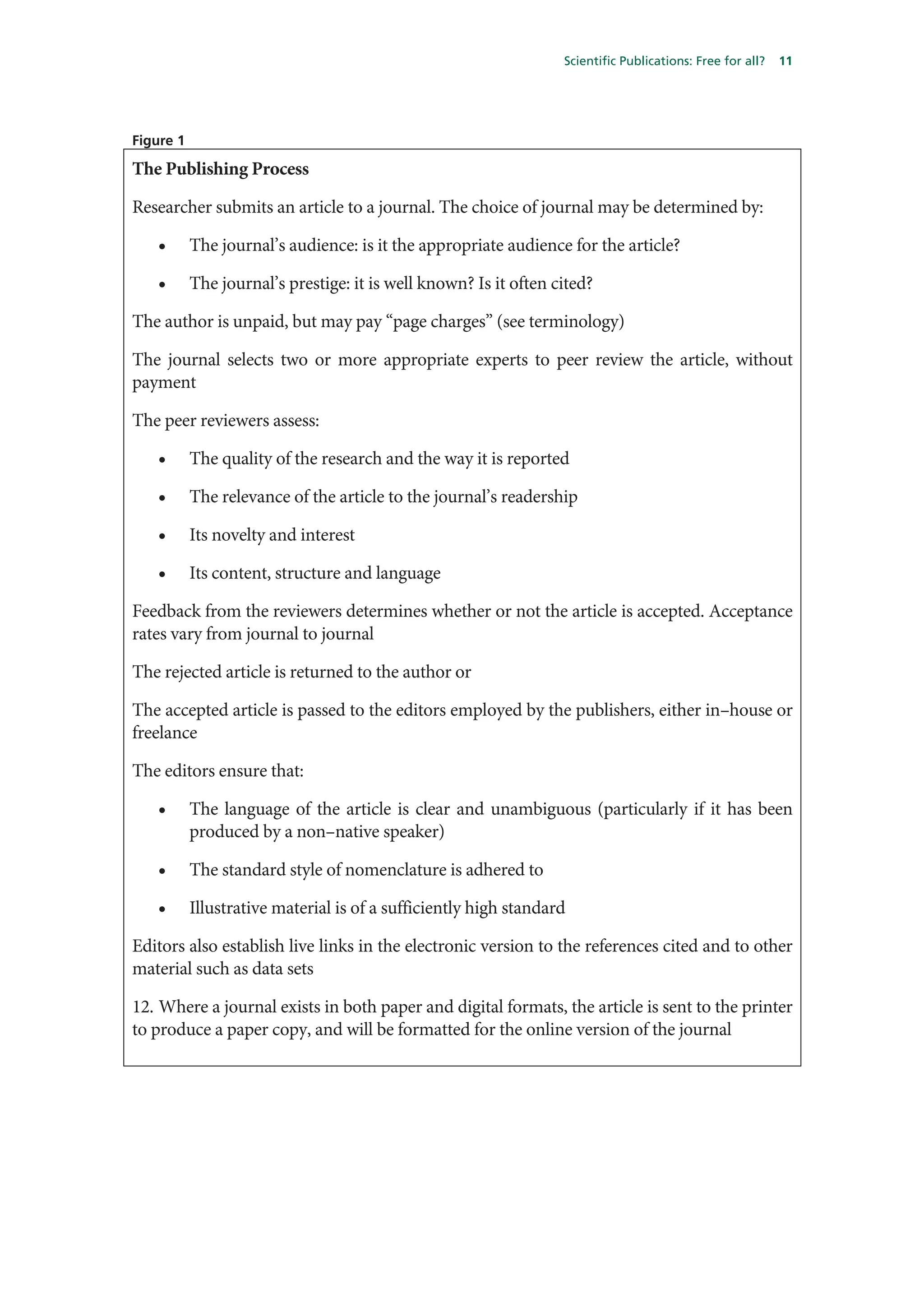
  • 80.
    76 Scientific Publications: Free for all? wholeheartedly, there are practical considerations that must also be understood. These considerations are explored in the remainder of this chapter. Extending access? 155. Author–pays publishing is shaped by the perception that the current publishing model limits and inhibits access to scientific publishing. By making journal articles free at the point of use, author–pays publishers hope to solve this problem. Nonetheless, there have been claims that, because the new publishing model relies on the internet for its delivery, it has the effect of restricting access to those who are able to access and use a computer. In oral evidence, Sir Crispin Davis told us that “open access would today have the result of reducing accessibility to scientific research because it is only available on the internet […] “this would exclude some 20–25 per cent of scientists; globally it would exclude 50 per cent of scientists”.283 We are not convinced by this argument for a number of reasons. Firstly, very few researchers would now be able to work without the aid of a computer, suggesting that the vast majority of journal readers would have ready access to online journals. Secondly, in the developed world, even those who do not own a computer can gain access to one, in particular through public libraries. Thirdly, for the reasons outlined in paragraphs 45—48, online journals provide the developing world with a cheaper and more efficient means of obtaining scientific information, even when the number of computers available is limited. 156. Author–pays publishing would bring the greatest potential increase in access for groups of users that do not habitually subscribe to journals or belong to subscribing institutions. Virginia Barbour, formerly Molecular Medicine Editor at The Lancet told us that patients in particular would benefit: “everyone should be able to read freely the primary research (often funded by public agencies) upon which decisions concerning their health care are made”.284 The departmental evidence also identified groups of users that would experience increased access, writing that “free access to research papers via the internet would be particularly useful for key groups such as women taking career breaks. Constant developments within many subjects mean that people on career breaks may often lose touch with the major developments in their subject”.285 Encouraging a public that is more scientifically literate and assisting women in their pursuit of successful careers in scientific research have been two of the Committee’s longstanding concerns. We support, in principle, any measure that seeks to further these aims. 157. It is still too early to tell whether or not author–pays publishing has had the effect of increasing access to scientific publications. BioMed Central reports a higher usage rate for its articles than that for articles published in subscriber–pays journals.286 Since January 2004 OUP has published its Nucleic Acids Research database on an author–pays basis. It reported that “during the six months following initial publication, the full–text of Database issue articles were, on average, downloaded 52% more frequently than the average number of full–text downloads of other [subscriber–pays] articles published in NAR”. OUP 283 Q 65 284 Ev 71 285 Ev 381 286 Ev 126
  • 81.
    Scientific Publications: Freefor all? 77 cautions that “it is difficult to be sure whether this difference is solely due to the absence of access restrictions or whether the Database issue would have generated higher than average access use had access been restricted to subscribers”.287 Nonetheless, OUP’s recent announcement that it would extend the author charge to all sections of Nucleic Acids Research suggests that OUP is confident that the experiment has been successful.288 There is also conflicting evidence. IoPP, for example reports that “the electronic readership of NJP [New Journal of Physics] is not significantly higher than our regular subscription journals”.289 158. A recent study by Thomson ISI, a private sector information provider, examined the citation rates of author–pays journals compared to their subscriber–pays competitors. It found that they “are cited at a level that indicates they compete favourably with similar journals in their field” but also that “the wide distribution of these OA journals has not yet been shown to have any appreciable effect on their appearance in lists of cited references in other journals”.290 This is not surprising for two reasons. Firstly, citation rates are indicators, albeit imperfect, of a journal’s usefulness to the research community, not primarily its accessibility. Given that author–pays publishing is likely to increase access for users, such as patients, who are unlikely to cite the material that they read in other journals, it is not surprising that they have not shown a marked increase in citation rates. Secondly, author–pays journals are relatively new. It takes time for new journals to achieve recognition and, consequently, citations. That author–pays journals are able to compete with subscriber–pays journals in terms of citations is an encouraging indication of high levels of quality. 159. Although early indications are positive, it is too early to assess the impact that author–pays publishing has had on access to scientific publications. Access for researchers in the developing world 160. On a recent visit to Malawi we heard from the Forestry Research Institute of Malawi, part of the University of Malawi, and others that researchers currently have only very limited print journal resources. The internet has the potential to vastly increase the number and range of journal articles available to them but they are unable to afford subscription charges. A shift towards free online access, via the author–pays publishing model, would greatly increase access to journal articles for researchers in developing countries. 161. There are concerns that, by transferring the costs of the system from readers to authors in the developing world, the author–pays model would reduce the visibility of research generated there because of the inability of many authors to pay the publication fee. Blackwell Publishing told us that “the author charge is a barrier to publication which will favour richer countries and organisations and make it difficult to publish a journal with authors from, say Eastern Europe and the Developing World”.291 Currently publishers 287 Oxford University Press, “Experimenting with Open Access publishing”, www3.oup.co.uk 288 www3.oup.co.uk 289 Ev 310 290 Thomson ISI, The Impact of Open Access Journals, April 2004, pp 2, 10 291 Ev 306
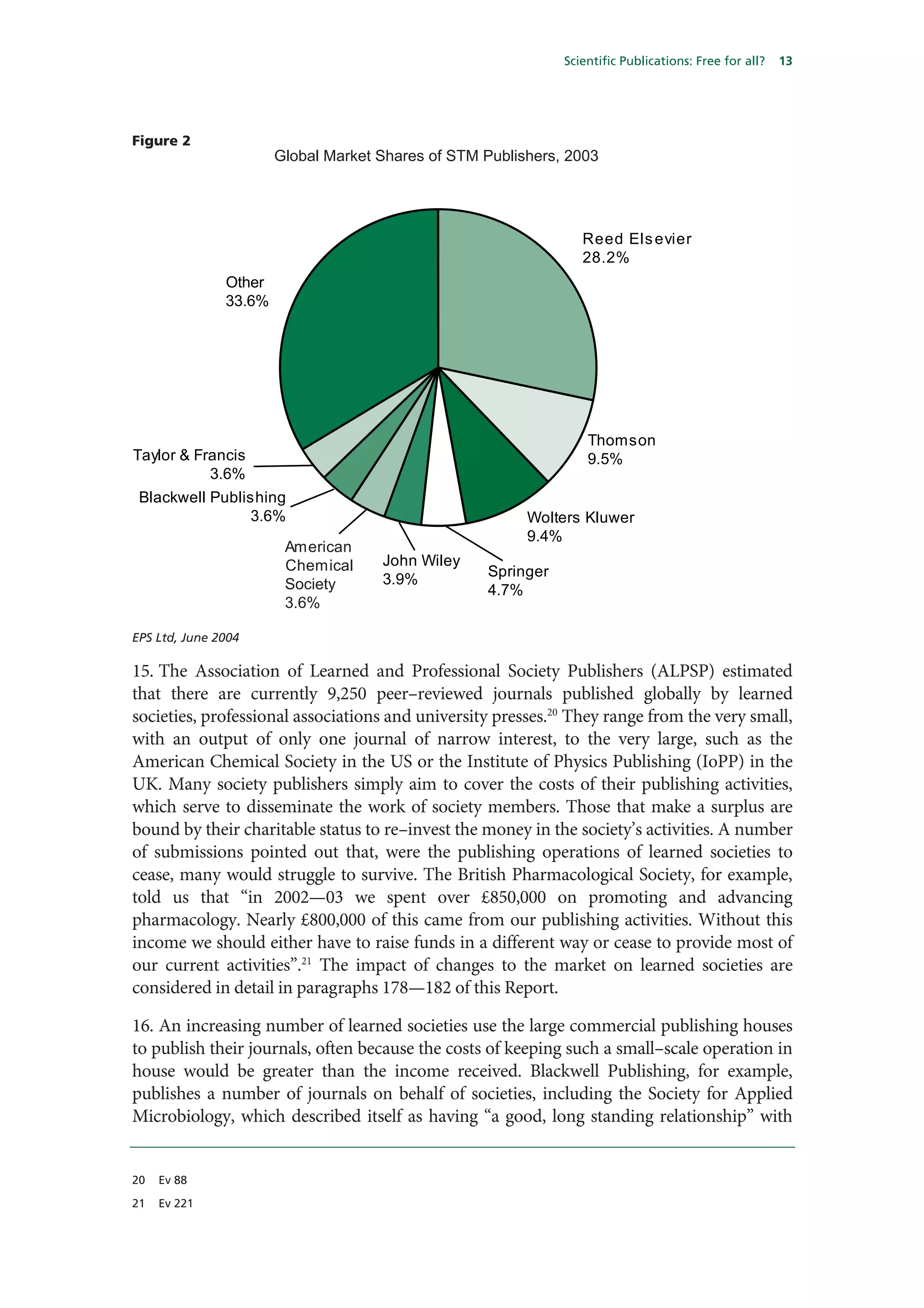
  • 82.
    78 Scientific Publications: Free for all? operate a number of admirable schemes to facilitate access to scientific publications in poorer countries. We see no reason why such schemes could not be adapted to meet the needs of an author–pays publishing model, with publishers paying for authors from the developing world to publish, rather than to read, articles. Whereas researchers in developing countries need access to as large a proportion of global research output as possible, the proportion of published articles originating in such countries is currently very small. In addition, many research projects in the developing world are either funded by or carried out in collaboration with partners in developed countries who can afford to pay publication charges. Developing countries would therefore be disadvantaged less by paying publication charges for a very small number of authors than they would be by buying subscriptions to all the journals that they need. By the same token, publishers could assist developing countries most efficiently by paying their publication fees and granting them free online access to journals. 162. The author–pays publishing model would be extremely advantageous to researchers in developing countries, enabling them to keep abreast of research conducted elsewhere. Financially, author charges would be less burdensome to researchers in the developing world than current subscription rates. If the author–pays model were to prevail, publishers, Government agencies and other donors would need to adapt existing schemes, such as HINARI, AGORA and INASP–PERI, to meet the demands of the altered cost recovery model. Practicalities Ability to pay 163. Publishing costs money. The author–pays publishing model transfers costs from the end user to the producer. There is some concern that, just as currently there are people who cannot afford to pay to read scientific journals, there are also those who would not be able to afford to publish in them. This is not a factor of the author’s personal financial situation. As Vitek Tracz noted in oral evidence, “people imagine that the situation is that we suddenly ask authors to take some money from their petty cash, or away from their children and give it to some publisher who is going to publish them. That is not at all the situation. […] Just as, most commonly, scientists do not have to subscribe, so most commonly scientists do not have to pay personally”.292 If it were made clear to authors that publication costs would be met by their research funder, it is likely that their reluctance to pay would be significantly reduced. 164. RCUK observed that there was already a need for scientists to pay some publishing fees.293 In order to give researchers a free choice of the journal in which they publish, funding to pay those fees will need to be formally identified. We believe that such funding should originate with the research funder, not the institution. By making publication costs a proportion of total research costs, this would facilitate effective planning and budgeting. Were research institutions to pay for publication costs, they would not be able to scale the model in the same way, leading to budgetary uncertainty. In oral evidence, the DGRC told 292 Q 164 293 Ev 296-7
  • 83.
    Scientific Publications: Freefor all? 79 us that “we are considering the possibility of making funds available to those authors that wish to go the open–access route, so they are in no sense penalised against other routes”.294 We were glad to hear that the Government has recognised the need for funds to be made available for authors who choose to publish in an author–pays journal. Given that author– pays publishing represents a growing proportion of the market, the Government will need to move swiftly from considering the issue to taking action. Currently, only 5% of all publishing takes place using the author–pays model. The funding needed to facilitate this activity at present is, therefore, limited. Were the practice to become more widespread, the amount of funding needed would increase. Such increases would, however, be balanced by savings in the library budget. 165. We recommend that the Research Councils each establish a fund to which their funded researchers can apply should they wish to publish their articles using the author–pays model. The Research Councils will need to be funded by OST to take account of this increase in costs. We hope that industry, charity and other Government funders will consider similar measures. The issue of free–riders in the publishing system will be discussed in paragraphs 175—177. 166. Publication costs paid by public funding bodies would not cover the costs of all potential authors. The City University Centre for Information Behaviour and the Evaluation of Research (CIBER) told us that not all funding sources are acknowledged, making it difficult for the funding bodies to pay for publication. According to their statistics, 35% of published articles currently have no financial acknowledgements, “either explicit or implicit from their corporate addresses”.295 The author payment may also prove difficult for charitably–funded researchers, because the charity may not have the extra funds available to cover publication costs. Differential levels of funding between disciplines further complicate the situation. ALPSP stated that “the financial feasibility of Open Access may well vary between disciplines; in some areas, particularly in the sciences, research is expensive, research grants are accordingly large, and a few thousand pounds to publish a couple of articles may make little difference to the total sum funded. In other areas, however, such as the humanities, research is relatively inexpensive and grants are therefore small or even non–existent”.296 Professor Hitchin of Oxford University noted a problem with mathematics in particular.297 Research Councils for disciplines that require only limited funding should be funded to enable them to pay for publication costs where necessary. 167. All witnesses agreed that the ability of the author to pay should not be a factor in the publisher’s decision about which articles to publish. At the moment, author–pays publishers waive author charges for those that cannot afford them. PloS told us that “if an author cannot pay, then the fee must be waived, if the peer review process judges that the article is worthy of publication”.298 PLoS editors are currently “blind” to the author’s financial situation when making decisions about acceptances and rejections. In its author– 294 Q 330 295 Ev 78 296 Ev 91 297 Ev 72 298 Ev 275
  • 84.
    80 Scientific Publications: Free for all? pays experiment with the Nucleic Acids Research database, OUP found that, out of a total of 142 articles, 90% of authors paid the publication charge. Of the 14 authors that were granted a waiver, four were from developing countries and the remainder were from developed countries, but lacked sufficient funding to pay the charge.299 If these statistics are indicative of general trends, under an author–pays model, the 90% of authors that pay would be subsidising the waiver for the 10% of authors that did not. This would inevitably, but slightly, push up the amount charged to paying authors. 168. The variation in the ability of authors to pay to publish is an important factor in any consideration of the author–pays model. It would not, however, have a significant adverse impact on the likely success of such a model were it to be implemented on a national or international scale. Were it to adopt the author–pays model, the UK Government eventually would make savings in the budgets currently allocated to libraries (see paragraphs 188 to 189 for an explanation of the costs to the UK of the implementation of the author-pays system if other countries did not follow suit). These savings would need to be redirected to research funders to enable them to meet the costs of publication. As PloS told us in answers to supplementary questions, “the best defence against a bias towards well–funded disciplines is for the funding agencies and research institutions who will primarily fund open access publishing to allocate sufficient funds to all disciplines to cover their publication costs”.300 By a similar token, Government should encourage charitable and private sector funders to meet the publication costs of their funded researchers where applicable. Peer review in an author–pays system 169. Many memoranda expressed concern that the author–pays publishing model would compromise the integrity of peer review. This was the position adopted by all of the commercial publishers that we spoke to on 1 March. It can be summed up by a statement made by the Publishers Association that “once financial or any other type of patronage is introduced, independence and objectivity [are] compromised”.301 This argument was dismissed by Harold Varmus, of PloS, in oral evidence as “rubbish […]We have reviewers who make the determinations about what we are going to accept, who have no direct interest in the fate of our journal, but the most important thing is that we, as publishers of open access journals, want our journals to be high quality. It is the only way we are going to succeed”.302 Peer review is carried out by academics who are unpaid and whose reputation is influenced by their participation in the peer review process. In both the subscriber–pays and the author–pays publishing models, the process of reviewing articles for publication is, and needs to remain, independent of the mechanisms used by publishers to recover costs. We would envisage this remaining the case even if our recommendation in paragraph 70 were to be implemented by publishers. 170. The success of the journal is a key factor in understanding the impact of author–pays publishing on peer review. As is outlined in paragraphs 7—9 above, in order to further 299 Oxford University Press, “Experimenting with Open Access publishing”, www3.oup.co.uk 300 Ev 454 301 Ev 306 302 Q 165
  • 85.
    Scientific Publications: Freefor all? 81 their career and disseminate their research to the most distinguished peer audience possible, academics seek to publish in journals that have high impact factors and are well regarded in their field. The academics that we spoke to agreed that, generally speaking, a journal would struggle to survive if the standards of the articles that it accepted for publication were low. Professor Crabbe told us that “science is a relatively close–knit area and within the field if something is wrong then people talk and if the journal does not instantly produce some sort of retraction or correction then people just will not go to publish in that journal”.303 This statement outlines two main principles: firstly that the scientific community is itself able to assess the merits of published articles; and secondly, that currently if a journal is perceived to be substandard it will be less successful. CURL told us that “the survival and growth of the BMC [BioMed Central] journals will depend, as with all journals, on the quality of submissions accepted and the number of citations to articles in their journals. This discipline should ensure that peer review remains stringent: acceptance of articles based on ability to pay will very quickly prove self–defeating”.304 Both PloS and BioMed Central told us that they wanted to publish successful journals. Whilst this may be true for the higher end of the market, in theory, if author–pays publishing were to become the dominant model, there is a risk that some parts of the market would be able to produce journals quickly, at high volume and with reduced quality control and still succeed in terms of profit, if not reputation. Such journals would cater for those academics for whom reputation and impact were less important factors than publication itself. This situation may take some time to develop because it is unlikely to occur whilst the author– pays journals are still striving to prove their worth in a mixed market. 171. We heard that payment for publication gave publishers a financial incentive to publish more articles because of the need to cover fixed costs, irrespective of the quantity or quality of submissions received. Sir Crispin Davis, for example, told us that “if you are receiving potential payment for every article submitted there is an inherent conflict of interest that could threaten the quality of the peer review system”.305 Blackwell Publishing told us that, by contrast, “the subscription based model favours rejection, which is especially important, for example, in clinical medicine, where the risks associated with publishing substandard material are higher”.306 It should be noted that subscriber–pays publishers also have an incentive to publish ever greater numbers of research articles, because, as is shown in paragraph 52 of this Report, increases in the volume of articles are used to justify price increases. For the reasons outlined above, we believe that the publishing process needs to have inbuilt checks and balances that would mitigate against the acceptance of an increasing volume of substandard articles. 172. In order to succeed, most author–pays publishers, like everyone else, will have to publish articles of a high quality. It is not, therefore, within the interest of journals at the higher end of the market to lessen the rigour of peer review. Nonetheless, there is a risk that lower quality journals might seek to reduce their quality threshold in order to generate profit. Were the author–pays publishing model to prevail it would be vital to 303 Q 321 304 Ev 126 305 Q 65 306 Ev 307
  • 86.
    82 Scientific Publications: Free for all? ensure that peer review was not compromised in order to retain confidence in the integrity of the publishing process. 173. The stringency of peer review, a potential strength of author–pays publishing, has also created problems for author–pays publishers when determining their payment models. John Cox Associates, a publishing consultancy, noted that in the author–pays model, because of the need to peer review every article, successful authors would be paying for the processing of unsuccessful articles: “if the author whose paper is accepted for publication bears the whole cost of publication, this means that he/she bears the cost of processing papers that are rejected; it seems inequitable that a successful author should bear the costs involved in dealing with others whose work is judged not to be worthy of publication. This will result in the most prestigious journals being the most expensive”.307 The Biochemical Society also noted that “The Biochemical Journal, along with many other journals has a rejection rate of 60%. It seems invidious that the authors of accepted papers should subsidise authors of rejected papers”.308 A 90% rejection rate is the reason given by Nature Publishing Group for its very high estimate of the publication charge for accepted articles. 174. The payment model is easily adapted to subvent this inequality. Under a revised system, authors would pay a small fee upon submission of their article in order to cover the costs of peer review. If their article were accepted, they would then pay a second fee to cover the costs of publication. Neither PloS nor BioMed Central employ this system. Vitek Tracz explained that, in the case of BioMed Central “the reason we do not do it is because we are still a young industry and we worry that if we start charging for submission it will be harder for us to persuade authors to do it”.309 This is probably true in a mixed market in which authors have the choice of publishing in a journal which charges no fee. The reluctance of authors to pay a submission fee would largely be overcome, however, if funds were made available for this purpose by the research funder. It is also worth noting that a submission fee might act as a disincentive to authors submitting articles speculatively, with little confidence that they will be published. This would reduce the need to reject so many articles and, in turn, reduce costs. The introduction of a submission fee would be an important step towards ensuring the quality of scientific publications and we strongly recommend that author–pays publishers introduce this system. Free–riders 175. A substantial proportion of the total number of journal readings derives from the industrial and corporate sectors. Reed Elsevier, for example, estimates that 25% of its revenue and 20% of annual global STM journal spending derives from these sectors.310 The Pharma Documentation Ring described the usefulness of journals to pharmaceutical companies: “new drugs, new cures against diseases can only be successfully and efficiently developed when the present scientific knowledge is easily available and reliable. […] Scientific publications are a key resource for pharmaceutical research”.311 Companies pay 307 Ev 140 308 Ev 179 309 Q 167 310 Q 65; Ev 200 311 Ev 423
  • 87.
    Scientific Publications: Freefor all? 83 substantially more for access to publications than public sector organisations, which are usually given discounted rates. Yet, for various reasons, the proportion of published articles that originates from the industrial and commercial sectors is much lower than the proportion of articles that they read. As a consequence of this discrepancy, the Biochemical Society told us that, “in the open–access world it would appear that the only real winners are going to be corporate pharmaceutical companies who would no longer have to pay to access information”.312 There is concern that author–pays publishing would allow companies to become free–riders in the publishing process. 176. The author–pays publishers that we took evidence from were unable to suggest a satisfactory solution to this problem. PloS told us that the commercial sector “pay their taxes, the taxes go to government, the government agencies pay for publication and want the industries to see the results of research because one of the reasons we do medical research is to support industrial efforts in making new products which help to improve the health of the nation”.313 This is true: giving industry access to research findings can have significant benefits for the economy and would assist the transfer of knowledge between academia and industry. It might also have the effect of attracting increased industry funding into research. Nonetheless, there are practical implications of allowing the commercial and industrial sectors to read the output from scientific research free of charge. PloS argued that “we have never relied on subscription revenues and thus no explicit measure needs to be put in place to deal with their loss”.314 It is indisputable, however, that a significant proportion of publishing costs are currently paid for by industry. Even though they are disputed, publishing costs do not fall below a minimum level whatever the publishing model. If industrial subscriptions are taken out of the system, the publishing process will be substantially less well off. Even taking into account a reduction in publisher profit margins, this would mean that the UK was paying more overall to publish articles than it would pay to read them. 177. The commercial and industrial sectors currently contribute significant funds to the publishing process through payments for journal subscriptions. Much of this money would be lost to the system if an author–pays model were to prevail. This is one of the key issues that needs to be addressed before the wholescale transition to an author–pays model can be supported. Government, publishers and industry need to work together to identify a solution to this problem in order to avoid a disproportionate increase in the amount of money that Government invests directly or indirectly in the publishing process. Impact on learned and professional societies 178. Learned societies use income generated by their publishing activities to subsidise other society activities, such as conferences, maintaining professional standards and supporting education in schools. Many learned societies expressed concern that the author–pays model would jeopardise their publishing income and, ultimately, their other activities. The British Pharmacological Society told us that “In 2002—3 we spent over £850,000 on 312 Ev 179 313 Q 179 314 Ev 451
  • 88.
    84 Scientific Publications: Free for all? promoting and advancing pharmacology. Nearly £800,000 of this came from our publishing activities. Without this income we should either have to raise funds in a different way or cease to provide most of our current activities”.315 Similarly, the Biochemical Society reported that it generated between £500,000 and £750,000 from publishing. This surplus, “the so–called ‘science dividend’ supports its other charitable objectives and it is not clear how these vital activities could continue to take place if the Biochemical Society was unable to continue funding them”.316 These concerns are based on the perception that the author–pays model would generate a reduced publishing surplus. Indeed, it is one of the stated objectives of the Open Access movement that publisher profit margins should be reduced. ALPSP told us that “one estimate is that surpluses in excess of 12% would be likely to be reduced. In the above survey, median surplus was 17%, representing 33% of society income”.317 On the basis of these figures, learned societies could lose up to 10% of their income in a move to the author–pays publishing model. 179. The transition to an author–pays publishing model involves substantial one–off costs and continuing subsidies until the journal in question reaches revenue stage. IoPP told us that, since 1998, it had been subsidising its New Journal of Physics at a rate of £100,000 per annum. It also stated that, at $560 per article, it had not been charging authors full costs: “we have found authors reluctant to pay. Even if all authors paid, we would need a far higher page charge in order for the journal to cover its costs”.318 Smaller societies publishing less–prestigious journals might find it difficult to attract authors with a more substantial publication charge. They would also be more likely to struggle with the levels of investment committed by IoPP to its author–pays project. 180. Learned societies are greatly valued by the academic and wider research community. It is of concern to us that learned societies could stand to lose a substantial portion of their income in a move to the author–pays publishing model. This is another key issue that proponents of the author–pays model need to address. 181. Journal subscriptions are frequently provided as one of the benefits of membership to a learned society. The Geological Society told us of its concern that “if free or discounted subscription to these journals is one of the benefits of society membership, open access will negate this reason for membership – if you can read the journal for free, why join the Society? The likely decline in Society membership would be a fatal blow for many societies resulting in their closure”.319 Just as, in the commercial sector, it is intended that author payments would replace subscription charges, the loss of some learned society members would in part be compensated for by the publication charge levied on authors. Moreover, it is clear that free subscriptions are a major, but not the only benefit given to members by learned societies. We heard from Professor Fry that “it is absolutely vital for science in Britain and the world today to have strong learned societies”. He added that “conferences, which are largely supported by the learned societies, are absolutely vital”.320 If learned 315 Ev 229 316 Ev 175 317 Ev 448 318 Ev 310 319 Ev 63 320 Q 280
  • 89.
    Scientific Publications: Freefor all? 85 societies are valued by their communities, which we believe to be the case, members are likely to remain loyal irrespective of the publishing model employed by their society. 182. The author–pays model would yield some benefits for learned societies. By facilitating a wider dissemination of their journals than is currently possible, it would raise their international profile. The Society for Experimental Biology also told us that a change in publishing model would encourage societies to innovate: “an author pays open access model will put pressure on societies to keep publication costs of primary research to a minimum and provide incentives to explore other sources of income. Adding value to the sections of the journals which remain under subscription control such as reviews and special issues will not only provide income to support the activities of the society but also fulfil the society’s objectives in promoting and communicating science”.321 Some learned societies also house a library. Like academic and public libraries, these libraries are adversely affected by rises in subscription prices. The Institution of Civil Engineers stated that “premium prices for e–journals are making it very difficult for specialist libraries such as ourselves to maintain our subject coverage. […] Permitting learned societies to accede to academic networks which are essentially publicly funded would help us to continue to fulfil our role as laid out in our charter to promote engineering science”.322 These would all be encouraging developments, but further analysis will need to be carried out to assess to what extent they would offset losses elsewhere. Government action 183. We received many calls for publishing in an author–pays journal to be made mandatory under the terms of research grants awarded from public funds. The World Summit on the Information Society (WSIS), for example, argued that “concerning the policy that should be adopted by funding entities, it is clear that because of sheer inertia, or because of fear of retribution from publishers, a compulsory policy must be adopted”.323 Whilst we do not believe that there is sufficient evidence to support the implementation of a Government mandate, we do not see this as an excuse for the current lack of any coherent Government policy on author–pays publishing. 184. In oral evidence, the DGRC told us that a decision in favour of the author–pays model would be “a pretty brave decision” for a government to take at this stage.324 Some Government agencies have been less cautious, however. The Food Standards Agency was recently reported to be “moving towards actively supporting open access publication of the research it commissions”.325 Similarly, JISC has implemented two schemes to encourage experimentation with the author–pays publishing model. In December 2003, it announced a funding programme to offer short–term funding, or seed money, of £150,000 to publishers to make journals freely available on the internet using open access models. In a press release it announced that “the money is to encourage them to switch ‘from the traditional subscription method to a model where authors have to pay to have papers 321 Ev 227 322 Ev 268 323 Ev 292 324 Q 354 325 “Food Standards Agency gives solid support to open access”, Research Fortnight, 23 June 2004
  • 90.
    86 Scientific Publications: Free for all? published’. The result of this is that research journals will become freely available on the web for everyone in further and higher education and beyond to benefit from”. 326 In June 2003, JISC announced a membership deal with BioMed Central. Under the terms of the deal, from 1 July 2003, article–processing charges were waived for all UK higher education staff when publishing in any of BioMed Central’s journals. The deal cost £85,000 in the first year, and will cost £80,000 next year.327 We strongly support further experimentation with the author–pays publishing model. In the short term Government may need to provide limited financial assistance to encourage publishers and institutions to take part in what, for them, may be an expensive process. We applaud the Joint Information Systems Committee for providing funding for this purpose so far and hope that it will continue to do so. 185. A wholescale transition to the author–pays publishing model would have profound implications for current funding structures, necessitating the transfer of funds between DfES and OST. Much of the evidence agrees that the author–pays publication model will become more prevalent, even if it does not replace the current publishing model, in the UK and globally. It is therefore likely that the UK STM publishing market will have to sustain a mixed economy for some time. This would be likely to prove costly for publishers, research funders and libraries alike. Given the scale of the financial impact of the new publishing model, whether or not it prevails, we expected that the Government would have conducted impact assessments and formulated a strategy. In oral evidence, Government agreed that this was a necessary step. The DGRC told us that “there ought to be a policy put together jointly between DfES, OST/DTI and DCMS”.328 We agree wholeheartedly. There is, however, scant evidence as yet of the departments involved working together on this issue. Author–pays publishing is a growing phenomenon. Its implementation on any scale will have important consequences for current funding structures and the UK publishing industry. So far the Government has shown little inclination to address this issue. 186. Government has not shown much evidence of a joined–up approach to the challenges posed by changes to the model for scientific publishing. Whilst the central departments have been slow to respond to the author–pays publishing model, at least two Government–funded bodies have given public support to it. This creates unnecessary confusion. We recommend that it formulate a coherent strategy as a matter of urgency. 187. This inquiry took place against the backdrop of an already lively debate. It soon became apparent to us, however, that discussions mostly tended to take place within separate interest groups. The relative lack of discussion between these groups has hindered any assessment of the potential impact of the author–pays publishing model and has prevented any sort of consensus view from emerging. Government has a role to play in bringing together policy–makers, funding bodies, publishers, librarians and academics to discuss the issues in a constructive way. 326 www.jisc.ac.uk 327 Ev 462 328 Q 349
  • 91.
    Scientific Publications: Freefor all? 87 Can the UK act alone? 188. The UK writes more articles than it reads. As a consequence of this, Reed Elsevier claims that a Government mandate for open access would be against the UK’s financial interests: “while Britain’s spending on journal subscriptions currently amounts to 3.3% of the world’s total, UK researchers contribute a much higher 5% of all articles published globally. As a result, we estimate that the UK Government, foundations, universities and researchers could together pay 30–50% more for STM journals in an Open Access system than they do today”.329 This statement can, of course, be inverted. Compared to its share of global STM research, the UK is currently paying proportionally less to access the research findings of other countries. Countries with lower research outputs, particularly in the developing world, are, on the other hand, paying proportionally more to access the same findings, a phenomenon which acts as a brake on further development. One of the main advantages of an author–pays system is that publication costs would scale with research costs: countries which invest greater amounts in research would pay more to see that research translated into outputs. Author–pays publishing would ensure that countries were paying an amount for publication that was commensurate with their total research spend. We are satisfied that, by scaling publication with research costs, the author–pays publishing model would ensure a fairer global distribution of the costs of publishing research findings. 189. A more immediate problem is the impact on the UK of a hybrid global publications market. Author–pays and subscriber–pays publishing models are alternatives: costs are met through publication or subscription charges. If the UK were to adopt a policy in favour of author–pays publishing, it would be at a financial disadvantage unless others acted in the same way. By acting alone, the UK would assume the full costs of publication for all its publicly–funded researchers. The resulting articles would be exported abroad where they could be read free of charge. This would increase the impact of UK research. Yet UK scientists also need access to global research. Thus the UK would still have to pay for subscriptions to journal articles originating abroad. We asked PloS how it would respond to this problem. It answered that “if the UK were the only country to make such a mandate, it would also have to pay to access the works of scientists from other countries, but this would be a separate expense for a different purpose”.330 This answer does not alter the fact that, by paying both to publish and to read articles, the UK would be investing greater sums in the publishing process than is currently the case. The UK would put itself at a financial disadvantage internationally if it were to act alone in mandating publicly– funded researchers to publish in author–pays journals. Conclusions on the author–pays publishing model 190. The arguments for the author–pays publishing model are in many ways attractive despite some difficulties which require resolution, and we believe that its implementation would yield many benefits for the global research community. The endeavours of author– pays publishers such as PLoS and BioMed Central to widen access to scientific publications are admirable and they are to be commended for the vigour with which they have pursued 329 Ev 194 330 Ev 452
  • 92.
    88 Scientific Publications: Free for all? their aims. We have recommended that funds be made available from Research Council budgets for those authors that wish to do so to publish in journals that impose publication charges. 191. We are satisfied that the implementation of an author–pays publishing model would not compromise peer review at the higher end of the market because it would not be in the interests of the publishers concerned to allow this to happen. We do, however, have concerns about free–riders and the potential impact of the new publishing model on learned societies. For this reason, we have recommended that the Government conduct a study and facilitate further experiments to ascertain what the likely impact of the author– pays publishing model will be. We hope that, subject to the resolution of these problems, the conditions can be created so that the author–pays model and other new publishing models can be allowed to flourish, to demonstrate whether or not they are sustainable and to confer their anticipated benefits. This aspiration should be viewed in the context of the current situation, which, as we have explained, is unsatisfactory. We have recommended that Government prepare for change in the formulation of a comprehensive strategy.
  • 93.
    Scientific Publications: Freefor all? 89 8 Archives The digital problem 192. Archiving, whilst it has always been costly and time–consuming, was at least a straightforward process in a print environment. In theory, digitisation makes archiving more efficient: digital archives take up less space; they are less at risk from fire, flood and theft; and they are easily searchable from a single point of access. Yet digital archives pose a substantial technical challenge. Digital publications are not identifiably “items” in the way that print publications are. Especially in the ephemeral environment of the internet, digital articles can be difficult to track. Furthermore, the technologies used to create and read digital journal articles are quickly superseded. This rapid rate of change makes preservation difficult: archives have to be continually updated, or their articles migrated to new formats, to ensure their continuing readability. We heard that the preservation on paper of print outs of digital journal articles would be insufficient. Julia Morris of IoPP told us that “you cannot print the New Journal of Physics because you cannot use the three–dimensional images and the video, some of the things which are really crucial to explaining some of the very complex concepts in the papers”.331 Witnesses on all sides agreed that a secure central archive for digital publications was essential to ensuring that today’s research findings were not lost to the future. The development of this archive and the evolving technologies needed to maintain it is an expensive process. 193. Several memoranda make the point that usage is an effective way of ensuring preservation. In oral evidence, Vitek Tracz told us that “as long as the data is available and used and appears in many places, as long as it is used, it tends to be preserved. Formats change and users adapt and change their format. Usage is the key to preservation of data”.332 This is frequently used as an argument for the author–pays publishing model, which, by disseminating research as widely as possible, attempts to increase usage. As archives that are open, institutional repositories would also help to ensure that data is used. Institutional repositories should be a key component of any long–term strategy to ensure the preservation of digital publications. 194. In the UK, the British Library plays a central role in the development of systems and technologies to secure the long–term preservation of digital content. With JISC, the British Library co–founded the Digital Preservation Coalition. The aim of the coalition is to secure the preservation of digital resources in the UK and to work with others internationally to secure the global digital memory and knowledge base.333 The British Library is also collaborating with higher education institutions on pilot projects under the JISC FAIR programme (see paragraph 109 of this Report). The Library is currently developing a digital object management system intended to ensure the long–term preservation and access for digital material.334 Many publishers have also invested substantially in developing archives for their own digital publications. These parallel projects act as a useful safety net, 331 Q 126 332 Q 198 333 www.dpconline.org 334 Ev 357
  • 94.
    90 Scientific Publications: Free for all? although they would be vulnerable in the event of company collapse. We heard that “one of the crucial things is that it is preserved in more than one place, so that if a disaster should befall the British Library or anywhere else, that is not the only electronic copy; that is a vital aspect to electronic preservation”.335 195. The British Library proposes to invest £12 million over the next four years in addressing the challenges posed by the preservation of digital material. To this end it intends to build up substantial in–house expertise.336 It is “seeking specific recognition from Government of this particular funding requirement in the forthcoming Spending Review and would welcome the Committee's endorsement of that requirement”.337 In making this request, the Library has strong support from all sides. Sally Morris of ALPSP told us that “a great many publishers are looking to the British Library as being the primary source of long–term preservation of electronic material, want to work very closely with them, want to be sure that they have the funds to do it, which is going to be a big question mark”.338 Similarly, the Royal Society of Chemistry told us that “sadly, the incorrectly held view that electronic = free or cheap to deal with, that is often levelled at publishers, is in danger of affecting the consideration of the British Library’s funding requests”.339 If this is true, it is of some concern to the Committee. The preservation of the national intellectual record is crucial for the maintenance of a strong research base in years to come. 196. The British Library has a crucial role to play in the preservation of digital publications, both strategically and practically. This is an expensive process. Whilst the publication of this Report is too late to have any influence on funding decisions made as part of the 2004 Spending Review, we strongly support the British Library’s call for extra funding in recognition of the work that it has carried out in this capacity. Failure of the Government to give adequate funding to the British Library could result in the loss of a substantial proportion of the UK’s scientific record. Legal deposit 197. Legal deposit is the act of depositing published material in designated libraries or archives. Publishers and distributors in the United Kingdom and Ireland have a legal obligation to deposit published material in the six legal deposit libraries which collectively maintain the national published archive of the British Isles. The six legal deposit libraries are: • The British Library • Bodleian Library, Oxford • Cambridge University Library • National Library of Scotland 335 Q 127 336 Q 262 337 Ev 357 338 Q 123 339 Ev 211
  • 95.
    Scientific Publications: Freefor all? 91 • Library of Trinity College Dublin • National Library of Wales 198. The purpose of the system of legal deposit is to “ensure that the nation's published output (and thereby its intellectual record and future published heritage) is collected systematically and as comprehensively as possible, both in order to make it available to current researchers within the libraries of the legal deposit system and to preserve the material for the use of future generations of researchers”.340 Until recently, legal deposit legislation covered only print publications. A substantial and growing proportion of published output in the UK, however, is in digital format. In recognition of this change, the Legal Deposit Libraries Act 2003 enabled the Secretary of State for Culture, Media and Sport to make regulations extending the system of legal deposit to non–print material. As an interim arrangement, in January 2000 a Voluntary Code of Practice was established between the deposit libraries and three bodies representing publishers, the Publishers Association, ALPSP and the Periodical Publishers Association, to provide for the voluntary deposit of digital publications. Under the Code, publishers are requested and encouraged to deposit their digital publications but are not obliged to do so. 199. Under the terms of the Legal Deposit Libraries Act 2003, DCMS is responsible for drawing up the regulations requiring the deposit of non–print material. Each set of regulations will be made subject to a public consultation. One of the assurances given by DCMS to the publishing community during the passage of the Act was that no regulations would be made until the department had appointed a Legal Deposit Advisory Panel, comprised of members of the publishing and library communities and independent experts. In the Government’s submission it is noted that “DCMS is consulting on setting up the Advisory Panel and aims to have it in place by the end of 2004. Work on regulations can begin then and legal deposit of non–print material is likely to start in 2005”.341 Since the current arrangements for the deposit of non–print material are voluntary only, the speed at which this process can be carried out is extremely important. In answers to supplementary questions, the British Library told the Committee that it hoped that we would “encourage Government to ensure that the Advisory Panel is set up without undue delay”.342 It is vital that work on regulations for the legal deposit of non–print publications begins as soon as possible. We cannot understand why DCMS has not yet established the Legal Deposit Advisory Panel. We recommend that they appoint the panel and begin preliminary work on the regulations at official level immediately. 200. Whereas print publications are relatively easy to define and to trace, these processes are more complicated in a digital environment. The British Library has attempted to define non–print publications, using the following categories: • Publications accessed over the internet, e.g. electronic journals; • Websites; • Publications on media other than paper, such as microfilm or fiche; and 340 www.bl.uk 341 Ev 382 342 Ev 458
  • 96.
    92 Scientific Publications: Free for all? • “Hand–held” electronic publications on media such as CD–ROM or DVD.343 This list is not exhaustive, and is likely to expand as new technologies bring to light new formats and possibilities. One of the issues that needs to be addressed in the regulations is how they can capture digital publications that are not easily categorised or defined as such. Similarly, the British Library noted in answers to supplementary questions, that, “in the making of Regulations, it will be necessary to arrive at a definition of a United Kingdom publication, especially in an online environment, which simultaneously recognises the need for an appropriate territorial limitation […] but also prevents any significant ‘deposit gap’ opening up in respect of material which could legitimately be regarded as constituting part of the UK’s intellectual and cultural record”.344 We recommend that the first task of the Advisory Panel is to establish definitions of a digital publication and a UK publication that are flexible enough to capture material from a range of sources in a range of formats. 201. In order for a print publication to be accessible from all six legal deposit libraries, a copy of it has to be deposited separately in each library. This is not the case for digital publications. In its memorandum the Government noted that “the establishment of a secure network between the deposit libraries […] would allow access to non–print material from any of the deposit libraries, following the deposit of just one copy. The details of how such a network may operate […] would be subject to consultation and be covered in the regulations”.345 The existence of a secure network between the legal deposit libraries would create greater efficiencies in the deposit system and would have the potential to increase access to deposited material. We recommend that provisions for such a network are made in the regulations with these two aims in mind. The deposit libraries should be funded to establish the network. 202. Legal deposit collections are not intended to be a means for readers to obtain free access to publications as an alternative to using existing supply channels. Print publications that have been deposited under current legislation are available to readers within the buildings of the relevant deposit library. In addition, as is discussed in paragraphs 30—31, the British Library currently operates a Document Supply Service whereby readers can pay a small fee to be sent articles that they need on request. Digital technology offers the deposit libraries the option of delivering deposited articles direct to the reader’s desktop. There is concern amongst the deposit libraries, however, that the regulations for deposit are likely to prohibit such arrangements. Cambridge University Library told us that the regulations “will restrict access to the legal deposit versions of electronic journals, probably to just one workstation within each legal deposit library building”.346 The National Library of Wales told us that “the Act and its Regulations will prohibit the networking of legal deposit material outside the walls of the LDLs themselves. (This is a particularly severe restriction in the case of the National Library of Wales because of its remote geographical location.)”347 Whilst we agree with the British Library that “a judicious balance must be 343 www.bl.uk 344 Ev 458 345 Ev 383 346 Ev 372-3 347 Ev 280
  • 97.
    Scientific Publications: Freefor all? 93 struck between the national interest (which requires access) on the one hand and the protection of the legitimate economic interests of the publishing industry on the other”, it would be disappointing if the deposit libraries were not able to exploit the technology available to improve access to non–print publications.348 We recommend that the regulations make provision for the deposit libraries to deliver digital articles remotely to desktops on the same payment basis as Document Supply. 203. It was brought to our attention that, because the deposit of non–print items is currently carried out on a voluntary basis only, the deposit libraries will have potentially significant gaps in their holdings by the time that the new regulations come into force. There is no bibliographic control of UK publications that would allow the libraries to be certain of the extent of these omissions. Nonetheless, the British Library told us that: • “Of hand–held electronic publications the Library was already receiving a high proportion of published output, possibly in the region of 75% • For electronically–delivered publications (mostly electronic serials) coverage was much less good with the BL receiving a smaller proportion of all published output, ie possibly as much as 45–50%”.349 As the National Library of Scotland told us, these gaps could present considerable expense to the libraries: “in this interim period if publishers are unwilling to deposit voluntarily, the Library will be required to pay for material it received free when it was in print form, or else cease to take it and accept having significant gaps in its holdings”.350 Gaps of up to 60% in the deposit of electronically–delivered publications, including STM journals, represent a significant breach in the intellectual record. It is imperative that work on recovering and purchasing the missing items begins immediately. The six deposit libraries will need additional funding to do this. 348 Ev 357 349 Ev 459 350 Ev 252
  • 98.
    94 Scientific Publications: Free for all? 9 Integrity of the publishing process Peer review 204. Many of the arguments in the debate on scientific publications focus on the issue of peer review: do new developments in the publishing market put it at risk? As is outlined in paragraphs 169—174, we have concluded that they must not. A factor in this debate is the scientific community’s capacity for self–policing. All of the academics that we spoke to were confident that they could determine the quality of a research article for themselves. This stands to reason given the fact that it is the same academics who carry out the function of peer review. Ironically it is this facility for self–regulation that calls peer review into question. If academics can distinguish a good article from a bad one by themselves, why do they need another academic to carry out this function for them? From this argument stems the view that peer review is unnecessarily censorious. 205. There are at least three strong arguments, however, for keeping the system of peer review intact. Firstly, volume. As has already been outlined, academics are producing more research articles than ever before: output increases by approximately 3% per year. Whilst academics might have the acumen to determine which of these articles are worth reading, they probably do not have the time to search through the entire output in order to achieve this. The peer review services provided by publishers act as a filter, saving academics time and thus also saving public money. Secondly, peer review gives successful articles a mark of distinction that helps to provide a measure of the academic’s and their department’s level of achievement. As Procurement for Libraries notes, for the academic, “scholarly publishing in academic journals is essentially about validation of results through the editorial and peer–review process”.351 We heard that the main motivations for academics to publish were career, funding and reputation–based. These incentives to publish would be significantly reduced were the mark of achievement conferred by passing successfully through the peer review process to be abandoned. Thirdly, peer review gives the lay reader an indication of the extent to which they can trust each article (see paragraph 132). 206. The usefulness of peer review to the scientific process is not a guarantee of its quality. We wrote to the Editors of four high–profile journals, Cell, The Lancet, Science and Nature, to ascertain what measures they used to ensure the integrity of the peer review process. Collectively the Editors cited the following measures: • Authors are given the opportunity to exclude from consideration any reviewers who are affected by a potential conflict of interest; • Reviewers are given the opportunity to disqualify themselves on the basis of a conflict of interest; • Articles are sent to a number of reviewers, for example, Cell uses three reviewers per article and The Lancet uses four. This allows for the moderation of their findings; 351 Ev 153
  • 99.
    Scientific Publications: Freefor all? 95 • Editors track all the reviews submitted by a particular reviewer for consistency. Any comments that are judged to be unduly harsh or lenient within that context are noted; • Editors evaluate all claims of reviewer bias or misconduct and appropriate action is taken; and • Journals have a formal appeals procedure available for all rejected articles.352 207. In addition, peer reviewers have no responsibility for making the final decision about which articles are published, and most of them are unpaid, ensuring that they retain a degree of detachment from the publishing process. All of the above measures attempt to minimise the risk of a compromise to the peer review system. However, as Richard Horton, Editor–in–Chief of The Lancet, pointed out in his response, “these processes rely on the integrity of the individuals involved, and we rely on trust between editors, reviewers, and authors”.353 As is the case with any process, peer review is not an infallible system and to a large extent depends on the integrity and competence of the people involved and the degree of editorial oversight and quality assurance of the peer review process itself. Nonetheless we are satisfied that publishers are taking reasonable measures to main high standards of peer review. Peer review is an issue of considerable importance and complexity and the Committee plans to pursue it in more detail in a future inquiry. The Research Assessment Exercise 208. The Research Assessment Exercise (RAE) is used as a means of implementing a policy of selective funding for universities. It aims to measure the quality of research in different departments, rewarding excellence where it occurs and encouraging its development elsewhere. The rating awarded to a department by the RAE helps to determine levels of funding. As one of the most readily identifiable and quantifiable research outputs, journal articles are a key measure used by the RAE. What follows is a brief analysis of the impact of the RAE on STM publishing trends. We will examine wider issues concerning the RAE in a forthcoming Report.354 209. Publication enhances career and reputation in a general sense: academics do not publish their research findings simply because of the RAE. As Rama Thirunamachandran pointed out in oral evidence, “if you look at other countries which do not have an RAE, people still want to publish in Nature”.355 Nonetheless, we received evidence to suggest that the measures used in the RAE distorted authors’ choice of where to publish. Although RAE panels are supposed to assess the quality of the content of each journal article submitted for assessment, we reported in 2002 that “there is still the suspicion that place of publication was given greater weight than the papers’ content”.356 This is certainly how the RAE was perceived to operate by the panel of academics we saw on 21 April. Professor Williams told 352 Ev 427-8 353 Ev 430 354 HC 586. See also the Second Report of the Science and Technology Committee, Session 2001—02, The Research Assessment Exercise (HC 507) 355 Q 397 356 Second Report of the Science and Technology Committee, Session 2001—02, p 17
  • 100.
    96 Scientific Publications: Free for all? us that he chose to publish in journals with high impact factors because “that is how I am measured every three years or every five years; RAE or a review, it is the quality of the journals on that list”.357 Similarly Professor Crabbe stated that “the driver is finance. The driver is the Research Assessment Exercise. Impact factors, the half–life of journals are what drives us, I am afraid”.358 In both oral and written evidence, HEFCE denied that journal impact factors formed the basis for an assessment of the quality of articles submitted to the RAE. 210. Whether or not RAE panels use journal impact factors as an indication of the quality of the articles that they assess, the perception that this is the case causes a bias amongst UK authors towards journals with higher impact factors. This in turn increases the journal’s impact factor still further. In this way, regrettably, the RAE indirectly supports a hierarchy of journals, making it difficult for new and little–known journals, including — because they have appeared only recently — some author–pays journals, to compete. The Open University told us that “Government should encourage the RAE to develop new quality indicators so that articles published in new open access journals can be evaluated in an even–handed manner in the Research Assessment Exercise”.359 However, the current system, which does not formally take account of impact factors, should already ensure that this is the case. The perception that the RAE rewards publication in journals with high impact factors is affecting decisions made by authors about where to publish. We urge HEFCE to remind RAE panels that they are obliged to assess the quality of the content of individual articles, not the reputation of the journal in which they are published. 357 Q 285 358 Q 286 359 Ev 323
  • 101.
    Scientific Publications: Freefor all? 97 10 Conclusion 211. Provision of STM journals in the UK is unsatisfactory. This is due to a combination of publishers’ pricing policy and the inadequacy of library budgets to meet the demands placed upon them by a system supporting an ever increasing volume of research. Despite evidence that they are adding value to the scientific process, publishers are not as transparent as they could be about their publication costs. The practice of some of the larger commercial publishers of “bundling” content together to be sold as one product is having a negative impact on smaller publishers and on the ability of libraries to purchase the journals required by their communities. On the purchasing side, HEFCE has not proved itself to be ready to respond to the problem of insufficient library budgets. We have concluded that change on all sides is necessary as a matter of urgency. The digitisation of the market place, with all its attendant benefits and possibilities, presents the ideal opportunity for the UK to make that change. 212. We have recommended that the UK Government fund the establishment of an inter– linked network of institutional repositories on which all research articles originating in the UK should be deposited and can be read for free. SHERPA has already carried out some valuable work in this area and needs to be funded to enable it to play a central role in the future. In order to ensure that the repositories are well–populated, we have recommended that Research Councils mandate their funded researchers to deposit copies of all their articles in this way. Universities and other research institutions will need to build up their capacity to manage the copyright that might in future be retained by authors as a result of this system. We conclude that these are the essential first steps in the direction of a more fundamental change to the way in which researchers publish their findings. 213. Rigorous quality assurance of the research that is disseminated is key to the integrity of science publishing, research and academia. It is vital that steps be taken to protect and enshrine the process of rigorous and independent peer review whatever the mode of dissemination or the publishing model used. 214. We have seen much to praise in the author–pays publishing model and the principles on which it has been established. Nonetheless, the UK still has insufficient understanding of the impact that this model would have, particularly on learned societies and in respect of the free rider problem, for us to recommend its wholesale adoption. Instead we have recommended a period of further experimentation. The Government has failed to respond to issues surrounding scientific publications in a coherent manner and we are not convinced that it would be ready to deal with any changes to the publishing process. We have recommended that it formulate a strategy for future action. 215. The market for STM journals is international. The UK cannot act alone. For this reason we have recommended that the UK Government act as a proponent for change on the international stage and lead by example. This will ultimately benefit researchers across the globe.
  • 102.
    98 Scientific Publications: Free for all? Conclusions and recommendations 1. It is discouraging that the Government does not yet appear to have given much consideration to balancing the needs of the research community, the taxpayer and the commercial sectors for which it has responsibility. (Paragraph 22) 2. We are convinced that the amount of public money invested in scientific research and its outputs is sufficient to merit Government involvement in the publishing process. Indeed, we would be very surprised if Government did not itself feel the need to account for its investment in the publishing process. We were disappointed by how little thought has been given to the issues within Government thus far and hope that this Report will prove to be a catalyst for change. (Paragraph 24) 3. The backdrop of international interest and momentum for change sets the scene for the UK Government to take a lead in establishing an efficient and sustainable environment for the publication of research findings. (Paragraph 25) 4. We will give a copy of this Report to the UK delegates to the Culture, Science and Education Committee of the Parliamentary Assembly of the Council of Europe. We hope that the Committee will pursue the issues raised here, both within the Council of Europe and on a wider international stage. (Paragraph 28) 5. The British Library’s Document Supply Service is an efficient and cost–effective method of providing access to articles in scientific journals. The decline in demand for Document Supply notwithstanding, we are persuaded that the service provides a valuable alternative route for users who would not otherwise have access to the journals that they needed. We recommend that the Government takes steps to protect the service. (Paragraph 31) 6. We are not convinced that the publisher practice of granting each subscriber access to a set number of digital “copies” of a journal is either effective or necessary. We recommend that the Joint Information Systems Committee strongly argues the case against such restrictive practices when it negotiates the terms for the next national site licence with publishers. (Paragraph 32) 7. We congratulate the Medical Research Council on its support of the principle that primary research data should be made available to the scientific community for subsequent research. We recommend that the Research Councils consider providing funds to enable researchers to publish their primary data alongside their research findings, where appropriate. (Paragraph 33) 8. All researchers, regardless of the nature of their institution, should be granted access to the scientific journals they need to carry out their work effectively. (Paragraph 35) 9. We recommend that the Joint Information Systems Committee and the NHS work together to implement joint procurement procedures that reflect the close working patterns of NHS and the higher education sector and represent value for money for both. (Paragraph 36)
  • 103.
    Scientific Publications: Freefor all? 99 10. Teaching is a crucial university function. Universities should be permitted, within reason, to derive maximum value from the digital journals to which they subscribe by using them for legitimate teaching purposes. We recommend that future licensing deals negotiated by the Joint Information Systems Committee explicitly include provisions to enable journal articles, whether print or digital, to be used for teaching purposes. (Paragraph 38) 11. It is not for either publishers or academics to decide who should, and who should not, be allowed to read scientific journal articles. We are encouraged by the growing interest in research findings shown by the public. It is in society’s interest that public understanding of science should increase. Increased public access to research findings should be encouraged by publishers, academics and Government alike. (Paragraph 40) 12. We are not convinced that journal articles are consistently available to members of the public through public libraries. (Paragraph 42) 13. Digitisation should facilitate, not restrict access. We recommend that the next national site licence negotiated by the Joint Information Systems Committee explicitly provides for all library users without an Athens password to access the digital journals stocked by their library. (Paragraph 44) 14. Publishers are to be commended for signing up to laudable schemes such as HINARI, AGORA and INASP–PERI. We hope that the provision of free and low– cost access to scientific publications for institutions and researchers in developing countries will continue to be a significant aspect of the way that they conduct their businesses. (Paragraph 47) 15. The digitisation of journals has the potential to greatly increase access to research findings for researchers in the developing world. (Paragraph 48) 16. We recommend that the Joint Information Systems Committee develop an independent set of measures, agreed by subscribers and publishers alike, to monitor trends in journal pricing. This will help exert pressure on the publishing industry to self–regulate more effectively and will give libraries and other users greater knowledge when they are deciding which subscriptions to take. (Paragraph 53) 17. It is not for us to pronounce on the acceptability of the profit margins secured by private sector companies. Nonetheless, high publisher profit margins need to be set against the context of faltering library budgets and an impending crisis in STM journals provision. Cancelled journal subscriptions due to pressures on library budgets will have a negative impact on publishers. It is thus in everybody’s interest for profit margins to be kept at a reasonable and sustainable level. We urge publishers to act on the recommendations of this Report to address these issues. (Paragraph 54) 18. Government invests a significant amount of money in scientific research, the outputs of which are expressed in terms of journal articles. It is accountable for this expenditure to the public. We were dismayed that the Government showed so little concern about where public money ended up. (Paragraph 55)
  • 104.
    100 Scientific Publications: Free for all? 19. We recommend that the Joint Information Systems Committee ensure that provision for continuing access in the event of cancellation to articles published during the subscription period is written into its next national licensing deal. (Paragraph 61) 20. Increasing usage rates do not equate to an increased ability for libraries to pay for journal bundles. The recent availability of usage statistics should not be used as a justification for publishers to raise their prices. (Paragraph 66) 21. Although libraries may aspire to provide access to every scientific journal, they cannot afford to do this. It is inevitable that difficult choices between a number of journals with lower usage rates and impact factors will have to be made. Nonetheless, these decisions should be made in response to local user needs rather than as a side effect of bundling. (Paragraph 67) 22. Current levels of flexibility within the journal bundle do not present libraries with value for money. Whilst we accept that unbundling STM information carries risks for the main commercial publishers, only when flexible bundled deals are made available will libraries achieve value for money on their subscriptions. Furthermore, although we recognise that bundled deals may be advantageous to libraries in certain circumstances, we are concerned about the potential impact bundling may have on competition, given limited library budgets and sustained STM journal price growth. (Paragraph 68) 23. Publishers should publicly acknowledge the contribution of unpaid peer reviewers to the publishing process. We recommend that they provide modest financial rewards to the departments in which the reviewers are based. These rewards could be fed back into the system, helping to fund seminars or further research. (Paragraph 70) 24. We do not doubt the central importance of peer review to the STM publishing process. Nonetheless, we note a tendency for publishers to inflate the cost to them of peer review in order to justify charging high prices. This lack of transparency about actual costs hampers informed debate about scientific publishing. (Paragraph 76) 25. We applaud the development by publishers of new technologies for digital journals. Innovative products such as ScienceDirect have brought increased functionality to researchers and users, making journals a more valuable research tool. (Paragraph 78) 26. We are persuaded that the costs to publishers associated with digitisation will reduce over time. Consequently, we would no longer expect these costs to be used as a justification for steep increases in prices. In the meantime we are concerned that financially powerful STM publishers may be using their strength during this digital transition period to make excessive profits whilst the going is good (Paragraph 79) 27. We believe that publishers should make it clear to subscribers what services and costs are and are not covered by the overall subscription price, enabling libraries and other users to weigh up the costs and benefits of taking out the subscription. We urge the Joint Information Systems Committee and other buying bodies to press for greater transparency in this area. (Paragraph 80)
  • 105.
    Scientific Publications: Freefor all? 101 28. Like the Office of Fair Trading, we are not entirely convinced by the cost– justification argument employed by publishers to explain rising prices. Publishers undoubtedly add value to the scientific process, but they also profit from it. (Paragraph 83) 29. It is not enough for the Government departments involved to declare themselves to be aware of the problems surrounding the imposition of VAT on digital, but not print, publications. As the issue is so critical to the adequate provision of scientific publications and to reaping the full anticipated benefits from digitisation, we recommend that DTI, DfES and DCMS all make a strong case to HM Customs and Excise for a change to the existing VAT regime. (Paragraph 86) 30. We recommend that HM Customs and Excise make strong and immediate representations within the European Commission to bring about the introduction of a zero rate VAT relief for digital journals, in line with the zero rate currently charged on print journals. (Paragraph 88) 31. We recommend that HM Customs and Excise exempt libraries from the VAT currently payable on digital publications whilst it negotiates for a more permanent solution within the EU. (Paragraph 89) 32. Because library budgets generally have a fixed ceiling, by increasing prices, the publisher with the largest share of the budget can gain an even greater share and may also force other publishers out of the budget altogether. (Paragraph 93) 33. We recommend that the Government Response to this Report provides information on the measures being taken by the Office of Fair Trading to monitor the market for STM journals. We urge the Office of Fair Trading to commit to biennial public reporting on the state of the market, including how STM publication prices are developing; how prices change following mergers and acquisitions in the sector and the impact of bundling deals upon competition. (Paragraph 94) 34. We agree that universities should be able to allocate their budgets locally in response to the needs of their teaching and research communities. (Paragraph 96) 35. It is unacceptable that HEFCE has shown so little interest in library budgets. We recommend that it commission a study from HEPI to ascertain both current library funding levels and library funding needs. The results of this study could be used to inform the allocation of the block grant. (Paragraph 97) 36. HEFCE has a valuable role to play in advising universities on library funding requirements. We recommend that HEFCE establish a code of good practice for library funding that universities can draw upon when allocating their budgets. (Paragraph 98) 37. Pressure on library journal acquisitions budgets has resulted in cancelled subscriptions and has contributed to a decline in book purchasing. This compromises the library’s ability to provide the full range of services required by its user community. (Paragraph 99)
  • 106.
    102 Scientific Publications: Free for all? 38. There is undoubtedly some scope for libraries to make efficiency savings, as there is for most organisations. Nonetheless, the valuable services provided by the library are expensive and staff–intensive. It is unlikely that libraries will have more to spend on acquisitions until they see an increase in budgets. (Paragraph 101) 39. Whilst we accept that it is important that libraries are responsive to local needs, opting out of national licensing deals negotiated with those needs in mind only makes the situation faced by libraries worse. (Paragraph 104) 40. We recommend that the Joint Information Systems Committee negotiate with libraries, regional purchasing consortia and other national bodies responsible for procurement to agree a common strategy. Only by combining their resources will they be able to negotiate a licensing deal that secures national support and brings real benefits. (Paragraph 105) 41. It is disappointing that many academics are content to ignore the significant difficulties faced by libraries. Until they start to see the provision of journals as, in part, their problem, the situation will not improve. (Paragraph 107) 42. Elsevier is no sudden convert to Open Access. The company has seen the direction of trends in publishing and has acted accordingly to minimise criticism of its current policies. We are in little doubt that Elsevier timed the announcement of its new policy on self–archiving to pre–empt the publication of this Report. It is good news that our inquiry has prompted such a high profile endorsement of increased access to research papers. Nonetheless, there are a number of serious constraints to self– archiving in the model proposed by Elsevier. (Paragraph 112) 43. Institutions need an incentive to set up repositories. We recommend that the requirement for universities to disseminate their research as widely as possible be written into their charters. In addition, SHERPA should be funded by DfES to allow it to make grants available to all research institutions for the establishment and maintenance of repositories. (Paragraph 115) 44. Academic authors currently lack sufficient motivation to self–archive in institutional repositories. We recommend that the Research Councils and other Government funders mandate their funded researchers to deposit a copy of all their articles in their institution’s repository within one month of publication or a reasonable period to be agreed following publication, as a condition of their research grant. An exception would need to be made for research findings that are deemed to be commercially sensitive. (Paragraph 117) 45. We recommend that institutional repositories are able to accept charitably- and privately–funded research articles from authors within the institution, providing that the funder has given their consent for the author to self–archive in this way. (Paragraph 118) 46. We recommend that DCMS provide adequate funds for the British Library to establish and maintain a central online repository for all UK research articles that are not housed in other institutional repositories. (Paragraph 118)
  • 107.
    Scientific Publications: Freefor all? 103 47. Institutional repositories should accept for archiving articles based on negative results, even when publication of the article in a journal is unlikely. This accumulated body of material would be a useful resource for the scientific community. It could help to prevent duplication of research and, particularly in the field of clinical research, would be in the public interest. Articles containing negative findings should be stored within a dedicated section of the repository to distinguish them from other articles. (Paragraph 118) 48. In order for institutional repositories to achieve maximum effectiveness, Government must adopt a joined–up approach. DTI, OST, DfES and DCMS should work together to create a strategy for the implementation of institutional repositories, with clearly defined aims and a realistic timetable. (Paragraph 120) 49. A greater degree of consistency is desirable in copyright agreements, from publishers, but also from Government, institutions and academics, who have the power to influence the terms on which copyright agreements are established. (Paragraph 121) 50. The issue of copyright is crucial to the success of self–archiving. We recommend that, as part of its strategy for the implementation of institutional repositories, Government ascertain what impact a UK–based policy of author copyright retention would have on UK authors. Providing that it can be established that such a policy would not have a disproportionately negative impact, Research Councils and other Government funders should mandate their funded researchers to retain the copyright on their research articles, licensing it to publishers for the purposes of publication. The Government would also need to be active in raising the issue of copyright at an international level. (Paragraph 126) 51. We recommend that higher education institutions are funded to enable them to assume control of copyright arising from their research. In order to carry out this function they will need in–house expertise and dedicated staff. (Paragraph 127) 52. The cost to the taxpayer of establishing and maintaining an infrastructure of institutional repositories across UK higher education would be minimal, particularly in proportion to the current total UK higher education spend. When the cost is weighed against the benefits they would bring, institutional repositories plainly represent value for money. (Paragraph 130) 53. Having taken the step of funding and supporting institutional repositories, the UK Government would need to become an advocate for them at a global level. If all countries archived their research findings in this way, access to scientific publications would increase dramatically. We see this as a great opportunity for the UK to lead the way in broadening access to publicly–funded research findings and making available software tools and resources for accomplishing this work. (Paragraph 131) 54. Peer review is a key element in the publishing process and should be a pillar of institutional repositories. We recommend that SHERPA agree a “kite mark” with publishers that can be used to denote articles that have been published in a peer– reviewed journal. Upon publication, articles in repositories should be allocated the kitemark and marked with the date and journal of publication by the staff member
  • 108.
    104 Scientific Publications: Free for all? responsible for populating the repository. Authors depositing articles in institutional repositories should also be required to declare their funding sources in order to reduce the risk of conflicts of interest occurring. (Paragraph 135) 55. We recommend that the Government appoints and funds a central body, based on SHERPA, to co–ordinate the implementation of a network of institutional repositories. (Paragraph 136) 56. A Government–established central body would play a major role in implementing technical standards across institutional repositories to ensure maximum functionality and interoperability. (Paragraph 137) 57. We recommend that DTI works with UK publishers to establish how the industry might evolve in an environment where other business models flourished alongside the subscriber–pays model. Government also needs to become an intelligent procurer, outsourcing some of the technical work involved in establishing and maintaining institutional repositories to publishers who already have the relevant infrastructure and expertise in place. (Paragraph 140) 58. We see institutional repositories as operating alongside the publishing industry. In the immediate term they will enable readers to gain free access to journal articles whilst the publishing industry experiments with new publishing models, such as the author–pays model. (Paragraph 143) 59. For the Government either to endorse or dismiss the new publishing model would be too simplistic. Without any Government action, some authors are already choosing to publish in journals that use author payments to recover costs. Author– pays publishing is a phenomenon that has already arrived: it is for the Government and others to decide how best to respond. (Paragraph 144) 60. The evidence produced so far suggests that the author–pays model could be viable. We recommend that Government mobilise the different interest groups to support a comprehensive independent study into the costs associated with author–pays publishing. The study could be used to inform Government policy and strategy. (Paragraph 150) 61. Encouraging a public that is more scientifically literate and assisting women in their pursuit of successful careers in scientific research have been two of the Committee’s longstanding concerns. We support, in principle, any measure that seeks to further these aims. (Paragraph 156) 62. Although early indications are positive, it is too early to assess the impact that author–pays publishing has had on access to scientific publications. (Paragraph 159) 63. The author–pays publishing model would be extremely advantageous to researchers in developing countries, enabling them to keep abreast of research conducted elsewhere. Financially, author charges would be less burdensome to researchers in the developing world than current subscription rates. If the author–pays model were to prevail, publishers, Government agencies and other donors would need to adapt
  • 109.
    Scientific Publications: Freefor all? 105 existing schemes, such as HINARI, AGORA and INASP–PERI, to meet the demands of the altered cost recovery model. (Paragraph 162) 64. We recommend that the Research Councils each establish a fund to which their funded researchers can apply should they wish to publish their articles using the author–pays model. The Research Councils will need to be funded by OST to take account of this increase in costs. We hope that industry, charity and other Government funders will consider similar measures. (Paragraph 165) 65. Research Councils for disciplines that require only limited funding should be funded to enable them to pay for publication costs where necessary. (Paragraph 166) 66. In order to succeed, most author–pays publishers, like everyone else, will have to publish articles of a high quality. It is not, therefore, within the interest of journals at the higher end of the market to lessen the rigour of peer review. Nonetheless, there is a risk that lower quality journals might seek to reduce their quality threshold in order to generate profit. Were the author–pays publishing model to prevail it would be vital to ensure that peer review was not compromised in order to retain confidence in the integrity of the publishing process. (Paragraph 172) 67. The introduction of a submission fee would be an important step towards ensuring the quality of scientific publications and we strongly recommend that author–pays publishers introduce this system. (Paragraph 174) 68. The commercial and industrial sectors currently contribute significant funds to the publishing process through payments for journal subscriptions. Much of this money would be lost to the system if an author–pays model were to prevail. This is one of the key issues that needs to be addressed before the wholescale transition to an author–pays model can be supported. Government, publishers and industry need to work together to identify a solution to this problem in order to avoid a disproportionate increase in the amount of money that Government invests directly or indirectly in the publishing process. (Paragraph 177) 69. Learned societies are greatly valued by the academic and wider research community. It is of concern to us that learned societies could stand to lose a substantial portion of their income in a move to the author–pays publishing model. This is another key issue that proponents of the author–pays model need to address. (Paragraph 180) 70. We strongly support further experimentation with the author–pays publishing model. In the short term Government may need to provide limited financial assistance to encourage publishers and institutions to take part in what, for them, may be an expensive process. We applaud the Joint Information Systems Committee for providing funding for this purpose so far and hope that it will continue to do so. (Paragraph 184) 71. Author–pays publishing is a growing phenomenon. Its implementation on any scale will have important consequences for current funding structures and the UK publishing industry. So far the Government has shown little inclination to address this issue. (Paragraph 185)
  • 110.
    106 Scientific Publications: Free for all? 72. Government has not shown much evidence of a joined–up approach to the challenges posed by changes to the model for scientific publishing. Whilst the central departments have been slow to respond to the author–pays publishing model, at least two Government–funded bodies have given public support to it. This creates unnecessary confusion. We recommend that it formulate a coherent strategy as a matter of urgency. (Paragraph 186) 73. We are satisfied that, by scaling publication with research costs, the author–pays publishing model would ensure a fairer global distribution of the costs of publishing research findings. (Paragraph 188) 74. The UK would put itself at a financial disadvantage internationally if it were to act alone in mandating publicly–funded researchers to publish in author–pays journals. (Paragraph 189) 75. Institutional repositories should be a key component of any long–term strategy to ensure the preservation of digital publications. (Paragraph 193) 76. The British Library has a crucial role to play in the preservation of digital publications, both strategically and practically. This is an expensive process. Whilst the publication of this Report is too late to have any influence on funding decisions made as part of the 2004 Spending Review, we strongly support the British Library’s call for extra funding in recognition of the work that it has carried out in this capacity. Failure of the Government to give adequate funding to the British Library could result in the loss of a substantial proportion of the UK’s scientific record. (Paragraph 196) 77. It is vital that work on regulations for the legal deposit of non–print publications begins as soon as possible. We cannot understand why DCMS has not yet established the Legal Deposit Advisory Panel. We recommend that they appoint the panel and begin preliminary work on the regulations at official level immediately. (Paragraph 199) 78. We recommend that the first task of the Advisory Panel is to establish definitions of a digital publication and a UK publication that are flexible enough to capture material from a range of sources in a range of formats. (Paragraph 200) 79. The existence of a secure network between the legal deposit libraries would create greater efficiencies in the deposit system and would have the potential to increase access to deposited material. We recommend that provisions for such a network are made in the regulations with these two aims in mind. The deposit libraries should be funded to establish the network. (Paragraph 201) 80. We recommend that the regulations make provision for the deposit libraries to deliver digital articles remotely to desktops on the same payment basis as Document Supply. (Paragraph 202) 81. Gaps of up to 60% in the deposit of electronically–delivered publications, including STM journals, represent a significant breach in the intellectual record. It is imperative that work on recovering and purchasing the missing items begins
  • 111.
    Scientific Publications: Freefor all? 107 immediately. The six deposit libraries will need additional funding to do this. (Paragraph 203) 82. As is the case with any process, peer review is not an infallible system and to a large extent depends on the integrity and competence of the people involved and the degree of editorial oversight and quality assurance of the peer review process itself. Nonetheless we are satisfied that publishers are taking reasonable measures to main high standards of peer review. (Paragraph 207)
  • 112.
    108 Scientific Publications: Free for all? Formal Minutes Wednesday 7 July 2004 Members Present Dr Ian Gibson, in the Chair Paul Farrelly Mr Robert Key Dr Evan Harris Mr Tony McWalter Dr Brian Iddon Dr Desmond Turner The Committee deliberated. Draft Report (Scientific Publications), proposed by the Chairman, brought up and read. Ordered, That the draft Report be read a second time, paragraph by paragraph. Paragraphs 1 to 220 read and agreed to. Resolved, That the Report be the Tenth Report of the Committee to the House. Ordered, That the Chairman do make the Report to the House. Ordered, That the Appendices to the Minutes of Evidence taken before the Committee be reported to the House. Ordered, That the provisions of Standing Order No. 134 (Select Committees (reports)) be applied to the Report. [Adjourned till Monday 12 July at Four O’Clock.
  • 113.
    Scientific Publications: Freefor all? 109 Witnesses Monday 1 March 2004 Page Mr Robert Campbell, President, Blackwell Publishing, Mr Richard Charkin, Nature Publishing Group, Macmillan Limited, and Dr John Jarvis, Senior Vice President, Europe, Managing Director, Wiley Europe Limited Ev 1 Mr Crispin Davis, Chief Executive Officer, and Mr Arie Jongejan, Chief Ev 9 Executive Officer, Science and Technology, Reed Elsevier Monday 8 March 2004 Dr Julia King, Chief Executive, Institute of Physics (IoP), Mrs Sally Morris, Chief Executive, Association of Learned and Professional Society Publishers (ALPSP), and Mr Martin Richardson, Managing Director, Journals Division, Oxford University Press (OUP) Ev 14 Dr Nigel Goddard, Principal Investigator, Axiope Project, Mr Vitek Tracz, Chairman, Current Science Group, BioMed Central, and Dr Harold Ev 21 E Varmus, President and CEO, Public Library of Science (PLoS) Wednesday 21 April 2004 Mrs Lynne Brindley, Chief Executive, The British Library, Mr Peter Fox, University Librarian, Cambridge University, Mr Frederick J Friend, Joint Information Systems Committee, and Ms Di Martin, Dean, Learning and Information Services, University of Hertfordshire Ev 32 Mrs Jane Carr, Chief Executive, Authors’ Licensing & Collecting Society, Professor M James C Crabbe, Head, School of Animal and Microbial Sciences, University of Reading, Professor John C Fry, Professor of Microbial Ecology, Cardiff University, Professor Nigel J Hitchin, Professor of Mathematics, University of Oxford, and Professor David F Ev 39 Williams, Professor of Tissue Engineering, University of Liverpool Wednesday 5 May 2004 Professor Sir Keith O’Nions, Director General of the Research Councils, Mr Rama Thirunamachandran, Director of Research and Knowledge Transfer, Higher Education Funding Council for England, and Professor John Wood, Research Councils UK Ev 48
  • 114.
    110 Scientific Publications: Free for all? List of Written Evidence 1 Geological Society of London Ev 61 2 Dr Jean Pierre L Bayley, Leiden University, Netherlands Ev 64 3 Professor Adrian P Sutton, University of Oxford Ev 64 4 Professor Neil H Mendelson, University of Arizona Ev 65 5 Paul Pinter Ev 66 6 Electronic Publishing Trust for Development Ev 67 7 Professor Thomas Elbert, University of Konstanz, Germany Ev 69 8 Dr Virginia Barbour Ev 70 9 Andrew Vickers, Medical Researcher, Memorial Sloan-Kettering Cancer Center, US Ev 71 10 Dr Jules J Berman Ev 71 11 Professor N J Hitchin, University of Oxford Ev 72 12 Professor James Crabbe, University of Reading Ev 73 13 Peter Howgate Ev 73 14 Mr David A Rew Ev 75 15 Centre for Information Behaviour and the Evaluation of Research (CIBER), City University Ev 78 16 Biological Procedures Online, Canada Ev 79 17 Professor Robert W Cahn, University of Cambridge Ev 80 18 Professional Engineering Publishing Limited, (subsidiary of the Institution of Mechanical Engineers) Ev 82 19 Association of Learned and Professional Society Publishers (ALPSP) Ev 85, Ev 447 20 Publishers Association Ev 95 21 Nature Publishing Group Ev 105, Ev 464 22 European Association for Health Information and Libraries Ev 106 23 International Union of Crystallography Ev 107 24 British Trust for Ornithology Ev 119 25 The Consortium of University Research Libraries (CURL) and the Society of College, National and University Libraries (SCONUL) Ev 121 26 John Wiley & Sons Ev 128 27 John Cox Associates Ltd Ev 132 28 Royal College of Psychiatrists Ev 141 29 Professor John C Fry, Cardiff University Ev 145 30 Knowledge Management Committee, West Dorset General Hospitals NHS Trust Ev 147 31 Professor Robert Boucher, University of Sheffield Ev 149 32 Procurement for Libraries Ev 151 33 British Journal of Surgery Society Ltd Ev 155 34 Linnean Society of London Ev 155 35 Mammal Society Ev 156 36 British Entomological and Natural History Society Ev 158 37 The Scholarly Publishing and Academic Resources Coalition (SPARC) Europe Ev 160 38 American Association of Libraries, American Library Association, Association of Academic Health Sciences Libraries, Association of College & Research Libraries, Medical
  • 115.
    Scientific Publications: Freefor all? 111 Library Association, Public Knowledge, and The Scholarly Publishing and Academic Resources Coalition (SPARC) Ev 166 39 British Ecological Society Ev 168 40 Engineers Professors Council Ev 169 41 BioMed Central Limited Ev 170, Ev 450 42 Biochemical Society Ev 175 43 BioMed Central Ev 181 44 Society for Applied Microbiology Ev 188 45 University College, London Ev 190 46 Reed Elsevier Ev 193, Ev 473 47 Library, University of East Anglia Ev 202 48 Royal Society of Chemistry Ev 206 49 Eastern Confederation of Library Knowledge Services Alliance (ECLaKSA) Ev 212 50 George Green Library, University of Nottingham Ev 213 51 The Securing a Hybrid Environment for Research Preservation and Access (SHERPA) Project Ev 214, 477 52 NHS National Core Content Project Team Ev 220 53 University Library, University of Abertay, Dundee Ev 221 54 Professor D F Williams, University of Liverpool Ev 224 55 Society for Experimental Biology Ev 226 56 British Pharmacological Society Ev 228 57 Physiological Society Ev 230 58 Professor Ray Spier, University of Surrey Ev 230 59 Professor Michael Ashburner, University of Cambridge Ev 232 60 Society of Chemical Industry Ev 236 61 Institute of Biology Ev 239 62 Royal Academy of Engineering Ev 246 63 The National Library of Scotland Ev 249 64 The Royal Society Ev 254 65 Canadian Association of Research Libraries Ev 260 66 QinetiQ Ev 265 67 Institution of Civil Engineers Ev 267 68 Public Library of Science (PLoS) Ev 269, Ev 451 69 National Library of Wales Ev 279 70 World Summit on the Information Society (WSIS) Ev 281 71 Research Councils UK (RCUK) Ev 293, Ev 472 Council for the Central Laboratory of the Research Councils (CCLRC) Ev 298 Medical Research Council (MRC) Ev 300 Particle Physics and Astronomy Research Council (PPARC) Ev 301 72 Ann Okerson, Yale University Ev 302 73 Blackwell Publishing Ev 305 74 Institute of Physics Ev 308, Ev 456 75 Dr Robert Cannon, Dr Nigel Goddard and Dr Fred Howell, Axiope Limited Ev 312 76 University of Hertfordshire Ev 314, Ev 474 77 Royal Pharmaceutical Society of Great Britain Ev 316 78 International Association of Scientific, Technical and Medical Publishers Ev 318
  • 116.
    112 Scientific Publications: Free for all? 79 Authors’ Licensing & Collecting Society (ALCS) Ev 319, Ev 457 80 Copyright Licensing Agency (CLA) Ev 320 81 Open University Ev 322 82 Scottish Confederation of University and Research Libraries (SCURL) Ev 324 83 The Association for Information Management (Aslib) Ev 327 84 Research Council Libraries & Information Consortium (RESCOLINC) Ev 333 85 Society for General Microbiology Ev 335 86 London Mathematical Society Ev 337 87 Professor Robin A Weiss, University College, London Ev 340 88 Royal Astronomical Society Ev 341 89 Museums, Libraries and Archives Council (MLA) Ev 346 90 National Electronic Library for Health (NELH) Ev 351 91 Institute of Food Research Ev 352 92 British Library Ev 354, Ev 458 93 International Council for Scientific and Technical Information (ICSTI) Ev 358 94 NHS Library and Knowledge Development Network Purchasing Group (CAUL) Ev 360 95 Council of Australian University Librarians Ev 361 96 University of Oxford Ev 363 97 Knowledge Services Group, NHS Education for Scotland Ev 366 98 Institute of Food Science and Technology Ev 368 99 John Innes Centre Ev 369 100 Cambridge University Library Ev 371, Ev 460 101 Save British Science Society (SBS) Ev 373 102 Society for Endocrinology Ev 374 103 Department of Trade and Industry (DTI), Department for Education and Skills (DfES) and Department for Culture, Media and Sport (DCMS) Ev 381, Ev 454 104 Dr Alexei Koudinov Ev 386 105 Oxford University Press (OUP) Ev 396, Ev 462 106 Sir Brian Follett Ev 398 107 Stephen Godfree, Leaf Coppin Technical Publishers Ev 399 108 World Cancer Research Fund International Ev 399 109 North Carolina State University Libraries Ev 400 110 Chartered Society of Physiotherapy Ev 402 111 Joint Information Systems Committee (JISC) Ev 404, Ev 462 112 Professor A Neil Barclay, University of Oxford Ev 409 113 Chartered Institute of Library and Information Professionals (CILIP) Ev 410 114 Victoria University of Manchester and the University of Manchester Institute of Science and Technology Ev 413 115 Jonathan Cowie Ev 415 116 Dr Brian Stuart McBeth Ev 421 117 Professor Nancy Rothwell, University of Manchester Ev 421 118 Pharma Documentation Ring Ev 422 119 HM Customs and Excise Ev 426 120 Dr Emilie Marcus, Editor, Cell, and Executive Editor, Cell Press Ev 426 121 Donald Kennedy, Editor-in-Chief, Science Ev 428 122 Richard Horton, Editor-in-Chief, Lancet Ev 429
  • 117.
    Scientific Publications: Freefor all? 113 123 Dr Philip Campbell, Editor-in-Chief, Nature Ev 433 124 Dr Christopher Walker Ev 438 125 Higher Education Funding Council for England (HEFCE) Ev 438, Ev 467 126 Imperial College Library Ev 439 127 Professor Stevan Harnard, University of Southampton Ev 440
  • 118.
    114 Scientific Publications: Free for all? Reports from the Science and Technology Committee since 2001 Session 2003-04 First Report Annual Report 2003 HC 169 Second Report Chief Executive of the Medical Research Council: Introductory Hearing HC 55 (Reply HC 629) Third Report The Work of the Biotechnology and Biological Sciences Research Council HC 6 (Reply HC 526 ) Fourth Report Office of Science and Technology: Scrutiny Report 2003 (Reply HC 588) HC 316 Fifth Report Too Little too late? Government Investment in Nanotechnology (Reply HC 650) HC 56 Sixth Report Within REACH: the EU’s new chemicals strategy HC 172 Seventh Report Director General for Higher Education: Introductory Hearing HC 461 Eighth Report The Work of the Council for the Central Laboratory of the Research Councils HC 462 Ninth Report Director General for the Research Councils: Introductory Hearing HC 577 Session 2002–03 First Report The Work of the Particle Physics and Astronomy Research Council HC 161 (Reply HC 507) Second Report Annual Report 2002 HC 260 Third Report The Work of the Medical Research Council (Reply Cm 5834) HC 132 Fourth Report Towards a Non-Carbon Fuel Economy: Research, Development and HC 55 Demonstration (Reply HC 745) Fifth Report The Work of the Natural Environment Research Council (Reply HC 1161) HC 674 Sixth Report UK Science and Europe: Value for Money? (Reply HC 1162) HC 386 Seventh Report Light Pollution and Astronomy (Reply HC 127, 2003-04) HC 747 Eighth Report The Scientific Response to Terrorism (Reply Cm 6108) HC 415 Ninth Report The Work of the Engineering and Physical Sciences Research Council HC 936 (Reply HC 169, 2003-04) Session 2001-02 First Report Cancer Research – A Follow-Up (Reply Cm 5532) HC 444 Second Report The Research Assessment Exercise (Reply HC 995) HC 507 Third Report Science Education from 14 to 19 (Reply HC 1204) HC 508 Fourth Report Developments in Human Genetics and Embryology (Reply Cm 5693) HC 791 Fifth Report Government Funding of the Scientific Learned Societies (Reply HC 53) HC 774 Sixth Report National Endowment for Science, Technology and the Arts: A Follow-Up HC 1064 (Reply HC 276) Seventh Report The Office of Science and Technology: Scrutiny Report 2002 (Reply HC 293) HC 860 Eighth Report Short-Term Research Contracts in Science and Engineering (Reply HC 442) HC 1046