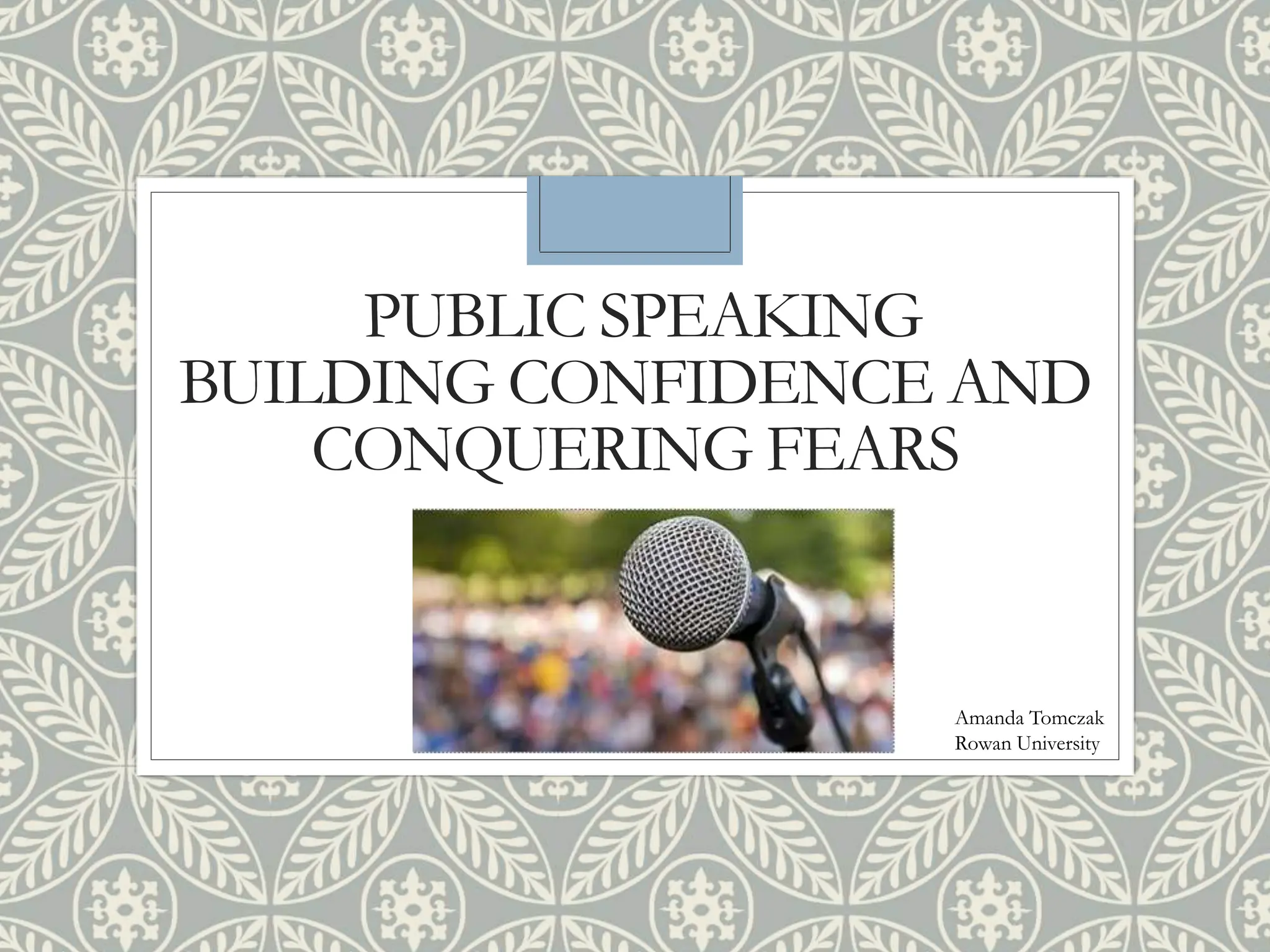
PUBLIC SPEAKING
BUILDING CONFIDENCE AND
CONQUERING FEARS
Amanda Tomczak
Rowan University
OBJECTIVES
• Identify what makes individuals scared of speaking in
public
• Learn to plan for and around stage nerves
• Build communications skills though simple speaking
opportunities
OBJECTIVE #1
Identify what makes you feel less
than confident about speaking in
public
CONSIDERATIONS
• Think of the factors that make you most uneasy
about public speaking
• Body Language
• Knowledge of Topic
• Keeping an audience’s attention
• What nervous symptoms have you had before or
while speaking in public?
OBJECTIVE #2
Learn to plan for and around stage
nerves
PLAN AND PREPARE
◦ Proper preparation and rehearsal can help to reduce
fear by about 75%.
◦ Proper breathing techniques can further reduce this
fear by 15%.
◦ Your mental state accounts for the remaining 10%.
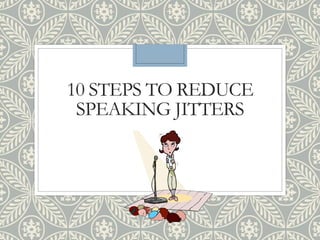
10 STEPS TO REDUCE
SPEAKING JITTERS
1. KNOW THE ROOM
◦ Arrive early and walk around the room
◦ Stand up front by lectern or podium
◦ Test out the microphone if using one
◦ Walk around where the audience will be seated
◦ Walk from where you will be seated to the place where you will be
speaking
2. KNOW THE AUDIENCE
◦ Try to greet some of the audience and chat with
them
◦ Friends are easier to talk to than a group of
strangers
3. KNOW YOUR MATERIAL
◦ Research topics thoroughly
◦ Provide specific examples and scenarios to illustrate your
point
◦ Read your material aloud and get a feel for how it sounds
as it is explained
◦ Be mindful and monitor your speed when going over your
presentation
4. LEARN HOW TO RELAX
◦ Sit comfortably with your back straight
◦ Breathe in slowly, hold your breath for 4 to 5 seconds,
and then slowly exhale
◦ To relax your facial muscles, open your mouth wide
and eyes wide, and then close them tightly. Pause and
open them again
5. VISUALIZE YOURSELF
SPEAKING
◦ Imagine yourself walking confidently to the
podium
◦ Imagine yourself speaking, your voice loud, clear,
and assured
◦ When you visualize yourself as successful, you
will be successful
6. REALIZE PEOPLE WANT
YOU TO SUCCEED
◦ Audiences want speakers to be interesting,
informative, and entertaining
◦ They want you to succeed, not to fail
7. DON'T APOLOGIZE
FOR BEING NERVOUS
◦ Most nervousness does not show
◦ If you don't say anything, nobody may
notice
8. CONCENTRATE ON YOUR
MESSAGE
◦ Your nervous feelings will ease as you focus your
attention away from your fears.
◦ Concentrate on your message and your audience, not
yourself.
9. TURN NERVOUSNESS INTO
POSITIVE ENERGY
◦ The same nervous energy that causes stage fright can be an
asset to you
◦ Harness it, and transform it into vitality and enthusiasm
◦ Learn a quick stress-reducing routine for relaxing your neck,
shoulder and facial muscles just before giving your talk
◦ Transform this energy into vitality and enthusiasm in delivering
your speech
10. GAIN EXPERIENCE
◦ Experience builds confidence, which is the key
to effective speaking. Most beginning speakers
find their anxieties decrease after each speech is
delivered.
OBJECTIVE #3
Build communications skills though
simple speaking opportunities
OPPORTUNITIES ARE ALL
AROUND
◦ Professional Examples:
◦ Break down a process in your department and ask a co-worker to
listen to you describe it or demonstrate it.
◦ Create a procedure and develop notes and explain it to colleagues.
◦ Personal Examples:
◦ Record yourself describing an activity you enjoy outside of work and
post a video on your social media.
CONCLUSION
Preparation + Practice = Perfection
Remember, he who fails to
prepare is preparing for failure!

Public Speaking Powepoint - Tips and Advice

  • 1.
    PUBLIC SPEAKING BUILDING CONFIDENCEAND CONQUERING FEARS Amanda Tomczak Rowan University
  • 2.
    OBJECTIVES • Identify whatmakes individuals scared of speaking in public • Learn to plan for and around stage nerves • Build communications skills though simple speaking opportunities
  • 3.
    OBJECTIVE #1 Identify whatmakes you feel less than confident about speaking in public
  • 4.
    CONSIDERATIONS • Think ofthe factors that make you most uneasy about public speaking • Body Language • Knowledge of Topic • Keeping an audience’s attention • What nervous symptoms have you had before or while speaking in public?
  • 5.
    OBJECTIVE #2 Learn toplan for and around stage nerves
  • 6.
    PLAN AND PREPARE ◦Proper preparation and rehearsal can help to reduce fear by about 75%. ◦ Proper breathing techniques can further reduce this fear by 15%. ◦ Your mental state accounts for the remaining 10%.
  • 7.
    10 STEPS TOREDUCE SPEAKING JITTERS
  • 8.
    1. KNOW THEROOM ◦ Arrive early and walk around the room ◦ Stand up front by lectern or podium ◦ Test out the microphone if using one ◦ Walk around where the audience will be seated ◦ Walk from where you will be seated to the place where you will be speaking
  • 9.
    2. KNOW THEAUDIENCE ◦ Try to greet some of the audience and chat with them ◦ Friends are easier to talk to than a group of strangers
  • 10.
    3. KNOW YOURMATERIAL ◦ Research topics thoroughly ◦ Provide specific examples and scenarios to illustrate your point ◦ Read your material aloud and get a feel for how it sounds as it is explained ◦ Be mindful and monitor your speed when going over your presentation
  • 11.
    4. LEARN HOWTO RELAX ◦ Sit comfortably with your back straight ◦ Breathe in slowly, hold your breath for 4 to 5 seconds, and then slowly exhale ◦ To relax your facial muscles, open your mouth wide and eyes wide, and then close them tightly. Pause and open them again
  • 12.
    5. VISUALIZE YOURSELF SPEAKING ◦Imagine yourself walking confidently to the podium ◦ Imagine yourself speaking, your voice loud, clear, and assured ◦ When you visualize yourself as successful, you will be successful
  • 13.
    6. REALIZE PEOPLEWANT YOU TO SUCCEED ◦ Audiences want speakers to be interesting, informative, and entertaining ◦ They want you to succeed, not to fail
  • 14.
    7. DON'T APOLOGIZE FORBEING NERVOUS ◦ Most nervousness does not show ◦ If you don't say anything, nobody may notice
  • 15.
    8. CONCENTRATE ONYOUR MESSAGE ◦ Your nervous feelings will ease as you focus your attention away from your fears. ◦ Concentrate on your message and your audience, not yourself.
  • 16.
    9. TURN NERVOUSNESSINTO POSITIVE ENERGY ◦ The same nervous energy that causes stage fright can be an asset to you ◦ Harness it, and transform it into vitality and enthusiasm ◦ Learn a quick stress-reducing routine for relaxing your neck, shoulder and facial muscles just before giving your talk ◦ Transform this energy into vitality and enthusiasm in delivering your speech
  • 17.
    10. GAIN EXPERIENCE ◦Experience builds confidence, which is the key to effective speaking. Most beginning speakers find their anxieties decrease after each speech is delivered.
  • 18.
    OBJECTIVE #3 Build communicationsskills though simple speaking opportunities
  • 19.
    OPPORTUNITIES ARE ALL AROUND ◦Professional Examples: ◦ Break down a process in your department and ask a co-worker to listen to you describe it or demonstrate it. ◦ Create a procedure and develop notes and explain it to colleagues. ◦ Personal Examples: ◦ Record yourself describing an activity you enjoy outside of work and post a video on your social media.
  • 20.
    CONCLUSION Preparation + Practice= Perfection Remember, he who fails to prepare is preparing for failure!