PROFESSORPARSONS.COM 1
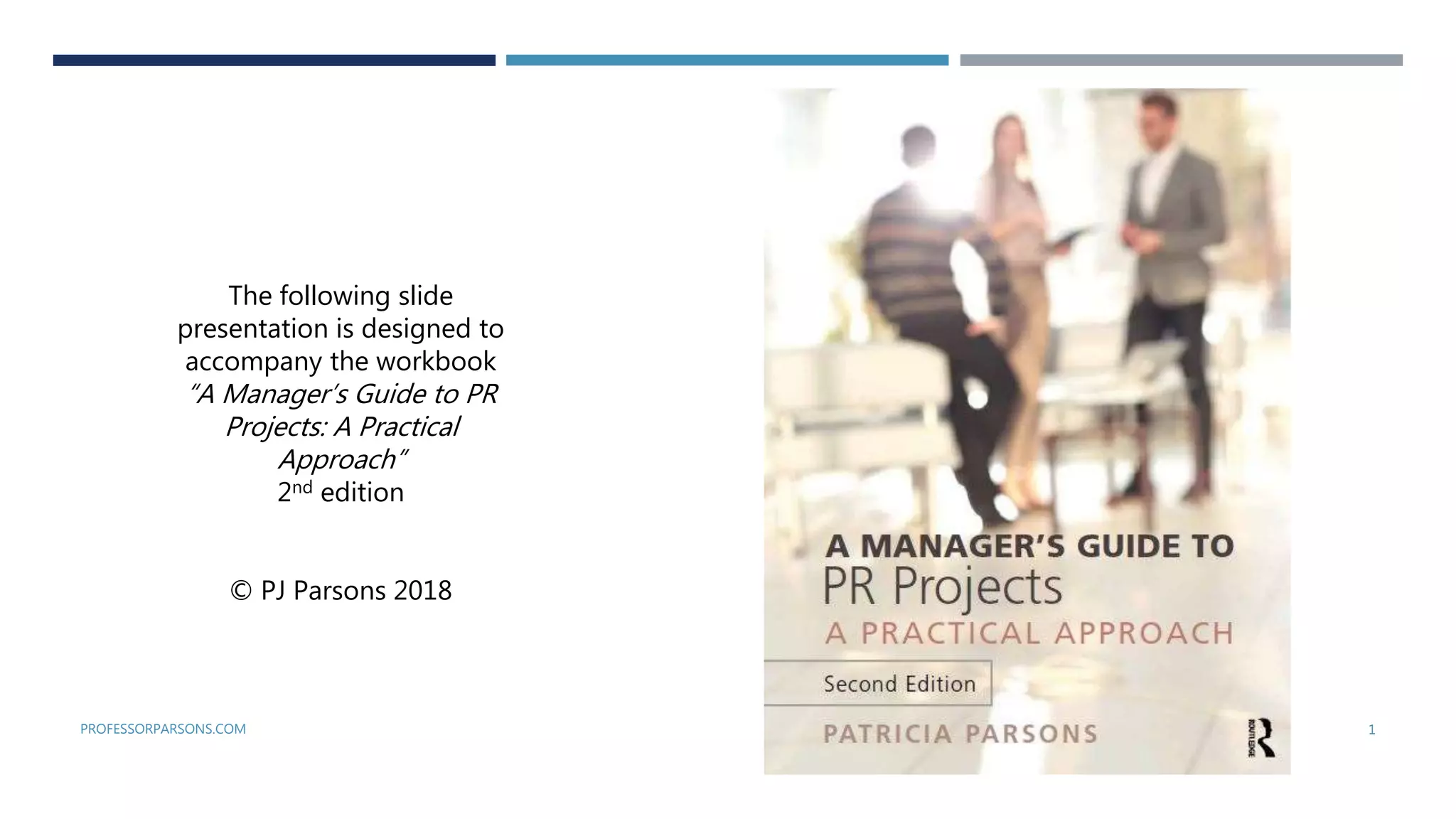
The following slide
presentation is designed to
accompany the workbook
“A Manager’s Guide to PR
Projects: A Practical
Approach”
2nd edition
© PJ Parsons 2018
PR PLANNING: THE RESEARCH PHASE
PART 2
PROFESSORPARSONS.COM 1
WHAT THIS SECTION COVERS…
 The importance of what research can accomplish
 The difference between a PR problem & a PR opportunity
 How research is done
 The concept of environmental scanning
 The importance of social media metrics
 The importance of researching relationships
 The importance of academic research to practitioners
PROFESSORPARSONS.COM 3
A WORKING DEFINITION OF “RESEARCH” FOR PR PLANNING
RESEARCH is a deliberate, planned, and
organized process for collection and analysis of
data for the purpose of determining an
organization’s public relations problems,
opportunities, and possible solutions.
PROFESSORPARSONS.COM 4
THREE QUESTIONS THAT UNDERPIN RESEARCH
 Where are we now?
 Where do we want to go?
 What is likely to be the best route to get there?
PROFESSORPARSONS.COM 5
6
WHY IS RESEARCH SO IMPORTANT?
 Increasing fragmentation & diversification of publics
 Decreasing personal contact between dominant coalition
& employees, as well as clients/ consumers
 Increasing multiplicity of communication channels
 Increasing involvement of social media means public
opinion is harder to predict
 Continuing need for PR to be able to articulate ROI to
organizational management
PROFESSORPARSONS.COM
7
WHAT CAN RESEARCH ACCOMPLISH IN GENERAL?
 Prevent wasting money, resources, effort & time
 Accumulate facts for PR program planning
 Increase positive publicity for an organization.
PROFESSORPARSONS.COM
8
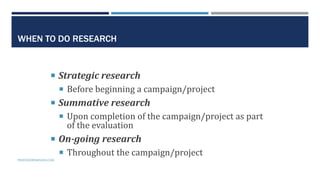
WHEN TO DO RESEARCH
 Strategic research
 Before beginning a campaign/project
 Summative research
 Upon completion of the campaign/project as part
of the evaluation
 On-going research
 Throughout the campaign/project
PROFESSORPARSONS.COM
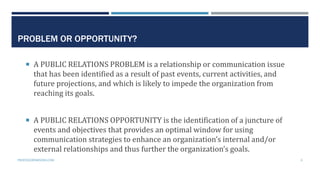
PROBLEM OR OPPORTUNITY?
 A PUBLIC RELATIONS PROBLEM is a relationship or communication issue
that has been identified as a result of past events, current activities, and
future projections, and which is likely to impede the organization from
reaching its goals.
 A PUBLIC RELATIONS OPPORTUNITY is the identification of a juncture of
events and objectives that provides an optimal window for using
communication strategies to enhance an organization’s internal and/or
external relationships and thus further the organization’s goals.
PROFESSORPARSONS.COM 9
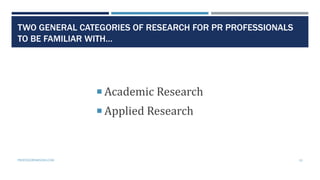
TWO GENERAL CATEGORIES OF RESEARCH FOR PR PROFESSIONALS
TO BE FAMILIAR WITH…
 Academic Research
 Applied Research
PROFESSORPARSONS.COM 10
PROFESSORPARSONS.COM 11
12
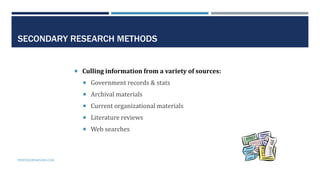
SECONDARY RESEARCH METHODS
 Culling information from a variety of sources:
 Government records & stats
 Archival materials
 Current organizational materials
 Literature reviews
 Web searches
PROFESSORPARSONS.COM
13
PRIMARY RESEARCH IN PR
 Informal methods
 Using personal contacts, polling opinion leaders,
community forums, advisory groups, feed-back lines, field
reports, interviewing
 Formal methods
 Surveys, focus groups, media-content analysis
PROFESSORPARSONS.COM
PROFESSORPARSONS.COM 14
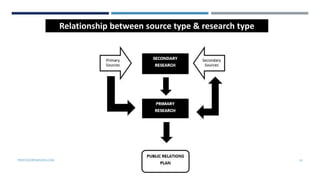
Relationship between source type & research type
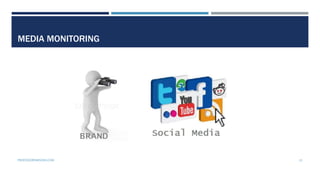
MEDIA MONITORING
PROFESSORPARSONS.COM 15
THE PR/COMMUNICATION AUDIT
THE COMMUNICATION/PUBLIC RELATIONS AUDIT is a research
tool that examines and assesses all aspects of an organization’s
activities, including the internal & external communication climate,
to diagnose the extent to which each public is receiving and
responding to the messages targeted toward them and the quality of
the relationships engendered by the organization through its
communication and activities.
PROFESSORPARSONS.COM 16
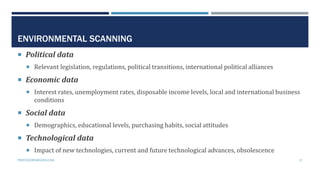
ENVIRONMENTAL SCANNING
 Political data
 Relevant legislation, regulations, political transitions, international political alliances
 Economic data
 Interest rates, unemployment rates, disposable income levels, local and international business
conditions
 Social data
 Demographics, educational levels, purchasing habits, social attitudes
 Technological data
 Impact of new technologies, current and future technological advances, obsolescence
PROFESSORPARSONS.COM 17
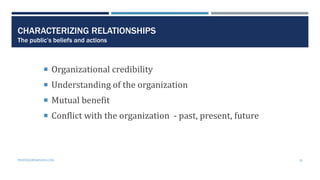
CHARACTERIZING RELATIONSHIPS
The public’s beliefs and actions
 Organizational credibility
 Understanding of the organization
 Mutual benefit
 Conflict with the organization - past, present, future
PROFESSORPARSONS.COM 18
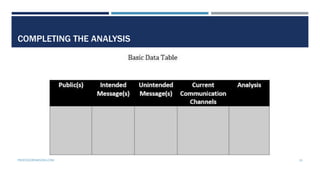
COMPLETING THE ANALYSIS
PROFESSORPARSONS.COM 19
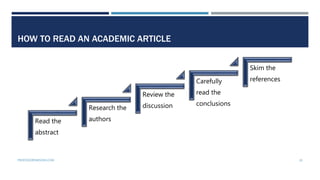
HOW TO READ AN ACADEMIC ARTICLE
Read the
abstract
Research the
authors
Review the
discussion
Carefully
read the
conclusions
Skim the
references
PROFESSORPARSONS.COM 20

Public Relations Planning Course Part 2: The research phase

  • 1.
    PROFESSORPARSONS.COM 1 The followingslide presentation is designed to accompany the workbook “A Manager’s Guide to PR Projects: A Practical Approach” 2nd edition © PJ Parsons 2018
  • 2.
    PR PLANNING: THERESEARCH PHASE PART 2 PROFESSORPARSONS.COM 1
  • 3.
    WHAT THIS SECTIONCOVERS…  The importance of what research can accomplish  The difference between a PR problem & a PR opportunity  How research is done  The concept of environmental scanning  The importance of social media metrics  The importance of researching relationships  The importance of academic research to practitioners PROFESSORPARSONS.COM 3
  • 4.
    A WORKING DEFINITIONOF “RESEARCH” FOR PR PLANNING RESEARCH is a deliberate, planned, and organized process for collection and analysis of data for the purpose of determining an organization’s public relations problems, opportunities, and possible solutions. PROFESSORPARSONS.COM 4
  • 5.
    THREE QUESTIONS THATUNDERPIN RESEARCH  Where are we now?  Where do we want to go?  What is likely to be the best route to get there? PROFESSORPARSONS.COM 5
  • 6.
    6 WHY IS RESEARCHSO IMPORTANT?  Increasing fragmentation & diversification of publics  Decreasing personal contact between dominant coalition & employees, as well as clients/ consumers  Increasing multiplicity of communication channels  Increasing involvement of social media means public opinion is harder to predict  Continuing need for PR to be able to articulate ROI to organizational management PROFESSORPARSONS.COM
  • 7.
    7 WHAT CAN RESEARCHACCOMPLISH IN GENERAL?  Prevent wasting money, resources, effort & time  Accumulate facts for PR program planning  Increase positive publicity for an organization. PROFESSORPARSONS.COM
  • 8.
    8 WHEN TO DORESEARCH  Strategic research  Before beginning a campaign/project  Summative research  Upon completion of the campaign/project as part of the evaluation  On-going research  Throughout the campaign/project PROFESSORPARSONS.COM
  • 9.
    PROBLEM OR OPPORTUNITY? A PUBLIC RELATIONS PROBLEM is a relationship or communication issue that has been identified as a result of past events, current activities, and future projections, and which is likely to impede the organization from reaching its goals.  A PUBLIC RELATIONS OPPORTUNITY is the identification of a juncture of events and objectives that provides an optimal window for using communication strategies to enhance an organization’s internal and/or external relationships and thus further the organization’s goals. PROFESSORPARSONS.COM 9
  • 10.
    TWO GENERAL CATEGORIESOF RESEARCH FOR PR PROFESSIONALS TO BE FAMILIAR WITH…  Academic Research  Applied Research PROFESSORPARSONS.COM 10
  • 11.
  • 12.
    12 SECONDARY RESEARCH METHODS Culling information from a variety of sources:  Government records & stats  Archival materials  Current organizational materials  Literature reviews  Web searches PROFESSORPARSONS.COM
  • 13.
    13 PRIMARY RESEARCH INPR  Informal methods  Using personal contacts, polling opinion leaders, community forums, advisory groups, feed-back lines, field reports, interviewing  Formal methods  Surveys, focus groups, media-content analysis PROFESSORPARSONS.COM
  • 14.
  • 15.
  • 16.
    THE PR/COMMUNICATION AUDIT THECOMMUNICATION/PUBLIC RELATIONS AUDIT is a research tool that examines and assesses all aspects of an organization’s activities, including the internal & external communication climate, to diagnose the extent to which each public is receiving and responding to the messages targeted toward them and the quality of the relationships engendered by the organization through its communication and activities. PROFESSORPARSONS.COM 16
  • 17.
    ENVIRONMENTAL SCANNING  Politicaldata  Relevant legislation, regulations, political transitions, international political alliances  Economic data  Interest rates, unemployment rates, disposable income levels, local and international business conditions  Social data  Demographics, educational levels, purchasing habits, social attitudes  Technological data  Impact of new technologies, current and future technological advances, obsolescence PROFESSORPARSONS.COM 17
  • 18.
    CHARACTERIZING RELATIONSHIPS The public’sbeliefs and actions  Organizational credibility  Understanding of the organization  Mutual benefit  Conflict with the organization - past, present, future PROFESSORPARSONS.COM 18
  • 19.
  • 20.
    HOW TO READAN ACADEMIC ARTICLE Read the abstract Research the authors Review the discussion Carefully read the conclusions Skim the references PROFESSORPARSONS.COM 20

Editor's Notes