By: Kate Kavanagh
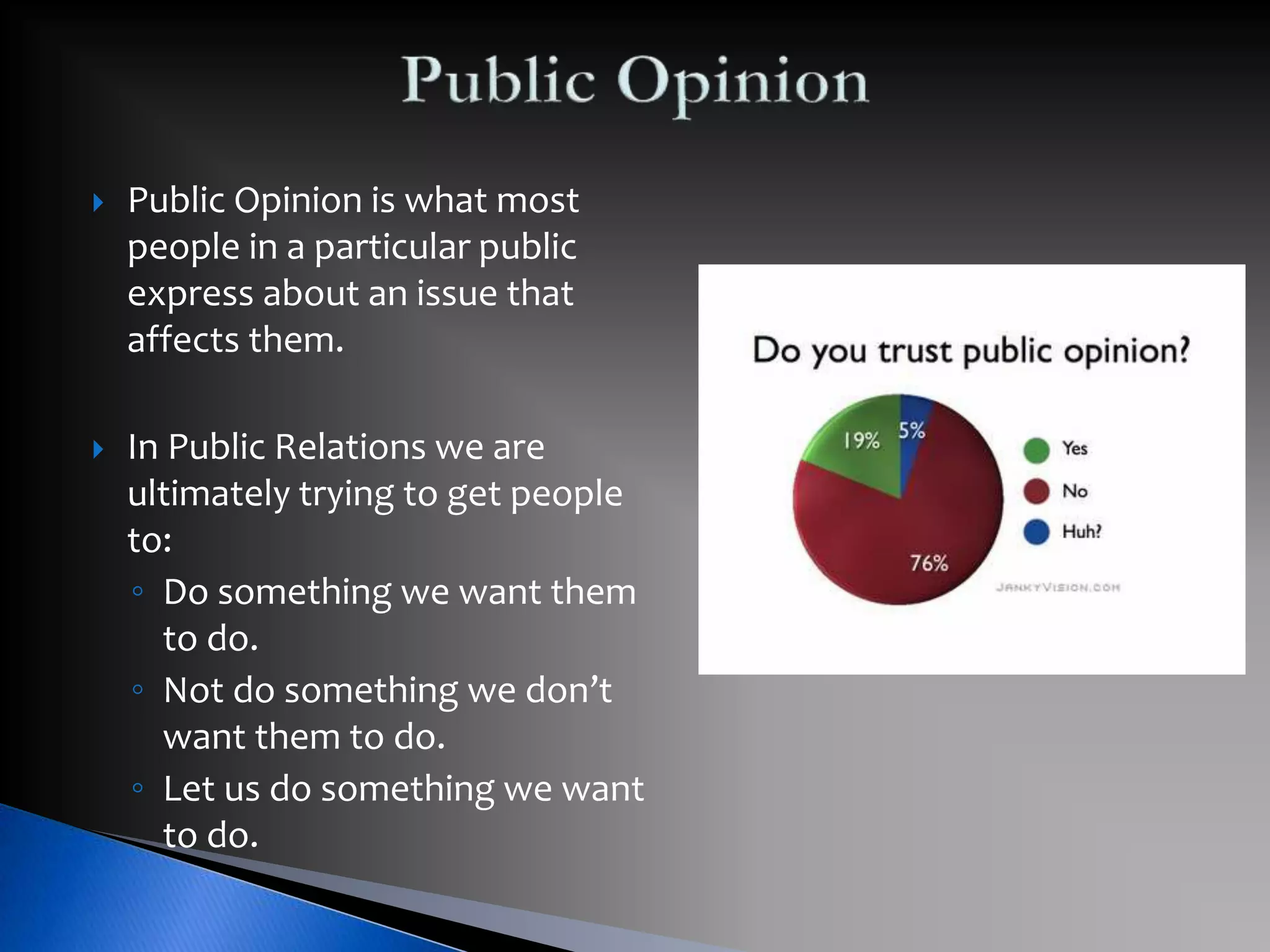
 Public Opinion is what most
people in a particular public
express about an issue that
affects them.
 In Public Relations we are
ultimately trying to get people
to:
◦ Do something we want them
to do.
◦ Not do something we don’t
want them to do.
◦ Let us do something we want
to do.
Awareness
Latent
Readiness to
Act
Triggering
Event
Behavior
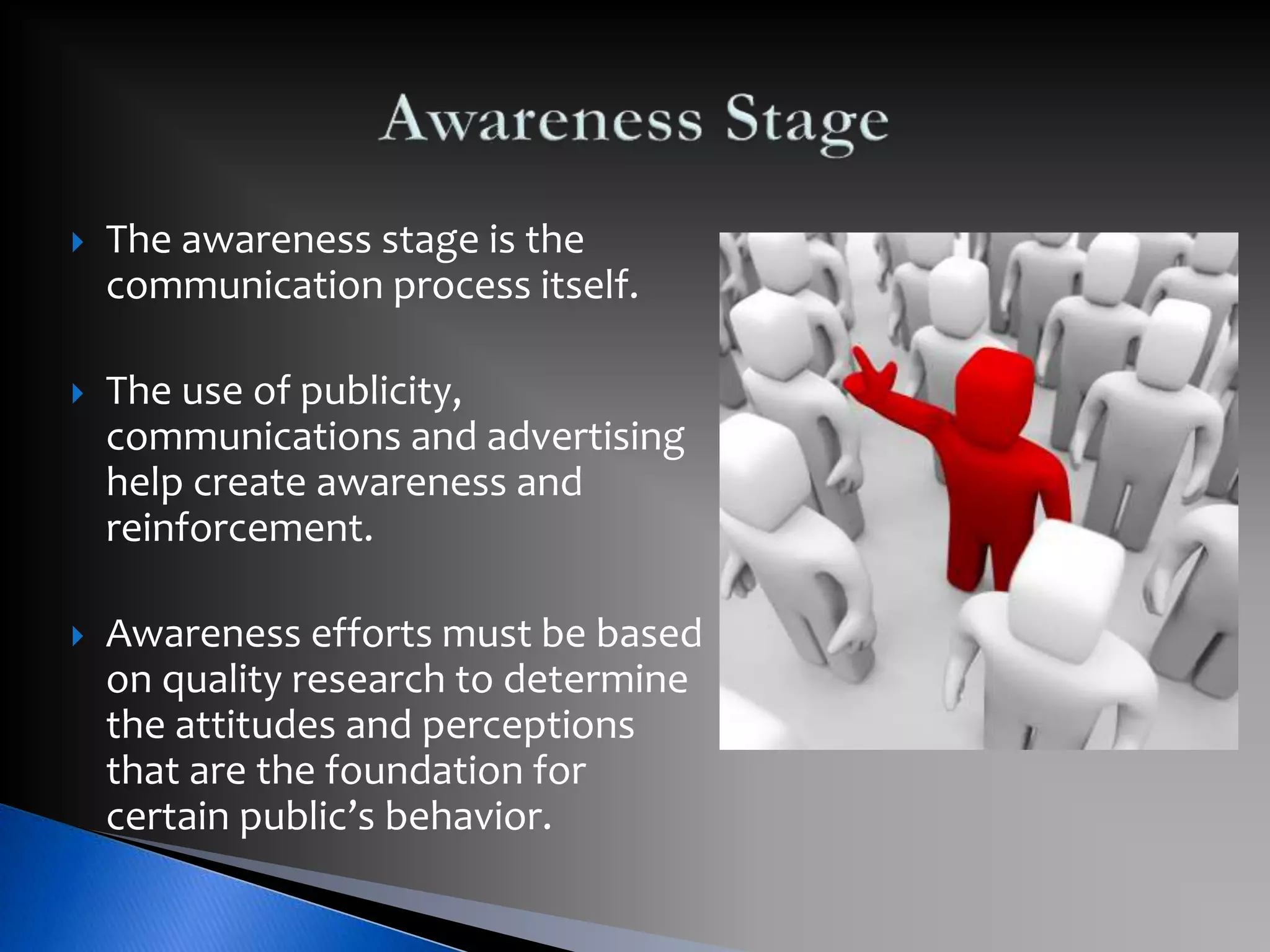
 The awareness stage is the
communication process itself.
 The use of publicity,
communications and advertising
help create awareness and
reinforcement.
 Awareness efforts must be based
on quality research to determine
the attitudes and perceptions
that are the foundation for
certain public’s behavior.
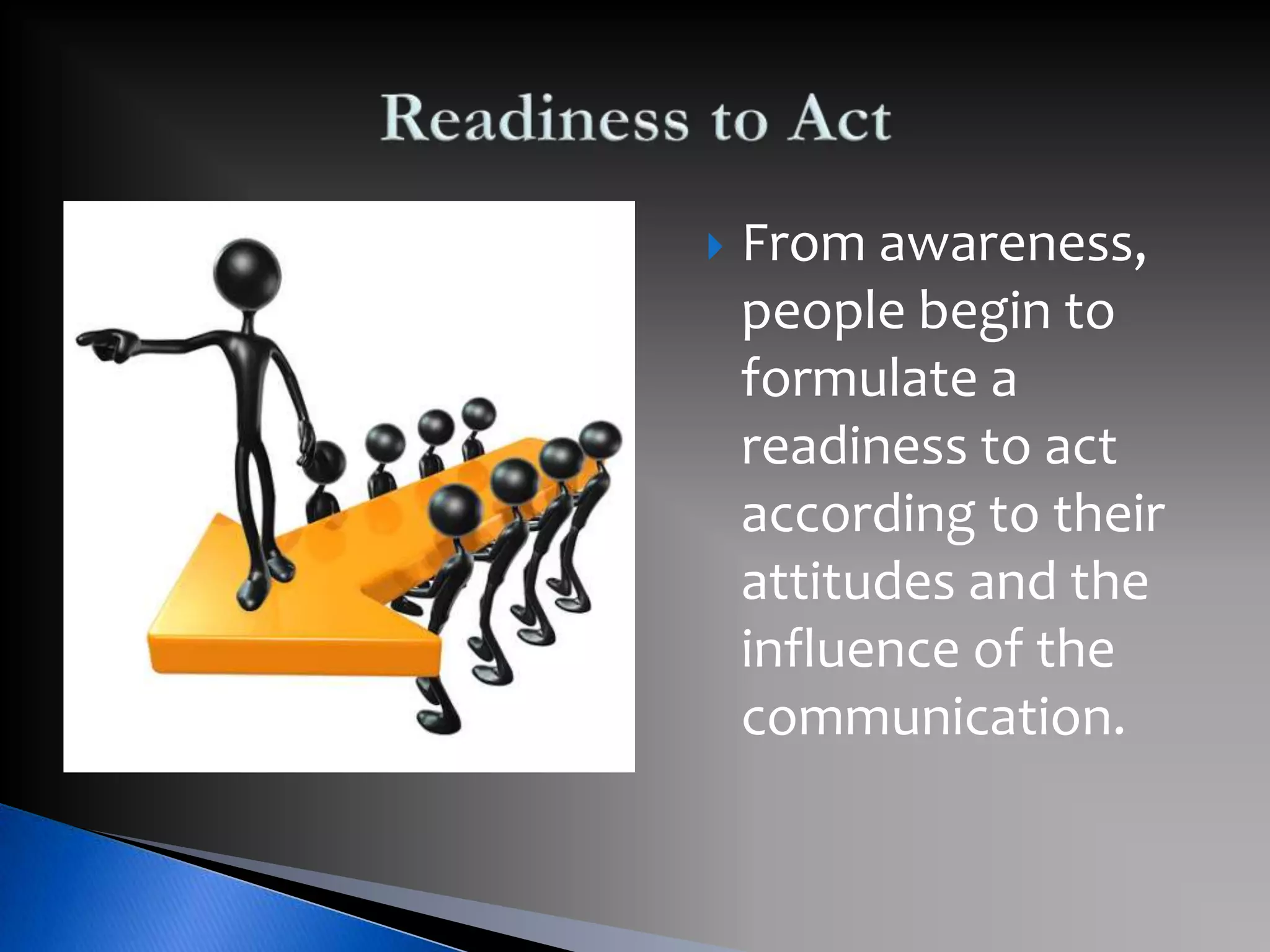
 From awareness,
people begin to
formulate a
readiness to act
according to their
attitudes and the
influence of the
communication.
 Action itself requires
some kind of
triggering event such
as an election in a
political campaign or a
sale at a clothing store.
 The event thus
transforms readiness
into actual behavior.
•Active on any
and all issues
All-issue
publics
•Inactive and
disinterested
Apathetic
publics
•Active on one or
few issues
Single-
issue
publics
•Bandwagon
jumpers
Hot-issue
publics
 James Grunig
concluded that publics
can be identified by
similarities in their
communication
behavior.
 However, behavioral
characteristics that
segment them are
unrelated to
demographics.
 Public Opinion is
collective it is not
what just one individual
thinks.
 Beliefs and ideas must
be expressed to be
public opinion.
 The opinion must be
held by the majority of
people within the group.
 The opinion is identified
with a certain group or
public, not the mass of
whoever is out there.
 The opinion is focused
on a particular issue or
topic.
 The topic must hold a
particular interest to the
individuals within the
group.
 Within our “frame of
reference” we attach
meaning to the world
around us.
 We establish our own
beliefs, values, and
attitudes.
 Our “frame of reference”
determines how was
perceive or sense our
world, and the
communication of others
directed toward us.
4. People trust their
leaders decision making
more when they feel
they have had a part in
shaping the decision.
5. Public opinion is focused
more on expected
results than in methods
to achieve those results.
People care more about
an outcome than the
process to reach the
outcome.
1. Opinions are influenced
by actions more than
words.
2. Opinion is determined by
self-interest and
persuasion is only
effective if it is
consistent with self-
interest over time.
3. Information is most
effective when opinion is
in formative stages.
 Sleeper Effect-A individual’s
fear of social rejection or
isolation may cause them not
to verbalize opinions they
perceive to be in the minority
 Silent Majority- vocal groups
suppress mainstream
opinions because the
majority believes itself to be
in the minority and,
therefore, remains silent.
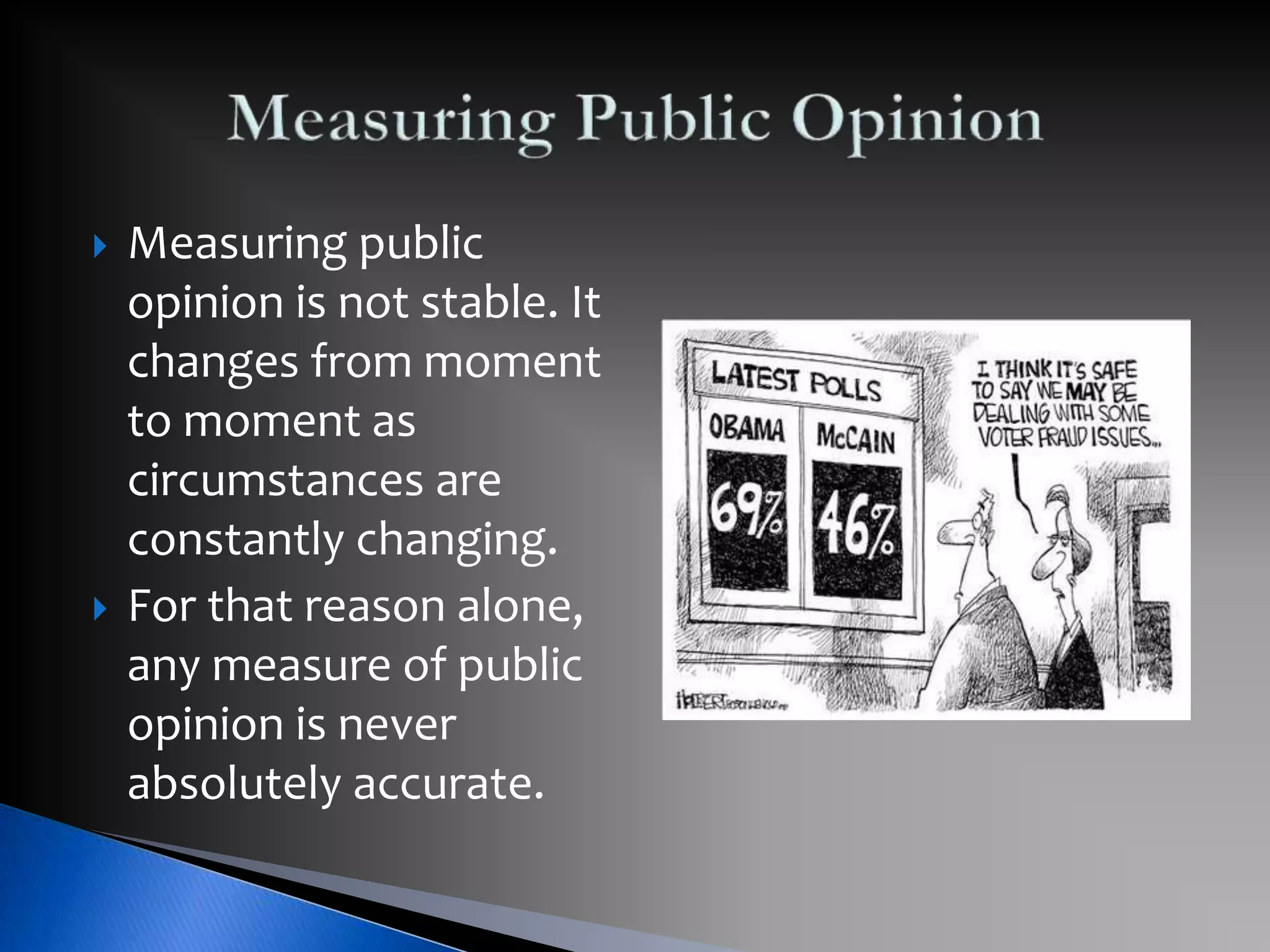
 Measuring public
opinion is not stable. It
changes from moment
to moment as
circumstances are
constantly changing.
 For that reason alone,
any measure of public
opinion is never
absolutely accurate.
Public Opinion Article

Public information

  • 1.
  • 2.
     Public Opinionis what most people in a particular public express about an issue that affects them.  In Public Relations we are ultimately trying to get people to: ◦ Do something we want them to do. ◦ Not do something we don’t want them to do. ◦ Let us do something we want to do.
  • 3.
  • 4.
     The awarenessstage is the communication process itself.  The use of publicity, communications and advertising help create awareness and reinforcement.  Awareness efforts must be based on quality research to determine the attitudes and perceptions that are the foundation for certain public’s behavior.
  • 5.
     From awareness, peoplebegin to formulate a readiness to act according to their attitudes and the influence of the communication.
  • 6.
     Action itselfrequires some kind of triggering event such as an election in a political campaign or a sale at a clothing store.  The event thus transforms readiness into actual behavior.
  • 7.
    •Active on any andall issues All-issue publics •Inactive and disinterested Apathetic publics •Active on one or few issues Single- issue publics •Bandwagon jumpers Hot-issue publics  James Grunig concluded that publics can be identified by similarities in their communication behavior.  However, behavioral characteristics that segment them are unrelated to demographics.
  • 8.
     Public Opinionis collective it is not what just one individual thinks.  Beliefs and ideas must be expressed to be public opinion.  The opinion must be held by the majority of people within the group.  The opinion is identified with a certain group or public, not the mass of whoever is out there.  The opinion is focused on a particular issue or topic.  The topic must hold a particular interest to the individuals within the group.
  • 9.
     Within our“frame of reference” we attach meaning to the world around us.  We establish our own beliefs, values, and attitudes.  Our “frame of reference” determines how was perceive or sense our world, and the communication of others directed toward us.
  • 10.
    4. People trusttheir leaders decision making more when they feel they have had a part in shaping the decision. 5. Public opinion is focused more on expected results than in methods to achieve those results. People care more about an outcome than the process to reach the outcome. 1. Opinions are influenced by actions more than words. 2. Opinion is determined by self-interest and persuasion is only effective if it is consistent with self- interest over time. 3. Information is most effective when opinion is in formative stages.
  • 11.
     Sleeper Effect-Aindividual’s fear of social rejection or isolation may cause them not to verbalize opinions they perceive to be in the minority  Silent Majority- vocal groups suppress mainstream opinions because the majority believes itself to be in the minority and, therefore, remains silent.
  • 12.
     Measuring public opinionis not stable. It changes from moment to moment as circumstances are constantly changing.  For that reason alone, any measure of public opinion is never absolutely accurate.
  • 13.