1
PAID TIME OFF
(PTO)
ANALYSIS
A. Introduction.
Hereafter, the Employee Leave Benefits referred to in this text will be
for City of Sunnyvale Classified Employees in Job Plan Category B.,
represented by the SEA, pursuant to Section 5.711 of the City of Sunnyvale
Salary Resolution.
In the 1992 negotiations, Sunnyvale Management representatives
pushed for adoption of Paid Time Off (PTO). PTO would replace existing
leave benefits comprised in the following categories located in the Extended
Contract MOU, September '89 to June '92:
1. Vacation Leave, Chapter C., Article 7.
2. Disability Leave, which includes: The Disability Leave Incentive pay,
Chapter C., Article 10; Disability Leave Entitlement, Provisions, and
Authorization Chapter C. Article 11, Additional Benefits and Sections 3.500,
3.510, and 3.520 of the City of Sunnyvale Salary Resolution. The Actual
description of Disability Leave is not in the MOU, but in the City of Sunnyvale
Salary Resolution, Section 3.510.
3. Medical Appointment Leave, Chapter C. Article 11, Additional
benefits and Section 3.600 of the City of Sunnyvale Salary Resolution.
4. Family Emergency Leave, Chapter D. Article 1. Also Section 3.700
of the City of Sunnyvale Salary Resolution
5. Workers' Compensation, Chapter C., Article 11, Additional Benefits
and Section 5.600, Appendix D. Additional benefits.
It is anticipated that the City of Sunnyvale Management will, again,
propose PTO in the upcoming negotiations in 1993. SEA is distributing the
following information so that employees can make an informed decision as to
2
whether PTO is an improvement in the benefits package or not.
The following is a comparison of current Leave Benefits as outlined in
the Extended Contract MOU September '89 to June '92 and the proposed
Leave Benefit program as outlined in the draft MOU, July '92 to June '94,
which includes PTO and was not ratified.
B. Current Leave Benefits not included in PTO.
The following leave benefits were not included in the PTO bank as
outlined in the July '92 to June '94 draft MOU.
1. Floating Holiday, Chapter C., Article 8.2. Which credits the employee
with 20 hours of leave January 1st of each year.
2. Bereavement Leave, Chapter C., Article 9. This leave does not
exceed 24 hours where a death has occured. 24 hours per death.
3. Holiday Leave, Chapter C., Article 8. This is the employees' 11 paid
holidays per year.
4. Military Leave, Chapter C. Article 11-Additional Benefits, Section
3.400 City of Sunnyvale Salary Resolution, and Administrative Policy Manual.
5. Jury Leave, Chapter C., Article 11-Additional Benefits, Section 3.300
of the City of Sunnyvale Salary Resolution, and the City of Sunnyvale
Administrative Policy Manual.
6. Leave Benefits, Leave Authorization, Leave Benefits-to Whom
Applicable, Leave Payment, and Leave Substitution are listed in Chapter C.,
Article 11-Additional benefits and are described in Sections 3.000, 3.010,
3.020, 3.030, and 3.040 of the City of Sunnyvale Salary Resolution. These
Sections apply to the administrative aspects of the Leave Benefits.
7. Special Schedule-Holiday Leave and Special Schedule-Waiver are
refered to in Chapter C., Article 11-Additional Benefits and are described in
Sections 3.210 and 3.220 of Appendix D Additional
3
Benefits, attached to the City of Sunnyvale Salary Resolution. These refer to
the Water Pollution Control Plant Operators.
C. Description of current Leave Benefits that are included in the PTO
proposal.
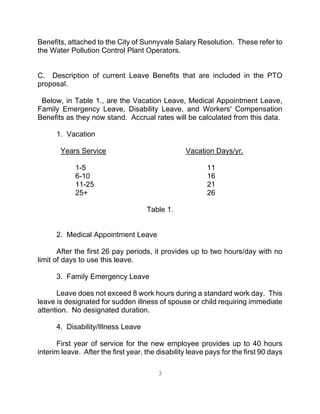
Below, in Table 1., are the Vacation Leave, Medical Appointment Leave,
Family Emergency Leave, Disability Leave, and Workers' Compensation
Benefits as they now stand. Accrual rates will be calculated from this data.
1. Vacation
Years Service Vacation Days/yr.
1-5 11
6-10 16
11-25 21
25+ 26
Table 1.
2. Medical Appointment Leave
After the first 26 pay periods, it provides up to two hours/day with no
limit of days to use this leave.
3. Family Emergency Leave
Leave does not exceed 8 work hours during a standard work day. This
leave is designated for sudden illness of spouse or child requiring immediate
attention. No designated duration.
4. Disability/Illness Leave
First year of service for the new employee provides up to 40 hours
interim leave. After the first year, the disability leave pays for the first 90 days
4
of every disability (illness or injury, including workers' compensation).
Under the proposed PTO plan, the 90 day Disability Leave per disability
would not take effect until after 10 full working days of disability per illness.
The amount of sick days taken per illness is subtracted from the PTO Bank.
You must be continuously disabled for 81 hours before the 90 day disability
plan kicks in. After the 90th day of continuous disability, long term disability
kicks in at 2/3rds pay.
5. Workers' Compensation
Currently, if you are disabled at work, the 90 day disability plan would
cover your illness.
Under the PTO Bank plan, for employees who have completed one full
year of service, four hours per day of the first three days you are disabled,
with a work related injury, would be deducted from your PTO Bank.
D. Paid Time Off (PTO)-Proposed in draft MOU.
PTO would replace Vacation Leaves (2-5 weeks annually),
Disability/Illness Leaves (approximately 72.6 hrs/employee for year 1992),
Workers' Compensation, Medical Appointment Leaves, and Family
Emergency Leaves.
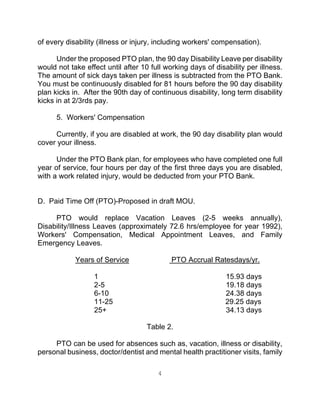
Years of Service PTO Accrual Ratesdays/yr.
1 15.93 days
2-5 19.18 days
6-10 24.38 days
11-25 29.25 days
25+ 34.13 days
Table 2.
PTO can be used for absences such as, vacation, illness or disability,
personal business, doctor/dentist and mental health practitioner visits, family
5
emergencies that include care of sick children and school visits.
For illness or injury not job related, the first ten working days of a
continuous disability or illness are deducted from PTO. After that the 90 day
disability plan kicks in.
For Workers' Compensation (illness/injury from work), four hours per
day of the first 3 days of your work related disability or illness is subtracted
from PTO.
E. Comments.
1. Firstly, PTO, basically is composed of five different leave benefits,
while vacation leave is just that, vacation leave. Comparing the two is a little
like comparing apples to oranges.
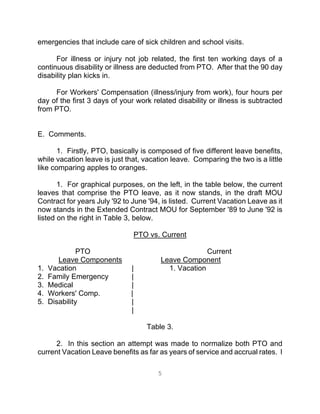
1. For graphical purposes, on the left, in the table below, the current
leaves that comprise the PTO leave, as it now stands, in the draft MOU
Contract for years July '92 to June '94, is listed. Current Vacation Leave as it
now stands in the Extended Contract MOU for September '89 to June '92 is
listed on the right in Table 3, below.
PTO vs. Current
PTO Current
Leave Components Leave Component
1. Vacation | 1. Vacation
2. Family Emergency |
3. Medical |
4. Workers' Comp. |
5. Disability |
|
Table 3.
2. In this section an attempt was made to normalize both PTO and
current Vacation Leave benefits as far as years of service and accrual rates. I
6
will try to normalize these accrual rates per years of service back into our
current years of service Vacation Leave benefit arrangement. Then a
comparison will be attempted between these two differing accrual rates.
Remember PTO includes Family Emergency Leave, Medical Leave,
Workers' Compensation, Vacation Leave, and Disability Leave. We are
comparing this overall accrual rate with just current Vacation Leave benefits.
We are comparing apples to oranges.
If you will look back at the PTO leave in Table 2. and the Current Leave
in Table 1., you can see that the accrual rates for years of service are different
in years of service 1-5. This is normalized by adding the first year of service
accrual rate (15.93) in the PTO Section D., with four times the 2nd thru 5th
year of service accrual rate (19.18) in Section D.,and then divided by five.
The algorithm looks like this:
PTO
Year 1 Accrual rate: 15.93 days/yr. * 1
Year 2 thru 5 Accrual rate: 19.18 days/yr. * 4
Total 92.65 days/yr. / 5 = 18.53 d/yr.
The resultant, listed in Table 4. below, can give one a rough comparison
between the two benefits, when years of service and accrual rates are
normalized.
Years Service PTO Current
1-5 18.53 11
6-10 24.38 16
11-25 29.25 21
25+ 34.13 26
Table 4.
Subtracting the current vacation leave benefit category from the
proposed PTO leave benefit that was normalized for comparison nets the
7
following apparent differences:
a. 7.53 days/yr more under the PTO package at 1-5 years of service.
b. 8.38 days/yr. more under the PTO package at 6-10 years of service.
c. 8.25 days/yr. more under the PTO package at 11-25 years of service.
d. 8.13 days/yr. more under the PTO package at 25+ years of service.
3. Do these net gains in PTO over the current vacation accrual rates,
7.53days/yr. to 8.13 days/yr., depending on years of service, make up for all
the Leave Benefits that will be traded for PTO?
How does the average Medical Leave accrual rates, the average Family
Emergency Leave accrual rates, the average Workers' Compensation accrual
rates, the average Disability/Illness Leave accrual rates, and the average
Vacation Leave accrual rates compare with the PTO accrual rates when
added together?
What is needed to further "normalize" the comparison between the
proposed PTO and the "Current" total leaves accrual rates is to obtain the
total number of hours that were taken in any given year for all SEA
Represented employees, and then convert these numbers to leave accrual
rates.
Remember, we are trying to obtain accrual rate totals for two differing
types of leaves, further complicating the matter. The two types of leaves
described herein are:
1. Discretionary leaves: This type of leave constitutes Vacation Leave,
which the employee possesses, and which can accumulate for the employee.
2. Contingency leaves, which are those types of leaves that are used
on a "contingency" basis, that is, when the employee has to. These leaves
comprise Medical Appointment Leave, Workers' Compensation Leave, Family
Emergency Leave, and the Disability Leave.
From the information given the SEA by Sunnyvale Management, there
was obtained the following average leaves totals*:
8
2a. 50,006.2 hrs of vacation taken in 1992.**
2b. 3,446.2 hrs of workers' comp. taken in 1992.
2c. 28,219.6 hrs of sick leave taken in 1992.
2d. 429.2 hrs Family Leave taken average for yrs. (89-91).***
2e. 3509.9 hrs Med, Appt. taken avg. for yrs. (89-91).***
*The average Pay Period of Service for all SEA Represented employees
would be useful. Also, obtaining information indicating how the average Pay
Period of Service has increased or decreased over the years for SEA
represented employees would be useful.
**Vacation Leave, being a discretionary leave, should probably be added to
the overall accrual rate by using the accumulation rate, not actual usage,
based upon years of service, and then converted to the accrual rate for
addition into the overall accrual component for comparison to PTO.
***These averages were the only numbers that were available. Since these
leaves are contingency leaves, the more years you use, to obtain an average,
the better. Hopefully, the small number of hours these components represent,
will not create to much of an error. Although Medical Appointment Leave can
be utilized for up to two hours per day, it is still a contingency leave. An
average SEA represented employee usage, utilizing several years of data is a
more accurate representation, not to mention more realistic.
Below are the average leaves usage for all SEA represented employees
given for the time periods in 2a. through 2e. listed above, for year 1992.
This breaks down to: 114.6 hrs vacation/employee/yr.
64.70 hrs sick leave/employee/yr.
8.70 hrs Med. Appt./employee/yr.
7.90 hrs Wkrs comp./employee/yr.
1.06 hrs Fam. Em./employee/yr.
Total 196.70 hrs taken/employee/yr.
This translates into 24.62 days of "average" leave benefit per employee
per year, for year 1992.
9
As indicated in superscript **, it is probably more accurate to use actual
accumulation rates, per years of service, for Vacation Leave accrual rates
calculations, since this is a discretionary leave that the employee can
accumulate and therefore "owns". The average Vacation Leave used is
mostly likely lower than accumulated since employees usually accumulate this
type of leave.
Additionally, since we do not have the average Pay Period of Service for
all SEA Represented employees, the average Vacation usage per all SEA
represented employees is meaningless.
Is the City of Sunnyvale management concerned about the increase in
the cost of overall benefits if the City of Sunnyvale work-force is getting long in
the tooth, as well as decreasing disability usage? Should City of Sunnyvale
employees actively help the City of Sunnyvale City Council and its citizens to
this end?
Therefore, converting and then adding the accrual rates for Vacation
Leave per years of service (in days), to the average usage of Medical
Appointment Leave, Family Emergency Leave, Workers' Compensation, and
Disability Leave (in days) and then subtracting this overall accrual rate (in
days) from the PTO accrual rate, per years of service yields the following
results listed in Table 5., below.
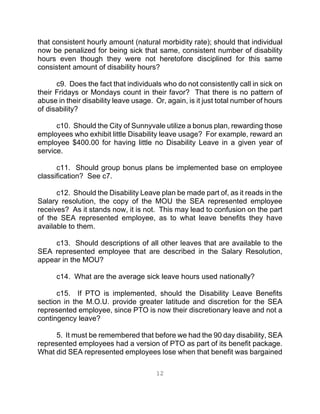
Accrual Rate Comparison
Years Service PTO Current Net days/yr.
1-5 18.53 21.3 -2.8
6-10 24.38 26.3 -1.9
11-25 29.25 31.3 -2.1
25+ 34.13 36.3 -2.2
Table 5.
As can be seen, the PTO plan, as proposed, would reduce leave
amounts by approximately 2 to 3 days depending on years of service of the
10
SEA employee.
4. The key to PTO is the 10 day window where the employee has to
use his or her PTO Bank. What percentage of total sick hours of all SEA
represented employees is derived from illnesses that last less than 10 days in
the last contract year? 80%? 90%? 95%? It may be in the 90th percentile.
If one considers that the average hours of Disability Leave taken per all
SEA Represented employees was 72.6 hours, in 1992, this percentage
reaches 100%.
According to the information provided, there is a total of 446 SEA
represented employees. Of these 446 employees, 116 employees had 70.0
or more disability hours in 1992. Further, of these 446 employees, 85 had
80.0 or more disability hours.
So that means:
a. 330 employees could have taken part in the Disability Leave incentive
plan (446-116).
b. 361 of all SEA represented employees (81%, 446-85), who used less
than 80 hours sick leave, would not have been able to use any of the 90 day
disability plan as it is now constituted under the proposed PTO plan. They all
would have had to use their own PTO.
Under the proposed PTO plan there is the ten day (80 hour) of
continuous disability window before an employee can use the 90 day disability
leave.
Additionally, it is most likely that the number of SEA represented
employees who probably did not have continuous disabilities longer than ten
days may probably be higher than 361. How many of those 85 employees
who used more than 80 hours of disability leave had disabilities longer than 10
continuous days?
c. Should the SEA, instead of negotiating for PTO, negotiate a definitive
Disability Leave plan, with City of Sunnyvale Management, to lower sick leave
usage and reduce sick leave abuse?
11
Should the SEA Board ask the City of Sunnyvale Management to "Meet
and Confer" over the City of Sunnyvale's new policy of indicating "N" (needs in
improvement) in an SEA represented employees yearly Audit if this same
individual has taken, in the City of Sunnyvale's estimation, to much disability
leave. That they have not maintained their health consist with their
employment.
To determine in a quantifiable way, whether there has been abuse.
Should basic policy guidelines be negotiated between the City of
Sunnyvale Management and the City of Sunnyvale bargaining units; to set
definitive policy as to how those employees, who abuse their disability leaves,
be disciplined?. The following questions need to be addressed.
c1. How is the City of Sunnyvale to determine that an employee is not
maintaining his or her health consistent with his or her employment? Just by
total disability hours taken?
c2. Are total disability hours enough?
c3. Does the threat of discipline compel truly sick individuals to still
come to work, even when they should not?
c4. Will this worsen their condition, requiring even more disability leave,
even hospitalization?
c5. Could this potentially create an unsafe and hazardous situation at
work?
c6. Could communicable diseases be spread this way?
c7. Should different departments in the City of Sunnyvale have different
disability hour norms? Should the Sunnyvale WPCP be held up to the same
norm as Finance?
c8. If an individual who previously had been sick a certain number of
hours per year, and he/she has shown that they are usually sick each year
12
that consistent hourly amount (natural morbidity rate); should that individual
now be penalized for being sick that same, consistent number of disability
hours even though they were not heretofore disciplined for this same
consistent amount of disability hours?
c9. Does the fact that individuals who do not consistently call in sick on
their Fridays or Mondays count in their favor? That there is no pattern of
abuse in their disability leave usage. Or, again, is it just total number of hours
of disability?
c10. Should the City of Sunnyvale utilize a bonus plan, rewarding those
employees who exhibit little Disability leave usage? For example, reward an
employee $400.00 for having little no Disability Leave in a given year of
service.
c11. Should group bonus plans be implemented base on employee
classification? See c7.
c12. Should the Disability Leave plan be made part of, as it reads in the
Salary resolution, the copy of the MOU the SEA represented employee
receives? As it stands now, it is not. This may lead to confusion on the part
of the SEA represented employee, as to what leave benefits they have
available to them.
c13. Should descriptions of all other leaves that are available to the
SEA represented employee that are described in the Salary Resolution,
appear in the MOU?
c14. What are the average sick leave hours used nationally?
c15. If PTO is implemented, should the Disability Leave Benefits
section in the M.O.U. provide greater latitude and discretion for the SEA
represented employee, since PTO is now their discretionary leave and not a
contingency leave?
5. It must be remembered that before we had the 90 day disability, SEA
represented employees had a version of PTO as part of its benefit package.
What did SEA represented employees lose when that benefit was bargained
13
into the 90 day disability? Frank De Bono, our negotiator for the upcoming
M.O.U. Contract Negotiations was one of the negotiators back then. His
perspective is important. It may look as if we are giving up the goose that laid
the golden egg, but are we? Did we trade in a Rolls Royce for A Cadillac. Are
we now trading in that Cadillac for a Ford Pinto?
6. It appears as if City of Sunnyvale Management includes Worker's
Compensation disability hours in its total of sick hours used by all Sea
Represented employees. Is this reasonable? Should work related disabilities
count towards total disability hours or should they be broken out?
Since Workers' Compensation hours are factored in, would it be
advisable to have an SEA Representative named to the Safety Committee?
7. One of the primary factors in implementing PTO is the psychological
motivation provided the employee, because the leave the employee is
accumulating is now the employees' "possession".
It isn't just an open-ended benefit to be used indiscriminately and in
some cases abusively. This factor, alone, would be motivation enough to cut
disability hours. Therefore, should overall accumulation accrual rates of PTO
be a primary concern of City of Sunnyvale Management during the M.O.U.
negotiations.
Additionally, has the City of Sunnyvale Management estimated how
many hours of disability leave this option will save?
8. Other Public Agencies have 11 and 12 day disability plans, should
we consider negotiating these type of plan?
9. How much money does the City of Sunnyvale Management estimate
they will save by implementing the proposed PTO plan?
10. City of Sunnyvale Management has already implemented PTO.
Therefore, they are most likely, looked upon by City of Sunnyvale City Council
and the City of Sunnyvale citizens as having taken the "high moral ground" in
the upcoming SEA M.O.U. negotiations. That they have swallowed the "bitter
pill" of PTO.
14
We SEA represented employees must also demonstrate that, we too,
wish to make the necessary sacrifices in the face of the massive budgetary
cut-backs and take-aways the State of California is implementing on the
districts, counties, and cities of California.
That, we too, can do our part in "reinventing government". The ultimate
question may not be whether we will have PTO, but rather how it will look.

PTO_SEA00040

  • 1.
    1 PAID TIME OFF (PTO) ANALYSIS A.Introduction. Hereafter, the Employee Leave Benefits referred to in this text will be for City of Sunnyvale Classified Employees in Job Plan Category B., represented by the SEA, pursuant to Section 5.711 of the City of Sunnyvale Salary Resolution. In the 1992 negotiations, Sunnyvale Management representatives pushed for adoption of Paid Time Off (PTO). PTO would replace existing leave benefits comprised in the following categories located in the Extended Contract MOU, September '89 to June '92: 1. Vacation Leave, Chapter C., Article 7. 2. Disability Leave, which includes: The Disability Leave Incentive pay, Chapter C., Article 10; Disability Leave Entitlement, Provisions, and Authorization Chapter C. Article 11, Additional Benefits and Sections 3.500, 3.510, and 3.520 of the City of Sunnyvale Salary Resolution. The Actual description of Disability Leave is not in the MOU, but in the City of Sunnyvale Salary Resolution, Section 3.510. 3. Medical Appointment Leave, Chapter C. Article 11, Additional benefits and Section 3.600 of the City of Sunnyvale Salary Resolution. 4. Family Emergency Leave, Chapter D. Article 1. Also Section 3.700 of the City of Sunnyvale Salary Resolution 5. Workers' Compensation, Chapter C., Article 11, Additional Benefits and Section 5.600, Appendix D. Additional benefits. It is anticipated that the City of Sunnyvale Management will, again, propose PTO in the upcoming negotiations in 1993. SEA is distributing the following information so that employees can make an informed decision as to
  • 2.
    2 whether PTO isan improvement in the benefits package or not. The following is a comparison of current Leave Benefits as outlined in the Extended Contract MOU September '89 to June '92 and the proposed Leave Benefit program as outlined in the draft MOU, July '92 to June '94, which includes PTO and was not ratified. B. Current Leave Benefits not included in PTO. The following leave benefits were not included in the PTO bank as outlined in the July '92 to June '94 draft MOU. 1. Floating Holiday, Chapter C., Article 8.2. Which credits the employee with 20 hours of leave January 1st of each year. 2. Bereavement Leave, Chapter C., Article 9. This leave does not exceed 24 hours where a death has occured. 24 hours per death. 3. Holiday Leave, Chapter C., Article 8. This is the employees' 11 paid holidays per year. 4. Military Leave, Chapter C. Article 11-Additional Benefits, Section 3.400 City of Sunnyvale Salary Resolution, and Administrative Policy Manual. 5. Jury Leave, Chapter C., Article 11-Additional Benefits, Section 3.300 of the City of Sunnyvale Salary Resolution, and the City of Sunnyvale Administrative Policy Manual. 6. Leave Benefits, Leave Authorization, Leave Benefits-to Whom Applicable, Leave Payment, and Leave Substitution are listed in Chapter C., Article 11-Additional benefits and are described in Sections 3.000, 3.010, 3.020, 3.030, and 3.040 of the City of Sunnyvale Salary Resolution. These Sections apply to the administrative aspects of the Leave Benefits. 7. Special Schedule-Holiday Leave and Special Schedule-Waiver are refered to in Chapter C., Article 11-Additional Benefits and are described in Sections 3.210 and 3.220 of Appendix D Additional
  • 3.
    3 Benefits, attached tothe City of Sunnyvale Salary Resolution. These refer to the Water Pollution Control Plant Operators. C. Description of current Leave Benefits that are included in the PTO proposal. Below, in Table 1., are the Vacation Leave, Medical Appointment Leave, Family Emergency Leave, Disability Leave, and Workers' Compensation Benefits as they now stand. Accrual rates will be calculated from this data. 1. Vacation Years Service Vacation Days/yr. 1-5 11 6-10 16 11-25 21 25+ 26 Table 1. 2. Medical Appointment Leave After the first 26 pay periods, it provides up to two hours/day with no limit of days to use this leave. 3. Family Emergency Leave Leave does not exceed 8 work hours during a standard work day. This leave is designated for sudden illness of spouse or child requiring immediate attention. No designated duration. 4. Disability/Illness Leave First year of service for the new employee provides up to 40 hours interim leave. After the first year, the disability leave pays for the first 90 days
  • 4.
    4 of every disability(illness or injury, including workers' compensation). Under the proposed PTO plan, the 90 day Disability Leave per disability would not take effect until after 10 full working days of disability per illness. The amount of sick days taken per illness is subtracted from the PTO Bank. You must be continuously disabled for 81 hours before the 90 day disability plan kicks in. After the 90th day of continuous disability, long term disability kicks in at 2/3rds pay. 5. Workers' Compensation Currently, if you are disabled at work, the 90 day disability plan would cover your illness. Under the PTO Bank plan, for employees who have completed one full year of service, four hours per day of the first three days you are disabled, with a work related injury, would be deducted from your PTO Bank. D. Paid Time Off (PTO)-Proposed in draft MOU. PTO would replace Vacation Leaves (2-5 weeks annually), Disability/Illness Leaves (approximately 72.6 hrs/employee for year 1992), Workers' Compensation, Medical Appointment Leaves, and Family Emergency Leaves. Years of Service PTO Accrual Ratesdays/yr. 1 15.93 days 2-5 19.18 days 6-10 24.38 days 11-25 29.25 days 25+ 34.13 days Table 2. PTO can be used for absences such as, vacation, illness or disability, personal business, doctor/dentist and mental health practitioner visits, family
  • 5.
    5 emergencies that includecare of sick children and school visits. For illness or injury not job related, the first ten working days of a continuous disability or illness are deducted from PTO. After that the 90 day disability plan kicks in. For Workers' Compensation (illness/injury from work), four hours per day of the first 3 days of your work related disability or illness is subtracted from PTO. E. Comments. 1. Firstly, PTO, basically is composed of five different leave benefits, while vacation leave is just that, vacation leave. Comparing the two is a little like comparing apples to oranges. 1. For graphical purposes, on the left, in the table below, the current leaves that comprise the PTO leave, as it now stands, in the draft MOU Contract for years July '92 to June '94, is listed. Current Vacation Leave as it now stands in the Extended Contract MOU for September '89 to June '92 is listed on the right in Table 3, below. PTO vs. Current PTO Current Leave Components Leave Component 1. Vacation | 1. Vacation 2. Family Emergency | 3. Medical | 4. Workers' Comp. | 5. Disability | | Table 3. 2. In this section an attempt was made to normalize both PTO and current Vacation Leave benefits as far as years of service and accrual rates. I
  • 6.
    6 will try tonormalize these accrual rates per years of service back into our current years of service Vacation Leave benefit arrangement. Then a comparison will be attempted between these two differing accrual rates. Remember PTO includes Family Emergency Leave, Medical Leave, Workers' Compensation, Vacation Leave, and Disability Leave. We are comparing this overall accrual rate with just current Vacation Leave benefits. We are comparing apples to oranges. If you will look back at the PTO leave in Table 2. and the Current Leave in Table 1., you can see that the accrual rates for years of service are different in years of service 1-5. This is normalized by adding the first year of service accrual rate (15.93) in the PTO Section D., with four times the 2nd thru 5th year of service accrual rate (19.18) in Section D.,and then divided by five. The algorithm looks like this: PTO Year 1 Accrual rate: 15.93 days/yr. * 1 Year 2 thru 5 Accrual rate: 19.18 days/yr. * 4 Total 92.65 days/yr. / 5 = 18.53 d/yr. The resultant, listed in Table 4. below, can give one a rough comparison between the two benefits, when years of service and accrual rates are normalized. Years Service PTO Current 1-5 18.53 11 6-10 24.38 16 11-25 29.25 21 25+ 34.13 26 Table 4. Subtracting the current vacation leave benefit category from the proposed PTO leave benefit that was normalized for comparison nets the
  • 7.
    7 following apparent differences: a.7.53 days/yr more under the PTO package at 1-5 years of service. b. 8.38 days/yr. more under the PTO package at 6-10 years of service. c. 8.25 days/yr. more under the PTO package at 11-25 years of service. d. 8.13 days/yr. more under the PTO package at 25+ years of service. 3. Do these net gains in PTO over the current vacation accrual rates, 7.53days/yr. to 8.13 days/yr., depending on years of service, make up for all the Leave Benefits that will be traded for PTO? How does the average Medical Leave accrual rates, the average Family Emergency Leave accrual rates, the average Workers' Compensation accrual rates, the average Disability/Illness Leave accrual rates, and the average Vacation Leave accrual rates compare with the PTO accrual rates when added together? What is needed to further "normalize" the comparison between the proposed PTO and the "Current" total leaves accrual rates is to obtain the total number of hours that were taken in any given year for all SEA Represented employees, and then convert these numbers to leave accrual rates. Remember, we are trying to obtain accrual rate totals for two differing types of leaves, further complicating the matter. The two types of leaves described herein are: 1. Discretionary leaves: This type of leave constitutes Vacation Leave, which the employee possesses, and which can accumulate for the employee. 2. Contingency leaves, which are those types of leaves that are used on a "contingency" basis, that is, when the employee has to. These leaves comprise Medical Appointment Leave, Workers' Compensation Leave, Family Emergency Leave, and the Disability Leave. From the information given the SEA by Sunnyvale Management, there was obtained the following average leaves totals*:
  • 8.
    8 2a. 50,006.2 hrsof vacation taken in 1992.** 2b. 3,446.2 hrs of workers' comp. taken in 1992. 2c. 28,219.6 hrs of sick leave taken in 1992. 2d. 429.2 hrs Family Leave taken average for yrs. (89-91).*** 2e. 3509.9 hrs Med, Appt. taken avg. for yrs. (89-91).*** *The average Pay Period of Service for all SEA Represented employees would be useful. Also, obtaining information indicating how the average Pay Period of Service has increased or decreased over the years for SEA represented employees would be useful. **Vacation Leave, being a discretionary leave, should probably be added to the overall accrual rate by using the accumulation rate, not actual usage, based upon years of service, and then converted to the accrual rate for addition into the overall accrual component for comparison to PTO. ***These averages were the only numbers that were available. Since these leaves are contingency leaves, the more years you use, to obtain an average, the better. Hopefully, the small number of hours these components represent, will not create to much of an error. Although Medical Appointment Leave can be utilized for up to two hours per day, it is still a contingency leave. An average SEA represented employee usage, utilizing several years of data is a more accurate representation, not to mention more realistic. Below are the average leaves usage for all SEA represented employees given for the time periods in 2a. through 2e. listed above, for year 1992. This breaks down to: 114.6 hrs vacation/employee/yr. 64.70 hrs sick leave/employee/yr. 8.70 hrs Med. Appt./employee/yr. 7.90 hrs Wkrs comp./employee/yr. 1.06 hrs Fam. Em./employee/yr. Total 196.70 hrs taken/employee/yr. This translates into 24.62 days of "average" leave benefit per employee per year, for year 1992.
  • 9.
    9 As indicated insuperscript **, it is probably more accurate to use actual accumulation rates, per years of service, for Vacation Leave accrual rates calculations, since this is a discretionary leave that the employee can accumulate and therefore "owns". The average Vacation Leave used is mostly likely lower than accumulated since employees usually accumulate this type of leave. Additionally, since we do not have the average Pay Period of Service for all SEA Represented employees, the average Vacation usage per all SEA represented employees is meaningless. Is the City of Sunnyvale management concerned about the increase in the cost of overall benefits if the City of Sunnyvale work-force is getting long in the tooth, as well as decreasing disability usage? Should City of Sunnyvale employees actively help the City of Sunnyvale City Council and its citizens to this end? Therefore, converting and then adding the accrual rates for Vacation Leave per years of service (in days), to the average usage of Medical Appointment Leave, Family Emergency Leave, Workers' Compensation, and Disability Leave (in days) and then subtracting this overall accrual rate (in days) from the PTO accrual rate, per years of service yields the following results listed in Table 5., below. Accrual Rate Comparison Years Service PTO Current Net days/yr. 1-5 18.53 21.3 -2.8 6-10 24.38 26.3 -1.9 11-25 29.25 31.3 -2.1 25+ 34.13 36.3 -2.2 Table 5. As can be seen, the PTO plan, as proposed, would reduce leave amounts by approximately 2 to 3 days depending on years of service of the
  • 10.
    10 SEA employee. 4. Thekey to PTO is the 10 day window where the employee has to use his or her PTO Bank. What percentage of total sick hours of all SEA represented employees is derived from illnesses that last less than 10 days in the last contract year? 80%? 90%? 95%? It may be in the 90th percentile. If one considers that the average hours of Disability Leave taken per all SEA Represented employees was 72.6 hours, in 1992, this percentage reaches 100%. According to the information provided, there is a total of 446 SEA represented employees. Of these 446 employees, 116 employees had 70.0 or more disability hours in 1992. Further, of these 446 employees, 85 had 80.0 or more disability hours. So that means: a. 330 employees could have taken part in the Disability Leave incentive plan (446-116). b. 361 of all SEA represented employees (81%, 446-85), who used less than 80 hours sick leave, would not have been able to use any of the 90 day disability plan as it is now constituted under the proposed PTO plan. They all would have had to use their own PTO. Under the proposed PTO plan there is the ten day (80 hour) of continuous disability window before an employee can use the 90 day disability leave. Additionally, it is most likely that the number of SEA represented employees who probably did not have continuous disabilities longer than ten days may probably be higher than 361. How many of those 85 employees who used more than 80 hours of disability leave had disabilities longer than 10 continuous days? c. Should the SEA, instead of negotiating for PTO, negotiate a definitive Disability Leave plan, with City of Sunnyvale Management, to lower sick leave usage and reduce sick leave abuse?
  • 11.
    11 Should the SEABoard ask the City of Sunnyvale Management to "Meet and Confer" over the City of Sunnyvale's new policy of indicating "N" (needs in improvement) in an SEA represented employees yearly Audit if this same individual has taken, in the City of Sunnyvale's estimation, to much disability leave. That they have not maintained their health consist with their employment. To determine in a quantifiable way, whether there has been abuse. Should basic policy guidelines be negotiated between the City of Sunnyvale Management and the City of Sunnyvale bargaining units; to set definitive policy as to how those employees, who abuse their disability leaves, be disciplined?. The following questions need to be addressed. c1. How is the City of Sunnyvale to determine that an employee is not maintaining his or her health consistent with his or her employment? Just by total disability hours taken? c2. Are total disability hours enough? c3. Does the threat of discipline compel truly sick individuals to still come to work, even when they should not? c4. Will this worsen their condition, requiring even more disability leave, even hospitalization? c5. Could this potentially create an unsafe and hazardous situation at work? c6. Could communicable diseases be spread this way? c7. Should different departments in the City of Sunnyvale have different disability hour norms? Should the Sunnyvale WPCP be held up to the same norm as Finance? c8. If an individual who previously had been sick a certain number of hours per year, and he/she has shown that they are usually sick each year
  • 12.
    12 that consistent hourlyamount (natural morbidity rate); should that individual now be penalized for being sick that same, consistent number of disability hours even though they were not heretofore disciplined for this same consistent amount of disability hours? c9. Does the fact that individuals who do not consistently call in sick on their Fridays or Mondays count in their favor? That there is no pattern of abuse in their disability leave usage. Or, again, is it just total number of hours of disability? c10. Should the City of Sunnyvale utilize a bonus plan, rewarding those employees who exhibit little Disability leave usage? For example, reward an employee $400.00 for having little no Disability Leave in a given year of service. c11. Should group bonus plans be implemented base on employee classification? See c7. c12. Should the Disability Leave plan be made part of, as it reads in the Salary resolution, the copy of the MOU the SEA represented employee receives? As it stands now, it is not. This may lead to confusion on the part of the SEA represented employee, as to what leave benefits they have available to them. c13. Should descriptions of all other leaves that are available to the SEA represented employee that are described in the Salary Resolution, appear in the MOU? c14. What are the average sick leave hours used nationally? c15. If PTO is implemented, should the Disability Leave Benefits section in the M.O.U. provide greater latitude and discretion for the SEA represented employee, since PTO is now their discretionary leave and not a contingency leave? 5. It must be remembered that before we had the 90 day disability, SEA represented employees had a version of PTO as part of its benefit package. What did SEA represented employees lose when that benefit was bargained
  • 13.
    13 into the 90day disability? Frank De Bono, our negotiator for the upcoming M.O.U. Contract Negotiations was one of the negotiators back then. His perspective is important. It may look as if we are giving up the goose that laid the golden egg, but are we? Did we trade in a Rolls Royce for A Cadillac. Are we now trading in that Cadillac for a Ford Pinto? 6. It appears as if City of Sunnyvale Management includes Worker's Compensation disability hours in its total of sick hours used by all Sea Represented employees. Is this reasonable? Should work related disabilities count towards total disability hours or should they be broken out? Since Workers' Compensation hours are factored in, would it be advisable to have an SEA Representative named to the Safety Committee? 7. One of the primary factors in implementing PTO is the psychological motivation provided the employee, because the leave the employee is accumulating is now the employees' "possession". It isn't just an open-ended benefit to be used indiscriminately and in some cases abusively. This factor, alone, would be motivation enough to cut disability hours. Therefore, should overall accumulation accrual rates of PTO be a primary concern of City of Sunnyvale Management during the M.O.U. negotiations. Additionally, has the City of Sunnyvale Management estimated how many hours of disability leave this option will save? 8. Other Public Agencies have 11 and 12 day disability plans, should we consider negotiating these type of plan? 9. How much money does the City of Sunnyvale Management estimate they will save by implementing the proposed PTO plan? 10. City of Sunnyvale Management has already implemented PTO. Therefore, they are most likely, looked upon by City of Sunnyvale City Council and the City of Sunnyvale citizens as having taken the "high moral ground" in the upcoming SEA M.O.U. negotiations. That they have swallowed the "bitter pill" of PTO.
  • 14.
    14 We SEA representedemployees must also demonstrate that, we too, wish to make the necessary sacrifices in the face of the massive budgetary cut-backs and take-aways the State of California is implementing on the districts, counties, and cities of California. That, we too, can do our part in "reinventing government". The ultimate question may not be whether we will have PTO, but rather how it will look.