3
Learning objective
At theend of this course, the students will be able to:
Know the historical overview of psychiatric nursing development
Understand basic principles of Mental health (psychiatric ) nursing
Discuss the definition of psychiatry, mental health, and mental illness
Differentiate mental health and mental illness
Explain therapeutic communication
Etiology of mental disorder
Sign and symptom of mental disorder
Principle of management
4.
4
Introduction to psychiatry
It is the branch of medicine that concerned with the study
of
mental illness
emotional disturbance
abnormal behavior
Is concerned with the prevention, diagnosis and
treatment of mental illness
5.
5
Health and mentalhealth
Health
• is defined as a complete
– Physical
– Mental
– Social, spritual well-being
– and not merely the absence of
disease and infirmity
(weakness)
Mental health
• is defined as a state of well-being in
an individual’s
– emotional
– social and
– psychological aspect throughout
one’s life
6.
6
Mental health…
TheWorld Health Organization (WHO) describes mental health
as "a state of well-being in which the individual…
realizes his or her own abilities
can copy with the normal stresses of life
can work productively and fruitfully
able to make a contribution to his or her community’’
Mental Health is not just the absence of mental illness
7.
Mental Illness
Mentalillness is characterized by:
Dissatisfaction with ones characteristic, abilities or
accomplishments
Ineffective or unsatisfying relationship
Dissatisfaction with ones place in the world
Ineffective coping with life events
Lack of personal growth
7
8.
8
Definition of apsychiatric disorder
Psychiatric disorder is disturbance of
1. Cognition (thought)
2. Conation (action)
3. Affect (feeling)
Or any disequilibrium between the three
9.
9
History of psychiatry
The early Babylonian, Chinese and Egyptian civilization
viewed mental illness as
o possession
o Used exorcism, which sometimes involved
Beatings
restraints
starvation to drive evil spirits from their victim
10.
10
Hippocrates
Hippocrates (460-377BC)- A Greece physician, believed that the
human body was filled with four basic substances, called humours,
which are in balance when a person is healthy
blood
lymph
bile and
phlegm(mucus)
To Hippocrates, diseases resulted from an imbalance of these humours
11.
11
Cont..
Hippocrates (400BC)
oClassified mental illness – mania, melancholia
o Suggested more human treatment –
Rest
Bathing
exercise and dieting
Aristotle (384 to 322 BCE) believed that mental illness occurred when
the soul was subjected to changes in temperature and the emotions
12.
12
Cont..
20th
century
– Diseaseclassification and rebirth of biological psychiatry
– Advance in discovery of medication
– Discovery of relationship between illness and specific
neurotransmitter
• E.g. increase in NE and serotonin seemed to help depressed
• patients medications that block the transmission of dopamine
provided relief from hallucination and paranoia
13.
13
Second half 20thCentury
These period Psychopharmacology became part of psychiatry with the
discovery of the first neurotransmitter by Otto Loewi, Acetylcholine!
Radiology and image diagnosis was first used as a psychiatric tool in
1980
The 1st
discovery of chlorpromazine in the treatment of Schizophrenia
in 1952
Imipramin in 1957
SSRI’S since 1988
lithium carbonate revolutionized treatment of Bipolar Disorder, in 1948
14.
14
Ethiopian psychiatric history
The Amanuel Mental Hospital
Built by the Italians
The built for general purpose when the country was
occupied
After independent it was converted to a mental care
institution, appropriate for the isolation of ‘serious
mentally ill’
Few beds for mentally ill patient
15.
Ethiopian psychiatric history
Inthe 1960s
Introduction of psychiatry in the curriculum of the new
medical faculty
Training of Ethiopian psychiatrists started in different
European countries
Return of psychiatrists from abroad
Also psychiatric nurse training started for decentralizing the
service to people who can’t afford transport to Addis Ababa
15
16.
Problems encountered inthe development of MHS
Negative attitudes:- still describe mental illness to individual’s wrong
doings
Inaccessibilities of services (scarcity)
Limited knowledge of spectrum of mental disorders
Centralization
Shortage of human resources
16
17.
Problems Cont’d
Limitedscope of management skills
Lack of proper planning, monitoring and evaluation
Lack of basic statistics
Shortage of essential drugs
Lack of national mental health policy
17
18.
18
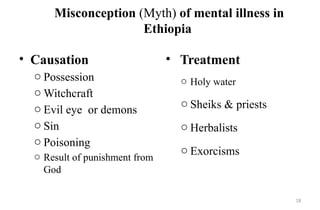
Misconception (Myth) ofmental illness in
Ethiopia
• Causation
o Possession
o Witchcraft
o Evil eye or demons
o Sin
o Poisoning
o Result of punishment from
God
• Treatment
o Holy water
o Sheiks & priests
o Herbalists
o Exorcisms
19.
19
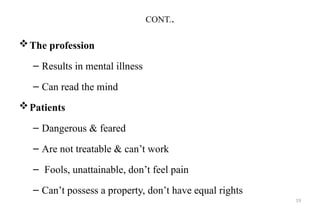
CONT..
The profession
– Resultsin mental illness
– Can read the mind
Patients
– Dangerous & feared
– Are not treatable & can’t work
– Fools, unattainable, don’t feel pain
– Can’t possess a property, don’t have equal rights
20.
20
…
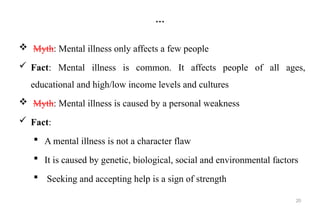
Myth: Mentalillness only affects a few people
Fact: Mental illness is common. It affects people of all ages,
educational and high/low income levels and cultures
Myth: Mental illness is caused by a personal weakness
Fact:
A mental illness is not a character flaw
It is caused by genetic, biological, social and environmental factors
Seeking and accepting help is a sign of strength
21.
21
….
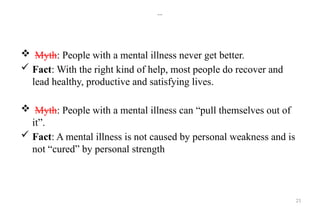
Myth: Peoplewith a mental illness never get better.
Fact: With the right kind of help, most people do recover and
lead healthy, productive and satisfying lives.
Myth: People with a mental illness can “pull themselves out of
it”.
Fact: A mental illness is not caused by personal weakness and is
not “cured” by personal strength
22.
22
…
Myth: Peoplewith a mental illness are violent
Fact:
People with a mental illness are no more violent or dangerous than the
rest of the population
People with a mental illness are more likely to harm themselves or to be
harmed than they are to hurt other people
Myth: People with a mental illness should be kept in hospital
Fact:
With appropriate treatment and support, people with mental illness can
live successfully in the community
In fact, the majority of people with a mental illness live independently in
the community
23.
23
Etiology of mentaldisorders
Unknown or not well understood.
Caused by combination and interaction of several factors
Single cause may lead to several effect
Complex and ambiguous
The Bio-Psycho-social model is so far the most plausible
approach to the problem
24.
24
Cont..
Stressful lifeevents
unemployment, the death of a loved one
economic problems
loneliness
infertility, marital conflict
Violence and trauma
Difficult family background- People who have had an unhappy childhood because
of violence or emotional neglect are more likely to suffer mental
Brain diseases
Heredity or genes
Medical problems
25.
25
Factor influencing mentalhealth
Major Factor influencing mental health is three “P”
1. predisposing factors
2. Precipitating factors
3. Perpetuating factors
Predisposing factors are increase susceptibility to psychiatric disorder
and present over a long period of time. Eg ;- age, gender, genetics
26.
26
Cont…
Precipitating factorsare trigger occurrence of illness
-are events that precede clinical onset, (Environmental factors,
physical illness)
Problem with family interaction
Problem in interpersonal r/ship
Living circumstances /immigration
Occupational loss
Physical illness
27.
27
Cont…
Perpetuating factors arefactors that prolong the course
of a disorder and delay recovery from illness
– Secondary demoralization and withdrawal from social activities
– Substance use/abuse
– Lack of social support
– Chronic physical illness
28.
28
Prevalence of mentaldisorder
Common to all countries
25% of the world’s population will develop mental illness at
some stage in their lives
450million people suffer from mental disorder
29.
29
Management of mentaldisorder
Mainly of three types
– Biological- mainly medication, ECT
– Psychological
– social
30.
30
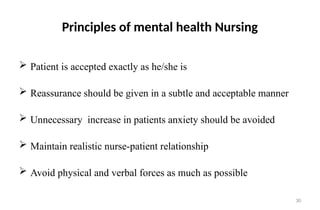
Principles of mentalhealth Nursing
Patient is accepted exactly as he/she is
Reassurance should be given in a subtle and acceptable manner
Unnecessary increase in patients anxiety should be avoided
Maintain realistic nurse-patient relationship
Avoid physical and verbal forces as much as possible
31.
31
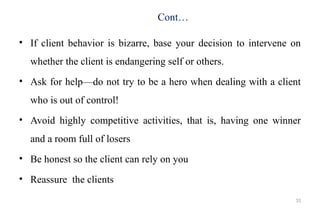
Cont…
• If clientbehavior is bizarre, base your decision to intervene on
whether the client is endangering self or others.
• Ask for help—do not try to be a hero when dealing with a client
who is out of control!
• Avoid highly competitive activities, that is, having one winner
and a room full of losers
• Be honest so the client can rely on you
• Reassure the clients
33
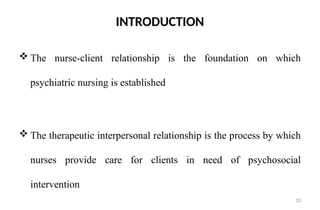
INTRODUCTION
The nurse-clientrelationship is the foundation on which
psychiatric nursing is established
The therapeutic interpersonal relationship is the process by which
nurses provide care for clients in need of psychosocial
intervention
34.
34
Cont..
Mental healthproviders need to know how to gain trust and
gather information from the patient
The patient's family, friends and relevant social relations, and to
involve them in an effective treatment plan
Therapeutic use of self is the instrument for delivery of care to
clients in need of psychosocial intervention
Interpersonal communication techniques are the “tools” of
psychosocial intervention
36
Cont…
Therapeutic Useof Self - ability to use one’s personality
consciously and in full awareness in an attempt to establish relatedness
and to structure nursing interventions
Nurses must possess self-awareness, self-understanding, and a
philosophical belief about life, death, and the overall human condition
for effective therapeutic use of self
38
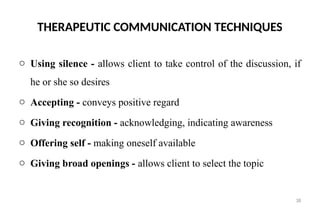
THERAPEUTIC COMMUNICATION TECHNIQUES
oUsing silence - allows client to take control of the discussion, if
he or she so desires
o Accepting - conveys positive regard
o Giving recognition - acknowledging, indicating awareness
o Offering self - making oneself available
o Giving broad openings - allows client to select the topic
39.
39
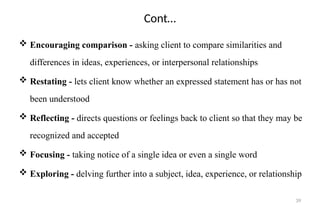
Cont…
Encouraging comparison- asking client to compare similarities and
differences in ideas, experiences, or interpersonal relationships
Restating - lets client know whether an expressed statement has or has not
been understood
Reflecting - directs questions or feelings back to client so that they may be
recognized and accepted
Focusing - taking notice of a single idea or even a single word
Exploring - delving further into a subject, idea, experience, or relationship
41
Learning Objectives
• Tohelp you identify
– What sign and symptoms are in psychiatry
– Sign and symptom of
• Emotion
• speech
• Perception
• Thought
• Motor activity
• Cognition
42.
42
Sign
Observation andobjective findings elicited by clinician
E.g. patient’s constricted affect or psychomotor retardation
43.
43
Symptoms
The subjectiveexperiences described by the patient
Often expressed as the chief complaint
E.g. depressed mood or lack of energy
44.
44
Syndrome
A groupof signs and symptoms that together make up a recognizable
condition
More ambiguous than a specific disorder or disease
Symptoms are more likely to indicate mental disorder if they
occur together
persistent
interfere with the function of the individual
45.
45
Sign and symptoms
Over 350 terms are used to describe the sign and symptoms in psychiatric
illness
Becoming an expert in recognizing specific signs and symptoms allows the
clinicians to-
Understandably communicate with other clinicians
Accurately make a diagnosis
Effectively manage treatment
Reliably predict a prognosis
Thoroughly explore pathophysiology, causes and psychodynamic issues
46.
46
Abnormalities related toemotion
Emotion is a complex feeling state with physiological changes
occurring as a response to some event and behavior component
that is related to affect and mood
Emotion has two parts
– Mood is the inside feeling of a person and is relatively long
lasting
– Affect is the outward and observed expression of one’s feeling
and is mostly short lived
47.
47
Affect
Affect shouldbe assessed in terms of:-
– Stability (stable , labile)
– Appropriate (to the content of speech and circumstances)
– Intensity (flat, blunted, constricted)
– Affect can be ( sad, happy, euphoric, irritable, anxious, neutral,
fearful, angry, pleasant)
48.
48
Affect
Appropriate affect
–Condition in which the emotional tone is in harmony with the
accompanying idea, thought or speech
Inappropriate affect
– Disharmony between the emotional feeling tone and the idea,
thought or speech
– E.g. laughing when discussing the death of a loved one
– Mostly seen in severe psychiatric disorder
49.
49
Affect
Restricted orconstricted affect
– Reduction in intensity of feeling tone
– Less severe than blunted affect but clearly reduced
– Limited range of expressed emotion
– Little variability of expression during the interview
50.
50
Affect
Blunted affect
–Disturbance in affect manifested by severe reduction in intensity
of externalized feeling tone
– The individual’s facial expression varies little
– There are few physical gestures of emotion
– Eye contact is either minimal or the patient seems to stare at the
interviewer
– The patient speaks in monotonous tone with little vocal
inflection
– The person’s face seems to have little muscle tone
51.
51
Affect
Flat affect
–Is more severe form of blunted affect with essentially no
affective expression
– The interviewer may feel as if he is conversing with inanimate
object
– If he is told that his mother died or if he is told that he win
lottery the response will be the same
– No expression of sadness at the news of the death of his
mother
52.
52
Affect
Labile affect
–Refer to abrupt, rapid and repeated shifts of type and intensity
of emotion
– Unrelated to external stimuli
– It is not proportionate to the expected response
– There is emotional incontinence
53.
53
Mood
A pervasiveand sustained emotion subjectively experienced and
reported by a patient
E.g. depression, elation, anger
54.
54
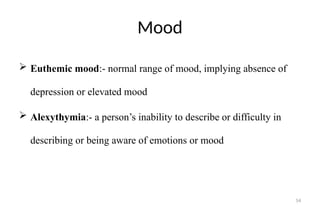
Mood
Euthemic mood:-normal range of mood, implying absence of
depression or elevated mood
Alexythymia:- a person’s inability to describe or difficulty in
describing or being aware of emotions or mood
55.
55
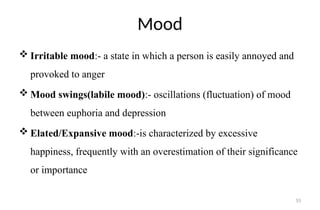
Mood
Irritable mood:-a state in which a person is easily annoyed and
provoked to anger
Mood swings(labile mood):- oscillations (fluctuation) of mood
between euphoria and depression
Elated/Expansive mood:-is characterized by excessive
happiness, frequently with an overestimation of their significance
or importance
56.
56
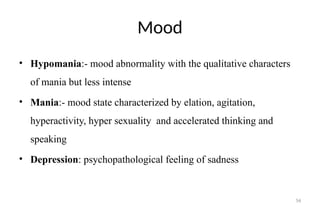
Mood
• Hypomania:- moodabnormality with the qualitative characters
of mania but less intense
• Mania:- mood state characterized by elation, agitation,
hyperactivity, hyper sexuality and accelerated thinking and
speaking
• Depression: psychopathological feeling of sadness
57.
57
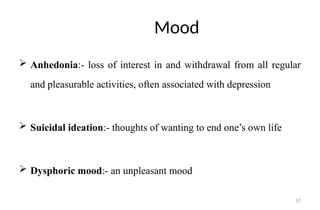
Mood
Anhedonia:- lossof interest in and withdrawal from all regular
and pleasurable activities, often associated with depression
Suicidal ideation:- thoughts of wanting to end one’s own life
Dysphoric mood:- an unpleasant mood
58.
58
Speech disorders
Pressureof speech- rapid and increased in amount
poverty of speech- restrictions in amount
Non-spontaneous- no self initiation
Mutism - complete loss of speech
Neologism - new words that are constructed by the patient or
ordinary words that are used in a new way
59.
Disorders of Perception
Perception: is the process of becoming aware of what is presented through
sense organs
Disorders of perception can be divided into sensory distortions and sensory
deceptions
Sensory distortions
• There is a constant real perceptual object which is perceived in a distorted way
Sensory deceptions
• A new perception occurs that may or may not be in response to an external
object
59
60.
Sensory distortions
Theseare changes in perception that are the result of a change in
the
Intensity
o Eg. (hyperacusis or hypoacusis)
the spatial form of the perception
o Eg. (micropsia or macropsia)
60
61.
61
Sensory deceptions
Thesecan be divided into two forms
– Illusions - misinterpretations of stimuli arising from an
external object
– Stimuli from a perceived object are combined with a mental
image to produce a false perception e.g., misinterpreting
shadows as threatening
62.
62
Disorder of perception
Hallucinations –
is perception experienced in the absence of actual stimuli
may occur in all the sensory modalities
A false perception which is not a sensory distortion or a
misinterpretation, but which occurs at the same time as real perceptions
Come from ‘within’, but subject reacts to them as true perceptions
coming from ‘without’
63.
63
Forms of hallucination
•Auditory hallucination is hearing a voice which does not exist
– Common in schizophrenia
• Visual hallucination is seeing things which don’t exist
• Olfactory – smelling things which don’t exist uncommon
• Gustatory-. is the experience of strange taste in the mouth. uncommon
• Tactile is sense of touch without existing stimulus, e.g. insect crawling on
the body
– Visual and tactile hallucination are common in delirium, alcohol
withdrawal or other medical condition
64.
64
Perceptual disorders
Derealization:refers to the experience of the patient that
everything in his surrounding appears to have changed and is
strange
Depersonalization: Sensation of unreality concerning oneself, or
parts of oneself
65.
65
Thought disorder
Thinking:the ability to process information in once mind in both
content and form
When a logical sequence occurs thinking is normal
Disorders of thinking occur in the following forms:
Forms of thought
Content of thought
66.
66
Specific disturbances inform of thought
Form of thought: refers to how ideas are connected and related
to each other
Neologism:- new word created by a patient, often by combining
syllables of other words
Circumstantialities:- indirect speech that is delayed in reaching
the point but eventually gets from original point to desired goal;
characterized by an over inclusion of unnecessary details
67.
67
Cont..
Tangentiality:- inabilityto have goal-directed associations of
thought; speaker never gets from desired point to desired goal
clang association:-Association or speech directed by the sound of
a word rather than by its meaning
Flight of ideas:- rapid continuous verbalizations or plays on
words produce constant shifting from one idea to another
68.
68
Cont..
Loosening ofassociation:-refers to lack of connection between ideas as
occurs in schizophrenia; when severe speech may be incoherent
Perseveration: is the tendency to focus on a specific idea or content
without the ability to move on to other topics
Thought block: refers to the experience of the patient characterized by
sudden blankness, and or emptiness, and the patient losses track of his/her
own thought
Echolalia:- pathological repeating of words of one person by another;
tends to be repetitive and persistent
69.
69
Delusion
A delusionis a false belief or conviction that cannot be changed
by rational arguments or evidence
As a pathology, it is distinct from a belief based on false or
incomplete information
They are of particular diagnostic importance in psychotic
disorders and particularly in schizophrenia, manic episode and
psychotic depression
70.
70
delusion
A falsebelief based on incorrect inference about external reality
Firmly sustained despite what almost everybody else believes
The belief is not ordinarily accepted by other members of the
person’s culture or subculture
71.
71
Types of delusion
Grandiose delusions: refers to the patient’s belief that he is great or
important
Delusions of jealousy (infidelity): refers to the person’s belief that
the spouse or partner is being unfaithful
Persecutory delusions: refers to the patient’s belief that people or
organizations are trying to inflict harm on him, damage his
reputation, or make him insane
72.
72
Types of delusion
•Nihilistic delusion: denial of existence of their body, their mind,
their loved ones and the world around
• Delusion of guilt and worthlessness: refers to the patient’s belief
that he/she is sinner and is not worthy to live
• Erotomania: Delusional belief, more common in women than in
men, that someone is deeply in love with them
73.
73
Types of delusion
Delusion of reference: concerned with ideas that objects, events or actions
of people have special significance for the person
– Example, gesture by somebody is believed to be directed specifically to the patient
Delusion of being controlled: belief that personal actions,
impulses, or thoughts are being controlled by an outside agency
74.
74
Types of delusion
Thought withdrawal: refers to the patient’s experience that his ideas are
mysteriously removed
The patient may complain that his political enemies remove his ideas for
their own personal ambitious
Thought broadcasting: refers to the patient’s experience that his/her ideas
are shared by others without telling him/her
Thought insertion:-Delusion that thoughts are being implanted in one's
mind by other people or forces
75.
75
Motor/ behavior abnormalities
Tics - irregular, involuntary & repeated movements involving a
group of muscles
Mannerism - repeated movements that appear to have some
functional significance to a given person, but used out of context
& inappropriately e.g. saluting
Stereotypes - repeated movements that are regular and without
obvious significance e.g. rocking to and fro
76.
76
Cont..
Negativism -doing the opposite of what was asked to do
Echopraxia - imitation of the others act
Echolalia – imitation of others speech
Waxy flexibility - maintenance of once body part in
uncomfortable position for a long
77.
77
Disturbance of attentionand concentration
Attention is the ability to focus on something
Concentration is the ability to maintain that focus
Attention and concentration can be impaired in many of
psychiatric conditions, and physical illness
78.
78
Cont..
Judgment: theability to make sound decisions in the interest of
self and others
Insight: - is a correct awareness of one’s own mental and
physical condition





![01 Antenatal Care [Autosaved].pptxrfrgggg](https://cdn.slidesharecdn.com/ss_thumbnails/01antenatalcareautosaved-250825212508-69f5adb1-thumbnail.jpg?width=640&height=640&fit=bounds)


