PSALM 104 COMME TARY
EDITED BY GLE PEASE
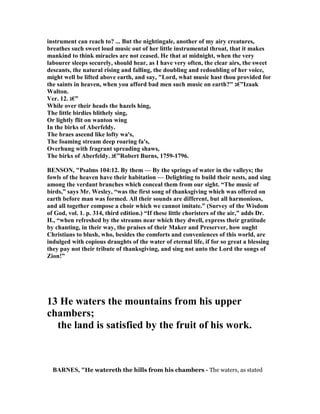
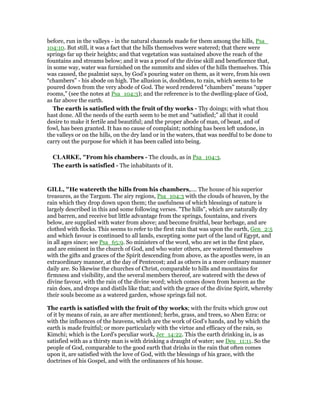
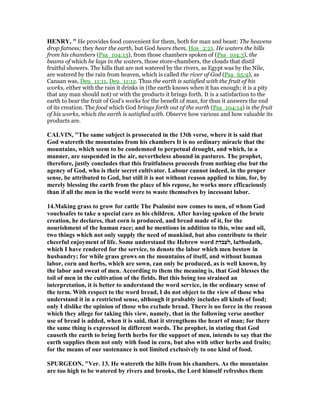
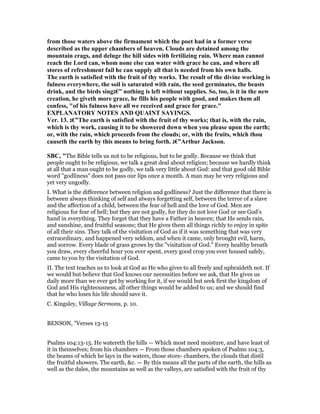
I TRODUCTIO
SPURGEO , "GE ERAL, REMARKS. —Here we have one of the loftiest and
longest sustained flights of the inspired muse. The psalm gives an interpretation to
the many voices of nature, and sings sweetly both of creation and providence. The
poem contains a complete cosmos sea and land, cloud and sunlight, plant and
animal, light and darkness, life and death, are all proved to be expressive of the
presence of the Lord. Traces of the six days of creation are very evident, and though
the creation of man, which was the crowning work of the sixth day, is not
mentioned, this is accounted for from the fact that man is himself the singer: some
have ever, discerned marks of the divine rest upon the seventh day in Psalms 104:31.
It is a poet's version of Genesis. or is it alone the present condition of the earth
which is here the subject of song; but a hint is given of those holier times when we
shall see "a new earth wherein dwelleth righteousness, "out of which the sinner
shall be consumed, Psalms 104:35. The spirit of ardent praise to God runs through
the whole, and with it a distinct realization of the divine Being as a personal
existence, loved and trusted as well as adored.
We have no information as to the author, but the Septuagint assigns it to David, and
we see no reason for ascribing it to any one else. His spirit, style, and manner of
writing are very manifest therein, and if the psalm must be ascribed to another, it
must be to a mind remarkably similar, and we could only suggest the wise son of
David—Solomon, the poet preacher, to whose notes upon natural history in the
Proverbs some of the verses bear a striking likeness. Whoever the human penman
may have been, the exceeding glory and perfection of the Holy Spirit's own divine
authorship are plain to every spiritual mind.
DIVISIO . —After ascribing blessedness to the Lord the devout psalmist sings of
the light and the firmament, which were the work of the first and second days
Psalms 104:1-6. By an easy transition he describes the separation of the waters from
the dry land, the formation of rain, brooks and rivers, and the uprising of green
herbs, which were the produce of the third day Psalms 104:7-18. Then the
appointment of the sun and moon to be the guardians of day and night commands
the poet's admiration Psalms 104:19-23, and so he sings the work of the fourth day.
Having already alluded to many varieties of living creatures, the psalmist proceeds
from Psalms 104:24-30 to sing of the life with which the Lord was pleased to fill the
air, the sea, and the land; these forms of existence were the peculiar produce of the
fifth and sixth days. We may regard the closing verses Psalms 104:31-35 as a
Sabbath meditation, hymn, and prayer. The whole lies before us as a panorama of
the universe viewed by the eye of devotion. O for grace to render due praise unto the
Lord while reading it.
ELLICOTT, "This psalm touches the highest point of religious poetry. It is the most
perfect hymn the world has ever produced. Even as a lyric it has scarcely been
surpassed; while as a lyric inspired by religion, not only was all ancient literature,
except that of the Hebrews, powerless to create anything like it, but even Christian
poetry has never succeeded in approaching it. Milton has told the story of Creation,
taking, as the psalmist does, the account in Genesis for his model; but the seventh
book of the Paradise Lost, even when we make allowance for the difference between
the narrative and lyric styles, is tame and prolix—seems to want animation and
fire—by the side of this hymn.
At the very opening of the poem we feel the magic of a master inspiration. The
world is not, as in Genesis, created by a Divine decree. It springs into life and
motion, into order and use, at the touch of the Divine presence. Indeed, the
pervading feeling of the hymn is the sense of God’s close and abiding relation to all
that He made; the conviction that He not only originated the universe, but dwells in
it and sustains it: and this feeling fastens upon us at the outset, as we see the light
enfolding the Creator as His robe, and the canopy of heaven rising over Him as His
tent. It is not a lifeless world that springs into being. There is no void, no chaos; even
the winds and clouds are not for this poet without denizens, or they themselves start
into life and people the universe for his satisfaction. He cannot conceive of a world
at any time without life and order. or has any poet, even of our modern age,
displayed a finer feeling for nature, and that not in her tempestuous and wrathful
moods—usually the source of Hebrew inspiration—but in her calm, everyday
temper. He is the Wordsworth of the ancients, penetrated with a love for nature,
and gifted with the insight that springs from love. This majestic hymn is anonymous
in the Hebrew. The LXX. have ascribed it to David. Its close connection with Psalms
103, and an Aramaic word in Psalms 104:12, indicate a post-exile date for its
composition. The verse shows every variety of rhythm.
1 Praise the Lord, my soul.
Lord my God, you are very great;
you are clothed with splendor and majesty.
BAR ES, "Bless the Lord, O my soul - See Psa_103:1.
O Lord my God, thou art very great - This is a reason why the psalmist calls on
his soul to bless God; namely, for the fact that he is so exalted; so vast in his perfections;
so powerful, so wise, so great.
Thou art clothed with honor and majesty - That is, with the emblems of honor
and majesty, as a king is arrayed in royal robes. Creation is the garment with which God
has invested himself. Compare the notes at Psa_93:1.
CLARKE, "O Lord my God, thou art very great - The works of God, which are
the subject of this Psalm, particularly show the grandeur and majesty of God. The
strongest proofs of the being of God, for common understandings, are derived from the
works of creation, their magnitude, variety, number, economy, and use. And a proper
consideration of those works presents a greater number of the attributes of the Divine
nature than we can learn from any other source. Revelation alone is superior.
GILL, "Bless the Lord, O my soul,.... As for the blessings of grace and mercy
expressed in the preceding psalm, so on account of the works of creation and
providence, enumerated in this; in which Christ has an equal concern, as in the former.
O Lord my God, thou art very great; the Messiah, who is Jehovah our
righteousness, Lord of all, truly God, and the God of his people; see Joh_20:28 and who
is great, and very great, in his divine Person, being the great God, and our Saviour; great
in all his works of creation, providence, and redemption; great in all his offices of
Prophet, Priest, and King; a Saviour, and a great one; the great Shepherd of the Sheep;
the Man, Jehovah's Fellow.
Thou art clothed with honour and majesty; being the brightness of his Father's
glory, and having on him the glory of the only begotten of the Father, and a natural
majesty in him as the Son of God and King of the whole universe; and, as Mediator, he
has honour and majesty laid upon him by his Father, Psa_21:5, he has all the regalia and
ensigns of royal majesty; he is on a throne, high and lifted up, even the same with his
divine Father; he has a crown of glory on his head, he is crowned with glory and honour;
he has a sceptre of righteousness in his hand, and is arrayed in robes of majesty; and, as
thus situated, is to look upon like a jasper and sardine stone; or as if he was covered with
sparkling gems and precious stones, Rev_4:2 and, having all power in heaven and earth,
over angels and men, honour and glory given him by both.
HE RY 1-4, "When we are addressing ourselves to any religious service we must stir
up ourselves to take hold on God in it (Isa_64:7); so David does here. “Come, my soul,
where art thou? What art thou thinking of? Here is work to be done, good work, angels'
work; set about it in good earnest; let all the powers and faculties be engaged and
employed in it: Bless the Lord, O my soul!” In these verses,
I. The psalmist looks up to the divine glory shining in the upper world, of which,
though it is one of the things not seen, faith is the evidence. With what reverence and
holy awe does he begin his meditation with that acknowledgment: O Lord my God! thou
art very great! It is the joy of the saints that he who is their God is a great God. The
grandeur of the prince is the pride and pleasure of all his good subjects. The majesty of
God is here set forth by various instances, alluding to the figure which great princes in
their public appearances covet to make. Their equipage, compared with his (even of the
eastern kings, who most affected pomp), is but as the light of a glow-worm compared
with that of the sun, when he goes forth in his strength. Princes appear great, 1. In their
robes; and what are God's robes? Thou art clothed with honour and majesty, Psa_104:1.
God is seen in his works, and these proclaim him infinitely wise and good, and all that is
great. Thou coverest thyself with light as with a garment, Psa_104:2. God is light (1Jo_
1:5), the Father of lights (Jam_1:17); he dwells in light (1Ti_6:16); he clothes himself
with it. The residence of his glory is in the highest heaven, that light which was created
the first day, Gen_1:3. Of all visible beings light comes nearest to the nature of a spirit,
and therefore with that God is pleased to cover himself, that is, to reveal himself under
that similitude, as men are seen in the clothes with which they cover themselves; and so
only, for his face cannot be seen. 2. In their palaces or pavilions, when they take the
field; and what is God's palace and his pavilion? He stretches out the heavens like a
curtain, Psa_104:2. So he did at first, when he made the firmament, which in the
Hebrew has its name from its being expanded, or stretched out, Gen_1:7. He made it to
divide the waters as a curtain divides between two apartments. So he does still: he now
stretches out the heavens like a curtain, keeps them upon the stretch, and they continue
to this day according to his ordinance. The regions of the air are stretched out about the
earth, like a curtain about a bed, to keep it warm, and drawn between us and the upper
world, to break its dazzling light; for, though God covers himself with light, yet, in
compassion to us, he makes darkness his pavilion. Thick clouds are a covering to him.
The vastness of this pavilion may lead us to consider how great, how very great, he is
that fills heaven and earth. He has his chambers, his upper rooms (so the word
signifies), the beams whereof he lays in the waters, the waters that are above the
firmament (Psa_104:3), as he has founded the earth upon the seas and floods, the
waters beneath the firmament. Though air and water are fluid bodies, yet, by the divine
power, they are kept as tight and as firm in the place assigned them as a chamber is with
beams and rafters. How great a God is he whose presence-chamber is thus reared, thus
fixed! 3. In their coaches of state, with their stately horses, which add much to the
magnificence of their entries; but God makes the clouds his chariots, in which he rides
strongly, swiftly, and far above out of the reach of opposition, when at any time he will
act by uncommon providences in the government of this world. He descended in a cloud,
as in a chariot, to Mount Sinai, to give the law, and to Mount Tabor, to proclaim the
gospel (Mat_17:5), and he walks (a gentle pace indeed, yet stately) upon the wings of the
wind. See Psa_18:10, Psa_18:11. He commands the winds, directs them as he pleases,
and serves his own purposes by them. 4. In their retinue or train of attendants; and here
also God is very great, for (Psa_104:4) he makes his angels spirits. This is quoted by the
apostle (Heb_1:7) to prove the pre-eminence of Christ above the angels. The angels are
here said to be his angels and his ministers, for they are under his dominion and at his
disposal; they are winds, and a flame of fire, that is, they appeared in wind and fire (so
some), or they are as swift as winds, and pure as flames; or he makes them spirits, so the
apostle quotes it. They are spiritual beings; and, whatever vehicles they may have proper
to their nature, it is certain they have not bodies as we have. Being spirits, they are so
much the further removed from the encumbrances of the human nature and so much the
nearer allied to the glories of the divine nature. And they are bright, and quick, and
ascending, as fire, as a flame of fire. In Ezekiel's vision they ran and returned like a flash
of lightning, Eze_1:14. Thence they are called seraphim - burners. Whatever they are,
they are what God made them, what he still makes them; they derive their being from
him, having the being he gave them, are held in being by him, and he makes what use he
pleases of them.
JAMISO , "Psa_104:1-35. The Psalmist celebrates God’s glory in His works of
creation and providence, teaching the dependence of all living creatures; and contrasting
the happiness of those who praise Him with the awful end of the wicked.
God’s essential glory, and also that displayed by His mighty works, afford ground for
praise.
SBC, "Greatness, if you look at it as something separate from you, and away, still more if
you have a consciousness that it may be against you, is a matter of awe and terror. If you
mingle it with yourself, as a part of yourself, and yourself a part of it, greatness,
becoming a possession, is a grand thought and a pleasant one. So we unite the two
clauses of the text. David could not have said the second with gladness unless he could
have said the first with confidence: "O Lord my God, Thou art very great."
I. If it is great to be at one and the same time infinitely comprehensive and exquisitely
minute, to fill the widest and yet to be occupied by the narrowest, then what a God is
ours! The unspeakably large and the invisibly small are alike to Him; and we stand, and
we marvel not at the one or at the other, but at the combination of the telescopic glance
and the microscopic care; and we confess, "O Lord my God, Thou art very great."
II. It is a great thing to stoop. He inhabiteth equally, at this very moment, eternity and
that little heart of yours. The whole Gospel is only a tale of immense stooping—how the
purest demeaned Himself to the vilest, and how, "though He was rich, yet for our sakes
He became poor, that we through His poverty might be rich."
III. Some one has said that continuity is the secret of the sublime; the eye goes on and
on, and finds no break, and calls it sublimity. Then what a sublimity there is in Him who
century after century, year by year, without the shadow of a turning, has continued the
same, "yesterday, today, and for ever"!
IV. Look at the wonderful greatness of His plan of redemption. The length, and the
breadth, and the depth, and the height are all passing knowledge; and we have nothing
to do but to humble ourselves in the dust and say, "O Lord my God, Thou art very great."
J. Vaughan, Fifty Sermons, 9th series, p. 257.
Psalms 104:1-2
Nature has two great revelations: that of use and that of beauty; and the first thing we
observe about these two characteristics of hers is that they are bound together and tied
to each other. The beauty of nature is not, as it were, a fortunate accident, which can be
separated from her use; there is no difference in the tenure upon which these two
characteristics stand: the beauty is just as much a part of nature as the use; they are only
different aspects of the selfsame facts. (2) But if the first thing we observe respecting use
and beauty is that they are united in their source, the next thing we observe is that in
themselves they are totally separate. We have not the slightest conception of the
common root in which these enormous diversities unite, the unity to which they mount
up, the ultimate heading out of which both branch, the secret of their identity. It is worth
observing, in the history of the mind of this country, the formation of a kind of passion
for scenery and natural beauty. This fact cannot well be without some consequences
bearing on religion.
I. First, with respect to the place which the beauty of nature has in the argument of
design from nature. When the materialist has exhausted himself in efforts to explain
utility in nature, it would appear to be the peculiar office of beauty to rise up suddenly as
a confounding and baffling extra, which was not even formally provided for in his
scheme. There is this remarkable difference between useful contrivance and beauty as
evidence of an intelligent cause, that contrivance has a complete end and account of
itself, without any reference to the understanding of man; but it is essential to the very
sense and meaning of beauty that it should be seen: and inasmuch as it is visible to
reason alone, we have thus in the very structure of nature a recognition of reason and a
distinct address to reason, wholly unaccountable unless there is a higher reason or mind
to which to make it.
II. The beauty of nature is necessary for the perfection of praise; the praise of the Creator
must be essentially weakened without it: it must be roused and excited by sight. (1)
Beauty stands upon the threshold of the mystical world, and excites a curiosity about
God. This curiosity is a strong part of worship and of praise. So long as a man is probing
nature, and in the thick of its causes and operations, he is too busy about his own
inquiries to receive this impress from her; but place the picture before him, and he
becomes conscious of a veil and curtain which has the secrets of a moral existence
behind it: interest is inspired, curiosity is awakened, and worship is raised. (2) Nature is
partly a curtain and partly a disclosure, partly a veil and partly a revelation; and here we
come to her faculty of symbolism, which is so strong an aid to, and has so immensely
affected, the principles of worship. The Great Spirit, speaking by dumb representation to
other spirits, intimates and signifies to them something about Himself, for if nature is
symbolical, what it is symbolical about must be its Author. The Deity over and above our
inward conscience wants His external world to tell us He is moral; He therefore creates
in nature a universal language about Himself: its features convey signals from a distant
country, and man is placed in communication with a great correspondent whose tablet
He interprets. And thus is formed that which is akin to worship in the poetical view of
nature. While we do not worship the material created sign—for that would be idolatry—
we still repose on it as the true language of the Deity.
III. In this peculiar view of nature, the mind fastening upon it as a spectacle or a picture,
it is to be observed that there are two points in striking concurrence with the vision
language of Scripture. (1) Scripture has specially consecrated the faculty of sight, and has
partly put forth, and has promised in a still more complete form, a manifestation of the
Deity to mankind, through the medium of a great sight. (2) It must be remarked, as
another principle in the Scriptural representation, that the act of seeing a perfectly
glorious sight or object is what constitutes the spectator’s and beholder’s own glory.
IV. But though the outward face of nature is a religious communication to those who
come to it with the religious element already in them, no man can get a religion out of
the beauty of nature. There must be for the base of a religion the internal view, the inner
sense, the look into ourselves, and recognition of an inward state: sin, helplessness,
misery. If there is not this, outward nature cannot of itself enlighten man’s conscience
and give him a knowledge of God. It will be a picture to him, and nothing more.
J. B. Mozley, University Sermons, p. 122.
K&D 1-4, "The first decastich begins the celebration with work of the first and second
days. ‫ר‬ ָ‫ד‬ ָ‫ה‬ְ‫ו‬ ‫ּוד‬‫ה‬ here is not the doxa belonging to God πρᆵ παντᆵς τοሞ αᅶራνος (Jud_1:25), but
the doxa which He has put on (Job_40:10) since He created the world, over against
which He stands in kingly glory, or rather in which He is immanent, and which reflects
this kingly glory in various gradations, yea, to a certain extent is this glory itself. For
inasmuch as God began the work of creation with the creation of light, He has covered
Himself with this created light itself as with a garment. That which once happened in
connection with the creation may, as in Amo_4:13; Isa_44:24; Isa_45:7; Jer_10:12, and
frequently, be expressed by participles of the present, because the original setting is
continued in the preservation of the world; and determinate participles alternate with
participles without the article, as in Isa_44:24-28, with no other difference than that the
former are more predicative and the latter more attributive. With Psa_104:2 the poet
comes upon the work of the second day: the creation of the expanse (‫)רקיע‬ which divides
between the waters. God has spread this out (cf. Isa_40:22) like a tent-cloth (Isa_54:2),
of such light and of such fine transparent work; ‫ה‬ ֶ‫ּוט‬‫נ‬ here rhymes with ‫ה‬ ֶ‫ּט‬‫ע‬. In those
waters which the “expanse” holds aloft over the earth God lays the beams of His upper
chambers (‫תו‬ ָ‫ּות‬ ִ‫ל‬ ֲ‫,ע‬ instead of which we find ‫יו‬ ָ‫ּות‬‫ל‬ ֲ‫ֽע‬ ַ‫מ‬ in Amo_9:6, from ‫ה‬ָ ִ‫ל‬ ֲ‫,ע‬ ascent,
elevation, then an upper story, an upper chamber, which would be more accurately ‫ה‬ָ ִ ִ‫ע‬
after the Aramaic and Arabic); but not as though the waters were the material for them,
they are only the place for them, that is exalted above the earth, and are able to be this
because to the Immaterial One even that which is fluid is solid, and that which is dense
is transparent. The reservoirs of the upper waters, the clouds, God makes, as the
lightning, thunder, and rain indicate, into His chariot (‫כוּב‬ ְ‫,)ר‬ upon which he rides along
in order to make His power felt below upon the earth judicially (Isa_19:1), or in rescuing
and blessing men. ‫כוּב‬ ְ‫ר‬ (only here) accords in sound with ‫רוּב‬ ְⅴ, Psa_18:11. For Psa_104:3
also recalls this primary passage, where the wings of the wind take the place of the
cloud-chariot. In Psa_104:4 the lxx (Heb_1:7) makes the first substantive into an
accusative of the object, and the second into an accusative of the predicate: ᆍ ποιራν τοᆷς
ᅊγγέλους αᆒτοሞ πνεሞµατα καᆳ τοᆷς λειτουργοᆷς αᆒτοሞ πυρᆵς φλόγα. It is usually translated
the reverse say: making the winds into His angels, etc. This rendering is possible so far
as the language is concerned (cf. Psa_100:3 Chethîb, and on the position of the worlds,
Amo_4:13 with Psa_5:8), and the plural ‫יו‬ ָ‫ת‬ ֲ‫ֽר‬ ָ‫שׁ‬ ְ‫מ‬ is explicable in connection with this
rendering from the force of the parallelism, and the singular ‫שׁ‬ ֵ‫א‬ from the fact that this
word has no plural. Since, however, ‫ה‬ ָ‫שׂ‬ ָ‫ע‬ with two accusatives usually signifies to produce
something out of something, so that the second accusative (viz., the accusative of the
predicate, which is logically the second, but according to the position of the words may
just as well be the first, Exo_25:39; Exo_30:25, as the second, Exo_37:23; Exo_38:3;
Gen_2:7; 2Ch_4:18-22) denotes the materia ex qua, it may with equal right at least be
interpreted: Who makes His messengers out of the winds, His servants out of the
flaming or consuming (vid., on Psa_57:5) fire (‫שׁ‬ ֵ‫,א‬ as in Jer_48:45, masc.). And this may
affirm either that God makes use of wind and fire for special missions (cf. Psa_148:8), or
(cf. Hofmann, Schriftbeweis, i. 325f.) that He gives wind and fire to His angels for the
purpose of His operations in the world which are effected through their agency, as the
materials of their outward manifestation, and as it were of their self-embodiment,
(Note: It is a Talmudic view that God really makes the angels out of fire, B.
Chagiga, 14a (cf. Koran, xxxviii. 77): Day by day are the angels of the service created
out of the stream of fire (‫דינור‬ ‫,)נהר‬ and sing their song of praise and perish.)
as then in Psa_18:11 wind and cherub are both to be associated together in thought as
the vehicle of the divine activity in the world, and in Psa_35:5 the angel of Jahve
represents the energy of the wind.
CALVI , "1Bless Jehovah, O my soul! After having exhorted himself to praise God,
the Psalmist adds, that there is abundant matter for such an exercise; thus indirectly
condemning himself and others of ingratitude, if the praises of God, than which
nothing ought to be better known, or MORE celebrated, are buried by silence. In
comparing the light with which he represents God as arrayed to a garment, he
intimates, that although God is invisible, yet his glory is conspicuous enough. In
respect of his essence, God undoubtedly dwells in light that is inaccessible; but as he
irradiates the whole world by his splendor, this is the garment in which He, who is
hidden in himself, appears in a manner visible to us. The knowledge of this truth is
of the greatest importance. If men attempt to reach the infinite height to which God
is exalted, although they fly above the clouds, they must fail in the midst of their
COURSE. Those who seek to see him in his naked majesty are certainly very foolish.
That we may enjoy the light of him, he must come forth to view with his clothing;
that is to say, we must cast our eyes upon the very beautiful fabric of the world in
which he wishes to be seen by us, and not be too curious and rash in searching into
his secret essence. ow, since God presents himself to us clothed with light, those
who are seeking pretexts for their living without the knowledge of him, cannot
allege in excuse of their slothfulness, that he is hidden in profound darkness. When
it is said that the heavens are a curtain, it is not meant that under them God hides
himself, but that by them his majesty and glory are displayed; being, as it were, his
royal pavilion.
SPURGEO , "Ver. 1. Bless the LORD, O my soul. This psalm begins and ends like
the Hundred and Third, and it could not do better: when the model is perfect it
deserves to exist in duplicate. True praise begins at home. It is idle to stir up others
to praise if we are ungratefully silent ourselves. We should call upon our inmost
hearts to awake and bestir themselves, for we are apt to be sluggish, and if we are so
when called upon to bless God, we shall have great cause to be ashamed. When we
magnify the Lord, let us do it heartily: our best is far beneath his worthiness, let us
not dishonour him by rendering to him half hearted worship.
O LORD my God, thou art very great. This ascription has in it a remarkable
blending of the boldness of faith, and the awe of holy fear: for the psalmist calls the
infinite Jehovah "my God, "and at the same time, prostrate in amazement at the
divine greatness, he cries out in utter astonishment, "Thou art very great." God was
great on Sinai, yet the opening words of his law were, "I am the Lord thy God; " his
greatness is no reason why faith should not put in her claim, and call him all her
own. The declaration of Jehovah's greatness here given would have been very much
in place at the end of the psalm, for it is a natural inference and deduction from a
survey of the universe: its position at the very commencement of the poem is an
indication that the whole psalm was well considered and digested in the mind before
it was actually put into words; only on this supposition can we account for the
emotion preceding the contemplation. Observe also, that the wonder expressed does
not refer to the creation and its greatness, but to Jehovah himself. It is not "the
universe is very great!" but "THOU art very great." Many stay at the creature, and
so become idolatrous in spirit; to pass onward to the Creator himself is true wisdom.
Thou art clothed with honour and majesty. Thou thyself art not to be seen, but thy
works, which may be called thy garments, are full of beauties and marvels which
redound to thine honour. Garments both conceal and reveal a man, and so do the
creatures of God. The Lord is seen in his works as worthy of honour for his skill, his
goodness, and his power, and as claiming majesty, for he has fashioned all things in
sovereignty, doing as he wills, and asking no man's permit. He must be blind indeed
who does not see that nature is the work of a king. These are solemn strokes of
God's severer mind, terrible touches of his sterner attributes, broad lines of
inscrutable mystery, and deep shadings of overwhelming power, and these make
creation's picture a problem never to be solved, except by admitting that he who
drew it giveth no account of his matters, but ruleth all things according to the good
pleasure of his will. His majesty is, however, always so displayed as to reflect honour
upon his whole character; he does as lie wills, but he wills only that which is thrice
holy, like himself. The very robes of the unseen Spirit teach us this, and it is ours to
recognize it with humble adoration.
EXPLA ATORY OTES A D QUAI T SAYI GS.
Whole Psalm. —This psalm is an inspired "Oratorio of Creation." —Christopher
Wordsworth.
Whole Psalm. —The Psalm is delightful, sweet, and instructive as teaching us the
soundest views of nature (la mas sans fisica), and the best method of pursuing the
study of it, viz., by admiring with one eye the works of God, and with the other God
himself, their Creator and Preserver. —Sanchez, quoted by Perowne.
Whole Psalm. —It might almost be said that this one psalm represents the image of
the whole Cosmos. We are astonished to find in a lyrical poem of such a limited
compass, the whole universe—the heavens and the earth—sketched with a few
bold touches. The calm and toilsome labour of man, from the rising of the sun to the
setting of the same, when his daily work is done, is here contrasted with the moving
life of the elements of nature. This contrast and generalisation in the conception of
the mutual action of natural phenomena, and this retrospection of an omnipresent
invisible power, which can renew the earth or crumble it to dust, constitute a solemn
rather than a glowing and gentle form of poetic creation. —A. Vonl Hurnboldt's
Cosmos.
Whole Psalm. —Its touches are indeed few, rapid—but how comprehensive and
sublime! Is it God? —"He is clothed with light as with a garment, "and when he
walks abroad, it is on the "wings of the wind." The winds or lightnings? —They
are his messengers or angels: "Stop us not, "they seem to say; "the King's business
requireth haste." The waters? —The poet shows them in flood, covering the face of
the earth, and then as they now lie, enclosed within their embankments, to break
forth no more for ever. The springs? He traces them, by one inspired glance, as they
run among the hills, as they give drink to the wild and lonely creatures of the
wilderness, as they nourish the boughs, on which sing the birds, the grass, on which
feed the cattle, the herb, the corn, the olive tree, the vine, which fill man's mouth,
cheer his heart, and make his face to shine. Then he skims with bold wing all lofty
objects—the trees of the Lord on Lebanon, "full of sap, "—the fir trees, and the
storks which are upon them—the high hills, with their wild goats—and the rocks
with their conics. Then he soars up to the heavenly bodies—the sun and the moon.
Then he spreads abroad his wings in the darkness of the night, which "hideth not
from Him, "and hears the beasts of the forest creeping abroad to seek their prey,
and the roar of the lions to God for meat, coming up upon the wings of midnight.
Then as he sees the shades and the wild beasts fleeing together, in emulous haste,
from the presence of the morning sun, and man, strong and calm in its light as in the
smile of God, hieing to his labour, he exclaims, "O Lord, how manifold are thy
works! in wisdom hast thou made them all!" He casts, next, one look at the oceanâ
€”a look glancing at the ships which go there, at the leviathan which plays there;
and then piercing down to the innumerable creatures, small and great, which are
found below its unlifted veil of waters. He sees, then, all the beings, peopling alike
earth and sea, waiting for life and food around the table of their Divine Master—
nor waiting in vain—till, lo! he hides his face, and they are troubled, die, and
disappear in chaos and night. A gleam, next, of the great resurrection of nature and
of man comes across his eye. "Thou sendest forth thy Spirit, they are created, and
thou renewest the face of the earth." But a greater truth still succeeds, and forms
the climax of the psalm—(a truth Humboldt, with all his admiration of it, notices
not, and which gives a Christian tone to the whole) —"The Lord shall rejoice in his
works." He contemplates a yet more perfect Cosmos. He is "to consume Sinners"
and sin "out of" this fair universe: and then, when man is wholly worthy of his
dwelling, shall God say of both it and him, with a yet deeper emphasis than when he
said it at first, and smiling at the same time a yet warmer and softer smile, "It is
very good." And with an ascription of blessing to the Lord does the poet close this
almost angelic descant upon the works of nature, the glory of God, and the
prospects of man. It is not merely the unity of the Cosmos that he had displayed in
it, but its progression, as connected with the parallel progress of man—its
thorough dependence on one Infinite Mind—the "increasing purpose" which runs
along it—and its final purification, when it shall blossom into "the bright
consummate flower" of the new heavens and the new earth, "wherein dwelleth
righteousness; "—this is the real burden and the peculiar glory of the 104th Psalm.
—George Gilfillan, in "The Bards of the Bible".
Whole Psalm. —It is a singular circumstance in the composition of this psalm, that
each of the parts of the First Semichorus, after the first, begins with a participle.
And these participles are accusatives, agreeing with hwhy, the object of the verb
ygdb, at the beginning of the whole psalm. Bless the Jehovah—putting on —
extending—laying—constituting—travelling—making— setting—sendingâ
€”watering—making—making. Thus, this transitive verb, in the opening of the
psalm, extending its government through the successive parts of the same
semichorus, except the last, unites them all in one long period. —Samuel Horsley.
Whole Psalm. —As to the details, —the sections intervening between verses 2 and
31, —they may be read as a meditation upon creation and the first "ordering of the
world, "as itself the counterpart and foreshadowing of the new and restored order
in the great Sabbath or Millenary period, or, it may be, they are actually descriptive
of this—beginning with the coming of the Lord in the clouds of heaven (verse 3
with Psalms 18:9-11), attended with "the angels of his power" (verse 4 with 2
Thessalonians 1:7 Gr.): followed by the "establishing" of the earth, no more to be
"moved" or "agitated" by the convulsions and disturbances which sin has caused:
after which ature is exhibited in the perfection of her beauty—all things
answering the end of their creation: all the orders of the animal world in harmony
with each other, and all at peace with man; all provided for by the varied produce of
the earth, no longer cursed, bug blessed, and again made fruitful by God, "on whom
all wait...who openeth his hand and fills them with good"; and all his goodness
meeting with its due acknowledgment from his creatures, who join in chorus to
praise him, and say—"O Lord, how manifold are thy works! In wisdom hast thou
made them all: the earth is full of thy riches. Hallelujah." —William De Burgh.
Ver. 1. —"Bless the Lord, O my soul." A good man's work lieth most within doors,
he is more taken up with his own soul, than with all the world besides; neither can
he ever be alone so long as he hath God and his own heart to converse with. —John
Trapp.
Ver. 1. —With what reverence and holy awe doth the psalmist begin his meditation
with that acknowledgment! "O Lord, my God, thou art very great; "and it is the joy
of the saints that he who is their God is a great God: the grandeur of the prince is
the pride and pleasure of all his good subjects. —Matthew Henry.
Ver. 1. —Thou art clothed with honour and majesty. That is, as Jerome says, Thou
art arrayed and adorned with magnificence and splendour; Thou art acknowledged
to be glorious and illustrious by thy works, as a man by his garment. Whence it is
clear that the greatness celebrated here is not the intrinsic but the exterior or
revealed greatness of God. —Lorinus.
Ver. 1. —Each created, redeemed, regenerated soul is bound to praise the Lord,
the Creator, Redeemer, Sanctifier; for that God the Son, who in the beginning made
the worlds, and whose grace is ever carrying on his work to its perfect end by the
operation of the Holy Ghost, has been revealed before us in his exceeding glory. He,
as the eternal High priest, hath put on the Urim and Thummim of majesty and
honour, and hath clothed himself with light, as a priest clothes himself with his holy
vestments: his brightness on the mount of transfiguration was but a passing glimpse
of what he is now, ever hath been, and ever shall be. He is the true Light, therefore
his angels are the angels of light, his children the children of light, this doctrine the
doctrine of light. The universe is his tabernacle; the heavens visible and invisible are
the curtains which shroud his holy place. He hath laid the beams and foundations of
his holy of holies very high, even above the waters which are above the firmament.
The clouds and the winds of the lower heaven are his chariot, upon which he stood
when he ascended from Olivet, upon which he will sit when he cometh again. â
€”"Plain Commentary".
COKE, "Verse 1
Psalms 104.
A meditation upon the mighty power and wonderful providence of God. God's glory
is eternal. The prophet voweth perpetually to praise God.
THOUGH this psalm has no title in the original, it is said to be David's by all the old
versions, except the Chaldee; and certainly the thoughts and expressions of it
throughout, and especially in the first part of it, are so lofty and grand, that they
may well be supposed the composition of the Royal Prophet. However, be the author
who he will, it is universally allowed to be one of the finest poems that we have upon
the works of creation and the providence of God: and as it is upon so general a
subject, it is proper to be used at all times. Bishop Lowth observes, that there is
nothing extant which can be conceived more perfect than this psalm. See his 29th
Prelection. Dr. Delaney imagines it, with great probability, to have been composed
by David while he was in the forest of Hareth, where he was surrounded by those
pastoral scenes which he so beautifully describes; for, after some general
observations upon the works and wisdom of God in the creation, he descends to the
following particulars: the rise of springs, the course of rivers, the retreats of fowls
and wild beasts of the forests and mountains; the vicissitudes of night and day, and
their various uses to the animal world; the dependance of the whole creation upon
the Almighty for being and subsistence. He withdraws their breath, and they die; he
breaths, and they revive; he but opens his hand, and he feeds; he satisfies them all at
once. These are ideas familiar to him, and his manner of introducing them plainly
shews them to be the effect of his most retired meditations in his solitary
wanderings. Life of David, book 1: chap. 8.
BE SO , "Verse 1-2
Psalms 104:1-2. O Lord my God, thou art very great — As in thine own nature and
perfections, so also in the glory of thy works; thou art clothed — Surrounded and
adorned, with honour and majesty — With honourable majesty: who coverest, or
clothest, thyself with light — Either, 1st, With that light which no man can
approach unto, as it is described 1 Timothy 1:10 : wherewith, therefore, he may well
be said to be covered, or hid, from the eyes of mortal men. Or, 2d, He speaks of that
first created light, mentioned Genesis 1:3, which the psalmist properly treats of first,
as being the first of all God’s visible works. Of all visible beings light comes nearest
to the nature of a spirit, and therefore with that, God, who is a spirit, is pleased to
clothe himself, and also to reveal himself under that similitude, as men are seen in
the clothes with which they cover themselves. Who stretchest out the heavens like a
curtain — Forming “a magnificent canopy or pavilion, comprehending within it the
earth, and all the inhabitants thereof; enlightened by the celestial orbs suspended in
it, as the holy tabernacle was by the lamps of the golden candlestick.” ow God is
said to stretch this out like a curtain, to intimate that it was “originally framed,
erected, and furnished by its maker, with more ease than man can construct and
pitch a tent for his own temporary abode. Yet must this noble pavilion also be taken
down; these resplendent and beautiful heavens must pass away and come to an end.
How glorious, then, shall be those new heavens which are to succeed them and
endure for ever!” — Horne.
COFFMA , "Verse 1
PSALM 104
GOD'S GREAT ESS AS SEE I THE CREATIO
Taking his information from the book of Genesis, the psalmist HEREelaborates the
greatness of God's works in the first five days of creation, this is the portion of the
creation that concerns nature only, as distinguished from mankind.
Who authored the psalm is unknown, as is also the occasion of its being written.
Barnes tells us that, "The LXX, the Latin, the Syriac and Arabic versions ascribe it
to David, but do not cite any grounds for their doing so."[1] Dummelow concluded
that, "It was written by the same author as Psalms 103."[2] However, he did not
believe David was the author of either one. We believe that his remark supports the
possibility that David was indeed the author of both.
Regarding the occasion, Rosenmuller and Hengstenberg suppose it was written in
the times of the exile;[3] and Briggs thought the tone of it REFLECTED the times of
the Maccabees.[4] This writer can find nothing whatever in the psalm that definitely
indicates either of those occasions; and we find full agreement with Barnes that, "It
has nothing that would make it inappropriate at any time, or in any public
service."[5]
This writer never sees this psalm without remembering the unlearned man who got
up to read it at church one Sunday, and being unable to decipher the Roman
numerals in the big church Bible, gazed at the title, "Psalm CIV," for a moment,
and then said, "We are now going to READ`PESSELLAM SIV'"!
The paragraphing we shall follow is that of the five days of creation as spoken of in
this psalm.
Psalms 104:1-5
THE FIRST DAY OF CREATIO
"Bless Jehovah, O my soul.
O Jehovah my God, thou art very great;
Thou art clothed with honor and majesty.
Who covereth thyself with light, as with a garment;
Who stretchest out the heavens like a curtain;
Who layeth the beams of his chambers in the waters;
Who maketh the clouds his chariot;
Who walketh upon the wings of the wind;
Who maketh winds his messengers;
Flames of fire his ministers;
Who laid the foundations of the earth,
That it should not be moved forever."
The FOCUS of these lines is upon Genesis 1:1-5. The creation of light and the
heavens and the earth are mentioned in that passage.
"The heavens like a curtain" (Psalms 104:2). This is an appropriate line indeed,
because the atmospheric heavens are indeed a protective tent or curtain shielding
the earth from the destructive debris from outer space. A glance at the moon, which
has no atmosphere, shows what the earth would have looked like without that
protective mantle of the atmosphere.
"The beams of his chambers in the waters" (Psalms 104:3). The `waters' HERE are
those "above the firmament," that is, the vaporous waters of the clouds mentioned
in the same breath.
"His chambers ... his chariot ... walketh upon the wings of the wind" (Psalms 104:3).
These poetic expressions of God's ubiquitousness and mobility are highly
imaginative, but there is no ground whatever for criticizing them.
"Who maketh winds his messengers and flames of fire his ministers" (Psalms
104:4). A marginal READI G for "winds" is angels; Hebrews 1:7 sheds light on
what is meant HERE. "And of the angels he saith, "Who maketh his angels winds,
and his ministers a flame of fire."
"Who laid the foundations of the earth" (Psalms 104:5). It is not merely the creation
of the earth but its stability and permanence which are stressed.
WATTS
1 THE Lord Jehovah reigns,
His throne is built on high;
The garments he assumes
Are light and majesty:
His glories shine with beams so bright,
No mortal eye can bear the sight.
2 The thunders of his hand
Keep the wide world in awe:
His wrath and justice stand
To guard his holy law;
And where his love resolves to bless,
His truth confirms and seals the grace.
3 Through all his mighty works
Amazing wisdom shines,
Confounds the powers of hell,
And breaks their dark designs;
Strong is his arm, and shall fulfil
His great decrees and sovereign will.
4 And will this sovereign King
Of glory condescend?
And will he write his name,
My Father and my Friend?
I love his name, I love his word,
Join all my powers to praise the Lord!
2 The Lord wraps himself in light as with a
garment;
he stretches out the heavens like a tent
BAR ES, "Who coverest thyself with light as with a garment - Referring to
the first work of creation Gen_1:3, “And God said, Let there be light, and there was
light.” He seemed to put on light as a garment; he himself appeared as if invested with
light. It was the first “manifestation” of God. He seemed at once to have put on light as
his robe.
Who stretchest out the heavens like a curtain - As an expanse spread over us.
The word used here means a curtain or hanging, so called from its tremulous motion,
from a word meaning to tremble. Thus it is applied to a curtain before a door; to a tent,
etc. It is applied here to the heavens, as they seem to be “spread out” like the curtains of
a tent, as if God had spread them out for a tent for himself to dwell in. See the notes at
Isa_40:22.
CLARKE, "Who coverest thyself with light - Light, insufferable splendor, is the
robe of the Divine Majesty. Light and fire are generally the accompaniments of the
Supreme Being, when he manifests his presence to his creatures. He appeared thus to
Abraham when he made a covenant with him, Gen_15:17; and to Moses when he
appointed him to bring the people out of Egypt, Exo_3:2; and when he gave him his law
on Sinai, Exo_19:18. Moses calls God a consuming fire, Deu_4:24. When Christ was
transfigured on the mount, his face shone like the sun, and his garment was white as the
light, Mat_17:2. And when the Lord manifests himself to the prophets, he is always
surrounded with fire, and the most brilliant light.
Bishop Lowth has some fine remarks on the imagery and metaphors of this Psalm.
The exordium, says he, is peculiarly magnificent, wherein the majesty of God is
described, so far as we can investigate and comprehend it, from the admirable
construction of nature; in which passage, as it was for the most part necessary to use
translatitious images, the sacred poet has principally applied those which would be
esteemed by the Hebrews the most elevated, and worthy such an argument; for they all,
as it seems to me, are taken from the tabernacle. We will give these passages verbally,
with a short illustration: -
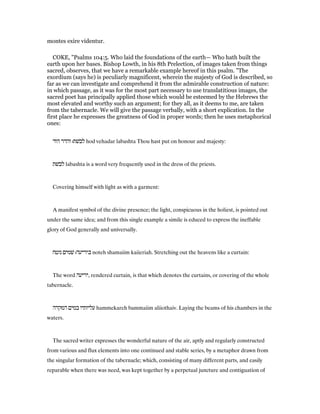
‫לבשת‬ ‫והדר‬ ‫הוד‬ hod vehadar labashta.
“Thou hast put on honor and majesty.”
The original, ‫,לבשת‬ is frequently used when speaking of the clothing or dress of the
priests.
Psa_104:2
‫כשלמה‬ ‫אור‬ ‫עטה‬ oteh or cassalmah.
“Covering thyself with light as with a garment.”
A manifest symbol of the Divine Presence; the light conspicuous in the holiest is
pointed out under the same idea; and from this single example a simile is educed to
express the ineffable glory of God generally and universally.
‫כיריעה‬ ‫שמים‬ ‫נוטה‬ noteh shamayim kayeriah.
“Stretching out the heavens like a curtain.”
The word ‫,יריעה‬ rendered here curtain, is that which denotes the curtains or
uncovering of the whole tabernacle. This may also be an allusion to those curtains or
awnings, stretched over an area, under which companies sit at weddings, feasts,
religious festivals, curiously painted under, to give them the appearance of the visible
heavens in the night-season.
GILL, "Who coverest thyself with light as with a garment,.... Referring, as Aben
Ezra and Kimchi think, to the light, which was first created; and indeed this was
commanded out of darkness by God the Word, or by the essential Word of God. Light is
expressive of the nature of God himself, who is light, and in him is no darkness at all,
and who dwells in light (h) inaccessible, and so may be said to be clothed with it; which
is applicable to Christ as a divine Person, 1Jo_1:5. and to whom this term "light" well
agrees; Light being one of the names of the Messiah in the Old Testament, Psa_43:3,
and is often given him in the New Testament, as the author of the light of nature, grace,
and glory, Joh_1:9. He is now possessed of the light and glory of the heavenly state, of
which his transfiguration on the mount was an emblem, when his face shone like the
sun, and his raiment was as the light, Mat_17:2.
Who stretchest out the heavens like a curtain; alluding to the firmament or
expanse, which, being spread out like a curtain, divided between the waters and the
waters, Gen_1:6. Heaven is represented as a tent stretched out, with curtains drawn
around it, to hide the dazzling and unapproachable light in which the Lord dwells, Isa_
40:22 and it is as a curtain or canopy stretched out and encompassing this earth; the
stretching of it out belongs to God alone, and is a proof of the deity of Christ, to whom it
is here and elsewhere ascribed, Job_9:8. Here Christ dwells invisible to us at present; he
is received up into heaven, retained there, and from thence will descend at the last day;
and in the mean while is within the curtains of heaven, unseen by us.
JAMISO , "light — is a figurative representation of the glory of the invisible God
(Mat_17:2; 1Ti_6:16). Its use in this connection may refer to the first work of creation
(Gen_1:3).
stretchest out the heavens — the visible heavens or sky which cover the earth as a
curtain (Isa_40:12).
SBC, "I. There are two kinds of mystery: a mystery of darkness and a mystery of light.
With the mystery of darkness we are familiar. Of the mystery of light we have not
thought, perhaps, so much. With all deep things the deeper light brings new
mysteriousness. The mystery of light is the privilege and prerogative of the profoundest
things. The shallow things are capable only of the mystery of darkness. Of that all things
are capable. Nothing is so thin, so light, so small, that if you cover it with clouds or hide
it in half-lights, it will not seem mysterious. But the most genuine and profound things
you may bring forth into the fullest light and let the sunshine bathe them through and
through, and in them there will open ever-new wonders of mysteriousness. Surely of
God it must be supremely true that the more we know of Him, the more He shows
Himself to us, the more mysterious He must for ever be. The mystery of light must be
complete in Him. Revelation is not the unveiling of God, but a changing of the veil that
covers Him, not the dissipation of mystery, but the transformation of the mystery of
darkness into the mystery of light. To the pagan God is mysterious because He is hidden
in clouds, mysterious like the storm. To the Christian God is mysterious because He is
radiant with infinite truth, mysterious like the sun.
II. The doctrine of the Trinity is not an easy, ready-made, satisfactory explanation of
God, in which the inmost chambers of His life are unlocked and thrown wide open, that
whoso will may walk there and understand Him through and through. There is a
mystery concerning God to him who sees the richness of the Divine life in the threefold
unity of Father, Son, and Holy Ghost which no man feels to whom God does not seem to
stand forth from the pages of his Testament in that completeness. Not as the answer to a
riddle which leaves all things clear, but as the deeper sight of God, prolific with a
thousand novel questions which were never known before, clothed in a wonder which
only in that larger light displayed itself, offering new worlds for faith and reverence to
wander in, so must the New Testament revelation, the truth of Father, Son, and Spirit,
one perfect God, offer itself to man.
Phillips Brooks, The Candle of the Lord, p. 305.
SPURGEO , "Ver. 2. Who coverest thyself with light as with a garment: wrapping
the light about him as a monarch puts on his robe. The conception is sublime: but it
makes us feel how altogether inconceivable the personal glory of the Lord must be;
if light itself is but his garment and veil, what must be the blazing splendour of his
own essential being! We are lost in astonishment, and dare not pry into the mystery
lest we be blinded by its insufferable glory.
Who stretchest out the heavens like a curtain —within which he might dwell. Light
was created on the first day and the firmament upon the second, so that they fitly
follow each other in this verse. Oriental princes put on their glorious apparel and
then sit in state within curtains, and the Lord is spoken of under that image: but
how far above all comprehension the figure must be lifted, since the robe is essential
light, to which suns and moons owe their brightness, and the curtain is the azure sky
studded with stars for gems. This is a substantial argument for the truth with which
the psalmist commenced his song, "O Lord my God, thou art very great."
EXPLA ATORY OTES A D QUAI T SAYI GS.
Ver. 2. —Who coverest thyself with light as with a garment. In comparing the light
with which he represents God as arrayed to a garment, he intimates, that although
God is invisible, yet his glory is conspicuous enough. In respect of his essence, God
undoubtedly dwells in light that is inaccessible; but as he irradiates the whole world
by his splendour, this is the garment in which he, who is hidden in himself, appears
in a manner visible to us. The knowledge of this truth is of the greatest importance.
If men attempt to reach the infinite height to which God is exalted, although they fly
above the clouds, they must fail in the midst of their course. Those who seek to see
him in his naked majesty are certainly very foolish. That we may enjoy the sight of
him, he must come forth to view with his clothing; that is to say, we must cast our
eyes upon the very beautiful fabric of the world in which he wishes to be seen by us,
and not be too curious and rash in searching into his secret essence. ow, since God
presents himself to us clothed with light, those who are seeking pretexts for their
living without the knowledge of him, cannot allege in excuse of their slothfulness,
that he is hidden in profound darkness. When it is said that the heavens are a
curtain, it is not meant that under them God hides himself, but that by them his
majesty and glory are displayed, being, as it were, his royal pavilion. —John
Calvin.
Ver. 2. —With light. The first creation of God in the works of the days was the
light of sense; the last was the light of reason; and his Sabbath work ever since is the
illumination of the spirit. —Francis Bacon.
Ver. 2. —Who stretchest out the heavens like a curtain. It is usual in the East, in
the summer season, and upon all occasions when a large company is to be received,
to have the court of the house sheltered from the heat of the weather by all umbrella
or veil, which being expanded upon ropes from one side of the parapet wall to
another may be folded or unfolded at pleasure. The Psalmist seems to allude to some
covering of this kind in that beautiful expression of stretching out the heavens like a
curtain. —Kitto's Pictorial Bible.
Ver. 2. —Like a curtain. With the same case, by his mere word, with which a man
spreads out a tent curtain, Psalms 104:2, Isaiah 40:22 is parallel, "that stretcheth
out the heavens as a curtain, and spreadeth them out as a tent to dwell in." Ver. 3
continues the description of the work of the second day. There lie at bottom, in the
first clause, the words of Genesis 1:7 "God made the vaulted sky and divided
between the waters which are under the vault and the waters which are above the
vault." The waters above are the materials with which, or out of which, the
structure is reared. To construct out of the movable waters a firm palace, the cloudy
heaven, "firm as a molten glass" (Job 37:18), is a magnificent work of divine
omnipotence. —E.V. Hengstenberg.
Ver. 2. —Like a curtain. Because the Hebrews conceived of heaven as a temple and
palace of God, that sacred azure was at once the floor of his, the roof of our, abode.
Yet I think the dwellers in tents ever loved best the figure of the heavenly tent. They
represent God as daily spreading it out, and fastening it at the extremity of the
horizon to the pillars of heaven, the mountains: it is to them a tent of safety, of rest,
of a fatherly hospitality in which God lives with his creatures. —Herder, quoted by
Perowne.
An Embrace of Light
There's a wonderful story about the obel laureate Isidore M. Rabi, who said
that his mother never asked him what he learned in school. Instead she'd ask him
each day, "Izzy, did you ask a good question?" We are a people who revere the
question as the mark of one who is awake and free. Last week Elaine Goodman
asked me, "When is it appropriate to wear a tallit?" And then after I answered, she
said, "You know, it would be interesting on a Friday night to answer questions we
may have about Judaism." So tonight I'd like to talk about not only the when, but
the what, why, where, and how of the tallit.
Actually, let's begin with who wears a tallit. First, God wears a tallit, and since we
are in God's image, we pay close attention to what God wears. Before putting on the
tallit, we say, "Bless Adonai, my soul! Adonai my God, how great You are, clothed
in majesty and glory, wrapped in light like a robe. You spread out the heavens like a
tent." The light of the world is God's tallit, God's robe, God's tent. Energy or force
are other words for the same idea. And when we clothe and wrap ourselves in the
prayer shawl, we connect ourselves to the light of creation and to the light within
ourselves.
ow, the what of tallit. The tallit, along with tefilin, is our most important ritual
clothing. Tallit means robe, and it's not the shawl but the fringes, the tzitziot, that
count. What is the big deal about the fringe? In the ancient world, one's status was
revealed by the hem of the garment: the more fringes, the more important the
person. God tells the Jews that they are a nation of priests, and since the priests
were of highest status, now every Jew will wear the same fringes.
That's one meaning of the tzitziot, the pshat or simplest meaning. I wear fringes
because I am part of a royal people. The deeper meaning comes from umbers 15,
which is part of the shema. Adonai said to Moses, 'Speak to the children of Israel
and tell them that each generation shall put tassels on the corner of their clothes,
and put a blue thread on the corner tassel. Then when this tasel catches your eye,
you will remember all God's commands and do them. Then you will no longer
wander after the desires of your heart and your eyes which led you to lust."
Here we learn that the tallit is a reminder not only of our descent but of our
responsibility to live surrounded by God's light. By that light do we come to see our
own, and our own light shines when we live by God's guidelines, the mitzvot. Tzitzit,
like all Hebrew words, has a numerical eqivalent, and its number is 600. The fringe
contains eight strings and five knots. Put it together and it equals 613, the legendary
number of commandments we own. When we say the shema, we gather the four
corners of the tallit together to bring heaven and earth, and all beings together.
umbers 15 also tells us when we wear the tallit --by day, not night, because the
only way the tzittzit catches the eye is when we can see it, and we need light to see.
Every morning during prayers we wear a tallit and that's why we don't wear it
tonight. The great exception to this is Kol idre, when we all wear prayer shawls.
We do this because it is the holiest night of the year, and the service begins before
sundown, so we stay within the guidelines set forth in umbers.
Let's get back to who wears the tallit. In most non-Orthodox congregations,
Bar/Bat Mitzvah is the event that marks the beginning of wearing this garment. For
our children, the tallit represents what long pants represented in my father's
generation, clothing that tells the wearer that he or she has reached a stage beyond
childhood. At 13, children in our tradition are understood to be ready to make
moral choices, to move from their parents emotionally and intellectually, and to take
responsibility for their decisions. The tallit, usually given by the parents, now
becomes woven with the the shelter provided by the parents. We cannot hold them
forever, and we are comforted knowing that the tallit will embrace them. . The
weight of the shawl will remind the wearer of his or her parent's embrace.
For the legalists, however, a Bar Mitzvah tallit is a custom. In Talmudic times
children wore tzitziot as soon as they understood their meaning. And in the
Orthodox world, unmarried men do not wear tallitot; it's easy to spot eligible
bachelors. And what about women? Do they wear them? Traditionally, no, yet we
know that the writer of the Mishnah sewed them on his wife's clothes. So, some
argue women aren't allowed and others argue they are.
Besides tzitziot, a tallit always has a band or atarah, so that we always wear the
tallit in the same direction, and it usually has stripes, and they're often blue. You
remember that umbers 15 refers to a blue thread. The dye for the thread came
from a precious mediterranean sea snail, and because of its great value, it was the
royal color. All Jews wore this color on the fringe to further stress the nobility of the
nation. When the Temple was destroyed, the snail disappeared, and we no longer
wear the blue thread on the fringe but weave the color into the shawl.
The Torah portion this week is Lech Lecha, God's words to Abraham. Go from
the land of your ancestors...." God says. Yet the grammar is odd. It really says, go
yourself, or go to yourself. Enter your deepest self, Abraham, to birth a new people
with a new idea. The tallit is a ticket to this inward journey. By cloaking ourselves in
light, we may see where we are going, who we have come from, and who we want to
be.
Rabbi Malka Drucker is the spiritual leader of HaMakom: The Place for
Passionate and Progressive Judaism, Santa Fe, ew Mexico. She is a, teacher,
lecturer and author of Rescuers: Portraits of Moral Courage in the Holocaust,
Grandma's Latkes, and The Family Treasury of Jewish Holidays. Rabbi Drucker
maintains a website.
COKE, "Psalms 104:2. The heavens like a curtain— Like a tilt—a tent. Or, Like a
canopy. Mudge. A tent seems the most proper translation, as comprehending, not
the uppermost part of the tent or the canopy only, but the whole tent, both canopy
and curtains: for by that the air which encompasseth the earth is most fitly
resembled, in respect of us here below, for whose use it is that God has thus
extended or stretched it out; as doing that by his secret and invisible virtue, which in
tents used to be done by cords.
ELLICOTT, "Verse 2
(2) Who coverest.—Perhaps better with the participles of the original retained:
Putting on light as a robe;
Spreading the heavens as a curtain.
The psalmist does not think of the formation of light as of a single past act, but as a
continued glorious operation of Divine power and splendour. ot only is light as to
the modern poet,
“ ature’s resplendent robe,
Without whose vesting beauty all were wrapt
In unessential gloom,”
but it is the dress of Divinity, the “ethereal woof” that God Himself is for ever
weaving for His own wear.
Curtain.—Especially of a tent (see Song of Solomon 1:5, &c.), the tremulous
movement of its folds being expressed in the Hebrew word. Different explanations
have been given of the figure. Some see an allusion to the curtains of the Tabernacle
(Exodus 26, 27). The associations of this ritual were dear to a religious Hebrew, and
he may well have had in his mind the rich folds of the curtain of the Holy of Holies.
So a modern poet speaks of
“The arras-folds, that variegate
The earth, God’s ante-chamber.
Herder, again, refers the image to the survival of the nomadic instinct. But there is
no need to put a limit to a figure so natural and suggestive. Possibly images of
palace, temple, and tent, all combined, rose to the poet’s thought, as in Shelley’s
“Ode to Heaven”:—
“Palace roof of cloudless nights!
Paradise of golden lights!
Deep immeasurable vast,
Which art now, and which wert then;
Of the present and the past,
Of the Eternal where and when,
Presence-chamber, temple, home,
Ever-canopying dome
Of acts and ages yet to come!”
3 and lays the beams of his upper chambers on
their waters.
He makes the clouds his chariot
and rides on the wings of the wind.
BAR ES, "Who layeth the beams of his chambers in the waters - The word
here rendered “layeth” - from ‫קרה‬ qârâh - means properly to meet; then, in Hiphil, to
cause to meet, or to fit into each other, as beams or joists do in a dwelling. It is a word
which would be properly applied to the construction of a house, and to the right
adjustment of the different materials employed in building it. The word rendered
“beams” - ‫עליה‬ ‛ălıyâh - means “an upper chamber, a loft,” such as rises, in Oriental
houses, above the flat roof; in the New Testament, the ᆓπερሬον huperōon, rendered
“upper room,” Act_1:13; Act_9:37, Act_9:39; Act_20:8. It refers here to the chamber -
the exalted abode of God - as if raised above all other edifices, or above the world. The
word “waters” here refers to the description of the creation in Gen_1:6-7 - the waters
“above the firmament,” and the waters “below the firmament.” The allusion here is to
the waters above the firmament; and the meaning is, that God had constructed the place
of his own abode - the room where he dwelt - in those waters; that is, in the most exalted
place in the universe. It does not mean that he made it of the waters, but that his home -
his dwelling-place - was in or above those waters, as if he had built his dwelling not on
solid earth or rock, but in the waters, giving stability to that which seems to have no
stability, and making the very waters a foundation for the structure of his abode.
Who maketh the clouds his chariot - Who rides on the clouds as in a chariot. See
the notes at Isa_19:1. Compare the notes at Psa_18:11.
Who walketh upon the wings of the wind - See the notes at Psa_18:10.
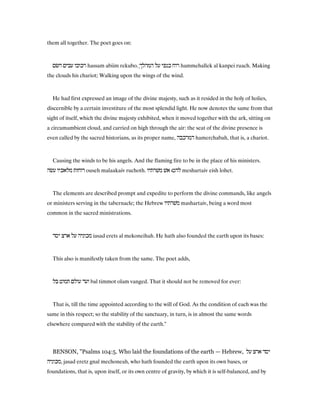
CLARKE, "‫עליותיו‬ ‫במים‬ ‫המקרה‬ hamekareh bammayim aliyothaiv.
“Laying the beams of his chambers in the waters.”
The sacred writer expresses the wonderful nature of the air aptly, and regularly
constructed, from various and flux elements, into one continued and stable series, by a
metaphor drawn from the singular formation of the tabernacle, which, consisting of
many and different parts, and easily reparable when there was need, was kept together
by a perpetual juncture and contignation of them all together. The poet goes on: -
‫רכובו‬ ‫עבים‬ ‫השם‬ hassem abim rechubo,
‫רוה‬ ‫כנפי‬ ‫על‬ ‫המהלך‬ hamehallech al canphey ruach.
“Making the clouds his chariot,
Walking upon the wings of the wind.”
He had first expressed an image of the Divine Majesty, such as it resided in the holy of
holies, discernible by a certain investiture of the most splendid light; he now denotes the
same from that light of itself which the Divine Majesty exhibited, when it moved
together with the ark, sitting on a circumambient cloud, and carried on high through the
air. That seat of the Divine Presence is even called by the sacred historians, as its proper
name, ‫המרכבה‬ hammercabah, The Chariot.
GILL, "Who layeth the beams of his chambers in the waters,.... Or "his upper
rooms" (i); one story over another being built by him in the heavens, Amo_9:6, the
chambers where he resides; his courts, as the Targum; his palace and apartments, his
presence chamber particularly, the floor and beams of them are the waters bound up in
the thick clouds; or the region of the air, from whence the rain descends to water the
hills, as in Psa_104:13.
Who maketh the clouds his chariot; to ride in; in these sometimes Jehovah rides to
execute judgment on his enemies, Isa_19:1 and in these sometimes he appears in a way
of grace and mercy to his people, Exo_13:21, in these, as in chariots, Christ went up to
heaven; and in these will he come a second time; and into these will the saints be caught
up to meet the Lord in the air at his coming, Act_1:9.
Who walketh upon the wings of the wind; see Psa_18:10 which is expressive of his
swiftness in coming to help and assist his people in time of need; who helps, and that
right early; and may very well be applied both to the first and second coming of Christ,
who came leaping upon the mountains, and skipping upon the hills, when he first came;
and, when he comes a second time, will be as a roe or a young hart upon the mountains
of spices, Son_2:8. The Targum is,
"upon the swift clouds, like the wings of an eagle;''
hence, perhaps, it is, the Heathens have a notion of Jupiter's being carried in a chariot
through the air, when it thunders and lightens (k).
JAMISO , "in the waters — or, it may be “with”; using this fluid for the beams, or
frames, of His residence accords with the figure of clouds for chariots, and wind as a
means of conveyance.
walketh — or, “moveth” (compare Psa_18:10, Psa_18:11; Amo_9:6).
CALVI , "3.Laying the beams of his chambers in the WATERS David now
proceeds to explain at greater length what he had briefly stated under the figure of
God’s raiment. The scope of the passage is shortly this, that we need not pierce our
way above the clouds for the purpose of finding God, since he meets us in the fabric
of the world, and is everywhere exhibiting to our view scenes of the most vivid
description. That we may not imagine that there is any thing in Him derived, as if,
by the creation of the world, he received any addition to his essential perfection and
glory, we must remember that he clothes himself with this robe for our sake. The
metaphorical representation of God, as laying the beams of his chambers in the
waters, seems somewhat difficult to understand; but it was the design of the
prophet, from a thing incomprehensible to us, to ravish us with the greater
admiration. Unless beams be substantial and strong, they will not be able to sustain
even the weight of an ordinary house. When, therefore, God makes the waters the
foundation of his heavenly palace, who can fail to be astonished at a miracle so
wonderful? When we take into ACCOU T our slowness of apprehension, such
hyperbolical expressions are by no means superfluous; for it is with difficulty that
they awaken and enable us to attain even a slight knowledge of God.
What is meant by his walking upon the wings of the wind, is rendered more obvious
from the following verse, where it is said, that the winds are his messengers God
rides on the clouds, and is carried upon the wings of the wind, inasmuch as he drives
about the winds and clouds at his pleasure, and by sending them hither and thither
as swiftly as he pleases, shows thereby the signs of his presence. By these words we
are taught that the winds do not blow by chance, nor the lightnings flash by a
fortuitous impulse, but that God, in the exercise of his sovereign power, rules and
controls all the agitations and disturbances of the atmosphere. From this doctrine a
twofold advantage may be reaped. In the first place, if at any time noxious winds
arise, if the south wind corrupt the air, or if the north wind scorch the corn, and not
only tear up trees by the root, but overthrow houses, and if other winds destroy the
fruits of the earth, we ought to tremble under these scourges of Providence. In the
second place, if, on the other hand, God moderate the excessive heat by a gentle
cooling breeze, if he purify the polluted atmosphere by the north wind, or if he
moisten the parched ground by south winds; in this we ought to contemplate his
goodness.
As the apostle, who writes to the Hebrews, (Hebrews 1:7) quotes this passage, and
applies it to the angels, BOTH the Greek and Latin expositors have almost
unanimously considered David as here speaking allegorically. In like manner,
because Paul, in quoting Psalms 19:4, in his Epistle to the Romans, (Romans 10:18)
seems to apply to the apostles what is there STATED concerning the heavens, the
whole psalm has been injudiciously expounded as if it were an allegory. (179) The
design of the apostle, in that part of the Epistle to the Hebrews referred to, was not
simply to explain the mind of the prophet in this place; but since God is exhibited to
us, as it were, visibly in a mirror, the apostle very properly lays down the analogy
between the obedience which the winds manifestly and perceptibly yield to God, and
that obedience which he receives from the angels. In short, the meaning is, that as
God makes use of the winds as his messengers, turns them hither and thither, calms
and raises them whenever he pleases, that by their ministry he may declare his
power, so the angels were created to execute his commands. And certainly we profit
little in the contemplation of universal nature, if we do not behold with the eyes of
faith that spiritual glory of which an image is presented to us in the world.
SPURGEO , "Ver. 3. Who layeth the beams of his chambers in the water's. His
lofty halls are framed with the waters which are above the firmament. The upper
rooms of God's great house, the secret stories far above our ken, the palatial
chambers wherein he resides, are based upon the floods which form the upper
ocean. To the unsubstantial he lends stability; he needs no joists and rafters, for his
palace is sustained by his own power. We are not to interpret literally where the
language is poetical, it would be simple absurdity to do so.
Who maketh the clouds his chariot. When he comes forth from his secret pavilion it
is thus he makes his royal progress. "It is chariot of wrath deep thunder clouds
form, "and his chariot of mercy drops plenty as it traverses the celestial road.
Who walketh or rather goes upon the wings of the wind. With the clouds for a car,
and the winds for winged steeds, the Great King hastens on his movements whether
for mercy or for judgment. Thus we have the idea of a king still further elaboratedâ
€”his lofty palace, his chariot, and his coursers are before us; but what a palace
must we imagine, whose beams are of crystal, and whose base is consolidated
vapour! What a stately car is that which is fashioned out of the flying clouds, whose
gorgeous colours Solomon in all his glory could not rival; and what a Godlike
progress is that in which spirit wings and breath of winds bear up the moving
throne. "O Lord, my God, thou art very great!"
EXPLA ATORY OTES A D QUAI T SAYI GS.
Ver. 3. —The metaphorical representation of God, as laying the beams of his
chambers in the waters, seems somewhat difficult to understand; but it was the
design of the prophet, from a thing incomprehensible to us, to ravish us with the
greater admiration. Unless beams be substantial and strong, they will not be able to
sustain even the weight of an ordinary house. When, therefore, God makes the
waters the foundation of his heavenly palace, who can fail to be astonished at a
miracle so wonderful? When we take into account our slowness of apprehension,
such hyperbolical expressions are by no means superfluous; for it is with difficulty
that they awaken and enable us to attain even a slight knowledge of God. —John
Calvin.
Ver. 3. —Who layeth the beams of his chambers in the waters; or, "who layeth his
upper chambers above the waters." His upper chamber (people in the East used to
retire to the upper chamber when they wished for solitude) is reared up in bright
other on the slender foundation of rainy clouds. —A.F. Tholuck.
Ver. 3. —Who layeth the beams, etc. "He floodeth his chambers with waters, "i.e.,
the clouds make the flooring of his heavens. —Zachary Mudge.
Ver. 3. —Who walketh upon the wings of the wind; see Psalms 18:10; which is
expressive of his swiftness in coming to helped assist his people in time of need; who
helps, and that right early; and may very well be applied both to the first and
second coming of Christ, who came leaping Upon the mountains, and skipping upon
the hills, when he first came; and, when he comes a second time will be as a roe or a
young hart upon the mountains of spices, So 2:8 8:14 The Targum is, "upon the
swift clouds, like the wings of an eagle"; hence, perhaps, it is the heathens have a
notion that Jupiter is being carried in a chariot through the air when it thunders
and lightens. —John Gill.
Ver. 3. —Who walketh upon the wings of the wind. In these words there is an
unequalled elegance; not, he fleeth —he runneth, but—he walketh;and that on
the very wings of the wind;on the most impetuous element raised into the utmost
rage, and sweeping along with incredible rapidity. We cannot have a more sublime
idea of the deity; serenely walking on an element of inconceivable swiftness, and, as
it seems to us, uncontrollable impetuosity! —James Hervey, 1713-14—1758.
BE SO , "Verse 3
Psalms 104:3. Who layeth the beams of his chambers — His upper rooms, (so the
word ‫עליותיו‬ signifies,) in the waters — The waters that are above the firmament,
(Psalms 104:3,) as he has founded the earth upon the seas and floods, the waters
beneath the firmament. The Almighty is elsewhere said to make those dark waters,
compacted in the thick clouds of the skies, the secret place, or chamber, of his
residence, and a kind of footstool to his throne: see Psalms 18:9; Psalms 18:11.
Though air and water are fluid bodies, yet, by the divine power, they are kept as
tight and as firm in the place assigned them, as a chamber is with beams and rafters.
How great a God is he whose presence-chamber is thus reared, thus fixed! Who
maketh the clouds his chariot — In which he rides strongly, swiftly, and far above,
out of the reach of opposition, when at any time it is his will to make use of
uncommon providences in his government of the world. He descended in a cloud, as
in a chariot, to mount Sinai, to give the law, and to mount Tabor, to proclaim the
gospel; and he still frequently rides upon the clouds, or heavens, to the help of his
people, Deuteronomy 33:26. Who walketh upon the wings of the wind — “There is
an unequalled elegance,” says Mr. Hervey, “in these words. It is not said he flieth,
he runneth, but he walketh; and that, on the very wings of the wind; on the most
impetuous element, raised into the utmost rage, and sweeping along with incredible
rapidity. We cannot have a more sublime idea of the Deity; serenely walking on an
element of inconceivable swiftness, and, as it seems to us, uncontrollable
impetuosity.” “How astonishingly magnificent and tremendous is the idea which
these words convey to us of the great King, riding upon the heavens, encompassed
with clouds and darkness, attended by the lightnings, those ready executioners of his
vengeance, and causing the world to resound and tremble at the thunder of his
power and the noise of his chariot-wheels. By these ensigns of royalty, these
emblems of omnipotence, and instruments of his displeasure, doth Jehovah manifest
his presence, when he visiteth rebellious man, to make him own and adore his
neglected and insulted Lord.” — Horne,
COKE, "Psalms 104:3. Who layeth the beams of his chambers— He flooreth his
chambers with waters: i.e. "The clouds make the flooring of his heavens." Mudge.
By these chambers are meant, though not the supreme, yet the superior or middle
regions of the air. It is here described as an upper story in a house, laid firm with
beams; (accounting the earth, and the region of air around it, as the lowest story:)
and this floor is here poetically said to be laid in the waters; i.e. in watery clouds.
ow, whereas in the building of an upper story there must be some walls or pillars
to support the weight of it, and on which the beams must be laid; God here, by his
own miraculous power, laid, and hath ever since supported, these upper rooms;
there being nothing but waters to support them; a fluid unstable body, incapable of
supporting itself. This therefore is another work of his divine power; that the
waters, which are so fluid, and unable to contain themselves within their own
bounds, should yet hang in the middle of the air, and be as walls or pillars to
support that region of air, which is itself another fluid body. Mr. Hervey observes
very well, that in the words, Who walketh upon the wings of the wind, there is an
unequalled elegance; not he flieth—he runneth, but—he walketh; and that on the
very wings of the wind; on the most impetuous element, raised into the utmost rage,
and sweeping along with incredible rapidity. We cannot have a more sublime idea of
the Deity; serenely walking on an element of inconceivable swiftness, and, as it
seems to us, uncontrollable impetuosity!
ELLICOTT, "(3) Layeth the beams.—Literally, maketh to meet The meaning of the
Hebrew word, which is an exact equivalent of the Latin contignare, is clear from
ehemiah 2:8; ehemiah 3:3; ehemiah 3:6, and from the meaning of the derived
noun (2 Kings 6:2; 2 Kings 6:5; Song of Solomon 1:17).
Chambers.—Literally, lofts or upper stories. (See 2 Kings 4:10; Jeremiah 22:13-14.)
In the waters.—The manner of this ethereal architecture is necessarily somewhat
difficult to picture. The pavilion which God rears for His own abode appears to rest
on a floor of rain-clouds, like a tent spread on a flat eastern roof. (See Psalms 18:11;
Amos 9:6-7.) Southey’s description of the Palace of Indra may perhaps help the
imagination:—
“Built on the lake, the waters were its floor;
And here its walls were water arched with fire,
And here were fire with water vaulted o’er;
And spires and pinnacles of fire
Round watery cupolas aspire,
And domes of rainbow rest on fiery towers.”
Curse of Kehama.
Who maketh the clouds His chariot.—See Psalms 18:10, probably the original of
this verse; chariot (rekhûb) here taking the place of cherub.
Walketh upon the wings of the wind.—Doubtless the metaphor is taken from the
clouds, which, in a wind-swept sky, float along like “the drifted wings of many
companies of angels.” The clause is thus in direct parallelism with the description of
the cloud chariot. The figure has passed into modern song:
“Every gust of rugged wings
That blows from off each beaked promontory.”
MILTO : Lycidas.
“ o wing of wind the region swept.”
TE YSO : In Memoriam
4444 He makes winds his messengers,[a]He makes winds his messengers,[a]He makes winds his messengers,[a]He makes winds his messengers,[a]
flames of fire his servants.flames of fire his servants.flames of fire his servants.flames of fire his servants.
BARNES, "BARNES, "BARNES, "BARNES, "Who maketh his angels spiritsWho maketh his angels spiritsWho maketh his angels spiritsWho maketh his angels spirits ---- The meaning here literally would be, “Who
makes the winds his messengers,” or “his angels;” that is, who employs them to execute his
purpose; who sends them out as messengers or angels to do his will.
His ministers a flaming fireHis ministers a flaming fireHis ministers a flaming fireHis ministers a flaming fire ---- That is, Fire is employed by him - in lightnings - to accomplish
his purpose as his ministers or his servants. They are entirely under his command. They are sent
by him to do his will; to carry out his designs. This is intended to describe the majesty and the
power of God - that he can employ wind and lightning - tempest and storm - to go on errands
such as he commands; to fulfill his plans; to do his bidding. For the application of this to the
angels, and as employed by the apostle Paul to prove the inferiority of the angels to the Messiah,
see the notes at Heb_1:7.
CLARKE, "CLARKE, "CLARKE, "CLARKE, "‫רחות‬ ‫מלאכיו‬ ‫עשה‬ oseh rnalachaiv ruchoth,
‫להט‬ ‫אש‬ ‫משרתיו‬ mesharethaiv esh lohet.
The elements are described as prompt and expedite to perform the Divine commands,
like angels or ministers serving in the tabernacle; the Hebrew word ‫משרתיו‬ mesharethaiv
being a word most common in the sacred ministrations.
GILL, "Who maketh his angels spirits,.... The angels are spirits, or spiritual
substances, yet created ones; and so differ from God, who is a spirit, and from the Holy
Spirit of God, who are Creators and not creatures; angels are spirits without bodies, and
so differ from the souls or spirits of men, and are immaterial, and so die not; these are
made by Christ, by whom all things are made, Col_1:16 and so he must be greater and
more excellent than they; for which purpose the passage is quoted in Heb_1:7. Some
render it, "who maketh his angels as the winds"; to which they may be compared for
their invisibility, they being not to be seen, no more than the wind, unless when they
assume an external form; and for their penetration through bodies in a very surprising
manner; see Act_12:6, and for their great force and power, being mighty angels, and said
to excel in strength, Psa_103:20, and for their swiftness in obeying the divine
commands; so the Targum,
"he maketh his messengers, or angels, swift as the wind.''
His ministers a flaming fire; angels are ministers to God, stand before him, behold
his face, wait for and listen to his orders, and execute them; they are ministers to Christ,
they were so at his incarnation, in his infancy, when in the wilderness and in the garden,
at his resurrection and ascension, and will attend him at his second coming; and these
are ministers to his people, take the care of them, encamp about them, do many good
offices to them in life, and at death carry their souls to Abraham's bosom: these are
made a flaming fire, or "as" flaming fire, for their force and power; so the Targum,
"his ministers strong as flaming fire;''
and for their swiftness as before; and because of their burning love to God, Christ, and
his people, and their flaming zeal for his cause and interest; hence thought by some to be
called "seraphim": and because they are sometimes the executioners of God's wrath; and
have sometimes appeared in fiery forms, as in forms of horses of fire and chariots of fire,
and will descend with Christ in flaming fire at the last day; see 2Ki_2:11. Some invert the
words, both reading and sense, thus, "who maketh the winds his angels, or messengers,
and flaming fire his ministers"; so Jarchi, Aben Ezra, and Kimchi; we read of stormy
wind fulfilling his word, Psa_148:8, he sends out his winds at his pleasure to do his
errands; as to dry up the waters of the flood, to drive back the waters of the Red sea, and
make dry land, to bring quails from thence, and scatter them about the camp of Israel,
and in many other instances. So flaming fire was used as his ministers in burning Sodom
and Gomorrah; and multitudes of the murmuring Israelites, and the captains with their
fifties; but this sense is contrary to the order of the words, and the design of them, and to
the apostle's sense of them, Heb_1:7 which is confirmed by the Targum, Septuagint, and
all the Oriental versions.
JAMISO , "This is quoted by Paul (Heb_1:7) to denote the subordinate position of
angels; that is, they are only messengers as other and material agencies.
spirits — literally, “winds.”
flaming fire — (Psa_105:32) being here so called.
SPURGEO , "Ver. 4. Who maketh his angels spirits; or wields, for the word means
either. Angels are pure spirits, though they are permitted to assume a visible form
when God desires us to see them. God is a spirit, and he is waited upon by spirits in
his royal courts. Angels are like winds for mystery, force, and invisibility, and no
doubt the winds themselves are often the angels or messengers of God. God who
makes his angels to be as winds, can also make winds to be his angels, and they are
constantly so in the economy of nature.
His ministers a flaming fire. Here, too, we may choose which we will of two
meanings: God's ministers or servants he makes to be as swift, potent, and terrible
as fire, and on the other hand he makes fire, that devouring element, to be his
minister flaming forth upon his errands. That the passage refers to angels is clear
from Hebrews 1:7; and it was most proper to mention them here in connection with
light and the heavens, and immediately after the robes and paltree of the Great
King. Should not the retinue of the Lord of Hosts be mentioned as well as his
chariot? It would have been a flaw in the description of the universe had the angels
not been alluded to, and this is the most appropriate place for their introduction.
When we think of the extraordinary powers entrusted to angelic beings, and the
mysterious glory of the seraphim and the four living creatures, we are led to reflect
upon the glory of the Master whom they serve, and again we cry out with the
psalmist, "O Lord, my God, thou art very great."
EXPLA ATORY OTES A D QUAI T SAYI GS.
Ver. 4. ‫”€ג‬Who maketh his angels spirits. Some render it, Who maketh his angels as
the winds, to which they may be compared for their invisibility, they being not to be
seen, no more than the wind, unless when they assume an external form; and for
their penetration through bodies in a very surprising manner; see Acts 7:6-10; and
for their great force and power, being mighty angels, and said to excel in strength,
Psalms 103:20; and for their swiftness in obeying the divine commands; so the
Targum, "He maketh his messengers, or angels, swift as the wind." ‫”€ג‬John Gill.
Ver. 4. ‫”€ג‬Who maketh his angels spirits. The words, "creating his angels spirits,
"may either mean "creating them spiritual beings, not material beings, "or
"creating them winds" ‫”€ג‬i.e. like the winds, invisible, rapid in their movements,
and capable of producing great effects. The last mode of interpretation seems
pointed out by the parallelism‫"”€ג‬and his ministers" ‫”€ג‬or, "servants" ‫”€ג‬who are
plainly the same as his angels, ‫"”€ג‬a flame of fire, "i.e., like the lightning. The
statement here made about the angels seems to be this: "They are created beings,
who in their qualities bear a resemblance to the winds and the lightning."
The argument deduced by Paul, in Hebrews 2:7, from this statement for the
inferiority of the angels is direct and powerful: ‫”€ג‬He is the Son; they are the
creatures of God. "Only begotten" is the description of his mode of existence; made
is the description of theirs. All their powers are communicated power; and however
high they may stand in the scale of creation, it is in that scale they stand, which
places them infinitely below him, who is so the Son of God as to be "God over all,
blessed for ever." ‫”€ג‬John Brown, in "An Exposition of the Epistle to the Hebrews."
Ver. 4. ‫”€ג‬A flaming fire. Fire is expressive of irresistible power, immaculate
holiness, and ardent emotion. It is remarkable that the seraphim, one class at least
of these ministers, have their name from a root signifying to burn; and the altar,
from which one of them took the live coal, Isaiah 6:6, is the symbol of the highest
form of holy love. ‫”€ג‬James G. Murphy, in "A Commentary on the Book of Psalms,
"1875.
SBC, "Consider what is implied in the text.
I. What a number of beautiful and wonderful objects does nature present on every side
of us, and how little we know concerning them! Why do rivers flow? Why does rain fall?
Why does the sun warm us? And the wind—why does it blow? Here our natural reason is
at fault; we know that it is the spirit in man and in beast that makes man and beast
move, but reason tells us of no spirit abiding in what is called the natural world, to make
it perform its ordinary duties. Now here Scripture interposes, and seems to tell us that
all this wonderful harmony is the work of angels. Those events which we ascribe to
chance, as the weather, or to nature, as the seasons, are duties done to that God who
maketh His angels to be winds, and His ministers a flame of fire. Nature is not
inanimate; its daily toil is intelligent; its works are duties. Every breath of air and ray of
light and heat, every beautiful prospect, is, as it were, the skirts of their garments, the
waving of the robes of those whose faces see God in heaven.
II. While this doctrine raises the mind and gives it a matter of thought, it is also
profitable as a humbling doctrine. Theories of science are useful, as classifying, and so
assisting us to recollect, the works and ways of God and of His ministering angels. And
again, they are ever most useful in enabling us to apply the course of His providence and
the ordinances of His will to the benefit of man. Thus we are enabled to enjoy God’s
gifts; and let us thank Him for the knowledge which enables us to do so, and honour
those who are His instruments in communicating it. But if such a one proceeds to
imagine that, because he knows something of this world’s wonderful order, he therefore
knows how things really go on; if he treats the miracles of nature as mere mechanical
processes, continuing their course by themselves; if in consequence he is what may be
called irreverent in his conduct towards nature, thinking (if I may so speak) that it does
not hear him, and see how he is bearing himself towards it; and if, moreover, he
conceives that the order of nature, which he partially discerns, will stand in the place of
the God who made it, and that all things continue and move on not by His will and
power and the agency of the thousands and ten thousands of His unseen servants, but by
fixed laws, self-caused and self-sustained, what a poor weak worm and miserable sinner
he becomes! When we converse on subjects of nature scientifically, repeating the names
of plants and earths and describing their properties, we should do so religiously, as in
the hearing of the great servants of God, with the sort of diffidence which we always feel
when speaking before the learned and wise of our own mortal race, as poor beginners in
intellectual knowledge as well as in moral attainments.
J. H. Newman, Parochial and Plain Sermons, vol. ii., p. 358.
Psalms 104:4
In the present day a large number of scientific men maintain that the appearance of
design in nature is an appearance only, not a reality. This view is supposed to be
established in two ways: first, by the general doctrine of the universal reign of law; and
secondly, by the particular theory of evolution.
I. Look, first, at the argument drawn from the universality of law. Law is a very
misleading word. Law only means invariable sequence. You will sometimes hear it said,
the universe is governed by laws. The universe is not governed by laws. It is governed
according to laws, but no one can suppose that the laws make themselves; no one can
imagine, for example, that water determines of its own accord always to freeze at one
temperature and to boil at another, that snowflakes make up their minds to assume
certain definite and regular shapes, or that fire burns of malice aforethought. The
sequences of nature do not explain themselves. The regularity of nature, then, needs to
be explained. It cannot explain itself, nor can it disprove the existence of a controlling
will. The only reign of law incompatible with volition would be the reign of the law of
chaos.
II. Look at the bearing of the theory of evolution upon theology. We will suppose, for
argument’s sake, that even in its most comprehensive shape the doctrine has been
proved true; what is the effect upon our theology? Why, simply that a certain mode of
statement of a certain argument of Paley’s is seen to be unsound. And this unsoundness
has been already recognised on other grounds. Paley maintained that every definite
organ and portion of an organ throughout the world is specially, by a particular creative
fiat, adapted to a certain end, just as every portion of a watch implies a special
contrivance on the part of the watchmaker. But this, as every one now knows, is
completely disproved by the existence in most animals of rudimentary and abortive
organs, which are evidently not adapted to any end, as, for example, the rudiments of
fingers in a horse’s hoof, the teeth in a whale’s mouth, or the eyes in an unborn mole. But
though we no longer profess to trace Divine design in every minute fraction of an
organism, this does not hinder us from seeing it in organisms regarded in their entirety
and in nature considered as a whole.
The doctrine of the survival of the fittest does not account for the fact that there are
fittest to survive. Evolution does not disprove a Designer; it only proves that He works in
a different way from what had been supposed. There is no reason why things may not be
made for their circumstances, though they are partly made by them. The fact that
natural forces work together regularly and methodically does not prove that they have no
master; it suggests rather His absolute control. The eternal evolution of the more
desirable from the less cannot be logically accounted for except on the ground that it is
effected by infinite power, and wisdom, and skill.
A. W. Momerie, The Origin of Evil, and Other Sermons, p. 271.
BENSON, "Psalms 104:4. Who maketh his angels spirits — That is, of a spiritual or
incorporeal nature, that they might be more fit for their employments; or who maketh
them winds, as the word ‫,רוחות‬ ruchoth, commonly signifies; that is, who maketh them like the
winds, powerful, active, and nimble in executing his pleasure. His ministers a flaming fire — So
called for their irresistible force, agility, and fervency in the execution of his commands. But this
verse is otherwise rendered by Jewish, and some Christian interpreters, and that very agreeably to
the Hebrew text; namely, He maketh the winds his messengers, and flames of fire (that is, the
lightning, and thunder, and fiery meteors in the air) his ministers: he maketh use of them no less
than of the holy angels; and oftentimes for the same purposes; and they do as certainly and
readily obey all his commands as the blessed angels themselves do. This interpretation seems
most agreeable to the scope of the Psalm and of the context, wherein he is speaking of the visible
works of God; and, perhaps, if properly considered, it will not be found to invalidate the
argument of the apostle, (Hebrews 1:7,) who informs us that the words have a reference to
immaterial angels: for, when the psalmist says that God maketh the winds, ‫,מלאכיו‬ malachaiv, his
angels, or messengers, he plainly signifies that the angels are God’s ministers, or servants, no less
than the winds. And that is sufficient to justify the apostle’s argument, and to prove the pre-
eminence of Christ above the angels, which is the apostle’s design in that place: see on Hebrews
1:7 .
5 He set the earth on its foundations;
it can never be moved.
BAR ES, "Who laid the foundations of the earth - Referring still to the
creation of the earth. The margin is, “He hath founded the earth upon her bases.” The
Hebrew word rendered in the margin “her bases” means properly a place; then a basis or
foundation. The idea is, that there wes something, as it were, placed under the earth to
support it. The idea is not uncommon in the Scriptures. Compare the notes at Job_38:4.
That it should not be removed for ever - So that it cannot be shaken out of its
place. That is, It is fixed, permanent, solid. Its foundations do not give way, as edifices
reared by man. but it abides the same from age to age - the most fixed and stable object
of which we have any knowledge. Compare the notes at Psa_78:69.
CLARKE, "‫מכוניה‬ ‫על‬ ‫ארץ‬ ‫יסד‬ yasad erets al mechonepha,
‫ועד‬ ‫עולם‬ ‫תמוט‬ ‫בל‬ bal tammot olam vaed.
“Laying the earth upon its foundations,
That it should not be shaken for evermore.”
This image Bishop Lowth thinks evidently taken from the tabernacle, which was so
laid upon its foundations that nothing could move it, and the dispensation to which it
was attached, till the end purposed by the secret counsel of God was accomplished: and
thus the earth is established, till the end of its creation shall be fully answered; and then
it and its works shall be burnt up. On the above ground, the stability of the sanctuary
and the stability of the earth are sometimes mentioned in the same words.
GILL, "Who laid the foundations of the earth,.... Or "founded the earth upon its
bases" (l); which some take to be the waters, according to Psa_24:2, others the centre of
gravity in it; others the mountains; others the circumambient air, by which it is poised;
rather the almighty power of God, by which it subsists; this is the work of Christ the
Almighty; see Heb_1:3.
That it should not be removed for ever: for though it may be shaken by
earthquakes, yet not removed; nor will it be until the dissolution of all things, when it
shall flee away before the face of the Judge, and a new earth shall succeed, Rev_20:11.
HE RY, "He looks down, and looks about, to the power of God shining in this lower
world. He is not so taken up with the glories of his court as to neglect even the remotest
of his territories; no, not the sea and dry land.
1. He has founded the earth, Psa_104:5. Though he has hung it upon nothing (Job_
26:2), ponderibus librata suis - balanced by its own weight, yet it is as immovable as if
it had been laid upon the surest foundations. He has built the earth upon her basis, so
that though it has received a dangerous shock by the sin of man, and the malice of hell
strikes at it, yet it shall not be removed for ever, that is, not till the end of time, when it
must give way to the new earth. Dr. Hammond's paraphrase of this is worth noting:
“God has fixed so strange a place for the earth, that, being a heavy body, one would think
it should fall every minute; and yet, which way soever we would imagine it to stir, it
must, contrary to the nature of such a body, fall upwards, and so can have no possible
ruin but by tumbling into heaven.”
JAMISO , "The earth is firmly fixed by His power.
CALVI , "5He hath founded the earth upon its foundations Here the prophet
celebrates the glory of God, as manifested in the stability of the earth. Since it is
suspended in the midst of the air, and is supported only by pillars of water, how
does it keep its place so steadfastly that it cannot be moved? This I indeed grant may
be explained on natural principles; for the earth, as it occupies the lowest place,
being the center of the world, naturally settles down there. But even in this
contrivance there shines forth the wonderful power of God. Again, if the waters are
higher than the earth, because they are lighter, why do they not cover the whole
earth round about? Certainly the only answer which philosophers can give to this is,
that the tendency of the waters to do so is counteracted by the providence of God,
that a dwelling-place might be provided for man. If they do not admit that the
waters are restrained by the determinate appointment of God, they betray not only
their depravity and unthankfulness, but also their ignorance, and are altogether
barbarous. The prophet, therefore, not without reason, recounts among the miracles
of God, that which would be to us wholly incredible, did not even experience show
its truth. We are very base indeed if, taught by such undoubted a proof, we do not
learn that nothing in the world is stable except in as far as it is sustained by the
hand of God. The world did not originate from itself, consequently, the whole order
of nature depends on nothing else than his appointment, by which each element has
its own peculiar property. or is the language of the prophet to be viewed merely as
an exhortation to give thanks to God; it is also intended to strengthen our
confidence in regard to the future, that we may not live in the world in a state of
constant fear and anxiety, as we must have done had not God testified that he has
given the earth for a habitation to men. It is a singular blessing, which he bestows
upon us, in his causing us to dwell upon the earth with undisturbed minds, by giving
us the assurance that he has established it upon everlasting pillars. Although cities
often perish by earthquakes, yet the body of the earth itself remains. Yea, all the
agitations which befall it more fully confirm to us the truth, that the earth would be
swallowed up every moment were it not preserved by the secret power of God.
SPURGEO , "Ver. 5. Who laid the foundations of the earth. Thus the
commencement of creation is described, in almost the very words employed by the
Lord himself in Job 38:4. "Where wast thou when I laid the foundations of the
earth? Whereupon are the foundations thereof fastened, and who laid the corner
stone thereof?" And the words are found in the same connection too, for the Lord
proceeds to say, "When the morning stars sang together and all the sons of God
shouted for joy."
That it should not be removed forever. The language is, of course, poetical, but the
fact is none the less wonderful: the earth is so placed in space that it remains as
stable as if it were a fixture. The several motions of our planet are carried on so
noiselessly and evenly that, as far as we are concerned, all things are as permanent
and peaceful as if the old notion of its resting upon pillars were literally true. With
what delicacy has the great Artificer poised our globe! What power must there be in
that hand which has caused so vast a body to know its orbit, and to move so
smoothly in it! What engineer can save every part of his machinery from an
occasional jar, jerk, or friction? yet to our great world in its complicated motions no
such thing has ever occurred. "O Lord, my God, thou art very great."
EXPLA ATORY OTES A D QUAI T SAYI GS.
Ver. 5.‫”€ג‬ ot be removed for ever. The stability of the earth is of God, as much as
the being and existence of it. There have been many earthquakes or movings of the
earth in several parts of it, but the whole body of the earth was never removed so
much as one hair's breadth out of its place, since the foundations thereof were laid.
Archimedes, the great mathematician, said, "If you will give me a place to set my
engine on, I will remove the earth." It was a great brag; but the Lord hath laid it too
fast for man's removing. Himself can make it quake and shake, he can move it when
he pleaseth; but he never hath nor will remove it. He hath laid the foundations of
the earth that it shall not be removed, nor can it be at all moved, but at his pleasure;
and when it moves at any time, it is to mind the sons of men that they by their sins
have moved him to displeasure. ‫”€ג‬Joseph Caryl.
Ver. 5. ‫”€ג‬The philosophical mode of stating this truth may be seen in Amֳ◌©dֳ◌©e
Guillemin's work entitled "THE HEAVE S." "How is it that though we are carried
along with a vast rapidity by the motion of the earth, we do not ourselves perceive
our movement? It is because the entire bulk of the earth, atmosphere, and clouds,
participate in the movement. This constant velocity, with which all bodies situated
on the surface of the earth are animated, would be the cause of the most terrible and
general catastrophe that could be imagined, if, by any possibility, the rotation of the
earth were abruptly to cease. Such an event would be the precursor of a most
sweeping destruction of all organized beings. But the constancy of the laws of nature
permits us to contemplate such a catastrophe without fear. It is demonstrated that
the position of the poles of rotation on the surface of the earth is invariable. It has
also been asked whether the velocity of the earth's rotation has changed, or, which
comes to the same thing, if the length of the sidereal day and that of the solar day
deduced from it have varied within the historical period? Laplace has replied to this
question, and his demonstration shows that it has not varied the one hundredth of a
second during the last two thousand years."
Ver. 5. ‫”€ג‬
God of the earth and sea, Thou hast laid earth's foundations:
Because thy hand sustains,
It ever firm remaineth.
Once didst thou open its deep, hidden fountains,
And soon the rising waters stood above the mountains.
At thy rebuke they fled at the voice of thy thunder,
The flood thy mandate heeded,
And hastily receded:
The waters keep the place Thou has assigned them,
And in the hills and vales a channel Thou dost find them.
A limit Thou hast set, which they may not pass over;
The deep within bound inclosing,
Strong barriers interposing,
That its proud waves no more bring desolation,
And sweep away from earth each human habitation.
John Barton, in "The Book of Psalms in English Verse: a ew Testament
Paraphrase, "1871
K&D, "In a second decastich the poet speaks of the restraining of the lower waters
and the establishing of the land standing out of the water. The suffix, referring back to
‫,ארץ‬ is intended to say that the earth hanging free in space (Job_26:7) has its internal
supports. Its eternal stability is preserved even amidst the judgment predicted in Isa_
24:16., since it comes forth out of it, unremoved from its former station, as a
transformed, glorified earth. The deep (‫הום‬ ְ ) with which God covers it is that primordial
mass of water in which it lay first of all as it were in embryo, for it came into being ᅚξ
ᆖδατος καᆳ δι ʆ ᆖδατος (2Pe_3:5). ‫ּו‬‫ת‬‫י‬ ִ ִⅴ does not refer to ‫תהום‬ (masc. as in Job_28:14),
because then ָ‫יה‬ ֶ‫ל‬ ָ‫ע‬ would be required, but to ‫,ארץ‬ and the masculine is to be explained
either by attraction) according to the model of 1Sa_2:4), or by a reversion to the
masculine ground-form as the discourse proceeds (cf. the same thing with ‫יר‬ ִ‫ע‬ 2Sa_17:13,
‫ה‬ ָ‫ק‬ ָ‫ע‬ ְ‫צ‬ Exo_11:6, ‫ד‬ָ‫י‬ Eze_2:9). According to Psa_104:6, the earth thus overflowed with
water was already mountainous; the primal formation of the mountains is therefore just
as old as the ‫תהום‬ mentioned in direct succession to the ‫ובהו‬ ‫.תהו‬ After this, Psa_104:7
describe the subduing of the primordial waters by raising up the dry land and the
confining of these waters in basins surrounded by banks. Terrified by the despotic
command of God, they started asunder, and mountains rose aloft, the dry land with its
heights and its low grounds appeared. The rendering that the waters, thrown into wild
excitement, rose up the mountains and descended again (Hengstenberg), does not
harmonize with the fact that they are represented in Psa_104:6 as standing above the
mountains. Accordingly, too, it is not to be interpreted after Psa_107:26 : they (the
waters) rose mountain-high, they sunk down like valleys. The reference of the
description to the coming forth of the dry land on the third day of creation requires that
‫ים‬ ִ‫ר‬ ָ‫ה‬ should be taken as subject to ‫לוּ‬ ֲ‫ע‬ַ‫.י‬ But then, too, the ‫ּות‬‫ע‬ ָ‫ק‬ ְ‫ב‬ are the subject to ‫דוּ‬ ְ‫ֽר‬ֵ‫,י‬ as
Hilary of Poictiers renders it in his Genesis, 5:97, etc.: subsidunt valles, and not the
waters as subsiding into the valleys. Hupfeld is correct; Psa_104:8 is a parenthesis
which affirms that, inasmuch as the waters retreating laid the solid land bare, mountains
and valleys as such came forth visibly; cf. Ovid, Metam. i. 344: Flumina subsidunt,
montes exire videntur.
COKE, "Psalms 104:5. Who laid the foundations of the earth— Who hath built the
earth upon her bases. Bishop Lowth, in his 8th Prelection, of images taken from things
sacred, observes, that we have a remarkable example hereof in this psalm. "The
exordium (says he) is peculiarly magnificent, wherein the majesty of God is described, so
far as we can investigate and comprehend it from the admirable construction of nature:
in which passage, as it was for the most part necessary to use translatitious images, the
sacred poet has principally applied those which would be esteemed by the Hebrews the
most elevated and worthy such an argument; for they all, as it deems to me, are taken
from the tabernacle. We will give the passage verbally, with a short explication. In the
first place he expresses the greatness of God in proper words; then he uses metaphorical
ones:
‫הוד‬ ‫והדר‬ ‫לבשׁת׃‬ hod vehadar labashta Thou hast put on honour and majesty:
‫לבשׁת‬ labashta is a word very frequently used in the dress of the priests.
Covering himself with light as with a garment:
A manifest symbol of the divine presence; the light, conspicuous in the holiest, is pointed out
under the same idea; and from this single example a simile is educed to express the ineffable
glory of God generally and universally.
‫נוטח‬ ‫שׁמים‬ ‫כיריעה׃‬ noteh shamaiim kaiieriah. Stretching out the heavens like a curtain:
The word ‫,יריעה‬ rendered curtain, is that which denotes the curtains, or covering of the whole
tabernacle.
‫המקרה‬ ‫במים‬ ‫עליותיו‬ hammekareh bammaiim aliiothaiv. Laying the beams of his chambers in the
waters.
The sacred writer expresses the wonderful nature of the air, aptly and regularly constructed
from various and flux elements into one continued and stable series, by a metaphor drawn from
the singular formation of the tabernacle; which, consisting of many different parts, and easily
reparable when there was need, was kept together by a perpetual juncture and contiguation of
them all together. The poet goes on:
‫השׂם‬ ‫עבים‬ ‫רכובו‬ hassam abiim rekubo. ֶ‫המהלך‬ ‫על‬ ‫כנפי‬ ‫רוח‬ hammehallek al kanpei ruach. Making
the clouds his chariot; Walking upon the wings of the wind.
He had first expressed an image of the divine majesty, such as it resided in the holy of holies,
discernible by a certain investiture of the most splendid light. He now denotes the same from that
sight of itself, which the divine majesty exhibited, when it moved together with the ark, sitting on
a circumambient cloud, and carried on high through the air: the seat of the divine presence is
even called by the sacred historians, as its proper name, ‫המרכבה‬ hamerchabah, that is, a chariot.
Causing the winds to be his angels. And the flaming fire to be in the place of his ministers.
‫עשׂה‬ ‫מלאכיו‬ ‫רוחות‬ ouseh malaakaiv ruchoth. ‫משׁרתיו‬ ‫אשׁ‬ ‫להט׃‬ meshartaiv eish lohet.
The elements are described prompt and expedite to perform the divine commands, like angels
or ministers serving in the tabernacle; the Hebrew ‫משׁרתיו‬ mashartaiv, being a word most
common in the sacred ministrations.
‫יסד‬ ‫ארצ‬ ‫על‬ ‫מכוניה‬ iasad erets al mekoneihah. He hath also founded the earth upon its bases:
This also is manifestly taken from the same. The poet adds,
‫בל‬ ‫תמוט‬ ‫עולם‬ ‫ועד‬ bal timmot olam vanged. That it should not be removed for ever:
That is, till the time appointed according to the will of God. As the condition of each was the
same in this respect; so the stability of the sanctuary, in turn, is in almost the same words
elsewhere compared with the stability of the earth."
BENSON, "Psalms 104:5. Who laid the foundations of the earth — Hebrew, ‫על‬ ‫ארצ‬ ‫יסד‬
‫,מכוניה‬ jasad eretz gnal mechoneah, who hath founded the earth upon its own bases, or
foundations, that is, upon itself, or its own centre of gravity, by which it is self-balanced, and by
which it stands as fast and immoveable as if it were built upon the strongest foundation
imaginable, which is a most stupendous work of divine wisdom and power; that it should not be
removed — Out of its proper place; for ever — Or, till the end of time, when it must give way to
the new earth. “God,” says Dr. Hammond, “has fixed so strange a place for the earth, that, being
a heavy body, one would think it should fall every moment: and yet, which way so- ever we should
imagine it to stir, it must, contrary to the nature of such a body, fall upward, and so can have no
possible ruin, but by tumbling into heaven,” namely, which surrounds it on all sides.
6666 You covered it with the watery depths as with aYou covered it with the watery depths as with aYou covered it with the watery depths as with aYou covered it with the watery depths as with a
garment;garment;garment;garment;
the waters stood above the mountains.the waters stood above the mountains.the waters stood above the mountains.the waters stood above the mountains.
BARNES, "BARNES, "BARNES, "BARNES, "Thou coveredst it with the deep as with a garmentThou coveredst it with the deep as with a garmentThou coveredst it with the deep as with a garmentThou coveredst it with the deep as with a garment ---- Compare the notes at Job_
38:9. The meaning is, that God covered the earth with the sea - the waters - the abyss - as if a
garment had been spread over it. The reference is to Gen_1:2; where, in the account of the work
of creation, what is there called “the deep” - the abyss - (the same Hebrew word as here - ‫תהום‬
te
hôm - covered the earth, or was what “appeared,” or was manifest, before the waters
were collected into seas, and the dry land was seen.
The waters stood above the mountains - Above what are now the mountains. As
yet no dry land appeared. It seemed to be one wide waste of waters. This does not refer
to the Deluge, but to the appearance of the earth at the time of the creation, before the
gathering of the waters into seas and oceans, Gen_1:9. At that stage in the work, all that
appeared was a wide waste of waters.
CLARKE, "Thou coveredst it with the deep - This seems to be spoken in
allusion to the creation of the earth, when it was without form and void, and darkness
was upon the face of the deep, and the waters invested the whole, till God separated the
dry land from them; thus forming the seas and the terraqueous globe.
The poet Ovid has nearly the same idea: -
Densior his tellus, elementaque grandia traxit,
Et pressa est gravitate sua; circumfluus humor
Ultima possedit, solidumque coercuit orbem.
Met. lib. i., ver. 29.
Earth sinks beneath, and draws a numerous throng
Of ponderous, thick, unwieldy seeds along:
About her coasts unruly waters roar;
And, rising on a ridge, insult the shore.
Dryden.
GILL, "Thou coverest it with the deep as with a garment,.... This refers not to
the waters of the flood, when the earth was covered with them, even the tops of the
highest mountains; but to the huge mass of waters, the abyss and depth of them, which
lay upon the earth and covered it as a garment, at its first creation, as the context and the
scope of it show; and which deep was covered with darkness, at which time the earth was
without form, and void, Gen_1:2 an emblem of the corrupt state of man by nature,
destitute of the image of God, void and empty of all that is good, having an huge mass of
sin and corruption on him, and being darkness itself; though this depth does not
separate the elect of God, in this state, from his love; nor these aboundings of sin hinder
the superaboundings of the grace of God; nor the operations of his Spirit; nor the
communication of light unto them; nor the forming and renewing them, so as to become
a curious piece of workmanship; even as the state of the original earth did not hinder the
moving of the Spirit upon the waters that covered it, to the bringing of it into a beautiful
form and order.
The waters stood above the mountains; from whence we learn the mountains were
from the beginning of the creation; since they were when the depths of water covered the
unformed chaos; and which depths were so very great as to reach above the highest
mountains; an emblem of the universal corruption of human nature; the highest, the
greatest men that ever were, comparable to mountains, have been involved in it, as
David, Paul, and others.
HE RY, " He has set bounds to the sea; for that also is his. (1.) He brought it within
bounds in the creation. At first the earth, which, being the more ponderous body, would
subside of course, was covered with the deep (Psa_104:6): The waters were above the
mountains; and so it was unfit to be, as it was designed, a habitation for man; and
therefore, on the third day, God said, Let the waters under the heaven be gathered to
one place, and let the dry land appear, Gen_1:9. This command of God is here called his
rebuke, as if he gave it because he was displeased that the earth was thus covered with
water and not fit for man to dwell on. Power went along with this word, and therefore it
is also called here the voice of his thunder, which is a mighty voice and produces strange
effects, Psa_104:7. At thy rebuke, as if they were made sensible that they were out of
their place, they fled; they hasted away (they called, and not in vain, to the rocks and
mountains to cover them), as it is said on another occasion (Psa_77:16), The waters saw
thee, O God! the waters saw thee; they were afraid. Even those fluid bodies received the
impression of God's terror. But was the Lord displeased against the rivers? No; it was
for the salvation of his people, Hab_3:8, Hab_3:13. So here; God rebuked the waters for
man's sake, to prepare room for him; for men must not be made as the fishes of the sea
(Hab_1:14); they must have air to breathe in. Immediately therefore, with all speed, the
waters retired, Psa_104:8. They go over hill and dale (as we say), go up by the
mountains and down by the valleys; they will neither stop at the former nor lodge in the
latter, but make the best of their way to the place which thou hast founded for them, and
there they make their bed. Let the obsequiousness even of the unstable waters teach us
obedience to the word and will of God; for shall man alone of all the creatures be
obstinate? Let their retiring to and resting in the place assigned them teach us to
acquiesce in the disposals of that wise providence which appoints us the bounds of our
habitation. (2.) He keeps it within bounds, Psa_104:9. The waters are forbidden to pass
over the limits set them; they may not, and therefore they do not, turn again to cover the
earth. Once they did, in Noah's flood, because God bade them, but never since, because
he forbids them, having promised not to drown the world again. God himself glorifies in
this instance of his power (Job_38:8, etc.) and uses it as an argument with us to fear
him, Jer_5:22. This, if duly considered, would keep the world in awe of the Lord and his
goodness, That the waters of the sea would soon cover the earth if God did not restrain
them.
JAMISO , "These verses rather describe the wonders of the flood than the creation
(Gen_7:19, Gen_7:20; 2Pe_3:5, 2Pe_3:6). God’s method of arresting the flood and
making its waters subside is poetically called a “rebuke” (Psa_76:6; Isa_50:2), and the
process of the flood’s subsiding by undulations among the hills and valleys is vividly
described.
COKE, "Psalms 104:6. Thou coveredst it with the deep, &c.— That is, at the first
creation, the earth, while yet without form, was covered all over, and, as it were, clothed
with the great deep; that vast expansion of air and waters; and those which are now the
highest mountains, were then all under that liquid element. He adds, Psalms 104:7. At
thy rebuke they fled; they, namely, the inferior waters, (see Genesis 1:9.) which were all
gathered together into one place: At thy rebuke, i.e. at the powerful command of God;
which, as it were, rebuked, and thereby corrected and regulated, that indigested
confusion of things. At the voice of thy thunder, means, "Thy powerful voice, which
resounded like thunder."
CALVI , "6.He hath covered it with the deep as with a garment, This may be
understood in two ways, either as implying that now the sea covers the earth as a
garment, or that at the beginning, before God by his omnipotent word held gathered
the waters together into one place, the earth was covered with the deep. But the
more suitable sense appears to be, that the sea is now the covering of the earth. At
the first creation the deep was not so much a garment as a grave, inasmuch as
nothing bears less resemblance to the adorning of apparel than the state of confused
desolation and shapeless chaos in which the earth then was. Accordingly, in my
judgment, there is here celebrated that wonderful arrangement by which the deep,
although without form, is yet the garment of the earth. But as the context seems to
lead to a different view, interpreters are rather inclined to explain the language as
denoting, That the earth was covered with the deep before the waters had been
collected into a separate place. This difficulty is however easily solved, if the words
of the prophet, The waters shall stand above the mountains, are resolved into the
potential mood thus, The waters would stand above the mountains; which is
sufficiently vindicated from the usage of the Hebrew language. I have indeed no
doubt that the prophet, after having said that God had clothed the earth with
waters, adds, by way of exposition, that the waters would stand above the
mountains, were it not that they flee away at God’s rebuke. Whence is it that the
mountains are elevated, and that the valleys sink down, but because bounds are set
to the waters, that they may not return to overwhelm the earth? The passage then, it
is obvious, may very properly be understood thus, — that the sea, although a mighty
deep, which strikes terror by its vastness, is yet as a beautiful garment to the earth.
The reason of the metaphor is, because the surface of the earth stands uncovered.
The prophet affirms that this does not happen by chance; for, if the providence of
God did not restrain the waters, would they not immediately rush forth to
overwhelm the whole earth? He, therefore, speaks advisedly when he maintains that
the appearance of any part of the earth’s surface is not the effect of nature, but is an
evident miracle. Were God to give loose reins to the sea, the waters would suddenly
cover the mountains. But now, fleeing at God’s rebuke, they retire to a different
quarter. By the rebuke of God, and the voice of his thunder, is meant the awful
command of God, by which he restrains the violent raging of the sea. Although at
the beginning, by his word alone, he confined the sea within determinate bounds,
and continues to this day to keep it within them, yet if we consider how
tumultuously its billows cast up their foam when it is agitated, it is not without
reason that the prophet speaks of it, as kept in check by the powerful command of
God; just as, both in Jeremiah, (Jeremiah 5:22) and in Job, (Job 28:25) God, with
much sublimity, commends his power, as displayed in the ocean. The ascending of
the mountains, and the descending of the valleys, are poetical figures, implying, that
unless God confined the deep within bounds, the distinction between mountains and
valleys, which contributes to the beauty of the earth, would cease to exist, for it
would engulf the whole earth. It is said that God has founded a place for the valleys;
for there would be no dry land at the foot of the mountains, but the deep would bear
sway, did not God command the space there to be unoccupied by the sea, as it were
contrary to nature.
SPURGEO , "Ver. 6. Thou coveredst it with the deep as with a garment. The new
born earth was wrapped in aqueous swaddling bands. In the first ages, ere man
appeared, the proud waters ruled the whole earth.
The waters stood above the mountains, no dry land was visible, vapour as from a
steaming cauldron covered all. Geologists inform us of this as a discovery, but the
Holy Spirit had revealed the fact long before. The passage before us shows us the
Creator commencing his work, and laying the foundation for future order and
beauty: to think of this reverently will fill us with adoration; to conceive of it grossly
and carnally would be highly blasphemous.
EXPLA ATORY OTES A D QUAI T SAYI GS.
Ver. 6‫"”€ג‬Stood, ""fled, ""hasted away." The words of the psalm put the original
wondrous process graphically before the eye. The change of tense, too, from past to
present, in verses 6, 7, 8, is expressive, and paints the scene in its progress. In ver. 6
"stood" should be STA D: in ver. 7 "fled" should be FLEE: and "hasted away"
should be HASTE AWAY, as in the P.B.V. ‫"”€ג‬The Speaker's Commentary."
BE SO , "Verse 6-7
Psalms 104:6-7. Thou coveredst it with the deep — That is, in the first creation, of
which the psalmist is here speaking, when the earth, while yet without form, was
covered all over, and, as it were, clothed with the great deep, that vast expansion of
air and waters; the waters stood above the mountains — Those which are now the
highest mountains were all under that liquid element. At thy rebuke — That is, at
thy powerful command, which, as it were, rebuked, and thereby corrected and
regulated that indigested congeries and confusion of things; they fled — amely, the
inferior waters; at the voice of thy thunder — Thy powerful voice, which resounded
like thunder; they hasted away — To the place that thou hadst prepared for them,
where they still make their bed.
COFFMA , "Verse 6
THE SECO D DAY OF CREATIO
"Thou coverest it with the deep as with a vesture;
The waters stood ABOVE the mountains.
At thy rebuke they fled;
At the voice of thy thunder they hasted away
(The mountains rose, the valleys sank down)
Unto the place which thou hadst founded for them.
Thou hast set a bound that they may not pass over;
That they turn not again to cover the earth."
The division of the waters from the waters, separated by the firmament, is
recounted in Genesis 1:6-8
"Thou coverest it (the earth) with the deep (the sea) as with a vesture; the waters
stood ABOVEthe mountains" (Psalms 104:7). This simply means that the entire
planet earth was completely submerged at first, the highest mountains being
beneath the waves: This, of course, is exactly the truth. If all of the multiplied
trillions of tons of water in its vaporous or gaseous state were suddenly released
upon the earth, and if all the millions of cubic miles of the frozen waters of the polar
ice-caps were suddenly melted, the entire world would AGAI be completely
submerged in the sea.
The highly-imaginative manner in which this information is stated here has a
majesty and dignity about it that every man should appreciate. These words are
certainly entitled to a better comment than that of Briggs who wrote: "God's
thunder frightened the sea to the boundaries which God had assigned to it"![6]
7 But at your rebuke the waters fled,
at the sound of your thunder they took to flight;
BAR ES, "At thy rebuke they fled - At thy command; or when thou didst speak
to them. The Hebrew word also implies the notion of “rebuke,” or “reproof,” as if there
were some displeasure or dissatisfaction. Pro_13:1; Pro_17:10; Ecc_7:5; Isa_30:17; Psa_
76:6. It is “as if” God had been displeased that the waters prevented the appearing or the
rising of the dry land, and had commanded them to “hasten” to their beds and channels,
and no longer to cover the earth. The allusion is to Gen_1:9, and there is nowhere to be
found a more sublime expression than this. Even the command, “And God said, Let
there be light; and there was light,” so much commended by Longinus as an instance of
sublimity, does not surpass this in grandeur.
At the voice of thy thunder they hasted away - They fled in dismay. The Hebrew
word - ‫חפז‬ châphaz - contains the idea of haste, trepidation, consternation, alarm, “as if”
they were frightened; Psa_31:22. God spake in tones of thunder, and they fled. It is
impossible to conceive anything more sublime than this.
CLARKE, "At thy rebuke they fled - When God separated the waters which were
above the firmament from those below, and caused the dry land to appear. He
commanded the separation to take place; and the waters, as if instinct with life, hastened
to obey.
At the voice of thy thunder - It is very likely God employed the electric fluid as an
agent in this separation.
GILL, "At thy rebuke they fled,.... The depths of water that covered the earth fled,
went off apace, when Christ, the essential Word, gave the word of command that they
should; saying, "Let the waters under the heaven be gathered together unto one place,
and let the dry land appear, and it was so", Gen_1:9 and this being called a "rebuke",
suggests as if there was something amiss, irregular and disorderly, and to be amended;
as if these waters were not in their proper place.
At the voice of thy thunder they hasted away; ran off with great precipitancy; just
as a servant, when his master puts on a stern countenance, and speaks to him in a
thundering, menacing manner, hastes away from him to do his will and work. This is an
instance of the mighty power of Christ; and by the same power he removed the waters of
the deluge; when they covered the earth, and the tops of the highest hills; and rebuked
the Red sea, and it became dry land; and drove back the waters of Jordan for the
Israelites to pass through; and who also rebuked the sea of Galilee when his disciples
were in distress: and with equal ease can he and does he remove the depth of sin and
darkness from his people at conversion; rebukes Satan, and delivers out of his
temptations, when he comes in like a flood; and rebukes the waters of affliction when
they threaten to overwhelm; who are his servants, and come when he bids them come,
and go when he bids them go.
SPURGEO , "Ver. 7. At thy rebuke they fled; at the voice of thy thunder they
hasted away. When the waters and vapours covered all, the Lord had but to speak
and they disappeared at once. As though they had been intelligent agents the waves
hurried to their appointed deeps and left the land to itself; then the mountains lifted
their heads, the high lands rose from the main, and at length continents and islands,
slopes and plains were left to form the habitable earth. The voice of the Lord
effected this great marvel. Is not his word equal to every emergency? potent enough
to work the greatest miracle? By that same word shall the waterfloods of trouble be
restrained, and the raging billows of sin be rebuked: the day cometh when at the
thunder of Jehovah's voice all the proud waters of evil shall utterly haste away. "O
Lord, my God, thou art very great."
EXPLA ATORY OTES A D QUAI T SAYI GS.
Ver. 7. ‫”€ג‬At thy rebuke they fled. The famous description of Virgil comes to mind,
who introduces eptune as sternly rebuking the winds for daring without his
consent to embroil earth and heaven, and raise such huge mountain-waves: then
swifter than the word is spoken, he calms the swollen seas, scatters the gathered
clouds, and brings back the sun. ‫”€ג‬Lorinus.
Ver. 7. ‫”€ג‬At the voice of thy that rider they hasted away, ran off with great
precipitance: just as a servant, when his master puts on a stern countenance, and
speaks to him in a thundering, menacing manner, hastens away from him to do his
will and work. This is an instance of the mighty power of Christ; and by the same
power he removed the waters of the deluge, when they covered the earth, and the
tops of the highest hills; and rebuked the Red Sea, and it became dry land; and
drove back the waters of Jordan for the Israelites to pass through; and who also
rebuked the Sea of Galilee when his disciples were in distress; and with equal ease
can be and does he remove the depth of sin and darkness from his people at
conversion; rebukes Satan, and delivers out of his temptations, when he comes in
like a flood; and commands off the waters of affliction when they threaten to
overwhelm; who are his servants, and come when he bids them come, and go when
he bids them go. ‫”€ג‬John Gill.
Ver. 7. ‫”€ג‬At the voice of thy thunder. It is very likely God employed the electric
fluid as an agent in this separation. ‫”€ג‬Ingram Cobbin.
Ver. 7. ‫”€ג‬They hasted away.
God said,
Be gathered now, ye waters under heaven
Into one place and let dry land appear.
Immediately the mountains huge appear
Emergent, and their broad bare backs upheave
Into the clouds; their tops ascend the sky:
So high as heaved the tumid hills, so low
Down sunk a hollow bottom broad and deep,
Capacious bed of waters: Thither they
Hasted with glad precipitance, uprolled
As drops on dust conglobing from the dry:
Part rise in crystal wall, or ridge direct,
For haste: such flight the great command impressed
On the swift floods: As armies at the call
Of trumpet (for of armies thou hast heard)
Troop to their standard; so the watery throng,
Wave rolling after wave, where way they found,
If steep, with torrent rapture, if through plain,
Soft ebbing; nor withstood them rock or hill;
But they, or under ground, or circuit wide
With serpent error wandering, found their way,
And on the washy ooze deep channels wore;
Easy, ere God had bid the ground be dry,
All but within those banks, where rivers now
Stream, and perpetual draw their tumid train,
The dry land, Earth; and the great receptacle
Of congregated waters, he called Seas:
And saw that it was good. ‫”€ג‬John Milton.
8 they flowed over the mountains,
they went down into the valleys,
to the place you assigned for them.
BAR ES, "They go up by the mountains ... - That is, when they were gathered
together into seas. They seemed to roll and tumble over hills and mountains, and to run
down in valleys, until they found the deep hollows which had been formed for seas, and
where they were permanently collected together. The margin here is, “The mountains
ascend, the valleys descend.” So it is translated in the Septuagint, in the Latin Vulgate,
by Luther, and by DeWette. The more natural idea, however, is that in our translation:
“They (the waters) go up mountains; they descend valleys.”
Unto the place - The deep hollows of the earth, which seem to have been scooped
out to make a place for them.
Which thou hast founded for them - Where thou hast laid a permanent
foundation for them on which to rest; that is, which thou hast prepared for them.
CLARKE, "They go up by the mountains; they go down by the valleys -
Taking the words as they stand here, springs seem to be what are intended. But it is
difficult to conceive how the water could ascend, through the fissures of mountains, to
their tops, and then come down their sides so as to form rivulets to water the valleys.
Most probably all the springs in mountains and hills are formed from waters which fall
on their tops in the form of rain, or from clouds that, passing over them, are arrested,
and precipitate their contents, which, sinking down, are stopped by some solid strata,
till, forcing their way at some aperture at their sides, they form springs and fountains.
Possibly, however, vapours and exhalations are understood; these by evaporation ascend
to the tops of mountains, where they are condensed and precipitated. Thus the vapours
ascend, and then come down to the valleys, forming fountains and rivulets in those
places which the providence of God has allotted them; that is, continuous valleys, with
such a degree of inclination as determines their waters to run in that direction till they
reach another river, or fall into the ocean.
Some have thought there is a reference to the breaking up on the fountains of the great
deep, at the time of the flood; while the protrusion of the waters would raise the
circumambient crust, so as to form mountains, the other parts, falling in to fill up the
vacuum occasioned by the waters which were thrown up from the central abyss, would
constitute valleys.
Ovid seems to paraphrase this verse: -
Jussit et extendi campos, subsidere valles,
Fronde tegi sylvas, lapidosos surgere montes.
Met. lib. i., ver. 43.
“He shades the woods, the valleys he restrains
With rocky mountains, and extends the plains.”
Dryden.
GILL, "They go up by the mountains, they go down by the valleys,.... The
Targum is,
"they ascend out of the deep to the mountains;''
that is, the waters, when they went off the earth at the divine orders, steered their course
up the mountains, and then went down by the valleys to the place appointed for them;
they went over hills and dales, nothing could stop them or retard their course till they
came to their proper place; which is another instance of the almighty power of the Son of
God. Some render the words, "the mountains ascended, the valleys descended (m)"; and
then the meaning is, when the depth of waters were called off the earth, the mountains
and valleys appeared, the one seemed to rise up and the other to go down; but the
former reading seems best, and emblematically describes the state of God's people in
this world, in their passage to their appointed place; who have sometimes mountains of
difficulties to go over, and which seem insuperable, and yet they surmount them;
sometimes they are upon the mount of heaven by contemplation, and have their hearts
and affections above; they mount up with wings as eagles; sometimes they are upon the
mount of communion with God, and by his favour their mount stands strong, and they
think they shall never be moved; at other times they are down in the valleys, in a low
estate and condition; in low frames of soul, in a low exercise of grace, and in the valley of
the shadow of death, of afflictive providences in soul or body: and as the waters, thus
steering their course under a divine direction, and by an almighty power, at length came
unto the place which, the psalmist says, thou hast founded for them, meaning the seas;
which the Lord founded and prepared for the reception of them; and which collection of
waters in one place he called by that name, Gen_1:10. So the Lord's people, through a
variety of circumstances, trials, and exercises, will be all brought safe to the place
appointed for them, and prepared by Christ in his Father's house; where they will be
swallowed up in the boundless ocean of everlasting love.
SBC, "Psa_104:8 continues with the words ‫ּום‬‫ק‬ ְ‫ל־מ‬ ֶ‫א‬ (cf. Gen_1:9, ‫ד‬ ָ‫ח‬ ֶ‫א‬ ‫ּום‬‫ק‬ ָ‫ל־מ‬ ֶ‫:)א‬ the
waters retreat to the place which (‫ה‬ֶ‫,ז‬ cf. Psa_104:26, for ‫ר‬ ֶ‫שׁ‬ ֲ‫,א‬ Gen_39:20) God has
assigned to them as that which should contain them. He hath set a bound (‫בוּל‬ְ, synon. ‫ּק‬‫ח‬
, Pro_8:29; Jer_5:22) for them beyond which they may not flow forth again to cover the
earth, as the primordial waters of chaos have done.
SPURGEO , "Ver. 8. The vanquished waters are henceforth obedient. They go up
by the mountains, climbing in the form of clouds even to the summits of the Alps.
They go down by the valleys unto the place which thou hast founded for them: they
are as willing to descend in rain, and brooks, and torrents as they were eager to
ascend in mists. The loyalty of the mighty waters to the laws of their God is most
notable; the fierce flood, the boisterous rapid; the tremendous torrent, are only
forms of that gentle dew which trembles on the tiny blade of grass, and in those
ruder shapes they are equally obedient to the laws which their Maker has impressed
upon them. ot so much as a solitary particle of spray ever breaks rank, or violates
the command of the Lord of sea and land, neither do the awful cataracts and terrific
floods revolt from his sway. It is very beautiful among the mountains to see the
divine system of water supply‫”€ג‬the rising of the fleecy vapours, the distillation of
the pure fluid, the glee with which the newborn element leaps down the crags to
reach the rivers, and the strong eagerness with which the rivers seek the ocean, their
appointed place.
EXPLA ATORY OTES A D QUAI T SAYI GS.
Ver. 8. ‫”€ג‬They go up by the mountains, etc. The Targum is, "They ascend out of
the deep to the mountains"; that is, the waters, when they went off the earth at the
divine orders, steered their course up the mountains, and then went down by the
valleys to the place appointed for them; they went over hills and dales, nothing
could stop them or retard their course till they came to their proper place; which is
another instance of the almighty power of the Son of God. ‫”€ג‬John Gill.
BE SO , "Verse 8
Psalms 104:8. They go up by the mountains — Rather, They went up mountains:
they went down valleys, &c. — They went over hill and dale, as we say; they neither
stopped at the former, nor lodged in the latter, but made the best of their way to the
place founded for them. The psalmist is “describing the motion of the waters in
mountains and valleys, when, at God’s command, they filed off from the surface of
the earth, into the posts assigned them.” Some interpret the psalmist’s meaning to
be, that, in that first division of the waters from the earth, part went upward and
became springs in the mountains, but the greatest part went downward to the
channels made for them. Thus Dr. Waterland: They climb the mountains; they fall
down on the valleys. The Hebrew, however, may be rendered, (as it is by some, both
ancient and later interpreters,) The mountains ascended; the valleys descended; that
is, when the waters were separated, part of the earth appeared to be high, and
formed the mountains, and a part to be low, and constituted the valleys or low
grounds. So Bishop Patrick: “Immediately the dry land was seen, part of which rose
up in lofty hills; and the rest sunk down in lowly valleys, where thou hast cut
channels for the waters to run into the main ocean, the place thou hast appointed
for them.” But the former sense seems most agreeable to the context, because he
speaks of the waters both in the foregoing and following verses.
COKE, "Psalms 104:8. They go up to the mountains— They went up mountains,
they went down vallies, to the place which thou hast founded for them. Here a noble
image is lost in our translation, for want of considering that the sacred writer is
describing the motion of the waters over mountains and in vallies, when, at God's
command, they filed off from the surface of the earth unto the posts assigned them.
Mudge. This psalm will gain great light by being compared with the first chapter of
Genesis, and considered as a kind of comment upon it.
9 You set a boundary they cannot cross;
never again will they cover the earth.
BAR ES, "Thou hast set a bound that they may not pass over - See Job_
26:10, note; Job_38:10-11, note.
That they turn not again to cover the earth - As it was before the dry land
appeared; or as the earth was when “darkness was upon the face of the deep” Gen_1:2,
and when all was mingled earth and water. It is “possible” that in connection with this,
the psalmist may also have had his eye on the facts connected with the deluge in the time
of Noah, and the promise then made that the world should no more be destroyed by a
flood, Gen_9:11, Gen_9:15.
CLARKE, "Thou hast set a bound that they may not pass - And what is this
bound? The flux and reflux of the sea, occasioned by the solar and lunar attraction, the
rotation of the earth on its own axis, and the gravitation of the waters to the center of the
earth. And what is the cause of all these? The will and energy of God. Thus the sea is
prevented from drowning the earth equally where there are flat shores as where the sea
seems hemmed in by huge mounds of land and mountains. The above, not these, are the
bounds which it cannot pass, so that they cannot turn again to cover the earth.
GILL, "Thou hast set a bound, that they may not pass over,.... The Targum
adds,
"to the rolling waves of the sea.''
Set doors with bolts and bars, cliffs, rocks, and shores: and, what is more surprising,
sand, which is penetrable, flexible, and moveable, is set as a perpetual bound to the
raging ocean and its waves, which they cannot pass over: see Job_38:8. So the Lord has
set a bound to the proud waters of afflictions, and says, Thus far shall ye go, and no
farther; and to the life of man, which he cannot exceed, Job_14:5. But he has given man
a law, as a rule to walk by, as the boundary of his conversation, and this he transgresses;
in which he is less tractable than the raging sea and its waves. That they turn not again to
cover the earth; as they did when it was first made, Psa_104:6 that is, not without the
divine leave and power; for they did turn again and cover the earth, at the time of the
flood; but never shall more. Some think there is no need to make this exception; since
this was written after the flood, and when God had swore that the waters should no more
go over the earth, Isa_54:9.
SPURGEO , "Ver. 9. Thou hast set a bound that they may not pass over; that they
turn not again to cover the earth. That bound has once been passed, but it shall
never be so again. The deluge was caused by the suspension of the divine mandate
which held the floods in check: they knew their old supremacy, and hastened to
reassert it, but now the covenant promise for ever prevents a return of that carnival
of waters, that revolt of the waves: ought we not rather to call it that impetuous rush
of the indignant floods to avenge the injured honour of their King, whom men had
offended? Jehovah's word bounds the ocean, using only a narrow belt of sand to
confine it to its own limits: that apparently feeble restraint answers every purpose,
for the sea is obedient as a little child to the bidding of its Maker. Destruction lies
asleep in the bed of the ocean, and though our sins might well arouse it, yet are its
bands made strong by covenant mercy, so that it cannot break loose again upon the
guilty sons of men.
EXPLA ATORY OTES A D QUAI T SAYI GS.
Ver. 9. ‫”€ג‬Thou hast set a bound, etc. The Baltic Sea, in our own time, inundated
large tracts of land, and did great damage to the Flemish people and other
neighbouring nations. By an instance of this kind we are warned what would be the
consequence, were the restraint imposed upon the sea, by the hand of God, removed.
How is it that we have not thereby been swallowed up together, but because God has
held in that outrageous element by his word? In short, although the natural
tendency of the waters is to cover the earth, yet this will not happen, because God
has established, by his word, a counteracting law, and as his truth is eternal, this
law must remain stedfast. ‫”€ג‬John Calvin.
Ver. 9. ‫”€ג‬Thou hast set a bound, etc. In these words the psalmist gives us three
things clearly concerning the waters. First, that once (he means it not of the deluge,
but of the chaos), the waters did cover the whole earth, till God by a word of
command sent them into their proper channels, that the dry land might appear.
Secondly, that the waters have a natural propensity to return back and cover the
earth again. Thirdly, that the only reason why they do not return back and cover
the whole earth is, because God hath "set a bound, that they cannot pass." They
would be boundless and know no limits, did not God bound and limit them. Wisdom
giveth us the like eulogium of the power of God in this, Proverbs 8:29 "He gave to
the sea his decree, that the waters should not pass his commandment." What cannot
he command, who sendeth his commandment to the sea and is obeyed? Some great
princes, heated with rage and drunken with pride, have cast shackles into the sea, as
threatening it with imprisonment and bondage if it would not be quiet; but the sea
would not be bound by them; they have also awarded so many strokes to be given
the sea as a punishment of its contumacy and rebellion against either their
commands or their designs. How ridiculously ambitious have they been, who would
needs pretend to such a dominion! Many princes have had great power at and upon
the sea, but there was never any prince had any power over the sea; that's a flower
belonging to no crown but the crown of heaven. ‫”€ג‬Joseph Caryl.
Ver. 9. ‫”€ג‬Thou hast set a bound, etc. A few feet of increase in the ocean wave that
pursues its tidal circuit round the globe, would desolate cities and provinces
innumerable... But with what immutable and safe control God has marked its
limits! You shall observe a shrub or a flower on a bank of verdure that covers a sea
cliff, or hangs down in some hollow; nay, you shall mark a pebble on the beach, you
shall lay a shred of gossamer upon it; and this vast, ungovernable, unwieldy,
tempestuous element shall know how to draw a line of moisture by its beating spray
at the very edge, or on the very point of your demarcation, and then draw off its
forces, not having passed one inch or hand's breadth across the appointed margin.
And all this exact restraint and measurement in the motion of the sea, by that
mysterious power shot beyond unfathomable depths of space, from orbs rolling in
ether! a power itself how prodigious, how irresistible, yet how invisible, how gentle,
how with minutest exactness measured and exerted. ‫”€ג‬George B. Cheever, in
"Voices of ature to her Foster Child, the soul of Man, "1852.
Ver. 9. ‫”€ג‬A bound that they may not pass over.
ow stretch your eye off shore, over waters made To cleanse the air, and bear the
world's great trade, To rise and wet the mountains near the sun, Then back into
themselves in rivers run, Fulfilling mighty uses, far and wide, Through earth, in air,
or here, as ocean tide.
Ho! how the giant heaves himself, and strains And flings to break his strong and
viewless chains; Foams in his wrath; and at his prison doors, Hark! hear him! how
he beats, and tugs, and roars, As if he would break forth again, and sweep Each
living thing within his lowest deep.
CALVI , "9.Thou hast set a bound which they shall not pass The miracle spoken of
is in this verse amplified, from its perpetuity. atural philosophers are compelled to
admit, and it is even one of their first principles, that the water is circular, and
occupies the region intermediate between the earth and the air. It is entirely owing
to the providence of God, that part of the earth remains dry and fit for the
habitation of men. This is a fact of which mariners have the most satisfactory
evidence. Yea, were even the rudest and most stupid of our race only to open their
eyes, they would behold in the sea mountains of water elevated far above the level of
the land. Certainly no banks, and even no iron gates, could make the waters, which
in their own nature are fluid and unstable, keep together and in one place, as we see
to be the case. I have just now said that earthquakes, which bring destruction upon
some places, leave the globe, upon the whole, as it was before; and in like manner,
although the sea, in some parts of the world, overpasses its boundaries, yet the law,
which confines it; within certain limits, stands fast, that the earth may be a fit
habitation for men. The Baltic Sea, in our own time, inundated large tracts of land,
and did great damage to the Flemish people and other neighboring nations. By an
instance of this kind we are warned what would be the consequence, were the
restraint imposed upon the sea, by the hand of God, removed. How is it that we have
not thereby been swallowed up together, but because God has held in that
outrageous element by his word? In short, although the natural tendency of the
waters is to cover the earth, yet this will not happen, because God has established,
by his word, a counteracting law, and as his truth is eternal, this law must remain
steadfast.
BE SO , "Verse 9
Psalms 104:9. Thou hast set a bound — Even the sand of the sea-shore, as is
expressed Jeremiah 5:22. Which, though in itself contemptible, and a very poor
defence to the earth against that swelling and raging element, yet, by God’s almighty
power and gracious providence, is made sufficient for that purpose, as the
experience of five thousand years hath taught us. That they turn not again to cover
the earth — Once indeed they did, namely, in oah’s flood, because God
commanded them so to do; but not since, because he prohibits them, having
promised not to drown the world again. God himself glories in this instance of his
power, and uses it as an argument with us to fear him, Job 38:8, &c.; Jeremiah 5:22.
And surely this, if duly considered, would keep the world in awe of God and his
goodness, that the waters of the sea would soon cover the earth if God did not
restrain them.
10 He makes springs pour water into the ravines;
it flows between the mountains.
BAR ES, "He sendeth the springs into the valleys - Though the waters are
gathered together into seas, yet God has taken care that the earth shall not be dry,
parched, and barren. He has made provision for watering it, and by a most wise,
wonderful, and benevolent arrangement, he has formed springs among the valleys and
the hills. It is now animated nature which comes before the eye of the psalmist; and all
this he traces to the fact that the earth is “watered,” and that it is not a waste of rocks
and sands. The allusion in this part of the psalm (see the Introduction) is to the earth as
covered with vegetation - or, to the third day of the week of creation Gen_1:9-13, which,
in Genesis, is connected with the gathering of the waters into seas. This description
continues in Psa_104:18. The literal rendering here would be, “sending springs into the
valleys.” He conducts the waters from the great reservoirs - lakes and seas - in such a
way that they form springs in the valleys. The way in which this is done is among the
most wonderful and the most benevolent in nature - by that power, derived from heat,
by which the waters of the ocean, contrary to the natural law of gravitation, are lifted up
in small particles - in vapor - and carried by the clouds where they are needed, and let
fall upon the earth, to water the plants, and to form fountains, rivulets, and streams -
and borne thus to the highest mountains, to be filtered through the ground to form
springs and streams below.
Which run among the hills - Margin, “walk.” That is, they go between the hills.
The streams of water flow along in the natural valleys which have been made for them.
CLARKE, "He sendeth the springs into the valleys - Evaporation is guided and
regulated by Divine Providence. The sun has a certain power to raise a certain portion of
vapours from a given space. God has apportioned the aqueous to the terrene surface,
and the solar attraction to both. There is just as much aqueous surface as affords a
sufficiency of vapours to be raised by the solar attraction to water the earthy surface.
Experiments have been instituted which prove that it requires a given space of aqueous
surface to provide vapours for a given space of terrene surface; and the proportion
appears ordinarily to be seventeen of water to three of earth; and this is the proportion
that the aqueous bears to the terrene surface of the globe. See Ray’s three Physico-
theological Discourses.
GILL, "He sendeth the springs into the valleys,.... The Targum is,
"who sendeth fountains into the rivers.''
Either from the waters of the sea, which being drained through the sand, become sweet
and drinkable; or from the hills and mountains. This is an instance of divine goodness,
that having removed the waters from the earth, and shut them up in the sea, and which,
through the saltness of them, not being proper drink for men and beasts, he has been
pleased to form and open springs, fountains, wells, and rivers of fresh water in the
valleys, for the supply of both. Though this is not to be compared with the wells of
salvation, and springs and fountains of grace, which he has opened for his chosen
people. God himself is a spring or fountain of living water; his love is a river, whose
streams delight the city of God; his covenant a source and spring of all blessings and
promises. Christ is the fountain of gardens; his fulness is a supply for all his people: the
Spirit of God and his grace are a well of living water, springing up unto eternal life. The
word and ordinances are the springs in Zion,
which run among the hills, the several congregated churches, to the watering and
refreshing of them; just as springs and rivers of water run in the dales and valleys among
the hills, by which they are bounded.
HE RY 10-11, "Having given glory to God as the powerful protector of this earth, in
saving it from being deluged, here he comes to acknowledge him as its bountiful
benefactor, who provides conveniences for all the creatures.
I. He provides fresh water for their drink: He sends the springs into the valleys, Psa_
104:10. There is water enough indeed in the sea, that is, enough to drown us, but not one
drop to refresh us, be we ever so thirsty - it is all so salt; and therefore God has
graciously provided water fit to drink. Naturalists dispute about the origin of fountains;
but, whatever are their second causes, here is their first cause; it is God that sends the
springs into the brooks, which walk by easy steps between the hills, and receive increase
from the rain-water that descends from them. These give drink, not only to man, and
those creatures that are immediately useful to him, but to every beast of the field (Psa_
104:11); for where God has given life he provides a livelihood and takes care of all the
creatures. Even the wild asses, though untameable and therefore of no use to man, are
welcome to quench their thirst; and we have no reason to grudge it them, for we are
better provided for, though born like the wild ass's colt. We have reason to thank God
for the plenty of fair water with which he has provided the habitable part of his earth,
which otherwise would not be habitable. That ought to be reckoned a great mercy the
want of which would be a great affliction; and the more common it is the greater mercy it
is. Usus communis aquarum - water is common for all.
JAMISO , "Once destructive, these waters are subjected to the service of God’s
creatures. In rain and dew from His chambers (compare Psa_104:3), and fountains and
streams, they give drink to thirsting animals and fertilize the soil. Trees thus nourished
supply homes to singing birds, and the earth teems with the productions of God’s wise
agencies,
CALVI , "10.Sending out springs by the valleys The Psalmist here describes
another instance both of the power and goodness of God, which is, that he makes
fountains to gush out in the mountains, and to run down through the midst of the
valleys. Although it is necessary for the earth to be dry, to render it a fit habitation
for us, yet, unless we had water to drink, and unless the earth opened her veins, all
kinds of living creatures would perish. The prophet, therefore, speaks in
commendation of that arrangement by which the earth, though dry, yet supplies us
with water by its moisture. The word ‫,נחלים‬ nechalim, which I have rendered
springs, is by some translated, torrents or rivers; but springs is more appropriate.
In the same sense it is added immediately after, that they run among the hills; and
yet, it is scarcely credible that fountains could spring forth from rocks and stony
places. But here it may be asked, why the prophet says that the beasts of the field
quench their thirst, rather than men, for whose sake the world was created? I would
observe, in reply, that he obviously spake in this manner, for the purpose of
enhancing the goodness of God, who vouchsafes to extend his care to the brute
creation, yea, even to the wild asses, under which species are included all other
kinds of wild beasts. And he purposely refers to desert places, that each of us may
compare with them the more pleasant, and the cultivated parts of the earth,
afterwards mentioned. Rivers run even through great and desolate wildernesses,
where the wild beasts enjoy some blessing of God; and no country is so barren as
not to have trees growing here and there, on which birds make the air to resound
with the melody of their singing. Since even those regions where all lies waste and
uncultivated, furnish manifest tokens of the Divine goodness and power, with what
admiration ought we to regard that most abundant supply of all good things, which
is to be seen in cultivated and favorable regions? Surely in countries where not only
one river flows, or where not only grass grows for the feeding of wild beasts, or
where the singing of birds is heard not only from a few trees, but where a manifold
and varied abundance of good things everywhere presents itself to our view, our
stupidity is more than brutish, if our minds, by such manifestations of the goodness
of God, are not fixed in devout meditation on his glory.
SPURGEO , "Ver. 10. He sendeth the springs into the valleys, which run among
the hills. This is a beautiful part of the Lord's arrangement of the subject waters:
they find vents through which they leap into liberty where their presence will be
beneficial in the highest degree. Depressions exist in the sides of the mountains, and
down these the water brooks are made to flow, often taking their rise at bubbling
fountains which issue from the bowels of the earth. It is God who sends these
springs even as a gardener makes the water courses, and turns the current with his
foot. When the waters are confined in the abyss the Lord sets their bound, and when
they sport at liberty he sends them forth.
EXPLA ATORY OTES A D QUAI T SAYI GS.
Ver. 10. ‫”€ג‬He sendeth the springs into the valleys, etc. Having spoken of the salt
waters, he treats afterwards of the sweet and potable, commending the wisdom and
providence of God, that from the lower places of the earth and the hidden veins of
the mountains, he should cause the fountains of water to gush forth. ‫”€ג‬Lorinus.
Ver. 10. ‫”€ג‬He sendeth the springs into the valleys. The more of humility the more of
grace; if in valleys some hollows are deeper than others the waters collect in them. ‫ג‬
€”Martin Luther.
Ver. 10. ‫”€ג‬He sendeth the springs into the valleys. Men cut places for rivers to run
in, but none but God can cut a channel to bring spiritual streams into the soul. The
psalmist speaks of the sending forth of springs as one great act of the providence of
God. It is a secret mystery which those that have searched deepest into nature
cannot resolve us in, how those springs are fed, how they are maintained and
nourished, so as to run without ceasing in such great streams as many of them make.
Philosophy cannot show the reason of it. The Psalmist doth it well: God sends them
into the valleys, his providence and power keeps them continually running: he that
would have his soul watered must go to God in prayer. ‫”€ג‬Ralph Robinson.
Ver. 10. ‫”€ג‬Which run among the hills. That is, the streams or springs run. In many
a part of the world can be found a Sault, a dancing water, and a Minne-ha-ha, a
laughing water. The mountain streams walk, and run, and leap, and praise the
Lord. ‫”€ג‬William S. Plumer.
Ver. 10. ‫"”€ג‬HE." "HE." "HE."
All things are here of Him;from the black pines,
Which are his shade on high, and the loud roar
Of torrents, where he listens, to the vines
Which slope his green path downward to the shore,
Where the bowed waters meet him, and adore,
Kissing his feet with murmurs. ‫”€ג‬Byron.
HI TS TO THE VILLAGE PREACHER.
Ver. 10. ‫”€ג‬The thoughtfulness of God for those who, like the valleys, are lowly,
hidden, and needy: the abiding character of his supplies: and the joyous results of
his care.
Ver. 10. ‫”€ג‬God's care for wild creatures, reflections from it.
1. Shall he not much more care for his people?
2. Will he not look after wild, wandering men?
3. Ought we not also to care for all that live?
Ver. 10. ‫”€ג‬From the fertility, life and music which mark the course of a stream,
illustrate the beneficial influences of the Gospel. ‫”€ג‬C.A. Davis.
SBC, "I. The incessant murmur of the mountain spring in the solitude speaks to the ear
of the thoughtful of the wonderful rhythm of the universe. That spring seems the
wayward child of uncertain parents; and yet it wells up with every beat of the pulse of
nature, as it has welled up for thousands of years. As the blood circulates in the body
continually, so does the water circulate on the earth. Not more certainly would life
terminate in the body if the pulse ceased to beat than would the world be locked in
everlasting sleep if the mountain spring ceased to throb. Calm and grand as when the
morning stars sang together in the morning of creation, nature moves in her appointed
orbit; and her blades of grass, and grains of sand, and drops of water tell us that we must
be brought into concord with the beneficent law which they all obey so steadfastly and
harmoniously or else perish. What nature does unconsciously and will-lessly let us do
consciously and willingly; and learning a lesson even from the humble voice of the
mountain spring, let us make the statutes of the Lord our song in the house of our
pilgrimage.
II. Very mysterious seems the origin of a spring as it sparkles up from the bosom of the
mountain, from the heart of the rock, into the sunshine. It stimulates our imagination. It
seems like a new creation in the place. Through what dark fissures, through what fine
veins and pores of the earth, have its waters trickled up to the central reservoir whose
overflowing comes up to view, crystal-clear and crowned with light! The Hebrew name of
a prophet was derived from the bubbling forth of the waters of a spring, implying that
his utterances were the irresistible overflowings of the Divine fountain of inspiration in
his soul. Beside the well of Sychar, incarnate in human form, in visible manifestation to
the eyes of men, was the great Reality to whom all myths and symbols pointed, who
thirsted Himself that He might give us to drink. And if our eyes be purged with spiritual
eyesalve, we too shall see beside every spring the true Oracle, the great Prophet, the
Divinity of the waters, who "sendeth the springs into the valleys which run among the
hills." As the natural spring stands between the living and the dead, between the sterility
of desert plains and the bright verdure which it creates along its course, so He stands
between our souls and spiritual death, between the desolation of sin and the peaceable
fruits of righteousness which He enables us to produce.
H. Macmillan, Two Worlds are Ours, p. 117.
K&D 10-11, "The third decastich, passing on to the third day of creation, sings the
benefit which the shore-surrounded waters are to the animal creation and the growth of
the plants out of the earth, which is irrigated from below and moistened from above.
God, the blessed One, being the principal subject of the Psalm, the poet (in Psa_104:10
and further on) is able to go on in attributive and predicative participles: Who sendeth
springs ‫ים‬ ִ‫ל‬ ָ‫ח‬ְ ַ , into the wad‫מ‬s (not: ‫חלים‬ְ‫נ‬ ִ , as brooks). ‫ל‬ ַ‫ח‬ַ‫,נ‬ as Psa_104:10 shows, is here
a synonym of ‫ה‬ ָ‫ע‬ ְ‫ק‬ ִ , and there is no need for saying that, flowing on in the plains, they
grow into rivers. The lxx has ᅚν φάραγξιν. ‫י‬ ַ‫ד‬ ָ‫שׂ‬ ‫ּו‬‫ת‬ְ‫י‬ ַ‫ח‬ is doubly poetic for ‫ה‬ ֶ‫ד‬ ָ ַ‫ה‬ ‫ת‬ַ ַ‫.ח‬ God has
also provided for all the beasts that roam far from men; and the wild ass, swift as an
arrow, difficult to be hunted, and living in troops (‫א‬ ֶ‫ר‬ ֶ , Arabic ferâ, root ‫,פר‬ Arab. fr, to
move quickly, to whiz, to flee; the wild ass, the onager, Arabic him‫ג‬r el-wahs, whose
home is on the steppes), is made prominent by way of example. The phrase “to break the
thirst” occurs only here. ‫ם‬ ֶ‫יה‬ ֵ‫ל‬ ֲ‫,ע‬ Psa_104:12, refers to the ‫ים‬ִ‫נ‬ָ‫י‬ ֵ‫ע‬ ַ‫,מ‬ which are also still the
subject in Psa_104:11. The pointing ‫ם‬ִ‫אי‬ ָ‫פ‬ ֳ‫ע‬ needlessly creates a hybrid form in addition to
‫ים‬ ִ‫א‬ ָ‫פ‬ ֲ‫ע‬ (like ‫ים‬ ִ‫א‬ ָ‫ב‬ ְ‫)ל‬ and ‫ים‬ִ‫י‬ ָ‫פ‬ ֳ‫.ע‬ From the tangled branches by the springs the poet insensibly
reaches the second half of the third day. The vegetable kingdom at the same time
reminds him of the rain which, descending out of the upper chambers of the heavens,
waters the waterless mountain-tops. Like the Talmud (B. Ta‛anıth, 10a), by the “fruit of
Thy work” (‫מעשׂיך‬ as singular) Hitzig understands the rain; but rain is rather that which
fertilizes; and why might not the fruit be meant which God's works (‫,מעשׂיך‬ plural) here
below (Psa_104:24), viz., the vegetable creations, bear, and from which the earth, i.e., its
population, is satisfied, inasmuch as vegetable food springs up as much for the beasts as
for man? In connection with ‫ב‬ ֶ‫שׂ‬ ֵ‫ע‬ the poet is thinking of cultivated plants, more especially
wheat; ‫ת‬ ַ‫ּד‬‫ב‬ ֲ‫ֽע‬ ַ‫,ל‬ however, does not signify: for cultivation by man, since, according to
Hitzig's correct remonstrance, they do not say ‫העשׂב‬ ‫,עבד‬ and ‫להוציא‬ has not man, but
rather God, as its subject, but as in 1Ch_26:30, for the service (use) of man.
BENSON,"Verse 10-11
Psalms 104:10-11. He sendeth the springs — “The waters of the sea are not only
prevented from destroying the earth, but, by a wonderful machinery, are rendered the
means of preserving every living thing which moveth thereon. Partly ascending from the
great deep, through the strata of the earth, partly exhaled in vapour, from the surface of
the ocean, into the air, and from thence falling in rain, especially on the tops and by the
sides of the mountains, they break forth in fresh springs, having left their salts behind
them; they trickle through the valleys, between the hills, receiving new supplies as they
go; they become large rivers, and, after watering, by their innumerable turnings and
windings, immense tracts of country, they return to the place from whence they came.”
— Horne. Thus they give drink to every beast of the field — Not only to man, and those
creatures that are immediately useful to him, but to every animal which needs that
refreshment, for God’s mercies are over all his works; where he has given life he provides
for its support, and takes care of all creatures. The wild asses quench their thirst —
Which he mentions, because they live in dry and desolate wildernesses, and are neither
ruled nor regarded by men, yet are plentifully provided for by the bounty of Divine
Providence, by which, dull and stupid as they are, they are taught the way to the waters,
in those sandy and parched deserts, so perfectly, that “there is no better guide for the
thirsty traveller to follow than to observe the herds of them descending to the streams.”
The reader of taste will easily observe, that “the description here is very picturesque, of
fine springs in the midst of valleys frequented by a variety of beasts and birds, allured
thither by the place, and giving a kind of society to it.” — Dodd.
COFFMAN, "Verse 10
THE THIRD DAY OF CREATION
"He sendeth forth springs into the valleys;
They run among the mountains;
They give drink to every beast of the FIELD;
The wild asses quench their thirst.
By them the birds of the heavens have their habitation;
They sing among the branches.
He watereth the mountains from his chambers:
The earth is filled with the fruit of thy works.
He causeth the grass to grow for the cattle,
And herb for the SERVICE of man;
That he may bring forth food out of the earth.
And wine that maketh glad the heart of man,
And oil to make his face to shine,
And bread that strengtheneth man's heart.
The trees of Jehovah are filled with moisture,
The cedars of Lebanon which he hath planted;
Where the BIRDS make their nests:
As for the stork, the fir-trees are her house.
The high mountains are for the wild goats;
The rocks are a refuge for the conies."
The Genesis account of this third day of creation is in Genesis 1:9-13. The Genesis
ACCOUNT relates the gathering of the waters into one place, the appearance of the dry
land, the creation of grass, herbs, fruit-trees and vegetables; but the account here
stresses a number of things not mentioned in Genesis.
The thought regards the thoroughness and completeness of God's provisions for all of
his creatures upon the earth. We have often mentioned A. Crescy Morrison's book, "Man
Does not Stand Alone," which specifically extols the adaptation of our earth to its human
inhabitants. This psalm indicates that same perfect adaptation and adequacy of the
earth, not merely for mankind, but for all of the creatures God made and PLACED upon
it.
The cycle of earth's waters as they rise from the seas, fall upon the earth, and make
their way back to the seas is the device by which the springs and streams of the
mountains and valleys of earth provide life-sustaining water for a myriad of earthly
creatures. As Dummelow said, "These things need not be analyzed in detail."[7]
Briggs translated "fir-tree" (Psalms 104:17) as "cypress," and "conies" (Psalms 104:18)
as "marmots."[8] "This animal lives in holes in the rocks, where it makes its nest and
conceals its young, and to which it retires at the least alarm."[9]
ELLICOTT, "(10) Springs.—The account in Genesis goes on abruptly from the
appearance of the dry land to speak of the vegetation which covers it, apparently without
any physical means for its production. But a poet, especially an Oriental poet, thinks first
of the springs and rivers on which fertility and life depend. And such is his sympathy
with nature that in disregard of the original record he hastens at once to people his
world with creatures to share the Creator’s joy in its beauty and goodness.
Valleys—i.e., the torrent beds, the “wadys” as the Arabs now call them.
Which run.—Better, they flow between the hills. The LXX. supply the subject “waters.”
11 They give water to all the beasts of the field;
the wild donkeys quench their thirst.
BAR ES, "They give drink to every beast of the field - All are thus kept alive.
The wild beasts that roam at large, find water thus provided for them.
The wild donkeys quench their thirst - Margin, as in Hebrew, “break.” The
meaning is, that the most wild and ungovernable of beasts - those which are farthest
from the habits of domesticated animals, and the most independent of any aid derived
from man, find abundance everywhere. On the word rendered “wild asses,” and on the
habits of the animals here referred to, see the notes at Job_11:12.
CLARKE, "The wild asses quench their thirst - The ‫פרא‬ pere, onager or wild
ass, differs in nothing from the tame ass, only it has not a broken spirit, and is
consequently more lively and active. It is so very swift that no horse except the Arab barb
can overtake it. It is a gregarious animal, and they go in troops to feed and to drink. It is
very timid, or rather jealous of its liberty, and therefore retires deep into the desert; yet
even there the providence of God regards it; springs are provided, and it has the instinct
to find them out.
GILL, "They give drink to every beast of the field,.... These fountains, springs,
and rivers, afford water for all the beasts of the field; who are therefore said to honour
and praise the Lord on account of it, Isa_43:19.
The wild asses quench their thirst; or "break" (n) it. Those creatures that live in dry
and desert places, and are themselves dry and thirsty; and though so stupid as they be,
yet provision of water is made for them, and they are directed where to seek for it, and
find it; see Job_39:5. And if God takes care of the beasts of the field, even the most wild
and stupid, will he not take care of his own people? He will, and does. He opens rivers in
high places, and fountains in the midst of the valleys; he gives waters in the wilderness,
and rivers in the desert, to give drink to his people, his chosen, Isa_41:18.
SPURGEO , "Ver. 11. They give drink to every beast of the field. Who else would
water them if the Lord did not? They are his cattle, and therefore he leads them
forth to watering. ot one of them is forgotten of him.
The wild asses quench their thirst. The good Lord gives them enough and to spare.
They know their Master's crib. Though bit or bridle of man they will not brook, and
man denounces them as unteachable, they learn of the Lord, and know better far
than man where flows the cooling crystal of which they must drink or die. They are
only asses, and wild, yet our heavenly Father careth for them. Will he not also care
for us? We see here, also, that nothing is made in vain; though no human lip is
moistened by the brooklet in the lone valley, yet are there other creatures which
need refreshment, and these slake their thirst at the stream. Is this nothing? Must
everything exist for man, or else be wasted? What but our pride and selfishness
could have suggested such a notion? It is not true that flowers which blush unseen
by human eye are wasting their sweetness, for the bee finds them out, and other
winged wanderers live on their luscious juices. Man is but one creature of the many
whom the heavenly Father feedeth and watereth.
EXPLA ATORY OTES A D QUAI T SAYI GS.
Ver. 11. ‫”€ג‬The wild asses quench their thirst. It is particularly remarked of the
asses, that though they are dull and stupid creatures, yet by Providence they are
taught the way to the waters, in the dry and sandy deserts, and that there is no
better guide for the thirsty travellers to follow, than to observe the herds of them
descending to the streams. ‫”€ג‬Thomas Fenton.
Ver. 11. ‫”€ג‬The wild asses quench their thirst. As evening approached we saw
congregated, near a small stream, what appeared to be a large company of
dismounted Arabs, their horses standing by them. As we were already near them,
and could not have escaped the watchful eye of the Bedouins, we prepared for an
encounter. We approached cautiously, and were surprised to see that the horses still
remained without their riders; we drew still nearer, when they galloped off towards
the desert. They were wild asses. ‫”€ג‬Henry Austin Layard.
COKE, "Psalms 104:11. The wild asses quench their thirst— It is particularly
remarked of the asses, that though they are dull and stupid creatures, yet by
Providence they are taught the way to the waters in the dry and sandy desarts; and
that there is no better guide for the thirsty traveller to follow, than to observe the
herds of them descending to the streams. The description here is very picturesque,
of fine springs in the midst of shady vallies, frequented by a variety of beasts and
birds, allured thither by the pleasantness of the place, and giving a kind of life and
society to it. See Psalms 104:12.
12 The birds of the sky nest by the waters;
they sing among the branches.
BAR ES, "By them shall the fowls of the heaven have their habitation -
Among them the fowls of the air dwell. That is, among the trees which spring up by the
fountains and water-courses. The whole picture is full of animation and beauty.
Which sing among the branches - Margin, as in Hebrew, “give a voice.” Their
voice is heard - their sweet music - in the foliage of the trees which grow on the margin
of the streams and by the fountains. There is scarcely to be found a more beautiful poetic
image than this.
CLARKE, "By them shall the fowls of the heaven have their habitation - All
fowls love verdure, and have their residence where they can find wood and water.
GILL, "By them shall the fowls of the heaven have their habitation,....
Another use of the springs, fountains, and rivers of water; by the sides and on the shores
of these, some birds delight to be, and on trees that grow here do they build their nests;
and here, having wetted their throats, they sit, and chirp, and sing: to doves, by rivers of
water, is the allusion in Son_5:12.
Which sing among the branches; of trees that grow by the sides of fountains and
rivers; see Eze_17:23. To such birds may saints be compared; being, like them, weak,
defenceless, and timorous; liable to be taken in snares, and sometimes wonderfully
delivered; as well as given to wanderings and strayings: and to fowls of the heaven, being
heaven born souls, and partakers of the heavenly calling. These have their habitation by
the fountain of Jacob, by the river of divine love, beside the still waters of the sanctuary;
where they sing the songs of Zion, the songs of electing, redeeming, and calling grace.
SPURGEO , "Ver. 12. By them shall the fowls of the heaven have their habitation,
which sing among the branches. How refreshing are these words! What happy
memories they arouse of splashing waterfalls and entangled boughs, where the
merry din of the falling and rushing water forms a sort of solid background of
music, and the sweet tuneful notes of the birds are the brighter and more flashing
lights in the harmony. Pretty birdies, sing on! What better can ye do, and who can
do it better? When we too drink of the river of God, and eat of the fruit of the tree
of fife, it well becomes us to "sing among the branches." Where ye dwell ye sing;
and shall not we rejoice in the Lord, who has been our dwelling place in all
generations. As ye fly from bough to bough, ye warble forth your notes, and so will
we as we flit through time into eternity. It is not meet that birds of Paradise should
be outdone by birds of earth.
EXPLA ATORY OTES A D QUAI T SAYI GS.
Ver. 12. ‫”€ג‬By them shall the fowls of the heaven have their habitation. ever shall I
forget my first ride from Riha to Ain Sultan; our way lay right across the oasis
evoked by the waters. It may be that the contrast with the arid desert of the previous
day heightened the feelings of present enjoyment, but certainly they echoed the
words of Josephus, ‫”€ג‬a "Divine region". At one time I was reminded of Epping
Forest, and then of a neglected orchard with an undergrowth of luxuriant
vegetation. Large thorn bushes and forest shrubs dotted the plain on every side. In
some places the ground was carpeted with flowers, and every bush seemed vocal
with the cheerful twittering of birds. I use the word "twittering", because I do not
think that I ever heard a decided warble during the whole time I was in Syria.
Coleridge speaks of the "merry nightingale",
"That crowds, and hurries, and precipitates
With fast, quick warble, his delicious notes."
The song of my little Syrian friends seemed to consist of a series of, cheerful chirps.
Other travellers have been more fortunate. Bonar speaks of the note of the cuckoo;
Dr. Robinson of the nightingale. Lord Lindsay tells us of the delight of an evening
spent by the Jordan, "the river murmuring along, and the nightingale singing from
the trees." Canon Tristram, describing the scenery near Tell-el-Kady, says that "the
bulbul and nightingale vied in rival scrag in the branches above, audible over the
noise of the torrent below." In the face of these statements it seems to me
remarkable, considering the innumerable references to nature in the Bible, that the
singing of birds is only mentioned three times. In the well known passage which so
exquisitely depicts a Syrian spring, we read "the time of the singing of birds is
come" (Song of Solomon 2:12). The Psalmist in speaking of the mighty power and
wondrous Providence of God, mentions the springs in "the valleys, which run
among the hills. They give drink to every beast of the field; the wild asses quench
their thirst. By them shall the fowls of the heaven have their habitation which sing
among the branches." Canon Tristram commenting on this passage, says, that it
may refer especially to the "bulbul and the nightingale, both of which throng the
trees that fringe the Jordan and abound in all the wooded valleys, filling the air in
early spring with the rich cadence of their notes." ‫”€ג‬James Wareing Bardsley, in
"Illustrative Texts", 1876.
Ver. 12. ‫”€ג‬By them shall the fowls of the heaven have their habitation, etc. To such
birds may saints be compared; being, like them, weak, defenceless, and timorous;
liable to be taken in snares, and sometimes wonderfully delivered; as well as given to
wanderings and straying; and to fowls of the heaven, being heaven born souls, and
partakers of the heavenly calling. These have their habitation by the fountain of
Jacob, by the river of divine love, beside the still waters of the sanctuary, where they
sing the songs of Zion, the songs of electing, redeeming, and calling grace. ‫”€ג‬John
Gill.
Ver. 12. ‫”€ג‬The fowls...which sing among the branches. The music of birds was the
first song of thanksgiving which was offered from the earth, before man was
formed. ‫”€ג‬John Wesley.
Ver. 12. ‫”€ג‬The fowls of the heaven which sing among the branches. How do the
blackbird and thrassel thrush, with their melodious voices, bid welcome to the
cheerful spring, and in their fixed months warble forth such ditties as no art or
instrument can reach to? ... But the nightingale, another of my airy creatures,
breathes such sweet loud music out of her little instrumental throat, that it makes
mankind to think miracles are not ceased. He that at midnight, when the very
labourer sleeps securely, should hear, as I have very often, the clear airs, the sweet
descants, the natural rising and falling, the doubling and redoubling of her voice,
might well be lifted above earth, and say, "Lord, what music hast thou provided for
the saints in heaven, when you afford bad men such music on earth?" ‫”€ג‬Izaak
Walton.
Ver. 12. ‫”€ג‬
While over their heads the hazels hing,
The little birdies blithely sing,
Or lightly flit on wanton wing
In the birks of Aberfeldy.
The braes ascend like lofty wa's,
The foaming stream deep roaring fa's,
Overhung with fragrant spreading shaws,
The birks of Aberfeldy. ‫”€ג‬Robert Burns, 1759-1796.
BE SO , "Psalms 104:12. By them — By the springs of water in the valleys; the
fowls of the heaven have their habitation — Delighting to build their nests, and sing
among the verdant branches which conceal them from our sight. “The music of
birds,” says Mr. Wesley, “was the first song of thanksgiving which was offered on
earth before man was formed. All their sounds are different, but all harmonious,
and all together compose a choir which we cannot imitate.” (Survey of the Wisdom
of God, vol. 1. p. 314, third edition.) “If these little choristers of the air,” adds Dr.
H., “when refreshed by the streams near which they dwell, express their gratitude
by chanting, in their way, the praises of their Maker and Preserver, how ought
Christians to blush, who, besides the comforts and conveniences of this world, are
indulged with copious draughts of the water of eternal life, if for so great a blessing
they pay not their tribute of thanksgiving, and sing not unto the Lord the songs of
Zion!”
13 He waters the mountains from his upper
chambers;
the land is satisfied by the fruit of his work.
BAR ES, "He watereth the hills from his chambers - The waters, as stated
before, run in the valleys - in the natural channels made for them among the hills, Psa_
104:10. But still, it was a fact that the hills themselves were watered; that there were
springs far up their heights; and that vegetation was sustained above the reach of the
fountains and streams below; and it was a proof of the divine skill and beneficence that,
in some way, water was furnished on the summits and sides of the hills themselves. This
was caused, the psalmist says, by God’s pouring water on them, as it were, from his own
“chambers” - his abode on high. The allusion is, doubtless, to rain, which seems to be
poured down from the very abode of God. The word rendered “chambers” means “upper
rooms,” (see the notes at Psa_104:3); and the reference is to the dwelling-place of God,
as far above the earth.
The earth is satisfied with the fruit of thy works - Thy doings; with what thou
hast done. All the needs of the earth seem to be met and “satisfied;” all that it could
desire to make it fertile and beautiful; and the proper abode of man, of beast, and of
fowl, has been granted. It has no cause of complaint; nothing has been left undone, in
the valleys or on the hills, on the dry land or in the waters, that was needful to be done to
carry out the purpose for which it has been called into being.
CLARKE, "From his chambers - The clouds, as in Psa_104:3.
The earth is satisfied - The inhabitants of it.
GILL, "He watereth the hills from his chambers,.... The house of his superior
treasures, as the Targum. The airy regions, Psa_104:3 with the clouds of heaven, by the
rain which they drop down upon them; the usefulness of which blessings of nature is
largely described in this and some following verses. "The hills", which are naturally dry
and barren, and receive but little advantage from the springs, fountains, and rivers
below, are supplied with water from above; and become fruitful, bear herbage, and are
clothed with flocks. This seems to refer to the first rain that was upon the earth, Gen_2:5
and which favour is continued to all lands, excepting some part of the land of Egypt, and
in all ages since; see Psa_65:9. So ministers of the word, who are set in the first place,
and are eminent in the church of God, and who water others, are watered themselves
with the gifts and graces of the Spirit descending from above, as the apostles were, in an
extraordinary manner, at the day of Pentecost; and as others in a more ordinary manner
daily are. So likewise the churches of Christ, comparable to hills and mountains for
firmness and visibility, and the several members thereof, are watered with the dews of
divine favour, with the rain of the divine word; which comes down from heaven as the
rain does, and drops and distils like that; and with the grace of the divine Spirit, whereby
their souls become as a watered garden, whose springs fail not.
The earth is satisfied with the fruit of thy works; with the fruits which grow out
of it by means of rain, as are after mentioned; herbs, grass, and trees, so Aben Ezra: or
with the influences of the heavens, which are the work of God's hands, and by which the
earth is made fruitful; or more particularly with the virtue and efficacy of the rain, so
Kimchi; which is the Lord's peculiar work, Jer_14:22. This the earth drinking in, is as
satisfied with as a thirsty man is with drinking a draught of water; see Deu_11:11. So the
people of God, comparable to the good earth that drinks in the rain that often comes
upon it, are satisfied with the love of God, with the blessings of his grace, with the
doctrines of his Gospel, and with the ordinances of his house.
HE RY, " He provides food convenient for them, both for man and beast: The heavens
drop fatness; they hear the earth, but God hears them, Hos_2:21. He waters the hills
from his chambers (Psa_104:13), from those chambers spoken of (Psa_104:3), the
beams of which he lays in the waters, those store-chambers, the clouds that distil
fruitful showers. The hills that are not watered by the rivers, as Egypt was by the Nile,
are watered by the rain from heaven, which is called the river of God (Psa_65:9), as
Canaan was, Deu_11:11, Deu_11:12. Thus the earth is satisfied with the fruit of his
works, either with the rain it drinks in (the earth knows when it has enough; it is a pity
that any man should not) or with the products it brings forth. It is a satisfaction to the
earth to bear the fruit of God's works for the benefit of man, for thus it answers the end
of its creation. The food which God brings forth out of the earth (Psa_104:14) is the fruit
of his works, which the earth is satisfied with. Observe how various and how valuable its
products are.
CALVI , "The same subject is prosecuted in the 13th verse, where it is said that
God watereth the mountains from his chambers It is no ordinary miracle that the
mountains, which seem to be condemned to perpetual drought, and which, in a
manner, are suspended in the air, nevertheless abound in pastures. The prophet,
therefore, justly concludes that this fruitfulness proceeds from nothing else but the
agency of God, who is their secret cultivator. Labour cannot indeed, in the proper
sense, be attributed to God, but still it is not without reason applied to him, for, by
merely blessing the earth from the place of his repose, he works more efficaciously
than if all the men in the world were to waste themselves by incessant labor.
14.Making grass to grow for cattle The Psalmist now comes to men, of whom God
vouchsafes to take a special care as his children. After having spoken of the brute
creation, he declares, that corn is produced, and bread made of it, for the
nourishment of the human race; and he mentions in addition to this, wine and oil,
two things which not only supply the need of mankind, but also contribute to their
cheerful enjoyment of life. Some understand the Hebrew word ‫,לעבדת‬ la‫ה‬bodath,
which I have rendered for the service, to denote the labor which men bestow in
husbandry; for while grass grows on the mountains of itself, and without human
labor, corn and herbs, which are sown, can only be produced, as is well known, by
the labor and sweat of men. According to them the meaning is, that God blesses the
toil of men in the cultivation of the fields. But this being too strained an
interpretation, it is better to understand the word service, in the ordinary sense of
the term. With respect to the word bread, I do not object to the view of those who
understand it in a restricted sense, although it probably includes all kinds of food;
only I dislike the opinion of those who exclude bread. There is no force in the reason
which they allege for taking this view, namely, that in the following verse another
use of bread is added, when it is said, that it strengthens the heart of man; for there
the same thing is expressed in different words. The prophet, in stating that God
causeth the earth to bring forth herbs for the support of men, intends to say that the
earth supplies them not only with food in corn, but also with other herbs and fruits;
for the means of our sustenance is not limited exclusively to one kind of food.
SPURGEO , "Ver. 13. He watereth the hills from his chambers. As the mountains
are too high to be watered by rivers and brooks, the Lord himself refreshes them
from those waters above the firmament which the poet had in a former verse
described as the upper chambers of heaven. Clouds are detained among the
mountain crags, and deluge the hill sides with fertilizing rain. Where man cannot
reach the Lord can, whom none else can water with grace he can, and where all
stores of refreshment fail he can supply all that is needed from his own halls.
The earth is satisfied with the fruit of thy works. The result of the divine working is
fulness everywhere, the soil is saturated with rain, the seed germinates, the beasts
drink, and the birds sing‫”€ג‬ nothing is left without supplies. So, too, is it in the new
creation, he giveth more grace, he fills his people with good, and makes them all
confess, "of his fulness have all we received and grace for grace."
EXPLA ATORY OTES A D QUAI T SAYI GS.
Ver. 13. ‫”€ג‬The earth is satisfied with the fruit of thy works; that is, with the rain,
which is thy work, causing it to be showered down when you please upon the earth;
or, with the rain, which proceeds from the clouds; or, with the fruits, which thou
causeth the earth by this means to bring forth. ‫”€ג‬Arthur Jackson.
SBC, "The Bible tells us not to be religious, but to be godly. Because we think that
people ought to be religious, we talk a great deal about religion; because we hardly think
at all that a man ought to be godly, we talk very little about God: and that good old Bible
word "godliness" does not pass our lips once a month. A man may be very religious and
yet very ungodly.
I. What is the difference between religion and godliness? Just the difference that there is
between always thinking of self and always forgetting self, between the terror of a slave
and the affection of a child, between the fear of hell and the love of God. Men are
religious for fear of hell; but they are not godly, for they do not love God or see God’s
hand in everything. They forget that they have a Father in heaven; that He sends rain,
and sunshine, and fruitful seasons; that He gives them all things richly to enjoy in spite
of all their sins. They talk of the visitation of God as if it was something that was very
extraordinary, and happened very seldom, and when it came, only brought evil, harm,
and sorrow. Every blade of grass grows by the "visitation of God." Every healthy breath
you draw, every cheerful hour you ever spent, every good crop you ever housed safely,
came to you by the visitation of God.
II. The text teaches us to look at God as He who gives to all freely and upbraideth not. If
we would but believe that God knows our necessities before we ask, that He gives us
daily more than we ever get by working for it, if we would but seek first the kingdom of
God and His righteousness, all other things would be added to us; and we should find
that he who loses his life should save it.
C. Kingsley, Village Sermons, p. 10.
BENSON, "Verses 13-15
Psalms 104:13-15. He watereth the hills — Which most need moisture, and have least of
it in themselves; from his chambers — From those chambers spoken of Psalms 104:3,
the beams of which he lays in the waters, those store- chambers, the clouds that distil
the fruitful showers. The earth, &c. — By this means all the parts of the earth, the hills as
well as the dales, the mountains as well as the valleys, are satisfied with the fruit of thy
works — With those sweet showers which they drink in, or rather with the effect of them,
the fruitfulness caused thereby. “Hence all the glory and beauty of the vegetable world;
hence grass that nourishes the cattle, that they may nourish the human race; hence the
green herb for food and for medicine; hence fields covered with corn, for the support of
life; hence vines and olive-trees, laden with fruits, whose juices exhilarate the heart, and
brighten the countenance.” — Horne.
14 He makes grass grow for the cattle,
and plants for people to cultivate—
bringing forth food from the earth:
BAR ES, "He causeth the grass to grow for the cattle - Out of the earth there
is caused to grow every variety of food necessary for the various orders of beings that are
placed upon it. The idea here is not merely that of “abundance;” it is also that of
“variety:” the needs and tastes of all have been consulted in the productions of the earth.
The one earth - the same earth - has been made to produce the endless varieties of food
required for the creatures that have been placed on it. The word “grass” here refers to all
the vegetable productions needful for cattle.
And herb for the service of man - Gen_1:29. The word “herb” here would include
every green plant or vegetable; or all that the earth produces for the food of man. This, of
course, refers to the earth as it came from the hand of God, and to the original
arrangement, before permission was given to man to eat the flesh of animals, Gen_9:3.
The word translated “service” might be rendered “culture,” as if man was to cultivate it
for his use, not that it was to be produced, as the food for cattle, spontaneously.
That he may bring forth food out of the earth - Hebrew, “bread.” That is, that
by culture he may bring forth that which would make bread.
CLARKE, "He causeth the grass to grow for the cattle - Doth God care for
oxen? Yes, and there is not a beast of the field that does not share his merciful regards.
And herb for the serviee of man - Plants, esculent herbs, and nutritive grain in
general; and thus he brings forth food (‫לחם‬ lechem, bread) out of the earth. In the
germination and growth of a grain of wheat there is a profusion of miracles. God takes
care of man, and of all those animals which are so necessary to the convenience and
comfort of man.
GILL, "He causeth the grass to grow for the cattle,.... By means of rain falling
upon the tender herb, and upon the mown grass, whereby provision of food is made for
those creatures that live upon grass.
And herb for the service of man: some herbs being for physic for him, and others
for food, and all more or less for his use. Herbs were the original food of man, Gen_1:29
and still a dinner of herbs, where love is, is better than a stalled ox, and hatred therewith,
Pro_15:17. Some render it, "and herb at the tillage of man" (o): grass grows of itself for
the use of the cattle; but the herb, as wheat and the like, which is for the use of man, is
caused to grow when man has taken some pains with the earth, and has tilled and
manured it: but the former sense seems best.
That he may bring forth food out of the earth; either that man may do it by his
tillage; or rather that the Lord may do it, by sending rain, and causing the grass and
herbs to grow. However, man's food, as well as the food of beasts, comes out of the earth,
as he himself does, and to which he must return.
JAMISO , "so that men and beasts are abundantly provided with food.
for the service — literally, “for the culture,” etc., by which he secures the results.
oil ... shine — literally, “makes his face to shine more than oil,” that is, so cheers and
invigorates him, that outwardly he appears better than if anointed.
strengtheneth ... heart — gives vigor to man (compare Jdg_19:5).
CALVI , "
SPURGEO , "Ver. 14. He causeth the grass to grow for the cattle, and herb for the
service of man. Grass grows as well as herbs, for cattle must be fed as well as men.
God appoints to the lowliest creature its portion and takes care that it has it: Divine
power is as truly and as worthily put forth in the feeding of beasts as in the
nurturing of man; watch but a blade of grass with a devout eye and you may see
God at work within it. The herb is for man, and he must till the soil, or it will not be
produced, yet it is God that causeth it to grow in the garden, even the same God who
made the grass to grow in the unenclosed pastures of the wilderness. Man forgets
this and talks of his produce, but in very truth without God he would plough and
sow in vain. The Lord causeth each green blade to spring and each ear to ripen; do
but watch with opened eye and you shall see the Lord walking through the
cornfields.
That he may bring forth food out of the earth. Both grass for cattle and corn for
man are food brought forth out of the earth and they are signs that it was God's
design that the very dust beneath our feet, which seems better adapted to bury us
than to sustain us, should actually be transformed into the staff of life. The more we
think of this the more wonderful it will appear. How great is that God who from
among the sepulchres finds the support of life, and out of the ground which was
cursed brings forth the blessings of corn and wine and oil.
EXPLA ATORY OTES A D QUAI T SAYI GS.
Ver. 14. ‫”€ג‬He causeth the grass to grow. Surely it should humble men to know that
all human power united cannot make anything, not even the grass to grow. ‫”€ג‬
William S. Plumer.
Ver. 14. ‫”€ג‬For the cattle, etc. To make us thankful, let us consider, 1. That God not
only provides for us, but for our servants; the cattle that are of use to man, are
particularly taken care of; grass is made to grow in great abundance for them, when
"the young lions, "that are not for the service of man, often "lack, and suffer
hunger." 2. That our food is nigh us, and ready to us: having our habitation on the
earth, there we have our storehouse, and depend not on "the merchant ships that
bring food from afar, "Pr 31:14. 3. That we have even from the products of the
earth, not only for necessity, but for ornament and delight, so good a master do we
serve. Doth nature call for something to support it, and repair its daily decays? Here
is "bread which strengtheneth man's heart, "and is therefore called the staff of life;
let none that have that complain of want. Doth nature go further, and covet
something pleasant? Here is "wine that maketh glad the heart", refresheth the
spirits, and exhilarates them, when it is soberly and moderately used; that we may
not only go through our business, but go through it cheerfully; it is a pity that that
should be abused to overcharge the heart, and disfit men for their duty, which was
given to revive their heart, and quicken them in their duty. Is nature yet more
humoursome, and doth it crave something for ornament too? Here is that also out of
the earth: "oil to make the face to shine", that the countenance may not only be
cheerful, but beautiful, and we may be the more acceptable to one another. ‫”€ג‬
Matthew Henry.
Ver. 14. ‫”€ג‬For the service of man. The common version of these words can only
mean for his benefit or use, a sense not belonging to the Hebrew word, which, as
well as its verbal root, is applied to man's servitude or bondage as a tiller of the
ground (Genesis 3:17-19), and has here the sense of husbandry or cultivation, as in
Exodus 1:14, Leviticus 25:39, it has that of compulsory or servile labour, the
infinitive in the last clause indicates the object for which labour is imposed on man.
‫”€ג‬J.A. Alexander.
Ver. 14. ‫”€ג‬That he may bring forth food out of the earth. The Israelites at the feast
of the Passover and before the breaking of bread, were accustomed to say, "Praise
be to the Lord our God, thou King of the world, who hath brought forth our bread
from the earth": and at each returning harvest we ought to be filled with gratitude,
as often as we again receive the valuable gift of bread. It is the most indispensable
and necessary means of nourishment, of which we never tire, whilst other food, the
sweeter it is, the more easily it surfeits: everybody, the child and the old man, the
beggar and the king, like bread. We remember the unfortunate man, who was cast
on the desert isle, famishing with hunger, and who cried at the sight of a handful of
gold, "Ah, it is only gold!" He would willingly have exchanged for a handful of
bread, this to him, useless material, which in the mind of most men is above all
price. O let us never sin against God, by lightly esteeming bread! Let us gratefully
accept the sheaves we gather, and thankfully visit the barns which preserve them;
that we may break bread to the hungry, and give to the thirsty from the supplies
God has given us. Let us never sit down to table without asking God to bless the
gifts we receive from his gracious hand, and never eat bread without thinking of
Christ our Lord, who calls himself the living bread, who came down from heaven to
give life unto the world. And above all, may we never go to the table of the Lord
without enjoying, through the symbols of bread and wine, his body and blood,
whereby we receive strength to nourish our spiritual life! Yes, Lord, thou satisfiest
both body and soul, with bread from earth and bread from heaven. Praise be to thy
holy name, our hearts and mouths shall be full of thy praises for time and eternity! ‫ג‬
€”Frederick Arndt in "Lights of the Morning", 1861.
K&D 14-18, "In the fourth decastich the poet goes further among the creatures of the
field and of the forest. The subject to ‫יא‬ ִ‫ּוצ‬‫ה‬ ְ‫ל‬ is ‫.מצמיח‬ The clause expressing the purpose,
which twice begins with an infinitive, is continued in both instances, as in Isa_13:9, but
with a change of subject (cf. e.g., Amo_1:11; Amo_2:4), in the finite verb. On what is said
of wine we may compare Ecc_10:19, Sir. 40:20, and more especially Isaiah, who
frequently mentions wine as a representative of all the natural sources of joy. The
assertion that ‫ן‬ ֶ‫מ‬ ֶ ִ‫מ‬ signifies “before oil = brighter than oil,” is an error that is rightly
combated by B‫צ‬ttcher in his Proben and two of his “Gleanings,”
(Note: Proben, i.e., Specimens of Old Testament interpretation, Leipzig 1833, and
Aehrenlese (Gleanings), referred to in the preface of these volumes. - Tr.)
which imputes to the poet a mention of oil that is contrary to his purpose in this
connection wand inappropriate. Corn, wine, and oil are mentioned as the three chief
products of the vegetable kingdom (Luther, Calvin, Grotius, Dathe, and Hupfeld), and
are assumed under ‫ב‬ ֶ‫שׂ‬ ֵ‫ע‬ in Psa_104:14, as is also the case in other instances where
distinction would be superfluous, e.g., in Exo_9:22. With oil God makes the
countenance shining, or bright and cheerful, not by means of anointing-since it was not
the face but the head that was anointed (Mat_6:17), - but by the fact of its increasing the
savouriness and nutritiveness of the food. ‫יל‬ ִ‫ה‬ ְ‫צ‬ ַ‫ה‬ ְ‫ל‬ is chosen with reference to ‫ר‬ ָ‫ה‬ ְ‫צ‬ִ‫.י‬ In
Psa_104:15 ‫ּושׁ‬‫נ‬ ֱ‫ב־א‬ ַ‫ב‬ ְ‫ל‬ does not stand after, as in Psa_104:15 (where it is ‫ב־‬ ַ‫ב‬ ְ‫ל‬ with Gaja on
account of the distinctive), but before the verb, because ‫לבב‬ as that which is inward
stands in antithesis to ‫פנים‬ as that which is outside. Since the fertilization of the earth by
the rain is the chief subject of the predication in Psa_104:13, Psa_104:16 is naturally
attached to what precedes without arousing critical suspicion. That which satisfies is
here the rain itself, and not, as in Psa_104:13, that which the rain matures. The “trees of
Jahve” are those which before all others proclaim the greatness of their Creator. ‫ם‬ ָ‫ר־שׁ‬ ֶ‫שׁ‬ ֲ‫א‬
refers to these trees, of which the cedars and then the cypresses (‫ים‬ ִ‫ּושׁ‬‫ר‬ ְ‫,ב‬ root ‫,בר‬ to cut)
are mentioned. They are places where small and large birds build their nests and lodge,
more particularly the stork, which is called the ‫ה‬ ָ‫יד‬ ִ‫ס‬ ֲ‫ח‬ as being πτηνራν εᆒσεβέστατον ζώων
(Barbrius, Fab. xiii.), as avis pia (pietaticultrix in Petronius, lv. 6), i.e., on account of its
love of family life, on account of which it is also regarded as bringing good fortune to a
house.
(Note: In the Merg& district, where the stork is not called leklek as it is elsewhere,
but charnuk[ on account of its bill like a long horn (Arab. chrn) standing out in front,
the women and children call it Arab. 'bû sa‛d, “bringer of good luck.” Like the ‫,חסידה‬
the long-legged carrion-vulture (Vultur percnopterus) or mountain-stork,
ᆆρειπελαργός, is called ‫ם‬ ָ‫ח‬ ָ‫ר‬ (Arab. rᐓm) on account of its στοργή.)
The care of God for the lodging of His creatures leads the poet from the trees to the
heights of the mountains and the hiding-places of the rocks, in a manner that is certainly
abrupt and that disturbs the sketch taken from the account of the creation. ‫ים‬ ִ‫ּה‬‫ב‬ְ ַ‫ה‬ is an
apposition. ‫ל‬ ֵ‫ע‬ָ‫י‬ (Arabic wa‛il) is the steinboc, wild-goat, as being an inhabitant of ‫ל‬ ַ‫ע‬ַ‫י‬ (wa‛l,
wa‛la), i.e., the high places of the rocks, as ‫ן‬ ֵ‫ע‬ָ‫,י‬ Lam_4:3, according to Wetzstein, is the
ostrich as being an inhabitant of the wa‛na, i.e., the sterile desert; and ‫ן‬ ָ‫פ‬ ָ‫שׁ‬ is the rock-
badger, which dwells in the clefts of the rocks (Pro_30:26), and resembles the marmot -
South Arabic Arab. tufun, Hyrax Syriacus (distinct from the African). By ‫ן‬ ָ‫פ‬ ָ‫שׁ‬ the Jewish
tradition understand the coney, after which the Pesh‫מ‬to here renders it ‫א‬ ֵ‫ס‬ָ‫ג‬ ְ‫ח‬ ַ‫ל‬ (‫ס‬ָ‫ג‬ ֲ‫,ח‬
cuniculus). Both animals, the coney and the rock-badger, may be meant in Lev_11:5;
Deu_14:7; for the sign of the cloven hoof (‫ה‬ ָ‫סוּע‬ ְ‫שׁ‬ ‫ה‬ ָ‫ס‬ ְ‫ר‬ ַ ) is wanting in both. The coney has
four toes, and the hyrax has a peculiar formation of hoof, not cloven, but divided into
several parts.
ELLICOTT, "(14) For the service of man—i.e., for his use (so Gesenius). But some deny
this meaning to the Hebrew, which properly means “labour” or “office.” (In 1 Chronicles
27:26; Nehemiah 10:37, it means “agriculture,” “tillage.”) Hence they render, “And herbs
for man’s labour in bringing them forth from the earth,” alluding to his task of
cultivating the soil. Standing by itself the clause would indeed naturally require this
sense, but the parallelism is against it, and in 1 Chronicles 26:30, “service of a king,” we
have a near approach to the meaning “use.”
That he may.—Better, bringing food out of the earth, taking the verb as gerund instead of
infinitive absolute.
15 wine that gladdens human hearts,
oil to make their faces shine,
and bread that sustains their hearts.
BAR ES, "And wine that maketh glad the heart of man ... - literally, “And
wine (it) gladdens the heart of man to make his face to shine more than oil.” Margin, “to
make his face shine with oil, or more than oil.” The latter expresses the idea most
accurately. So DeWette renders it. The meaning is, that the earth is made to produce
wine (or grapes which produce wine), and this exhilarates the heart, so that the effect is
seen on the countenance, making it more bright and cheerful than it is when anointed
with oil. On the use of oil, see the notes at Psa_23:5. The reference here, in the original,
is not to wine and oil as produced by the earth, as would seem to be implied in our
translation, but to wine that makes the heart glad, and the face brighter than if anointed
with oil. The psalmist here states a fact about the use of wine - a wellknown fact that it
exhilarates the heart, and brightens the countenance; and he states it merely as a fact.
He says nothing on the question whether the use of wine as a beverage is, or is not,
proper and safe. Compare the notes at Joh_2:10.
And bread which strengtheneth man’s heart - That is, Which sustains the heart
- that being regarded as the seat of life. Compare Gen_18:5.
CLARKE, "And wine - Wine, in moderate quantity, has a wondrous tendency to
revive and invigorate the human being. Ardent spirits exhilarate, but they exhaust the
strength; and every dose leaves man the worse. Unadulterated wine, on the contrary,
exhilarates and invigorates: it makes him cheerful, and provides for the continuance of
that cheerfulness by strengthening the muscles, and bracing the nerves. This is its use.
Those who continue drinking till wine inflames them, abase this mercy of God.
Oil to make his face to shine - That is, to anoint the body; and particularly those
parts most exposed to the sun and weather. This is of high importance in all arid lands
and sultry climates. By it the pores are kept open, and perspiration maintained.
Bread which strengtheneth man’s heart - In hunger not only the strength is
prostrated, but the natural courage is also abated. Hunger has no enterprise, emulation,
nor courage. But when, in such circumstances, a little bread is received into the stomach,
even before concoction can have time to prepare it for nutriment, the strength is
restored, and the spirits revived. This is a surprising effect; and it has not yet been
satisfactorily accounted for.
Three of the choicest and most important articles of life are here mentioned: Wine, for
the support of the vital and intellectual spirits; Bread, for the support of the nervous and
muscular system; and Oil, as a seasoner of food, and for those unctions so necessary for
the maintenance of health. Where wine, oil, and bread can be had in sufficient
quantities, there animal food, ardent spirits, and all high-seasoned aliments, may be well
dispensed with. Heavy taxes on these necessaries of life are taxes on life, itself; and
infallibly lead to adulteration of the articles themselves; especially wine and oil, which, in
countries where they are highly taxed, are no longer to be found pure.
GILL, "And wine that maketh glad the heart of man,.... That is, by means of rain
watering the earth, vines are caused to grow out of it; which produce wine, that has such
a virtue in it, as to cheer the heart of man, even of a miserable, distressed, and afflicted
man, as the word (p) is supposed to signify, Jdg_9:13. Of this nature are (and therefore
are compared to wine, or expressed by it) the love of God and Christ; the blessings of
grace, the doctrines of the Gospel, the ordinances of it; particularly that of the Lord's
supper, and even the joys of heaven.
And oil to make his face to shine: or, "to make his face shine more than oil" (q); and
so it continues the account of the virtue of wine, which not only cheers the heart, but
makes the countenance brisk and lively, and even shine again: but, according to our
version, and others, this is a distinct effect of the rain, causing olive trees to grow out of
the earth, productive of oil; which being eaten, fattens, and so makes the face to shine; as
it also does by anointing with it, which was much in use for that purpose in the eastern
countries, as well as for cheering and refreshing; see Rth_3:3. Pliny (r) says, oil purifies
or clears; and particularly of oil of almonds, he says, that it makes clean, makes bodies
soft, smooths the skin, procures gracefulness; and, with honey, takes spots or specks out
of the face. Kimchi makes mention of another use of oil, in lighting lamps; by which the
face of man is enlightened, or light is given him. So the Targum,
"to enlighten the face with oil.''
To this the grace of the Spirit is often compared in Scripture, with which both Christ and
his members are said to be anointed, Act_10:38. This not only cheers and refreshes
them, and is therefore called the oil of joy and gladness, Psa_45:7, but beautifies and
adorns them, and even makes them fat and flourishing, and so their faces to shine; as
well as causes their lamps of profession to burn clearly, and the light of their good works
to shine before men to the glory of God.
And bread which strengthens man's heart: the earth being watered with rain,
causes the wheat sown in it to grow up; of which bread is made for the support of man's
life, and is the chief sustenance of it; and is therefore commonly called "the staff of life",
and, by the prophet, "the whole stay of bread", Isa_3:1, by which human nature is
invigorated, and the strength of man is kept up and increased; for the phrase, see Gen_
18:5. Of this nature are the provisions of God's house, which go by the same name, the
word and ordinances; and especially Christ Jesus himself, the true and living bread; by
which the Christian's spiritual life is supported and maintained, and he is comforted and
refreshed, and strengthened for every good work.
HE RY, "For the cattle there is grass, and the beasts of prey, that live not on grass,
feed on those that do; for man there is herb, a better sort of grass (and a dinner of herbs
and roots is not to be despised); nay, he is furnished with wine, and oil, and bread, Psa_
104:15. We may observe here, concerning our food, that which will help to make us both
humble and thankful. (1.) To make us humble let us consider that we have a necessary
dependence upon God for all the supports of this life (we live upon alms; we are at his
finding, for our own hands are not sufficient for us), - that our food comes all out of the
earth, to remind us whence we ourselves were taken and whither we must return, - and
that therefore we must not think to live by bread alone, for that will feed the body only,
but must look into the word of God for the meat that endures to eternal life. Let us also
consider that we are in this respect fellow-commoners with the beasts; the same earth,
the same spot of ground, that brings grass for the cattle, brings corn for man. (2.) To
make us thankful let us consider, [1.] That God not only provides for us, but for our
servants. The cattle that are of use to man are particularly taken care of; grass is made to
grow in great abundance for them, when the young lions, that are not for the service of
man, often lack and suffer hunger. [2.] That our food is nigh us, and ready to us. Having
our habitation on the earth, there we have our storehouse, and depend not on the
merchant-ships that bring food from afar, Pro_31:14. [3.] That we have even from the
products of the earth, not only for necessity, but for ornament and delight, so good a
Master do we serve. First, Does nature call for something to support it, and repair its
daily decays? Here is bread, which strengthens man's heart, and is therefore called the
staff of life; let none who have that complain of want. Secondly, Does nature go further,
and covet something pleasant? Here is wine, that makes glad the heart, refreshes the
spirits, and exhilarates them, when it is soberly and moderately used, that we may not
only go through our business, but go through it cheerfully. It is a pity that that should be
abused to overcharge the heart, and unfit men for their duty, which was given to revive
their heart and quicken them in their duty. Thirdly, Is nature yet more humoursome,
and does it crave something for ornament too? Here is that also out of the earth - oil to
make the face to shine, that the countenance may not only be cheerful but beautiful, and
we may be the more acceptable to one another.
CALVI , "15.And wine that cheereth the heart of man In these words we are
taught, that God not only provides for men’s necessity, and bestows upon them as
much as is sufficient for the ordinary purposes of life, but that in his goodness he
deals still more bountifully with them by cheering their hearts with wine and oil.
ature would certainly be satisfied with water to drink; and therefore the addition
of wine is owing to God’s superabundant liberality. The expression, and oil to make
his face to shine, has been explained in different ways. As sadness spreads a gloom
over the countenance, some give this exposition, That when men enjoy the
commodities of wine and oil, their faces shine with gladness. Some with more
refinement of interpretation, but without foundation, refer this to lamps. Others,
considering the letter ‫,מ‬ mem to be the sign of the comparative degree, take the
meaning to be, that wine makes men’s faces shine more than if they were anointeds faces shine more than if they were anointeds faces shine more than if they were anointeds faces shine more than if they were anointed
with oil. But the prophet, I have no doubt, speaks of unguents, intimating that God notwith oil. But the prophet, I have no doubt, speaks of unguents, intimating that God notwith oil. But the prophet, I have no doubt, speaks of unguents, intimating that God notwith oil. But the prophet, I have no doubt, speaks of unguents, intimating that God not
only bestows upon men what is sufficient for their moderate use, but that he goesonly bestows upon men what is sufficient for their moderate use, but that he goesonly bestows upon men what is sufficient for their moderate use, but that he goesonly bestows upon men what is sufficient for their moderate use, but that he goes
beyond this, giving them even their delicacies.beyond this, giving them even their delicacies.beyond this, giving them even their delicacies.beyond this, giving them even their delicacies.
The words in the last clause, and bread that sustains manThe words in the last clause, and bread that sustains manThe words in the last clause, and bread that sustains manThe words in the last clause, and bread that sustains man’s heart, I interpret thus:s heart, I interpret thus:s heart, I interpret thus:s heart, I interpret thus:
Bread would be sufficient to support the life of man, but God over and above, to use aBread would be sufficient to support the life of man, but God over and above, to use aBread would be sufficient to support the life of man, but God over and above, to use aBread would be sufficient to support the life of man, but God over and above, to use a
common expression, bestows upon them wine and oil. The repetition then of thecommon expression, bestows upon them wine and oil. The repetition then of thecommon expression, bestows upon them wine and oil. The repetition then of thecommon expression, bestows upon them wine and oil. The repetition then of the
purpose which bread serves is not superfluous: it is employed to commend to us thepurpose which bread serves is not superfluous: it is employed to commend to us thepurpose which bread serves is not superfluous: it is employed to commend to us thepurpose which bread serves is not superfluous: it is employed to commend to us the
goodness of God in his tenderly and abundantly nourishing men as a kindgoodness of God in his tenderly and abundantly nourishing men as a kindgoodness of God in his tenderly and abundantly nourishing men as a kindgoodness of God in his tenderly and abundantly nourishing men as a kind----heartedheartedheartedhearted
father does his children. For this reason, it is here stated again, that as God showsfather does his children. For this reason, it is here stated again, that as God showsfather does his children. For this reason, it is here stated again, that as God showsfather does his children. For this reason, it is here stated again, that as God shows
himself a fosterhimself a fosterhimself a fosterhimself a foster----father sufficiently bountiful in providing bread, his liberality appearsfather sufficiently bountiful in providing bread, his liberality appearsfather sufficiently bountiful in providing bread, his liberality appearsfather sufficiently bountiful in providing bread, his liberality appears
still more conspicuous in giving us dainties.still more conspicuous in giving us dainties.still more conspicuous in giving us dainties.still more conspicuous in giving us dainties.
But as there is nothing to which we are more prone, than to abuse GodBut as there is nothing to which we are more prone, than to abuse GodBut as there is nothing to which we are more prone, than to abuse GodBut as there is nothing to which we are more prone, than to abuse God’s benefits bys benefits bys benefits bys benefits by
giving way to excess, the more bountiful he is towards men, the more ought they to takegiving way to excess, the more bountiful he is towards men, the more ought they to takegiving way to excess, the more bountiful he is towards men, the more ought they to takegiving way to excess, the more bountiful he is towards men, the more ought they to take
care not to pollute, by their intemperance, the abundance which is presented beforecare not to pollute, by their intemperance, the abundance which is presented beforecare not to pollute, by their intemperance, the abundance which is presented beforecare not to pollute, by their intemperance, the abundance which is presented before
them. Paul had therefore good reason for giving that prohibition, (Romansthem. Paul had therefore good reason for giving that prohibition, (Romansthem. Paul had therefore good reason for giving that prohibition, (Romansthem. Paul had therefore good reason for giving that prohibition, (Romans 13:14)
“Make not provision for the flesh, to fulfill the lusts thereof;Make not provision for the flesh, to fulfill the lusts thereof;Make not provision for the flesh, to fulfill the lusts thereof;Make not provision for the flesh, to fulfill the lusts thereof;”
for if we give full scope to the desires of the flesh, there will be no bounds. As Godfor if we give full scope to the desires of the flesh, there will be no bounds. As Godfor if we give full scope to the desires of the flesh, there will be no bounds. As Godfor if we give full scope to the desires of the flesh, there will be no bounds. As God
bountifully provides for us, so he has appointed a law of temperance, that each maybountifully provides for us, so he has appointed a law of temperance, that each maybountifully provides for us, so he has appointed a law of temperance, that each maybountifully provides for us, so he has appointed a law of temperance, that each may
voluntarily restrain himself in his abundance. He sends out oxen and asses intovoluntarily restrain himself in his abundance. He sends out oxen and asses intovoluntarily restrain himself in his abundance. He sends out oxen and asses intovoluntarily restrain himself in his abundance. He sends out oxen and asses into
pastures, and they content themselves with a sufficiency; but while furnishing us withpastures, and they content themselves with a sufficiency; but while furnishing us withpastures, and they content themselves with a sufficiency; but while furnishing us withpastures, and they content themselves with a sufficiency; but while furnishing us with
more than we need, he enjoins upon us an observance of the rules of moderation, thatmore than we need, he enjoins upon us an observance of the rules of moderation, thatmore than we need, he enjoins upon us an observance of the rules of moderation, thatmore than we need, he enjoins upon us an observance of the rules of moderation, that
we may not voraciously devour his benefits; and in lavishing upon us a more abundantwe may not voraciously devour his benefits; and in lavishing upon us a more abundantwe may not voraciously devour his benefits; and in lavishing upon us a more abundantwe may not voraciously devour his benefits; and in lavishing upon us a more abundant
supply of good things than our necessities require, he puts our moderation to the test.supply of good things than our necessities require, he puts our moderation to the test.supply of good things than our necessities require, he puts our moderation to the test.supply of good things than our necessities require, he puts our moderation to the test.
The proper rule with respect to the use of bodily sustenance, is to partake of it that itThe proper rule with respect to the use of bodily sustenance, is to partake of it that itThe proper rule with respect to the use of bodily sustenance, is to partake of it that itThe proper rule with respect to the use of bodily sustenance, is to partake of it that it
may sustain, but not oppress us. The mutual communication of the things needful formay sustain, but not oppress us. The mutual communication of the things needful formay sustain, but not oppress us. The mutual communication of the things needful formay sustain, but not oppress us. The mutual communication of the things needful for
the support of the body, which God has enjoined upon us, is a very good check tothe support of the body, which God has enjoined upon us, is a very good check tothe support of the body, which God has enjoined upon us, is a very good check tothe support of the body, which God has enjoined upon us, is a very good check to
intemperance; for the condition upon which the rich are favored with their abundanceintemperance; for the condition upon which the rich are favored with their abundanceintemperance; for the condition upon which the rich are favored with their abundanceintemperance; for the condition upon which the rich are favored with their abundance
is, that they should relieve the wants of their brethren. As the prophet in this accountis, that they should relieve the wants of their brethren. As the prophet in this accountis, that they should relieve the wants of their brethren. As the prophet in this accountis, that they should relieve the wants of their brethren. As the prophet in this account
of the divine goodness in providence makes no reference to the excesses of men, weof the divine goodness in providence makes no reference to the excesses of men, weof the divine goodness in providence makes no reference to the excesses of men, weof the divine goodness in providence makes no reference to the excesses of men, we
gather from his words that it is lawful to use wine not only in cases of necessity, but alsogather from his words that it is lawful to use wine not only in cases of necessity, but alsogather from his words that it is lawful to use wine not only in cases of necessity, but alsogather from his words that it is lawful to use wine not only in cases of necessity, but also
thereby to make us merry. This mirth must however be tempered with sobriety, first,thereby to make us merry. This mirth must however be tempered with sobriety, first,thereby to make us merry. This mirth must however be tempered with sobriety, first,thereby to make us merry. This mirth must however be tempered with sobriety, first,
that men may not forget themselves, drown their senses, and destroy their strength, butthat men may not forget themselves, drown their senses, and destroy their strength, butthat men may not forget themselves, drown their senses, and destroy their strength, butthat men may not forget themselves, drown their senses, and destroy their strength, but
rejoice before their God, according to the injunction of Moses, (Leviticusrejoice before their God, according to the injunction of Moses, (Leviticusrejoice before their God, according to the injunction of Moses, (Leviticusrejoice before their God, according to the injunction of Moses, (Leviticus 23:40;) and,
secondly, that they may exhilarate their minds under a sense of gratitude, so as to be
rendered more active in the service of God. He who rejoices in this way will also be
always prepared to endure sadness, whenever God is pleased to send it. That rule of
Paul ought to be kept in mind, (Philippians 4:12,)
“I have learned to abound,I have learned to abound,I have learned to abound,I have learned to abound, — I have learned to suffer want.”
If some token of the divine anger is manifest, even he who has an overflowing
abundance of all kinds of dainty food, will restrict himself in his diet knowing that
he is called to put on sackcloth, and to sit among ashes. Much more ought he whom
poverty compels to be temperate and sober, to abstain from such delicacies. In short,
if one man is constrained to abstain from wine by sickness, if another has only vapid
wine, and a third nothing but water, let each be content with his own lot, and
willingly and submissively wean himself from those gratifications which God denies
him.
The same remarks apply to oil. We see from this passage that ointments were much
in use among the Jews, as well as among the other eastern nations. At the present
day, it is different with us, who rather keep ointments for medicinal purposes, than
use them as articles of luxury. The prophet, however, says, that oil also is given to
men, that they may anoint themselves therewith. But as men are too prone to
pleasure, it is to be observed, that the law of temperance ought not to be separated
from the beneficence of God, lest they abuse their liberty by indulging in luxurious
excess. This exception must always be added, that no person may take
encouragement from this doctrine to licentiousness.
Moreover, when men have been carefully taught to bridle their lust, it is important
for them to know, that God permits them to enjoy pleasures in moderation, where
there is the ability to provide them; else they will never partake even of bread and
wine with a tranquil conscience; yea, they will begin to scruple about the tasting of
water, at least they will never come to the table but in fearfulness. Meanwhile, the
greater part of the world will wallow in pleasures without discrimination, because
they do not consider what God permits them; for his fatherly kindness should be to
us the best mistress to teach us moderation.
SPURGEON, "Ver.SPURGEON, "Ver.SPURGEON, "Ver.SPURGEON, "Ver. 15151515. And wine that maketh glad the heart of man. By the aid of. And wine that maketh glad the heart of man. By the aid of. And wine that maketh glad the heart of man. By the aid of. And wine that maketh glad the heart of man. By the aid of
genial showers the earth produces not merely necessaries but luxuries, that whichgenial showers the earth produces not merely necessaries but luxuries, that whichgenial showers the earth produces not merely necessaries but luxuries, that whichgenial showers the earth produces not merely necessaries but luxuries, that which
furnishes a feast as well as that which makes a meal. O that man were wise enough tofurnishes a feast as well as that which makes a meal. O that man were wise enough tofurnishes a feast as well as that which makes a meal. O that man were wise enough tofurnishes a feast as well as that which makes a meal. O that man were wise enough to
know how to use this gladdening product of the vine; but, alas, he full often turns it toknow how to use this gladdening product of the vine; but, alas, he full often turns it toknow how to use this gladdening product of the vine; but, alas, he full often turns it toknow how to use this gladdening product of the vine; but, alas, he full often turns it to
ill account, and debases himself therewith. Of this he must himself bear the blame; heill account, and debases himself therewith. Of this he must himself bear the blame; heill account, and debases himself therewith. Of this he must himself bear the blame; heill account, and debases himself therewith. Of this he must himself bear the blame; he
deserves to be miserable who turns even blessings into curses.deserves to be miserable who turns even blessings into curses.deserves to be miserable who turns even blessings into curses.deserves to be miserable who turns even blessings into curses.
And oil to make his face to shine. The easterns use oil more than we do, and probablyAnd oil to make his face to shine. The easterns use oil more than we do, and probablyAnd oil to make his face to shine. The easterns use oil more than we do, and probablyAnd oil to make his face to shine. The easterns use oil more than we do, and probably
are wiser in this respect than we are: they delight in anointing with perfumed oils, andare wiser in this respect than we are: they delight in anointing with perfumed oils, andare wiser in this respect than we are: they delight in anointing with perfumed oils, andare wiser in this respect than we are: they delight in anointing with perfumed oils, and
regard the shining of the face as a choice emblem of joy. God is to be praised for all theregard the shining of the face as a choice emblem of joy. God is to be praised for all theregard the shining of the face as a choice emblem of joy. God is to be praised for all theregard the shining of the face as a choice emblem of joy. God is to be praised for all the
products of the soil, not one of which could come to us were it not that he causeth it toproducts of the soil, not one of which could come to us were it not that he causeth it toproducts of the soil, not one of which could come to us were it not that he causeth it toproducts of the soil, not one of which could come to us were it not that he causeth it to
grow.grow.grow.grow.
And bread which strengtheneth man's heart. Men have more courage after they areAnd bread which strengtheneth man's heart. Men have more courage after they areAnd bread which strengtheneth man's heart. Men have more courage after they areAnd bread which strengtheneth man's heart. Men have more courage after they are
fed: many a depressed spirit has been comforted by a good substantial meal. We oughtfed: many a depressed spirit has been comforted by a good substantial meal. We oughtfed: many a depressed spirit has been comforted by a good substantial meal. We oughtfed: many a depressed spirit has been comforted by a good substantial meal. We ought
to bless God for strength of heart as well as force of limb, since if we possess them theyto bless God for strength of heart as well as force of limb, since if we possess them theyto bless God for strength of heart as well as force of limb, since if we possess them theyto bless God for strength of heart as well as force of limb, since if we possess them they
are both the bounties of his kindness.are both the bounties of his kindness.are both the bounties of his kindness.are both the bounties of his kindness.
EXPLANATORY NOTES AND QUAINT SAYINGS.EXPLANATORY NOTES AND QUAINT SAYINGS.EXPLANATORY NOTES AND QUAINT SAYINGS.EXPLANATORY NOTES AND QUAINT SAYINGS.
Ver.Ver.Ver.Ver. 15151515.... ‫ג‬‫ג‬‫ג‬‫ג‬€€€€”When thou wert taken out of the womb, what a stately palace did he bringWhen thou wert taken out of the womb, what a stately palace did he bringWhen thou wert taken out of the womb, what a stately palace did he bringWhen thou wert taken out of the womb, what a stately palace did he bring
thee into, the world, which thou foundest prepared and ready furnished with all thingsthee into, the world, which thou foundest prepared and ready furnished with all thingsthee into, the world, which thou foundest prepared and ready furnished with all thingsthee into, the world, which thou foundest prepared and ready furnished with all things
for thy maintenance, as Canaan was to the children of Israel; a stately house thoufor thy maintenance, as Canaan was to the children of Israel; a stately house thoufor thy maintenance, as Canaan was to the children of Israel; a stately house thoufor thy maintenance, as Canaan was to the children of Israel; a stately house thou
buildest not, trees thou plantedst not, a rich canopy spangled, spread as a curtain overbuildest not, trees thou plantedst not, a rich canopy spangled, spread as a curtain overbuildest not, trees thou plantedst not, a rich canopy spangled, spread as a curtain overbuildest not, trees thou plantedst not, a rich canopy spangled, spread as a curtain over
thy head; he sets up a taper for thee to work by, the sun, till thou art weary (Psalmsthy head; he sets up a taper for thee to work by, the sun, till thou art weary (Psalmsthy head; he sets up a taper for thee to work by, the sun, till thou art weary (Psalmsthy head; he sets up a taper for thee to work by, the sun, till thou art weary (Psalms
104:23104:23104:23104:23), and then it goes down without thy bidding, for it "knows its going down"), and then it goes down without thy bidding, for it "knows its going down"), and then it goes down without thy bidding, for it "knows its going down"), and then it goes down without thy bidding, for it "knows its going down"
(Psalms(Psalms(Psalms(Psalms 104:19104:19104:19104:19); then he draws a curtain over half the world, that men may go to rest:); then he draws a curtain over half the world, that men may go to rest:); then he draws a curtain over half the world, that men may go to rest:); then he draws a curtain over half the world, that men may go to rest:
"Thou causest darkness, and it is night" (Psalms"Thou causest darkness, and it is night" (Psalms"Thou causest darkness, and it is night" (Psalms"Thou causest darkness, and it is night" (Psalms 104:20104:20104:20104:20). As an house this world is, so). As an house this world is, so). As an house this world is, so). As an house this world is, so
curiously contrived that to every room of it, even to every poor village, springs do comecuriously contrived that to every room of it, even to every poor village, springs do comecuriously contrived that to every room of it, even to every poor village, springs do comecuriously contrived that to every room of it, even to every poor village, springs do come
as pipes to find thee water (Psalmsas pipes to find thee water (Psalmsas pipes to find thee water (Psalmsas pipes to find thee water (Psalms 104:11104:11104:11104:11). The pavement of which house you tread on). The pavement of which house you tread on). The pavement of which house you tread on). The pavement of which house you tread on
and it brings forth thy food (Psalmsand it brings forth thy food (Psalmsand it brings forth thy food (Psalmsand it brings forth thy food (Psalms 104:14104:14104:14104:14), "Bread for strength, wine to cheer thy), "Bread for strength, wine to cheer thy), "Bread for strength, wine to cheer thy), "Bread for strength, wine to cheer thy
heart, oil to make thy face to shine" (Psalmsheart, oil to make thy face to shine" (Psalmsheart, oil to make thy face to shine" (Psalmsheart, oil to make thy face to shine" (Psalms 104:15104:15104:15104:15). Which three are there). Which three are there). Which three are there). Which three are there
synecdochically put for all things needful to strength, ornament, and delight.synecdochically put for all things needful to strength, ornament, and delight.synecdochically put for all things needful to strength, ornament, and delight.synecdochically put for all things needful to strength, ornament, and delight. ‫ג‬‫ג‬‫ג‬‫ג‬€€€€”
Thomas Goodwin.Thomas Goodwin.Thomas Goodwin.Thomas Goodwin.
Ver.Ver.Ver.Ver. 15151515.... ‫ג‬‫ג‬‫ג‬‫ג‬€€€€”Wine that maketh glad the heart of man. The wine mentioned had theWine that maketh glad the heart of man. The wine mentioned had theWine that maketh glad the heart of man. The wine mentioned had theWine that maketh glad the heart of man. The wine mentioned had the
quality of fermented liquors; it gladdened the heart. Thus, if taken to excess, it wouldquality of fermented liquors; it gladdened the heart. Thus, if taken to excess, it wouldquality of fermented liquors; it gladdened the heart. Thus, if taken to excess, it wouldquality of fermented liquors; it gladdened the heart. Thus, if taken to excess, it would
have led to intoxication. The Hebrew term is "yayin", answering to the Greek oinos,have led to intoxication. The Hebrew term is "yayin", answering to the Greek oinos,have led to intoxication. The Hebrew term is "yayin", answering to the Greek oinos,have led to intoxication. The Hebrew term is "yayin", answering to the Greek oinos,
and including every form which the juice of the grape might be made to assume as aand including every form which the juice of the grape might be made to assume as aand including every form which the juice of the grape might be made to assume as aand including every form which the juice of the grape might be made to assume as a
beverage. It was this of which Noah partook when he became drunken (Genesisbeverage. It was this of which Noah partook when he became drunken (Genesisbeverage. It was this of which Noah partook when he became drunken (Genesisbeverage. It was this of which Noah partook when he became drunken (Genesis 9:219:219:219:21;;;;
GenesisGenesisGenesisGenesis 9:249:249:249:24). Melchizedek brought it forth to Abraham (Genesis). Melchizedek brought it forth to Abraham (Genesis). Melchizedek brought it forth to Abraham (Genesis). Melchizedek brought it forth to Abraham (Genesis 14:1814:1814:1814:18). Lot's). Lot's). Lot's). Lot's
daughters gave it to their father and made him drunk (Gedaughters gave it to their father and made him drunk (Gedaughters gave it to their father and made him drunk (Gedaughters gave it to their father and made him drunk (Ge 14:3514:3514:3514:35). From this the). From this the). From this the). From this the
Nazarite was to separate himself (NumbersNazarite was to separate himself (NumbersNazarite was to separate himself (NumbersNazarite was to separate himself (Numbers 6:36:36:36:3----20202020). This is the highly intoxicating drink). This is the highly intoxicating drink). This is the highly intoxicating drink). This is the highly intoxicating drink
so often mentioned by Isaiah (Isaso often mentioned by Isaiah (Isaso often mentioned by Isaiah (Isaso often mentioned by Isaiah (Isa 5:115:115:115:11----22222222 12:1312:1312:1312:13 28:128:128:128:1----7777); but just because of this, it); but just because of this, it); but just because of this, it); but just because of this, it
might become to man one of those mercies in connection with the use of which he wasmight become to man one of those mercies in connection with the use of which he wasmight become to man one of those mercies in connection with the use of which he wasmight become to man one of those mercies in connection with the use of which he was
to exercise constant self control. Taken to excess it was a curse; enjoyed as from God, itto exercise constant self control. Taken to excess it was a curse; enjoyed as from God, itto exercise constant self control. Taken to excess it was a curse; enjoyed as from God, itto exercise constant self control. Taken to excess it was a curse; enjoyed as from God, it
was something for which man was called to be thankful.was something for which man was called to be thankful.was something for which man was called to be thankful.was something for which man was called to be thankful. ‫ג‬‫ג‬‫ג‬‫ג‬€€€€”John Duns.John Duns.John Duns.John Duns.
Ver.Ver.Ver.Ver. 15151515.... ‫ג‬‫ג‬‫ג‬‫ג‬€€€€”And oil to make his face to shine. Observe, after the mention of wine, heAnd oil to make his face to shine. Observe, after the mention of wine, heAnd oil to make his face to shine. Observe, after the mention of wine, heAnd oil to make his face to shine. Observe, after the mention of wine, he
speaks of oil or ointment, because at the banquets among the Jews and other Easternspeaks of oil or ointment, because at the banquets among the Jews and other Easternspeaks of oil or ointment, because at the banquets among the Jews and other Easternspeaks of oil or ointment, because at the banquets among the Jews and other Eastern
people, as afterwards among the Greeks and Romans, there was a frequent use ofpeople, as afterwards among the Greeks and Romans, there was a frequent use ofpeople, as afterwards among the Greeks and Romans, there was a frequent use ofpeople, as afterwards among the Greeks and Romans, there was a frequent use of
ointments. The reasons why ointment was poured upon the head were: To avoidointments. The reasons why ointment was poured upon the head were: To avoidointments. The reasons why ointment was poured upon the head were: To avoidointments. The reasons why ointment was poured upon the head were: To avoid
intoxication: To improve the health: To contribute to pleasure and delight. Homerintoxication: To improve the health: To contribute to pleasure and delight. Homerintoxication: To improve the health: To contribute to pleasure and delight. Homerintoxication: To improve the health: To contribute to pleasure and delight. Homer
often refers to this custom, and there is an allusion to it by Solomon, Ecclesiastesoften refers to this custom, and there is an allusion to it by Solomon, Ecclesiastesoften refers to this custom, and there is an allusion to it by Solomon, Ecclesiastesoften refers to this custom, and there is an allusion to it by Solomon, Ecclesiastes 9:89:89:89:8,,,,
"Let thy garments be always white; and let thy head lack no ointment". See also Psalms"Let thy garments be always white; and let thy head lack no ointment". See also Psalms"Let thy garments be always white; and let thy head lack no ointment". See also Psalms"Let thy garments be always white; and let thy head lack no ointment". See also Psalms
23:523:523:523:5.... ‫ג‬‫ג‬‫ג‬‫ג‬€€€€”Le Blanc.Le Blanc.Le Blanc.Le Blanc.
Ver.Ver.Ver.Ver. 15151515.... ‫ג‬‫ג‬‫ג‬‫ג‬€€€€”The ancients made much use of oil to beautify their persons. We read ofThe ancients made much use of oil to beautify their persons. We read ofThe ancients made much use of oil to beautify their persons. We read ofThe ancients made much use of oil to beautify their persons. We read of
"oil to make man's face to shine". Ruth anointed herself for decoration (Ruth"oil to make man's face to shine". Ruth anointed herself for decoration (Ruth"oil to make man's face to shine". Ruth anointed herself for decoration (Ruth"oil to make man's face to shine". Ruth anointed herself for decoration (Ruth 3:33:33:33:3), and), and), and), and
the woman of Tekoah and the prophet Daniel omitted the use of oil for the contrarythe woman of Tekoah and the prophet Daniel omitted the use of oil for the contrarythe woman of Tekoah and the prophet Daniel omitted the use of oil for the contrarythe woman of Tekoah and the prophet Daniel omitted the use of oil for the contrary
reason (reason (reason (reason (2222 SamuelSamuelSamuelSamuel 14:314:314:314:3, Daniel, Daniel, Daniel, Daniel 10:310:310:310:3). The custom is also mentioned in Matthew). The custom is also mentioned in Matthew). The custom is also mentioned in Matthew). The custom is also mentioned in Matthew 6:176:176:176:17 LuLuLuLu
7:467:467:467:46.... ‫ג‬‫ג‬‫ג‬‫ג‬€€€€”Ambrose Serle in "Horae Solitariae",Ambrose Serle in "Horae Solitariae",Ambrose Serle in "Horae Solitariae",Ambrose Serle in "Horae Solitariae", 1815181518151815....
Ver.Ver.Ver.Ver. 15151515.... ‫ג‬‫ג‬‫ג‬‫ג‬€€€€”Bread which strengtheneth man's heart. In hunger not only the strength isBread which strengtheneth man's heart. In hunger not only the strength isBread which strengtheneth man's heart. In hunger not only the strength isBread which strengtheneth man's heart. In hunger not only the strength is
prostrated, but the natural courage is also abated. Hunger has no enterprise,prostrated, but the natural courage is also abated. Hunger has no enterprise,prostrated, but the natural courage is also abated. Hunger has no enterprise,prostrated, but the natural courage is also abated. Hunger has no enterprise,
emulation, nor courage. But when in such circumstances, a little bread is received intoemulation, nor courage. But when in such circumstances, a little bread is received intoemulation, nor courage. But when in such circumstances, a little bread is received intoemulation, nor courage. But when in such circumstances, a little bread is received into
the stomach, even before concoction can have time to prepare it for nutriment, thethe stomach, even before concoction can have time to prepare it for nutriment, thethe stomach, even before concoction can have time to prepare it for nutriment, thethe stomach, even before concoction can have time to prepare it for nutriment, the
strength is restored, and the spirits revived. This is a surprising effect, and it has not yetstrength is restored, and the spirits revived. This is a surprising effect, and it has not yetstrength is restored, and the spirits revived. This is a surprising effect, and it has not yetstrength is restored, and the spirits revived. This is a surprising effect, and it has not yet
been satisfactorily accounted for.been satisfactorily accounted for.been satisfactorily accounted for.been satisfactorily accounted for. ‫ג‬‫ג‬‫ג‬‫ג‬€€€€”Adam Clarke.Adam Clarke.Adam Clarke.Adam Clarke.
Ver.Ver.Ver.Ver. 15151515.... ‫ג‬‫ג‬‫ג‬‫ג‬€€€€”Bread which strengtheneth man's heart. In Homer's Odyssey we meet withBread which strengtheneth man's heart. In Homer's Odyssey we meet withBread which strengtheneth man's heart. In Homer's Odyssey we meet withBread which strengtheneth man's heart. In Homer's Odyssey we meet with
the expression "Bread, the marrow of men."the expression "Bread, the marrow of men."the expression "Bread, the marrow of men."the expression "Bread, the marrow of men."
Ver.Ver.Ver.Ver. 15151515.... ‫ג‬‫ג‬‫ג‬‫ג‬€€€€”Man's heart. It is not without reason that instead of the word Mdah, ofMan's heart. It is not without reason that instead of the word Mdah, ofMan's heart. It is not without reason that instead of the word Mdah, ofMan's heart. It is not without reason that instead of the word Mdah, of
Adam, which was used in PsalmsAdam, which was used in PsalmsAdam, which was used in PsalmsAdam, which was used in Psalms 104:14104:14104:14104:14, there is here employed the word vwba, an, there is here employed the word vwba, an, there is here employed the word vwba, an, there is here employed the word vwba, an
infirm and feeble man, because he mentions those nourishments of which there was noinfirm and feeble man, because he mentions those nourishments of which there was noinfirm and feeble man, because he mentions those nourishments of which there was noinfirm and feeble man, because he mentions those nourishments of which there was no
need before the fall, and which are specially suitable to nourish and exhilarate feebleneed before the fall, and which are specially suitable to nourish and exhilarate feebleneed before the fall, and which are specially suitable to nourish and exhilarate feebleneed before the fall, and which are specially suitable to nourish and exhilarate feeble
man.man.man.man. ‫ג‬‫ג‬‫ג‬‫ג‬€€€€”Venema.Venema.Venema.Venema.
Ver.Ver.Ver.Ver. 15151515.... ‫ג‬‫ג‬‫ג‬‫ג‬€€€€”If the transitory earth is so full of the good things of God, what will we haveIf the transitory earth is so full of the good things of God, what will we haveIf the transitory earth is so full of the good things of God, what will we haveIf the transitory earth is so full of the good things of God, what will we have
when we come to the land of the living?when we come to the land of the living?when we come to the land of the living?when we come to the land of the living? ‫ג‬‫ג‬‫ג‬‫ג‬€€€€”Starke, in Lange's Commentary.Starke, in Lange's Commentary.Starke, in Lange's Commentary.Starke, in Lange's Commentary.
ELLICOTT, "(ELLICOTT, "(ELLICOTT, "(ELLICOTT, "(15151515) And wine that . . .) And wine that . . .) And wine that . . .) And wine that . . .————Better, and wine gladdens man’s heart, makingBetter, and wine gladdens man’s heart, makingBetter, and wine gladdens man’s heart, makingBetter, and wine gladdens man’s heart, making
his face shine more than oil (seehis face shine more than oil (seehis face shine more than oil (seehis face shine more than oil (see----margin. The alternative follows the LXX. and Vulg.,margin. The alternative follows the LXX. and Vulg.,margin. The alternative follows the LXX. and Vulg.,margin. The alternative follows the LXX. and Vulg.,
and suggests the anointing with oil at a banquet), and bread man’s heart sustains.and suggests the anointing with oil at a banquet), and bread man’s heart sustains.and suggests the anointing with oil at a banquet), and bread man’s heart sustains.and suggests the anointing with oil at a banquet), and bread man’s heart sustains.
Oil.Oil.Oil.Oil.————For oil and its uses see PsalmsFor oil and its uses see PsalmsFor oil and its uses see PsalmsFor oil and its uses see Psalms 133133133133::::2222; Psalms; Psalms; Psalms; Psalms 141141141141::::5555....
Strengtheneth.Strengtheneth.Strengtheneth.Strengtheneth.————Properly, props or supports. (Comp. “the staff of bread,” PsalmsProperly, props or supports. (Comp. “the staff of bread,” PsalmsProperly, props or supports. (Comp. “the staff of bread,” PsalmsProperly, props or supports. (Comp. “the staff of bread,” Psalms
105105105105::::16161616), and our “staff of life,” and for the same phrase Genesis), and our “staff of life,” and for the same phrase Genesis), and our “staff of life,” and for the same phrase Genesis), and our “staff of life,” and for the same phrase Genesis 18181818::::5555; Judges; Judges; Judges; Judges 19191919::::5555).).).).
16161616 The trees of the Lord are well watered,The trees of the Lord are well watered,The trees of the Lord are well watered,The trees of the Lord are well watered,
the cedars of Lebanon that he planted.the cedars of Lebanon that he planted.the cedars of Lebanon that he planted.the cedars of Lebanon that he planted.
BARNES, "BARNES, "BARNES, "BARNES, "The trees of the LordThe trees of the LordThe trees of the LordThe trees of the Lord ---- From the grass, from the herb, from the vine, and from
bread, as adapted to sustain the living beings upon the earth, the psalmist passes to the more
lofty and grand productions of the vegetable world - to those which display more manifestly the
power of God, and which furnish abodes and retreats for the various orders of living beings. The
phrase “the trees of the Lord” means great and magnificent trees - as the expression “mountains
of God” means great and lofty mountains - as if they seemed to “approach” God, or as if no
appellation would so well describe their nature as that which was derived from the Infinite One.
See Psa_36:6, note; Psa_65:9, note; Psa_80:10, note.
Are full of sapAre full of sapAre full of sapAre full of sap ---- The word so rendered means merely to be full, to be saturated - the words “of
sap” being supplied by the translators. The idea is, that, lofty as they are, they are abundantly
supplied with that which is necessary to their growth. There is no want - no lack - of that which is
needful to supply them. They flourish, sustained abundantly by that which is derived from the
earth and the waters.
The cedars of LebanonThe cedars of LebanonThe cedars of LebanonThe cedars of Lebanon ---- As among the loftiest and most magnificent productions of the earth.
See Psa_29:5, note; Psa_92:12, note; Isa_2:13, note.
Which he hath plantedWhich he hath plantedWhich he hath plantedWhich he hath planted ---- So lofty and large, that it would seem as if none could plant them but
the Almighty.
CLARKE, "CLARKE, "CLARKE, "CLARKE, "The trees of the Lord are full of sapThe trees of the Lord are full of sapThe trees of the Lord are full of sapThe trees of the Lord are full of sap ---- ‫ישבעו‬ yisbeu, “are saturated.”
The cedars of Lebanon - God’s providence not only extends to then and cattle, but
also to the trees of the field and forest. Many of these are not only sustained, but planted
by his providence. Who ever planted the seeds of the cedars of Lebanon, or of the
thousands of woods and forests on the globe? God himself sowed those seeds, and they
have sprung up and flourished without the care of man.
GILL, "The trees of the Lord are full of sap,.... Or "satiated" (s); that is, with rain;
and through it are filled with fruits. This is to be understood not only of the tallest and
largest trees; which are therefore called the trees of the Lord, as high mountains are
called the mountains of the Lord, Psa_36:6 and so other things excellent in their kind:
but of trees of the field and forest; so the Septuagint, Vulgate Latin, and Arabic versions;
which are not planted and cultivated by man, as trees in gardens and orchards are; but
are more especially under the care and cultivation of the Lord himself, and may design
such as were produced by him at the creation.
The cedars of Lebanon which he hath planted; a mountain on the borders of
Judea, so called from its whiteness, through the snow on it, as the Alps are; and where
grew great quantities of large and spreading cedars, which were not of man's, but of the
Lord's planting: these were watered and made to grow with the rain of heaven. Rauwolff
(t), who was upon this mountain in 1574, says,
"though this hill in former ages has been quite covered over with cedars, yet they are so
decreased, that I could tell, says he, no more but twenty four, that stood round about in a
circle; and two others, the branches whereof are quite decayed with age.''
But Thevenot (u), who has been there since, affirms there are no more nor less than
twenty three, great and small; of the largeness, thickness, and height of these trees; see
Gill on Isa_37:24. Saints are often compared to trees, which are planted by the Lord in
Christ, and in his churches; and particularly to cedars, for their height, strength, and
durableness; see Psa_92:13, and these, through the grace of God, are full of sap and
spiritual life, and are filled with the fruits of righteousness, and are often represented as
planted and growing by rivers of water; see Num_24:6.
HE RY, " Nay, the divine providence not only furnishes animals with their proper
food, but vegetables also with theirs (Psa_104:16): The trees of the Lord are full of sap,
not only men's trees, which they take care of and have an eye to, in their orchards, and
parks, and other enclosures, but God's trees, which grow in the wildernesses, and are
taken care of only by his providence; they are full of sap and want no nourishment. Even
the cedars of Lebanon, an open forest, though they are high and bulky, and require a
great deal of sap to feed them, have enough from the earth; they are trees which he has
planted, and which therefore he will protect and provide for. We may apply this to the
trees of righteousness, which are the planting of the Lord, planted in his vineyard; these
are full of sap, for what God plants he will water, and those that are planted in the house
of the Lord shall flourish in the courts of our God, Psa_92:13.
JAMISO , "God’s care of even wild animals and uncultivated parts of the earth.
CALVI , "16.The trees of Jehovah shall be satiated The Psalmist again treats of
God’s general providence in cherishing all the parts of the world. In the first place,
he asserts, that by the watering of which he had spoken the trees are satiated, or
filled with sap, that thus flourishing they may be a place of abode to the birds. He
next declares, that the wild deer and conies have also their places of shelter, to show
that no part of the world is forgotten by Him, who is the best of fathers, and that no
creature is excluded from his care. The transition which the prophet makes from
men to trees is as if he had said, It is not to be wondered at, if God so bountifully
nourishes men who are created after his own image, since he does not grudge to
extend his care even to trees. By the trees of the Lord, is meant those which are high
and of surpassing beauty; for God’s blessing is more conspicuous in them. It seems
scarcely possible for any juice of the earth to reach so great a height, and yet they
renew their foliage every year.
SPURGEO , "Ver. 16. The watering of the hills not only produces the grass and the
cultivated herbs, but also the nobler species of vegetation, which come not within the
range of human culture: ‫”€ג‬
"Their veins with genial moisture fed,
Jehovah's forests lift the head:
or other than his fostering hand
Thy cedars, Lebanon, demand."
The trees of the Lord ‫”€ג‬the greatest, noblest, and most royal of trees; those too
which are unowned of man, and untouched by his hand.
Are full of sap, or are full, well supplied, richly watered, so that they become, as the
cedars, full of resin, flowing with life, and verdant all the year round.
The cedars of Lebanon, which he hath planted. They grow where none ever thought
of planting them, where for ages they were unobserved, and where at this moment
they are too gigantic for man to prune them. What would our psalmist have said to
some of the trees in the Yosemite valley? Truly these are worthy to be called the
trees of the Lord, for towering stature and enormous girth. Thus is the care of God
seen to be effectual and all sufficient. If trees uncared for by man are yet so full of
sap, we may rest assured that the people of God who by faith live upon the Lord
alone shall be equally well sustained. Planted by grace, and owing all to our
heavenly Father's care, we may defy the hurricane, and laugh at the fear of drought,
for none that trust in him shall ever be left unwatered.
EXPLA ATORY OTES A D QUAI T SAYI GS.
Ver. 16. ‫”€ג‬The trees of the Lord. The transition which the prophet makes from
men to trees is as if he had said, It is not to be wondered at, if God so bountifully
nourishes men who are created after his own image, since he does not grudge to
extend his care even to trees. By "the trees of the Lord", is meant those which are
high and of surpassing beauty; for God's blessing is more conspicuous in them. It
seems scarcely possible for any juice of the earth to reach so great a height, and yet
they renew their foliage every year. ‫”€ג‬John Calving.
Ver. 16. ‫”€ג‬The trees of the Lord may be so named from their size and stature‫”€ג‬
this name being used as a superlative in the Hebrew, or to denote aught which is
great and extraordinary. ‫”€ג‬Thomas Chalmers.
Ver. 16. ‫”€ג‬The trees of the Lord, etc. The cedars are indeed the trees of the Lord.
They are especially his planting. There is a sense in which, above all other trees,
they belong to him, and shadow forth in a higher degree his glory. The peculiar
expression of the text, however, must not be limited to one particular species of
cedar... Encouraged by this Scripture usage, I shall use the word in a somewhat
wider sense than the conventional one, to denote three remarkable examples which
may be selected from the coniferae to show the power and wisdom of God as
displayed in the trees of the forest. These are, the cedar of Lebanon, the cedar of the
Himalayas, and the cedar of the Sierra evada. The epithet which the psalmist
applies to one, may most appropriately be applied to all of them; and there are
various reasons why the Lord may be said to have a special interest and property in
each of them, to a few of which our attention may now be profitably directed.
1. They are "trees of the Lord" on account of the peculiarities of their structure. In
common with all the pine tribe, they are exceptional in their organization. They
reveal a new idea of the creative mind.
2. The cedars are "the trees of the Lord" on account of the antiquity of their type it
was of this class of trees that the pre Adamite forests were principally composed.
3. The cedars are the "trees of the Lord, "on account of the majesty of their
appearance. It is the tree, par excellence, of the Bible‫”€ג‬the type of all forest
vegetation.
‫”€ג‬Condensed from Hugh Macmillan's "Bible Teachings in ature, "1868.
Ver. 16. ‫”€ג‬Full of sap. The cedar has a store of resin. It flows from wounds made in
the bark, and from the scales of the cones, and is abundant in the seeds. Both the
resin and the wood were much valued by the ancients. The Romans believed that the
gum which exuded from the cedar had the power of rendering whatever was steeped
in it incorruptible; and we are told that the books of uma, the early king of Rome,
which were found uninjured in his tomb, five hundred years after his death, had
been steeped in oil of cedar. The Egyptians also used the oil in embalming their
dead. ‫”€ג‬Mary and Elizabeth Kirby, in "Chapters on Trees", 1873.
BE SO , "Verse 16
Psalms 104:16. The trees of the Lord — Trees which are not planted by the art, nor
watered by the care of man, but by God’s almighty providence, are full of sap —
Being sufficiently supplied therewith through the rain, of the good effects of which
he is yet speaking; for “the moisture of the earth, rarefied by the heat of the sun,
enters their roots, ascends their tubes, and, by due degrees, expands and increases
them, till they arrive at their growth.” The cedars of Lebanon which he hath
planted — Yea, the tallest and largest cedars, those of Lebanon, and even whole
forests of them, though growing upon the most barren and stony mountains.
17 There the birds make their nests;
the stork has its home in the junipers.
BAR ES, "Where the birds make their nests - Furnishing a home for the birds
where they may breed their young. In Psa_104:12, the birds are introduced as singing
among the foliage of trees and shrubs by the water-courses; here they are introduced as
having their home in the lofty cedars in places which God had made for them. The word
rendered “birds” here is the word which in Psa_84:3 is translated “sparrow,” and which
is commonly used to denote “small birds.” Compare Lev_14:4 (margin), and Lev_14:5-7,
Lev_14:49-53. It is used, however, to denote birds of any kind. See Gen_7:14; Psa_8:8;
Psa_11:1; Psa_148:10.
As for the stork - See the notes at Job_39:13.
The fir trees are her house - Her retreat; her abode. The stork here is used to
represent the larger class of birds. The meaning is, that they build their nests among the
fir-trees or cypresses. See the notes at Isa_14:8; notes at Isa_41:19. So Milton says:
“The eagle and the stork
On cliffs and cedar-tops their eyries build.”
They build their nests, however, not only on fir and pine trees, but on houses and
castles. Dr. Thomson (“Land and the Book,” vol. i. p. 504), says of them, “These singular
birds do not breed in Syria, but pass over it to Asia Minor, and into Northwestern
Europe, where they not only build in fir and pine trees upon the mountains, but also
enter cities and villages, and make their nests on houses, castles, and minarets.”
CLARKE, "Where the birds make their nests - ‫צפרים‬ tsipporim signifies
swallows, sparrows, and small birds in general; here opposed to the ‫חסידה‬ chasidah or
stork. Perhaps the heron may be understood, which is said to be the first of all birds to
build her nest, and she builds it on the very highest trees. The general meaning is, that
God has provided shelter and support for the greatest and smallest birds; they are all
objects of his providential regard.
GILL, "Where the birds make their nests,.... As they do in large, tall, spreading
trees: not any particular "birds", as the sparrow, to which the Septuagint and Vulgate
Latin versions, and Apollinarius, restrain it: but birds in general are intended; and
especially such as build in large trees, as before and after mentioned. Jarchi applies it to
the Israelites dwelling among the trees in the garden of Eden: and it may be much better
applied to the saints dwelling in the churches, among the trees of righteousness, under
the shadow of Gospel ordinances; see Eze_17:23.
As for the stork, the fir trees are her house; where she makes her nest, and brings
up her young. Kimchi says it is a large bird, and builds its nest in high trees, as in cedars;
but the bird which goes by the name of "pelargus" with the Greeks, and of "ciconia" with
the Latins, and of "stork" with us, for the most part builds its nest on the tops of towers
and temples (w), and the roofs of high houses, and seldom in trees; and when it does, it
is in such that are not far from the habitations of men, which it loves to be near: perhaps
the reason of its not building on houses in Palestine might be because their roofs were
flat and frequented, and therefore built on high trees there, as fir trees and cedars. And
Olympiodorus (x) says it does not lay its eggs on the ground, but on high trees; and
Michaelis on the text attests, that he himself had seen, in many places in Germany,
storks nests on very high and dry oaks. It has its name in Hebrew from a word (y) which
signifies "holy", "merciful", and "beneficent"; because of the great care which it takes of
its dam when grown old (z): and a like behaviour among men is called piety by the
apostle, 1Ti_5:4. But in the Chaldee tongue, and so in the Targum, it has its name from
its whiteness; for though its wings are black, the feathers of its body are white: and so
Virgil (a) describes it as a white bird, and as an enemy to serpents; for which reason the
Thessalians forbad the killing them, on pain of banishment (b). It was an unclean bird,
according to the ceremonial law, Lev_11:19. Good men are called by the same name, holy
and beneficent; and though they are unclean by nature, yet Christ, the green fir tree,
Hos_14:8 is the house of their habitation; in him they dwell by faith, who receives
sinners, and eats with them, Luk_15:2. It is usual with the Latin poets to call the nests of
birds their houses (c).
HE RY 17-18, "He takes care that they shall have suitable habitations to dwell in. To
men God has given discretion to build for themselves and for the cattle that are
serviceable to them; but there are some creatures which God more immediately provides
a settlement for. 1. The birds. Some birds, by instinct, make their nests in the bushes
near rivers (Psa_104:12): By the springs that run among the hills some of the fowls of
heaven have their habitation, which sing among the branches. They sing, according to
their capacity, to the honour of their Creator and benefactor, and their singing may
shame our silence. Our heavenly Father feeds them (Mat_6:26), and therefore they are
easy and cheerful, and take no thought for the morrow. The birds being made to fly
above the earth (as we find, Gen_1:20), they make their nests on high, in the tops of
trees (Psa_104:17); it should seem as if nature had an eye to this in planting the cedars
of Lebanon, that they might be receptacles for the birds. Those that fly heavenward shall
not want resting-places. The stork is particularly mentioned; the fir-trees, which are very
high, are her house, her castle. 2. The smaller sort of beasts (Psa_104:18): The wild
goats, having neither strength nor swiftness to secure themselves, are guided by instinct
to the high hills, which are a refuge to them; and the rabbits, which are also helpless
animals, find shelter in the rocks, where they can set the beasts of prey at defiance. Does
God provide thus for the inferior creatures; and will he not himself be a refuge and
dwelling-place to his own people?
SBC, "I. Nature, in all her departments, is a system of mutual accommodation. Every
object affords hospitality to every other object. Nature places before us, in the kind
shelter which the larger and more richly endowed objects afford to the smaller and
poorer, a silent picture of what should be our own conduct in the intercourse of human
life; and in the added beauty and charm which the exercise of this grace of hospitality
imparts to the objects that bestow it, she teaches us that by receiving strangers we too
may be entertaining angels unawares. As nature is ever defeating the plans of selfishness
by making all her objects mutually dependent, none being allowed to live entirely for
itself, so God, by the arrangements of His providence, is breaking down all human
monopolies and enforcing a wide hospitality, allowing no man to live for himself alone.
II. In the plan of religion His intention is still more manifest. The growth of His kingdom
on earth is like that of a mustard tree, which, springing from the smallest seed, develops
into the grandest form, covering the earth with its shadow and lodging the birds of the
air among its boughs, protecting the poorest and feeblest things which men may despise.
III. From every lonely, hungry soul Jesus seeks hospitality, standing at the door without,
patiently waiting for the opening of it; and when He is welcomed in, there is a mutual
feeling of love, and the Guest becomes a generous Host. And what His thoughts of
hospitality to the race whom He has come to seek and redeem are is strikingly seen in
that beautiful parable where the feast is spread, and the servants are sent first to
individuals favoured by fortune and then to the poor and the outcast, to bid them all
come, for all things are ready.
H. Macmillan, The Olive Leaf, p. 39.
CALVI , "
SPURGEO , "Ver. 17. Where the birds make their nests: as for the stork, the fir
trees are her house. So far from being in need, these trees of God afford shelter to
others, birds small and great make their nests in the branches. Thus what they
receive from the great Lord they endeavour to return to his weaker creatures. How
one thing fits into another in this fair creation, each link drawing on its fellow: the
rains water the fir trees, and the fir trees become the happy home of birds; thus do
the thunder clouds build the sparrow's house, and the descending rain sustains the
basis of the stork's nest. Observe, also, how everything has its use‫”€ג‬the boughs
furnish a home for the birds; and every living thing has its accommodation‫”€ג‬the
stork finds a house in the pines. Her nest is called a house, because this bird exhibits
domestic virtues and maternal love which make her young to be comparable to a
family. o doubt this ancient writer had seen storks' nests in fir trees; they appear
usually to build on houses and ruins, but there is also evidence that where there are
forests they are content with pine trees. Has the reader ever walked through a forest
of great trees and felt the awe which strikes the heart in nature's sublime cathedral?
Then he will remember to have felt that each bird was holy, since it dwelt amid such
sacred solitude. Those who cannot see or hear of God except in Gothic edifices, amid
the swell of organs, and the voices of a surpliced choir, will not be able to enter into
the feeling which makes the simple, unsophisticated soul hear "the voice of the Lord
God walking among the trees."
EXPLA ATORY OTES A D QUAI T SAYI GS.
Ver. 17. ‫”€ג‬Birds. The word rendered "birds" here is the word which in Psalms
84:3 is translated sparrow, and which is commonly used to denote small birds.
Comp. Leviticus 14:4 (margin), and Le 14:5-7 14:49-53. It is used, however, to
denote birds of any kind. See Genesis 7:14 Ps 8:8 6:1 148:10. ‫”€ג‬Albert Barnes.
Ver. 17. ‫”€ג‬The stork is instanced as one of the largest of nest building birds, as the
cedars of Lebanon were introduced in Psalms 104:16 as being the largest of
uncultivated trees. ‫”€ג‬A.C. Jennings and W.H. Zowe, in "The Psalms, with
Introductions and Critical otes", 1875.
Ver. 17. ‫”€ג‬The stork, the fir trees are her hoarse. In many cases the stork breeds
among old ruins, and under such circumstances it is fond of building its nest on the
tops of pillars or towers, the summits of arches, and similar localities. When it takes
up its abode among mankind, it generally selects the breeding places which have
been built for it by those who know its taste, but it frequently chooses the top of a
chimney, or some such locality. When it is obliged to build in spots where it can find
neither rocks nor buildings, it builds on trees, and, like the heron, is sociable in its
nesting, a whole community residing in a clump of trees. It is not very particular
about the kind of tree, provided that it be tolerably tall, and strong enough to bear
the weight of its enormous nest; and the reader will at once see that the fir trees are
peculiarly fitted to be the houses for the stork.
The particular species of fir tree to which the Psalmist alludes is probably the
Aleppo pine (Pinus halepensis), which comes next to the great cedars of Lebanon in
point of size. It was this tree that furnished the timber and planks for Solomon's
temple and palace, a timber which was evidently held in the greatest estimation.
This tree fulfils all the conditions which a stork would require in nest building. It is
lofty, and its boughs are sufficiently horizontal to form a platform for the nest, and
strong enough to sustain it. On account of its value and the reckless manner in
which it has been cut down without new plantations being formed, the Aleppo pine
has vanished from many parts of Palestine wherein it was formerly common, and
would afford a dwelling place for the stork. There are, however, several other
species of fir which are common in various parts of the country, each species
flourishing in the soil best suited to it, so that the stork would never be at a loss to
find a nesting place in a country which furnished so many trees suitable to its
purposes. ‫”€ג‬J.G. Wood, in "Bible Animals".
Ver. 17. ‫”€ג‬The stork, the fir trees are her house. Well wooded districts are for the
most part the favourite resorts of the storks, as they constantly select trees both for
breeding purposes and as resting places for the night; some few species, however,
prove exceptions to this rule, and make their nests on roofs, chimneys, or other
elevated situations in the immediate vicinity of men. ‫”€ג‬From "Cassell's Book of
Birds." From the Text of Dr. Brehm. By T.R. Jones, F.R.S.
Ver. 17. ‫”€ג‬The fir trees. The doors of the temple were made of the fir tree; even of
that tree which was a type of the humanity of Jesus Christ. Consider Hebrews 2:14.
The fir tree is also the house of the stork, that unclean bird, even as Christ is a
harbour and shelter for sinners. "As for the stork", saith the text, "the fir trees are
her house; "and Christ saith to the sinners that see their want of shelter, "Come
unto me, and I will give you rest." He is a refuge for the oppressed, a refuge in time
of trouble. He is, as the doors of fir of the temple, the inlet of God's house, to God's
presence, and to a partaking of his glory. Thus God did of old, by similitudes teach
his people his way. ‫”€ג‬John Bunyan, in "Solomon's Temple Spiritualized."
Ver. 17. ‫”€ג‬
The eagle and the stork
On cliffs and cedar-tops their eyries build. ‫”€ג‬John Milton.
BE SO , "Verse 17
Psalms 104:17. Where the birds make their nests — Taught by the wisdom and
understanding imparted to them by the great Creator, which is indeed most
wonderful, enabling them “to distinguish times and seasons, choose the most proper
places, construct their nests with an art and exactness unattainable by man, and
secure and provide for their young.” “What master” (inquires Mr. Wesley in the
fore-mentioned work, pp. 312 and 313) “has taught birds that they have need of
nests? Who has warned them to prepare them in time, and not to suffer themselves
to be prevented by necessity? Who hath shown them how to build? What
mathematician has given the figure of them? What architect has taught them to
choose a firm place, and to lay a solid foundation? What tender mother has advised
them to cover the bottom with a soft and delicate substance, such as cotton or down;
and when these fail, who has suggested to them that ingenious charity, to pluck off
as many feathers from their own breasts as will prepare a soft cradle for their
young? And what wisdom has pointed out to each kind a peculiar manner of
building? Is it for the birds, O Lord, who have no knowledge thereof, that thou hast
joined together so many miracles? Is it for the men, who give no attention to them?
Is it for those who admire them, without thinking of thee? Rather, is it not thy
design, by all these wonders, to call us to thyself? To make us sensible of thy
wisdom, and fill us with confidence in thy bounty, who watchest so carefully over
those inconsiderable creatures, two of which are sold for one farthing?”
ELLICOTT, "(17) Stork.—The LXX. give “heron,” but Dr. Tristram has shown
that there is no need to prefer “heron” here, on account of “the nesting in fir trees,”
since if near its feeding-grounds the stork readily selects a fir as the tallest and most
convenient tree for its nest ( at. Hist. of the Bible, p. 244).
“The eagle and the stork
On cliffs and cedar-tops their eyries build.”—MILTO .
18 The high mountains belong to the wild goats;
the crags are a refuge for the hyrax.
BAR ES, "The high hills are a refuge for the wild goats - Still keeping up the
description of animated nature - the carrying out of the work of creation. The idea is,
that nature is full of life. Even the most inaccessible places - the rocks - the high hills -
have their inhabitants. Where man cannot climb or dwell, there are abodes of animals
which God has made to dwell there, and which find there a refuge - a shelter - a home.
On the word used here, and rendered “wild goats,” see the notes at Job_39:1. The word
occurs elsewhere only in 1Sa_24:2.
And the rocks for the conies - The word here “employed” - ‫שׁפן‬ shâphân - denotes a
quadruped that chews the cud, in the manner of a hare Lev_11:5; Deu_14:7, and living in
flocks. The rabbis render it the “coney,” or rabbit, as our translators have done. The
habits of the rabbit accord with this description. The word occurs nowhere else, except
in Pro_30:26, where it is rendered, as here, “conies.”
CLARKE, "The high hills are a refuge - The barren tops of the highest hills, and
the craggy abrupt precipices of the most stupendous rocks, are not without their uses:
they afford protection, refuge, and food, for creatures whose dispositions and habits are
suited to such places; and thus no part of the creation is useless. The creatures who are
their inhabitants are necessary links in the great chain of animated beings, and show the
wisdom and providence of God.
For a description of the covey, see Lev_11:5. The ‫יעל‬ yael, translated here the wild
goat, is no doubt a creature of the stag or deer kind; the ibex, chamois, antelope, etc.
GILL, "The high hills are a refuge for the wild goats,.... Who have their name in
Hebrew (d) from their climbing and ascending them. What we commonly call "a wild
goose chase" should be expressed "a wild goat's chase"; for not geese, but goats, are
chased; and when they are, they flee to the hills for refuge. Hence they are sometimes
called the wild goats of the rocks, Job_39:1, and sometimes the rocks are called from
them the rocks of wild goats, 1Sa_24:2. The Septuagint, Vulgate Latin, and Arabic
versions, render it "for the harts", or deer; and so Apollinarius: but the word is not used
of them.
And the rocks for the conies; who being a feeble folk, make their houses in them, to
protect them from creatures of superior power and strength, Pro_30:26. Some interpret
it of the "hedgehog", as the Septuagint and Vulgate Latin versions: others of "hares", as
the Syriac and Arabic, and so Apollinarius; and others of "mountain mice". Now what
the hills and rocks are to the above creatures, a refuge and a habitation for them, that
Christ is to those that fly to him for refuge; though weak and feeble, sinful and unworthy,
he is their rock, the rock of their refuge, their strong tower, and place of defence.
HE RY, " The smaller sort of beasts (Psa_104:18): The wild goats, having neither
strength nor swiftness to secure themselves, are guided by instinct to the high hills,
which are a refuge to them; and the rabbits, which are also helpless animals, find shelter
in the rocks, where they can set the beasts of prey at defiance. Does God provide thus for
the inferior creatures; and will he not himself be a refuge and dwelling-place to his own
people?
CALVI , "
SPURGEO , "Ver. 18. The high hills are a refuge for the wild goats; and the rocks
for the conics. All places teem with life. We call our cities populous, but are not the
forests and the high hills more densely peopled with life? We speak of uninhabitable
places, but where are they? The chamois leaps from crag to crag, and the rabbit
burrows beneath the soil. For one creature the loftiness of the hills, and for another
the hollowness of the rocks, serves as a protection: ‫”€ג‬
"Far over the crags the wild goats roam,
The rocks supply the coney's home."
Thus all the earth is full of happy life, every place has its appropriate in habitant,
nothing is empty and void and waste. See how goats, and storks, and conics, and
sparrows, each contribute a verse to the psalm of nature; have we not also our
canticles to sing unto the Lord? Little though we may be in the scale of importance,
yet let us fill our sphere, and so honour the Lord who made us with a purpose.
EXPLA ATORY OTES A D QUAI T SAYI GS.
Ver. 18. ‫”€ג‬The high hills are a refuge for the wild goats. There is scarcely any
doubt that the Azel of the Old Testament is the Arabian Ibex or Beden (Capra
ubiana). This animal is very closely allied to the well known Ibex of the Alps, or
Steinbock, but may be distinguished from it by one or two slight differences, such as
the black beard and the slighter make of the horns, which moreover have three
angles instead of four, as is the case with the Alpine Ibex ...The colour of its coat
resembles so nearly that of the rocks, that an inexperienced eye would see nothing
but bare stones and sticks where a practised hunter would see numbers of Beden,
conspicuous by their beautifully curved horns.
The agility of the Beden is extraordinary. Living in the highest and most craggy
parts of the mountain ridge, it flings itself from spot to spot with a recklessness that
startles one who has not been accustomed to the animal, and the wonderful certainty
of its foot. It will, for example, dash at the face of a perpendicular precipice that
looks as smooth as a brick wall, for the purpose of reaching a tiny ledge which is
hardly perceptible, and which is some fifteen feet or so above the spot whence the
animal sprang. Its eye, however, has marked certain little cracks and projections on
the face of the rock, and as the animal makes its leap, it takes these little points of
vantage in rapid succession, just touching them as it passes upwards, and by the
slight stroke of its foot keeping up the original impulse of its leap. Similarly the Ibex
comes sliding and leaping down precipitous sides of the mountains, sometimes
halting with all the four feet drawn together, on a little projection scarcely larger
than a penny, and sometimes springing boldly over a wild crevasse, and alighting
with exact precision upon a projecting piece of rock, that seems scarcely large
enough to sustain a rat comfortably. ‫”€ג‬J.G. Wood.
Ver. 18. ‫”€ג‬Conies. When we were exploring the rocks in the neighbourhood of the
convent, I was delighted to point attention to a family or two of the Wubar, engaged
in their gambols on the heights above us. Mr. Smith and I watched them narrowly,
and were much amused with the liveliness of their motions, and the quickness of
their retreat within the clefts of the rock when they apprehended danger. We were,
we believe, the first European travellers who actually noticed this animal, now
universally admitted to be the shaphan, or coney of Scripture, within the proper
bounds of the Holy Land; and we were not a little gratified by its discovery... The
preparer of the skin mistook it for a rabbit, though it is of a stronger build, and of a
duskier colour, being of a dark brown. It is destitute of a tail, and has some bristles
at its mouth, over its head, and down its back, along the course of which there are
traces of light and dark shade. In its short ears, small, black, and naked feet, and
pointed snout, it resembles the hedgehog. It does not, however, belong to the
insectivora, but, though somewhat anomalous, it is allied to the paehydermata,
among which it is now classed by naturalists. ‫”€ג‬John Wilson, in "The Lands of the
Bible", 1847.
Ver. 18. ‫”€ג‬Conies. People used to think the conies of Solomon the same as our
rabbits, which are indeed "a feeble folk, "but which do not "make their houses in
the rock." ow that the coney is ascertained to be the Damon or Hyrax, ‫”€ג‬a shy
defenceless creature, which lurks among the cliffs of the mountains, and darts into
its den at the least approach of danger, the words of Agar acquire their full
significance. ‫”€ג‬James Hamilton.
BE SO , "Verse 18
Psalms 104:18. The high hills are a refuge for the wild goats — As if he had said,
“even those parts of the earth which may seem barren and useless, have yet their
uses, and serve to shelter certain animals that are adapted to them.” The psalmist,
having alluded to the force of what we call instinct in birds, influencing them to
choose secret and secure places in which to fix their habitation, and place their
young, proceeds to show the power of the same principle in terrestrial animals,
directing them to places of refuge, where they may be safe from their enemies.
“Thus the wild goats climb, with ease, to the tops and crags of mountains, where
they deposite their young. And thus animals of another kind, which are more
defenceless than goats, and not able to climb like them, have yet a way of
intrenching themselves in a situation perfectly impregnable among the rocks:” see
on Leviticus 11:5.
COKE, "Psalms 104:18. The rocks for the conies— See Leviticus 11:5. The meaning
of the Psalmist is, that even those parts of the earth which may seem barren and
useless have yet their uses, and serve to shelter certain animals which are adapted to
them. one, says Dr. Delaney, but one who had surveyed the venerable shade and
stupendous size of the cedars of Libanus, could entertain those exalted conceptions
of them which David here does: that they were planted by the hand of God, Psalms
104:16. one but one who had been himself refuged in the hills of the wild goats,
could so well, and so familiarly, contemplate upon the ends of the divine wisdom in
forming these solitary sanctuaries. It were endless to enumerate particulars; and I
shall only beg leave to add, that none but one well acquainted with the fierce
inhabitants of the forest, their rovings and roarings, could so describe them, as
David doth in Psalms 104:20-22.
19 He made the moon to mark the seasons,
and the sun knows when to go down.
BAR ES, "He appointed the moon for seasons - Gen_1:14-18. That is, The
moon, as well as the sun, is appointed to divide time; to determine its progress; to
indicate the return of festival occasions, or appointed times to be observed in any
manner. It is, in fact, the foundation of the division of the year into “months,” and
consequently the indication of all that is to be observed in the “months” of the year. But
for this, there would be no natural divisions of time except those of day and night, and of
the year. How great an advantage it is for the purpose of life, to have time broken up into
brief intervals or periods which can be marked and remembered, both in our private life
and in history, it is not necessary to say. God has been pleased to add to the natural
divisions of time into days, and years, and months, an “artificial” division - the “fourth”
part of the moon’s course - “a week,” indicated by the Sabbath, thus greatly facilitating
the plans of life in regard to stated times or “seasons,” and especially in regard to
religious observances. The idea in the passage before us is, that the whole arrangement
is one of benevolence, promoting the comfort of man, and bringing the ideas of
succession, variety, and beauty into the system.
The sun knoweth his going down - As if conscious of what he is doing, he knows
the exact time of setting, and never varies, but always obeys the divine command; never
sets “before” his time - unexpectedly shortening the day, and leaving man in sudden
darkness in the midst of his toil; and never lingers above the horizon “after” the moment
has come for his setting, but withdraws at the exact time, enabling man to close his toil,
and seek repose, and giving an opportunity for another class of creatures to come forth
on the animated scene. Their good is regarded as well as that of man; and the operations
of nature are so arranged as to promote the welfare of all.
CLARKE, "He appointed the moon for seasons - The heathens thought that
the sun and moon were gods, and worshipped them as such. The psalmist shows, 1. That
they are creatures dependent on God for their being and continuance; and, 2. That they
were made for the use of man. See what has been said on these luminaries in the notes
on Gen_1:14-16 (note).
GILL, "He appointeth the moon for seasons,.... Or, "he made" (e); for the moon is
the work of his hands, Psa_8:3 as is likewise the sun. From the rain the psalmist passes
to the luminaries; for this reason, as Aben Ezra thinks, because they are the cause of
rain: the moon is taken notice of in the first place, because, as Kimchi observes, the night
was before the day; and in the night of the fourth day were the sun, moon, and stars; but
the sun rose in the morning. The moon was made for seasons as well as the sun, Gen_
1:16 or that times might be numbered by it, as the Targum, both months and years; one
of its courses and revolutions making a month, and twelve of these a year; which lunar
years were in use among some nations: as also it is supposed to have an influence on the
ebbing and flowing of the tides; and served to regulate the festivals of the Jews, their set
appointed times, as the word signifies, and is used of them, and which were governed by
it. And this Jarchi takes to be the sense of the passage; though Aben Ezra more truly
remarks, that it purely belongs to the work of creation, and the original design and use of
this luminary. It was an emblem of the ceremonial law; which consisted, among other
things, in the observation of new moons; which gave some light in the time of Jewish
darkness, though but a dim one, in comparison of the Gospel; had its imperfections, was
changeable, waxed old, and vanished away; and which the church is said to have under
her feet, being abolished, Rev_12:1. Though some think the world is meant, which is
changeable and fading. It was also an emblem of the church, Son_6:10 which receives
her light from Christ, the sun of righteousness; has its different phases and appearances;
sometimes being in prosperity, and sometimes in adversity; has its spots and
imperfections, and yet beautiful, through the grace of God and righteousness of Christ.
The sun knoweth his going down; not the going down of the moon, which is the
sense of some, according to Kimchi; but his own going down; and so he knows his rising,
to which this is opposed, Psa_50:1 and every revolution, diurnal or annual, he makes;
and which he constantly and punctually observes, as if he was a creature endued with
reason and understanding; see Psa_19:5. He knows the time of his setting, as the
Targum, Syriac, and Arabic versions; and also the place where he is to set, at the
different seasons of the year, and indeed every day. This luminary is an emblem of
Christ, the sun of righteousness, Psa_84:11 the fountain of all light; the light of nature,
grace, and glory; and of all spiritual life and heat, as well as fruitfulness. He arose at his
incarnation, and set at his death, the time of both which he full well knew; and he has his
risings and settings, with respect to the manifestation of himself to his people, or hiding
himself from them, which depend on his pleasure.
HE RY, " For the constant revolutions and succession of day and night, and the
dominion of sun and moon over them. The heathen were so affected with the light and
influence of the sun and moon, and their serviceableness to the earth, that they
worshipped them as deities; and therefore the scripture takes all occasions to show that
the gods they worshipped are the creatures and servants of the true God (Psa_104:19):
He appointed the moon for seasons, for the measuring of the months, the directing of
the seasons for the business of the husbandman, and the governing of the tides. The full
and change, the increase and decrease, of the moon, exactly observe the appointment of
the Creator; so does the sun, for he keeps as punctually to the time and place of his going
down as if he were an intellectual being and knew what he did. God herein consults the
comfort of man.
CALVI , "19.He hath appointed the moon to distinguish seasons The Psalmist now
comes to another commendation of God’s providence as manifested in the beautiful
arrangement by which the course of the sun and moon alternately succeeds each
other; for the diversity in their mutual changes is so far from producing confusion,
that all must easily perceive the impossibility of finding any better method of
distinguishing time. When it is said, that the moon was appointed to distinguish
seasons, interpreters agree that this is to be understood of the ordinary and
appointed feasts. The Hebrews having been accustomed to compute their months by
the moon, this served for regulating their festival days and assemblies, both sacred
and political. (194) The prophet, I have no doubt, by the figure synecdoche, puts a
part for the whole, intimating, that the moon not only distinguishes the days from
the nights, but likewise marks out the festival days, measures years and months,
and, in fine, answers many useful purposes, inasmuch as the distinction of times is
taken from her course. As to the sentence, The sun knoweth his going down, I
understand it not only of his daily circuit, but as also denoting that by gradually
approaching nearer us at one time, and receding farther from us at another, he
knows how to regulate his movements by which to make summer, winter, spring,
and autumn. It is farther stated, that the beasts of the forest creep forth during the
night, because they go out of their dens with fear. Some translate the verb ‫רמש‬ ,
ramas, to walk; but its proper signification which I have given is not unsuitable; for
although hunger often drives wild beasts into fury, yet they watch for the darkness
of the night, that they may move abroad from their hiding-places, and on account of
this fearfulness they are said to creep forth.
SPURGEO , "Ver. 19. The appointed rule of the great lights is now the theme for
praise. The moon is mentioned first, because in the Jewish day the night leads the
way.
He appointed the moon for seasons. By the waxing and waning of the moon the year
is divided into months, and weeks, and by this means the exact dates of the holy
days were arranged. Thus the lamp of night is made to be of service to man, and in
fixing the period of religious assemblies (as it did among the Jews) it enters into
connection with his noblest being. ever let us regard the moon's motions as the
inevitable result of inanimate impersonal law, but as the appointment of our God.
The sun knoweth his going down. In finely poetic imagery the sun is represented as
knowing when to retire from sight, and sink below the horizon. He never loiters on
his way, or pauses as if undecided when to descend; his appointed hour for going
down, although it is constantly varying, he always keeps to a second. We need to be
aroused in the morning, but he arises punctually, and though some require to watch
the clock to know the hour of rest, he, without a timepiece to consult, hides himself
in the western sky the instant the set time has come. For all this man should praise
the Lord of the sun and moon, who has made these great lights to be our
chronometers, and thus keeps our world in order, and suffers no confusion to
distract us.
EXPLA ATORY OTES A D QUAI T SAYI GS.
Ver. 19. ‫”€ג‬He appointed the moon for seasons. When it is said, that the moon was
appointed to distinguish seasons, interpreters agree that this is to be understood of
the ordinary and appointed feasts. The Hebrews having been accustomed to
compute their months by the moon, this served for regulating their festival days and
assemblies both sacred and political. The prophet, I have no doubt, by the figure
synecdoche, puts a part for the whole, intimating that the moon not only
distinguishes the days from the nights, but likewise marks out the festival days,
measures years and months, and, in line, answers many useful purposes, in as much
as the distinction of times is taken from her course. ‫”€ג‬John Calvin.
Ver. 19. ‫”€ג‬He appointed the moon for seasons. "He made the moon to serve in her
season, for a declaration ofttimes, and a sign to the world. From the moon is the sign
of feasts, a light that decreases in her perfection. The month is called after her name,
increasing wonderfully in her changing, being an instrument of the armies above,
shining in the firmament of heaven; the beauty of heaven, the glory of the stars, an
ornament giving light in the highest places of the Lord." ‫”€ג‬Ecclesiastes 10:7
Ver. 19. ‫”€ג‬The sun knoweth his going down. The second clause is not to be
rendered in the common way, "The sun knoweth his going down, "but according to
the usual idiom, He, i.e., God knoweth the going down of the sun. ot to mention the
unwanted and harsh form of the phrase, by which the knowledge of his setting is
attributed to the sun, there appears no reason why it should be here used, since it is
destitute of force, {1} or why he should turn from God as a cause, to the moving sun,
when both before and afterwards he speaks of God, saying, "He appointed the
moon, ""Thou makest darkness". Far more fitly, therefore, is he to be understood
as speaking of God, as before and after, so in the middle, of the directing cause of
the appearances of the moon, the setting of the sun, and the spread of darkness. God
also is said more correctly to know the going down of the sun, than the sun himself,
since to know has in effect the force of to cared for, as is often the case in other
passages. ‫”€ג‬Venema.
{1} This excellent expounder cannot see the beauty of the poetic expression, and so
proses in this fashion.
ELLICOTT, "(19) The moon for seasons.—See Psalms 89:37, ote. The mention of
the inferior luminary first is no doubt partly due to its importance in fixing the
calendar, but partly also to the diurnal reckoning, “the evening and the morning” as
making the day.
The sun knoweth.—So Job 38:12’ of the dawn. The sun is no mere mechanical
timepiece to the Israelite poet, but a conscious servant of God. How beautifully this
mention of sunset prepares the way for the exquisite picture of the nocturnal
landscape, as the sunrise in Psalms 104:22 does for the landscape of the day.
In Genesis the creation of the “heavenly bodies”—the fourth day’s work—is related
in, so to speak, a scientific manner. But the poet, as in the former part of his
treatment of the subject, at once goes to the influence of these phenomena on
animated being. In Genesis the lamps of heaven are, as it were, hung out at God’s
command; in the poem they seem to move to their office of guiding the seasons and
illuminating the earth like living things who are conscious of the glorious function
they have to perform
BE SO , "Verse 19
Psalms 104:19. He appointeth the moon, &c. — “From a survey of the works of God
upon the earth, the psalmist proceeds to extol that divine wisdom which is
manifested in the motions and revolutions of the heavenly bodies, and in the grateful
vicissitude of day and night occasioned thereby.” For seasons — For measuring the
weeks and months, and, among many nations, years also, distinguishing the seasons
of the year, and directing the business of the husbandman; for governing the tides,
the state of the weather, and divers other natural events; as also the times for sacred
and civil affairs, which were commonly regulated by the moon, not only among the
Jews, but among heathen also: see on Genesis 1:14. The full and change, the
increase and decrease of the moon, exactly observe the appointment of the Creator.
The sun, also, knoweth his going down — amely, the time and place in which he is
to set every day of the year, which, though varied from day to day, yet he as
regularly and exactly observes as if he were an intelligent being, and had the
understanding of a man or angel to guide him, in obeying the laws of his Creator.
COFFMA , "Verse 19
THE FOURTH DAY OF CREATIO
"He APPOI TED the moon for seasons:
The sun knoweth his going down.
Thou makest darkness, and it is night,
Wherein ALL the beasts of the forest creep forth.
The young lions roar after their prey,
And seek their food from God.
The sun ariseth, they get them away,
And lay them down in their dens.
Man goeth forth unto his work
And to his labor until the evening."
In Genesis 1:14-19, is found the basis of what is written HERE. We shall mention
one feature of the fourth day which is often overlooked. The sacred text states that,
"God set them (the sun, moon and stars) in the firmament of heaven to give light
upon the earth" (Genesis 1:17). Also they were thus set in order to produce the
seasons. Significantly, it is not here stated that God created the sun, moon, stars and
the earth; because that had already been accomplished in the very first day of
creation. Then what was it that occurred on the fourth day? We believe that God
Almighty moved the earth from some other location and established it in its present
orbit around the sun with its axis inclined 23 degrees upon the plane of its orbit.
Would such a maneuver indeed have "set the sun, moon and stars" in the earth's
firmament? See my comments in Vol. I of my Pentateuchal series of commentaries
(Genesis) regarding this "fourth day." Is there a better explanation of what is meant
by this? If so, we have not encountered it.
In this discussion of the fourth day, as in the others, it is not the mere fact of
creation that is stressed, but the RESULTS of what was created.
The day and the night provide dual opportunities. The young lions SEARCH for
their prey at night and retire to their dens in the daytime. Man, on the other hand
works in the daytime and retires to his place at night. God's creation provides the
correct environment for all of the creatures God made to live upon earth.
20 You bring darkness, it becomes night,
and all the beasts of the forest prowl.
BAR ES, "Thou makest darkness, and it is night - Thou hast made
arrangements for the return of night - for the alternations of day and night. The Hebrew
word rendered “makest,” means “to place;” and the idea is, that God constitutes the
darkness, or so disposes things that it occurs.
Wherein all the beasts of the forest - The margin is, “the beasts thereof do
trample on the forest.” The reference is to the beasts which seek their prey at night.
Do creep forth - The Hebrew word used here means properly “to creep,” as the
smaller animals do, which have feet, as mice, lizards, crabs, or as those do which glide or
drag themselves upon the ground, having no feet, as worms and serpents. Gen_1:21,
Gen_1:26, Gen_1:28, Gen_1:30; Gen_9:2. The allusion here is to the quiet and noiseless
manner in which the animals come forth at night in search of their prey, or seem to
crawl out of their hiding-places - the places where they conceal themselves in the day-
time. The idea is, that the arrangements which God has made in regard to day and night
are wisely adapted to the animals which he has placed on the earth. The earth is full of
animated beings, accomplishing by day and night the purposes of their existence.
CLARKE, "Thou makest darkness - It is not the design of God that there should
be either constant darkness or constant light. That man may labor, he gives him, by
means of the sun, the light of the day; and that he may rest from his labor, and get his
strength recruited, he gives him night, and comparative darkness. And as it would not be
convenient for man and the wild beasts of the forest to collect their food at the same
time, he has given the night to them as the proper time to procure their prey, and the
day to rest in. When Man labors, They rest; when Man rests, They labor.
GILL, "Thou makest darkness, and it is night,.... The darkness was before the
light, and the night before the day, Gen_1:2 and now the darkness and night are made by
the setting of the sun before mentioned; see Isa_45:7.
Wherein all the beasts of the field do creep forth; out of their dens, and range
about for their prey, as the evening wolves and others: and these are not the only
creatures that choose the night and darkness; all wicked men do the same; whose deeds
are evil, and do not care to come to the light, lest they should be reproved; particularly
drunkards, adulterers, thieves, and murderers, Joh_3:20. So the Scribes and Pharisees,
when they consulted to take away the life of Christ, and agreed with Judas to betray him,
did it in the night: so false teachers, who are wolves in sheep's clothing, when it is a night
of darkness with the church, take the advantage of it, to creep about and spread their
pernicious doctrines; see 2Ti_3:6.
HE RY, " The shadows of the evening befriend the repose of the night (Psa_104:20):
Thou makes darkness and it is night, which, though black, contributes to the beauty of
nature, and is as a foil to the light of the day; and under the protection of the night all
the beasts of the forest creep forth to feed, which they are afraid to do in the day, God
having put the fear and dread of man upon every beast of the earth (Gen_9:2), which
contributes as much to man's safety as to his honour. See how nearly allied those are to
the disposition of the wild beasts who wait for the twilight (Job_24:15) and have
fellowship with the unfruitful works of darkness; and compare to this the danger of
ignorance and melancholy, which are both as darkness to the soul; when, in either of
those ways, it is night, then all the beasts of the forest creep forth. Satan's temptations
then assault us and have advantage against us. Then the young lions roar after their
prey; and, as naturalists tell us, their roaring terrifies the timorous beasts so that they
have not strength nor spirit to escape from them, which otherwise they might do, and so
they become an easy prey to them. They are said to seek their meat from God, because it
is not prepared for them by the care and forecast of man, but more immediately by the
providence of God. The roaring of the young lions, like the crying of the young ravens, is
interpreted asking their meat of God. Does God put this construction upon the language
of mere nature, even in venomous creatures? and shall he not much more interpret
favourably the language of grace in his own people, though it be weak and broken,
groanings which cannot be uttered?
JAMISO , "He provides and adapts to man’s wants the appointed times and
seasons.
BENSON, "Psalms 104:20. Thou makest darkness — Which succeeds the light, by virtue
of thy decree and established order; and it is night — Which, though black and dismal,
contributes to the beauty of nature, and is as a foil to the light of the day. Wherein all the
beasts of the forest do creep forth — To seek their prey, which they are afraid to do in the
day-time, God having put the fear and dread of man upon them, (Genesis 9:2,) which
contributes as much to man’s safety as to his honour. Thus, by this vicissitude of day and
night, God hath wisely and mercifully provided, both for men, that they may follow their
daily labours without danger from wild beasts, and for the beasts, that they may procure
a subsistence.
SPURGEO , "Ver. 20. Thou, makest darkness, and it is night. Drawing down the
blinds for us, he prepares our bedchamber that we may sleep. Were there no
darkness we should sigh for it, since we should find repose so much more difficult, if
the weary day were never calmed into night. Let us see God's hand in the veiling of
the sun, and never fear either natural or providential darkness, since both are of the
Lord's own making.
Wherein all the beasts of the forest do creep forth. Then is the lion's day, his time to
hunt his food. Why should not the wild beast have his hour as well as man? He has a
service to perform, should he not also have his food? Darkness is fitter for beasts
than man; and those men are most brutish who love darkness rather than light.
When the darkness of ignorance broods over a nation, then all sorts of superstitions,
cruelties, and vices abound; the gospel, like the sunrising, soon clears the world of
the open ravages of these monsters, and they seek more congenial abodes. We see
here the value of true light, for we may depend upon it where there is night there
will also be wild beasts to kill and to devour.
EXPLA ATORY OTES A D QUAI T SAYI GS.
Ver. 20. ‫”€ג‬Thou makest darkness. Some observe with Augustine that in Genesis it
is said that light was made, but not that darkness was made, because darkness is
nothing, it is mere non existence. But in this passage it is also said that night was
made, and the Lord calls himself the Maker of light and the Creator of darkness. ‫ג‬
€”Lorinus.
Ver. 20. ‫”€ג‬Thou makest darkness, etc. It would be interesting to consider the
wonderful adaptation of the length of the day to the health of man, and to the rigour
and perhaps existence of the animal and vegetable tribes. The rejoicing of life
depends so much upon the grateful alternation of day and night. For a full
consideration of this subject I must refer the reader to Dr. Whewell's Bridgewater
Treatise. The subjoined extracts may, however, aid reflection. The terrestrial day,
and consequently, the length of the cycle of light and darkness, being what it is, we
find various parts of the constitution both of animals and vegetables, which have a
periodical character in their functions, corresponding to the diurnal succession of
external conditions; and we find that the length of the period, as it exists in their
constitution, coincides with the length of the natural day. The alternation of
processes which takes place in plants by day and by night is less obvious, and less
obviously essential to their well being, than the annum series of changes. But there
are abundance of facts which serve to show that such an alternation is part of the
vegetable economy...
"Animals also have a period in their functions and habits; as in the habits of
waking, sleeping, etc., and their well being appears to depend on the coincidence of
this period with the length of the natural day. We see that in the day, as it now is, all
animals find seasons for taking food and repose, which agree perfectly with their
health and comfort. Some animals feed during the day, as nearly all the ruminating
animals and land birds; others feed only in the twilight, as bats and owls, and are
called crepuscular; while many beasts of prey, aquatic birds, and others, take their
food during the night. These animals, which are nocturnal feeders, are diurnal
sleepers, while those which are crepuscular sleep partly in the night and partly in
the day; but in all, the complete period of these functions is twenty-four hours. Man
in like manner, in all nations and ages, takes his principal rest once in twenty-four
hours; and the regularity of this practice seems most suitable to his health, though
the duration of time allotted to repose is extremely different in different cases. So far
as we can judge, this period is of a length beneficial to the human frame,
independently of the effect of external agents. In the voyages recently made into
high northern latitudes, where the sun did not rise for three months, the crews of
the ships were made to adhere, with the utmost punctuality, to the hallit of retiring
to rest at nine, and rising a quarter before six; and they enjoyed, under
circumstances apparently the most trying, a state of salubrity quite remarkable.
This shows, that according to the common constitution of such men, the cycle of
twenty-four hours is very commodious, though not imposed on them by external
circumstances." ‫”€ג‬William Whewell (1795-1866).
21 The lions roar for their prey
and seek their food from God.
BAR ES, "The young lions roar after their prey - This is a continuation of the
description in the previous verse. At night the beasts which had been hidden in the
daytime crawl forth and seek their food. The lion is particularly specified as one of the
beasts that in a general survey would attract attention. The psalmist hears his “roar” as
he goes forth in the forest in pursuit of his prey.
And seek their meat from God - Their food. That is, God bestows it on them, and
they act as if they sought it at his hand. They seek it where he has placed it; they are
dependent on him for it. It is a beautiful idea that even the brute creation act as if they
called on God, and sought the supply of their needs at his hands.
CLARKE, "The young lions roar after their prey - It is said of the lion, that his
roaring is so terrible as to astonish and quite unnerve the beast which he pursues; so
that, though fleeter than himself, it falls down and becomes an easy prey.
GILL, "The young lions roar after their prey,.... Or, "at the prey" (f); for,
according to the Scriptures, it seems as if their time of roaring was when they have got
their prey, and are tearing it and feeding on it, and not till then, Amo_3:4 though
naturalists tell us, that, when they are pinched with hunger, they make such a hideous
roaring, as quite stupefies, as well as terrifies, other creatures; that they have no power
to stir, till they come up to them, and become their prey, who otherwise could outrun
them; for the lion is neither a swift creature, nor of good scent: wherefore, according to
credible accounts, a creature called a "jackal", little bigger than a fox, hunts its prey for
it, and secures it till it comes up to it. Young lions are rather mentioned, because their
appetite is keenest, and their voice loudest and strongest. This creature is an emblem of
Satan, who goes about like a roaring lion, seeking whom he may devour, 1Pe_5:8.
And seek their meat from God; as all creatures in their way do; as the ravens by
crying, so the young lions by roaring; neither one nor other can provide for themselves,
but God, in his providence, supplies them all with food; see Psa_104:27. And should not
we seek and ask our meat of God too, even both temporal and spiritual? And may we not
expect it from him? Does he feed the ravens, and also the young lions, and will he not
take care of his own people, and feed them with food convenient for them, and especially
when they ask it of him? Psa_34:10.
CALVI , "21.The lions roar after their prey Although lions, if hunger compels
them, go forth from their dens and roar even at noon-day, yet the prophet describes
what is most usually the case. He therefore says, that lions do not venture to go
abroad during the daytime, but that, trusting to the darkness of the night, they then
sally forth in quest of their prey. Herein is manifested the wonderful providence of
God, that a beast so dreadful confines itself within its den, that men may walk
abroad with the greater freedom. And if lions sometimes range with greater liberty,
this is to be imputed to the fall of Adam, which has deprived men of their dominion
over the wild beasts. There are, however, still some remains of the original blessing
conferred by God on men, inasmuch as he holds in check so many wild beasts by the
light of day, as if by iron cages or chains. The expression, They seek their food from
God, is not to be understood of their casting themselves upon the care of God, as if
they acknowledged him to be their foster-father, but it points out the fact itself, that
God in a wonderful manner provides food for such ravenous beasts.
SPURGEO , "Ver. 21. The young lions roar after their prey, and seek their meat
from God. This is the poetic interpretation of a roar. To whom do the lions roar?
Certainly not to their prey, for the terrible sound tends to alarm their victims, and
drive them away. They after their own fashion express their desires for food, and
the expression of desire is a kind of prayer. Out of this fact comes the devout
thought of the wild beast's appealing to its Maker for food. But neither with lions
nor men will the seeking of prayer suffice, there must be practical seeking too, and
the lions are well aware of it. What they have in their own language asked for they
go forth to seek; being in this thing far wiser than many men who offer formal
prayers not half so earnest as those of the young lions, and then neglect the means in
the use of which the object of their petitions might be gained. The lions roar and
seek; too many are liars before God, and roar but never seek.
How comforting is the thought that the Spirit translates the voice of a lion, and finds
it to be a seeking of meat from God! May we not hope that our poor broken cries
and groans, which in our sorrow we have called "the voice of our roaring" Ps 12:10,
will be understood by him, and interpreted in our favour. Evidently he considers the
meaning rather than the music of the utterance and puts the best construction upon
it.
EXPLA ATORY OTES A D QUAI T SAYI GS.
Ver. 21. ‫”€ג‬The young lions...seek their meat from God. God feeds not only sheep
and lambs, but wolves and lions. It is a strange expression that young lions when
they roar after their prey, should be said to seek their meat of God; implying that
neither their own strength nor craft could feed them without help from God. The
strongest creatures left to themselves cannot help themselves. As they who fear God
are fed by a special providence of God, so all creatures are fed and nourished by a
general providence. The lion, though he be strong and subtle, yet cannot get his own
prey; we think a lion might shift for himself; no, it is the lord that provides for him;
the young lions seek their meat of God. Surely, then, the mightiest of men cannot
live upon themselves; as it is of God that we receive life and breath, so all things
needful for the maintenance of this life. ‫”€ג‬Joseph Caryl.
Ver. 21. ‫”€ג‬The young lions roar. The roar of a lion, according to Burcheil,
sometimes resembles the sound which is heard at the moment of an earthquake; and
is produced by his laying his head on the ground, and uttering a half stifled growl,
by which means the noise is conveyed along the earth. The instant it is heard by the
animals reposing m the plains, they start up in alarm, fly in all directions, and even
rush into the danger which they seek to avoid. ‫”€ג‬From Cassell's Popular atural
History.
Ver. 21. ‫”€ג‬The roaring of the young lions, like the crying of the ravens, is
interpreted, asking their meat of God. Both God put this construction upon the
language of mere nature, even in venomous creatures, and shall he not much more
interpret favourably the language of grace in his own people, though it be weak and
broken groanings which cannot be uttered? ‫”€ג‬Matthew Henry.
BE SO , "Psalms 104:21. The young lions — Which can no more subsist, without
Divine Providence, than those that are old and infirm; roar after their prey — They
roar, as naturalists observe, when they come within sight of their prey, by which
interpretation this place is reconciled with Amos 3:4, Will a lion roar in the forest
when he hath no prey? that is, when he hath no prey in view. And seek their meat
from God — This is a figurative and poetical expression; their roaring is a kind of
natural prayer to God for relief, as the cries of infants are a kind of prayer to their
mothers for the breast. It is observed by Dr. Hammond here, that lions are not
provided with great swiftness of foot to pursue those beasts on which they prey, and
that it was necessary, therefore, that this defect should be provided for some other
way: and, accordingly, it has been affirmed, that their very roaring is useful to them
for this purpose; and that when they cannot overtake their prey, they do, by that
terrible noise, so astonish and terrify the poor beasts, that they fall down, and
become an easy prey to them.
COKE, "Psalms 104:21. The young lions roar after their prey— Dr. Hammond
observes, that lions are not provided with great swiftness of foot to pursue those
beasts on which they prey. It is necessary, therefore, that this defect should be
provided for some other way; and it has been affirmed, that their very roaring is
useful to them for this purpose; and that when they cannot overtake their prey, they
do by that fierce noise so astonish and terrify the poor beasts, that they fall down
before them. This seems probable enough, and illustrates the Psalmist's expression.
The prophet Amos has the same allusion, ch. Psalms 3:4. Will a lion roar in the
forest, when he hath no prey? i.e. when he hath no prey in view.
22 The sun rises, and they steal away;
they return and lie down in their dens.
BAR ES, "The sun ariseth - A new scene in this endless variety of incidents in a
world full of life and beauty. The psalmist sees the light break in the east, and the sun
appear above the horizon - and the whole scene is changed. The animals that had gone
forth at night are seen to return again to their hiding-places, and man in his turn Psa_
104:23 is seen to go forth to his daily toil.
They gather themselves together - Though scattered in the night, when light
returns, they all bend their steps to the places where they are accustomed to repose in
the daytime. The scene is most beautiful. At night they sally forth for their prey; when
the morning light returns, they all retrace their steps to the places in dens and caverns
where they pass the day, and there they repose in silence until night returns again.
CLARKE, "The sun ariseth - The dawn of day is the warning for man to arise and
betake himself to his work; and is the warning to them to retire to their dens.
GILL, "The sun ariseth, they gather themselves together,.... Having gone some
one way, some another, seeking their prey; but upon the sun's rising gather together in
order to return from whence they came, abhorring the light of the sun, as some creatures
do, and fearing being hunted and taken by men, the fear of whom is still in some
measure upon the beasts of the field, Gen_9:2. So wicked men do not care for the light of
the day, nor do false teachers choose to come to the light of the word; these owls and
bats, these, as Tertullian calls them; and Satan himself chooses to set upon persons
when they are in darkness, and in melancholy and disconsolate frames; and is afraid of
believers, when they put on the armour of light, especially the shield of faith, and resist
him with it, then he flees from them.
And lay them down in their dens; for rest and safety, and to feed themselves and
young ones with the ravin they bring with them; see Son_4:8.
HE RY, "The light of the morning befriends the business of the day (Psa_104:22,
Psa_104:23): The sun arises (for, as he knows his going down, so, thanks be to God, he
knows his rising again), and then the wild beasts betake themselves to their rest; even
they have some society among them, for they gather themselves together and lay down
in their dens, which is a great mercy to the children of men, that while they are abroad,
as becomes honest travellers, between sun and sun, care is taken that they shall not be
set upon by wild beasts, for they are then drawn out of the field, and the sluggard shall
have no ground to excuse himself from the business of the day with this, That there is a
lion in the way. Therefore then man goes forth to his work and to his labour. The beasts
of prey creep forth with fear; man goes forth with boldness, as one that has dominion.
The beasts creep forth to spoil and do mischief; man goes forth to work and do good.
There is the work of every day, which is to be done in its day, which man must apply to
every morning (for the lights are set up for us to work by, not to play by) and which he
must stick to till evening; it will be time enough to rest when the night comes, in which
no man can work.
CALVI , "22.The sun shall rise The Psalmist continues to prosecute the same
subject, showing that God so distributes the successions of time, as that the day
belongs properly to man. Did not God put a restraint upon so many wild beasts
which are hostile to us, the human race would soon become extinct. As wild beasts
since the fall of man may seem to be born to do us hurt, and to rend and tear in
pieces all whom they meet with, this savage cruelty must be kept under check by the
providence of God. And in order to keep them shut up within their dens, the only
means which he employs is to inspire them with terror, simply by the light of the
sun. This instance of divine goodness, the prophet commends the more on account of
its necessity; for were it otherwise, men would have no liberty to go forth to engage
in the labors and business of life. Man being thus protected by the light against the
violence and injuries of wild beasts, in this is to be seen the unparalleled goodness of
God, who in so fatherly a manner has provided for his convenience and welfare.
SPURGEO , "Ver. 22. The sun ariseth. Every evening has its morning to make the
day. Were it not that we have seen the sun rise so often we should think it the
greatest of miracles, and the most amazing of blessings.
They gather themselves together, and lay them down in their dens. Thus they are
out of man's way, and he seldom encounters them unless he desires to do so. The
forest's warriors retire to their quarters when the morning's drum is heard, finding
in the recesses of their dens a darkness suitable for their slumbers; there they lay
them down and digest their food, for God has allotted even to them their portion of
rest and enjoyment. There was one who in this respect was poorer than lions and
foxes, for he had not where to lay his head: all were provided for except their
incarnate Provider. Blessed Lord, thou hast stooped beneath the conditions of the
brutes to lift up worse than brutish men!
It is very striking how the Lord controls the fiercest of animals far more readily
than the shepherd manages his sheep. At nightfall they separate and go forth each
one upon the merciful errand of ending the miseries of the sickly and decrepit
among grass eating animals. The younger of these animals being swift of foot easily
escape them and are benefited by the exercise, and for the most part only those are
overtaken and killed to whom life would have been protracted agony. So far lions
are messengers of mercy, and are as much sent of God as the sporting dog is sent by
man on his errands. But these mighty hunters must not always be abroad, they must
be sent back to their lairs when man comes upon the scene. Who shall gather these
ferocious creatures and shut them in? Who shall chain them down and make them
harmless? The sun suffices to do it. He is the true lion tamer. They gather
themselves together as though they were so many sheep, and in their own retreats
they keep themselves prisoners till returning darkness gives them another leave to
range. By simply majestic means the divine purposes are accomplished. In like
manner even the devils are subject unto our Lord Jesus, and by the simple spread of
the light of the gospel these roaring demons are chased out of the world. o need for
miracles or displays of physical power, the Sun of Righteousness arises, and the
devil and the false gods, and superstitions and errors of men, all seek their hiding
places in the dark places of the earth among the moles and the bats.
EXPLA ATORY OTES A D QUAI T SAYI GS.
Ver. 22. ‫”€ג‬The sun ariseth...they lay them down in their dens. As wild beasts since
the fall of man may seem to be born to do us hurt, and to rend and tear in pieces all
whom they meet with, this savage cruelty must be kept under check by the
providence of God. And in order to keep them shut up within their dens, the only
means which he employs is to inspire them with terror, simply by the light of the
sun. This instance of divine goodness, the prophet commends the more on account of
its necessity; for were it otherwise, men would have no liberty to go forth to engage
in the labours and business of life. ‫”€ג‬John Calvin.
BE SO , "Verse 22-23
Psalms 104:22-23. The sun ariseth — For as he knows the time of his going down,
so, thanks be to God, he knows the proper time of his rising, and then the wild
beasts gather themselves together — Or, rather, withdraw themselves, or retire, as
‫,יאספו‬ jeaseephu, may be rendered; and lay them down in their dens — Which is a
great mercy to mankind, who can now go forth with security and confidence, and
perform unmolested the task assigned them by their Maker. Thus, “when the light
of truth and righteousness shineth, error and iniquity fly away before it, and the
roaring lion himself departeth for a time. Then the Christian goeth forth to the
work of his salvation, and to his labour of love, until the evening of old age warns
him to prepare for his last repose, in faith of a joyful resurrection.” — Horne.
23232323 Then people go out to their work,Then people go out to their work,Then people go out to their work,Then people go out to their work,
to their labor until evening.to their labor until evening.to their labor until evening.to their labor until evening.
BARNES, "BARNES, "BARNES, "BARNES, "Man goeth forth ...Man goeth forth ...Man goeth forth ...Man goeth forth ... ---- Man is now seen to go forth from his dwelling, and he
appears on the stage to perform his daily toil, until evening comes, and then again he gives way
for the beasts of night. Thus the scene is ever varying - showing how full of animated existence
the earth is; how varied are the occupations of its different inhabitants; and how the varieties of
being are adapted to its own varied condition in the alternations of day and night.
GILL, "GILL, "GILL, "GILL, "Man goeth forth to his workMan goeth forth to his workMan goeth forth to his workMan goeth forth to his work,.... Having taken sleep in the night, being comfortably
refreshed, and his strength recruited; he rises with the rising sun, and goes forth cheerfully and
with intrepidity to his work in the field, or elsewhere, the beasts being fled and gone.
And to his labour until the eveningAnd to his labour until the eveningAnd to his labour until the eveningAnd to his labour until the evening; to till the ground, and do other services and labour, either
of the head or hand; for man is born and designed for labour, and not for sloth and idleness: in
his innocent state he was set to dress the garden and keep it; and, after the fall, his doom was to
get his bread by the sweat of his brow; and he is to work while the day lasts, till the evening and
night come on, when he betakes himself to sleep and rest again. So the believer, though the work
of redemption and salvation is wrought for him, and the work of grace is wrought in him, each by
another hand; yet he has work enough to do, which he is created for, and under obligation to
perform; and in which he is to continue steadfast and immovable, while the day of life lasts, till
the night of death comes, and no man can work; and then he rests from his labours, and his works
follow him.
CALVIN, "CALVIN, "CALVIN, "CALVIN, "
SPURGEON, "Ver.SPURGEON, "Ver.SPURGEON, "Ver.SPURGEON, "Ver. 23232323. Man goeth forth. It is his turn now, and the sunrise has made. Man goeth forth. It is his turn now, and the sunrise has made. Man goeth forth. It is his turn now, and the sunrise has made. Man goeth forth. It is his turn now, and the sunrise has made
things ready for him. His warm couch he forsakes and the comforts of home, to find histhings ready for him. His warm couch he forsakes and the comforts of home, to find histhings ready for him. His warm couch he forsakes and the comforts of home, to find histhings ready for him. His warm couch he forsakes and the comforts of home, to find his
daily food; this work is good for him, both keeping him out of mischief, and exercisingdaily food; this work is good for him, both keeping him out of mischief, and exercisingdaily food; this work is good for him, both keeping him out of mischief, and exercisingdaily food; this work is good for him, both keeping him out of mischief, and exercising
his faculties.his faculties.his faculties.his faculties.
Unto his work and to his labour until the evening. He goes not forth to sport but toUnto his work and to his labour until the evening. He goes not forth to sport but toUnto his work and to his labour until the evening. He goes not forth to sport but toUnto his work and to his labour until the evening. He goes not forth to sport but to
work, not to loiter but to labour; at least, this is the lot of the best part of mankind. Wework, not to loiter but to labour; at least, this is the lot of the best part of mankind. Wework, not to loiter but to labour; at least, this is the lot of the best part of mankind. Wework, not to loiter but to labour; at least, this is the lot of the best part of mankind. We
are made for work and ought to work, and should never grumble that so it is appointed.are made for work and ought to work, and should never grumble that so it is appointed.are made for work and ought to work, and should never grumble that so it is appointed.are made for work and ought to work, and should never grumble that so it is appointed.
The hours of labour, however, ought not to be too long. If labour lasts out the averageThe hours of labour, however, ought not to be too long. If labour lasts out the averageThe hours of labour, however, ought not to be too long. If labour lasts out the averageThe hours of labour, however, ought not to be too long. If labour lasts out the average
daylight it is certainly all that any man ought to expect of another, and yet there aredaylight it is certainly all that any man ought to expect of another, and yet there aredaylight it is certainly all that any man ought to expect of another, and yet there aredaylight it is certainly all that any man ought to expect of another, and yet there are
poor creatures so badly paid that in twelve hours they cannot earn bread enough topoor creatures so badly paid that in twelve hours they cannot earn bread enough topoor creatures so badly paid that in twelve hours they cannot earn bread enough topoor creatures so badly paid that in twelve hours they cannot earn bread enough to
keep them from hunger. Shame on those who dare so impose upon helpless womenkeep them from hunger. Shame on those who dare so impose upon helpless womenkeep them from hunger. Shame on those who dare so impose upon helpless womenkeep them from hunger. Shame on those who dare so impose upon helpless women
and children. Night work should also be avoided as much as possible. There are twelveand children. Night work should also be avoided as much as possible. There are twelveand children. Night work should also be avoided as much as possible. There are twelveand children. Night work should also be avoided as much as possible. There are twelve
hours in which a man ought to work: the night is meant for rest and sleep.hours in which a man ought to work: the night is meant for rest and sleep.hours in which a man ought to work: the night is meant for rest and sleep.hours in which a man ought to work: the night is meant for rest and sleep.
Night, then as well as day has its voice of praise. It is more soft and hushed, but it isNight, then as well as day has its voice of praise. It is more soft and hushed, but it isNight, then as well as day has its voice of praise. It is more soft and hushed, but it isNight, then as well as day has its voice of praise. It is more soft and hushed, but it is
none the less true. The moon lights up a solemn silence of worship among the fir trees,none the less true. The moon lights up a solemn silence of worship among the fir trees,none the less true. The moon lights up a solemn silence of worship among the fir trees,none the less true. The moon lights up a solemn silence of worship among the fir trees,
through which the night wind softly breathes its "songs without words." Every now andthrough which the night wind softly breathes its "songs without words." Every now andthrough which the night wind softly breathes its "songs without words." Every now andthrough which the night wind softly breathes its "songs without words." Every now and
then a sound is heard, which, however simple by day, sounds among the shadowsthen a sound is heard, which, however simple by day, sounds among the shadowsthen a sound is heard, which, however simple by day, sounds among the shadowsthen a sound is heard, which, however simple by day, sounds among the shadows
startling and weird like, as if the presence of the unknown had filled the heart withstartling and weird like, as if the presence of the unknown had filled the heart withstartling and weird like, as if the presence of the unknown had filled the heart withstartling and weird like, as if the presence of the unknown had filled the heart with
trembling, and made the influence of the Infinite to be realized. Imagination awakenstrembling, and made the influence of the Infinite to be realized. Imagination awakenstrembling, and made the influence of the Infinite to be realized. Imagination awakenstrembling, and made the influence of the Infinite to be realized. Imagination awakens
herself; unbelief finds the silence and the solemnity uncongenial, faith looks up to theherself; unbelief finds the silence and the solemnity uncongenial, faith looks up to theherself; unbelief finds the silence and the solemnity uncongenial, faith looks up to theherself; unbelief finds the silence and the solemnity uncongenial, faith looks up to the
skies above her and sees heavenly things all the more clearly in the absence of theskies above her and sees heavenly things all the more clearly in the absence of theskies above her and sees heavenly things all the more clearly in the absence of theskies above her and sees heavenly things all the more clearly in the absence of the
sunlight, and adoration bows itself before the Great Invisible! There are spirits thatsunlight, and adoration bows itself before the Great Invisible! There are spirits thatsunlight, and adoration bows itself before the Great Invisible! There are spirits thatsunlight, and adoration bows itself before the Great Invisible! There are spirits that
keep the night watches, and the spell of their presence has been felt by many akeep the night watches, and the spell of their presence has been felt by many akeep the night watches, and the spell of their presence has been felt by many akeep the night watches, and the spell of their presence has been felt by many a
wanderer in the solitudes of nature: God also himself is abroad all night long, and thewanderer in the solitudes of nature: God also himself is abroad all night long, and thewanderer in the solitudes of nature: God also himself is abroad all night long, and thewanderer in the solitudes of nature: God also himself is abroad all night long, and the
glory which concealeth is often felt to be even greater than that which reveals. Bless theglory which concealeth is often felt to be even greater than that which reveals. Bless theglory which concealeth is often felt to be even greater than that which reveals. Bless theglory which concealeth is often felt to be even greater than that which reveals. Bless the
Lord, O my soul.Lord, O my soul.Lord, O my soul.Lord, O my soul.
EXPLANATORY NOTES AND QUAINT SAYINGS.EXPLANATORY NOTES AND QUAINT SAYINGS.EXPLANATORY NOTES AND QUAINT SAYINGS.EXPLANATORY NOTES AND QUAINT SAYINGS.
Ver.Ver.Ver.Ver. 23232323.... ‫ג‬‫ג‬‫ג‬‫ג‬€€€€”Man goeth forth unto his work, etc. Man alone, among all creatures, inMan goeth forth unto his work, etc. Man alone, among all creatures, inMan goeth forth unto his work, etc. Man alone, among all creatures, inMan goeth forth unto his work, etc. Man alone, among all creatures, in
distinction from the involuntary instruments of the Almighty, has a real daily work. Hedistinction from the involuntary instruments of the Almighty, has a real daily work. Hedistinction from the involuntary instruments of the Almighty, has a real daily work. Hedistinction from the involuntary instruments of the Almighty, has a real daily work. He
has a definite part to play in life; and can recognize it.has a definite part to play in life; and can recognize it.has a definite part to play in life; and can recognize it.has a definite part to play in life; and can recognize it. ‫ג‬‫ג‬‫ג‬‫ג‬€€€€”Carl Bernhard Moll, inCarl Bernhard Moll, inCarl Bernhard Moll, inCarl Bernhard Moll, in
Lange's Commentary.Lange's Commentary.Lange's Commentary.Lange's Commentary.
Ver.Ver.Ver.Ver. 23232323.... ‫ג‬‫ג‬‫ג‬‫ג‬€€€€”When the light of truth and righteousness shineth, error and iniquity flyWhen the light of truth and righteousness shineth, error and iniquity flyWhen the light of truth and righteousness shineth, error and iniquity flyWhen the light of truth and righteousness shineth, error and iniquity fly
away before it, and the "roaring lion" himself departeth for a time. Then the Christianaway before it, and the "roaring lion" himself departeth for a time. Then the Christianaway before it, and the "roaring lion" himself departeth for a time. Then the Christianaway before it, and the "roaring lion" himself departeth for a time. Then the Christian
goeth forth to the work of his salvation, and to his labour of love, until the evening ofgoeth forth to the work of his salvation, and to his labour of love, until the evening ofgoeth forth to the work of his salvation, and to his labour of love, until the evening ofgoeth forth to the work of his salvation, and to his labour of love, until the evening of
old age warns him to prepare for his last repose, in faith of a joyful resurrection.old age warns him to prepare for his last repose, in faith of a joyful resurrection.old age warns him to prepare for his last repose, in faith of a joyful resurrection.old age warns him to prepare for his last repose, in faith of a joyful resurrection. ‫ג‬‫ג‬‫ג‬‫ג‬€€€€”
George Horne.George Horne.George Horne.George Horne.
ELLICOTT-GREAT TEXTS, "The Day’s Work
Man goeth forth unto his work
And to his labour until the evening.—Psalms 104:23.
The psalm from which the text is taken is one of the most complete and impressive
pictures of the universe to be found in ancient literature, and it breathes the very
spirit of the Hebrew race. It has been called the Psalm of the Cosmos. It moves
through all creation, and begins and ends with praise. Like all the highest reaches of
the human imagination, it lays hold of the inner and deeper truth of things, and
suggests much more than literary description can convey. He was not a man of
knowledge in the modern sense, this Hebrew poet, although the wide sweep of his
thought seems to speak of some contact with foreign culture; but he was at home in
that knowledge of God which is Eternal Life. o careful reader of the psalm will fail
to see that it follows mainly the order and sequence of the story of the beginnings of
things with which our Bible opens—a story which in its groupings of the creative
action into progressive stages dimly anticipates our modern idea of development: yet
the psalm is no mere copy of that story. The story of Genesis is the record of a past
and finished creation: the psalm is a picture of a continuous, ever-proceeding
creation—a kind of prophecy of the genesis of science. All the work of the ancient
record we see going on before our eyes: the wondrous week of Divine activity is
every week, and its six great days are repeated in all the days. In the psalm, as in the
Book of Genesis, we see life moving on in the same ordered and stately way to the
same goal; rising up in slow and steady grandeur to man, and in man reaching its
summit and crown. The going forth of man is the highest point in the vast,
ascending movement—the end or goal of life on its material side. In this psalm, until
we reach this verse, God is represented as working alone, causing the grass to grow
and giving to the wild beasts their food; but man goeth forth—goeth forth a self-
conscious, self-acting being, a distinct person, a sovereign soul with power to shape
the course of his own life and activity. And this going forth of man is not only the
summing-up and end of a creation, but the beginning of a new creation. However
closely he may be allied to what is beneath him, he belongs to another order.
Because he thinks and wills and loves, he is kindred to the Infinite Mind and Will
and Heart—kindred to God; not only a creature formed and sustained by the
Creator’s power, but a son of God, and therefore more to God than vast worlds and
blazing suns.
In the Psalms, Alexander von Humboldt recognized an epitome of scientific
progress, a summary of the laws which govern the universe. “A single Psalm, the
104th,” he writes, “may be said to present a picture of the entire Cosmos. We are
astonished to see, within the compass of a poem of such small dimension, the
universe, the heavens and the earth, thus drawn with a few grand strokes.”1 [ ote:
R. E. Prothero, The Psalms in Human Life, 315.]
In the 104th Psalm the inspired poet gives us a magnificent picture of the movement
and march of a living world. The clouds roll on like the swift chariots of God; the
winds are winged creatures; the springs of water run among the hills; the grass is
growing, the sap circling through the cedars, the birds building their nests among
the branches; the moon keeps her seasons; the sun rises and sets, the beasts of the
forest creep forth in search of their food; the ships are sailing upon the great and
wide sea. And of man, set in the midst of this vast, busy scene, the Psalmist says,
“Man goeth forth unto his work and to his labour until the evening.” There is a
beauty and pathos in these words which makes them smite upon the heart like the
fingers of a skilled player upon his instrument, a beauty and pathos which is due
essentially to their truthfulness to human experience, turning them, all simple as
they are, into the solemn refrain of the Psalm of Life.2 [ ote: J. C. Lambert, The
Christian Workman, 18.]
I
Work as a Law of Man’s Life
1. To the vast majority of men and women work is a law, first of all, in the sense that
it is a positive necessity of their daily existence. We must eat to live, and we must
work to eat; that is what the law comes to in its ultimate physical form.
In one of his poems Arthur Hugh Clough gives us a realistic picture of morning in
the city:—
Labourers settling
Slowly to work, in their limbs the lingering sweetness of slumber;
Humble market-carts coming in, bringing in not only
Flowers, fruit, farm-store, but sounds and sights of the country
Dwelling yet on the sense of the dreamy drivers; soon after,
Half-awake servant-maids unfastening drowsy shutters
Up at the windows, or down letting in the air by the doorway.
o early stroller through the streets has failed to observe with interest this awaking
of a great city from its slumbers, this re-application of itself to all its manifold tasks
and toils. And if he seeks an explanation of it all, the reason at bottom undoubtedly
is that in no other way than by arising and working can human beings earn their
daily bread. A little further on in Clough’s poem, we get a glimpse of the secret
spring which drives the huge machine, as we read of the
Little child bringing breakfast to “father,” that sits on the timber
There by the scaffolding; see, she waits for the can beside him.1 [ ote: J. C.
Lambert.]
2. But it is not merely in this lower sense that work must be conceived of as the
universal law of human life, a sense determined by the relations in which we stand
to the forces of ature on the one hand, and the social order on the other. Work is
the proof that man offers of his manhood. This is his law of relationship to the
complex universe. He works. He creates a world for himself. He makes his own
environment. He does not merely accept from ature his range of opportunity. He
does not merely find her useful for his purposes, and rest satisfied with the food he
can capture from her, or the shelter that she suggests. He sets to work to bring
about what he will require. He takes up what she gives him, and out of its materials
he contrives, fashions, invents, improves, thinks, reasons, imagines, and toils until he
has brought into existence a whole creation of things that were not there before. His
life is his own in the sense that his head and hands and heart have produced it. It
could not come into existence but by the sweat of his brow. And as he began, so he
continues. He is ever at work. He is ever bettering, correcting, enlarging. Ever a
worker! Ever a creator! Ever a builder! Ever labouring to win a fuller result! Ever
sowing in tears that he may reap in joy! Ever hoping to wring a richer spoil out of
the rugged soil! Ever dreaming of a finer reward, ever foreseeing a better day; ever
spending and being spent; ever giving himself away for a vision still denied him, of a
hope still deferred! Ever on his pilgrim way, with his eyes set on far horizons! Ever
warring with a stubborn earth which must be purged of thorn or thistle in order to
correspond with his strong desire! So man down all the ages, amid the awful silence
of a nature that waits around him in expectation, “goeth forth to his work and to his
labour.”
It has been well said—said by a poet—that labour is at once the symbol of man’s
punishment and the secret of man’s happiness. And it has been well said too that the
gospel does not abolish labour, but gives it a new and nobler aspect. “The gospel
abolishes labour much in the same way as it abolished death: it leaves the thing, but
it changes its nature.”1 [ ote: A. K. H. Boyd, The Graver Thoughts of a Country
Parson, ii. 148.]
There are three things to which a man is born—labour, and sorrow, and joy. Each
of these three things has its baseness and its nobleness. There is base labour, and
noble labour. There is base sorrow, and noble sorrow. There is base joy, and noble
joy. But you must not think to avoid the corruption of these things by doing without
the things themselves. or can any life be right that has not all three. Labour
without joy is base. Labour without sorrow is base. Sorrow without labour is base.
Joy without labour is base.2 [ ote: Ruskin, Time and Tide, v. § 21.]
When Charles Lamb was released for life from his daily drudgery of desk-work at
the India Office, he felt himself the happiest of men. “I would not go back to my
prison,” he said to a friend, “ten years longer, for ten thousand pounds.” He also
wrote in the same ecstatic mood to Bernard Barton: “I have scarce steadiness of
head to compose a letter,” he said; “I am free! free as air! I will live another fifty
years. Would I could sell you some of my leisure! Positively the best thing a man can
do is—nothing; and next to that, perhaps good works.” Two years—two long and
tedious years—passed; and Charles Lamb’s feelings had undergone an entire
change. He now discovered that official, even humdrum work—“the daily round,
the common task”—had been good for him, though he knew it not. Time had
formerly been his friend; it had now become his enemy. To Bernard Barton he
again wrote: “I assure you, no work is worse than overwork; the mind preys on
itself—the most unwholesome of food. I have ceased to care for almost anything.…
ever did the waters of heaven pour down upon a forlorner head. What I can do,
and overdo, is to walk. I am a sanguinary murderer of time. But the oracle is silent.”
1 [ ote: S. Smiles, Character, 98.]
3. Work, then, is the significance of our manhood. We are those who present
themselves to the earth in the eye of God as workers. We create a world of our
own—the world of human society. We build a city, we organize a fellowship, we
produce a wealth, which were not there until we called them into existence out of the
resources and materials supplied us by God in nature. And every one contributes to
this work, every one is a worker, who spends a continuous and rational effort in
creating, or sustaining, or fulfilling, or enriching, the social fabric that man has
fashioned for himself. All who contribute by head, or hand, or heart, to the common
endeavour have found and verified their manhood; they have justified themselves as
members of that humanity which for ever goes forth to its work and to its labour.
And, reversely, those who play no such part at all, who have no intelligible function
to fulfil, who bring no contribution, who have discovered no rational purpose for
which to labour, and no special use for their heads or their hands, and no end that
they can serve, and can see no reason why they should not be idle if they choose, and
leisured when they like, and live to please themselves—such, the workless, have
failed their manhood; they have betrayed humanity.
On a passenger ship the officers and crew keep the watches day and night, and busy
themselves continually with the working and the safety of the vessel; while the
passengers, looking upon the voyage as a mere holiday, amuse themselves on deck
by day, and lie down in their berths at night, without any sense of responsibility.
But on board ship every one knows that the positions and relations of passengers
and crew are of a special and temporary kind, due to the specialization of social
function through the division of labour, and that they justify themselves by that
very fact. When Jack gets ashore, it is his turn for a holiday; while yonder lounging
passenger in the deck-chair will have to put on his harness again as soon as the
vessel reaches port, and work all the harder because of the respite he is now
enjoying. What is natural and proper, for the time being, on board of an ocean liner
is neither natural nor tolerable on the voyage of life. Here all are sharers in a
common duty and responsibility. o one has any prescriptive right to enter himself
in the ship’s books as a mere cabin-passenger. In some capacity or other every one is
morally bound to take a part in the working of the vessel; and, from the point of
view of social obligation, those who refuse to do so are no better than malingerers or
mutineers.1 [ ote: J. C. Lambert.]
Indolence is one name of many for the abstraction of Francis’s mind and the
inactivities of his body. He was not of the stuff to “break ice in his basin by candle-
light,” and no doves fluttered against his lodging window to wake him in summer,
but he was not indolent in the struggle against indolence. ot a lifetime of mornings
spent in bed killed the desire to be up and doing. In the trembling hand of his last
months he wrote out in big capitals on pages torn from exercise-books such texts as
were calculated to frighten him into his clothes. “Thou wilt not lie a-bed when the
last trump blows”; “Thy sleep with the worms will be long enough,” and so on. They
were ineffectual. His was a long series of broken trysts—trysts with the sunrise,
trysts with Sunday Mass, obligatory but impossible; trysts with friends. Whether it
was indolence or, as he explained it, an unsurmountable series of detaining
accidents, it is certain that he, captain of his soul, was not captain of his hours. They
played him false at every stroke of the clock, mutinied with such cunning that he
would keep an appointment in all good faith six hours after it was past. Dismayed,
he would emerge from his room upon a household preparing for dinner, when he
had lain listening to sounds he thought betokened breakfast. He was always
behindhand with punctual eve, and in trouble with strict noon.1 [ ote: E. Meynell,
The Life of Francis Thompson (1913), 32.]
II
Work as a High Calling of God
1. We ought to think of our work as an expression of our personal life—to think of it
as the means granted to us to give body and coherence and aim to the great
universe-forces. And then, if in our imagination we can identify these universe-
forces with the wisdom and love of God, the One who with us lives and works, we
shall be able to rise to the point of view which Christ took—that point of view which
becomes both light and inspiration: “My Father worketh continuously, and so do I.”
That is the highest reach of the human spirit—to conceive of one’s work as a part of
the Divine activity itself. The daily life, with its tasks and occupations, its duties and
its cares, its problems to solve, its burdens to carry, its beauty to appreciate and
enjoy—all these become an echo and reflection of what the infinite activity itself is.
Viewed in this light
The trivial round, the common task,
Would furnish all we ought to ask—
Room to deny ourselves; a road
To bring us daily nearer God.
“Ask me,” she wrote, “to do something for your sake, something difficult, and you
will see that I shall do it regularly, which is for me the most difficult thing of all.”
Let those who reproach themselves for a desultoriness, seemingly incurable, take
heart again from the example of Florence ightingale! o self-reproach recurs more
often in her private outpourings at this time than that of irregularity and even sloth.
She found it difficult to rise early in the morning; she prayed and wrestled to be
delivered from desultory thoughts, from idle dreaming, from scrappiness in
unselfish work. She wrestled and she won. When her capacities had found full scope
in congenial work, nothing was more fixed and noteworthy in her life and work
than regularity, precision, and persistence.2 [ ote: Sir Edward Cook, The Life of
Florence ightingale, i. 40.]
o author of modern times has striven more earnestly or impressively than George
Eliot to inculcate a law of duty which rests simply upon our human and social
relations, and is independent of the great spiritual sanctions of the Christian faith.
The late Mr. F. W. H. Myers, in one of his essays, tells how at Cambridge he walked
with her once in the Fellows’ Garden of Trinity, and how she, “taking as her text the
three words which have been used so often as the inspiring trumpet-calls of man—
the words God, Immortality, Duty—pronounced, with terrible earnestness, how
inconceivable was the first, how unbelievable the second, and yet how peremptory
and absolute the third. ever, perhaps, had sterner accents affirmed the sovereignty
of impersonal and unrecompensing law. I listened, and night fell; her grave majestic
countenance turned towards me like a Sibyl’s in the gloom; it was as though she
withdrew from my grasp, one by one, the two scrolls of promise, and left me the
third scroll only, awful with inevitable fate. And when we stood at length and
parted, amid that columnar circuit of the forest trees, beneath the last twilight of
starless skies, I seemed to be gazing, like Titus at Jerusalem, on vacant seats and
empty halls—on a sanctuary with no Presence to hallow it, and heaven left lonely of
a God.1 [ ote: J. C. Lambert.]
Carlyle preached the gospel of work as the panacea for human ills. But he did so
with the air of a parent who is mixing a disagreeable medicine for a child, and is
insisting on its wholesome effects in order to take away attention from its
nauseousness. To Morris work was a sheer joy. It has been said that he picked out
only those forms of work that were attractive. It would be truer to say that whatever
work he undertook he made attractive. It was a joy to him, because he imported
beauty into it. When his spirits flagged, it meant, not that he was tired, but that his
insatiable energies cried out for even more.2 [ ote: A. G. Rickett, William Morris,
24.]
2. Work and labour have changed indeed since the Psalmist pictured man in the
fields, on the hillside, rising with the sun, to go out to his work on the soil until the
fading twilight sent him peacefully home again. ow labour stays not with the dying
day. o evening sets in its quiet limit. On and on through the night its vast
mechanism clangs and roars. On and on through the night the loaded trains groan
and shriek; the furnaces blaze on in the deep holds of the liners that press on
untiringly through the black waters. Labour means no longer the slow pacing of
ploughing oxen, the long watch of the creeping sheep along the folds. It means now
the storm and stress of tumultuous cities, the haste of quivering looms, the heat of
rushing wheels, the shout of hurrying multitudes, and the rush of crowded streets.
Yes! But all this is still humanity at work. It is man achieving his purpose. It is man
fulfilling his Divine prerogative. It is man building himself a city. By his labour,
tremendous in its volume and energy and force, he comes to himself. He discloses his
powers. He reveals his elemental character. He creates a new world. He proclaims
himself a man, he discharges his obligations to God. He fulfils his high calling.
Woe to us if we let our work lose the inspiration that comes from knowing that we
do it for our Heavenly Father and not for ourselves! We stand in danger of letting
that knowledge go, because work so absorbs us and enchains us by its own sheer
power; but yet we know that that slavery to work which we are aware is growing in
ourselves is not the highest or most noble type of life as we behold it in other men.
We know that the man to whom work is really sanctifying and helpful is the man
who has God behind his work; who is able to retire out of the fret and hurry of his
work into the calmness and peace of Deity, and come out again into his labour full of
the exalted certainties of the redemption of Christ and the love of God: to make
work sweet and fresh and interesting and spiritual by doing it not for himself, not
for itself, but for the Saviour in whom he lives.1 [ ote: Phillips Brooks, Seeking
Life, 347.]
In Millet’s “Angelus” we see the toil-worn peasants, who have been bending over
the ground through the long afternoon, standing up from their work to think
reverently and prayerfully of God, as the notes of the evening bell come floating
over the fields from the dim church tower. The pious men of Israel continually
heard a Divine monition, as clear and sweet as the sound of the Angelus-bell,
reminding them that life’s labours were part of a godly service, and that the eyes of
the Lord were upon them in the midst of the common occupations of each returning
day.2 [ ote: J. C. Lambert.]
III
Work as Fellowship with God
1. St. Paul more than once in his Epistles describes himself and his companions in
service and sacrifice as fellow-workers with God. The words speak of conscious and
voluntary co-operation, of willing and intelligent oneness of purpose and effort, with
the will and work of God. In creating and perfecting His world, in getting His will
done on earth as it is in heaven, God has made Himself dependent upon the help and
fidelity of His human children. And the more we understand of the nature of God
and the range of His working, the more shall we realize the extent to which it is
possible for man to have a share in doing God’s work. Our Lord’s teaching about
the Fatherhood of God and His personal care for every detail of every life has
thrown a new light both on the nature of human work and on the spirit in which it
may be done. Since all the trivialities of life and the petty drudgeries are steps in the
progress towards one end, there is no sphere of human activity which is excluded
from contributing towards the realization of the Divine purpose for the comfort and
good of man.
All service ranks the same with God.
And there is no labourer, however humble, who may not be inspired at his toil by
the child’s proud consciousness that he is helping his Father. Under all
circumstances he is called to co-operate with God in the service of man.
Her devotion and her power of work were prodigious. “I work in the wards all
day,” she said, “and write all night”; and this was hardly exaggeration. Miss
ightingale has been known, said General Bentinck, to pass eight hours on her
knees dressing wounds and administering comfort. There were times when she stood
for twenty hours at a stretch, apportioning quarters, distributing stores, directing
the labours of her staff, or assisting at the painful operations where her presence
might soothe or support. She had, said Mr. Osborne, “an utter disregard of
contagion. I have known her spend hours over men dying of cholera or fever. The
more awful to every sense, any particular case, especially if it was that of a dying
man, the more certainly might her slight form be seen bending over him,
administering to his ease by every means in her power, and seldom quitting his side
till death released him.”1 [ ote: Sir Edward Cook, The Life of Florence
ightingale, i. 234.]
You remember George Eliot’s fine poem on the famous violin-maker of Cremona
and its lesson:
… ot God Himself can make man’s best
Without best men to help Him.…
’Tis God gives skill,
But not without men’s hands: He could not make
Antonio Stradivari’s violins
Without Antonio.
It is a bold saying, but true. We have a work to do in the world which God cannot
do, which we must do, or it will be left undone. Only as we co-operate with Him, can
His will be done on earth as in heaven.1 [ ote: John Hunter, De Profundis Clamavi,
238.]
2. The Divine power in the world is not an abstract, impersonal energy. God is in the
world creating and perfecting, His power and spirit dwelling in and working
through industrious, righteous, faithful, beneficent lives. The unit of power in the
world is not God isolated from man, and not man isolated from God; but God and
man united, working purposely and continuously together; God quickening and
inspiring man, and man opening his life to be a part of the Divine life of the world.
The religion of Jesus Christ represents this union of man and God in purpose and
work. Man works with God: God inspires man. “My Father,” said Jesus, “works
continuously and I work. The works I do are not Mine, but the Father’s who sent
Me. I do what I see My Father doing. And as the Father sent Me so send I you. The
glory He has given to Me I give to you—that we may all be one, doing the same
thing, working the same work.”
We have all been tired in our time, one may presume; we have toiled in business, or
in some ambitious course, or in the perfecting of some accomplishment, or even in
the mastery of some game or the pursuit of some amusement, till we were utterly
wearied: how many of us have so toiled in love? How many of us have been wearied
and worn with some labour to which we set ourselves for God’s sake? This is what
the Apostle has in view in his phrase “labour of love,” and, strange as it may appear,
it is one of the things for which he gives God thanks. But is he not right? Is it not a
thing to evoke gratitude and joy, that God counts us worthy to be fellow-labourers
with Him in the manifold works which love imposes?2 [ ote: J. Denney, The
Epistles to the Thessalonians, 29.]
Ah! brothers, let us work our work, for love
Of what the God in us prevails to do!
And if, when all is done, the unanswering void
And silence weigh upon our souls, remember
The music of a lonely heart may help
How many lonely hearts unknown to him!
The seeming void and silence are aware
With audience august, invisible,
Who yield thank-offering, encouragement,
And strong co-operation; the dim deep
Is awful with the God in whom we move,
Who moulds to consummation where we fail,
And saith, “Well done!” to every faithful deed,
Who in Himself will full accomplish all.1 [ ote: Roden oel, Collected Poems, 354.]
3. If work is ever to win its honour, it will be from out of the name of Jesus Christ
our Lord. He was Himself the ideal worker. He lived in the spirit of work, aware of
the task set Him—lived to do the will of Him that sent Him; conscious of the strain
of the allotted limit—the twelve hours of the working day into which all the work
must be crowded before the night fall, in which no man can work; living ever among
men as one that worketh; straining under the yoke as He felt the terrible pressure of
His task; straitened until it was accomplished; consecrated to the work of glorifying
the Father by doing the work which He gave Him to do; yielding Himself to death as
soon as He could pronounce that work to have been done faithfully and could say
over it, “It is finished.”
The highest soul this world has seen was a mechanic by trade. Behind His year and
a half as a teacher lay long years in which He toiled in wood, “making ploughs and
yokes,” as one of the earliest Fathers says. And that was a preaching mightier
perhaps than His mightiest word. It was the inauguration of labour’s day. It was the
shifting of the basis of esteem. In the age into which He came, work of that kind was
under taboo. The Greek, the Roman, thought it an occupation for slaves. And for
long ages after, that continued the current view. It was endorsed by official
Christianity. The Pope in the splendour of his Court forgot the tradition of the
Carpenter. To-day we are beginning once more to remember it. The Redeemer of
our soul is becoming the Redeemer of our economics, of our social state. The age-
long blindness is passing away.1 [ ote: J. Brierley, Life and the Ideal, 24.]
Lord of the breeze, the rolling tide,
The rivers rushing to the sea,
The clouds that through the azure glide,—
Well works the hand that works with Thee.
How finely toil, from morn till eve,
Thy ministers of light and shade;
How fair a web the sunbeams weave
Of waving grass and blossoms made!
O Thou that madest earth and man
That man should make an earth more fair,
Give us to see Thy larger plan
And Thy creative joy to share.
Had we but eyes, and hands of skill,
Had we but love, our work would be
Wisely begun, and bettered still,
Till all were perfected by Thee.
Work Thou with us, that what is wrought
May bring to earth diviner days,
While in the higher realms of thought
A temple glorious we raise.2 [ ote: W. G. Tarrant, Songs Devout, 48.]
IV
Work and Rest
The strangest thing about work is the way in which all men praise it, and yet all men
try to get away from it. There is no subject so popular as the blessedness of work.
There is no theory so universal as that of the wretchedness of not being compelled to
work. There is no man who does not feel a certain excited sense of admiration, a
certain satisfaction, a certain comfort that things are right, when he stands where
men are working their hardest, where trade is roaring or the great hammers are
deafening you as they clang upon the iron. Everywhere work and the approval of
work! and yet everywhere the desire to get away from work! Everywhere what all
these men we see are toiling for is to make such an accumulation of money that they
shall not have to toil any longer. ow, this double sense, this value of work and
impatience with work as they exist together, seems to be the crude expression in
men’s minds of the conviction that work is good, that men degenerate and rust
without it, and yet that work is at its best and brings its best results, is most
honourable and most useful, only when it is aiming at something beyond itself.
Everybody will bear witness that this is the healthiest feeling about any work that
we have to do; satisfaction and pleasure in doing it, but expectation of having it
done some day and graduating from it into some higher state which we think of as
rest.
1. If we look to the arrangements of nature for indications of what man’s life is
meant to be, we see at once that, bravely as she has provided for his work, she has
not thought of him only as a working being. She has set her morning sun in the sky
to tempt—nay, to summon—him forth to his work and to his labour, to make him
ashamed of himself if he loiters and shirks at home; but she has limited her daylight,
she has given her sun only his appointed hours, and the labour and work are always
to be only “until the evening.” Rest as truly as work is written in her constitution.
Rest, then as much as work is an element of life.
After a very hard day’s work,—during which he had confirmed candidates,
preached at the re-opening of a church, spoken two or three times, and done much
beside in a manner which perhaps no person but himself could have
accomplished,—Bishop Wilberforce returned in the evening to Turvey, where he
was staying. A small party had been invited to meet him at dinner, and there was
some bright and pleasant conversation. When the time came for retiring into the
drawing-room, the Bishop, who looked a little fatigued, said to me: “There is
nothing which makes me more absolutely disgusted with myself than feeling tired
when evening comes. What business have I to be tired? nothing gives me any
comfort at all but that verse in the Psalms,—‘Man goeth forth to his work and to his
labour until the evening’; and so, I suppose that, when evening comes, he may rest.”
1 [ ote: J. W. Burgon, Lives of Twelve Good Men, ii. 39.]
2. Man goes out to his work, to his labour, only with one softening clause in the
agreement—“until the evening.” There are limits set; there are reliefs permitted and
contrived; there are moments for slackening, for recreation, for repose. ot
unbroken this labour; not monotonously blind this work. o, fixed times, ordered
signals, ordained closes!
Sunset and evening star,
And one clear call for me.
Man knows the signs. He is not left forgotten or unconsidered. He can calculate
when the strain will be off.
Twilight and evening bell,
And after that the dark.
So, in kindly, successive periods, he turns to the rest that he has earned. “He goeth
forth to his work” with the friendly sense in his heart that it will not last for ever. It
will end in the quiet hour when the sun goes down.
When in the beginning God said: Let there be Light, and there was Light, Light did
not spring into undivided empire, but was ordained to rule alternately with
darkness. Day and night abide for ever. What was the reason, so far as man is
concerned, for this curbing and restriction of so free an element as Light? The
readiest reason seems to be—for our relief and rest. But that is not half the reason.
Our light is broken up and shortened, not only in order to afford us intervals of rest,
but also to bestow upon us intensity; not only to relieve our faculties from the strain
of life, but also to strain and stimulate them ever more keenly. According to Christ
Himself the night cometh when no man can work, not merely that man may hope
for release beneath its shelter, but that he may work while it is called to-day. Had
there been no interval, since first upon the tones of God’s word Light rippled across
the face of the deep—had the Sun been created to stand still in the midst of the
heavens, then indeed one might say there would have been no progress for man. Let
your imagination strike ight out of the world, and you need not begin to speculate
on the iron frames men should have required to bear the unrelieved strain, for it is
tolerably certain that, without the urgency and discipline which a limited day brings
upon our life, we should never have been stimulated to enough of toil to make us
weary. ight, which has been called the Liberator of the Slave, is far more the task-
mistress of the free—a task-mistress who does not scourge nor drive us in panic, but
who startles our sluggishness, rallies our wandering thoughts, develops our instincts
of order, reduces our impulsiveness to methods, incites us to our very best, and only
then crowns her beneficence by rewarding our obedience with rest. In short, ight,
while she is nature’s mercy on our weakness, is nature’s purest discipline for our
strength.1 [ ote: George Adam Smith, The Forgiveness of Sins, 92.]
3. The daily drawing of the curtain between man and his active labours represents
and continually reminds us of the need of the internal as well as the external in our
lives. It brings up to us our need, by bringing up to us our opportunity, of
meditation, of contemplation. For active life is always tending to become shallow. It
is always forgetting its motives, forgetting its principles, forgetting what it is so busy
for, and settling itself into superficial habits. So God shuts us out from our work
and bids us daily think what the heart of our work is, what we are doing it for. If
this is the meaning of the evening—and no man sees the daylight sink away and the
shadows gather without sensitively feeling some such meaning in it—then surely we
need it.
It is hard to see how, were it not for the continually repeated, daily stoppages of
work, we could remember, as we need to remember, the great close of work which is
coming to every one of us and may be very near. I picture to myself a world without
an evening, a world with an unsetting daylight, and with men who never tired at
their tasks; and it seems as if death in a world like that would be so much more
terrible and mysterious than it is now; when once a day, for many years, we have
learned that work was not meant to last always, and have had to drop our tools as if
in practice and rehearsal for the great darkness when we are to let them go for
ever.2 [ ote: Phillips Brooks, Seeking Life, 348.]
“And is the twilight closing fast?
(I hear the night-breeze wild);
And is the long week’s work all done?”
“Thy work is done, my child.”
“Must I not rise at dawn of day?
(The night-breeze swells so wild);
And must I not resume my toil?”
“ o! nevermore, my child.”
“And may I sleep through all the dark?
(The wind to-night is wild);
And may I rest tired head and feet?”
“Thou mayest rest, my child.”
“And may I fold my feeble hands?
(Hush! breezes sad and wild);
And may I close these wearied lids?”
“Yes, close thine eyes, my child.”
“Oh, passing sweet these closing hours!
And sweet the night-breeze mild,
And the Sabbath-day that cometh fast!”
“The Eternal Day, my child.”
“The night is gone, clear breaks the dawn,
It rises soft and mild;
Dear Lord! I see Thee face to face!”
“Yes! face to face, my child.”
24242424 How many are your works, Lord!How many are your works, Lord!How many are your works, Lord!How many are your works, Lord!
In wisdom you made them all;In wisdom you made them all;In wisdom you made them all;In wisdom you made them all;
the earth is full of your creatures.the earth is full of your creatures.the earth is full of your creatures.the earth is full of your creatures.
BARNES, "BARNES, "BARNES, "BARNES, "O Lord, how manifold are thy works!O Lord, how manifold are thy works!O Lord, how manifold are thy works!O Lord, how manifold are thy works! ---- literally, “how many.” The reference is to
the “number” and the “variety” of the works of God, and to the wisdom displayed in them all.
The earth is not suited up merely for one class of inhabitants, but for an almost endless variety;
and the wisdom of God is manifested alike in the number and in the variety. No one can estimate
the “number” of beings God has made on the earth; no one can comprehend the richness of the
variety. By day the air, the earth, the waters swarm with life - life struggling everywhere as if no
placc was to be left unoccupied; even for the dark scenes of night countless numbers of beings
have been created; and, in all this immensity of numbers, there is an endless variety. No two are
alike. Individuality is everywhere preserved, and the mind is astonished and confounded alike at
the numbers and the variety.
In wisdom hast thou made them allIn wisdom hast thou made them allIn wisdom hast thou made them allIn wisdom hast thou made them all ---- That is, Thou hast adapted each and all to the different
ends contemplated in their creation. Anyone of these beings shows the wisdom of God in its
formation, and in its adaptations to the ends of its existence; how much more is that wisdom
displayed in these countless numbers, and in this endless variety!
The earth is full of thy richesThe earth is full of thy richesThe earth is full of thy richesThe earth is full of thy riches ---- Hebrew, “possessions.” So the Septuagint and the Vulgate.
That is, these various objects thus created are regarded as the “possession” of God; or, they
belong to him, as the property of a man belongs to himself. The psalmist says that this wealth or
property abounds everywhere; the earth is full of it.
CLARKE, "CLARKE, "CLARKE, "CLARKE, "O Lord, how manifold are thy worksO Lord, how manifold are thy worksO Lord, how manifold are thy worksO Lord, how manifold are thy works ---- In this verse there are three propositions:
1. The works of the Lord are multitudinous and varied.
2. They are so constructed as to show the most consummate wisdom in their design, and in
the end for which they are formed.
3. They are all God’s property, and should be used only in reference to the end for which
they were created.
All abuse and waste of God’s creatures are spoil and robbery on the property of the Creator. On
this verse Mr. Ray has published an excellent work, entitled, “The Wisdom of God in the
Creation,” which the reader will do well, not only to consult, but carefully to read over and study.
GILL, "GILL, "GILL, "GILL, "O Lord, how manifold are thy worksO Lord, how manifold are thy worksO Lord, how manifold are thy worksO Lord, how manifold are thy works,.... The psalmist having taken notice of many of
the works of creation, stops and wonders at the number of them; though he had not gone
through them all, and there were even things innumerable behind; see Psa_104:25, he admires
the sum of them, how great it was; and not only the quantity but the quality of them; for so the
words may be rendered, "how great are thy works" (g), as for number, so for nature; in which
there is such an amazing display of the greatness and power of God, and particularly of his
wisdom, as is observed in the next clause.
In wisdom hast thou made them allIn wisdom hast thou made them allIn wisdom hast thou made them allIn wisdom hast thou made them all not only one thing, as the heavens, Psa_136:5, but everything
is wisely contrived and made; there is a most glorious display of the wisdom of God in the most
minute thing his hands have made; he has made everything beautiful in its season: a skilful
artificer, when he has finished his work and looks it over again, often finds some fault or another
in it: but when the Lord had finished his works of creation, and looked over them, he saw that all
was good; infinite wisdom itself could find no blemish in them: what weak, foolish, stupid
creatures must they be that pretend to charge any of the works of God with folly, or want of
wisdom? Some by "wisdom" here understand Christ himself, the wisdom of God; and not amiss,
since without him was not anything made; see Pro_3:19.
The earth is full of thy richesThe earth is full of thy richesThe earth is full of thy richesThe earth is full of thy riches: or possessions (h); for as the Lord is the maker, he is the
proprietor and the possessor of heaven and earth, and all that is in them, and can and does
dispose thereof as seems good in his sight; and whatever of the riches and good things of the
earth men may have, they are only stewards, the Lord is the rightful owner and possessor of
them; see Gen_14:19, with which compare Psa_33:5; see Gill on Psa_33:5.
JAMISON, "JAMISON, "JAMISON, "JAMISON, "From a view of the earth thus full of God’s blessings, the writer passes to the sea,
which, in its immensity, and as a scene and means of man’s activity in commerce, and the home of
countless multitudes of creatures, also displays divine power and beneficence. The mention of
CALVIN, "CALVIN, "CALVIN, "CALVIN, "24242424.O Jehovah! how magnificent are thy works The prophet does not make a.O Jehovah! how magnificent are thy works The prophet does not make a.O Jehovah! how magnificent are thy works The prophet does not make a.O Jehovah! how magnificent are thy works The prophet does not make a
full enumeration of the works of God, which would be an endless task, but only touchesfull enumeration of the works of God, which would be an endless task, but only touchesfull enumeration of the works of God, which would be an endless task, but only touchesfull enumeration of the works of God, which would be an endless task, but only touches
upon certain particulars, that every one may be led from the consideration of them toupon certain particulars, that every one may be led from the consideration of them toupon certain particulars, that every one may be led from the consideration of them toupon certain particulars, that every one may be led from the consideration of them to
reflect the more attentively on that wisdom by which God governs the whole world, andreflect the more attentively on that wisdom by which God governs the whole world, andreflect the more attentively on that wisdom by which God governs the whole world, andreflect the more attentively on that wisdom by which God governs the whole world, and
every particular part of it. Accordingly, breaking off his description, he exclaims withevery particular part of it. Accordingly, breaking off his description, he exclaims withevery particular part of it. Accordingly, breaking off his description, he exclaims withevery particular part of it. Accordingly, breaking off his description, he exclaims with
admiration,admiration,admiration,admiration, — How greatly to be praised are thy works! even as we then only
ascribe to God due honor when seized with astonishment, we acknowledge that our
tongues and all our senses fail us in doing justice to so great a subject. If a small
portion of the works of God make us amazed, how inadequate are our feeble minds
to comprehend the whole extent of them! In the first place, it is said, that God has
made all things in wisdom, and then it is added, that the earth is full of his riches
The mention of wisdom only is not intended to exclude the divine power, but the
meaning is, that there is nothing in the world confused, — that, so far from this, the
vast variety of things mixed together in it are arranged with the greatest wisdom, so
as to render it impossible for any thing to be added, abstracted, or improved. This
commendation is set in opposition to the unhallowed imaginations, which often
creep upon us when we are unable to discover the designs of God in his works, as if
indeed he were subject to folly like ourselves, so as to be forced to bear the
reprehension of those who are blind in the consideration of his works. The prophet
also, by the same eulogium, reproves the madness of those who dream, that the
world has been brought into its present form by chance, as Epicurus raved about
the elements being composed of atoms. As it is an imagination more than irrational
to suppose, that a fabric so elegant, and of such surpassing embellishment, was put
together by the fortuitous concourse of atoms, the prophet here bids us attend more
carefully to the wisdom of God, and to that wonderful skill which shines forth in the
whole government of the world. Under riches are comprehended the goodness and
beneficence of God; for it is not on his own account that he has so richly replenished
the earth but on ours, that nothing which contributes to our advantage may be
wanting. We ought to know that the earth does not possess such fruitfulness and
riches of itself, but solely by the blessing of God, who makes it the means of
administering to us his bounty.
SPURGEON, "Ver.SPURGEON, "Ver.SPURGEON, "Ver.SPURGEON, "Ver. 24242424. O Lord, how manifold are thy works. They are not only many. O Lord, how manifold are thy works. They are not only many. O Lord, how manifold are thy works. They are not only many. O Lord, how manifold are thy works. They are not only many
for number but manifold for variety. Mineral, vegetable, animalfor number but manifold for variety. Mineral, vegetable, animalfor number but manifold for variety. Mineral, vegetable, animalfor number but manifold for variety. Mineral, vegetable, animal ‫ג‬‫ג‬‫ג‬‫ג‬€€€€”what: a range ofwhat: a range ofwhat: a range ofwhat: a range of
works is suggested by these three names! No two even of the same class are exactlyworks is suggested by these three names! No two even of the same class are exactlyworks is suggested by these three names! No two even of the same class are exactlyworks is suggested by these three names! No two even of the same class are exactly
alike, and the classes are more numerous than science can number. Works in thealike, and the classes are more numerous than science can number. Works in thealike, and the classes are more numerous than science can number. Works in thealike, and the classes are more numerous than science can number. Works in the
heavens above and in the earth beneath, and in the waters under the earth, worksheavens above and in the earth beneath, and in the waters under the earth, worksheavens above and in the earth beneath, and in the waters under the earth, worksheavens above and in the earth beneath, and in the waters under the earth, works
which abide the ages, works which come to perfection and pass away in a year, workswhich abide the ages, works which come to perfection and pass away in a year, workswhich abide the ages, works which come to perfection and pass away in a year, workswhich abide the ages, works which come to perfection and pass away in a year, works
which with all their beauty do not outlive a day, works within works, and works withinwhich with all their beauty do not outlive a day, works within works, and works withinwhich with all their beauty do not outlive a day, works within works, and works withinwhich with all their beauty do not outlive a day, works within works, and works within
thesethesethesethese‫ג‬‫ג‬‫ג‬‫ג‬€€€€”who can number one of a thousand? God is the great worker, and ordainer ofwho can number one of a thousand? God is the great worker, and ordainer ofwho can number one of a thousand? God is the great worker, and ordainer ofwho can number one of a thousand? God is the great worker, and ordainer of
variety. It is ours to study his works, for they are great, and sought out of all them thatvariety. It is ours to study his works, for they are great, and sought out of all them thatvariety. It is ours to study his works, for they are great, and sought out of all them thatvariety. It is ours to study his works, for they are great, and sought out of all them that
have pleasure therein. The kingdom of grace contains as manifold and as great workshave pleasure therein. The kingdom of grace contains as manifold and as great workshave pleasure therein. The kingdom of grace contains as manifold and as great workshave pleasure therein. The kingdom of grace contains as manifold and as great works
as that of nature, but the chosen of the Lord alone discern them.as that of nature, but the chosen of the Lord alone discern them.as that of nature, but the chosen of the Lord alone discern them.as that of nature, but the chosen of the Lord alone discern them.
In wisdom hast thou made them all, or wrought them all. They are all his works,In wisdom hast thou made them all, or wrought them all. They are all his works,In wisdom hast thou made them all, or wrought them all. They are all his works,In wisdom hast thou made them all, or wrought them all. They are all his works,
wrought by his own power, and they all display his wisdom. It was wise to make theirwrought by his own power, and they all display his wisdom. It was wise to make theirwrought by his own power, and they all display his wisdom. It was wise to make theirwrought by his own power, and they all display his wisdom. It was wise to make their‫ג‬‫ג‬‫ג‬‫ג‬€€€€”
none could be spared; every link is essential to the chain of naturenone could be spared; every link is essential to the chain of naturenone could be spared; every link is essential to the chain of naturenone could be spared; every link is essential to the chain of nature‫ג‬‫ג‬‫ג‬‫ג‬€€€€”wild beasts aswild beasts aswild beasts aswild beasts as
much as men, poisons as truly as odoriferous herbs. They are wisely mademuch as men, poisons as truly as odoriferous herbs. They are wisely mademuch as men, poisons as truly as odoriferous herbs. They are wisely mademuch as men, poisons as truly as odoriferous herbs. They are wisely made‫ג‬‫ג‬‫ג‬‫ג‬€€€€”each oneeach oneeach oneeach one
fits its place, fills it, and is happy in so doing. As a whole, the "all" of creation is a wisefits its place, fills it, and is happy in so doing. As a whole, the "all" of creation is a wisefits its place, fills it, and is happy in so doing. As a whole, the "all" of creation is a wisefits its place, fills it, and is happy in so doing. As a whole, the "all" of creation is a wise
achievement, and however it may be chequered with mysteries, and clouded withachievement, and however it may be chequered with mysteries, and clouded withachievement, and however it may be chequered with mysteries, and clouded withachievement, and however it may be chequered with mysteries, and clouded with
terrors, it all works together for good, and as one complete harmonious piece ofterrors, it all works together for good, and as one complete harmonious piece ofterrors, it all works together for good, and as one complete harmonious piece ofterrors, it all works together for good, and as one complete harmonious piece of
workmanship it answers the great Worker's end.workmanship it answers the great Worker's end.workmanship it answers the great Worker's end.workmanship it answers the great Worker's end.
The earth is full of thy riches. It is not a poor house, but a palace; not a hungry ruin,The earth is full of thy riches. It is not a poor house, but a palace; not a hungry ruin,The earth is full of thy riches. It is not a poor house, but a palace; not a hungry ruin,The earth is full of thy riches. It is not a poor house, but a palace; not a hungry ruin,
but a well filled store house. The Creator has not set his creatures down in a dwellingbut a well filled store house. The Creator has not set his creatures down in a dwellingbut a well filled store house. The Creator has not set his creatures down in a dwellingbut a well filled store house. The Creator has not set his creatures down in a dwelling
place where the table is bare, and the buttery empty, he has filled the earth with food;place where the table is bare, and the buttery empty, he has filled the earth with food;place where the table is bare, and the buttery empty, he has filled the earth with food;place where the table is bare, and the buttery empty, he has filled the earth with food;
and not with bare necessaries only, but with richesand not with bare necessaries only, but with richesand not with bare necessaries only, but with richesand not with bare necessaries only, but with riches‫ג‬‫ג‬‫ג‬‫ג‬€€€€”dainties, luxuries, beauties,dainties, luxuries, beauties,dainties, luxuries, beauties,dainties, luxuries, beauties,
treasures. In the bowels of the earth are hidden mines of wealth, and on her surface aretreasures. In the bowels of the earth are hidden mines of wealth, and on her surface aretreasures. In the bowels of the earth are hidden mines of wealth, and on her surface aretreasures. In the bowels of the earth are hidden mines of wealth, and on her surface are
teeming harvests of plenty. All these riches are the Lord's; we ought to call them notteeming harvests of plenty. All these riches are the Lord's; we ought to call them notteeming harvests of plenty. All these riches are the Lord's; we ought to call them notteeming harvests of plenty. All these riches are the Lord's; we ought to call them not
"the wealth of nations, "but "thy riches" O Lord! Not in one clime alone are these riches"the wealth of nations, "but "thy riches" O Lord! Not in one clime alone are these riches"the wealth of nations, "but "thy riches" O Lord! Not in one clime alone are these riches"the wealth of nations, "but "thy riches" O Lord! Not in one clime alone are these riches
of God to be found, but in all landsof God to be found, but in all landsof God to be found, but in all landsof God to be found, but in all lands‫ג‬‫ג‬‫ג‬‫ג‬€€€€”even the Arctic ocean has its precious thingseven the Arctic ocean has its precious thingseven the Arctic ocean has its precious thingseven the Arctic ocean has its precious things
which men endure much hardness to win, and the burning sun of the equator ripens awhich men endure much hardness to win, and the burning sun of the equator ripens awhich men endure much hardness to win, and the burning sun of the equator ripens awhich men endure much hardness to win, and the burning sun of the equator ripens a
produce which flavours the food of all mankind. If his house below is so full of richesproduce which flavours the food of all mankind. If his house below is so full of richesproduce which flavours the food of all mankind. If his house below is so full of richesproduce which flavours the food of all mankind. If his house below is so full of riches
what must his house above be, wherewhat must his house above be, wherewhat must his house above be, wherewhat must his house above be, where
"The very streets are paved with gold"The very streets are paved with gold"The very streets are paved with gold"The very streets are paved with gold
Exceeding clear and fine"?Exceeding clear and fine"?Exceeding clear and fine"?Exceeding clear and fine"?
EXPLANATORY NOTES AND QUAINT SAYINGS.EXPLANATORY NOTES AND QUAINT SAYINGS.EXPLANATORY NOTES AND QUAINT SAYINGS.EXPLANATORY NOTES AND QUAINT SAYINGS.
Ver.Ver.Ver.Ver. 24242424.... ‫ג‬‫ג‬‫ג‬‫ג‬€€€€”O Lord, how manifold are thy works! etc. If the number of the creatures beO Lord, how manifold are thy works! etc. If the number of the creatures beO Lord, how manifold are thy works! etc. If the number of the creatures beO Lord, how manifold are thy works! etc. If the number of the creatures be
so exceeding great, how great, nay, immense, must needs be the power and wisdom ofso exceeding great, how great, nay, immense, must needs be the power and wisdom ofso exceeding great, how great, nay, immense, must needs be the power and wisdom ofso exceeding great, how great, nay, immense, must needs be the power and wisdom of
him who formed them all! For (that I may borrow the words of a noble and excellenthim who formed them all! For (that I may borrow the words of a noble and excellenthim who formed them all! For (that I may borrow the words of a noble and excellenthim who formed them all! For (that I may borrow the words of a noble and excellent
author) as it argues and manifests more skill by far in an artificer, to be able to frameauthor) as it argues and manifests more skill by far in an artificer, to be able to frameauthor) as it argues and manifests more skill by far in an artificer, to be able to frameauthor) as it argues and manifests more skill by far in an artificer, to be able to frame
both clocks and watches, and pumps and mills, and granadoes and rockets, than heboth clocks and watches, and pumps and mills, and granadoes and rockets, than heboth clocks and watches, and pumps and mills, and granadoes and rockets, than heboth clocks and watches, and pumps and mills, and granadoes and rockets, than he
could display in making but one of those sorts of engines; so the Almighty discoverscould display in making but one of those sorts of engines; so the Almighty discoverscould display in making but one of those sorts of engines; so the Almighty discoverscould display in making but one of those sorts of engines; so the Almighty discovers
more of his wisdom in forming such a vast multitude of different sorts of creatures, andmore of his wisdom in forming such a vast multitude of different sorts of creatures, andmore of his wisdom in forming such a vast multitude of different sorts of creatures, andmore of his wisdom in forming such a vast multitude of different sorts of creatures, and
all with admirable and irreprovable art, than if he had created but a few; for thisall with admirable and irreprovable art, than if he had created but a few; for thisall with admirable and irreprovable art, than if he had created but a few; for thisall with admirable and irreprovable art, than if he had created but a few; for this
declares the greatness and unbounded capacity of his understanding. Again, the samedeclares the greatness and unbounded capacity of his understanding. Again, the samedeclares the greatness and unbounded capacity of his understanding. Again, the samedeclares the greatness and unbounded capacity of his understanding. Again, the same
superiority of knowledge would be displayed by contriving engines of the same kind, orsuperiority of knowledge would be displayed by contriving engines of the same kind, orsuperiority of knowledge would be displayed by contriving engines of the same kind, orsuperiority of knowledge would be displayed by contriving engines of the same kind, or
for the same purposes, after different fashions, as the moving of clocks by springsfor the same purposes, after different fashions, as the moving of clocks by springsfor the same purposes, after different fashions, as the moving of clocks by springsfor the same purposes, after different fashions, as the moving of clocks by springs
instead of weights: so the infinitely wise Creator hath shown in many instances that heinstead of weights: so the infinitely wise Creator hath shown in many instances that heinstead of weights: so the infinitely wise Creator hath shown in many instances that heinstead of weights: so the infinitely wise Creator hath shown in many instances that he
is not confined to one only instrument for the working one effect, but can perform theis not confined to one only instrument for the working one effect, but can perform theis not confined to one only instrument for the working one effect, but can perform theis not confined to one only instrument for the working one effect, but can perform the
same thing by divers means. So, though feathers seem necessary for flying, yet hath hesame thing by divers means. So, though feathers seem necessary for flying, yet hath hesame thing by divers means. So, though feathers seem necessary for flying, yet hath hesame thing by divers means. So, though feathers seem necessary for flying, yet hath he
enabled several creatures to fly without them, as two sorts of fishes, one sort of lizard,enabled several creatures to fly without them, as two sorts of fishes, one sort of lizard,enabled several creatures to fly without them, as two sorts of fishes, one sort of lizard,enabled several creatures to fly without them, as two sorts of fishes, one sort of lizard,
and the bat, not to mention the numerous tribes of flying insects. In like manner,and the bat, not to mention the numerous tribes of flying insects. In like manner,and the bat, not to mention the numerous tribes of flying insects. In like manner,and the bat, not to mention the numerous tribes of flying insects. In like manner,
though the air bladder in fishes seems necessary for swimming, yet some are so formedthough the air bladder in fishes seems necessary for swimming, yet some are so formedthough the air bladder in fishes seems necessary for swimming, yet some are so formedthough the air bladder in fishes seems necessary for swimming, yet some are so formed
as to swim without it, viz., First, the cartilaginous kind, which by what artifice theyas to swim without it, viz., First, the cartilaginous kind, which by what artifice theyas to swim without it, viz., First, the cartilaginous kind, which by what artifice theyas to swim without it, viz., First, the cartilaginous kind, which by what artifice they
poise themselves, ascend and descend at pleasure, and continue in what depth of waterpoise themselves, ascend and descend at pleasure, and continue in what depth of waterpoise themselves, ascend and descend at pleasure, and continue in what depth of waterpoise themselves, ascend and descend at pleasure, and continue in what depth of water
they list, is as yet unknown to us. Secondly, the cetaceous kind, or sea beasts, differingthey list, is as yet unknown to us. Secondly, the cetaceous kind, or sea beasts, differingthey list, is as yet unknown to us. Secondly, the cetaceous kind, or sea beasts, differingthey list, is as yet unknown to us. Secondly, the cetaceous kind, or sea beasts, differing
in nothing almost but the want of feet. The air which in respiration these receive intoin nothing almost but the want of feet. The air which in respiration these receive intoin nothing almost but the want of feet. The air which in respiration these receive intoin nothing almost but the want of feet. The air which in respiration these receive into
their lungs, may serve to render their bodies equiponderant to the water; and thetheir lungs, may serve to render their bodies equiponderant to the water; and thetheir lungs, may serve to render their bodies equiponderant to the water; and thetheir lungs, may serve to render their bodies equiponderant to the water; and the
construction or dilatation of it, by the help of the diaphragm and muscles ofconstruction or dilatation of it, by the help of the diaphragm and muscles ofconstruction or dilatation of it, by the help of the diaphragm and muscles ofconstruction or dilatation of it, by the help of the diaphragm and muscles of
respiration, may probably assist them to ascend or descend in the water, by a lightrespiration, may probably assist them to ascend or descend in the water, by a lightrespiration, may probably assist them to ascend or descend in the water, by a lightrespiration, may probably assist them to ascend or descend in the water, by a light
impulse thereof with their fins...impulse thereof with their fins...impulse thereof with their fins...impulse thereof with their fins...
Again, the great use and convenience, the beauty and variety of so many springs andAgain, the great use and convenience, the beauty and variety of so many springs andAgain, the great use and convenience, the beauty and variety of so many springs andAgain, the great use and convenience, the beauty and variety of so many springs and
fountains, so many brooks and rivers, so many lakes and standing pools of water, andfountains, so many brooks and rivers, so many lakes and standing pools of water, andfountains, so many brooks and rivers, so many lakes and standing pools of water, andfountains, so many brooks and rivers, so many lakes and standing pools of water, and
these so scattered and dispersed all the earth over, that no great part of it is destitute ofthese so scattered and dispersed all the earth over, that no great part of it is destitute ofthese so scattered and dispersed all the earth over, that no great part of it is destitute ofthese so scattered and dispersed all the earth over, that no great part of it is destitute of
them, without which it must, without a supply other ways, be desolate and void ofthem, without which it must, without a supply other ways, be desolate and void ofthem, without which it must, without a supply other ways, be desolate and void ofthem, without which it must, without a supply other ways, be desolate and void of
inhabitants, afford abundant arguments of wisdom and counsel: that springs shouldinhabitants, afford abundant arguments of wisdom and counsel: that springs shouldinhabitants, afford abundant arguments of wisdom and counsel: that springs shouldinhabitants, afford abundant arguments of wisdom and counsel: that springs should
break forth on the sides of mountains most remote from the sea: that there should waybreak forth on the sides of mountains most remote from the sea: that there should waybreak forth on the sides of mountains most remote from the sea: that there should waybreak forth on the sides of mountains most remote from the sea: that there should way
be made for rivers through straits and rocks, and subterraneous vaults, so that onebe made for rivers through straits and rocks, and subterraneous vaults, so that onebe made for rivers through straits and rocks, and subterraneous vaults, so that onebe made for rivers through straits and rocks, and subterraneous vaults, so that one
would think that nature had cut a way on purpose to derive the water, which else wouldwould think that nature had cut a way on purpose to derive the water, which else wouldwould think that nature had cut a way on purpose to derive the water, which else wouldwould think that nature had cut a way on purpose to derive the water, which else would
overflow and drown whole countries.overflow and drown whole countries.overflow and drown whole countries.overflow and drown whole countries. ‫ג‬‫ג‬‫ג‬‫ג‬€€€€”John Ray (John Ray (John Ray (John Ray (1678167816781678----1705170517051705), in "The Wisdom, of), in "The Wisdom, of), in "The Wisdom, of), in "The Wisdom, of
God manifested in the Works of the Creation."God manifested in the Works of the Creation."God manifested in the Works of the Creation."God manifested in the Works of the Creation."
Ver.Ver.Ver.Ver. 24242424.... ‫ג‬‫ג‬‫ג‬‫ג‬€€€€”How manifold are thy works! When we contemplate the wonderful worksHow manifold are thy works! When we contemplate the wonderful worksHow manifold are thy works! When we contemplate the wonderful worksHow manifold are thy works! When we contemplate the wonderful works
of Nature, and walking about at leisure, gaze upon this ample theatre of the world,of Nature, and walking about at leisure, gaze upon this ample theatre of the world,of Nature, and walking about at leisure, gaze upon this ample theatre of the world,of Nature, and walking about at leisure, gaze upon this ample theatre of the world,
considering the stately beauty, constant order, and sumptuous furniture thereof; theconsidering the stately beauty, constant order, and sumptuous furniture thereof; theconsidering the stately beauty, constant order, and sumptuous furniture thereof; theconsidering the stately beauty, constant order, and sumptuous furniture thereof; the
glorious splendour and uniform motion of the heavens; the pleasant fertility of theglorious splendour and uniform motion of the heavens; the pleasant fertility of theglorious splendour and uniform motion of the heavens; the pleasant fertility of theglorious splendour and uniform motion of the heavens; the pleasant fertility of the
earth; the curious figure and fragrant sweetness of plants; the exquisite frame ofearth; the curious figure and fragrant sweetness of plants; the exquisite frame ofearth; the curious figure and fragrant sweetness of plants; the exquisite frame ofearth; the curious figure and fragrant sweetness of plants; the exquisite frame of
animals; and all other amazing miracles of nature, wherein the glorious attributes ofanimals; and all other amazing miracles of nature, wherein the glorious attributes ofanimals; and all other amazing miracles of nature, wherein the glorious attributes ofanimals; and all other amazing miracles of nature, wherein the glorious attributes of
God, especially his transcendant goodness, are more conspicuously displayed: so thatGod, especially his transcendant goodness, are more conspicuously displayed: so thatGod, especially his transcendant goodness, are more conspicuously displayed: so thatGod, especially his transcendant goodness, are more conspicuously displayed: so that
by them, not only large acknowledgments, but even gratulatory hymns, as it were, ofby them, not only large acknowledgments, but even gratulatory hymns, as it were, ofby them, not only large acknowledgments, but even gratulatory hymns, as it were, ofby them, not only large acknowledgments, but even gratulatory hymns, as it were, of
praise have been extorted from the mouths of Aristotle, Pliny, Galen, and such likepraise have been extorted from the mouths of Aristotle, Pliny, Galen, and such likepraise have been extorted from the mouths of Aristotle, Pliny, Galen, and such likepraise have been extorted from the mouths of Aristotle, Pliny, Galen, and such like
men, never suspected guilty of an excessive devotion; then should our hearts bemen, never suspected guilty of an excessive devotion; then should our hearts bemen, never suspected guilty of an excessive devotion; then should our hearts bemen, never suspected guilty of an excessive devotion; then should our hearts be
affected with thankful sense, and our lips break forth in praise.affected with thankful sense, and our lips break forth in praise.affected with thankful sense, and our lips break forth in praise.affected with thankful sense, and our lips break forth in praise. ‫ג‬‫ג‬‫ג‬‫ג‬€€€€”William Barrow,William Barrow,William Barrow,William Barrow,
1754175417541754----1836183618361836....
Ver.Ver.Ver.Ver. 24242424.... ‫ג‬‫ג‬‫ג‬‫ג‬€€€€”He does not undertake to answer his own question, "How manifold?" for heHe does not undertake to answer his own question, "How manifold?" for heHe does not undertake to answer his own question, "How manifold?" for heHe does not undertake to answer his own question, "How manifold?" for he
confesses God's works to be greater than his own power of expression; whether theseconfesses God's works to be greater than his own power of expression; whether theseconfesses God's works to be greater than his own power of expression; whether theseconfesses God's works to be greater than his own power of expression; whether these
"works" belong to the creation of nature or to that of grace. And observe how the"works" belong to the creation of nature or to that of grace. And observe how the"works" belong to the creation of nature or to that of grace. And observe how the"works" belong to the creation of nature or to that of grace. And observe how the
concurrent operation of the Blessed Trinity is set forth: "O Lord, how manifold are thyconcurrent operation of the Blessed Trinity is set forth: "O Lord, how manifold are thyconcurrent operation of the Blessed Trinity is set forth: "O Lord, how manifold are thyconcurrent operation of the Blessed Trinity is set forth: "O Lord, how manifold are thy
works, "teaches of the Father, the Source of all things: "in wisdom hast thou made themworks, "teaches of the Father, the Source of all things: "in wisdom hast thou made themworks, "teaches of the Father, the Source of all things: "in wisdom hast thou made themworks, "teaches of the Father, the Source of all things: "in wisdom hast thou made them
all, "tells of the Son, the Eternal Word, "Christ the power of God and the Wisdom ofall, "tells of the Son, the Eternal Word, "Christ the power of God and the Wisdom ofall, "tells of the Son, the Eternal Word, "Christ the power of God and the Wisdom ofall, "tells of the Son, the Eternal Word, "Christ the power of God and the Wisdom of
God, by whom were all things made, and without him was not anything made that wasGod, by whom were all things made, and without him was not anything made that wasGod, by whom were all things made, and without him was not anything made that wasGod, by whom were all things made, and without him was not anything made that was
made, "(made, "(made, "(made, "(1111 CorinthiansCorinthiansCorinthiansCorinthians 1:241:241:241:24, John, John, John, John 1:31:31:31:3); "the earth is full of thy riches, "is spoken of the); "the earth is full of thy riches, "is spoken of the); "the earth is full of thy riches, "is spoken of the); "the earth is full of thy riches, "is spoken of the
Holy Ghost, who filleth the world.Holy Ghost, who filleth the world.Holy Ghost, who filleth the world.Holy Ghost, who filleth the world. ‫ג‬‫ג‬‫ג‬‫ג‬€€€€”Augustine, Hugo, and Uassiodorus, in Neale andAugustine, Hugo, and Uassiodorus, in Neale andAugustine, Hugo, and Uassiodorus, in Neale andAugustine, Hugo, and Uassiodorus, in Neale and
Littledale.Littledale.Littledale.Littledale.
Ver.Ver.Ver.Ver. 24242424.... ‫ג‬‫ג‬‫ג‬‫ג‬€€€€”In wisdom hast thou made them all. Not only one thing, as the heavens,In wisdom hast thou made them all. Not only one thing, as the heavens,In wisdom hast thou made them all. Not only one thing, as the heavens,In wisdom hast thou made them all. Not only one thing, as the heavens,
PsalmsPsalmsPsalmsPsalms 136:5136:5136:5136:5; but everything is wisely contrived and made; there is a most glorious; but everything is wisely contrived and made; there is a most glorious; but everything is wisely contrived and made; there is a most glorious; but everything is wisely contrived and made; there is a most glorious
display of the wisdom of God in the most minute things his hands have made; he hasdisplay of the wisdom of God in the most minute things his hands have made; he hasdisplay of the wisdom of God in the most minute things his hands have made; he hasdisplay of the wisdom of God in the most minute things his hands have made; he has
made everything beautiful in its season. A skilful artificer, when he has finished hismade everything beautiful in its season. A skilful artificer, when he has finished hismade everything beautiful in its season. A skilful artificer, when he has finished hismade everything beautiful in its season. A skilful artificer, when he has finished his
work and looks it over again, often finds some fault or another in it: but when the Lordwork and looks it over again, often finds some fault or another in it: but when the Lordwork and looks it over again, often finds some fault or another in it: but when the Lordwork and looks it over again, often finds some fault or another in it: but when the Lord
had finished his works of creation, and looked over them, he saw that all was good;had finished his works of creation, and looked over them, he saw that all was good;had finished his works of creation, and looked over them, he saw that all was good;had finished his works of creation, and looked over them, he saw that all was good;
infinite wisdom itself could find no blemish in them: what weak, foolish, stupidinfinite wisdom itself could find no blemish in them: what weak, foolish, stupidinfinite wisdom itself could find no blemish in them: what weak, foolish, stupidinfinite wisdom itself could find no blemish in them: what weak, foolish, stupid
creatures must they be that pretend to charge any of the works of God with folly, orcreatures must they be that pretend to charge any of the works of God with folly, orcreatures must they be that pretend to charge any of the works of God with folly, orcreatures must they be that pretend to charge any of the works of God with folly, or
want of wisdom?want of wisdom?want of wisdom?want of wisdom? ‫ג‬‫ג‬‫ג‬‫ג‬€€€€”John Gill.John Gill.John Gill.John Gill.
Ver.Ver.Ver.Ver. 24242424.... ‫ג‬‫ג‬‫ג‬‫ג‬€€€€”The earth is full of thy riches, literally, thy possessions; these thou keepestThe earth is full of thy riches, literally, thy possessions; these thou keepestThe earth is full of thy riches, literally, thy possessions; these thou keepestThe earth is full of thy riches, literally, thy possessions; these thou keepest
not to thyself, but blessest thy creatures with.not to thyself, but blessest thy creatures with.not to thyself, but blessest thy creatures with.not to thyself, but blessest thy creatures with. ‫ג‬‫ג‬‫ג‬‫ג‬€€€€”A.R. Fausset.A.R. Fausset.A.R. Fausset.A.R. Fausset.
HINTS TO THE VILLAGE PREACHER.HINTS TO THE VILLAGE PREACHER.HINTS TO THE VILLAGE PREACHER.HINTS TO THE VILLAGE PREACHER.
Ver.Ver.Ver.Ver. 24242424.... ‫ג‬‫ג‬‫ג‬‫ג‬€€€€”
1111. The language of wonder: "O Lord, how manifold, "etc. Their number, variety,. The language of wonder: "O Lord, how manifold, "etc. Their number, variety,. The language of wonder: "O Lord, how manifold, "etc. Their number, variety,. The language of wonder: "O Lord, how manifold, "etc. Their number, variety,
cooperation, harmony.cooperation, harmony.cooperation, harmony.cooperation, harmony.
2222. Of admiration: "In wisdom, "etc. Everywhere the same wisdom displayed. God, says. Of admiration: "In wisdom, "etc. Everywhere the same wisdom displayed. God, says. Of admiration: "In wisdom, "etc. Everywhere the same wisdom displayed. God, says. Of admiration: "In wisdom, "etc. Everywhere the same wisdom displayed. God, says
Dr. Chalmers, is as great in minutia as in magnitude.Dr. Chalmers, is as great in minutia as in magnitude.Dr. Chalmers, is as great in minutia as in magnitude.Dr. Chalmers, is as great in minutia as in magnitude.
3333. Of gratitude: "The earth is full, "etc.. Of gratitude: "The earth is full, "etc.. Of gratitude: "The earth is full, "etc.. Of gratitude: "The earth is full, "etc. ‫ג‬‫ג‬‫ג‬‫ג‬€€€€”G.R.G.R.G.R.G.R.
Ver.Ver.Ver.Ver. 24242424.... ‫ג‬‫ג‬‫ג‬‫ג‬€€€€”
1111. The works of the Lord are multitudinous and varied.. The works of the Lord are multitudinous and varied.. The works of the Lord are multitudinous and varied.. The works of the Lord are multitudinous and varied.
2222. They are so constructed as to show the most consummate wisdom in their design,. They are so constructed as to show the most consummate wisdom in their design,. They are so constructed as to show the most consummate wisdom in their design,. They are so constructed as to show the most consummate wisdom in their design,
and in the end for which they are formed.and in the end for which they are formed.and in the end for which they are formed.and in the end for which they are formed.
3333. They are all God's property, and should be used only in reference to the end for. They are all God's property, and should be used only in reference to the end for. They are all God's property, and should be used only in reference to the end for. They are all God's property, and should be used only in reference to the end for
which they were created. All abuse and waste of God's creatures are spoil and robberywhich they were created. All abuse and waste of God's creatures are spoil and robberywhich they were created. All abuse and waste of God's creatures are spoil and robberywhich they were created. All abuse and waste of God's creatures are spoil and robbery
on the property of the Creator.on the property of the Creator.on the property of the Creator.on the property of the Creator. ‫ג‬‫ג‬‫ג‬‫ג‬€€€€”Adam Clarke.Adam Clarke.Adam Clarke.Adam Clarke.
ELLICOTT, "(ELLICOTT, "(ELLICOTT, "(ELLICOTT, "(24242424) Riches.) Riches.) Riches.) Riches.————LXX., “creation;” Aquila, Symmachus, and the Vulg.,LXX., “creation;” Aquila, Symmachus, and the Vulg.,LXX., “creation;” Aquila, Symmachus, and the Vulg.,LXX., “creation;” Aquila, Symmachus, and the Vulg.,
“possession.” The MSS. vary between singular and plural. Creatures will perhaps. best“possession.” The MSS. vary between singular and plural. Creatures will perhaps. best“possession.” The MSS. vary between singular and plural. Creatures will perhaps. best“possession.” The MSS. vary between singular and plural. Creatures will perhaps. best
express the sense here.express the sense here.express the sense here.express the sense here.
There is something as fine in art as true in religion in this sudden burst of praiseThere is something as fine in art as true in religion in this sudden burst of praiseThere is something as fine in art as true in religion in this sudden burst of praiseThere is something as fine in art as true in religion in this sudden burst of praise————thethethethe
“evening voluntary” of grateful adoration“evening voluntary” of grateful adoration“evening voluntary” of grateful adoration“evening voluntary” of grateful adoration————into which the poet bursts at the mentioninto which the poet bursts at the mentioninto which the poet bursts at the mentioninto which the poet bursts at the mention
of the day’s close. Weariness leaves the soul, as it is lifted from contemplation of man’sof the day’s close. Weariness leaves the soul, as it is lifted from contemplation of man’sof the day’s close. Weariness leaves the soul, as it is lifted from contemplation of man’sof the day’s close. Weariness leaves the soul, as it is lifted from contemplation of man’s
toil to that of God. Athanasius remarked on the sense of rest and refreshmenttoil to that of God. Athanasius remarked on the sense of rest and refreshmenttoil to that of God. Athanasius remarked on the sense of rest and refreshmenttoil to that of God. Athanasius remarked on the sense of rest and refreshment
produced by this change of strain.produced by this change of strain.produced by this change of strain.produced by this change of strain.
BENSON, "VersesBENSON, "VersesBENSON, "VersesBENSON, "Verses 24242424----26262626
PsalmsPsalmsPsalmsPsalms 104104104104::::24242424----26262626. O Lord, how manifold are thy works. O Lord, how manifold are thy works. O Lord, how manifold are thy works. O Lord, how manifold are thy works — How numerous, how
various! Of how many kinds, and how many of every kind. Thus, “transported with
a survey of the wonders which present themselves in heaven above, and on earth
below, the psalmist breaks forth into an exclamation, on the variety and
magnificence, the harmony and proportion, of the works of God, in this outward,
and visible, and perishable world. What then are the miracles of grace and glory?
What are those invisible and eternal things, which God hath for them that love him,
in another and a better world, and of which the things visible and temporary are no
more than shadows? Admitted to that place, where we shall at once be indulged
with a view of all the divine dispensations, and of that beatitude in which they
terminated, shall we not, with angels and archangels, cry out, O Lord, how manifold
are thy works, &c.” — Horne. In wisdom hast thou made them all — When men
undertake many works, and of different kinds, commonly some of them are
neglected, and not done with due care; but God’s works, though many, and of
different kinds, yet are all made in wisdom, and with the greatest exactness: there is
not the least flaw or defect in them. The most perfect works of art, the more
narrowly they are viewed, (as, suppose, with the help of microscopes,) the more
rough and imperfect they appear; but the more the works of God are examined, (by
these glasses,) they appear the more fine and complete. God’s works are all made in
wisdom, for they are all made to answer the end designed, the good of the universe,
in order to the glory of the universal King. The earth is full of thy riches — Of
excellent, useful, and comfortable things, which are the effects of thy goodness and
power. So is this great and wide sea — Which might seem at first view a useless part
of the globe, or, at least, not to be worth the room it occupies, but God has
appointed it its place, and made it serviceable to man many ways. For therein are
things creeping, or, rather, swimming, innumerable — (Hebrew, ‫מספר‬ ‫,ואין‬ veein
mispar, and there is no number, namely, that can comprehend them,) both small
and great beasts — Or animals, as ‫,חיות‬ chaioth, signifies; that is, fishes of various
kinds, many of which serve for the food of man; and there go the ships — In which
goods are conveyed to countries very distant much more easily, speedily, and at less
expense than by land carriage. “There is not,” says Dr. Horne, “in all nature, a more
august and striking object than the ocean. Its inhabitants are as numerous as those
upon the land; nor are the wisdom and power of the Creator less displayed,
perhaps, in their formation and preservation, from the smallest fish that swims, to
the enormous tyrant of the deep, the leviathan himself,” of which see Job 40. and 41.
“By means of navigation, Providence hath opened a communication between the
most distant parts of the globe; the largest solid bodies are wafted with incredible
swiftness upon one fluid, by the impulse of another, and seas join the countries
which they appear to divide.”
COFFMA , "Verse 24
THE FIFTH DAY OF CREATIO
"O Jehovah, how manifold are thy works!
In wisdom hast thou made them ALL:
The earth is full of thy riches.
Yonder is the sea, great and wide,
Wherein are things creeping innumerable,
Both small and great beasts.
There go the ships;
There is Leviathan, whom thou hast formed to play therein.
These wait all for thee,
That thou mayest give them their food in due SEASO .
Thou givest unto them, they gather;
Thou openest thy hand, they are satisfied with good.
Thou hidest thy face, they are troubled;
Thou takest away their breath, they die,
And RETUR to the dust.
Thou sendest forth thy Spirit, they are created;
And thou renewest the face of the ground."
This is based upon Genesis 1:2-23; but HERE again, the psalmist speaks not so
much of the actual creation, but of the existence of it in the myriad forms and
manifestations of it at the present time.
"How manifold are thy works" (Psalms 104:24). The uncounted millions of species
in the animate creation include not merely the larger units of the creation, but
innumerable beings that are almost infinitely small, not merely insects, and the
tiniest creatures of the sea, as mentioned in this paragraph, but the sub-microscopic
beings, All of this great host of creatures both great and small that God made are
fitted into an ecological system so great and so complicated that no man has ever
understood all of it.
There is the utmost diversity in the animate creation. One reference HERE suggests
that Leviathan (the whale) was made to play in the sea, which is exactly what that
creature does throughout his whole life. The Zebra with his stripes, the giraffe with
his long neck, the elephant with his long nose, the monkey with his long tail, etc. All
of these illustrate the unlimited diversity of the animate creation.
Although the inanimate world of flowers, trees, shrubs, grasses, etc., is not
mentioned here, that portion of God's creation is truly as wonderful as any of the
rest of it.
The big surprise of this psalm is the fact that after detailed attention to the first five
days of creation, there comes no mention whatever of the sixth day, and of God's
creation of mankind. The apparent purpose of the psalm FOU D such a reference
totally unnecessary.
The design is apparently to stimulate men to appreciate God's overruling
providence in the marvelous way he has arranged in the world of nature to care for
and feed the myriad creatures of the earth. Apparently Jesus had the same purpose
in mind when he spoke of the sparrow, declaring that, " ot one of them shall fall on
the ground without your Father" (Matthew 10:29), "and not one of them is
forgotten in the sight of God" (Luke 12:6).
The deductions that Jesus made from such statements are also important. "Are ye
not of MORE value than many sparrows?" "The very hairs of your head are
numbered" Is there really anything that the child of God should worry about?
Verse 31
PRAISE A D GLORY TO GOD FOREVER
"Let the glory of Jehovah endure forever;
Let Jehovah rejoice in his works:
Who looketh on the earth, and it trembleth;
He toucheth the mountains, and they smoke.
I will sing unto Jehovah as long as I LIVE:
I will sing praise to my God while I have any being.
Let my MEDITATIO be sweet unto him:
I will rejoice in Jehovah.
Let sinners be consumed out of the earth.
And let the wicked be no more,
Bless Jehovah, O my soul.
Praise ye Jehovah."
"The earth ... it trembleth ... the mountains ... they smoke" (Psalms 104:32). These
are obvious references to earthquakes and volcanos; and the fact that men have
some small scientific understanding of such things does not take away the fact that
they are nevertheless God's doings. As a matter of fact, ALL of the great
disturbances of man's peace and PROSPERITY on earth such as earthquakes,
volcanos, floods, tornadoes, cyclones, hurricanes, droughts, climatic changes,
untimely freezes, etc., etc., are, in all probability, merely the heavenly extension of
God's curse upon the earth "for Adam's sake" (Genesis 3:18-19). God is surely the
"first cause" of all such things, the design of which is clear enough. God simply does
not intend that rebellious and sinful men should be able to make themselves too
comfortable on earth. Such disasters as those mentioned, and others, are designed to
prevent that.
Regarding that primeval curse upon the earth in Genesis 3:18-19, a proper
interpretation of the "Trumpets" of Revelation (chapter 8) shows that God is still
providentially monitoring the earth and conditions therein as a judgment upon
sinful men.
"I will sing ... I will sing ... I will rejoice ..." (Psalms 104:33-34). These words carry
the pledge of the psalmist of his undying love of Jehovah and of his intention to sing
and shout his praises as long as he has life and breath. By implication, it is also his
prayer that ALL who hear his words will join him in so doing.
THE IMPRECATIO "Let sinners be consumed out of the earth. And let the
wicked be no MORE" (Psalms 104:35). Some love to find fault with an imprecation
of this kind; but inasmuch as such a wish is absolutely in harmony with the will of
God, being in fact exactly what God has promised to do in the Second Advent, we
shall allow it to stand without any comment of our own about how superior the
Christian attitude is to such a cruel wish as this.
It is our opinion that Christians should accept into their theology the principle that
God totally abhors evil, and that upon the occasion appointed by his own eternal
will, he will cast evil out of this universe; and that is EXACTLY what the psalmist
prayed for in these lines.
Psalms 103
PsalmsPsalms 105
25252525 There is the sea, vast and spacious,There is the sea, vast and spacious,There is the sea, vast and spacious,There is the sea, vast and spacious,
teeming with creatures beyond numberteeming with creatures beyond numberteeming with creatures beyond numberteeming with creatures beyond number—
living things both large and small.living things both large and small.living things both large and small.living things both large and small.
BARNES, "BARNES, "BARNES, "BARNES, "So is this great and wide sea ...So is this great and wide sea ...So is this great and wide sea ...So is this great and wide sea ... ---- Our translation here does not quite express the
beauty and the force of the original; “This sea! Great and broad of hands! There is the creeping
thing - and there is no number; animals - the little with the great.” The reference here is,
undoubtedly to the Mediterranean Sea, which not improbably was in sight when the psalm was
composed - as it is in sight not only along the coast, but from many of the elevations in Palestine.
The phrase “wide of hands” applied to the sea, means that it seems to stretch out in all directions.
Compare the notes at Isa_33:21. The “creeping things” refer to the variety of inhabitants of the
deep that glide along as if they crept. See the notes at Psa_104:20. The word “beasts” refers to
any of the inhabitants of the deep, and the idea is that there is an endless variety “there.” This
reflection cannot but impress itself on the mind of anyone when looking on the ocean: What a
countless number, and what a vast variety of inhabitants are there in these waters - all created by
God; all provided for by his bounty!
CLARKE, "CLARKE, "CLARKE, "CLARKE, "This great and wide seaThis great and wide seaThis great and wide seaThis great and wide sea ---- The original is very emphatic: ‫ידים‬ ‫ורחב‬ ‫גדול‬ ‫הים‬ ‫זה‬ zeh
haiyam gadol urechab yadayim, “This very sea, great and extensive of hands.” Its waters,
like arms, encompassing all the terrene parts of the globe. I suppose the psalmist was
within sight of the Mediterranean when he wrote these words.
GILL, "So is this great and wide sea,.... One of the great and manifold works of
God, made in his wisdom, and full of his riches and possessions, as the earth is; this is
that collection of waters which God called seas, Gen_1:10 and is, as Kimchi observes,
great in length, and wide and spacious in breadth; or "broad of hands" (i), as in the
original; or spacious in borders, as the Targum; it washing the several parts of the
continent, and encompassing and embracing the whole earth with both arms as it were.
Nor is it unusual with other writers to call the sea the great sea (k), and to speak of an
arm or arms of the sea (l), as we do. Isidore says (m), the great sea is that which flows
out of the ocean from the west, and goes to the south, and then to the north, called so in
comparison of other seas that are less, and is the Mediterranean sea, This is an emblem
of the world, which may be compared to the sea for the multitude of nations and people
in it, as numerous as the waves of the sea; for the temper of the inhabitants of it, being
like the troubled sea, restless and uneasy, casting up the mire of dirt and sin; and for the
instability of it, and the fluctuating state and condition of all things in it.
Wherein are things creeping innumerable; so that it seems there are reptiles in
the water as well as on land; and indeed every creature without feet, and that goes upon
its belly, in the element where it is, whether earth or water, is a creeping thing; of these
swimming or creeping things the number is exceeding great, especially of the latter sort;
fishes increasing much more than the beasts of the earth. Their species are innumerable;
so their kinds or sorts are reckoned up by some one hundred and forty four (n), by
others one hundred and fifty three (o), and by others one hundred and seventy six (p);
the Malabarians reckon, up 900,000 fishes, and 1,100,000 creeping things (q). These
are an emblem of the common people of the world, which are innumerable; see Hab_
1:14.
Both small and great beasts; for there are creatures in the seas which answer to
those on the dry land, both of the lesser and greater sort, as sea lions, sea horses, sea
cows, sea hogs, &c. these may represent the rulers and governors of the world, supreme
and subordinate; it is no unusual thing for great monarchies, and persons of great power
and authority, to be signified by beasts rising out of the sea, Dan_7:3.
HE RY, "For the replenishing of the ocean (Psa_104:25, Psa_104:26): As the earth
is full of God's riches, well stocked with animals, and those well provided for, so that it is
seldom that any creature dies merely for want of food, so is this great and wide sea
which seems a useless part of the globe, at least not to answer the room it takes up; yet
God has appointed it its place and made it serviceable to man both for navigation (there
go the ships, in which goods are conveyed, to countries vastly distant, speedily and much
more cheaply than by land-carriage) and also to be his storehouse for fish. God made not
the sea in vain, any more than the earth; he made it to be inherited, for there are things
swimming innumerable, both small and great animals, which serve for man's dainty
food. The whale is particularly mentioned in the history of the creation (Gen_1:21) and
is here called the leviathan, as Job_41:1. He is made to play in the sea; he has nothing to
do, as man has, who goes forth to his work; he has nothing to fear, as the beasts have,
that lie down in their dens; and therefore he plays with the waters. It is a pity that any of
the children of men, who have nobler powers and were made for nobler purposes,
should live as if they were sent into the world, like leviathan into the waters, to play
therein, spending all their time in pastime. The leviathan is said to play in the waters,
because he is so well armed against all assaults that he sets them at defiance and laughs
at the shaking of a spear, Job_41:29.
CALVI , "25.Great is this sea, and wide in extent After having treated of the
evidences which the earth affords of the glory of God, the prophet goes down into
the sea, and teaches us that it is a new mirror in which may be beheld the divine
power and wisdom. Although the sea were not inhabited by fishes, yet the mere view
of its vastness would excite our wonder, especially when at one time it swells with
the winds and tempests, while at another it is calm and unruffled. Again, although
navigation is an art which has been acquired by the skill of men, yet it depends on
the providence of God, who has granted to men a passage through the mighty deep.
But the abundance and variety of fishes enhance in no small degree the glory of God
in the sea. Of these the Psalmist celebrates especially the leviathan or the whale
(196) because this animal, though there were no more, presents to our view a
sufficient, yea, more than a sufficient, proof of the dreadful power of God, and for
the same reason, we have a lengthened account of it in the book of Job. As its
movements not only throw the sea into great agitation, but also strike with alarm the
hearts of men, the prophet, by the word sport, intimates that these its movements
are only sport in respect of God; as if he had said, The sea is given to the leviathans,
as a field in which to exercise themselves.
SPURGEO , "Ver. 25. So is this great and wide sea. He gives an instance of the
immense number and variety of Jehovah's works by pointing to the sea. "Look,
"saith he, "at yonder ocean, stretching itself on both hands and embracing so many
lands, it too swarms with animal life, and in its deeps lie treasures beyond all
counting. The heathen made the sea a different province from the land, and gave the
command thereof to eptune, but we know of a surety that Jehovah rules the
waves."
Wherein, are things creeping innumerable, both small and great beasts; read
moving things and animals small arid great, and you have the true sense. The
number of minute forms of animal life is indeed beyond all reckoning: when a single
phosphorescent wave may bear millions of infusoria, and around a fragment of rock
armies of microscopic beings may gather, we renounce all idea of applying
arithmetic to such a case. The sea in many regions appears to be all alive, as if every
drop were a world. or are these tiny creatures the only tenants of the sea, for it
contains gigantic mammals which exceed in bulk those which range the land, and a
vast host of huge fishes which wander among the waves, and hide in the caverns of
the sea as the tiger lurks in the jungle, or the lion roams the plain. Truly, O Lord,
thou makest the sea to be as rich in the works of thy hands as the land itself.
EXPLA ATORY OTES A D QUAI T SAYI GS.
Ver. 25. ‫”€ג‬Things innumerable. The waters teem with more life than the land.
Beneath a surface less varied than that of the continents, the sea enfolds in its bosom
an exuberance of life, of which no other region of the globe can afford the faintest
idea. Its life extends from the poles to the equator, from east to west. Everywhere
the sea is peopled; everywhere, down to its unfathomable depths, live and sport
creatures suited to the locality. In every spot of its vast expanse the naturalist finds
instruction, and the philosopher meditation, while the very varieties of life tend to
impress upon our souls a feeling of gratitude to the Creator of the universe. Yes, the
shores of the ocean and its depths, its plains and its mountains, its valleys and its
precipices, even its debris, are enlivened and beautified by thousands of living
beings. There are the solitary or sociable plants, upright or pendant, stretching in
prairies, grouped in oases, or growing in immense forests. These plants give a cover
to and feed millions of animals which creep, run, swim, fly, burrow in the soil,
attach themselves to roots, lodge in the crevices, or build for themselves shelters,
which seek or fly from one another, which pursue or fight each other, which caress
each other with affection or devour each other without pity. Charles Darwin truly
says that the terrestrial forests do not contain anything like the number of animals
as those of the sea. The ocean, which is for man the element of death, is for myriads
of animals a home of life and health. There is joy in its waves, there is happiness
upon its shores, and heavenly blue everywhere. ‫”€ג‬Moquin Tandon, in "The World
of the Sea", Translated and enlarged by H. Martin Hart, 1869.
Ver. 25. ‫”€ג‬Both small and great beasts.
The sounds and seas, each creek and bay,
With fry innumerable swarm, and shoals
Of fish that with their fins and shining scales
Glide under the green wave, in shoals that oft
Bank the mid sea; part single, or with mate,
Graze the seaweed their pasture, and through groves
Of coral stray; or sporting with quick glance,
Show to the sun their waved coats drop it with gold;
Or, in their pearly shells at ease, attend
Moist nutriment; or under rocks their food
In jointed armour watch: on smooth the seal
And bended dolphins play: part huge of bulk
Wallowing unwieldy, enormous in their gait,
Tempest the ocean: there leviathan,
Hugest of living creatures, on the deep
Stretched like a promontory sleeps or swims,
And seems a moving land; and at his gills
Draws in, and at his trunk spouts out, a sea. ‫”€ג‬John Milton.
ELLICOTT, "(25) So is . . .—Better, Yonder is the sea great and broad. For a
moment the poet, “lost in wonder, love and praise,” has forgotten his model, the
Mosaic account of creation. But suddenly, as his eye catches sight of the sea—we
imagine him on some hill-top, commanding on the one hand the range of Lebanon,
on the other the Mediterranean—the words recur to him, “Let the waters bring
forth abundantly,” &c
Creeping.—See Psalms 104:20. Perhaps here, “swarming.”
26 There the ships go to and fro,
and Leviathan, which you formed to frolic
there.
BAR ES, "There go the ships - There the vessels move along - objects that would,
of course, attract the attention of one looking at the sea, and admiring its wonders. The
psalmist is describing the active scenes on the surface of the globe, and, of course, on
looking at the ocean, these would be among the objects that would particularly attract
his attention.
There is that leviathan - The Septuagint and the Vulgate render this, dragon. On
the meaning of the word “leviathan,” see the notes at Job_41:1.
Whom thou hast made - Margin, as in Hebrew, “formed.” The idea of creation is
implied in the word.
To play therein - As his native element. To move about therein; to make quick and
rapid motions, as if in sport.
CLARKE, "There go the ships - By means of navigation, countries the most
remote are connected, and all the inhabitants of the earth become known to each other.
He appears at this time to have seen the ships under sail.
That leviathan - This may mean the whale, or any of the large marine animals. The
Septuagint and Vulgate call it dragon. Sometimes the crocodile is intended by the
original word.
To play therein - Dreadful and tempestuous as the sea may appear, and
uncontrollable in its billows and surges, it is only the field of sport, the play-ground, the
bowling-green to those huge marine monsters.
GILL, "There go the ships,.... From place to place, from one end of the world to the
other, for the sake of merchandise (r); this is one of the four things that were too
wonderful for Solomon, "the way of a ship in the midst of the sea", Pro_30:19 though
navigation was improved in his times indeed not so much as it is now. The original of
ships was doubtless Noah's ark, so that they owe their first draught to God himself. They
seem to be an emblem of the church and people of God passing through the sea of this
world to the haven of eternal rest. The ship is but a small vessel, and takes up but a small
room in comparison of the vast ocean on which it is; and so the church of Christ is but
small, a little city, and few men in it, a little flock, a small remnant: a ship is unfixed and
unsettled, sometimes here and sometimes there; so the church of Christ is sometimes in
one place, and sometimes in another; nor is this world the rest of God's people, nor have
they any continuing city here; for, as a ship is tossed with tempests, so are they with the
waves of afflictions, the temptations of Satan, and the persecutions of men; and
sometimes, like Paul, and the mariners with him, have no sight of sun and stars for
many days, of the sun of righteousness, or of the stars, the ministers of the word; when
sailing is dangerous it bodes perilous times, through the impure lives of professors, and
impious doctrines of false teachers, whereby many suffer shipwreck; yet all the Lord's
people get safe ashore, having a good pilot, Christ, to conduct them; and the good
anchor of hope, sure and steadfast.
There is that leviathan, whom thou hast made to play therein; the Targum
adds,
"for the righteous at the feast of the house of his habitation.''
Of this creature there is an account in Job_41:1. Some take it to be the crocodile, which
is both a sea and river fish; the Septuagint, Vulgate Latin, Ethiopic, and Arabic versions,
and so Apollinarius, call it the dragon; it is more generally thought to be the whale; Aben
Ezra says it is the name of every great fish; it is a sportive creature, tumbles about in the
great sea, and plays with the waters of it, which it tosses up in great quantities; and with
the fishes of the sea, which it devours at pleasure; and laughs at the shaking of the spear;
and to which mariners throw out their empty casks to play with, when near them, and
they in danger by it; see Job_41:5. This creature is generally reckoned by the ancients a
figure of Satan, it being king over all the children of pride, Job_41:34 as he is the prince
of the power of the air, and god of this world; who has been playing his tricks in it from
the beginning of it, not only deceiving our first parents, but all the nations of the world;
nor are saints ignorant of his devices. It sometimes describes a tyrannical prince, as the
kings of Babylon and of Egypt, Isa_27:1 and is a true picture of antichrist, the beast
which rose out of the sea; nor is there any like him on earth; see Rev_13:1.
(r) So Homer calls ships νηας ποντυπορους, Iliad. 3. v. 46.
CALVI , "
SPURGEO , "Ver. 26. There go the ships. So that ocean is not altogether deserted
of mankind. It is the highway of nations, and unites, rather than divides, distant
lands.
There is that leviathan, whom thou hast made to play therein. Them huge whale
turns the sea into his recreation ground, and disports himself as God designed that
he should do. The thought of this amazing creature caused the psalmist to adore the
mighty Creator who created him, formed him for his place and made him happy in
it. Our ancient maps generally depict a ship and whale upon the sea, and so show
that it is most natural, as well as poetical, to connect them both with the mention of
the ocean.
EXPLA ATORY OTES A D QUAI T SAYI GS.
Ver. 26. ‫”€ג‬Ships. The original of ships was doubtless oah's ark, so that they owe
their first draught to God himself. ‫”€ג‬John Gill.
Ver. 26. ‫”€ג‬There go the ships. Far from separating from each other the nations of
the earth (as the ancients, still inexperienced in navigation, supposed), the sea is the
great highway of the human race, and unites all its various tribes into one common
family by the beneficial bonds of commerce. Countless fleets are constantly
furrowing its bosom, to enrich, by perpetual exchanges, all the countries of the globe
with the products of every zone, to convey the fruits of the tropical world to the
children of the chilly north, or to transport the manufactures of colder climes to the
inhabitants of the equatorial regions. With the growth of commerce civilization also
spreads athwart the wide cause way of the ocean from shore to shore; it first
dawned on the borders of the sea, and its chief seats are still to be found along its
confines. ‫”€ג‬G. Hartwig, in "The Harmonies of ature, "1866.
Ver. 26. ‫”€ג‬Leviathan. There is ground for thinking (though this is denied by some)
that in several passages the term leviathan is used generically, much as we employ
dragon; and that it denotes a great sea monster. ‫”€ג‬E.P. Barrows, in "Biblical
Geography and Antiquities."
Ver. 26. ‫”€ג‬To play therein. Dreadful and tempestuous as the sea may appear, and
uncontrollable in its billows and surges, it is only the field of sport, the playground,
the bowling green, to those huge marine monsters. ‫”€ג‬Adam Clarke.
Ver. 26. Leviathan... made to play therein. With such wonderful strength is the tail
of the whale endowed, that the largest of these animals, measuring some eighty feet
in length, are able by its aid to leap clear out of the water, as if they were little fish
leaping after flies. This movement is technically termed "breaching, "and the sound
which is produced by the huge carcase as it falls upon the water is so powerful as to
be heard for a distance of several miles. ‫”€ג‬J.G. Wood, in "The Illustrated atural
History, "1861.
Ver. 26. ‫”€ג‬Leviathan...made to play therein. Though these immense mammiferous
fish have no legs, they swim with great swiftness, and they gambol in the mountains
of water lashed up by the storms. ‫”€ג‬Moquin Tandon.
Ver. 26. ‫”€ג‬Leviathan...made to play. He is made to "play in the sea"; he hath
nothing to do as man hath, that "goes forth to his work"; he hath nothing to fear as
the beasts have, that lie down in their dens; and therefore he plays with the waters:
it is pity any of the children of men, that have nobler powers, and were made for
nobler purposes, should live as if they were sent into the world like the leviathan
into the waters, to play therein, spending all their time in pastime. ‫”€ג‬Matthew
Henry.
Ver. 26. ‫”€ג‬Therein. Fish, great and small, sport and play in the element, but as soon
as they are brought out of it, they languish and die. Mark, O soul! what thy element
is, if thou wouldest live joyful and blessed. ‫”€ג‬Starke, in Lange's Commentary.
ELLICOTT, "(26) Ships.—The poet writes like one who had been accustomed to see
the navies of Phœnicia, one of the indications which leads to the hypothesis that he
belonged to the northern part of Palestine. And here for once we seem to catch a
breath of enthusiasm for the sea—so rare a feeling in a Jew.
Leviathan.—See Psalms 74:14. In Job (Job 41) it is the crocodile, but here evidently
an animal of the sea, and probably the whale. Several species of cetacea are still
found in the Mediterranean, and that they were known to the Hebrews is clear from
Lamentations 4:3. Various passages from classic authors support this view.
Whom Thou . . .—This clause is rendered by some “whom Thou hast made to play
with him” (so LXX. and Vulg.), referring to Job 41:5. It is a rabbinical tradition
that Leviathan is God’s play thing.
27 All creatures look to you
to give them their food at the proper time.
BAR ES, "These wait all upon thee - That is, These are all dependent on thee. It
does not, of course, mean that they “wait” in the sense that they are conscious of their
dependence on God, but that they are “actually” dependent. The original word implies
the idea of “expecting” or “hoping,” and is so rendered in the Septuagint and Vulgate.
They have no other ground of expectation or hope but in thee.
That thou mayest give them their meat in due season - Their food at the
proper time. That is, They are constantly dependent on thee, that thou mayest give them
food from day to day. Perhaps there is also the idea that they do not lay up or hoard
anything; or that they cannot anticipate their own needs, but must receive from one day
to another all that they want directly from God.
CLARKE, "These wait all upon thee - The innumerable fry of the smaller aquatic
animals, as well as whales, dolphins, porpoises, and sharks, all have their meat from
God. He has in his gracious providence furnished that sort of food which is suitable to
all. And this provision is various; not only for every kind of fish does God provide food,
but a different kind of aliment for each in its different periods of growth. Here are
displayed the goodness and infinitely varied providence of God: “He giveth them their
meat in due season.”
GILL, "These wait all upon thee,.... Or "hope in thee" (s); not only the fishes of the
sea, but the beasts of the field; for to them the psalmist returns, as Aben Ezra observes;
to whom hope and expectation of their food and waiting for it at the hands of God, are
ascribed; the allusion seems to be to tame creatures, who come at their certain times and
wait on them that have been used to give them their food; and it may instruct us to wait
on the Lord, as for our daily bread, so for our spiritual food, in prayer, and in public
ordinances, where and from whom we may hope and expect to have it.
That thou mayest give them their meat in due season; or "in his time" (t);
everyone in its own time, which is natural to them, and they have been used to; at which
time the Lord gives it to them and they take it; it would be well if men would do so
likewise, eat and drink in proper and due time, Ecc_10:17. Christ speaks a word in
season to weary souls; his ministers give to everyone their portion of meat in due season;
and a word spoken in due season, how good and sweet is it? Isa_1:4.
HE RY, " For the seasonable and plentiful provision which is made for all the
creatures, Psa_104:27, Psa_104:28. 1. God is a bountiful benefactor to them: He gives
them their meat; he opens his hand and they are filled with good. He supports the
armies both of heaven and earth. Even the meanest creatures are not below his
cognizance. He is open-handed in the gifts of his bounty, and is a great and good
housekeeper that provides for so large a family. 2. They are patient expectants from him:
They all wait upon him. They seek their food, according to the natural instinct God has
put into them and in the proper season for it, and affect not any other food, or at any
other time, than nature has ordained. They do their part for the obtaining of it: what
God gives them they gather, and expect not that Providence should put it into their
mouths; and what they gather they are satisfied with - they are filled with good. They
desire no more than what God sees fit for them, which may shame our murmurings, and
discontent, and dissatisfaction with our lot.
CALVI , "27.All these wait upon thee The prophet here again describes God as
acting the part of the master of a household, and a foster-father towards all sorts of
living creatures, by providing liberally for them. He had said before, that God made
food to grow on the mountains for the support of cattle, and that sustenance is
ministered to the very lions by the hand of the same God, although they live upon
prey. ow he amplifies this wonder of the divine beneficence by an additional
circumstance. While the different species of living creatures are almost
innumerable, and the number in each species is so great, there is yet not one of them
which does not stand in need of daily food. The meaning then of the expression, All
things wait upon thee, is, that they could not continue in existence even for a few
days, unless God were to supply their daily need, and to nourish each of them in
particular. We thus see why there is so great a diversity of fruits; for God assigns
and appoints to each species of living creatures the food suitable and proper for
them. The brute beasts are not indeed endued with reason and judgment to seek the
supply of their wants from God, but stooping towards the earth, they seek to fill
themselves with food; still the prophet speaks with propriety, when he represents
them as waiting upon God; for their hunger must be relieved by his bounty, else
they would soon die. or is the specification of the season when God furnishes them
with food superfluous, since God lays up in store for them, that they may have the
means of sustenance during the whole course of the year. As the earth in winter
shuts up her bowels, what would become of them if he did not provide them with
food for a long time? The miracle, then, is the greater from the circumstance, that
God, by making the earth fruitful at stated seasons, extends in this way his blessing
to the rest of the year which threatens us with hunger and famine. How wretched
would we be when the earth in winter shuts up her riches, were not our hearts
cheered with the hope of a new increase? In this sense, the Psalmist appropriately
affirms, that God opens his hand If wheat should grow up daily, God’s providence
would not be so manifest. But when the earth becomes barren, it is as if God shut his
hand. Whence it follows, that when he makes it fruitful, he, so to speak, stretches
out his hand from heaven to give us food. ow if he supply wild and brute beasts
with sustenance in due season, by which they are fed to the full, his blessing will
doubtless be to us as an inexhaustible source of plenty, provided we ourselves do not
hinder it from flowing to us by our unbelief.
SPURGEO , "Ver. 27. These wait all upon thee. They come around thee as fowls
around the farmer's door at the time for feeding, and look up with expectation. Men
or marmots, eagles or emmets, whales or minnows, they alike rely upon thy care.
That thou mayest give them meat in due season; that is to say, when they need it and
when it is ready for them. God has a time for all things, and does not feed his
creatures by fits and starts; he gives them daily bread, and a quantity proportioned
to their needs. This is all that any of us should expect; if even the brute creatures are
content with a sufficiency we ought not to be more greedy than they.
EXPLA ATORY OTES A D QUAI T SAYI GS.
Ver. 27. ‫”€ג‬There are five things to be observed in God's sustaining all animals. His
power, which alone suffices for all: "These wait all upon thee." Wisdom, which
selects a fitting time: "That thou mayest give them their meat in due season." His
majesty rising above all: "That thou givest them they gather, "like the crumbs
falling from the table of their supreme Lord. His liberality, which retains nothing in
his open hand that it does not give: "Thou openest thine hand." His original
goodness that flows down to all: "They are filled with good, "that is, with the good
things that spring from thy goodness. ‫”€ג‬Le Blanc.
Ver. 27. ‫”€ג‬That thou mayest give them their meat in due season; or, in his time;
every one in its own time which is natural to them, and they have been used to, at
which time the Lord gives it to them, and they take it; it would be well if men would
do so likewise, eat and drink in proper and due time, Ecclesiastes 10:17. Christ
speaks a word in season to weary souls; his ministers give to every one his portion of
meat in due season; and a word spoken in due season, how good and sweet is it?
Isaiah 7:4 Lu 7:12, Proverbs 15:23. ‫”€ג‬John Gill.
Ver. 27. ‫”€ג‬
These, Lord, all wait on thee, that thou their food may it give them;
Thou to their wants attendest;
They gather what thou sendest;
Thine hand thou openest, all their need supplying,
Over lookest not the least, the greatest satisfying.
When thou dost hide thy face a sudden change comes over them
Their breath in myriads taken,
They die no more to awaken;
But myriads more thy Spirit soon createth,
And the whole face of nature quickly renovateth.
The glory of the Lord, changeless, endures for ever;
In all his works delighting,
or even the smallest slighting;
Yet, if he frown, earth shrinks with fear before him,
And, at his touch, the hills with kindling flames adore him, ‫”€ג‬John Burton.
BE SO , "Verses 27-30
Psalms 104:27-30. These all — Both beasts and fishes, wait upon thee — Expect
supplies from thy providence: which is spoken of them figuratively, and with an
allusion to the manner of tame beasts and fowls, which commonly look after and
wait upon those persons who bring their food to them. That thou mayest give them
their meat, &c. — When it is necessary or convenient for them. That thou givest
them they gather — Whatsoever they receive is from the bounty of thy gift, and they
do their part for the obtaining of it: what thou placest within their reach they
gather, and expect not that thy providence should put it into their mouths; and with
what they gather they are satisfied. For when thou openest thy hand — To supply
their wants, they are filled with good — And desire no more than what thou seest fit
to give them. Thou hidest thy face — Withdrawest, or suspendest the favour and
care of thy providence; they are troubled — Dejected and distressed through want
and misery. Thou takest away their breath — Which is in thy hand, and then, and
not till then, they die and return to their dust — To the earth, from whence they had
their original. Thou sendest forth thy spirit — That spirit by which they live, which
may be called God’s spirit, because given and preserved by him. Or rather, that
quickening power of God, by which he produces and preserves life in the creatures
from time to time. For he speaks not here of the first creation, but of the continued
production and preservation of living creatures. They are created — That is, either,
1st, The same living creatures, which were languishing and dying, are strangely
revived and restored. Or, 2d, Other living creatures are produced or generated; the
word created being taken in its largest sense, for the production of things by second
causes. And thou renewest the face of the earth — And thus, by thy wise and
powerful providence, thou preservest the succession of living creatures upon the
earth, which otherwise would be desolate and without inhabitants. It is justly
observed here, by Dr. Dodd, that “the ideas in these verses can be excelled by
nothing, but by the concise elegance of the expressions;” which convey to the human
mind the most sublime and awful conceptions of that Almighty Being who does but
open his hand, and the creatures are filled with good; does but hide his face, and
they are troubled and die; does but send forth his Spirit, and they are created.
28 When you give it to them,
they gather it up;
when you open your hand,
they are satisfied with good things.
BAR ES, "That thou givest them they gather - What thou dost place before
them they collect. They have no resources of their own. They can invent nothing; they
cannot vary their food by art, as man does; they cannot make use of reason, as man does,
or of skill, in preparing it, to suit and pamper the appetite. It comes prepared for them
direct from the hand of God.
Thou openest thine hand - As one does who bestows a gift on another. The point
in the passage is, that they receive it immediately from God, and that they are wholly
dependent on him for it. They have not to labor to prepare it, but it is made ready for
them, and they have only to gather it up. The allusion in the “language” may be to the
gathering of manna in the wilderness, when it was provided by God, and people had only
to collect it for their use. So it is with the brute creation on land and in the waters.
They are filled with good - They are “satiated” with good; that is, They are satisfied
with what to them is good, or with what supplies their needs.
CLARKE, "That thou givest them they gather - All creatures are formed with
such and such digestive organs, and the food proper for them is provided. Infinitely
varied as are living creatures in their habits and internal economy, so are the aliments
which God has caused the air, the earth, and the waters to produce.
Thou openest thine hand - An allusion to the act of scattering grain among fowls.
GILL, "That thou givest them they gather,.... What God bestows upon them as a
bounty of Providence they take and make use of, and in their way thankfully, and
without repining; some gather it up for immediate use and service, and not into barns;
others gather it up for time to come, as the ant, Mat_6:26. Kimchi understands this of a
time of scarcity, when they gather here a little and there a little; as he does the following
clause of a time of plenty.
Thou openest thine hand, they are filled with good; God, in whose hand all
things are, and from whence all things come, opens his hand of providence, and liberally
and bountifully gives, as this phrase signifies, Deu_15:11 and all his creatures are filled
with his good things to their satisfaction: and thus the spiritual food which he gives his
people, they gather it by the hand of faith, as the Israelites gathered the manna in the
wilderness every morning, and according to their eating, what was sufficient for them;
and to whom he gives liberally, even all things richly to enjoy; all things pertaining to life
and godliness; Christ, and all things along with him; abundance of grace here, and glory
hereafter; and they are satisfied with his good things as with marrow and fatness.
CALVI , "
SPURGEO , "Ver. 28. That thou givest them they gather. God gives it, but they
must gather it, and they are glad that he does so, for otherwise their gathering
would be in vain. We often forget that animals and birds in their free life have to
work to obtain food even as we do; and yet it is true with them as with us that our
heavenly Father feeds all. When we see the chickens picking up the corn which the
housewife scatters from her lap we have an apt illustration of the manner in which
the Lord supplies the needs of all living things‫”€ג‬he gives and they gather.
Thou openest thine hand, they are filled with good. Here is divine liberality with its
open hand filling needy creatures till they want no more: and here is divine
omnipotence feeding a world by simply opening its hand. What should we do if that
hand were closed? There would be no need to strike a blow, the mere closing of it
would produce death by famine. Let us praise the open handed Lord, whose
providence and grace satisfy our mouths with good things.
EXPLA ATORY OTES A D QUAI T SAYI GS.
Ver. 28. ‫”€ג‬That thou givest them they gather. This sentence describes The
Commissariat of Creation. The problem is the feeding of "the creeping things
innumerable, both small and great beasts, "which swarm the sea; the armies of
birds which fill the air, and the vast hordes of animals which people the dry land;
and in this sentence we have the problem solved, "That thou givest them they
gather." The work is stupendous, but it is done with ease because the Worker is
infinite: if he were not at the head of it the task would never be accomplished.
Blessed be God for the great They of the text. It is every way our sweetest
consolation that the personal God is still at work in the world: leviathan in the
ocean, and the sparrow on the bough, may be alike glad of this; and we, the children
of the great Father, much more.
The general principle of the text is, God gives to his creatures, and his creatures
gather. That general principle we shall apply to our own case as men and women;
for it is as true of us as it is of the fish of the sea, and the cattle on the hills: "That
thou givest them they gather."
1. We have only to gather, for God gives. In temporal things: God gives us day by
day our daily bread, and our business is simply to gather it. As to spirituals, the
principle is true, most emphatically, we have, in the matter of grace, only to gather
what God gives. The natural man thinks that he has to earn divine favour; that he
has to purchase the blessing of heaven; but he is in grave error: the soul has only to
receive that which Jesus freely gives.
2. We can only gather what God gives; however eager we may be, there is the end of
the matter. The diligent bird shall not be able to gather more than the Lord has
given it; neither shall the most avaricious and covetous man. "It is vain for you to
rise up early and to sit up late, to eat the bread of carefulness; for so he giveth his
beloved sleep."
3. We must gather what God gives, or else we shall get no good by his bountiful
giving. God feeds the creeping things innumerable, but each creature collects the
provender for itself. The huge leviathan receives his vast provision, but he must go
ploughing through the boundless meadows and gather up the myriads of minute
objects which supply his need. The fish must leap up to catch the fly, the swallow
must hawk for its food, the young lions must hunt for their prey.
4. The fourth turn of the text gives us the sweet thought that, we may gather what he
gives. We have divine permission to enjoy freely what the Lord bestows.
5. The last thing is, God will always give us something to gather. It is written, "The
Lord will provide." Thus is it also in spiritual things. If you are willing to gather,
God will always give. ‫”€ג‬C.H.S.
Ver. 28. ‫”€ג‬Gather. The verb rendered "gather" means to pick up or collect from
the ground. It is used in the history of the manna (Exodus 16:1; Exodus 16:5;
Exodus 16:16), to which there is obvious allusion. The act of gathering from the
ground seems to presuppose a previous throwing down from heaven. ‫”€ג‬J.A.
Alexander.
Ver. 28. ‫”€ג‬Thou openest thine hand. The Greek expositors take the opening of the
hand to indicate facility. I am of opinion that it refers also to abundance and
liberality, as in Psalms 145:16 : ‫"”€ג‬Thou openest thine hand, and satisfiest the
desire of every living thing." Using this same formula, God commands us not to
close the hand, but to open it to the poor. ‫”€ג‬Lorinus.
COKE, "Psalms 104:28. Thou openest thine hand— The ideas in these verses can be
excelled by nothing but by the concise elegance of the expressions; which convey to
the human mind the most sublime and awful conceptions of that tremendous Being,
who doth but look on the earth, and it trembleth; who doth but touch the hills, and
they smoke; Psalms 104:32. The Psalmist alludes in the latter clause to God's
descent on mount Sinai.
29 When you hide your face,
they are terrified;
when you take away their breath,
they die and return to the dust.
BAR ES, "Thou hidest thy face - As if God turned away from them; as if he was
displeased with them; as if he withdrew from them the tokens of his friendship and
favor.
They are troubled - They are confounded; they are overwhelmed with terror and
amazement. The word “troubled” by no means conveys the sense of the original word -
‫בהל‬ bâhal - which means properly to tremble; to be in trepidation; to be filled with
terror; to be amazed; to be confounded. It is that kind of consternation which one has
when all support and protection are withdrawn, and when inevitable ruin stares one in
the face. So when God turns away, all their support is gone; all their resources “fail, and
they must die.” They are represented as conscious of this; or, this is what would occur if
they were conscious.
Thou takest away their breath - Withdrawing that which thou gavest to them.
They die, and return to their dust - Life ends when thou dost leave them, and
they return again to earth. So it is also with man. When God withdraws from him,
nothing remains for him “but to die.”
CLARKE, "Thou hidest thy face - If thou bring dearth or famine on the land,
contagion in the air, or any destruction on the provision made by the waters, then
beasts, fowl, and fish die, and are dissolved.
GILL, "Thou hidest thy face, they are troubled,.... God may be said to hide his
face from the creatures when he withholds their food from them, when there is a scarcity
of provisions, a famine in the land; when there is no pasture for them to feed on, nor
brooks of water to drink of; then are they troubled or perplexed, as in Joe_1:18 and
know not what to do, nor where to go for help, but faint, and sink, and die. So in a
spiritual sense when God hides his face from his people, removes his Shechinah, or
divine Majesty and Presence, as the Targum here; and withdraws the influences of his
grace and Spirit; or when they have no food for their souls, or what they have is not
blessed, then are they troubled, Psa_30:7.
Thou takest away their breath, they die, and return to their dust; their original
dust, from whence they sprung, as man himself does; the breath of all is from the Lord;
he gives it to his creatures, and when he pleases he takes it away; and when he does, they
die and become dust again.
HE RY, "For the absolute power and sovereign dominion which he has over all the
creatures, by which every species is still continued, though the individuals of each are
daily dying and dropping off. See here, 1. All the creatures perishing (Psa_104:29): Thou
hidest thy face, withdrawest thy supporting power, thy supplying bounty, and they are
troubled immediately. Every creature has as necessary a dependence upon God's favours
as every saint is sensible he has and therefore says with David (Psa_30:7), Thou didst
hide thy face and I was troubled. God's displeasure against this lower world for the sin
of man is the cause of all the vanity and burden which the whole creation groans under.
Thou takest away their breath, which is in thy hand, and then, and not till then, they die
and return to their dust, to their first principles. The spirit of the beast, which goes
downward, is at God's command, as well as the spirit of a man, which goes upward.
The death of cattle was one of the plagues of Egypt, and is particularly taken notice of in
the drowning of the world.
CALVI , "Verse 29
29Thou shalt hide thy face, and they shall be afraid In these words, the Psalmist
declares, that we stand or fall according to the will of God. We continue to live, so
long as he sustains us by his power; but no sooner does he withdraw his life-giving
spirit than we die. Even Plato knew this, who so often teaches that, properly
speaking, there is but one God, and that all things subsist, or have their being only
in him. or do I doubt, that it was the will of God, by means of that heathen writer,
to awaken all men to the knowledge, that they derive their life from another source
than from themselves. In the first place, the Psalmist asserts, that if God hide his
face they are afraid; and, secondly, that if he take away their spirit they die, and
return to their dust; by which words he points out, that when God vouchsafes to
look upon us, that look gives us life, and that as long as his serene countenance
shines, it inspires all the creatures with life. Our blindness then is doubly
inexcusable, if we do not on our part cast our eyes upon that goodness which gives
life to the whole world. The prophet describes step by step the destruction of living
creatures, upon God’s withdrawing from them his secret energy, that from the
contrast he may the better commend that continued inspiration, by which all things
are maintained in life and rigor. He could have gone farther, and have asserted, that
all things, unless upheld in being by God, would return to nothing; but he was
content with affirming in general and popular language, that whatever is not
cherished by Him falls into corruption. He again declares, that the world is daily
renewed, because God sends forth his spirit In the propagation of living creatures,
we doubtless see continually a new creation of the world. In now calling that God’s
spirit, which he before represented as the spirit of living creatures, there is no
contradiction. God sendeth forth that spirit which remains with him whither he
pleases; and as soon as he has sent it forth, all things are created. In this way, what
was his own he makes to be ours. But this gives no countenance to the old dream of
the Manicheeans, which that filthy dog Servetus has made still worse in our own
day. The Manicheeans said that the soul of man is a particle of the Divine Spirit,
and is propagated from it as the shoot of a tree; but this base man has had the
audacity to assert, that oxen, asses, and dogs, are parts of the divine essence. The
Manichees at least had this pretext for their error, that the soul was created after
the image of God; but to maintain this with respect to swine and cattle, is in the
highest degree monstrous and detestable. othing was farther from the prophet’s
intention, than to divide the spirit of God into parts, so that a portion of it should
dwell essentially in every living creature. But he termed that the spirit of God which
proceeds from him. By the way, he instructs us, that it is ours, because it is given us,
that it may quicken us. The amount of what is stated is, that when we see the world
daily decaying, and daily renewed, the life-giving power of God is reflected to us
herein as in a mirror. All the deaths which take place among living creatures, are
just so many examples of our nothingness, so to speak; and when others are
produced and grow up in their room, we have in that presented to us a renewal of
the world. Since then the world daily dies, and is daily renewed in its various parts,
the manifest conclusion is, that it subsists only by a secret virtue derived from God.
SPURGEO , "Ver. 29. Thou hidest thy face, they are troubled. So dependent are all
living things upon God's smile, that a frown fills them with terror, as though
convulsed with anguish. This is so in the natural world, and certainly not less so in
the spiritual: saints when the Lord hides his face are in terrible perplexity.
Thou takest away their breath, they die, and return to their dust. The breath
appears to be a trifling matter, and the air an impalpable substance of but small
importance, yet, once withdrawn, the body loses all vitality, and crumbles back to
the earth from which it was originally taken. All animals come under this law, and
even the dwellers in the sea are not exempt from it. Thus dependent is all nature
upon the will of the Eternal. ote here that death is caused by the act of God, "thou
takest away their breath"; we are immortal till he bids us die, and so are even the
little sparrows, who fall not to the ground without our Father.
EXPLA ATORY OTES A D QUAI T SAYI GS.
Ver. 29. ‫”€ג‬They are troubled. They are confounded; they are overwhelmed with
terror and amazement. The word "troubled" by no means conveys the sense of the
original word‫”€ג‬ ab, bahal‫”€ג‬which means properly to tremble; to be in
trepidation; to be filled with terror; to be amazed; to be confounded. It is that kind
of consternation which one has when all support and protection are withdrawn, and
when inevitable ruin stares one in the face. So when God turns away, all their
support is gone, all their resources fail, and they must die. They are represented as
conscious of this; or this is what would occur if they were conscious. ‫”€ג‬Albert
Barnes.
ELLICOTT, "(29) Thou hidest Thy face.—Elsewhere an image of displeasure, here
only of withdrawal of providential care. (See Psalms 30:7, where the expression
“troubled” also occurs.)
Thou takest away their breath.— ot only is the food which sustains animal life
dependent on the ceaseless providence of God, but even the very breath of life is His,
to be sent forth or withdrawn at His will. But to this thought, derived of course from
Genesis (comp. Psalms 90:3, ote), the poet adds another. The existence of death is
not a sorrow to him any more than it is a mystery. To the psalmist it is only the
individual that dies; the race lives. One generation fades as God’s breath is
withdrawn, but another succeeds as it is sent forth.
30 When you send your Spirit,
they are created,
and you renew the face of the ground.
BAR ES, "Thou sendest forth thy spirit, they are created - That is, New races
are created in their place, or start up as if they were created directly by God. They derive
their being from him as really as those did which were first formed by his hand, and the
work of creation is constantly going on.
And thou renewest the face of the earth - The earth is not suffered to become
desolate. Though one generation passes off, yet a new one is made in its place, and the
face of the earth constantly puts on the aspect of freshness and newness.
CLARKE, "Thou sendest forth thy spirit, they are created - ‫יבראון‬ yibbareun,
“They are created again.”
And thou renewest the face of the earth - Do not these words plainly imply a
resurrection of the bodies which have died, been dissolved, or turned to dust? And is not
the brute creation principally intended here? Is it not on this account it is said, Psa_
104:31, “the glory of the Lord shall endure for ever, (‫לעולם‬ leolam),” to be manifest in
those times which are secret, when Jehovah himself shall rejoice in his works; when the
brute creation shall be delivered from the bondage of its corruption? See the notes on
Rom_8:19-23 (note).
GILL, "Thou sendest forth thy Spirit, they are created,.... Thy Holy Spirit, as the
Targum, who was at first concerned in the creation of all things, the heavens and the
earth, and man upon it, Gen_1:2, Job_26:13 which may be alluded to here; though it
seems chiefly to intend the generation and production of creatures in the room of those
that die off; that so their species may be preserved, and there may be a constant
succession of them, as there is in all ages, Ecc_1:4.
And thou renewest the face of the earth; by a new set of creatures of all kinds
being brought upon it to fill it. As there is also a daily renewing it every morning by the
rising sun, giving fresh life and vigour to all created beings; and a yearly one every
spring, when the face of all nature is renewed and revived. Jarchi and Arama understand
it of the resurrection of the dead; this sense Kimchi mentions as an article of their faith,
but not as the sense of the text. It may be applied to the renewing work of the Spirit of
God in the souls of men, by whom they are made new, and by whom they are daily
renewed in the Spirit of their minds. And there are particular seasons in which God
sends forth his Spirit and renews the face of things in the world, and in his churches;
upon the effusion of his Spirit in the first times of the Gospels, there was a new face of
things, not only in the land of Judea, but throughout the whole Gentile world, where old
things passed away, and all things became new; as in the latter day, when the Spirit shall
be poured forth from on high, there will be a renewing of the face of the earth again; it
will be filled with the knowledge of the Lord as the waters cover the sea; the kingdoms of
it will become Christ's; new heavens and a new earth will be created, and Jerusalem will
be made a rejoicing, and her people a joy, Isa_65:17.
HE RY, "All preserved notwithstanding, in a succession (Psa_104:30): Thou
sendest forth thy spirit, they are created. The same spirit (that is, the same divine will
and power) by which they were all created at first still preserves the several sorts of
creatures in their being, and place, and usefulness; so that, though one generation of
them passes away, another comes, and from time to time they are created; new ones rise
up instead of the old ones, and this is a continual creation. Thus the face of the earth is
renewed from day to day by the light of the sun (which beautifies it anew every
morning), from year to year by the products of it, which enrich it anew every spring and
put quite another face upon it from what it had all winter. The world is as full of
creatures as if none died, for the place of those that die is filled up. This (the Jews say) is
to be applied to the resurrection, which every spring is an emblem of, when a new world
rises out of the ashes of the old one.
In the midst of this discourse the psalmist breaks out into wonder at the works of God
(Psa_104:24): O Lord! how manifold are thy works! They are numerous, they are
various, of many kinds, and many of every kind; and yet in wisdom hast thou made
them all. When men undertake many works, and of different kinds, commonly some of
them are neglected and not done with due care; but God's works, though many and of
very different kinds, are all made in wisdom and with the greatest exactness; there is not
the least flaw nor defect in them. The works of art, the more closely they are looked upon
with the help of microscopes, the more rough they appear; the works of nature through
these glasses appear more fine and exact. They are all made in wisdom, for they are all
made to answer the end they were designed to serve, the good of the universe, in order to
the glory of the universal Monarch.
CALVI , "
SPURGEO , "Ver. 30. Thou sendest forth thy spirit, they are created: and thou
renewest the face of the earth. The loss of their breath destroys them, and by
Jehovah's breath a new race is created. The works of the Lord are majestically
simple, and are performed with royal ease‫”€ג‬a breath creates, and its withdrawal
destroys. If we read the word spirit as we have it in our version, it is also instructive,
for we see the Divine Spirit going forth to create life in nature even as we see him in
the realms of grace. At the flood the world was stripped of almost all life, yet how
soon the power of God refilled the desolate places! In winter the earth falls into a
sleep which makes her appear worn and old, but how readily does the Lord awaken
her with the voice of spring, and make her put on anew the beauty of her youth.
Thou, Lord, doest all things, and let glory be unto thy name.
EXPLA ATORY OTES A D QUAI T SAYI GS.
Ver. 30. ‫”€ג‬Thou sendest forth thy spirit, they are created. The Spirit of God creates
every day: what is it that continueth things in their created being, but providence?
That is a true axiom in divinity, Providence is creation continued. ow the Spirit of
God who created at first, creates to this day: "Thou sendest forth thy spirit, they are
created." The work of creation was finished in the first six days of the world, but the
work of creation is renewed every day, and so continued to the end of the world.
Successive providential creation as well as original creation is ascribed to the Spirit.
"And thou renewest the face of the earth." Thou makest a new world; and thus God
makes a new world every year, sending forth his Spirit, or quickening power, in the
rain and sun to renew the face of the earth. And as the Lord sends forth his power
in providential mercies, so in providential judgments. ‫”€ג‬Joseph Caryl.
ELLICOTT, "(30) Spirit.—Rather, breath, as in Psalms 104:29. We must not here
think of the later theological doctrine of the Holy Spirit. The psalmist evidently
regards the breath of God only as the vivifying power that gives matter a distinct
and individual, but transient, existence. Even in the speculative book of Ecclesiastes,
the idea of a human soul having a permanent separate existence does not make its
appearance. At death the dust, no longer animate, returns to the earth as it was, and
the breath, which had given it life, returns to God who gave it—gave it as an
emanation, to be resumed unto Himself when its work was done. Still less, then,
must we look in poetry for any more developed doctrine.
31 May the glory of the Lord endure forever;
may the Lord rejoice in his works—
BAR ES, "The glory of the Lord shall endure for ever - Margin, as in Hebrew,
“shall be.” It might be rendered, “Let the glory of the Lord be for ever,” implying a strong
desire that it should be so. But the language may denote a strong conviction that it would
be so. The mind of the writer was filled with wonder at the beauty and variety of the
works of God on the land, in the air, and in the waters; and he exclaims, with a heart full
of admiration, that the glory of a Being who had made all these things could never cease,
but must endure forever. All the glory of man would pass away; all the monuments that
he would rear would be destroyed; all the works of art executed by him must perish; but
the glory of One who had made the earth, and filled it with such wonders, could not but
endure forever and ever.
The Lord shall rejoice in his works - See Gen_1:31. The idea here is, that God
finds pleasure in the contemplation of his own works; in the beauty and order of
creation; and in the happiness which he sees as the result of his work of creation. There
is no impropriety in supposing that God finds pleasure in the manifestation of the
wisdom, the power, the goodness, the mercy, and the love of his own glorious nature.
GILL, "The glory of the Lord shall endure for ever,.... The glory which arises
from the works of his hands, which is due unto him, and shall be given him; this is
opposed to the perishing and fading glory of all created beings: and as Christ is the
person spoken of throughout the whole psalm, this may be understood of his glory as the
only begotten of the Father; and which is equal to his Father's glory, and is the same
yesterday, today, and for ever; and of the glory of his office as Mediator: and of all his
works of nature and grace, of creation and redemption: nor will there be creatures
wanting, angels and men to glorify his name, to all eternity. The Targum, Septuagint,
Vulgate Latin, and all the Oriental versions render it as a prayer, "let the glory of the
Lord be for ever"; or, let him be for ever glorified, on account of the perfections of his
nature, and the works of his hands; as he will and ought to be.
The Lord shall rejoice in his works; being well pleased with them, as he was with
the works of creation; they appearing, on a survey of them, to be all very good, Gen_1:31
so he rejoices in the sustaining and preservation of them; and the rather when he is
glorified in them. And this should be a reason why glory should be given him, that he
may rejoice in his works, and not be grieved, as he is sometimes said to be and to repent
of his making them, Gen_6:6. Christ rejoices in the work of redemption, which he
undertook and performed with pleasure; he rejoiced at the finishing it, and he rejoices in
the application of it to his people and will rejoice in their complete enjoyment of it; they
being the objects of his love, in whom he has an interest; whom he engaged for, are the
purchase of his blood, and for whom he prays and intercedes; he rejoices in them as the
work of his hands now; in their persons, who are his "hephzibah", in whom he delights;
"his beulah", to whom he is married: he rejoices in his own grace wrought in them, and
in the exercise of it on him; he rejoices over them to do them good, and never ceases
doing good to them and for them.
HE RY, "I. Praise to God, which is chiefly intended in the psalm.
1. He is to be praised, (1.) As a great God, and a God of matchless perfection: The glory
of the Lord shall endure for ever, Psa_104:31. It shall endure to the end of time in his
works of creation and providence; it shall endure to eternity in the felicity and
adorations of saints and angels. Man's glory is fading; God's glory is everlasting.
Creatures change, but with the Creator there is no variableness. (2.) As a gracious God:
The Lord shall rejoice in his works. He continues that complacency in the products of
his own wisdom and goodness which he had when he saw every thing that he had
made, and behold it was very good, and rested the seventh day. We often do that which,
upon the review, we cannot rejoice in, but are displeased at, and wish undone again,
blaming our own management. But God always rejoices in his works, because they are
all done in wisdom. We regret our bounty and beneficence, but God never does; he
rejoices in the works of his grace: his gifts and callings are without repentance.
JAMISO , "While God could equally glorify His power in destruction, that He does
it in preservation is of His rich goodness and mercy, so that we may well spend our lives
in grateful praise, honoring to Him, and delightful to pious hearts (Psa_147:1).
SBC 31-35, "I. In God, in the ever-blessed Trinity—Father, Son, and Holy Ghost—we and
every living thing live, and move, and have our being. He is the Infinite, whom nothing,
however huge, and vast, and strong, can comprehend; that is, take in and limit. He takes
in and limits all things, giving to each thing form according to its own kind, and life and
growth according to its own law. Therefore everything which we see is a thought of
God’s, an action of God’s, a message to us from God. We can look neither at the sun in
the sky nor at the grass beneath our feet without being brought face to face with God, the
ever-blessed Trinity.
II. If God be so awful in the material world, of which our five senses tell us, how much
more awful is He in that spiritual and moral world of which our senses tell us nought!
How awful is God in that eternal world of right and wrong, wherein cherubim, seraphim,
angel, and archangel cry to Him for ever, not merely "Mighty! mighty! mighty!" but
"Holy! holy! holy!" so awful that we might well be overwhelmed with dread and horror at
the sight of God’s righteousness and our sinfulness were it not for the gracious message
of revelation that tells us that God the Father of heaven is our Father likewise, who so
loved us that He gave for us His only-begotten, God the Son, that for His sake our sins
might be freely forgiven us; that God the Son is our Atonement, our Redeemer, our King,
our Intercessor, our Example, our Saviour in life and death, and God the Holy Ghost our
Comforter, our Guide, our Inspirer, who will give to our souls the eternal life which will
never perish, even as He gives to our bodies the mortal life which must perish.
C. Kingsley, All Saints’ Day, and Other Sermons, p. 142.
BENSON, "Psalms 104:31. The glory of the Lord shall endure for ever — God will never
cease to manifest his glorious wisdom, power, and goodness in his works; and creatures
shall never be wanting to give him the praise and honour due unto his name. The Lord
shall rejoice in his works — Shall continue to take that complacency in the products of
his own wisdom, power, and goodness, which he had, when he saw every thing which he
had made, and behold, it was very good. We often do that which, upon the review, we
cannot rejoice in, but are displeased at, and wish undone again, blaming our own
management. But God always rejoices in his works, because they are all done in wisdom.
We regret our bounty and beneficence, but God never does: he rejoices in the works of
his grace: his gifts and calling are without repentance.
CALVI , "31.Glory be to Jehovah for ever The inspired writer shows for what
purpose he has celebrated in the preceding part of the psalm the power, wisdom,
and goodness of God in his works, namely, to stir up men to praise him. It is no
small honor that God for our sake has so magnificently adorned the world, in order
that we may not only be spectators of this beauteous theater, but also enjoy the
multiplied abundance and variety of good things which are presented to us in it.
Our gratitude in yielding to God the praise which is his due, is regarded by him as a
singular recompense. What the Psalmist adds, Let Jehovah rejoice in his works, is
not superfluous; for he desires that the order which God has established from the
beginning may be continued in the lawful use of his gifts. As we read in Genesis 6:6,
that “it repented the Lord that he had made man on the earth,” so when he sees that
the good things which he bestows are polluted by our corruptions, he ceases to take
delight in bestowing them. And certainly the confusion and disorder which take
place, when the elements cease to perform their office, testify that God, displeased
and wearied out, is provoked to discontinue, and put a stop to the regular course of
his beneficence; although anger and impatience have strictly speaking no place in
his mind. What is here taught is, that he bears the character of the best of fathers,
who takes pleasure in tenderly cherishing his children, and in bountifully
nourishing them. In the following verse it is shown, that the stability of the world
depends on this rejoicing of God in his works; for did he not give vigor to the earth
by his gracious and fatherly regard, as soon as he looked upon it with a severe
countenance, he would make it tremble, and would burn up the very mountains.
SPURGEO , "Ver. 31. The glory of the LORD shall endure forever. His works may
pass away, but not his glory. Were it only for what he has already done, the Lord
deserves to be praised without ceasing. His personal being and character ensure that
he would be glorious even were all the creatures dead.
The LORD shall rejoice in his works. He did so at the first, when he rested on the
seventh day, and saw that everything was very good; he does so still in a measure
where beauty and purity in nature still survive the Fall, and he will do so yet more
fully when the earth is renovated, and the trail of the serpent is cleansed from the
globe. This verse is written in the most glowing manner. The poet finds his heart
gladdened by beholding the works of the Lord, and he feels that the Creator himself
must have felt unspeakable delight in exercising so much wisdom, goodness, and
power.
EXPLA ATORY OTES A D QUAI T SAYI GS.
Ver. 31. ‫”€ג‬The Lord shall rejoice in his works. Man alone amongst the creatures
grieves God, and brought tears from the eyes of Christ, who rejoiced in Spirit,
because the Father had deigned to reveal the mysteries to the little ones. It repented
God that he had made men, because as a wise son maketh a glad father, so a foolish
one is a vexation to him. ‫”€ג‬Lorinus.
Ver. 31 (last clause). ‫”€ג‬What the Psalmist adds, Let Jehovah rejoice in his works, is
not superfluous, for he desires that the order which God has established from the
beginning may be continued in the lawful use of his gifts. As we read in Genesis 6:6,
that "it repented the Lord that he had made man on the earth; "so when he sees
that the good things which he bestows are polluted by our corruptions, he ceases to
take delight in bestowing them. And certainly the confusion and disorder which
take place, when the elements cease to perform their office, testify that God,
displeased and wearied out, is provoked to discontinue, and put a stop to the regular
course of his beneficence; although anger and impatience have strictly speaking no
place in his mind. What is here taught is, that he bears the character of the best of
fathers, who takes pleasure in tenderly cherishing his children, and in bountifully
nourishing them. ‫”€ג‬John Calvin.
K&D 31-35, "The poet has now come to an end with the review of the wonders of the
creation, and closes in this seventh group, which is again substantially decastichic, with
a sabbatic meditation, inasmuch as he wishes that the glory of God, which He has put
upon His creatures, and which is reflected and echoed back by them to Him, may
continue for ever, and that His works may ever be so constituted that He who was
satisfied at the completion of His six days' work may be able to rejoice in them. For if
they cease to give Him pleasure, He can indeed blot them out as He did at the time of the
Flood, since He is always able by a look to put the earth in a tremble, and by a touch to
set the mountains on fire (‫ד‬ ָ‫ע‬ ְ‫ר‬ ִ ַ‫ו‬ of the result of the looking, as in Amo_5:8; Amo_9:6,
and ‫נוּ‬ ָ‫שׁ‬ ֱ‫ֽע‬ֶ‫י‬ְ‫ו‬ of that which takes place simultaneously with the touching, as in Psa_144:5,
Zec_9:5, cf. on Hab_3:10). The poet, however, on his part, will not suffer there to be any
lack of the glorifying of Jahve, inasmuch as he makes it his life's work to praise his God
with music and song (‫י‬ָ ַ‫ח‬ ְ as in Psa_63:5, cf. Bar. 4:20, ᅚν ταሏς ᅧµέραις µου). Oh that this
his quiet and his audible meditation upon the honour of God may be pleasing to Him
(‫ל‬ ַ‫ע‬ ‫ב‬ ֵ‫ר‬ ָ‫ע‬ synonymous with ‫ל‬ ַ‫ע‬ ‫ּוב‬ , but also ‫ל‬ ַ‫ע‬ ‫ר‬ ֵ‫פ‬ ָ‫,שׁ‬ Psa_16:6)! Oh that Jahve may be able to
rejoice in him, as he himself will rejoice in his God! Between “I will rejoice,” Psa_104:34,
and “He shall rejoice,” Psa_104:31, there exists a reciprocal relation, as between the
Sabbath of the creature in God and the Sabbath of God in the creature. When the
Psalmist wishes that God may have joy in His works of creation, and seeks on his part to
please God and to have his joy in God, he is also warranted in wishing that those who
take pleasure in wickedness, and instead of giving God joy excite His wrath, may be
removed from the earth (‫וּ‬ ַ ִ‫,י‬ cf. Num_14:35); for they are contrary to the purpose of the
good creation of God, they imperil its continuance, and mar the joy of His creatures. The
expression is not: may sins (‫ים‬ ִ‫א‬ ָ ַ‫,ח‬ as it is meant to be read in B. Berachoth, 10a, and as
some editions, e.g., Bomberg's of 1521, actually have it), but: may sinners, be no more,
for there is no other existence of sin than the personal one.
With the words Bless, O my soul, Jahve, the Psalm recurs to its introduction, and to
this call upon himself is appended the Hallelujah which summons all creatures to the
praise of God - a call of devotion which occurs nowhere out of the Psalter, and within the
Psalter is found here for the first time, and consequently was only coined in the alter age.
In modern printed copies it is sometimes written ָ‫לוּ־י‬ ְ‫ֽל‬ ַ‫,ה‬ sometimes ָ‫י‬ ‫לוּ‬ ְ‫ֽל‬ ַ‫,ה‬ but in the
earlier copies (e.g., Venice 1521, Wittenberg 1566) mostly as one word ָ‫לוּי‬ ְ‫ֽל‬ ַ‫.ה‬
(Note: More accurately ָ‫לוּי‬ ֲ‫ֽל‬ ַ‫ה‬ with Chateph, as Jekuthi‫כ‬l ha-Nakdan expressly
demands. Moreover the mode of writing it as one word is the rule, since the Masora
notes the ָ‫לוּ־י‬ ֲ‫ֽל‬ ַ‫,ה‬ occurring only once, in Psa_135:3, with ‫בטעם‬ ‫לית‬ as being the only
instance of the kind.)
In the majority of MSS it is also found thus as one word,
(Note: Yet even in the Talmud (J. Megilla i. 9, Sofrim v. 10) it is a matter of
controversy concerning the mode of writing this word, whether it is to be separate or
combined; and in B. Pesachim 117a Rab appeals to a Psalter of the school of Chabibi
(‫חביבי‬ ‫דבי‬ ‫)תילי‬ that he has seen, in which ‫הללו‬ stood in one line and ‫יה‬ in the other. In
the same place Rab Chasda appeals to a ‫חנין‬ ‫רב‬ ‫דבי‬ ‫תילי‬ that he has seen, in which the
Hallelujah standing between two Psalms, which might be regarded as the close of the
Psalm preceding it or as the beginning of the Psalm following it, as written in the
middle between the two (‫פירקא‬ ‫.)בעמצע‬ In the ‫ה‬ ֲ‫הללי‬ written as one word, ‫יה‬ is not
regarded as strictly the divine name, only as an addition strengthening the notion of
the ‫,הללו‬ as in ‫במרחביה‬ Psa_118:5; with reference to this, vide Geiger, Urschrift, S.
275.)
and that always with , except the first ָ‫לוּי‬ ְ‫ֽל‬ ַ‫ה‬ which occurs here at the end of Ps 104,
which has ‫ה‬ raphe in good MSS and old printed copies. This mode of writing is that
attested by the Masora (vid., Baer's Psalterium, p. 132). The Talmud and Midrash
observe this first Hallelujah is connected in a significant manner with the prospect of the
final overthrow of the wicked. Ben-Pazzi (B. Berachoth 10a) counts 103 ‫פרשׁיות‬ up to this
Hallelujah, reckoning Psa_1:1-6 and Psa_2:1-12 as one ‫.'פרשׁת‬
32 he who looks at the earth, and it trembles,
who touches the mountains, and they smoke.
BAR ES, "He looketh on the earth, and it trembleth - There is great sublimity
in this expression, as indicating the power and the majesty of God. He has only to “look”
upon his works, and they stand in awe and tremble. The most mighty and fearful
convulsions of nature occur as if they were the mere effect of God’s “looking” on the
earth. Compare Hab_3:10 - “The mountains saw thee, and they trembled.”
He toucheth the hills, and they smoke - That is, as Mount Sinai did when God
came down upon it. Exo_19:18. It is as if the hills were conscious of his presence, and
were awed.
CLARKE, "He looketh on the earth - Even the look of God terrifies all created
nature!
He toucheth the hills - So easy is it for God to burn up the earth and the worlds
thereof, that even his touch kindles the mountains into flames! See Etna, Vesuvius,
Stromboli, etc.; these are ignited by the touch of God. How majestic are these figures!
The renewal of the earth, and re-creation of deceased animals, shall take place when
he shall shake terribly the heavens and the earth; when they shall be wrapped together
as a scroll, and the earth and its works be dissolved, that is, after the general convulsion
and conflagration of the world.
GILL, "He looketh on the earth, and it trembleth,.... As Sinai did when he
descended on it, Psa_68:8, to which the allusion seems to be; and a look from him, a
severe one, a frowning one, will make the inhabitants of the earth to tremble; a
providential look, sending famine, pestilence or the sword among them. A displeased
look will make the hearts of his own children tremble, as no doubt Peter's did, when the
Lord looked upon him, and he remembered his word; and if a look, much more a word,
an awful word, as his voice in the law, pronouncing such cursed as keep it not; and
especially the tremendous sentence he will pronounce on the wicked at the last day,
go, ye cursed, &c. and if a look and a word are so terrible, what will be the lighting
down of his arm, with the indignation of his anger upon those who have refused to give
him glory? For the words seem to carry in them a reason why he should be glorified,
taken from the consequence of not glorifying him, who has such a majesty in his looks,
such a terror in his countenance, and such power in his hands.
He toucheth the hills, and they smoke; as Sinai likewise did, when he was upon it,
Exo_19:18, and as other hills do, when touched with lightning; the tops of mountains,
the higher they are, the sooner and the more they smoke (u). God, with a touch of his
hand, can set mountains on fire, open "volcanos", and cause them to burn for years
together; as Etna, Vesuvius, Hecla, and others: and how easily can he set on fire the
course of nature, burn the world, and all that is in it! It is but touching it, and it takes fire
immediately: this he can as easily do as a man can light a torch or a candle; and as easily
can he destroy sinners with the fire of his wrath, or cast them into everlasting fire, with
the devil and his angels, which will burn to the lowest hell; and what are hills and
mountains, or the greatest personages on earth, if he does but touch them, or lay his
hand upon them in wrath? They are crushed as the moth; they are nothing before our
great Zerubbabel.
HE RY, "As a God of almighty power (Psa_104:32): He looks on the earth, and it
trembles, as unable to bear his frowns - trembles, as Sinai did, at the presence of the
Lord. He touches the hills, and they smoke. The volcanoes, or burning mountains, such
as Aetna, are emblems of the power of God's wrath fastening upon proud unhumbled
sinners. If an angry look and a touch have such effects, what will the weight of his heavy
hand do and the operations of his outstretched arm? Who knows the power of his
anger? Who then dares set it at defiance? God rejoices in his works because they are all
so observant of him; and he will in like manner take pleasure in those that fear him and
that tremble at his word.
BE SO , "Psalms 104:32. He looketh on the earth, and it trembleth, &c. — Unable
to bear his frown. This is a further illustration of God’s powerful providence. As
when he affords his favour to creatures, they live and thrive; so, on the contrary,
one angry look or touch of his, upon the hills or earth, makes them tremble or
smoke, as once Sinai did when God appeared on it.
SPURGEO , "Ver. 32. He looketh on the earth, and it trembleth. The Lord who
has graciously displayed his power in acts and works of goodness might, if he had
seen fit, have overwhelmed us with the terrors of destruction, for even at a glance of
his eye the solid earth rocks with fear.
He toucheth the hills, and they smoke. Sinai was altogether on a smoke when the
Lord descended upon it. It was but a touch, but it sufficed to make the mountain
dissolve in flame. Even our God is a consuming fire. Woe unto those who shall
provoke him to frown upon them, they shall perish at the touch of his hand. If
sinners were not altogether insensible a glance of the Lord's eye would make them
tremble, and the touches of his hand in affliction would set their hearts on fire with
repentance. "Of reason all things show some sign, " except man's unfeeling heart.
EXPLA ATORY OTES A D QUAI T SAYI GS.
Ver. 32. ‫”€ג‬He looketh on the earth and it trembleth. As man can soon give a cast
with his eye, so soon can God shake the earth, that is, either the whole mass of the
earth, or the inferior sort of men on the earth when he "looketh, "or casteth an
angry eye "upon the earth it trembleth." "He toucheth the hills, "(that is, the
powers and principalities of the world), "and they smoke; "if he do but touch them
they smoke, that is, the dreadful effects of the power and judgment of God are
visible upon them. ‫”€ג‬Joseph Caryl.
Ver. 32. ‫”€ג‬ o one save a photographer can sketch the desert around Sinai.
Roberts' views are noble, and to a certain extent true; but they do not represent
these desert cliffs and ravines. o artist can rightly do it. Only the photographer can
pourtray the million of minute details that go to make up the bleakness, the
wildness, the awfulness, and the dismal loneliness of these unearthly wastes.
About noon I went out and walked upon the convent roof. The star light over the
mountain peaks was splendid, while the gloom that hung round these enormous
precipices and Impenetrable ravines was quite oppressive to the spirit. This is the
scene of which David spoke. "He looketh on the earth, and it trembleth: he toucheth
the hills, and they smoke." This is the mountain "that was touched, and that burned
with fire" (Hebrews 7:18). ot the mount that "might be touched, "as our
translators have rendered it, but the mount "that was touched, " qhla fwmena, ‫”€ג‬
the mount on which the finger of God rested.
We could imagine the black girdle of the thick darkness with which the mountain
was surrounded, and the lightnings giving forth their quick fire through tiffs
covering, making its blackness blacker. We could imagine, too, the supernatural
blaze, kindled by no earthly hand, that shot up out of the midst of this, like a living
column of fire, ascending, amid the sound of angelic trumpets and superangelic
thunders, to the very heart of heaven. ‫”€ג‬Horatius Bonar, in "The Desert of Sinai",
1858.
Ver. 32. ‫”€ג‬The philosopher labours to investigate the natural cause of earthquakes
and volcanoes. Well, let him account as he will, still the immediate power of Jehovah
is the true and ultimate cause. God works in these tremendous operations. "He
looketh on the earth, and it trembleth; he toucheth the hills, and they smoke." This
is the philosophy of Scripture: this, then, shall be my philosophy. ever was a
sentence uttered by uninspired man so sublime as this sentence. The thought is
grand beyond conception; and the expression clothes the thought with suitable
external majesty. God needs no means by which to give effect to his purpose by his
power, yet, in general, he has established means through which he acts. In
conformity with this Divine plan, he created by means, and he governs by means.
But the means which he has employed in creation, and the means which he employs
in providence, are effectual only by his almighty power. The sublimity of the
expression in this passage arises from the infinite disproportion between the means
and the end. An earthly sovereign looks with anger, and his courtiers tremble. God
looks on the earth, and it trembles to its foundation. He touches the mountains, and
the volcano smokes, vomiting forth torrents of lava. Hills are said to melt at the
presence of the Lord. "Tremble, thou earth, at the presence of the Lord, at the
presence of the God of Jacob." How chill and withering is the breath of that noxious
philosophy, that would detach our minds from viewing God in his works of
Providence! The Christian who lives in this atmosphere, or on the borders of it, will
be unhealthy and unfruitful in true works of righteousness. This malaria destroys
all spiritual life. ‫”€ג‬Alexander Carson.
Ver. 32. ‫”€ג‬He toucheth the hills, and they smoke. It's therefore ill falling into his
hands, who can do such terrible things with his looks and touches. ‫”€ג‬John Trapp.
33 I will sing to the Lord all my life;
I will sing praise to my God as long as I live.
BAR ES, "I will sing unto the Lord as long as I live - That is, I will continue to
praise him; I will never cease to adore him. The result of the psalmist’s meditations on
the wonderful works of God is to awaken in his mind a desire to praise God forever. He
is so filled with a sense of his greatness and glory that he sees that there would be
occasion for eternal praise; or that the reason for praise could never be exhausted. He
who has any proper sense of the greatness, the majesty, and the glory of God “intends” to
praise him forever. He sees that there is enough in the character of God to demand
eternal praise, and he does not anticipate that a period can ever occur in all the future
when he will feel that the causes for praise have come to an end, or when his heart will
be indisposed to celebrate that praise.
CLARKE, "I will sing unto the Lord - The psalmist exulting in the glorious
prospect of the renovation of all things, breaks out in triumphant anticipation of the
great event, and says, I will sing unto the Lord ‫בחיי‬ bechaiyai, with my lives, the life that I
now have, and the life that I shall have hereafter.
I will sing praise to my God - ‫בעודי‬ beodi, “in my eternity;” my going on, my
endless progression. What astonishing ideas! But then, how shall this great work be
brought about? and how shall the new earth be inhabited with righteous spirits only?
The answer is,
GILL, "I will sing unto the Lord as long as I live,.... Or, "in my life or lives (w)",
throughout the whole of it. This was what the psalmist determined to do, let others do
what they would; even sing songs of praise to the Lord; since he was the God of his life,
who had fed him all his life long; from whom he had all the mercies of life, and by whom
he had been followed with goodness and mercy all his days, and on whom his life and the
comforts of it depended.
I will sing praise unto my God while I have my being: because he lived, and
moved, and had his being in him; and it was continued to him, and he was upheld in it;
and not only for his being, but for his well being; as for his temporal, so for his spiritual
mercies, which he had from him as his God, as his covenant God; such as peace, pardon,
righteousness, and eternal life: a view of God as our own God, such a view as Thomas
had of Christ, when he said, "my Lord, and my God", is enough to make a man sing; and
when the psalmist says he would do this as long as he lived and had a being, this is not to
be understood as if this work would end with his life, or that he had no thought of
praising him hereafter; but it signifies his constancy in this employment, while in the
land of the living; knowing that in the grave he could not praise the Lord with his bodily
organs as now; though he knew that this would be his eternal employ in the world of
spirits, in his soul, during its separate state, and in soul and body after the resurrection.
HE RY, " The psalmist will himself be much in praising him (Psa_104:33): “I will
sing unto the Lord, unto my God, will praise him as Jehovah, the Creator, and as my
God, a God in covenant with me, and this not now only, but as long as I live, and while I
have my being.” Because we have our being from God, and depend upon him for the
support and continuance of it, as long as we live and have our being we must continue to
praise God; and when we have no life, no being, on earth, we hope to have a better life
and better being in a better world and there to be doing this work in a better manner and
in better company.
CALVI , "33.I will sing to Jehovah whilst I live Here the Psalmist points out to
others their duty by his own example, declaring, that throughout the whole course
of his life he will proclaim the praises of God without ever growing weary of that
exercise. The only boundary which he fixes to the celebration of God’s praises is
death; not that the saints, when they pass from this world into another state of
existence, desist from this religious duty, but because the end for which we are
created is, that the divine name may be celebrated by us on the earth. Conscious of
his unworthiness to offer to God so precious a sacrifice, he humbly prays, (verse 34,)
that the praises which he will sing to God may be acceptable to him, although they
proceed from polluted lips. It is true, that there is nothing more acceptable to God,
nor any thing of which he more approves, than the publication of his praises, even
as there is no service which he more peculiarly requires us to perform. But as our
uncleanness defiles that which in its own nature is most holy, the prophet with good
reason betakes himself to the goodness of God, and on this ground alone pleads that
He would accept of his song of praise. Accordingly, the Apostle, in Hebrews 13:15
teaches that our sacrifices of thanksgiving are well pleasing to God, when they are
offered to him through Christ. It being however the case, that whilst all men
indiscriminately enjoy the benefits of God, there are yet very few who look to the
author of them, the prophet subjoins the clause, I will rejoice in the Lord;
intimating, that this is a rare virtue; for nothing is more difficult than to call home
the mind from those wild and erratic joys, which disperse themselves through
heaven and earth in which they evanish, that it may keep itself fixed on God alone.
SPURGEO , "Ver. 33. I will sing unto the LORD as long as I live, or, literally, in
my lives. Here and hereafter the psalmist would continue to praise the Lord, for the
theme is an endless one, and remains for ever fresh and new. The birds sang God's
praises before men were created, but redeemed men will sing his glories when the
birds are no more. Jehovah, who ever lives and makes us to live shall be for ever
exalted, and extolled in the songs of redeemed men.
I will sing praise to my God while I have my being. A resolve both happy for himself
and glorifying to the Lord. ote the sweet title‫”€ג‬ my God. We never sing so well as
when we know that we have an interest in the good things of which we sing, and a
relationship to the God whom we praise.
EXPLA ATORY OTES A D QUAI T SAYI GS.
Ver. 33. ‫”€ג‬I will sing unto the Lord. The Psalmist, exulting in the glorious prospect
of the renovation of all things, breaks out in triumphant anticipation of the great
event, and says, "I will sing unto the Lord", ywxb bechaiyai, "with my lives, "the
life that I now have, and the life that I shall have hereafter.
"I will sing praise to my God, "ydweb beodi, "in my eternity; " my going on, my
endless progression. What astonishing ideas! But then, how shall this great work be
brought about? and how shall the new earth be inhabited with righteous spirits
only? The answer is Psalms 104:35, "Let the sinners be consumed out of the earth,
and let the wicked be no more." ‫”€ג‬Adam Clarke.
Ver. 33 ‫”€ג‬All having been admonished to glorify God, he discloses what he himself
is about to do; with his voice he will declare his praises, "I will sing unto the Lord as
long as I live:" with his hand he will write psalms, and set them to music, "I will
sing psalms to my God while I have my being:" with his mind he will make sweet
meditations, "My meditation of him shall be sweet:" with will and affection he will
seek after God alone, "I will be glad in the Lord:" he predicts and desires the
destruction of all sinners who think not of praising God, but dishonour him in their
words and works, "Let the sinners be consumed out of the earth, and let the wicked
be no more:" lastly, with his whole soul and all his powers he will bless God, "Bless
thou the Lord, O my soul." ‫”€ג‬Le Blanc.
BE SO , "Verse 33-34
Psalms 104:33-34. I will sing unto the Lord, &c. — Whatever others do, I will not
fail to give to God his glory and due praises. My meditation of him — My praising
of God concerning the glory of his works; shall be sweet — Either, 1st, To God; he
will graciously accept it; praise being his most acceptable sacrifice, Psalms 69:30-31.
Or rather, 2d, To myself. I will not only do this work of praising God, but I will do it
cheerfully and with delight: it shall be a pleasure to me to praise him, and I shall
find comfort in so doing.
34 May my meditation be pleasing to him,
as I rejoice in the Lord.
BAR ES, "My meditation of him shall be sweet - That is, I will find pleasure in
meditating on his character and works. See the notes at Psa_1:2. It is one of the
characteristics of true piety that there is a “disposition” to think about God; that the
mind is “naturally” drawn to that subject; that it does not turn away from it, when it is
suggested; that this fills up the intervals of business in the day-time, and that it occupies
the mind when wakeful at night. Psa_63:6. It is also a characteristic of true piety that
there is “pleasure” in such meditations; happiness in thinking of God. The sinner has no
such pleasure. The thought of God is painful to him; he does not desire to have it
suggested to him; he turns away from it, and avoids it. Compare the notes at Isa_30:11.
It is one of the evidences of true piety when a man “begins” to find pleasure in thinking
about God; when the subject, instead of being unpleasant to him, becomes pleasant;
when he no longer turns away from it, but is sensible of a desire to cherish the thought of
God, and to know more of him.
I will be glad in the Lord - That is, I will rejoice that there is such a Being; I will
seek my happiness in him as my God.
GILL, "My meditation of him shall be sweet,.... Of the glories, excellencies, and
perfections of his person; of his offices, as Mediator, King, Priest, and Prophet, the
Saviour and Redeemer; of his works of creation, providence, and redemption; of his
word, the blessed truths and comfortable doctrines of it; of his providential
dispensations, and gracious dealings with his people in the present state; which to
meditate upon, when grace is in exercise, is very sweet, delightful, and comfortable. The
Targum renders it as a petition,
"let my meditation be sweet before him;''
that is, grateful and acceptable to him: or, as the Septuagint and Vulgate Latin versions,
"let my speech", discourse, colloquy, address in prayer; see Psa_141:2, or, "let my
praise", so the Arabic and Syriac versions: the spiritual sacrifices both of prayer and
praise are acceptable to God through Christ; and the speech of the church, and every
believer, whether in the one way or the other, is sweet to Christ, very pleasant and
delightful to him, Son_2:14.
I will be glad in the Lord: the Targum is,
"in the Word of the Lord;''
in the essential Word, the Lord Jesus Christ; in his person, the greatness, glory, beauty,
and fulness of it; in his righteousness, its purity, perfection, and perpetuity; in his
salvation, being so suitable, complete, and glorious.
HE RY, " Joy to himself (Psa_104:34): My meditation of him shall be sweet; it shall
be fixed and close; it shall be affecting and influencing; and therefore it shall be sweet.
Thoughts of God will then be most pleasing, when they are most powerful. Note, Divine
meditation is a very sweet duty to all that are sanctified: “I will be glad in the Lord; it
shall be a pleasure to me to praise him; I will be glad of all opportunities to set forth his
glory; and I will rejoice in the Lord always and in him only.” All my joys shall centre in
him, and in him they shall be full.
CALVI , "
SPURGEO , "Ver. 34. My meditation of him shall be sweet. Sweet both to him and
to me. I shall be delighted thus to survey his works and think of his person, and he
will graciously accept my notes of praise. Meditation is the soul of religion. It is the
tree of life in the midst of the garden of piety, and very refreshing is its fruit to the
soul which feeds thereon. And as it is good towards man, so is it towards God. As
the fat of the sacrifice was the Lord's portion, so are our best meditations due to the
Most High and are most acceptable to him. We ought, therefore, both for our own
good and for the Lord's honour to be much occupied with meditation, and that
meditation should chiefly dwell upon the Lord himself: it should be "meditation of
him." For want of it much communion is lost and much happiness is missed.
I will be glad in the Lord. To the meditative mind every thought of God is full of joy.
Each one of the divine attributes is a well spring of delight now that in Christ Jesus
we are reconciled unto God.
EXPLA ATORY OTES A D QUAI T SAYI GS.
Ver. 34‫”€ג‬My meditation of him shall be sweet. A Christian needs to study nothing
but Christ, there is enough in Christ to take up his study and contemplation all his
days; and the more we study Christ, the more we may study him; there will be new
wonders still appearing in him. ‫”€ג‬John Pox, 1680.
Ver. 34. ‫”€ג‬My meditation of him shall be sweet. The last words ever written by
Henry Martyn, dying among Mohammedans in Persia, was: I sat in the orchard and
thought with sweet comfort and peace of my God, in solitude my company, my
Friend and Comforter.
Ver. 34. ‫”€ג‬My meditation of him shall be sweet. I must meditate on Christ. Let
philosophers soar in their contemplations, and walk among the stars; what are the
stars to Christ, the Sun of righteousness, the brightness of the Father's glory, and
the express image of his person? God manifest in the flesh is a theme which angela
rejoice to contemplate. ‫”€ג‬Samuel Lavington.
Ver. 34. ‫”€ג‬My meditation of him shall be sweet. First. Take this as an assertion.
The meditation on God is sweet. And the sweetness of it should stir us up to the
putting of it in practice. Secondly. Take it as a resolution‫”€ג‬that he would make it
for his own practice; that is, that he would comfort himself in such performances as
these are; whilst others took pleasure in other things, he would please himself in
communion with God, this should be his solace and delight upon all occasions.
David promises himself a great deal of contentment in this exercise of divine
meditation which he undertook with much delight: and so likewise do others of
God's servants of the same nature and disposition with him in the like undertakings.
Thirdly. Take it as a prayer and petition. It "shall be, "that is, let it be, the future
put for the imperative, as it frequently uses to be; and so the word "gnatam" is to be
translated, not, of God, but to God. Let my meditation, or prayer, or converse, be
sweet unto him. Place at "illi meditatio mea", so some good authors interpret it. The
English translation, "Let my words be acceptable, "and the other before that, "Oh,
that my words might please him, "which comes to one and the same effect, all taking
it in the notion of a prayer: this is that which the servants of God have still thought
to be most necessary for them (as indeed it is); God's acceptance of the
performances which have been presented by them. ‫”€ג‬Condensed from Thomas
Horton.
Ver. 34. (first clause) ‫”€ג‬All the ancients join in understanding it thus, "My
meditation shall be sweet to him, "or, as the Jewish Arab, hdge with him, according
to that of the Psalmist, Ps 14:14 "Let the meditation of my heart be always
acceptable in thy sight." Thus the Chaldee here, ywmrq, before him; the LXXII
hdunyeih antw, "Let it be sweet to him"; the Syriac to him, and so the others also.
And so Ke signifies to as well as on. ‫”€ג‬Henry Hammond.
Ver. 34‫”€ג‬I will be glad in the Lord. Compare this with verse 31, and observe the
mutual and reciprocal pleasure and delight between God who is praised and the
soul that praises him. God, who rejoices in his works, takes the highest delight in
man, the compendium of his other works, and in that work, than which none more
excellent can be pursued by man, the work of praising God in which the blessed are
employed. Thus in this very praise of God which is so pleasing to him, David
professes to be evermore willing to take delight. My beloved is mine, sings the
Spouse, and I am his. ‫”€ג‬Lorinus.
COKE, "Psalms 104:34. My meditation of him shall be sweet— I shall delight in
making him my theme. Mudge. It is literally, My theme upon him will be sweet. The
next verse may be rendered, While the sinners shall be consumed out of the earth,
and the wicked shall be no more, &c. The reader desirous of seeing a more complete
and philosophical comment on this psalm, will find such a one in the 7th Volume of
Scheuchzer's Physique Sacree.
REFLECTIO S.—1st, One page of the holy Scriptures contains more of the true
sublime than is to be found in all the volumes of poets and philosophers; of which
this psalm is a striking instance; where majesty of diction, vastness of idea, and the
transcendently dazzling brightness of the images, conspire to fill the soul with
sacred reverence and awe of the Divine Majesty, whose glory passes before us.
1. The Psalmist calls upon his own soul to awake, to praise Jehovah, Jesus; Very
great in his divine person; in his amazing works of creation, providence, and grace;
and in his distinguished offices; clothed with honour and majesty; the object of
universal adoration in earth and heaven; and, what above all engages the heart, my
God, in all whole greatness and glory I am interested.
2. He describes the exceeding greatness of his covenant God; before whose majestic
presence all human grandeur vanishes, as the glow-worm before the meridian sun.
What monarch ever appeared so clothed, so enthroned, so attended? Light itself is
his garment, so bright and dazzling, that even angels themselves veil their faces
when they approach his footstool, unable to bear the intolerable blaze. The vast
expanse of heaven forms the curtains of his pavilion, as easily stretched out at his
word, and, when he pleases, as instantly rolled together. Above the firmament his
radiant throne is fixed; and those waters which float in the skies are the beams of
his chambers. If he comes forth, the clouds, his chariots, wait, and he walketh on the
wings of the wind; so swift to succour his people, or pour vengeance on their foes.
Bright angels, ministers of flame, spirits disencumbered from the fetters of material
substance, stand ready, the creatures of his hand and the willing servants of his
pleasure. Fixed by him on a basis immoveable, the solid earth abides. The vast abyss
of waters, which at creation covered it, at his command halted to the hollow deep,
fled over the mountains, and through the vallies retired to their appointed places:
there shut up in bounds they cannot pass, the billows toss themselves in vain; since
God hath said, "Hitherto shalt thou come, and no further, and here shall thy proud
waves be stayed." Meditate, my soul, on these wonders of power, and ceaseless
adore this glorious Jehovah.
2nd, Having mentioned the more august displays of the Divine Majesty in heaven
and earth, the Psalmist passes on to consider his bountiful providential care over the
world, and the creatures in it, the work of his hands.
1. He sends his rain from the clouds, his chambers, to fill the vast reservoirs in the
hills and mountains, from whence the springs burst forth, and descend into the
vallies beneath, affording grateful refreshment to the thirsty cattle, and at which
even the wild asses quench their thirst. Shall God then so kindly relieve the wants of
creatures so worthless, and can we dare distrust him, or fear that he will suffer us to
want?
2. By the sides of these flowing streams the birds take up their grateful abode, and
sing on the branches, as if attempting to articulate thanksgiving for the provision
which God had made. Shall they sing, and man be silent? forbid it, gratitude!
3. By these kind rains also the earth impregnated, teems with vegetative life, well-
pleased to bear those fruits which God causes to spring forth, grass for the cattle,
and herb for the service of man, for food or physic: a rich provision, not only for
necessity but delight: corn, wine, and oil, to strengthen his body, to cheer his spirits,
and beautify his countenance. ote; (1.) Since we are daily fed by God's bounty, it
becomes us to be thankful for the provision, and dependant on his providence. (2.) If
God hath given us so many good things, and, far from tantalizing us merely with the
sight, bids us enjoy his blessings, let us beware that we do not, by our abuse, turn
that into our curse, which was designed for our comfort.
4. The trees, as well as animals, are fed with their proper nourishment: filled with
sap, under God's care they grow; his hand planted them, and he waters them with
the dew of heaven. Such are his saints, planted by his grace, and watered with
heavenly influences; full of sap and spiritual life within; increasing with the increase
of God; tall as the cedars, and bringing forth the fruits of righteousness, which are
by Jesus Christ to the praise and glory of God.
5. By strange instinct the birds are taught to build their nests on the lofty trees, as
the places most suitable and safe; and the wild goats, sensible of their defenceless
state, choose the high hills and precipices for their abode and refuge; and the feeble
and fearful rabbits burrow under the rocks for their shelter. Shall these all shew
wisdom in their choice, and shall we be the only fools in nature! Instead of flying to
Jesus as our refuge, and making him our munition of rocks, shall we neglect his
great salvation, and carelessly stand exposed to every spiritual enemy, till we fall a
prey to the destroyer!
3rdly, ew wonders of God's power and providence afford new matter for our
contemplation and praise.
1. The day and night, and the luminaries which preside over them, are the works of
his hands: if the sun knoweth his stated seasons of revolution, and the moon in
regular order fills and empties her orb with light, it is by Divine appointment, and
for the wisest purposes. The night, which affords welcome repose to man, emboldens
the creatures on whom the fear of man is impressed to arise in quest of food; the
lions, roaring, roam about the forest, and seek their meat from God who feedeth
them, and when the sun begins to rear his head they return again to their dens: the
welcome morning breaks, and slumbering man arises; the day is his time for labour,
till the shadows of the evening warn him to retire, and recruit with repose his
exhausted strength for the labours of another day. ote; (1.) If God at the lion's
roar provides flesh for his hunger, can it be possible that his own children should
cry to him and be refused bread? (2.) In the night of desertion and temptation the
roaring lion, Satan, fails not to endeavour to scare the poor distressed soul: but lo!
the morning breaks, and before the beams of the sun of righteousness our fears are
dispelled, and our enemy driven away. (3.) The day is for labour; a sluggard is an
offence to the sun, that wastes on him his glorious light. (4.) The shadows of the
evening of death will be welcome to those who have, through Divine grace, finished
the work which God had given them to do.
2. The earth with all its riches, and the sea with all its swarms of inhabitants, display
the wisdom and power of the great Creator; there go the ships, transporting to other
lands the various produce of different climes; and there fearless plays on the surface
the vast leviathan; whilst all the watery brood which swim or creep, both small and
great, depend on their Maker's hand are fed from day to day, the least not
disregarded, the largest liberally supplied, and all are filled with good, receiving the
portion suited to their wants. Shall men then be less careful to seek their meat from
God, or dare they impatiently murmur against the provision made for them!
3. In his hands they are to live or die; if he withhold their supplies, they pine with
hunger; if he command the breath that he gave to depart, they return to their dust.
Yet, though death seem to threaten universal desolation, a new creation in
succession rises, no species of animals fails; the earth is replenished with
inhabitants, renewed daily by the rising sun, and annually by the returning spring.
4. Well might these views make the pious Psalmist cry out, O Lord! how manifold
are thy works! so vast and various, and withal so exquisitely finished; in wisdom
hast thou made them all: the works of man will hardly bear inspection, and the
microscopic eye descries the foulest flaws in the most finished pieces; but here
examination raises the wonder, all is executed beyond the power of imagination to
add thereto, or the possibility of finding fault: as for God, his work is perfect.
4thly and lastly, We have,
1. The Psalmist's resolution, while he has a being, to give praise to God for all he is
in himself, and for the wonders he hath wrought. His glory is everlasting; it will
appear not only through time, but to eternity; and glorified saints and angels will
for ever adore him. The Lord shall rejoice in his works, well pleased on the survey;
for all he doth, is well done: and, if he pleased, with one frown he could dissolve all
created nature. He looketh on the earth, and it trembleth, convulsed with
earthquakes: he toucheth the hills, and straight the fire kindles, they smoke, and
burst forth in flames. Most worthy therefore is he to be praised, who is so greatly to
be feared. Let the sinner tremble, who obstinately refuses, or carelessly neglects, to
give him the glory due unto his name. If but a touch, a frown, is so terrible, how will
the guilty soul endure the fierceness of his wrath, and the lighting down of his
indignation?
2. He determines with delight to meditate continually on all God's wondrous works:
his works of providence, and his yet more pleasing works of redemption and grace;
the sweetest subject that can engage the believer's thoughts; and as the blest effect of
such contemplation, I will be glad in the Lord; the reflections will fill his soul with
joy, and his lips with praise to his divine and adored Jesus.
3. He foresees the end of the wicked, and prays for the appearing of God's glory in
their destruction. Let the sinners who obstinately and perseveringly reject God's
government, and rob him of his glory, be consumed out of the earth, by the stroke of
judgment, and the brightness of the Saviour's coming; and let the wicked, whose
ways are one continued scene of impiety and impenitence, be no more; cut off with
everlasting destruction from the presence of the Lord. ote; The hour is near, when
all God's patience with the ungodly shall have an end, and ruin terrible and eternal
overtake them.
4. He concludes with calling on his own soul to bless the Lord for his judgments on
the wicked, and invites all God's people to join his praises. Here first in the psalms
the word Hallelujah occurs, and this on occasion of the destruction of the ungodly.
It is in the ew Testament only found in Revelation 19:1-6 where it is used on a like
occasion. ote; The damnation of the finally impenitent will redound to God's glory,
as well as the salvation of the faithful, and both afford matter for his saints'
everlasting praises.
ISBET, "SWEET THOUGHTS OF GOD
‘My meditation of Him shall be sweet: I will be glad in the Lord.’
Psalms 104:34
Meditation is the calm and quiet dwelling of the mind upon a great fact till that fact
has time to get into the mind and pervade it with its influence. Meditation is the
quiet thinking on single truths, the steady setting of attentive thought drawn away
from other things and concentrated on this alone.
I. The words of the text imply a personal relationship: that is, the relation of the
human person who thinks towards a Divine Person on whom he meditates. All
through it is the personal, living God whom the Psalmist saw, the God who thought,
and felt, and schemed, and ruled, and loved, and with whom the Psalmist himself
was brought into relation. ot an abstract or distant Deity is He who calls out the
adoration of His human creatures, but One in whom we live, and move, and have
our being round about our path and about our bed, and searching out all our ways.
II. Consider whence comes the sweetness of this exercise of the head and heart.—(1)
It is sweet to think of the love of Christ, and especially to realise that we, with all our
conscious unworthiness, are the objects of it. (2) It is sweet to dwell on the love-
tokens of our absent Saviour. (3) It is sweet to anticipate the time when we shall
meet Him, ‘Whom, having not seen, we love; in Whom, though now we see Him not,
yet believing, we rejoice with joy unspeakable and full of glory.’
—Rev. Canon Garbett.
Illustration
‘Of Him Whom I have forgotten, neglected, braved? Can it be sweet to meditate on
Him? It is sweet to meditate on things we love, on things we delight in—on those
from whom we expect benefit, and from whom we have deserved it. But how can it
be sweet to a sinner to meditate on his God, the great obstacle to his safety and his
happiness, without Whom he might indulge his propensities and be at rest as to the
consequences? This is impossible—while there is a debt uncancelled between us and
our God, it cannot be sweet to us to think of Him.’
35 But may sinners vanish from the earth
and the wicked be no more.
Praise the Lord, my soul.
Praise the Lord.[b]
BAR ES, "Let the sinners be consumed out of the earth - Compare Psa_
37:38. This might with propriety be rendered, “Consumed are the sinners out of the
earth,” expressing a fact and not a desire; and it may have been prompted by the feeling
of the psalmist that such an event would occur; that is, that the time would come when
sin would no more abound, but when the world would be filled with righteousness, and
all the dwellers on the earth would praise God. The word translated “consumed” - from
‫תמם‬ tâmam - means properly to complete, to perfect, to finish, to cease. It does not mean
“consume” in the sense of being burned up - as our word means - or destroyed, but
merely to come to an end, to cease, to pass away: that is; Let the time soon come - or, the
time will soon come - when there will be no sinners on the earth, but when all the
inhabitants of the earth will worship and honor God. The “connection” here seems to be
this: The psalmist was himself so filled with the love of God, and with admiration of his
works, that he desired that all might partake of the same feeling; and he looked forward,
therefore, as those who love God must do, to the time when all the dwellers on earth
would see his glory, and when there should be none who did not adore and love him. All
that is “fairly” implied in the wish of the psalmist here would be accomplished if all
sinners were converted, and if, in that sense, there were to be no more transgressors in
the world.
And let the wicked be no more - Let there not be anymore wicked persons; let the
time come when there shall be no bad people on the earth, but when all shall be
righteous. In this prayer all persons could properly unite.
Bless thou the Lord, O my soul - The psalm closes (as Ps. 103 does) as it began.
The psalmist commenced with the expression of a purpose to bless God; it closes with
the same purpose, confirmed by a survey of the wonderful works of God.
Praise ye the Lord - Hebrew, Hallelu-jah. The psalmist expresses the earnest desire
of a truly pious heart (in looking upon a world so beautiful, so varied in its works, so full
of the expressions of the wisdom and goodness of God - a world where all the inferior
creation so completely carries out the purpose of the Creator), that man, the noblest of
all the works of God, might unite with the world around and beneath him in carrying out
the great purpose of the creation - so that he might, in his own proper place, and
according to the powers with which he is endowed, acknowledge God. How beautiful -
how sublime - would be the spectacle on earth, if man accomplished the purpose of his
creation, and filled his place, as well as the springs, the hills, the trees, the fowls, the wild
goats, the moon, the sun, the young lions, and the inhabitants of the “great and wide sea”
do in their spheres! Oh, come the time when on earth there shall be harmony in all the
works of God, and when all creatures here shall carry out the purpose which was
contemplated when God called the earth into existence.
CLARKE, "Let the sinners be consumed out of the earth, and let the
wicked be no more - Or, He shall consume the wicked and ungodly, till no more of
them be found. Then the wicked shall be turned into hell, with all the nations that forget
God. No wonder, with these prospects before his eyes, he cries out, “Bless Jehovah, O my
soul! Hallelujah!” And ye that hear of these things, bless the Lord also.
GILL, "Let the sinners be consumed out of the earth,.... Not in common, for all
men are sinners, even good men are not without sin; but notorious sinners, whose lives
are one continued series and course of sinning; such as will not have Christ to reign over
them, and do not give him the glory due unto him; particularly antichrist, the man of sin,
and his followers; they that worship the beast and his image: these will be consumed
with the breath of his mouth, and with the brightness of his coming, and will perish out
of his land, 2Th_2:3.
And let the wicked be no more; as the wicked one, antichrist, will be no more when
consumed; there will never rise another, when the beast and false prophet are taken and
cast alive into the lake of fire; there will no more of the antichristian party remain, the
remnant of them will be slain with the sword; after the battle of Armageddon, there will
be none left of the followers of antichrist, nor any ever rise up any more.
Bless thou the Lord, O my soul; as for his mercies, spiritual and temporal, so for the
destruction of all his enemies. The psalm begins and ends alike as the preceding.
Praise ye the Lord, or hallelujah: this is the first time this word is used in this book
of Psalms, though frequently afterwards: and it is observable that it is only used, in the
New Testament, at the prophecy of the destruction of antichrist, Rev_19:1 which may
serve to confirm the sense before given; and is to be considered as a call upon the saints
to praise the Lord, on account of his righteous judgments on his and his church's
enemies; so Aben Ezra.
HE RY, "Terror to the wicked (Psa_104:35): Let the sinners be consumed out of the
earth; and let the wicked be no more. 1. Those that oppose the God of power, and fight
against him, will certainly be consumed; none can prosper that harden themselves
against the Almighty. 2. Those that rebel against the light of such convincing evidence of
God's being, and refuse to serve him whom all the creatures serve, will justly be
consumed. Those that make that earth to groan under the burden of their impieties
which God thus fills with his riches deserve to be consumed out of it, and that it should
spue them out. 3. Those that heartily desire to praise God themselves cannot but have a
holy indignation at those that blaspheme and dishonour him, and a holy satisfaction in
the prospect of their destruction and the honour that God will get to himself upon them.
Even this ought to be the matter of their praise: “While sinners are consumed out of the
earth, let my soul bless the Lord that I am not cast away with the workers of iniquity, but
distinguished from them by the special grace of God. When the wicked are no more I
hope to be praising God world without end; and therefore, Praise you the Lord; let all
about me join with me in praising God. Hallelujah; sing praise to Jehovah.” This is the
first time that we meet with Hallelujah; and it comes in here upon occasion of the
destruction of the wicked; and the last time we meet with it is upon a similar occasion.
When the New Testament Babylon is consumed, this is the burden of the song,
Hallelujah, Rev_19:1, Rev_19:3, Rev_19:4, Rev_19:6.
JAMISO , "Those who refuse such a protector and withhold such a service mar the
beauty of His works, and must perish from His presence.
Praise ye the Lord — The Psalm closes with an invocation of praise, the translation
of a Hebrew phrase, which is used as an English word, “Hallelujah,” and may have
served the purpose of a chorus, as often in our psalmody, or to give fuller expression to
the writer’s emotions. It is peculiar to Psalms composed after the captivity, as “Selah” is
to those of an earlier date.
CALVI , "35.Let sinners perish from the earth This imprecation depends on the
last clause of the 31st verse, Let Jehovah rejoice in his works As the wicked infect
the world with their pollutions, the consequence is, that God has less delight in his
own workmanship, and is even almost displeased with it. It is impossible, but that
this uncleanness, which, being extended and diffused through every part of the
world, vitiates and corrupts such a noble product of his hands, must be offensive to
him. Since then the wicked, by their perverse abuse of God’s gifts, cause the world
in a manner to degenerate and fall away from its first original, the prophet justly
desires that they may be exterminated, until the race of them entirely fail. Let us
then take care so to weigh the providence of God, as that being wholly devoted to
obeying him, we may rightly and purely use the benefits which he sanctities for our
enjoying them. Farther, let us be grieved, that such precious treasures are wickedly
squandered away, and let us regard it as monstrous and detestable, that men not
only forget their Maker, but also, as it were, purposely turn to a perverse and an
unworthy end, whatever good things he has bestowed upon them.
SPURGEO , "Ver. 35. Let the sinners be consumed out of the earth, and let the
wicked be no more. They are the only blot upon creation.
"Every prospect pleases.
And only man is vile."
In holy indignation the psalmist would fain rid the world of beings so base as not to
love their gracious Creator, so blind as to rebel against their Benefactor. He does
but ask for that which just men look forward to as the end of history: for the day is
eminently to be desired when in all God's kingdom there shall not remain a single
traitor or rebel. The Christian way of putting it will be to ask that grace may turn
sinners into saints, and win the wicked to the ways of truth.
Bless thou the LORD, O my soul. Here is the end of the matter‫”€ג‬ whatever sinners
may do, do thou, my soul, stand to thy colours, and be true to thy calling. Their
silence must not silence thee, but rather provoke thee to redoubled praise to make
up for their failures. or canst thou alone accomplish the work; others must come to
thy help. O ye saints,
Praise ye the LORD. Let your hearts cry HALLELUJAH, ‫”€ג‬for that is the word in
the Hebrew. Heavenly word! Let it close the Psalm: for what more remains to be
said or written? HALLELUJAH. Praise ye the Lord.
EXPLA ATORY OTES A D QUAI T SAYI GS.
Ver. 35. ‫”€ג‬Let the sinners be consumed out of the earth, etc. ‫”€ג‬ It fell to my lot
some years ago, to undertake a walk of some miles, on a summer morning, along a
seashore of surpassing beauty. It was the Lord's day, and the language of the
Hundred and fourth Psalm rose spontaneously in my mind as one scene after
another unfolded itself before the eye. About half way to my destination the road lay
through a dirty hamlet, and my meditations were rudely interrupted by the
brawling of some people, who looked as if they had been spending the night in a
drunken debauch. Well, I thought, the Psalmist must have had some such
unpleasant experience. He must have fallen in with people, located in some scene of
natural beauty, who, instead of being a holy priesthood to give voice to nature in
praise of her Creator, instead of being, in the pure and holy tenor of their lives the
most heavenly note of the general song, filled it with a harsh discord. His prayer is
the vehement expression of a desire that the earth may no longer be marred by the
presence of wicked men, ‫”€ג‬that they may be utterly consumed, and may give place
to men animated with the fear of God, just and holy men, men that shall be a crown
of beauty on the head of this fair creation. If this be the right explanation of the
Psalmist's prayer, it is not only justifiable, but there is something wrong in our
meditations on nature, if we are not disposed to join in it. ‫”€ג‬William Binnie.
Ver. 35. ‫”€ג‬Let the sinners be consumed out of the earth. This imprecation depends
on the last clause of the 31st verse, "Let Jehovah, rejoice in his works." As the
wicked infect the world with their pollutions, the consequence is, that God has less
delight in his own workmanship, and is even almost displeased with it. It is
impossible, but that this uncleanness, which, being extended and diffused through
every part of the world, vitiates and corrupts such a noble product of his hands,
must be offensive to him. Since then the wicked, by their perverse abuse of God's
gifts, cause the world in a manner to degenerate and fall away from its first original,
the prophet justly desires that they may be exterminated, until the race of them
entirely fails. Let us, then, take care so to weigh the providence of God, as that being
wholly devoted to obeying him, we may rightly and purely use the benefits which he
sanctifies for our enjoying them. Further, let us be grieved, that such precious
treasures are wickedly squandered away, and let us regard it as monstrous and
detestable, that men not only forget their Maker, but also, as it were, purposely turn
to a perverse and an unworthy end, whatever good things he has bestowed upon
them. ‫”€ג‬John Calvin.
Ver. 35. ‫”€ג‬The sinners.
All true, all faultless, all in tune,
Creation's wondrous choir,
Opened in mystic unison,
To last till time expire.
And still it lasts: by day and night,
With one consenting voice,
All hymn thy glory, Lord, aright,
All worship and rejoice.
Man only mars the sweet accord,
Overpowering with harsh din
The music of thy works and word,
Ill matched with grief and sin. ‫”€ג‬John Keble in "The Christian Year."
Ver. 35. ‫”€ג‬Bless thou the Lord, O my soul. Rehearse the first words of the Psalm
which are the same as these. They are here repeated as if to hint that the end of good
men is like their beginning, and that he is not of the number who begins in the spirit
and seeks to be made perfect in the flesh. A worthy beginning of the Psalm, says
Cassiodorus, and a worthy end, ever to bless him who never at any time fails to be
with the faithful. The soul which blesses shall be made fat... Reined in by this rein of
divine praise, he shall never perish. ‫”€ג‬Lorinus.
Ver. 35. ‫”€ג‬This is the first place where HALLELUJAH ("Praise ye the Lord")
occurs in the Book of Psalms. It is produced by a retrospect of Creation, and by the
contemplation of God's goodness in the preservation of all the creatures of his hand,
and also by a prospective view of that future Sabbath, when, by the removal of evil
men from communion with the good, God will be enabled to look on his works, as he
did on the first Sabbath, before the Tempter had marred them, and see "everything
very good." See Ge 1:31 2:2-3 ‫”€ג‬Christopher Wordsworth.
Ver. 35. ‫”€ג‬Praise ye the Lord. This is the first time that we meet with Hallelujah;
and it comes in here upon occasion of the destruction of the wicked; and the last
time we meet with it, it is upon the like occasion, when the ew Testament Babylon
is consumed, this is the burden of the song, ‫"”€ג‬Hallelujah, "Revelation 14:1;
Revelation 14:3-4; Revelation 14:6. ‫”€ג‬Matthew Henry.
BE SO , "Psalms 104:35. Let the sinners be consumed, &c. — This speaks terror
to the wicked. As if he had said, As for those ungodly creatures who do not regard
the works of the Lord, nor give him the glory due to his name, but dishonour him,
and abuse his creatures, and thereby provoke God to destroy the earth, and the men
and things which are upon it, let them be consumed, and be no more, for it is my
prayer that, for thine honour and for the safety of mankind, those sinners who
obstinately and resolutely continue in this practice of disobeying their Creator and
Preserver, their Governor and Judge, may be taken out of the world, that they may
no longer infect it, and hasten its total destruction. Or rather, the words are a
prediction, and ‫,יתמו‬ jittamu, should be rendered, they shall be consumed, it being
impossible that any should prosper, who harden themselves against the Almighty.
And they that rebel against the light of such convincing evidence of God’s existence,s existence,s existence,s existence,
wisdom, power, and goodness, and refuse to serve him, whom all the creatures serve,wisdom, power, and goodness, and refuse to serve him, whom all the creatures serve,wisdom, power, and goodness, and refuse to serve him, whom all the creatures serve,wisdom, power, and goodness, and refuse to serve him, whom all the creatures serve,
will be justly consumed. Bless thou the Lord, O my soulwill be justly consumed. Bless thou the Lord, O my soulwill be justly consumed. Bless thou the Lord, O my soulwill be justly consumed. Bless thou the Lord, O my soul — But thou, O my soul, come
not into this wretched society, but employ thyself in this great and blessed work of
praising God, in which I hope to be employed when the wicked are consumed, even
world without end; and desire that others may follow my example herein, and
therefore say, Praise ye the Lord — Hebrew, Hallelujah. This is the first time that
this word occurs, and it comes in here on occasion of the destruction of the wicked.
And the last time it occurs, Revelation 19., it is on a like occasion, the destruction of
Babylon.
ELLICOTT, "Verse 35
“I heard a thousand blended notes,
While in a grove I lay reclined,
In that sweet mood when pleasant thoughts
Bring sad thoughts to the mind.
To her fair works did ature link
The human soul that through me ran
And much it grieved my heart to think
What Man has made of Man.”
Bless thou the Lord.—This is the first hallelujah in the psalter. Outside the psalter it
is never found, and was therefore a liturgical expression coined in a comparatively
late age. It is variously written as one or two words.

Psalm 104 commentary

  • 1.
    PSALM 104 COMMETARY EDITED BY GLE PEASE I TRODUCTIO SPURGEO , "GE ERAL, REMARKS. —Here we have one of the loftiest and longest sustained flights of the inspired muse. The psalm gives an interpretation to the many voices of nature, and sings sweetly both of creation and providence. The poem contains a complete cosmos sea and land, cloud and sunlight, plant and animal, light and darkness, life and death, are all proved to be expressive of the presence of the Lord. Traces of the six days of creation are very evident, and though the creation of man, which was the crowning work of the sixth day, is not mentioned, this is accounted for from the fact that man is himself the singer: some have ever, discerned marks of the divine rest upon the seventh day in Psalms 104:31. It is a poet's version of Genesis. or is it alone the present condition of the earth which is here the subject of song; but a hint is given of those holier times when we shall see "a new earth wherein dwelleth righteousness, "out of which the sinner shall be consumed, Psalms 104:35. The spirit of ardent praise to God runs through the whole, and with it a distinct realization of the divine Being as a personal existence, loved and trusted as well as adored. We have no information as to the author, but the Septuagint assigns it to David, and we see no reason for ascribing it to any one else. His spirit, style, and manner of writing are very manifest therein, and if the psalm must be ascribed to another, it must be to a mind remarkably similar, and we could only suggest the wise son of David—Solomon, the poet preacher, to whose notes upon natural history in the Proverbs some of the verses bear a striking likeness. Whoever the human penman may have been, the exceeding glory and perfection of the Holy Spirit's own divine authorship are plain to every spiritual mind. DIVISIO . —After ascribing blessedness to the Lord the devout psalmist sings of the light and the firmament, which were the work of the first and second days Psalms 104:1-6. By an easy transition he describes the separation of the waters from the dry land, the formation of rain, brooks and rivers, and the uprising of green herbs, which were the produce of the third day Psalms 104:7-18. Then the appointment of the sun and moon to be the guardians of day and night commands the poet's admiration Psalms 104:19-23, and so he sings the work of the fourth day. Having already alluded to many varieties of living creatures, the psalmist proceeds from Psalms 104:24-30 to sing of the life with which the Lord was pleased to fill the air, the sea, and the land; these forms of existence were the peculiar produce of the fifth and sixth days. We may regard the closing verses Psalms 104:31-35 as a Sabbath meditation, hymn, and prayer. The whole lies before us as a panorama of the universe viewed by the eye of devotion. O for grace to render due praise unto the
  • 2.
    Lord while readingit. ELLICOTT, "This psalm touches the highest point of religious poetry. It is the most perfect hymn the world has ever produced. Even as a lyric it has scarcely been surpassed; while as a lyric inspired by religion, not only was all ancient literature, except that of the Hebrews, powerless to create anything like it, but even Christian poetry has never succeeded in approaching it. Milton has told the story of Creation, taking, as the psalmist does, the account in Genesis for his model; but the seventh book of the Paradise Lost, even when we make allowance for the difference between the narrative and lyric styles, is tame and prolix—seems to want animation and fire—by the side of this hymn. At the very opening of the poem we feel the magic of a master inspiration. The world is not, as in Genesis, created by a Divine decree. It springs into life and motion, into order and use, at the touch of the Divine presence. Indeed, the pervading feeling of the hymn is the sense of God’s close and abiding relation to all that He made; the conviction that He not only originated the universe, but dwells in it and sustains it: and this feeling fastens upon us at the outset, as we see the light enfolding the Creator as His robe, and the canopy of heaven rising over Him as His tent. It is not a lifeless world that springs into being. There is no void, no chaos; even the winds and clouds are not for this poet without denizens, or they themselves start into life and people the universe for his satisfaction. He cannot conceive of a world at any time without life and order. or has any poet, even of our modern age, displayed a finer feeling for nature, and that not in her tempestuous and wrathful moods—usually the source of Hebrew inspiration—but in her calm, everyday temper. He is the Wordsworth of the ancients, penetrated with a love for nature, and gifted with the insight that springs from love. This majestic hymn is anonymous in the Hebrew. The LXX. have ascribed it to David. Its close connection with Psalms 103, and an Aramaic word in Psalms 104:12, indicate a post-exile date for its composition. The verse shows every variety of rhythm. 1 Praise the Lord, my soul. Lord my God, you are very great; you are clothed with splendor and majesty.
  • 3.
    BAR ES, "Blessthe Lord, O my soul - See Psa_103:1. O Lord my God, thou art very great - This is a reason why the psalmist calls on his soul to bless God; namely, for the fact that he is so exalted; so vast in his perfections; so powerful, so wise, so great. Thou art clothed with honor and majesty - That is, with the emblems of honor and majesty, as a king is arrayed in royal robes. Creation is the garment with which God has invested himself. Compare the notes at Psa_93:1. CLARKE, "O Lord my God, thou art very great - The works of God, which are the subject of this Psalm, particularly show the grandeur and majesty of God. The strongest proofs of the being of God, for common understandings, are derived from the works of creation, their magnitude, variety, number, economy, and use. And a proper consideration of those works presents a greater number of the attributes of the Divine nature than we can learn from any other source. Revelation alone is superior. GILL, "Bless the Lord, O my soul,.... As for the blessings of grace and mercy expressed in the preceding psalm, so on account of the works of creation and providence, enumerated in this; in which Christ has an equal concern, as in the former. O Lord my God, thou art very great; the Messiah, who is Jehovah our righteousness, Lord of all, truly God, and the God of his people; see Joh_20:28 and who is great, and very great, in his divine Person, being the great God, and our Saviour; great in all his works of creation, providence, and redemption; great in all his offices of Prophet, Priest, and King; a Saviour, and a great one; the great Shepherd of the Sheep; the Man, Jehovah's Fellow. Thou art clothed with honour and majesty; being the brightness of his Father's glory, and having on him the glory of the only begotten of the Father, and a natural majesty in him as the Son of God and King of the whole universe; and, as Mediator, he has honour and majesty laid upon him by his Father, Psa_21:5, he has all the regalia and ensigns of royal majesty; he is on a throne, high and lifted up, even the same with his divine Father; he has a crown of glory on his head, he is crowned with glory and honour; he has a sceptre of righteousness in his hand, and is arrayed in robes of majesty; and, as thus situated, is to look upon like a jasper and sardine stone; or as if he was covered with sparkling gems and precious stones, Rev_4:2 and, having all power in heaven and earth, over angels and men, honour and glory given him by both. HE RY 1-4, "When we are addressing ourselves to any religious service we must stir up ourselves to take hold on God in it (Isa_64:7); so David does here. “Come, my soul, where art thou? What art thou thinking of? Here is work to be done, good work, angels' work; set about it in good earnest; let all the powers and faculties be engaged and employed in it: Bless the Lord, O my soul!” In these verses, I. The psalmist looks up to the divine glory shining in the upper world, of which, though it is one of the things not seen, faith is the evidence. With what reverence and holy awe does he begin his meditation with that acknowledgment: O Lord my God! thou
  • 4.
    art very great!It is the joy of the saints that he who is their God is a great God. The grandeur of the prince is the pride and pleasure of all his good subjects. The majesty of God is here set forth by various instances, alluding to the figure which great princes in their public appearances covet to make. Their equipage, compared with his (even of the eastern kings, who most affected pomp), is but as the light of a glow-worm compared with that of the sun, when he goes forth in his strength. Princes appear great, 1. In their robes; and what are God's robes? Thou art clothed with honour and majesty, Psa_104:1. God is seen in his works, and these proclaim him infinitely wise and good, and all that is great. Thou coverest thyself with light as with a garment, Psa_104:2. God is light (1Jo_ 1:5), the Father of lights (Jam_1:17); he dwells in light (1Ti_6:16); he clothes himself with it. The residence of his glory is in the highest heaven, that light which was created the first day, Gen_1:3. Of all visible beings light comes nearest to the nature of a spirit, and therefore with that God is pleased to cover himself, that is, to reveal himself under that similitude, as men are seen in the clothes with which they cover themselves; and so only, for his face cannot be seen. 2. In their palaces or pavilions, when they take the field; and what is God's palace and his pavilion? He stretches out the heavens like a curtain, Psa_104:2. So he did at first, when he made the firmament, which in the Hebrew has its name from its being expanded, or stretched out, Gen_1:7. He made it to divide the waters as a curtain divides between two apartments. So he does still: he now stretches out the heavens like a curtain, keeps them upon the stretch, and they continue to this day according to his ordinance. The regions of the air are stretched out about the earth, like a curtain about a bed, to keep it warm, and drawn between us and the upper world, to break its dazzling light; for, though God covers himself with light, yet, in compassion to us, he makes darkness his pavilion. Thick clouds are a covering to him. The vastness of this pavilion may lead us to consider how great, how very great, he is that fills heaven and earth. He has his chambers, his upper rooms (so the word signifies), the beams whereof he lays in the waters, the waters that are above the firmament (Psa_104:3), as he has founded the earth upon the seas and floods, the waters beneath the firmament. Though air and water are fluid bodies, yet, by the divine power, they are kept as tight and as firm in the place assigned them as a chamber is with beams and rafters. How great a God is he whose presence-chamber is thus reared, thus fixed! 3. In their coaches of state, with their stately horses, which add much to the magnificence of their entries; but God makes the clouds his chariots, in which he rides strongly, swiftly, and far above out of the reach of opposition, when at any time he will act by uncommon providences in the government of this world. He descended in a cloud, as in a chariot, to Mount Sinai, to give the law, and to Mount Tabor, to proclaim the gospel (Mat_17:5), and he walks (a gentle pace indeed, yet stately) upon the wings of the wind. See Psa_18:10, Psa_18:11. He commands the winds, directs them as he pleases, and serves his own purposes by them. 4. In their retinue or train of attendants; and here also God is very great, for (Psa_104:4) he makes his angels spirits. This is quoted by the apostle (Heb_1:7) to prove the pre-eminence of Christ above the angels. The angels are here said to be his angels and his ministers, for they are under his dominion and at his disposal; they are winds, and a flame of fire, that is, they appeared in wind and fire (so some), or they are as swift as winds, and pure as flames; or he makes them spirits, so the apostle quotes it. They are spiritual beings; and, whatever vehicles they may have proper to their nature, it is certain they have not bodies as we have. Being spirits, they are so much the further removed from the encumbrances of the human nature and so much the nearer allied to the glories of the divine nature. And they are bright, and quick, and ascending, as fire, as a flame of fire. In Ezekiel's vision they ran and returned like a flash of lightning, Eze_1:14. Thence they are called seraphim - burners. Whatever they are, they are what God made them, what he still makes them; they derive their being from
  • 5.
    him, having thebeing he gave them, are held in being by him, and he makes what use he pleases of them. JAMISO , "Psa_104:1-35. The Psalmist celebrates God’s glory in His works of creation and providence, teaching the dependence of all living creatures; and contrasting the happiness of those who praise Him with the awful end of the wicked. God’s essential glory, and also that displayed by His mighty works, afford ground for praise. SBC, "Greatness, if you look at it as something separate from you, and away, still more if you have a consciousness that it may be against you, is a matter of awe and terror. If you mingle it with yourself, as a part of yourself, and yourself a part of it, greatness, becoming a possession, is a grand thought and a pleasant one. So we unite the two clauses of the text. David could not have said the second with gladness unless he could have said the first with confidence: "O Lord my God, Thou art very great." I. If it is great to be at one and the same time infinitely comprehensive and exquisitely minute, to fill the widest and yet to be occupied by the narrowest, then what a God is ours! The unspeakably large and the invisibly small are alike to Him; and we stand, and we marvel not at the one or at the other, but at the combination of the telescopic glance and the microscopic care; and we confess, "O Lord my God, Thou art very great." II. It is a great thing to stoop. He inhabiteth equally, at this very moment, eternity and that little heart of yours. The whole Gospel is only a tale of immense stooping—how the purest demeaned Himself to the vilest, and how, "though He was rich, yet for our sakes He became poor, that we through His poverty might be rich." III. Some one has said that continuity is the secret of the sublime; the eye goes on and on, and finds no break, and calls it sublimity. Then what a sublimity there is in Him who century after century, year by year, without the shadow of a turning, has continued the same, "yesterday, today, and for ever"! IV. Look at the wonderful greatness of His plan of redemption. The length, and the breadth, and the depth, and the height are all passing knowledge; and we have nothing to do but to humble ourselves in the dust and say, "O Lord my God, Thou art very great." J. Vaughan, Fifty Sermons, 9th series, p. 257. Psalms 104:1-2 Nature has two great revelations: that of use and that of beauty; and the first thing we observe about these two characteristics of hers is that they are bound together and tied to each other. The beauty of nature is not, as it were, a fortunate accident, which can be separated from her use; there is no difference in the tenure upon which these two characteristics stand: the beauty is just as much a part of nature as the use; they are only different aspects of the selfsame facts. (2) But if the first thing we observe respecting use and beauty is that they are united in their source, the next thing we observe is that in themselves they are totally separate. We have not the slightest conception of the common root in which these enormous diversities unite, the unity to which they mount up, the ultimate heading out of which both branch, the secret of their identity. It is worth
  • 6.
    observing, in thehistory of the mind of this country, the formation of a kind of passion for scenery and natural beauty. This fact cannot well be without some consequences bearing on religion. I. First, with respect to the place which the beauty of nature has in the argument of design from nature. When the materialist has exhausted himself in efforts to explain utility in nature, it would appear to be the peculiar office of beauty to rise up suddenly as a confounding and baffling extra, which was not even formally provided for in his scheme. There is this remarkable difference between useful contrivance and beauty as evidence of an intelligent cause, that contrivance has a complete end and account of itself, without any reference to the understanding of man; but it is essential to the very sense and meaning of beauty that it should be seen: and inasmuch as it is visible to reason alone, we have thus in the very structure of nature a recognition of reason and a distinct address to reason, wholly unaccountable unless there is a higher reason or mind to which to make it. II. The beauty of nature is necessary for the perfection of praise; the praise of the Creator must be essentially weakened without it: it must be roused and excited by sight. (1) Beauty stands upon the threshold of the mystical world, and excites a curiosity about God. This curiosity is a strong part of worship and of praise. So long as a man is probing nature, and in the thick of its causes and operations, he is too busy about his own inquiries to receive this impress from her; but place the picture before him, and he becomes conscious of a veil and curtain which has the secrets of a moral existence behind it: interest is inspired, curiosity is awakened, and worship is raised. (2) Nature is partly a curtain and partly a disclosure, partly a veil and partly a revelation; and here we come to her faculty of symbolism, which is so strong an aid to, and has so immensely affected, the principles of worship. The Great Spirit, speaking by dumb representation to other spirits, intimates and signifies to them something about Himself, for if nature is symbolical, what it is symbolical about must be its Author. The Deity over and above our inward conscience wants His external world to tell us He is moral; He therefore creates in nature a universal language about Himself: its features convey signals from a distant country, and man is placed in communication with a great correspondent whose tablet He interprets. And thus is formed that which is akin to worship in the poetical view of nature. While we do not worship the material created sign—for that would be idolatry— we still repose on it as the true language of the Deity. III. In this peculiar view of nature, the mind fastening upon it as a spectacle or a picture, it is to be observed that there are two points in striking concurrence with the vision language of Scripture. (1) Scripture has specially consecrated the faculty of sight, and has partly put forth, and has promised in a still more complete form, a manifestation of the Deity to mankind, through the medium of a great sight. (2) It must be remarked, as another principle in the Scriptural representation, that the act of seeing a perfectly glorious sight or object is what constitutes the spectator’s and beholder’s own glory. IV. But though the outward face of nature is a religious communication to those who come to it with the religious element already in them, no man can get a religion out of the beauty of nature. There must be for the base of a religion the internal view, the inner sense, the look into ourselves, and recognition of an inward state: sin, helplessness, misery. If there is not this, outward nature cannot of itself enlighten man’s conscience and give him a knowledge of God. It will be a picture to him, and nothing more. J. B. Mozley, University Sermons, p. 122.
  • 7.
    K&D 1-4, "Thefirst decastich begins the celebration with work of the first and second days. ‫ר‬ ָ‫ד‬ ָ‫ה‬ְ‫ו‬ ‫ּוד‬‫ה‬ here is not the doxa belonging to God πρᆵ παντᆵς τοሞ αᅶራνος (Jud_1:25), but the doxa which He has put on (Job_40:10) since He created the world, over against which He stands in kingly glory, or rather in which He is immanent, and which reflects this kingly glory in various gradations, yea, to a certain extent is this glory itself. For inasmuch as God began the work of creation with the creation of light, He has covered Himself with this created light itself as with a garment. That which once happened in connection with the creation may, as in Amo_4:13; Isa_44:24; Isa_45:7; Jer_10:12, and frequently, be expressed by participles of the present, because the original setting is continued in the preservation of the world; and determinate participles alternate with participles without the article, as in Isa_44:24-28, with no other difference than that the former are more predicative and the latter more attributive. With Psa_104:2 the poet comes upon the work of the second day: the creation of the expanse (‫)רקיע‬ which divides between the waters. God has spread this out (cf. Isa_40:22) like a tent-cloth (Isa_54:2), of such light and of such fine transparent work; ‫ה‬ ֶ‫ּוט‬‫נ‬ here rhymes with ‫ה‬ ֶ‫ּט‬‫ע‬. In those waters which the “expanse” holds aloft over the earth God lays the beams of His upper chambers (‫תו‬ ָ‫ּות‬ ִ‫ל‬ ֲ‫,ע‬ instead of which we find ‫יו‬ ָ‫ּות‬‫ל‬ ֲ‫ֽע‬ ַ‫מ‬ in Amo_9:6, from ‫ה‬ָ ִ‫ל‬ ֲ‫,ע‬ ascent, elevation, then an upper story, an upper chamber, which would be more accurately ‫ה‬ָ ִ ִ‫ע‬ after the Aramaic and Arabic); but not as though the waters were the material for them, they are only the place for them, that is exalted above the earth, and are able to be this because to the Immaterial One even that which is fluid is solid, and that which is dense is transparent. The reservoirs of the upper waters, the clouds, God makes, as the lightning, thunder, and rain indicate, into His chariot (‫כוּב‬ ְ‫,)ר‬ upon which he rides along in order to make His power felt below upon the earth judicially (Isa_19:1), or in rescuing and blessing men. ‫כוּב‬ ְ‫ר‬ (only here) accords in sound with ‫רוּב‬ ְⅴ, Psa_18:11. For Psa_104:3 also recalls this primary passage, where the wings of the wind take the place of the cloud-chariot. In Psa_104:4 the lxx (Heb_1:7) makes the first substantive into an accusative of the object, and the second into an accusative of the predicate: ᆍ ποιራν τοᆷς ᅊγγέλους αᆒτοሞ πνεሞµατα καᆳ τοᆷς λειτουργοᆷς αᆒτοሞ πυρᆵς φλόγα. It is usually translated the reverse say: making the winds into His angels, etc. This rendering is possible so far as the language is concerned (cf. Psa_100:3 Chethîb, and on the position of the worlds, Amo_4:13 with Psa_5:8), and the plural ‫יו‬ ָ‫ת‬ ֲ‫ֽר‬ ָ‫שׁ‬ ְ‫מ‬ is explicable in connection with this rendering from the force of the parallelism, and the singular ‫שׁ‬ ֵ‫א‬ from the fact that this word has no plural. Since, however, ‫ה‬ ָ‫שׂ‬ ָ‫ע‬ with two accusatives usually signifies to produce something out of something, so that the second accusative (viz., the accusative of the predicate, which is logically the second, but according to the position of the words may just as well be the first, Exo_25:39; Exo_30:25, as the second, Exo_37:23; Exo_38:3; Gen_2:7; 2Ch_4:18-22) denotes the materia ex qua, it may with equal right at least be interpreted: Who makes His messengers out of the winds, His servants out of the flaming or consuming (vid., on Psa_57:5) fire (‫שׁ‬ ֵ‫,א‬ as in Jer_48:45, masc.). And this may affirm either that God makes use of wind and fire for special missions (cf. Psa_148:8), or (cf. Hofmann, Schriftbeweis, i. 325f.) that He gives wind and fire to His angels for the purpose of His operations in the world which are effected through their agency, as the
  • 8.
    materials of theiroutward manifestation, and as it were of their self-embodiment, (Note: It is a Talmudic view that God really makes the angels out of fire, B. Chagiga, 14a (cf. Koran, xxxviii. 77): Day by day are the angels of the service created out of the stream of fire (‫דינור‬ ‫,)נהר‬ and sing their song of praise and perish.) as then in Psa_18:11 wind and cherub are both to be associated together in thought as the vehicle of the divine activity in the world, and in Psa_35:5 the angel of Jahve represents the energy of the wind. CALVI , "1Bless Jehovah, O my soul! After having exhorted himself to praise God, the Psalmist adds, that there is abundant matter for such an exercise; thus indirectly condemning himself and others of ingratitude, if the praises of God, than which nothing ought to be better known, or MORE celebrated, are buried by silence. In comparing the light with which he represents God as arrayed to a garment, he intimates, that although God is invisible, yet his glory is conspicuous enough. In respect of his essence, God undoubtedly dwells in light that is inaccessible; but as he irradiates the whole world by his splendor, this is the garment in which He, who is hidden in himself, appears in a manner visible to us. The knowledge of this truth is of the greatest importance. If men attempt to reach the infinite height to which God is exalted, although they fly above the clouds, they must fail in the midst of their COURSE. Those who seek to see him in his naked majesty are certainly very foolish. That we may enjoy the light of him, he must come forth to view with his clothing; that is to say, we must cast our eyes upon the very beautiful fabric of the world in which he wishes to be seen by us, and not be too curious and rash in searching into his secret essence. ow, since God presents himself to us clothed with light, those who are seeking pretexts for their living without the knowledge of him, cannot allege in excuse of their slothfulness, that he is hidden in profound darkness. When it is said that the heavens are a curtain, it is not meant that under them God hides himself, but that by them his majesty and glory are displayed; being, as it were, his royal pavilion. SPURGEO , "Ver. 1. Bless the LORD, O my soul. This psalm begins and ends like the Hundred and Third, and it could not do better: when the model is perfect it deserves to exist in duplicate. True praise begins at home. It is idle to stir up others to praise if we are ungratefully silent ourselves. We should call upon our inmost hearts to awake and bestir themselves, for we are apt to be sluggish, and if we are so when called upon to bless God, we shall have great cause to be ashamed. When we magnify the Lord, let us do it heartily: our best is far beneath his worthiness, let us not dishonour him by rendering to him half hearted worship. O LORD my God, thou art very great. This ascription has in it a remarkable blending of the boldness of faith, and the awe of holy fear: for the psalmist calls the infinite Jehovah "my God, "and at the same time, prostrate in amazement at the divine greatness, he cries out in utter astonishment, "Thou art very great." God was great on Sinai, yet the opening words of his law were, "I am the Lord thy God; " his greatness is no reason why faith should not put in her claim, and call him all her own. The declaration of Jehovah's greatness here given would have been very much
  • 9.
    in place atthe end of the psalm, for it is a natural inference and deduction from a survey of the universe: its position at the very commencement of the poem is an indication that the whole psalm was well considered and digested in the mind before it was actually put into words; only on this supposition can we account for the emotion preceding the contemplation. Observe also, that the wonder expressed does not refer to the creation and its greatness, but to Jehovah himself. It is not "the universe is very great!" but "THOU art very great." Many stay at the creature, and so become idolatrous in spirit; to pass onward to the Creator himself is true wisdom. Thou art clothed with honour and majesty. Thou thyself art not to be seen, but thy works, which may be called thy garments, are full of beauties and marvels which redound to thine honour. Garments both conceal and reveal a man, and so do the creatures of God. The Lord is seen in his works as worthy of honour for his skill, his goodness, and his power, and as claiming majesty, for he has fashioned all things in sovereignty, doing as he wills, and asking no man's permit. He must be blind indeed who does not see that nature is the work of a king. These are solemn strokes of God's severer mind, terrible touches of his sterner attributes, broad lines of inscrutable mystery, and deep shadings of overwhelming power, and these make creation's picture a problem never to be solved, except by admitting that he who drew it giveth no account of his matters, but ruleth all things according to the good pleasure of his will. His majesty is, however, always so displayed as to reflect honour upon his whole character; he does as lie wills, but he wills only that which is thrice holy, like himself. The very robes of the unseen Spirit teach us this, and it is ours to recognize it with humble adoration. EXPLA ATORY OTES A D QUAI T SAYI GS. Whole Psalm. —This psalm is an inspired "Oratorio of Creation." —Christopher Wordsworth. Whole Psalm. —The Psalm is delightful, sweet, and instructive as teaching us the soundest views of nature (la mas sans fisica), and the best method of pursuing the study of it, viz., by admiring with one eye the works of God, and with the other God himself, their Creator and Preserver. —Sanchez, quoted by Perowne. Whole Psalm. —It might almost be said that this one psalm represents the image of the whole Cosmos. We are astonished to find in a lyrical poem of such a limited compass, the whole universe—the heavens and the earth—sketched with a few bold touches. The calm and toilsome labour of man, from the rising of the sun to the setting of the same, when his daily work is done, is here contrasted with the moving life of the elements of nature. This contrast and generalisation in the conception of the mutual action of natural phenomena, and this retrospection of an omnipresent invisible power, which can renew the earth or crumble it to dust, constitute a solemn rather than a glowing and gentle form of poetic creation. —A. Vonl Hurnboldt's Cosmos. Whole Psalm. —Its touches are indeed few, rapid—but how comprehensive and sublime! Is it God? —"He is clothed with light as with a garment, "and when he walks abroad, it is on the "wings of the wind." The winds or lightnings? —They are his messengers or angels: "Stop us not, "they seem to say; "the King's business requireth haste." The waters? —The poet shows them in flood, covering the face of the earth, and then as they now lie, enclosed within their embankments, to break forth no more for ever. The springs? He traces them, by one inspired glance, as they
  • 10.
    run among thehills, as they give drink to the wild and lonely creatures of the wilderness, as they nourish the boughs, on which sing the birds, the grass, on which feed the cattle, the herb, the corn, the olive tree, the vine, which fill man's mouth, cheer his heart, and make his face to shine. Then he skims with bold wing all lofty objects—the trees of the Lord on Lebanon, "full of sap, "—the fir trees, and the storks which are upon them—the high hills, with their wild goats—and the rocks with their conics. Then he soars up to the heavenly bodies—the sun and the moon. Then he spreads abroad his wings in the darkness of the night, which "hideth not from Him, "and hears the beasts of the forest creeping abroad to seek their prey, and the roar of the lions to God for meat, coming up upon the wings of midnight. Then as he sees the shades and the wild beasts fleeing together, in emulous haste, from the presence of the morning sun, and man, strong and calm in its light as in the smile of God, hieing to his labour, he exclaims, "O Lord, how manifold are thy works! in wisdom hast thou made them all!" He casts, next, one look at the oceanâ €”a look glancing at the ships which go there, at the leviathan which plays there; and then piercing down to the innumerable creatures, small and great, which are found below its unlifted veil of waters. He sees, then, all the beings, peopling alike earth and sea, waiting for life and food around the table of their Divine Master— nor waiting in vain—till, lo! he hides his face, and they are troubled, die, and disappear in chaos and night. A gleam, next, of the great resurrection of nature and of man comes across his eye. "Thou sendest forth thy Spirit, they are created, and thou renewest the face of the earth." But a greater truth still succeeds, and forms the climax of the psalm—(a truth Humboldt, with all his admiration of it, notices not, and which gives a Christian tone to the whole) —"The Lord shall rejoice in his works." He contemplates a yet more perfect Cosmos. He is "to consume Sinners" and sin "out of" this fair universe: and then, when man is wholly worthy of his dwelling, shall God say of both it and him, with a yet deeper emphasis than when he said it at first, and smiling at the same time a yet warmer and softer smile, "It is very good." And with an ascription of blessing to the Lord does the poet close this almost angelic descant upon the works of nature, the glory of God, and the prospects of man. It is not merely the unity of the Cosmos that he had displayed in it, but its progression, as connected with the parallel progress of man—its thorough dependence on one Infinite Mind—the "increasing purpose" which runs along it—and its final purification, when it shall blossom into "the bright consummate flower" of the new heavens and the new earth, "wherein dwelleth righteousness; "—this is the real burden and the peculiar glory of the 104th Psalm. —George Gilfillan, in "The Bards of the Bible". Whole Psalm. —It is a singular circumstance in the composition of this psalm, that each of the parts of the First Semichorus, after the first, begins with a participle. And these participles are accusatives, agreeing with hwhy, the object of the verb ygdb, at the beginning of the whole psalm. Bless the Jehovah—putting on — extending—laying—constituting—travelling—making— setting—sendingâ €”watering—making—making. Thus, this transitive verb, in the opening of the psalm, extending its government through the successive parts of the same semichorus, except the last, unites them all in one long period. —Samuel Horsley. Whole Psalm. —As to the details, —the sections intervening between verses 2 and 31, —they may be read as a meditation upon creation and the first "ordering of the
  • 11.
    world, "as itselfthe counterpart and foreshadowing of the new and restored order in the great Sabbath or Millenary period, or, it may be, they are actually descriptive of this—beginning with the coming of the Lord in the clouds of heaven (verse 3 with Psalms 18:9-11), attended with "the angels of his power" (verse 4 with 2 Thessalonians 1:7 Gr.): followed by the "establishing" of the earth, no more to be "moved" or "agitated" by the convulsions and disturbances which sin has caused: after which ature is exhibited in the perfection of her beauty—all things answering the end of their creation: all the orders of the animal world in harmony with each other, and all at peace with man; all provided for by the varied produce of the earth, no longer cursed, bug blessed, and again made fruitful by God, "on whom all wait...who openeth his hand and fills them with good"; and all his goodness meeting with its due acknowledgment from his creatures, who join in chorus to praise him, and say—"O Lord, how manifold are thy works! In wisdom hast thou made them all: the earth is full of thy riches. Hallelujah." —William De Burgh. Ver. 1. —"Bless the Lord, O my soul." A good man's work lieth most within doors, he is more taken up with his own soul, than with all the world besides; neither can he ever be alone so long as he hath God and his own heart to converse with. —John Trapp. Ver. 1. —With what reverence and holy awe doth the psalmist begin his meditation with that acknowledgment! "O Lord, my God, thou art very great; "and it is the joy of the saints that he who is their God is a great God: the grandeur of the prince is the pride and pleasure of all his good subjects. —Matthew Henry. Ver. 1. —Thou art clothed with honour and majesty. That is, as Jerome says, Thou art arrayed and adorned with magnificence and splendour; Thou art acknowledged to be glorious and illustrious by thy works, as a man by his garment. Whence it is clear that the greatness celebrated here is not the intrinsic but the exterior or revealed greatness of God. —Lorinus. Ver. 1. —Each created, redeemed, regenerated soul is bound to praise the Lord, the Creator, Redeemer, Sanctifier; for that God the Son, who in the beginning made the worlds, and whose grace is ever carrying on his work to its perfect end by the operation of the Holy Ghost, has been revealed before us in his exceeding glory. He, as the eternal High priest, hath put on the Urim and Thummim of majesty and honour, and hath clothed himself with light, as a priest clothes himself with his holy vestments: his brightness on the mount of transfiguration was but a passing glimpse of what he is now, ever hath been, and ever shall be. He is the true Light, therefore his angels are the angels of light, his children the children of light, this doctrine the doctrine of light. The universe is his tabernacle; the heavens visible and invisible are the curtains which shroud his holy place. He hath laid the beams and foundations of his holy of holies very high, even above the waters which are above the firmament. The clouds and the winds of the lower heaven are his chariot, upon which he stood when he ascended from Olivet, upon which he will sit when he cometh again. â €”"Plain Commentary". COKE, "Verse 1 Psalms 104. A meditation upon the mighty power and wonderful providence of God. God's glory
  • 12.
    is eternal. Theprophet voweth perpetually to praise God. THOUGH this psalm has no title in the original, it is said to be David's by all the old versions, except the Chaldee; and certainly the thoughts and expressions of it throughout, and especially in the first part of it, are so lofty and grand, that they may well be supposed the composition of the Royal Prophet. However, be the author who he will, it is universally allowed to be one of the finest poems that we have upon the works of creation and the providence of God: and as it is upon so general a subject, it is proper to be used at all times. Bishop Lowth observes, that there is nothing extant which can be conceived more perfect than this psalm. See his 29th Prelection. Dr. Delaney imagines it, with great probability, to have been composed by David while he was in the forest of Hareth, where he was surrounded by those pastoral scenes which he so beautifully describes; for, after some general observations upon the works and wisdom of God in the creation, he descends to the following particulars: the rise of springs, the course of rivers, the retreats of fowls and wild beasts of the forests and mountains; the vicissitudes of night and day, and their various uses to the animal world; the dependance of the whole creation upon the Almighty for being and subsistence. He withdraws their breath, and they die; he breaths, and they revive; he but opens his hand, and he feeds; he satisfies them all at once. These are ideas familiar to him, and his manner of introducing them plainly shews them to be the effect of his most retired meditations in his solitary wanderings. Life of David, book 1: chap. 8. BE SO , "Verse 1-2 Psalms 104:1-2. O Lord my God, thou art very great — As in thine own nature and perfections, so also in the glory of thy works; thou art clothed — Surrounded and adorned, with honour and majesty — With honourable majesty: who coverest, or clothest, thyself with light — Either, 1st, With that light which no man can approach unto, as it is described 1 Timothy 1:10 : wherewith, therefore, he may well be said to be covered, or hid, from the eyes of mortal men. Or, 2d, He speaks of that first created light, mentioned Genesis 1:3, which the psalmist properly treats of first, as being the first of all God’s visible works. Of all visible beings light comes nearest to the nature of a spirit, and therefore with that, God, who is a spirit, is pleased to clothe himself, and also to reveal himself under that similitude, as men are seen in the clothes with which they cover themselves. Who stretchest out the heavens like a curtain — Forming “a magnificent canopy or pavilion, comprehending within it the earth, and all the inhabitants thereof; enlightened by the celestial orbs suspended in it, as the holy tabernacle was by the lamps of the golden candlestick.” ow God is said to stretch this out like a curtain, to intimate that it was “originally framed, erected, and furnished by its maker, with more ease than man can construct and pitch a tent for his own temporary abode. Yet must this noble pavilion also be taken down; these resplendent and beautiful heavens must pass away and come to an end. How glorious, then, shall be those new heavens which are to succeed them and endure for ever!” — Horne.
  • 13.
    COFFMA , "Verse1 PSALM 104 GOD'S GREAT ESS AS SEE I THE CREATIO Taking his information from the book of Genesis, the psalmist HEREelaborates the greatness of God's works in the first five days of creation, this is the portion of the creation that concerns nature only, as distinguished from mankind. Who authored the psalm is unknown, as is also the occasion of its being written. Barnes tells us that, "The LXX, the Latin, the Syriac and Arabic versions ascribe it to David, but do not cite any grounds for their doing so."[1] Dummelow concluded that, "It was written by the same author as Psalms 103."[2] However, he did not believe David was the author of either one. We believe that his remark supports the possibility that David was indeed the author of both. Regarding the occasion, Rosenmuller and Hengstenberg suppose it was written in the times of the exile;[3] and Briggs thought the tone of it REFLECTED the times of the Maccabees.[4] This writer can find nothing whatever in the psalm that definitely indicates either of those occasions; and we find full agreement with Barnes that, "It has nothing that would make it inappropriate at any time, or in any public service."[5] This writer never sees this psalm without remembering the unlearned man who got up to read it at church one Sunday, and being unable to decipher the Roman numerals in the big church Bible, gazed at the title, "Psalm CIV," for a moment, and then said, "We are now going to READ`PESSELLAM SIV'"! The paragraphing we shall follow is that of the five days of creation as spoken of in this psalm. Psalms 104:1-5 THE FIRST DAY OF CREATIO "Bless Jehovah, O my soul. O Jehovah my God, thou art very great; Thou art clothed with honor and majesty. Who covereth thyself with light, as with a garment; Who stretchest out the heavens like a curtain; Who layeth the beams of his chambers in the waters;
  • 14.
    Who maketh theclouds his chariot; Who walketh upon the wings of the wind; Who maketh winds his messengers; Flames of fire his ministers; Who laid the foundations of the earth, That it should not be moved forever." The FOCUS of these lines is upon Genesis 1:1-5. The creation of light and the heavens and the earth are mentioned in that passage. "The heavens like a curtain" (Psalms 104:2). This is an appropriate line indeed, because the atmospheric heavens are indeed a protective tent or curtain shielding the earth from the destructive debris from outer space. A glance at the moon, which has no atmosphere, shows what the earth would have looked like without that protective mantle of the atmosphere. "The beams of his chambers in the waters" (Psalms 104:3). The `waters' HERE are those "above the firmament," that is, the vaporous waters of the clouds mentioned in the same breath. "His chambers ... his chariot ... walketh upon the wings of the wind" (Psalms 104:3). These poetic expressions of God's ubiquitousness and mobility are highly imaginative, but there is no ground whatever for criticizing them. "Who maketh winds his messengers and flames of fire his ministers" (Psalms 104:4). A marginal READI G for "winds" is angels; Hebrews 1:7 sheds light on what is meant HERE. "And of the angels he saith, "Who maketh his angels winds, and his ministers a flame of fire." "Who laid the foundations of the earth" (Psalms 104:5). It is not merely the creation of the earth but its stability and permanence which are stressed. WATTS 1 THE Lord Jehovah reigns, His throne is built on high; The garments he assumes Are light and majesty: His glories shine with beams so bright, No mortal eye can bear the sight. 2 The thunders of his hand
  • 15.
    Keep the wideworld in awe: His wrath and justice stand To guard his holy law; And where his love resolves to bless, His truth confirms and seals the grace. 3 Through all his mighty works Amazing wisdom shines, Confounds the powers of hell, And breaks their dark designs; Strong is his arm, and shall fulfil His great decrees and sovereign will. 4 And will this sovereign King Of glory condescend? And will he write his name, My Father and my Friend? I love his name, I love his word, Join all my powers to praise the Lord! 2 The Lord wraps himself in light as with a garment; he stretches out the heavens like a tent BAR ES, "Who coverest thyself with light as with a garment - Referring to the first work of creation Gen_1:3, “And God said, Let there be light, and there was light.” He seemed to put on light as a garment; he himself appeared as if invested with light. It was the first “manifestation” of God. He seemed at once to have put on light as his robe. Who stretchest out the heavens like a curtain - As an expanse spread over us. The word used here means a curtain or hanging, so called from its tremulous motion, from a word meaning to tremble. Thus it is applied to a curtain before a door; to a tent, etc. It is applied here to the heavens, as they seem to be “spread out” like the curtains of a tent, as if God had spread them out for a tent for himself to dwell in. See the notes at Isa_40:22.
  • 16.
    CLARKE, "Who coverestthyself with light - Light, insufferable splendor, is the robe of the Divine Majesty. Light and fire are generally the accompaniments of the Supreme Being, when he manifests his presence to his creatures. He appeared thus to Abraham when he made a covenant with him, Gen_15:17; and to Moses when he appointed him to bring the people out of Egypt, Exo_3:2; and when he gave him his law on Sinai, Exo_19:18. Moses calls God a consuming fire, Deu_4:24. When Christ was transfigured on the mount, his face shone like the sun, and his garment was white as the light, Mat_17:2. And when the Lord manifests himself to the prophets, he is always surrounded with fire, and the most brilliant light. Bishop Lowth has some fine remarks on the imagery and metaphors of this Psalm. The exordium, says he, is peculiarly magnificent, wherein the majesty of God is described, so far as we can investigate and comprehend it, from the admirable construction of nature; in which passage, as it was for the most part necessary to use translatitious images, the sacred poet has principally applied those which would be esteemed by the Hebrews the most elevated, and worthy such an argument; for they all, as it seems to me, are taken from the tabernacle. We will give these passages verbally, with a short illustration: - ‫לבשת‬ ‫והדר‬ ‫הוד‬ hod vehadar labashta. “Thou hast put on honor and majesty.” The original, ‫,לבשת‬ is frequently used when speaking of the clothing or dress of the priests. Psa_104:2 ‫כשלמה‬ ‫אור‬ ‫עטה‬ oteh or cassalmah. “Covering thyself with light as with a garment.” A manifest symbol of the Divine Presence; the light conspicuous in the holiest is pointed out under the same idea; and from this single example a simile is educed to express the ineffable glory of God generally and universally. ‫כיריעה‬ ‫שמים‬ ‫נוטה‬ noteh shamayim kayeriah. “Stretching out the heavens like a curtain.” The word ‫,יריעה‬ rendered here curtain, is that which denotes the curtains or uncovering of the whole tabernacle. This may also be an allusion to those curtains or awnings, stretched over an area, under which companies sit at weddings, feasts, religious festivals, curiously painted under, to give them the appearance of the visible heavens in the night-season. GILL, "Who coverest thyself with light as with a garment,.... Referring, as Aben Ezra and Kimchi think, to the light, which was first created; and indeed this was commanded out of darkness by God the Word, or by the essential Word of God. Light is expressive of the nature of God himself, who is light, and in him is no darkness at all, and who dwells in light (h) inaccessible, and so may be said to be clothed with it; which
  • 17.
    is applicable toChrist as a divine Person, 1Jo_1:5. and to whom this term "light" well agrees; Light being one of the names of the Messiah in the Old Testament, Psa_43:3, and is often given him in the New Testament, as the author of the light of nature, grace, and glory, Joh_1:9. He is now possessed of the light and glory of the heavenly state, of which his transfiguration on the mount was an emblem, when his face shone like the sun, and his raiment was as the light, Mat_17:2. Who stretchest out the heavens like a curtain; alluding to the firmament or expanse, which, being spread out like a curtain, divided between the waters and the waters, Gen_1:6. Heaven is represented as a tent stretched out, with curtains drawn around it, to hide the dazzling and unapproachable light in which the Lord dwells, Isa_ 40:22 and it is as a curtain or canopy stretched out and encompassing this earth; the stretching of it out belongs to God alone, and is a proof of the deity of Christ, to whom it is here and elsewhere ascribed, Job_9:8. Here Christ dwells invisible to us at present; he is received up into heaven, retained there, and from thence will descend at the last day; and in the mean while is within the curtains of heaven, unseen by us. JAMISO , "light — is a figurative representation of the glory of the invisible God (Mat_17:2; 1Ti_6:16). Its use in this connection may refer to the first work of creation (Gen_1:3). stretchest out the heavens — the visible heavens or sky which cover the earth as a curtain (Isa_40:12). SBC, "I. There are two kinds of mystery: a mystery of darkness and a mystery of light. With the mystery of darkness we are familiar. Of the mystery of light we have not thought, perhaps, so much. With all deep things the deeper light brings new mysteriousness. The mystery of light is the privilege and prerogative of the profoundest things. The shallow things are capable only of the mystery of darkness. Of that all things are capable. Nothing is so thin, so light, so small, that if you cover it with clouds or hide it in half-lights, it will not seem mysterious. But the most genuine and profound things you may bring forth into the fullest light and let the sunshine bathe them through and through, and in them there will open ever-new wonders of mysteriousness. Surely of God it must be supremely true that the more we know of Him, the more He shows Himself to us, the more mysterious He must for ever be. The mystery of light must be complete in Him. Revelation is not the unveiling of God, but a changing of the veil that covers Him, not the dissipation of mystery, but the transformation of the mystery of darkness into the mystery of light. To the pagan God is mysterious because He is hidden in clouds, mysterious like the storm. To the Christian God is mysterious because He is radiant with infinite truth, mysterious like the sun. II. The doctrine of the Trinity is not an easy, ready-made, satisfactory explanation of God, in which the inmost chambers of His life are unlocked and thrown wide open, that whoso will may walk there and understand Him through and through. There is a mystery concerning God to him who sees the richness of the Divine life in the threefold unity of Father, Son, and Holy Ghost which no man feels to whom God does not seem to stand forth from the pages of his Testament in that completeness. Not as the answer to a riddle which leaves all things clear, but as the deeper sight of God, prolific with a thousand novel questions which were never known before, clothed in a wonder which only in that larger light displayed itself, offering new worlds for faith and reverence to
  • 18.
    wander in, somust the New Testament revelation, the truth of Father, Son, and Spirit, one perfect God, offer itself to man. Phillips Brooks, The Candle of the Lord, p. 305. SPURGEO , "Ver. 2. Who coverest thyself with light as with a garment: wrapping the light about him as a monarch puts on his robe. The conception is sublime: but it makes us feel how altogether inconceivable the personal glory of the Lord must be; if light itself is but his garment and veil, what must be the blazing splendour of his own essential being! We are lost in astonishment, and dare not pry into the mystery lest we be blinded by its insufferable glory. Who stretchest out the heavens like a curtain —within which he might dwell. Light was created on the first day and the firmament upon the second, so that they fitly follow each other in this verse. Oriental princes put on their glorious apparel and then sit in state within curtains, and the Lord is spoken of under that image: but how far above all comprehension the figure must be lifted, since the robe is essential light, to which suns and moons owe their brightness, and the curtain is the azure sky studded with stars for gems. This is a substantial argument for the truth with which the psalmist commenced his song, "O Lord my God, thou art very great." EXPLA ATORY OTES A D QUAI T SAYI GS. Ver. 2. —Who coverest thyself with light as with a garment. In comparing the light with which he represents God as arrayed to a garment, he intimates, that although God is invisible, yet his glory is conspicuous enough. In respect of his essence, God undoubtedly dwells in light that is inaccessible; but as he irradiates the whole world by his splendour, this is the garment in which he, who is hidden in himself, appears in a manner visible to us. The knowledge of this truth is of the greatest importance. If men attempt to reach the infinite height to which God is exalted, although they fly above the clouds, they must fail in the midst of their course. Those who seek to see him in his naked majesty are certainly very foolish. That we may enjoy the sight of him, he must come forth to view with his clothing; that is to say, we must cast our eyes upon the very beautiful fabric of the world in which he wishes to be seen by us, and not be too curious and rash in searching into his secret essence. ow, since God presents himself to us clothed with light, those who are seeking pretexts for their living without the knowledge of him, cannot allege in excuse of their slothfulness, that he is hidden in profound darkness. When it is said that the heavens are a curtain, it is not meant that under them God hides himself, but that by them his majesty and glory are displayed, being, as it were, his royal pavilion. —John Calvin. Ver. 2. —With light. The first creation of God in the works of the days was the light of sense; the last was the light of reason; and his Sabbath work ever since is the illumination of the spirit. —Francis Bacon. Ver. 2. —Who stretchest out the heavens like a curtain. It is usual in the East, in the summer season, and upon all occasions when a large company is to be received, to have the court of the house sheltered from the heat of the weather by all umbrella or veil, which being expanded upon ropes from one side of the parapet wall to another may be folded or unfolded at pleasure. The Psalmist seems to allude to some covering of this kind in that beautiful expression of stretching out the heavens like a
  • 19.
    curtain. —Kitto's PictorialBible. Ver. 2. —Like a curtain. With the same case, by his mere word, with which a man spreads out a tent curtain, Psalms 104:2, Isaiah 40:22 is parallel, "that stretcheth out the heavens as a curtain, and spreadeth them out as a tent to dwell in." Ver. 3 continues the description of the work of the second day. There lie at bottom, in the first clause, the words of Genesis 1:7 "God made the vaulted sky and divided between the waters which are under the vault and the waters which are above the vault." The waters above are the materials with which, or out of which, the structure is reared. To construct out of the movable waters a firm palace, the cloudy heaven, "firm as a molten glass" (Job 37:18), is a magnificent work of divine omnipotence. —E.V. Hengstenberg. Ver. 2. —Like a curtain. Because the Hebrews conceived of heaven as a temple and palace of God, that sacred azure was at once the floor of his, the roof of our, abode. Yet I think the dwellers in tents ever loved best the figure of the heavenly tent. They represent God as daily spreading it out, and fastening it at the extremity of the horizon to the pillars of heaven, the mountains: it is to them a tent of safety, of rest, of a fatherly hospitality in which God lives with his creatures. —Herder, quoted by Perowne. An Embrace of Light There's a wonderful story about the obel laureate Isidore M. Rabi, who said that his mother never asked him what he learned in school. Instead she'd ask him each day, "Izzy, did you ask a good question?" We are a people who revere the question as the mark of one who is awake and free. Last week Elaine Goodman asked me, "When is it appropriate to wear a tallit?" And then after I answered, she said, "You know, it would be interesting on a Friday night to answer questions we may have about Judaism." So tonight I'd like to talk about not only the when, but the what, why, where, and how of the tallit. Actually, let's begin with who wears a tallit. First, God wears a tallit, and since we are in God's image, we pay close attention to what God wears. Before putting on the tallit, we say, "Bless Adonai, my soul! Adonai my God, how great You are, clothed in majesty and glory, wrapped in light like a robe. You spread out the heavens like a tent." The light of the world is God's tallit, God's robe, God's tent. Energy or force are other words for the same idea. And when we clothe and wrap ourselves in the prayer shawl, we connect ourselves to the light of creation and to the light within ourselves. ow, the what of tallit. The tallit, along with tefilin, is our most important ritual clothing. Tallit means robe, and it's not the shawl but the fringes, the tzitziot, that count. What is the big deal about the fringe? In the ancient world, one's status was revealed by the hem of the garment: the more fringes, the more important the person. God tells the Jews that they are a nation of priests, and since the priests were of highest status, now every Jew will wear the same fringes. That's one meaning of the tzitziot, the pshat or simplest meaning. I wear fringes
  • 20.
    because I ampart of a royal people. The deeper meaning comes from umbers 15, which is part of the shema. Adonai said to Moses, 'Speak to the children of Israel and tell them that each generation shall put tassels on the corner of their clothes, and put a blue thread on the corner tassel. Then when this tasel catches your eye, you will remember all God's commands and do them. Then you will no longer wander after the desires of your heart and your eyes which led you to lust." Here we learn that the tallit is a reminder not only of our descent but of our responsibility to live surrounded by God's light. By that light do we come to see our own, and our own light shines when we live by God's guidelines, the mitzvot. Tzitzit, like all Hebrew words, has a numerical eqivalent, and its number is 600. The fringe contains eight strings and five knots. Put it together and it equals 613, the legendary number of commandments we own. When we say the shema, we gather the four corners of the tallit together to bring heaven and earth, and all beings together. umbers 15 also tells us when we wear the tallit --by day, not night, because the only way the tzittzit catches the eye is when we can see it, and we need light to see. Every morning during prayers we wear a tallit and that's why we don't wear it tonight. The great exception to this is Kol idre, when we all wear prayer shawls. We do this because it is the holiest night of the year, and the service begins before sundown, so we stay within the guidelines set forth in umbers. Let's get back to who wears the tallit. In most non-Orthodox congregations, Bar/Bat Mitzvah is the event that marks the beginning of wearing this garment. For our children, the tallit represents what long pants represented in my father's generation, clothing that tells the wearer that he or she has reached a stage beyond childhood. At 13, children in our tradition are understood to be ready to make moral choices, to move from their parents emotionally and intellectually, and to take responsibility for their decisions. The tallit, usually given by the parents, now becomes woven with the the shelter provided by the parents. We cannot hold them forever, and we are comforted knowing that the tallit will embrace them. . The weight of the shawl will remind the wearer of his or her parent's embrace. For the legalists, however, a Bar Mitzvah tallit is a custom. In Talmudic times children wore tzitziot as soon as they understood their meaning. And in the Orthodox world, unmarried men do not wear tallitot; it's easy to spot eligible bachelors. And what about women? Do they wear them? Traditionally, no, yet we know that the writer of the Mishnah sewed them on his wife's clothes. So, some argue women aren't allowed and others argue they are. Besides tzitziot, a tallit always has a band or atarah, so that we always wear the tallit in the same direction, and it usually has stripes, and they're often blue. You remember that umbers 15 refers to a blue thread. The dye for the thread came from a precious mediterranean sea snail, and because of its great value, it was the royal color. All Jews wore this color on the fringe to further stress the nobility of the nation. When the Temple was destroyed, the snail disappeared, and we no longer wear the blue thread on the fringe but weave the color into the shawl.
  • 21.
    The Torah portionthis week is Lech Lecha, God's words to Abraham. Go from the land of your ancestors...." God says. Yet the grammar is odd. It really says, go yourself, or go to yourself. Enter your deepest self, Abraham, to birth a new people with a new idea. The tallit is a ticket to this inward journey. By cloaking ourselves in light, we may see where we are going, who we have come from, and who we want to be. Rabbi Malka Drucker is the spiritual leader of HaMakom: The Place for Passionate and Progressive Judaism, Santa Fe, ew Mexico. She is a, teacher, lecturer and author of Rescuers: Portraits of Moral Courage in the Holocaust, Grandma's Latkes, and The Family Treasury of Jewish Holidays. Rabbi Drucker maintains a website. COKE, "Psalms 104:2. The heavens like a curtain— Like a tilt—a tent. Or, Like a canopy. Mudge. A tent seems the most proper translation, as comprehending, not the uppermost part of the tent or the canopy only, but the whole tent, both canopy and curtains: for by that the air which encompasseth the earth is most fitly resembled, in respect of us here below, for whose use it is that God has thus extended or stretched it out; as doing that by his secret and invisible virtue, which in tents used to be done by cords. ELLICOTT, "Verse 2 (2) Who coverest.—Perhaps better with the participles of the original retained: Putting on light as a robe; Spreading the heavens as a curtain. The psalmist does not think of the formation of light as of a single past act, but as a continued glorious operation of Divine power and splendour. ot only is light as to the modern poet, “ ature’s resplendent robe, Without whose vesting beauty all were wrapt In unessential gloom,” but it is the dress of Divinity, the “ethereal woof” that God Himself is for ever weaving for His own wear. Curtain.—Especially of a tent (see Song of Solomon 1:5, &c.), the tremulous movement of its folds being expressed in the Hebrew word. Different explanations have been given of the figure. Some see an allusion to the curtains of the Tabernacle (Exodus 26, 27). The associations of this ritual were dear to a religious Hebrew, and he may well have had in his mind the rich folds of the curtain of the Holy of Holies.
  • 22.
    So a modernpoet speaks of “The arras-folds, that variegate The earth, God’s ante-chamber. Herder, again, refers the image to the survival of the nomadic instinct. But there is no need to put a limit to a figure so natural and suggestive. Possibly images of palace, temple, and tent, all combined, rose to the poet’s thought, as in Shelley’s “Ode to Heaven”:— “Palace roof of cloudless nights! Paradise of golden lights! Deep immeasurable vast, Which art now, and which wert then; Of the present and the past, Of the Eternal where and when, Presence-chamber, temple, home, Ever-canopying dome Of acts and ages yet to come!” 3 and lays the beams of his upper chambers on their waters. He makes the clouds his chariot and rides on the wings of the wind.
  • 23.
    BAR ES, "Wholayeth the beams of his chambers in the waters - The word here rendered “layeth” - from ‫קרה‬ qârâh - means properly to meet; then, in Hiphil, to cause to meet, or to fit into each other, as beams or joists do in a dwelling. It is a word which would be properly applied to the construction of a house, and to the right adjustment of the different materials employed in building it. The word rendered “beams” - ‫עליה‬ ‛ălıyâh - means “an upper chamber, a loft,” such as rises, in Oriental houses, above the flat roof; in the New Testament, the ᆓπερሬον huperōon, rendered “upper room,” Act_1:13; Act_9:37, Act_9:39; Act_20:8. It refers here to the chamber - the exalted abode of God - as if raised above all other edifices, or above the world. The word “waters” here refers to the description of the creation in Gen_1:6-7 - the waters “above the firmament,” and the waters “below the firmament.” The allusion here is to the waters above the firmament; and the meaning is, that God had constructed the place of his own abode - the room where he dwelt - in those waters; that is, in the most exalted place in the universe. It does not mean that he made it of the waters, but that his home - his dwelling-place - was in or above those waters, as if he had built his dwelling not on solid earth or rock, but in the waters, giving stability to that which seems to have no stability, and making the very waters a foundation for the structure of his abode. Who maketh the clouds his chariot - Who rides on the clouds as in a chariot. See the notes at Isa_19:1. Compare the notes at Psa_18:11. Who walketh upon the wings of the wind - See the notes at Psa_18:10. CLARKE, "‫עליותיו‬ ‫במים‬ ‫המקרה‬ hamekareh bammayim aliyothaiv. “Laying the beams of his chambers in the waters.” The sacred writer expresses the wonderful nature of the air aptly, and regularly constructed, from various and flux elements, into one continued and stable series, by a metaphor drawn from the singular formation of the tabernacle, which, consisting of many and different parts, and easily reparable when there was need, was kept together by a perpetual juncture and contignation of them all together. The poet goes on: - ‫רכובו‬ ‫עבים‬ ‫השם‬ hassem abim rechubo, ‫רוה‬ ‫כנפי‬ ‫על‬ ‫המהלך‬ hamehallech al canphey ruach. “Making the clouds his chariot, Walking upon the wings of the wind.” He had first expressed an image of the Divine Majesty, such as it resided in the holy of holies, discernible by a certain investiture of the most splendid light; he now denotes the same from that light of itself which the Divine Majesty exhibited, when it moved together with the ark, sitting on a circumambient cloud, and carried on high through the air. That seat of the Divine Presence is even called by the sacred historians, as its proper name, ‫המרכבה‬ hammercabah, The Chariot.
  • 24.
    GILL, "Who layeththe beams of his chambers in the waters,.... Or "his upper rooms" (i); one story over another being built by him in the heavens, Amo_9:6, the chambers where he resides; his courts, as the Targum; his palace and apartments, his presence chamber particularly, the floor and beams of them are the waters bound up in the thick clouds; or the region of the air, from whence the rain descends to water the hills, as in Psa_104:13. Who maketh the clouds his chariot; to ride in; in these sometimes Jehovah rides to execute judgment on his enemies, Isa_19:1 and in these sometimes he appears in a way of grace and mercy to his people, Exo_13:21, in these, as in chariots, Christ went up to heaven; and in these will he come a second time; and into these will the saints be caught up to meet the Lord in the air at his coming, Act_1:9. Who walketh upon the wings of the wind; see Psa_18:10 which is expressive of his swiftness in coming to help and assist his people in time of need; who helps, and that right early; and may very well be applied both to the first and second coming of Christ, who came leaping upon the mountains, and skipping upon the hills, when he first came; and, when he comes a second time, will be as a roe or a young hart upon the mountains of spices, Son_2:8. The Targum is, "upon the swift clouds, like the wings of an eagle;'' hence, perhaps, it is, the Heathens have a notion of Jupiter's being carried in a chariot through the air, when it thunders and lightens (k). JAMISO , "in the waters — or, it may be “with”; using this fluid for the beams, or frames, of His residence accords with the figure of clouds for chariots, and wind as a means of conveyance. walketh — or, “moveth” (compare Psa_18:10, Psa_18:11; Amo_9:6). CALVI , "3.Laying the beams of his chambers in the WATERS David now proceeds to explain at greater length what he had briefly stated under the figure of God’s raiment. The scope of the passage is shortly this, that we need not pierce our way above the clouds for the purpose of finding God, since he meets us in the fabric of the world, and is everywhere exhibiting to our view scenes of the most vivid description. That we may not imagine that there is any thing in Him derived, as if, by the creation of the world, he received any addition to his essential perfection and glory, we must remember that he clothes himself with this robe for our sake. The metaphorical representation of God, as laying the beams of his chambers in the waters, seems somewhat difficult to understand; but it was the design of the prophet, from a thing incomprehensible to us, to ravish us with the greater admiration. Unless beams be substantial and strong, they will not be able to sustain even the weight of an ordinary house. When, therefore, God makes the waters the foundation of his heavenly palace, who can fail to be astonished at a miracle so wonderful? When we take into ACCOU T our slowness of apprehension, such hyperbolical expressions are by no means superfluous; for it is with difficulty that
  • 25.
    they awaken andenable us to attain even a slight knowledge of God. What is meant by his walking upon the wings of the wind, is rendered more obvious from the following verse, where it is said, that the winds are his messengers God rides on the clouds, and is carried upon the wings of the wind, inasmuch as he drives about the winds and clouds at his pleasure, and by sending them hither and thither as swiftly as he pleases, shows thereby the signs of his presence. By these words we are taught that the winds do not blow by chance, nor the lightnings flash by a fortuitous impulse, but that God, in the exercise of his sovereign power, rules and controls all the agitations and disturbances of the atmosphere. From this doctrine a twofold advantage may be reaped. In the first place, if at any time noxious winds arise, if the south wind corrupt the air, or if the north wind scorch the corn, and not only tear up trees by the root, but overthrow houses, and if other winds destroy the fruits of the earth, we ought to tremble under these scourges of Providence. In the second place, if, on the other hand, God moderate the excessive heat by a gentle cooling breeze, if he purify the polluted atmosphere by the north wind, or if he moisten the parched ground by south winds; in this we ought to contemplate his goodness. As the apostle, who writes to the Hebrews, (Hebrews 1:7) quotes this passage, and applies it to the angels, BOTH the Greek and Latin expositors have almost unanimously considered David as here speaking allegorically. In like manner, because Paul, in quoting Psalms 19:4, in his Epistle to the Romans, (Romans 10:18) seems to apply to the apostles what is there STATED concerning the heavens, the whole psalm has been injudiciously expounded as if it were an allegory. (179) The design of the apostle, in that part of the Epistle to the Hebrews referred to, was not simply to explain the mind of the prophet in this place; but since God is exhibited to us, as it were, visibly in a mirror, the apostle very properly lays down the analogy between the obedience which the winds manifestly and perceptibly yield to God, and that obedience which he receives from the angels. In short, the meaning is, that as God makes use of the winds as his messengers, turns them hither and thither, calms and raises them whenever he pleases, that by their ministry he may declare his power, so the angels were created to execute his commands. And certainly we profit little in the contemplation of universal nature, if we do not behold with the eyes of faith that spiritual glory of which an image is presented to us in the world. SPURGEO , "Ver. 3. Who layeth the beams of his chambers in the water's. His lofty halls are framed with the waters which are above the firmament. The upper rooms of God's great house, the secret stories far above our ken, the palatial chambers wherein he resides, are based upon the floods which form the upper ocean. To the unsubstantial he lends stability; he needs no joists and rafters, for his palace is sustained by his own power. We are not to interpret literally where the language is poetical, it would be simple absurdity to do so. Who maketh the clouds his chariot. When he comes forth from his secret pavilion it is thus he makes his royal progress. "It is chariot of wrath deep thunder clouds form, "and his chariot of mercy drops plenty as it traverses the celestial road. Who walketh or rather goes upon the wings of the wind. With the clouds for a car,
  • 26.
    and the windsfor winged steeds, the Great King hastens on his movements whether for mercy or for judgment. Thus we have the idea of a king still further elaboratedâ €”his lofty palace, his chariot, and his coursers are before us; but what a palace must we imagine, whose beams are of crystal, and whose base is consolidated vapour! What a stately car is that which is fashioned out of the flying clouds, whose gorgeous colours Solomon in all his glory could not rival; and what a Godlike progress is that in which spirit wings and breath of winds bear up the moving throne. "O Lord, my God, thou art very great!" EXPLA ATORY OTES A D QUAI T SAYI GS. Ver. 3. —The metaphorical representation of God, as laying the beams of his chambers in the waters, seems somewhat difficult to understand; but it was the design of the prophet, from a thing incomprehensible to us, to ravish us with the greater admiration. Unless beams be substantial and strong, they will not be able to sustain even the weight of an ordinary house. When, therefore, God makes the waters the foundation of his heavenly palace, who can fail to be astonished at a miracle so wonderful? When we take into account our slowness of apprehension, such hyperbolical expressions are by no means superfluous; for it is with difficulty that they awaken and enable us to attain even a slight knowledge of God. —John Calvin. Ver. 3. —Who layeth the beams of his chambers in the waters; or, "who layeth his upper chambers above the waters." His upper chamber (people in the East used to retire to the upper chamber when they wished for solitude) is reared up in bright other on the slender foundation of rainy clouds. —A.F. Tholuck. Ver. 3. —Who layeth the beams, etc. "He floodeth his chambers with waters, "i.e., the clouds make the flooring of his heavens. —Zachary Mudge. Ver. 3. —Who walketh upon the wings of the wind; see Psalms 18:10; which is expressive of his swiftness in coming to helped assist his people in time of need; who helps, and that right early; and may very well be applied both to the first and second coming of Christ, who came leaping Upon the mountains, and skipping upon the hills, when he first came; and, when he comes a second time will be as a roe or a young hart upon the mountains of spices, So 2:8 8:14 The Targum is, "upon the swift clouds, like the wings of an eagle"; hence, perhaps, it is the heathens have a notion that Jupiter is being carried in a chariot through the air when it thunders and lightens. —John Gill. Ver. 3. —Who walketh upon the wings of the wind. In these words there is an unequalled elegance; not, he fleeth —he runneth, but—he walketh;and that on the very wings of the wind;on the most impetuous element raised into the utmost rage, and sweeping along with incredible rapidity. We cannot have a more sublime idea of the deity; serenely walking on an element of inconceivable swiftness, and, as it seems to us, uncontrollable impetuosity! —James Hervey, 1713-14—1758. BE SO , "Verse 3 Psalms 104:3. Who layeth the beams of his chambers — His upper rooms, (so the word ‫עליותיו‬ signifies,) in the waters — The waters that are above the firmament, (Psalms 104:3,) as he has founded the earth upon the seas and floods, the waters beneath the firmament. The Almighty is elsewhere said to make those dark waters,
  • 27.
    compacted in thethick clouds of the skies, the secret place, or chamber, of his residence, and a kind of footstool to his throne: see Psalms 18:9; Psalms 18:11. Though air and water are fluid bodies, yet, by the divine power, they are kept as tight and as firm in the place assigned them, as a chamber is with beams and rafters. How great a God is he whose presence-chamber is thus reared, thus fixed! Who maketh the clouds his chariot — In which he rides strongly, swiftly, and far above, out of the reach of opposition, when at any time it is his will to make use of uncommon providences in his government of the world. He descended in a cloud, as in a chariot, to mount Sinai, to give the law, and to mount Tabor, to proclaim the gospel; and he still frequently rides upon the clouds, or heavens, to the help of his people, Deuteronomy 33:26. Who walketh upon the wings of the wind — “There is an unequalled elegance,” says Mr. Hervey, “in these words. It is not said he flieth, he runneth, but he walketh; and that, on the very wings of the wind; on the most impetuous element, raised into the utmost rage, and sweeping along with incredible rapidity. We cannot have a more sublime idea of the Deity; serenely walking on an element of inconceivable swiftness, and, as it seems to us, uncontrollable impetuosity.” “How astonishingly magnificent and tremendous is the idea which these words convey to us of the great King, riding upon the heavens, encompassed with clouds and darkness, attended by the lightnings, those ready executioners of his vengeance, and causing the world to resound and tremble at the thunder of his power and the noise of his chariot-wheels. By these ensigns of royalty, these emblems of omnipotence, and instruments of his displeasure, doth Jehovah manifest his presence, when he visiteth rebellious man, to make him own and adore his neglected and insulted Lord.” — Horne, COKE, "Psalms 104:3. Who layeth the beams of his chambers— He flooreth his chambers with waters: i.e. "The clouds make the flooring of his heavens." Mudge. By these chambers are meant, though not the supreme, yet the superior or middle regions of the air. It is here described as an upper story in a house, laid firm with beams; (accounting the earth, and the region of air around it, as the lowest story:) and this floor is here poetically said to be laid in the waters; i.e. in watery clouds. ow, whereas in the building of an upper story there must be some walls or pillars to support the weight of it, and on which the beams must be laid; God here, by his own miraculous power, laid, and hath ever since supported, these upper rooms; there being nothing but waters to support them; a fluid unstable body, incapable of supporting itself. This therefore is another work of his divine power; that the waters, which are so fluid, and unable to contain themselves within their own bounds, should yet hang in the middle of the air, and be as walls or pillars to support that region of air, which is itself another fluid body. Mr. Hervey observes very well, that in the words, Who walketh upon the wings of the wind, there is an unequalled elegance; not he flieth—he runneth, but—he walketh; and that on the very wings of the wind; on the most impetuous element, raised into the utmost rage, and sweeping along with incredible rapidity. We cannot have a more sublime idea of the Deity; serenely walking on an element of inconceivable swiftness, and, as it seems to us, uncontrollable impetuosity! ELLICOTT, "(3) Layeth the beams.—Literally, maketh to meet The meaning of the
  • 28.
    Hebrew word, whichis an exact equivalent of the Latin contignare, is clear from ehemiah 2:8; ehemiah 3:3; ehemiah 3:6, and from the meaning of the derived noun (2 Kings 6:2; 2 Kings 6:5; Song of Solomon 1:17). Chambers.—Literally, lofts or upper stories. (See 2 Kings 4:10; Jeremiah 22:13-14.) In the waters.—The manner of this ethereal architecture is necessarily somewhat difficult to picture. The pavilion which God rears for His own abode appears to rest on a floor of rain-clouds, like a tent spread on a flat eastern roof. (See Psalms 18:11; Amos 9:6-7.) Southey’s description of the Palace of Indra may perhaps help the imagination:— “Built on the lake, the waters were its floor; And here its walls were water arched with fire, And here were fire with water vaulted o’er; And spires and pinnacles of fire Round watery cupolas aspire, And domes of rainbow rest on fiery towers.” Curse of Kehama. Who maketh the clouds His chariot.—See Psalms 18:10, probably the original of this verse; chariot (rekhûb) here taking the place of cherub. Walketh upon the wings of the wind.—Doubtless the metaphor is taken from the clouds, which, in a wind-swept sky, float along like “the drifted wings of many companies of angels.” The clause is thus in direct parallelism with the description of the cloud chariot. The figure has passed into modern song: “Every gust of rugged wings That blows from off each beaked promontory.” MILTO : Lycidas. “ o wing of wind the region swept.” TE YSO : In Memoriam
  • 29.
    4444 He makeswinds his messengers,[a]He makes winds his messengers,[a]He makes winds his messengers,[a]He makes winds his messengers,[a] flames of fire his servants.flames of fire his servants.flames of fire his servants.flames of fire his servants. BARNES, "BARNES, "BARNES, "BARNES, "Who maketh his angels spiritsWho maketh his angels spiritsWho maketh his angels spiritsWho maketh his angels spirits ---- The meaning here literally would be, “Who makes the winds his messengers,” or “his angels;” that is, who employs them to execute his purpose; who sends them out as messengers or angels to do his will. His ministers a flaming fireHis ministers a flaming fireHis ministers a flaming fireHis ministers a flaming fire ---- That is, Fire is employed by him - in lightnings - to accomplish his purpose as his ministers or his servants. They are entirely under his command. They are sent by him to do his will; to carry out his designs. This is intended to describe the majesty and the power of God - that he can employ wind and lightning - tempest and storm - to go on errands such as he commands; to fulfill his plans; to do his bidding. For the application of this to the angels, and as employed by the apostle Paul to prove the inferiority of the angels to the Messiah, see the notes at Heb_1:7. CLARKE, "CLARKE, "CLARKE, "CLARKE, "‫רחות‬ ‫מלאכיו‬ ‫עשה‬ oseh rnalachaiv ruchoth, ‫להט‬ ‫אש‬ ‫משרתיו‬ mesharethaiv esh lohet. The elements are described as prompt and expedite to perform the Divine commands, like angels or ministers serving in the tabernacle; the Hebrew word ‫משרתיו‬ mesharethaiv being a word most common in the sacred ministrations. GILL, "Who maketh his angels spirits,.... The angels are spirits, or spiritual substances, yet created ones; and so differ from God, who is a spirit, and from the Holy Spirit of God, who are Creators and not creatures; angels are spirits without bodies, and so differ from the souls or spirits of men, and are immaterial, and so die not; these are
  • 30.
    made by Christ,by whom all things are made, Col_1:16 and so he must be greater and more excellent than they; for which purpose the passage is quoted in Heb_1:7. Some render it, "who maketh his angels as the winds"; to which they may be compared for their invisibility, they being not to be seen, no more than the wind, unless when they assume an external form; and for their penetration through bodies in a very surprising manner; see Act_12:6, and for their great force and power, being mighty angels, and said to excel in strength, Psa_103:20, and for their swiftness in obeying the divine commands; so the Targum, "he maketh his messengers, or angels, swift as the wind.'' His ministers a flaming fire; angels are ministers to God, stand before him, behold his face, wait for and listen to his orders, and execute them; they are ministers to Christ, they were so at his incarnation, in his infancy, when in the wilderness and in the garden, at his resurrection and ascension, and will attend him at his second coming; and these are ministers to his people, take the care of them, encamp about them, do many good offices to them in life, and at death carry their souls to Abraham's bosom: these are made a flaming fire, or "as" flaming fire, for their force and power; so the Targum, "his ministers strong as flaming fire;'' and for their swiftness as before; and because of their burning love to God, Christ, and his people, and their flaming zeal for his cause and interest; hence thought by some to be called "seraphim": and because they are sometimes the executioners of God's wrath; and have sometimes appeared in fiery forms, as in forms of horses of fire and chariots of fire, and will descend with Christ in flaming fire at the last day; see 2Ki_2:11. Some invert the words, both reading and sense, thus, "who maketh the winds his angels, or messengers, and flaming fire his ministers"; so Jarchi, Aben Ezra, and Kimchi; we read of stormy wind fulfilling his word, Psa_148:8, he sends out his winds at his pleasure to do his errands; as to dry up the waters of the flood, to drive back the waters of the Red sea, and make dry land, to bring quails from thence, and scatter them about the camp of Israel, and in many other instances. So flaming fire was used as his ministers in burning Sodom and Gomorrah; and multitudes of the murmuring Israelites, and the captains with their fifties; but this sense is contrary to the order of the words, and the design of them, and to the apostle's sense of them, Heb_1:7 which is confirmed by the Targum, Septuagint, and all the Oriental versions. JAMISO , "This is quoted by Paul (Heb_1:7) to denote the subordinate position of angels; that is, they are only messengers as other and material agencies. spirits — literally, “winds.” flaming fire — (Psa_105:32) being here so called. SPURGEO , "Ver. 4. Who maketh his angels spirits; or wields, for the word means either. Angels are pure spirits, though they are permitted to assume a visible form when God desires us to see them. God is a spirit, and he is waited upon by spirits in his royal courts. Angels are like winds for mystery, force, and invisibility, and no doubt the winds themselves are often the angels or messengers of God. God who makes his angels to be as winds, can also make winds to be his angels, and they are constantly so in the economy of nature.
  • 31.
    His ministers aflaming fire. Here, too, we may choose which we will of two meanings: God's ministers or servants he makes to be as swift, potent, and terrible as fire, and on the other hand he makes fire, that devouring element, to be his minister flaming forth upon his errands. That the passage refers to angels is clear from Hebrews 1:7; and it was most proper to mention them here in connection with light and the heavens, and immediately after the robes and paltree of the Great King. Should not the retinue of the Lord of Hosts be mentioned as well as his chariot? It would have been a flaw in the description of the universe had the angels not been alluded to, and this is the most appropriate place for their introduction. When we think of the extraordinary powers entrusted to angelic beings, and the mysterious glory of the seraphim and the four living creatures, we are led to reflect upon the glory of the Master whom they serve, and again we cry out with the psalmist, "O Lord, my God, thou art very great." EXPLA ATORY OTES A D QUAI T SAYI GS. Ver. 4. ‫”€ג‬Who maketh his angels spirits. Some render it, Who maketh his angels as the winds, to which they may be compared for their invisibility, they being not to be seen, no more than the wind, unless when they assume an external form; and for their penetration through bodies in a very surprising manner; see Acts 7:6-10; and for their great force and power, being mighty angels, and said to excel in strength, Psalms 103:20; and for their swiftness in obeying the divine commands; so the Targum, "He maketh his messengers, or angels, swift as the wind." ‫”€ג‬John Gill. Ver. 4. ‫”€ג‬Who maketh his angels spirits. The words, "creating his angels spirits, "may either mean "creating them spiritual beings, not material beings, "or "creating them winds" ‫”€ג‬i.e. like the winds, invisible, rapid in their movements, and capable of producing great effects. The last mode of interpretation seems pointed out by the parallelism‫"”€ג‬and his ministers" ‫”€ג‬or, "servants" ‫”€ג‬who are plainly the same as his angels, ‫"”€ג‬a flame of fire, "i.e., like the lightning. The statement here made about the angels seems to be this: "They are created beings, who in their qualities bear a resemblance to the winds and the lightning." The argument deduced by Paul, in Hebrews 2:7, from this statement for the inferiority of the angels is direct and powerful: ‫”€ג‬He is the Son; they are the creatures of God. "Only begotten" is the description of his mode of existence; made is the description of theirs. All their powers are communicated power; and however high they may stand in the scale of creation, it is in that scale they stand, which places them infinitely below him, who is so the Son of God as to be "God over all, blessed for ever." ‫”€ג‬John Brown, in "An Exposition of the Epistle to the Hebrews." Ver. 4. ‫”€ג‬A flaming fire. Fire is expressive of irresistible power, immaculate holiness, and ardent emotion. It is remarkable that the seraphim, one class at least of these ministers, have their name from a root signifying to burn; and the altar, from which one of them took the live coal, Isaiah 6:6, is the symbol of the highest form of holy love. ‫”€ג‬James G. Murphy, in "A Commentary on the Book of Psalms, "1875. SBC, "Consider what is implied in the text. I. What a number of beautiful and wonderful objects does nature present on every side of us, and how little we know concerning them! Why do rivers flow? Why does rain fall? Why does the sun warm us? And the wind—why does it blow? Here our natural reason is
  • 32.
    at fault; weknow that it is the spirit in man and in beast that makes man and beast move, but reason tells us of no spirit abiding in what is called the natural world, to make it perform its ordinary duties. Now here Scripture interposes, and seems to tell us that all this wonderful harmony is the work of angels. Those events which we ascribe to chance, as the weather, or to nature, as the seasons, are duties done to that God who maketh His angels to be winds, and His ministers a flame of fire. Nature is not inanimate; its daily toil is intelligent; its works are duties. Every breath of air and ray of light and heat, every beautiful prospect, is, as it were, the skirts of their garments, the waving of the robes of those whose faces see God in heaven. II. While this doctrine raises the mind and gives it a matter of thought, it is also profitable as a humbling doctrine. Theories of science are useful, as classifying, and so assisting us to recollect, the works and ways of God and of His ministering angels. And again, they are ever most useful in enabling us to apply the course of His providence and the ordinances of His will to the benefit of man. Thus we are enabled to enjoy God’s gifts; and let us thank Him for the knowledge which enables us to do so, and honour those who are His instruments in communicating it. But if such a one proceeds to imagine that, because he knows something of this world’s wonderful order, he therefore knows how things really go on; if he treats the miracles of nature as mere mechanical processes, continuing their course by themselves; if in consequence he is what may be called irreverent in his conduct towards nature, thinking (if I may so speak) that it does not hear him, and see how he is bearing himself towards it; and if, moreover, he conceives that the order of nature, which he partially discerns, will stand in the place of the God who made it, and that all things continue and move on not by His will and power and the agency of the thousands and ten thousands of His unseen servants, but by fixed laws, self-caused and self-sustained, what a poor weak worm and miserable sinner he becomes! When we converse on subjects of nature scientifically, repeating the names of plants and earths and describing their properties, we should do so religiously, as in the hearing of the great servants of God, with the sort of diffidence which we always feel when speaking before the learned and wise of our own mortal race, as poor beginners in intellectual knowledge as well as in moral attainments. J. H. Newman, Parochial and Plain Sermons, vol. ii., p. 358. Psalms 104:4 In the present day a large number of scientific men maintain that the appearance of design in nature is an appearance only, not a reality. This view is supposed to be established in two ways: first, by the general doctrine of the universal reign of law; and secondly, by the particular theory of evolution. I. Look, first, at the argument drawn from the universality of law. Law is a very misleading word. Law only means invariable sequence. You will sometimes hear it said, the universe is governed by laws. The universe is not governed by laws. It is governed according to laws, but no one can suppose that the laws make themselves; no one can imagine, for example, that water determines of its own accord always to freeze at one temperature and to boil at another, that snowflakes make up their minds to assume certain definite and regular shapes, or that fire burns of malice aforethought. The sequences of nature do not explain themselves. The regularity of nature, then, needs to be explained. It cannot explain itself, nor can it disprove the existence of a controlling
  • 33.
    will. The onlyreign of law incompatible with volition would be the reign of the law of chaos. II. Look at the bearing of the theory of evolution upon theology. We will suppose, for argument’s sake, that even in its most comprehensive shape the doctrine has been proved true; what is the effect upon our theology? Why, simply that a certain mode of statement of a certain argument of Paley’s is seen to be unsound. And this unsoundness has been already recognised on other grounds. Paley maintained that every definite organ and portion of an organ throughout the world is specially, by a particular creative fiat, adapted to a certain end, just as every portion of a watch implies a special contrivance on the part of the watchmaker. But this, as every one now knows, is completely disproved by the existence in most animals of rudimentary and abortive organs, which are evidently not adapted to any end, as, for example, the rudiments of fingers in a horse’s hoof, the teeth in a whale’s mouth, or the eyes in an unborn mole. But though we no longer profess to trace Divine design in every minute fraction of an organism, this does not hinder us from seeing it in organisms regarded in their entirety and in nature considered as a whole. The doctrine of the survival of the fittest does not account for the fact that there are fittest to survive. Evolution does not disprove a Designer; it only proves that He works in a different way from what had been supposed. There is no reason why things may not be made for their circumstances, though they are partly made by them. The fact that natural forces work together regularly and methodically does not prove that they have no master; it suggests rather His absolute control. The eternal evolution of the more desirable from the less cannot be logically accounted for except on the ground that it is effected by infinite power, and wisdom, and skill. A. W. Momerie, The Origin of Evil, and Other Sermons, p. 271. BENSON, "Psalms 104:4. Who maketh his angels spirits — That is, of a spiritual or incorporeal nature, that they might be more fit for their employments; or who maketh them winds, as the word ‫,רוחות‬ ruchoth, commonly signifies; that is, who maketh them like the winds, powerful, active, and nimble in executing his pleasure. His ministers a flaming fire — So called for their irresistible force, agility, and fervency in the execution of his commands. But this verse is otherwise rendered by Jewish, and some Christian interpreters, and that very agreeably to the Hebrew text; namely, He maketh the winds his messengers, and flames of fire (that is, the lightning, and thunder, and fiery meteors in the air) his ministers: he maketh use of them no less than of the holy angels; and oftentimes for the same purposes; and they do as certainly and readily obey all his commands as the blessed angels themselves do. This interpretation seems most agreeable to the scope of the Psalm and of the context, wherein he is speaking of the visible works of God; and, perhaps, if properly considered, it will not be found to invalidate the argument of the apostle, (Hebrews 1:7,) who informs us that the words have a reference to immaterial angels: for, when the psalmist says that God maketh the winds, ‫,מלאכיו‬ malachaiv, his angels, or messengers, he plainly signifies that the angels are God’s ministers, or servants, no less than the winds. And that is sufficient to justify the apostle’s argument, and to prove the pre- eminence of Christ above the angels, which is the apostle’s design in that place: see on Hebrews 1:7 .
  • 34.
    5 He setthe earth on its foundations; it can never be moved. BAR ES, "Who laid the foundations of the earth - Referring still to the creation of the earth. The margin is, “He hath founded the earth upon her bases.” The Hebrew word rendered in the margin “her bases” means properly a place; then a basis or foundation. The idea is, that there wes something, as it were, placed under the earth to support it. The idea is not uncommon in the Scriptures. Compare the notes at Job_38:4. That it should not be removed for ever - So that it cannot be shaken out of its place. That is, It is fixed, permanent, solid. Its foundations do not give way, as edifices reared by man. but it abides the same from age to age - the most fixed and stable object of which we have any knowledge. Compare the notes at Psa_78:69. CLARKE, "‫מכוניה‬ ‫על‬ ‫ארץ‬ ‫יסד‬ yasad erets al mechonepha, ‫ועד‬ ‫עולם‬ ‫תמוט‬ ‫בל‬ bal tammot olam vaed. “Laying the earth upon its foundations, That it should not be shaken for evermore.” This image Bishop Lowth thinks evidently taken from the tabernacle, which was so laid upon its foundations that nothing could move it, and the dispensation to which it was attached, till the end purposed by the secret counsel of God was accomplished: and thus the earth is established, till the end of its creation shall be fully answered; and then it and its works shall be burnt up. On the above ground, the stability of the sanctuary and the stability of the earth are sometimes mentioned in the same words. GILL, "Who laid the foundations of the earth,.... Or "founded the earth upon its bases" (l); which some take to be the waters, according to Psa_24:2, others the centre of gravity in it; others the mountains; others the circumambient air, by which it is poised; rather the almighty power of God, by which it subsists; this is the work of Christ the Almighty; see Heb_1:3. That it should not be removed for ever: for though it may be shaken by earthquakes, yet not removed; nor will it be until the dissolution of all things, when it shall flee away before the face of the Judge, and a new earth shall succeed, Rev_20:11.
  • 35.
    HE RY, "Helooks down, and looks about, to the power of God shining in this lower world. He is not so taken up with the glories of his court as to neglect even the remotest of his territories; no, not the sea and dry land. 1. He has founded the earth, Psa_104:5. Though he has hung it upon nothing (Job_ 26:2), ponderibus librata suis - balanced by its own weight, yet it is as immovable as if it had been laid upon the surest foundations. He has built the earth upon her basis, so that though it has received a dangerous shock by the sin of man, and the malice of hell strikes at it, yet it shall not be removed for ever, that is, not till the end of time, when it must give way to the new earth. Dr. Hammond's paraphrase of this is worth noting: “God has fixed so strange a place for the earth, that, being a heavy body, one would think it should fall every minute; and yet, which way soever we would imagine it to stir, it must, contrary to the nature of such a body, fall upwards, and so can have no possible ruin but by tumbling into heaven.” JAMISO , "The earth is firmly fixed by His power. CALVI , "5He hath founded the earth upon its foundations Here the prophet celebrates the glory of God, as manifested in the stability of the earth. Since it is suspended in the midst of the air, and is supported only by pillars of water, how does it keep its place so steadfastly that it cannot be moved? This I indeed grant may be explained on natural principles; for the earth, as it occupies the lowest place, being the center of the world, naturally settles down there. But even in this contrivance there shines forth the wonderful power of God. Again, if the waters are higher than the earth, because they are lighter, why do they not cover the whole earth round about? Certainly the only answer which philosophers can give to this is, that the tendency of the waters to do so is counteracted by the providence of God, that a dwelling-place might be provided for man. If they do not admit that the waters are restrained by the determinate appointment of God, they betray not only their depravity and unthankfulness, but also their ignorance, and are altogether barbarous. The prophet, therefore, not without reason, recounts among the miracles of God, that which would be to us wholly incredible, did not even experience show its truth. We are very base indeed if, taught by such undoubted a proof, we do not learn that nothing in the world is stable except in as far as it is sustained by the hand of God. The world did not originate from itself, consequently, the whole order of nature depends on nothing else than his appointment, by which each element has its own peculiar property. or is the language of the prophet to be viewed merely as an exhortation to give thanks to God; it is also intended to strengthen our confidence in regard to the future, that we may not live in the world in a state of constant fear and anxiety, as we must have done had not God testified that he has given the earth for a habitation to men. It is a singular blessing, which he bestows upon us, in his causing us to dwell upon the earth with undisturbed minds, by giving us the assurance that he has established it upon everlasting pillars. Although cities often perish by earthquakes, yet the body of the earth itself remains. Yea, all the agitations which befall it more fully confirm to us the truth, that the earth would be swallowed up every moment were it not preserved by the secret power of God.
  • 36.
    SPURGEO , "Ver.5. Who laid the foundations of the earth. Thus the commencement of creation is described, in almost the very words employed by the Lord himself in Job 38:4. "Where wast thou when I laid the foundations of the earth? Whereupon are the foundations thereof fastened, and who laid the corner stone thereof?" And the words are found in the same connection too, for the Lord proceeds to say, "When the morning stars sang together and all the sons of God shouted for joy." That it should not be removed forever. The language is, of course, poetical, but the fact is none the less wonderful: the earth is so placed in space that it remains as stable as if it were a fixture. The several motions of our planet are carried on so noiselessly and evenly that, as far as we are concerned, all things are as permanent and peaceful as if the old notion of its resting upon pillars were literally true. With what delicacy has the great Artificer poised our globe! What power must there be in that hand which has caused so vast a body to know its orbit, and to move so smoothly in it! What engineer can save every part of his machinery from an occasional jar, jerk, or friction? yet to our great world in its complicated motions no such thing has ever occurred. "O Lord, my God, thou art very great." EXPLA ATORY OTES A D QUAI T SAYI GS. Ver. 5.‫”€ג‬ ot be removed for ever. The stability of the earth is of God, as much as the being and existence of it. There have been many earthquakes or movings of the earth in several parts of it, but the whole body of the earth was never removed so much as one hair's breadth out of its place, since the foundations thereof were laid. Archimedes, the great mathematician, said, "If you will give me a place to set my engine on, I will remove the earth." It was a great brag; but the Lord hath laid it too fast for man's removing. Himself can make it quake and shake, he can move it when he pleaseth; but he never hath nor will remove it. He hath laid the foundations of the earth that it shall not be removed, nor can it be at all moved, but at his pleasure; and when it moves at any time, it is to mind the sons of men that they by their sins have moved him to displeasure. ‫”€ג‬Joseph Caryl. Ver. 5. ‫”€ג‬The philosophical mode of stating this truth may be seen in Amֳ◌©dֳ◌©e Guillemin's work entitled "THE HEAVE S." "How is it that though we are carried along with a vast rapidity by the motion of the earth, we do not ourselves perceive our movement? It is because the entire bulk of the earth, atmosphere, and clouds, participate in the movement. This constant velocity, with which all bodies situated on the surface of the earth are animated, would be the cause of the most terrible and general catastrophe that could be imagined, if, by any possibility, the rotation of the earth were abruptly to cease. Such an event would be the precursor of a most sweeping destruction of all organized beings. But the constancy of the laws of nature permits us to contemplate such a catastrophe without fear. It is demonstrated that the position of the poles of rotation on the surface of the earth is invariable. It has also been asked whether the velocity of the earth's rotation has changed, or, which comes to the same thing, if the length of the sidereal day and that of the solar day deduced from it have varied within the historical period? Laplace has replied to this question, and his demonstration shows that it has not varied the one hundredth of a second during the last two thousand years." Ver. 5. ‫”€ג‬ God of the earth and sea, Thou hast laid earth's foundations:
  • 37.
    Because thy handsustains, It ever firm remaineth. Once didst thou open its deep, hidden fountains, And soon the rising waters stood above the mountains. At thy rebuke they fled at the voice of thy thunder, The flood thy mandate heeded, And hastily receded: The waters keep the place Thou has assigned them, And in the hills and vales a channel Thou dost find them. A limit Thou hast set, which they may not pass over; The deep within bound inclosing, Strong barriers interposing, That its proud waves no more bring desolation, And sweep away from earth each human habitation. John Barton, in "The Book of Psalms in English Verse: a ew Testament Paraphrase, "1871 K&D, "In a second decastich the poet speaks of the restraining of the lower waters and the establishing of the land standing out of the water. The suffix, referring back to ‫,ארץ‬ is intended to say that the earth hanging free in space (Job_26:7) has its internal supports. Its eternal stability is preserved even amidst the judgment predicted in Isa_ 24:16., since it comes forth out of it, unremoved from its former station, as a transformed, glorified earth. The deep (‫הום‬ ְ ) with which God covers it is that primordial mass of water in which it lay first of all as it were in embryo, for it came into being ᅚξ ᆖδατος καᆳ δι ʆ ᆖδατος (2Pe_3:5). ‫ּו‬‫ת‬‫י‬ ִ ִⅴ does not refer to ‫תהום‬ (masc. as in Job_28:14), because then ָ‫יה‬ ֶ‫ל‬ ָ‫ע‬ would be required, but to ‫,ארץ‬ and the masculine is to be explained either by attraction) according to the model of 1Sa_2:4), or by a reversion to the masculine ground-form as the discourse proceeds (cf. the same thing with ‫יר‬ ִ‫ע‬ 2Sa_17:13, ‫ה‬ ָ‫ק‬ ָ‫ע‬ ְ‫צ‬ Exo_11:6, ‫ד‬ָ‫י‬ Eze_2:9). According to Psa_104:6, the earth thus overflowed with water was already mountainous; the primal formation of the mountains is therefore just as old as the ‫תהום‬ mentioned in direct succession to the ‫ובהו‬ ‫.תהו‬ After this, Psa_104:7 describe the subduing of the primordial waters by raising up the dry land and the confining of these waters in basins surrounded by banks. Terrified by the despotic command of God, they started asunder, and mountains rose aloft, the dry land with its heights and its low grounds appeared. The rendering that the waters, thrown into wild excitement, rose up the mountains and descended again (Hengstenberg), does not harmonize with the fact that they are represented in Psa_104:6 as standing above the mountains. Accordingly, too, it is not to be interpreted after Psa_107:26 : they (the waters) rose mountain-high, they sunk down like valleys. The reference of the description to the coming forth of the dry land on the third day of creation requires that ‫ים‬ ִ‫ר‬ ָ‫ה‬ should be taken as subject to ‫לוּ‬ ֲ‫ע‬ַ‫.י‬ But then, too, the ‫ּות‬‫ע‬ ָ‫ק‬ ְ‫ב‬ are the subject to ‫דוּ‬ ְ‫ֽר‬ֵ‫,י‬ as Hilary of Poictiers renders it in his Genesis, 5:97, etc.: subsidunt valles, and not the waters as subsiding into the valleys. Hupfeld is correct; Psa_104:8 is a parenthesis which affirms that, inasmuch as the waters retreating laid the solid land bare, mountains and valleys as such came forth visibly; cf. Ovid, Metam. i. 344: Flumina subsidunt,
  • 38.
    montes exire videntur. COKE,"Psalms 104:5. Who laid the foundations of the earth— Who hath built the earth upon her bases. Bishop Lowth, in his 8th Prelection, of images taken from things sacred, observes, that we have a remarkable example hereof in this psalm. "The exordium (says he) is peculiarly magnificent, wherein the majesty of God is described, so far as we can investigate and comprehend it from the admirable construction of nature: in which passage, as it was for the most part necessary to use translatitious images, the sacred poet has principally applied those which would be esteemed by the Hebrews the most elevated and worthy such an argument; for they all, as it deems to me, are taken from the tabernacle. We will give the passage verbally, with a short explication. In the first place he expresses the greatness of God in proper words; then he uses metaphorical ones: ‫הוד‬ ‫והדר‬ ‫לבשׁת׃‬ hod vehadar labashta Thou hast put on honour and majesty: ‫לבשׁת‬ labashta is a word very frequently used in the dress of the priests. Covering himself with light as with a garment: A manifest symbol of the divine presence; the light, conspicuous in the holiest, is pointed out under the same idea; and from this single example a simile is educed to express the ineffable glory of God generally and universally. ‫נוטח‬ ‫שׁמים‬ ‫כיריעה׃‬ noteh shamaiim kaiieriah. Stretching out the heavens like a curtain: The word ‫,יריעה‬ rendered curtain, is that which denotes the curtains, or covering of the whole tabernacle. ‫המקרה‬ ‫במים‬ ‫עליותיו‬ hammekareh bammaiim aliiothaiv. Laying the beams of his chambers in the waters. The sacred writer expresses the wonderful nature of the air, aptly and regularly constructed from various and flux elements into one continued and stable series, by a metaphor drawn from the singular formation of the tabernacle; which, consisting of many different parts, and easily reparable when there was need, was kept together by a perpetual juncture and contiguation of
  • 39.
    them all together.The poet goes on: ‫השׂם‬ ‫עבים‬ ‫רכובו‬ hassam abiim rekubo. ֶ‫המהלך‬ ‫על‬ ‫כנפי‬ ‫רוח‬ hammehallek al kanpei ruach. Making the clouds his chariot; Walking upon the wings of the wind. He had first expressed an image of the divine majesty, such as it resided in the holy of holies, discernible by a certain investiture of the most splendid light. He now denotes the same from that sight of itself, which the divine majesty exhibited, when it moved together with the ark, sitting on a circumambient cloud, and carried on high through the air: the seat of the divine presence is even called by the sacred historians, as its proper name, ‫המרכבה‬ hamerchabah, that is, a chariot. Causing the winds to be his angels. And the flaming fire to be in the place of his ministers. ‫עשׂה‬ ‫מלאכיו‬ ‫רוחות‬ ouseh malaakaiv ruchoth. ‫משׁרתיו‬ ‫אשׁ‬ ‫להט׃‬ meshartaiv eish lohet. The elements are described prompt and expedite to perform the divine commands, like angels or ministers serving in the tabernacle; the Hebrew ‫משׁרתיו‬ mashartaiv, being a word most common in the sacred ministrations. ‫יסד‬ ‫ארצ‬ ‫על‬ ‫מכוניה‬ iasad erets al mekoneihah. He hath also founded the earth upon its bases: This also is manifestly taken from the same. The poet adds, ‫בל‬ ‫תמוט‬ ‫עולם‬ ‫ועד‬ bal timmot olam vanged. That it should not be removed for ever: That is, till the time appointed according to the will of God. As the condition of each was the same in this respect; so the stability of the sanctuary, in turn, is in almost the same words elsewhere compared with the stability of the earth." BENSON, "Psalms 104:5. Who laid the foundations of the earth — Hebrew, ‫על‬ ‫ארצ‬ ‫יסד‬ ‫,מכוניה‬ jasad eretz gnal mechoneah, who hath founded the earth upon its own bases, or foundations, that is, upon itself, or its own centre of gravity, by which it is self-balanced, and by
  • 40.
    which it standsas fast and immoveable as if it were built upon the strongest foundation imaginable, which is a most stupendous work of divine wisdom and power; that it should not be removed — Out of its proper place; for ever — Or, till the end of time, when it must give way to the new earth. “God,” says Dr. Hammond, “has fixed so strange a place for the earth, that, being a heavy body, one would think it should fall every moment: and yet, which way so- ever we should imagine it to stir, it must, contrary to the nature of such a body, fall upward, and so can have no possible ruin, but by tumbling into heaven,” namely, which surrounds it on all sides. 6666 You covered it with the watery depths as with aYou covered it with the watery depths as with aYou covered it with the watery depths as with aYou covered it with the watery depths as with a garment;garment;garment;garment; the waters stood above the mountains.the waters stood above the mountains.the waters stood above the mountains.the waters stood above the mountains. BARNES, "BARNES, "BARNES, "BARNES, "Thou coveredst it with the deep as with a garmentThou coveredst it with the deep as with a garmentThou coveredst it with the deep as with a garmentThou coveredst it with the deep as with a garment ---- Compare the notes at Job_ 38:9. The meaning is, that God covered the earth with the sea - the waters - the abyss - as if a garment had been spread over it. The reference is to Gen_1:2; where, in the account of the work of creation, what is there called “the deep” - the abyss - (the same Hebrew word as here - ‫תהום‬ te hôm - covered the earth, or was what “appeared,” or was manifest, before the waters were collected into seas, and the dry land was seen. The waters stood above the mountains - Above what are now the mountains. As yet no dry land appeared. It seemed to be one wide waste of waters. This does not refer to the Deluge, but to the appearance of the earth at the time of the creation, before the gathering of the waters into seas and oceans, Gen_1:9. At that stage in the work, all that appeared was a wide waste of waters. CLARKE, "Thou coveredst it with the deep - This seems to be spoken in allusion to the creation of the earth, when it was without form and void, and darkness was upon the face of the deep, and the waters invested the whole, till God separated the
  • 41.
    dry land fromthem; thus forming the seas and the terraqueous globe. The poet Ovid has nearly the same idea: - Densior his tellus, elementaque grandia traxit, Et pressa est gravitate sua; circumfluus humor Ultima possedit, solidumque coercuit orbem. Met. lib. i., ver. 29. Earth sinks beneath, and draws a numerous throng Of ponderous, thick, unwieldy seeds along: About her coasts unruly waters roar; And, rising on a ridge, insult the shore. Dryden. GILL, "Thou coverest it with the deep as with a garment,.... This refers not to the waters of the flood, when the earth was covered with them, even the tops of the highest mountains; but to the huge mass of waters, the abyss and depth of them, which lay upon the earth and covered it as a garment, at its first creation, as the context and the scope of it show; and which deep was covered with darkness, at which time the earth was without form, and void, Gen_1:2 an emblem of the corrupt state of man by nature, destitute of the image of God, void and empty of all that is good, having an huge mass of sin and corruption on him, and being darkness itself; though this depth does not separate the elect of God, in this state, from his love; nor these aboundings of sin hinder the superaboundings of the grace of God; nor the operations of his Spirit; nor the communication of light unto them; nor the forming and renewing them, so as to become a curious piece of workmanship; even as the state of the original earth did not hinder the moving of the Spirit upon the waters that covered it, to the bringing of it into a beautiful form and order. The waters stood above the mountains; from whence we learn the mountains were from the beginning of the creation; since they were when the depths of water covered the unformed chaos; and which depths were so very great as to reach above the highest mountains; an emblem of the universal corruption of human nature; the highest, the greatest men that ever were, comparable to mountains, have been involved in it, as David, Paul, and others. HE RY, " He has set bounds to the sea; for that also is his. (1.) He brought it within bounds in the creation. At first the earth, which, being the more ponderous body, would subside of course, was covered with the deep (Psa_104:6): The waters were above the mountains; and so it was unfit to be, as it was designed, a habitation for man; and therefore, on the third day, God said, Let the waters under the heaven be gathered to one place, and let the dry land appear, Gen_1:9. This command of God is here called his rebuke, as if he gave it because he was displeased that the earth was thus covered with water and not fit for man to dwell on. Power went along with this word, and therefore it is also called here the voice of his thunder, which is a mighty voice and produces strange effects, Psa_104:7. At thy rebuke, as if they were made sensible that they were out of their place, they fled; they hasted away (they called, and not in vain, to the rocks and mountains to cover them), as it is said on another occasion (Psa_77:16), The waters saw thee, O God! the waters saw thee; they were afraid. Even those fluid bodies received the
  • 42.
    impression of God'sterror. But was the Lord displeased against the rivers? No; it was for the salvation of his people, Hab_3:8, Hab_3:13. So here; God rebuked the waters for man's sake, to prepare room for him; for men must not be made as the fishes of the sea (Hab_1:14); they must have air to breathe in. Immediately therefore, with all speed, the waters retired, Psa_104:8. They go over hill and dale (as we say), go up by the mountains and down by the valleys; they will neither stop at the former nor lodge in the latter, but make the best of their way to the place which thou hast founded for them, and there they make their bed. Let the obsequiousness even of the unstable waters teach us obedience to the word and will of God; for shall man alone of all the creatures be obstinate? Let their retiring to and resting in the place assigned them teach us to acquiesce in the disposals of that wise providence which appoints us the bounds of our habitation. (2.) He keeps it within bounds, Psa_104:9. The waters are forbidden to pass over the limits set them; they may not, and therefore they do not, turn again to cover the earth. Once they did, in Noah's flood, because God bade them, but never since, because he forbids them, having promised not to drown the world again. God himself glorifies in this instance of his power (Job_38:8, etc.) and uses it as an argument with us to fear him, Jer_5:22. This, if duly considered, would keep the world in awe of the Lord and his goodness, That the waters of the sea would soon cover the earth if God did not restrain them. JAMISO , "These verses rather describe the wonders of the flood than the creation (Gen_7:19, Gen_7:20; 2Pe_3:5, 2Pe_3:6). God’s method of arresting the flood and making its waters subside is poetically called a “rebuke” (Psa_76:6; Isa_50:2), and the process of the flood’s subsiding by undulations among the hills and valleys is vividly described. COKE, "Psalms 104:6. Thou coveredst it with the deep, &c.— That is, at the first creation, the earth, while yet without form, was covered all over, and, as it were, clothed with the great deep; that vast expansion of air and waters; and those which are now the highest mountains, were then all under that liquid element. He adds, Psalms 104:7. At thy rebuke they fled; they, namely, the inferior waters, (see Genesis 1:9.) which were all gathered together into one place: At thy rebuke, i.e. at the powerful command of God; which, as it were, rebuked, and thereby corrected and regulated, that indigested confusion of things. At the voice of thy thunder, means, "Thy powerful voice, which resounded like thunder." CALVI , "6.He hath covered it with the deep as with a garment, This may be understood in two ways, either as implying that now the sea covers the earth as a garment, or that at the beginning, before God by his omnipotent word held gathered the waters together into one place, the earth was covered with the deep. But the more suitable sense appears to be, that the sea is now the covering of the earth. At the first creation the deep was not so much a garment as a grave, inasmuch as nothing bears less resemblance to the adorning of apparel than the state of confused desolation and shapeless chaos in which the earth then was. Accordingly, in my judgment, there is here celebrated that wonderful arrangement by which the deep, although without form, is yet the garment of the earth. But as the context seems to lead to a different view, interpreters are rather inclined to explain the language as denoting, That the earth was covered with the deep before the waters had been
  • 43.
    collected into aseparate place. This difficulty is however easily solved, if the words of the prophet, The waters shall stand above the mountains, are resolved into the potential mood thus, The waters would stand above the mountains; which is sufficiently vindicated from the usage of the Hebrew language. I have indeed no doubt that the prophet, after having said that God had clothed the earth with waters, adds, by way of exposition, that the waters would stand above the mountains, were it not that they flee away at God’s rebuke. Whence is it that the mountains are elevated, and that the valleys sink down, but because bounds are set to the waters, that they may not return to overwhelm the earth? The passage then, it is obvious, may very properly be understood thus, — that the sea, although a mighty deep, which strikes terror by its vastness, is yet as a beautiful garment to the earth. The reason of the metaphor is, because the surface of the earth stands uncovered. The prophet affirms that this does not happen by chance; for, if the providence of God did not restrain the waters, would they not immediately rush forth to overwhelm the whole earth? He, therefore, speaks advisedly when he maintains that the appearance of any part of the earth’s surface is not the effect of nature, but is an evident miracle. Were God to give loose reins to the sea, the waters would suddenly cover the mountains. But now, fleeing at God’s rebuke, they retire to a different quarter. By the rebuke of God, and the voice of his thunder, is meant the awful command of God, by which he restrains the violent raging of the sea. Although at the beginning, by his word alone, he confined the sea within determinate bounds, and continues to this day to keep it within them, yet if we consider how tumultuously its billows cast up their foam when it is agitated, it is not without reason that the prophet speaks of it, as kept in check by the powerful command of God; just as, both in Jeremiah, (Jeremiah 5:22) and in Job, (Job 28:25) God, with much sublimity, commends his power, as displayed in the ocean. The ascending of the mountains, and the descending of the valleys, are poetical figures, implying, that unless God confined the deep within bounds, the distinction between mountains and valleys, which contributes to the beauty of the earth, would cease to exist, for it would engulf the whole earth. It is said that God has founded a place for the valleys; for there would be no dry land at the foot of the mountains, but the deep would bear sway, did not God command the space there to be unoccupied by the sea, as it were contrary to nature. SPURGEO , "Ver. 6. Thou coveredst it with the deep as with a garment. The new born earth was wrapped in aqueous swaddling bands. In the first ages, ere man appeared, the proud waters ruled the whole earth. The waters stood above the mountains, no dry land was visible, vapour as from a steaming cauldron covered all. Geologists inform us of this as a discovery, but the Holy Spirit had revealed the fact long before. The passage before us shows us the Creator commencing his work, and laying the foundation for future order and beauty: to think of this reverently will fill us with adoration; to conceive of it grossly and carnally would be highly blasphemous. EXPLA ATORY OTES A D QUAI T SAYI GS. Ver. 6‫"”€ג‬Stood, ""fled, ""hasted away." The words of the psalm put the original wondrous process graphically before the eye. The change of tense, too, from past to present, in verses 6, 7, 8, is expressive, and paints the scene in its progress. In ver. 6
  • 44.
    "stood" should beSTA D: in ver. 7 "fled" should be FLEE: and "hasted away" should be HASTE AWAY, as in the P.B.V. ‫"”€ג‬The Speaker's Commentary." BE SO , "Verse 6-7 Psalms 104:6-7. Thou coveredst it with the deep — That is, in the first creation, of which the psalmist is here speaking, when the earth, while yet without form, was covered all over, and, as it were, clothed with the great deep, that vast expansion of air and waters; the waters stood above the mountains — Those which are now the highest mountains were all under that liquid element. At thy rebuke — That is, at thy powerful command, which, as it were, rebuked, and thereby corrected and regulated that indigested congeries and confusion of things; they fled — amely, the inferior waters; at the voice of thy thunder — Thy powerful voice, which resounded like thunder; they hasted away — To the place that thou hadst prepared for them, where they still make their bed. COFFMA , "Verse 6 THE SECO D DAY OF CREATIO "Thou coverest it with the deep as with a vesture; The waters stood ABOVE the mountains. At thy rebuke they fled; At the voice of thy thunder they hasted away (The mountains rose, the valleys sank down) Unto the place which thou hadst founded for them. Thou hast set a bound that they may not pass over; That they turn not again to cover the earth." The division of the waters from the waters, separated by the firmament, is recounted in Genesis 1:6-8 "Thou coverest it (the earth) with the deep (the sea) as with a vesture; the waters stood ABOVEthe mountains" (Psalms 104:7). This simply means that the entire planet earth was completely submerged at first, the highest mountains being beneath the waves: This, of course, is exactly the truth. If all of the multiplied trillions of tons of water in its vaporous or gaseous state were suddenly released upon the earth, and if all the millions of cubic miles of the frozen waters of the polar ice-caps were suddenly melted, the entire world would AGAI be completely submerged in the sea.
  • 45.
    The highly-imaginative mannerin which this information is stated here has a majesty and dignity about it that every man should appreciate. These words are certainly entitled to a better comment than that of Briggs who wrote: "God's thunder frightened the sea to the boundaries which God had assigned to it"![6] 7 But at your rebuke the waters fled, at the sound of your thunder they took to flight; BAR ES, "At thy rebuke they fled - At thy command; or when thou didst speak to them. The Hebrew word also implies the notion of “rebuke,” or “reproof,” as if there were some displeasure or dissatisfaction. Pro_13:1; Pro_17:10; Ecc_7:5; Isa_30:17; Psa_ 76:6. It is “as if” God had been displeased that the waters prevented the appearing or the rising of the dry land, and had commanded them to “hasten” to their beds and channels, and no longer to cover the earth. The allusion is to Gen_1:9, and there is nowhere to be found a more sublime expression than this. Even the command, “And God said, Let there be light; and there was light,” so much commended by Longinus as an instance of sublimity, does not surpass this in grandeur. At the voice of thy thunder they hasted away - They fled in dismay. The Hebrew word - ‫חפז‬ châphaz - contains the idea of haste, trepidation, consternation, alarm, “as if” they were frightened; Psa_31:22. God spake in tones of thunder, and they fled. It is impossible to conceive anything more sublime than this. CLARKE, "At thy rebuke they fled - When God separated the waters which were above the firmament from those below, and caused the dry land to appear. He commanded the separation to take place; and the waters, as if instinct with life, hastened to obey. At the voice of thy thunder - It is very likely God employed the electric fluid as an agent in this separation. GILL, "At thy rebuke they fled,.... The depths of water that covered the earth fled, went off apace, when Christ, the essential Word, gave the word of command that they should; saying, "Let the waters under the heaven be gathered together unto one place, and let the dry land appear, and it was so", Gen_1:9 and this being called a "rebuke", suggests as if there was something amiss, irregular and disorderly, and to be amended; as if these waters were not in their proper place.
  • 46.
    At the voiceof thy thunder they hasted away; ran off with great precipitancy; just as a servant, when his master puts on a stern countenance, and speaks to him in a thundering, menacing manner, hastes away from him to do his will and work. This is an instance of the mighty power of Christ; and by the same power he removed the waters of the deluge; when they covered the earth, and the tops of the highest hills; and rebuked the Red sea, and it became dry land; and drove back the waters of Jordan for the Israelites to pass through; and who also rebuked the sea of Galilee when his disciples were in distress: and with equal ease can he and does he remove the depth of sin and darkness from his people at conversion; rebukes Satan, and delivers out of his temptations, when he comes in like a flood; and rebukes the waters of affliction when they threaten to overwhelm; who are his servants, and come when he bids them come, and go when he bids them go. SPURGEO , "Ver. 7. At thy rebuke they fled; at the voice of thy thunder they hasted away. When the waters and vapours covered all, the Lord had but to speak and they disappeared at once. As though they had been intelligent agents the waves hurried to their appointed deeps and left the land to itself; then the mountains lifted their heads, the high lands rose from the main, and at length continents and islands, slopes and plains were left to form the habitable earth. The voice of the Lord effected this great marvel. Is not his word equal to every emergency? potent enough to work the greatest miracle? By that same word shall the waterfloods of trouble be restrained, and the raging billows of sin be rebuked: the day cometh when at the thunder of Jehovah's voice all the proud waters of evil shall utterly haste away. "O Lord, my God, thou art very great." EXPLA ATORY OTES A D QUAI T SAYI GS. Ver. 7. ‫”€ג‬At thy rebuke they fled. The famous description of Virgil comes to mind, who introduces eptune as sternly rebuking the winds for daring without his consent to embroil earth and heaven, and raise such huge mountain-waves: then swifter than the word is spoken, he calms the swollen seas, scatters the gathered clouds, and brings back the sun. ‫”€ג‬Lorinus. Ver. 7. ‫”€ג‬At the voice of thy that rider they hasted away, ran off with great precipitance: just as a servant, when his master puts on a stern countenance, and speaks to him in a thundering, menacing manner, hastens away from him to do his will and work. This is an instance of the mighty power of Christ; and by the same power he removed the waters of the deluge, when they covered the earth, and the tops of the highest hills; and rebuked the Red Sea, and it became dry land; and drove back the waters of Jordan for the Israelites to pass through; and who also rebuked the Sea of Galilee when his disciples were in distress; and with equal ease can be and does he remove the depth of sin and darkness from his people at conversion; rebukes Satan, and delivers out of his temptations, when he comes in like a flood; and commands off the waters of affliction when they threaten to overwhelm; who are his servants, and come when he bids them come, and go when he bids them go. ‫”€ג‬John Gill. Ver. 7. ‫”€ג‬At the voice of thy thunder. It is very likely God employed the electric fluid as an agent in this separation. ‫”€ג‬Ingram Cobbin. Ver. 7. ‫”€ג‬They hasted away. God said,
  • 47.
    Be gathered now,ye waters under heaven Into one place and let dry land appear. Immediately the mountains huge appear Emergent, and their broad bare backs upheave Into the clouds; their tops ascend the sky: So high as heaved the tumid hills, so low Down sunk a hollow bottom broad and deep, Capacious bed of waters: Thither they Hasted with glad precipitance, uprolled As drops on dust conglobing from the dry: Part rise in crystal wall, or ridge direct, For haste: such flight the great command impressed On the swift floods: As armies at the call Of trumpet (for of armies thou hast heard) Troop to their standard; so the watery throng, Wave rolling after wave, where way they found, If steep, with torrent rapture, if through plain, Soft ebbing; nor withstood them rock or hill; But they, or under ground, or circuit wide With serpent error wandering, found their way, And on the washy ooze deep channels wore; Easy, ere God had bid the ground be dry, All but within those banks, where rivers now Stream, and perpetual draw their tumid train, The dry land, Earth; and the great receptacle Of congregated waters, he called Seas: And saw that it was good. ‫”€ג‬John Milton. 8 they flowed over the mountains, they went down into the valleys, to the place you assigned for them. BAR ES, "They go up by the mountains ... - That is, when they were gathered together into seas. They seemed to roll and tumble over hills and mountains, and to run down in valleys, until they found the deep hollows which had been formed for seas, and where they were permanently collected together. The margin here is, “The mountains ascend, the valleys descend.” So it is translated in the Septuagint, in the Latin Vulgate,
  • 48.
    by Luther, andby DeWette. The more natural idea, however, is that in our translation: “They (the waters) go up mountains; they descend valleys.” Unto the place - The deep hollows of the earth, which seem to have been scooped out to make a place for them. Which thou hast founded for them - Where thou hast laid a permanent foundation for them on which to rest; that is, which thou hast prepared for them. CLARKE, "They go up by the mountains; they go down by the valleys - Taking the words as they stand here, springs seem to be what are intended. But it is difficult to conceive how the water could ascend, through the fissures of mountains, to their tops, and then come down their sides so as to form rivulets to water the valleys. Most probably all the springs in mountains and hills are formed from waters which fall on their tops in the form of rain, or from clouds that, passing over them, are arrested, and precipitate their contents, which, sinking down, are stopped by some solid strata, till, forcing their way at some aperture at their sides, they form springs and fountains. Possibly, however, vapours and exhalations are understood; these by evaporation ascend to the tops of mountains, where they are condensed and precipitated. Thus the vapours ascend, and then come down to the valleys, forming fountains and rivulets in those places which the providence of God has allotted them; that is, continuous valleys, with such a degree of inclination as determines their waters to run in that direction till they reach another river, or fall into the ocean. Some have thought there is a reference to the breaking up on the fountains of the great deep, at the time of the flood; while the protrusion of the waters would raise the circumambient crust, so as to form mountains, the other parts, falling in to fill up the vacuum occasioned by the waters which were thrown up from the central abyss, would constitute valleys. Ovid seems to paraphrase this verse: - Jussit et extendi campos, subsidere valles, Fronde tegi sylvas, lapidosos surgere montes. Met. lib. i., ver. 43. “He shades the woods, the valleys he restrains With rocky mountains, and extends the plains.” Dryden. GILL, "They go up by the mountains, they go down by the valleys,.... The Targum is, "they ascend out of the deep to the mountains;'' that is, the waters, when they went off the earth at the divine orders, steered their course up the mountains, and then went down by the valleys to the place appointed for them; they went over hills and dales, nothing could stop them or retard their course till they came to their proper place; which is another instance of the almighty power of the Son of God. Some render the words, "the mountains ascended, the valleys descended (m)"; and then the meaning is, when the depth of waters were called off the earth, the mountains
  • 49.
    and valleys appeared,the one seemed to rise up and the other to go down; but the former reading seems best, and emblematically describes the state of God's people in this world, in their passage to their appointed place; who have sometimes mountains of difficulties to go over, and which seem insuperable, and yet they surmount them; sometimes they are upon the mount of heaven by contemplation, and have their hearts and affections above; they mount up with wings as eagles; sometimes they are upon the mount of communion with God, and by his favour their mount stands strong, and they think they shall never be moved; at other times they are down in the valleys, in a low estate and condition; in low frames of soul, in a low exercise of grace, and in the valley of the shadow of death, of afflictive providences in soul or body: and as the waters, thus steering their course under a divine direction, and by an almighty power, at length came unto the place which, the psalmist says, thou hast founded for them, meaning the seas; which the Lord founded and prepared for the reception of them; and which collection of waters in one place he called by that name, Gen_1:10. So the Lord's people, through a variety of circumstances, trials, and exercises, will be all brought safe to the place appointed for them, and prepared by Christ in his Father's house; where they will be swallowed up in the boundless ocean of everlasting love. SBC, "Psa_104:8 continues with the words ‫ּום‬‫ק‬ ְ‫ל־מ‬ ֶ‫א‬ (cf. Gen_1:9, ‫ד‬ ָ‫ח‬ ֶ‫א‬ ‫ּום‬‫ק‬ ָ‫ל־מ‬ ֶ‫:)א‬ the waters retreat to the place which (‫ה‬ֶ‫,ז‬ cf. Psa_104:26, for ‫ר‬ ֶ‫שׁ‬ ֲ‫,א‬ Gen_39:20) God has assigned to them as that which should contain them. He hath set a bound (‫בוּל‬ְ, synon. ‫ּק‬‫ח‬ , Pro_8:29; Jer_5:22) for them beyond which they may not flow forth again to cover the earth, as the primordial waters of chaos have done. SPURGEO , "Ver. 8. The vanquished waters are henceforth obedient. They go up by the mountains, climbing in the form of clouds even to the summits of the Alps. They go down by the valleys unto the place which thou hast founded for them: they are as willing to descend in rain, and brooks, and torrents as they were eager to ascend in mists. The loyalty of the mighty waters to the laws of their God is most notable; the fierce flood, the boisterous rapid; the tremendous torrent, are only forms of that gentle dew which trembles on the tiny blade of grass, and in those ruder shapes they are equally obedient to the laws which their Maker has impressed upon them. ot so much as a solitary particle of spray ever breaks rank, or violates the command of the Lord of sea and land, neither do the awful cataracts and terrific floods revolt from his sway. It is very beautiful among the mountains to see the divine system of water supply‫”€ג‬the rising of the fleecy vapours, the distillation of the pure fluid, the glee with which the newborn element leaps down the crags to reach the rivers, and the strong eagerness with which the rivers seek the ocean, their appointed place. EXPLA ATORY OTES A D QUAI T SAYI GS. Ver. 8. ‫”€ג‬They go up by the mountains, etc. The Targum is, "They ascend out of the deep to the mountains"; that is, the waters, when they went off the earth at the divine orders, steered their course up the mountains, and then went down by the valleys to the place appointed for them; they went over hills and dales, nothing could stop them or retard their course till they came to their proper place; which is another instance of the almighty power of the Son of God. ‫”€ג‬John Gill.
  • 50.
    BE SO ,"Verse 8 Psalms 104:8. They go up by the mountains — Rather, They went up mountains: they went down valleys, &c. — They went over hill and dale, as we say; they neither stopped at the former, nor lodged in the latter, but made the best of their way to the place founded for them. The psalmist is “describing the motion of the waters in mountains and valleys, when, at God’s command, they filed off from the surface of the earth, into the posts assigned them.” Some interpret the psalmist’s meaning to be, that, in that first division of the waters from the earth, part went upward and became springs in the mountains, but the greatest part went downward to the channels made for them. Thus Dr. Waterland: They climb the mountains; they fall down on the valleys. The Hebrew, however, may be rendered, (as it is by some, both ancient and later interpreters,) The mountains ascended; the valleys descended; that is, when the waters were separated, part of the earth appeared to be high, and formed the mountains, and a part to be low, and constituted the valleys or low grounds. So Bishop Patrick: “Immediately the dry land was seen, part of which rose up in lofty hills; and the rest sunk down in lowly valleys, where thou hast cut channels for the waters to run into the main ocean, the place thou hast appointed for them.” But the former sense seems most agreeable to the context, because he speaks of the waters both in the foregoing and following verses. COKE, "Psalms 104:8. They go up to the mountains— They went up mountains, they went down vallies, to the place which thou hast founded for them. Here a noble image is lost in our translation, for want of considering that the sacred writer is describing the motion of the waters over mountains and in vallies, when, at God's command, they filed off from the surface of the earth unto the posts assigned them. Mudge. This psalm will gain great light by being compared with the first chapter of Genesis, and considered as a kind of comment upon it. 9 You set a boundary they cannot cross; never again will they cover the earth. BAR ES, "Thou hast set a bound that they may not pass over - See Job_ 26:10, note; Job_38:10-11, note. That they turn not again to cover the earth - As it was before the dry land appeared; or as the earth was when “darkness was upon the face of the deep” Gen_1:2, and when all was mingled earth and water. It is “possible” that in connection with this,
  • 51.
    the psalmist mayalso have had his eye on the facts connected with the deluge in the time of Noah, and the promise then made that the world should no more be destroyed by a flood, Gen_9:11, Gen_9:15. CLARKE, "Thou hast set a bound that they may not pass - And what is this bound? The flux and reflux of the sea, occasioned by the solar and lunar attraction, the rotation of the earth on its own axis, and the gravitation of the waters to the center of the earth. And what is the cause of all these? The will and energy of God. Thus the sea is prevented from drowning the earth equally where there are flat shores as where the sea seems hemmed in by huge mounds of land and mountains. The above, not these, are the bounds which it cannot pass, so that they cannot turn again to cover the earth. GILL, "Thou hast set a bound, that they may not pass over,.... The Targum adds, "to the rolling waves of the sea.'' Set doors with bolts and bars, cliffs, rocks, and shores: and, what is more surprising, sand, which is penetrable, flexible, and moveable, is set as a perpetual bound to the raging ocean and its waves, which they cannot pass over: see Job_38:8. So the Lord has set a bound to the proud waters of afflictions, and says, Thus far shall ye go, and no farther; and to the life of man, which he cannot exceed, Job_14:5. But he has given man a law, as a rule to walk by, as the boundary of his conversation, and this he transgresses; in which he is less tractable than the raging sea and its waves. That they turn not again to cover the earth; as they did when it was first made, Psa_104:6 that is, not without the divine leave and power; for they did turn again and cover the earth, at the time of the flood; but never shall more. Some think there is no need to make this exception; since this was written after the flood, and when God had swore that the waters should no more go over the earth, Isa_54:9. SPURGEO , "Ver. 9. Thou hast set a bound that they may not pass over; that they turn not again to cover the earth. That bound has once been passed, but it shall never be so again. The deluge was caused by the suspension of the divine mandate which held the floods in check: they knew their old supremacy, and hastened to reassert it, but now the covenant promise for ever prevents a return of that carnival of waters, that revolt of the waves: ought we not rather to call it that impetuous rush of the indignant floods to avenge the injured honour of their King, whom men had offended? Jehovah's word bounds the ocean, using only a narrow belt of sand to confine it to its own limits: that apparently feeble restraint answers every purpose, for the sea is obedient as a little child to the bidding of its Maker. Destruction lies asleep in the bed of the ocean, and though our sins might well arouse it, yet are its bands made strong by covenant mercy, so that it cannot break loose again upon the guilty sons of men. EXPLA ATORY OTES A D QUAI T SAYI GS. Ver. 9. ‫”€ג‬Thou hast set a bound, etc. The Baltic Sea, in our own time, inundated large tracts of land, and did great damage to the Flemish people and other
  • 52.
    neighbouring nations. Byan instance of this kind we are warned what would be the consequence, were the restraint imposed upon the sea, by the hand of God, removed. How is it that we have not thereby been swallowed up together, but because God has held in that outrageous element by his word? In short, although the natural tendency of the waters is to cover the earth, yet this will not happen, because God has established, by his word, a counteracting law, and as his truth is eternal, this law must remain stedfast. ‫”€ג‬John Calvin. Ver. 9. ‫”€ג‬Thou hast set a bound, etc. In these words the psalmist gives us three things clearly concerning the waters. First, that once (he means it not of the deluge, but of the chaos), the waters did cover the whole earth, till God by a word of command sent them into their proper channels, that the dry land might appear. Secondly, that the waters have a natural propensity to return back and cover the earth again. Thirdly, that the only reason why they do not return back and cover the whole earth is, because God hath "set a bound, that they cannot pass." They would be boundless and know no limits, did not God bound and limit them. Wisdom giveth us the like eulogium of the power of God in this, Proverbs 8:29 "He gave to the sea his decree, that the waters should not pass his commandment." What cannot he command, who sendeth his commandment to the sea and is obeyed? Some great princes, heated with rage and drunken with pride, have cast shackles into the sea, as threatening it with imprisonment and bondage if it would not be quiet; but the sea would not be bound by them; they have also awarded so many strokes to be given the sea as a punishment of its contumacy and rebellion against either their commands or their designs. How ridiculously ambitious have they been, who would needs pretend to such a dominion! Many princes have had great power at and upon the sea, but there was never any prince had any power over the sea; that's a flower belonging to no crown but the crown of heaven. ‫”€ג‬Joseph Caryl. Ver. 9. ‫”€ג‬Thou hast set a bound, etc. A few feet of increase in the ocean wave that pursues its tidal circuit round the globe, would desolate cities and provinces innumerable... But with what immutable and safe control God has marked its limits! You shall observe a shrub or a flower on a bank of verdure that covers a sea cliff, or hangs down in some hollow; nay, you shall mark a pebble on the beach, you shall lay a shred of gossamer upon it; and this vast, ungovernable, unwieldy, tempestuous element shall know how to draw a line of moisture by its beating spray at the very edge, or on the very point of your demarcation, and then draw off its forces, not having passed one inch or hand's breadth across the appointed margin. And all this exact restraint and measurement in the motion of the sea, by that mysterious power shot beyond unfathomable depths of space, from orbs rolling in ether! a power itself how prodigious, how irresistible, yet how invisible, how gentle, how with minutest exactness measured and exerted. ‫”€ג‬George B. Cheever, in "Voices of ature to her Foster Child, the soul of Man, "1852. Ver. 9. ‫”€ג‬A bound that they may not pass over. ow stretch your eye off shore, over waters made To cleanse the air, and bear the world's great trade, To rise and wet the mountains near the sun, Then back into themselves in rivers run, Fulfilling mighty uses, far and wide, Through earth, in air, or here, as ocean tide. Ho! how the giant heaves himself, and strains And flings to break his strong and viewless chains; Foams in his wrath; and at his prison doors, Hark! hear him! how
  • 53.
    he beats, andtugs, and roars, As if he would break forth again, and sweep Each living thing within his lowest deep. CALVI , "9.Thou hast set a bound which they shall not pass The miracle spoken of is in this verse amplified, from its perpetuity. atural philosophers are compelled to admit, and it is even one of their first principles, that the water is circular, and occupies the region intermediate between the earth and the air. It is entirely owing to the providence of God, that part of the earth remains dry and fit for the habitation of men. This is a fact of which mariners have the most satisfactory evidence. Yea, were even the rudest and most stupid of our race only to open their eyes, they would behold in the sea mountains of water elevated far above the level of the land. Certainly no banks, and even no iron gates, could make the waters, which in their own nature are fluid and unstable, keep together and in one place, as we see to be the case. I have just now said that earthquakes, which bring destruction upon some places, leave the globe, upon the whole, as it was before; and in like manner, although the sea, in some parts of the world, overpasses its boundaries, yet the law, which confines it; within certain limits, stands fast, that the earth may be a fit habitation for men. The Baltic Sea, in our own time, inundated large tracts of land, and did great damage to the Flemish people and other neighboring nations. By an instance of this kind we are warned what would be the consequence, were the restraint imposed upon the sea, by the hand of God, removed. How is it that we have not thereby been swallowed up together, but because God has held in that outrageous element by his word? In short, although the natural tendency of the waters is to cover the earth, yet this will not happen, because God has established, by his word, a counteracting law, and as his truth is eternal, this law must remain steadfast. BE SO , "Verse 9 Psalms 104:9. Thou hast set a bound — Even the sand of the sea-shore, as is expressed Jeremiah 5:22. Which, though in itself contemptible, and a very poor defence to the earth against that swelling and raging element, yet, by God’s almighty power and gracious providence, is made sufficient for that purpose, as the experience of five thousand years hath taught us. That they turn not again to cover the earth — Once indeed they did, namely, in oah’s flood, because God commanded them so to do; but not since, because he prohibits them, having promised not to drown the world again. God himself glories in this instance of his power, and uses it as an argument with us to fear him, Job 38:8, &c.; Jeremiah 5:22. And surely this, if duly considered, would keep the world in awe of God and his goodness, that the waters of the sea would soon cover the earth if God did not restrain them.
  • 54.
    10 He makessprings pour water into the ravines; it flows between the mountains. BAR ES, "He sendeth the springs into the valleys - Though the waters are gathered together into seas, yet God has taken care that the earth shall not be dry, parched, and barren. He has made provision for watering it, and by a most wise, wonderful, and benevolent arrangement, he has formed springs among the valleys and the hills. It is now animated nature which comes before the eye of the psalmist; and all this he traces to the fact that the earth is “watered,” and that it is not a waste of rocks and sands. The allusion in this part of the psalm (see the Introduction) is to the earth as covered with vegetation - or, to the third day of the week of creation Gen_1:9-13, which, in Genesis, is connected with the gathering of the waters into seas. This description continues in Psa_104:18. The literal rendering here would be, “sending springs into the valleys.” He conducts the waters from the great reservoirs - lakes and seas - in such a way that they form springs in the valleys. The way in which this is done is among the most wonderful and the most benevolent in nature - by that power, derived from heat, by which the waters of the ocean, contrary to the natural law of gravitation, are lifted up in small particles - in vapor - and carried by the clouds where they are needed, and let fall upon the earth, to water the plants, and to form fountains, rivulets, and streams - and borne thus to the highest mountains, to be filtered through the ground to form springs and streams below. Which run among the hills - Margin, “walk.” That is, they go between the hills. The streams of water flow along in the natural valleys which have been made for them. CLARKE, "He sendeth the springs into the valleys - Evaporation is guided and regulated by Divine Providence. The sun has a certain power to raise a certain portion of vapours from a given space. God has apportioned the aqueous to the terrene surface, and the solar attraction to both. There is just as much aqueous surface as affords a sufficiency of vapours to be raised by the solar attraction to water the earthy surface. Experiments have been instituted which prove that it requires a given space of aqueous surface to provide vapours for a given space of terrene surface; and the proportion appears ordinarily to be seventeen of water to three of earth; and this is the proportion that the aqueous bears to the terrene surface of the globe. See Ray’s three Physico- theological Discourses. GILL, "He sendeth the springs into the valleys,.... The Targum is, "who sendeth fountains into the rivers.'' Either from the waters of the sea, which being drained through the sand, become sweet and drinkable; or from the hills and mountains. This is an instance of divine goodness,
  • 55.
    that having removedthe waters from the earth, and shut them up in the sea, and which, through the saltness of them, not being proper drink for men and beasts, he has been pleased to form and open springs, fountains, wells, and rivers of fresh water in the valleys, for the supply of both. Though this is not to be compared with the wells of salvation, and springs and fountains of grace, which he has opened for his chosen people. God himself is a spring or fountain of living water; his love is a river, whose streams delight the city of God; his covenant a source and spring of all blessings and promises. Christ is the fountain of gardens; his fulness is a supply for all his people: the Spirit of God and his grace are a well of living water, springing up unto eternal life. The word and ordinances are the springs in Zion, which run among the hills, the several congregated churches, to the watering and refreshing of them; just as springs and rivers of water run in the dales and valleys among the hills, by which they are bounded. HE RY 10-11, "Having given glory to God as the powerful protector of this earth, in saving it from being deluged, here he comes to acknowledge him as its bountiful benefactor, who provides conveniences for all the creatures. I. He provides fresh water for their drink: He sends the springs into the valleys, Psa_ 104:10. There is water enough indeed in the sea, that is, enough to drown us, but not one drop to refresh us, be we ever so thirsty - it is all so salt; and therefore God has graciously provided water fit to drink. Naturalists dispute about the origin of fountains; but, whatever are their second causes, here is their first cause; it is God that sends the springs into the brooks, which walk by easy steps between the hills, and receive increase from the rain-water that descends from them. These give drink, not only to man, and those creatures that are immediately useful to him, but to every beast of the field (Psa_ 104:11); for where God has given life he provides a livelihood and takes care of all the creatures. Even the wild asses, though untameable and therefore of no use to man, are welcome to quench their thirst; and we have no reason to grudge it them, for we are better provided for, though born like the wild ass's colt. We have reason to thank God for the plenty of fair water with which he has provided the habitable part of his earth, which otherwise would not be habitable. That ought to be reckoned a great mercy the want of which would be a great affliction; and the more common it is the greater mercy it is. Usus communis aquarum - water is common for all. JAMISO , "Once destructive, these waters are subjected to the service of God’s creatures. In rain and dew from His chambers (compare Psa_104:3), and fountains and streams, they give drink to thirsting animals and fertilize the soil. Trees thus nourished supply homes to singing birds, and the earth teems with the productions of God’s wise agencies, CALVI , "10.Sending out springs by the valleys The Psalmist here describes another instance both of the power and goodness of God, which is, that he makes fountains to gush out in the mountains, and to run down through the midst of the valleys. Although it is necessary for the earth to be dry, to render it a fit habitation for us, yet, unless we had water to drink, and unless the earth opened her veins, all kinds of living creatures would perish. The prophet, therefore, speaks in commendation of that arrangement by which the earth, though dry, yet supplies us
  • 56.
    with water byits moisture. The word ‫,נחלים‬ nechalim, which I have rendered springs, is by some translated, torrents or rivers; but springs is more appropriate. In the same sense it is added immediately after, that they run among the hills; and yet, it is scarcely credible that fountains could spring forth from rocks and stony places. But here it may be asked, why the prophet says that the beasts of the field quench their thirst, rather than men, for whose sake the world was created? I would observe, in reply, that he obviously spake in this manner, for the purpose of enhancing the goodness of God, who vouchsafes to extend his care to the brute creation, yea, even to the wild asses, under which species are included all other kinds of wild beasts. And he purposely refers to desert places, that each of us may compare with them the more pleasant, and the cultivated parts of the earth, afterwards mentioned. Rivers run even through great and desolate wildernesses, where the wild beasts enjoy some blessing of God; and no country is so barren as not to have trees growing here and there, on which birds make the air to resound with the melody of their singing. Since even those regions where all lies waste and uncultivated, furnish manifest tokens of the Divine goodness and power, with what admiration ought we to regard that most abundant supply of all good things, which is to be seen in cultivated and favorable regions? Surely in countries where not only one river flows, or where not only grass grows for the feeding of wild beasts, or where the singing of birds is heard not only from a few trees, but where a manifold and varied abundance of good things everywhere presents itself to our view, our stupidity is more than brutish, if our minds, by such manifestations of the goodness of God, are not fixed in devout meditation on his glory. SPURGEO , "Ver. 10. He sendeth the springs into the valleys, which run among the hills. This is a beautiful part of the Lord's arrangement of the subject waters: they find vents through which they leap into liberty where their presence will be beneficial in the highest degree. Depressions exist in the sides of the mountains, and down these the water brooks are made to flow, often taking their rise at bubbling fountains which issue from the bowels of the earth. It is God who sends these springs even as a gardener makes the water courses, and turns the current with his foot. When the waters are confined in the abyss the Lord sets their bound, and when they sport at liberty he sends them forth. EXPLA ATORY OTES A D QUAI T SAYI GS. Ver. 10. ‫”€ג‬He sendeth the springs into the valleys, etc. Having spoken of the salt waters, he treats afterwards of the sweet and potable, commending the wisdom and providence of God, that from the lower places of the earth and the hidden veins of the mountains, he should cause the fountains of water to gush forth. ‫”€ג‬Lorinus. Ver. 10. ‫”€ג‬He sendeth the springs into the valleys. The more of humility the more of grace; if in valleys some hollows are deeper than others the waters collect in them. ‫ג‬ €”Martin Luther. Ver. 10. ‫”€ג‬He sendeth the springs into the valleys. Men cut places for rivers to run in, but none but God can cut a channel to bring spiritual streams into the soul. The psalmist speaks of the sending forth of springs as one great act of the providence of God. It is a secret mystery which those that have searched deepest into nature cannot resolve us in, how those springs are fed, how they are maintained and nourished, so as to run without ceasing in such great streams as many of them make.
  • 57.
    Philosophy cannot showthe reason of it. The Psalmist doth it well: God sends them into the valleys, his providence and power keeps them continually running: he that would have his soul watered must go to God in prayer. ‫”€ג‬Ralph Robinson. Ver. 10. ‫”€ג‬Which run among the hills. That is, the streams or springs run. In many a part of the world can be found a Sault, a dancing water, and a Minne-ha-ha, a laughing water. The mountain streams walk, and run, and leap, and praise the Lord. ‫”€ג‬William S. Plumer. Ver. 10. ‫"”€ג‬HE." "HE." "HE." All things are here of Him;from the black pines, Which are his shade on high, and the loud roar Of torrents, where he listens, to the vines Which slope his green path downward to the shore, Where the bowed waters meet him, and adore, Kissing his feet with murmurs. ‫”€ג‬Byron. HI TS TO THE VILLAGE PREACHER. Ver. 10. ‫”€ג‬The thoughtfulness of God for those who, like the valleys, are lowly, hidden, and needy: the abiding character of his supplies: and the joyous results of his care. Ver. 10. ‫”€ג‬God's care for wild creatures, reflections from it. 1. Shall he not much more care for his people? 2. Will he not look after wild, wandering men? 3. Ought we not also to care for all that live? Ver. 10. ‫”€ג‬From the fertility, life and music which mark the course of a stream, illustrate the beneficial influences of the Gospel. ‫”€ג‬C.A. Davis. SBC, "I. The incessant murmur of the mountain spring in the solitude speaks to the ear of the thoughtful of the wonderful rhythm of the universe. That spring seems the wayward child of uncertain parents; and yet it wells up with every beat of the pulse of nature, as it has welled up for thousands of years. As the blood circulates in the body continually, so does the water circulate on the earth. Not more certainly would life terminate in the body if the pulse ceased to beat than would the world be locked in everlasting sleep if the mountain spring ceased to throb. Calm and grand as when the morning stars sang together in the morning of creation, nature moves in her appointed orbit; and her blades of grass, and grains of sand, and drops of water tell us that we must be brought into concord with the beneficent law which they all obey so steadfastly and harmoniously or else perish. What nature does unconsciously and will-lessly let us do consciously and willingly; and learning a lesson even from the humble voice of the mountain spring, let us make the statutes of the Lord our song in the house of our pilgrimage. II. Very mysterious seems the origin of a spring as it sparkles up from the bosom of the mountain, from the heart of the rock, into the sunshine. It stimulates our imagination. It seems like a new creation in the place. Through what dark fissures, through what fine veins and pores of the earth, have its waters trickled up to the central reservoir whose overflowing comes up to view, crystal-clear and crowned with light! The Hebrew name of a prophet was derived from the bubbling forth of the waters of a spring, implying that his utterances were the irresistible overflowings of the Divine fountain of inspiration in his soul. Beside the well of Sychar, incarnate in human form, in visible manifestation to the eyes of men, was the great Reality to whom all myths and symbols pointed, who
  • 58.
    thirsted Himself thatHe might give us to drink. And if our eyes be purged with spiritual eyesalve, we too shall see beside every spring the true Oracle, the great Prophet, the Divinity of the waters, who "sendeth the springs into the valleys which run among the hills." As the natural spring stands between the living and the dead, between the sterility of desert plains and the bright verdure which it creates along its course, so He stands between our souls and spiritual death, between the desolation of sin and the peaceable fruits of righteousness which He enables us to produce. H. Macmillan, Two Worlds are Ours, p. 117. K&D 10-11, "The third decastich, passing on to the third day of creation, sings the benefit which the shore-surrounded waters are to the animal creation and the growth of the plants out of the earth, which is irrigated from below and moistened from above. God, the blessed One, being the principal subject of the Psalm, the poet (in Psa_104:10 and further on) is able to go on in attributive and predicative participles: Who sendeth springs ‫ים‬ ִ‫ל‬ ָ‫ח‬ְ ַ , into the wad‫מ‬s (not: ‫חלים‬ְ‫נ‬ ִ , as brooks). ‫ל‬ ַ‫ח‬ַ‫,נ‬ as Psa_104:10 shows, is here a synonym of ‫ה‬ ָ‫ע‬ ְ‫ק‬ ִ , and there is no need for saying that, flowing on in the plains, they grow into rivers. The lxx has ᅚν φάραγξιν. ‫י‬ ַ‫ד‬ ָ‫שׂ‬ ‫ּו‬‫ת‬ְ‫י‬ ַ‫ח‬ is doubly poetic for ‫ה‬ ֶ‫ד‬ ָ ַ‫ה‬ ‫ת‬ַ ַ‫.ח‬ God has also provided for all the beasts that roam far from men; and the wild ass, swift as an arrow, difficult to be hunted, and living in troops (‫א‬ ֶ‫ר‬ ֶ , Arabic ferâ, root ‫,פר‬ Arab. fr, to move quickly, to whiz, to flee; the wild ass, the onager, Arabic him‫ג‬r el-wahs, whose home is on the steppes), is made prominent by way of example. The phrase “to break the thirst” occurs only here. ‫ם‬ ֶ‫יה‬ ֵ‫ל‬ ֲ‫,ע‬ Psa_104:12, refers to the ‫ים‬ִ‫נ‬ָ‫י‬ ֵ‫ע‬ ַ‫,מ‬ which are also still the subject in Psa_104:11. The pointing ‫ם‬ִ‫אי‬ ָ‫פ‬ ֳ‫ע‬ needlessly creates a hybrid form in addition to ‫ים‬ ִ‫א‬ ָ‫פ‬ ֲ‫ע‬ (like ‫ים‬ ִ‫א‬ ָ‫ב‬ ְ‫)ל‬ and ‫ים‬ִ‫י‬ ָ‫פ‬ ֳ‫.ע‬ From the tangled branches by the springs the poet insensibly reaches the second half of the third day. The vegetable kingdom at the same time reminds him of the rain which, descending out of the upper chambers of the heavens, waters the waterless mountain-tops. Like the Talmud (B. Ta‛anıth, 10a), by the “fruit of Thy work” (‫מעשׂיך‬ as singular) Hitzig understands the rain; but rain is rather that which fertilizes; and why might not the fruit be meant which God's works (‫,מעשׂיך‬ plural) here below (Psa_104:24), viz., the vegetable creations, bear, and from which the earth, i.e., its population, is satisfied, inasmuch as vegetable food springs up as much for the beasts as for man? In connection with ‫ב‬ ֶ‫שׂ‬ ֵ‫ע‬ the poet is thinking of cultivated plants, more especially wheat; ‫ת‬ ַ‫ּד‬‫ב‬ ֲ‫ֽע‬ ַ‫,ל‬ however, does not signify: for cultivation by man, since, according to Hitzig's correct remonstrance, they do not say ‫העשׂב‬ ‫,עבד‬ and ‫להוציא‬ has not man, but rather God, as its subject, but as in 1Ch_26:30, for the service (use) of man. BENSON,"Verse 10-11 Psalms 104:10-11. He sendeth the springs — “The waters of the sea are not only prevented from destroying the earth, but, by a wonderful machinery, are rendered the means of preserving every living thing which moveth thereon. Partly ascending from the
  • 59.
    great deep, throughthe strata of the earth, partly exhaled in vapour, from the surface of the ocean, into the air, and from thence falling in rain, especially on the tops and by the sides of the mountains, they break forth in fresh springs, having left their salts behind them; they trickle through the valleys, between the hills, receiving new supplies as they go; they become large rivers, and, after watering, by their innumerable turnings and windings, immense tracts of country, they return to the place from whence they came.” — Horne. Thus they give drink to every beast of the field — Not only to man, and those creatures that are immediately useful to him, but to every animal which needs that refreshment, for God’s mercies are over all his works; where he has given life he provides for its support, and takes care of all creatures. The wild asses quench their thirst — Which he mentions, because they live in dry and desolate wildernesses, and are neither ruled nor regarded by men, yet are plentifully provided for by the bounty of Divine Providence, by which, dull and stupid as they are, they are taught the way to the waters, in those sandy and parched deserts, so perfectly, that “there is no better guide for the thirsty traveller to follow than to observe the herds of them descending to the streams.” The reader of taste will easily observe, that “the description here is very picturesque, of fine springs in the midst of valleys frequented by a variety of beasts and birds, allured thither by the place, and giving a kind of society to it.” — Dodd. COFFMAN, "Verse 10 THE THIRD DAY OF CREATION "He sendeth forth springs into the valleys; They run among the mountains; They give drink to every beast of the FIELD; The wild asses quench their thirst. By them the birds of the heavens have their habitation; They sing among the branches. He watereth the mountains from his chambers: The earth is filled with the fruit of thy works. He causeth the grass to grow for the cattle, And herb for the SERVICE of man; That he may bring forth food out of the earth.
  • 60.
    And wine thatmaketh glad the heart of man, And oil to make his face to shine, And bread that strengtheneth man's heart. The trees of Jehovah are filled with moisture, The cedars of Lebanon which he hath planted; Where the BIRDS make their nests: As for the stork, the fir-trees are her house. The high mountains are for the wild goats; The rocks are a refuge for the conies." The Genesis account of this third day of creation is in Genesis 1:9-13. The Genesis ACCOUNT relates the gathering of the waters into one place, the appearance of the dry land, the creation of grass, herbs, fruit-trees and vegetables; but the account here stresses a number of things not mentioned in Genesis. The thought regards the thoroughness and completeness of God's provisions for all of his creatures upon the earth. We have often mentioned A. Crescy Morrison's book, "Man Does not Stand Alone," which specifically extols the adaptation of our earth to its human inhabitants. This psalm indicates that same perfect adaptation and adequacy of the earth, not merely for mankind, but for all of the creatures God made and PLACED upon it. The cycle of earth's waters as they rise from the seas, fall upon the earth, and make their way back to the seas is the device by which the springs and streams of the mountains and valleys of earth provide life-sustaining water for a myriad of earthly creatures. As Dummelow said, "These things need not be analyzed in detail."[7] Briggs translated "fir-tree" (Psalms 104:17) as "cypress," and "conies" (Psalms 104:18) as "marmots."[8] "This animal lives in holes in the rocks, where it makes its nest and conceals its young, and to which it retires at the least alarm."[9] ELLICOTT, "(10) Springs.—The account in Genesis goes on abruptly from the appearance of the dry land to speak of the vegetation which covers it, apparently without any physical means for its production. But a poet, especially an Oriental poet, thinks first of the springs and rivers on which fertility and life depend. And such is his sympathy with nature that in disregard of the original record he hastens at once to people his world with creatures to share the Creator’s joy in its beauty and goodness.
  • 61.
    Valleys—i.e., the torrentbeds, the “wadys” as the Arabs now call them. Which run.—Better, they flow between the hills. The LXX. supply the subject “waters.” 11 They give water to all the beasts of the field; the wild donkeys quench their thirst. BAR ES, "They give drink to every beast of the field - All are thus kept alive. The wild beasts that roam at large, find water thus provided for them. The wild donkeys quench their thirst - Margin, as in Hebrew, “break.” The meaning is, that the most wild and ungovernable of beasts - those which are farthest from the habits of domesticated animals, and the most independent of any aid derived from man, find abundance everywhere. On the word rendered “wild asses,” and on the habits of the animals here referred to, see the notes at Job_11:12. CLARKE, "The wild asses quench their thirst - The ‫פרא‬ pere, onager or wild ass, differs in nothing from the tame ass, only it has not a broken spirit, and is consequently more lively and active. It is so very swift that no horse except the Arab barb can overtake it. It is a gregarious animal, and they go in troops to feed and to drink. It is very timid, or rather jealous of its liberty, and therefore retires deep into the desert; yet even there the providence of God regards it; springs are provided, and it has the instinct to find them out. GILL, "They give drink to every beast of the field,.... These fountains, springs, and rivers, afford water for all the beasts of the field; who are therefore said to honour and praise the Lord on account of it, Isa_43:19. The wild asses quench their thirst; or "break" (n) it. Those creatures that live in dry and desert places, and are themselves dry and thirsty; and though so stupid as they be, yet provision of water is made for them, and they are directed where to seek for it, and find it; see Job_39:5. And if God takes care of the beasts of the field, even the most wild and stupid, will he not take care of his own people? He will, and does. He opens rivers in
  • 62.
    high places, andfountains in the midst of the valleys; he gives waters in the wilderness, and rivers in the desert, to give drink to his people, his chosen, Isa_41:18. SPURGEO , "Ver. 11. They give drink to every beast of the field. Who else would water them if the Lord did not? They are his cattle, and therefore he leads them forth to watering. ot one of them is forgotten of him. The wild asses quench their thirst. The good Lord gives them enough and to spare. They know their Master's crib. Though bit or bridle of man they will not brook, and man denounces them as unteachable, they learn of the Lord, and know better far than man where flows the cooling crystal of which they must drink or die. They are only asses, and wild, yet our heavenly Father careth for them. Will he not also care for us? We see here, also, that nothing is made in vain; though no human lip is moistened by the brooklet in the lone valley, yet are there other creatures which need refreshment, and these slake their thirst at the stream. Is this nothing? Must everything exist for man, or else be wasted? What but our pride and selfishness could have suggested such a notion? It is not true that flowers which blush unseen by human eye are wasting their sweetness, for the bee finds them out, and other winged wanderers live on their luscious juices. Man is but one creature of the many whom the heavenly Father feedeth and watereth. EXPLA ATORY OTES A D QUAI T SAYI GS. Ver. 11. ‫”€ג‬The wild asses quench their thirst. It is particularly remarked of the asses, that though they are dull and stupid creatures, yet by Providence they are taught the way to the waters, in the dry and sandy deserts, and that there is no better guide for the thirsty travellers to follow, than to observe the herds of them descending to the streams. ‫”€ג‬Thomas Fenton. Ver. 11. ‫”€ג‬The wild asses quench their thirst. As evening approached we saw congregated, near a small stream, what appeared to be a large company of dismounted Arabs, their horses standing by them. As we were already near them, and could not have escaped the watchful eye of the Bedouins, we prepared for an encounter. We approached cautiously, and were surprised to see that the horses still remained without their riders; we drew still nearer, when they galloped off towards the desert. They were wild asses. ‫”€ג‬Henry Austin Layard. COKE, "Psalms 104:11. The wild asses quench their thirst— It is particularly remarked of the asses, that though they are dull and stupid creatures, yet by Providence they are taught the way to the waters in the dry and sandy desarts; and that there is no better guide for the thirsty traveller to follow, than to observe the herds of them descending to the streams. The description here is very picturesque, of fine springs in the midst of shady vallies, frequented by a variety of beasts and birds, allured thither by the pleasantness of the place, and giving a kind of life and society to it. See Psalms 104:12.
  • 63.
    12 The birdsof the sky nest by the waters; they sing among the branches. BAR ES, "By them shall the fowls of the heaven have their habitation - Among them the fowls of the air dwell. That is, among the trees which spring up by the fountains and water-courses. The whole picture is full of animation and beauty. Which sing among the branches - Margin, as in Hebrew, “give a voice.” Their voice is heard - their sweet music - in the foliage of the trees which grow on the margin of the streams and by the fountains. There is scarcely to be found a more beautiful poetic image than this. CLARKE, "By them shall the fowls of the heaven have their habitation - All fowls love verdure, and have their residence where they can find wood and water. GILL, "By them shall the fowls of the heaven have their habitation,.... Another use of the springs, fountains, and rivers of water; by the sides and on the shores of these, some birds delight to be, and on trees that grow here do they build their nests; and here, having wetted their throats, they sit, and chirp, and sing: to doves, by rivers of water, is the allusion in Son_5:12. Which sing among the branches; of trees that grow by the sides of fountains and rivers; see Eze_17:23. To such birds may saints be compared; being, like them, weak, defenceless, and timorous; liable to be taken in snares, and sometimes wonderfully delivered; as well as given to wanderings and strayings: and to fowls of the heaven, being heaven born souls, and partakers of the heavenly calling. These have their habitation by the fountain of Jacob, by the river of divine love, beside the still waters of the sanctuary; where they sing the songs of Zion, the songs of electing, redeeming, and calling grace. SPURGEO , "Ver. 12. By them shall the fowls of the heaven have their habitation, which sing among the branches. How refreshing are these words! What happy memories they arouse of splashing waterfalls and entangled boughs, where the merry din of the falling and rushing water forms a sort of solid background of music, and the sweet tuneful notes of the birds are the brighter and more flashing lights in the harmony. Pretty birdies, sing on! What better can ye do, and who can do it better? When we too drink of the river of God, and eat of the fruit of the tree of fife, it well becomes us to "sing among the branches." Where ye dwell ye sing; and shall not we rejoice in the Lord, who has been our dwelling place in all generations. As ye fly from bough to bough, ye warble forth your notes, and so will we as we flit through time into eternity. It is not meet that birds of Paradise should be outdone by birds of earth.
  • 64.
    EXPLA ATORY OTESA D QUAI T SAYI GS. Ver. 12. ‫”€ג‬By them shall the fowls of the heaven have their habitation. ever shall I forget my first ride from Riha to Ain Sultan; our way lay right across the oasis evoked by the waters. It may be that the contrast with the arid desert of the previous day heightened the feelings of present enjoyment, but certainly they echoed the words of Josephus, ‫”€ג‬a "Divine region". At one time I was reminded of Epping Forest, and then of a neglected orchard with an undergrowth of luxuriant vegetation. Large thorn bushes and forest shrubs dotted the plain on every side. In some places the ground was carpeted with flowers, and every bush seemed vocal with the cheerful twittering of birds. I use the word "twittering", because I do not think that I ever heard a decided warble during the whole time I was in Syria. Coleridge speaks of the "merry nightingale", "That crowds, and hurries, and precipitates With fast, quick warble, his delicious notes." The song of my little Syrian friends seemed to consist of a series of, cheerful chirps. Other travellers have been more fortunate. Bonar speaks of the note of the cuckoo; Dr. Robinson of the nightingale. Lord Lindsay tells us of the delight of an evening spent by the Jordan, "the river murmuring along, and the nightingale singing from the trees." Canon Tristram, describing the scenery near Tell-el-Kady, says that "the bulbul and nightingale vied in rival scrag in the branches above, audible over the noise of the torrent below." In the face of these statements it seems to me remarkable, considering the innumerable references to nature in the Bible, that the singing of birds is only mentioned three times. In the well known passage which so exquisitely depicts a Syrian spring, we read "the time of the singing of birds is come" (Song of Solomon 2:12). The Psalmist in speaking of the mighty power and wondrous Providence of God, mentions the springs in "the valleys, which run among the hills. They give drink to every beast of the field; the wild asses quench their thirst. By them shall the fowls of the heaven have their habitation which sing among the branches." Canon Tristram commenting on this passage, says, that it may refer especially to the "bulbul and the nightingale, both of which throng the trees that fringe the Jordan and abound in all the wooded valleys, filling the air in early spring with the rich cadence of their notes." ‫”€ג‬James Wareing Bardsley, in "Illustrative Texts", 1876. Ver. 12. ‫”€ג‬By them shall the fowls of the heaven have their habitation, etc. To such birds may saints be compared; being, like them, weak, defenceless, and timorous; liable to be taken in snares, and sometimes wonderfully delivered; as well as given to wanderings and straying; and to fowls of the heaven, being heaven born souls, and partakers of the heavenly calling. These have their habitation by the fountain of Jacob, by the river of divine love, beside the still waters of the sanctuary, where they sing the songs of Zion, the songs of electing, redeeming, and calling grace. ‫”€ג‬John Gill. Ver. 12. ‫”€ג‬The fowls...which sing among the branches. The music of birds was the first song of thanksgiving which was offered from the earth, before man was formed. ‫”€ג‬John Wesley. Ver. 12. ‫”€ג‬The fowls of the heaven which sing among the branches. How do the blackbird and thrassel thrush, with their melodious voices, bid welcome to the cheerful spring, and in their fixed months warble forth such ditties as no art or
  • 65.
    instrument can reachto? ... But the nightingale, another of my airy creatures, breathes such sweet loud music out of her little instrumental throat, that it makes mankind to think miracles are not ceased. He that at midnight, when the very labourer sleeps securely, should hear, as I have very often, the clear airs, the sweet descants, the natural rising and falling, the doubling and redoubling of her voice, might well be lifted above earth, and say, "Lord, what music hast thou provided for the saints in heaven, when you afford bad men such music on earth?" ‫”€ג‬Izaak Walton. Ver. 12. ‫”€ג‬ While over their heads the hazels hing, The little birdies blithely sing, Or lightly flit on wanton wing In the birks of Aberfeldy. The braes ascend like lofty wa's, The foaming stream deep roaring fa's, Overhung with fragrant spreading shaws, The birks of Aberfeldy. ‫”€ג‬Robert Burns, 1759-1796. BE SO , "Psalms 104:12. By them — By the springs of water in the valleys; the fowls of the heaven have their habitation — Delighting to build their nests, and sing among the verdant branches which conceal them from our sight. “The music of birds,” says Mr. Wesley, “was the first song of thanksgiving which was offered on earth before man was formed. All their sounds are different, but all harmonious, and all together compose a choir which we cannot imitate.” (Survey of the Wisdom of God, vol. 1. p. 314, third edition.) “If these little choristers of the air,” adds Dr. H., “when refreshed by the streams near which they dwell, express their gratitude by chanting, in their way, the praises of their Maker and Preserver, how ought Christians to blush, who, besides the comforts and conveniences of this world, are indulged with copious draughts of the water of eternal life, if for so great a blessing they pay not their tribute of thanksgiving, and sing not unto the Lord the songs of Zion!” 13 He waters the mountains from his upper chambers; the land is satisfied by the fruit of his work. BAR ES, "He watereth the hills from his chambers - The waters, as stated
  • 66.
    before, run inthe valleys - in the natural channels made for them among the hills, Psa_ 104:10. But still, it was a fact that the hills themselves were watered; that there were springs far up their heights; and that vegetation was sustained above the reach of the fountains and streams below; and it was a proof of the divine skill and beneficence that, in some way, water was furnished on the summits and sides of the hills themselves. This was caused, the psalmist says, by God’s pouring water on them, as it were, from his own “chambers” - his abode on high. The allusion is, doubtless, to rain, which seems to be poured down from the very abode of God. The word rendered “chambers” means “upper rooms,” (see the notes at Psa_104:3); and the reference is to the dwelling-place of God, as far above the earth. The earth is satisfied with the fruit of thy works - Thy doings; with what thou hast done. All the needs of the earth seem to be met and “satisfied;” all that it could desire to make it fertile and beautiful; and the proper abode of man, of beast, and of fowl, has been granted. It has no cause of complaint; nothing has been left undone, in the valleys or on the hills, on the dry land or in the waters, that was needful to be done to carry out the purpose for which it has been called into being. CLARKE, "From his chambers - The clouds, as in Psa_104:3. The earth is satisfied - The inhabitants of it. GILL, "He watereth the hills from his chambers,.... The house of his superior treasures, as the Targum. The airy regions, Psa_104:3 with the clouds of heaven, by the rain which they drop down upon them; the usefulness of which blessings of nature is largely described in this and some following verses. "The hills", which are naturally dry and barren, and receive but little advantage from the springs, fountains, and rivers below, are supplied with water from above; and become fruitful, bear herbage, and are clothed with flocks. This seems to refer to the first rain that was upon the earth, Gen_2:5 and which favour is continued to all lands, excepting some part of the land of Egypt, and in all ages since; see Psa_65:9. So ministers of the word, who are set in the first place, and are eminent in the church of God, and who water others, are watered themselves with the gifts and graces of the Spirit descending from above, as the apostles were, in an extraordinary manner, at the day of Pentecost; and as others in a more ordinary manner daily are. So likewise the churches of Christ, comparable to hills and mountains for firmness and visibility, and the several members thereof, are watered with the dews of divine favour, with the rain of the divine word; which comes down from heaven as the rain does, and drops and distils like that; and with the grace of the divine Spirit, whereby their souls become as a watered garden, whose springs fail not. The earth is satisfied with the fruit of thy works; with the fruits which grow out of it by means of rain, as are after mentioned; herbs, grass, and trees, so Aben Ezra: or with the influences of the heavens, which are the work of God's hands, and by which the earth is made fruitful; or more particularly with the virtue and efficacy of the rain, so Kimchi; which is the Lord's peculiar work, Jer_14:22. This the earth drinking in, is as satisfied with as a thirsty man is with drinking a draught of water; see Deu_11:11. So the people of God, comparable to the good earth that drinks in the rain that often comes upon it, are satisfied with the love of God, with the blessings of his grace, with the doctrines of his Gospel, and with the ordinances of his house.
  • 67.
    HE RY, "He provides food convenient for them, both for man and beast: The heavens drop fatness; they hear the earth, but God hears them, Hos_2:21. He waters the hills from his chambers (Psa_104:13), from those chambers spoken of (Psa_104:3), the beams of which he lays in the waters, those store-chambers, the clouds that distil fruitful showers. The hills that are not watered by the rivers, as Egypt was by the Nile, are watered by the rain from heaven, which is called the river of God (Psa_65:9), as Canaan was, Deu_11:11, Deu_11:12. Thus the earth is satisfied with the fruit of his works, either with the rain it drinks in (the earth knows when it has enough; it is a pity that any man should not) or with the products it brings forth. It is a satisfaction to the earth to bear the fruit of God's works for the benefit of man, for thus it answers the end of its creation. The food which God brings forth out of the earth (Psa_104:14) is the fruit of his works, which the earth is satisfied with. Observe how various and how valuable its products are. CALVI , "The same subject is prosecuted in the 13th verse, where it is said that God watereth the mountains from his chambers It is no ordinary miracle that the mountains, which seem to be condemned to perpetual drought, and which, in a manner, are suspended in the air, nevertheless abound in pastures. The prophet, therefore, justly concludes that this fruitfulness proceeds from nothing else but the agency of God, who is their secret cultivator. Labour cannot indeed, in the proper sense, be attributed to God, but still it is not without reason applied to him, for, by merely blessing the earth from the place of his repose, he works more efficaciously than if all the men in the world were to waste themselves by incessant labor. 14.Making grass to grow for cattle The Psalmist now comes to men, of whom God vouchsafes to take a special care as his children. After having spoken of the brute creation, he declares, that corn is produced, and bread made of it, for the nourishment of the human race; and he mentions in addition to this, wine and oil, two things which not only supply the need of mankind, but also contribute to their cheerful enjoyment of life. Some understand the Hebrew word ‫,לעבדת‬ la‫ה‬bodath, which I have rendered for the service, to denote the labor which men bestow in husbandry; for while grass grows on the mountains of itself, and without human labor, corn and herbs, which are sown, can only be produced, as is well known, by the labor and sweat of men. According to them the meaning is, that God blesses the toil of men in the cultivation of the fields. But this being too strained an interpretation, it is better to understand the word service, in the ordinary sense of the term. With respect to the word bread, I do not object to the view of those who understand it in a restricted sense, although it probably includes all kinds of food; only I dislike the opinion of those who exclude bread. There is no force in the reason which they allege for taking this view, namely, that in the following verse another use of bread is added, when it is said, that it strengthens the heart of man; for there the same thing is expressed in different words. The prophet, in stating that God causeth the earth to bring forth herbs for the support of men, intends to say that the earth supplies them not only with food in corn, but also with other herbs and fruits; for the means of our sustenance is not limited exclusively to one kind of food. SPURGEO , "Ver. 13. He watereth the hills from his chambers. As the mountains are too high to be watered by rivers and brooks, the Lord himself refreshes them
  • 68.
    from those watersabove the firmament which the poet had in a former verse described as the upper chambers of heaven. Clouds are detained among the mountain crags, and deluge the hill sides with fertilizing rain. Where man cannot reach the Lord can, whom none else can water with grace he can, and where all stores of refreshment fail he can supply all that is needed from his own halls. The earth is satisfied with the fruit of thy works. The result of the divine working is fulness everywhere, the soil is saturated with rain, the seed germinates, the beasts drink, and the birds sing‫”€ג‬ nothing is left without supplies. So, too, is it in the new creation, he giveth more grace, he fills his people with good, and makes them all confess, "of his fulness have all we received and grace for grace." EXPLA ATORY OTES A D QUAI T SAYI GS. Ver. 13. ‫”€ג‬The earth is satisfied with the fruit of thy works; that is, with the rain, which is thy work, causing it to be showered down when you please upon the earth; or, with the rain, which proceeds from the clouds; or, with the fruits, which thou causeth the earth by this means to bring forth. ‫”€ג‬Arthur Jackson. SBC, "The Bible tells us not to be religious, but to be godly. Because we think that people ought to be religious, we talk a great deal about religion; because we hardly think at all that a man ought to be godly, we talk very little about God: and that good old Bible word "godliness" does not pass our lips once a month. A man may be very religious and yet very ungodly. I. What is the difference between religion and godliness? Just the difference that there is between always thinking of self and always forgetting self, between the terror of a slave and the affection of a child, between the fear of hell and the love of God. Men are religious for fear of hell; but they are not godly, for they do not love God or see God’s hand in everything. They forget that they have a Father in heaven; that He sends rain, and sunshine, and fruitful seasons; that He gives them all things richly to enjoy in spite of all their sins. They talk of the visitation of God as if it was something that was very extraordinary, and happened very seldom, and when it came, only brought evil, harm, and sorrow. Every blade of grass grows by the "visitation of God." Every healthy breath you draw, every cheerful hour you ever spent, every good crop you ever housed safely, came to you by the visitation of God. II. The text teaches us to look at God as He who gives to all freely and upbraideth not. If we would but believe that God knows our necessities before we ask, that He gives us daily more than we ever get by working for it, if we would but seek first the kingdom of God and His righteousness, all other things would be added to us; and we should find that he who loses his life should save it. C. Kingsley, Village Sermons, p. 10. BENSON, "Verses 13-15 Psalms 104:13-15. He watereth the hills — Which most need moisture, and have least of it in themselves; from his chambers — From those chambers spoken of Psalms 104:3, the beams of which he lays in the waters, those store- chambers, the clouds that distil the fruitful showers. The earth, &c. — By this means all the parts of the earth, the hills as well as the dales, the mountains as well as the valleys, are satisfied with the fruit of thy
  • 69.
    works — Withthose sweet showers which they drink in, or rather with the effect of them, the fruitfulness caused thereby. “Hence all the glory and beauty of the vegetable world; hence grass that nourishes the cattle, that they may nourish the human race; hence the green herb for food and for medicine; hence fields covered with corn, for the support of life; hence vines and olive-trees, laden with fruits, whose juices exhilarate the heart, and brighten the countenance.” — Horne. 14 He makes grass grow for the cattle, and plants for people to cultivate— bringing forth food from the earth: BAR ES, "He causeth the grass to grow for the cattle - Out of the earth there is caused to grow every variety of food necessary for the various orders of beings that are placed upon it. The idea here is not merely that of “abundance;” it is also that of “variety:” the needs and tastes of all have been consulted in the productions of the earth. The one earth - the same earth - has been made to produce the endless varieties of food required for the creatures that have been placed on it. The word “grass” here refers to all the vegetable productions needful for cattle. And herb for the service of man - Gen_1:29. The word “herb” here would include every green plant or vegetable; or all that the earth produces for the food of man. This, of course, refers to the earth as it came from the hand of God, and to the original arrangement, before permission was given to man to eat the flesh of animals, Gen_9:3. The word translated “service” might be rendered “culture,” as if man was to cultivate it for his use, not that it was to be produced, as the food for cattle, spontaneously. That he may bring forth food out of the earth - Hebrew, “bread.” That is, that by culture he may bring forth that which would make bread. CLARKE, "He causeth the grass to grow for the cattle - Doth God care for oxen? Yes, and there is not a beast of the field that does not share his merciful regards. And herb for the serviee of man - Plants, esculent herbs, and nutritive grain in general; and thus he brings forth food (‫לחם‬ lechem, bread) out of the earth. In the germination and growth of a grain of wheat there is a profusion of miracles. God takes care of man, and of all those animals which are so necessary to the convenience and comfort of man.
  • 70.
    GILL, "He causeththe grass to grow for the cattle,.... By means of rain falling upon the tender herb, and upon the mown grass, whereby provision of food is made for those creatures that live upon grass. And herb for the service of man: some herbs being for physic for him, and others for food, and all more or less for his use. Herbs were the original food of man, Gen_1:29 and still a dinner of herbs, where love is, is better than a stalled ox, and hatred therewith, Pro_15:17. Some render it, "and herb at the tillage of man" (o): grass grows of itself for the use of the cattle; but the herb, as wheat and the like, which is for the use of man, is caused to grow when man has taken some pains with the earth, and has tilled and manured it: but the former sense seems best. That he may bring forth food out of the earth; either that man may do it by his tillage; or rather that the Lord may do it, by sending rain, and causing the grass and herbs to grow. However, man's food, as well as the food of beasts, comes out of the earth, as he himself does, and to which he must return. JAMISO , "so that men and beasts are abundantly provided with food. for the service — literally, “for the culture,” etc., by which he secures the results. oil ... shine — literally, “makes his face to shine more than oil,” that is, so cheers and invigorates him, that outwardly he appears better than if anointed. strengtheneth ... heart — gives vigor to man (compare Jdg_19:5). CALVI , " SPURGEO , "Ver. 14. He causeth the grass to grow for the cattle, and herb for the service of man. Grass grows as well as herbs, for cattle must be fed as well as men. God appoints to the lowliest creature its portion and takes care that it has it: Divine power is as truly and as worthily put forth in the feeding of beasts as in the nurturing of man; watch but a blade of grass with a devout eye and you may see God at work within it. The herb is for man, and he must till the soil, or it will not be produced, yet it is God that causeth it to grow in the garden, even the same God who made the grass to grow in the unenclosed pastures of the wilderness. Man forgets this and talks of his produce, but in very truth without God he would plough and sow in vain. The Lord causeth each green blade to spring and each ear to ripen; do but watch with opened eye and you shall see the Lord walking through the cornfields. That he may bring forth food out of the earth. Both grass for cattle and corn for man are food brought forth out of the earth and they are signs that it was God's design that the very dust beneath our feet, which seems better adapted to bury us than to sustain us, should actually be transformed into the staff of life. The more we think of this the more wonderful it will appear. How great is that God who from among the sepulchres finds the support of life, and out of the ground which was cursed brings forth the blessings of corn and wine and oil. EXPLA ATORY OTES A D QUAI T SAYI GS.
  • 71.
    Ver. 14. ‫”€ג‬Hecauseth the grass to grow. Surely it should humble men to know that all human power united cannot make anything, not even the grass to grow. ‫”€ג‬ William S. Plumer. Ver. 14. ‫”€ג‬For the cattle, etc. To make us thankful, let us consider, 1. That God not only provides for us, but for our servants; the cattle that are of use to man, are particularly taken care of; grass is made to grow in great abundance for them, when "the young lions, "that are not for the service of man, often "lack, and suffer hunger." 2. That our food is nigh us, and ready to us: having our habitation on the earth, there we have our storehouse, and depend not on "the merchant ships that bring food from afar, "Pr 31:14. 3. That we have even from the products of the earth, not only for necessity, but for ornament and delight, so good a master do we serve. Doth nature call for something to support it, and repair its daily decays? Here is "bread which strengtheneth man's heart, "and is therefore called the staff of life; let none that have that complain of want. Doth nature go further, and covet something pleasant? Here is "wine that maketh glad the heart", refresheth the spirits, and exhilarates them, when it is soberly and moderately used; that we may not only go through our business, but go through it cheerfully; it is a pity that that should be abused to overcharge the heart, and disfit men for their duty, which was given to revive their heart, and quicken them in their duty. Is nature yet more humoursome, and doth it crave something for ornament too? Here is that also out of the earth: "oil to make the face to shine", that the countenance may not only be cheerful, but beautiful, and we may be the more acceptable to one another. ‫”€ג‬ Matthew Henry. Ver. 14. ‫”€ג‬For the service of man. The common version of these words can only mean for his benefit or use, a sense not belonging to the Hebrew word, which, as well as its verbal root, is applied to man's servitude or bondage as a tiller of the ground (Genesis 3:17-19), and has here the sense of husbandry or cultivation, as in Exodus 1:14, Leviticus 25:39, it has that of compulsory or servile labour, the infinitive in the last clause indicates the object for which labour is imposed on man. ‫”€ג‬J.A. Alexander. Ver. 14. ‫”€ג‬That he may bring forth food out of the earth. The Israelites at the feast of the Passover and before the breaking of bread, were accustomed to say, "Praise be to the Lord our God, thou King of the world, who hath brought forth our bread from the earth": and at each returning harvest we ought to be filled with gratitude, as often as we again receive the valuable gift of bread. It is the most indispensable and necessary means of nourishment, of which we never tire, whilst other food, the sweeter it is, the more easily it surfeits: everybody, the child and the old man, the beggar and the king, like bread. We remember the unfortunate man, who was cast on the desert isle, famishing with hunger, and who cried at the sight of a handful of gold, "Ah, it is only gold!" He would willingly have exchanged for a handful of bread, this to him, useless material, which in the mind of most men is above all price. O let us never sin against God, by lightly esteeming bread! Let us gratefully accept the sheaves we gather, and thankfully visit the barns which preserve them; that we may break bread to the hungry, and give to the thirsty from the supplies God has given us. Let us never sit down to table without asking God to bless the gifts we receive from his gracious hand, and never eat bread without thinking of Christ our Lord, who calls himself the living bread, who came down from heaven to
  • 72.
    give life untothe world. And above all, may we never go to the table of the Lord without enjoying, through the symbols of bread and wine, his body and blood, whereby we receive strength to nourish our spiritual life! Yes, Lord, thou satisfiest both body and soul, with bread from earth and bread from heaven. Praise be to thy holy name, our hearts and mouths shall be full of thy praises for time and eternity! ‫ג‬ €”Frederick Arndt in "Lights of the Morning", 1861. K&D 14-18, "In the fourth decastich the poet goes further among the creatures of the field and of the forest. The subject to ‫יא‬ ִ‫ּוצ‬‫ה‬ ְ‫ל‬ is ‫.מצמיח‬ The clause expressing the purpose, which twice begins with an infinitive, is continued in both instances, as in Isa_13:9, but with a change of subject (cf. e.g., Amo_1:11; Amo_2:4), in the finite verb. On what is said of wine we may compare Ecc_10:19, Sir. 40:20, and more especially Isaiah, who frequently mentions wine as a representative of all the natural sources of joy. The assertion that ‫ן‬ ֶ‫מ‬ ֶ ִ‫מ‬ signifies “before oil = brighter than oil,” is an error that is rightly combated by B‫צ‬ttcher in his Proben and two of his “Gleanings,” (Note: Proben, i.e., Specimens of Old Testament interpretation, Leipzig 1833, and Aehrenlese (Gleanings), referred to in the preface of these volumes. - Tr.) which imputes to the poet a mention of oil that is contrary to his purpose in this connection wand inappropriate. Corn, wine, and oil are mentioned as the three chief products of the vegetable kingdom (Luther, Calvin, Grotius, Dathe, and Hupfeld), and are assumed under ‫ב‬ ֶ‫שׂ‬ ֵ‫ע‬ in Psa_104:14, as is also the case in other instances where distinction would be superfluous, e.g., in Exo_9:22. With oil God makes the countenance shining, or bright and cheerful, not by means of anointing-since it was not the face but the head that was anointed (Mat_6:17), - but by the fact of its increasing the savouriness and nutritiveness of the food. ‫יל‬ ִ‫ה‬ ְ‫צ‬ ַ‫ה‬ ְ‫ל‬ is chosen with reference to ‫ר‬ ָ‫ה‬ ְ‫צ‬ִ‫.י‬ In Psa_104:15 ‫ּושׁ‬‫נ‬ ֱ‫ב־א‬ ַ‫ב‬ ְ‫ל‬ does not stand after, as in Psa_104:15 (where it is ‫ב־‬ ַ‫ב‬ ְ‫ל‬ with Gaja on account of the distinctive), but before the verb, because ‫לבב‬ as that which is inward stands in antithesis to ‫פנים‬ as that which is outside. Since the fertilization of the earth by the rain is the chief subject of the predication in Psa_104:13, Psa_104:16 is naturally attached to what precedes without arousing critical suspicion. That which satisfies is here the rain itself, and not, as in Psa_104:13, that which the rain matures. The “trees of Jahve” are those which before all others proclaim the greatness of their Creator. ‫ם‬ ָ‫ר־שׁ‬ ֶ‫שׁ‬ ֲ‫א‬ refers to these trees, of which the cedars and then the cypresses (‫ים‬ ִ‫ּושׁ‬‫ר‬ ְ‫,ב‬ root ‫,בר‬ to cut) are mentioned. They are places where small and large birds build their nests and lodge, more particularly the stork, which is called the ‫ה‬ ָ‫יד‬ ִ‫ס‬ ֲ‫ח‬ as being πτηνራν εᆒσεβέστατον ζώων (Barbrius, Fab. xiii.), as avis pia (pietaticultrix in Petronius, lv. 6), i.e., on account of its love of family life, on account of which it is also regarded as bringing good fortune to a house. (Note: In the Merg& district, where the stork is not called leklek as it is elsewhere, but charnuk[ on account of its bill like a long horn (Arab. chrn) standing out in front, the women and children call it Arab. 'bû sa‛d, “bringer of good luck.” Like the ‫,חסידה‬ the long-legged carrion-vulture (Vultur percnopterus) or mountain-stork,
  • 73.
    ᆆρειπελαργός, is called‫ם‬ ָ‫ח‬ ָ‫ר‬ (Arab. rᐓm) on account of its στοργή.) The care of God for the lodging of His creatures leads the poet from the trees to the heights of the mountains and the hiding-places of the rocks, in a manner that is certainly abrupt and that disturbs the sketch taken from the account of the creation. ‫ים‬ ִ‫ּה‬‫ב‬ְ ַ‫ה‬ is an apposition. ‫ל‬ ֵ‫ע‬ָ‫י‬ (Arabic wa‛il) is the steinboc, wild-goat, as being an inhabitant of ‫ל‬ ַ‫ע‬ַ‫י‬ (wa‛l, wa‛la), i.e., the high places of the rocks, as ‫ן‬ ֵ‫ע‬ָ‫,י‬ Lam_4:3, according to Wetzstein, is the ostrich as being an inhabitant of the wa‛na, i.e., the sterile desert; and ‫ן‬ ָ‫פ‬ ָ‫שׁ‬ is the rock- badger, which dwells in the clefts of the rocks (Pro_30:26), and resembles the marmot - South Arabic Arab. tufun, Hyrax Syriacus (distinct from the African). By ‫ן‬ ָ‫פ‬ ָ‫שׁ‬ the Jewish tradition understand the coney, after which the Pesh‫מ‬to here renders it ‫א‬ ֵ‫ס‬ָ‫ג‬ ְ‫ח‬ ַ‫ל‬ (‫ס‬ָ‫ג‬ ֲ‫,ח‬ cuniculus). Both animals, the coney and the rock-badger, may be meant in Lev_11:5; Deu_14:7; for the sign of the cloven hoof (‫ה‬ ָ‫סוּע‬ ְ‫שׁ‬ ‫ה‬ ָ‫ס‬ ְ‫ר‬ ַ ) is wanting in both. The coney has four toes, and the hyrax has a peculiar formation of hoof, not cloven, but divided into several parts. ELLICOTT, "(14) For the service of man—i.e., for his use (so Gesenius). But some deny this meaning to the Hebrew, which properly means “labour” or “office.” (In 1 Chronicles 27:26; Nehemiah 10:37, it means “agriculture,” “tillage.”) Hence they render, “And herbs for man’s labour in bringing them forth from the earth,” alluding to his task of cultivating the soil. Standing by itself the clause would indeed naturally require this sense, but the parallelism is against it, and in 1 Chronicles 26:30, “service of a king,” we have a near approach to the meaning “use.” That he may.—Better, bringing food out of the earth, taking the verb as gerund instead of infinitive absolute. 15 wine that gladdens human hearts, oil to make their faces shine, and bread that sustains their hearts. BAR ES, "And wine that maketh glad the heart of man ... - literally, “And
  • 74.
    wine (it) gladdensthe heart of man to make his face to shine more than oil.” Margin, “to make his face shine with oil, or more than oil.” The latter expresses the idea most accurately. So DeWette renders it. The meaning is, that the earth is made to produce wine (or grapes which produce wine), and this exhilarates the heart, so that the effect is seen on the countenance, making it more bright and cheerful than it is when anointed with oil. On the use of oil, see the notes at Psa_23:5. The reference here, in the original, is not to wine and oil as produced by the earth, as would seem to be implied in our translation, but to wine that makes the heart glad, and the face brighter than if anointed with oil. The psalmist here states a fact about the use of wine - a wellknown fact that it exhilarates the heart, and brightens the countenance; and he states it merely as a fact. He says nothing on the question whether the use of wine as a beverage is, or is not, proper and safe. Compare the notes at Joh_2:10. And bread which strengtheneth man’s heart - That is, Which sustains the heart - that being regarded as the seat of life. Compare Gen_18:5. CLARKE, "And wine - Wine, in moderate quantity, has a wondrous tendency to revive and invigorate the human being. Ardent spirits exhilarate, but they exhaust the strength; and every dose leaves man the worse. Unadulterated wine, on the contrary, exhilarates and invigorates: it makes him cheerful, and provides for the continuance of that cheerfulness by strengthening the muscles, and bracing the nerves. This is its use. Those who continue drinking till wine inflames them, abase this mercy of God. Oil to make his face to shine - That is, to anoint the body; and particularly those parts most exposed to the sun and weather. This is of high importance in all arid lands and sultry climates. By it the pores are kept open, and perspiration maintained. Bread which strengtheneth man’s heart - In hunger not only the strength is prostrated, but the natural courage is also abated. Hunger has no enterprise, emulation, nor courage. But when, in such circumstances, a little bread is received into the stomach, even before concoction can have time to prepare it for nutriment, the strength is restored, and the spirits revived. This is a surprising effect; and it has not yet been satisfactorily accounted for. Three of the choicest and most important articles of life are here mentioned: Wine, for the support of the vital and intellectual spirits; Bread, for the support of the nervous and muscular system; and Oil, as a seasoner of food, and for those unctions so necessary for the maintenance of health. Where wine, oil, and bread can be had in sufficient quantities, there animal food, ardent spirits, and all high-seasoned aliments, may be well dispensed with. Heavy taxes on these necessaries of life are taxes on life, itself; and infallibly lead to adulteration of the articles themselves; especially wine and oil, which, in countries where they are highly taxed, are no longer to be found pure. GILL, "And wine that maketh glad the heart of man,.... That is, by means of rain watering the earth, vines are caused to grow out of it; which produce wine, that has such a virtue in it, as to cheer the heart of man, even of a miserable, distressed, and afflicted man, as the word (p) is supposed to signify, Jdg_9:13. Of this nature are (and therefore are compared to wine, or expressed by it) the love of God and Christ; the blessings of grace, the doctrines of the Gospel, the ordinances of it; particularly that of the Lord's supper, and even the joys of heaven. And oil to make his face to shine: or, "to make his face shine more than oil" (q); and
  • 75.
    so it continuesthe account of the virtue of wine, which not only cheers the heart, but makes the countenance brisk and lively, and even shine again: but, according to our version, and others, this is a distinct effect of the rain, causing olive trees to grow out of the earth, productive of oil; which being eaten, fattens, and so makes the face to shine; as it also does by anointing with it, which was much in use for that purpose in the eastern countries, as well as for cheering and refreshing; see Rth_3:3. Pliny (r) says, oil purifies or clears; and particularly of oil of almonds, he says, that it makes clean, makes bodies soft, smooths the skin, procures gracefulness; and, with honey, takes spots or specks out of the face. Kimchi makes mention of another use of oil, in lighting lamps; by which the face of man is enlightened, or light is given him. So the Targum, "to enlighten the face with oil.'' To this the grace of the Spirit is often compared in Scripture, with which both Christ and his members are said to be anointed, Act_10:38. This not only cheers and refreshes them, and is therefore called the oil of joy and gladness, Psa_45:7, but beautifies and adorns them, and even makes them fat and flourishing, and so their faces to shine; as well as causes their lamps of profession to burn clearly, and the light of their good works to shine before men to the glory of God. And bread which strengthens man's heart: the earth being watered with rain, causes the wheat sown in it to grow up; of which bread is made for the support of man's life, and is the chief sustenance of it; and is therefore commonly called "the staff of life", and, by the prophet, "the whole stay of bread", Isa_3:1, by which human nature is invigorated, and the strength of man is kept up and increased; for the phrase, see Gen_ 18:5. Of this nature are the provisions of God's house, which go by the same name, the word and ordinances; and especially Christ Jesus himself, the true and living bread; by which the Christian's spiritual life is supported and maintained, and he is comforted and refreshed, and strengthened for every good work. HE RY, "For the cattle there is grass, and the beasts of prey, that live not on grass, feed on those that do; for man there is herb, a better sort of grass (and a dinner of herbs and roots is not to be despised); nay, he is furnished with wine, and oil, and bread, Psa_ 104:15. We may observe here, concerning our food, that which will help to make us both humble and thankful. (1.) To make us humble let us consider that we have a necessary dependence upon God for all the supports of this life (we live upon alms; we are at his finding, for our own hands are not sufficient for us), - that our food comes all out of the earth, to remind us whence we ourselves were taken and whither we must return, - and that therefore we must not think to live by bread alone, for that will feed the body only, but must look into the word of God for the meat that endures to eternal life. Let us also consider that we are in this respect fellow-commoners with the beasts; the same earth, the same spot of ground, that brings grass for the cattle, brings corn for man. (2.) To make us thankful let us consider, [1.] That God not only provides for us, but for our servants. The cattle that are of use to man are particularly taken care of; grass is made to grow in great abundance for them, when the young lions, that are not for the service of man, often lack and suffer hunger. [2.] That our food is nigh us, and ready to us. Having our habitation on the earth, there we have our storehouse, and depend not on the merchant-ships that bring food from afar, Pro_31:14. [3.] That we have even from the products of the earth, not only for necessity, but for ornament and delight, so good a Master do we serve. First, Does nature call for something to support it, and repair its daily decays? Here is bread, which strengthens man's heart, and is therefore called the
  • 76.
    staff of life;let none who have that complain of want. Secondly, Does nature go further, and covet something pleasant? Here is wine, that makes glad the heart, refreshes the spirits, and exhilarates them, when it is soberly and moderately used, that we may not only go through our business, but go through it cheerfully. It is a pity that that should be abused to overcharge the heart, and unfit men for their duty, which was given to revive their heart and quicken them in their duty. Thirdly, Is nature yet more humoursome, and does it crave something for ornament too? Here is that also out of the earth - oil to make the face to shine, that the countenance may not only be cheerful but beautiful, and we may be the more acceptable to one another. CALVI , "15.And wine that cheereth the heart of man In these words we are taught, that God not only provides for men’s necessity, and bestows upon them as much as is sufficient for the ordinary purposes of life, but that in his goodness he deals still more bountifully with them by cheering their hearts with wine and oil. ature would certainly be satisfied with water to drink; and therefore the addition of wine is owing to God’s superabundant liberality. The expression, and oil to make his face to shine, has been explained in different ways. As sadness spreads a gloom over the countenance, some give this exposition, That when men enjoy the commodities of wine and oil, their faces shine with gladness. Some with more refinement of interpretation, but without foundation, refer this to lamps. Others, considering the letter ‫,מ‬ mem to be the sign of the comparative degree, take the meaning to be, that wine makes men’s faces shine more than if they were anointeds faces shine more than if they were anointeds faces shine more than if they were anointeds faces shine more than if they were anointed with oil. But the prophet, I have no doubt, speaks of unguents, intimating that God notwith oil. But the prophet, I have no doubt, speaks of unguents, intimating that God notwith oil. But the prophet, I have no doubt, speaks of unguents, intimating that God notwith oil. But the prophet, I have no doubt, speaks of unguents, intimating that God not only bestows upon men what is sufficient for their moderate use, but that he goesonly bestows upon men what is sufficient for their moderate use, but that he goesonly bestows upon men what is sufficient for their moderate use, but that he goesonly bestows upon men what is sufficient for their moderate use, but that he goes beyond this, giving them even their delicacies.beyond this, giving them even their delicacies.beyond this, giving them even their delicacies.beyond this, giving them even their delicacies. The words in the last clause, and bread that sustains manThe words in the last clause, and bread that sustains manThe words in the last clause, and bread that sustains manThe words in the last clause, and bread that sustains man’s heart, I interpret thus:s heart, I interpret thus:s heart, I interpret thus:s heart, I interpret thus: Bread would be sufficient to support the life of man, but God over and above, to use aBread would be sufficient to support the life of man, but God over and above, to use aBread would be sufficient to support the life of man, but God over and above, to use aBread would be sufficient to support the life of man, but God over and above, to use a common expression, bestows upon them wine and oil. The repetition then of thecommon expression, bestows upon them wine and oil. The repetition then of thecommon expression, bestows upon them wine and oil. The repetition then of thecommon expression, bestows upon them wine and oil. The repetition then of the purpose which bread serves is not superfluous: it is employed to commend to us thepurpose which bread serves is not superfluous: it is employed to commend to us thepurpose which bread serves is not superfluous: it is employed to commend to us thepurpose which bread serves is not superfluous: it is employed to commend to us the goodness of God in his tenderly and abundantly nourishing men as a kindgoodness of God in his tenderly and abundantly nourishing men as a kindgoodness of God in his tenderly and abundantly nourishing men as a kindgoodness of God in his tenderly and abundantly nourishing men as a kind----heartedheartedheartedhearted father does his children. For this reason, it is here stated again, that as God showsfather does his children. For this reason, it is here stated again, that as God showsfather does his children. For this reason, it is here stated again, that as God showsfather does his children. For this reason, it is here stated again, that as God shows himself a fosterhimself a fosterhimself a fosterhimself a foster----father sufficiently bountiful in providing bread, his liberality appearsfather sufficiently bountiful in providing bread, his liberality appearsfather sufficiently bountiful in providing bread, his liberality appearsfather sufficiently bountiful in providing bread, his liberality appears still more conspicuous in giving us dainties.still more conspicuous in giving us dainties.still more conspicuous in giving us dainties.still more conspicuous in giving us dainties. But as there is nothing to which we are more prone, than to abuse GodBut as there is nothing to which we are more prone, than to abuse GodBut as there is nothing to which we are more prone, than to abuse GodBut as there is nothing to which we are more prone, than to abuse God’s benefits bys benefits bys benefits bys benefits by giving way to excess, the more bountiful he is towards men, the more ought they to takegiving way to excess, the more bountiful he is towards men, the more ought they to takegiving way to excess, the more bountiful he is towards men, the more ought they to takegiving way to excess, the more bountiful he is towards men, the more ought they to take care not to pollute, by their intemperance, the abundance which is presented beforecare not to pollute, by their intemperance, the abundance which is presented beforecare not to pollute, by their intemperance, the abundance which is presented beforecare not to pollute, by their intemperance, the abundance which is presented before
  • 77.
    them. Paul hadtherefore good reason for giving that prohibition, (Romansthem. Paul had therefore good reason for giving that prohibition, (Romansthem. Paul had therefore good reason for giving that prohibition, (Romansthem. Paul had therefore good reason for giving that prohibition, (Romans 13:14) “Make not provision for the flesh, to fulfill the lusts thereof;Make not provision for the flesh, to fulfill the lusts thereof;Make not provision for the flesh, to fulfill the lusts thereof;Make not provision for the flesh, to fulfill the lusts thereof;” for if we give full scope to the desires of the flesh, there will be no bounds. As Godfor if we give full scope to the desires of the flesh, there will be no bounds. As Godfor if we give full scope to the desires of the flesh, there will be no bounds. As Godfor if we give full scope to the desires of the flesh, there will be no bounds. As God bountifully provides for us, so he has appointed a law of temperance, that each maybountifully provides for us, so he has appointed a law of temperance, that each maybountifully provides for us, so he has appointed a law of temperance, that each maybountifully provides for us, so he has appointed a law of temperance, that each may voluntarily restrain himself in his abundance. He sends out oxen and asses intovoluntarily restrain himself in his abundance. He sends out oxen and asses intovoluntarily restrain himself in his abundance. He sends out oxen and asses intovoluntarily restrain himself in his abundance. He sends out oxen and asses into pastures, and they content themselves with a sufficiency; but while furnishing us withpastures, and they content themselves with a sufficiency; but while furnishing us withpastures, and they content themselves with a sufficiency; but while furnishing us withpastures, and they content themselves with a sufficiency; but while furnishing us with more than we need, he enjoins upon us an observance of the rules of moderation, thatmore than we need, he enjoins upon us an observance of the rules of moderation, thatmore than we need, he enjoins upon us an observance of the rules of moderation, thatmore than we need, he enjoins upon us an observance of the rules of moderation, that we may not voraciously devour his benefits; and in lavishing upon us a more abundantwe may not voraciously devour his benefits; and in lavishing upon us a more abundantwe may not voraciously devour his benefits; and in lavishing upon us a more abundantwe may not voraciously devour his benefits; and in lavishing upon us a more abundant supply of good things than our necessities require, he puts our moderation to the test.supply of good things than our necessities require, he puts our moderation to the test.supply of good things than our necessities require, he puts our moderation to the test.supply of good things than our necessities require, he puts our moderation to the test. The proper rule with respect to the use of bodily sustenance, is to partake of it that itThe proper rule with respect to the use of bodily sustenance, is to partake of it that itThe proper rule with respect to the use of bodily sustenance, is to partake of it that itThe proper rule with respect to the use of bodily sustenance, is to partake of it that it may sustain, but not oppress us. The mutual communication of the things needful formay sustain, but not oppress us. The mutual communication of the things needful formay sustain, but not oppress us. The mutual communication of the things needful formay sustain, but not oppress us. The mutual communication of the things needful for the support of the body, which God has enjoined upon us, is a very good check tothe support of the body, which God has enjoined upon us, is a very good check tothe support of the body, which God has enjoined upon us, is a very good check tothe support of the body, which God has enjoined upon us, is a very good check to intemperance; for the condition upon which the rich are favored with their abundanceintemperance; for the condition upon which the rich are favored with their abundanceintemperance; for the condition upon which the rich are favored with their abundanceintemperance; for the condition upon which the rich are favored with their abundance is, that they should relieve the wants of their brethren. As the prophet in this accountis, that they should relieve the wants of their brethren. As the prophet in this accountis, that they should relieve the wants of their brethren. As the prophet in this accountis, that they should relieve the wants of their brethren. As the prophet in this account of the divine goodness in providence makes no reference to the excesses of men, weof the divine goodness in providence makes no reference to the excesses of men, weof the divine goodness in providence makes no reference to the excesses of men, weof the divine goodness in providence makes no reference to the excesses of men, we gather from his words that it is lawful to use wine not only in cases of necessity, but alsogather from his words that it is lawful to use wine not only in cases of necessity, but alsogather from his words that it is lawful to use wine not only in cases of necessity, but alsogather from his words that it is lawful to use wine not only in cases of necessity, but also thereby to make us merry. This mirth must however be tempered with sobriety, first,thereby to make us merry. This mirth must however be tempered with sobriety, first,thereby to make us merry. This mirth must however be tempered with sobriety, first,thereby to make us merry. This mirth must however be tempered with sobriety, first, that men may not forget themselves, drown their senses, and destroy their strength, butthat men may not forget themselves, drown their senses, and destroy their strength, butthat men may not forget themselves, drown their senses, and destroy their strength, butthat men may not forget themselves, drown their senses, and destroy their strength, but rejoice before their God, according to the injunction of Moses, (Leviticusrejoice before their God, according to the injunction of Moses, (Leviticusrejoice before their God, according to the injunction of Moses, (Leviticusrejoice before their God, according to the injunction of Moses, (Leviticus 23:40;) and, secondly, that they may exhilarate their minds under a sense of gratitude, so as to be rendered more active in the service of God. He who rejoices in this way will also be always prepared to endure sadness, whenever God is pleased to send it. That rule of Paul ought to be kept in mind, (Philippians 4:12,) “I have learned to abound,I have learned to abound,I have learned to abound,I have learned to abound, — I have learned to suffer want.” If some token of the divine anger is manifest, even he who has an overflowing abundance of all kinds of dainty food, will restrict himself in his diet knowing that he is called to put on sackcloth, and to sit among ashes. Much more ought he whom poverty compels to be temperate and sober, to abstain from such delicacies. In short, if one man is constrained to abstain from wine by sickness, if another has only vapid wine, and a third nothing but water, let each be content with his own lot, and willingly and submissively wean himself from those gratifications which God denies him.
  • 78.
    The same remarksapply to oil. We see from this passage that ointments were much in use among the Jews, as well as among the other eastern nations. At the present day, it is different with us, who rather keep ointments for medicinal purposes, than use them as articles of luxury. The prophet, however, says, that oil also is given to men, that they may anoint themselves therewith. But as men are too prone to pleasure, it is to be observed, that the law of temperance ought not to be separated from the beneficence of God, lest they abuse their liberty by indulging in luxurious excess. This exception must always be added, that no person may take encouragement from this doctrine to licentiousness. Moreover, when men have been carefully taught to bridle their lust, it is important for them to know, that God permits them to enjoy pleasures in moderation, where there is the ability to provide them; else they will never partake even of bread and wine with a tranquil conscience; yea, they will begin to scruple about the tasting of water, at least they will never come to the table but in fearfulness. Meanwhile, the greater part of the world will wallow in pleasures without discrimination, because they do not consider what God permits them; for his fatherly kindness should be to us the best mistress to teach us moderation. SPURGEON, "Ver.SPURGEON, "Ver.SPURGEON, "Ver.SPURGEON, "Ver. 15151515. And wine that maketh glad the heart of man. By the aid of. And wine that maketh glad the heart of man. By the aid of. And wine that maketh glad the heart of man. By the aid of. And wine that maketh glad the heart of man. By the aid of genial showers the earth produces not merely necessaries but luxuries, that whichgenial showers the earth produces not merely necessaries but luxuries, that whichgenial showers the earth produces not merely necessaries but luxuries, that whichgenial showers the earth produces not merely necessaries but luxuries, that which furnishes a feast as well as that which makes a meal. O that man were wise enough tofurnishes a feast as well as that which makes a meal. O that man were wise enough tofurnishes a feast as well as that which makes a meal. O that man were wise enough tofurnishes a feast as well as that which makes a meal. O that man were wise enough to know how to use this gladdening product of the vine; but, alas, he full often turns it toknow how to use this gladdening product of the vine; but, alas, he full often turns it toknow how to use this gladdening product of the vine; but, alas, he full often turns it toknow how to use this gladdening product of the vine; but, alas, he full often turns it to ill account, and debases himself therewith. Of this he must himself bear the blame; heill account, and debases himself therewith. Of this he must himself bear the blame; heill account, and debases himself therewith. Of this he must himself bear the blame; heill account, and debases himself therewith. Of this he must himself bear the blame; he deserves to be miserable who turns even blessings into curses.deserves to be miserable who turns even blessings into curses.deserves to be miserable who turns even blessings into curses.deserves to be miserable who turns even blessings into curses. And oil to make his face to shine. The easterns use oil more than we do, and probablyAnd oil to make his face to shine. The easterns use oil more than we do, and probablyAnd oil to make his face to shine. The easterns use oil more than we do, and probablyAnd oil to make his face to shine. The easterns use oil more than we do, and probably are wiser in this respect than we are: they delight in anointing with perfumed oils, andare wiser in this respect than we are: they delight in anointing with perfumed oils, andare wiser in this respect than we are: they delight in anointing with perfumed oils, andare wiser in this respect than we are: they delight in anointing with perfumed oils, and regard the shining of the face as a choice emblem of joy. God is to be praised for all theregard the shining of the face as a choice emblem of joy. God is to be praised for all theregard the shining of the face as a choice emblem of joy. God is to be praised for all theregard the shining of the face as a choice emblem of joy. God is to be praised for all the products of the soil, not one of which could come to us were it not that he causeth it toproducts of the soil, not one of which could come to us were it not that he causeth it toproducts of the soil, not one of which could come to us were it not that he causeth it toproducts of the soil, not one of which could come to us were it not that he causeth it to grow.grow.grow.grow. And bread which strengtheneth man's heart. Men have more courage after they areAnd bread which strengtheneth man's heart. Men have more courage after they areAnd bread which strengtheneth man's heart. Men have more courage after they areAnd bread which strengtheneth man's heart. Men have more courage after they are fed: many a depressed spirit has been comforted by a good substantial meal. We oughtfed: many a depressed spirit has been comforted by a good substantial meal. We oughtfed: many a depressed spirit has been comforted by a good substantial meal. We oughtfed: many a depressed spirit has been comforted by a good substantial meal. We ought to bless God for strength of heart as well as force of limb, since if we possess them theyto bless God for strength of heart as well as force of limb, since if we possess them theyto bless God for strength of heart as well as force of limb, since if we possess them theyto bless God for strength of heart as well as force of limb, since if we possess them they are both the bounties of his kindness.are both the bounties of his kindness.are both the bounties of his kindness.are both the bounties of his kindness. EXPLANATORY NOTES AND QUAINT SAYINGS.EXPLANATORY NOTES AND QUAINT SAYINGS.EXPLANATORY NOTES AND QUAINT SAYINGS.EXPLANATORY NOTES AND QUAINT SAYINGS. Ver.Ver.Ver.Ver. 15151515.... ‫ג‬‫ג‬‫ג‬‫ג‬€€€€”When thou wert taken out of the womb, what a stately palace did he bringWhen thou wert taken out of the womb, what a stately palace did he bringWhen thou wert taken out of the womb, what a stately palace did he bringWhen thou wert taken out of the womb, what a stately palace did he bring thee into, the world, which thou foundest prepared and ready furnished with all thingsthee into, the world, which thou foundest prepared and ready furnished with all thingsthee into, the world, which thou foundest prepared and ready furnished with all thingsthee into, the world, which thou foundest prepared and ready furnished with all things
  • 79.
    for thy maintenance,as Canaan was to the children of Israel; a stately house thoufor thy maintenance, as Canaan was to the children of Israel; a stately house thoufor thy maintenance, as Canaan was to the children of Israel; a stately house thoufor thy maintenance, as Canaan was to the children of Israel; a stately house thou buildest not, trees thou plantedst not, a rich canopy spangled, spread as a curtain overbuildest not, trees thou plantedst not, a rich canopy spangled, spread as a curtain overbuildest not, trees thou plantedst not, a rich canopy spangled, spread as a curtain overbuildest not, trees thou plantedst not, a rich canopy spangled, spread as a curtain over thy head; he sets up a taper for thee to work by, the sun, till thou art weary (Psalmsthy head; he sets up a taper for thee to work by, the sun, till thou art weary (Psalmsthy head; he sets up a taper for thee to work by, the sun, till thou art weary (Psalmsthy head; he sets up a taper for thee to work by, the sun, till thou art weary (Psalms 104:23104:23104:23104:23), and then it goes down without thy bidding, for it "knows its going down"), and then it goes down without thy bidding, for it "knows its going down"), and then it goes down without thy bidding, for it "knows its going down"), and then it goes down without thy bidding, for it "knows its going down" (Psalms(Psalms(Psalms(Psalms 104:19104:19104:19104:19); then he draws a curtain over half the world, that men may go to rest:); then he draws a curtain over half the world, that men may go to rest:); then he draws a curtain over half the world, that men may go to rest:); then he draws a curtain over half the world, that men may go to rest: "Thou causest darkness, and it is night" (Psalms"Thou causest darkness, and it is night" (Psalms"Thou causest darkness, and it is night" (Psalms"Thou causest darkness, and it is night" (Psalms 104:20104:20104:20104:20). As an house this world is, so). As an house this world is, so). As an house this world is, so). As an house this world is, so curiously contrived that to every room of it, even to every poor village, springs do comecuriously contrived that to every room of it, even to every poor village, springs do comecuriously contrived that to every room of it, even to every poor village, springs do comecuriously contrived that to every room of it, even to every poor village, springs do come as pipes to find thee water (Psalmsas pipes to find thee water (Psalmsas pipes to find thee water (Psalmsas pipes to find thee water (Psalms 104:11104:11104:11104:11). The pavement of which house you tread on). The pavement of which house you tread on). The pavement of which house you tread on). The pavement of which house you tread on and it brings forth thy food (Psalmsand it brings forth thy food (Psalmsand it brings forth thy food (Psalmsand it brings forth thy food (Psalms 104:14104:14104:14104:14), "Bread for strength, wine to cheer thy), "Bread for strength, wine to cheer thy), "Bread for strength, wine to cheer thy), "Bread for strength, wine to cheer thy heart, oil to make thy face to shine" (Psalmsheart, oil to make thy face to shine" (Psalmsheart, oil to make thy face to shine" (Psalmsheart, oil to make thy face to shine" (Psalms 104:15104:15104:15104:15). Which three are there). Which three are there). Which three are there). Which three are there synecdochically put for all things needful to strength, ornament, and delight.synecdochically put for all things needful to strength, ornament, and delight.synecdochically put for all things needful to strength, ornament, and delight.synecdochically put for all things needful to strength, ornament, and delight. ‫ג‬‫ג‬‫ג‬‫ג‬€€€€” Thomas Goodwin.Thomas Goodwin.Thomas Goodwin.Thomas Goodwin. Ver.Ver.Ver.Ver. 15151515.... ‫ג‬‫ג‬‫ג‬‫ג‬€€€€”Wine that maketh glad the heart of man. The wine mentioned had theWine that maketh glad the heart of man. The wine mentioned had theWine that maketh glad the heart of man. The wine mentioned had theWine that maketh glad the heart of man. The wine mentioned had the quality of fermented liquors; it gladdened the heart. Thus, if taken to excess, it wouldquality of fermented liquors; it gladdened the heart. Thus, if taken to excess, it wouldquality of fermented liquors; it gladdened the heart. Thus, if taken to excess, it wouldquality of fermented liquors; it gladdened the heart. Thus, if taken to excess, it would have led to intoxication. The Hebrew term is "yayin", answering to the Greek oinos,have led to intoxication. The Hebrew term is "yayin", answering to the Greek oinos,have led to intoxication. The Hebrew term is "yayin", answering to the Greek oinos,have led to intoxication. The Hebrew term is "yayin", answering to the Greek oinos, and including every form which the juice of the grape might be made to assume as aand including every form which the juice of the grape might be made to assume as aand including every form which the juice of the grape might be made to assume as aand including every form which the juice of the grape might be made to assume as a beverage. It was this of which Noah partook when he became drunken (Genesisbeverage. It was this of which Noah partook when he became drunken (Genesisbeverage. It was this of which Noah partook when he became drunken (Genesisbeverage. It was this of which Noah partook when he became drunken (Genesis 9:219:219:219:21;;;; GenesisGenesisGenesisGenesis 9:249:249:249:24). Melchizedek brought it forth to Abraham (Genesis). Melchizedek brought it forth to Abraham (Genesis). Melchizedek brought it forth to Abraham (Genesis). Melchizedek brought it forth to Abraham (Genesis 14:1814:1814:1814:18). Lot's). Lot's). Lot's). Lot's daughters gave it to their father and made him drunk (Gedaughters gave it to their father and made him drunk (Gedaughters gave it to their father and made him drunk (Gedaughters gave it to their father and made him drunk (Ge 14:3514:3514:3514:35). From this the). From this the). From this the). From this the Nazarite was to separate himself (NumbersNazarite was to separate himself (NumbersNazarite was to separate himself (NumbersNazarite was to separate himself (Numbers 6:36:36:36:3----20202020). This is the highly intoxicating drink). This is the highly intoxicating drink). This is the highly intoxicating drink). This is the highly intoxicating drink so often mentioned by Isaiah (Isaso often mentioned by Isaiah (Isaso often mentioned by Isaiah (Isaso often mentioned by Isaiah (Isa 5:115:115:115:11----22222222 12:1312:1312:1312:13 28:128:128:128:1----7777); but just because of this, it); but just because of this, it); but just because of this, it); but just because of this, it might become to man one of those mercies in connection with the use of which he wasmight become to man one of those mercies in connection with the use of which he wasmight become to man one of those mercies in connection with the use of which he wasmight become to man one of those mercies in connection with the use of which he was to exercise constant self control. Taken to excess it was a curse; enjoyed as from God, itto exercise constant self control. Taken to excess it was a curse; enjoyed as from God, itto exercise constant self control. Taken to excess it was a curse; enjoyed as from God, itto exercise constant self control. Taken to excess it was a curse; enjoyed as from God, it was something for which man was called to be thankful.was something for which man was called to be thankful.was something for which man was called to be thankful.was something for which man was called to be thankful. ‫ג‬‫ג‬‫ג‬‫ג‬€€€€”John Duns.John Duns.John Duns.John Duns. Ver.Ver.Ver.Ver. 15151515.... ‫ג‬‫ג‬‫ג‬‫ג‬€€€€”And oil to make his face to shine. Observe, after the mention of wine, heAnd oil to make his face to shine. Observe, after the mention of wine, heAnd oil to make his face to shine. Observe, after the mention of wine, heAnd oil to make his face to shine. Observe, after the mention of wine, he speaks of oil or ointment, because at the banquets among the Jews and other Easternspeaks of oil or ointment, because at the banquets among the Jews and other Easternspeaks of oil or ointment, because at the banquets among the Jews and other Easternspeaks of oil or ointment, because at the banquets among the Jews and other Eastern people, as afterwards among the Greeks and Romans, there was a frequent use ofpeople, as afterwards among the Greeks and Romans, there was a frequent use ofpeople, as afterwards among the Greeks and Romans, there was a frequent use ofpeople, as afterwards among the Greeks and Romans, there was a frequent use of ointments. The reasons why ointment was poured upon the head were: To avoidointments. The reasons why ointment was poured upon the head were: To avoidointments. The reasons why ointment was poured upon the head were: To avoidointments. The reasons why ointment was poured upon the head were: To avoid intoxication: To improve the health: To contribute to pleasure and delight. Homerintoxication: To improve the health: To contribute to pleasure and delight. Homerintoxication: To improve the health: To contribute to pleasure and delight. Homerintoxication: To improve the health: To contribute to pleasure and delight. Homer often refers to this custom, and there is an allusion to it by Solomon, Ecclesiastesoften refers to this custom, and there is an allusion to it by Solomon, Ecclesiastesoften refers to this custom, and there is an allusion to it by Solomon, Ecclesiastesoften refers to this custom, and there is an allusion to it by Solomon, Ecclesiastes 9:89:89:89:8,,,, "Let thy garments be always white; and let thy head lack no ointment". See also Psalms"Let thy garments be always white; and let thy head lack no ointment". See also Psalms"Let thy garments be always white; and let thy head lack no ointment". See also Psalms"Let thy garments be always white; and let thy head lack no ointment". See also Psalms
  • 80.
    23:523:523:523:5.... ‫ג‬‫ג‬‫ג‬‫ג‬€€€€”Le Blanc.LeBlanc.Le Blanc.Le Blanc. Ver.Ver.Ver.Ver. 15151515.... ‫ג‬‫ג‬‫ג‬‫ג‬€€€€”The ancients made much use of oil to beautify their persons. We read ofThe ancients made much use of oil to beautify their persons. We read ofThe ancients made much use of oil to beautify their persons. We read ofThe ancients made much use of oil to beautify their persons. We read of "oil to make man's face to shine". Ruth anointed herself for decoration (Ruth"oil to make man's face to shine". Ruth anointed herself for decoration (Ruth"oil to make man's face to shine". Ruth anointed herself for decoration (Ruth"oil to make man's face to shine". Ruth anointed herself for decoration (Ruth 3:33:33:33:3), and), and), and), and the woman of Tekoah and the prophet Daniel omitted the use of oil for the contrarythe woman of Tekoah and the prophet Daniel omitted the use of oil for the contrarythe woman of Tekoah and the prophet Daniel omitted the use of oil for the contrarythe woman of Tekoah and the prophet Daniel omitted the use of oil for the contrary reason (reason (reason (reason (2222 SamuelSamuelSamuelSamuel 14:314:314:314:3, Daniel, Daniel, Daniel, Daniel 10:310:310:310:3). The custom is also mentioned in Matthew). The custom is also mentioned in Matthew). The custom is also mentioned in Matthew). The custom is also mentioned in Matthew 6:176:176:176:17 LuLuLuLu 7:467:467:467:46.... ‫ג‬‫ג‬‫ג‬‫ג‬€€€€”Ambrose Serle in "Horae Solitariae",Ambrose Serle in "Horae Solitariae",Ambrose Serle in "Horae Solitariae",Ambrose Serle in "Horae Solitariae", 1815181518151815.... Ver.Ver.Ver.Ver. 15151515.... ‫ג‬‫ג‬‫ג‬‫ג‬€€€€”Bread which strengtheneth man's heart. In hunger not only the strength isBread which strengtheneth man's heart. In hunger not only the strength isBread which strengtheneth man's heart. In hunger not only the strength isBread which strengtheneth man's heart. In hunger not only the strength is prostrated, but the natural courage is also abated. Hunger has no enterprise,prostrated, but the natural courage is also abated. Hunger has no enterprise,prostrated, but the natural courage is also abated. Hunger has no enterprise,prostrated, but the natural courage is also abated. Hunger has no enterprise, emulation, nor courage. But when in such circumstances, a little bread is received intoemulation, nor courage. But when in such circumstances, a little bread is received intoemulation, nor courage. But when in such circumstances, a little bread is received intoemulation, nor courage. But when in such circumstances, a little bread is received into the stomach, even before concoction can have time to prepare it for nutriment, thethe stomach, even before concoction can have time to prepare it for nutriment, thethe stomach, even before concoction can have time to prepare it for nutriment, thethe stomach, even before concoction can have time to prepare it for nutriment, the strength is restored, and the spirits revived. This is a surprising effect, and it has not yetstrength is restored, and the spirits revived. This is a surprising effect, and it has not yetstrength is restored, and the spirits revived. This is a surprising effect, and it has not yetstrength is restored, and the spirits revived. This is a surprising effect, and it has not yet been satisfactorily accounted for.been satisfactorily accounted for.been satisfactorily accounted for.been satisfactorily accounted for. ‫ג‬‫ג‬‫ג‬‫ג‬€€€€”Adam Clarke.Adam Clarke.Adam Clarke.Adam Clarke. Ver.Ver.Ver.Ver. 15151515.... ‫ג‬‫ג‬‫ג‬‫ג‬€€€€”Bread which strengtheneth man's heart. In Homer's Odyssey we meet withBread which strengtheneth man's heart. In Homer's Odyssey we meet withBread which strengtheneth man's heart. In Homer's Odyssey we meet withBread which strengtheneth man's heart. In Homer's Odyssey we meet with the expression "Bread, the marrow of men."the expression "Bread, the marrow of men."the expression "Bread, the marrow of men."the expression "Bread, the marrow of men." Ver.Ver.Ver.Ver. 15151515.... ‫ג‬‫ג‬‫ג‬‫ג‬€€€€”Man's heart. It is not without reason that instead of the word Mdah, ofMan's heart. It is not without reason that instead of the word Mdah, ofMan's heart. It is not without reason that instead of the word Mdah, ofMan's heart. It is not without reason that instead of the word Mdah, of Adam, which was used in PsalmsAdam, which was used in PsalmsAdam, which was used in PsalmsAdam, which was used in Psalms 104:14104:14104:14104:14, there is here employed the word vwba, an, there is here employed the word vwba, an, there is here employed the word vwba, an, there is here employed the word vwba, an infirm and feeble man, because he mentions those nourishments of which there was noinfirm and feeble man, because he mentions those nourishments of which there was noinfirm and feeble man, because he mentions those nourishments of which there was noinfirm and feeble man, because he mentions those nourishments of which there was no need before the fall, and which are specially suitable to nourish and exhilarate feebleneed before the fall, and which are specially suitable to nourish and exhilarate feebleneed before the fall, and which are specially suitable to nourish and exhilarate feebleneed before the fall, and which are specially suitable to nourish and exhilarate feeble man.man.man.man. ‫ג‬‫ג‬‫ג‬‫ג‬€€€€”Venema.Venema.Venema.Venema. Ver.Ver.Ver.Ver. 15151515.... ‫ג‬‫ג‬‫ג‬‫ג‬€€€€”If the transitory earth is so full of the good things of God, what will we haveIf the transitory earth is so full of the good things of God, what will we haveIf the transitory earth is so full of the good things of God, what will we haveIf the transitory earth is so full of the good things of God, what will we have when we come to the land of the living?when we come to the land of the living?when we come to the land of the living?when we come to the land of the living? ‫ג‬‫ג‬‫ג‬‫ג‬€€€€”Starke, in Lange's Commentary.Starke, in Lange's Commentary.Starke, in Lange's Commentary.Starke, in Lange's Commentary. ELLICOTT, "(ELLICOTT, "(ELLICOTT, "(ELLICOTT, "(15151515) And wine that . . .) And wine that . . .) And wine that . . .) And wine that . . .————Better, and wine gladdens man’s heart, makingBetter, and wine gladdens man’s heart, makingBetter, and wine gladdens man’s heart, makingBetter, and wine gladdens man’s heart, making his face shine more than oil (seehis face shine more than oil (seehis face shine more than oil (seehis face shine more than oil (see----margin. The alternative follows the LXX. and Vulg.,margin. The alternative follows the LXX. and Vulg.,margin. The alternative follows the LXX. and Vulg.,margin. The alternative follows the LXX. and Vulg., and suggests the anointing with oil at a banquet), and bread man’s heart sustains.and suggests the anointing with oil at a banquet), and bread man’s heart sustains.and suggests the anointing with oil at a banquet), and bread man’s heart sustains.and suggests the anointing with oil at a banquet), and bread man’s heart sustains. Oil.Oil.Oil.Oil.————For oil and its uses see PsalmsFor oil and its uses see PsalmsFor oil and its uses see PsalmsFor oil and its uses see Psalms 133133133133::::2222; Psalms; Psalms; Psalms; Psalms 141141141141::::5555.... Strengtheneth.Strengtheneth.Strengtheneth.Strengtheneth.————Properly, props or supports. (Comp. “the staff of bread,” PsalmsProperly, props or supports. (Comp. “the staff of bread,” PsalmsProperly, props or supports. (Comp. “the staff of bread,” PsalmsProperly, props or supports. (Comp. “the staff of bread,” Psalms 105105105105::::16161616), and our “staff of life,” and for the same phrase Genesis), and our “staff of life,” and for the same phrase Genesis), and our “staff of life,” and for the same phrase Genesis), and our “staff of life,” and for the same phrase Genesis 18181818::::5555; Judges; Judges; Judges; Judges 19191919::::5555).).).).
  • 81.
    16161616 The treesof the Lord are well watered,The trees of the Lord are well watered,The trees of the Lord are well watered,The trees of the Lord are well watered, the cedars of Lebanon that he planted.the cedars of Lebanon that he planted.the cedars of Lebanon that he planted.the cedars of Lebanon that he planted. BARNES, "BARNES, "BARNES, "BARNES, "The trees of the LordThe trees of the LordThe trees of the LordThe trees of the Lord ---- From the grass, from the herb, from the vine, and from bread, as adapted to sustain the living beings upon the earth, the psalmist passes to the more lofty and grand productions of the vegetable world - to those which display more manifestly the power of God, and which furnish abodes and retreats for the various orders of living beings. The phrase “the trees of the Lord” means great and magnificent trees - as the expression “mountains of God” means great and lofty mountains - as if they seemed to “approach” God, or as if no appellation would so well describe their nature as that which was derived from the Infinite One. See Psa_36:6, note; Psa_65:9, note; Psa_80:10, note. Are full of sapAre full of sapAre full of sapAre full of sap ---- The word so rendered means merely to be full, to be saturated - the words “of sap” being supplied by the translators. The idea is, that, lofty as they are, they are abundantly supplied with that which is necessary to their growth. There is no want - no lack - of that which is needful to supply them. They flourish, sustained abundantly by that which is derived from the earth and the waters. The cedars of LebanonThe cedars of LebanonThe cedars of LebanonThe cedars of Lebanon ---- As among the loftiest and most magnificent productions of the earth. See Psa_29:5, note; Psa_92:12, note; Isa_2:13, note. Which he hath plantedWhich he hath plantedWhich he hath plantedWhich he hath planted ---- So lofty and large, that it would seem as if none could plant them but the Almighty.
  • 82.
    CLARKE, "CLARKE, "CLARKE,"CLARKE, "The trees of the Lord are full of sapThe trees of the Lord are full of sapThe trees of the Lord are full of sapThe trees of the Lord are full of sap ---- ‫ישבעו‬ yisbeu, “are saturated.” The cedars of Lebanon - God’s providence not only extends to then and cattle, but also to the trees of the field and forest. Many of these are not only sustained, but planted by his providence. Who ever planted the seeds of the cedars of Lebanon, or of the thousands of woods and forests on the globe? God himself sowed those seeds, and they have sprung up and flourished without the care of man. GILL, "The trees of the Lord are full of sap,.... Or "satiated" (s); that is, with rain; and through it are filled with fruits. This is to be understood not only of the tallest and largest trees; which are therefore called the trees of the Lord, as high mountains are called the mountains of the Lord, Psa_36:6 and so other things excellent in their kind: but of trees of the field and forest; so the Septuagint, Vulgate Latin, and Arabic versions; which are not planted and cultivated by man, as trees in gardens and orchards are; but are more especially under the care and cultivation of the Lord himself, and may design such as were produced by him at the creation. The cedars of Lebanon which he hath planted; a mountain on the borders of Judea, so called from its whiteness, through the snow on it, as the Alps are; and where grew great quantities of large and spreading cedars, which were not of man's, but of the Lord's planting: these were watered and made to grow with the rain of heaven. Rauwolff (t), who was upon this mountain in 1574, says, "though this hill in former ages has been quite covered over with cedars, yet they are so decreased, that I could tell, says he, no more but twenty four, that stood round about in a circle; and two others, the branches whereof are quite decayed with age.'' But Thevenot (u), who has been there since, affirms there are no more nor less than twenty three, great and small; of the largeness, thickness, and height of these trees; see Gill on Isa_37:24. Saints are often compared to trees, which are planted by the Lord in Christ, and in his churches; and particularly to cedars, for their height, strength, and durableness; see Psa_92:13, and these, through the grace of God, are full of sap and spiritual life, and are filled with the fruits of righteousness, and are often represented as planted and growing by rivers of water; see Num_24:6. HE RY, " Nay, the divine providence not only furnishes animals with their proper food, but vegetables also with theirs (Psa_104:16): The trees of the Lord are full of sap, not only men's trees, which they take care of and have an eye to, in their orchards, and parks, and other enclosures, but God's trees, which grow in the wildernesses, and are taken care of only by his providence; they are full of sap and want no nourishment. Even the cedars of Lebanon, an open forest, though they are high and bulky, and require a great deal of sap to feed them, have enough from the earth; they are trees which he has planted, and which therefore he will protect and provide for. We may apply this to the trees of righteousness, which are the planting of the Lord, planted in his vineyard; these are full of sap, for what God plants he will water, and those that are planted in the house
  • 83.
    of the Lordshall flourish in the courts of our God, Psa_92:13. JAMISO , "God’s care of even wild animals and uncultivated parts of the earth. CALVI , "16.The trees of Jehovah shall be satiated The Psalmist again treats of God’s general providence in cherishing all the parts of the world. In the first place, he asserts, that by the watering of which he had spoken the trees are satiated, or filled with sap, that thus flourishing they may be a place of abode to the birds. He next declares, that the wild deer and conies have also their places of shelter, to show that no part of the world is forgotten by Him, who is the best of fathers, and that no creature is excluded from his care. The transition which the prophet makes from men to trees is as if he had said, It is not to be wondered at, if God so bountifully nourishes men who are created after his own image, since he does not grudge to extend his care even to trees. By the trees of the Lord, is meant those which are high and of surpassing beauty; for God’s blessing is more conspicuous in them. It seems scarcely possible for any juice of the earth to reach so great a height, and yet they renew their foliage every year. SPURGEO , "Ver. 16. The watering of the hills not only produces the grass and the cultivated herbs, but also the nobler species of vegetation, which come not within the range of human culture: ‫”€ג‬ "Their veins with genial moisture fed, Jehovah's forests lift the head: or other than his fostering hand Thy cedars, Lebanon, demand." The trees of the Lord ‫”€ג‬the greatest, noblest, and most royal of trees; those too which are unowned of man, and untouched by his hand. Are full of sap, or are full, well supplied, richly watered, so that they become, as the cedars, full of resin, flowing with life, and verdant all the year round. The cedars of Lebanon, which he hath planted. They grow where none ever thought of planting them, where for ages they were unobserved, and where at this moment they are too gigantic for man to prune them. What would our psalmist have said to some of the trees in the Yosemite valley? Truly these are worthy to be called the trees of the Lord, for towering stature and enormous girth. Thus is the care of God seen to be effectual and all sufficient. If trees uncared for by man are yet so full of sap, we may rest assured that the people of God who by faith live upon the Lord alone shall be equally well sustained. Planted by grace, and owing all to our heavenly Father's care, we may defy the hurricane, and laugh at the fear of drought, for none that trust in him shall ever be left unwatered. EXPLA ATORY OTES A D QUAI T SAYI GS. Ver. 16. ‫”€ג‬The trees of the Lord. The transition which the prophet makes from men to trees is as if he had said, It is not to be wondered at, if God so bountifully nourishes men who are created after his own image, since he does not grudge to extend his care even to trees. By "the trees of the Lord", is meant those which are high and of surpassing beauty; for God's blessing is more conspicuous in them. It
  • 84.
    seems scarcely possiblefor any juice of the earth to reach so great a height, and yet they renew their foliage every year. ‫”€ג‬John Calving. Ver. 16. ‫”€ג‬The trees of the Lord may be so named from their size and stature‫”€ג‬ this name being used as a superlative in the Hebrew, or to denote aught which is great and extraordinary. ‫”€ג‬Thomas Chalmers. Ver. 16. ‫”€ג‬The trees of the Lord, etc. The cedars are indeed the trees of the Lord. They are especially his planting. There is a sense in which, above all other trees, they belong to him, and shadow forth in a higher degree his glory. The peculiar expression of the text, however, must not be limited to one particular species of cedar... Encouraged by this Scripture usage, I shall use the word in a somewhat wider sense than the conventional one, to denote three remarkable examples which may be selected from the coniferae to show the power and wisdom of God as displayed in the trees of the forest. These are, the cedar of Lebanon, the cedar of the Himalayas, and the cedar of the Sierra evada. The epithet which the psalmist applies to one, may most appropriately be applied to all of them; and there are various reasons why the Lord may be said to have a special interest and property in each of them, to a few of which our attention may now be profitably directed. 1. They are "trees of the Lord" on account of the peculiarities of their structure. In common with all the pine tribe, they are exceptional in their organization. They reveal a new idea of the creative mind. 2. The cedars are "the trees of the Lord" on account of the antiquity of their type it was of this class of trees that the pre Adamite forests were principally composed. 3. The cedars are the "trees of the Lord, "on account of the majesty of their appearance. It is the tree, par excellence, of the Bible‫”€ג‬the type of all forest vegetation. ‫”€ג‬Condensed from Hugh Macmillan's "Bible Teachings in ature, "1868. Ver. 16. ‫”€ג‬Full of sap. The cedar has a store of resin. It flows from wounds made in the bark, and from the scales of the cones, and is abundant in the seeds. Both the resin and the wood were much valued by the ancients. The Romans believed that the gum which exuded from the cedar had the power of rendering whatever was steeped in it incorruptible; and we are told that the books of uma, the early king of Rome, which were found uninjured in his tomb, five hundred years after his death, had been steeped in oil of cedar. The Egyptians also used the oil in embalming their dead. ‫”€ג‬Mary and Elizabeth Kirby, in "Chapters on Trees", 1873. BE SO , "Verse 16 Psalms 104:16. The trees of the Lord — Trees which are not planted by the art, nor watered by the care of man, but by God’s almighty providence, are full of sap — Being sufficiently supplied therewith through the rain, of the good effects of which he is yet speaking; for “the moisture of the earth, rarefied by the heat of the sun, enters their roots, ascends their tubes, and, by due degrees, expands and increases them, till they arrive at their growth.” The cedars of Lebanon which he hath planted — Yea, the tallest and largest cedars, those of Lebanon, and even whole forests of them, though growing upon the most barren and stony mountains.
  • 85.
    17 There thebirds make their nests; the stork has its home in the junipers. BAR ES, "Where the birds make their nests - Furnishing a home for the birds where they may breed their young. In Psa_104:12, the birds are introduced as singing among the foliage of trees and shrubs by the water-courses; here they are introduced as having their home in the lofty cedars in places which God had made for them. The word rendered “birds” here is the word which in Psa_84:3 is translated “sparrow,” and which is commonly used to denote “small birds.” Compare Lev_14:4 (margin), and Lev_14:5-7, Lev_14:49-53. It is used, however, to denote birds of any kind. See Gen_7:14; Psa_8:8; Psa_11:1; Psa_148:10. As for the stork - See the notes at Job_39:13. The fir trees are her house - Her retreat; her abode. The stork here is used to represent the larger class of birds. The meaning is, that they build their nests among the fir-trees or cypresses. See the notes at Isa_14:8; notes at Isa_41:19. So Milton says: “The eagle and the stork On cliffs and cedar-tops their eyries build.” They build their nests, however, not only on fir and pine trees, but on houses and castles. Dr. Thomson (“Land and the Book,” vol. i. p. 504), says of them, “These singular birds do not breed in Syria, but pass over it to Asia Minor, and into Northwestern Europe, where they not only build in fir and pine trees upon the mountains, but also enter cities and villages, and make their nests on houses, castles, and minarets.” CLARKE, "Where the birds make their nests - ‫צפרים‬ tsipporim signifies swallows, sparrows, and small birds in general; here opposed to the ‫חסידה‬ chasidah or stork. Perhaps the heron may be understood, which is said to be the first of all birds to build her nest, and she builds it on the very highest trees. The general meaning is, that God has provided shelter and support for the greatest and smallest birds; they are all objects of his providential regard. GILL, "Where the birds make their nests,.... As they do in large, tall, spreading trees: not any particular "birds", as the sparrow, to which the Septuagint and Vulgate Latin versions, and Apollinarius, restrain it: but birds in general are intended; and especially such as build in large trees, as before and after mentioned. Jarchi applies it to the Israelites dwelling among the trees in the garden of Eden: and it may be much better
  • 86.
    applied to thesaints dwelling in the churches, among the trees of righteousness, under the shadow of Gospel ordinances; see Eze_17:23. As for the stork, the fir trees are her house; where she makes her nest, and brings up her young. Kimchi says it is a large bird, and builds its nest in high trees, as in cedars; but the bird which goes by the name of "pelargus" with the Greeks, and of "ciconia" with the Latins, and of "stork" with us, for the most part builds its nest on the tops of towers and temples (w), and the roofs of high houses, and seldom in trees; and when it does, it is in such that are not far from the habitations of men, which it loves to be near: perhaps the reason of its not building on houses in Palestine might be because their roofs were flat and frequented, and therefore built on high trees there, as fir trees and cedars. And Olympiodorus (x) says it does not lay its eggs on the ground, but on high trees; and Michaelis on the text attests, that he himself had seen, in many places in Germany, storks nests on very high and dry oaks. It has its name in Hebrew from a word (y) which signifies "holy", "merciful", and "beneficent"; because of the great care which it takes of its dam when grown old (z): and a like behaviour among men is called piety by the apostle, 1Ti_5:4. But in the Chaldee tongue, and so in the Targum, it has its name from its whiteness; for though its wings are black, the feathers of its body are white: and so Virgil (a) describes it as a white bird, and as an enemy to serpents; for which reason the Thessalians forbad the killing them, on pain of banishment (b). It was an unclean bird, according to the ceremonial law, Lev_11:19. Good men are called by the same name, holy and beneficent; and though they are unclean by nature, yet Christ, the green fir tree, Hos_14:8 is the house of their habitation; in him they dwell by faith, who receives sinners, and eats with them, Luk_15:2. It is usual with the Latin poets to call the nests of birds their houses (c). HE RY 17-18, "He takes care that they shall have suitable habitations to dwell in. To men God has given discretion to build for themselves and for the cattle that are serviceable to them; but there are some creatures which God more immediately provides a settlement for. 1. The birds. Some birds, by instinct, make their nests in the bushes near rivers (Psa_104:12): By the springs that run among the hills some of the fowls of heaven have their habitation, which sing among the branches. They sing, according to their capacity, to the honour of their Creator and benefactor, and their singing may shame our silence. Our heavenly Father feeds them (Mat_6:26), and therefore they are easy and cheerful, and take no thought for the morrow. The birds being made to fly above the earth (as we find, Gen_1:20), they make their nests on high, in the tops of trees (Psa_104:17); it should seem as if nature had an eye to this in planting the cedars of Lebanon, that they might be receptacles for the birds. Those that fly heavenward shall not want resting-places. The stork is particularly mentioned; the fir-trees, which are very high, are her house, her castle. 2. The smaller sort of beasts (Psa_104:18): The wild goats, having neither strength nor swiftness to secure themselves, are guided by instinct to the high hills, which are a refuge to them; and the rabbits, which are also helpless animals, find shelter in the rocks, where they can set the beasts of prey at defiance. Does God provide thus for the inferior creatures; and will he not himself be a refuge and dwelling-place to his own people? SBC, "I. Nature, in all her departments, is a system of mutual accommodation. Every object affords hospitality to every other object. Nature places before us, in the kind shelter which the larger and more richly endowed objects afford to the smaller and poorer, a silent picture of what should be our own conduct in the intercourse of human
  • 87.
    life; and inthe added beauty and charm which the exercise of this grace of hospitality imparts to the objects that bestow it, she teaches us that by receiving strangers we too may be entertaining angels unawares. As nature is ever defeating the plans of selfishness by making all her objects mutually dependent, none being allowed to live entirely for itself, so God, by the arrangements of His providence, is breaking down all human monopolies and enforcing a wide hospitality, allowing no man to live for himself alone. II. In the plan of religion His intention is still more manifest. The growth of His kingdom on earth is like that of a mustard tree, which, springing from the smallest seed, develops into the grandest form, covering the earth with its shadow and lodging the birds of the air among its boughs, protecting the poorest and feeblest things which men may despise. III. From every lonely, hungry soul Jesus seeks hospitality, standing at the door without, patiently waiting for the opening of it; and when He is welcomed in, there is a mutual feeling of love, and the Guest becomes a generous Host. And what His thoughts of hospitality to the race whom He has come to seek and redeem are is strikingly seen in that beautiful parable where the feast is spread, and the servants are sent first to individuals favoured by fortune and then to the poor and the outcast, to bid them all come, for all things are ready. H. Macmillan, The Olive Leaf, p. 39. CALVI , " SPURGEO , "Ver. 17. Where the birds make their nests: as for the stork, the fir trees are her house. So far from being in need, these trees of God afford shelter to others, birds small and great make their nests in the branches. Thus what they receive from the great Lord they endeavour to return to his weaker creatures. How one thing fits into another in this fair creation, each link drawing on its fellow: the rains water the fir trees, and the fir trees become the happy home of birds; thus do the thunder clouds build the sparrow's house, and the descending rain sustains the basis of the stork's nest. Observe, also, how everything has its use‫”€ג‬the boughs furnish a home for the birds; and every living thing has its accommodation‫”€ג‬the stork finds a house in the pines. Her nest is called a house, because this bird exhibits domestic virtues and maternal love which make her young to be comparable to a family. o doubt this ancient writer had seen storks' nests in fir trees; they appear usually to build on houses and ruins, but there is also evidence that where there are forests they are content with pine trees. Has the reader ever walked through a forest of great trees and felt the awe which strikes the heart in nature's sublime cathedral? Then he will remember to have felt that each bird was holy, since it dwelt amid such sacred solitude. Those who cannot see or hear of God except in Gothic edifices, amid the swell of organs, and the voices of a surpliced choir, will not be able to enter into the feeling which makes the simple, unsophisticated soul hear "the voice of the Lord God walking among the trees." EXPLA ATORY OTES A D QUAI T SAYI GS. Ver. 17. ‫”€ג‬Birds. The word rendered "birds" here is the word which in Psalms 84:3 is translated sparrow, and which is commonly used to denote small birds. Comp. Leviticus 14:4 (margin), and Le 14:5-7 14:49-53. It is used, however, to denote birds of any kind. See Genesis 7:14 Ps 8:8 6:1 148:10. ‫”€ג‬Albert Barnes. Ver. 17. ‫”€ג‬The stork is instanced as one of the largest of nest building birds, as the
  • 88.
    cedars of Lebanonwere introduced in Psalms 104:16 as being the largest of uncultivated trees. ‫”€ג‬A.C. Jennings and W.H. Zowe, in "The Psalms, with Introductions and Critical otes", 1875. Ver. 17. ‫”€ג‬The stork, the fir trees are her hoarse. In many cases the stork breeds among old ruins, and under such circumstances it is fond of building its nest on the tops of pillars or towers, the summits of arches, and similar localities. When it takes up its abode among mankind, it generally selects the breeding places which have been built for it by those who know its taste, but it frequently chooses the top of a chimney, or some such locality. When it is obliged to build in spots where it can find neither rocks nor buildings, it builds on trees, and, like the heron, is sociable in its nesting, a whole community residing in a clump of trees. It is not very particular about the kind of tree, provided that it be tolerably tall, and strong enough to bear the weight of its enormous nest; and the reader will at once see that the fir trees are peculiarly fitted to be the houses for the stork. The particular species of fir tree to which the Psalmist alludes is probably the Aleppo pine (Pinus halepensis), which comes next to the great cedars of Lebanon in point of size. It was this tree that furnished the timber and planks for Solomon's temple and palace, a timber which was evidently held in the greatest estimation. This tree fulfils all the conditions which a stork would require in nest building. It is lofty, and its boughs are sufficiently horizontal to form a platform for the nest, and strong enough to sustain it. On account of its value and the reckless manner in which it has been cut down without new plantations being formed, the Aleppo pine has vanished from many parts of Palestine wherein it was formerly common, and would afford a dwelling place for the stork. There are, however, several other species of fir which are common in various parts of the country, each species flourishing in the soil best suited to it, so that the stork would never be at a loss to find a nesting place in a country which furnished so many trees suitable to its purposes. ‫”€ג‬J.G. Wood, in "Bible Animals". Ver. 17. ‫”€ג‬The stork, the fir trees are her house. Well wooded districts are for the most part the favourite resorts of the storks, as they constantly select trees both for breeding purposes and as resting places for the night; some few species, however, prove exceptions to this rule, and make their nests on roofs, chimneys, or other elevated situations in the immediate vicinity of men. ‫”€ג‬From "Cassell's Book of Birds." From the Text of Dr. Brehm. By T.R. Jones, F.R.S. Ver. 17. ‫”€ג‬The fir trees. The doors of the temple were made of the fir tree; even of that tree which was a type of the humanity of Jesus Christ. Consider Hebrews 2:14. The fir tree is also the house of the stork, that unclean bird, even as Christ is a harbour and shelter for sinners. "As for the stork", saith the text, "the fir trees are her house; "and Christ saith to the sinners that see their want of shelter, "Come unto me, and I will give you rest." He is a refuge for the oppressed, a refuge in time of trouble. He is, as the doors of fir of the temple, the inlet of God's house, to God's presence, and to a partaking of his glory. Thus God did of old, by similitudes teach his people his way. ‫”€ג‬John Bunyan, in "Solomon's Temple Spiritualized." Ver. 17. ‫”€ג‬ The eagle and the stork On cliffs and cedar-tops their eyries build. ‫”€ג‬John Milton.
  • 89.
    BE SO ,"Verse 17 Psalms 104:17. Where the birds make their nests — Taught by the wisdom and understanding imparted to them by the great Creator, which is indeed most wonderful, enabling them “to distinguish times and seasons, choose the most proper places, construct their nests with an art and exactness unattainable by man, and secure and provide for their young.” “What master” (inquires Mr. Wesley in the fore-mentioned work, pp. 312 and 313) “has taught birds that they have need of nests? Who has warned them to prepare them in time, and not to suffer themselves to be prevented by necessity? Who hath shown them how to build? What mathematician has given the figure of them? What architect has taught them to choose a firm place, and to lay a solid foundation? What tender mother has advised them to cover the bottom with a soft and delicate substance, such as cotton or down; and when these fail, who has suggested to them that ingenious charity, to pluck off as many feathers from their own breasts as will prepare a soft cradle for their young? And what wisdom has pointed out to each kind a peculiar manner of building? Is it for the birds, O Lord, who have no knowledge thereof, that thou hast joined together so many miracles? Is it for the men, who give no attention to them? Is it for those who admire them, without thinking of thee? Rather, is it not thy design, by all these wonders, to call us to thyself? To make us sensible of thy wisdom, and fill us with confidence in thy bounty, who watchest so carefully over those inconsiderable creatures, two of which are sold for one farthing?” ELLICOTT, "(17) Stork.—The LXX. give “heron,” but Dr. Tristram has shown that there is no need to prefer “heron” here, on account of “the nesting in fir trees,” since if near its feeding-grounds the stork readily selects a fir as the tallest and most convenient tree for its nest ( at. Hist. of the Bible, p. 244). “The eagle and the stork On cliffs and cedar-tops their eyries build.”—MILTO . 18 The high mountains belong to the wild goats; the crags are a refuge for the hyrax.
  • 90.
    BAR ES, "Thehigh hills are a refuge for the wild goats - Still keeping up the description of animated nature - the carrying out of the work of creation. The idea is, that nature is full of life. Even the most inaccessible places - the rocks - the high hills - have their inhabitants. Where man cannot climb or dwell, there are abodes of animals which God has made to dwell there, and which find there a refuge - a shelter - a home. On the word used here, and rendered “wild goats,” see the notes at Job_39:1. The word occurs elsewhere only in 1Sa_24:2. And the rocks for the conies - The word here “employed” - ‫שׁפן‬ shâphân - denotes a quadruped that chews the cud, in the manner of a hare Lev_11:5; Deu_14:7, and living in flocks. The rabbis render it the “coney,” or rabbit, as our translators have done. The habits of the rabbit accord with this description. The word occurs nowhere else, except in Pro_30:26, where it is rendered, as here, “conies.” CLARKE, "The high hills are a refuge - The barren tops of the highest hills, and the craggy abrupt precipices of the most stupendous rocks, are not without their uses: they afford protection, refuge, and food, for creatures whose dispositions and habits are suited to such places; and thus no part of the creation is useless. The creatures who are their inhabitants are necessary links in the great chain of animated beings, and show the wisdom and providence of God. For a description of the covey, see Lev_11:5. The ‫יעל‬ yael, translated here the wild goat, is no doubt a creature of the stag or deer kind; the ibex, chamois, antelope, etc. GILL, "The high hills are a refuge for the wild goats,.... Who have their name in Hebrew (d) from their climbing and ascending them. What we commonly call "a wild goose chase" should be expressed "a wild goat's chase"; for not geese, but goats, are chased; and when they are, they flee to the hills for refuge. Hence they are sometimes called the wild goats of the rocks, Job_39:1, and sometimes the rocks are called from them the rocks of wild goats, 1Sa_24:2. The Septuagint, Vulgate Latin, and Arabic versions, render it "for the harts", or deer; and so Apollinarius: but the word is not used of them. And the rocks for the conies; who being a feeble folk, make their houses in them, to protect them from creatures of superior power and strength, Pro_30:26. Some interpret it of the "hedgehog", as the Septuagint and Vulgate Latin versions: others of "hares", as the Syriac and Arabic, and so Apollinarius; and others of "mountain mice". Now what the hills and rocks are to the above creatures, a refuge and a habitation for them, that Christ is to those that fly to him for refuge; though weak and feeble, sinful and unworthy, he is their rock, the rock of their refuge, their strong tower, and place of defence. HE RY, " The smaller sort of beasts (Psa_104:18): The wild goats, having neither strength nor swiftness to secure themselves, are guided by instinct to the high hills, which are a refuge to them; and the rabbits, which are also helpless animals, find shelter in the rocks, where they can set the beasts of prey at defiance. Does God provide thus for the inferior creatures; and will he not himself be a refuge and dwelling-place to his own people?
  • 91.
    CALVI , " SPURGEO, "Ver. 18. The high hills are a refuge for the wild goats; and the rocks for the conics. All places teem with life. We call our cities populous, but are not the forests and the high hills more densely peopled with life? We speak of uninhabitable places, but where are they? The chamois leaps from crag to crag, and the rabbit burrows beneath the soil. For one creature the loftiness of the hills, and for another the hollowness of the rocks, serves as a protection: ‫”€ג‬ "Far over the crags the wild goats roam, The rocks supply the coney's home." Thus all the earth is full of happy life, every place has its appropriate in habitant, nothing is empty and void and waste. See how goats, and storks, and conics, and sparrows, each contribute a verse to the psalm of nature; have we not also our canticles to sing unto the Lord? Little though we may be in the scale of importance, yet let us fill our sphere, and so honour the Lord who made us with a purpose. EXPLA ATORY OTES A D QUAI T SAYI GS. Ver. 18. ‫”€ג‬The high hills are a refuge for the wild goats. There is scarcely any doubt that the Azel of the Old Testament is the Arabian Ibex or Beden (Capra ubiana). This animal is very closely allied to the well known Ibex of the Alps, or Steinbock, but may be distinguished from it by one or two slight differences, such as the black beard and the slighter make of the horns, which moreover have three angles instead of four, as is the case with the Alpine Ibex ...The colour of its coat resembles so nearly that of the rocks, that an inexperienced eye would see nothing but bare stones and sticks where a practised hunter would see numbers of Beden, conspicuous by their beautifully curved horns. The agility of the Beden is extraordinary. Living in the highest and most craggy parts of the mountain ridge, it flings itself from spot to spot with a recklessness that startles one who has not been accustomed to the animal, and the wonderful certainty of its foot. It will, for example, dash at the face of a perpendicular precipice that looks as smooth as a brick wall, for the purpose of reaching a tiny ledge which is hardly perceptible, and which is some fifteen feet or so above the spot whence the animal sprang. Its eye, however, has marked certain little cracks and projections on the face of the rock, and as the animal makes its leap, it takes these little points of vantage in rapid succession, just touching them as it passes upwards, and by the slight stroke of its foot keeping up the original impulse of its leap. Similarly the Ibex comes sliding and leaping down precipitous sides of the mountains, sometimes halting with all the four feet drawn together, on a little projection scarcely larger than a penny, and sometimes springing boldly over a wild crevasse, and alighting with exact precision upon a projecting piece of rock, that seems scarcely large enough to sustain a rat comfortably. ‫”€ג‬J.G. Wood. Ver. 18. ‫”€ג‬Conies. When we were exploring the rocks in the neighbourhood of the convent, I was delighted to point attention to a family or two of the Wubar, engaged in their gambols on the heights above us. Mr. Smith and I watched them narrowly, and were much amused with the liveliness of their motions, and the quickness of their retreat within the clefts of the rock when they apprehended danger. We were, we believe, the first European travellers who actually noticed this animal, now universally admitted to be the shaphan, or coney of Scripture, within the proper
  • 92.
    bounds of theHoly Land; and we were not a little gratified by its discovery... The preparer of the skin mistook it for a rabbit, though it is of a stronger build, and of a duskier colour, being of a dark brown. It is destitute of a tail, and has some bristles at its mouth, over its head, and down its back, along the course of which there are traces of light and dark shade. In its short ears, small, black, and naked feet, and pointed snout, it resembles the hedgehog. It does not, however, belong to the insectivora, but, though somewhat anomalous, it is allied to the paehydermata, among which it is now classed by naturalists. ‫”€ג‬John Wilson, in "The Lands of the Bible", 1847. Ver. 18. ‫”€ג‬Conies. People used to think the conies of Solomon the same as our rabbits, which are indeed "a feeble folk, "but which do not "make their houses in the rock." ow that the coney is ascertained to be the Damon or Hyrax, ‫”€ג‬a shy defenceless creature, which lurks among the cliffs of the mountains, and darts into its den at the least approach of danger, the words of Agar acquire their full significance. ‫”€ג‬James Hamilton. BE SO , "Verse 18 Psalms 104:18. The high hills are a refuge for the wild goats — As if he had said, “even those parts of the earth which may seem barren and useless, have yet their uses, and serve to shelter certain animals that are adapted to them.” The psalmist, having alluded to the force of what we call instinct in birds, influencing them to choose secret and secure places in which to fix their habitation, and place their young, proceeds to show the power of the same principle in terrestrial animals, directing them to places of refuge, where they may be safe from their enemies. “Thus the wild goats climb, with ease, to the tops and crags of mountains, where they deposite their young. And thus animals of another kind, which are more defenceless than goats, and not able to climb like them, have yet a way of intrenching themselves in a situation perfectly impregnable among the rocks:” see on Leviticus 11:5. COKE, "Psalms 104:18. The rocks for the conies— See Leviticus 11:5. The meaning of the Psalmist is, that even those parts of the earth which may seem barren and useless have yet their uses, and serve to shelter certain animals which are adapted to them. one, says Dr. Delaney, but one who had surveyed the venerable shade and stupendous size of the cedars of Libanus, could entertain those exalted conceptions of them which David here does: that they were planted by the hand of God, Psalms 104:16. one but one who had been himself refuged in the hills of the wild goats, could so well, and so familiarly, contemplate upon the ends of the divine wisdom in forming these solitary sanctuaries. It were endless to enumerate particulars; and I shall only beg leave to add, that none but one well acquainted with the fierce inhabitants of the forest, their rovings and roarings, could so describe them, as David doth in Psalms 104:20-22.
  • 93.
    19 He madethe moon to mark the seasons, and the sun knows when to go down. BAR ES, "He appointed the moon for seasons - Gen_1:14-18. That is, The moon, as well as the sun, is appointed to divide time; to determine its progress; to indicate the return of festival occasions, or appointed times to be observed in any manner. It is, in fact, the foundation of the division of the year into “months,” and consequently the indication of all that is to be observed in the “months” of the year. But for this, there would be no natural divisions of time except those of day and night, and of the year. How great an advantage it is for the purpose of life, to have time broken up into brief intervals or periods which can be marked and remembered, both in our private life and in history, it is not necessary to say. God has been pleased to add to the natural divisions of time into days, and years, and months, an “artificial” division - the “fourth” part of the moon’s course - “a week,” indicated by the Sabbath, thus greatly facilitating the plans of life in regard to stated times or “seasons,” and especially in regard to religious observances. The idea in the passage before us is, that the whole arrangement is one of benevolence, promoting the comfort of man, and bringing the ideas of succession, variety, and beauty into the system. The sun knoweth his going down - As if conscious of what he is doing, he knows the exact time of setting, and never varies, but always obeys the divine command; never sets “before” his time - unexpectedly shortening the day, and leaving man in sudden darkness in the midst of his toil; and never lingers above the horizon “after” the moment has come for his setting, but withdraws at the exact time, enabling man to close his toil, and seek repose, and giving an opportunity for another class of creatures to come forth on the animated scene. Their good is regarded as well as that of man; and the operations of nature are so arranged as to promote the welfare of all. CLARKE, "He appointed the moon for seasons - The heathens thought that the sun and moon were gods, and worshipped them as such. The psalmist shows, 1. That they are creatures dependent on God for their being and continuance; and, 2. That they were made for the use of man. See what has been said on these luminaries in the notes on Gen_1:14-16 (note). GILL, "He appointeth the moon for seasons,.... Or, "he made" (e); for the moon is the work of his hands, Psa_8:3 as is likewise the sun. From the rain the psalmist passes to the luminaries; for this reason, as Aben Ezra thinks, because they are the cause of rain: the moon is taken notice of in the first place, because, as Kimchi observes, the night was before the day; and in the night of the fourth day were the sun, moon, and stars; but the sun rose in the morning. The moon was made for seasons as well as the sun, Gen_
  • 94.
    1:16 or thattimes might be numbered by it, as the Targum, both months and years; one of its courses and revolutions making a month, and twelve of these a year; which lunar years were in use among some nations: as also it is supposed to have an influence on the ebbing and flowing of the tides; and served to regulate the festivals of the Jews, their set appointed times, as the word signifies, and is used of them, and which were governed by it. And this Jarchi takes to be the sense of the passage; though Aben Ezra more truly remarks, that it purely belongs to the work of creation, and the original design and use of this luminary. It was an emblem of the ceremonial law; which consisted, among other things, in the observation of new moons; which gave some light in the time of Jewish darkness, though but a dim one, in comparison of the Gospel; had its imperfections, was changeable, waxed old, and vanished away; and which the church is said to have under her feet, being abolished, Rev_12:1. Though some think the world is meant, which is changeable and fading. It was also an emblem of the church, Son_6:10 which receives her light from Christ, the sun of righteousness; has its different phases and appearances; sometimes being in prosperity, and sometimes in adversity; has its spots and imperfections, and yet beautiful, through the grace of God and righteousness of Christ. The sun knoweth his going down; not the going down of the moon, which is the sense of some, according to Kimchi; but his own going down; and so he knows his rising, to which this is opposed, Psa_50:1 and every revolution, diurnal or annual, he makes; and which he constantly and punctually observes, as if he was a creature endued with reason and understanding; see Psa_19:5. He knows the time of his setting, as the Targum, Syriac, and Arabic versions; and also the place where he is to set, at the different seasons of the year, and indeed every day. This luminary is an emblem of Christ, the sun of righteousness, Psa_84:11 the fountain of all light; the light of nature, grace, and glory; and of all spiritual life and heat, as well as fruitfulness. He arose at his incarnation, and set at his death, the time of both which he full well knew; and he has his risings and settings, with respect to the manifestation of himself to his people, or hiding himself from them, which depend on his pleasure. HE RY, " For the constant revolutions and succession of day and night, and the dominion of sun and moon over them. The heathen were so affected with the light and influence of the sun and moon, and their serviceableness to the earth, that they worshipped them as deities; and therefore the scripture takes all occasions to show that the gods they worshipped are the creatures and servants of the true God (Psa_104:19): He appointed the moon for seasons, for the measuring of the months, the directing of the seasons for the business of the husbandman, and the governing of the tides. The full and change, the increase and decrease, of the moon, exactly observe the appointment of the Creator; so does the sun, for he keeps as punctually to the time and place of his going down as if he were an intellectual being and knew what he did. God herein consults the comfort of man. CALVI , "19.He hath appointed the moon to distinguish seasons The Psalmist now comes to another commendation of God’s providence as manifested in the beautiful arrangement by which the course of the sun and moon alternately succeeds each other; for the diversity in their mutual changes is so far from producing confusion, that all must easily perceive the impossibility of finding any better method of distinguishing time. When it is said, that the moon was appointed to distinguish
  • 95.
    seasons, interpreters agreethat this is to be understood of the ordinary and appointed feasts. The Hebrews having been accustomed to compute their months by the moon, this served for regulating their festival days and assemblies, both sacred and political. (194) The prophet, I have no doubt, by the figure synecdoche, puts a part for the whole, intimating, that the moon not only distinguishes the days from the nights, but likewise marks out the festival days, measures years and months, and, in fine, answers many useful purposes, inasmuch as the distinction of times is taken from her course. As to the sentence, The sun knoweth his going down, I understand it not only of his daily circuit, but as also denoting that by gradually approaching nearer us at one time, and receding farther from us at another, he knows how to regulate his movements by which to make summer, winter, spring, and autumn. It is farther stated, that the beasts of the forest creep forth during the night, because they go out of their dens with fear. Some translate the verb ‫רמש‬ , ramas, to walk; but its proper signification which I have given is not unsuitable; for although hunger often drives wild beasts into fury, yet they watch for the darkness of the night, that they may move abroad from their hiding-places, and on account of this fearfulness they are said to creep forth. SPURGEO , "Ver. 19. The appointed rule of the great lights is now the theme for praise. The moon is mentioned first, because in the Jewish day the night leads the way. He appointed the moon for seasons. By the waxing and waning of the moon the year is divided into months, and weeks, and by this means the exact dates of the holy days were arranged. Thus the lamp of night is made to be of service to man, and in fixing the period of religious assemblies (as it did among the Jews) it enters into connection with his noblest being. ever let us regard the moon's motions as the inevitable result of inanimate impersonal law, but as the appointment of our God. The sun knoweth his going down. In finely poetic imagery the sun is represented as knowing when to retire from sight, and sink below the horizon. He never loiters on his way, or pauses as if undecided when to descend; his appointed hour for going down, although it is constantly varying, he always keeps to a second. We need to be aroused in the morning, but he arises punctually, and though some require to watch the clock to know the hour of rest, he, without a timepiece to consult, hides himself in the western sky the instant the set time has come. For all this man should praise the Lord of the sun and moon, who has made these great lights to be our chronometers, and thus keeps our world in order, and suffers no confusion to distract us. EXPLA ATORY OTES A D QUAI T SAYI GS. Ver. 19. ‫”€ג‬He appointed the moon for seasons. When it is said, that the moon was appointed to distinguish seasons, interpreters agree that this is to be understood of the ordinary and appointed feasts. The Hebrews having been accustomed to compute their months by the moon, this served for regulating their festival days and assemblies both sacred and political. The prophet, I have no doubt, by the figure synecdoche, puts a part for the whole, intimating that the moon not only distinguishes the days from the nights, but likewise marks out the festival days, measures years and months, and, in line, answers many useful purposes, in as much as the distinction of times is taken from her course. ‫”€ג‬John Calvin.
  • 96.
    Ver. 19. ‫”€ג‬Heappointed the moon for seasons. "He made the moon to serve in her season, for a declaration ofttimes, and a sign to the world. From the moon is the sign of feasts, a light that decreases in her perfection. The month is called after her name, increasing wonderfully in her changing, being an instrument of the armies above, shining in the firmament of heaven; the beauty of heaven, the glory of the stars, an ornament giving light in the highest places of the Lord." ‫”€ג‬Ecclesiastes 10:7 Ver. 19. ‫”€ג‬The sun knoweth his going down. The second clause is not to be rendered in the common way, "The sun knoweth his going down, "but according to the usual idiom, He, i.e., God knoweth the going down of the sun. ot to mention the unwanted and harsh form of the phrase, by which the knowledge of his setting is attributed to the sun, there appears no reason why it should be here used, since it is destitute of force, {1} or why he should turn from God as a cause, to the moving sun, when both before and afterwards he speaks of God, saying, "He appointed the moon, ""Thou makest darkness". Far more fitly, therefore, is he to be understood as speaking of God, as before and after, so in the middle, of the directing cause of the appearances of the moon, the setting of the sun, and the spread of darkness. God also is said more correctly to know the going down of the sun, than the sun himself, since to know has in effect the force of to cared for, as is often the case in other passages. ‫”€ג‬Venema. {1} This excellent expounder cannot see the beauty of the poetic expression, and so proses in this fashion. ELLICOTT, "(19) The moon for seasons.—See Psalms 89:37, ote. The mention of the inferior luminary first is no doubt partly due to its importance in fixing the calendar, but partly also to the diurnal reckoning, “the evening and the morning” as making the day. The sun knoweth.—So Job 38:12’ of the dawn. The sun is no mere mechanical timepiece to the Israelite poet, but a conscious servant of God. How beautifully this mention of sunset prepares the way for the exquisite picture of the nocturnal landscape, as the sunrise in Psalms 104:22 does for the landscape of the day. In Genesis the creation of the “heavenly bodies”—the fourth day’s work—is related in, so to speak, a scientific manner. But the poet, as in the former part of his treatment of the subject, at once goes to the influence of these phenomena on animated being. In Genesis the lamps of heaven are, as it were, hung out at God’s command; in the poem they seem to move to their office of guiding the seasons and illuminating the earth like living things who are conscious of the glorious function they have to perform BE SO , "Verse 19 Psalms 104:19. He appointeth the moon, &c. — “From a survey of the works of God upon the earth, the psalmist proceeds to extol that divine wisdom which is manifested in the motions and revolutions of the heavenly bodies, and in the grateful vicissitude of day and night occasioned thereby.” For seasons — For measuring the weeks and months, and, among many nations, years also, distinguishing the seasons
  • 97.
    of the year,and directing the business of the husbandman; for governing the tides, the state of the weather, and divers other natural events; as also the times for sacred and civil affairs, which were commonly regulated by the moon, not only among the Jews, but among heathen also: see on Genesis 1:14. The full and change, the increase and decrease of the moon, exactly observe the appointment of the Creator. The sun, also, knoweth his going down — amely, the time and place in which he is to set every day of the year, which, though varied from day to day, yet he as regularly and exactly observes as if he were an intelligent being, and had the understanding of a man or angel to guide him, in obeying the laws of his Creator. COFFMA , "Verse 19 THE FOURTH DAY OF CREATIO "He APPOI TED the moon for seasons: The sun knoweth his going down. Thou makest darkness, and it is night, Wherein ALL the beasts of the forest creep forth. The young lions roar after their prey, And seek their food from God. The sun ariseth, they get them away, And lay them down in their dens. Man goeth forth unto his work And to his labor until the evening." In Genesis 1:14-19, is found the basis of what is written HERE. We shall mention one feature of the fourth day which is often overlooked. The sacred text states that, "God set them (the sun, moon and stars) in the firmament of heaven to give light upon the earth" (Genesis 1:17). Also they were thus set in order to produce the seasons. Significantly, it is not here stated that God created the sun, moon, stars and the earth; because that had already been accomplished in the very first day of creation. Then what was it that occurred on the fourth day? We believe that God Almighty moved the earth from some other location and established it in its present orbit around the sun with its axis inclined 23 degrees upon the plane of its orbit. Would such a maneuver indeed have "set the sun, moon and stars" in the earth's firmament? See my comments in Vol. I of my Pentateuchal series of commentaries (Genesis) regarding this "fourth day." Is there a better explanation of what is meant by this? If so, we have not encountered it.
  • 98.
    In this discussionof the fourth day, as in the others, it is not the mere fact of creation that is stressed, but the RESULTS of what was created. The day and the night provide dual opportunities. The young lions SEARCH for their prey at night and retire to their dens in the daytime. Man, on the other hand works in the daytime and retires to his place at night. God's creation provides the correct environment for all of the creatures God made to live upon earth. 20 You bring darkness, it becomes night, and all the beasts of the forest prowl. BAR ES, "Thou makest darkness, and it is night - Thou hast made arrangements for the return of night - for the alternations of day and night. The Hebrew word rendered “makest,” means “to place;” and the idea is, that God constitutes the darkness, or so disposes things that it occurs. Wherein all the beasts of the forest - The margin is, “the beasts thereof do trample on the forest.” The reference is to the beasts which seek their prey at night. Do creep forth - The Hebrew word used here means properly “to creep,” as the smaller animals do, which have feet, as mice, lizards, crabs, or as those do which glide or drag themselves upon the ground, having no feet, as worms and serpents. Gen_1:21, Gen_1:26, Gen_1:28, Gen_1:30; Gen_9:2. The allusion here is to the quiet and noiseless manner in which the animals come forth at night in search of their prey, or seem to crawl out of their hiding-places - the places where they conceal themselves in the day- time. The idea is, that the arrangements which God has made in regard to day and night are wisely adapted to the animals which he has placed on the earth. The earth is full of animated beings, accomplishing by day and night the purposes of their existence. CLARKE, "Thou makest darkness - It is not the design of God that there should be either constant darkness or constant light. That man may labor, he gives him, by means of the sun, the light of the day; and that he may rest from his labor, and get his strength recruited, he gives him night, and comparative darkness. And as it would not be convenient for man and the wild beasts of the forest to collect their food at the same time, he has given the night to them as the proper time to procure their prey, and the day to rest in. When Man labors, They rest; when Man rests, They labor.
  • 99.
    GILL, "Thou makestdarkness, and it is night,.... The darkness was before the light, and the night before the day, Gen_1:2 and now the darkness and night are made by the setting of the sun before mentioned; see Isa_45:7. Wherein all the beasts of the field do creep forth; out of their dens, and range about for their prey, as the evening wolves and others: and these are not the only creatures that choose the night and darkness; all wicked men do the same; whose deeds are evil, and do not care to come to the light, lest they should be reproved; particularly drunkards, adulterers, thieves, and murderers, Joh_3:20. So the Scribes and Pharisees, when they consulted to take away the life of Christ, and agreed with Judas to betray him, did it in the night: so false teachers, who are wolves in sheep's clothing, when it is a night of darkness with the church, take the advantage of it, to creep about and spread their pernicious doctrines; see 2Ti_3:6. HE RY, " The shadows of the evening befriend the repose of the night (Psa_104:20): Thou makes darkness and it is night, which, though black, contributes to the beauty of nature, and is as a foil to the light of the day; and under the protection of the night all the beasts of the forest creep forth to feed, which they are afraid to do in the day, God having put the fear and dread of man upon every beast of the earth (Gen_9:2), which contributes as much to man's safety as to his honour. See how nearly allied those are to the disposition of the wild beasts who wait for the twilight (Job_24:15) and have fellowship with the unfruitful works of darkness; and compare to this the danger of ignorance and melancholy, which are both as darkness to the soul; when, in either of those ways, it is night, then all the beasts of the forest creep forth. Satan's temptations then assault us and have advantage against us. Then the young lions roar after their prey; and, as naturalists tell us, their roaring terrifies the timorous beasts so that they have not strength nor spirit to escape from them, which otherwise they might do, and so they become an easy prey to them. They are said to seek their meat from God, because it is not prepared for them by the care and forecast of man, but more immediately by the providence of God. The roaring of the young lions, like the crying of the young ravens, is interpreted asking their meat of God. Does God put this construction upon the language of mere nature, even in venomous creatures? and shall he not much more interpret favourably the language of grace in his own people, though it be weak and broken, groanings which cannot be uttered? JAMISO , "He provides and adapts to man’s wants the appointed times and seasons. BENSON, "Psalms 104:20. Thou makest darkness — Which succeeds the light, by virtue of thy decree and established order; and it is night — Which, though black and dismal, contributes to the beauty of nature, and is as a foil to the light of the day. Wherein all the beasts of the forest do creep forth — To seek their prey, which they are afraid to do in the day-time, God having put the fear and dread of man upon them, (Genesis 9:2,) which contributes as much to man’s safety as to his honour. Thus, by this vicissitude of day and night, God hath wisely and mercifully provided, both for men, that they may follow their daily labours without danger from wild beasts, and for the beasts, that they may procure a subsistence.
  • 100.
    SPURGEO , "Ver.20. Thou, makest darkness, and it is night. Drawing down the blinds for us, he prepares our bedchamber that we may sleep. Were there no darkness we should sigh for it, since we should find repose so much more difficult, if the weary day were never calmed into night. Let us see God's hand in the veiling of the sun, and never fear either natural or providential darkness, since both are of the Lord's own making. Wherein all the beasts of the forest do creep forth. Then is the lion's day, his time to hunt his food. Why should not the wild beast have his hour as well as man? He has a service to perform, should he not also have his food? Darkness is fitter for beasts than man; and those men are most brutish who love darkness rather than light. When the darkness of ignorance broods over a nation, then all sorts of superstitions, cruelties, and vices abound; the gospel, like the sunrising, soon clears the world of the open ravages of these monsters, and they seek more congenial abodes. We see here the value of true light, for we may depend upon it where there is night there will also be wild beasts to kill and to devour. EXPLA ATORY OTES A D QUAI T SAYI GS. Ver. 20. ‫”€ג‬Thou makest darkness. Some observe with Augustine that in Genesis it is said that light was made, but not that darkness was made, because darkness is nothing, it is mere non existence. But in this passage it is also said that night was made, and the Lord calls himself the Maker of light and the Creator of darkness. ‫ג‬ €”Lorinus. Ver. 20. ‫”€ג‬Thou makest darkness, etc. It would be interesting to consider the wonderful adaptation of the length of the day to the health of man, and to the rigour and perhaps existence of the animal and vegetable tribes. The rejoicing of life depends so much upon the grateful alternation of day and night. For a full consideration of this subject I must refer the reader to Dr. Whewell's Bridgewater Treatise. The subjoined extracts may, however, aid reflection. The terrestrial day, and consequently, the length of the cycle of light and darkness, being what it is, we find various parts of the constitution both of animals and vegetables, which have a periodical character in their functions, corresponding to the diurnal succession of external conditions; and we find that the length of the period, as it exists in their constitution, coincides with the length of the natural day. The alternation of processes which takes place in plants by day and by night is less obvious, and less obviously essential to their well being, than the annum series of changes. But there are abundance of facts which serve to show that such an alternation is part of the vegetable economy... "Animals also have a period in their functions and habits; as in the habits of waking, sleeping, etc., and their well being appears to depend on the coincidence of this period with the length of the natural day. We see that in the day, as it now is, all animals find seasons for taking food and repose, which agree perfectly with their health and comfort. Some animals feed during the day, as nearly all the ruminating animals and land birds; others feed only in the twilight, as bats and owls, and are called crepuscular; while many beasts of prey, aquatic birds, and others, take their food during the night. These animals, which are nocturnal feeders, are diurnal sleepers, while those which are crepuscular sleep partly in the night and partly in the day; but in all, the complete period of these functions is twenty-four hours. Man in like manner, in all nations and ages, takes his principal rest once in twenty-four
  • 101.
    hours; and theregularity of this practice seems most suitable to his health, though the duration of time allotted to repose is extremely different in different cases. So far as we can judge, this period is of a length beneficial to the human frame, independently of the effect of external agents. In the voyages recently made into high northern latitudes, where the sun did not rise for three months, the crews of the ships were made to adhere, with the utmost punctuality, to the hallit of retiring to rest at nine, and rising a quarter before six; and they enjoyed, under circumstances apparently the most trying, a state of salubrity quite remarkable. This shows, that according to the common constitution of such men, the cycle of twenty-four hours is very commodious, though not imposed on them by external circumstances." ‫”€ג‬William Whewell (1795-1866). 21 The lions roar for their prey and seek their food from God. BAR ES, "The young lions roar after their prey - This is a continuation of the description in the previous verse. At night the beasts which had been hidden in the daytime crawl forth and seek their food. The lion is particularly specified as one of the beasts that in a general survey would attract attention. The psalmist hears his “roar” as he goes forth in the forest in pursuit of his prey. And seek their meat from God - Their food. That is, God bestows it on them, and they act as if they sought it at his hand. They seek it where he has placed it; they are dependent on him for it. It is a beautiful idea that even the brute creation act as if they called on God, and sought the supply of their needs at his hands. CLARKE, "The young lions roar after their prey - It is said of the lion, that his roaring is so terrible as to astonish and quite unnerve the beast which he pursues; so that, though fleeter than himself, it falls down and becomes an easy prey. GILL, "The young lions roar after their prey,.... Or, "at the prey" (f); for, according to the Scriptures, it seems as if their time of roaring was when they have got their prey, and are tearing it and feeding on it, and not till then, Amo_3:4 though naturalists tell us, that, when they are pinched with hunger, they make such a hideous roaring, as quite stupefies, as well as terrifies, other creatures; that they have no power to stir, till they come up to them, and become their prey, who otherwise could outrun them; for the lion is neither a swift creature, nor of good scent: wherefore, according to
  • 102.
    credible accounts, acreature called a "jackal", little bigger than a fox, hunts its prey for it, and secures it till it comes up to it. Young lions are rather mentioned, because their appetite is keenest, and their voice loudest and strongest. This creature is an emblem of Satan, who goes about like a roaring lion, seeking whom he may devour, 1Pe_5:8. And seek their meat from God; as all creatures in their way do; as the ravens by crying, so the young lions by roaring; neither one nor other can provide for themselves, but God, in his providence, supplies them all with food; see Psa_104:27. And should not we seek and ask our meat of God too, even both temporal and spiritual? And may we not expect it from him? Does he feed the ravens, and also the young lions, and will he not take care of his own people, and feed them with food convenient for them, and especially when they ask it of him? Psa_34:10. CALVI , "21.The lions roar after their prey Although lions, if hunger compels them, go forth from their dens and roar even at noon-day, yet the prophet describes what is most usually the case. He therefore says, that lions do not venture to go abroad during the daytime, but that, trusting to the darkness of the night, they then sally forth in quest of their prey. Herein is manifested the wonderful providence of God, that a beast so dreadful confines itself within its den, that men may walk abroad with the greater freedom. And if lions sometimes range with greater liberty, this is to be imputed to the fall of Adam, which has deprived men of their dominion over the wild beasts. There are, however, still some remains of the original blessing conferred by God on men, inasmuch as he holds in check so many wild beasts by the light of day, as if by iron cages or chains. The expression, They seek their food from God, is not to be understood of their casting themselves upon the care of God, as if they acknowledged him to be their foster-father, but it points out the fact itself, that God in a wonderful manner provides food for such ravenous beasts. SPURGEO , "Ver. 21. The young lions roar after their prey, and seek their meat from God. This is the poetic interpretation of a roar. To whom do the lions roar? Certainly not to their prey, for the terrible sound tends to alarm their victims, and drive them away. They after their own fashion express their desires for food, and the expression of desire is a kind of prayer. Out of this fact comes the devout thought of the wild beast's appealing to its Maker for food. But neither with lions nor men will the seeking of prayer suffice, there must be practical seeking too, and the lions are well aware of it. What they have in their own language asked for they go forth to seek; being in this thing far wiser than many men who offer formal prayers not half so earnest as those of the young lions, and then neglect the means in the use of which the object of their petitions might be gained. The lions roar and seek; too many are liars before God, and roar but never seek. How comforting is the thought that the Spirit translates the voice of a lion, and finds it to be a seeking of meat from God! May we not hope that our poor broken cries and groans, which in our sorrow we have called "the voice of our roaring" Ps 12:10, will be understood by him, and interpreted in our favour. Evidently he considers the meaning rather than the music of the utterance and puts the best construction upon it. EXPLA ATORY OTES A D QUAI T SAYI GS.
  • 103.
    Ver. 21. ‫”€ג‬Theyoung lions...seek their meat from God. God feeds not only sheep and lambs, but wolves and lions. It is a strange expression that young lions when they roar after their prey, should be said to seek their meat of God; implying that neither their own strength nor craft could feed them without help from God. The strongest creatures left to themselves cannot help themselves. As they who fear God are fed by a special providence of God, so all creatures are fed and nourished by a general providence. The lion, though he be strong and subtle, yet cannot get his own prey; we think a lion might shift for himself; no, it is the lord that provides for him; the young lions seek their meat of God. Surely, then, the mightiest of men cannot live upon themselves; as it is of God that we receive life and breath, so all things needful for the maintenance of this life. ‫”€ג‬Joseph Caryl. Ver. 21. ‫”€ג‬The young lions roar. The roar of a lion, according to Burcheil, sometimes resembles the sound which is heard at the moment of an earthquake; and is produced by his laying his head on the ground, and uttering a half stifled growl, by which means the noise is conveyed along the earth. The instant it is heard by the animals reposing m the plains, they start up in alarm, fly in all directions, and even rush into the danger which they seek to avoid. ‫”€ג‬From Cassell's Popular atural History. Ver. 21. ‫”€ג‬The roaring of the young lions, like the crying of the ravens, is interpreted, asking their meat of God. Both God put this construction upon the language of mere nature, even in venomous creatures, and shall he not much more interpret favourably the language of grace in his own people, though it be weak and broken groanings which cannot be uttered? ‫”€ג‬Matthew Henry. BE SO , "Psalms 104:21. The young lions — Which can no more subsist, without Divine Providence, than those that are old and infirm; roar after their prey — They roar, as naturalists observe, when they come within sight of their prey, by which interpretation this place is reconciled with Amos 3:4, Will a lion roar in the forest when he hath no prey? that is, when he hath no prey in view. And seek their meat from God — This is a figurative and poetical expression; their roaring is a kind of natural prayer to God for relief, as the cries of infants are a kind of prayer to their mothers for the breast. It is observed by Dr. Hammond here, that lions are not provided with great swiftness of foot to pursue those beasts on which they prey, and that it was necessary, therefore, that this defect should be provided for some other way: and, accordingly, it has been affirmed, that their very roaring is useful to them for this purpose; and that when they cannot overtake their prey, they do, by that terrible noise, so astonish and terrify the poor beasts, that they fall down, and become an easy prey to them. COKE, "Psalms 104:21. The young lions roar after their prey— Dr. Hammond observes, that lions are not provided with great swiftness of foot to pursue those beasts on which they prey. It is necessary, therefore, that this defect should be provided for some other way; and it has been affirmed, that their very roaring is useful to them for this purpose; and that when they cannot overtake their prey, they do by that fierce noise so astonish and terrify the poor beasts, that they fall down before them. This seems probable enough, and illustrates the Psalmist's expression. The prophet Amos has the same allusion, ch. Psalms 3:4. Will a lion roar in the
  • 104.
    forest, when hehath no prey? i.e. when he hath no prey in view. 22 The sun rises, and they steal away; they return and lie down in their dens. BAR ES, "The sun ariseth - A new scene in this endless variety of incidents in a world full of life and beauty. The psalmist sees the light break in the east, and the sun appear above the horizon - and the whole scene is changed. The animals that had gone forth at night are seen to return again to their hiding-places, and man in his turn Psa_ 104:23 is seen to go forth to his daily toil. They gather themselves together - Though scattered in the night, when light returns, they all bend their steps to the places where they are accustomed to repose in the daytime. The scene is most beautiful. At night they sally forth for their prey; when the morning light returns, they all retrace their steps to the places in dens and caverns where they pass the day, and there they repose in silence until night returns again. CLARKE, "The sun ariseth - The dawn of day is the warning for man to arise and betake himself to his work; and is the warning to them to retire to their dens. GILL, "The sun ariseth, they gather themselves together,.... Having gone some one way, some another, seeking their prey; but upon the sun's rising gather together in order to return from whence they came, abhorring the light of the sun, as some creatures do, and fearing being hunted and taken by men, the fear of whom is still in some measure upon the beasts of the field, Gen_9:2. So wicked men do not care for the light of the day, nor do false teachers choose to come to the light of the word; these owls and bats, these, as Tertullian calls them; and Satan himself chooses to set upon persons when they are in darkness, and in melancholy and disconsolate frames; and is afraid of believers, when they put on the armour of light, especially the shield of faith, and resist him with it, then he flees from them. And lay them down in their dens; for rest and safety, and to feed themselves and young ones with the ravin they bring with them; see Son_4:8. HE RY, "The light of the morning befriends the business of the day (Psa_104:22, Psa_104:23): The sun arises (for, as he knows his going down, so, thanks be to God, he knows his rising again), and then the wild beasts betake themselves to their rest; even they have some society among them, for they gather themselves together and lay down
  • 105.
    in their dens,which is a great mercy to the children of men, that while they are abroad, as becomes honest travellers, between sun and sun, care is taken that they shall not be set upon by wild beasts, for they are then drawn out of the field, and the sluggard shall have no ground to excuse himself from the business of the day with this, That there is a lion in the way. Therefore then man goes forth to his work and to his labour. The beasts of prey creep forth with fear; man goes forth with boldness, as one that has dominion. The beasts creep forth to spoil and do mischief; man goes forth to work and do good. There is the work of every day, which is to be done in its day, which man must apply to every morning (for the lights are set up for us to work by, not to play by) and which he must stick to till evening; it will be time enough to rest when the night comes, in which no man can work. CALVI , "22.The sun shall rise The Psalmist continues to prosecute the same subject, showing that God so distributes the successions of time, as that the day belongs properly to man. Did not God put a restraint upon so many wild beasts which are hostile to us, the human race would soon become extinct. As wild beasts since the fall of man may seem to be born to do us hurt, and to rend and tear in pieces all whom they meet with, this savage cruelty must be kept under check by the providence of God. And in order to keep them shut up within their dens, the only means which he employs is to inspire them with terror, simply by the light of the sun. This instance of divine goodness, the prophet commends the more on account of its necessity; for were it otherwise, men would have no liberty to go forth to engage in the labors and business of life. Man being thus protected by the light against the violence and injuries of wild beasts, in this is to be seen the unparalleled goodness of God, who in so fatherly a manner has provided for his convenience and welfare. SPURGEO , "Ver. 22. The sun ariseth. Every evening has its morning to make the day. Were it not that we have seen the sun rise so often we should think it the greatest of miracles, and the most amazing of blessings. They gather themselves together, and lay them down in their dens. Thus they are out of man's way, and he seldom encounters them unless he desires to do so. The forest's warriors retire to their quarters when the morning's drum is heard, finding in the recesses of their dens a darkness suitable for their slumbers; there they lay them down and digest their food, for God has allotted even to them their portion of rest and enjoyment. There was one who in this respect was poorer than lions and foxes, for he had not where to lay his head: all were provided for except their incarnate Provider. Blessed Lord, thou hast stooped beneath the conditions of the brutes to lift up worse than brutish men! It is very striking how the Lord controls the fiercest of animals far more readily than the shepherd manages his sheep. At nightfall they separate and go forth each one upon the merciful errand of ending the miseries of the sickly and decrepit among grass eating animals. The younger of these animals being swift of foot easily escape them and are benefited by the exercise, and for the most part only those are overtaken and killed to whom life would have been protracted agony. So far lions are messengers of mercy, and are as much sent of God as the sporting dog is sent by man on his errands. But these mighty hunters must not always be abroad, they must be sent back to their lairs when man comes upon the scene. Who shall gather these
  • 106.
    ferocious creatures andshut them in? Who shall chain them down and make them harmless? The sun suffices to do it. He is the true lion tamer. They gather themselves together as though they were so many sheep, and in their own retreats they keep themselves prisoners till returning darkness gives them another leave to range. By simply majestic means the divine purposes are accomplished. In like manner even the devils are subject unto our Lord Jesus, and by the simple spread of the light of the gospel these roaring demons are chased out of the world. o need for miracles or displays of physical power, the Sun of Righteousness arises, and the devil and the false gods, and superstitions and errors of men, all seek their hiding places in the dark places of the earth among the moles and the bats. EXPLA ATORY OTES A D QUAI T SAYI GS. Ver. 22. ‫”€ג‬The sun ariseth...they lay them down in their dens. As wild beasts since the fall of man may seem to be born to do us hurt, and to rend and tear in pieces all whom they meet with, this savage cruelty must be kept under check by the providence of God. And in order to keep them shut up within their dens, the only means which he employs is to inspire them with terror, simply by the light of the sun. This instance of divine goodness, the prophet commends the more on account of its necessity; for were it otherwise, men would have no liberty to go forth to engage in the labours and business of life. ‫”€ג‬John Calvin. BE SO , "Verse 22-23 Psalms 104:22-23. The sun ariseth — For as he knows the time of his going down, so, thanks be to God, he knows the proper time of his rising, and then the wild beasts gather themselves together — Or, rather, withdraw themselves, or retire, as ‫,יאספו‬ jeaseephu, may be rendered; and lay them down in their dens — Which is a great mercy to mankind, who can now go forth with security and confidence, and perform unmolested the task assigned them by their Maker. Thus, “when the light of truth and righteousness shineth, error and iniquity fly away before it, and the roaring lion himself departeth for a time. Then the Christian goeth forth to the work of his salvation, and to his labour of love, until the evening of old age warns him to prepare for his last repose, in faith of a joyful resurrection.” — Horne. 23232323 Then people go out to their work,Then people go out to their work,Then people go out to their work,Then people go out to their work, to their labor until evening.to their labor until evening.to their labor until evening.to their labor until evening.
  • 107.
    BARNES, "BARNES, "BARNES,"BARNES, "Man goeth forth ...Man goeth forth ...Man goeth forth ...Man goeth forth ... ---- Man is now seen to go forth from his dwelling, and he appears on the stage to perform his daily toil, until evening comes, and then again he gives way for the beasts of night. Thus the scene is ever varying - showing how full of animated existence the earth is; how varied are the occupations of its different inhabitants; and how the varieties of being are adapted to its own varied condition in the alternations of day and night. GILL, "GILL, "GILL, "GILL, "Man goeth forth to his workMan goeth forth to his workMan goeth forth to his workMan goeth forth to his work,.... Having taken sleep in the night, being comfortably refreshed, and his strength recruited; he rises with the rising sun, and goes forth cheerfully and with intrepidity to his work in the field, or elsewhere, the beasts being fled and gone. And to his labour until the eveningAnd to his labour until the eveningAnd to his labour until the eveningAnd to his labour until the evening; to till the ground, and do other services and labour, either of the head or hand; for man is born and designed for labour, and not for sloth and idleness: in his innocent state he was set to dress the garden and keep it; and, after the fall, his doom was to get his bread by the sweat of his brow; and he is to work while the day lasts, till the evening and night come on, when he betakes himself to sleep and rest again. So the believer, though the work of redemption and salvation is wrought for him, and the work of grace is wrought in him, each by another hand; yet he has work enough to do, which he is created for, and under obligation to perform; and in which he is to continue steadfast and immovable, while the day of life lasts, till the night of death comes, and no man can work; and then he rests from his labours, and his works follow him. CALVIN, "CALVIN, "CALVIN, "CALVIN, " SPURGEON, "Ver.SPURGEON, "Ver.SPURGEON, "Ver.SPURGEON, "Ver. 23232323. Man goeth forth. It is his turn now, and the sunrise has made. Man goeth forth. It is his turn now, and the sunrise has made. Man goeth forth. It is his turn now, and the sunrise has made. Man goeth forth. It is his turn now, and the sunrise has made things ready for him. His warm couch he forsakes and the comforts of home, to find histhings ready for him. His warm couch he forsakes and the comforts of home, to find histhings ready for him. His warm couch he forsakes and the comforts of home, to find histhings ready for him. His warm couch he forsakes and the comforts of home, to find his daily food; this work is good for him, both keeping him out of mischief, and exercisingdaily food; this work is good for him, both keeping him out of mischief, and exercisingdaily food; this work is good for him, both keeping him out of mischief, and exercisingdaily food; this work is good for him, both keeping him out of mischief, and exercising his faculties.his faculties.his faculties.his faculties. Unto his work and to his labour until the evening. He goes not forth to sport but toUnto his work and to his labour until the evening. He goes not forth to sport but toUnto his work and to his labour until the evening. He goes not forth to sport but toUnto his work and to his labour until the evening. He goes not forth to sport but to work, not to loiter but to labour; at least, this is the lot of the best part of mankind. Wework, not to loiter but to labour; at least, this is the lot of the best part of mankind. Wework, not to loiter but to labour; at least, this is the lot of the best part of mankind. Wework, not to loiter but to labour; at least, this is the lot of the best part of mankind. We are made for work and ought to work, and should never grumble that so it is appointed.are made for work and ought to work, and should never grumble that so it is appointed.are made for work and ought to work, and should never grumble that so it is appointed.are made for work and ought to work, and should never grumble that so it is appointed. The hours of labour, however, ought not to be too long. If labour lasts out the averageThe hours of labour, however, ought not to be too long. If labour lasts out the averageThe hours of labour, however, ought not to be too long. If labour lasts out the averageThe hours of labour, however, ought not to be too long. If labour lasts out the average
  • 108.
    daylight it iscertainly all that any man ought to expect of another, and yet there aredaylight it is certainly all that any man ought to expect of another, and yet there aredaylight it is certainly all that any man ought to expect of another, and yet there aredaylight it is certainly all that any man ought to expect of another, and yet there are poor creatures so badly paid that in twelve hours they cannot earn bread enough topoor creatures so badly paid that in twelve hours they cannot earn bread enough topoor creatures so badly paid that in twelve hours they cannot earn bread enough topoor creatures so badly paid that in twelve hours they cannot earn bread enough to keep them from hunger. Shame on those who dare so impose upon helpless womenkeep them from hunger. Shame on those who dare so impose upon helpless womenkeep them from hunger. Shame on those who dare so impose upon helpless womenkeep them from hunger. Shame on those who dare so impose upon helpless women and children. Night work should also be avoided as much as possible. There are twelveand children. Night work should also be avoided as much as possible. There are twelveand children. Night work should also be avoided as much as possible. There are twelveand children. Night work should also be avoided as much as possible. There are twelve hours in which a man ought to work: the night is meant for rest and sleep.hours in which a man ought to work: the night is meant for rest and sleep.hours in which a man ought to work: the night is meant for rest and sleep.hours in which a man ought to work: the night is meant for rest and sleep. Night, then as well as day has its voice of praise. It is more soft and hushed, but it isNight, then as well as day has its voice of praise. It is more soft and hushed, but it isNight, then as well as day has its voice of praise. It is more soft and hushed, but it isNight, then as well as day has its voice of praise. It is more soft and hushed, but it is none the less true. The moon lights up a solemn silence of worship among the fir trees,none the less true. The moon lights up a solemn silence of worship among the fir trees,none the less true. The moon lights up a solemn silence of worship among the fir trees,none the less true. The moon lights up a solemn silence of worship among the fir trees, through which the night wind softly breathes its "songs without words." Every now andthrough which the night wind softly breathes its "songs without words." Every now andthrough which the night wind softly breathes its "songs without words." Every now andthrough which the night wind softly breathes its "songs without words." Every now and then a sound is heard, which, however simple by day, sounds among the shadowsthen a sound is heard, which, however simple by day, sounds among the shadowsthen a sound is heard, which, however simple by day, sounds among the shadowsthen a sound is heard, which, however simple by day, sounds among the shadows startling and weird like, as if the presence of the unknown had filled the heart withstartling and weird like, as if the presence of the unknown had filled the heart withstartling and weird like, as if the presence of the unknown had filled the heart withstartling and weird like, as if the presence of the unknown had filled the heart with trembling, and made the influence of the Infinite to be realized. Imagination awakenstrembling, and made the influence of the Infinite to be realized. Imagination awakenstrembling, and made the influence of the Infinite to be realized. Imagination awakenstrembling, and made the influence of the Infinite to be realized. Imagination awakens herself; unbelief finds the silence and the solemnity uncongenial, faith looks up to theherself; unbelief finds the silence and the solemnity uncongenial, faith looks up to theherself; unbelief finds the silence and the solemnity uncongenial, faith looks up to theherself; unbelief finds the silence and the solemnity uncongenial, faith looks up to the skies above her and sees heavenly things all the more clearly in the absence of theskies above her and sees heavenly things all the more clearly in the absence of theskies above her and sees heavenly things all the more clearly in the absence of theskies above her and sees heavenly things all the more clearly in the absence of the sunlight, and adoration bows itself before the Great Invisible! There are spirits thatsunlight, and adoration bows itself before the Great Invisible! There are spirits thatsunlight, and adoration bows itself before the Great Invisible! There are spirits thatsunlight, and adoration bows itself before the Great Invisible! There are spirits that keep the night watches, and the spell of their presence has been felt by many akeep the night watches, and the spell of their presence has been felt by many akeep the night watches, and the spell of their presence has been felt by many akeep the night watches, and the spell of their presence has been felt by many a wanderer in the solitudes of nature: God also himself is abroad all night long, and thewanderer in the solitudes of nature: God also himself is abroad all night long, and thewanderer in the solitudes of nature: God also himself is abroad all night long, and thewanderer in the solitudes of nature: God also himself is abroad all night long, and the glory which concealeth is often felt to be even greater than that which reveals. Bless theglory which concealeth is often felt to be even greater than that which reveals. Bless theglory which concealeth is often felt to be even greater than that which reveals. Bless theglory which concealeth is often felt to be even greater than that which reveals. Bless the Lord, O my soul.Lord, O my soul.Lord, O my soul.Lord, O my soul. EXPLANATORY NOTES AND QUAINT SAYINGS.EXPLANATORY NOTES AND QUAINT SAYINGS.EXPLANATORY NOTES AND QUAINT SAYINGS.EXPLANATORY NOTES AND QUAINT SAYINGS. Ver.Ver.Ver.Ver. 23232323.... ‫ג‬‫ג‬‫ג‬‫ג‬€€€€”Man goeth forth unto his work, etc. Man alone, among all creatures, inMan goeth forth unto his work, etc. Man alone, among all creatures, inMan goeth forth unto his work, etc. Man alone, among all creatures, inMan goeth forth unto his work, etc. Man alone, among all creatures, in distinction from the involuntary instruments of the Almighty, has a real daily work. Hedistinction from the involuntary instruments of the Almighty, has a real daily work. Hedistinction from the involuntary instruments of the Almighty, has a real daily work. Hedistinction from the involuntary instruments of the Almighty, has a real daily work. He has a definite part to play in life; and can recognize it.has a definite part to play in life; and can recognize it.has a definite part to play in life; and can recognize it.has a definite part to play in life; and can recognize it. ‫ג‬‫ג‬‫ג‬‫ג‬€€€€”Carl Bernhard Moll, inCarl Bernhard Moll, inCarl Bernhard Moll, inCarl Bernhard Moll, in Lange's Commentary.Lange's Commentary.Lange's Commentary.Lange's Commentary. Ver.Ver.Ver.Ver. 23232323.... ‫ג‬‫ג‬‫ג‬‫ג‬€€€€”When the light of truth and righteousness shineth, error and iniquity flyWhen the light of truth and righteousness shineth, error and iniquity flyWhen the light of truth and righteousness shineth, error and iniquity flyWhen the light of truth and righteousness shineth, error and iniquity fly away before it, and the "roaring lion" himself departeth for a time. Then the Christianaway before it, and the "roaring lion" himself departeth for a time. Then the Christianaway before it, and the "roaring lion" himself departeth for a time. Then the Christianaway before it, and the "roaring lion" himself departeth for a time. Then the Christian goeth forth to the work of his salvation, and to his labour of love, until the evening ofgoeth forth to the work of his salvation, and to his labour of love, until the evening ofgoeth forth to the work of his salvation, and to his labour of love, until the evening ofgoeth forth to the work of his salvation, and to his labour of love, until the evening of old age warns him to prepare for his last repose, in faith of a joyful resurrection.old age warns him to prepare for his last repose, in faith of a joyful resurrection.old age warns him to prepare for his last repose, in faith of a joyful resurrection.old age warns him to prepare for his last repose, in faith of a joyful resurrection. ‫ג‬‫ג‬‫ג‬‫ג‬€€€€” George Horne.George Horne.George Horne.George Horne. ELLICOTT-GREAT TEXTS, "The Day’s Work Man goeth forth unto his work
  • 109.
    And to hislabour until the evening.—Psalms 104:23. The psalm from which the text is taken is one of the most complete and impressive pictures of the universe to be found in ancient literature, and it breathes the very spirit of the Hebrew race. It has been called the Psalm of the Cosmos. It moves through all creation, and begins and ends with praise. Like all the highest reaches of the human imagination, it lays hold of the inner and deeper truth of things, and suggests much more than literary description can convey. He was not a man of knowledge in the modern sense, this Hebrew poet, although the wide sweep of his thought seems to speak of some contact with foreign culture; but he was at home in that knowledge of God which is Eternal Life. o careful reader of the psalm will fail to see that it follows mainly the order and sequence of the story of the beginnings of things with which our Bible opens—a story which in its groupings of the creative action into progressive stages dimly anticipates our modern idea of development: yet the psalm is no mere copy of that story. The story of Genesis is the record of a past and finished creation: the psalm is a picture of a continuous, ever-proceeding creation—a kind of prophecy of the genesis of science. All the work of the ancient record we see going on before our eyes: the wondrous week of Divine activity is every week, and its six great days are repeated in all the days. In the psalm, as in the Book of Genesis, we see life moving on in the same ordered and stately way to the same goal; rising up in slow and steady grandeur to man, and in man reaching its summit and crown. The going forth of man is the highest point in the vast, ascending movement—the end or goal of life on its material side. In this psalm, until we reach this verse, God is represented as working alone, causing the grass to grow and giving to the wild beasts their food; but man goeth forth—goeth forth a self- conscious, self-acting being, a distinct person, a sovereign soul with power to shape the course of his own life and activity. And this going forth of man is not only the summing-up and end of a creation, but the beginning of a new creation. However closely he may be allied to what is beneath him, he belongs to another order. Because he thinks and wills and loves, he is kindred to the Infinite Mind and Will and Heart—kindred to God; not only a creature formed and sustained by the Creator’s power, but a son of God, and therefore more to God than vast worlds and blazing suns. In the Psalms, Alexander von Humboldt recognized an epitome of scientific progress, a summary of the laws which govern the universe. “A single Psalm, the 104th,” he writes, “may be said to present a picture of the entire Cosmos. We are astonished to see, within the compass of a poem of such small dimension, the universe, the heavens and the earth, thus drawn with a few grand strokes.”1 [ ote: R. E. Prothero, The Psalms in Human Life, 315.] In the 104th Psalm the inspired poet gives us a magnificent picture of the movement and march of a living world. The clouds roll on like the swift chariots of God; the winds are winged creatures; the springs of water run among the hills; the grass is growing, the sap circling through the cedars, the birds building their nests among the branches; the moon keeps her seasons; the sun rises and sets, the beasts of the forest creep forth in search of their food; the ships are sailing upon the great and wide sea. And of man, set in the midst of this vast, busy scene, the Psalmist says,
  • 110.
    “Man goeth forthunto his work and to his labour until the evening.” There is a beauty and pathos in these words which makes them smite upon the heart like the fingers of a skilled player upon his instrument, a beauty and pathos which is due essentially to their truthfulness to human experience, turning them, all simple as they are, into the solemn refrain of the Psalm of Life.2 [ ote: J. C. Lambert, The Christian Workman, 18.] I Work as a Law of Man’s Life 1. To the vast majority of men and women work is a law, first of all, in the sense that it is a positive necessity of their daily existence. We must eat to live, and we must work to eat; that is what the law comes to in its ultimate physical form. In one of his poems Arthur Hugh Clough gives us a realistic picture of morning in the city:— Labourers settling Slowly to work, in their limbs the lingering sweetness of slumber; Humble market-carts coming in, bringing in not only Flowers, fruit, farm-store, but sounds and sights of the country Dwelling yet on the sense of the dreamy drivers; soon after, Half-awake servant-maids unfastening drowsy shutters Up at the windows, or down letting in the air by the doorway. o early stroller through the streets has failed to observe with interest this awaking of a great city from its slumbers, this re-application of itself to all its manifold tasks and toils. And if he seeks an explanation of it all, the reason at bottom undoubtedly is that in no other way than by arising and working can human beings earn their daily bread. A little further on in Clough’s poem, we get a glimpse of the secret spring which drives the huge machine, as we read of the Little child bringing breakfast to “father,” that sits on the timber There by the scaffolding; see, she waits for the can beside him.1 [ ote: J. C. Lambert.] 2. But it is not merely in this lower sense that work must be conceived of as the universal law of human life, a sense determined by the relations in which we stand to the forces of ature on the one hand, and the social order on the other. Work is the proof that man offers of his manhood. This is his law of relationship to the complex universe. He works. He creates a world for himself. He makes his own environment. He does not merely accept from ature his range of opportunity. He does not merely find her useful for his purposes, and rest satisfied with the food he can capture from her, or the shelter that she suggests. He sets to work to bring about what he will require. He takes up what she gives him, and out of its materials he contrives, fashions, invents, improves, thinks, reasons, imagines, and toils until he has brought into existence a whole creation of things that were not there before. His life is his own in the sense that his head and hands and heart have produced it. It could not come into existence but by the sweat of his brow. And as he began, so he continues. He is ever at work. He is ever bettering, correcting, enlarging. Ever a
  • 111.
    worker! Ever acreator! Ever a builder! Ever labouring to win a fuller result! Ever sowing in tears that he may reap in joy! Ever hoping to wring a richer spoil out of the rugged soil! Ever dreaming of a finer reward, ever foreseeing a better day; ever spending and being spent; ever giving himself away for a vision still denied him, of a hope still deferred! Ever on his pilgrim way, with his eyes set on far horizons! Ever warring with a stubborn earth which must be purged of thorn or thistle in order to correspond with his strong desire! So man down all the ages, amid the awful silence of a nature that waits around him in expectation, “goeth forth to his work and to his labour.” It has been well said—said by a poet—that labour is at once the symbol of man’s punishment and the secret of man’s happiness. And it has been well said too that the gospel does not abolish labour, but gives it a new and nobler aspect. “The gospel abolishes labour much in the same way as it abolished death: it leaves the thing, but it changes its nature.”1 [ ote: A. K. H. Boyd, The Graver Thoughts of a Country Parson, ii. 148.] There are three things to which a man is born—labour, and sorrow, and joy. Each of these three things has its baseness and its nobleness. There is base labour, and noble labour. There is base sorrow, and noble sorrow. There is base joy, and noble joy. But you must not think to avoid the corruption of these things by doing without the things themselves. or can any life be right that has not all three. Labour without joy is base. Labour without sorrow is base. Sorrow without labour is base. Joy without labour is base.2 [ ote: Ruskin, Time and Tide, v. § 21.] When Charles Lamb was released for life from his daily drudgery of desk-work at the India Office, he felt himself the happiest of men. “I would not go back to my prison,” he said to a friend, “ten years longer, for ten thousand pounds.” He also wrote in the same ecstatic mood to Bernard Barton: “I have scarce steadiness of head to compose a letter,” he said; “I am free! free as air! I will live another fifty years. Would I could sell you some of my leisure! Positively the best thing a man can do is—nothing; and next to that, perhaps good works.” Two years—two long and tedious years—passed; and Charles Lamb’s feelings had undergone an entire change. He now discovered that official, even humdrum work—“the daily round, the common task”—had been good for him, though he knew it not. Time had formerly been his friend; it had now become his enemy. To Bernard Barton he again wrote: “I assure you, no work is worse than overwork; the mind preys on itself—the most unwholesome of food. I have ceased to care for almost anything.… ever did the waters of heaven pour down upon a forlorner head. What I can do, and overdo, is to walk. I am a sanguinary murderer of time. But the oracle is silent.” 1 [ ote: S. Smiles, Character, 98.] 3. Work, then, is the significance of our manhood. We are those who present themselves to the earth in the eye of God as workers. We create a world of our own—the world of human society. We build a city, we organize a fellowship, we produce a wealth, which were not there until we called them into existence out of the resources and materials supplied us by God in nature. And every one contributes to
  • 112.
    this work, everyone is a worker, who spends a continuous and rational effort in creating, or sustaining, or fulfilling, or enriching, the social fabric that man has fashioned for himself. All who contribute by head, or hand, or heart, to the common endeavour have found and verified their manhood; they have justified themselves as members of that humanity which for ever goes forth to its work and to its labour. And, reversely, those who play no such part at all, who have no intelligible function to fulfil, who bring no contribution, who have discovered no rational purpose for which to labour, and no special use for their heads or their hands, and no end that they can serve, and can see no reason why they should not be idle if they choose, and leisured when they like, and live to please themselves—such, the workless, have failed their manhood; they have betrayed humanity. On a passenger ship the officers and crew keep the watches day and night, and busy themselves continually with the working and the safety of the vessel; while the passengers, looking upon the voyage as a mere holiday, amuse themselves on deck by day, and lie down in their berths at night, without any sense of responsibility. But on board ship every one knows that the positions and relations of passengers and crew are of a special and temporary kind, due to the specialization of social function through the division of labour, and that they justify themselves by that very fact. When Jack gets ashore, it is his turn for a holiday; while yonder lounging passenger in the deck-chair will have to put on his harness again as soon as the vessel reaches port, and work all the harder because of the respite he is now enjoying. What is natural and proper, for the time being, on board of an ocean liner is neither natural nor tolerable on the voyage of life. Here all are sharers in a common duty and responsibility. o one has any prescriptive right to enter himself in the ship’s books as a mere cabin-passenger. In some capacity or other every one is morally bound to take a part in the working of the vessel; and, from the point of view of social obligation, those who refuse to do so are no better than malingerers or mutineers.1 [ ote: J. C. Lambert.] Indolence is one name of many for the abstraction of Francis’s mind and the inactivities of his body. He was not of the stuff to “break ice in his basin by candle- light,” and no doves fluttered against his lodging window to wake him in summer, but he was not indolent in the struggle against indolence. ot a lifetime of mornings spent in bed killed the desire to be up and doing. In the trembling hand of his last months he wrote out in big capitals on pages torn from exercise-books such texts as were calculated to frighten him into his clothes. “Thou wilt not lie a-bed when the last trump blows”; “Thy sleep with the worms will be long enough,” and so on. They were ineffectual. His was a long series of broken trysts—trysts with the sunrise, trysts with Sunday Mass, obligatory but impossible; trysts with friends. Whether it was indolence or, as he explained it, an unsurmountable series of detaining accidents, it is certain that he, captain of his soul, was not captain of his hours. They played him false at every stroke of the clock, mutinied with such cunning that he would keep an appointment in all good faith six hours after it was past. Dismayed, he would emerge from his room upon a household preparing for dinner, when he had lain listening to sounds he thought betokened breakfast. He was always behindhand with punctual eve, and in trouble with strict noon.1 [ ote: E. Meynell,
  • 113.
    The Life ofFrancis Thompson (1913), 32.] II Work as a High Calling of God 1. We ought to think of our work as an expression of our personal life—to think of it as the means granted to us to give body and coherence and aim to the great universe-forces. And then, if in our imagination we can identify these universe- forces with the wisdom and love of God, the One who with us lives and works, we shall be able to rise to the point of view which Christ took—that point of view which becomes both light and inspiration: “My Father worketh continuously, and so do I.” That is the highest reach of the human spirit—to conceive of one’s work as a part of the Divine activity itself. The daily life, with its tasks and occupations, its duties and its cares, its problems to solve, its burdens to carry, its beauty to appreciate and enjoy—all these become an echo and reflection of what the infinite activity itself is. Viewed in this light The trivial round, the common task, Would furnish all we ought to ask— Room to deny ourselves; a road To bring us daily nearer God. “Ask me,” she wrote, “to do something for your sake, something difficult, and you will see that I shall do it regularly, which is for me the most difficult thing of all.” Let those who reproach themselves for a desultoriness, seemingly incurable, take heart again from the example of Florence ightingale! o self-reproach recurs more often in her private outpourings at this time than that of irregularity and even sloth. She found it difficult to rise early in the morning; she prayed and wrestled to be delivered from desultory thoughts, from idle dreaming, from scrappiness in unselfish work. She wrestled and she won. When her capacities had found full scope in congenial work, nothing was more fixed and noteworthy in her life and work than regularity, precision, and persistence.2 [ ote: Sir Edward Cook, The Life of Florence ightingale, i. 40.] o author of modern times has striven more earnestly or impressively than George Eliot to inculcate a law of duty which rests simply upon our human and social relations, and is independent of the great spiritual sanctions of the Christian faith. The late Mr. F. W. H. Myers, in one of his essays, tells how at Cambridge he walked with her once in the Fellows’ Garden of Trinity, and how she, “taking as her text the three words which have been used so often as the inspiring trumpet-calls of man— the words God, Immortality, Duty—pronounced, with terrible earnestness, how inconceivable was the first, how unbelievable the second, and yet how peremptory and absolute the third. ever, perhaps, had sterner accents affirmed the sovereignty of impersonal and unrecompensing law. I listened, and night fell; her grave majestic countenance turned towards me like a Sibyl’s in the gloom; it was as though she withdrew from my grasp, one by one, the two scrolls of promise, and left me the third scroll only, awful with inevitable fate. And when we stood at length and parted, amid that columnar circuit of the forest trees, beneath the last twilight of starless skies, I seemed to be gazing, like Titus at Jerusalem, on vacant seats and
  • 114.
    empty halls—on asanctuary with no Presence to hallow it, and heaven left lonely of a God.1 [ ote: J. C. Lambert.] Carlyle preached the gospel of work as the panacea for human ills. But he did so with the air of a parent who is mixing a disagreeable medicine for a child, and is insisting on its wholesome effects in order to take away attention from its nauseousness. To Morris work was a sheer joy. It has been said that he picked out only those forms of work that were attractive. It would be truer to say that whatever work he undertook he made attractive. It was a joy to him, because he imported beauty into it. When his spirits flagged, it meant, not that he was tired, but that his insatiable energies cried out for even more.2 [ ote: A. G. Rickett, William Morris, 24.] 2. Work and labour have changed indeed since the Psalmist pictured man in the fields, on the hillside, rising with the sun, to go out to his work on the soil until the fading twilight sent him peacefully home again. ow labour stays not with the dying day. o evening sets in its quiet limit. On and on through the night its vast mechanism clangs and roars. On and on through the night the loaded trains groan and shriek; the furnaces blaze on in the deep holds of the liners that press on untiringly through the black waters. Labour means no longer the slow pacing of ploughing oxen, the long watch of the creeping sheep along the folds. It means now the storm and stress of tumultuous cities, the haste of quivering looms, the heat of rushing wheels, the shout of hurrying multitudes, and the rush of crowded streets. Yes! But all this is still humanity at work. It is man achieving his purpose. It is man fulfilling his Divine prerogative. It is man building himself a city. By his labour, tremendous in its volume and energy and force, he comes to himself. He discloses his powers. He reveals his elemental character. He creates a new world. He proclaims himself a man, he discharges his obligations to God. He fulfils his high calling. Woe to us if we let our work lose the inspiration that comes from knowing that we do it for our Heavenly Father and not for ourselves! We stand in danger of letting that knowledge go, because work so absorbs us and enchains us by its own sheer power; but yet we know that that slavery to work which we are aware is growing in ourselves is not the highest or most noble type of life as we behold it in other men. We know that the man to whom work is really sanctifying and helpful is the man who has God behind his work; who is able to retire out of the fret and hurry of his work into the calmness and peace of Deity, and come out again into his labour full of the exalted certainties of the redemption of Christ and the love of God: to make work sweet and fresh and interesting and spiritual by doing it not for himself, not for itself, but for the Saviour in whom he lives.1 [ ote: Phillips Brooks, Seeking Life, 347.] In Millet’s “Angelus” we see the toil-worn peasants, who have been bending over the ground through the long afternoon, standing up from their work to think reverently and prayerfully of God, as the notes of the evening bell come floating over the fields from the dim church tower. The pious men of Israel continually heard a Divine monition, as clear and sweet as the sound of the Angelus-bell,
  • 115.
    reminding them thatlife’s labours were part of a godly service, and that the eyes of the Lord were upon them in the midst of the common occupations of each returning day.2 [ ote: J. C. Lambert.] III Work as Fellowship with God 1. St. Paul more than once in his Epistles describes himself and his companions in service and sacrifice as fellow-workers with God. The words speak of conscious and voluntary co-operation, of willing and intelligent oneness of purpose and effort, with the will and work of God. In creating and perfecting His world, in getting His will done on earth as it is in heaven, God has made Himself dependent upon the help and fidelity of His human children. And the more we understand of the nature of God and the range of His working, the more shall we realize the extent to which it is possible for man to have a share in doing God’s work. Our Lord’s teaching about the Fatherhood of God and His personal care for every detail of every life has thrown a new light both on the nature of human work and on the spirit in which it may be done. Since all the trivialities of life and the petty drudgeries are steps in the progress towards one end, there is no sphere of human activity which is excluded from contributing towards the realization of the Divine purpose for the comfort and good of man. All service ranks the same with God. And there is no labourer, however humble, who may not be inspired at his toil by the child’s proud consciousness that he is helping his Father. Under all circumstances he is called to co-operate with God in the service of man. Her devotion and her power of work were prodigious. “I work in the wards all day,” she said, “and write all night”; and this was hardly exaggeration. Miss ightingale has been known, said General Bentinck, to pass eight hours on her knees dressing wounds and administering comfort. There were times when she stood for twenty hours at a stretch, apportioning quarters, distributing stores, directing the labours of her staff, or assisting at the painful operations where her presence might soothe or support. She had, said Mr. Osborne, “an utter disregard of contagion. I have known her spend hours over men dying of cholera or fever. The more awful to every sense, any particular case, especially if it was that of a dying man, the more certainly might her slight form be seen bending over him, administering to his ease by every means in her power, and seldom quitting his side till death released him.”1 [ ote: Sir Edward Cook, The Life of Florence ightingale, i. 234.] You remember George Eliot’s fine poem on the famous violin-maker of Cremona and its lesson: … ot God Himself can make man’s best Without best men to help Him.… ’Tis God gives skill, But not without men’s hands: He could not make
  • 116.
    Antonio Stradivari’s violins WithoutAntonio. It is a bold saying, but true. We have a work to do in the world which God cannot do, which we must do, or it will be left undone. Only as we co-operate with Him, can His will be done on earth as in heaven.1 [ ote: John Hunter, De Profundis Clamavi, 238.] 2. The Divine power in the world is not an abstract, impersonal energy. God is in the world creating and perfecting, His power and spirit dwelling in and working through industrious, righteous, faithful, beneficent lives. The unit of power in the world is not God isolated from man, and not man isolated from God; but God and man united, working purposely and continuously together; God quickening and inspiring man, and man opening his life to be a part of the Divine life of the world. The religion of Jesus Christ represents this union of man and God in purpose and work. Man works with God: God inspires man. “My Father,” said Jesus, “works continuously and I work. The works I do are not Mine, but the Father’s who sent Me. I do what I see My Father doing. And as the Father sent Me so send I you. The glory He has given to Me I give to you—that we may all be one, doing the same thing, working the same work.” We have all been tired in our time, one may presume; we have toiled in business, or in some ambitious course, or in the perfecting of some accomplishment, or even in the mastery of some game or the pursuit of some amusement, till we were utterly wearied: how many of us have so toiled in love? How many of us have been wearied and worn with some labour to which we set ourselves for God’s sake? This is what the Apostle has in view in his phrase “labour of love,” and, strange as it may appear, it is one of the things for which he gives God thanks. But is he not right? Is it not a thing to evoke gratitude and joy, that God counts us worthy to be fellow-labourers with Him in the manifold works which love imposes?2 [ ote: J. Denney, The Epistles to the Thessalonians, 29.] Ah! brothers, let us work our work, for love Of what the God in us prevails to do! And if, when all is done, the unanswering void And silence weigh upon our souls, remember The music of a lonely heart may help How many lonely hearts unknown to him! The seeming void and silence are aware With audience august, invisible, Who yield thank-offering, encouragement, And strong co-operation; the dim deep Is awful with the God in whom we move, Who moulds to consummation where we fail, And saith, “Well done!” to every faithful deed, Who in Himself will full accomplish all.1 [ ote: Roden oel, Collected Poems, 354.] 3. If work is ever to win its honour, it will be from out of the name of Jesus Christ our Lord. He was Himself the ideal worker. He lived in the spirit of work, aware of
  • 117.
    the task setHim—lived to do the will of Him that sent Him; conscious of the strain of the allotted limit—the twelve hours of the working day into which all the work must be crowded before the night fall, in which no man can work; living ever among men as one that worketh; straining under the yoke as He felt the terrible pressure of His task; straitened until it was accomplished; consecrated to the work of glorifying the Father by doing the work which He gave Him to do; yielding Himself to death as soon as He could pronounce that work to have been done faithfully and could say over it, “It is finished.” The highest soul this world has seen was a mechanic by trade. Behind His year and a half as a teacher lay long years in which He toiled in wood, “making ploughs and yokes,” as one of the earliest Fathers says. And that was a preaching mightier perhaps than His mightiest word. It was the inauguration of labour’s day. It was the shifting of the basis of esteem. In the age into which He came, work of that kind was under taboo. The Greek, the Roman, thought it an occupation for slaves. And for long ages after, that continued the current view. It was endorsed by official Christianity. The Pope in the splendour of his Court forgot the tradition of the Carpenter. To-day we are beginning once more to remember it. The Redeemer of our soul is becoming the Redeemer of our economics, of our social state. The age- long blindness is passing away.1 [ ote: J. Brierley, Life and the Ideal, 24.] Lord of the breeze, the rolling tide, The rivers rushing to the sea, The clouds that through the azure glide,— Well works the hand that works with Thee. How finely toil, from morn till eve, Thy ministers of light and shade; How fair a web the sunbeams weave Of waving grass and blossoms made! O Thou that madest earth and man That man should make an earth more fair, Give us to see Thy larger plan And Thy creative joy to share. Had we but eyes, and hands of skill, Had we but love, our work would be Wisely begun, and bettered still, Till all were perfected by Thee. Work Thou with us, that what is wrought May bring to earth diviner days, While in the higher realms of thought A temple glorious we raise.2 [ ote: W. G. Tarrant, Songs Devout, 48.] IV Work and Rest
  • 118.
    The strangest thingabout work is the way in which all men praise it, and yet all men try to get away from it. There is no subject so popular as the blessedness of work. There is no theory so universal as that of the wretchedness of not being compelled to work. There is no man who does not feel a certain excited sense of admiration, a certain satisfaction, a certain comfort that things are right, when he stands where men are working their hardest, where trade is roaring or the great hammers are deafening you as they clang upon the iron. Everywhere work and the approval of work! and yet everywhere the desire to get away from work! Everywhere what all these men we see are toiling for is to make such an accumulation of money that they shall not have to toil any longer. ow, this double sense, this value of work and impatience with work as they exist together, seems to be the crude expression in men’s minds of the conviction that work is good, that men degenerate and rust without it, and yet that work is at its best and brings its best results, is most honourable and most useful, only when it is aiming at something beyond itself. Everybody will bear witness that this is the healthiest feeling about any work that we have to do; satisfaction and pleasure in doing it, but expectation of having it done some day and graduating from it into some higher state which we think of as rest. 1. If we look to the arrangements of nature for indications of what man’s life is meant to be, we see at once that, bravely as she has provided for his work, she has not thought of him only as a working being. She has set her morning sun in the sky to tempt—nay, to summon—him forth to his work and to his labour, to make him ashamed of himself if he loiters and shirks at home; but she has limited her daylight, she has given her sun only his appointed hours, and the labour and work are always to be only “until the evening.” Rest as truly as work is written in her constitution. Rest, then as much as work is an element of life. After a very hard day’s work,—during which he had confirmed candidates, preached at the re-opening of a church, spoken two or three times, and done much beside in a manner which perhaps no person but himself could have accomplished,—Bishop Wilberforce returned in the evening to Turvey, where he was staying. A small party had been invited to meet him at dinner, and there was some bright and pleasant conversation. When the time came for retiring into the drawing-room, the Bishop, who looked a little fatigued, said to me: “There is nothing which makes me more absolutely disgusted with myself than feeling tired when evening comes. What business have I to be tired? nothing gives me any comfort at all but that verse in the Psalms,—‘Man goeth forth to his work and to his labour until the evening’; and so, I suppose that, when evening comes, he may rest.” 1 [ ote: J. W. Burgon, Lives of Twelve Good Men, ii. 39.] 2. Man goes out to his work, to his labour, only with one softening clause in the agreement—“until the evening.” There are limits set; there are reliefs permitted and contrived; there are moments for slackening, for recreation, for repose. ot unbroken this labour; not monotonously blind this work. o, fixed times, ordered signals, ordained closes!
  • 119.
    Sunset and eveningstar, And one clear call for me. Man knows the signs. He is not left forgotten or unconsidered. He can calculate when the strain will be off. Twilight and evening bell, And after that the dark. So, in kindly, successive periods, he turns to the rest that he has earned. “He goeth forth to his work” with the friendly sense in his heart that it will not last for ever. It will end in the quiet hour when the sun goes down. When in the beginning God said: Let there be Light, and there was Light, Light did not spring into undivided empire, but was ordained to rule alternately with darkness. Day and night abide for ever. What was the reason, so far as man is concerned, for this curbing and restriction of so free an element as Light? The readiest reason seems to be—for our relief and rest. But that is not half the reason. Our light is broken up and shortened, not only in order to afford us intervals of rest, but also to bestow upon us intensity; not only to relieve our faculties from the strain of life, but also to strain and stimulate them ever more keenly. According to Christ Himself the night cometh when no man can work, not merely that man may hope for release beneath its shelter, but that he may work while it is called to-day. Had there been no interval, since first upon the tones of God’s word Light rippled across the face of the deep—had the Sun been created to stand still in the midst of the heavens, then indeed one might say there would have been no progress for man. Let your imagination strike ight out of the world, and you need not begin to speculate on the iron frames men should have required to bear the unrelieved strain, for it is tolerably certain that, without the urgency and discipline which a limited day brings upon our life, we should never have been stimulated to enough of toil to make us weary. ight, which has been called the Liberator of the Slave, is far more the task- mistress of the free—a task-mistress who does not scourge nor drive us in panic, but who startles our sluggishness, rallies our wandering thoughts, develops our instincts of order, reduces our impulsiveness to methods, incites us to our very best, and only then crowns her beneficence by rewarding our obedience with rest. In short, ight, while she is nature’s mercy on our weakness, is nature’s purest discipline for our strength.1 [ ote: George Adam Smith, The Forgiveness of Sins, 92.] 3. The daily drawing of the curtain between man and his active labours represents and continually reminds us of the need of the internal as well as the external in our lives. It brings up to us our need, by bringing up to us our opportunity, of meditation, of contemplation. For active life is always tending to become shallow. It is always forgetting its motives, forgetting its principles, forgetting what it is so busy for, and settling itself into superficial habits. So God shuts us out from our work and bids us daily think what the heart of our work is, what we are doing it for. If this is the meaning of the evening—and no man sees the daylight sink away and the shadows gather without sensitively feeling some such meaning in it—then surely we need it.
  • 120.
    It is hardto see how, were it not for the continually repeated, daily stoppages of work, we could remember, as we need to remember, the great close of work which is coming to every one of us and may be very near. I picture to myself a world without an evening, a world with an unsetting daylight, and with men who never tired at their tasks; and it seems as if death in a world like that would be so much more terrible and mysterious than it is now; when once a day, for many years, we have learned that work was not meant to last always, and have had to drop our tools as if in practice and rehearsal for the great darkness when we are to let them go for ever.2 [ ote: Phillips Brooks, Seeking Life, 348.] “And is the twilight closing fast? (I hear the night-breeze wild); And is the long week’s work all done?” “Thy work is done, my child.” “Must I not rise at dawn of day? (The night-breeze swells so wild); And must I not resume my toil?” “ o! nevermore, my child.” “And may I sleep through all the dark? (The wind to-night is wild); And may I rest tired head and feet?” “Thou mayest rest, my child.” “And may I fold my feeble hands? (Hush! breezes sad and wild); And may I close these wearied lids?” “Yes, close thine eyes, my child.” “Oh, passing sweet these closing hours! And sweet the night-breeze mild, And the Sabbath-day that cometh fast!” “The Eternal Day, my child.” “The night is gone, clear breaks the dawn, It rises soft and mild; Dear Lord! I see Thee face to face!” “Yes! face to face, my child.” 24242424 How many are your works, Lord!How many are your works, Lord!How many are your works, Lord!How many are your works, Lord! In wisdom you made them all;In wisdom you made them all;In wisdom you made them all;In wisdom you made them all;
  • 121.
    the earth isfull of your creatures.the earth is full of your creatures.the earth is full of your creatures.the earth is full of your creatures. BARNES, "BARNES, "BARNES, "BARNES, "O Lord, how manifold are thy works!O Lord, how manifold are thy works!O Lord, how manifold are thy works!O Lord, how manifold are thy works! ---- literally, “how many.” The reference is to the “number” and the “variety” of the works of God, and to the wisdom displayed in them all. The earth is not suited up merely for one class of inhabitants, but for an almost endless variety; and the wisdom of God is manifested alike in the number and in the variety. No one can estimate the “number” of beings God has made on the earth; no one can comprehend the richness of the variety. By day the air, the earth, the waters swarm with life - life struggling everywhere as if no placc was to be left unoccupied; even for the dark scenes of night countless numbers of beings have been created; and, in all this immensity of numbers, there is an endless variety. No two are alike. Individuality is everywhere preserved, and the mind is astonished and confounded alike at the numbers and the variety. In wisdom hast thou made them allIn wisdom hast thou made them allIn wisdom hast thou made them allIn wisdom hast thou made them all ---- That is, Thou hast adapted each and all to the different ends contemplated in their creation. Anyone of these beings shows the wisdom of God in its formation, and in its adaptations to the ends of its existence; how much more is that wisdom displayed in these countless numbers, and in this endless variety! The earth is full of thy richesThe earth is full of thy richesThe earth is full of thy richesThe earth is full of thy riches ---- Hebrew, “possessions.” So the Septuagint and the Vulgate. That is, these various objects thus created are regarded as the “possession” of God; or, they belong to him, as the property of a man belongs to himself. The psalmist says that this wealth or property abounds everywhere; the earth is full of it. CLARKE, "CLARKE, "CLARKE, "CLARKE, "O Lord, how manifold are thy worksO Lord, how manifold are thy worksO Lord, how manifold are thy worksO Lord, how manifold are thy works ---- In this verse there are three propositions: 1. The works of the Lord are multitudinous and varied. 2. They are so constructed as to show the most consummate wisdom in their design, and in the end for which they are formed. 3. They are all God’s property, and should be used only in reference to the end for which
  • 122.
    they were created. Allabuse and waste of God’s creatures are spoil and robbery on the property of the Creator. On this verse Mr. Ray has published an excellent work, entitled, “The Wisdom of God in the Creation,” which the reader will do well, not only to consult, but carefully to read over and study. GILL, "GILL, "GILL, "GILL, "O Lord, how manifold are thy worksO Lord, how manifold are thy worksO Lord, how manifold are thy worksO Lord, how manifold are thy works,.... The psalmist having taken notice of many of the works of creation, stops and wonders at the number of them; though he had not gone through them all, and there were even things innumerable behind; see Psa_104:25, he admires the sum of them, how great it was; and not only the quantity but the quality of them; for so the words may be rendered, "how great are thy works" (g), as for number, so for nature; in which there is such an amazing display of the greatness and power of God, and particularly of his wisdom, as is observed in the next clause. In wisdom hast thou made them allIn wisdom hast thou made them allIn wisdom hast thou made them allIn wisdom hast thou made them all not only one thing, as the heavens, Psa_136:5, but everything is wisely contrived and made; there is a most glorious display of the wisdom of God in the most minute thing his hands have made; he has made everything beautiful in its season: a skilful artificer, when he has finished his work and looks it over again, often finds some fault or another in it: but when the Lord had finished his works of creation, and looked over them, he saw that all was good; infinite wisdom itself could find no blemish in them: what weak, foolish, stupid creatures must they be that pretend to charge any of the works of God with folly, or want of wisdom? Some by "wisdom" here understand Christ himself, the wisdom of God; and not amiss, since without him was not anything made; see Pro_3:19. The earth is full of thy richesThe earth is full of thy richesThe earth is full of thy richesThe earth is full of thy riches: or possessions (h); for as the Lord is the maker, he is the proprietor and the possessor of heaven and earth, and all that is in them, and can and does dispose thereof as seems good in his sight; and whatever of the riches and good things of the earth men may have, they are only stewards, the Lord is the rightful owner and possessor of them; see Gen_14:19, with which compare Psa_33:5; see Gill on Psa_33:5. JAMISON, "JAMISON, "JAMISON, "JAMISON, "From a view of the earth thus full of God’s blessings, the writer passes to the sea, which, in its immensity, and as a scene and means of man’s activity in commerce, and the home of
  • 123.
    countless multitudes ofcreatures, also displays divine power and beneficence. The mention of CALVIN, "CALVIN, "CALVIN, "CALVIN, "24242424.O Jehovah! how magnificent are thy works The prophet does not make a.O Jehovah! how magnificent are thy works The prophet does not make a.O Jehovah! how magnificent are thy works The prophet does not make a.O Jehovah! how magnificent are thy works The prophet does not make a full enumeration of the works of God, which would be an endless task, but only touchesfull enumeration of the works of God, which would be an endless task, but only touchesfull enumeration of the works of God, which would be an endless task, but only touchesfull enumeration of the works of God, which would be an endless task, but only touches upon certain particulars, that every one may be led from the consideration of them toupon certain particulars, that every one may be led from the consideration of them toupon certain particulars, that every one may be led from the consideration of them toupon certain particulars, that every one may be led from the consideration of them to reflect the more attentively on that wisdom by which God governs the whole world, andreflect the more attentively on that wisdom by which God governs the whole world, andreflect the more attentively on that wisdom by which God governs the whole world, andreflect the more attentively on that wisdom by which God governs the whole world, and every particular part of it. Accordingly, breaking off his description, he exclaims withevery particular part of it. Accordingly, breaking off his description, he exclaims withevery particular part of it. Accordingly, breaking off his description, he exclaims withevery particular part of it. Accordingly, breaking off his description, he exclaims with admiration,admiration,admiration,admiration, — How greatly to be praised are thy works! even as we then only ascribe to God due honor when seized with astonishment, we acknowledge that our tongues and all our senses fail us in doing justice to so great a subject. If a small portion of the works of God make us amazed, how inadequate are our feeble minds to comprehend the whole extent of them! In the first place, it is said, that God has made all things in wisdom, and then it is added, that the earth is full of his riches The mention of wisdom only is not intended to exclude the divine power, but the meaning is, that there is nothing in the world confused, — that, so far from this, the vast variety of things mixed together in it are arranged with the greatest wisdom, so as to render it impossible for any thing to be added, abstracted, or improved. This commendation is set in opposition to the unhallowed imaginations, which often creep upon us when we are unable to discover the designs of God in his works, as if indeed he were subject to folly like ourselves, so as to be forced to bear the reprehension of those who are blind in the consideration of his works. The prophet also, by the same eulogium, reproves the madness of those who dream, that the world has been brought into its present form by chance, as Epicurus raved about the elements being composed of atoms. As it is an imagination more than irrational to suppose, that a fabric so elegant, and of such surpassing embellishment, was put together by the fortuitous concourse of atoms, the prophet here bids us attend more carefully to the wisdom of God, and to that wonderful skill which shines forth in the whole government of the world. Under riches are comprehended the goodness and beneficence of God; for it is not on his own account that he has so richly replenished the earth but on ours, that nothing which contributes to our advantage may be wanting. We ought to know that the earth does not possess such fruitfulness and riches of itself, but solely by the blessing of God, who makes it the means of administering to us his bounty. SPURGEON, "Ver.SPURGEON, "Ver.SPURGEON, "Ver.SPURGEON, "Ver. 24242424. O Lord, how manifold are thy works. They are not only many. O Lord, how manifold are thy works. They are not only many. O Lord, how manifold are thy works. They are not only many. O Lord, how manifold are thy works. They are not only many for number but manifold for variety. Mineral, vegetable, animalfor number but manifold for variety. Mineral, vegetable, animalfor number but manifold for variety. Mineral, vegetable, animalfor number but manifold for variety. Mineral, vegetable, animal ‫ג‬‫ג‬‫ג‬‫ג‬€€€€”what: a range ofwhat: a range ofwhat: a range ofwhat: a range of works is suggested by these three names! No two even of the same class are exactlyworks is suggested by these three names! No two even of the same class are exactlyworks is suggested by these three names! No two even of the same class are exactlyworks is suggested by these three names! No two even of the same class are exactly
  • 124.
    alike, and theclasses are more numerous than science can number. Works in thealike, and the classes are more numerous than science can number. Works in thealike, and the classes are more numerous than science can number. Works in thealike, and the classes are more numerous than science can number. Works in the heavens above and in the earth beneath, and in the waters under the earth, worksheavens above and in the earth beneath, and in the waters under the earth, worksheavens above and in the earth beneath, and in the waters under the earth, worksheavens above and in the earth beneath, and in the waters under the earth, works which abide the ages, works which come to perfection and pass away in a year, workswhich abide the ages, works which come to perfection and pass away in a year, workswhich abide the ages, works which come to perfection and pass away in a year, workswhich abide the ages, works which come to perfection and pass away in a year, works which with all their beauty do not outlive a day, works within works, and works withinwhich with all their beauty do not outlive a day, works within works, and works withinwhich with all their beauty do not outlive a day, works within works, and works withinwhich with all their beauty do not outlive a day, works within works, and works within thesethesethesethese‫ג‬‫ג‬‫ג‬‫ג‬€€€€”who can number one of a thousand? God is the great worker, and ordainer ofwho can number one of a thousand? God is the great worker, and ordainer ofwho can number one of a thousand? God is the great worker, and ordainer ofwho can number one of a thousand? God is the great worker, and ordainer of variety. It is ours to study his works, for they are great, and sought out of all them thatvariety. It is ours to study his works, for they are great, and sought out of all them thatvariety. It is ours to study his works, for they are great, and sought out of all them thatvariety. It is ours to study his works, for they are great, and sought out of all them that have pleasure therein. The kingdom of grace contains as manifold and as great workshave pleasure therein. The kingdom of grace contains as manifold and as great workshave pleasure therein. The kingdom of grace contains as manifold and as great workshave pleasure therein. The kingdom of grace contains as manifold and as great works as that of nature, but the chosen of the Lord alone discern them.as that of nature, but the chosen of the Lord alone discern them.as that of nature, but the chosen of the Lord alone discern them.as that of nature, but the chosen of the Lord alone discern them. In wisdom hast thou made them all, or wrought them all. They are all his works,In wisdom hast thou made them all, or wrought them all. They are all his works,In wisdom hast thou made them all, or wrought them all. They are all his works,In wisdom hast thou made them all, or wrought them all. They are all his works, wrought by his own power, and they all display his wisdom. It was wise to make theirwrought by his own power, and they all display his wisdom. It was wise to make theirwrought by his own power, and they all display his wisdom. It was wise to make theirwrought by his own power, and they all display his wisdom. It was wise to make their‫ג‬‫ג‬‫ג‬‫ג‬€€€€” none could be spared; every link is essential to the chain of naturenone could be spared; every link is essential to the chain of naturenone could be spared; every link is essential to the chain of naturenone could be spared; every link is essential to the chain of nature‫ג‬‫ג‬‫ג‬‫ג‬€€€€”wild beasts aswild beasts aswild beasts aswild beasts as much as men, poisons as truly as odoriferous herbs. They are wisely mademuch as men, poisons as truly as odoriferous herbs. They are wisely mademuch as men, poisons as truly as odoriferous herbs. They are wisely mademuch as men, poisons as truly as odoriferous herbs. They are wisely made‫ג‬‫ג‬‫ג‬‫ג‬€€€€”each oneeach oneeach oneeach one fits its place, fills it, and is happy in so doing. As a whole, the "all" of creation is a wisefits its place, fills it, and is happy in so doing. As a whole, the "all" of creation is a wisefits its place, fills it, and is happy in so doing. As a whole, the "all" of creation is a wisefits its place, fills it, and is happy in so doing. As a whole, the "all" of creation is a wise achievement, and however it may be chequered with mysteries, and clouded withachievement, and however it may be chequered with mysteries, and clouded withachievement, and however it may be chequered with mysteries, and clouded withachievement, and however it may be chequered with mysteries, and clouded with terrors, it all works together for good, and as one complete harmonious piece ofterrors, it all works together for good, and as one complete harmonious piece ofterrors, it all works together for good, and as one complete harmonious piece ofterrors, it all works together for good, and as one complete harmonious piece of workmanship it answers the great Worker's end.workmanship it answers the great Worker's end.workmanship it answers the great Worker's end.workmanship it answers the great Worker's end. The earth is full of thy riches. It is not a poor house, but a palace; not a hungry ruin,The earth is full of thy riches. It is not a poor house, but a palace; not a hungry ruin,The earth is full of thy riches. It is not a poor house, but a palace; not a hungry ruin,The earth is full of thy riches. It is not a poor house, but a palace; not a hungry ruin, but a well filled store house. The Creator has not set his creatures down in a dwellingbut a well filled store house. The Creator has not set his creatures down in a dwellingbut a well filled store house. The Creator has not set his creatures down in a dwellingbut a well filled store house. The Creator has not set his creatures down in a dwelling place where the table is bare, and the buttery empty, he has filled the earth with food;place where the table is bare, and the buttery empty, he has filled the earth with food;place where the table is bare, and the buttery empty, he has filled the earth with food;place where the table is bare, and the buttery empty, he has filled the earth with food; and not with bare necessaries only, but with richesand not with bare necessaries only, but with richesand not with bare necessaries only, but with richesand not with bare necessaries only, but with riches‫ג‬‫ג‬‫ג‬‫ג‬€€€€”dainties, luxuries, beauties,dainties, luxuries, beauties,dainties, luxuries, beauties,dainties, luxuries, beauties, treasures. In the bowels of the earth are hidden mines of wealth, and on her surface aretreasures. In the bowels of the earth are hidden mines of wealth, and on her surface aretreasures. In the bowels of the earth are hidden mines of wealth, and on her surface aretreasures. In the bowels of the earth are hidden mines of wealth, and on her surface are teeming harvests of plenty. All these riches are the Lord's; we ought to call them notteeming harvests of plenty. All these riches are the Lord's; we ought to call them notteeming harvests of plenty. All these riches are the Lord's; we ought to call them notteeming harvests of plenty. All these riches are the Lord's; we ought to call them not "the wealth of nations, "but "thy riches" O Lord! Not in one clime alone are these riches"the wealth of nations, "but "thy riches" O Lord! Not in one clime alone are these riches"the wealth of nations, "but "thy riches" O Lord! Not in one clime alone are these riches"the wealth of nations, "but "thy riches" O Lord! Not in one clime alone are these riches of God to be found, but in all landsof God to be found, but in all landsof God to be found, but in all landsof God to be found, but in all lands‫ג‬‫ג‬‫ג‬‫ג‬€€€€”even the Arctic ocean has its precious thingseven the Arctic ocean has its precious thingseven the Arctic ocean has its precious thingseven the Arctic ocean has its precious things which men endure much hardness to win, and the burning sun of the equator ripens awhich men endure much hardness to win, and the burning sun of the equator ripens awhich men endure much hardness to win, and the burning sun of the equator ripens awhich men endure much hardness to win, and the burning sun of the equator ripens a produce which flavours the food of all mankind. If his house below is so full of richesproduce which flavours the food of all mankind. If his house below is so full of richesproduce which flavours the food of all mankind. If his house below is so full of richesproduce which flavours the food of all mankind. If his house below is so full of riches what must his house above be, wherewhat must his house above be, wherewhat must his house above be, wherewhat must his house above be, where "The very streets are paved with gold"The very streets are paved with gold"The very streets are paved with gold"The very streets are paved with gold Exceeding clear and fine"?Exceeding clear and fine"?Exceeding clear and fine"?Exceeding clear and fine"? EXPLANATORY NOTES AND QUAINT SAYINGS.EXPLANATORY NOTES AND QUAINT SAYINGS.EXPLANATORY NOTES AND QUAINT SAYINGS.EXPLANATORY NOTES AND QUAINT SAYINGS. Ver.Ver.Ver.Ver. 24242424.... ‫ג‬‫ג‬‫ג‬‫ג‬€€€€”O Lord, how manifold are thy works! etc. If the number of the creatures beO Lord, how manifold are thy works! etc. If the number of the creatures beO Lord, how manifold are thy works! etc. If the number of the creatures beO Lord, how manifold are thy works! etc. If the number of the creatures be
  • 125.
    so exceeding great,how great, nay, immense, must needs be the power and wisdom ofso exceeding great, how great, nay, immense, must needs be the power and wisdom ofso exceeding great, how great, nay, immense, must needs be the power and wisdom ofso exceeding great, how great, nay, immense, must needs be the power and wisdom of him who formed them all! For (that I may borrow the words of a noble and excellenthim who formed them all! For (that I may borrow the words of a noble and excellenthim who formed them all! For (that I may borrow the words of a noble and excellenthim who formed them all! For (that I may borrow the words of a noble and excellent author) as it argues and manifests more skill by far in an artificer, to be able to frameauthor) as it argues and manifests more skill by far in an artificer, to be able to frameauthor) as it argues and manifests more skill by far in an artificer, to be able to frameauthor) as it argues and manifests more skill by far in an artificer, to be able to frame both clocks and watches, and pumps and mills, and granadoes and rockets, than heboth clocks and watches, and pumps and mills, and granadoes and rockets, than heboth clocks and watches, and pumps and mills, and granadoes and rockets, than heboth clocks and watches, and pumps and mills, and granadoes and rockets, than he could display in making but one of those sorts of engines; so the Almighty discoverscould display in making but one of those sorts of engines; so the Almighty discoverscould display in making but one of those sorts of engines; so the Almighty discoverscould display in making but one of those sorts of engines; so the Almighty discovers more of his wisdom in forming such a vast multitude of different sorts of creatures, andmore of his wisdom in forming such a vast multitude of different sorts of creatures, andmore of his wisdom in forming such a vast multitude of different sorts of creatures, andmore of his wisdom in forming such a vast multitude of different sorts of creatures, and all with admirable and irreprovable art, than if he had created but a few; for thisall with admirable and irreprovable art, than if he had created but a few; for thisall with admirable and irreprovable art, than if he had created but a few; for thisall with admirable and irreprovable art, than if he had created but a few; for this declares the greatness and unbounded capacity of his understanding. Again, the samedeclares the greatness and unbounded capacity of his understanding. Again, the samedeclares the greatness and unbounded capacity of his understanding. Again, the samedeclares the greatness and unbounded capacity of his understanding. Again, the same superiority of knowledge would be displayed by contriving engines of the same kind, orsuperiority of knowledge would be displayed by contriving engines of the same kind, orsuperiority of knowledge would be displayed by contriving engines of the same kind, orsuperiority of knowledge would be displayed by contriving engines of the same kind, or for the same purposes, after different fashions, as the moving of clocks by springsfor the same purposes, after different fashions, as the moving of clocks by springsfor the same purposes, after different fashions, as the moving of clocks by springsfor the same purposes, after different fashions, as the moving of clocks by springs instead of weights: so the infinitely wise Creator hath shown in many instances that heinstead of weights: so the infinitely wise Creator hath shown in many instances that heinstead of weights: so the infinitely wise Creator hath shown in many instances that heinstead of weights: so the infinitely wise Creator hath shown in many instances that he is not confined to one only instrument for the working one effect, but can perform theis not confined to one only instrument for the working one effect, but can perform theis not confined to one only instrument for the working one effect, but can perform theis not confined to one only instrument for the working one effect, but can perform the same thing by divers means. So, though feathers seem necessary for flying, yet hath hesame thing by divers means. So, though feathers seem necessary for flying, yet hath hesame thing by divers means. So, though feathers seem necessary for flying, yet hath hesame thing by divers means. So, though feathers seem necessary for flying, yet hath he enabled several creatures to fly without them, as two sorts of fishes, one sort of lizard,enabled several creatures to fly without them, as two sorts of fishes, one sort of lizard,enabled several creatures to fly without them, as two sorts of fishes, one sort of lizard,enabled several creatures to fly without them, as two sorts of fishes, one sort of lizard, and the bat, not to mention the numerous tribes of flying insects. In like manner,and the bat, not to mention the numerous tribes of flying insects. In like manner,and the bat, not to mention the numerous tribes of flying insects. In like manner,and the bat, not to mention the numerous tribes of flying insects. In like manner, though the air bladder in fishes seems necessary for swimming, yet some are so formedthough the air bladder in fishes seems necessary for swimming, yet some are so formedthough the air bladder in fishes seems necessary for swimming, yet some are so formedthough the air bladder in fishes seems necessary for swimming, yet some are so formed as to swim without it, viz., First, the cartilaginous kind, which by what artifice theyas to swim without it, viz., First, the cartilaginous kind, which by what artifice theyas to swim without it, viz., First, the cartilaginous kind, which by what artifice theyas to swim without it, viz., First, the cartilaginous kind, which by what artifice they poise themselves, ascend and descend at pleasure, and continue in what depth of waterpoise themselves, ascend and descend at pleasure, and continue in what depth of waterpoise themselves, ascend and descend at pleasure, and continue in what depth of waterpoise themselves, ascend and descend at pleasure, and continue in what depth of water they list, is as yet unknown to us. Secondly, the cetaceous kind, or sea beasts, differingthey list, is as yet unknown to us. Secondly, the cetaceous kind, or sea beasts, differingthey list, is as yet unknown to us. Secondly, the cetaceous kind, or sea beasts, differingthey list, is as yet unknown to us. Secondly, the cetaceous kind, or sea beasts, differing in nothing almost but the want of feet. The air which in respiration these receive intoin nothing almost but the want of feet. The air which in respiration these receive intoin nothing almost but the want of feet. The air which in respiration these receive intoin nothing almost but the want of feet. The air which in respiration these receive into their lungs, may serve to render their bodies equiponderant to the water; and thetheir lungs, may serve to render their bodies equiponderant to the water; and thetheir lungs, may serve to render their bodies equiponderant to the water; and thetheir lungs, may serve to render their bodies equiponderant to the water; and the construction or dilatation of it, by the help of the diaphragm and muscles ofconstruction or dilatation of it, by the help of the diaphragm and muscles ofconstruction or dilatation of it, by the help of the diaphragm and muscles ofconstruction or dilatation of it, by the help of the diaphragm and muscles of respiration, may probably assist them to ascend or descend in the water, by a lightrespiration, may probably assist them to ascend or descend in the water, by a lightrespiration, may probably assist them to ascend or descend in the water, by a lightrespiration, may probably assist them to ascend or descend in the water, by a light impulse thereof with their fins...impulse thereof with their fins...impulse thereof with their fins...impulse thereof with their fins... Again, the great use and convenience, the beauty and variety of so many springs andAgain, the great use and convenience, the beauty and variety of so many springs andAgain, the great use and convenience, the beauty and variety of so many springs andAgain, the great use and convenience, the beauty and variety of so many springs and fountains, so many brooks and rivers, so many lakes and standing pools of water, andfountains, so many brooks and rivers, so many lakes and standing pools of water, andfountains, so many brooks and rivers, so many lakes and standing pools of water, andfountains, so many brooks and rivers, so many lakes and standing pools of water, and these so scattered and dispersed all the earth over, that no great part of it is destitute ofthese so scattered and dispersed all the earth over, that no great part of it is destitute ofthese so scattered and dispersed all the earth over, that no great part of it is destitute ofthese so scattered and dispersed all the earth over, that no great part of it is destitute of them, without which it must, without a supply other ways, be desolate and void ofthem, without which it must, without a supply other ways, be desolate and void ofthem, without which it must, without a supply other ways, be desolate and void ofthem, without which it must, without a supply other ways, be desolate and void of inhabitants, afford abundant arguments of wisdom and counsel: that springs shouldinhabitants, afford abundant arguments of wisdom and counsel: that springs shouldinhabitants, afford abundant arguments of wisdom and counsel: that springs shouldinhabitants, afford abundant arguments of wisdom and counsel: that springs should break forth on the sides of mountains most remote from the sea: that there should waybreak forth on the sides of mountains most remote from the sea: that there should waybreak forth on the sides of mountains most remote from the sea: that there should waybreak forth on the sides of mountains most remote from the sea: that there should way be made for rivers through straits and rocks, and subterraneous vaults, so that onebe made for rivers through straits and rocks, and subterraneous vaults, so that onebe made for rivers through straits and rocks, and subterraneous vaults, so that onebe made for rivers through straits and rocks, and subterraneous vaults, so that one
  • 126.
    would think thatnature had cut a way on purpose to derive the water, which else wouldwould think that nature had cut a way on purpose to derive the water, which else wouldwould think that nature had cut a way on purpose to derive the water, which else wouldwould think that nature had cut a way on purpose to derive the water, which else would overflow and drown whole countries.overflow and drown whole countries.overflow and drown whole countries.overflow and drown whole countries. ‫ג‬‫ג‬‫ג‬‫ג‬€€€€”John Ray (John Ray (John Ray (John Ray (1678167816781678----1705170517051705), in "The Wisdom, of), in "The Wisdom, of), in "The Wisdom, of), in "The Wisdom, of God manifested in the Works of the Creation."God manifested in the Works of the Creation."God manifested in the Works of the Creation."God manifested in the Works of the Creation." Ver.Ver.Ver.Ver. 24242424.... ‫ג‬‫ג‬‫ג‬‫ג‬€€€€”How manifold are thy works! When we contemplate the wonderful worksHow manifold are thy works! When we contemplate the wonderful worksHow manifold are thy works! When we contemplate the wonderful worksHow manifold are thy works! When we contemplate the wonderful works of Nature, and walking about at leisure, gaze upon this ample theatre of the world,of Nature, and walking about at leisure, gaze upon this ample theatre of the world,of Nature, and walking about at leisure, gaze upon this ample theatre of the world,of Nature, and walking about at leisure, gaze upon this ample theatre of the world, considering the stately beauty, constant order, and sumptuous furniture thereof; theconsidering the stately beauty, constant order, and sumptuous furniture thereof; theconsidering the stately beauty, constant order, and sumptuous furniture thereof; theconsidering the stately beauty, constant order, and sumptuous furniture thereof; the glorious splendour and uniform motion of the heavens; the pleasant fertility of theglorious splendour and uniform motion of the heavens; the pleasant fertility of theglorious splendour and uniform motion of the heavens; the pleasant fertility of theglorious splendour and uniform motion of the heavens; the pleasant fertility of the earth; the curious figure and fragrant sweetness of plants; the exquisite frame ofearth; the curious figure and fragrant sweetness of plants; the exquisite frame ofearth; the curious figure and fragrant sweetness of plants; the exquisite frame ofearth; the curious figure and fragrant sweetness of plants; the exquisite frame of animals; and all other amazing miracles of nature, wherein the glorious attributes ofanimals; and all other amazing miracles of nature, wherein the glorious attributes ofanimals; and all other amazing miracles of nature, wherein the glorious attributes ofanimals; and all other amazing miracles of nature, wherein the glorious attributes of God, especially his transcendant goodness, are more conspicuously displayed: so thatGod, especially his transcendant goodness, are more conspicuously displayed: so thatGod, especially his transcendant goodness, are more conspicuously displayed: so thatGod, especially his transcendant goodness, are more conspicuously displayed: so that by them, not only large acknowledgments, but even gratulatory hymns, as it were, ofby them, not only large acknowledgments, but even gratulatory hymns, as it were, ofby them, not only large acknowledgments, but even gratulatory hymns, as it were, ofby them, not only large acknowledgments, but even gratulatory hymns, as it were, of praise have been extorted from the mouths of Aristotle, Pliny, Galen, and such likepraise have been extorted from the mouths of Aristotle, Pliny, Galen, and such likepraise have been extorted from the mouths of Aristotle, Pliny, Galen, and such likepraise have been extorted from the mouths of Aristotle, Pliny, Galen, and such like men, never suspected guilty of an excessive devotion; then should our hearts bemen, never suspected guilty of an excessive devotion; then should our hearts bemen, never suspected guilty of an excessive devotion; then should our hearts bemen, never suspected guilty of an excessive devotion; then should our hearts be affected with thankful sense, and our lips break forth in praise.affected with thankful sense, and our lips break forth in praise.affected with thankful sense, and our lips break forth in praise.affected with thankful sense, and our lips break forth in praise. ‫ג‬‫ג‬‫ג‬‫ג‬€€€€”William Barrow,William Barrow,William Barrow,William Barrow, 1754175417541754----1836183618361836.... Ver.Ver.Ver.Ver. 24242424.... ‫ג‬‫ג‬‫ג‬‫ג‬€€€€”He does not undertake to answer his own question, "How manifold?" for heHe does not undertake to answer his own question, "How manifold?" for heHe does not undertake to answer his own question, "How manifold?" for heHe does not undertake to answer his own question, "How manifold?" for he confesses God's works to be greater than his own power of expression; whether theseconfesses God's works to be greater than his own power of expression; whether theseconfesses God's works to be greater than his own power of expression; whether theseconfesses God's works to be greater than his own power of expression; whether these "works" belong to the creation of nature or to that of grace. And observe how the"works" belong to the creation of nature or to that of grace. And observe how the"works" belong to the creation of nature or to that of grace. And observe how the"works" belong to the creation of nature or to that of grace. And observe how the concurrent operation of the Blessed Trinity is set forth: "O Lord, how manifold are thyconcurrent operation of the Blessed Trinity is set forth: "O Lord, how manifold are thyconcurrent operation of the Blessed Trinity is set forth: "O Lord, how manifold are thyconcurrent operation of the Blessed Trinity is set forth: "O Lord, how manifold are thy works, "teaches of the Father, the Source of all things: "in wisdom hast thou made themworks, "teaches of the Father, the Source of all things: "in wisdom hast thou made themworks, "teaches of the Father, the Source of all things: "in wisdom hast thou made themworks, "teaches of the Father, the Source of all things: "in wisdom hast thou made them all, "tells of the Son, the Eternal Word, "Christ the power of God and the Wisdom ofall, "tells of the Son, the Eternal Word, "Christ the power of God and the Wisdom ofall, "tells of the Son, the Eternal Word, "Christ the power of God and the Wisdom ofall, "tells of the Son, the Eternal Word, "Christ the power of God and the Wisdom of God, by whom were all things made, and without him was not anything made that wasGod, by whom were all things made, and without him was not anything made that wasGod, by whom were all things made, and without him was not anything made that wasGod, by whom were all things made, and without him was not anything made that was made, "(made, "(made, "(made, "(1111 CorinthiansCorinthiansCorinthiansCorinthians 1:241:241:241:24, John, John, John, John 1:31:31:31:3); "the earth is full of thy riches, "is spoken of the); "the earth is full of thy riches, "is spoken of the); "the earth is full of thy riches, "is spoken of the); "the earth is full of thy riches, "is spoken of the Holy Ghost, who filleth the world.Holy Ghost, who filleth the world.Holy Ghost, who filleth the world.Holy Ghost, who filleth the world. ‫ג‬‫ג‬‫ג‬‫ג‬€€€€”Augustine, Hugo, and Uassiodorus, in Neale andAugustine, Hugo, and Uassiodorus, in Neale andAugustine, Hugo, and Uassiodorus, in Neale andAugustine, Hugo, and Uassiodorus, in Neale and Littledale.Littledale.Littledale.Littledale. Ver.Ver.Ver.Ver. 24242424.... ‫ג‬‫ג‬‫ג‬‫ג‬€€€€”In wisdom hast thou made them all. Not only one thing, as the heavens,In wisdom hast thou made them all. Not only one thing, as the heavens,In wisdom hast thou made them all. Not only one thing, as the heavens,In wisdom hast thou made them all. Not only one thing, as the heavens, PsalmsPsalmsPsalmsPsalms 136:5136:5136:5136:5; but everything is wisely contrived and made; there is a most glorious; but everything is wisely contrived and made; there is a most glorious; but everything is wisely contrived and made; there is a most glorious; but everything is wisely contrived and made; there is a most glorious display of the wisdom of God in the most minute things his hands have made; he hasdisplay of the wisdom of God in the most minute things his hands have made; he hasdisplay of the wisdom of God in the most minute things his hands have made; he hasdisplay of the wisdom of God in the most minute things his hands have made; he has made everything beautiful in its season. A skilful artificer, when he has finished hismade everything beautiful in its season. A skilful artificer, when he has finished hismade everything beautiful in its season. A skilful artificer, when he has finished hismade everything beautiful in its season. A skilful artificer, when he has finished his work and looks it over again, often finds some fault or another in it: but when the Lordwork and looks it over again, often finds some fault or another in it: but when the Lordwork and looks it over again, often finds some fault or another in it: but when the Lordwork and looks it over again, often finds some fault or another in it: but when the Lord had finished his works of creation, and looked over them, he saw that all was good;had finished his works of creation, and looked over them, he saw that all was good;had finished his works of creation, and looked over them, he saw that all was good;had finished his works of creation, and looked over them, he saw that all was good;
  • 127.
    infinite wisdom itselfcould find no blemish in them: what weak, foolish, stupidinfinite wisdom itself could find no blemish in them: what weak, foolish, stupidinfinite wisdom itself could find no blemish in them: what weak, foolish, stupidinfinite wisdom itself could find no blemish in them: what weak, foolish, stupid creatures must they be that pretend to charge any of the works of God with folly, orcreatures must they be that pretend to charge any of the works of God with folly, orcreatures must they be that pretend to charge any of the works of God with folly, orcreatures must they be that pretend to charge any of the works of God with folly, or want of wisdom?want of wisdom?want of wisdom?want of wisdom? ‫ג‬‫ג‬‫ג‬‫ג‬€€€€”John Gill.John Gill.John Gill.John Gill. Ver.Ver.Ver.Ver. 24242424.... ‫ג‬‫ג‬‫ג‬‫ג‬€€€€”The earth is full of thy riches, literally, thy possessions; these thou keepestThe earth is full of thy riches, literally, thy possessions; these thou keepestThe earth is full of thy riches, literally, thy possessions; these thou keepestThe earth is full of thy riches, literally, thy possessions; these thou keepest not to thyself, but blessest thy creatures with.not to thyself, but blessest thy creatures with.not to thyself, but blessest thy creatures with.not to thyself, but blessest thy creatures with. ‫ג‬‫ג‬‫ג‬‫ג‬€€€€”A.R. Fausset.A.R. Fausset.A.R. Fausset.A.R. Fausset. HINTS TO THE VILLAGE PREACHER.HINTS TO THE VILLAGE PREACHER.HINTS TO THE VILLAGE PREACHER.HINTS TO THE VILLAGE PREACHER. Ver.Ver.Ver.Ver. 24242424.... ‫ג‬‫ג‬‫ג‬‫ג‬€€€€” 1111. The language of wonder: "O Lord, how manifold, "etc. Their number, variety,. The language of wonder: "O Lord, how manifold, "etc. Their number, variety,. The language of wonder: "O Lord, how manifold, "etc. Their number, variety,. The language of wonder: "O Lord, how manifold, "etc. Their number, variety, cooperation, harmony.cooperation, harmony.cooperation, harmony.cooperation, harmony. 2222. Of admiration: "In wisdom, "etc. Everywhere the same wisdom displayed. God, says. Of admiration: "In wisdom, "etc. Everywhere the same wisdom displayed. God, says. Of admiration: "In wisdom, "etc. Everywhere the same wisdom displayed. God, says. Of admiration: "In wisdom, "etc. Everywhere the same wisdom displayed. God, says Dr. Chalmers, is as great in minutia as in magnitude.Dr. Chalmers, is as great in minutia as in magnitude.Dr. Chalmers, is as great in minutia as in magnitude.Dr. Chalmers, is as great in minutia as in magnitude. 3333. Of gratitude: "The earth is full, "etc.. Of gratitude: "The earth is full, "etc.. Of gratitude: "The earth is full, "etc.. Of gratitude: "The earth is full, "etc. ‫ג‬‫ג‬‫ג‬‫ג‬€€€€”G.R.G.R.G.R.G.R. Ver.Ver.Ver.Ver. 24242424.... ‫ג‬‫ג‬‫ג‬‫ג‬€€€€” 1111. The works of the Lord are multitudinous and varied.. The works of the Lord are multitudinous and varied.. The works of the Lord are multitudinous and varied.. The works of the Lord are multitudinous and varied. 2222. They are so constructed as to show the most consummate wisdom in their design,. They are so constructed as to show the most consummate wisdom in their design,. They are so constructed as to show the most consummate wisdom in their design,. They are so constructed as to show the most consummate wisdom in their design, and in the end for which they are formed.and in the end for which they are formed.and in the end for which they are formed.and in the end for which they are formed. 3333. They are all God's property, and should be used only in reference to the end for. They are all God's property, and should be used only in reference to the end for. They are all God's property, and should be used only in reference to the end for. They are all God's property, and should be used only in reference to the end for which they were created. All abuse and waste of God's creatures are spoil and robberywhich they were created. All abuse and waste of God's creatures are spoil and robberywhich they were created. All abuse and waste of God's creatures are spoil and robberywhich they were created. All abuse and waste of God's creatures are spoil and robbery on the property of the Creator.on the property of the Creator.on the property of the Creator.on the property of the Creator. ‫ג‬‫ג‬‫ג‬‫ג‬€€€€”Adam Clarke.Adam Clarke.Adam Clarke.Adam Clarke. ELLICOTT, "(ELLICOTT, "(ELLICOTT, "(ELLICOTT, "(24242424) Riches.) Riches.) Riches.) Riches.————LXX., “creation;” Aquila, Symmachus, and the Vulg.,LXX., “creation;” Aquila, Symmachus, and the Vulg.,LXX., “creation;” Aquila, Symmachus, and the Vulg.,LXX., “creation;” Aquila, Symmachus, and the Vulg., “possession.” The MSS. vary between singular and plural. Creatures will perhaps. best“possession.” The MSS. vary between singular and plural. Creatures will perhaps. best“possession.” The MSS. vary between singular and plural. Creatures will perhaps. best“possession.” The MSS. vary between singular and plural. Creatures will perhaps. best express the sense here.express the sense here.express the sense here.express the sense here. There is something as fine in art as true in religion in this sudden burst of praiseThere is something as fine in art as true in religion in this sudden burst of praiseThere is something as fine in art as true in religion in this sudden burst of praiseThere is something as fine in art as true in religion in this sudden burst of praise————thethethethe “evening voluntary” of grateful adoration“evening voluntary” of grateful adoration“evening voluntary” of grateful adoration“evening voluntary” of grateful adoration————into which the poet bursts at the mentioninto which the poet bursts at the mentioninto which the poet bursts at the mentioninto which the poet bursts at the mention of the day’s close. Weariness leaves the soul, as it is lifted from contemplation of man’sof the day’s close. Weariness leaves the soul, as it is lifted from contemplation of man’sof the day’s close. Weariness leaves the soul, as it is lifted from contemplation of man’sof the day’s close. Weariness leaves the soul, as it is lifted from contemplation of man’s toil to that of God. Athanasius remarked on the sense of rest and refreshmenttoil to that of God. Athanasius remarked on the sense of rest and refreshmenttoil to that of God. Athanasius remarked on the sense of rest and refreshmenttoil to that of God. Athanasius remarked on the sense of rest and refreshment produced by this change of strain.produced by this change of strain.produced by this change of strain.produced by this change of strain. BENSON, "VersesBENSON, "VersesBENSON, "VersesBENSON, "Verses 24242424----26262626
  • 128.
    PsalmsPsalmsPsalmsPsalms 104104104104::::24242424----26262626. OLord, how manifold are thy works. O Lord, how manifold are thy works. O Lord, how manifold are thy works. O Lord, how manifold are thy works — How numerous, how various! Of how many kinds, and how many of every kind. Thus, “transported with a survey of the wonders which present themselves in heaven above, and on earth below, the psalmist breaks forth into an exclamation, on the variety and magnificence, the harmony and proportion, of the works of God, in this outward, and visible, and perishable world. What then are the miracles of grace and glory? What are those invisible and eternal things, which God hath for them that love him, in another and a better world, and of which the things visible and temporary are no more than shadows? Admitted to that place, where we shall at once be indulged with a view of all the divine dispensations, and of that beatitude in which they terminated, shall we not, with angels and archangels, cry out, O Lord, how manifold are thy works, &c.” — Horne. In wisdom hast thou made them all — When men undertake many works, and of different kinds, commonly some of them are neglected, and not done with due care; but God’s works, though many, and of different kinds, yet are all made in wisdom, and with the greatest exactness: there is not the least flaw or defect in them. The most perfect works of art, the more narrowly they are viewed, (as, suppose, with the help of microscopes,) the more rough and imperfect they appear; but the more the works of God are examined, (by these glasses,) they appear the more fine and complete. God’s works are all made in wisdom, for they are all made to answer the end designed, the good of the universe, in order to the glory of the universal King. The earth is full of thy riches — Of excellent, useful, and comfortable things, which are the effects of thy goodness and power. So is this great and wide sea — Which might seem at first view a useless part of the globe, or, at least, not to be worth the room it occupies, but God has appointed it its place, and made it serviceable to man many ways. For therein are things creeping, or, rather, swimming, innumerable — (Hebrew, ‫מספר‬ ‫,ואין‬ veein mispar, and there is no number, namely, that can comprehend them,) both small and great beasts — Or animals, as ‫,חיות‬ chaioth, signifies; that is, fishes of various kinds, many of which serve for the food of man; and there go the ships — In which goods are conveyed to countries very distant much more easily, speedily, and at less expense than by land carriage. “There is not,” says Dr. Horne, “in all nature, a more august and striking object than the ocean. Its inhabitants are as numerous as those upon the land; nor are the wisdom and power of the Creator less displayed, perhaps, in their formation and preservation, from the smallest fish that swims, to the enormous tyrant of the deep, the leviathan himself,” of which see Job 40. and 41. “By means of navigation, Providence hath opened a communication between the most distant parts of the globe; the largest solid bodies are wafted with incredible swiftness upon one fluid, by the impulse of another, and seas join the countries which they appear to divide.” COFFMA , "Verse 24 THE FIFTH DAY OF CREATIO "O Jehovah, how manifold are thy works!
  • 129.
    In wisdom hastthou made them ALL: The earth is full of thy riches. Yonder is the sea, great and wide, Wherein are things creeping innumerable, Both small and great beasts. There go the ships; There is Leviathan, whom thou hast formed to play therein. These wait all for thee, That thou mayest give them their food in due SEASO . Thou givest unto them, they gather; Thou openest thy hand, they are satisfied with good. Thou hidest thy face, they are troubled; Thou takest away their breath, they die, And RETUR to the dust. Thou sendest forth thy Spirit, they are created; And thou renewest the face of the ground." This is based upon Genesis 1:2-23; but HERE again, the psalmist speaks not so much of the actual creation, but of the existence of it in the myriad forms and manifestations of it at the present time. "How manifold are thy works" (Psalms 104:24). The uncounted millions of species in the animate creation include not merely the larger units of the creation, but innumerable beings that are almost infinitely small, not merely insects, and the tiniest creatures of the sea, as mentioned in this paragraph, but the sub-microscopic beings, All of this great host of creatures both great and small that God made are fitted into an ecological system so great and so complicated that no man has ever understood all of it. There is the utmost diversity in the animate creation. One reference HERE suggests that Leviathan (the whale) was made to play in the sea, which is exactly what that
  • 130.
    creature does throughouthis whole life. The Zebra with his stripes, the giraffe with his long neck, the elephant with his long nose, the monkey with his long tail, etc. All of these illustrate the unlimited diversity of the animate creation. Although the inanimate world of flowers, trees, shrubs, grasses, etc., is not mentioned here, that portion of God's creation is truly as wonderful as any of the rest of it. The big surprise of this psalm is the fact that after detailed attention to the first five days of creation, there comes no mention whatever of the sixth day, and of God's creation of mankind. The apparent purpose of the psalm FOU D such a reference totally unnecessary. The design is apparently to stimulate men to appreciate God's overruling providence in the marvelous way he has arranged in the world of nature to care for and feed the myriad creatures of the earth. Apparently Jesus had the same purpose in mind when he spoke of the sparrow, declaring that, " ot one of them shall fall on the ground without your Father" (Matthew 10:29), "and not one of them is forgotten in the sight of God" (Luke 12:6). The deductions that Jesus made from such statements are also important. "Are ye not of MORE value than many sparrows?" "The very hairs of your head are numbered" Is there really anything that the child of God should worry about? Verse 31 PRAISE A D GLORY TO GOD FOREVER "Let the glory of Jehovah endure forever; Let Jehovah rejoice in his works: Who looketh on the earth, and it trembleth; He toucheth the mountains, and they smoke. I will sing unto Jehovah as long as I LIVE: I will sing praise to my God while I have any being. Let my MEDITATIO be sweet unto him: I will rejoice in Jehovah. Let sinners be consumed out of the earth. And let the wicked be no more,
  • 131.
    Bless Jehovah, Omy soul. Praise ye Jehovah." "The earth ... it trembleth ... the mountains ... they smoke" (Psalms 104:32). These are obvious references to earthquakes and volcanos; and the fact that men have some small scientific understanding of such things does not take away the fact that they are nevertheless God's doings. As a matter of fact, ALL of the great disturbances of man's peace and PROSPERITY on earth such as earthquakes, volcanos, floods, tornadoes, cyclones, hurricanes, droughts, climatic changes, untimely freezes, etc., etc., are, in all probability, merely the heavenly extension of God's curse upon the earth "for Adam's sake" (Genesis 3:18-19). God is surely the "first cause" of all such things, the design of which is clear enough. God simply does not intend that rebellious and sinful men should be able to make themselves too comfortable on earth. Such disasters as those mentioned, and others, are designed to prevent that. Regarding that primeval curse upon the earth in Genesis 3:18-19, a proper interpretation of the "Trumpets" of Revelation (chapter 8) shows that God is still providentially monitoring the earth and conditions therein as a judgment upon sinful men. "I will sing ... I will sing ... I will rejoice ..." (Psalms 104:33-34). These words carry the pledge of the psalmist of his undying love of Jehovah and of his intention to sing and shout his praises as long as he has life and breath. By implication, it is also his prayer that ALL who hear his words will join him in so doing. THE IMPRECATIO "Let sinners be consumed out of the earth. And let the wicked be no MORE" (Psalms 104:35). Some love to find fault with an imprecation of this kind; but inasmuch as such a wish is absolutely in harmony with the will of God, being in fact exactly what God has promised to do in the Second Advent, we shall allow it to stand without any comment of our own about how superior the Christian attitude is to such a cruel wish as this. It is our opinion that Christians should accept into their theology the principle that God totally abhors evil, and that upon the occasion appointed by his own eternal will, he will cast evil out of this universe; and that is EXACTLY what the psalmist prayed for in these lines. Psalms 103 PsalmsPsalms 105
  • 132.
    25252525 There isthe sea, vast and spacious,There is the sea, vast and spacious,There is the sea, vast and spacious,There is the sea, vast and spacious, teeming with creatures beyond numberteeming with creatures beyond numberteeming with creatures beyond numberteeming with creatures beyond number— living things both large and small.living things both large and small.living things both large and small.living things both large and small. BARNES, "BARNES, "BARNES, "BARNES, "So is this great and wide sea ...So is this great and wide sea ...So is this great and wide sea ...So is this great and wide sea ... ---- Our translation here does not quite express the beauty and the force of the original; “This sea! Great and broad of hands! There is the creeping thing - and there is no number; animals - the little with the great.” The reference here is, undoubtedly to the Mediterranean Sea, which not improbably was in sight when the psalm was composed - as it is in sight not only along the coast, but from many of the elevations in Palestine. The phrase “wide of hands” applied to the sea, means that it seems to stretch out in all directions. Compare the notes at Isa_33:21. The “creeping things” refer to the variety of inhabitants of the deep that glide along as if they crept. See the notes at Psa_104:20. The word “beasts” refers to any of the inhabitants of the deep, and the idea is that there is an endless variety “there.” This reflection cannot but impress itself on the mind of anyone when looking on the ocean: What a countless number, and what a vast variety of inhabitants are there in these waters - all created by God; all provided for by his bounty! CLARKE, "CLARKE, "CLARKE, "CLARKE, "This great and wide seaThis great and wide seaThis great and wide seaThis great and wide sea ---- The original is very emphatic: ‫ידים‬ ‫ורחב‬ ‫גדול‬ ‫הים‬ ‫זה‬ zeh haiyam gadol urechab yadayim, “This very sea, great and extensive of hands.” Its waters, like arms, encompassing all the terrene parts of the globe. I suppose the psalmist was within sight of the Mediterranean when he wrote these words. GILL, "So is this great and wide sea,.... One of the great and manifold works of God, made in his wisdom, and full of his riches and possessions, as the earth is; this is that collection of waters which God called seas, Gen_1:10 and is, as Kimchi observes, great in length, and wide and spacious in breadth; or "broad of hands" (i), as in the original; or spacious in borders, as the Targum; it washing the several parts of the continent, and encompassing and embracing the whole earth with both arms as it were.
  • 133.
    Nor is itunusual with other writers to call the sea the great sea (k), and to speak of an arm or arms of the sea (l), as we do. Isidore says (m), the great sea is that which flows out of the ocean from the west, and goes to the south, and then to the north, called so in comparison of other seas that are less, and is the Mediterranean sea, This is an emblem of the world, which may be compared to the sea for the multitude of nations and people in it, as numerous as the waves of the sea; for the temper of the inhabitants of it, being like the troubled sea, restless and uneasy, casting up the mire of dirt and sin; and for the instability of it, and the fluctuating state and condition of all things in it. Wherein are things creeping innumerable; so that it seems there are reptiles in the water as well as on land; and indeed every creature without feet, and that goes upon its belly, in the element where it is, whether earth or water, is a creeping thing; of these swimming or creeping things the number is exceeding great, especially of the latter sort; fishes increasing much more than the beasts of the earth. Their species are innumerable; so their kinds or sorts are reckoned up by some one hundred and forty four (n), by others one hundred and fifty three (o), and by others one hundred and seventy six (p); the Malabarians reckon, up 900,000 fishes, and 1,100,000 creeping things (q). These are an emblem of the common people of the world, which are innumerable; see Hab_ 1:14. Both small and great beasts; for there are creatures in the seas which answer to those on the dry land, both of the lesser and greater sort, as sea lions, sea horses, sea cows, sea hogs, &c. these may represent the rulers and governors of the world, supreme and subordinate; it is no unusual thing for great monarchies, and persons of great power and authority, to be signified by beasts rising out of the sea, Dan_7:3. HE RY, "For the replenishing of the ocean (Psa_104:25, Psa_104:26): As the earth is full of God's riches, well stocked with animals, and those well provided for, so that it is seldom that any creature dies merely for want of food, so is this great and wide sea which seems a useless part of the globe, at least not to answer the room it takes up; yet God has appointed it its place and made it serviceable to man both for navigation (there go the ships, in which goods are conveyed, to countries vastly distant, speedily and much more cheaply than by land-carriage) and also to be his storehouse for fish. God made not the sea in vain, any more than the earth; he made it to be inherited, for there are things swimming innumerable, both small and great animals, which serve for man's dainty food. The whale is particularly mentioned in the history of the creation (Gen_1:21) and is here called the leviathan, as Job_41:1. He is made to play in the sea; he has nothing to do, as man has, who goes forth to his work; he has nothing to fear, as the beasts have, that lie down in their dens; and therefore he plays with the waters. It is a pity that any of the children of men, who have nobler powers and were made for nobler purposes, should live as if they were sent into the world, like leviathan into the waters, to play therein, spending all their time in pastime. The leviathan is said to play in the waters, because he is so well armed against all assaults that he sets them at defiance and laughs at the shaking of a spear, Job_41:29. CALVI , "25.Great is this sea, and wide in extent After having treated of the evidences which the earth affords of the glory of God, the prophet goes down into the sea, and teaches us that it is a new mirror in which may be beheld the divine power and wisdom. Although the sea were not inhabited by fishes, yet the mere view of its vastness would excite our wonder, especially when at one time it swells with
  • 134.
    the winds andtempests, while at another it is calm and unruffled. Again, although navigation is an art which has been acquired by the skill of men, yet it depends on the providence of God, who has granted to men a passage through the mighty deep. But the abundance and variety of fishes enhance in no small degree the glory of God in the sea. Of these the Psalmist celebrates especially the leviathan or the whale (196) because this animal, though there were no more, presents to our view a sufficient, yea, more than a sufficient, proof of the dreadful power of God, and for the same reason, we have a lengthened account of it in the book of Job. As its movements not only throw the sea into great agitation, but also strike with alarm the hearts of men, the prophet, by the word sport, intimates that these its movements are only sport in respect of God; as if he had said, The sea is given to the leviathans, as a field in which to exercise themselves. SPURGEO , "Ver. 25. So is this great and wide sea. He gives an instance of the immense number and variety of Jehovah's works by pointing to the sea. "Look, "saith he, "at yonder ocean, stretching itself on both hands and embracing so many lands, it too swarms with animal life, and in its deeps lie treasures beyond all counting. The heathen made the sea a different province from the land, and gave the command thereof to eptune, but we know of a surety that Jehovah rules the waves." Wherein, are things creeping innumerable, both small and great beasts; read moving things and animals small arid great, and you have the true sense. The number of minute forms of animal life is indeed beyond all reckoning: when a single phosphorescent wave may bear millions of infusoria, and around a fragment of rock armies of microscopic beings may gather, we renounce all idea of applying arithmetic to such a case. The sea in many regions appears to be all alive, as if every drop were a world. or are these tiny creatures the only tenants of the sea, for it contains gigantic mammals which exceed in bulk those which range the land, and a vast host of huge fishes which wander among the waves, and hide in the caverns of the sea as the tiger lurks in the jungle, or the lion roams the plain. Truly, O Lord, thou makest the sea to be as rich in the works of thy hands as the land itself. EXPLA ATORY OTES A D QUAI T SAYI GS. Ver. 25. ‫”€ג‬Things innumerable. The waters teem with more life than the land. Beneath a surface less varied than that of the continents, the sea enfolds in its bosom an exuberance of life, of which no other region of the globe can afford the faintest idea. Its life extends from the poles to the equator, from east to west. Everywhere the sea is peopled; everywhere, down to its unfathomable depths, live and sport creatures suited to the locality. In every spot of its vast expanse the naturalist finds instruction, and the philosopher meditation, while the very varieties of life tend to impress upon our souls a feeling of gratitude to the Creator of the universe. Yes, the shores of the ocean and its depths, its plains and its mountains, its valleys and its precipices, even its debris, are enlivened and beautified by thousands of living beings. There are the solitary or sociable plants, upright or pendant, stretching in prairies, grouped in oases, or growing in immense forests. These plants give a cover to and feed millions of animals which creep, run, swim, fly, burrow in the soil, attach themselves to roots, lodge in the crevices, or build for themselves shelters, which seek or fly from one another, which pursue or fight each other, which caress
  • 135.
    each other withaffection or devour each other without pity. Charles Darwin truly says that the terrestrial forests do not contain anything like the number of animals as those of the sea. The ocean, which is for man the element of death, is for myriads of animals a home of life and health. There is joy in its waves, there is happiness upon its shores, and heavenly blue everywhere. ‫”€ג‬Moquin Tandon, in "The World of the Sea", Translated and enlarged by H. Martin Hart, 1869. Ver. 25. ‫”€ג‬Both small and great beasts. The sounds and seas, each creek and bay, With fry innumerable swarm, and shoals Of fish that with their fins and shining scales Glide under the green wave, in shoals that oft Bank the mid sea; part single, or with mate, Graze the seaweed their pasture, and through groves Of coral stray; or sporting with quick glance, Show to the sun their waved coats drop it with gold; Or, in their pearly shells at ease, attend Moist nutriment; or under rocks their food In jointed armour watch: on smooth the seal And bended dolphins play: part huge of bulk Wallowing unwieldy, enormous in their gait, Tempest the ocean: there leviathan, Hugest of living creatures, on the deep Stretched like a promontory sleeps or swims, And seems a moving land; and at his gills Draws in, and at his trunk spouts out, a sea. ‫”€ג‬John Milton. ELLICOTT, "(25) So is . . .—Better, Yonder is the sea great and broad. For a moment the poet, “lost in wonder, love and praise,” has forgotten his model, the Mosaic account of creation. But suddenly, as his eye catches sight of the sea—we imagine him on some hill-top, commanding on the one hand the range of Lebanon, on the other the Mediterranean—the words recur to him, “Let the waters bring forth abundantly,” &c Creeping.—See Psalms 104:20. Perhaps here, “swarming.” 26 There the ships go to and fro, and Leviathan, which you formed to frolic there.
  • 136.
    BAR ES, "Therego the ships - There the vessels move along - objects that would, of course, attract the attention of one looking at the sea, and admiring its wonders. The psalmist is describing the active scenes on the surface of the globe, and, of course, on looking at the ocean, these would be among the objects that would particularly attract his attention. There is that leviathan - The Septuagint and the Vulgate render this, dragon. On the meaning of the word “leviathan,” see the notes at Job_41:1. Whom thou hast made - Margin, as in Hebrew, “formed.” The idea of creation is implied in the word. To play therein - As his native element. To move about therein; to make quick and rapid motions, as if in sport. CLARKE, "There go the ships - By means of navigation, countries the most remote are connected, and all the inhabitants of the earth become known to each other. He appears at this time to have seen the ships under sail. That leviathan - This may mean the whale, or any of the large marine animals. The Septuagint and Vulgate call it dragon. Sometimes the crocodile is intended by the original word. To play therein - Dreadful and tempestuous as the sea may appear, and uncontrollable in its billows and surges, it is only the field of sport, the play-ground, the bowling-green to those huge marine monsters. GILL, "There go the ships,.... From place to place, from one end of the world to the other, for the sake of merchandise (r); this is one of the four things that were too wonderful for Solomon, "the way of a ship in the midst of the sea", Pro_30:19 though navigation was improved in his times indeed not so much as it is now. The original of ships was doubtless Noah's ark, so that they owe their first draught to God himself. They seem to be an emblem of the church and people of God passing through the sea of this world to the haven of eternal rest. The ship is but a small vessel, and takes up but a small room in comparison of the vast ocean on which it is; and so the church of Christ is but small, a little city, and few men in it, a little flock, a small remnant: a ship is unfixed and unsettled, sometimes here and sometimes there; so the church of Christ is sometimes in one place, and sometimes in another; nor is this world the rest of God's people, nor have they any continuing city here; for, as a ship is tossed with tempests, so are they with the waves of afflictions, the temptations of Satan, and the persecutions of men; and sometimes, like Paul, and the mariners with him, have no sight of sun and stars for many days, of the sun of righteousness, or of the stars, the ministers of the word; when sailing is dangerous it bodes perilous times, through the impure lives of professors, and impious doctrines of false teachers, whereby many suffer shipwreck; yet all the Lord's people get safe ashore, having a good pilot, Christ, to conduct them; and the good anchor of hope, sure and steadfast. There is that leviathan, whom thou hast made to play therein; the Targum
  • 137.
    adds, "for the righteousat the feast of the house of his habitation.'' Of this creature there is an account in Job_41:1. Some take it to be the crocodile, which is both a sea and river fish; the Septuagint, Vulgate Latin, Ethiopic, and Arabic versions, and so Apollinarius, call it the dragon; it is more generally thought to be the whale; Aben Ezra says it is the name of every great fish; it is a sportive creature, tumbles about in the great sea, and plays with the waters of it, which it tosses up in great quantities; and with the fishes of the sea, which it devours at pleasure; and laughs at the shaking of the spear; and to which mariners throw out their empty casks to play with, when near them, and they in danger by it; see Job_41:5. This creature is generally reckoned by the ancients a figure of Satan, it being king over all the children of pride, Job_41:34 as he is the prince of the power of the air, and god of this world; who has been playing his tricks in it from the beginning of it, not only deceiving our first parents, but all the nations of the world; nor are saints ignorant of his devices. It sometimes describes a tyrannical prince, as the kings of Babylon and of Egypt, Isa_27:1 and is a true picture of antichrist, the beast which rose out of the sea; nor is there any like him on earth; see Rev_13:1. (r) So Homer calls ships νηας ποντυπορους, Iliad. 3. v. 46. CALVI , " SPURGEO , "Ver. 26. There go the ships. So that ocean is not altogether deserted of mankind. It is the highway of nations, and unites, rather than divides, distant lands. There is that leviathan, whom thou hast made to play therein. Them huge whale turns the sea into his recreation ground, and disports himself as God designed that he should do. The thought of this amazing creature caused the psalmist to adore the mighty Creator who created him, formed him for his place and made him happy in it. Our ancient maps generally depict a ship and whale upon the sea, and so show that it is most natural, as well as poetical, to connect them both with the mention of the ocean. EXPLA ATORY OTES A D QUAI T SAYI GS. Ver. 26. ‫”€ג‬Ships. The original of ships was doubtless oah's ark, so that they owe their first draught to God himself. ‫”€ג‬John Gill. Ver. 26. ‫”€ג‬There go the ships. Far from separating from each other the nations of the earth (as the ancients, still inexperienced in navigation, supposed), the sea is the great highway of the human race, and unites all its various tribes into one common family by the beneficial bonds of commerce. Countless fleets are constantly furrowing its bosom, to enrich, by perpetual exchanges, all the countries of the globe with the products of every zone, to convey the fruits of the tropical world to the children of the chilly north, or to transport the manufactures of colder climes to the inhabitants of the equatorial regions. With the growth of commerce civilization also spreads athwart the wide cause way of the ocean from shore to shore; it first dawned on the borders of the sea, and its chief seats are still to be found along its confines. ‫”€ג‬G. Hartwig, in "The Harmonies of ature, "1866. Ver. 26. ‫”€ג‬Leviathan. There is ground for thinking (though this is denied by some)
  • 138.
    that in severalpassages the term leviathan is used generically, much as we employ dragon; and that it denotes a great sea monster. ‫”€ג‬E.P. Barrows, in "Biblical Geography and Antiquities." Ver. 26. ‫”€ג‬To play therein. Dreadful and tempestuous as the sea may appear, and uncontrollable in its billows and surges, it is only the field of sport, the playground, the bowling green, to those huge marine monsters. ‫”€ג‬Adam Clarke. Ver. 26. Leviathan... made to play therein. With such wonderful strength is the tail of the whale endowed, that the largest of these animals, measuring some eighty feet in length, are able by its aid to leap clear out of the water, as if they were little fish leaping after flies. This movement is technically termed "breaching, "and the sound which is produced by the huge carcase as it falls upon the water is so powerful as to be heard for a distance of several miles. ‫”€ג‬J.G. Wood, in "The Illustrated atural History, "1861. Ver. 26. ‫”€ג‬Leviathan...made to play therein. Though these immense mammiferous fish have no legs, they swim with great swiftness, and they gambol in the mountains of water lashed up by the storms. ‫”€ג‬Moquin Tandon. Ver. 26. ‫”€ג‬Leviathan...made to play. He is made to "play in the sea"; he hath nothing to do as man hath, that "goes forth to his work"; he hath nothing to fear as the beasts have, that lie down in their dens; and therefore he plays with the waters: it is pity any of the children of men, that have nobler powers, and were made for nobler purposes, should live as if they were sent into the world like the leviathan into the waters, to play therein, spending all their time in pastime. ‫”€ג‬Matthew Henry. Ver. 26. ‫”€ג‬Therein. Fish, great and small, sport and play in the element, but as soon as they are brought out of it, they languish and die. Mark, O soul! what thy element is, if thou wouldest live joyful and blessed. ‫”€ג‬Starke, in Lange's Commentary. ELLICOTT, "(26) Ships.—The poet writes like one who had been accustomed to see the navies of Phœnicia, one of the indications which leads to the hypothesis that he belonged to the northern part of Palestine. And here for once we seem to catch a breath of enthusiasm for the sea—so rare a feeling in a Jew. Leviathan.—See Psalms 74:14. In Job (Job 41) it is the crocodile, but here evidently an animal of the sea, and probably the whale. Several species of cetacea are still found in the Mediterranean, and that they were known to the Hebrews is clear from Lamentations 4:3. Various passages from classic authors support this view. Whom Thou . . .—This clause is rendered by some “whom Thou hast made to play with him” (so LXX. and Vulg.), referring to Job 41:5. It is a rabbinical tradition that Leviathan is God’s play thing. 27 All creatures look to you
  • 139.
    to give themtheir food at the proper time. BAR ES, "These wait all upon thee - That is, These are all dependent on thee. It does not, of course, mean that they “wait” in the sense that they are conscious of their dependence on God, but that they are “actually” dependent. The original word implies the idea of “expecting” or “hoping,” and is so rendered in the Septuagint and Vulgate. They have no other ground of expectation or hope but in thee. That thou mayest give them their meat in due season - Their food at the proper time. That is, They are constantly dependent on thee, that thou mayest give them food from day to day. Perhaps there is also the idea that they do not lay up or hoard anything; or that they cannot anticipate their own needs, but must receive from one day to another all that they want directly from God. CLARKE, "These wait all upon thee - The innumerable fry of the smaller aquatic animals, as well as whales, dolphins, porpoises, and sharks, all have their meat from God. He has in his gracious providence furnished that sort of food which is suitable to all. And this provision is various; not only for every kind of fish does God provide food, but a different kind of aliment for each in its different periods of growth. Here are displayed the goodness and infinitely varied providence of God: “He giveth them their meat in due season.” GILL, "These wait all upon thee,.... Or "hope in thee" (s); not only the fishes of the sea, but the beasts of the field; for to them the psalmist returns, as Aben Ezra observes; to whom hope and expectation of their food and waiting for it at the hands of God, are ascribed; the allusion seems to be to tame creatures, who come at their certain times and wait on them that have been used to give them their food; and it may instruct us to wait on the Lord, as for our daily bread, so for our spiritual food, in prayer, and in public ordinances, where and from whom we may hope and expect to have it. That thou mayest give them their meat in due season; or "in his time" (t); everyone in its own time, which is natural to them, and they have been used to; at which time the Lord gives it to them and they take it; it would be well if men would do so likewise, eat and drink in proper and due time, Ecc_10:17. Christ speaks a word in season to weary souls; his ministers give to everyone their portion of meat in due season; and a word spoken in due season, how good and sweet is it? Isa_1:4. HE RY, " For the seasonable and plentiful provision which is made for all the creatures, Psa_104:27, Psa_104:28. 1. God is a bountiful benefactor to them: He gives them their meat; he opens his hand and they are filled with good. He supports the armies both of heaven and earth. Even the meanest creatures are not below his cognizance. He is open-handed in the gifts of his bounty, and is a great and good housekeeper that provides for so large a family. 2. They are patient expectants from him:
  • 140.
    They all waitupon him. They seek their food, according to the natural instinct God has put into them and in the proper season for it, and affect not any other food, or at any other time, than nature has ordained. They do their part for the obtaining of it: what God gives them they gather, and expect not that Providence should put it into their mouths; and what they gather they are satisfied with - they are filled with good. They desire no more than what God sees fit for them, which may shame our murmurings, and discontent, and dissatisfaction with our lot. CALVI , "27.All these wait upon thee The prophet here again describes God as acting the part of the master of a household, and a foster-father towards all sorts of living creatures, by providing liberally for them. He had said before, that God made food to grow on the mountains for the support of cattle, and that sustenance is ministered to the very lions by the hand of the same God, although they live upon prey. ow he amplifies this wonder of the divine beneficence by an additional circumstance. While the different species of living creatures are almost innumerable, and the number in each species is so great, there is yet not one of them which does not stand in need of daily food. The meaning then of the expression, All things wait upon thee, is, that they could not continue in existence even for a few days, unless God were to supply their daily need, and to nourish each of them in particular. We thus see why there is so great a diversity of fruits; for God assigns and appoints to each species of living creatures the food suitable and proper for them. The brute beasts are not indeed endued with reason and judgment to seek the supply of their wants from God, but stooping towards the earth, they seek to fill themselves with food; still the prophet speaks with propriety, when he represents them as waiting upon God; for their hunger must be relieved by his bounty, else they would soon die. or is the specification of the season when God furnishes them with food superfluous, since God lays up in store for them, that they may have the means of sustenance during the whole course of the year. As the earth in winter shuts up her bowels, what would become of them if he did not provide them with food for a long time? The miracle, then, is the greater from the circumstance, that God, by making the earth fruitful at stated seasons, extends in this way his blessing to the rest of the year which threatens us with hunger and famine. How wretched would we be when the earth in winter shuts up her riches, were not our hearts cheered with the hope of a new increase? In this sense, the Psalmist appropriately affirms, that God opens his hand If wheat should grow up daily, God’s providence would not be so manifest. But when the earth becomes barren, it is as if God shut his hand. Whence it follows, that when he makes it fruitful, he, so to speak, stretches out his hand from heaven to give us food. ow if he supply wild and brute beasts with sustenance in due season, by which they are fed to the full, his blessing will doubtless be to us as an inexhaustible source of plenty, provided we ourselves do not hinder it from flowing to us by our unbelief. SPURGEO , "Ver. 27. These wait all upon thee. They come around thee as fowls around the farmer's door at the time for feeding, and look up with expectation. Men or marmots, eagles or emmets, whales or minnows, they alike rely upon thy care. That thou mayest give them meat in due season; that is to say, when they need it and when it is ready for them. God has a time for all things, and does not feed his
  • 141.
    creatures by fitsand starts; he gives them daily bread, and a quantity proportioned to their needs. This is all that any of us should expect; if even the brute creatures are content with a sufficiency we ought not to be more greedy than they. EXPLA ATORY OTES A D QUAI T SAYI GS. Ver. 27. ‫”€ג‬There are five things to be observed in God's sustaining all animals. His power, which alone suffices for all: "These wait all upon thee." Wisdom, which selects a fitting time: "That thou mayest give them their meat in due season." His majesty rising above all: "That thou givest them they gather, "like the crumbs falling from the table of their supreme Lord. His liberality, which retains nothing in his open hand that it does not give: "Thou openest thine hand." His original goodness that flows down to all: "They are filled with good, "that is, with the good things that spring from thy goodness. ‫”€ג‬Le Blanc. Ver. 27. ‫”€ג‬That thou mayest give them their meat in due season; or, in his time; every one in its own time which is natural to them, and they have been used to, at which time the Lord gives it to them, and they take it; it would be well if men would do so likewise, eat and drink in proper and due time, Ecclesiastes 10:17. Christ speaks a word in season to weary souls; his ministers give to every one his portion of meat in due season; and a word spoken in due season, how good and sweet is it? Isaiah 7:4 Lu 7:12, Proverbs 15:23. ‫”€ג‬John Gill. Ver. 27. ‫”€ג‬ These, Lord, all wait on thee, that thou their food may it give them; Thou to their wants attendest; They gather what thou sendest; Thine hand thou openest, all their need supplying, Over lookest not the least, the greatest satisfying. When thou dost hide thy face a sudden change comes over them Their breath in myriads taken, They die no more to awaken; But myriads more thy Spirit soon createth, And the whole face of nature quickly renovateth. The glory of the Lord, changeless, endures for ever; In all his works delighting, or even the smallest slighting; Yet, if he frown, earth shrinks with fear before him, And, at his touch, the hills with kindling flames adore him, ‫”€ג‬John Burton. BE SO , "Verses 27-30 Psalms 104:27-30. These all — Both beasts and fishes, wait upon thee — Expect supplies from thy providence: which is spoken of them figuratively, and with an allusion to the manner of tame beasts and fowls, which commonly look after and wait upon those persons who bring their food to them. That thou mayest give them their meat, &c. — When it is necessary or convenient for them. That thou givest them they gather — Whatsoever they receive is from the bounty of thy gift, and they do their part for the obtaining of it: what thou placest within their reach they gather, and expect not that thy providence should put it into their mouths; and with what they gather they are satisfied. For when thou openest thy hand — To supply
  • 142.
    their wants, theyare filled with good — And desire no more than what thou seest fit to give them. Thou hidest thy face — Withdrawest, or suspendest the favour and care of thy providence; they are troubled — Dejected and distressed through want and misery. Thou takest away their breath — Which is in thy hand, and then, and not till then, they die and return to their dust — To the earth, from whence they had their original. Thou sendest forth thy spirit — That spirit by which they live, which may be called God’s spirit, because given and preserved by him. Or rather, that quickening power of God, by which he produces and preserves life in the creatures from time to time. For he speaks not here of the first creation, but of the continued production and preservation of living creatures. They are created — That is, either, 1st, The same living creatures, which were languishing and dying, are strangely revived and restored. Or, 2d, Other living creatures are produced or generated; the word created being taken in its largest sense, for the production of things by second causes. And thou renewest the face of the earth — And thus, by thy wise and powerful providence, thou preservest the succession of living creatures upon the earth, which otherwise would be desolate and without inhabitants. It is justly observed here, by Dr. Dodd, that “the ideas in these verses can be excelled by nothing, but by the concise elegance of the expressions;” which convey to the human mind the most sublime and awful conceptions of that Almighty Being who does but open his hand, and the creatures are filled with good; does but hide his face, and they are troubled and die; does but send forth his Spirit, and they are created. 28 When you give it to them, they gather it up; when you open your hand, they are satisfied with good things. BAR ES, "That thou givest them they gather - What thou dost place before them they collect. They have no resources of their own. They can invent nothing; they cannot vary their food by art, as man does; they cannot make use of reason, as man does, or of skill, in preparing it, to suit and pamper the appetite. It comes prepared for them direct from the hand of God. Thou openest thine hand - As one does who bestows a gift on another. The point in the passage is, that they receive it immediately from God, and that they are wholly dependent on him for it. They have not to labor to prepare it, but it is made ready for them, and they have only to gather it up. The allusion in the “language” may be to the gathering of manna in the wilderness, when it was provided by God, and people had only
  • 143.
    to collect itfor their use. So it is with the brute creation on land and in the waters. They are filled with good - They are “satiated” with good; that is, They are satisfied with what to them is good, or with what supplies their needs. CLARKE, "That thou givest them they gather - All creatures are formed with such and such digestive organs, and the food proper for them is provided. Infinitely varied as are living creatures in their habits and internal economy, so are the aliments which God has caused the air, the earth, and the waters to produce. Thou openest thine hand - An allusion to the act of scattering grain among fowls. GILL, "That thou givest them they gather,.... What God bestows upon them as a bounty of Providence they take and make use of, and in their way thankfully, and without repining; some gather it up for immediate use and service, and not into barns; others gather it up for time to come, as the ant, Mat_6:26. Kimchi understands this of a time of scarcity, when they gather here a little and there a little; as he does the following clause of a time of plenty. Thou openest thine hand, they are filled with good; God, in whose hand all things are, and from whence all things come, opens his hand of providence, and liberally and bountifully gives, as this phrase signifies, Deu_15:11 and all his creatures are filled with his good things to their satisfaction: and thus the spiritual food which he gives his people, they gather it by the hand of faith, as the Israelites gathered the manna in the wilderness every morning, and according to their eating, what was sufficient for them; and to whom he gives liberally, even all things richly to enjoy; all things pertaining to life and godliness; Christ, and all things along with him; abundance of grace here, and glory hereafter; and they are satisfied with his good things as with marrow and fatness. CALVI , " SPURGEO , "Ver. 28. That thou givest them they gather. God gives it, but they must gather it, and they are glad that he does so, for otherwise their gathering would be in vain. We often forget that animals and birds in their free life have to work to obtain food even as we do; and yet it is true with them as with us that our heavenly Father feeds all. When we see the chickens picking up the corn which the housewife scatters from her lap we have an apt illustration of the manner in which the Lord supplies the needs of all living things‫”€ג‬he gives and they gather. Thou openest thine hand, they are filled with good. Here is divine liberality with its open hand filling needy creatures till they want no more: and here is divine omnipotence feeding a world by simply opening its hand. What should we do if that hand were closed? There would be no need to strike a blow, the mere closing of it would produce death by famine. Let us praise the open handed Lord, whose providence and grace satisfy our mouths with good things. EXPLA ATORY OTES A D QUAI T SAYI GS. Ver. 28. ‫”€ג‬That thou givest them they gather. This sentence describes The Commissariat of Creation. The problem is the feeding of "the creeping things innumerable, both small and great beasts, "which swarm the sea; the armies of birds which fill the air, and the vast hordes of animals which people the dry land;
  • 144.
    and in thissentence we have the problem solved, "That thou givest them they gather." The work is stupendous, but it is done with ease because the Worker is infinite: if he were not at the head of it the task would never be accomplished. Blessed be God for the great They of the text. It is every way our sweetest consolation that the personal God is still at work in the world: leviathan in the ocean, and the sparrow on the bough, may be alike glad of this; and we, the children of the great Father, much more. The general principle of the text is, God gives to his creatures, and his creatures gather. That general principle we shall apply to our own case as men and women; for it is as true of us as it is of the fish of the sea, and the cattle on the hills: "That thou givest them they gather." 1. We have only to gather, for God gives. In temporal things: God gives us day by day our daily bread, and our business is simply to gather it. As to spirituals, the principle is true, most emphatically, we have, in the matter of grace, only to gather what God gives. The natural man thinks that he has to earn divine favour; that he has to purchase the blessing of heaven; but he is in grave error: the soul has only to receive that which Jesus freely gives. 2. We can only gather what God gives; however eager we may be, there is the end of the matter. The diligent bird shall not be able to gather more than the Lord has given it; neither shall the most avaricious and covetous man. "It is vain for you to rise up early and to sit up late, to eat the bread of carefulness; for so he giveth his beloved sleep." 3. We must gather what God gives, or else we shall get no good by his bountiful giving. God feeds the creeping things innumerable, but each creature collects the provender for itself. The huge leviathan receives his vast provision, but he must go ploughing through the boundless meadows and gather up the myriads of minute objects which supply his need. The fish must leap up to catch the fly, the swallow must hawk for its food, the young lions must hunt for their prey. 4. The fourth turn of the text gives us the sweet thought that, we may gather what he gives. We have divine permission to enjoy freely what the Lord bestows. 5. The last thing is, God will always give us something to gather. It is written, "The Lord will provide." Thus is it also in spiritual things. If you are willing to gather, God will always give. ‫”€ג‬C.H.S. Ver. 28. ‫”€ג‬Gather. The verb rendered "gather" means to pick up or collect from the ground. It is used in the history of the manna (Exodus 16:1; Exodus 16:5; Exodus 16:16), to which there is obvious allusion. The act of gathering from the ground seems to presuppose a previous throwing down from heaven. ‫”€ג‬J.A. Alexander. Ver. 28. ‫”€ג‬Thou openest thine hand. The Greek expositors take the opening of the hand to indicate facility. I am of opinion that it refers also to abundance and liberality, as in Psalms 145:16 : ‫"”€ג‬Thou openest thine hand, and satisfiest the desire of every living thing." Using this same formula, God commands us not to close the hand, but to open it to the poor. ‫”€ג‬Lorinus. COKE, "Psalms 104:28. Thou openest thine hand— The ideas in these verses can be excelled by nothing but by the concise elegance of the expressions; which convey to the human mind the most sublime and awful conceptions of that tremendous Being,
  • 145.
    who doth butlook on the earth, and it trembleth; who doth but touch the hills, and they smoke; Psalms 104:32. The Psalmist alludes in the latter clause to God's descent on mount Sinai. 29 When you hide your face, they are terrified; when you take away their breath, they die and return to the dust. BAR ES, "Thou hidest thy face - As if God turned away from them; as if he was displeased with them; as if he withdrew from them the tokens of his friendship and favor. They are troubled - They are confounded; they are overwhelmed with terror and amazement. The word “troubled” by no means conveys the sense of the original word - ‫בהל‬ bâhal - which means properly to tremble; to be in trepidation; to be filled with terror; to be amazed; to be confounded. It is that kind of consternation which one has when all support and protection are withdrawn, and when inevitable ruin stares one in the face. So when God turns away, all their support is gone; all their resources “fail, and they must die.” They are represented as conscious of this; or, this is what would occur if they were conscious. Thou takest away their breath - Withdrawing that which thou gavest to them. They die, and return to their dust - Life ends when thou dost leave them, and they return again to earth. So it is also with man. When God withdraws from him, nothing remains for him “but to die.” CLARKE, "Thou hidest thy face - If thou bring dearth or famine on the land, contagion in the air, or any destruction on the provision made by the waters, then beasts, fowl, and fish die, and are dissolved. GILL, "Thou hidest thy face, they are troubled,.... God may be said to hide his face from the creatures when he withholds their food from them, when there is a scarcity of provisions, a famine in the land; when there is no pasture for them to feed on, nor
  • 146.
    brooks of waterto drink of; then are they troubled or perplexed, as in Joe_1:18 and know not what to do, nor where to go for help, but faint, and sink, and die. So in a spiritual sense when God hides his face from his people, removes his Shechinah, or divine Majesty and Presence, as the Targum here; and withdraws the influences of his grace and Spirit; or when they have no food for their souls, or what they have is not blessed, then are they troubled, Psa_30:7. Thou takest away their breath, they die, and return to their dust; their original dust, from whence they sprung, as man himself does; the breath of all is from the Lord; he gives it to his creatures, and when he pleases he takes it away; and when he does, they die and become dust again. HE RY, "For the absolute power and sovereign dominion which he has over all the creatures, by which every species is still continued, though the individuals of each are daily dying and dropping off. See here, 1. All the creatures perishing (Psa_104:29): Thou hidest thy face, withdrawest thy supporting power, thy supplying bounty, and they are troubled immediately. Every creature has as necessary a dependence upon God's favours as every saint is sensible he has and therefore says with David (Psa_30:7), Thou didst hide thy face and I was troubled. God's displeasure against this lower world for the sin of man is the cause of all the vanity and burden which the whole creation groans under. Thou takest away their breath, which is in thy hand, and then, and not till then, they die and return to their dust, to their first principles. The spirit of the beast, which goes downward, is at God's command, as well as the spirit of a man, which goes upward. The death of cattle was one of the plagues of Egypt, and is particularly taken notice of in the drowning of the world. CALVI , "Verse 29 29Thou shalt hide thy face, and they shall be afraid In these words, the Psalmist declares, that we stand or fall according to the will of God. We continue to live, so long as he sustains us by his power; but no sooner does he withdraw his life-giving spirit than we die. Even Plato knew this, who so often teaches that, properly speaking, there is but one God, and that all things subsist, or have their being only in him. or do I doubt, that it was the will of God, by means of that heathen writer, to awaken all men to the knowledge, that they derive their life from another source than from themselves. In the first place, the Psalmist asserts, that if God hide his face they are afraid; and, secondly, that if he take away their spirit they die, and return to their dust; by which words he points out, that when God vouchsafes to look upon us, that look gives us life, and that as long as his serene countenance shines, it inspires all the creatures with life. Our blindness then is doubly inexcusable, if we do not on our part cast our eyes upon that goodness which gives life to the whole world. The prophet describes step by step the destruction of living creatures, upon God’s withdrawing from them his secret energy, that from the contrast he may the better commend that continued inspiration, by which all things are maintained in life and rigor. He could have gone farther, and have asserted, that all things, unless upheld in being by God, would return to nothing; but he was content with affirming in general and popular language, that whatever is not cherished by Him falls into corruption. He again declares, that the world is daily renewed, because God sends forth his spirit In the propagation of living creatures,
  • 147.
    we doubtless seecontinually a new creation of the world. In now calling that God’s spirit, which he before represented as the spirit of living creatures, there is no contradiction. God sendeth forth that spirit which remains with him whither he pleases; and as soon as he has sent it forth, all things are created. In this way, what was his own he makes to be ours. But this gives no countenance to the old dream of the Manicheeans, which that filthy dog Servetus has made still worse in our own day. The Manicheeans said that the soul of man is a particle of the Divine Spirit, and is propagated from it as the shoot of a tree; but this base man has had the audacity to assert, that oxen, asses, and dogs, are parts of the divine essence. The Manichees at least had this pretext for their error, that the soul was created after the image of God; but to maintain this with respect to swine and cattle, is in the highest degree monstrous and detestable. othing was farther from the prophet’s intention, than to divide the spirit of God into parts, so that a portion of it should dwell essentially in every living creature. But he termed that the spirit of God which proceeds from him. By the way, he instructs us, that it is ours, because it is given us, that it may quicken us. The amount of what is stated is, that when we see the world daily decaying, and daily renewed, the life-giving power of God is reflected to us herein as in a mirror. All the deaths which take place among living creatures, are just so many examples of our nothingness, so to speak; and when others are produced and grow up in their room, we have in that presented to us a renewal of the world. Since then the world daily dies, and is daily renewed in its various parts, the manifest conclusion is, that it subsists only by a secret virtue derived from God. SPURGEO , "Ver. 29. Thou hidest thy face, they are troubled. So dependent are all living things upon God's smile, that a frown fills them with terror, as though convulsed with anguish. This is so in the natural world, and certainly not less so in the spiritual: saints when the Lord hides his face are in terrible perplexity. Thou takest away their breath, they die, and return to their dust. The breath appears to be a trifling matter, and the air an impalpable substance of but small importance, yet, once withdrawn, the body loses all vitality, and crumbles back to the earth from which it was originally taken. All animals come under this law, and even the dwellers in the sea are not exempt from it. Thus dependent is all nature upon the will of the Eternal. ote here that death is caused by the act of God, "thou takest away their breath"; we are immortal till he bids us die, and so are even the little sparrows, who fall not to the ground without our Father. EXPLA ATORY OTES A D QUAI T SAYI GS. Ver. 29. ‫”€ג‬They are troubled. They are confounded; they are overwhelmed with terror and amazement. The word "troubled" by no means conveys the sense of the original word‫”€ג‬ ab, bahal‫”€ג‬which means properly to tremble; to be in trepidation; to be filled with terror; to be amazed; to be confounded. It is that kind of consternation which one has when all support and protection are withdrawn, and when inevitable ruin stares one in the face. So when God turns away, all their support is gone, all their resources fail, and they must die. They are represented as conscious of this; or this is what would occur if they were conscious. ‫”€ג‬Albert Barnes. ELLICOTT, "(29) Thou hidest Thy face.—Elsewhere an image of displeasure, here
  • 148.
    only of withdrawalof providential care. (See Psalms 30:7, where the expression “troubled” also occurs.) Thou takest away their breath.— ot only is the food which sustains animal life dependent on the ceaseless providence of God, but even the very breath of life is His, to be sent forth or withdrawn at His will. But to this thought, derived of course from Genesis (comp. Psalms 90:3, ote), the poet adds another. The existence of death is not a sorrow to him any more than it is a mystery. To the psalmist it is only the individual that dies; the race lives. One generation fades as God’s breath is withdrawn, but another succeeds as it is sent forth. 30 When you send your Spirit, they are created, and you renew the face of the ground. BAR ES, "Thou sendest forth thy spirit, they are created - That is, New races are created in their place, or start up as if they were created directly by God. They derive their being from him as really as those did which were first formed by his hand, and the work of creation is constantly going on. And thou renewest the face of the earth - The earth is not suffered to become desolate. Though one generation passes off, yet a new one is made in its place, and the face of the earth constantly puts on the aspect of freshness and newness. CLARKE, "Thou sendest forth thy spirit, they are created - ‫יבראון‬ yibbareun, “They are created again.” And thou renewest the face of the earth - Do not these words plainly imply a resurrection of the bodies which have died, been dissolved, or turned to dust? And is not the brute creation principally intended here? Is it not on this account it is said, Psa_ 104:31, “the glory of the Lord shall endure for ever, (‫לעולם‬ leolam),” to be manifest in those times which are secret, when Jehovah himself shall rejoice in his works; when the brute creation shall be delivered from the bondage of its corruption? See the notes on Rom_8:19-23 (note).
  • 149.
    GILL, "Thou sendestforth thy Spirit, they are created,.... Thy Holy Spirit, as the Targum, who was at first concerned in the creation of all things, the heavens and the earth, and man upon it, Gen_1:2, Job_26:13 which may be alluded to here; though it seems chiefly to intend the generation and production of creatures in the room of those that die off; that so their species may be preserved, and there may be a constant succession of them, as there is in all ages, Ecc_1:4. And thou renewest the face of the earth; by a new set of creatures of all kinds being brought upon it to fill it. As there is also a daily renewing it every morning by the rising sun, giving fresh life and vigour to all created beings; and a yearly one every spring, when the face of all nature is renewed and revived. Jarchi and Arama understand it of the resurrection of the dead; this sense Kimchi mentions as an article of their faith, but not as the sense of the text. It may be applied to the renewing work of the Spirit of God in the souls of men, by whom they are made new, and by whom they are daily renewed in the Spirit of their minds. And there are particular seasons in which God sends forth his Spirit and renews the face of things in the world, and in his churches; upon the effusion of his Spirit in the first times of the Gospels, there was a new face of things, not only in the land of Judea, but throughout the whole Gentile world, where old things passed away, and all things became new; as in the latter day, when the Spirit shall be poured forth from on high, there will be a renewing of the face of the earth again; it will be filled with the knowledge of the Lord as the waters cover the sea; the kingdoms of it will become Christ's; new heavens and a new earth will be created, and Jerusalem will be made a rejoicing, and her people a joy, Isa_65:17. HE RY, "All preserved notwithstanding, in a succession (Psa_104:30): Thou sendest forth thy spirit, they are created. The same spirit (that is, the same divine will and power) by which they were all created at first still preserves the several sorts of creatures in their being, and place, and usefulness; so that, though one generation of them passes away, another comes, and from time to time they are created; new ones rise up instead of the old ones, and this is a continual creation. Thus the face of the earth is renewed from day to day by the light of the sun (which beautifies it anew every morning), from year to year by the products of it, which enrich it anew every spring and put quite another face upon it from what it had all winter. The world is as full of creatures as if none died, for the place of those that die is filled up. This (the Jews say) is to be applied to the resurrection, which every spring is an emblem of, when a new world rises out of the ashes of the old one. In the midst of this discourse the psalmist breaks out into wonder at the works of God (Psa_104:24): O Lord! how manifold are thy works! They are numerous, they are various, of many kinds, and many of every kind; and yet in wisdom hast thou made them all. When men undertake many works, and of different kinds, commonly some of them are neglected and not done with due care; but God's works, though many and of very different kinds, are all made in wisdom and with the greatest exactness; there is not the least flaw nor defect in them. The works of art, the more closely they are looked upon with the help of microscopes, the more rough they appear; the works of nature through these glasses appear more fine and exact. They are all made in wisdom, for they are all made to answer the end they were designed to serve, the good of the universe, in order to the glory of the universal Monarch.
  • 150.
    CALVI , " SPURGEO, "Ver. 30. Thou sendest forth thy spirit, they are created: and thou renewest the face of the earth. The loss of their breath destroys them, and by Jehovah's breath a new race is created. The works of the Lord are majestically simple, and are performed with royal ease‫”€ג‬a breath creates, and its withdrawal destroys. If we read the word spirit as we have it in our version, it is also instructive, for we see the Divine Spirit going forth to create life in nature even as we see him in the realms of grace. At the flood the world was stripped of almost all life, yet how soon the power of God refilled the desolate places! In winter the earth falls into a sleep which makes her appear worn and old, but how readily does the Lord awaken her with the voice of spring, and make her put on anew the beauty of her youth. Thou, Lord, doest all things, and let glory be unto thy name. EXPLA ATORY OTES A D QUAI T SAYI GS. Ver. 30. ‫”€ג‬Thou sendest forth thy spirit, they are created. The Spirit of God creates every day: what is it that continueth things in their created being, but providence? That is a true axiom in divinity, Providence is creation continued. ow the Spirit of God who created at first, creates to this day: "Thou sendest forth thy spirit, they are created." The work of creation was finished in the first six days of the world, but the work of creation is renewed every day, and so continued to the end of the world. Successive providential creation as well as original creation is ascribed to the Spirit. "And thou renewest the face of the earth." Thou makest a new world; and thus God makes a new world every year, sending forth his Spirit, or quickening power, in the rain and sun to renew the face of the earth. And as the Lord sends forth his power in providential mercies, so in providential judgments. ‫”€ג‬Joseph Caryl. ELLICOTT, "(30) Spirit.—Rather, breath, as in Psalms 104:29. We must not here think of the later theological doctrine of the Holy Spirit. The psalmist evidently regards the breath of God only as the vivifying power that gives matter a distinct and individual, but transient, existence. Even in the speculative book of Ecclesiastes, the idea of a human soul having a permanent separate existence does not make its appearance. At death the dust, no longer animate, returns to the earth as it was, and the breath, which had given it life, returns to God who gave it—gave it as an emanation, to be resumed unto Himself when its work was done. Still less, then, must we look in poetry for any more developed doctrine. 31 May the glory of the Lord endure forever; may the Lord rejoice in his works—
  • 151.
    BAR ES, "Theglory of the Lord shall endure for ever - Margin, as in Hebrew, “shall be.” It might be rendered, “Let the glory of the Lord be for ever,” implying a strong desire that it should be so. But the language may denote a strong conviction that it would be so. The mind of the writer was filled with wonder at the beauty and variety of the works of God on the land, in the air, and in the waters; and he exclaims, with a heart full of admiration, that the glory of a Being who had made all these things could never cease, but must endure forever. All the glory of man would pass away; all the monuments that he would rear would be destroyed; all the works of art executed by him must perish; but the glory of One who had made the earth, and filled it with such wonders, could not but endure forever and ever. The Lord shall rejoice in his works - See Gen_1:31. The idea here is, that God finds pleasure in the contemplation of his own works; in the beauty and order of creation; and in the happiness which he sees as the result of his work of creation. There is no impropriety in supposing that God finds pleasure in the manifestation of the wisdom, the power, the goodness, the mercy, and the love of his own glorious nature. GILL, "The glory of the Lord shall endure for ever,.... The glory which arises from the works of his hands, which is due unto him, and shall be given him; this is opposed to the perishing and fading glory of all created beings: and as Christ is the person spoken of throughout the whole psalm, this may be understood of his glory as the only begotten of the Father; and which is equal to his Father's glory, and is the same yesterday, today, and for ever; and of the glory of his office as Mediator: and of all his works of nature and grace, of creation and redemption: nor will there be creatures wanting, angels and men to glorify his name, to all eternity. The Targum, Septuagint, Vulgate Latin, and all the Oriental versions render it as a prayer, "let the glory of the Lord be for ever"; or, let him be for ever glorified, on account of the perfections of his nature, and the works of his hands; as he will and ought to be. The Lord shall rejoice in his works; being well pleased with them, as he was with the works of creation; they appearing, on a survey of them, to be all very good, Gen_1:31 so he rejoices in the sustaining and preservation of them; and the rather when he is glorified in them. And this should be a reason why glory should be given him, that he may rejoice in his works, and not be grieved, as he is sometimes said to be and to repent of his making them, Gen_6:6. Christ rejoices in the work of redemption, which he undertook and performed with pleasure; he rejoiced at the finishing it, and he rejoices in the application of it to his people and will rejoice in their complete enjoyment of it; they being the objects of his love, in whom he has an interest; whom he engaged for, are the purchase of his blood, and for whom he prays and intercedes; he rejoices in them as the work of his hands now; in their persons, who are his "hephzibah", in whom he delights; "his beulah", to whom he is married: he rejoices in his own grace wrought in them, and in the exercise of it on him; he rejoices over them to do them good, and never ceases doing good to them and for them. HE RY, "I. Praise to God, which is chiefly intended in the psalm. 1. He is to be praised, (1.) As a great God, and a God of matchless perfection: The glory of the Lord shall endure for ever, Psa_104:31. It shall endure to the end of time in his works of creation and providence; it shall endure to eternity in the felicity and
  • 152.
    adorations of saintsand angels. Man's glory is fading; God's glory is everlasting. Creatures change, but with the Creator there is no variableness. (2.) As a gracious God: The Lord shall rejoice in his works. He continues that complacency in the products of his own wisdom and goodness which he had when he saw every thing that he had made, and behold it was very good, and rested the seventh day. We often do that which, upon the review, we cannot rejoice in, but are displeased at, and wish undone again, blaming our own management. But God always rejoices in his works, because they are all done in wisdom. We regret our bounty and beneficence, but God never does; he rejoices in the works of his grace: his gifts and callings are without repentance. JAMISO , "While God could equally glorify His power in destruction, that He does it in preservation is of His rich goodness and mercy, so that we may well spend our lives in grateful praise, honoring to Him, and delightful to pious hearts (Psa_147:1). SBC 31-35, "I. In God, in the ever-blessed Trinity—Father, Son, and Holy Ghost—we and every living thing live, and move, and have our being. He is the Infinite, whom nothing, however huge, and vast, and strong, can comprehend; that is, take in and limit. He takes in and limits all things, giving to each thing form according to its own kind, and life and growth according to its own law. Therefore everything which we see is a thought of God’s, an action of God’s, a message to us from God. We can look neither at the sun in the sky nor at the grass beneath our feet without being brought face to face with God, the ever-blessed Trinity. II. If God be so awful in the material world, of which our five senses tell us, how much more awful is He in that spiritual and moral world of which our senses tell us nought! How awful is God in that eternal world of right and wrong, wherein cherubim, seraphim, angel, and archangel cry to Him for ever, not merely "Mighty! mighty! mighty!" but "Holy! holy! holy!" so awful that we might well be overwhelmed with dread and horror at the sight of God’s righteousness and our sinfulness were it not for the gracious message of revelation that tells us that God the Father of heaven is our Father likewise, who so loved us that He gave for us His only-begotten, God the Son, that for His sake our sins might be freely forgiven us; that God the Son is our Atonement, our Redeemer, our King, our Intercessor, our Example, our Saviour in life and death, and God the Holy Ghost our Comforter, our Guide, our Inspirer, who will give to our souls the eternal life which will never perish, even as He gives to our bodies the mortal life which must perish. C. Kingsley, All Saints’ Day, and Other Sermons, p. 142. BENSON, "Psalms 104:31. The glory of the Lord shall endure for ever — God will never cease to manifest his glorious wisdom, power, and goodness in his works; and creatures shall never be wanting to give him the praise and honour due unto his name. The Lord shall rejoice in his works — Shall continue to take that complacency in the products of his own wisdom, power, and goodness, which he had, when he saw every thing which he had made, and behold, it was very good. We often do that which, upon the review, we cannot rejoice in, but are displeased at, and wish undone again, blaming our own management. But God always rejoices in his works, because they are all done in wisdom. We regret our bounty and beneficence, but God never does: he rejoices in the works of his grace: his gifts and calling are without repentance.
  • 153.
    CALVI , "31.Glorybe to Jehovah for ever The inspired writer shows for what purpose he has celebrated in the preceding part of the psalm the power, wisdom, and goodness of God in his works, namely, to stir up men to praise him. It is no small honor that God for our sake has so magnificently adorned the world, in order that we may not only be spectators of this beauteous theater, but also enjoy the multiplied abundance and variety of good things which are presented to us in it. Our gratitude in yielding to God the praise which is his due, is regarded by him as a singular recompense. What the Psalmist adds, Let Jehovah rejoice in his works, is not superfluous; for he desires that the order which God has established from the beginning may be continued in the lawful use of his gifts. As we read in Genesis 6:6, that “it repented the Lord that he had made man on the earth,” so when he sees that the good things which he bestows are polluted by our corruptions, he ceases to take delight in bestowing them. And certainly the confusion and disorder which take place, when the elements cease to perform their office, testify that God, displeased and wearied out, is provoked to discontinue, and put a stop to the regular course of his beneficence; although anger and impatience have strictly speaking no place in his mind. What is here taught is, that he bears the character of the best of fathers, who takes pleasure in tenderly cherishing his children, and in bountifully nourishing them. In the following verse it is shown, that the stability of the world depends on this rejoicing of God in his works; for did he not give vigor to the earth by his gracious and fatherly regard, as soon as he looked upon it with a severe countenance, he would make it tremble, and would burn up the very mountains. SPURGEO , "Ver. 31. The glory of the LORD shall endure forever. His works may pass away, but not his glory. Were it only for what he has already done, the Lord deserves to be praised without ceasing. His personal being and character ensure that he would be glorious even were all the creatures dead. The LORD shall rejoice in his works. He did so at the first, when he rested on the seventh day, and saw that everything was very good; he does so still in a measure where beauty and purity in nature still survive the Fall, and he will do so yet more fully when the earth is renovated, and the trail of the serpent is cleansed from the globe. This verse is written in the most glowing manner. The poet finds his heart gladdened by beholding the works of the Lord, and he feels that the Creator himself must have felt unspeakable delight in exercising so much wisdom, goodness, and power. EXPLA ATORY OTES A D QUAI T SAYI GS. Ver. 31. ‫”€ג‬The Lord shall rejoice in his works. Man alone amongst the creatures grieves God, and brought tears from the eyes of Christ, who rejoiced in Spirit, because the Father had deigned to reveal the mysteries to the little ones. It repented God that he had made men, because as a wise son maketh a glad father, so a foolish one is a vexation to him. ‫”€ג‬Lorinus. Ver. 31 (last clause). ‫”€ג‬What the Psalmist adds, Let Jehovah rejoice in his works, is not superfluous, for he desires that the order which God has established from the beginning may be continued in the lawful use of his gifts. As we read in Genesis 6:6, that "it repented the Lord that he had made man on the earth; "so when he sees
  • 154.
    that the goodthings which he bestows are polluted by our corruptions, he ceases to take delight in bestowing them. And certainly the confusion and disorder which take place, when the elements cease to perform their office, testify that God, displeased and wearied out, is provoked to discontinue, and put a stop to the regular course of his beneficence; although anger and impatience have strictly speaking no place in his mind. What is here taught is, that he bears the character of the best of fathers, who takes pleasure in tenderly cherishing his children, and in bountifully nourishing them. ‫”€ג‬John Calvin. K&D 31-35, "The poet has now come to an end with the review of the wonders of the creation, and closes in this seventh group, which is again substantially decastichic, with a sabbatic meditation, inasmuch as he wishes that the glory of God, which He has put upon His creatures, and which is reflected and echoed back by them to Him, may continue for ever, and that His works may ever be so constituted that He who was satisfied at the completion of His six days' work may be able to rejoice in them. For if they cease to give Him pleasure, He can indeed blot them out as He did at the time of the Flood, since He is always able by a look to put the earth in a tremble, and by a touch to set the mountains on fire (‫ד‬ ָ‫ע‬ ְ‫ר‬ ִ ַ‫ו‬ of the result of the looking, as in Amo_5:8; Amo_9:6, and ‫נוּ‬ ָ‫שׁ‬ ֱ‫ֽע‬ֶ‫י‬ְ‫ו‬ of that which takes place simultaneously with the touching, as in Psa_144:5, Zec_9:5, cf. on Hab_3:10). The poet, however, on his part, will not suffer there to be any lack of the glorifying of Jahve, inasmuch as he makes it his life's work to praise his God with music and song (‫י‬ָ ַ‫ח‬ ְ as in Psa_63:5, cf. Bar. 4:20, ᅚν ταሏς ᅧµέραις µου). Oh that this his quiet and his audible meditation upon the honour of God may be pleasing to Him (‫ל‬ ַ‫ע‬ ‫ב‬ ֵ‫ר‬ ָ‫ע‬ synonymous with ‫ל‬ ַ‫ע‬ ‫ּוב‬ , but also ‫ל‬ ַ‫ע‬ ‫ר‬ ֵ‫פ‬ ָ‫,שׁ‬ Psa_16:6)! Oh that Jahve may be able to rejoice in him, as he himself will rejoice in his God! Between “I will rejoice,” Psa_104:34, and “He shall rejoice,” Psa_104:31, there exists a reciprocal relation, as between the Sabbath of the creature in God and the Sabbath of God in the creature. When the Psalmist wishes that God may have joy in His works of creation, and seeks on his part to please God and to have his joy in God, he is also warranted in wishing that those who take pleasure in wickedness, and instead of giving God joy excite His wrath, may be removed from the earth (‫וּ‬ ַ ִ‫,י‬ cf. Num_14:35); for they are contrary to the purpose of the good creation of God, they imperil its continuance, and mar the joy of His creatures. The expression is not: may sins (‫ים‬ ִ‫א‬ ָ ַ‫,ח‬ as it is meant to be read in B. Berachoth, 10a, and as some editions, e.g., Bomberg's of 1521, actually have it), but: may sinners, be no more, for there is no other existence of sin than the personal one. With the words Bless, O my soul, Jahve, the Psalm recurs to its introduction, and to this call upon himself is appended the Hallelujah which summons all creatures to the praise of God - a call of devotion which occurs nowhere out of the Psalter, and within the Psalter is found here for the first time, and consequently was only coined in the alter age. In modern printed copies it is sometimes written ָ‫לוּ־י‬ ְ‫ֽל‬ ַ‫,ה‬ sometimes ָ‫י‬ ‫לוּ‬ ְ‫ֽל‬ ַ‫,ה‬ but in the earlier copies (e.g., Venice 1521, Wittenberg 1566) mostly as one word ָ‫לוּי‬ ְ‫ֽל‬ ַ‫.ה‬ (Note: More accurately ָ‫לוּי‬ ֲ‫ֽל‬ ַ‫ה‬ with Chateph, as Jekuthi‫כ‬l ha-Nakdan expressly demands. Moreover the mode of writing it as one word is the rule, since the Masora notes the ָ‫לוּ־י‬ ֲ‫ֽל‬ ַ‫,ה‬ occurring only once, in Psa_135:3, with ‫בטעם‬ ‫לית‬ as being the only
  • 155.
    instance of thekind.) In the majority of MSS it is also found thus as one word, (Note: Yet even in the Talmud (J. Megilla i. 9, Sofrim v. 10) it is a matter of controversy concerning the mode of writing this word, whether it is to be separate or combined; and in B. Pesachim 117a Rab appeals to a Psalter of the school of Chabibi (‫חביבי‬ ‫דבי‬ ‫)תילי‬ that he has seen, in which ‫הללו‬ stood in one line and ‫יה‬ in the other. In the same place Rab Chasda appeals to a ‫חנין‬ ‫רב‬ ‫דבי‬ ‫תילי‬ that he has seen, in which the Hallelujah standing between two Psalms, which might be regarded as the close of the Psalm preceding it or as the beginning of the Psalm following it, as written in the middle between the two (‫פירקא‬ ‫.)בעמצע‬ In the ‫ה‬ ֲ‫הללי‬ written as one word, ‫יה‬ is not regarded as strictly the divine name, only as an addition strengthening the notion of the ‫,הללו‬ as in ‫במרחביה‬ Psa_118:5; with reference to this, vide Geiger, Urschrift, S. 275.) and that always with , except the first ָ‫לוּי‬ ְ‫ֽל‬ ַ‫ה‬ which occurs here at the end of Ps 104, which has ‫ה‬ raphe in good MSS and old printed copies. This mode of writing is that attested by the Masora (vid., Baer's Psalterium, p. 132). The Talmud and Midrash observe this first Hallelujah is connected in a significant manner with the prospect of the final overthrow of the wicked. Ben-Pazzi (B. Berachoth 10a) counts 103 ‫פרשׁיות‬ up to this Hallelujah, reckoning Psa_1:1-6 and Psa_2:1-12 as one ‫.'פרשׁת‬ 32 he who looks at the earth, and it trembles, who touches the mountains, and they smoke. BAR ES, "He looketh on the earth, and it trembleth - There is great sublimity in this expression, as indicating the power and the majesty of God. He has only to “look” upon his works, and they stand in awe and tremble. The most mighty and fearful convulsions of nature occur as if they were the mere effect of God’s “looking” on the earth. Compare Hab_3:10 - “The mountains saw thee, and they trembled.” He toucheth the hills, and they smoke - That is, as Mount Sinai did when God came down upon it. Exo_19:18. It is as if the hills were conscious of his presence, and were awed. CLARKE, "He looketh on the earth - Even the look of God terrifies all created nature!
  • 156.
    He toucheth thehills - So easy is it for God to burn up the earth and the worlds thereof, that even his touch kindles the mountains into flames! See Etna, Vesuvius, Stromboli, etc.; these are ignited by the touch of God. How majestic are these figures! The renewal of the earth, and re-creation of deceased animals, shall take place when he shall shake terribly the heavens and the earth; when they shall be wrapped together as a scroll, and the earth and its works be dissolved, that is, after the general convulsion and conflagration of the world. GILL, "He looketh on the earth, and it trembleth,.... As Sinai did when he descended on it, Psa_68:8, to which the allusion seems to be; and a look from him, a severe one, a frowning one, will make the inhabitants of the earth to tremble; a providential look, sending famine, pestilence or the sword among them. A displeased look will make the hearts of his own children tremble, as no doubt Peter's did, when the Lord looked upon him, and he remembered his word; and if a look, much more a word, an awful word, as his voice in the law, pronouncing such cursed as keep it not; and especially the tremendous sentence he will pronounce on the wicked at the last day, go, ye cursed, &c. and if a look and a word are so terrible, what will be the lighting down of his arm, with the indignation of his anger upon those who have refused to give him glory? For the words seem to carry in them a reason why he should be glorified, taken from the consequence of not glorifying him, who has such a majesty in his looks, such a terror in his countenance, and such power in his hands. He toucheth the hills, and they smoke; as Sinai likewise did, when he was upon it, Exo_19:18, and as other hills do, when touched with lightning; the tops of mountains, the higher they are, the sooner and the more they smoke (u). God, with a touch of his hand, can set mountains on fire, open "volcanos", and cause them to burn for years together; as Etna, Vesuvius, Hecla, and others: and how easily can he set on fire the course of nature, burn the world, and all that is in it! It is but touching it, and it takes fire immediately: this he can as easily do as a man can light a torch or a candle; and as easily can he destroy sinners with the fire of his wrath, or cast them into everlasting fire, with the devil and his angels, which will burn to the lowest hell; and what are hills and mountains, or the greatest personages on earth, if he does but touch them, or lay his hand upon them in wrath? They are crushed as the moth; they are nothing before our great Zerubbabel. HE RY, "As a God of almighty power (Psa_104:32): He looks on the earth, and it trembles, as unable to bear his frowns - trembles, as Sinai did, at the presence of the Lord. He touches the hills, and they smoke. The volcanoes, or burning mountains, such as Aetna, are emblems of the power of God's wrath fastening upon proud unhumbled sinners. If an angry look and a touch have such effects, what will the weight of his heavy hand do and the operations of his outstretched arm? Who knows the power of his anger? Who then dares set it at defiance? God rejoices in his works because they are all so observant of him; and he will in like manner take pleasure in those that fear him and that tremble at his word. BE SO , "Psalms 104:32. He looketh on the earth, and it trembleth, &c. — Unable to bear his frown. This is a further illustration of God’s powerful providence. As when he affords his favour to creatures, they live and thrive; so, on the contrary,
  • 157.
    one angry lookor touch of his, upon the hills or earth, makes them tremble or smoke, as once Sinai did when God appeared on it. SPURGEO , "Ver. 32. He looketh on the earth, and it trembleth. The Lord who has graciously displayed his power in acts and works of goodness might, if he had seen fit, have overwhelmed us with the terrors of destruction, for even at a glance of his eye the solid earth rocks with fear. He toucheth the hills, and they smoke. Sinai was altogether on a smoke when the Lord descended upon it. It was but a touch, but it sufficed to make the mountain dissolve in flame. Even our God is a consuming fire. Woe unto those who shall provoke him to frown upon them, they shall perish at the touch of his hand. If sinners were not altogether insensible a glance of the Lord's eye would make them tremble, and the touches of his hand in affliction would set their hearts on fire with repentance. "Of reason all things show some sign, " except man's unfeeling heart. EXPLA ATORY OTES A D QUAI T SAYI GS. Ver. 32. ‫”€ג‬He looketh on the earth and it trembleth. As man can soon give a cast with his eye, so soon can God shake the earth, that is, either the whole mass of the earth, or the inferior sort of men on the earth when he "looketh, "or casteth an angry eye "upon the earth it trembleth." "He toucheth the hills, "(that is, the powers and principalities of the world), "and they smoke; "if he do but touch them they smoke, that is, the dreadful effects of the power and judgment of God are visible upon them. ‫”€ג‬Joseph Caryl. Ver. 32. ‫”€ג‬ o one save a photographer can sketch the desert around Sinai. Roberts' views are noble, and to a certain extent true; but they do not represent these desert cliffs and ravines. o artist can rightly do it. Only the photographer can pourtray the million of minute details that go to make up the bleakness, the wildness, the awfulness, and the dismal loneliness of these unearthly wastes. About noon I went out and walked upon the convent roof. The star light over the mountain peaks was splendid, while the gloom that hung round these enormous precipices and Impenetrable ravines was quite oppressive to the spirit. This is the scene of which David spoke. "He looketh on the earth, and it trembleth: he toucheth the hills, and they smoke." This is the mountain "that was touched, and that burned with fire" (Hebrews 7:18). ot the mount that "might be touched, "as our translators have rendered it, but the mount "that was touched, " qhla fwmena, ‫”€ג‬ the mount on which the finger of God rested. We could imagine the black girdle of the thick darkness with which the mountain was surrounded, and the lightnings giving forth their quick fire through tiffs covering, making its blackness blacker. We could imagine, too, the supernatural blaze, kindled by no earthly hand, that shot up out of the midst of this, like a living column of fire, ascending, amid the sound of angelic trumpets and superangelic thunders, to the very heart of heaven. ‫”€ג‬Horatius Bonar, in "The Desert of Sinai", 1858. Ver. 32. ‫”€ג‬The philosopher labours to investigate the natural cause of earthquakes and volcanoes. Well, let him account as he will, still the immediate power of Jehovah is the true and ultimate cause. God works in these tremendous operations. "He looketh on the earth, and it trembleth; he toucheth the hills, and they smoke." This
  • 158.
    is the philosophyof Scripture: this, then, shall be my philosophy. ever was a sentence uttered by uninspired man so sublime as this sentence. The thought is grand beyond conception; and the expression clothes the thought with suitable external majesty. God needs no means by which to give effect to his purpose by his power, yet, in general, he has established means through which he acts. In conformity with this Divine plan, he created by means, and he governs by means. But the means which he has employed in creation, and the means which he employs in providence, are effectual only by his almighty power. The sublimity of the expression in this passage arises from the infinite disproportion between the means and the end. An earthly sovereign looks with anger, and his courtiers tremble. God looks on the earth, and it trembles to its foundation. He touches the mountains, and the volcano smokes, vomiting forth torrents of lava. Hills are said to melt at the presence of the Lord. "Tremble, thou earth, at the presence of the Lord, at the presence of the God of Jacob." How chill and withering is the breath of that noxious philosophy, that would detach our minds from viewing God in his works of Providence! The Christian who lives in this atmosphere, or on the borders of it, will be unhealthy and unfruitful in true works of righteousness. This malaria destroys all spiritual life. ‫”€ג‬Alexander Carson. Ver. 32. ‫”€ג‬He toucheth the hills, and they smoke. It's therefore ill falling into his hands, who can do such terrible things with his looks and touches. ‫”€ג‬John Trapp. 33 I will sing to the Lord all my life; I will sing praise to my God as long as I live. BAR ES, "I will sing unto the Lord as long as I live - That is, I will continue to praise him; I will never cease to adore him. The result of the psalmist’s meditations on the wonderful works of God is to awaken in his mind a desire to praise God forever. He is so filled with a sense of his greatness and glory that he sees that there would be occasion for eternal praise; or that the reason for praise could never be exhausted. He who has any proper sense of the greatness, the majesty, and the glory of God “intends” to praise him forever. He sees that there is enough in the character of God to demand eternal praise, and he does not anticipate that a period can ever occur in all the future when he will feel that the causes for praise have come to an end, or when his heart will be indisposed to celebrate that praise. CLARKE, "I will sing unto the Lord - The psalmist exulting in the glorious prospect of the renovation of all things, breaks out in triumphant anticipation of the
  • 159.
    great event, andsays, I will sing unto the Lord ‫בחיי‬ bechaiyai, with my lives, the life that I now have, and the life that I shall have hereafter. I will sing praise to my God - ‫בעודי‬ beodi, “in my eternity;” my going on, my endless progression. What astonishing ideas! But then, how shall this great work be brought about? and how shall the new earth be inhabited with righteous spirits only? The answer is, GILL, "I will sing unto the Lord as long as I live,.... Or, "in my life or lives (w)", throughout the whole of it. This was what the psalmist determined to do, let others do what they would; even sing songs of praise to the Lord; since he was the God of his life, who had fed him all his life long; from whom he had all the mercies of life, and by whom he had been followed with goodness and mercy all his days, and on whom his life and the comforts of it depended. I will sing praise unto my God while I have my being: because he lived, and moved, and had his being in him; and it was continued to him, and he was upheld in it; and not only for his being, but for his well being; as for his temporal, so for his spiritual mercies, which he had from him as his God, as his covenant God; such as peace, pardon, righteousness, and eternal life: a view of God as our own God, such a view as Thomas had of Christ, when he said, "my Lord, and my God", is enough to make a man sing; and when the psalmist says he would do this as long as he lived and had a being, this is not to be understood as if this work would end with his life, or that he had no thought of praising him hereafter; but it signifies his constancy in this employment, while in the land of the living; knowing that in the grave he could not praise the Lord with his bodily organs as now; though he knew that this would be his eternal employ in the world of spirits, in his soul, during its separate state, and in soul and body after the resurrection. HE RY, " The psalmist will himself be much in praising him (Psa_104:33): “I will sing unto the Lord, unto my God, will praise him as Jehovah, the Creator, and as my God, a God in covenant with me, and this not now only, but as long as I live, and while I have my being.” Because we have our being from God, and depend upon him for the support and continuance of it, as long as we live and have our being we must continue to praise God; and when we have no life, no being, on earth, we hope to have a better life and better being in a better world and there to be doing this work in a better manner and in better company. CALVI , "33.I will sing to Jehovah whilst I live Here the Psalmist points out to others their duty by his own example, declaring, that throughout the whole course of his life he will proclaim the praises of God without ever growing weary of that exercise. The only boundary which he fixes to the celebration of God’s praises is death; not that the saints, when they pass from this world into another state of existence, desist from this religious duty, but because the end for which we are created is, that the divine name may be celebrated by us on the earth. Conscious of his unworthiness to offer to God so precious a sacrifice, he humbly prays, (verse 34,) that the praises which he will sing to God may be acceptable to him, although they proceed from polluted lips. It is true, that there is nothing more acceptable to God, nor any thing of which he more approves, than the publication of his praises, even
  • 160.
    as there isno service which he more peculiarly requires us to perform. But as our uncleanness defiles that which in its own nature is most holy, the prophet with good reason betakes himself to the goodness of God, and on this ground alone pleads that He would accept of his song of praise. Accordingly, the Apostle, in Hebrews 13:15 teaches that our sacrifices of thanksgiving are well pleasing to God, when they are offered to him through Christ. It being however the case, that whilst all men indiscriminately enjoy the benefits of God, there are yet very few who look to the author of them, the prophet subjoins the clause, I will rejoice in the Lord; intimating, that this is a rare virtue; for nothing is more difficult than to call home the mind from those wild and erratic joys, which disperse themselves through heaven and earth in which they evanish, that it may keep itself fixed on God alone. SPURGEO , "Ver. 33. I will sing unto the LORD as long as I live, or, literally, in my lives. Here and hereafter the psalmist would continue to praise the Lord, for the theme is an endless one, and remains for ever fresh and new. The birds sang God's praises before men were created, but redeemed men will sing his glories when the birds are no more. Jehovah, who ever lives and makes us to live shall be for ever exalted, and extolled in the songs of redeemed men. I will sing praise to my God while I have my being. A resolve both happy for himself and glorifying to the Lord. ote the sweet title‫”€ג‬ my God. We never sing so well as when we know that we have an interest in the good things of which we sing, and a relationship to the God whom we praise. EXPLA ATORY OTES A D QUAI T SAYI GS. Ver. 33. ‫”€ג‬I will sing unto the Lord. The Psalmist, exulting in the glorious prospect of the renovation of all things, breaks out in triumphant anticipation of the great event, and says, "I will sing unto the Lord", ywxb bechaiyai, "with my lives, "the life that I now have, and the life that I shall have hereafter. "I will sing praise to my God, "ydweb beodi, "in my eternity; " my going on, my endless progression. What astonishing ideas! But then, how shall this great work be brought about? and how shall the new earth be inhabited with righteous spirits only? The answer is Psalms 104:35, "Let the sinners be consumed out of the earth, and let the wicked be no more." ‫”€ג‬Adam Clarke. Ver. 33 ‫”€ג‬All having been admonished to glorify God, he discloses what he himself is about to do; with his voice he will declare his praises, "I will sing unto the Lord as long as I live:" with his hand he will write psalms, and set them to music, "I will sing psalms to my God while I have my being:" with his mind he will make sweet meditations, "My meditation of him shall be sweet:" with will and affection he will seek after God alone, "I will be glad in the Lord:" he predicts and desires the destruction of all sinners who think not of praising God, but dishonour him in their words and works, "Let the sinners be consumed out of the earth, and let the wicked be no more:" lastly, with his whole soul and all his powers he will bless God, "Bless thou the Lord, O my soul." ‫”€ג‬Le Blanc. BE SO , "Verse 33-34 Psalms 104:33-34. I will sing unto the Lord, &c. — Whatever others do, I will not fail to give to God his glory and due praises. My meditation of him — My praising
  • 161.
    of God concerningthe glory of his works; shall be sweet — Either, 1st, To God; he will graciously accept it; praise being his most acceptable sacrifice, Psalms 69:30-31. Or rather, 2d, To myself. I will not only do this work of praising God, but I will do it cheerfully and with delight: it shall be a pleasure to me to praise him, and I shall find comfort in so doing. 34 May my meditation be pleasing to him, as I rejoice in the Lord. BAR ES, "My meditation of him shall be sweet - That is, I will find pleasure in meditating on his character and works. See the notes at Psa_1:2. It is one of the characteristics of true piety that there is a “disposition” to think about God; that the mind is “naturally” drawn to that subject; that it does not turn away from it, when it is suggested; that this fills up the intervals of business in the day-time, and that it occupies the mind when wakeful at night. Psa_63:6. It is also a characteristic of true piety that there is “pleasure” in such meditations; happiness in thinking of God. The sinner has no such pleasure. The thought of God is painful to him; he does not desire to have it suggested to him; he turns away from it, and avoids it. Compare the notes at Isa_30:11. It is one of the evidences of true piety when a man “begins” to find pleasure in thinking about God; when the subject, instead of being unpleasant to him, becomes pleasant; when he no longer turns away from it, but is sensible of a desire to cherish the thought of God, and to know more of him. I will be glad in the Lord - That is, I will rejoice that there is such a Being; I will seek my happiness in him as my God. GILL, "My meditation of him shall be sweet,.... Of the glories, excellencies, and perfections of his person; of his offices, as Mediator, King, Priest, and Prophet, the Saviour and Redeemer; of his works of creation, providence, and redemption; of his word, the blessed truths and comfortable doctrines of it; of his providential dispensations, and gracious dealings with his people in the present state; which to meditate upon, when grace is in exercise, is very sweet, delightful, and comfortable. The Targum renders it as a petition, "let my meditation be sweet before him;'' that is, grateful and acceptable to him: or, as the Septuagint and Vulgate Latin versions, "let my speech", discourse, colloquy, address in prayer; see Psa_141:2, or, "let my praise", so the Arabic and Syriac versions: the spiritual sacrifices both of prayer and
  • 162.
    praise are acceptableto God through Christ; and the speech of the church, and every believer, whether in the one way or the other, is sweet to Christ, very pleasant and delightful to him, Son_2:14. I will be glad in the Lord: the Targum is, "in the Word of the Lord;'' in the essential Word, the Lord Jesus Christ; in his person, the greatness, glory, beauty, and fulness of it; in his righteousness, its purity, perfection, and perpetuity; in his salvation, being so suitable, complete, and glorious. HE RY, " Joy to himself (Psa_104:34): My meditation of him shall be sweet; it shall be fixed and close; it shall be affecting and influencing; and therefore it shall be sweet. Thoughts of God will then be most pleasing, when they are most powerful. Note, Divine meditation is a very sweet duty to all that are sanctified: “I will be glad in the Lord; it shall be a pleasure to me to praise him; I will be glad of all opportunities to set forth his glory; and I will rejoice in the Lord always and in him only.” All my joys shall centre in him, and in him they shall be full. CALVI , " SPURGEO , "Ver. 34. My meditation of him shall be sweet. Sweet both to him and to me. I shall be delighted thus to survey his works and think of his person, and he will graciously accept my notes of praise. Meditation is the soul of religion. It is the tree of life in the midst of the garden of piety, and very refreshing is its fruit to the soul which feeds thereon. And as it is good towards man, so is it towards God. As the fat of the sacrifice was the Lord's portion, so are our best meditations due to the Most High and are most acceptable to him. We ought, therefore, both for our own good and for the Lord's honour to be much occupied with meditation, and that meditation should chiefly dwell upon the Lord himself: it should be "meditation of him." For want of it much communion is lost and much happiness is missed. I will be glad in the Lord. To the meditative mind every thought of God is full of joy. Each one of the divine attributes is a well spring of delight now that in Christ Jesus we are reconciled unto God. EXPLA ATORY OTES A D QUAI T SAYI GS. Ver. 34‫”€ג‬My meditation of him shall be sweet. A Christian needs to study nothing but Christ, there is enough in Christ to take up his study and contemplation all his days; and the more we study Christ, the more we may study him; there will be new wonders still appearing in him. ‫”€ג‬John Pox, 1680. Ver. 34. ‫”€ג‬My meditation of him shall be sweet. The last words ever written by Henry Martyn, dying among Mohammedans in Persia, was: I sat in the orchard and thought with sweet comfort and peace of my God, in solitude my company, my Friend and Comforter. Ver. 34. ‫”€ג‬My meditation of him shall be sweet. I must meditate on Christ. Let philosophers soar in their contemplations, and walk among the stars; what are the stars to Christ, the Sun of righteousness, the brightness of the Father's glory, and
  • 163.
    the express imageof his person? God manifest in the flesh is a theme which angela rejoice to contemplate. ‫”€ג‬Samuel Lavington. Ver. 34. ‫”€ג‬My meditation of him shall be sweet. First. Take this as an assertion. The meditation on God is sweet. And the sweetness of it should stir us up to the putting of it in practice. Secondly. Take it as a resolution‫”€ג‬that he would make it for his own practice; that is, that he would comfort himself in such performances as these are; whilst others took pleasure in other things, he would please himself in communion with God, this should be his solace and delight upon all occasions. David promises himself a great deal of contentment in this exercise of divine meditation which he undertook with much delight: and so likewise do others of God's servants of the same nature and disposition with him in the like undertakings. Thirdly. Take it as a prayer and petition. It "shall be, "that is, let it be, the future put for the imperative, as it frequently uses to be; and so the word "gnatam" is to be translated, not, of God, but to God. Let my meditation, or prayer, or converse, be sweet unto him. Place at "illi meditatio mea", so some good authors interpret it. The English translation, "Let my words be acceptable, "and the other before that, "Oh, that my words might please him, "which comes to one and the same effect, all taking it in the notion of a prayer: this is that which the servants of God have still thought to be most necessary for them (as indeed it is); God's acceptance of the performances which have been presented by them. ‫”€ג‬Condensed from Thomas Horton. Ver. 34. (first clause) ‫”€ג‬All the ancients join in understanding it thus, "My meditation shall be sweet to him, "or, as the Jewish Arab, hdge with him, according to that of the Psalmist, Ps 14:14 "Let the meditation of my heart be always acceptable in thy sight." Thus the Chaldee here, ywmrq, before him; the LXXII hdunyeih antw, "Let it be sweet to him"; the Syriac to him, and so the others also. And so Ke signifies to as well as on. ‫”€ג‬Henry Hammond. Ver. 34‫”€ג‬I will be glad in the Lord. Compare this with verse 31, and observe the mutual and reciprocal pleasure and delight between God who is praised and the soul that praises him. God, who rejoices in his works, takes the highest delight in man, the compendium of his other works, and in that work, than which none more excellent can be pursued by man, the work of praising God in which the blessed are employed. Thus in this very praise of God which is so pleasing to him, David professes to be evermore willing to take delight. My beloved is mine, sings the Spouse, and I am his. ‫”€ג‬Lorinus. COKE, "Psalms 104:34. My meditation of him shall be sweet— I shall delight in making him my theme. Mudge. It is literally, My theme upon him will be sweet. The next verse may be rendered, While the sinners shall be consumed out of the earth, and the wicked shall be no more, &c. The reader desirous of seeing a more complete and philosophical comment on this psalm, will find such a one in the 7th Volume of Scheuchzer's Physique Sacree. REFLECTIO S.—1st, One page of the holy Scriptures contains more of the true sublime than is to be found in all the volumes of poets and philosophers; of which this psalm is a striking instance; where majesty of diction, vastness of idea, and the transcendently dazzling brightness of the images, conspire to fill the soul with
  • 164.
    sacred reverence andawe of the Divine Majesty, whose glory passes before us. 1. The Psalmist calls upon his own soul to awake, to praise Jehovah, Jesus; Very great in his divine person; in his amazing works of creation, providence, and grace; and in his distinguished offices; clothed with honour and majesty; the object of universal adoration in earth and heaven; and, what above all engages the heart, my God, in all whole greatness and glory I am interested. 2. He describes the exceeding greatness of his covenant God; before whose majestic presence all human grandeur vanishes, as the glow-worm before the meridian sun. What monarch ever appeared so clothed, so enthroned, so attended? Light itself is his garment, so bright and dazzling, that even angels themselves veil their faces when they approach his footstool, unable to bear the intolerable blaze. The vast expanse of heaven forms the curtains of his pavilion, as easily stretched out at his word, and, when he pleases, as instantly rolled together. Above the firmament his radiant throne is fixed; and those waters which float in the skies are the beams of his chambers. If he comes forth, the clouds, his chariots, wait, and he walketh on the wings of the wind; so swift to succour his people, or pour vengeance on their foes. Bright angels, ministers of flame, spirits disencumbered from the fetters of material substance, stand ready, the creatures of his hand and the willing servants of his pleasure. Fixed by him on a basis immoveable, the solid earth abides. The vast abyss of waters, which at creation covered it, at his command halted to the hollow deep, fled over the mountains, and through the vallies retired to their appointed places: there shut up in bounds they cannot pass, the billows toss themselves in vain; since God hath said, "Hitherto shalt thou come, and no further, and here shall thy proud waves be stayed." Meditate, my soul, on these wonders of power, and ceaseless adore this glorious Jehovah. 2nd, Having mentioned the more august displays of the Divine Majesty in heaven and earth, the Psalmist passes on to consider his bountiful providential care over the world, and the creatures in it, the work of his hands. 1. He sends his rain from the clouds, his chambers, to fill the vast reservoirs in the hills and mountains, from whence the springs burst forth, and descend into the vallies beneath, affording grateful refreshment to the thirsty cattle, and at which even the wild asses quench their thirst. Shall God then so kindly relieve the wants of creatures so worthless, and can we dare distrust him, or fear that he will suffer us to want? 2. By the sides of these flowing streams the birds take up their grateful abode, and sing on the branches, as if attempting to articulate thanksgiving for the provision which God had made. Shall they sing, and man be silent? forbid it, gratitude! 3. By these kind rains also the earth impregnated, teems with vegetative life, well- pleased to bear those fruits which God causes to spring forth, grass for the cattle, and herb for the service of man, for food or physic: a rich provision, not only for necessity but delight: corn, wine, and oil, to strengthen his body, to cheer his spirits,
  • 165.
    and beautify hiscountenance. ote; (1.) Since we are daily fed by God's bounty, it becomes us to be thankful for the provision, and dependant on his providence. (2.) If God hath given us so many good things, and, far from tantalizing us merely with the sight, bids us enjoy his blessings, let us beware that we do not, by our abuse, turn that into our curse, which was designed for our comfort. 4. The trees, as well as animals, are fed with their proper nourishment: filled with sap, under God's care they grow; his hand planted them, and he waters them with the dew of heaven. Such are his saints, planted by his grace, and watered with heavenly influences; full of sap and spiritual life within; increasing with the increase of God; tall as the cedars, and bringing forth the fruits of righteousness, which are by Jesus Christ to the praise and glory of God. 5. By strange instinct the birds are taught to build their nests on the lofty trees, as the places most suitable and safe; and the wild goats, sensible of their defenceless state, choose the high hills and precipices for their abode and refuge; and the feeble and fearful rabbits burrow under the rocks for their shelter. Shall these all shew wisdom in their choice, and shall we be the only fools in nature! Instead of flying to Jesus as our refuge, and making him our munition of rocks, shall we neglect his great salvation, and carelessly stand exposed to every spiritual enemy, till we fall a prey to the destroyer! 3rdly, ew wonders of God's power and providence afford new matter for our contemplation and praise. 1. The day and night, and the luminaries which preside over them, are the works of his hands: if the sun knoweth his stated seasons of revolution, and the moon in regular order fills and empties her orb with light, it is by Divine appointment, and for the wisest purposes. The night, which affords welcome repose to man, emboldens the creatures on whom the fear of man is impressed to arise in quest of food; the lions, roaring, roam about the forest, and seek their meat from God who feedeth them, and when the sun begins to rear his head they return again to their dens: the welcome morning breaks, and slumbering man arises; the day is his time for labour, till the shadows of the evening warn him to retire, and recruit with repose his exhausted strength for the labours of another day. ote; (1.) If God at the lion's roar provides flesh for his hunger, can it be possible that his own children should cry to him and be refused bread? (2.) In the night of desertion and temptation the roaring lion, Satan, fails not to endeavour to scare the poor distressed soul: but lo! the morning breaks, and before the beams of the sun of righteousness our fears are dispelled, and our enemy driven away. (3.) The day is for labour; a sluggard is an offence to the sun, that wastes on him his glorious light. (4.) The shadows of the evening of death will be welcome to those who have, through Divine grace, finished the work which God had given them to do. 2. The earth with all its riches, and the sea with all its swarms of inhabitants, display the wisdom and power of the great Creator; there go the ships, transporting to other lands the various produce of different climes; and there fearless plays on the surface
  • 166.
    the vast leviathan;whilst all the watery brood which swim or creep, both small and great, depend on their Maker's hand are fed from day to day, the least not disregarded, the largest liberally supplied, and all are filled with good, receiving the portion suited to their wants. Shall men then be less careful to seek their meat from God, or dare they impatiently murmur against the provision made for them! 3. In his hands they are to live or die; if he withhold their supplies, they pine with hunger; if he command the breath that he gave to depart, they return to their dust. Yet, though death seem to threaten universal desolation, a new creation in succession rises, no species of animals fails; the earth is replenished with inhabitants, renewed daily by the rising sun, and annually by the returning spring. 4. Well might these views make the pious Psalmist cry out, O Lord! how manifold are thy works! so vast and various, and withal so exquisitely finished; in wisdom hast thou made them all: the works of man will hardly bear inspection, and the microscopic eye descries the foulest flaws in the most finished pieces; but here examination raises the wonder, all is executed beyond the power of imagination to add thereto, or the possibility of finding fault: as for God, his work is perfect. 4thly and lastly, We have, 1. The Psalmist's resolution, while he has a being, to give praise to God for all he is in himself, and for the wonders he hath wrought. His glory is everlasting; it will appear not only through time, but to eternity; and glorified saints and angels will for ever adore him. The Lord shall rejoice in his works, well pleased on the survey; for all he doth, is well done: and, if he pleased, with one frown he could dissolve all created nature. He looketh on the earth, and it trembleth, convulsed with earthquakes: he toucheth the hills, and straight the fire kindles, they smoke, and burst forth in flames. Most worthy therefore is he to be praised, who is so greatly to be feared. Let the sinner tremble, who obstinately refuses, or carelessly neglects, to give him the glory due unto his name. If but a touch, a frown, is so terrible, how will the guilty soul endure the fierceness of his wrath, and the lighting down of his indignation? 2. He determines with delight to meditate continually on all God's wondrous works: his works of providence, and his yet more pleasing works of redemption and grace; the sweetest subject that can engage the believer's thoughts; and as the blest effect of such contemplation, I will be glad in the Lord; the reflections will fill his soul with joy, and his lips with praise to his divine and adored Jesus. 3. He foresees the end of the wicked, and prays for the appearing of God's glory in their destruction. Let the sinners who obstinately and perseveringly reject God's government, and rob him of his glory, be consumed out of the earth, by the stroke of judgment, and the brightness of the Saviour's coming; and let the wicked, whose ways are one continued scene of impiety and impenitence, be no more; cut off with everlasting destruction from the presence of the Lord. ote; The hour is near, when all God's patience with the ungodly shall have an end, and ruin terrible and eternal
  • 167.
    overtake them. 4. Heconcludes with calling on his own soul to bless the Lord for his judgments on the wicked, and invites all God's people to join his praises. Here first in the psalms the word Hallelujah occurs, and this on occasion of the destruction of the ungodly. It is in the ew Testament only found in Revelation 19:1-6 where it is used on a like occasion. ote; The damnation of the finally impenitent will redound to God's glory, as well as the salvation of the faithful, and both afford matter for his saints' everlasting praises. ISBET, "SWEET THOUGHTS OF GOD ‘My meditation of Him shall be sweet: I will be glad in the Lord.’ Psalms 104:34 Meditation is the calm and quiet dwelling of the mind upon a great fact till that fact has time to get into the mind and pervade it with its influence. Meditation is the quiet thinking on single truths, the steady setting of attentive thought drawn away from other things and concentrated on this alone. I. The words of the text imply a personal relationship: that is, the relation of the human person who thinks towards a Divine Person on whom he meditates. All through it is the personal, living God whom the Psalmist saw, the God who thought, and felt, and schemed, and ruled, and loved, and with whom the Psalmist himself was brought into relation. ot an abstract or distant Deity is He who calls out the adoration of His human creatures, but One in whom we live, and move, and have our being round about our path and about our bed, and searching out all our ways. II. Consider whence comes the sweetness of this exercise of the head and heart.—(1) It is sweet to think of the love of Christ, and especially to realise that we, with all our conscious unworthiness, are the objects of it. (2) It is sweet to dwell on the love- tokens of our absent Saviour. (3) It is sweet to anticipate the time when we shall meet Him, ‘Whom, having not seen, we love; in Whom, though now we see Him not, yet believing, we rejoice with joy unspeakable and full of glory.’ —Rev. Canon Garbett. Illustration ‘Of Him Whom I have forgotten, neglected, braved? Can it be sweet to meditate on Him? It is sweet to meditate on things we love, on things we delight in—on those from whom we expect benefit, and from whom we have deserved it. But how can it be sweet to a sinner to meditate on his God, the great obstacle to his safety and his happiness, without Whom he might indulge his propensities and be at rest as to the consequences? This is impossible—while there is a debt uncancelled between us and our God, it cannot be sweet to us to think of Him.’
  • 168.
    35 But maysinners vanish from the earth and the wicked be no more. Praise the Lord, my soul. Praise the Lord.[b] BAR ES, "Let the sinners be consumed out of the earth - Compare Psa_ 37:38. This might with propriety be rendered, “Consumed are the sinners out of the earth,” expressing a fact and not a desire; and it may have been prompted by the feeling of the psalmist that such an event would occur; that is, that the time would come when sin would no more abound, but when the world would be filled with righteousness, and all the dwellers on the earth would praise God. The word translated “consumed” - from ‫תמם‬ tâmam - means properly to complete, to perfect, to finish, to cease. It does not mean “consume” in the sense of being burned up - as our word means - or destroyed, but merely to come to an end, to cease, to pass away: that is; Let the time soon come - or, the time will soon come - when there will be no sinners on the earth, but when all the inhabitants of the earth will worship and honor God. The “connection” here seems to be this: The psalmist was himself so filled with the love of God, and with admiration of his works, that he desired that all might partake of the same feeling; and he looked forward, therefore, as those who love God must do, to the time when all the dwellers on earth would see his glory, and when there should be none who did not adore and love him. All that is “fairly” implied in the wish of the psalmist here would be accomplished if all sinners were converted, and if, in that sense, there were to be no more transgressors in the world. And let the wicked be no more - Let there not be anymore wicked persons; let the time come when there shall be no bad people on the earth, but when all shall be righteous. In this prayer all persons could properly unite. Bless thou the Lord, O my soul - The psalm closes (as Ps. 103 does) as it began. The psalmist commenced with the expression of a purpose to bless God; it closes with the same purpose, confirmed by a survey of the wonderful works of God. Praise ye the Lord - Hebrew, Hallelu-jah. The psalmist expresses the earnest desire of a truly pious heart (in looking upon a world so beautiful, so varied in its works, so full of the expressions of the wisdom and goodness of God - a world where all the inferior creation so completely carries out the purpose of the Creator), that man, the noblest of all the works of God, might unite with the world around and beneath him in carrying out the great purpose of the creation - so that he might, in his own proper place, and according to the powers with which he is endowed, acknowledge God. How beautiful - how sublime - would be the spectacle on earth, if man accomplished the purpose of his creation, and filled his place, as well as the springs, the hills, the trees, the fowls, the wild goats, the moon, the sun, the young lions, and the inhabitants of the “great and wide sea” do in their spheres! Oh, come the time when on earth there shall be harmony in all the
  • 169.
    works of God,and when all creatures here shall carry out the purpose which was contemplated when God called the earth into existence. CLARKE, "Let the sinners be consumed out of the earth, and let the wicked be no more - Or, He shall consume the wicked and ungodly, till no more of them be found. Then the wicked shall be turned into hell, with all the nations that forget God. No wonder, with these prospects before his eyes, he cries out, “Bless Jehovah, O my soul! Hallelujah!” And ye that hear of these things, bless the Lord also. GILL, "Let the sinners be consumed out of the earth,.... Not in common, for all men are sinners, even good men are not without sin; but notorious sinners, whose lives are one continued series and course of sinning; such as will not have Christ to reign over them, and do not give him the glory due unto him; particularly antichrist, the man of sin, and his followers; they that worship the beast and his image: these will be consumed with the breath of his mouth, and with the brightness of his coming, and will perish out of his land, 2Th_2:3. And let the wicked be no more; as the wicked one, antichrist, will be no more when consumed; there will never rise another, when the beast and false prophet are taken and cast alive into the lake of fire; there will no more of the antichristian party remain, the remnant of them will be slain with the sword; after the battle of Armageddon, there will be none left of the followers of antichrist, nor any ever rise up any more. Bless thou the Lord, O my soul; as for his mercies, spiritual and temporal, so for the destruction of all his enemies. The psalm begins and ends alike as the preceding. Praise ye the Lord, or hallelujah: this is the first time this word is used in this book of Psalms, though frequently afterwards: and it is observable that it is only used, in the New Testament, at the prophecy of the destruction of antichrist, Rev_19:1 which may serve to confirm the sense before given; and is to be considered as a call upon the saints to praise the Lord, on account of his righteous judgments on his and his church's enemies; so Aben Ezra. HE RY, "Terror to the wicked (Psa_104:35): Let the sinners be consumed out of the earth; and let the wicked be no more. 1. Those that oppose the God of power, and fight against him, will certainly be consumed; none can prosper that harden themselves against the Almighty. 2. Those that rebel against the light of such convincing evidence of God's being, and refuse to serve him whom all the creatures serve, will justly be consumed. Those that make that earth to groan under the burden of their impieties which God thus fills with his riches deserve to be consumed out of it, and that it should spue them out. 3. Those that heartily desire to praise God themselves cannot but have a holy indignation at those that blaspheme and dishonour him, and a holy satisfaction in the prospect of their destruction and the honour that God will get to himself upon them. Even this ought to be the matter of their praise: “While sinners are consumed out of the earth, let my soul bless the Lord that I am not cast away with the workers of iniquity, but distinguished from them by the special grace of God. When the wicked are no more I hope to be praising God world without end; and therefore, Praise you the Lord; let all
  • 170.
    about me joinwith me in praising God. Hallelujah; sing praise to Jehovah.” This is the first time that we meet with Hallelujah; and it comes in here upon occasion of the destruction of the wicked; and the last time we meet with it is upon a similar occasion. When the New Testament Babylon is consumed, this is the burden of the song, Hallelujah, Rev_19:1, Rev_19:3, Rev_19:4, Rev_19:6. JAMISO , "Those who refuse such a protector and withhold such a service mar the beauty of His works, and must perish from His presence. Praise ye the Lord — The Psalm closes with an invocation of praise, the translation of a Hebrew phrase, which is used as an English word, “Hallelujah,” and may have served the purpose of a chorus, as often in our psalmody, or to give fuller expression to the writer’s emotions. It is peculiar to Psalms composed after the captivity, as “Selah” is to those of an earlier date. CALVI , "35.Let sinners perish from the earth This imprecation depends on the last clause of the 31st verse, Let Jehovah rejoice in his works As the wicked infect the world with their pollutions, the consequence is, that God has less delight in his own workmanship, and is even almost displeased with it. It is impossible, but that this uncleanness, which, being extended and diffused through every part of the world, vitiates and corrupts such a noble product of his hands, must be offensive to him. Since then the wicked, by their perverse abuse of God’s gifts, cause the world in a manner to degenerate and fall away from its first original, the prophet justly desires that they may be exterminated, until the race of them entirely fail. Let us then take care so to weigh the providence of God, as that being wholly devoted to obeying him, we may rightly and purely use the benefits which he sanctities for our enjoying them. Farther, let us be grieved, that such precious treasures are wickedly squandered away, and let us regard it as monstrous and detestable, that men not only forget their Maker, but also, as it were, purposely turn to a perverse and an unworthy end, whatever good things he has bestowed upon them. SPURGEO , "Ver. 35. Let the sinners be consumed out of the earth, and let the wicked be no more. They are the only blot upon creation. "Every prospect pleases. And only man is vile." In holy indignation the psalmist would fain rid the world of beings so base as not to love their gracious Creator, so blind as to rebel against their Benefactor. He does but ask for that which just men look forward to as the end of history: for the day is eminently to be desired when in all God's kingdom there shall not remain a single traitor or rebel. The Christian way of putting it will be to ask that grace may turn sinners into saints, and win the wicked to the ways of truth. Bless thou the LORD, O my soul. Here is the end of the matter‫”€ג‬ whatever sinners may do, do thou, my soul, stand to thy colours, and be true to thy calling. Their silence must not silence thee, but rather provoke thee to redoubled praise to make up for their failures. or canst thou alone accomplish the work; others must come to thy help. O ye saints,
  • 171.
    Praise ye theLORD. Let your hearts cry HALLELUJAH, ‫”€ג‬for that is the word in the Hebrew. Heavenly word! Let it close the Psalm: for what more remains to be said or written? HALLELUJAH. Praise ye the Lord. EXPLA ATORY OTES A D QUAI T SAYI GS. Ver. 35. ‫”€ג‬Let the sinners be consumed out of the earth, etc. ‫”€ג‬ It fell to my lot some years ago, to undertake a walk of some miles, on a summer morning, along a seashore of surpassing beauty. It was the Lord's day, and the language of the Hundred and fourth Psalm rose spontaneously in my mind as one scene after another unfolded itself before the eye. About half way to my destination the road lay through a dirty hamlet, and my meditations were rudely interrupted by the brawling of some people, who looked as if they had been spending the night in a drunken debauch. Well, I thought, the Psalmist must have had some such unpleasant experience. He must have fallen in with people, located in some scene of natural beauty, who, instead of being a holy priesthood to give voice to nature in praise of her Creator, instead of being, in the pure and holy tenor of their lives the most heavenly note of the general song, filled it with a harsh discord. His prayer is the vehement expression of a desire that the earth may no longer be marred by the presence of wicked men, ‫”€ג‬that they may be utterly consumed, and may give place to men animated with the fear of God, just and holy men, men that shall be a crown of beauty on the head of this fair creation. If this be the right explanation of the Psalmist's prayer, it is not only justifiable, but there is something wrong in our meditations on nature, if we are not disposed to join in it. ‫”€ג‬William Binnie. Ver. 35. ‫”€ג‬Let the sinners be consumed out of the earth. This imprecation depends on the last clause of the 31st verse, "Let Jehovah, rejoice in his works." As the wicked infect the world with their pollutions, the consequence is, that God has less delight in his own workmanship, and is even almost displeased with it. It is impossible, but that this uncleanness, which, being extended and diffused through every part of the world, vitiates and corrupts such a noble product of his hands, must be offensive to him. Since then the wicked, by their perverse abuse of God's gifts, cause the world in a manner to degenerate and fall away from its first original, the prophet justly desires that they may be exterminated, until the race of them entirely fails. Let us, then, take care so to weigh the providence of God, as that being wholly devoted to obeying him, we may rightly and purely use the benefits which he sanctifies for our enjoying them. Further, let us be grieved, that such precious treasures are wickedly squandered away, and let us regard it as monstrous and detestable, that men not only forget their Maker, but also, as it were, purposely turn to a perverse and an unworthy end, whatever good things he has bestowed upon them. ‫”€ג‬John Calvin. Ver. 35. ‫”€ג‬The sinners. All true, all faultless, all in tune, Creation's wondrous choir, Opened in mystic unison, To last till time expire. And still it lasts: by day and night, With one consenting voice, All hymn thy glory, Lord, aright, All worship and rejoice.
  • 172.
    Man only marsthe sweet accord, Overpowering with harsh din The music of thy works and word, Ill matched with grief and sin. ‫”€ג‬John Keble in "The Christian Year." Ver. 35. ‫”€ג‬Bless thou the Lord, O my soul. Rehearse the first words of the Psalm which are the same as these. They are here repeated as if to hint that the end of good men is like their beginning, and that he is not of the number who begins in the spirit and seeks to be made perfect in the flesh. A worthy beginning of the Psalm, says Cassiodorus, and a worthy end, ever to bless him who never at any time fails to be with the faithful. The soul which blesses shall be made fat... Reined in by this rein of divine praise, he shall never perish. ‫”€ג‬Lorinus. Ver. 35. ‫”€ג‬This is the first place where HALLELUJAH ("Praise ye the Lord") occurs in the Book of Psalms. It is produced by a retrospect of Creation, and by the contemplation of God's goodness in the preservation of all the creatures of his hand, and also by a prospective view of that future Sabbath, when, by the removal of evil men from communion with the good, God will be enabled to look on his works, as he did on the first Sabbath, before the Tempter had marred them, and see "everything very good." See Ge 1:31 2:2-3 ‫”€ג‬Christopher Wordsworth. Ver. 35. ‫”€ג‬Praise ye the Lord. This is the first time that we meet with Hallelujah; and it comes in here upon occasion of the destruction of the wicked; and the last time we meet with it, it is upon the like occasion, when the ew Testament Babylon is consumed, this is the burden of the song, ‫"”€ג‬Hallelujah, "Revelation 14:1; Revelation 14:3-4; Revelation 14:6. ‫”€ג‬Matthew Henry. BE SO , "Psalms 104:35. Let the sinners be consumed, &c. — This speaks terror to the wicked. As if he had said, As for those ungodly creatures who do not regard the works of the Lord, nor give him the glory due to his name, but dishonour him, and abuse his creatures, and thereby provoke God to destroy the earth, and the men and things which are upon it, let them be consumed, and be no more, for it is my prayer that, for thine honour and for the safety of mankind, those sinners who obstinately and resolutely continue in this practice of disobeying their Creator and Preserver, their Governor and Judge, may be taken out of the world, that they may no longer infect it, and hasten its total destruction. Or rather, the words are a prediction, and ‫,יתמו‬ jittamu, should be rendered, they shall be consumed, it being impossible that any should prosper, who harden themselves against the Almighty. And they that rebel against the light of such convincing evidence of God’s existence,s existence,s existence,s existence, wisdom, power, and goodness, and refuse to serve him, whom all the creatures serve,wisdom, power, and goodness, and refuse to serve him, whom all the creatures serve,wisdom, power, and goodness, and refuse to serve him, whom all the creatures serve,wisdom, power, and goodness, and refuse to serve him, whom all the creatures serve, will be justly consumed. Bless thou the Lord, O my soulwill be justly consumed. Bless thou the Lord, O my soulwill be justly consumed. Bless thou the Lord, O my soulwill be justly consumed. Bless thou the Lord, O my soul — But thou, O my soul, come not into this wretched society, but employ thyself in this great and blessed work of praising God, in which I hope to be employed when the wicked are consumed, even world without end; and desire that others may follow my example herein, and therefore say, Praise ye the Lord — Hebrew, Hallelujah. This is the first time that this word occurs, and it comes in here on occasion of the destruction of the wicked. And the last time it occurs, Revelation 19., it is on a like occasion, the destruction of Babylon.
  • 173.
    ELLICOTT, "Verse 35 “Iheard a thousand blended notes, While in a grove I lay reclined, In that sweet mood when pleasant thoughts Bring sad thoughts to the mind. To her fair works did ature link The human soul that through me ran And much it grieved my heart to think What Man has made of Man.” Bless thou the Lord.—This is the first hallelujah in the psalter. Outside the psalter it is never found, and was therefore a liturgical expression coined in a comparatively late age. It is variously written as one or two words.