*
* proxy.c - CS:APP Web proxy
*
* NAME:
*
* IMPORTANT: Give a high level description of your code here.
*/
#include "csapp.h"
/* The name of the proxy's log file */
#define PROXY_LOG "proxy.log"
/* Undefine this if you don't want debugging output */
#define DEBUG
/*
* This struct remembers some key attributes of an HTTP request and
* the thread that is processing it.
*/
typedef struct {
int myid; /* used to identify threads in debug messages */
int connfd; /* Connected file descriptor */
struct sockaddr_in clientaddr; /* Client IP address */
} arglist_t;
/*
* Globals
*/
FILE *log_file; /* Log file with one line per HTTP request */
sem_t mutex; /* Semaphore for when mutual exclusion is needed */
/*
* Functions needed
*/
void *process_request(void* vargp);
int open_clientfd_ts(char *hostname, int port, sem_t *mutexp);
ssize_t Rio_readn_w(int fd, void *ptr, size_t nbytes);
ssize_t Rio_readlineb_w(rio_t *rp, void *usrbuf, size_t maxlen);
void Rio_writen_w(int fd, void *usrbuf, size_t n);
int parse_uri(char *uri, char *target_addr, char *path, int *port);
void format_log_entry(char *logstring, struct sockaddr_in *sockaddr, char *uri, int size);
/*
* main - Main routine for the proxy program
*/
int main(int argc, char **argv)
{
int listenfd; /* proxy's listening descriptor */
int port; /* port the proxy is listening on */
pthread_t tid; /* Pthread thread id */
int clientlen; /* Size in bytes of the client socket address */
arglist_t *argp = NULL; /* Argument struct passed to a thread */
int request_count = 0; /* Number of requests received so far */
/* Check arguments */
if (argc != 2) {
fprintf(stderr, "Usage: %s <port number>n", argv[0]);
exit(0);
}
/*
* Ignore any SIGPIPE signals elicited by writing to a connection
* that has already been closed by the peer process.
*/
signal(???);
/* Create a listening descriptor */
port = atoi(???);
listenfd = Open_listenfd(port);
/* Inititialize */
log_file = Fopen(PROXY_LOG, "a");
Sem_init(???); /* mutex = 1 initially */
/* Wait for and process client connections */
while (1) {
argp = (arglist_t *)Malloc(sizeof(arglist_t));
clientlen = sizeof(argp->clientaddr);
argp->connfd =
Accept(???);
/* Start a new thread to process the HTTP request */
argp->myid = request_count++;
pthread_create(???);
}
/* Control never reaches here */
exit(0);
}
/*
* process_request - Thread routine.
*
* Each thread reads an HTTP request from a client, forwards it to the
* end server (always as a simple HTTP/1.0 request), waits for the
* response, and then forwards it back to the client.
*
* Note: this function is longer than usual, but
* having everything in one function greatly simplifies error
* handling, in particualar cleaning up after errors so as to avoid
* memory leaks.
*/
void *process_request(void *vargp)
{
arglist_t arglist; /* Arg list passed into thread */
struct sockaddr_in clientaddr; /* Client socket address */
int connfd; /* Socket descriptor for talking with client */
int serverfd; /* Socket descriptor for talking with end server */
char *request; /* HTTP request from client */
char *request_uri; /* Start of URI in first HTTP request header line */
char *request_uri_end; /* End of URI in first HTTP request header line */
char *rest_of_request; /* Beginning of second HTTP request header line */
int request_len; /* Total size of HTTP request */
int response_len; /* Total size in bytes of response from end server */
int i, n; /* General index and counting variables */
int realloc_factor; /* Used to increase size of request buffer if necessary */
char hostname[MAXLINE]; /* Hostname extracted from request URI */
char pathname[MAXLINE]; /* Content pathname extracted from request URI */
int port; /* Port number extracted from request URI (default 80) */
char log_entry[MAXLINE]; /* Formatted log entry */
rio_t rio; /* Rio buffer for calls to buffered rio_readlineb routine */
char buf[MAXLINE]; /* General I/O buffer */
/* Do some initial setup */
arglist = *((arglist_t *)vargp); /* Copy the arguments onto the stack */
connfd = arglist.connfd; /* Put connfd and clientaddr in scalars for convenience */
clientaddr = arglist.clientaddr;
Pthread_detach(???); /* Detach the thread */
Free(???); /* Free up the arguments */
/*
* Read the entire HTTP request into the request buffer, one line
* at a time.
*/
request = (char *)Malloc(MAXLINE);
request[0] = '0';
realloc_factor = 2;
request_len = 0;
Rio_readinitb(???);
while (1) {
if ((n = Rio_readlineb_w(???)) <= 0) {
printf("process_request: client issued a bad request (1).n");
close(???);
free(???);
return NULL;
}
/* If not enough room in request buffer, make more room */
if (request_len + n + 1 > MAXLINE)
Realloc(request, MAXLINE*realloc_factor++);
strcat(request, buf);
request_len += n;
/* An HTTP requests is always terminated by a blank line */
if (strcmp(buf, "rn") == 0)
break;
}
#if defined(DEBUG)
{
struct hostent *hp;
char *haddrp;
P(???);
hp = Gethostbyaddr((char *)&clientaddr.sin_addr.s_addr,
sizeof(clientaddr.sin_addr.s_addr),
AF_INET);
haddrp = inet_ntoa(clientaddr.sin_addr);
printf("Thread %d: Received request from %s (%s):n", arglist.myid,
hp->h_name, haddrp);
printf("%s", request);
printf("*** End of Request ***n");
printf("n");
fflush(stdout);
V(???);
}
#endif
/*
* Make sure that this is indeed a GET request
*/
if (strncmp(request, "GET ", strlen("GET "))) {
printf("process_request: Received non-GET requestn");
close(???);
free(???);
return NULL;
}
request_uri = request + 4;
/*
* Extract the URI from the request
*/
request_uri_end = NULL;
for (i = 0; i < request_len; i++) {
if (request_uri[i] == ' ') {
request_uri[i] = '0';
request_uri_end = &request_uri[i];
break;
}
}
/*
* If we hit the end of the request without encountering a
* terminating blank, then there is something screwy with the
* request
*/
if ( i == request_len ) {
printf("process_request: Couldn't find the end of the URIn");
close(???);
free(???);
return NULL;
}
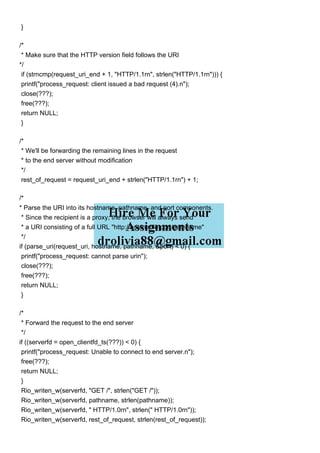
/*
* Make sure that the HTTP version field follows the URI
*/
if (strncmp(request_uri_end + 1, "HTTP/1.1rn", strlen("HTTP/1.1rn"))) {
printf("process_request: client issued a bad request (4).n");
close(???);
free(???);
return NULL;
}
/*
* We'll be forwarding the remaining lines in the request
* to the end server without modification
*/
rest_of_request = request_uri_end + strlen("HTTP/1.1rn") + 1;
/*
* Parse the URI into its hostname, pathname, and port components.
* Since the recipient is a proxy, the browser will always send
* a URI consisting of a full URL "http://hostname:port/pathname"
*/
if (parse_uri(request_uri, hostname, pathname, &port) < 0) {
printf("process_request: cannot parse urin");
close(???);
free(???);
return NULL;
}
/*
* Forward the request to the end server
*/
if ((serverfd = open_clientfd_ts(???)) < 0) {
printf("process_request: Unable to connect to end server.n");
free(???);
return NULL;
}
Rio_writen_w(serverfd, "GET /", strlen("GET /"));
Rio_writen_w(serverfd, pathname, strlen(pathname));
Rio_writen_w(serverfd, " HTTP/1.0rn", strlen(" HTTP/1.0rn"));
Rio_writen_w(serverfd, rest_of_request, strlen(rest_of_request));
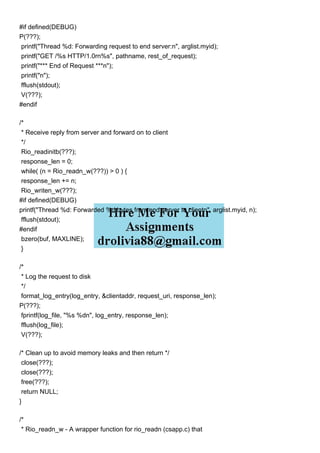
#if defined(DEBUG)
P(???);
printf("Thread %d: Forwarding request to end server:n", arglist.myid);
printf("GET /%s HTTP/1.0rn%s", pathname, rest_of_request);
printf("*** End of Request ***n");
printf("n");
fflush(stdout);
V(???);
#endif
/*
* Receive reply from server and forward on to client
*/
Rio_readinitb(???);
response_len = 0;
while( (n = Rio_readn_w(???)) > 0 ) {
response_len += n;
Rio_writen_w(???);
#if defined(DEBUG)
printf("Thread %d: Forwarded %d bytes from end server to clientn", arglist.myid, n);
fflush(stdout);
#endif
bzero(buf, MAXLINE);
}
/*
* Log the request to disk
*/
format_log_entry(log_entry, &clientaddr, request_uri, response_len);
P(???);
fprintf(log_file, "%s %dn", log_entry, response_len);
fflush(log_file);
V(???);
/* Clean up to avoid memory leaks and then return */
close(???);
close(???);
free(???);
return NULL;
}
/*
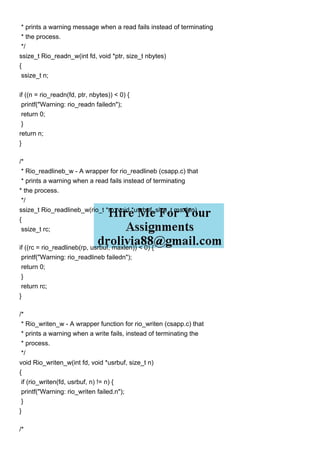
* Rio_readn_w - A wrapper function for rio_readn (csapp.c) that
* prints a warning message when a read fails instead of terminating
* the process.
*/
ssize_t Rio_readn_w(int fd, void *ptr, size_t nbytes)
{
ssize_t n;
if ((n = rio_readn(fd, ptr, nbytes)) < 0) {
printf("Warning: rio_readn failedn");
return 0;
}
return n;
}
/*
* Rio_readlineb_w - A wrapper for rio_readlineb (csapp.c) that
* prints a warning when a read fails instead of terminating
* the process.
*/
ssize_t Rio_readlineb_w(rio_t *rp, void *usrbuf, size_t maxlen)
{
ssize_t rc;
if ((rc = rio_readlineb(rp, usrbuf, maxlen)) < 0) {
printf("Warning: rio_readlineb failedn");
return 0;
}
return rc;
}
/*
* Rio_writen_w - A wrapper function for rio_writen (csapp.c) that
* prints a warning when a write fails, instead of terminating the
* process.
*/
void Rio_writen_w(int fd, void *usrbuf, size_t n)
{
if (rio_writen(fd, usrbuf, n) != n) {
printf("Warning: rio_writen failed.n");
}
}
/*
* open_clientfd_ts - A thread safe version of the open_clientfd
* function (csapp.c) that uses the lock-and-copy technique to deal
* with the Class 3 thread unsafe gethostbyname function.
*/
int open_clientfd_ts(char *hostname, int port, sem_t *mutexp)
{
int clientfd;
struct hostent hostent, *hp = &hostent;
struct hostent *temp_hp;
struct sockaddr_in serveraddr;
if ((clientfd = socket(AF_INET, SOCK_STREAM, 0)) < 0)
return -1; /* check errno for cause of error */
/* Use lock-and-copy to keep this function thread safe */
P(???); /* lock */
temp_hp = gethostbyname(hostname);
if (temp_hp != NULL)
hostent = *temp_hp; /* copy */
V(???);
/* Fill in the server's IP address and port */
if (temp_hp == NULL)
return -2; /* check h_errno for cause of error */
bzero((char *) &serveraddr, sizeof(serveraddr));
serveraddr.sin_family = AF_INET;
bcopy((char *)hp->h_addr,
(char *)&serveraddr.sin_addr.s_addr, hp->h_length);
serveraddr.sin_port = htons(port);
/* Establish a connection with the server */
if (connect(clientfd, (SA *) &serveraddr, sizeof(serveraddr)) < 0)
return -1;
return clientfd;
}
/*
* parse_uri - URI parser
*
* Given a URI from an HTTP proxy GET request (i.e., a URL), extract
* the host name, path name, and port. The memory for hostname and
* pathname must already be allocated and should be at least MAXLINE
* bytes. Return -1 if there are any problems.
*/
int parse_uri(char *uri, char *hostname, char *pathname, int *port)
{
char *hostbegin;
char *hostend;
char *pathbegin;
int len;
if (strncasecmp(uri, "http://", 7) != 0) {
hostname[0] = '0';
return -1;
}
/* Extract the host name */
hostbegin = uri + 7;
hostend = strpbrk(hostbegin, " :/rn0");
len = hostend - hostbegin;
strncpy(hostname, hostbegin, len);
hostname[len] = '0';
/* Extract the port number */
*port = 80; /* default */
if (*hostend == ':')
*port = atoi(hostend + 1);
/* Extract the path */
pathbegin = strchr(hostbegin, '/');
if (pathbegin == NULL) {
pathname[0] = '0';
}
else {
pathbegin++;
strcpy(pathname, pathbegin);
}
return 0;
}
/*
* format_log_entry - Create a formatted log entry in logstring.
*
* The inputs are the socket address of the requesting client
* (sockaddr), the URI from the request (uri), and the size in bytes
* of the response from the server (size).
*/
void format_log_entry(char *logstring, struct sockaddr_in *sockaddr,
char *uri, int size)
{
time_t now;
char time_str[MAXLINE];
unsigned long host;
unsigned char a, b, c, d;
/* Get a formatted time string */
now = time(NULL);
strftime(time_str, MAXLINE, "%a %d %b %Y %H:%M:%S %Z", localtime(&now));
/*
* Convert the IP address in network byte order to dotted decimal
* form. Note that we could have used inet_ntoa, but chose not to
* because inet_ntoa is a Class 3 thread unsafe function that
* returns a pointer to a static variable (Ch 13, CS:APP).
*/
host = ntohl(sockaddr->sin_addr.s_addr);
a = host >> 24;
b = (host >> 16) & 0xff;
c = (host >> 8) & 0xff;
d = host & 0xff;
/* Return the formatted log entry string */
sprintf(logstring, "%s: %d.%d.%d.%d %s", time_str, a, b, c, d, uri);
}
*
* proxy.c - CS:APP Web proxy
*
* NAME:
*
* IMPORTANT: Give a high level description of your code here.
*/
#include "csapp.h"
/* The name of the proxy's log file */
#define PROXY_LOG "proxy.log"
/* Undefine this if you don't want debugging output */
#define DEBUG
/*
* This struct remembers some key attributes of an HTTP request and
* the thread that is processing it.
*/
typedef struct {
int myid; /* used to identify threads in debug messages */
int connfd; /* Connected file descriptor */
struct sockaddr_in clientaddr; /* Client IP address */
} arglist_t;
/*
* Globals
*/
FILE *log_file; /* Log file with one line per HTTP request */
sem_t mutex; /* Semaphore for when mutual exclusion is needed */
/*
* Functions needed
*/
void *process_request(void* vargp);
int open_clientfd_ts(char *hostname, int port, sem_t *mutexp);
ssize_t Rio_readn_w(int fd, void *ptr, size_t nbytes);
ssize_t Rio_readlineb_w(rio_t *rp, void *usrbuf, size_t maxlen);
void Rio_writen_w(int fd, void *usrbuf, size_t n);
int parse_uri(char *uri, char *target_addr, char *path, int *port);
void format_log_entry(char *logstring, struct sockaddr_in *sockaddr, char *uri, int size);
/*
* main - Main routine for the proxy program
*/
int main(int argc, char **argv)
{
int listenfd; /* proxy's listening descriptor */
int port; /* port the proxy is listening on */
pthread_t tid; /* Pthread thread id */
int clientlen; /* Size in bytes of the client socket address */
arglist_t *argp = NULL; /* Argument struct passed to a thread */
int request_count = 0; /* Number of requests received so far */
/* Check arguments */
if (argc != 2) {
fprintf(stderr, "Usage: %s <port number>n", argv[0]);
exit(0);
}
/*
* Ignore any SIGPIPE signals elicited by writing to a connection
* that has already been closed by the peer process.
*/
signal(???);
/* Create a listening descriptor */
port = atoi(???);
listenfd = Open_listenfd(port);
/* Inititialize */
log_file = Fopen(PROXY_LOG, "a");
Sem_init(???); /* mutex = 1 initially */
/* Wait for and process client connections */
while (1) {
argp = (arglist_t *)Malloc(sizeof(arglist_t));
clientlen = sizeof(argp->clientaddr);
argp->connfd =
Accept(???);
/* Start a new thread to process the HTTP request */
argp->myid = request_count++;
pthread_create(???);
}
/* Control never reaches here */
exit(0);
}
/*
* process_request - Thread routine.
*
* Each thread reads an HTTP request from a client, forwards it to the
* end server (always as a simple HTTP/1.0 request), waits for the
* response, and then forwards it back to the client.
*
* Note: this function is longer than usual, but
* having everything in one function greatly simplifies error
* handling, in particualar cleaning up after errors so as to avoid
* memory leaks.
*/
void *process_request(void *vargp)
{
arglist_t arglist; /* Arg list passed into thread */
struct sockaddr_in clientaddr; /* Client socket address */
int connfd; /* Socket descriptor for talking with client */
int serverfd; /* Socket descriptor for talking with end server */
char *request; /* HTTP request from client */
char *request_uri; /* Start of URI in first HTTP request header line */
char *request_uri_end; /* End of URI in first HTTP request header line */
char *rest_of_request; /* Beginning of second HTTP request header line */
int request_len; /* Total size of HTTP request */
int response_len; /* Total size in bytes of response from end server */
int i, n; /* General index and counting variables */
int realloc_factor; /* Used to increase size of request buffer if necessary */
char hostname[MAXLINE]; /* Hostname extracted from request URI */
char pathname[MAXLINE]; /* Content pathname extracted from request URI */
int port; /* Port number extracted from request URI (default 80) */
char log_entry[MAXLINE]; /* Formatted log entry */
rio_t rio; /* Rio buffer for calls to buffered rio_readlineb routine */
char buf[MAXLINE]; /* General I/O buffer */
/* Do some initial setup */
arglist = *((arglist_t *)vargp); /* Copy the arguments onto the stack */
connfd = arglist.connfd; /* Put connfd and clientaddr in scalars for convenience */
clientaddr = arglist.clientaddr;
Pthread_detach(???); /* Detach the thread */
Free(???); /* Free up the arguments */
/*
* Read the entire HTTP request into the request buffer, one line
* at a time.
*/
request = (char *)Malloc(MAXLINE);
request[0] = '0';
realloc_factor = 2;
request_len = 0;
Rio_readinitb(???);
while (1) {
if ((n = Rio_readlineb_w(???)) <= 0) {
printf("process_request: client issued a bad request (1).n");
close(???);
free(???);
return NULL;
}
/* If not enough room in request buffer, make more room */
if (request_len + n + 1 > MAXLINE)
Realloc(request, MAXLINE*realloc_factor++);
strcat(request, buf);
request_len += n;
/* An HTTP requests is always terminated by a blank line */
if (strcmp(buf, "rn") == 0)
break;
}
#if defined(DEBUG)
{
struct hostent *hp;
char *haddrp;
P(???);
hp = Gethostbyaddr((char *)&clientaddr.sin_addr.s_addr,
sizeof(clientaddr.sin_addr.s_addr),
AF_INET);
haddrp = inet_ntoa(clientaddr.sin_addr);
printf("Thread %d: Received request from %s (%s):n", arglist.myid,
hp->h_name, haddrp);
printf("%s", request);
printf("*** End of Request ***n");
printf("n");
fflush(stdout);
V(???);
}
#endif
/*
* Make sure that this is indeed a GET request
*/
if (strncmp(request, "GET ", strlen("GET "))) {
printf("process_request: Received non-GET requestn");
close(???);
free(???);
return NULL;
}
request_uri = request + 4;
/*
* Extract the URI from the request
*/
request_uri_end = NULL;
for (i = 0; i < request_len; i++) {
if (request_uri[i] == ' ') {
request_uri[i] = '0';
request_uri_end = &request_uri[i];
break;
}
}
/*
* If we hit the end of the request without encountering a
* terminating blank, then there is something screwy with the
* request
*/
if ( i == request_len ) {
printf("process_request: Couldn't find the end of the URIn");
close(???);
free(???);
return NULL;
}
/*
* Make sure that the HTTP version field follows the URI
*/
if (strncmp(request_uri_end + 1, "HTTP/1.1rn", strlen("HTTP/1.1rn"))) {
printf("process_request: client issued a bad request (4).n");
close(???);
free(???);
return NULL;
}
/*
* We'll be forwarding the remaining lines in the request
* to the end server without modification
*/
rest_of_request = request_uri_end + strlen("HTTP/1.1rn") + 1;
/*
* Parse the URI into its hostname, pathname, and port components.
* Since the recipient is a proxy, the browser will always send
* a URI consisting of a full URL "http://hostname:port/pathname"
*/
if (parse_uri(request_uri, hostname, pathname, &port) < 0) {
printf("process_request: cannot parse urin");
close(???);
free(???);
return NULL;
}
/*
* Forward the request to the end server
*/
if ((serverfd = open_clientfd_ts(???)) < 0) {
printf("process_request: Unable to connect to end server.n");
free(???);
return NULL;
}
Rio_writen_w(serverfd, "GET /", strlen("GET /"));
Rio_writen_w(serverfd, pathname, strlen(pathname));
Rio_writen_w(serverfd, " HTTP/1.0rn", strlen(" HTTP/1.0rn"));
Rio_writen_w(serverfd, rest_of_request, strlen(rest_of_request));
#if defined(DEBUG)
P(???);
printf("Thread %d: Forwarding request to end server:n", arglist.myid);
printf("GET /%s HTTP/1.0rn%s", pathname, rest_of_request);
printf("*** End of Request ***n");
printf("n");
fflush(stdout);
V(???);
#endif
/*
* Receive reply from server and forward on to client
*/
Rio_readinitb(???);
response_len = 0;
while( (n = Rio_readn_w(???)) > 0 ) {
response_len += n;
Rio_writen_w(???);
#if defined(DEBUG)
printf("Thread %d: Forwarded %d bytes from end server to clientn", arglist.myid, n);
fflush(stdout);
#endif
bzero(buf, MAXLINE);
}
/*
* Log the request to disk
*/
format_log_entry(log_entry, &clientaddr, request_uri, response_len);
P(???);
fprintf(log_file, "%s %dn", log_entry, response_len);
fflush(log_file);
V(???);
/* Clean up to avoid memory leaks and then return */
close(???);
close(???);
free(???);
return NULL;
}
/*
* Rio_readn_w - A wrapper function for rio_readn (csapp.c) that
* prints a warning message when a read fails instead of terminating
* the process.
*/
ssize_t Rio_readn_w(int fd, void *ptr, size_t nbytes)
{
ssize_t n;
if ((n = rio_readn(fd, ptr, nbytes)) < 0) {
printf("Warning: rio_readn failedn");
return 0;
}
return n;
}
/*
* Rio_readlineb_w - A wrapper for rio_readlineb (csapp.c) that
* prints a warning when a read fails instead of terminating
* the process.
*/
ssize_t Rio_readlineb_w(rio_t *rp, void *usrbuf, size_t maxlen)
{
ssize_t rc;
if ((rc = rio_readlineb(rp, usrbuf, maxlen)) < 0) {
printf("Warning: rio_readlineb failedn");
return 0;
}
return rc;
}
/*
* Rio_writen_w - A wrapper function for rio_writen (csapp.c) that
* prints a warning when a write fails, instead of terminating the
* process.
*/
void Rio_writen_w(int fd, void *usrbuf, size_t n)
{
if (rio_writen(fd, usrbuf, n) != n) {
printf("Warning: rio_writen failed.n");
}
}
/*
* open_clientfd_ts - A thread safe version of the open_clientfd
* function (csapp.c) that uses the lock-and-copy technique to deal
* with the Class 3 thread unsafe gethostbyname function.
*/
int open_clientfd_ts(char *hostname, int port, sem_t *mutexp)
{
int clientfd;
struct hostent hostent, *hp = &hostent;
struct hostent *temp_hp;
struct sockaddr_in serveraddr;
if ((clientfd = socket(AF_INET, SOCK_STREAM, 0)) < 0)
return -1; /* check errno for cause of error */
/* Use lock-and-copy to keep this function thread safe */
P(???); /* lock */
temp_hp = gethostbyname(hostname);
if (temp_hp != NULL)
hostent = *temp_hp; /* copy */
V(???);
/* Fill in the server's IP address and port */
if (temp_hp == NULL)
return -2; /* check h_errno for cause of error */
bzero((char *) &serveraddr, sizeof(serveraddr));
serveraddr.sin_family = AF_INET;
bcopy((char *)hp->h_addr,
(char *)&serveraddr.sin_addr.s_addr, hp->h_length);
serveraddr.sin_port = htons(port);
/* Establish a connection with the server */
if (connect(clientfd, (SA *) &serveraddr, sizeof(serveraddr)) < 0)
return -1;
return clientfd;
}
/*
* parse_uri - URI parser
*
* Given a URI from an HTTP proxy GET request (i.e., a URL), extract
* the host name, path name, and port. The memory for hostname and
* pathname must already be allocated and should be at least MAXLINE
* bytes. Return -1 if there are any problems.
*/
int parse_uri(char *uri, char *hostname, char *pathname, int *port)
{
char *hostbegin;
char *hostend;
char *pathbegin;
int len;
if (strncasecmp(uri, "http://", 7) != 0) {
hostname[0] = '0';
return -1;
}
/* Extract the host name */
hostbegin = uri + 7;
hostend = strpbrk(hostbegin, " :/rn0");
len = hostend - hostbegin;
strncpy(hostname, hostbegin, len);
hostname[len] = '0';
/* Extract the port number */
*port = 80; /* default */
if (*hostend == ':')
*port = atoi(hostend + 1);
/* Extract the path */
pathbegin = strchr(hostbegin, '/');
if (pathbegin == NULL) {
pathname[0] = '0';
}
else {
pathbegin++;
strcpy(pathname, pathbegin);
}
return 0;
}
/*
* format_log_entry - Create a formatted log entry in logstring.
*
* The inputs are the socket address of the requesting client
* (sockaddr), the URI from the request (uri), and the size in bytes
* of the response from the server (size).
*/
void format_log_entry(char *logstring, struct sockaddr_in *sockaddr,
char *uri, int size)
{
time_t now;
char time_str[MAXLINE];
unsigned long host;
unsigned char a, b, c, d;
/* Get a formatted time string */
now = time(NULL);
strftime(time_str, MAXLINE, "%a %d %b %Y %H:%M:%S %Z", localtime(&now));
/*
* Convert the IP address in network byte order to dotted decimal
* form. Note that we could have used inet_ntoa, but chose not to
* because inet_ntoa is a Class 3 thread unsafe function that
* returns a pointer to a static variable (Ch 13, CS:APP).
*/
host = ntohl(sockaddr->sin_addr.s_addr);
a = host >> 24;
b = (host >> 16) & 0xff;
c = (host >> 8) & 0xff;
d = host & 0xff;
/* Return the formatted log entry string */
sprintf(logstring, "%s: %d.%d.%d.%d %s", time_str, a, b, c, d, uri);
}

proxyc CSAPP Web proxy NAME IMPORTANT Giv.pdf

  • 1.
    * * proxy.c -CS:APP Web proxy * * NAME: * * IMPORTANT: Give a high level description of your code here. */ #include "csapp.h" /* The name of the proxy's log file */ #define PROXY_LOG "proxy.log" /* Undefine this if you don't want debugging output */ #define DEBUG /* * This struct remembers some key attributes of an HTTP request and * the thread that is processing it. */ typedef struct { int myid; /* used to identify threads in debug messages */ int connfd; /* Connected file descriptor */ struct sockaddr_in clientaddr; /* Client IP address */ } arglist_t; /* * Globals */ FILE *log_file; /* Log file with one line per HTTP request */ sem_t mutex; /* Semaphore for when mutual exclusion is needed */ /* * Functions needed */ void *process_request(void* vargp); int open_clientfd_ts(char *hostname, int port, sem_t *mutexp); ssize_t Rio_readn_w(int fd, void *ptr, size_t nbytes); ssize_t Rio_readlineb_w(rio_t *rp, void *usrbuf, size_t maxlen); void Rio_writen_w(int fd, void *usrbuf, size_t n); int parse_uri(char *uri, char *target_addr, char *path, int *port); void format_log_entry(char *logstring, struct sockaddr_in *sockaddr, char *uri, int size);
  • 2.
    /* * main -Main routine for the proxy program */ int main(int argc, char **argv) { int listenfd; /* proxy's listening descriptor */ int port; /* port the proxy is listening on */ pthread_t tid; /* Pthread thread id */ int clientlen; /* Size in bytes of the client socket address */ arglist_t *argp = NULL; /* Argument struct passed to a thread */ int request_count = 0; /* Number of requests received so far */ /* Check arguments */ if (argc != 2) { fprintf(stderr, "Usage: %s <port number>n", argv[0]); exit(0); } /* * Ignore any SIGPIPE signals elicited by writing to a connection * that has already been closed by the peer process. */ signal(???); /* Create a listening descriptor */ port = atoi(???); listenfd = Open_listenfd(port); /* Inititialize */ log_file = Fopen(PROXY_LOG, "a"); Sem_init(???); /* mutex = 1 initially */ /* Wait for and process client connections */ while (1) { argp = (arglist_t *)Malloc(sizeof(arglist_t)); clientlen = sizeof(argp->clientaddr); argp->connfd = Accept(???); /* Start a new thread to process the HTTP request */ argp->myid = request_count++; pthread_create(???); }
  • 3.
    /* Control neverreaches here */ exit(0); } /* * process_request - Thread routine. * * Each thread reads an HTTP request from a client, forwards it to the * end server (always as a simple HTTP/1.0 request), waits for the * response, and then forwards it back to the client. * * Note: this function is longer than usual, but * having everything in one function greatly simplifies error * handling, in particualar cleaning up after errors so as to avoid * memory leaks. */ void *process_request(void *vargp) { arglist_t arglist; /* Arg list passed into thread */ struct sockaddr_in clientaddr; /* Client socket address */ int connfd; /* Socket descriptor for talking with client */ int serverfd; /* Socket descriptor for talking with end server */ char *request; /* HTTP request from client */ char *request_uri; /* Start of URI in first HTTP request header line */ char *request_uri_end; /* End of URI in first HTTP request header line */ char *rest_of_request; /* Beginning of second HTTP request header line */ int request_len; /* Total size of HTTP request */ int response_len; /* Total size in bytes of response from end server */ int i, n; /* General index and counting variables */ int realloc_factor; /* Used to increase size of request buffer if necessary */ char hostname[MAXLINE]; /* Hostname extracted from request URI */ char pathname[MAXLINE]; /* Content pathname extracted from request URI */ int port; /* Port number extracted from request URI (default 80) */ char log_entry[MAXLINE]; /* Formatted log entry */ rio_t rio; /* Rio buffer for calls to buffered rio_readlineb routine */ char buf[MAXLINE]; /* General I/O buffer */ /* Do some initial setup */ arglist = *((arglist_t *)vargp); /* Copy the arguments onto the stack */ connfd = arglist.connfd; /* Put connfd and clientaddr in scalars for convenience */
  • 4.
    clientaddr = arglist.clientaddr; Pthread_detach(???);/* Detach the thread */ Free(???); /* Free up the arguments */ /* * Read the entire HTTP request into the request buffer, one line * at a time. */ request = (char *)Malloc(MAXLINE); request[0] = '0'; realloc_factor = 2; request_len = 0; Rio_readinitb(???); while (1) { if ((n = Rio_readlineb_w(???)) <= 0) { printf("process_request: client issued a bad request (1).n"); close(???); free(???); return NULL; } /* If not enough room in request buffer, make more room */ if (request_len + n + 1 > MAXLINE) Realloc(request, MAXLINE*realloc_factor++); strcat(request, buf); request_len += n; /* An HTTP requests is always terminated by a blank line */ if (strcmp(buf, "rn") == 0) break; } #if defined(DEBUG) { struct hostent *hp; char *haddrp; P(???); hp = Gethostbyaddr((char *)&clientaddr.sin_addr.s_addr, sizeof(clientaddr.sin_addr.s_addr), AF_INET); haddrp = inet_ntoa(clientaddr.sin_addr);
  • 5.
    printf("Thread %d: Receivedrequest from %s (%s):n", arglist.myid, hp->h_name, haddrp); printf("%s", request); printf("*** End of Request ***n"); printf("n"); fflush(stdout); V(???); } #endif /* * Make sure that this is indeed a GET request */ if (strncmp(request, "GET ", strlen("GET "))) { printf("process_request: Received non-GET requestn"); close(???); free(???); return NULL; } request_uri = request + 4; /* * Extract the URI from the request */ request_uri_end = NULL; for (i = 0; i < request_len; i++) { if (request_uri[i] == ' ') { request_uri[i] = '0'; request_uri_end = &request_uri[i]; break; } } /* * If we hit the end of the request without encountering a * terminating blank, then there is something screwy with the * request */ if ( i == request_len ) { printf("process_request: Couldn't find the end of the URIn"); close(???); free(???); return NULL;
  • 6.
    } /* * Make surethat the HTTP version field follows the URI */ if (strncmp(request_uri_end + 1, "HTTP/1.1rn", strlen("HTTP/1.1rn"))) { printf("process_request: client issued a bad request (4).n"); close(???); free(???); return NULL; } /* * We'll be forwarding the remaining lines in the request * to the end server without modification */ rest_of_request = request_uri_end + strlen("HTTP/1.1rn") + 1; /* * Parse the URI into its hostname, pathname, and port components. * Since the recipient is a proxy, the browser will always send * a URI consisting of a full URL "http://hostname:port/pathname" */ if (parse_uri(request_uri, hostname, pathname, &port) < 0) { printf("process_request: cannot parse urin"); close(???); free(???); return NULL; } /* * Forward the request to the end server */ if ((serverfd = open_clientfd_ts(???)) < 0) { printf("process_request: Unable to connect to end server.n"); free(???); return NULL; } Rio_writen_w(serverfd, "GET /", strlen("GET /")); Rio_writen_w(serverfd, pathname, strlen(pathname)); Rio_writen_w(serverfd, " HTTP/1.0rn", strlen(" HTTP/1.0rn")); Rio_writen_w(serverfd, rest_of_request, strlen(rest_of_request));
  • 7.
    #if defined(DEBUG) P(???); printf("Thread %d:Forwarding request to end server:n", arglist.myid); printf("GET /%s HTTP/1.0rn%s", pathname, rest_of_request); printf("*** End of Request ***n"); printf("n"); fflush(stdout); V(???); #endif /* * Receive reply from server and forward on to client */ Rio_readinitb(???); response_len = 0; while( (n = Rio_readn_w(???)) > 0 ) { response_len += n; Rio_writen_w(???); #if defined(DEBUG) printf("Thread %d: Forwarded %d bytes from end server to clientn", arglist.myid, n); fflush(stdout); #endif bzero(buf, MAXLINE); } /* * Log the request to disk */ format_log_entry(log_entry, &clientaddr, request_uri, response_len); P(???); fprintf(log_file, "%s %dn", log_entry, response_len); fflush(log_file); V(???); /* Clean up to avoid memory leaks and then return */ close(???); close(???); free(???); return NULL; } /* * Rio_readn_w - A wrapper function for rio_readn (csapp.c) that
  • 8.
    * prints awarning message when a read fails instead of terminating * the process. */ ssize_t Rio_readn_w(int fd, void *ptr, size_t nbytes) { ssize_t n; if ((n = rio_readn(fd, ptr, nbytes)) < 0) { printf("Warning: rio_readn failedn"); return 0; } return n; } /* * Rio_readlineb_w - A wrapper for rio_readlineb (csapp.c) that * prints a warning when a read fails instead of terminating * the process. */ ssize_t Rio_readlineb_w(rio_t *rp, void *usrbuf, size_t maxlen) { ssize_t rc; if ((rc = rio_readlineb(rp, usrbuf, maxlen)) < 0) { printf("Warning: rio_readlineb failedn"); return 0; } return rc; } /* * Rio_writen_w - A wrapper function for rio_writen (csapp.c) that * prints a warning when a write fails, instead of terminating the * process. */ void Rio_writen_w(int fd, void *usrbuf, size_t n) { if (rio_writen(fd, usrbuf, n) != n) { printf("Warning: rio_writen failed.n"); } } /*
  • 9.
    * open_clientfd_ts -A thread safe version of the open_clientfd * function (csapp.c) that uses the lock-and-copy technique to deal * with the Class 3 thread unsafe gethostbyname function. */ int open_clientfd_ts(char *hostname, int port, sem_t *mutexp) { int clientfd; struct hostent hostent, *hp = &hostent; struct hostent *temp_hp; struct sockaddr_in serveraddr; if ((clientfd = socket(AF_INET, SOCK_STREAM, 0)) < 0) return -1; /* check errno for cause of error */ /* Use lock-and-copy to keep this function thread safe */ P(???); /* lock */ temp_hp = gethostbyname(hostname); if (temp_hp != NULL) hostent = *temp_hp; /* copy */ V(???); /* Fill in the server's IP address and port */ if (temp_hp == NULL) return -2; /* check h_errno for cause of error */ bzero((char *) &serveraddr, sizeof(serveraddr)); serveraddr.sin_family = AF_INET; bcopy((char *)hp->h_addr, (char *)&serveraddr.sin_addr.s_addr, hp->h_length); serveraddr.sin_port = htons(port); /* Establish a connection with the server */ if (connect(clientfd, (SA *) &serveraddr, sizeof(serveraddr)) < 0) return -1; return clientfd; } /* * parse_uri - URI parser * * Given a URI from an HTTP proxy GET request (i.e., a URL), extract * the host name, path name, and port. The memory for hostname and * pathname must already be allocated and should be at least MAXLINE * bytes. Return -1 if there are any problems.
  • 10.
    */ int parse_uri(char *uri,char *hostname, char *pathname, int *port) { char *hostbegin; char *hostend; char *pathbegin; int len; if (strncasecmp(uri, "http://", 7) != 0) { hostname[0] = '0'; return -1; } /* Extract the host name */ hostbegin = uri + 7; hostend = strpbrk(hostbegin, " :/rn0"); len = hostend - hostbegin; strncpy(hostname, hostbegin, len); hostname[len] = '0'; /* Extract the port number */ *port = 80; /* default */ if (*hostend == ':') *port = atoi(hostend + 1); /* Extract the path */ pathbegin = strchr(hostbegin, '/'); if (pathbegin == NULL) { pathname[0] = '0'; } else { pathbegin++; strcpy(pathname, pathbegin); } return 0; } /* * format_log_entry - Create a formatted log entry in logstring. * * The inputs are the socket address of the requesting client * (sockaddr), the URI from the request (uri), and the size in bytes
  • 11.
    * of theresponse from the server (size). */ void format_log_entry(char *logstring, struct sockaddr_in *sockaddr, char *uri, int size) { time_t now; char time_str[MAXLINE]; unsigned long host; unsigned char a, b, c, d; /* Get a formatted time string */ now = time(NULL); strftime(time_str, MAXLINE, "%a %d %b %Y %H:%M:%S %Z", localtime(&now)); /* * Convert the IP address in network byte order to dotted decimal * form. Note that we could have used inet_ntoa, but chose not to * because inet_ntoa is a Class 3 thread unsafe function that * returns a pointer to a static variable (Ch 13, CS:APP). */ host = ntohl(sockaddr->sin_addr.s_addr); a = host >> 24; b = (host >> 16) & 0xff; c = (host >> 8) & 0xff; d = host & 0xff; /* Return the formatted log entry string */ sprintf(logstring, "%s: %d.%d.%d.%d %s", time_str, a, b, c, d, uri); } * * proxy.c - CS:APP Web proxy * * NAME: * * IMPORTANT: Give a high level description of your code here. */
  • 12.
    #include "csapp.h" /* Thename of the proxy's log file */ #define PROXY_LOG "proxy.log" /* Undefine this if you don't want debugging output */ #define DEBUG /* * This struct remembers some key attributes of an HTTP request and * the thread that is processing it. */ typedef struct { int myid; /* used to identify threads in debug messages */ int connfd; /* Connected file descriptor */ struct sockaddr_in clientaddr; /* Client IP address */ } arglist_t; /* * Globals */ FILE *log_file; /* Log file with one line per HTTP request */ sem_t mutex; /* Semaphore for when mutual exclusion is needed */ /*
  • 13.
    * Functions needed */ void*process_request(void* vargp); int open_clientfd_ts(char *hostname, int port, sem_t *mutexp); ssize_t Rio_readn_w(int fd, void *ptr, size_t nbytes); ssize_t Rio_readlineb_w(rio_t *rp, void *usrbuf, size_t maxlen); void Rio_writen_w(int fd, void *usrbuf, size_t n); int parse_uri(char *uri, char *target_addr, char *path, int *port); void format_log_entry(char *logstring, struct sockaddr_in *sockaddr, char *uri, int size); /* * main - Main routine for the proxy program */ int main(int argc, char **argv) { int listenfd; /* proxy's listening descriptor */ int port; /* port the proxy is listening on */ pthread_t tid; /* Pthread thread id */ int clientlen; /* Size in bytes of the client socket address */ arglist_t *argp = NULL; /* Argument struct passed to a thread */ int request_count = 0; /* Number of requests received so far */ /* Check arguments */ if (argc != 2) { fprintf(stderr, "Usage: %s <port number>n", argv[0]);
  • 14.
    exit(0); } /* * Ignore anySIGPIPE signals elicited by writing to a connection * that has already been closed by the peer process. */ signal(???); /* Create a listening descriptor */ port = atoi(???); listenfd = Open_listenfd(port); /* Inititialize */ log_file = Fopen(PROXY_LOG, "a"); Sem_init(???); /* mutex = 1 initially */ /* Wait for and process client connections */ while (1) { argp = (arglist_t *)Malloc(sizeof(arglist_t)); clientlen = sizeof(argp->clientaddr); argp->connfd = Accept(???); /* Start a new thread to process the HTTP request */ argp->myid = request_count++;
  • 15.
    pthread_create(???); } /* Control neverreaches here */ exit(0); } /* * process_request - Thread routine. * * Each thread reads an HTTP request from a client, forwards it to the * end server (always as a simple HTTP/1.0 request), waits for the * response, and then forwards it back to the client. * * Note: this function is longer than usual, but * having everything in one function greatly simplifies error * handling, in particualar cleaning up after errors so as to avoid * memory leaks. */ void *process_request(void *vargp) { arglist_t arglist; /* Arg list passed into thread */ struct sockaddr_in clientaddr; /* Client socket address */ int connfd; /* Socket descriptor for talking with client */ int serverfd; /* Socket descriptor for talking with end server */
  • 16.
    char *request; /*HTTP request from client */ char *request_uri; /* Start of URI in first HTTP request header line */ char *request_uri_end; /* End of URI in first HTTP request header line */ char *rest_of_request; /* Beginning of second HTTP request header line */ int request_len; /* Total size of HTTP request */ int response_len; /* Total size in bytes of response from end server */ int i, n; /* General index and counting variables */ int realloc_factor; /* Used to increase size of request buffer if necessary */ char hostname[MAXLINE]; /* Hostname extracted from request URI */ char pathname[MAXLINE]; /* Content pathname extracted from request URI */ int port; /* Port number extracted from request URI (default 80) */ char log_entry[MAXLINE]; /* Formatted log entry */ rio_t rio; /* Rio buffer for calls to buffered rio_readlineb routine */ char buf[MAXLINE]; /* General I/O buffer */ /* Do some initial setup */ arglist = *((arglist_t *)vargp); /* Copy the arguments onto the stack */ connfd = arglist.connfd; /* Put connfd and clientaddr in scalars for convenience */ clientaddr = arglist.clientaddr; Pthread_detach(???); /* Detach the thread */ Free(???); /* Free up the arguments */ /* * Read the entire HTTP request into the request buffer, one line
  • 17.
    * at atime. */ request = (char *)Malloc(MAXLINE); request[0] = '0'; realloc_factor = 2; request_len = 0; Rio_readinitb(???); while (1) { if ((n = Rio_readlineb_w(???)) <= 0) { printf("process_request: client issued a bad request (1).n"); close(???); free(???); return NULL; } /* If not enough room in request buffer, make more room */ if (request_len + n + 1 > MAXLINE) Realloc(request, MAXLINE*realloc_factor++); strcat(request, buf); request_len += n; /* An HTTP requests is always terminated by a blank line */
  • 18.
    if (strcmp(buf, "rn")== 0) break; } #if defined(DEBUG) { struct hostent *hp; char *haddrp; P(???); hp = Gethostbyaddr((char *)&clientaddr.sin_addr.s_addr, sizeof(clientaddr.sin_addr.s_addr), AF_INET); haddrp = inet_ntoa(clientaddr.sin_addr); printf("Thread %d: Received request from %s (%s):n", arglist.myid, hp->h_name, haddrp); printf("%s", request); printf("*** End of Request ***n"); printf("n"); fflush(stdout); V(???); } #endif
  • 19.
    /* * Make surethat this is indeed a GET request */ if (strncmp(request, "GET ", strlen("GET "))) { printf("process_request: Received non-GET requestn"); close(???); free(???); return NULL; } request_uri = request + 4; /* * Extract the URI from the request */ request_uri_end = NULL; for (i = 0; i < request_len; i++) { if (request_uri[i] == ' ') { request_uri[i] = '0'; request_uri_end = &request_uri[i]; break; } } /*
  • 20.
    * If wehit the end of the request without encountering a * terminating blank, then there is something screwy with the * request */ if ( i == request_len ) { printf("process_request: Couldn't find the end of the URIn"); close(???); free(???); return NULL; } /* * Make sure that the HTTP version field follows the URI */ if (strncmp(request_uri_end + 1, "HTTP/1.1rn", strlen("HTTP/1.1rn"))) { printf("process_request: client issued a bad request (4).n"); close(???); free(???); return NULL; } /* * We'll be forwarding the remaining lines in the request
  • 21.
    * to theend server without modification */ rest_of_request = request_uri_end + strlen("HTTP/1.1rn") + 1; /* * Parse the URI into its hostname, pathname, and port components. * Since the recipient is a proxy, the browser will always send * a URI consisting of a full URL "http://hostname:port/pathname" */ if (parse_uri(request_uri, hostname, pathname, &port) < 0) { printf("process_request: cannot parse urin"); close(???); free(???); return NULL; } /* * Forward the request to the end server */ if ((serverfd = open_clientfd_ts(???)) < 0) { printf("process_request: Unable to connect to end server.n"); free(???); return NULL; } Rio_writen_w(serverfd, "GET /", strlen("GET /"));
  • 22.
    Rio_writen_w(serverfd, pathname, strlen(pathname)); Rio_writen_w(serverfd," HTTP/1.0rn", strlen(" HTTP/1.0rn")); Rio_writen_w(serverfd, rest_of_request, strlen(rest_of_request)); #if defined(DEBUG) P(???); printf("Thread %d: Forwarding request to end server:n", arglist.myid); printf("GET /%s HTTP/1.0rn%s", pathname, rest_of_request); printf("*** End of Request ***n"); printf("n"); fflush(stdout); V(???); #endif /* * Receive reply from server and forward on to client */ Rio_readinitb(???); response_len = 0; while( (n = Rio_readn_w(???)) > 0 ) { response_len += n; Rio_writen_w(???); #if defined(DEBUG)
  • 23.
    printf("Thread %d: Forwarded%d bytes from end server to clientn", arglist.myid, n); fflush(stdout); #endif bzero(buf, MAXLINE); } /* * Log the request to disk */ format_log_entry(log_entry, &clientaddr, request_uri, response_len); P(???); fprintf(log_file, "%s %dn", log_entry, response_len); fflush(log_file); V(???); /* Clean up to avoid memory leaks and then return */ close(???); close(???); free(???); return NULL; } /* * Rio_readn_w - A wrapper function for rio_readn (csapp.c) that
  • 24.
    * prints awarning message when a read fails instead of terminating * the process. */ ssize_t Rio_readn_w(int fd, void *ptr, size_t nbytes) { ssize_t n; if ((n = rio_readn(fd, ptr, nbytes)) < 0) { printf("Warning: rio_readn failedn"); return 0; } return n; } /* * Rio_readlineb_w - A wrapper for rio_readlineb (csapp.c) that * prints a warning when a read fails instead of terminating * the process. */ ssize_t Rio_readlineb_w(rio_t *rp, void *usrbuf, size_t maxlen) { ssize_t rc; if ((rc = rio_readlineb(rp, usrbuf, maxlen)) < 0) { printf("Warning: rio_readlineb failedn");
  • 25.
    return 0; } return rc; } /* *Rio_writen_w - A wrapper function for rio_writen (csapp.c) that * prints a warning when a write fails, instead of terminating the * process. */ void Rio_writen_w(int fd, void *usrbuf, size_t n) { if (rio_writen(fd, usrbuf, n) != n) { printf("Warning: rio_writen failed.n"); } } /* * open_clientfd_ts - A thread safe version of the open_clientfd * function (csapp.c) that uses the lock-and-copy technique to deal * with the Class 3 thread unsafe gethostbyname function. */ int open_clientfd_ts(char *hostname, int port, sem_t *mutexp) { int clientfd;
  • 26.
    struct hostent hostent,*hp = &hostent; struct hostent *temp_hp; struct sockaddr_in serveraddr; if ((clientfd = socket(AF_INET, SOCK_STREAM, 0)) < 0) return -1; /* check errno for cause of error */ /* Use lock-and-copy to keep this function thread safe */ P(???); /* lock */ temp_hp = gethostbyname(hostname); if (temp_hp != NULL) hostent = *temp_hp; /* copy */ V(???); /* Fill in the server's IP address and port */ if (temp_hp == NULL) return -2; /* check h_errno for cause of error */ bzero((char *) &serveraddr, sizeof(serveraddr)); serveraddr.sin_family = AF_INET; bcopy((char *)hp->h_addr, (char *)&serveraddr.sin_addr.s_addr, hp->h_length); serveraddr.sin_port = htons(port); /* Establish a connection with the server */
  • 27.
    if (connect(clientfd, (SA*) &serveraddr, sizeof(serveraddr)) < 0) return -1; return clientfd; } /* * parse_uri - URI parser * * Given a URI from an HTTP proxy GET request (i.e., a URL), extract * the host name, path name, and port. The memory for hostname and * pathname must already be allocated and should be at least MAXLINE * bytes. Return -1 if there are any problems. */ int parse_uri(char *uri, char *hostname, char *pathname, int *port) { char *hostbegin; char *hostend; char *pathbegin; int len; if (strncasecmp(uri, "http://", 7) != 0) { hostname[0] = '0'; return -1;
  • 28.
    } /* Extract thehost name */ hostbegin = uri + 7; hostend = strpbrk(hostbegin, " :/rn0"); len = hostend - hostbegin; strncpy(hostname, hostbegin, len); hostname[len] = '0'; /* Extract the port number */ *port = 80; /* default */ if (*hostend == ':') *port = atoi(hostend + 1); /* Extract the path */ pathbegin = strchr(hostbegin, '/'); if (pathbegin == NULL) { pathname[0] = '0'; } else { pathbegin++; strcpy(pathname, pathbegin); } return 0; }
  • 29.
    /* * format_log_entry -Create a formatted log entry in logstring. * * The inputs are the socket address of the requesting client * (sockaddr), the URI from the request (uri), and the size in bytes * of the response from the server (size). */ void format_log_entry(char *logstring, struct sockaddr_in *sockaddr, char *uri, int size) { time_t now; char time_str[MAXLINE]; unsigned long host; unsigned char a, b, c, d; /* Get a formatted time string */ now = time(NULL); strftime(time_str, MAXLINE, "%a %d %b %Y %H:%M:%S %Z", localtime(&now)); /* * Convert the IP address in network byte order to dotted decimal * form. Note that we could have used inet_ntoa, but chose not to * because inet_ntoa is a Class 3 thread unsafe function that * returns a pointer to a static variable (Ch 13, CS:APP).
  • 30.
    */ host = ntohl(sockaddr->sin_addr.s_addr); a= host >> 24; b = (host >> 16) & 0xff; c = (host >> 8) & 0xff; d = host & 0xff; /* Return the formatted log entry string */ sprintf(logstring, "%s: %d.%d.%d.%d %s", time_str, a, b, c, d, uri); }