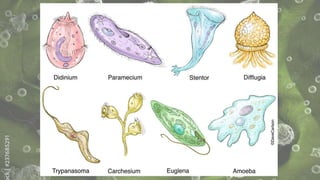
This document provides information on protozoans, including their structure, life cycles, reproduction, and diseases they can cause. Some key points:
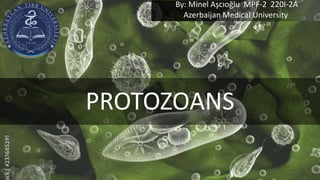
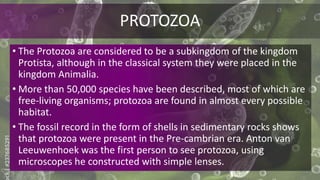
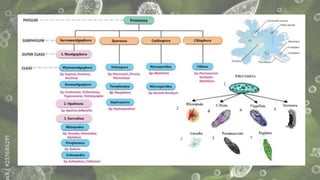
- Protozoans are unicellular eukaryotes that exist in almost every habitat and include both free-living and parasitic species.
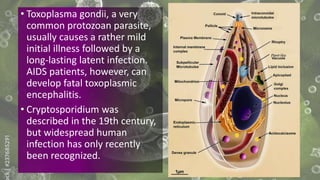
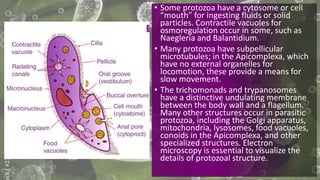
- They have organelles like the nucleus, mitochondria, and Golgi apparatus. Parasitic protozoa range in size but are generally less than 50 micrometers.
- Life cycles typically involve different infectious stages like trophozoites and cysts. Reproduction can be asexual through binary fission or schizogony, or involve sexual stages and hosts.
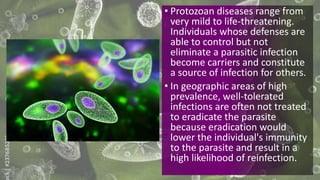
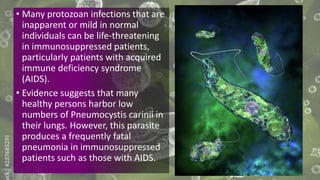
- Protozoan diseases range from mild to