Trading Psychology
Behavioural Finance Approach
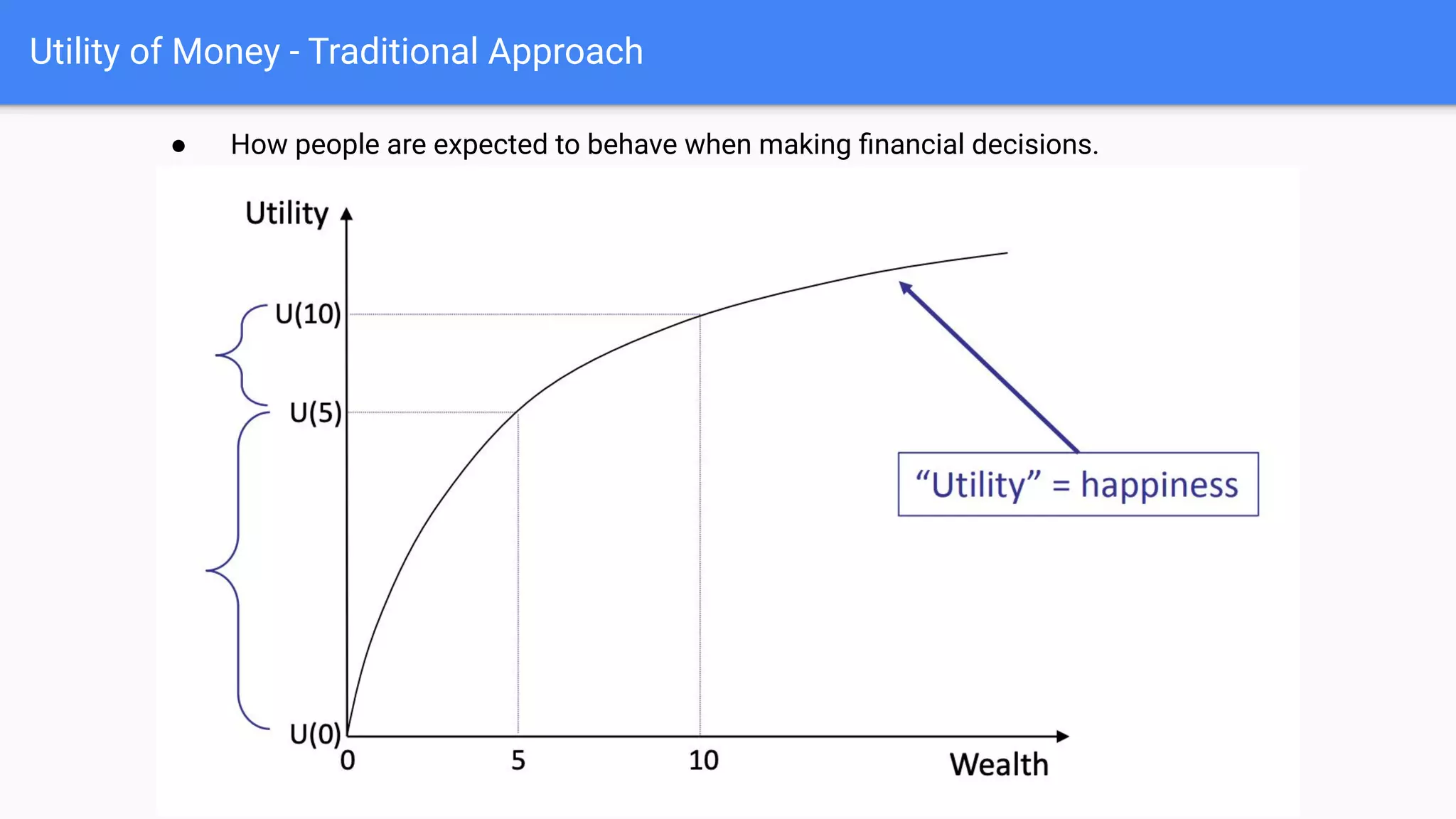
Utility of Money - Traditional Approach
● How people are expected to behave when making financial decisions.
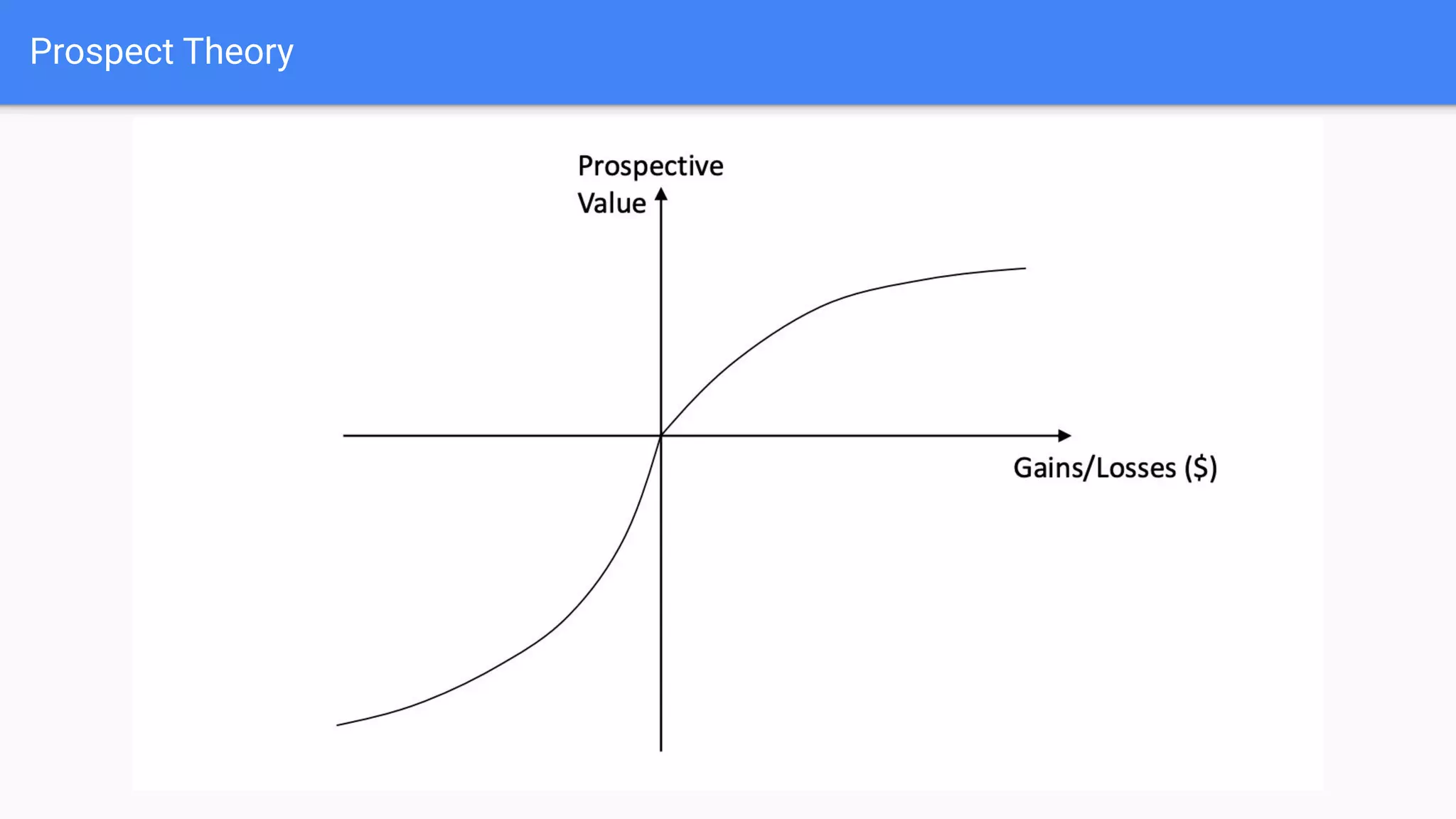
Prospect Theory
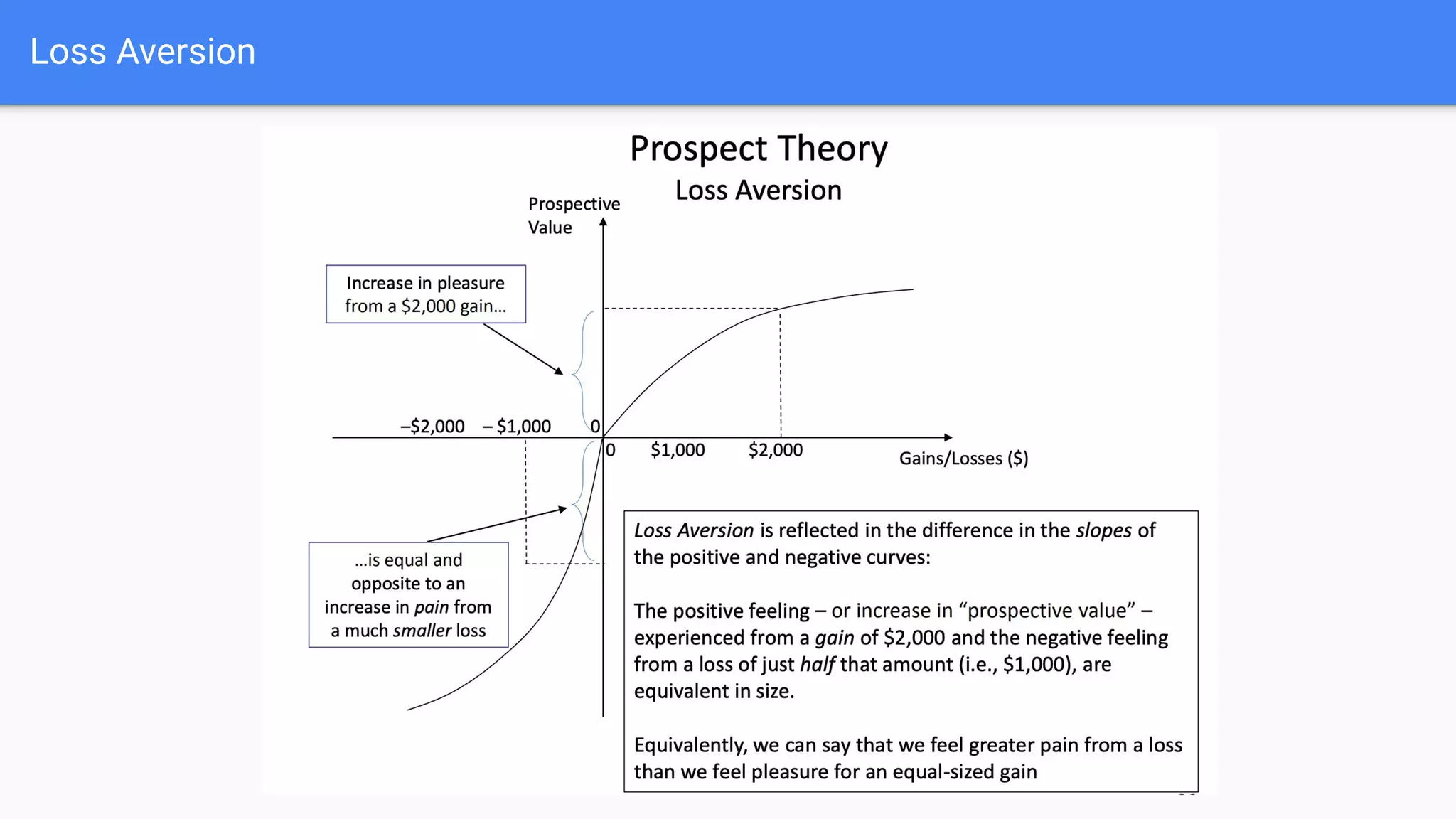
Loss Aversion
Weighting Function
Prospect Theory
People do not make decisions based solely on the expected value of the outcomes, but rather on the way
that the outcomes are framed or presented.
Gains & Losses
Alternative A: A sure gain of $240
Alternative B: A 25% chance to gain $1000, and a 75% chance to gain nothing
Decision 1
Decision 2
Alternative C: A sure loss of $240
Alternative D: A 75% chance to lose $1000, and a 25% chance to lose nothing
Regret Theory
A flu epidemic has hit your community. This flu can be fatal for children under the age of three. The
probability of a child getting the flu is 1 in 10, and 1 in 100 children who get the flu will die from it. This
means that, statistically speaking, 10 out of each 10,000 children in your community will die.
A vaccine for this type of flu has been developed and tested. The vaccine eliminates any chance of getting
the flu. The vaccine, however, has potentially fatal side effects. Suppose that the vaccine has a 0.05%
fatality rate; that is, the vaccine itself is fatal in 5 out of every 10,000 cases.
You have a two-year old daughter. Will you choose to vaccinate her?
Omission bias
If you were a parent in the 1950s, which version of the vaccine would you prefer your child to receive:
● The Salk vaccine that occasionally fails to protect your child against contracting polio in the community, or
● The Sabin vaccine that, in even more occasional circumstances, gives your child polio?
Risk Aversion vs Risk Seeking
Option A: $50 for sure
Option B: $0 if HEAD, $100 if TAIL
Decision 1
Decision 2
Option C: $500
Option D: $0 if HEAD, $1000 if TAIL
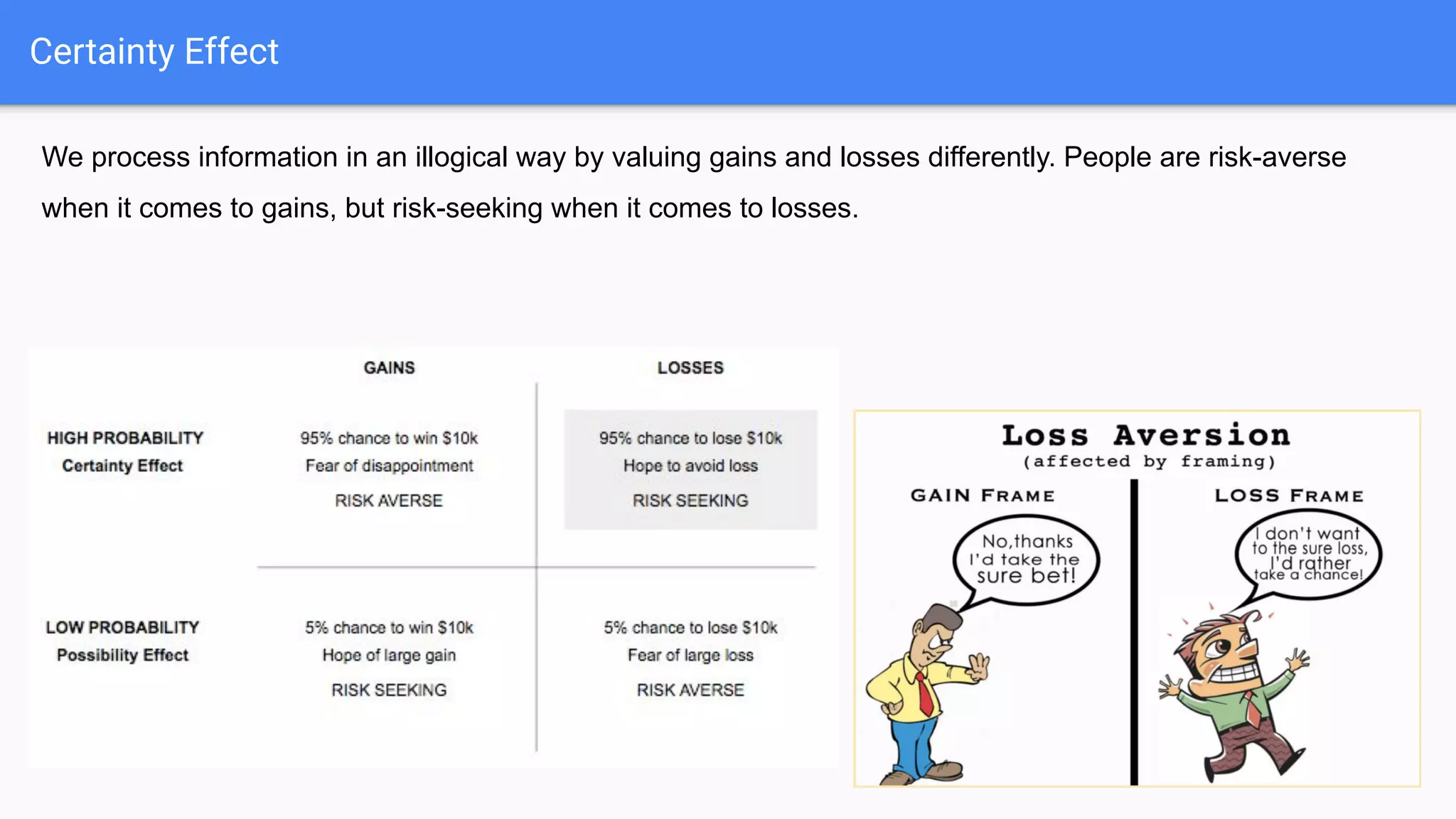
Certainty Effect
We process information in an illogical way by valuing gains and losses differently. People are risk-averse
when it comes to gains, but risk-seeking when it comes to losses.
About Insurances
● Insurance should focus on really big things like Life Insurance
● Electronic Insurance
● Diamond Ring Insurance, Funeral Insurance
Certainty Effect
● People overweight certainty, even when certainty is only an illusion.
● People tend to avoid uncertainty even with high probabilities.
● A vaccine that was described as 100% effective against 70% of disease targets was preferred to one
described as 70% effective against 100% of disease targets.
● 100% of anything looks good": The appeal of one hundred percent.
● An FMCG markets a soap saying that Buy 1 get 1 free
● Another FMCG markets a soap saying scratch the coupon with the soap and 1 out of 10 will get a gift.
● Prefer to invest in fixed return instruments
Prospect Theory in Stock Market
● More likely to hold on to losing stocks for too long, hoping to recover their losses, rather than selling
them and cutting their losses.
● Evaluate different investment strategies and to make better decisions.
● Set realistic expectations for returns on investments.
● Your decision making in derivatives is likely to be different from Equity due to loss aversion.

Prospect Theory.pdf

  • 1.
  • 2.
    Utility of Money- Traditional Approach ● How people are expected to behave when making financial decisions.
  • 3.
  • 4.
  • 5.
  • 6.
    Prospect Theory People donot make decisions based solely on the expected value of the outcomes, but rather on the way that the outcomes are framed or presented.
  • 7.
    Gains & Losses AlternativeA: A sure gain of $240 Alternative B: A 25% chance to gain $1000, and a 75% chance to gain nothing Decision 1 Decision 2 Alternative C: A sure loss of $240 Alternative D: A 75% chance to lose $1000, and a 25% chance to lose nothing
  • 8.
    Regret Theory A fluepidemic has hit your community. This flu can be fatal for children under the age of three. The probability of a child getting the flu is 1 in 10, and 1 in 100 children who get the flu will die from it. This means that, statistically speaking, 10 out of each 10,000 children in your community will die. A vaccine for this type of flu has been developed and tested. The vaccine eliminates any chance of getting the flu. The vaccine, however, has potentially fatal side effects. Suppose that the vaccine has a 0.05% fatality rate; that is, the vaccine itself is fatal in 5 out of every 10,000 cases. You have a two-year old daughter. Will you choose to vaccinate her?
  • 9.
    Omission bias If youwere a parent in the 1950s, which version of the vaccine would you prefer your child to receive: ● The Salk vaccine that occasionally fails to protect your child against contracting polio in the community, or ● The Sabin vaccine that, in even more occasional circumstances, gives your child polio?
  • 10.
    Risk Aversion vsRisk Seeking Option A: $50 for sure Option B: $0 if HEAD, $100 if TAIL Decision 1 Decision 2 Option C: $500 Option D: $0 if HEAD, $1000 if TAIL
  • 11.
    Certainty Effect We processinformation in an illogical way by valuing gains and losses differently. People are risk-averse when it comes to gains, but risk-seeking when it comes to losses.
  • 12.
    About Insurances ● Insuranceshould focus on really big things like Life Insurance ● Electronic Insurance ● Diamond Ring Insurance, Funeral Insurance
  • 13.
    Certainty Effect ● Peopleoverweight certainty, even when certainty is only an illusion. ● People tend to avoid uncertainty even with high probabilities. ● A vaccine that was described as 100% effective against 70% of disease targets was preferred to one described as 70% effective against 100% of disease targets. ● 100% of anything looks good": The appeal of one hundred percent. ● An FMCG markets a soap saying that Buy 1 get 1 free ● Another FMCG markets a soap saying scratch the coupon with the soap and 1 out of 10 will get a gift. ● Prefer to invest in fixed return instruments
  • 14.
    Prospect Theory inStock Market ● More likely to hold on to losing stocks for too long, hoping to recover their losses, rather than selling them and cutting their losses. ● Evaluate different investment strategies and to make better decisions. ● Set realistic expectations for returns on investments. ● Your decision making in derivatives is likely to be different from Equity due to loss aversion.