Prosecution Group Luncheon
        November 2012
USPTO Warning: Non-USPTO Solicitations

• Expanded warning page about non-USPTO
  Solicitations – lists 13 examples/companies
• Suggests filing a complaint with FTC if client
  receives a misleading solicitation
• Requests report misleading solicitations to
  USPTO at TMFeedback@uspto.gov

• See also WIPO website for warnings about
  international examples
TMEP – Oct. 2012 Edition
• The USPTO has issued the Trademark
  Manual of Examining Procedure (v. October
  2012), with an effective date of October 31,
  2012.
• the current version of the TMEP is now
  identified by the month and year in which it is
  issued.
• the new online interface is now the exclusive
  interface and search tool for the TMEP.
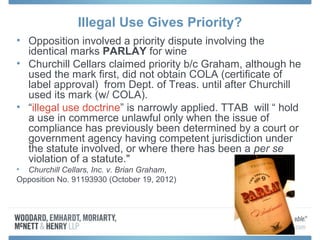
Illegal Use Gives Priority?
• Opposition involved a priority dispute involving the
  identical marks PARLAY for wine
• Churchill Cellars claimed priority b/c Graham, although he
  used the mark first, did not obtain COLA (certificate of
  label approval) from Dept. of Treas. until after Churchill
  used its mark (w/ COLA).
• “illegal use doctrine” is narrowly applied. TTAB will “ hold
  a use in commerce unlawful only when the issue of
  compliance has previously been determined by a court or
  government agency having competent jurisdiction under
  the statute involved, or where there has been a per se
  violation of a statute."
• Churchill Cellars, Inc. v. Brian Graham,
Opposition No. 91193930 (October 19, 2012)
ITU Assignments – actual product?
• The Lanham Act prohibits the assignment of intent-to-use
  trademark applications prior to the filing of a SOU, …
  except for an assignment to a successor to the business
  of the applicant, or portion thereof, to which the mark
  pertains, if that business is ongoing and existing.
• Court stated that that a product must already exist before
  the application can be assigned:
     – “even that transfer is only permissible if the applicant actually
       has such a business, i.e., if the applicant is already
       providing the goods or services recited in the application.”
•   Ab Coaster Holdings, Inc. v. Greene, Nos. 2:10-CV-38, 2:10-CV-234 (S.D.
    Ohio Sept. 25, 2012).
• Incorrect Holding ???
PC ON A STICK?

• descriptiveness refusal of the mark PC ON A STICK for "computer
  software …; computer storage devices, namely, blank flash drives
  …; and computer hardware."
• EA: dictionary definitions, online articles, and Applicant's
  specimens support that PC is a commonly-recognized reference
  to "personal computer," that STICK is a slang expression for a
  memory module, such as a USB stick, and that PC ON A STICK
  directly informs consumers that goods "enable the user to carry
  the essence of their PC with them on a flash drive. The product
  enables a flash drive to function as a virtual PC."
• TTAB: definitions show meanings of PC and STICK; Applicant's
  mark means "a personal computer installed on, contained within,
  held upon or otherwise connected to a memory storage device
  such as a flash drive or other compact data storage medium."
• TTAB reverses:
   – the mark suggests the function and purpose of the goods, but it
     does not do so "forthwith and with immediacy."
   – “Rather, the mark is both elliptical and exaggerative. The term PC
     is used elliptically to stand in for "all of the data and software
     content of a PC." PC is also exaggerative, as the mark suggests
     that the product is the equivalent of a PC actually contained within
     a STICK ...." In order to understand the meaning of the mark in
     the context of these goods, a customer must undertake a
     multistage reasoning process, through which he or she may
     appreciate the suggestion that the STICK does not contain a PC,
     but rather all of the data and software content of a PC. The
     indirect way in which the mark conveys this information renders it
     suggestive rather than descriptive of the nature of applicant's
     computer storage devices.”
In re Lockheed Martin Corporation, Serial No. 85073741 (November 15, 2012) [not
     precedential].
Objective Indicia of Nonobviousness
• Transocean Offshore Deepwater Drilling, Inc. v.
  Maersk Contractors USA (FC 2012) (Transocean II)

• Transocean I: FC overturned summary judgment of obviousness as
  improper in view of “secondary indicia” of nonobviousness
   – Remand: jury award, but court grants JMOL on obviousness

• FC reinstated jury verdict on substantial objective evidence
   – Commercial success (customers willing to pay premium or require
     rigs with patented features)
   – Industry praise and unexpected results
   – Copying (including by defendant Maersk)
   – Industry skepticism, licensing, and long-felt but unsolved need

• "Few cases present such extensive objective evidence of non-
  obviousness, and thus we have rarely held that objective evidence is
  sufficient to overcome a prima facie case of obviousness. . . . This,
  however, is precisely the sort of case where the objective evidence
  establishes that an invention appearing to have been obvious in light
  of the prior art was not."
When is a "Lease" a "Sale" Under Section 271?
• Transocean II did not reach contested issue of whether
  a “lease” is a section 271(a)“sale” or “offer to sell”
   – Maersk "leased" and offered to "lease" its rig

• Leases can be tantamount to a sale, but those cases
  involved transfer of property indefinitely or for entire
  useful life (e.g. the common software "license")
   – See Minton v. Nat'I Ass'n. of Secs. Dealers, Inc., 336 F.3d
     1373, 1378 (Fed. Cir. 2003).

• Maersk argued (1) lease did not last for entire useful
  life of the drilling rig, and (2) contract was for provision
  of drilling services and at all time Maersk maintained
  possession of the rig. The court ignored the issue,
  referring to the transaction as a "sale" without comment
Supplemental Examination Request Published
• No. 96/000,007, filed Oct. 31, re US Patent No. 7,909,641

• (1) Why so few filings? PTO estimated 1,400 requests per year
   – Ex parte requests filed just before the fee increase in September
   – High cost, procedural novelty, weakening of inequitable conduct
      doctrine

• (2) Why is this request the first to publish?
   – Per PatentlyO research, several rejected for rule non-compliance

• The seven-page 96/000,007 petition included:
   – $21,260 filing fee ($16,120 reimbursed if no reexamination ordered);
   – Submission of seven references;
   – Explanation of references vis á vis the patent, with claim chart; and
   – Explanation of how the claims are still valid over the references

• PTO’s deadline is Dec. 31, 2012 to decide if references raise SNQP
   – If yes, reexamination commences
   – If no, first supplemental examination certificate to be issued
Satellite USPTOs

• Detroit: currently running with about 50
  examiners, 10 administrative patent judges

• Google deputy GC Michelle Lee appointed
  Director of the Silicon Valley (San Jose) office

• Continuing toward offices in Dallas and
  Denver as well
Patent Issues for Lame Ducks
Patent Law Treaties Implementation Act of 2012
• Implements Geneva Act of Hague Agreement Con-
  cerning International Registration of Industrial Designs
   – (1) Extension of design term by 1 year (15 years from
     issue)
   – (2) Allowing up to 100 design inventions in one int’l
     application
   – Commentator: better ability to attack knockoff products in
     producing countries, while also able to attack such
     knockoffs in consumer countries
• Implements provisions of procedural Patent Law
  Treaty (major change: revival of unintentionally
  abandoned int’l applications)
Patent Issues for Lame Ducks
• AIA Amendment(s) (no proposed text available)
  – Possible topics: (1) reducing estoppel associated with PGR;
    (2) expanding scope of prior-user rights; (3) defining
    "otherwise publicly available" and "disclosure" in new
    Section 102; (4) allowing IPR during the first 9 months after
    issuance for pre-AIA patents

• Other Potential Patent Reforms
  – Fee shifting in software and computer hardware suits (H.R.
    6245)
  – Infringement exception for automotive repair parts (H.R.
    3889)
  – Design Rights for fashion under copyright laws (S. 3523)
  – Federal civil cause of action for trade secret theft involving
    interstate or international commerce (S. 3389)
Effect of RCE on PTA
• Exelixis, Inc. v. Kappos, No. 1:12cv96, 2012 U.S.
  Dist. LEXIS 157762 (E.D. Va. Nov. 1, 2012)

• Recall: Patent term adjustment (PTA, §154(b))
  provides 1 day of extra term for each day of pre-
  issuance pendency beyond three years
   – An exception involves filing of an RCE, which can cut
     short such term adjustments

• Court held that RCE filing after three-year-pendency
  date does not stop the PTA; only impacts patents
  where RCE filing occurred after that three-year mark

• Note that in prior Wyeth case, PTO did not alter
  calculations or offer guidance until after Federal
  Circuit’s confirmation of lower court decision

Prosecution Luncheon November 2012

  • 1.
  • 2.
    USPTO Warning: Non-USPTOSolicitations • Expanded warning page about non-USPTO Solicitations – lists 13 examples/companies • Suggests filing a complaint with FTC if client receives a misleading solicitation • Requests report misleading solicitations to USPTO at TMFeedback@uspto.gov • See also WIPO website for warnings about international examples
  • 3.
    TMEP – Oct.2012 Edition • The USPTO has issued the Trademark Manual of Examining Procedure (v. October 2012), with an effective date of October 31, 2012. • the current version of the TMEP is now identified by the month and year in which it is issued. • the new online interface is now the exclusive interface and search tool for the TMEP.
  • 4.
    Illegal Use GivesPriority? • Opposition involved a priority dispute involving the identical marks PARLAY for wine • Churchill Cellars claimed priority b/c Graham, although he used the mark first, did not obtain COLA (certificate of label approval) from Dept. of Treas. until after Churchill used its mark (w/ COLA). • “illegal use doctrine” is narrowly applied. TTAB will “ hold a use in commerce unlawful only when the issue of compliance has previously been determined by a court or government agency having competent jurisdiction under the statute involved, or where there has been a per se violation of a statute." • Churchill Cellars, Inc. v. Brian Graham, Opposition No. 91193930 (October 19, 2012)
  • 5.
    ITU Assignments –actual product? • The Lanham Act prohibits the assignment of intent-to-use trademark applications prior to the filing of a SOU, … except for an assignment to a successor to the business of the applicant, or portion thereof, to which the mark pertains, if that business is ongoing and existing. • Court stated that that a product must already exist before the application can be assigned: – “even that transfer is only permissible if the applicant actually has such a business, i.e., if the applicant is already providing the goods or services recited in the application.” • Ab Coaster Holdings, Inc. v. Greene, Nos. 2:10-CV-38, 2:10-CV-234 (S.D. Ohio Sept. 25, 2012). • Incorrect Holding ???
  • 6.
    PC ON ASTICK? • descriptiveness refusal of the mark PC ON A STICK for "computer software …; computer storage devices, namely, blank flash drives …; and computer hardware." • EA: dictionary definitions, online articles, and Applicant's specimens support that PC is a commonly-recognized reference to "personal computer," that STICK is a slang expression for a memory module, such as a USB stick, and that PC ON A STICK directly informs consumers that goods "enable the user to carry the essence of their PC with them on a flash drive. The product enables a flash drive to function as a virtual PC." • TTAB: definitions show meanings of PC and STICK; Applicant's mark means "a personal computer installed on, contained within, held upon or otherwise connected to a memory storage device such as a flash drive or other compact data storage medium."
  • 7.
    • TTAB reverses: – the mark suggests the function and purpose of the goods, but it does not do so "forthwith and with immediacy." – “Rather, the mark is both elliptical and exaggerative. The term PC is used elliptically to stand in for "all of the data and software content of a PC." PC is also exaggerative, as the mark suggests that the product is the equivalent of a PC actually contained within a STICK ...." In order to understand the meaning of the mark in the context of these goods, a customer must undertake a multistage reasoning process, through which he or she may appreciate the suggestion that the STICK does not contain a PC, but rather all of the data and software content of a PC. The indirect way in which the mark conveys this information renders it suggestive rather than descriptive of the nature of applicant's computer storage devices.” In re Lockheed Martin Corporation, Serial No. 85073741 (November 15, 2012) [not precedential].
  • 8.
    Objective Indicia ofNonobviousness • Transocean Offshore Deepwater Drilling, Inc. v. Maersk Contractors USA (FC 2012) (Transocean II) • Transocean I: FC overturned summary judgment of obviousness as improper in view of “secondary indicia” of nonobviousness – Remand: jury award, but court grants JMOL on obviousness • FC reinstated jury verdict on substantial objective evidence – Commercial success (customers willing to pay premium or require rigs with patented features) – Industry praise and unexpected results – Copying (including by defendant Maersk) – Industry skepticism, licensing, and long-felt but unsolved need • "Few cases present such extensive objective evidence of non- obviousness, and thus we have rarely held that objective evidence is sufficient to overcome a prima facie case of obviousness. . . . This, however, is precisely the sort of case where the objective evidence establishes that an invention appearing to have been obvious in light of the prior art was not."
  • 9.
    When is a"Lease" a "Sale" Under Section 271? • Transocean II did not reach contested issue of whether a “lease” is a section 271(a)“sale” or “offer to sell” – Maersk "leased" and offered to "lease" its rig • Leases can be tantamount to a sale, but those cases involved transfer of property indefinitely or for entire useful life (e.g. the common software "license") – See Minton v. Nat'I Ass'n. of Secs. Dealers, Inc., 336 F.3d 1373, 1378 (Fed. Cir. 2003). • Maersk argued (1) lease did not last for entire useful life of the drilling rig, and (2) contract was for provision of drilling services and at all time Maersk maintained possession of the rig. The court ignored the issue, referring to the transaction as a "sale" without comment
  • 10.
    Supplemental Examination RequestPublished • No. 96/000,007, filed Oct. 31, re US Patent No. 7,909,641 • (1) Why so few filings? PTO estimated 1,400 requests per year – Ex parte requests filed just before the fee increase in September – High cost, procedural novelty, weakening of inequitable conduct doctrine • (2) Why is this request the first to publish? – Per PatentlyO research, several rejected for rule non-compliance • The seven-page 96/000,007 petition included: – $21,260 filing fee ($16,120 reimbursed if no reexamination ordered); – Submission of seven references; – Explanation of references vis á vis the patent, with claim chart; and – Explanation of how the claims are still valid over the references • PTO’s deadline is Dec. 31, 2012 to decide if references raise SNQP – If yes, reexamination commences – If no, first supplemental examination certificate to be issued
  • 11.
    Satellite USPTOs • Detroit:currently running with about 50 examiners, 10 administrative patent judges • Google deputy GC Michelle Lee appointed Director of the Silicon Valley (San Jose) office • Continuing toward offices in Dallas and Denver as well
  • 12.
    Patent Issues forLame Ducks Patent Law Treaties Implementation Act of 2012 • Implements Geneva Act of Hague Agreement Con- cerning International Registration of Industrial Designs – (1) Extension of design term by 1 year (15 years from issue) – (2) Allowing up to 100 design inventions in one int’l application – Commentator: better ability to attack knockoff products in producing countries, while also able to attack such knockoffs in consumer countries • Implements provisions of procedural Patent Law Treaty (major change: revival of unintentionally abandoned int’l applications)
  • 13.
    Patent Issues forLame Ducks • AIA Amendment(s) (no proposed text available) – Possible topics: (1) reducing estoppel associated with PGR; (2) expanding scope of prior-user rights; (3) defining "otherwise publicly available" and "disclosure" in new Section 102; (4) allowing IPR during the first 9 months after issuance for pre-AIA patents • Other Potential Patent Reforms – Fee shifting in software and computer hardware suits (H.R. 6245) – Infringement exception for automotive repair parts (H.R. 3889) – Design Rights for fashion under copyright laws (S. 3523) – Federal civil cause of action for trade secret theft involving interstate or international commerce (S. 3389)
  • 14.
    Effect of RCEon PTA • Exelixis, Inc. v. Kappos, No. 1:12cv96, 2012 U.S. Dist. LEXIS 157762 (E.D. Va. Nov. 1, 2012) • Recall: Patent term adjustment (PTA, §154(b)) provides 1 day of extra term for each day of pre- issuance pendency beyond three years – An exception involves filing of an RCE, which can cut short such term adjustments • Court held that RCE filing after three-year-pendency date does not stop the PTA; only impacts patents where RCE filing occurred after that three-year mark • Note that in prior Wyeth case, PTO did not alter calculations or offer guidance until after Federal Circuit’s confirmation of lower court decision