OPTIMIZING
USING MOBILE APPS
BY ENGAGING
CUSTOMERS
MARKETING RESULTS
10 Steps for Creating a Comprehensive
Blueprint for Your Mobile Marketing Apps
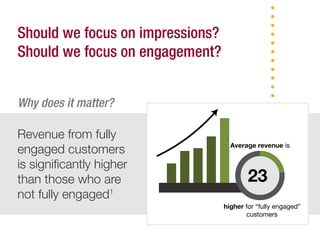
Revenue from fully
engaged customers
is significantly higher
than those who are
not fully engaged1
Should we focus on impressions?
Should we focus on engagement?
Why does it matter?
Average revenue is
23
higher for “fully engaged”
customers
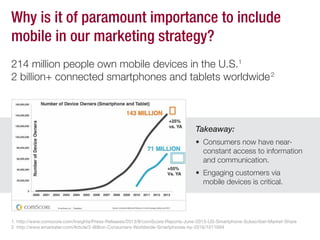
214 million people own mobile devices in the U.S.1
2 billion+ connected smartphones and tablets worldwide2
Why is it of paramount importance to include
mobile in our marketing strategy?
1. http://www.comscore.com/Insights/Press-Releases/2013/8/comScore-Reports-June-2013-US-Smartphone-Subscriber-Market-Share
2. http://www.emarketer.com/Article/2-Billion-Consumers-Worldwide-Smartphones-by-2016/1011694
Takeaway:
Consumers now have near-
constant access to information
and communication.
Engaging customers via
mobile devices is critical.
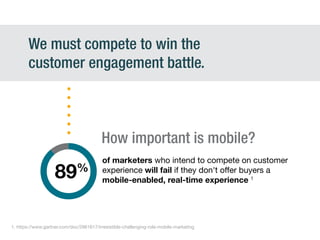
We must compete to win the
customer engagement battle.
1. https://www.gartner.com/doc/2961617/irresistible-challenging-role-mobile-marketing
89%
of marketers who intend to compete on customer
experience will fail if they don't offer buyers a
mobile-enabled, real-time experience 1
How important is mobile?
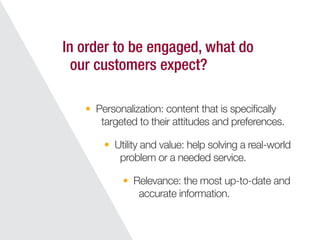
Personalization: content that is specifically
targeted to their attitudes and preferences.
In order to be engaged, what do
our customers expect?
Utility and value: help solving a real-world
problem or a needed service.
Relevance: the most up-to-date and
accurate information.
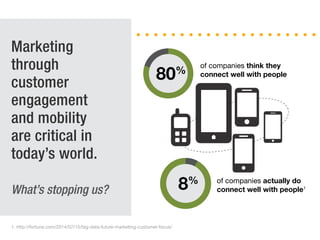
Marketing
through
customer
engagement
and mobility
are critical in
today’s world.
What’s stopping us?
1. http://fortune.com/2014/07/15/big-data-future-marketing-customer-focus/
of companies think they
connect well with people80%
of companies actually do
connect well with people18%
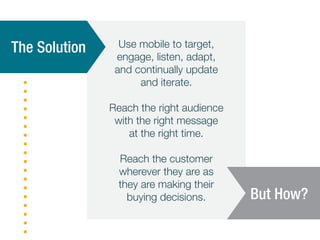
Use mobile to target,
engage, listen, adapt,
and continually update
and iterate.
Reach the right audience
with the right message
at the right time.
Reach the customer
wherever they are as
they are making their
buying decisions.
The Solution
But How?
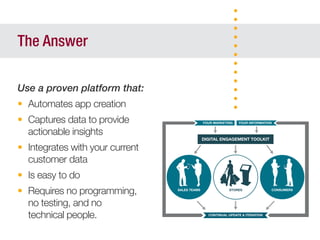
Use a proven platform that:
Automates app creation
Captures data to provide
actionable insights
Integrates with your current
customer data
Is easy to do
Requires no programming,
no testing, and no
technical people.
The Answer
DIGITAL ENGAGEMENT TOOLKIT
CONTINUAL UPDATE & ITERATION
YOUR MARKETING YOUR INFORMATION
SALES TEAMS STORES CONSUMERS
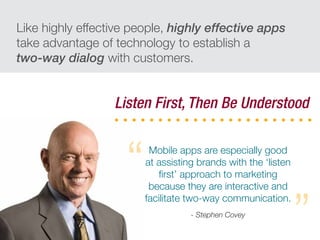
Like highly effective people, highly effective apps
take advantage of technology to establish a
two-way dialog with customers.
Listen First, Then Be Understood
Mobile apps are especially good
at assisting brands with the ‘listen
first’ approach to marketing
because they are interactive and
facilitate two-way communication.
- Stephen Covey
“
”
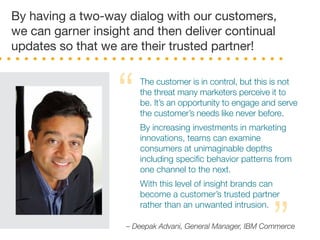
The customer is in control, but this is not
the threat many marketers perceive it to
be. It’s an opportunity to engage and serve
the customer’s needs like never before.
By increasing investments in marketing
innovations, teams can examine
consumers at unimaginable depths
including specific behavior patterns from
one channel to the next.
With this level of insight brands can
become a customer’s trusted partner
rather than an unwanted intrusion.
By having a two-way dialog with our customers,
we can garner insight and then deliver continual
updates so that we are their trusted partner!
“
”– Deepak Advani, General Manager, IBM Commerce
1. Broadly segment by type and stage
2. Utilize in-app feedback to sub-segment
3. Monitor in-app behavior to dynamically micro-segment
4. Track all customer app experiences
5. Analyze experience data, iterate to maximize engagement
Trusted partners engage customers
while gaining insights
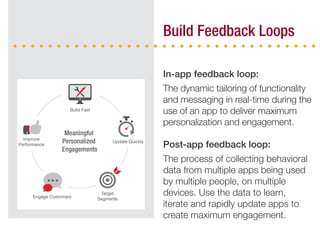
Build Feedback Loops
The dynamic tailoring of functionality
and messaging in real-time during the
use of an app to deliver maximum
personalization and engagement.
The process of collecting behavioral
data from multiple apps being used
by multiple people, on multiple
devices. Use the data to learn,
iterate and rapidly update apps to
create maximum engagement.
The Critical Starting Point:
Your App Blueprint
Success hinges on the upfront work
of planning an app blueprint.
Leading Brands and Agencies have
been using the Proscape Marketing
App Cloud to create highly engaging
apps since the launch of the Smart
Phone. Our best practices have been
packaged into a easy-to-follow 10-step
process that we are happy to share
with you! And answer questions about!
Best Practices to Create an App
Blueprint in 10 Simple Steps…
STEP 1
Determine Mobile
App Requirements
Collect the basics about your
brand, your goals, and your
target audiences.
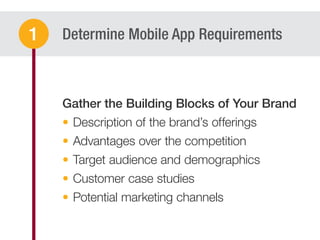
1
Determine Mobile App Requirements
Description of the brand’s offerings
Advantages over the competition
Target audience and demographics
Customer case studies
Potential marketing channels
1
STEP 2
Prioritize and
Categorize Materials
Capture the materials that
marketing and other key teams
in the company believe are
most important.
2
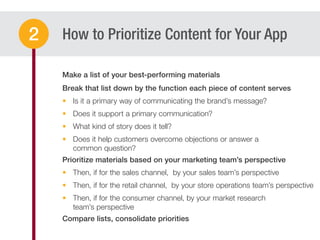
How to Prioritize Content for Your App2
Is it a primary way of communicating the brand’s message?
Does it support a primary communication?
What kind of story does it tell?
Does it help customers overcome objections or answer a
common question?
Then, if for the sales channel, by your sales team’s perspective
Then, if for the retail channel, by your store operations team’s perspective
Then, if for the consumer channel, by your market research
team’s perspective
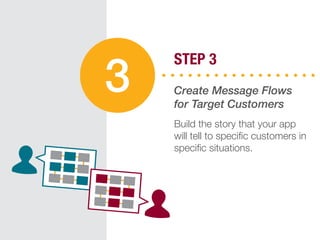
STEP 3
Create Message Flows
for Target Customers
Build the story that your app
will tell to specific customers in
specific situations.
3
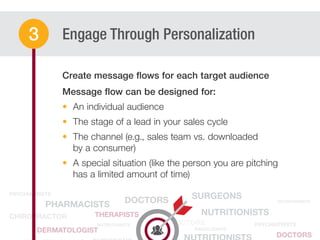
Engage Through Personalization
PHARMACISTS
SURGEONS
NUTRITIONISTS
DOCTORS
RADIOLOGISTS
CHIROPRACTOR
NUTRITIONISTS
NUTRITIONISTS
THERAPISTS
DERMATOLOGIST
DOCTORS
PSYCHIATRISTS
PSYCHIATRISTSDOCTORS
An individual audience
The stage of a lead in your sales cycle
The channel (e.g., sales team vs. downloaded
by a consumer)
A special situation (like the person you are pitching
has a limited amount of time)
3
STEP 4
Determine Special
Message Flows
Define story flow for special
situations, such as customers
who are considering a specific
competitors offering or
customers that have a limited
amount of time to learn about
your solutions.
4
Design Your App to Address
Unique Situations
Just like one message does not fit
every customer, one message flow
will not fit every situation
By creating optimal message flows for
common customer situations, customer
experiences are greatly improved and
engagement is maximized
4
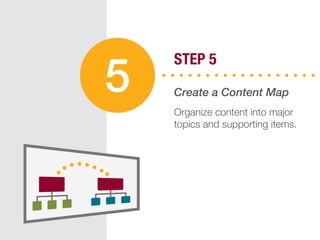
STEP 5
Create a Content Map
Organize content into major
topics and supporting items.
5
How to Build Your Content Map
The major topics will define the primary
navigation in your app
Each of these will become buttons or menu items
on your app’s home page or main screen
5
STEP 6
Develop Strategies for
Special Topics
Determine special topics like
PR issues, breaking news, or
technical specs.
6
How to Handle Special Topics
(these require additional attention, resources and investment – but with ROI!)
PR communications
Unique product features
Overcoming common customer concerns
Important statistics
Promotional videos
Client testimonials
Checklists
Interactive guides
Interactive animations
6
STEP 7
Incorporate Supporting
Materials
Include supporting materials
in an easy-to-navigate
framework.
7
The Importance of Reference Materials
Customers often need to see reference
materials when making buying decisions
Reference materials add credibility to
key brand messages
Plan for and incorporate these proof
points into the app
Build them into the blueprint to ensure
seamless integration within the app
7
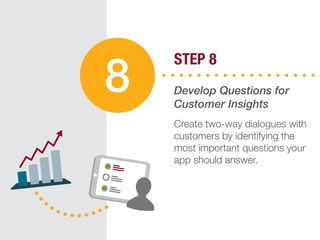
STEP 8
Develop Questions for
Customer Insights
Create two-way dialogues with
customers by identifying the
most important questions your
app should answer.
8
The Importance of Listening via Mobile Apps
To enable sub-segmentation of
your customers
To develop questions that can be used
in the app to gather insights through
surveys or behavioral tracking
The proper use of “questions” in your
app enables marketing to automatically
adapt conversations to the customer’s
response and record that response for
insights and improved engagement
8
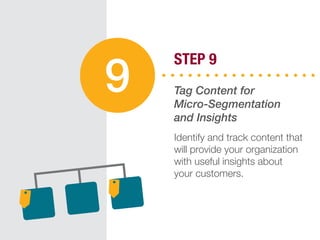
STEP 9
Tag Content for
Micro-Segmentation
and Insights
Identify and track content that
will provide your organization
with useful insights about
your customers.
9
Why Tag Content in Your App?9
Customer pathways and experiences
Customer reactions to messages and customer decision trees
Aspects of your offering that require more explaining
Features people want to learn more about
Specific geo-location and demographic information about
your customers
Use an app creation platform with built-in functionality that
tags each app page or content piece you create (Proscape
provides one of these)
Use HTML to create your tags during the app development process
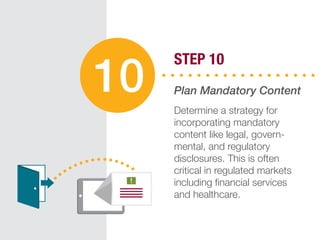
STEP 10
Plan Mandatory Content
Determine a strategy for
incorporating mandatory
content like legal, govern-
mental, and regulatory
disclosures. This is often
critical in regulated markets
including financial services
and healthcare.
910
When to Display Mandatory Content10
When changing topics
When the app is opened
Just before the app is closed
If this is the customer’s first time
using the app
When changing between two
different apps from your company
Before or after certain pages in
your app gets displayed
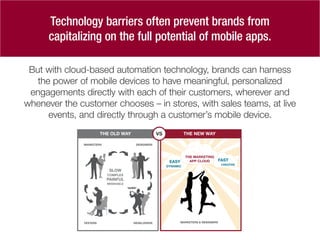
But with cloud-based automation technology, brands can harness
the power of mobile devices to have meaningful, personalized
engagements directly with each of their customers, wherever and
whenever the customer chooses – in stores, with sales teams, at live
events, and directly through a customer’s mobile device.
Technology barriers often prevent brands from
capitalizing on the full potential of mobile apps.
THE OLD WAY THE NEW WAY
SLOW
COMPLEX
PAINFUL
MISERABLE
MARKETERS
TESTERS DEVELOPERS
DESIGNERS
*&(#$@!
APP CLOUD
MARKETERS & DESIGNERS
THE MARKETING
APP CLOUD
DYNAMIC
FASTEASY
CREATIVE
If you have a question about anything in this Slide Share,
we are happy to help. Visit: proscape.com/contact/
For more in-depth information on the 10 steps to creating
a mobile app blueprint, visit proscape.com/handbook
To start building your own mobile app blueprint, visit
proscape.com/handbook/build-your-blueprint
If you have interest in Proscape’s Marketing App Cloud as
a potential solution to the pain of manually creating mobile
apps, visit proscape.com/tour
Next Steps
Founded to empower brands to have meaningful, personalized
engagements directly with their customers in a Mobile First world,
Proscape removes technology restrictions that make the mobile app
creation process slow, painful, and expensive. By eliminating the pain of
mobile app development, The Marketing App Cloud platform makes it
possible for designers to bring their creative visions to life.
The Proscape Marketing App Cloud is built by leading technologists
from IBM, Microsoft, NBC Studios, iLevel, Corel, and other innovative
companies. The Proscape team is dedicated to helping marketers reach
their goals through mobile technology.
For more information, visit www.proscape.com
About Proscape

Optimizing Marketing Results By Engaging Customers Using Mobile Apps

  • 1.
    OPTIMIZING USING MOBILE APPS BYENGAGING CUSTOMERS MARKETING RESULTS 10 Steps for Creating a Comprehensive Blueprint for Your Mobile Marketing Apps
  • 2.
    Revenue from fully engagedcustomers is significantly higher than those who are not fully engaged1 Should we focus on impressions? Should we focus on engagement? Why does it matter? Average revenue is 23 higher for “fully engaged” customers
  • 3.
    214 million peopleown mobile devices in the U.S.1 2 billion+ connected smartphones and tablets worldwide2 Why is it of paramount importance to include mobile in our marketing strategy? 1. http://www.comscore.com/Insights/Press-Releases/2013/8/comScore-Reports-June-2013-US-Smartphone-Subscriber-Market-Share 2. http://www.emarketer.com/Article/2-Billion-Consumers-Worldwide-Smartphones-by-2016/1011694 Takeaway: Consumers now have near- constant access to information and communication. Engaging customers via mobile devices is critical.
  • 4.
    We must competeto win the customer engagement battle. 1. https://www.gartner.com/doc/2961617/irresistible-challenging-role-mobile-marketing 89% of marketers who intend to compete on customer experience will fail if they don't offer buyers a mobile-enabled, real-time experience 1 How important is mobile?
  • 5.
    Personalization: content thatis specifically targeted to their attitudes and preferences. In order to be engaged, what do our customers expect? Utility and value: help solving a real-world problem or a needed service. Relevance: the most up-to-date and accurate information.
  • 6.
    Marketing through customer engagement and mobility are criticalin today’s world. What’s stopping us? 1. http://fortune.com/2014/07/15/big-data-future-marketing-customer-focus/ of companies think they connect well with people80% of companies actually do connect well with people18%
  • 7.
    Use mobile totarget, engage, listen, adapt, and continually update and iterate. Reach the right audience with the right message at the right time. Reach the customer wherever they are as they are making their buying decisions. The Solution But How?
  • 8.
    Use a provenplatform that: Automates app creation Captures data to provide actionable insights Integrates with your current customer data Is easy to do Requires no programming, no testing, and no technical people. The Answer DIGITAL ENGAGEMENT TOOLKIT CONTINUAL UPDATE & ITERATION YOUR MARKETING YOUR INFORMATION SALES TEAMS STORES CONSUMERS
  • 9.
    Like highly effectivepeople, highly effective apps take advantage of technology to establish a two-way dialog with customers. Listen First, Then Be Understood Mobile apps are especially good at assisting brands with the ‘listen first’ approach to marketing because they are interactive and facilitate two-way communication. - Stephen Covey “ ”
  • 10.
    The customer isin control, but this is not the threat many marketers perceive it to be. It’s an opportunity to engage and serve the customer’s needs like never before. By increasing investments in marketing innovations, teams can examine consumers at unimaginable depths including specific behavior patterns from one channel to the next. With this level of insight brands can become a customer’s trusted partner rather than an unwanted intrusion. By having a two-way dialog with our customers, we can garner insight and then deliver continual updates so that we are their trusted partner! “ ”– Deepak Advani, General Manager, IBM Commerce
  • 11.
    1. Broadly segmentby type and stage 2. Utilize in-app feedback to sub-segment 3. Monitor in-app behavior to dynamically micro-segment 4. Track all customer app experiences 5. Analyze experience data, iterate to maximize engagement Trusted partners engage customers while gaining insights
  • 12.
    Build Feedback Loops Thedynamic tailoring of functionality and messaging in real-time during the use of an app to deliver maximum personalization and engagement. The process of collecting behavioral data from multiple apps being used by multiple people, on multiple devices. Use the data to learn, iterate and rapidly update apps to create maximum engagement.
  • 13.
    The Critical StartingPoint: Your App Blueprint Success hinges on the upfront work of planning an app blueprint.
  • 14.
    Leading Brands andAgencies have been using the Proscape Marketing App Cloud to create highly engaging apps since the launch of the Smart Phone. Our best practices have been packaged into a easy-to-follow 10-step process that we are happy to share with you! And answer questions about! Best Practices to Create an App Blueprint in 10 Simple Steps…
  • 15.
    STEP 1 Determine Mobile AppRequirements Collect the basics about your brand, your goals, and your target audiences. 1
  • 16.
    Determine Mobile AppRequirements Description of the brand’s offerings Advantages over the competition Target audience and demographics Customer case studies Potential marketing channels 1
  • 17.
    STEP 2 Prioritize and CategorizeMaterials Capture the materials that marketing and other key teams in the company believe are most important. 2
  • 18.
    How to PrioritizeContent for Your App2 Is it a primary way of communicating the brand’s message? Does it support a primary communication? What kind of story does it tell? Does it help customers overcome objections or answer a common question? Then, if for the sales channel, by your sales team’s perspective Then, if for the retail channel, by your store operations team’s perspective Then, if for the consumer channel, by your market research team’s perspective
  • 19.
    STEP 3 Create MessageFlows for Target Customers Build the story that your app will tell to specific customers in specific situations. 3
  • 20.
    Engage Through Personalization PHARMACISTS SURGEONS NUTRITIONISTS DOCTORS RADIOLOGISTS CHIROPRACTOR NUTRITIONISTS NUTRITIONISTS THERAPISTS DERMATOLOGIST DOCTORS PSYCHIATRISTS PSYCHIATRISTSDOCTORS Anindividual audience The stage of a lead in your sales cycle The channel (e.g., sales team vs. downloaded by a consumer) A special situation (like the person you are pitching has a limited amount of time) 3
  • 21.
    STEP 4 Determine Special MessageFlows Define story flow for special situations, such as customers who are considering a specific competitors offering or customers that have a limited amount of time to learn about your solutions. 4
  • 22.
    Design Your Appto Address Unique Situations Just like one message does not fit every customer, one message flow will not fit every situation By creating optimal message flows for common customer situations, customer experiences are greatly improved and engagement is maximized 4
  • 23.
    STEP 5 Create aContent Map Organize content into major topics and supporting items. 5
  • 24.
    How to BuildYour Content Map The major topics will define the primary navigation in your app Each of these will become buttons or menu items on your app’s home page or main screen 5
  • 25.
    STEP 6 Develop Strategiesfor Special Topics Determine special topics like PR issues, breaking news, or technical specs. 6
  • 26.
    How to HandleSpecial Topics (these require additional attention, resources and investment – but with ROI!) PR communications Unique product features Overcoming common customer concerns Important statistics Promotional videos Client testimonials Checklists Interactive guides Interactive animations 6
  • 27.
    STEP 7 Incorporate Supporting Materials Includesupporting materials in an easy-to-navigate framework. 7
  • 28.
    The Importance ofReference Materials Customers often need to see reference materials when making buying decisions Reference materials add credibility to key brand messages Plan for and incorporate these proof points into the app Build them into the blueprint to ensure seamless integration within the app 7
  • 29.
    STEP 8 Develop Questionsfor Customer Insights Create two-way dialogues with customers by identifying the most important questions your app should answer. 8
  • 30.
    The Importance ofListening via Mobile Apps To enable sub-segmentation of your customers To develop questions that can be used in the app to gather insights through surveys or behavioral tracking The proper use of “questions” in your app enables marketing to automatically adapt conversations to the customer’s response and record that response for insights and improved engagement 8
  • 31.
    STEP 9 Tag Contentfor Micro-Segmentation and Insights Identify and track content that will provide your organization with useful insights about your customers. 9
  • 32.
    Why Tag Contentin Your App?9 Customer pathways and experiences Customer reactions to messages and customer decision trees Aspects of your offering that require more explaining Features people want to learn more about Specific geo-location and demographic information about your customers Use an app creation platform with built-in functionality that tags each app page or content piece you create (Proscape provides one of these) Use HTML to create your tags during the app development process
  • 33.
    STEP 10 Plan MandatoryContent Determine a strategy for incorporating mandatory content like legal, govern- mental, and regulatory disclosures. This is often critical in regulated markets including financial services and healthcare. 910
  • 34.
    When to DisplayMandatory Content10 When changing topics When the app is opened Just before the app is closed If this is the customer’s first time using the app When changing between two different apps from your company Before or after certain pages in your app gets displayed
  • 35.
    But with cloud-basedautomation technology, brands can harness the power of mobile devices to have meaningful, personalized engagements directly with each of their customers, wherever and whenever the customer chooses – in stores, with sales teams, at live events, and directly through a customer’s mobile device. Technology barriers often prevent brands from capitalizing on the full potential of mobile apps. THE OLD WAY THE NEW WAY SLOW COMPLEX PAINFUL MISERABLE MARKETERS TESTERS DEVELOPERS DESIGNERS *&(#$@! APP CLOUD MARKETERS & DESIGNERS THE MARKETING APP CLOUD DYNAMIC FASTEASY CREATIVE
  • 36.
    If you havea question about anything in this Slide Share, we are happy to help. Visit: proscape.com/contact/ For more in-depth information on the 10 steps to creating a mobile app blueprint, visit proscape.com/handbook To start building your own mobile app blueprint, visit proscape.com/handbook/build-your-blueprint If you have interest in Proscape’s Marketing App Cloud as a potential solution to the pain of manually creating mobile apps, visit proscape.com/tour Next Steps
  • 37.
    Founded to empowerbrands to have meaningful, personalized engagements directly with their customers in a Mobile First world, Proscape removes technology restrictions that make the mobile app creation process slow, painful, and expensive. By eliminating the pain of mobile app development, The Marketing App Cloud platform makes it possible for designers to bring their creative visions to life. The Proscape Marketing App Cloud is built by leading technologists from IBM, Microsoft, NBC Studios, iLevel, Corel, and other innovative companies. The Proscape team is dedicated to helping marketers reach their goals through mobile technology. For more information, visit www.proscape.com About Proscape