Proposed workflow for
Agile Integration
projects
16/8/2022
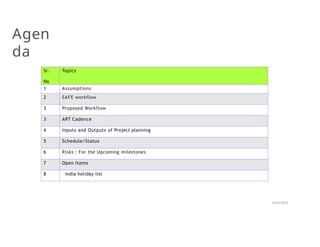
Agen
da
Sr.
No
Topics
1 Assumptions
2 SAFE workflow
3 Proposed Workflow
3 ART Cadence
4 Inputs and Outputs of Project planning
5 Schedule/Status
6 Risks : For the Upcoming milestones
7 Open Items
8 India holiday list
1/18/2023
Assumpt
ions
 All inputs required for current sprint are available.
 Product backlog is defined properly.
 Resources are in-lined with the project (Trainings).
 Scope of current milestone is clearly understood.
 All dependencies are resolved
 Team is properly skilled
 Team is willing to embrace agile.
 Team is scrum and agile trained.
Scaled Agile ART
cycle
12/14/202
2
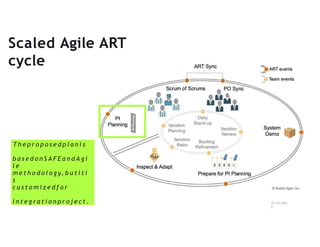
T h e p r o p o s e d p l a n i s
b a s e d o n S A F E a n d A g i
l e
m e t h o d o l o g y, b u t i t i
s
c u s t o m i z e d f o r
i n t e g r a t i o n p r o j e c t .
12/14/202
2
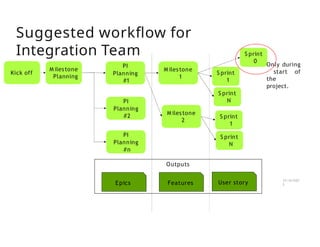
M ilestone
Planning
M ilestone
1
S print
0
S print
1
S print
N
PI
Planning
#1
PI
Planning
#2
PI
Planning
#n
Suggested workflow for
Integration Team
Features User story
Outputs
Epics
M ilestone
2
S print
1
S print
N
Kick off
Only during
start of
the
project.
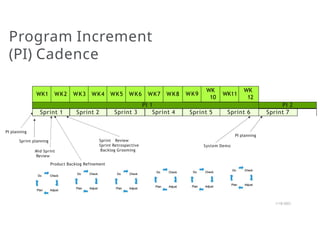
Program Increment
(PI) Cadence
Sprint planning Sprint Review
Sprint Retrospective
Backlog Grooming
Mid Sprint
Review
Product Backlog Refinement
PI planning
PI planning
WK1 WK2 WK3 WK4 WK5 WK6 WK7 WK8 WK9
WK
10
WK11
WK
12
PI 1 PI 2
Sprint 1 Sprint 2 Sprint 3 Sprint 4 Sprint 5 Sprint 6 Sprint 7
System Demo
1/18/2023
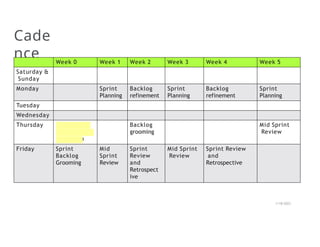
Cade
nce Week 0 Week 1 Week 2 Week 3 Week 4 Week 5
Saturday &
Sunday
Monday Sprint
Planning
Backlog
refinement
Sprint
Planning
Backlog
refinement
Sprint
Planning
Tuesday
Wednesday
Thursday PI Planning
and Backlog
Updation
Backlog
grooming
Mid Sprint
Review
Friday Sprint
Backlog
Grooming
Mid
Sprint
Review
Sprint
Review
and
Retrospect
ive
Mid Sprint
Review
Sprint Review
and
Retrospective
1/18/2023
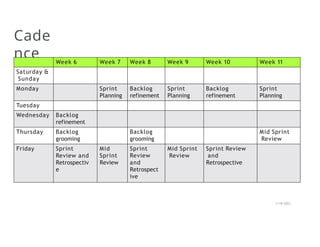
Cade
nce
1/18/2023
Week 6 Week 7 Week 8 Week 9 Week 10 Week 11
Saturday &
Sunday
Monday Sprint
Planning
Backlog
refinement
Sprint
Planning
Backlog
refinement
Sprint
Planning
Tuesday
Wednesday Backlog
refinement
Thursday Backlog
grooming
Backlog
grooming
Mid Sprint
Review
Friday Sprint
Review and
Retrospectiv
e
Mid
Sprint
Review
Sprint
Review
and
Retrospect
ive
Mid Sprint
Review
Sprint Review
and
Retrospective
Cade
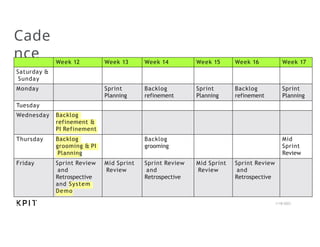
nce Week 12 Week 13 Week 14 Week 15 Week 16 Week 17
Saturday &
Sunday
Monday Sprint
Planning
Backlog
refinement
Sprint
Planning
Backlog
refinement
Sprint
Planning
Tuesday
Wednesday Backlog
refinement &
PI Refinement
Thursday Backlog
grooming & PI
Planning
Backlog
grooming
Mid
Sprint
Review
Friday Sprint Review
and
Retrospective
and System
Demo
Mid Sprint
Review
Sprint Review
and
Retrospective
Mid Sprint
Review
Sprint Review
and
Retrospective
1/18/2023
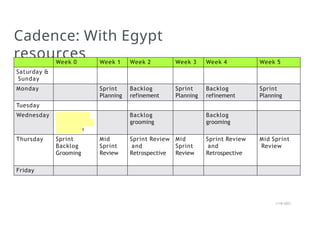
Cadence: With Egypt
resources
Week 0 Week 1 Week 2 Week 3 Week 4 Week 5
Saturday &
Sunday
Monday Sprint
Planning
Backlog
refinement
Sprint
Planning
Backlog
refinement
Sprint
Planning
Tuesday
Wednesday PI Planning
and Backlog
Updation
Backlog
grooming
Backlog
grooming
Thursday Sprint
Backlog
Grooming
Mid
Sprint
Review
Sprint Review
and
Retrospective
Mid
Sprint
Review
Sprint Review
and
Retrospective
Mid Sprint
Review
Friday
1/18/2023
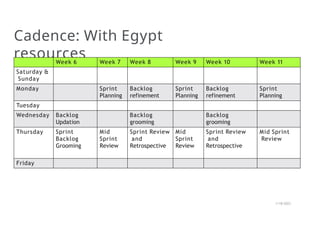
Cadence: With Egypt
resources
1/18/2023
Week 6 Week 7 Week 8 Week 9 Week 10 Week 11
Saturday &
Sunday
Monday Sprint
Planning
Backlog
refinement
Sprint
Planning
Backlog
refinement
Sprint
Planning
Tuesday
Wednesday Backlog
Updation
Backlog
grooming
Backlog
grooming
Thursday Sprint
Backlog
Grooming
Mid
Sprint
Review
Sprint Review
and
Retrospective
Mid
Sprint
Review
Sprint Review
and
Retrospective
Mid Sprint
Review
Friday
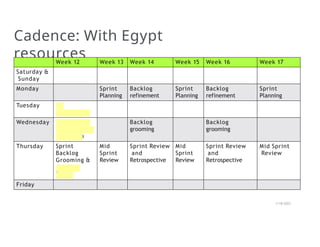
Cadence: With Egypt
resources
Week 12 Week 13 Week 14 Week 15 Week 16 Week 17
Saturday &
Sunday
Monday Sprint
Planning
Backlog
refinement
Sprint
Planning
Backlog
refinement
Sprint
Planning
Tuesday PI
Refinement
Wednesday PI Planning
and Backlog
Updation
Backlog
grooming
Backlog
grooming
Thursday Sprint
Backlog
Grooming &
System
Demo
Mid
Sprint
Review
Sprint Review
and
Retrospective
Mid
Sprint
Review
Sprint Review
and
Retrospective
Mid Sprint
Review
Friday
1/18/2023
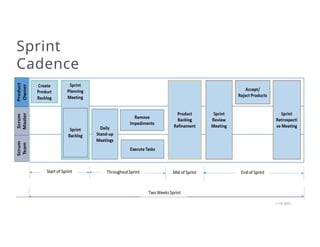
Sprint
Cadence
1/18/2023
Even
ts
14
• The What
• The Who
• The Inputs
• The Outputs
• The How
• Properties
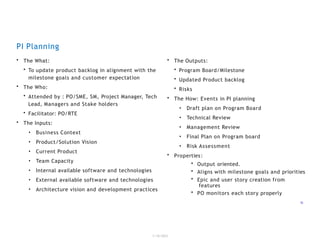
PI Planning
1/18/2023
15
• The What:
• To update product backlog in alignment with the
milestone goals and customer expectation
• The Who:
• Attended by : PO/SME, SM, Project Manager, Tech
Lead, Managers and Stake holders
• Facilitator: PO/RTE
• The Inputs:
• Business Context
• Product/Solution Vision
• Current Product
• Team Capacity
• Internal available software and technologies
• External available software and technologies
• Architecture vision and development practices
• Properties:
• The Outputs:
• Program Board/Milestone
• Updated Product backlog
• Risks
• The How: Events in PI planning
• Draft plan on Program Board
• Technical Review
• Management Review
• Final Plan on Program board
• Risk Assessment
• Output oriented.
• Aligns with milestone goals and priorities
• Epic and user story creation from
features
• PO monitors each story properly
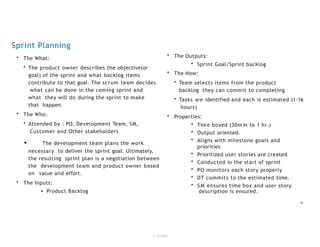
Sprint Planning
1/18/2023
16
• The What:
• The product owner describes the objective(or
goal) of the sprint and what backlog items
contribute to that goal. The scrum team decides
what can be done in the coming sprint and
what they will do during the sprint to make
that happen.
• The Who:
• Attended by : PO, Development Team, SM,
Customer and Other stakeholders
• The development team plans the work
necessary to deliver the sprint goal. Ultimately,
the resulting sprint plan is a negotiation between
the development team and product owner based
on value and effort.
• The Inputs:
• Product Backlog
• The Outputs:
• Sprint Goal/Sprint backlog
• The How:
• Team selects items from the product
backlog they can commit to completing
• Tasks are identified and each is estimated (1-16
hours)
• Properties:
• Time boxed (30min to 1 hr.)
• Output oriented.
• Aligns with milestone goals and
priorities
• Prioritized user stories are created
• Conducted in the start of sprint
• PO monitors each story properly
• DT commits to the estimated time.
• S M ensures time box and user story
description is ensured.
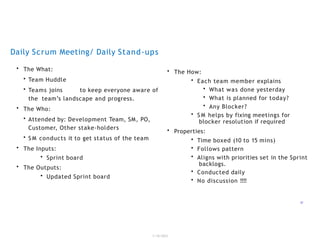
Daily Scrum Meeting/ Daily Stand-ups
1/18/2023
17
• The What:
• Team Huddle
• Teams joins to keep everyone aware of
the team’s landscape and progress.
• The Who:
• Attended by: Development Team, SM, PO,
Customer, Other stake-holders
• S M conducts it to get status of the team
• The Inputs:
• Sprint board
• The Outputs:
• Updated Sprint board
• The How:
• Each team member explains
• What was done yesterday
• What is planned for today?
• Any Blocker?
• S M helps by fixing meetings for
blocker resolution if required
• Properties:
• Time boxed (10 to 15 mins)
• Follows pattern
• Aligns with priorities set in the Sprint
backlogs.
• Conducted daily
• No discussion !!!!
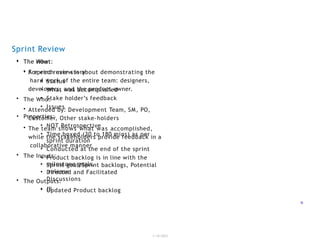
Sprint Review
• The How:
• For each user story
• Status
• What was accomplished
• Stake holder’s feedback
• Issues
• Properties:
• NOT Retrospective
• Time boxed (30 to 180 mins) as per
sprint duration
• Conducted at the end of the sprint
• Product backlog is in line with the
milestone goals.
• Directed and Facilitated
Discussions
• !!!
1/18/2023
18
• The What:
• A sprint review is about demonstrating the
hard work of the entire team: designers,
developers, and the product owner.
• The Who:
• Attended by: Development Team, SM, PO,
Customer, Other stake-holders
• The team shows what was accomplished,
while the stakeholders provide feedback in a
collaborative manner
• The Inputs:
• Sprint goal/Sprint backlogs, Potential
release
• The Outputs:
• Updated Product backlog
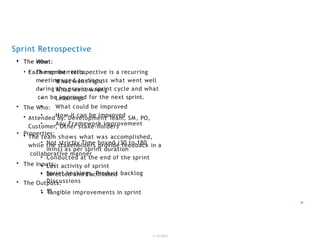
Sprint Retrospective
• The How:
• Each member tells
• What went right
• What went wrong
• Learnings
• What could be improved
• How it can be improved
• Any Framework improvement
• Properties:
• Not strictly Time boxed (30 to 180
mins) as per sprint duration
• Conducted at the end of the sprint
• Last activity of sprint
• Directed and Facilitated
Discussions
• !!!
1/18/2023
• Tangible improvements in sprint
19
• The What:
• The sprint retrospective is a recurring
meeting used to discuss what went well
during the previous sprint cycle and what
can be improved for the next sprint.
• The Who:
• Attended by: Development Team, SM, PO,
Customer, Other stake-holders
• The team shows what was accomplished,
while the stakeholders provide feedback in a
collaborative manner
• The Inputs:
• Sprint backlogs, Product backlog
• The Outputs:
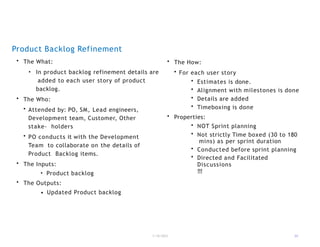
Product Backlog Refinement
1/18/2023 20
• Updated Product backlog
• The What:
• In product backlog refinement details are
added to each user story of product
backlog.
• The Who:
• Attended by: PO, SM, Lead engineers,
Development team, Customer, Other
stake- holders
• PO conducts it with the Development
Team to collaborate on the details of
Product Backlog items.
• The Inputs:
• Product backlog
• The Outputs:
• The How:
• For each user story
• Estimates is done.
• Alignment with milestones is done
• Details are added
• Timeboxing is done
• Properties:
• NOT Sprint planning
• Not strictly Time boxed (30 to 180
mins) as per sprint duration
• Conducted before sprint planning
• Directed and Facilitated
Discussions
!!!
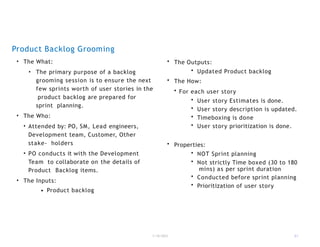
Product Backlog Grooming
• The What:
• The primary purpose of a backlog
grooming session is to ensure the next
few sprints worth of user stories in the
product backlog are prepared for
sprint planning.
• The Who:
• Attended by: PO, SM, Lead engineers,
Development team, Customer, Other
stake- holders
• PO conducts it with the Development
Team to collaborate on the details of
Product Backlog items.
• The Inputs:
1/18/2023 21
• Product backlog
• The Outputs:
• Updated Product backlog
• The How:
• For each user story
• User story Estimates is done.
• User story description is updated.
• Timeboxing is done
• User story prioritization is done.
• Properties:
• NOT Sprint planning
• Not strictly Time boxed (30 to 180
mins) as per sprint duration
• Conducted before sprint planning
• Prioritization of user story
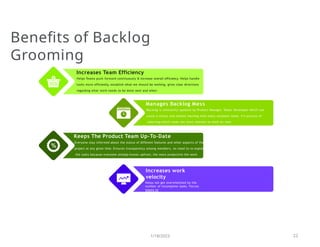
Increases Team Efficiency
Helps Teams push forward continuously & increase overall efficiency. Helps handle
tasks more efficiently, establish what we should be working, gives clear directions
regarding what work needs to be done next and when
everyone
Benefits of Backlog
Grooming
1/18/2023 22
Manages Backlog Mess
Backlog is constantly updated by Product Manager, Tester, Developer which can
cause a messy and chaotic backlog with many outdates items. It’s process of
selecting which tasks are most relevant to work on next
Keeps The Product Team Up-To-Date
Everyone stay informed about the status of different features and other aspects of the
project at any given time. Ensures transparency among members, no need to re-explai
the tasks because everyone already knows upfront, the more productive the work
Increases work
velocity
Helps not get overwhelmed by the
number of incomplete tasks. Forces
teams to
deliver the product more rapidly, ensures the organization is moving forward
on schedule. Reduces time spent on planning sprints, increases the
productivity of
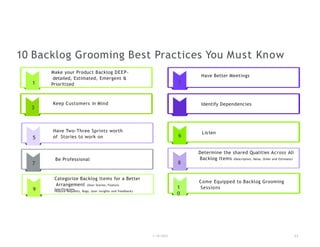
Make your Product Backlog DEEP-
detailed, Estimated, Emergent &
Prioritized
1
Have Better Meetings
2
Keep Customers in Mind
3
Identify Dependencies
4
Have Two-Three Sprints worth
of Stories to work on
5 6
10 Backlog Grooming Best Practices You Must Know
1/18/2023 23
Be Professional
7
Determine the shared Qualities Across All
Backlog Items (Description, Value, Order and Estimate)
8
Categorize Backlog Items for a Better
Arrangement (User Stories, Feature
Specifications,
Feature Requests, Bugs, User insights and Feedback)
9
Come Equipped to Backlog Grooming
Sessions
1
0
Listen
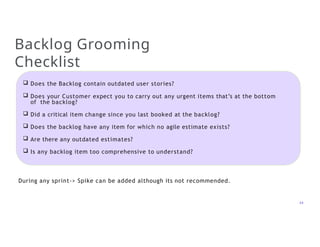
Backlog Grooming
Checklist
 Does the Backlog contain outdated user stories?
 Does your Customer expect you to carry out any urgent items that’s at the bottom
of the backlog?
 Did a critical item change since you last booked at the backlog?
 Does the backlog have any item for which no agile estimate exists?
 Are there any outdated estimates?
 Is any backlog item too comprehensive to understand?
24
During any sprint-> Spike can be added although its not recommended.
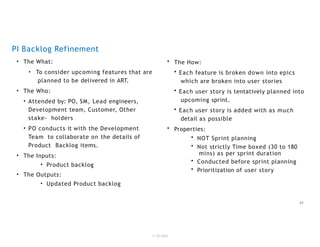
PI Backlog Refinement
• The What:
• To consider upcoming features that are
planned to be delivered in ART.
• The Who:
• Attended by: PO, SM, Lead engineers,
Development team, Customer, Other
stake- holders
• PO conducts it with the Development
Team to collaborate on the details of
Product Backlog items.
• The Inputs:
• Product backlog
• The Outputs:
• Updated Product backlog
1/18/2023
25
• The How:
• Each feature is broken down into epics
which are broken into user stories
• Each user story is tentatively planned into
upcoming sprint.
• Each user story is added with as much
detail as possible
• Properties:
• NOT Sprint planning
• Not strictly Time boxed (30 to 180
mins) as per sprint duration
• Conducted before sprint planning
• Prioritization of user story
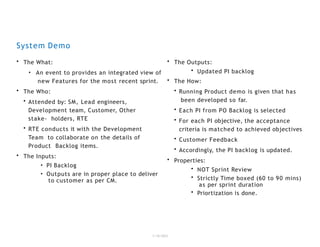
System Demo
1/18/2023
• The What:
• An event to provides an integrated view of
new Features for the most recent sprint.
• The Who:
• Attended by: SM, Lead engineers,
Development team, Customer, Other
stake- holders, RTE
• RTE conducts it with the Development
Team to collaborate on the details of
Product Backlog items.
• The Inputs:
• PI Backlog
• Outputs are in proper place to deliver
to customer as per CM.
• The Outputs:
• Updated PI backlog
• The How:
• Running Product demo is given that has
been developed so far.
• Each PI from PO Backlog is selected
• For each PI objective, the acceptance
criteria is matched to achieved objectives
• Customer Feedback
• Accordingly, the PI backlog is updated.
• Properties:
• NOT Sprint Review
• Strictly Time boxed (60 to 90 mins)
as per sprint duration
• Priortization is done.
Implementation
Units
27
• Features
• Epics
• User stories
• Tasks
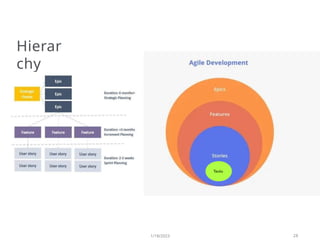
Hierar
chy
1/18/2023 28
Tasks
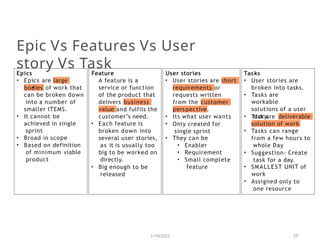
Epic Vs Features Vs User
story Vs Task
1/18/2023 29
large
bodies of work that
can be broken down
into a number of
smaller ITEMS.
• It cannot be
achieved in single
sprint
• Broad in scope
• Based on definition
of minimum viable
product
• User stories are short
requirements or
requests written
from the customer
perspective.
• Its what user wants
• Only created for
single sprint
• They can be
• Enabler
• Requirement
• Small complete
feature
Tasks
• User stories are
broken into tasks.
• Tasks are
workable
solutions of a user
story.
• Task are deliverable
solution of work
• Tasks can range
from a few hours to
whole Day
• Suggestion- Create
task for a day.
• SMALLEST UNIT of
work
• Assigned only to
one resource
Epics Feature User stories
• Epics are
•
A feature is a
service or function
of the product that
delivers business
value and fulfils the
customer’s need.
• Each feature is
broken down into
several user stories,
as it is usually too
big to be worked on
directly.
• Big enough to be
released
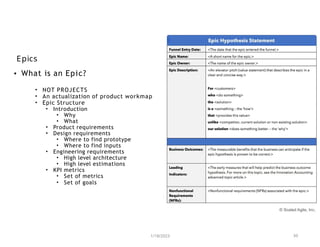
Epics
1/18/2023 30
• What is an Epic?
• NOT PROJECTS
• An actualization of product workmap
• Epic Structure
• Introduction
• Why
• What
• Product requirements
• Design requirements
• Where to find prototype
• Where to find inputs
• Engineering requirements
• High level architecture
• High level estimations
• KPI metrics
• Set of metrics
• Set of goals
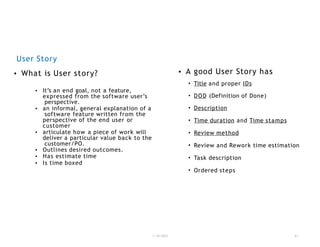
User Story
1/18/2023 31
• What is User story?
• It’s an end goal, not a feature,
expressed from the software user’s
perspective.
• an informal, general explanation of a
software feature written from the
perspective of the end user or
customer
• articulate how a piece of work will
deliver a particular value back to the
customer/PO.
• Outlines desired outcomes.
• Has estimate time
• Is time boxed
• A good User Story has
• Title and proper IDs
• DOD (Definition of Done)
• Description
• Time duration and Time stamps
• Review method
• Review and Rework time estimation
• Task description
• Ordered steps
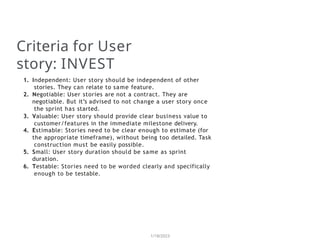
Criteria for User
story: INVEST
1/18/2023
1. Independent: User story should be independent of other
stories. They can relate to same feature.
2. Negotiable: User stories are not a contract. They are
negotiable. But it’s advised to not change a user story once
the sprint has started.
3. Valuable: User story should provide clear business value to
customer/features in the immediate milestone delivery.
4. Estimable: Stories need to be clear enough to estimate (for
the appropriate timeframe), without being too detailed. Task
construction must be easily possible.
5. Small: User story duration should be same as sprint
duration.
6. Testable: Stories need to be worded clearly and specifically
enough to be testable.
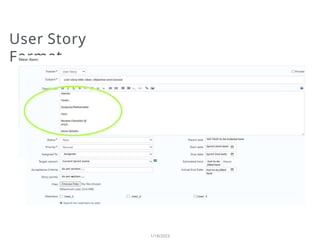
User Story
Format
1/18/2023
User story
Checks
1/18/2023
1. It does not combine with, overlap nor conflict with other User Stories.
2. It is independent of other user stories.
3. It is traceable back to the business needs expressed in the business case and project objectives for
immediate/current milestone.
4. Duration should be 1 sprint (exceptions for smaller user story are possible but they should be justified
in description).
5. Task creation must be easy. Hence, create the possible task in sprint planning itself while creating the
user story. Review and rework task are to be included.
6. The created user-story must be workable in current sprint. It should not be having dependencies. If
still a user story with dependency is considered, then the reason for taking it in current sprint must be
justified in description.
7. User story inputs and deliverables must be clearly defined in description.
8. It should be assigned to one team member.
9. User story does not have a parent task.
10. Start date for user story should be Sprint start date and Due date of user story should be sprint end
date*.
11. The watchers should be added to a user story if any stake holder wants to monitor the task regularly.
This point should be captured in sprint review.
12. User story has properly defined acceptance criteria.
Tasks
1/18/2023
35
• What is Task?
• Should be completed by 1 person in
the team
• Should be created at the start of the
sprint
• Should be outcome focused.
• Outlines desired outcomes.
• Has estimate time
• Is time boxed
• A good Task is 1-2 3-4
• Should take a day to complete
• Closed with a proper comment
• Estimated for a day
• Time duration and Time stamps
• Precisely Scoped
• Defined Inputs
• Defined Exit Criteria
Definition of Done
1/18/2023
• What is DoD?
• It is a comprehensive checklist of necessary
activities that ensure that only truly done
features are delivered, not only in terms of
functionality but in terms of quality as well.
• DoD Levels
• DoD for a Product Backlog item (e.g. writing
code, tests and all necessary documentation)
• DoD for a Sprint (e.g. install demo system for
review) Q111Q1Q
• DoD for a Release (e.g. writing release notes)
• Characteristics of DOD
• Doesn’t remail same throughout the project
• Must get refined and enhanced with time.
• Checklist of DOD for user story : 10 Golden rules
1. Assumptions of User Story/sprint/release met
2. Project builds without errors
3. Unit tests written and passing
4. Project deployed on the test environment
identical to production platform
5. Tests on devices/browsers listed in
the project assumptions passed
6. In lined with Epic and hence with
feature
7. Tested against Acceptance criteria
8. Refactoring completed
9. Any configuration or build changes
documented
10. Peer Code Review performed
Acceptance Criteria
1/18/2023
• What is Acceptance Criteria?
• It is a comprehensive checklist of necessary
activities that ensure that only truly done
features are delivered, not only in terms of
functionality but in terms of quality as well.
• Process for user story: 3Cs
• The Card: A written description of the User
Story. It is instead a reminder for subsequent
communication that must take place.
• The Conversation: Its used to discuss details
of the User Story. It may be supplemented
by some documentation.
• The Confirmation: Its represented by user
acceptance tests, which ensure that the User
Story satisfies acceptance criteria of the
user/customer.
• Properties of acceptance criteria
• Testable
• Clear and concise
• Everyone must understand
• Provides user perspective
• Always aligned with Sprint goal
• Criteria/Checklist of acceptance criteria : SMART
S: Specific
M: Measurable
A: Acceptable
R: Realistic
T: Testable

ProposedWorkflow_IntegrationProjects_18Jan23 (1).pptx

  • 1.
    Proposed workflow for AgileIntegration projects
  • 2.
    16/8/2022 Agen da Sr. No Topics 1 Assumptions 2 SAFEworkflow 3 Proposed Workflow 3 ART Cadence 4 Inputs and Outputs of Project planning 5 Schedule/Status 6 Risks : For the Upcoming milestones 7 Open Items 8 India holiday list
  • 3.
    1/18/2023 Assumpt ions  All inputsrequired for current sprint are available.  Product backlog is defined properly.  Resources are in-lined with the project (Trainings).  Scope of current milestone is clearly understood.  All dependencies are resolved  Team is properly skilled  Team is willing to embrace agile.  Team is scrum and agile trained.
  • 4.
    Scaled Agile ART cycle 12/14/202 2 Th e p r o p o s e d p l a n i s b a s e d o n S A F E a n d A g i l e m e t h o d o l o g y, b u t i t i s c u s t o m i z e d f o r i n t e g r a t i o n p r o j e c t .
  • 5.
    12/14/202 2 M ilestone Planning M ilestone 1 Sprint 0 S print 1 S print N PI Planning #1 PI Planning #2 PI Planning #n Suggested workflow for Integration Team Features User story Outputs Epics M ilestone 2 S print 1 S print N Kick off Only during start of the project.
  • 6.
    Program Increment (PI) Cadence Sprintplanning Sprint Review Sprint Retrospective Backlog Grooming Mid Sprint Review Product Backlog Refinement PI planning PI planning WK1 WK2 WK3 WK4 WK5 WK6 WK7 WK8 WK9 WK 10 WK11 WK 12 PI 1 PI 2 Sprint 1 Sprint 2 Sprint 3 Sprint 4 Sprint 5 Sprint 6 Sprint 7 System Demo 1/18/2023
  • 7.
    Cade nce Week 0Week 1 Week 2 Week 3 Week 4 Week 5 Saturday & Sunday Monday Sprint Planning Backlog refinement Sprint Planning Backlog refinement Sprint Planning Tuesday Wednesday Thursday PI Planning and Backlog Updation Backlog grooming Mid Sprint Review Friday Sprint Backlog Grooming Mid Sprint Review Sprint Review and Retrospect ive Mid Sprint Review Sprint Review and Retrospective 1/18/2023
  • 8.
    Cade nce 1/18/2023 Week 6 Week7 Week 8 Week 9 Week 10 Week 11 Saturday & Sunday Monday Sprint Planning Backlog refinement Sprint Planning Backlog refinement Sprint Planning Tuesday Wednesday Backlog refinement Thursday Backlog grooming Backlog grooming Mid Sprint Review Friday Sprint Review and Retrospectiv e Mid Sprint Review Sprint Review and Retrospect ive Mid Sprint Review Sprint Review and Retrospective
  • 9.
    Cade nce Week 12Week 13 Week 14 Week 15 Week 16 Week 17 Saturday & Sunday Monday Sprint Planning Backlog refinement Sprint Planning Backlog refinement Sprint Planning Tuesday Wednesday Backlog refinement & PI Refinement Thursday Backlog grooming & PI Planning Backlog grooming Mid Sprint Review Friday Sprint Review and Retrospective and System Demo Mid Sprint Review Sprint Review and Retrospective Mid Sprint Review Sprint Review and Retrospective 1/18/2023
  • 10.
    Cadence: With Egypt resources Week0 Week 1 Week 2 Week 3 Week 4 Week 5 Saturday & Sunday Monday Sprint Planning Backlog refinement Sprint Planning Backlog refinement Sprint Planning Tuesday Wednesday PI Planning and Backlog Updation Backlog grooming Backlog grooming Thursday Sprint Backlog Grooming Mid Sprint Review Sprint Review and Retrospective Mid Sprint Review Sprint Review and Retrospective Mid Sprint Review Friday 1/18/2023
  • 11.
    Cadence: With Egypt resources 1/18/2023 Week6 Week 7 Week 8 Week 9 Week 10 Week 11 Saturday & Sunday Monday Sprint Planning Backlog refinement Sprint Planning Backlog refinement Sprint Planning Tuesday Wednesday Backlog Updation Backlog grooming Backlog grooming Thursday Sprint Backlog Grooming Mid Sprint Review Sprint Review and Retrospective Mid Sprint Review Sprint Review and Retrospective Mid Sprint Review Friday
  • 12.
    Cadence: With Egypt resources Week12 Week 13 Week 14 Week 15 Week 16 Week 17 Saturday & Sunday Monday Sprint Planning Backlog refinement Sprint Planning Backlog refinement Sprint Planning Tuesday PI Refinement Wednesday PI Planning and Backlog Updation Backlog grooming Backlog grooming Thursday Sprint Backlog Grooming & System Demo Mid Sprint Review Sprint Review and Retrospective Mid Sprint Review Sprint Review and Retrospective Mid Sprint Review Friday 1/18/2023
  • 13.
  • 14.
    Even ts 14 • The What •The Who • The Inputs • The Outputs • The How • Properties
  • 15.
    PI Planning 1/18/2023 15 • TheWhat: • To update product backlog in alignment with the milestone goals and customer expectation • The Who: • Attended by : PO/SME, SM, Project Manager, Tech Lead, Managers and Stake holders • Facilitator: PO/RTE • The Inputs: • Business Context • Product/Solution Vision • Current Product • Team Capacity • Internal available software and technologies • External available software and technologies • Architecture vision and development practices • Properties: • The Outputs: • Program Board/Milestone • Updated Product backlog • Risks • The How: Events in PI planning • Draft plan on Program Board • Technical Review • Management Review • Final Plan on Program board • Risk Assessment • Output oriented. • Aligns with milestone goals and priorities • Epic and user story creation from features • PO monitors each story properly
  • 16.
    Sprint Planning 1/18/2023 16 • TheWhat: • The product owner describes the objective(or goal) of the sprint and what backlog items contribute to that goal. The scrum team decides what can be done in the coming sprint and what they will do during the sprint to make that happen. • The Who: • Attended by : PO, Development Team, SM, Customer and Other stakeholders • The development team plans the work necessary to deliver the sprint goal. Ultimately, the resulting sprint plan is a negotiation between the development team and product owner based on value and effort. • The Inputs: • Product Backlog • The Outputs: • Sprint Goal/Sprint backlog • The How: • Team selects items from the product backlog they can commit to completing • Tasks are identified and each is estimated (1-16 hours) • Properties: • Time boxed (30min to 1 hr.) • Output oriented. • Aligns with milestone goals and priorities • Prioritized user stories are created • Conducted in the start of sprint • PO monitors each story properly • DT commits to the estimated time. • S M ensures time box and user story description is ensured.
  • 17.
    Daily Scrum Meeting/Daily Stand-ups 1/18/2023 17 • The What: • Team Huddle • Teams joins to keep everyone aware of the team’s landscape and progress. • The Who: • Attended by: Development Team, SM, PO, Customer, Other stake-holders • S M conducts it to get status of the team • The Inputs: • Sprint board • The Outputs: • Updated Sprint board • The How: • Each team member explains • What was done yesterday • What is planned for today? • Any Blocker? • S M helps by fixing meetings for blocker resolution if required • Properties: • Time boxed (10 to 15 mins) • Follows pattern • Aligns with priorities set in the Sprint backlogs. • Conducted daily • No discussion !!!!
  • 18.
    Sprint Review • TheHow: • For each user story • Status • What was accomplished • Stake holder’s feedback • Issues • Properties: • NOT Retrospective • Time boxed (30 to 180 mins) as per sprint duration • Conducted at the end of the sprint • Product backlog is in line with the milestone goals. • Directed and Facilitated Discussions • !!! 1/18/2023 18 • The What: • A sprint review is about demonstrating the hard work of the entire team: designers, developers, and the product owner. • The Who: • Attended by: Development Team, SM, PO, Customer, Other stake-holders • The team shows what was accomplished, while the stakeholders provide feedback in a collaborative manner • The Inputs: • Sprint goal/Sprint backlogs, Potential release • The Outputs: • Updated Product backlog
  • 19.
    Sprint Retrospective • TheHow: • Each member tells • What went right • What went wrong • Learnings • What could be improved • How it can be improved • Any Framework improvement • Properties: • Not strictly Time boxed (30 to 180 mins) as per sprint duration • Conducted at the end of the sprint • Last activity of sprint • Directed and Facilitated Discussions • !!! 1/18/2023 • Tangible improvements in sprint 19 • The What: • The sprint retrospective is a recurring meeting used to discuss what went well during the previous sprint cycle and what can be improved for the next sprint. • The Who: • Attended by: Development Team, SM, PO, Customer, Other stake-holders • The team shows what was accomplished, while the stakeholders provide feedback in a collaborative manner • The Inputs: • Sprint backlogs, Product backlog • The Outputs:
  • 20.
    Product Backlog Refinement 1/18/202320 • Updated Product backlog • The What: • In product backlog refinement details are added to each user story of product backlog. • The Who: • Attended by: PO, SM, Lead engineers, Development team, Customer, Other stake- holders • PO conducts it with the Development Team to collaborate on the details of Product Backlog items. • The Inputs: • Product backlog • The Outputs: • The How: • For each user story • Estimates is done. • Alignment with milestones is done • Details are added • Timeboxing is done • Properties: • NOT Sprint planning • Not strictly Time boxed (30 to 180 mins) as per sprint duration • Conducted before sprint planning • Directed and Facilitated Discussions !!!
  • 21.
    Product Backlog Grooming •The What: • The primary purpose of a backlog grooming session is to ensure the next few sprints worth of user stories in the product backlog are prepared for sprint planning. • The Who: • Attended by: PO, SM, Lead engineers, Development team, Customer, Other stake- holders • PO conducts it with the Development Team to collaborate on the details of Product Backlog items. • The Inputs: 1/18/2023 21 • Product backlog • The Outputs: • Updated Product backlog • The How: • For each user story • User story Estimates is done. • User story description is updated. • Timeboxing is done • User story prioritization is done. • Properties: • NOT Sprint planning • Not strictly Time boxed (30 to 180 mins) as per sprint duration • Conducted before sprint planning • Prioritization of user story
  • 22.
    Increases Team Efficiency HelpsTeams push forward continuously & increase overall efficiency. Helps handle tasks more efficiently, establish what we should be working, gives clear directions regarding what work needs to be done next and when everyone Benefits of Backlog Grooming 1/18/2023 22 Manages Backlog Mess Backlog is constantly updated by Product Manager, Tester, Developer which can cause a messy and chaotic backlog with many outdates items. It’s process of selecting which tasks are most relevant to work on next Keeps The Product Team Up-To-Date Everyone stay informed about the status of different features and other aspects of the project at any given time. Ensures transparency among members, no need to re-explai the tasks because everyone already knows upfront, the more productive the work Increases work velocity Helps not get overwhelmed by the number of incomplete tasks. Forces teams to deliver the product more rapidly, ensures the organization is moving forward on schedule. Reduces time spent on planning sprints, increases the productivity of
  • 23.
    Make your ProductBacklog DEEP- detailed, Estimated, Emergent & Prioritized 1 Have Better Meetings 2 Keep Customers in Mind 3 Identify Dependencies 4 Have Two-Three Sprints worth of Stories to work on 5 6 10 Backlog Grooming Best Practices You Must Know 1/18/2023 23 Be Professional 7 Determine the shared Qualities Across All Backlog Items (Description, Value, Order and Estimate) 8 Categorize Backlog Items for a Better Arrangement (User Stories, Feature Specifications, Feature Requests, Bugs, User insights and Feedback) 9 Come Equipped to Backlog Grooming Sessions 1 0 Listen
  • 24.
    Backlog Grooming Checklist  Doesthe Backlog contain outdated user stories?  Does your Customer expect you to carry out any urgent items that’s at the bottom of the backlog?  Did a critical item change since you last booked at the backlog?  Does the backlog have any item for which no agile estimate exists?  Are there any outdated estimates?  Is any backlog item too comprehensive to understand? 24 During any sprint-> Spike can be added although its not recommended.
  • 25.
    PI Backlog Refinement •The What: • To consider upcoming features that are planned to be delivered in ART. • The Who: • Attended by: PO, SM, Lead engineers, Development team, Customer, Other stake- holders • PO conducts it with the Development Team to collaborate on the details of Product Backlog items. • The Inputs: • Product backlog • The Outputs: • Updated Product backlog 1/18/2023 25 • The How: • Each feature is broken down into epics which are broken into user stories • Each user story is tentatively planned into upcoming sprint. • Each user story is added with as much detail as possible • Properties: • NOT Sprint planning • Not strictly Time boxed (30 to 180 mins) as per sprint duration • Conducted before sprint planning • Prioritization of user story
  • 26.
    System Demo 1/18/2023 • TheWhat: • An event to provides an integrated view of new Features for the most recent sprint. • The Who: • Attended by: SM, Lead engineers, Development team, Customer, Other stake- holders, RTE • RTE conducts it with the Development Team to collaborate on the details of Product Backlog items. • The Inputs: • PI Backlog • Outputs are in proper place to deliver to customer as per CM. • The Outputs: • Updated PI backlog • The How: • Running Product demo is given that has been developed so far. • Each PI from PO Backlog is selected • For each PI objective, the acceptance criteria is matched to achieved objectives • Customer Feedback • Accordingly, the PI backlog is updated. • Properties: • NOT Sprint Review • Strictly Time boxed (60 to 90 mins) as per sprint duration • Priortization is done.
  • 27.
  • 28.
  • 29.
    Epic Vs FeaturesVs User story Vs Task 1/18/2023 29 large bodies of work that can be broken down into a number of smaller ITEMS. • It cannot be achieved in single sprint • Broad in scope • Based on definition of minimum viable product • User stories are short requirements or requests written from the customer perspective. • Its what user wants • Only created for single sprint • They can be • Enabler • Requirement • Small complete feature Tasks • User stories are broken into tasks. • Tasks are workable solutions of a user story. • Task are deliverable solution of work • Tasks can range from a few hours to whole Day • Suggestion- Create task for a day. • SMALLEST UNIT of work • Assigned only to one resource Epics Feature User stories • Epics are • A feature is a service or function of the product that delivers business value and fulfils the customer’s need. • Each feature is broken down into several user stories, as it is usually too big to be worked on directly. • Big enough to be released
  • 30.
    Epics 1/18/2023 30 • Whatis an Epic? • NOT PROJECTS • An actualization of product workmap • Epic Structure • Introduction • Why • What • Product requirements • Design requirements • Where to find prototype • Where to find inputs • Engineering requirements • High level architecture • High level estimations • KPI metrics • Set of metrics • Set of goals
  • 31.
    User Story 1/18/2023 31 •What is User story? • It’s an end goal, not a feature, expressed from the software user’s perspective. • an informal, general explanation of a software feature written from the perspective of the end user or customer • articulate how a piece of work will deliver a particular value back to the customer/PO. • Outlines desired outcomes. • Has estimate time • Is time boxed • A good User Story has • Title and proper IDs • DOD (Definition of Done) • Description • Time duration and Time stamps • Review method • Review and Rework time estimation • Task description • Ordered steps
  • 32.
    Criteria for User story:INVEST 1/18/2023 1. Independent: User story should be independent of other stories. They can relate to same feature. 2. Negotiable: User stories are not a contract. They are negotiable. But it’s advised to not change a user story once the sprint has started. 3. Valuable: User story should provide clear business value to customer/features in the immediate milestone delivery. 4. Estimable: Stories need to be clear enough to estimate (for the appropriate timeframe), without being too detailed. Task construction must be easily possible. 5. Small: User story duration should be same as sprint duration. 6. Testable: Stories need to be worded clearly and specifically enough to be testable.
  • 33.
  • 34.
    User story Checks 1/18/2023 1. Itdoes not combine with, overlap nor conflict with other User Stories. 2. It is independent of other user stories. 3. It is traceable back to the business needs expressed in the business case and project objectives for immediate/current milestone. 4. Duration should be 1 sprint (exceptions for smaller user story are possible but they should be justified in description). 5. Task creation must be easy. Hence, create the possible task in sprint planning itself while creating the user story. Review and rework task are to be included. 6. The created user-story must be workable in current sprint. It should not be having dependencies. If still a user story with dependency is considered, then the reason for taking it in current sprint must be justified in description. 7. User story inputs and deliverables must be clearly defined in description. 8. It should be assigned to one team member. 9. User story does not have a parent task. 10. Start date for user story should be Sprint start date and Due date of user story should be sprint end date*. 11. The watchers should be added to a user story if any stake holder wants to monitor the task regularly. This point should be captured in sprint review. 12. User story has properly defined acceptance criteria.
  • 35.
    Tasks 1/18/2023 35 • What isTask? • Should be completed by 1 person in the team • Should be created at the start of the sprint • Should be outcome focused. • Outlines desired outcomes. • Has estimate time • Is time boxed • A good Task is 1-2 3-4 • Should take a day to complete • Closed with a proper comment • Estimated for a day • Time duration and Time stamps • Precisely Scoped • Defined Inputs • Defined Exit Criteria
  • 36.
    Definition of Done 1/18/2023 •What is DoD? • It is a comprehensive checklist of necessary activities that ensure that only truly done features are delivered, not only in terms of functionality but in terms of quality as well. • DoD Levels • DoD for a Product Backlog item (e.g. writing code, tests and all necessary documentation) • DoD for a Sprint (e.g. install demo system for review) Q111Q1Q • DoD for a Release (e.g. writing release notes) • Characteristics of DOD • Doesn’t remail same throughout the project • Must get refined and enhanced with time. • Checklist of DOD for user story : 10 Golden rules 1. Assumptions of User Story/sprint/release met 2. Project builds without errors 3. Unit tests written and passing 4. Project deployed on the test environment identical to production platform 5. Tests on devices/browsers listed in the project assumptions passed 6. In lined with Epic and hence with feature 7. Tested against Acceptance criteria 8. Refactoring completed 9. Any configuration or build changes documented 10. Peer Code Review performed
  • 37.
    Acceptance Criteria 1/18/2023 • Whatis Acceptance Criteria? • It is a comprehensive checklist of necessary activities that ensure that only truly done features are delivered, not only in terms of functionality but in terms of quality as well. • Process for user story: 3Cs • The Card: A written description of the User Story. It is instead a reminder for subsequent communication that must take place. • The Conversation: Its used to discuss details of the User Story. It may be supplemented by some documentation. • The Confirmation: Its represented by user acceptance tests, which ensure that the User Story satisfies acceptance criteria of the user/customer. • Properties of acceptance criteria • Testable • Clear and concise • Everyone must understand • Provides user perspective • Always aligned with Sprint goal • Criteria/Checklist of acceptance criteria : SMART S: Specific M: Measurable A: Acceptable R: Realistic T: Testable