IPISE Int. Communication,
Understanding and Predicting
    Crash Risks on Freeways
                     January 23, 2008


                     Moinul Hossain
               Dept. of Built Environment
       Tokyo Institute of Technology (TIT)

                     Supervised By:
             Dr. YASUNORI MUROMACHI
Outline
Road Accidents – How Big is the Problem?
          Components of Road Accidents
      Safe Roads and Accident Prediction
   Accident Prediction Models – Progress
    Problems and My Research Objectives
                           Methodology
                      Expected Outcome
              Me, Myself and Road Safety
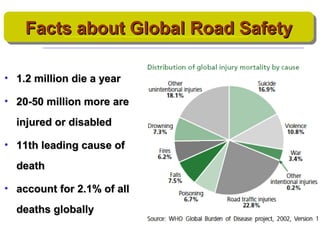
Facts about Global Road Safety

• 1.2 million die a year

• 20-50 million more are
  injured or disabled

• 11th leading cause of
  death

• account for 2.1% of all
  deaths globally
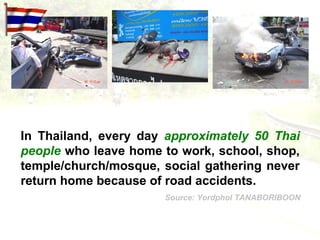
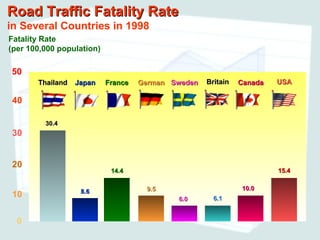
In Thailand, every day approximately 50 Thai
people who leave home to work, school, shop,
temple/church/mosque, social gathering never
return home because of road accidents.
                      Source: Yordphol TANABORIBOON
Road Traffic Fatality Rate
in Several Countries in 1998
Fatality Rate
(per 100,000 population)

50
       Thailand   Japan    France   German Sweden   Britain   Canada   USA

40

         30.4
30


20
                            14.4                                       15.4

                                     9.5                      10.0
                   8.6
10                                          6.0       6.1


  0
What are the
  Causes of
Accidents ?
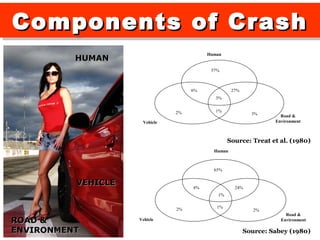
Components of Crash
Components of Crash
                                         Human
          HUMAN
                                          57%


                                    6%             27%
                                            3%


                               2%           1%
                                                           3%       Road &
                     Vehicle                                      Environment


                                                 Source: Treat et al. (1980)
                                           Human


                                           65%


          VEHICLE                   4%              24%
                                            1%


                               2%           1%
                                                            2%
                                                                      Road &
ROAD &              Vehicle                                         Environment

ENVIRONMENT                                              Source: Sabey (1980)
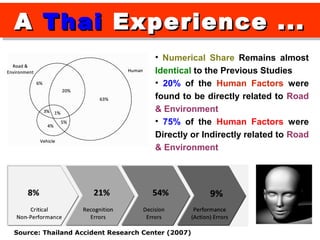
A Thai Experience ...
                                      • Numerical Share Remains almost
                                      Identical to the Previous Studies
                                      • 20% of the Human Factors were
                                      found to be directly related to Road
                                      & Environment
                                      • 75% of the Human Factors were
                                      Directly or Indirectly related to Road
                                      & Environment


Source: Thailand Accident Research Center (2007)
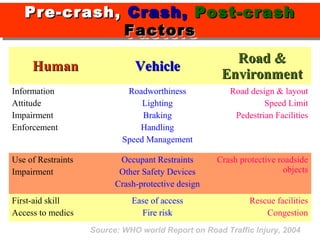
Pre-crash, Crash, Post-crash
   Pre-crash, Crash, Post-crash
              Factors
              Factors
                                                       Road &
     Human                     Vehicle
                                                     Environment
Information                  Roadworthiness            Road design & layout
Attitude                         Lighting                       Speed Limit
Impairment                       Braking                Pedestrian Facilities
Enforcement                     Handling
                            Speed Management

Use of Restraints          Occupant Restraints      Crash protective roadside
Impairment                 Other Safety Devices                       objects
                          Crash-protective design
First-aid skill               Ease of access                Rescue facilities
Access to medics                Fire risk                       Congestion
                    Source: WHO world Report on Road Traffic Injury, 2004
What solution can be offered
to improve the safety
problems within a short time
span ?
Accident Prediction Model
               (APM)
       A Potential Solution


 “Mathematical Models Capable of Predicting
the Safety Hazards of Roads based on Traffic
  Flow Variables and Other Physical and/or
          Environmental Variables.”
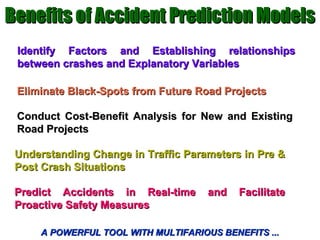
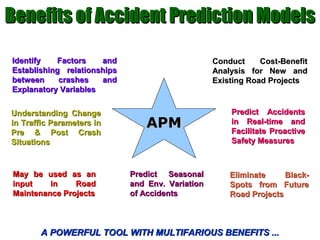
Benefits of Accident Prediction Models
 Identify Factors and Establishing relationships
 between crashes and Explanatory Variables

 Eliminate Black-Spots from Future Road Projects

 Conduct Cost-Benefit Analysis for New and Existing
 Road Projects

 Understanding Change in Traffic Parameters in Pre &
 Post Crash Situations

 Predict Accidents in Real-time      and   Facilitate
 Proactive Safety Measures

     A POWERFUL TOOL WITH MULTIFARIOUS BENEFITS ...
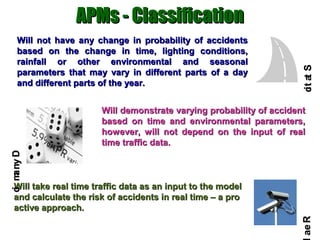
APMs - Classification
    Will not have any change in probability of accidents
    based on the change in time, lighting conditions,
    rainfall or other environmental and seasonal


                                                                      ct a S
    parameters that may vary in different parts of a day


                                                                      i t
    and different parts of the year.


                       Will demonstrate varying probability of accident
                       based on time and environmental parameters,
                       however, will not depend on the input of real
                       time traffic data.
c m ny D
i a


  Will take real time traffic data as an input to the model
  and calculate the risk of accidents in real time – a pro
  active approach.


                                                                     ae R
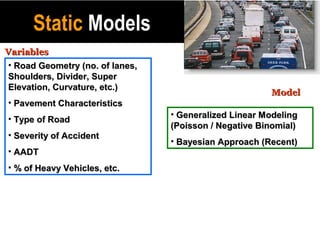
Static Models
Variables
• Road Geometry (no. of lanes,
Shoulders, Divider, Super
Elevation, Curvature, etc.)
                                                       Model
• Pavement Characteristics
                                 • Generalized Linear Modeling
• Type of Road
                                 (Poisson / Negative Binomial)
• Severity of Accident
                                 • Bayesian Approach (Recent)
• AADT
• % of Heavy Vehicles, etc.
Dynamic Models

    Variables                                 Model
• Road Geometry (no. of lanes,      • Time Series Analysis (Calender
Shoulders, Divider, Super           Data Analysis)
Elevation, Curvature, etc.)
• Pavement Characteristics
• Type of Road
• Severity of Accident
• AADT
• % of Heavy Vehicles, etc.
• Seasonal Input (e.g., Rainfall)
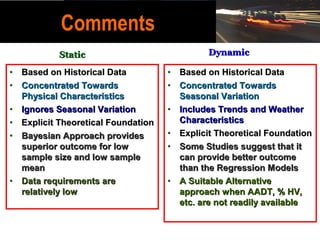
Comments
           Static                            Dynamic

• Based on Historical Data          • Based on Historical Data
• Concentrated Towards              • Concentrated Towards
  Physical Characteristics            Seasonal Variation
• Ignores Seasonal Variation        • Includes Trends and Weather
• Explicit Theoretical Foundation     Characteristics
• Bayesian Approach provides        • Explicit Theoretical Foundation
  superior outcome for low          • Some Studies suggest that it
  sample size and low sample          can provide better outcome
  mean                                than the Regression Models
• Data requirements are             • A Suitable Alternative
  relatively low                      approach when AADT, % HV,
                                      etc. are not readily available
Real-time Models
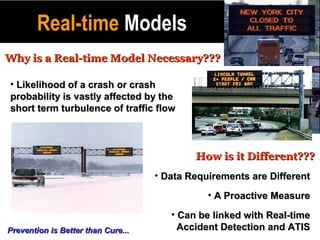
Why is a Real-time Model Necessary???

• Likelihood of a crash or crash
probability is vastly affected by the
short term turbulence of traffic flow


                                            How is it Different???
                                    • Data Requirements are Different
                                               • A Proactive Measure
                                       • Can be linked with Real-time
Prevention is Better than Cure...        Accident Detection and ATIS
Real-time Models
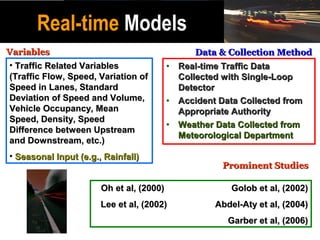
Variables                                       Data & Collection Method
• Traffic Related Variables               • Real-time Traffic Data
(Traffic Flow, Speed, Variation of          Collected with Single-Loop
Speed in Lanes, Standard                    Detector
Deviation of Speed and Volume,            • Accident Data Collected from
Vehicle Occupancy, Mean                     Appropriate Authority
Speed, Density, Speed
                                          • Weather Data Collected from
Difference between Upstream
                                            Meteorological Department
and Downstream, etc.)
• Seasonal Input (e.g., Rainfall)
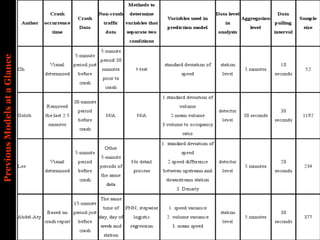
                                                      Prominent Studies

                       Oh et al, (2000)                 Golob et al, (2002)
                       Lee et al, (2002)            Abdel-Aty et al, (2004)
                                                       Garber et al, (2006)
PROBLEMS
• Interaction among Traffic, Geometric
  and Environmental Parameters were
  not studied
• Loop detectors proved to be inefficient
  in providing good data for the pre and
  post crash situations
• Different sources of data created a
  time lag between the actual time of
  accident and reported time of accident
• No comparison was made between the
  performance of Real-time and non-
  Real-time models
Research Demand and Questions
Research Questions
 What are the crash precursors or variables that can
explain the probability of accidents in real time?

 Can a traffic condition in relation to environmental
conditions be anticipated as dangerous enough to lead
to crash? If yes then how?

 What are the performance variations among a
static, dynamic and a real time accident prediction
models?
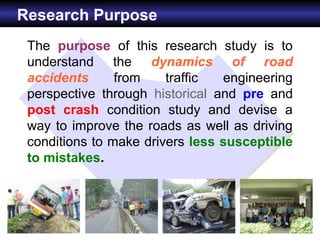
Research Purpose
 The purpose of this research study is to
 understand the dynamics of road
 accidents      from    traffic  engineering
 perspective through historical and pre and
 post crash condition study and devise a
 way to improve the roads as well as driving
 conditions to make drivers less susceptible
 to mistakes.
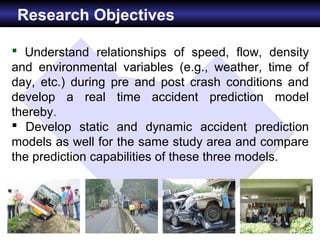
Research Objectives

 Understand relationships of speed, flow, density
and environmental variables (e.g., weather, time of
day, etc.) during pre and post crash conditions and
develop a real time accident prediction model
thereby.
 Develop static and dynamic accident prediction
models as well for the same study area and compare
the prediction capabilities of these three models.
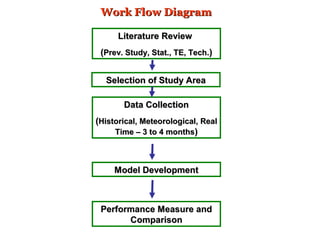
Work Flow Diagram

      Literature Review
 (Prev. Study, Stat., TE, Tech.)


  Selection of Study Area

       Data Collection
(Historical, Meteorological, Real
     Time – 3 to 4 months)


     Model Development


 Performance Measure and
       Comparison
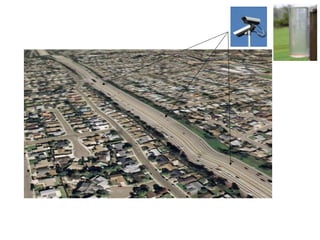
STUDY AREA
   STUDY AREA
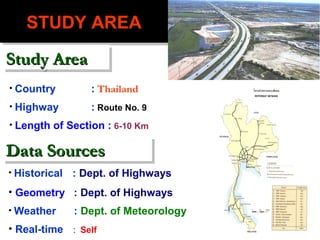
Study Area
Study Area
• Country         : Thailand
• Highway         : Route No. 9
• Length of Section : 6-10 Km


Data Sources
Data Sources
• Historical   : Dept. of Highways
• Geometry : Dept. of Highways
• Weather      : Dept. of Meteorology
• Real-time : Self
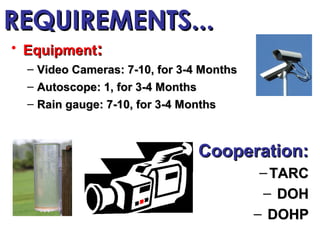
REQUIREMENTS...
• Equipment:
  – Video Cameras: 7-10, for 3-4 Months
  – Autoscope: 1, for 3-4 Months
  – Rain gauge: 7-10, for 3-4 Months


                                   Cooperation:
                                           – TARC
                                           – DOH
                                          – DOHP
Limitations...
        The Model will not consider
intersections or Entrances or Exits
   A Highly Accident prone section
                   will be selected
   Data will be collected for a short
                      period of Time
          Land Use Data will not be
                      Considered
    The Model will not be Tested in
               Real-time situation
Prepared by Yordphol T., AIT, 1 Dec 2005


Thank You

Working for road safety means not working under 'lime light' ...
                even not being paid attention by other people.
                    - Late Professor Yordphol TANABORIBOON.
          First Manager of Thailand Accident Research Center
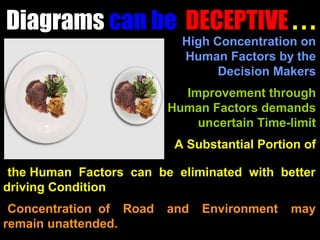
Diagrams can be DECEPTIVE . . .
                          •High Concentration on
                           Human Factors by the
                                 Decision Makers
                           •Improvement through
                         Human Factors demands
                              uncertain Time-limit
                          A Substantial Portion of

•the Human Factors can be eliminated with better
driving Condition
•Concentration of Road and Environment may
remain unattended.
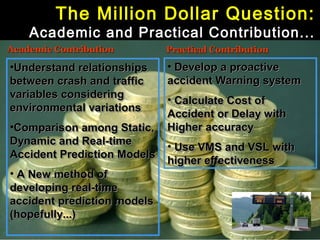
The Million Dollar Question:
    Academic and Practical Contribution...
Academic Contribution       Practical Contribution

•Understand relationships   • Develop a proactive
between crash and traffic   accident Warning system
variables considering       • Calculate Cost of
environmental variations
                            Accident or Delay with
•Comparison among Static,   Higher accuracy
Dynamic and Real-time      • Use VMS and VSL with
Accident Prediction Models
                           higher effectiveness
• A New method of
developing real-time
accident prediction models
(hopefully...)
Me, Myself
  and
Road Safety
Projects, Reports and Trainings (in Road Safety Only)

Projects
 Team Leader, Nationwide Real-time Vehicle Tracking System, Monico Limited,
  Bangladesh. July 2007 – September 2007. (For Profit Project).
 Research Associate, Thailand Accident Research Center (TARC), Thailand. June 2006 –
  July 2007.
 System Analyst, Provincial Road Safety Management System (PRSS), Donor: Thai Health

  Promotion Foundation, Thailand. June 2006 – December 2008.
 Student Assistant, Thailand Accident Research Center,Thailand. June 2005 – May 2006.

Project Reports
 Project Reports and Business Plan of Thailand Accidents Research Center, Thailand
 Application manual of Provincial Road Safety Management System (PRSS), Thailand

Training
 Lecturer, Road Safety and IT, The Third Country Training on Injury Surveillance (TCTP),
  November 14, 2006, Khon Kaen Hospital, Khon Kaen, Thailand. Donor: JICA.
Publications (in Road Safety Only...)
Thesis, Master of Engineering
 Application of Data Mining in Road Safety, AIT Thesis, 2006, Thailand.

Research Papers
 Motorcycle Accidents, Alcohol Intoxication and Futile Helmet Legislation in Thailand: How
 Long Must We Tolerate. Journal of the Eastern Asian Society for Transportation Studies, Vol. 7,
 China, October 2007.
 Medical Investigation of Motorcycle Accidents in Thailand. Journal of the Eastern Asian
Society
 for Transportation Studies, Vol. 7, p. 147-162, , China, October 2007
 Efficacy of Safety Helmets for the Thai Motorcyclists. The 3rd National Transport Conference:
   Sustainable and Safe Transportation Systems (SSTS), Khon Kaen University, 24 November,
2006,
  Khon Kaen, Thailand. Paper ID: TS-08.
 Probability of Survival (PS): An Alternative Severity Assessment Approach in Road Safety,
  Proceedings of International Conference of Road Safety in Developing Countries, Accident
Research Center, Bangladesh University of Engineering and Technology, 22-24 August, 2006,
Dhaka,
 Bangladesh.
 A Framework of Injury Surveillance (IS) Database for the Developing Countries: A Thai
  Experience from the Road Safety Perspective, Proceedings of International Conference of
Road
   Safety in Developing Countries, Accident Research Center, Bangladesh University of
Engineering
 and Technology, 22-24 August, 2006, Dhaka, Bangladesh.
 A Study on Pedestrian Accidents Based on the Injury Surveillance (IS) Data: Thailand’s Case,
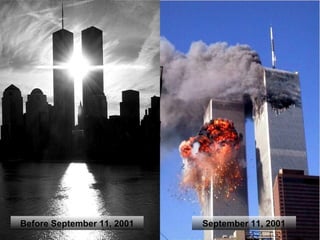
Before September 11, 2001   September 11, 2001
Benefits of Accident Prediction Models

Identify   Factors    and                         Conduct     Cost-Benefit
Establishing relationships                        Analysis for New and
between     crashes   and                         Existing Road Projects
Explanatory Variables

Understanding Change                                  Predict Accidents
in Traffic Parameters in         APM                  in Real-time and
                                                      Facilitate Proactive
Pre & Post Crash
Situations                                            Safety Measures


May be used as an            Predict Seasonal         Eliminate     Black-
input    in    Road          and Env. Variation       Spots from Future
Maintenance Projects         of Accidents             Road Projects


       A POWERFUL TOOL WITH MULTIFARIOUS BENEFITS ...
Previous Models at a Glance
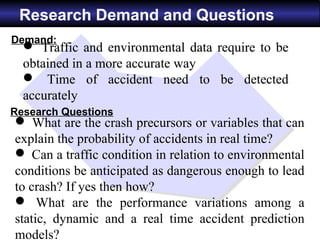
Research Demand and Questions
Demand:
   Traffic and environmental data require to be
  obtained in a more accurate way
   Time of accident need to be detected
  accurately
Research Questions
 What are the crash precursors or variables that can
explain the probability of accidents in real time?
 Can a traffic condition in relation to environmental
conditions be anticipated as dangerous enough to lead
to crash? If yes then how?
 What are the performance variations among a
static, dynamic and a real time accident prediction
models?

Proposal

  • 1.
    IPISE Int. Communication, Understandingand Predicting Crash Risks on Freeways January 23, 2008 Moinul Hossain Dept. of Built Environment Tokyo Institute of Technology (TIT) Supervised By: Dr. YASUNORI MUROMACHI
  • 2.
    Outline Road Accidents –How Big is the Problem? Components of Road Accidents Safe Roads and Accident Prediction Accident Prediction Models – Progress Problems and My Research Objectives Methodology Expected Outcome Me, Myself and Road Safety
  • 3.
    Facts about GlobalRoad Safety • 1.2 million die a year • 20-50 million more are injured or disabled • 11th leading cause of death • account for 2.1% of all deaths globally
  • 4.
    In Thailand, everyday approximately 50 Thai people who leave home to work, school, shop, temple/church/mosque, social gathering never return home because of road accidents. Source: Yordphol TANABORIBOON
  • 5.
    Road Traffic FatalityRate in Several Countries in 1998 Fatality Rate (per 100,000 population) 50 Thailand Japan France German Sweden Britain Canada USA 40 30.4 30 20 14.4 15.4 9.5 10.0 8.6 10 6.0 6.1 0
  • 6.
    What are the Causes of Accidents ?
  • 7.
    Components of Crash Componentsof Crash Human HUMAN 57% 6% 27% 3% 2% 1% 3% Road & Vehicle Environment Source: Treat et al. (1980) Human 65% VEHICLE 4% 24% 1% 2% 1% 2% Road & ROAD & Vehicle Environment ENVIRONMENT Source: Sabey (1980)
  • 8.
    A Thai Experience... A Thai Experience ... • Numerical Share Remains almost Identical to the Previous Studies • 20% of the Human Factors were found to be directly related to Road & Environment • 75% of the Human Factors were Directly or Indirectly related to Road & Environment Source: Thailand Accident Research Center (2007)
  • 9.
    Pre-crash, Crash, Post-crash Pre-crash, Crash, Post-crash Factors Factors Road & Human Vehicle Environment Information Roadworthiness Road design & layout Attitude Lighting Speed Limit Impairment Braking Pedestrian Facilities Enforcement Handling Speed Management Use of Restraints Occupant Restraints Crash protective roadside Impairment Other Safety Devices objects Crash-protective design First-aid skill Ease of access Rescue facilities Access to medics Fire risk Congestion Source: WHO world Report on Road Traffic Injury, 2004
  • 10.
    What solution canbe offered to improve the safety problems within a short time span ?
  • 11.
    Accident Prediction Model (APM) A Potential Solution “Mathematical Models Capable of Predicting the Safety Hazards of Roads based on Traffic Flow Variables and Other Physical and/or Environmental Variables.”
  • 12.
    Benefits of AccidentPrediction Models Identify Factors and Establishing relationships between crashes and Explanatory Variables Eliminate Black-Spots from Future Road Projects Conduct Cost-Benefit Analysis for New and Existing Road Projects Understanding Change in Traffic Parameters in Pre & Post Crash Situations Predict Accidents in Real-time and Facilitate Proactive Safety Measures A POWERFUL TOOL WITH MULTIFARIOUS BENEFITS ...
  • 13.
    APMs - Classification Will not have any change in probability of accidents based on the change in time, lighting conditions, rainfall or other environmental and seasonal ct a S parameters that may vary in different parts of a day i t and different parts of the year. Will demonstrate varying probability of accident based on time and environmental parameters, however, will not depend on the input of real time traffic data. c m ny D i a Will take real time traffic data as an input to the model and calculate the risk of accidents in real time – a pro active approach. ae R
  • 14.
    Static Models Variables • RoadGeometry (no. of lanes, Shoulders, Divider, Super Elevation, Curvature, etc.) Model • Pavement Characteristics • Generalized Linear Modeling • Type of Road (Poisson / Negative Binomial) • Severity of Accident • Bayesian Approach (Recent) • AADT • % of Heavy Vehicles, etc.
  • 15.
    Dynamic Models Variables Model • Road Geometry (no. of lanes, • Time Series Analysis (Calender Shoulders, Divider, Super Data Analysis) Elevation, Curvature, etc.) • Pavement Characteristics • Type of Road • Severity of Accident • AADT • % of Heavy Vehicles, etc. • Seasonal Input (e.g., Rainfall)
  • 16.
    Comments Static Dynamic • Based on Historical Data • Based on Historical Data • Concentrated Towards • Concentrated Towards Physical Characteristics Seasonal Variation • Ignores Seasonal Variation • Includes Trends and Weather • Explicit Theoretical Foundation Characteristics • Bayesian Approach provides • Explicit Theoretical Foundation superior outcome for low • Some Studies suggest that it sample size and low sample can provide better outcome mean than the Regression Models • Data requirements are • A Suitable Alternative relatively low approach when AADT, % HV, etc. are not readily available
  • 17.
    Real-time Models Why isa Real-time Model Necessary??? • Likelihood of a crash or crash probability is vastly affected by the short term turbulence of traffic flow How is it Different??? • Data Requirements are Different • A Proactive Measure • Can be linked with Real-time Prevention is Better than Cure... Accident Detection and ATIS
  • 18.
    Real-time Models Variables Data & Collection Method • Traffic Related Variables • Real-time Traffic Data (Traffic Flow, Speed, Variation of Collected with Single-Loop Speed in Lanes, Standard Detector Deviation of Speed and Volume, • Accident Data Collected from Vehicle Occupancy, Mean Appropriate Authority Speed, Density, Speed • Weather Data Collected from Difference between Upstream Meteorological Department and Downstream, etc.) • Seasonal Input (e.g., Rainfall) Prominent Studies Oh et al, (2000) Golob et al, (2002) Lee et al, (2002) Abdel-Aty et al, (2004) Garber et al, (2006)
  • 19.
    PROBLEMS • Interaction amongTraffic, Geometric and Environmental Parameters were not studied • Loop detectors proved to be inefficient in providing good data for the pre and post crash situations • Different sources of data created a time lag between the actual time of accident and reported time of accident • No comparison was made between the performance of Real-time and non- Real-time models
  • 20.
    Research Demand andQuestions Research Questions  What are the crash precursors or variables that can explain the probability of accidents in real time?  Can a traffic condition in relation to environmental conditions be anticipated as dangerous enough to lead to crash? If yes then how?  What are the performance variations among a static, dynamic and a real time accident prediction models?
  • 21.
    Research Purpose Thepurpose of this research study is to understand the dynamics of road accidents from traffic engineering perspective through historical and pre and post crash condition study and devise a way to improve the roads as well as driving conditions to make drivers less susceptible to mistakes.
  • 22.
    Research Objectives  Understandrelationships of speed, flow, density and environmental variables (e.g., weather, time of day, etc.) during pre and post crash conditions and develop a real time accident prediction model thereby.  Develop static and dynamic accident prediction models as well for the same study area and compare the prediction capabilities of these three models.

  • 23.
    Work Flow Diagram Literature Review (Prev. Study, Stat., TE, Tech.) Selection of Study Area Data Collection (Historical, Meteorological, Real Time – 3 to 4 months) Model Development Performance Measure and Comparison
  • 25.
    STUDY AREA STUDY AREA Study Area Study Area • Country : Thailand • Highway : Route No. 9 • Length of Section : 6-10 Km Data Sources Data Sources • Historical : Dept. of Highways • Geometry : Dept. of Highways • Weather : Dept. of Meteorology • Real-time : Self
  • 26.
    REQUIREMENTS... • Equipment: – Video Cameras: 7-10, for 3-4 Months – Autoscope: 1, for 3-4 Months – Rain gauge: 7-10, for 3-4 Months Cooperation: – TARC – DOH – DOHP
  • 27.
    Limitations... The Model will not consider intersections or Entrances or Exits A Highly Accident prone section will be selected Data will be collected for a short period of Time Land Use Data will not be Considered The Model will not be Tested in Real-time situation
  • 28.
    Prepared by YordpholT., AIT, 1 Dec 2005 Thank You Working for road safety means not working under 'lime light' ... even not being paid attention by other people. - Late Professor Yordphol TANABORIBOON. First Manager of Thailand Accident Research Center
  • 29.
    Diagrams can beDECEPTIVE . . . •High Concentration on Human Factors by the Decision Makers •Improvement through Human Factors demands uncertain Time-limit A Substantial Portion of •the Human Factors can be eliminated with better driving Condition •Concentration of Road and Environment may remain unattended.
  • 30.
    The Million DollarQuestion: Academic and Practical Contribution... Academic Contribution Practical Contribution •Understand relationships • Develop a proactive between crash and traffic accident Warning system variables considering • Calculate Cost of environmental variations Accident or Delay with •Comparison among Static, Higher accuracy Dynamic and Real-time • Use VMS and VSL with Accident Prediction Models higher effectiveness • A New method of developing real-time accident prediction models (hopefully...)
  • 31.
    Me, Myself and Road Safety
  • 32.
    Projects, Reports andTrainings (in Road Safety Only) Projects  Team Leader, Nationwide Real-time Vehicle Tracking System, Monico Limited, Bangladesh. July 2007 – September 2007. (For Profit Project).  Research Associate, Thailand Accident Research Center (TARC), Thailand. June 2006 – July 2007.  System Analyst, Provincial Road Safety Management System (PRSS), Donor: Thai Health Promotion Foundation, Thailand. June 2006 – December 2008.  Student Assistant, Thailand Accident Research Center,Thailand. June 2005 – May 2006. Project Reports  Project Reports and Business Plan of Thailand Accidents Research Center, Thailand  Application manual of Provincial Road Safety Management System (PRSS), Thailand Training  Lecturer, Road Safety and IT, The Third Country Training on Injury Surveillance (TCTP), November 14, 2006, Khon Kaen Hospital, Khon Kaen, Thailand. Donor: JICA.
  • 33.
    Publications (in RoadSafety Only...) Thesis, Master of Engineering  Application of Data Mining in Road Safety, AIT Thesis, 2006, Thailand. Research Papers  Motorcycle Accidents, Alcohol Intoxication and Futile Helmet Legislation in Thailand: How Long Must We Tolerate. Journal of the Eastern Asian Society for Transportation Studies, Vol. 7, China, October 2007.  Medical Investigation of Motorcycle Accidents in Thailand. Journal of the Eastern Asian Society for Transportation Studies, Vol. 7, p. 147-162, , China, October 2007  Efficacy of Safety Helmets for the Thai Motorcyclists. The 3rd National Transport Conference: Sustainable and Safe Transportation Systems (SSTS), Khon Kaen University, 24 November, 2006, Khon Kaen, Thailand. Paper ID: TS-08.  Probability of Survival (PS): An Alternative Severity Assessment Approach in Road Safety, Proceedings of International Conference of Road Safety in Developing Countries, Accident Research Center, Bangladesh University of Engineering and Technology, 22-24 August, 2006, Dhaka, Bangladesh.  A Framework of Injury Surveillance (IS) Database for the Developing Countries: A Thai Experience from the Road Safety Perspective, Proceedings of International Conference of Road Safety in Developing Countries, Accident Research Center, Bangladesh University of Engineering and Technology, 22-24 August, 2006, Dhaka, Bangladesh.  A Study on Pedestrian Accidents Based on the Injury Surveillance (IS) Data: Thailand’s Case,
  • 34.
    Before September 11,2001 September 11, 2001
  • 35.
    Benefits of AccidentPrediction Models Identify Factors and Conduct Cost-Benefit Establishing relationships Analysis for New and between crashes and Existing Road Projects Explanatory Variables Understanding Change Predict Accidents in Traffic Parameters in APM in Real-time and Facilitate Proactive Pre & Post Crash Situations Safety Measures May be used as an Predict Seasonal Eliminate Black- input in Road and Env. Variation Spots from Future Maintenance Projects of Accidents Road Projects A POWERFUL TOOL WITH MULTIFARIOUS BENEFITS ...
  • 36.
  • 37.
    Research Demand andQuestions Demand:  Traffic and environmental data require to be obtained in a more accurate way  Time of accident need to be detected accurately Research Questions  What are the crash precursors or variables that can explain the probability of accidents in real time?  Can a traffic condition in relation to environmental conditions be anticipated as dangerous enough to lead to crash? If yes then how?  What are the performance variations among a static, dynamic and a real time accident prediction models?