Writing the Scope,
Limitations, and
Delimitations
(ref. https://www.aje.com/arc/scope-and-delimitations-in-research/)
What is the scope in a research paper?
Scope is the domain of your research. It describes
the extent to which the research question will be
explored in your study.
Articulating your study's scope early on helps you
make your research question focused and realistic.
It also helps decide what data you need to collect
(and, therefore, what data collection tools you need
to design). Getting this right is vital for both
academic articles and funding applications.
What are delimitations in a research paper?
Delimitations are those factors or aspects of the
research area that you'll exclude from your research.
The scope and delimitations of the study are intimately
linked.
Essentially, delimitations form a more detailed and
narrowed-down formulation of the scope in terms of
exclusion. The delimitations explain what was
(intentionally) not considered within the given piece of
research.
What are the limitations in a research paper?
Limitations concern potential weaknesses out of the
researcher’s control.
Associated with design, statistical tools, funding and
other imposed restrictions.
Scope example
“Impact of the symbolic diagram on the conceptual understanding of
ELT/ELX majors in electronics subject”
This topic, on its own, doesn't say much about what's being
investigated.
The scope, for example, could encompass:
• Variables: “symbolic diagram” (independent variable), “conceptual
understanding” (dependent variable), and ways of defining or
measuring them
• Approaches: Both symbolic diagrams and conventional
• Target population: BTVTEd major in electronics and electrical
technology
• Geographical coverage: Higher Education Institution or ISAT
Delimitations and limitations example
Exploring the perceptions towards approaches is a preliminary
delimitation.
This one was chosen from among many possible research questions
(e.g., the impact of symbolic diagram on level of engagement)
Delimiting factors could include:
• Research design: Quasi-experimental research, pre-test-post-test,
and statistical analysis before and after data
• Timeframe: Data collection to run for 3 weeks instead of 3 months
• Population size: 500 participants instead of 5000
• Recruitment of participants: random sampling instead of
probability sampling
Define the scope and delimitations of your study before
collecting data. This is critical. This step should be part of your
research project planning. Answering the following questions
will help you address your scope and delimitations clearly and
convincingly.
What are your study's aims and objectives?
Why did you carry out the study?
What was the exact topic under investigation?
Which factors and variables were included? And state why specific
variables were omitted from the research scope.
Who or what did the study explore? What was the target
population?
What was the study's location (geographical area) or setting (e.g.,
laboratory)?
Consider a study exploring the differences between
identical twins who were raised together versus identical
twins who weren't. The data collection might span 5, 10, or
more years.
A study exploring a new immigration policy will cover the
period since the policy came into effect and the present
moment.
How was the research conducted (research design)?
Experimental research, qualitative, quantitative, or mixed-
methods research, literature review, etc.
What data collection tools and analysis techniques were
used? e.g., If you chose quantitative methods, which
statistical analysis techniques and software did you use?
What did you find?
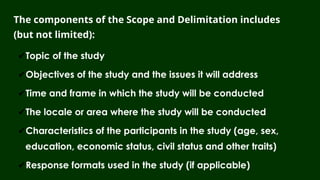
The components of the Scope and Delimitation includes
(but not limited):
✔Topic of the study
✔Objectives of the study and the issues it will address
✔Time and frame in which the study will be conducted
✔The locale or area where the study will be conducted
✔Characteristics of the participants in the study (age, sex,
education, economic status, civil status and other traits)
✔Response formats used in the study (if applicable)
merely for the sake of writing them.
You must make sure that there are reasons for the
inclusion and exclusion of some variables.
These reasons vary depending on the nature of the
study.
You may choose to delimit the participants due to
large population or due to time constraints
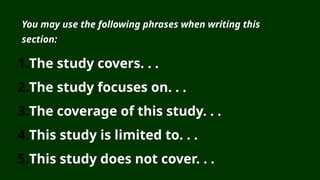
You may use the following phrases when writing this
section:
1.The study covers. . .
2.The study focuses on. . .
3.The coverage of this study. . .
4.This study is limited to. . .
5.This study does not cover. . .
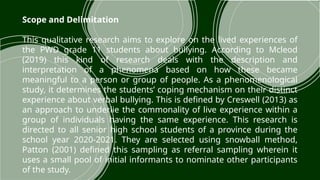
Scope and Delimitation
This qualitative research aims to explore on the lived experiences of
the PWD grade 11 students about bullying. According to Mcleod
(2019) this kind of research deals with the description and
interpretation of a phenomena based on how these became
meaningful to a person or group of people. As a phenomenological
study, it determines the students’ coping mechanism on their distinct
experience about verbal bullying. This is defined by Creswell (2013) as
an approach to underlie the commonality of live experience within a
group of individuals having the same experience. This research is
directed to all senior high school students of a province during the
school year 2020-2021. They are selected using snowball method,
Patton (2001) defined this sampling as referral sampling wherein it
uses a small pool of initial informants to nominate other participants
of the study.​
Scope and Limitation of the Study
The main purpose of this study is to determine the level of experience and
academic performance on first-hand science activities of BSED-Science students
at Iloilo Science and Technology University.
The respondents of this study were limited to former STEM students that is
currently enrolled in Bachelor of Secondary Education Major in Science during
the second semester of the academic year 2022-2023. This study mainly
focused on determining the level of experience and academic performance on
First-hand Science Activities of Bachelor of Secondary Education Major in
Science students. The data needed for this study gathered through the use of a
researcher's questionnaire that was validated by the three experts specifically in
Science, Language and grammar and Statisticians. The descriptive statistics
used were the mean and standard deviation. To describe the data gathered, the
mean and standard deviation were used for descriptive analysis while the
Mann-Whitney U test, Kruskal Wallis H test, and Spearman Rho for inferential
statistics. The level of experience was set at 0.5 alpha.

Proper Writing SCOPE AND DELIMITATION.pptx

  • 1.
    Writing the Scope, Limitations,and Delimitations (ref. https://www.aje.com/arc/scope-and-delimitations-in-research/)
  • 2.
    What is thescope in a research paper? Scope is the domain of your research. It describes the extent to which the research question will be explored in your study. Articulating your study's scope early on helps you make your research question focused and realistic. It also helps decide what data you need to collect (and, therefore, what data collection tools you need to design). Getting this right is vital for both academic articles and funding applications.
  • 3.
    What are delimitationsin a research paper? Delimitations are those factors or aspects of the research area that you'll exclude from your research. The scope and delimitations of the study are intimately linked. Essentially, delimitations form a more detailed and narrowed-down formulation of the scope in terms of exclusion. The delimitations explain what was (intentionally) not considered within the given piece of research.
  • 4.
    What are thelimitations in a research paper? Limitations concern potential weaknesses out of the researcher’s control. Associated with design, statistical tools, funding and other imposed restrictions.
  • 5.
    Scope example “Impact ofthe symbolic diagram on the conceptual understanding of ELT/ELX majors in electronics subject” This topic, on its own, doesn't say much about what's being investigated. The scope, for example, could encompass: • Variables: “symbolic diagram” (independent variable), “conceptual understanding” (dependent variable), and ways of defining or measuring them • Approaches: Both symbolic diagrams and conventional • Target population: BTVTEd major in electronics and electrical technology • Geographical coverage: Higher Education Institution or ISAT
  • 6.
    Delimitations and limitationsexample Exploring the perceptions towards approaches is a preliminary delimitation. This one was chosen from among many possible research questions (e.g., the impact of symbolic diagram on level of engagement) Delimiting factors could include: • Research design: Quasi-experimental research, pre-test-post-test, and statistical analysis before and after data • Timeframe: Data collection to run for 3 weeks instead of 3 months • Population size: 500 participants instead of 5000 • Recruitment of participants: random sampling instead of probability sampling
  • 7.
    Define the scopeand delimitations of your study before collecting data. This is critical. This step should be part of your research project planning. Answering the following questions will help you address your scope and delimitations clearly and convincingly. What are your study's aims and objectives? Why did you carry out the study? What was the exact topic under investigation? Which factors and variables were included? And state why specific variables were omitted from the research scope. Who or what did the study explore? What was the target population? What was the study's location (geographical area) or setting (e.g., laboratory)?
  • 8.
    Consider a studyexploring the differences between identical twins who were raised together versus identical twins who weren't. The data collection might span 5, 10, or more years. A study exploring a new immigration policy will cover the period since the policy came into effect and the present moment. How was the research conducted (research design)? Experimental research, qualitative, quantitative, or mixed- methods research, literature review, etc. What data collection tools and analysis techniques were used? e.g., If you chose quantitative methods, which statistical analysis techniques and software did you use? What did you find?
  • 9.
    The components ofthe Scope and Delimitation includes (but not limited): ✔Topic of the study ✔Objectives of the study and the issues it will address ✔Time and frame in which the study will be conducted ✔The locale or area where the study will be conducted ✔Characteristics of the participants in the study (age, sex, education, economic status, civil status and other traits) ✔Response formats used in the study (if applicable)
  • 10.
    merely for thesake of writing them. You must make sure that there are reasons for the inclusion and exclusion of some variables. These reasons vary depending on the nature of the study. You may choose to delimit the participants due to large population or due to time constraints
  • 11.
    You may usethe following phrases when writing this section: 1.The study covers. . . 2.The study focuses on. . . 3.The coverage of this study. . . 4.This study is limited to. . . 5.This study does not cover. . .
  • 12.
    Scope and Delimitation Thisqualitative research aims to explore on the lived experiences of the PWD grade 11 students about bullying. According to Mcleod (2019) this kind of research deals with the description and interpretation of a phenomena based on how these became meaningful to a person or group of people. As a phenomenological study, it determines the students’ coping mechanism on their distinct experience about verbal bullying. This is defined by Creswell (2013) as an approach to underlie the commonality of live experience within a group of individuals having the same experience. This research is directed to all senior high school students of a province during the school year 2020-2021. They are selected using snowball method, Patton (2001) defined this sampling as referral sampling wherein it uses a small pool of initial informants to nominate other participants of the study.​
  • 13.
    Scope and Limitationof the Study The main purpose of this study is to determine the level of experience and academic performance on first-hand science activities of BSED-Science students at Iloilo Science and Technology University. The respondents of this study were limited to former STEM students that is currently enrolled in Bachelor of Secondary Education Major in Science during the second semester of the academic year 2022-2023. This study mainly focused on determining the level of experience and academic performance on First-hand Science Activities of Bachelor of Secondary Education Major in Science students. The data needed for this study gathered through the use of a researcher's questionnaire that was validated by the three experts specifically in Science, Language and grammar and Statisticians. The descriptive statistics used were the mean and standard deviation. To describe the data gathered, the mean and standard deviation were used for descriptive analysis while the Mann-Whitney U test, Kruskal Wallis H test, and Spearman Rho for inferential statistics. The level of experience was set at 0.5 alpha.

Editor's Notes

  • #12 What is the study all about? Why the study is conducted? When the study is conducted? Where is the study conducted? From whom the data collected?
  • #13 What is the study all about? Why the study is conducted? When the study is conducted? Where is the study conducted? From whom the data collected?