It’s	all	about	relationships:	
The	“blame”	game
Dr.	Phil Barrett	Kirwan
University	of	Illinois
Relationships
• Difficult
• Complicated
• Never	deterministic
• The	“blame”	game—Who/what	caused	the	
outcome	we	are	concerned	about
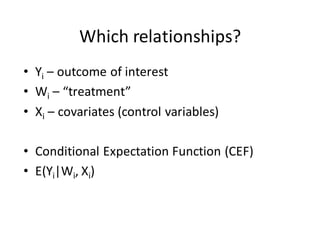
Which	relationships?
• Yi – outcome	of	interest
• Wi – “treatment”
• Xi – covariates	(control	variables)
• Conditional	Expectation	Function	(CEF)
• E(Yi|Wi, Xi)
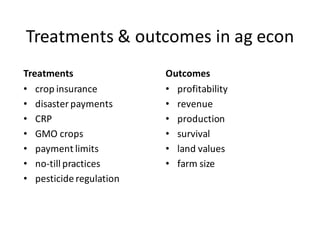
Treatments	&	outcomes	in	ag econ
Treatments
• crop	insurance
• disaster	payments
• CRP
• GMO	crops
• payment	limits
• no-till	practices
• pesticide	regulation
Outcomes
• profitability
• revenue
• production
• survival
• land	values
• farm	size
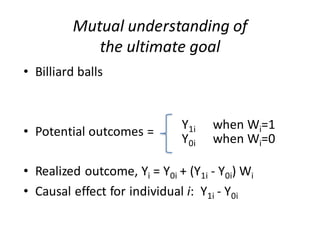
Mutual	understanding	of	
the	ultimate	goal
• Billiard	balls
• Potential	outcomes	=	
• Realized	outcome,	Yi =	Y0i +	(Y1i - Y0i)	Wi
• Causal	effect	for	individual	i:		Y1i - Y0i
Y1i when	Wi=1
Y0i when	Wi=0
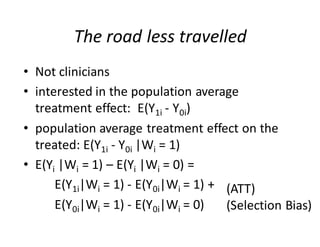
The	road	less	travelled
• Not	clinicians	
• interested	in	the	population	average	
treatment	effect:		E(Y1i - Y0i)
• population	average	treatment	effect	on	the	
treated:	E(Y1i - Y0i |Wi =	1)
• E(Yi |Wi =	1)	– E(Yi |Wi =	0)	=	
E(Y1i|Wi =	1)	- E(Y0i|Wi =	1)	+	
E(Y0i|Wi =	1)	- E(Y0i|Wi =	0)
(ATT)
(Selection	Bias)
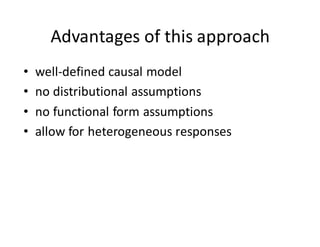
Advantages	of	this	approach
• well-defined	causal	model
• no	distributional	assumptions
• no	functional	form	assumptions
• allow	for	heterogeneous	responses
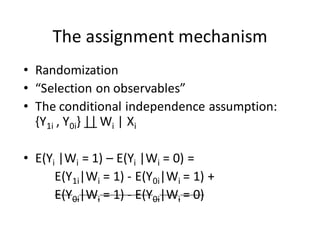
The	assignment	mechanism
• Randomization
• “Selection	on	observables”
• The	conditional	independence	assumption:	
{Y1i , Y0i}	|| Wi |	Xi
• E(Yi |Wi =	1)	– E(Yi |Wi =	0)	=	
E(Y1i|Wi =	1)	- E(Y0i|Wi =	1)	+	
E(Y0i|Wi =	1)	- E(Y0i|Wi =	0)
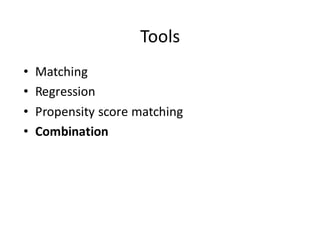
Tools
• Matching
• Regression
• Propensity	score	matching
• Combination
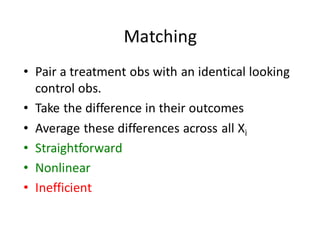
Matching
• Pair	a	treatment	obs with	an	identical	looking	
control	obs.
• Take	the	difference	in	their	outcomes
• Average	these	differences	across	all	Xi
• Straightforward
• Nonlinear
• Inefficient
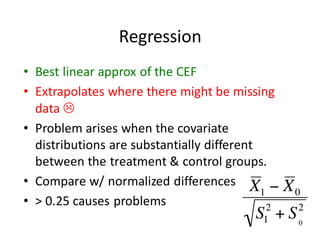
Regression
• Best	linear	approx	of	the	CEF
• Extrapolates	where	there	might	be	missing	
data	L
• Problem	arises	when	the	covariate	
distributions	are	substantially	different	
between	the	treatment	&	control	groups.
• Compare	w/	normalized	differences
• >	0.25	causes	problems
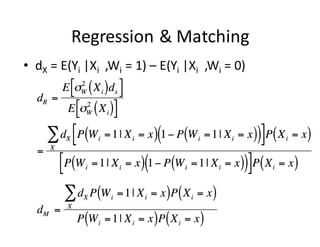
Regression	&	Matching
• dX =	E(Yi |Xi ,Wi =	1)	– E(Yi |Xi ,Wi =	0)
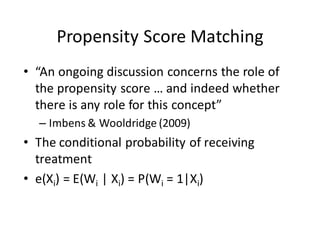
Propensity	Score	Matching
• “An	ongoing	discussion	concerns	the	role	of	
the	propensity	score	…	and	indeed	whether	
there	is	any	role	for	this	concept”		
– Imbens &	Wooldridge	(2009)
• The	conditional	probability	of	receiving	
treatment
• e(Xi)	=	E(Wi |	Xi)	=	P(Wi =	1|Xi)
Propensity	Score	Matching
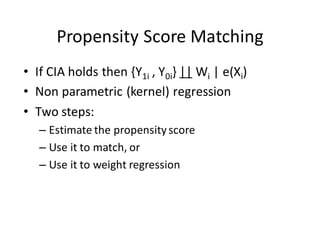
• If	CIA	holds	then	{Y1i ,	Y0i}	|| Wi |	e(Xi)
• Non	parametric	(kernel)	regression
• Two	steps:
– Estimate	the	propensity	score
– Use	it	to	match,	or
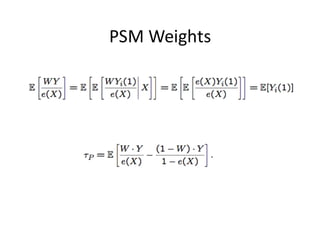
– Use	it	to	weight	regression
PSM	Weights

Propensity score matching overview

Editor's Notes

  • #6 Supply & demand functions, a la Haavelmo Production functions: potential outcome for each possible input General potential outcome w/ binary treatment