Missed Some of These Mistakes When Editing Your Work?
You’re Not Alone
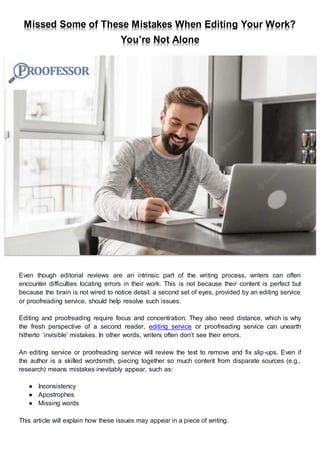
Even though editorial reviews are an intrinsic part of the writing process, writers can often
encounter difficulties locating errors in their work. This is not because their content is perfect but
because the brain is not wired to notice detail: a second set of eyes, provided by an editing service
or proofreading service, should help resolve such issues.
Editing and proofreading require focus and concentration. They also need distance, which is why
the fresh perspective of a second reader, editing service or proofreading service can unearth
hitherto ‘invisible’ mistakes. In other words, writers often don’t see their errors.
An editing service or proofreading service will review the text to remove and fix slip-ups. Even if
the author is a skilled wordsmith, piecing together so much content from disparate sources (e.g.,
research) means mistakes inevitably appear, such as:
● Inconsistency
● Apostrophes
● Missing words
This article will explain how these issues may appear in a piece of writing.
Inconsistency
Textual inconsistencies can appear in multiple ways. There are so many variants that it stands to
reason they can slip through the editorial net.
A few of the typical inconsistencies include the variable use of single and double quote marks,
mixed symbols (e.g., percent/per cent/%), usage of different varieties of English (such as -ise and -
ize spellings) and the unclear employment of title case and sentence case in headings.
The answer is simple: check the style guide. This document will usually clarify the document’s
style conventions. However, with so many variables to consider, it’s unsurprising that an author
may not consistently apply all these directives. But don’t worry: an editing service or proofreading
service is on hand to identify and fix these kinds of problems.
Apostrophes
Apostrophes denote possession (e.g., Jenny’s clothes) and contraction (e.g., it’s time to go). This
rule is a fundamental aspect of writing, but in the heat of battle, with a deadline quickly
approaching, it is not always applied correctly.
Bringing plurals into the mix only complicates matters: if you have two dogs, do both dogs’ tails
wag? Or do both dog’s tails wag? The answer is the former (i.e., dogs’ tales), but it’s easy for even
the most experienced writer to experience a slight mix-up and use a plural when they meant a
single (or vice versa). More likely, the errors resulted from a typo, which can happen to everyone.
Symbolically, apostrophes show the importance of focused reading. An editing service or
proofreading service will know when an apostrophe has been misplaced and can explain to the
author why the mistake occurred and how to avoid it.
Missing words
A simple one, this. A word, usually a key one, is missing from the copy. The absence becomes
apparent during reviews because the syntax is strange or the flow feels off. The editor will highlight
these mistakes for the writer to fix because although the editor can hazard a guess about what
should go where, only the writer knows for sure.

When Editing Your Work

  • 1.
    Missed Some ofThese Mistakes When Editing Your Work? You’re Not Alone Even though editorial reviews are an intrinsic part of the writing process, writers can often encounter difficulties locating errors in their work. This is not because their content is perfect but because the brain is not wired to notice detail: a second set of eyes, provided by an editing service or proofreading service, should help resolve such issues. Editing and proofreading require focus and concentration. They also need distance, which is why the fresh perspective of a second reader, editing service or proofreading service can unearth hitherto ‘invisible’ mistakes. In other words, writers often don’t see their errors. An editing service or proofreading service will review the text to remove and fix slip-ups. Even if the author is a skilled wordsmith, piecing together so much content from disparate sources (e.g., research) means mistakes inevitably appear, such as: ● Inconsistency ● Apostrophes ● Missing words This article will explain how these issues may appear in a piece of writing.
  • 2.
    Inconsistency Textual inconsistencies canappear in multiple ways. There are so many variants that it stands to reason they can slip through the editorial net. A few of the typical inconsistencies include the variable use of single and double quote marks, mixed symbols (e.g., percent/per cent/%), usage of different varieties of English (such as -ise and - ize spellings) and the unclear employment of title case and sentence case in headings. The answer is simple: check the style guide. This document will usually clarify the document’s style conventions. However, with so many variables to consider, it’s unsurprising that an author may not consistently apply all these directives. But don’t worry: an editing service or proofreading service is on hand to identify and fix these kinds of problems. Apostrophes Apostrophes denote possession (e.g., Jenny’s clothes) and contraction (e.g., it’s time to go). This rule is a fundamental aspect of writing, but in the heat of battle, with a deadline quickly approaching, it is not always applied correctly. Bringing plurals into the mix only complicates matters: if you have two dogs, do both dogs’ tails wag? Or do both dog’s tails wag? The answer is the former (i.e., dogs’ tales), but it’s easy for even the most experienced writer to experience a slight mix-up and use a plural when they meant a single (or vice versa). More likely, the errors resulted from a typo, which can happen to everyone. Symbolically, apostrophes show the importance of focused reading. An editing service or proofreading service will know when an apostrophe has been misplaced and can explain to the author why the mistake occurred and how to avoid it. Missing words A simple one, this. A word, usually a key one, is missing from the copy. The absence becomes apparent during reviews because the syntax is strange or the flow feels off. The editor will highlight these mistakes for the writer to fix because although the editor can hazard a guess about what should go where, only the writer knows for sure.