Promoting Gender Equality in
    Nicaragua through
        Education
  The Efforts of Two Non Governmental
               Organizations


             Greta Tom
         Eastern University
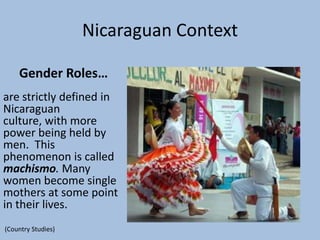
Nicaraguan Context

    Gender Roles…
are strictly defined in
Nicaraguan
culture, with more
power being held by
men. This
phenomenon is called
machismo. Many
women become single
mothers at some point
in their lives.
(Country Studies)
Proyecto Miriam
• Project Miriam was founded in 1989 to provide
  access to education to women living in poverty in
  Nicaragua and Guatemala.

• Objective: To promote women’s holistic
  development-through empowerment, reclaiming
  rights, gender equity and social justice.
Scholarship Program Impact Study
• In Nicaragua and Guatemala, Proyecto Miriam
  partnered with Bread for the World to provide 30
  scholarships to women between 2000 and 2009

• Priority for scholarships was given to women in
  rural areas and of indigenous background.

• In 2010, Proyecto Miriam surveyed 45 former
  scholarship students in Nicaragua in order to
  assess the program.
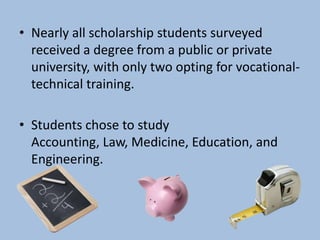
• Nearly all scholarship students surveyed
  received a degree from a public or private
  university, with only two opting for vocational-
  technical training.

• Students chose to study
  Accounting, Law, Medicine, Education, and
  Engineering.
Most of the students surveyed who

completed their university degree also went on to

 further their studies in the same field or

 receive an additional degree in a different

                     field.
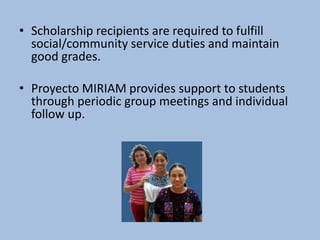
• Scholarship recipients are required to fulfill
  social/community service duties and maintain
  good grades.

• Proyecto MIRIAM provides support to students
  through periodic group meetings and individual
  follow up.
Employment
• Because of their difficult economic
  situations, women sometimes leave the
  program if they find employment, rather than
  finishing their studies.

• A survey of 45 scholarship students who
  completed the program showed a 96%
  employment rate, with 24% employed by
  Proyecto Miriam.
Success!
Women who completed the survey reported
higher rates of employment, increased self-
esteem, more equable relationships within
their families and with their partners, and a
sense of hope for their futures as a result of
participating in Proyecto Miriam’s scholarship
program.

(Proyecto Miriam)
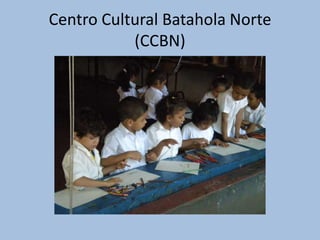
Centro Cultural Batahola Norte
           (CCBN)
Founded in 1983, the CCBN has
grown exponentially over the
last 29 years. From humble
beginnings as a children’s choir
and women’s sewing class, the
center now offers classes in
adult literacy & primary
education, technical and arts
classes.
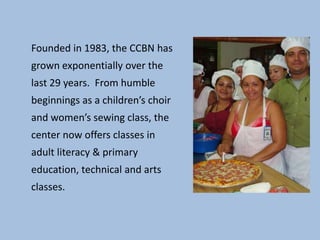
• Since the very beginning the CCBN has
  endeavored to empower women through
  education by offering classes in
  sewing, cooking, cake decorating, natural
  medicine, cosmetology.

• The skills they acquired in class, enable many
  women to work from their homes, where they
  can also care for their children and
  households.
(Friends of Batahola)
Gender Equality

    The CCBN seeks to educate both its male and
    female students about gender equality
    through workshops and by integrating
    discussions on gender into class curricula.

(Centro Cultural Batahola Norte)
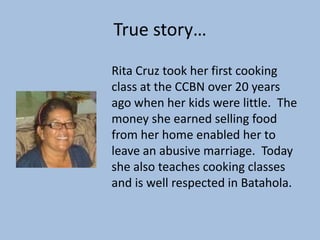
True story…

Rita Cruz took her first cooking
class at the CCBN over 20 years
ago when her kids were little. The
money she earned selling food
from her home enabled her to
leave an abusive marriage. Today
she also teaches cooking classes
and is well respected in Batahola.
References

Centro Cultural Batahola Norte. Áreasprogramáticas. Retrieved from
  http://centrobatahola.org/programas

Country Studies. Nicaragua. U.S. Library of Congress. Retrieved from
  http://countrystudies.us/nicaragua/29.htm

Friends of Batahola. Adult Programs. Retrieved from
   http://friendsofbatahola.org/adult_programs.htm

Proyecto Miriam. (2010). Estudio de impacto del programa de becas de
   MIRIAM en Nicaragua. Managua, Nicaragua. Retrieved from
   http://www.proyecto-miriam.org/esp/esp_22.html

Promoting

  • 1.
    Promoting Gender Equalityin Nicaragua through Education The Efforts of Two Non Governmental Organizations Greta Tom Eastern University
  • 2.
    Nicaraguan Context Gender Roles… are strictly defined in Nicaraguan culture, with more power being held by men. This phenomenon is called machismo. Many women become single mothers at some point in their lives. (Country Studies)
  • 3.
    Proyecto Miriam • ProjectMiriam was founded in 1989 to provide access to education to women living in poverty in Nicaragua and Guatemala. • Objective: To promote women’s holistic development-through empowerment, reclaiming rights, gender equity and social justice.
  • 4.
    Scholarship Program ImpactStudy • In Nicaragua and Guatemala, Proyecto Miriam partnered with Bread for the World to provide 30 scholarships to women between 2000 and 2009 • Priority for scholarships was given to women in rural areas and of indigenous background. • In 2010, Proyecto Miriam surveyed 45 former scholarship students in Nicaragua in order to assess the program.
  • 5.
    • Nearly allscholarship students surveyed received a degree from a public or private university, with only two opting for vocational- technical training. • Students chose to study Accounting, Law, Medicine, Education, and Engineering.
  • 6.
    Most of thestudents surveyed who completed their university degree also went on to further their studies in the same field or receive an additional degree in a different field.
  • 7.
    • Scholarship recipientsare required to fulfill social/community service duties and maintain good grades. • Proyecto MIRIAM provides support to students through periodic group meetings and individual follow up.
  • 8.
    Employment • Because oftheir difficult economic situations, women sometimes leave the program if they find employment, rather than finishing their studies. • A survey of 45 scholarship students who completed the program showed a 96% employment rate, with 24% employed by Proyecto Miriam.
  • 9.
    Success! Women who completedthe survey reported higher rates of employment, increased self- esteem, more equable relationships within their families and with their partners, and a sense of hope for their futures as a result of participating in Proyecto Miriam’s scholarship program. (Proyecto Miriam)
  • 10.
  • 11.
    Founded in 1983,the CCBN has grown exponentially over the last 29 years. From humble beginnings as a children’s choir and women’s sewing class, the center now offers classes in adult literacy & primary education, technical and arts classes.
  • 12.
    • Since thevery beginning the CCBN has endeavored to empower women through education by offering classes in sewing, cooking, cake decorating, natural medicine, cosmetology. • The skills they acquired in class, enable many women to work from their homes, where they can also care for their children and households. (Friends of Batahola)
  • 13.
    Gender Equality The CCBN seeks to educate both its male and female students about gender equality through workshops and by integrating discussions on gender into class curricula. (Centro Cultural Batahola Norte)
  • 14.
    True story… Rita Cruztook her first cooking class at the CCBN over 20 years ago when her kids were little. The money she earned selling food from her home enabled her to leave an abusive marriage. Today she also teaches cooking classes and is well respected in Batahola.
  • 15.
    References Centro Cultural BataholaNorte. Áreasprogramáticas. Retrieved from http://centrobatahola.org/programas Country Studies. Nicaragua. U.S. Library of Congress. Retrieved from http://countrystudies.us/nicaragua/29.htm Friends of Batahola. Adult Programs. Retrieved from http://friendsofbatahola.org/adult_programs.htm Proyecto Miriam. (2010). Estudio de impacto del programa de becas de MIRIAM en Nicaragua. Managua, Nicaragua. Retrieved from http://www.proyecto-miriam.org/esp/esp_22.html