Promoting Responsible
Business by BMOs
Issue II
January 2016
Foundation for MSME Clusters (FMC)
(ISO 9001:2008 certified Organisation)
Acknowledgement
For the micro, small and medium enterprises (MSMEs), the backbone of both developing as well as devel-
oped nations, the challenge is how to promote these nearly 50 million MSMEs towards Zero Defect Zero
associations and Chambers of Commerce also called Business Membership Organizations (BMOs). BMOs
being the most trusted ally of MSMEs, are best suited to promote the concept of “Responsible Business” in
a balanced manner among millions of MSMEs in India.
It is estimated that there are 3,500 BMOs in India. Historically, role of the BMO was mostly limited to busi-
ness advocacy, with very few providing strategic services to their members on economic aspects like linking
!
development activities to support MSMEs improve environmental and social aspects of doing business. But
the good initiatives implemented by some of the BMOs are not known to other BMOs in the country who do
#
The Foundation for MSME Clusters (FMC) being the premier organisation devoted to the cause of MSMEs
and clusters deemed it appropriate and timely to identify such BMOs that have made noteworthy contribu-
$	
	#

%'
programme in 2015. The overwhelming numbers of applications received (129 in total) and the shining ex-
amples coming out of the awards were documented as a compendium of case studies.
*
	+	
	#

%
	
/4	


678
-
tions. It is our utmost pleasure to present the 2nd issue of the case studies citing more examples of responsible

	
%*
-
tion of awardees has been made by an eminent jury.
4	


:
;
4	
!
=
?
-
	4
@
A@G
%


A%G#
J
	
K
L
%N
4
P	
		
J

	
APQG
P
#


AP#G
J
	
	
	AJG@
U
A@UGV%N
4
/
		4
	
	#

		%
*

A%*J:G
*

	
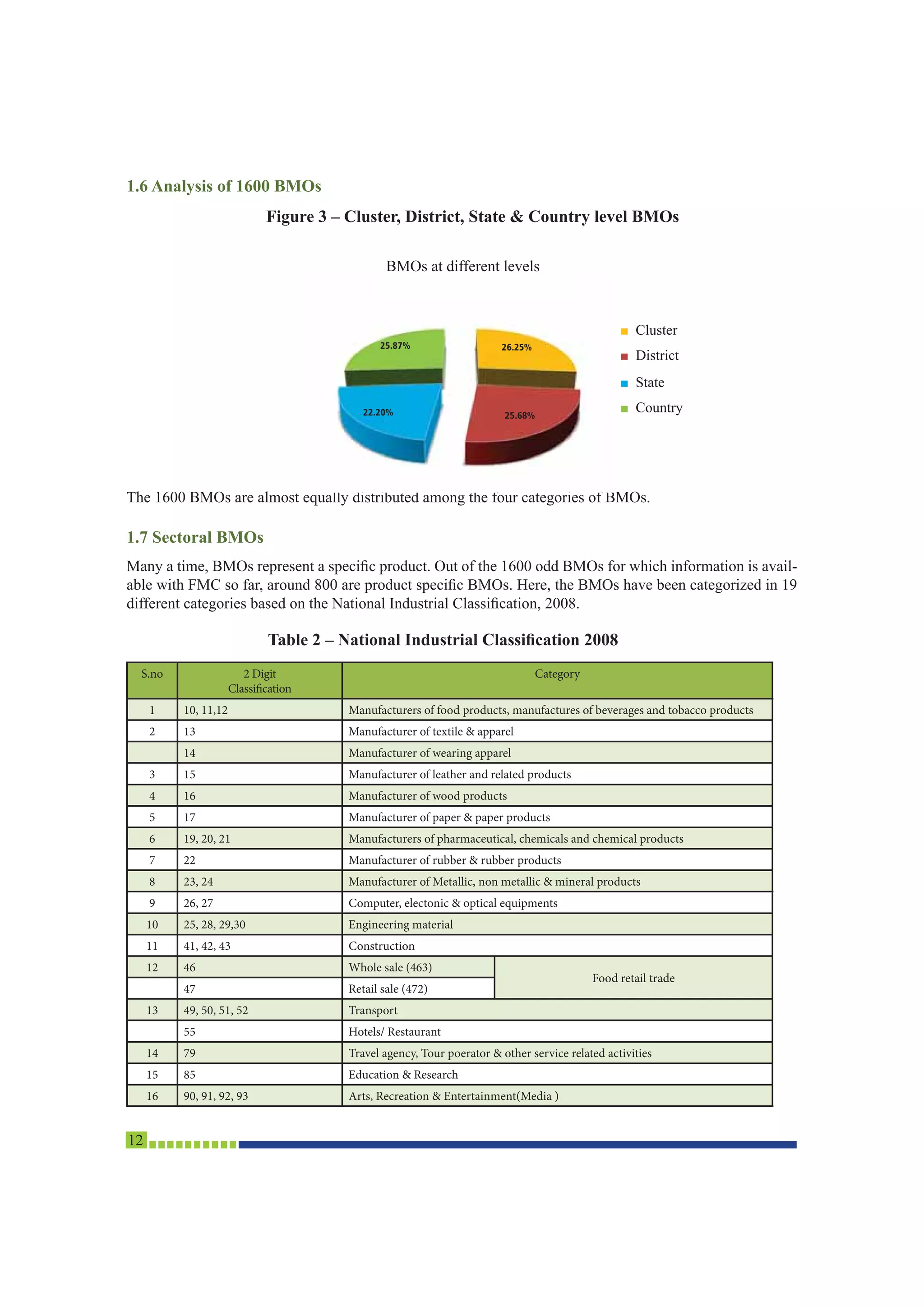
NA*NG


arduous job of evaluation.
*?
J
	

	=*
?K


	:=
K
		J
	U
J
	
	
	##	

	
	%
	
U
J
	
	
	W
	J#L	
		J
L
J
W
*	
Resource Institute (TERI) have given us valuable guidance and supported us in framing the parameters for
%4	


*


678%
!
research on the various innovative services that the BMOs are offering to their members and relate them to
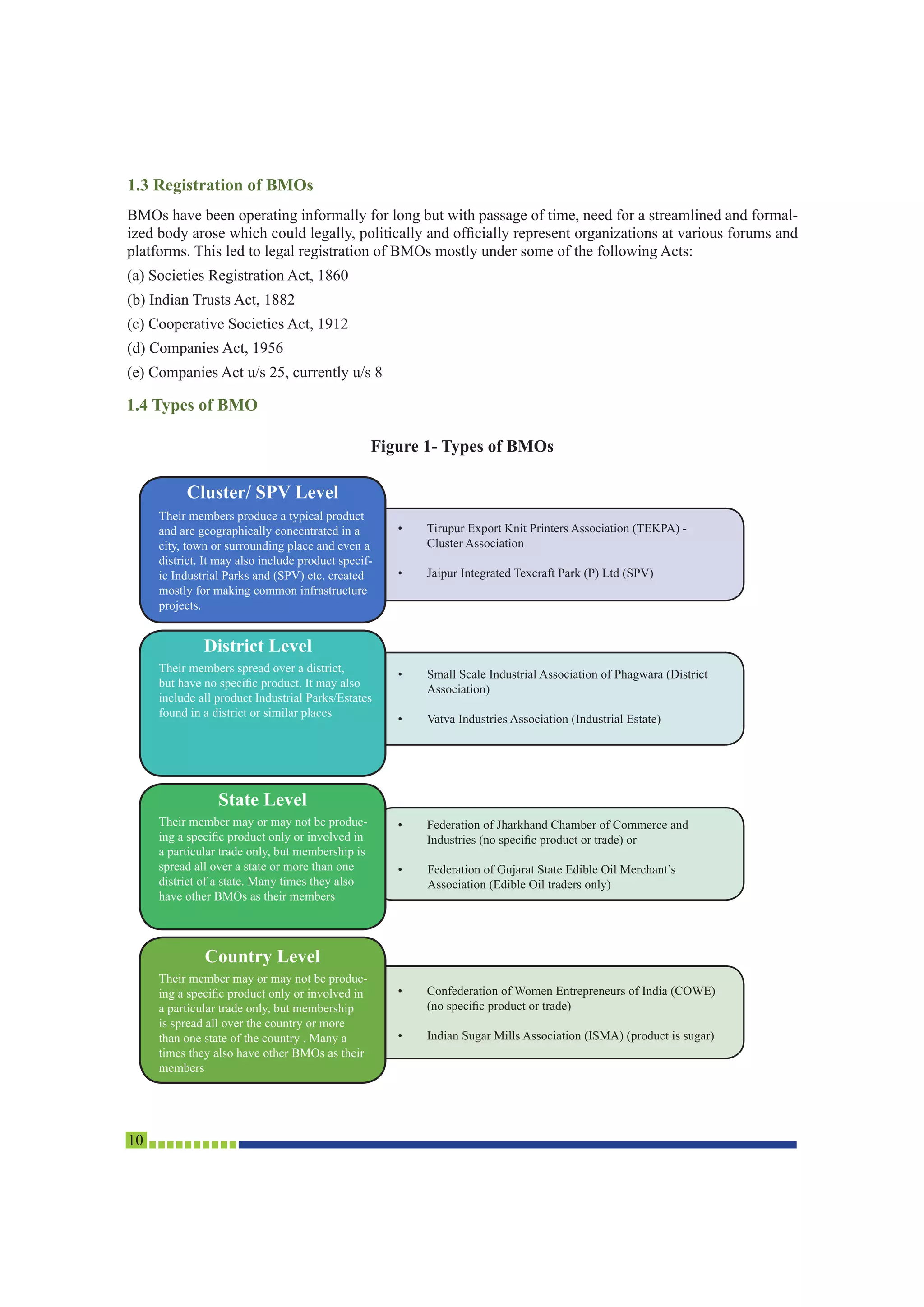
U
W
P
AUWPG


J
*
UWP


	%4
6X%
*


KJ
%


UWP
4
K
4
case and moral imperative for adopting sustainable and responsible business practices.
There are numerous good ideas and inspiring stories that other BMOs may want to replicate in the years to

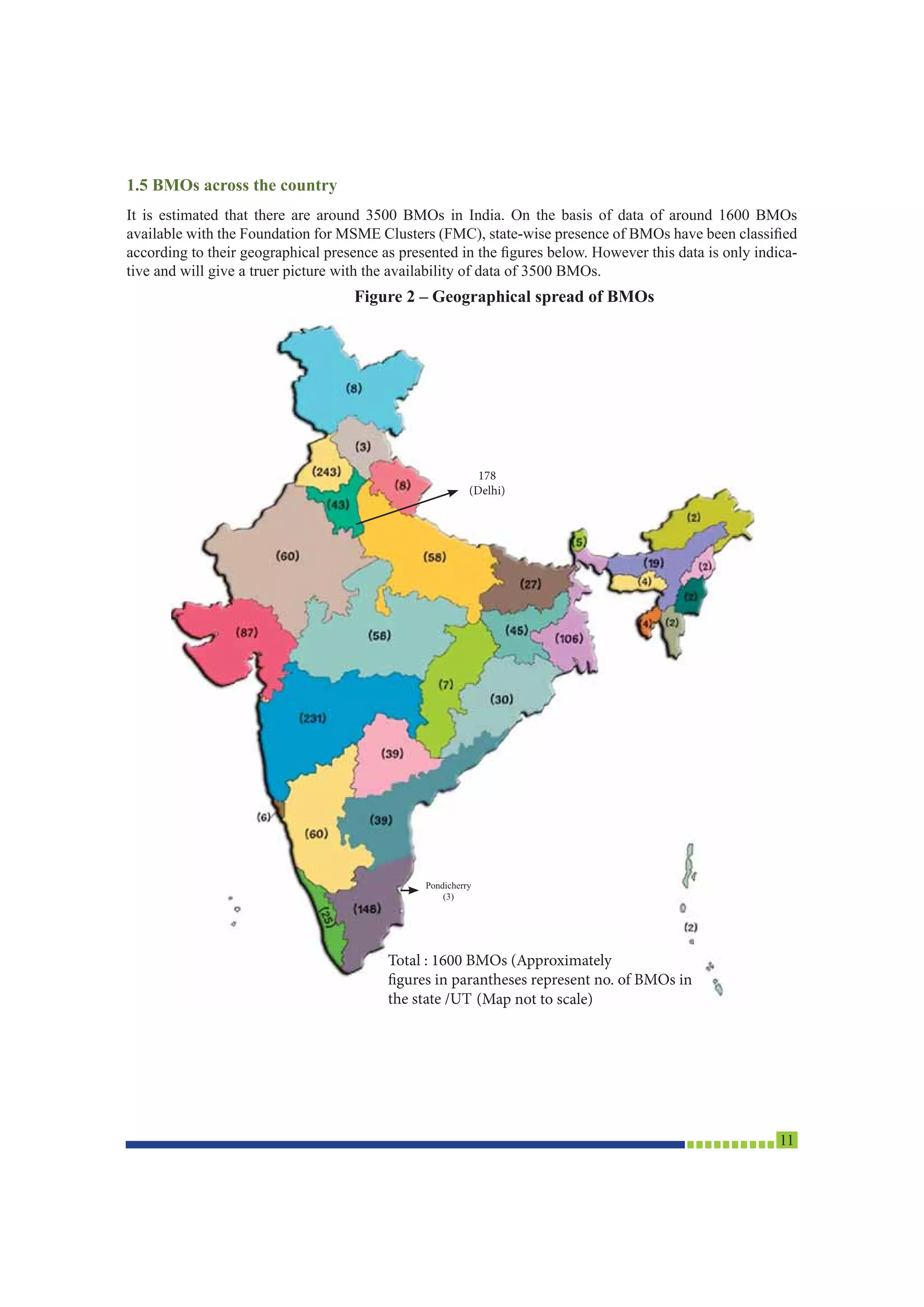
:
Y


Mukesh Gulati
Executive Director
Table of Contents
S.no. Chapter 1
Business Membership Organizations: Forms, Status and Challenges
1.1 Backdrop 9
6+ 4
% [
1.3 Registration of BMOs 10
1.4 Types of BMOs 10
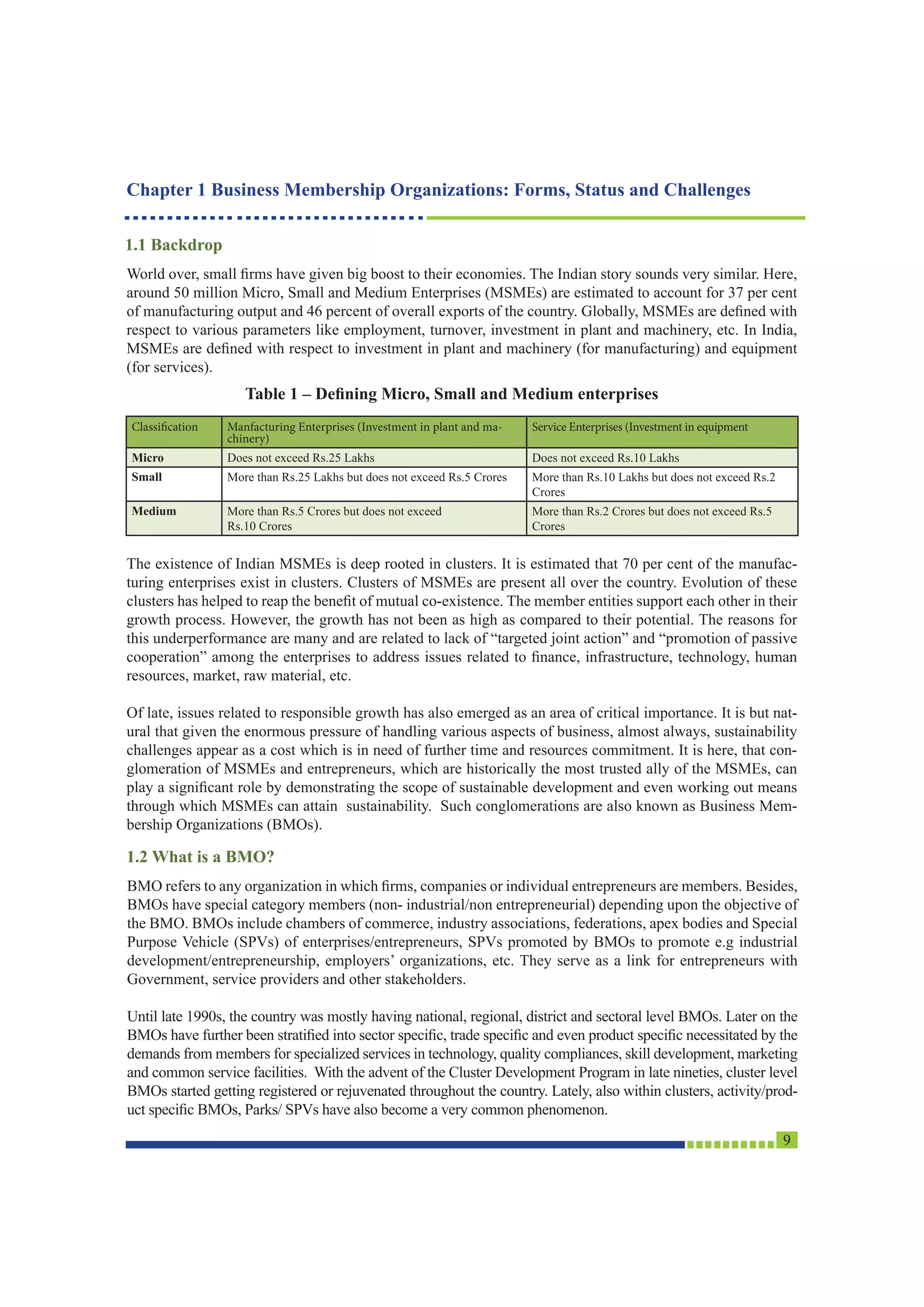
1.5 BMOs across the country 11
67 

6788% 6+
1.7 Sectoral BMOs 12
6^
%
	
_J
_W 6`
Chapter 2
Services by BMOs: Is Infrastructure a Challenge?
2.1 Introduction 15
2.2 Basic infrastructure available with BMOs 15
+q 


% 6X
+`
% 67
2.5 Support from other organizations 17
+7 


 6{
Chapter 3
Responsible Behavior by BMOs
3.1 Changing business values 19
3.2 Challenges of MSMEs 19
3.3 Role of BMOs in promoting Responsible Business 19
q` U
W
P
|#

% +8
qX J
%


UWP +8
Case Studies 27
Tables and Charts
Table 1- Defining Micro, Small and Medium Enterprises 9
 *+|U
J


+88^ 6+
Table 3- Classification of BMOs 13
 *`|	
%:
#!
A	
+86+|	+86XG 6X
 *X|	
%
67
 *7|
% 67
Table 7- Various schemes from other organizations 17
 *^|UWP
#

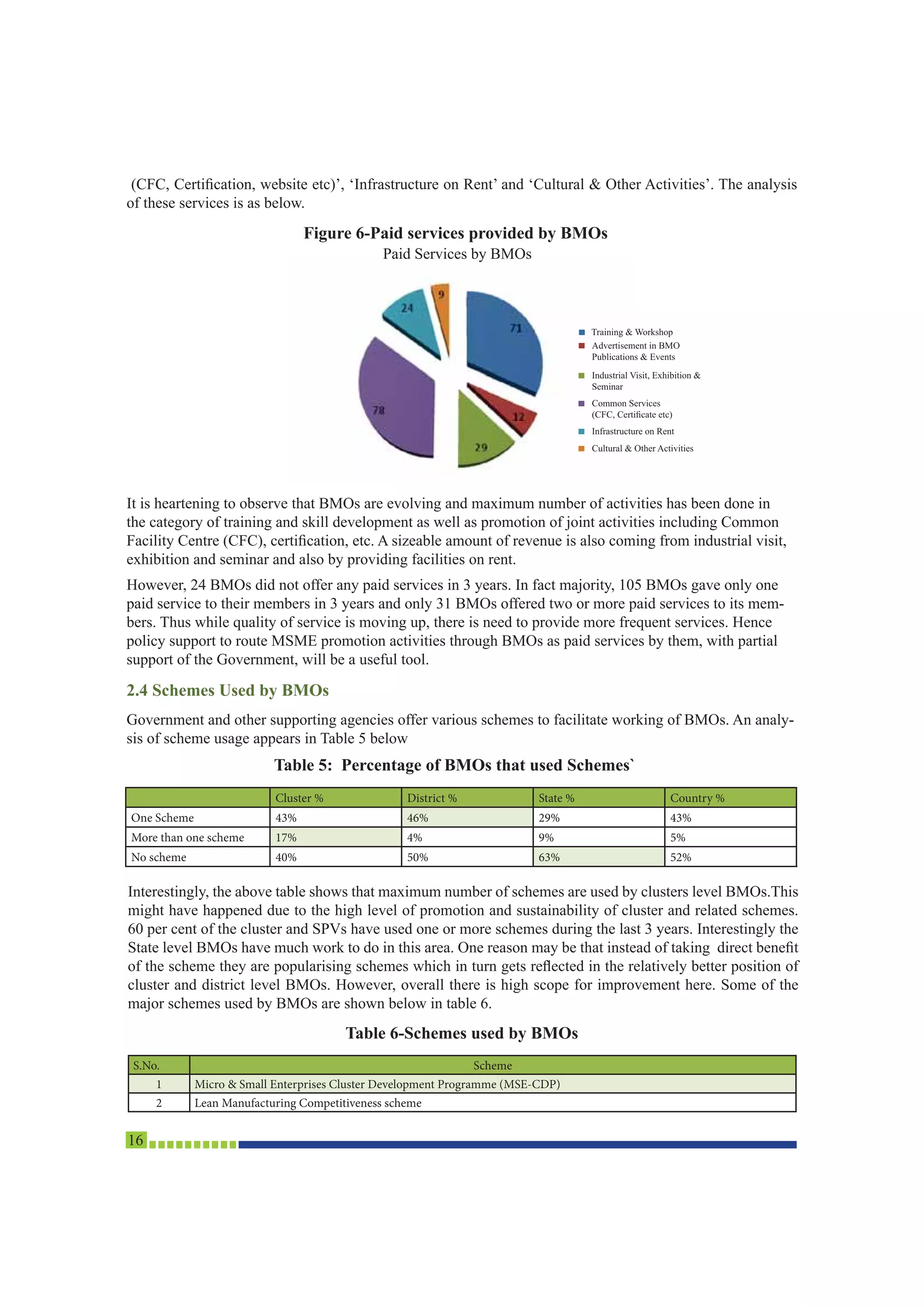
% +8
 *[|


UWP


 +6
Figure 1- Types of BMOs 10
 K
+|P
	
	
% 66
Figure 3- Cluster, District, State  Country level BMOs 12
Figure 4- Vicious cycle 14
Figure 5- Virtuous cycle 14
 K
7|
	
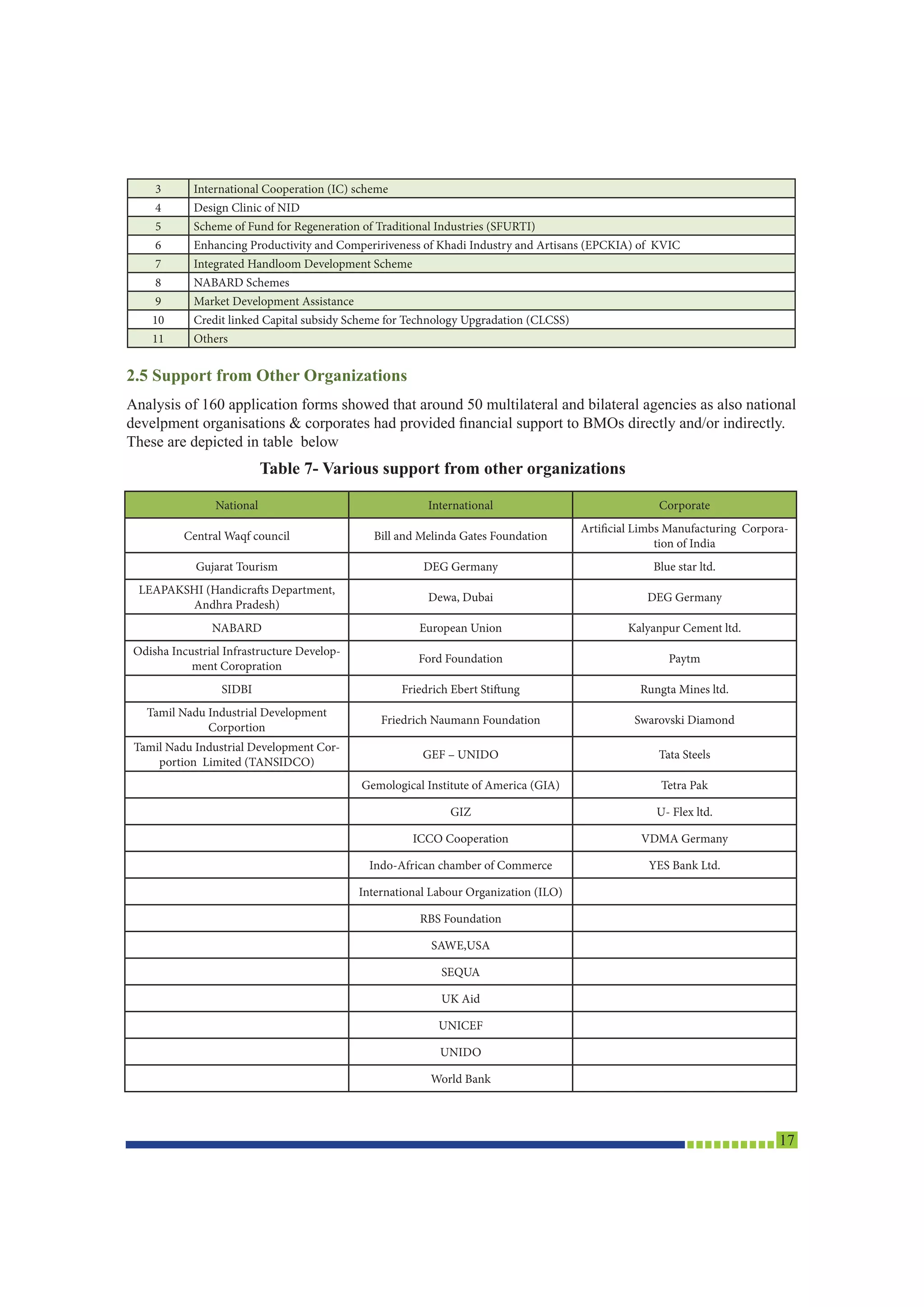
% 67
 K
{|
% 6^
 K

Promoting Responsible Business by BMOs - Issue II - FMC

  • 2.
    Promoting Responsible Business byBMOs Issue II January 2016 Foundation for MSME Clusters (FMC) (ISO 9001:2008 certified Organisation)
  • 4.
    Acknowledgement For the micro,small and medium enterprises (MSMEs), the backbone of both developing as well as devel- oped nations, the challenge is how to promote these nearly 50 million MSMEs towards Zero Defect Zero
  • 5.
    associations and Chambersof Commerce also called Business Membership Organizations (BMOs). BMOs being the most trusted ally of MSMEs, are best suited to promote the concept of “Responsible Business” in a balanced manner among millions of MSMEs in India. It is estimated that there are 3,500 BMOs in India. Historically, role of the BMO was mostly limited to busi- ness advocacy, with very few providing strategic services to their members on economic aspects like linking
  • 6.
  • 7.
    development activities tosupport MSMEs improve environmental and social aspects of doing business. But the good initiatives implemented by some of the BMOs are not known to other BMOs in the country who do
  • 8.
  • 9.
    The Foundation forMSME Clusters (FMC) being the premier organisation devoted to the cause of MSMEs and clusters deemed it appropriate and timely to identify such BMOs that have made noteworthy contribu-
  • 10.
    $ # %' programme in 2015.The overwhelming numbers of applications received (129 in total) and the shining ex- amples coming out of the awards were documented as a compendium of case studies. * + # % /4 678 - tions. It is our utmost pleasure to present the 2nd issue of the case studies citing more examples of responsible %*
  • 11.
    - tion of awardeeshas been made by an eminent jury. 4 : ;
  • 12.
  • 13.
  • 14.
  • 15.
  • 16.
  • 17.
  • 18.
  • 19.
  • 20.
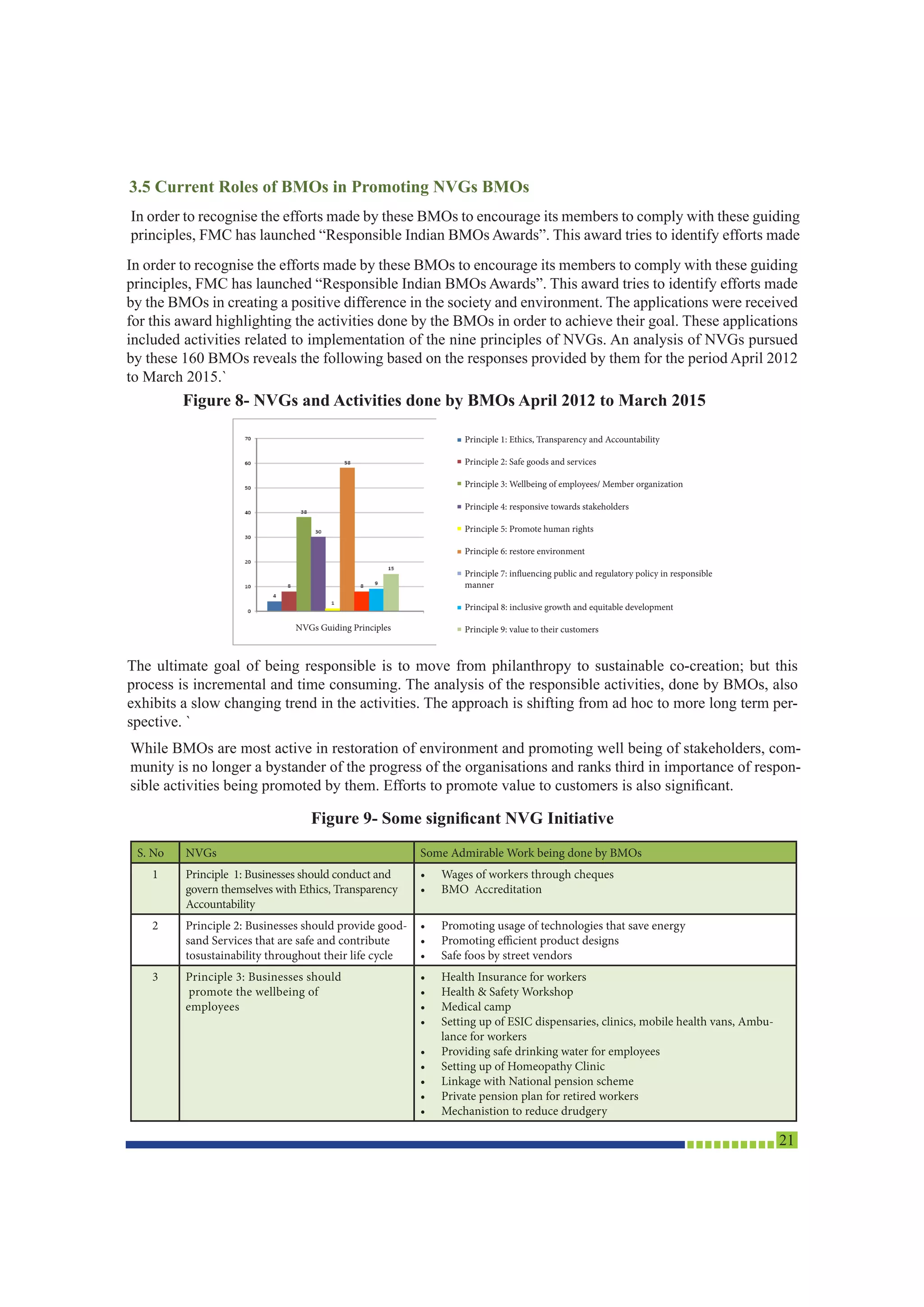
  • 21.
  • 22.
  • 23.
  • 24.
  • 25.
  • 26.
  • 27.
  • 28.
  • 29.
  • 30.
  • 31.
  • 32.
  • 33.
    * Resource Institute (TERI)have given us valuable guidance and supported us in framing the parameters for
  • 34.
  • 35.
  • 36.
    research on thevarious innovative services that the BMOs are offering to their members and relate them to U W
  • 37.
  • 38.
  • 39.
  • 40.
  • 41.
  • 42.
  • 43.
  • 44.
  • 45.
  • 46.
  • 47.
    case and moralimperative for adopting sustainable and responsible business practices. There are numerous good ideas and inspiring stories that other BMOs may want to replicate in the years to :
  • 48.
  • 49.
    Table of Contents S.no.Chapter 1 Business Membership Organizations: Forms, Status and Challenges 1.1 Backdrop 9 6+ 4 % [ 1.3 Registration of BMOs 10 1.4 Types of BMOs 10 1.5 BMOs across the country 11 67 6788% 6+ 1.7 Sectoral BMOs 12 6^
  • 50.
  • 51.
    _W 6` Chapter 2 Servicesby BMOs: Is Infrastructure a Challenge? 2.1 Introduction 15 2.2 Basic infrastructure available with BMOs 15 +q % 6X +`
  • 52.
    % 67 2.5 Supportfrom other organizations 17 +7 6{ Chapter 3 Responsible Behavior by BMOs 3.1 Changing business values 19 3.2 Challenges of MSMEs 19 3.3 Role of BMOs in promoting Responsible Business 19 q` U W
  • 53.
  • 54.
  • 55.
  • 56.
    Tables and Charts Table1- Defining Micro, Small and Medium Enterprises 9 *+|U
  • 57.
    J +88^ 6+ Table 3-Classification of BMOs 13 *`| %: #!
  • 58.
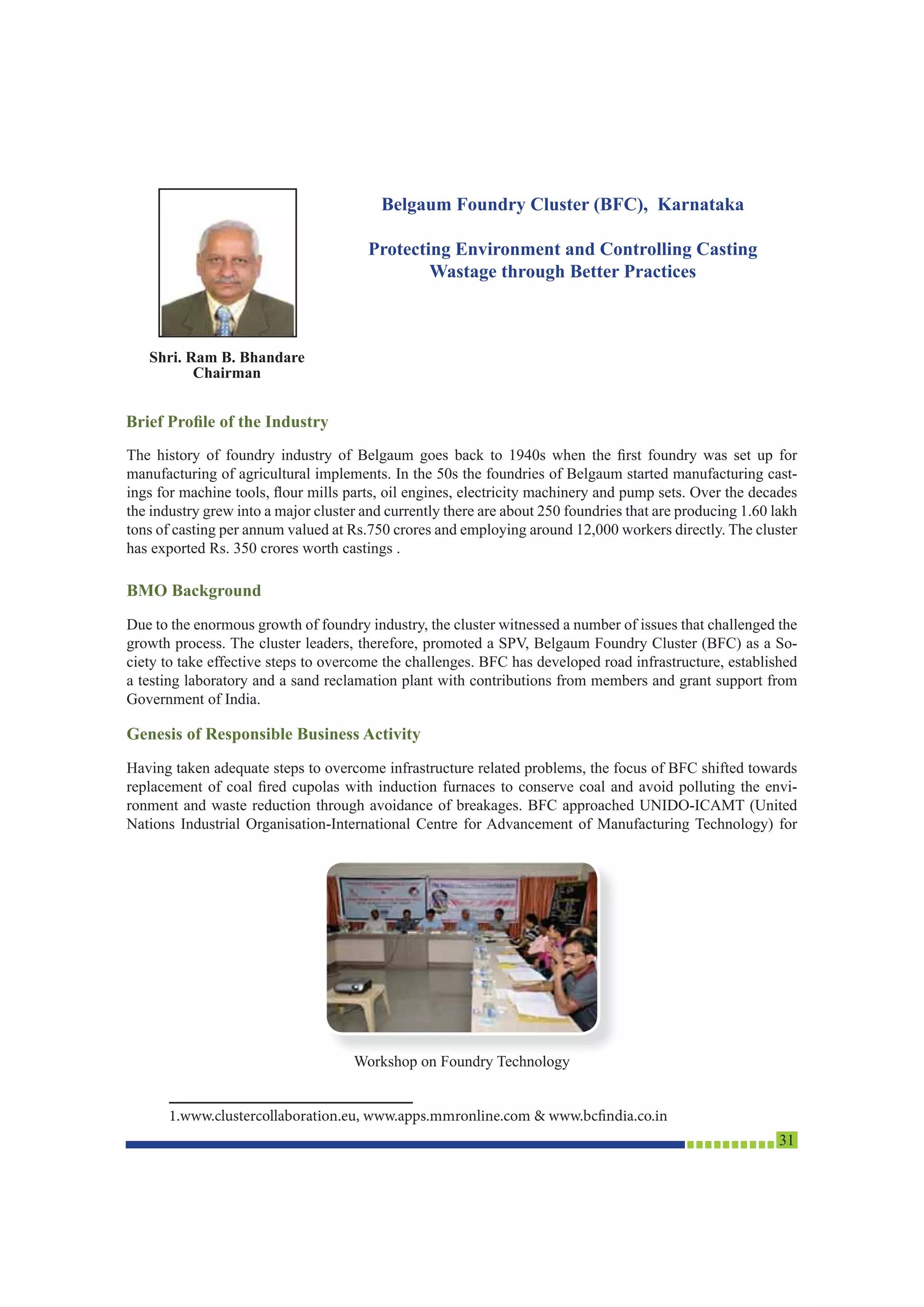
  • 59.
  • 60.
    % 67 Table 7-Various schemes from other organizations 17 *^|UWP
  • 61.
    # % +8 *[| UWP +6 Figure 1- Types of BMOs 10 K
  • 62.
    +|P % 66 Figure 3-Cluster, District, State Country level BMOs 12 Figure 4- Vicious cycle 14 Figure 5- Virtuous cycle 14 K
  • 63.
  • 64.
  • 65.
  • 66.
  • 67.
    Abbreviations ALEAP Association ofLady Entrepreneurs of India B2B Business to Business BDS Business Development Services BHEL Bharat Heavy Electricals Limited BIMTECH Birla Institute of Management and Technology BMO Business Membership Organization
  • 68.
    CFC Common FacilityCentre CFSC Common Facility Service Centre CLCSS Credit Linked Capital Subsidy Scheme CoTeX Consortium of Textile Exporters DEG Deutsche Investitions- und Entwicklungsgesellschaft (German Investment and Development Corporation) DEWA Dubai Electricity and Water Authority DST Department of Science and Technology EDC Entrepreneurship Development Cell EDP Entrepreneurship Development Programme ESIC Employee’s State Insurance Corporation EU European Union GEF- UNIDO Global Environment Facility- United Nations Industrial Development Organization GHG Green House Gases GIA Gemological Institute of America GIZ German Agency for International Cooperation GRI Global Reporting Initiative HBPT Hand Block Printed Textiles ICCO Interchurch Cooperative for Development Cooperation ICRISAT International Crops Research Institute for Semi- Arid Tropics ICT Information Communication and Technology IFC International Finance Cooperation IICA Indian Institute of Corporate Affairs IIUS Industrial Infrastructure Upgradation Scheme ILO International Labour Organization
  • 69.
    ISRO Indian SpaceResearch Organization ISTSL Indian SME Technology Services Ltd. KVIC Khadi and Village Industries Commission LEAP Lead, Educate, Apply, Prosper MSE- CDP Micro and Small Enterprises- Cluster Development Programme MSME Micro, Small and Medium Enterprises NABARD National Bank for Agriculture and Rural Development NABL National Accreditation Board for Testing and Calibration Laboratories NCLP National Child Labour Project NSTEDB National Science Technology Entrepreneurship Development Board NVG National Voluntary Guidelines RBS Royal Bank of Scotland SAWE Society of Allied Weight Engineers SDC Swiss Agency for Development and Cooperation SEDF South Asia Enterprise Development Facility SFURTI Scheme of Funds for Regeneration of Traditional Industries SGFI Sports Goods Federation of India SHG Self Help Groups SIDBI Small Industries Development Bank of India
  • 70.
    SPV Special PurposeVehicle TANSIDCO Tamil Nadu Small Industries Development Corporation Limited TERI The Energy and Resources Institute UNDP United Nations Development Programme UNICEF United Nations Children’s Fund UNIDO- ICAMT United Nations Industrial Development Organization- International Centre for Advancement ofManufacturing Technology UNIDO United Nations Industrial Development Organization UT Union Territory VDMA VerbandDeutscherMaschinen- und Anlagenbau YBLF Young Business Leader Forum
  • 71.
    9 Chapter 1 BusinessMembership Organizations: Forms, Status and Challenges 1.1 Backdrop 1.2 What is a BMO? 4 *
  • 72.
    : around 50 millionMicro, Small and Medium Enterprises (MSMEs) are estimated to account for 37 per cent
  • 73.
  • 74.
    P respect to variousparameters like employment, turnover, investment in plant and machinery, etc. In India, A
  • 75.
  • 76.
    (for services). The existenceof Indian MSMEs is deep rooted in clusters. It is estimated that 70 per cent of the manufac- turing enterprises exist in clusters. Clusters of MSMEs are present all over the country. Evolution of these
  • 77.
  • 78.
    growth process. However,the growth has not been as high as compared to their potential. The reasons for this underperformance are many and are related to lack of “targeted joint action” and “promotion of passive '
  • 79.
    resources, market, rawmaterial, etc. Of late, issues related to responsible growth has also emerged as an area of critical importance. It is but nat- ural that given the enormous pressure of handling various aspects of business, almost always, sustainability challenges appear as a cost which is in need of further time and resources commitment. It is here, that con- glomeration of MSMEs and entrepreneurs, which are historically the most trusted ally of the MSMEs, can
  • 80.
    through which MSMEscan attain sustainability. Such conglomerations are also known as Business Mem- bership Organizations (BMOs). % /
  • 81.
    % BMOs have specialcategory members (non- industrial/non entrepreneurial) depending upon the objective of the BMO. BMOs include chambers of commerce, industry associations, federations, apex bodies and Special
  • 82.
  • 83.
  • 84.
  • 85.
  • 86.
  • 87.
  • 88.
    demands from membersfor specialized services in technology, quality compliances, skill development, marketing 4 J
  • 89.
  • 90.
  • 91.
  • 92.
  • 93.
    $ Classification Manfacturing Enterprises(Investment in plant and ma- chinery) Service Enterprises (Investment in equipment Micro L#+XN L#68N Small More than Rs.25 N but does not exceed Rs.5 Crores More than Rs.10 N but does not exceed Rs.2 Crores Medium More than Rs.5 Crores but does not exceed Rs.10 Crores More than Rs.2 Crores but does not exceed Rs.5 Crores
  • 94.
    10 1.4 Types ofBMO 1.3 Registration of BMOs BMOs have been operating informally for long but with passage of time, need for a streamlined and formal- /
  • 95.
  • 96.
  • 97.
  • 98.
  • 99.
  • 100.
    _^ Figure 1- Typesof BMOs Cluster/ SPV Level State Level Country Level District Level Their members produce a typical product and are geographically concentrated in a city, town or surrounding place and even a district. It may also include product specif-
  • 101.
    AWG mostly for makingcommon infrastructure projects. ‚ *
  • 102.
  • 103.
  • 104.
  • 105.
  • 106.
  • 107.
    G ‚ Federation ofJharkhand Chamber of Commerce and
  • 108.
  • 109.
  • 110.
  • 111.
  • 112.
  • 113.
  • 114.
    G Their member mayor may not be produc-
  • 115.
    a particular tradeonly, but membership is spread all over a state or more than one district of a state. Many times they also have other BMOs as their members Their member may or may not be produc-
  • 116.
    a particular tradeonly, but membership is spread all over the country or more than one state of the country . Many a times they also have other BMOs as their members Their members spread over a district,
  • 117.
    _ found in adistrict or similar places
  • 118.
    11 1.5 BMOs acrossthe country
  • 119.
  • 120.
  • 121.
  • 122.
  • 123.
    : - tive and willgive a truer picture with the availability of data of 3500 BMOs. U (178) Figure 2 – Geographical spread of BMOs U ( ( ( (1 (1 17 7 7 78 8) 8 (178 8) ) ) ) ( (1 17 7 7 78 8) 8 8) ) ) ( (1 1 17 7 7 178 8 8 8) 8) ) ) ) ( (1 1 17 17 (178) (178) 8) 8) 8 8) ) ( ( ( (1 1 17 7 (178) 8) ) (178) ( ( ( (1 1 17 7 (178) 78) 8 ( ( (1 1 17 (178 8 ( ( (178) 178) ) Total : 1600 BMOs (Approximately figures in parantheses represent no. of BMOs in the state /UT (Map not to scale) (3) 178 (Delhi)
  • 124.
    12 1.6 Analysis of1600 BMOs 1.7 Sectoral BMOs Figure 3 – Cluster, District, State Country level BMOs *6788% !
  • 125.
  • 126.
  • 127.
  • 128.
  • 129.
  • 130.
    %**+ Cluster District State Country BMOs at differentlevels S.no 2 Digit Classification Category 1 10, 11,12 Manufacturers of food products, manufactures of beverages and tobacco products 2 13 Manufacturer of textile apparel 14 Manufacturer of wearing apparel 3 15 Manufacturer of leather and related products 4 16 Manufacturer of wood products 5 17 Manufacturer of paper paper products 6 19, 20, 21 Manufacturers of pharmaceutical, chemicals and chemical products 7 22 Manufacturer of rubber rubber products 8 23, 24 Manufacturer of Metallic, non metallic mineral products 9 26, 27 Computer, electonic optical equipments 10 25, 28, 29,30 Engineering material 11 41, 42, 43 Construction 12 46 Whole sale (463) Food retail trade 47 Retail sale (472) 13 49, 50, 51, 52 Transport 55 Hotels/ Restaurant 14 79 Travel agency, Tour poerator other service related activities  15 85 Education Research 16 90, 91, 92, 93 Arts, Recreation Entertainment(Media ) 25.87% 26.25% 22.20% 25.68%
  • 131.
  • 132.
    / levels. The tablebelow depicts their frequency in each category. S.No Classification Cluster SPV State Country Total 1 Engineering 72 21 46 139 2 Textille Textille Products 71 29 29 129 3 Food Product 47 34 32 113 4 Metals, Mineral Non Mineral Products 53 11 32 96 5 Basic Chemicals Chemial Products 14 19 38 71 6 Rubber, Plastic, Petroleum and Coal Products 13 18 19 50 7 Non-Food Retail and Wholesale 24 7 5 36 8 Electrical and Electronic 7 9 18 34 9 Construction 14 4 7 25 10 Other Services 6 2 15 23 11 Education Research 2 3 15 20 12 Arts, Recreation and Entertainment 1 1 16 18 13 Leather and Leather Products 10 1 5 16 14 Wood and Wood Products 8 3 3 14 15 Transport and Warehousing Support For Transportation 4 2 8 14 16 Hotel Restaurant 3 2 6 11 17 Paper and Paper Products 0 4 5 9 18 Food Retail and Wholesale 3 3 1 7 19 Travel and Tourism 1 5 0 6 +
  • 133.
  • 134.
  • 135.
    Majority of thesectoral BMOs are either at the cluster or country level L
  • 136.
  • 137.
    ;A6+[G categories. Textiles, engineering,metals food product sectors account for more than 50 percent of the BMOs. Interestingly more than 50% of the BMOs in these sectors are Cluster based BMOs. ‚ ‚ ‚ ‚ %
  • 138.
  • 139.
  • 140.
    _W  1) Limited vision:This restricts BMO from having a holistic perspective about the role they can play in the growth process of their members. %Q [ ]4
  • 141.
    _ - ment, lack ofa professional secretariat rules out the implementation of various planned activities, creating further disinterest among members. 8Q [ ^ ]
  • 142.
  • 143.
    14 Figure 4 –Vicious Cycle However, an inspired leadership with a solid vision can convert this cycle into a virtuous cycle as exhibited below 4) Lack of support infrastructure:N
  • 144.
  • 145.
    practices severely restricttheir outreach. 5) Poor communication: Most of the BMOs have little understanding of the importance of communication and public relations. This keeps the number of their members low and growth stagnant. 6) Limited sources of income:N
  • 146.
    % functionally weak toimplement its action plan. * %
  • 147.
  • 148.
  • 149.
  • 150.
    Support for Development N Membership base # of Services Infrastructure andHR Figure 5 – Virtuous Cycle Enhanced Incime Enabling Infrastructure and HR P # of Service Increased membership base Enhanced
  • 151.
  • 152.
  • 153.
  • 154.
    15 Table 4- Percentageof BMOs Having Requisite Infrastructure (April 2012-March 2015) Chapter 2: Services by BMOs – Is Infrastructure a Challenge? 2.1 Introduction 2.2 Basic Infrastructure Available with BMOs 2.3 Paid Services Provided by BMOs
  • 155.
  • 156.
  • 157.
  • 158.
  • 159.
  • 160.
    % /KJ* +86+ March 2015. This analysisdeals in basic facilities available with BMOs, paid services offered by them to their members -
  • 161.
  • 162.
    of applications receivedonly therefore this may not be a representative sample. But this analysis may give an indication regarding the current situation of BMOs. *
  • 163.
  • 164.
  • 165.
    * related facilities elsea BMO is often perceived as controlled by a person or a group and limits its growth. J
  • 166.
  • 167.
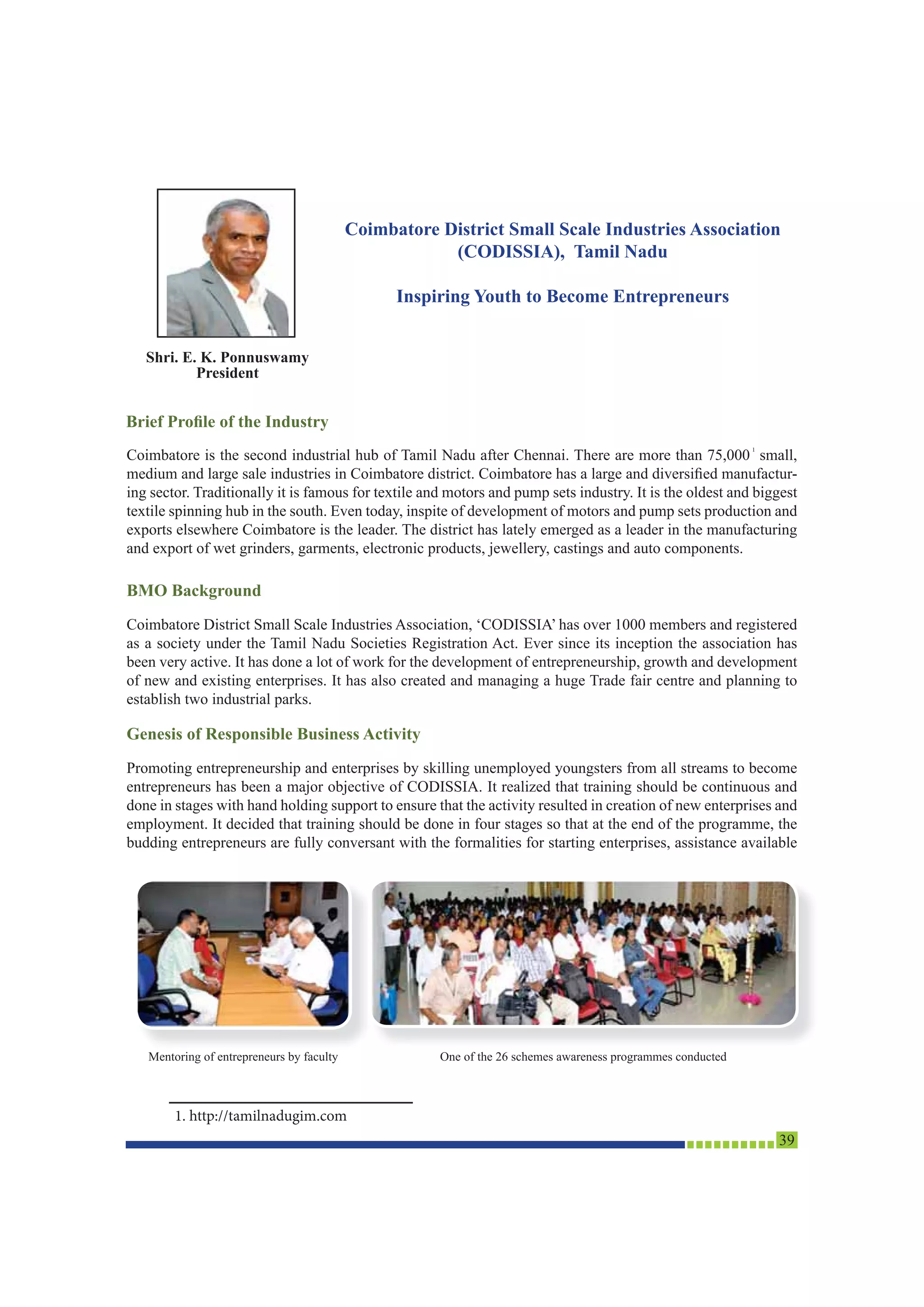
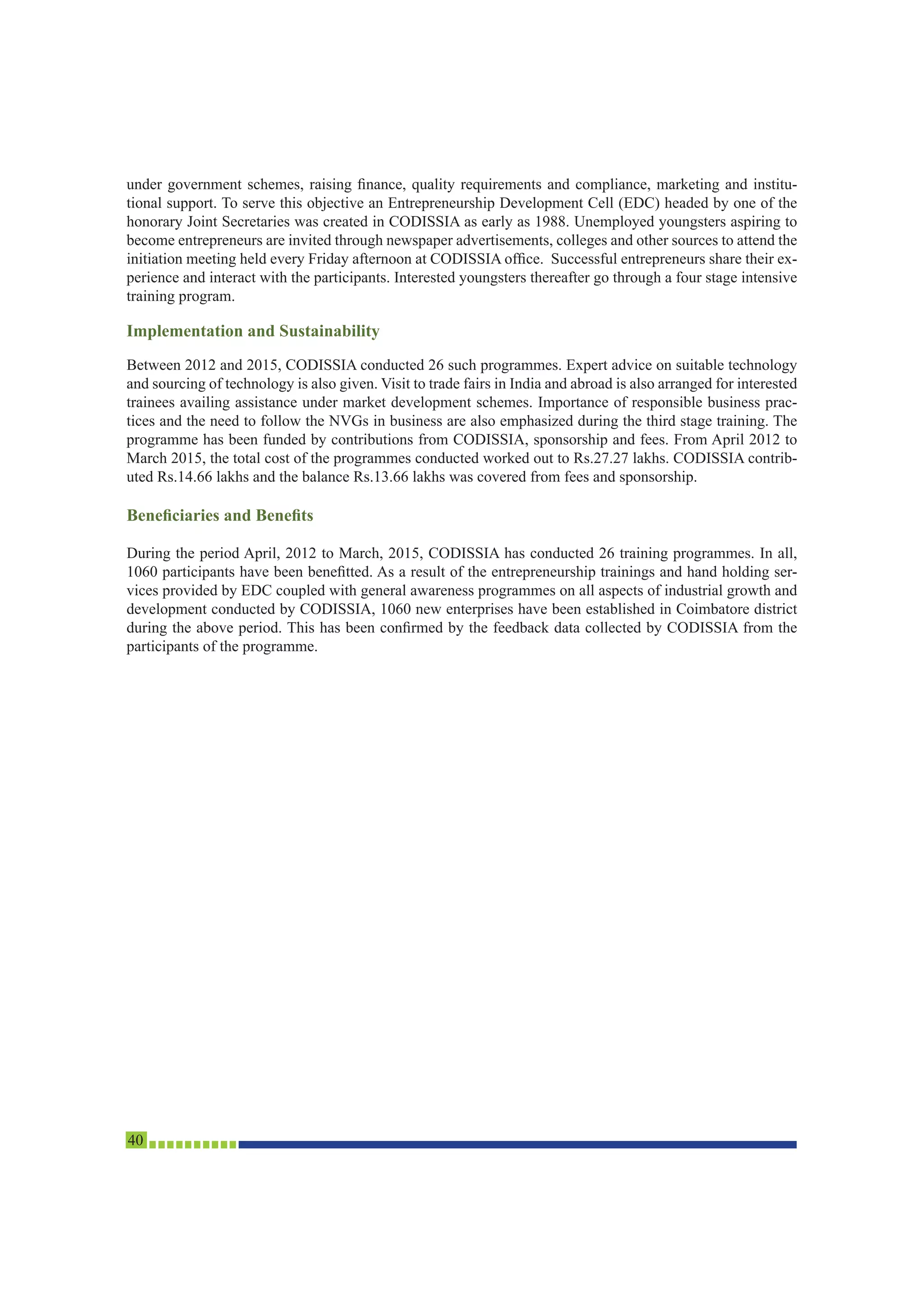
  • 168.
  • 169.
    * staff, website, registrationand accreditation status of the BMOs at different level.
  • 170.
  • 171.
    % clearly understand theneed for registration. However, cluster level BMOs has scope for improvement, when %
  • 172.
  • 173.
    value activities. Bothcluster and district level BMOs have huge scope for improvement when it comes to pro- moting themselves and their members through creation of website and also going for quality accreditation. These areas call for applying policy support. † ; % *
  • 174.
  • 175.
  • 176.
  • 177.
  • 178.
    L ‡4 ;†ƒ No. of BMOsRegistration Office Paid Staff Website Accreditation Cluster SVP 83% 69% 59% 36% 4% District 92% 75% 79% 33% 8% State 94% 89% 83% 71% 17% Country 95% 76% 86% 90% 5%
  • 179.
    67 It is hearteningto observe that BMOs are evolving and maximum number of activities has been done in the category of training and skill development as well as promotion of joint activities including Common K J AJKJG /
  • 180.
    exhibition and seminarand also by providing facilities on rent. However, 24 BMOs did not offer any paid services in 3 years. In fact majority, 105 BMOs gave only one paid service to their members in 3 years and only 31 BMOs offered two or more paid services to its mem- bers. Thus while quality of service is moving up, there is need to provide more frequent services. Hence policy support to route MSME promotion activities through BMOs as paid services by them, with partial
  • 181.
  • 182.
    Interestingly, the abovetable shows that maximum number of schemes are used by clusters level BMOs.This might have happened due to the high level of promotion and sustainability of cluster and related schemes. 78
  • 183.
  • 184.
  • 185.
    Y cluster and districtlevel BMOs. However, overall there is high scope for improvement here. Some of the ?
  • 186.
  • 187.
    %- sis of schemeusage appears in Table 5 below 2.4 Schemes Used by BMOs Table 5: Percentage of BMOs that used Schemes` Table 6-Schemes used by BMOs Figure 6-Paid services provided by BMOs * ‡4 %
  • 188.
    ‡ Industrial Visit, Exhibition Seminar Common Services AJKJJ G Infrastructure on Rent J
  • 189.
    ‡ % Cluster % District% State % Country % One Scheme 43% 46% 29% 43% More than one scheme 17% 4% 9% 5% No scheme 40% 50% 63% 52% S.No. Scheme 1 Micro Small Enterprises Cluster Development Programme (MSE-CDP) 2 Lean Manufacturing Competitiveness scheme AJKJJ G;†
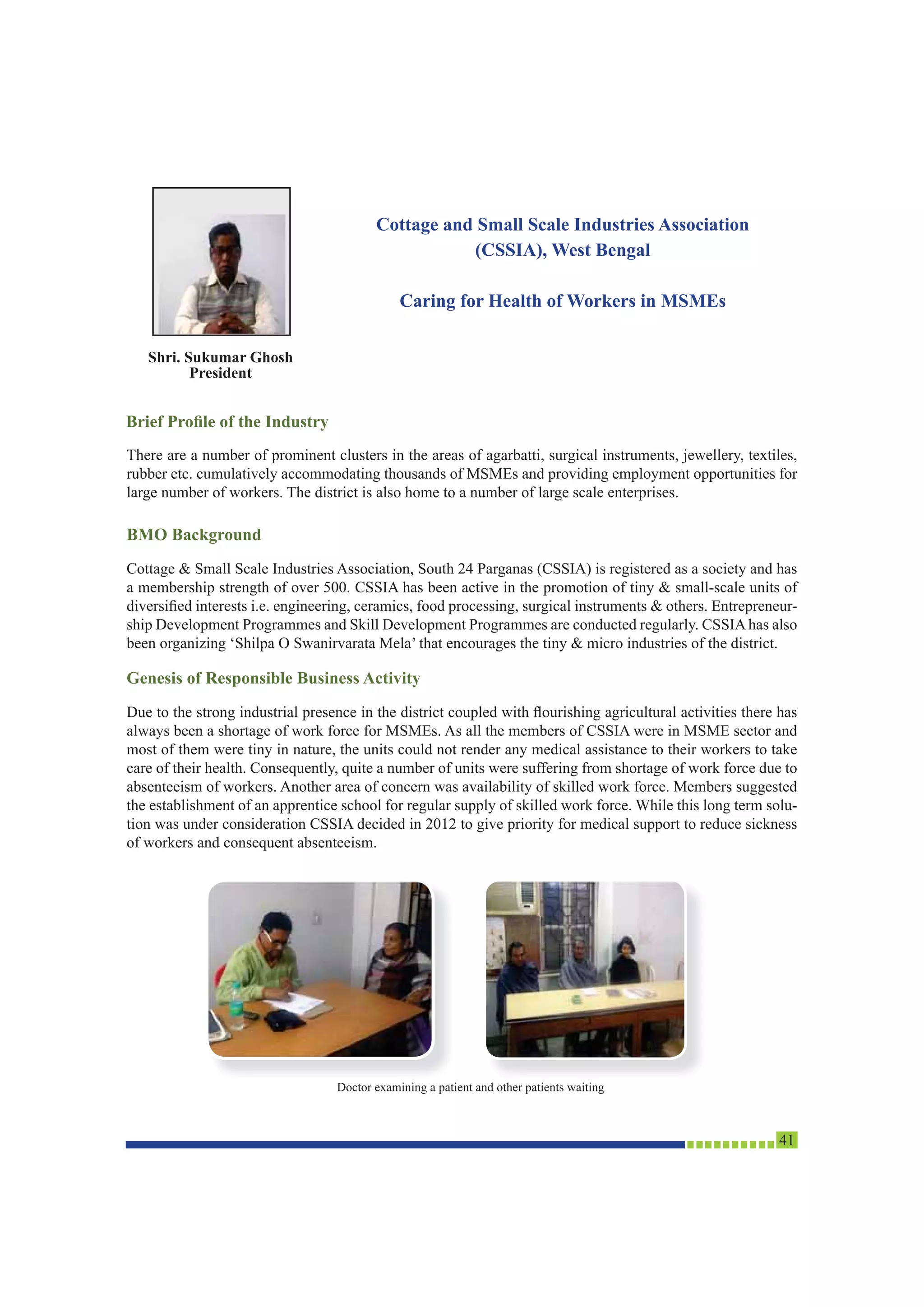
  • 190.
  • 191.
  • 192.
    17 Table 7- Varioussupport from other organizations 678
  • 193.
  • 194.
  • 195.
    % _ These are depictedin table below 2.5 Support from Other Organizations National International Corporate Central Waqf council Bill and Melinda Gates Foundation Artificial Limbs Manufacturing Corpora- tion of India Gujarat Tourism DEG Germany Blue star ltd. LEAPAKSHI (Handicrafts Department, Andhra Pradesh) Dewa, Dubai DEG Germany NABARD European Union Kalyanpur Cement ltd. Odisha Incustrial Infrastructure Develop- ment Coropration Ford Foundation Paytm SIDBI Friedrich Ebert Stiftung Rungta Mines ltd. Tamil Nadu Industrial Development Corportion Friedrich Naumann Foundation Swarovski Diamond Tamil Nadu Industrial Development Cor- portion Limited (TANSIDCO) GEF – UNIDO Tata Steels Gemological Institute of America (GIA) Tetra Pak GIZ U- Flex ltd. ICCO Cooperation VDMA Germany Indo-African chamber of Commerce YES Bank Ltd. International Labour Organization (ILO) RBS Foundation SAWE,USA SEQUA UK Aid UNICEF UNIDO World Bank 3 International Cooperation (IC) scheme 4 Design Clinic of NID 5 Scheme of Fund for Regeneration of Traditional Industries (SFURTI) 6 Enhancing Productivity and Compeririveness of Khadi Industry and Artisans (EPCKIA) of KVIC 7 Integrated Handloom Development Scheme 8 NABARD Schemes 9 Market Development Assistance 10 Credit linked Capital subsidy Scheme for Technology Upgradation (CLCSS) 11 Others
  • 196.
    18 Skill Development refersto the activities fostering direct employment opportunities among the applicants For example a BMO conducted training on coir spinning for SC/ ST women, which made these women ready P - ness and encourage people to take skill development training for better employment. The talent fairs act as a platform for interaction between skilled manpower and organizations looking for human resource.
  • 197.
  • 198.
  • 199.
  • 200.
    promotion of theproducts and services of these entrepreneurs. Figure 7- Analysis of various employment generation activities by BMOs Skill Development P Talent Fair
  • 201.
    Seminars, Exhibitions Other Support %
  • 202.
  • 203.
    * / 2.6 Employment GenerationActivities t Skill Development t P t Talent Fair t
  • 204.
    t Seminars, Exhibitions Other Support 7[ / Employment Generation Activities by BMOs
  • 205.
    19 Chapter 3: ResponsibleBehaviour by BMOs 3.1 Changing Business Values 3.2 Challenges of MSMEs 3.3 Role of BMOs in Promoting Responsible Business The changing business environment has transformed the expectations of consumers from business entities. In the current scenario the business have to follow social and environmental norms along with the quality service/product. To create a good image and also to cater to the social needs, industrial organisations are not only following responsible business practices but are also emphasising on getting responsible value chain U
  • 206.
    - able growth. Traditionally, responsiblebusiness practices were considered important by the large units only. However, complying environmental and social norms is becoming increasingly relevant not only for large units but also for MSMEs as well. This is due to satisfying customer, stakeholder and community needs. Even
  • 207.
    do little tomitigate the adverse effects created by many of them in the process of industrial growth that caters *
  • 208.
     tFirstly, MSMEs lackaccess to knowledge of responsible production and are sometimes overwhelmed by
  • 209.
    L to reach outto MSMEs based in every corner of the country having an estimated 50 million MSMEs spread across 3.3 million square kilometres. t
  • 210.
    - MEs often donot feel comfortable enough to discuss their challenges with newfaces (service providers) as they are sceptical that they may get penalised by sharing information about their activities and thus get trapped in a vicious cycle. tThirdly, often individual MSMEs lack the resources to individually address issues which are more of col- lective dimension, e.g. pollution, relocation of polluting units, alternate energy generation,etc. It is here that the BMOs can play a very proactive role in promoting Responsible Business K %
  • 211.
    and motivating theMSMEs to come out of the vicious cycle and challenge the sustainability issues upfront. This can be done at a minimum cost as the cost of spreading the knowledge through well informed BMOs is very minimal. Secondly, BMOs can pass their trust to the newly found service providers and promote their services. BMOs can negotiate an appropriate price and product suiting the requirements of their members and pass the nego- tiated advantage to their members. Thirdly, BMOs as a collective entity can promote various activities like organising workshop, providing trainings, giving services and creating CFCs to address various types of activities for promoting responsible business. In all the above cases the activity needs to be linked for promoting or bringing a change in thestatus quo of sustainable practices.
  • 212.
  • 213.
    J 9; 3.4 National VoluntaryGuidelines: Role of BMOs *
  • 214.
  • 215.
  • 216.
  • 217.
    - tribution of thoseactivities. The suggested activities are neutral to the size or turnover of the organizations and can be adopted by MSMEs as well. It encourages businesses to recognize their negative impact on the environment and community and take necessary steps to mitigate them. *UWP
  • 218.
  • 219.
  • 220.
  • 221.
  • 222.
    as to howthe BMOs can promote them. In what follows we map some activities, which are indicative and not exhaustive, as to what the BMOs can do on their own or taking support from agencies, institutions and
  • 223.
    L UWP S.No NVGs SuggestiveLikely Role of BMOs 1. Principle 1: Businesses should conduct and govern them- selves with Ethics, Transparency and Accountability BMOs can help MSMEs to get registered, get bank linkages, be complaint to the law. BMOs can themselves become ac- credited so as to promote transparency and efficiency. 2. Principle 2: Businesses should provide goodsand services that are safe and contribute tosustainability throughout their life cycle BMOs can help MSMEs for usage of recycled material, ener- gy efficient technologies, efficient product design, reducing water consumption, green house gas (GHG) reduction, etc. 3. Principle 3: Businesses should promote the wellbeing of employees BMOs should contribute by eliminating child labour, gender mainstreaming through promoting women employment, or- ganizing health camps, tying up/creating hospitals, improving housekeeping/layout plan, reducing dust/noise level, improving illumination, making provision of safe drinking water, etc. 4. Principle 4: Businesses should respect the interests of, and be responsive towards stakeholders, especially those who are disadvantaged, vulnerable and marginalised BMOs should promote regular interactions with the stake- holders of their members and identify key areas to build common response, promoting the vulnerable, provide safe drinking water, providing new employment and entrepre- neurship opportunities, etc 5. Principle 5: Businesses should respect and promote human rights BMOs can encourage promotion of the concept of human rights among its members and their stakeholders to draw right based response 6. Principle 6: Business should respect, protect, and make efforts to restore environment BMOs should promote usage of renewable technology, en- ergy efficiency measures, waste minimisation, cleaner pro- duction technologies and pollution control by members. Encouraging members to keep their premises and surround- ings clean and increasing green coverage will contribute a lot to protect and preserve environment and ecology 7. Principle 7: Businesses, when engaged in influencing public and regulatory policy, should do so in a responsible manner BMOs can promote policy advocacy for responsible produc- tion/consumption for larger good. 8. Principle 8: Businesses should support inclusive growth and equitable development BMOs can ensure appropriate resettlement and rehabilita- tion of displaced community through collective initiative, support growth of employment 9. Principle 9: Businesses should engage with and provide value to their customers and consumers in a responsible manner BMOs should discourage cartelization and persuade mem- bers to provide safer products to the customers as compared to what they are producing or getting produced now
  • 224.
  • 225.
  • 226.
    ~_ '@{ J The ultimate goalof being responsible is to move from philanthropy to sustainable co-creation; but this process is incremental and time consuming. The analysis of the responsible activities, done by BMOs, also exhibits a slow changing trend in the activities. The approach is shifting from ad hoc to more long term per- spective. ` 4 % - munity is no longer a bystander of the progress of the organisations and ranks third in importance of respon-
  • 227.
    In order torecognise the efforts made by these BMOs to encourage its members to comply with these guiding KJ
  • 228.
    $# % '* by the BMOsin creating a positive difference in the society and environment. The applications were received for this award highlighting the activities done by the BMOs in order to achieve their goal. These applications
  • 229.
  • 230.
    678% +86+ to March 2015.` S.No NVGs Some Admirable Work being done by BMOs 1 Principle 1: Businesses should conduct and govern themselves with Ethics, Transparency Accountability t Wages of workers through cheques t BMO Accreditation 2 Principle 2: Businesses should provide good- sand Services that are safe and contribute tosustainability throughout their life cycle t Promoting usage of technologies that save energy t Promoting efficient product designs t Safe foos by street vendors 3 Principle 3: Businesses should promote the wellbeing of employees t Health Insurance for workers t Health Safety Workshop t Medical camp t Setting up of ESIC dispensaries, clinics, mobile health vans, Ambu- lance for workers t Providing safe drinking water for employees t Setting up of Homeopathy Clinic t Linkage with National pension scheme t Private pension plan for retired workers t Mechanistion to reduce drudgery Principle 1: Ethics, Transparency and Accountability Principle 2: Safe goods and services Principle 3: Wellbeing of employees/ Member organization Principle 4: responsive towards stakeholders Principle 5: Promote human rights Principle 6: restore environment Principle 7: influencing public and regulatory policy in responsible manner Principal 8: inclusive growth and equitable development Principle 9: value to their customers 3.5 Current Roles of BMOs in Promoting NVGs BMOs In order to recognise the efforts made by these BMOs to encourage its members to comply with these guiding KJ
  • 231.
  • 232.
    22 4 Principle 4:Businesses should respect the inter- ests of, and be responsive towards stakeholders, especially those who are disadvantaged, vulnera- ble and marginalised t To establish the water pipe lines for the community t Disaster relief camps for business stakeholders t Financial help for poor artisan kids in payment of school fees, book, school uniforms. t Water cooler for the community t Community water testing facility t Drama to prevent alcoholism t Driving Awareness programme for truck drivers t Usage of solar lantem t Promoting middleman free market for village industries t Skill and Entrepreneurship development for women unemployed and poverty intensive as well as disadvantaged section of the so- ciety 5 Principle 5: Businesses should respect and pro- mote human rights Promoting well being of artisans 6 Principle 6: Business should respect, protect, And make efforts to restore environment t Promoting coir for replacing wood t Recycling of gases from chimney which is used in other Indus- try t Greening of industrial Area t Reduction/ reuse/ recycling of solid waste t Recycling of waste water t Common Effluent Treatment Plant (CETP) creation t Promoting appropriate usage of CETPs t Tree plantation t Promoting energy and environment friendly technologies 7 Principle 7: Businesses, when engaged in influ- encing Public and regulatory policy, should do so in a Responsible manner t Advocacy for vendors t Advocacy for coconut development 8 Principle 8: Businesses should support inclusive growth and equitable development t Promoting gender mainstreaming by promoting woman em- ployment and Entrepreneurship t Seminar on Export opportunities for women 9 Principle 9: Businesses should engage with and Provide value to their customers and consumers Responsible manner t Programme on BARCODE t National street food festival organised
  • 233.
    23 Dun B service foreign), planning basedo opportu Bradstreet Ta provider to , research o g cycle ma on coherent unities, addre
  • 234.
    angram Adv Indian and organisations anagementd feedback ca ess challenge ŽƵƌƐƐ
  • 235.
    isory Service foreign com sand multi decision mak aptured from es and create ƐĞŶƚŝĂůKĨĨĞƌŝ es Private Lim mpanies, indu lateral agen king process m primary in e sustainable ŝŶŐůĞŵĞŶƚƐ mited is an i ustry associa ncies. At Tan to provide nformation s e value. ntegrated re ations, gove ngram, we w simple and sources to id esearch and rnments (Ind work across actionable s dentify and ƐĨƌŽŵΘd dĂŶŐƌĂŵ advisory dian and sectors, solutions leverage Key sectors we serve E-mail: admin@dnbtangram.com Web site: www.dnbtangram.com Delhi Branch Office Level 15, Eros Corporate Towers, Nehru Place, New Delhi 110019 Tel: +91 11 4109 7944 I +91 9811476732 Mumbai Head Office Indiabulls Finance Centre, Tower Two, 14th Floor, SenapatiBapat Marg, Elphinstone Road (W), Mumbai, Maharashtra 400013 Tel: +91 22 4922 1000 I Fax: +91 22 4922 1010 Dun Bradstreet Tangram Advisory Services Private Limited ‚ Healthcare ‚ K ‡ |
  • 236.
  • 237.
    ‚ Building Construction ‚Materials Real Estate ‚ ‚ Textiles ‚ Banking Financial Services ‚ P ‚ Metals
  • 238.
    24 $MVTUFST 'VFMMJOHNQMPZNFOU(FOFSBUJPO UISPVHI$MVTUFS%FWFMPQNFOU 8F *-'4$MVTUFS%FWFMPQNFOU*OJUJBUJWF-JNJUFE *-'4$MVTUFST BSFBQBSUPGUIFTPDJBMJOGSBTUSVDUVSFBOEFOUFSQSJTFQSPNPUJPOHSPVQPG*OGSBTUSVDUVSF -FBTJOH'JOBODJBM4FSWJDFT-UE *-'4 8FQSPWJEFDPNNFSDJBMMZTVTUBJOBCMFJOUFHSBUFETPMVUJPOTGPSEFWFMPQNFOUPG.JDSP 4NBMMBOE .FEJVN OUFSQSJTFT .4.T UISPVHIBDMVTUFSCBTFE1VCMJD1SJWBUF1BSUOFSTIJQ 111 BQQSPBDIUIBUXPVMEFOBCMFUIFNUPCFDPNFHMPCBMMZDPNQFUJUJWF8F QSPWJEFUIFFOUJSFHBNVUPGTFSWJDFTGPSBQSPKFDUGSPNDPODFQUUPDPNNJTTJPOJOHUPDPNNFSDJBMJ[BUJPOBDSPTTUIFWBMVFDIBJO0WFSUIFZFBST XFIBWF EFWFMPQFEBIJHIEFHSFFPGFYQFSUJTFJOUIFEFWFMPQNFOU JNQMFNFOUBUJPO mOBODJOHBOENBOBHFNFOUPGDMVTUFSQSPKFDUTBDSPTTBXJEFSBOHFPGTFDUPST TVDI BTUFYUJMFT GPPE QSPDFTTJOH MFBUIFS BOE DPME DIBJO FUD FTQFDJBMMZ JOWPMWJOH EJWFSTF BOE NVMUJQMF TUBLFIPMEFST JODMVEJOH $FOUSBM BOE 4UBUF (PWFSONFOUT *OEVTUSZ$IBNCFSTTTPDJBUJPOT ODIPSFOUSFQSFOFVST$POTPSUJVNT #JMBUFSBM.VMUJMBUFSBM%POPS0SHBOJTBUJPOT 5FDIOJDBMPUIFS TVQQPSUJOTUJUVUJPOT0VSLFZBSFBTPGPQFSBUJPOJODMVEFQPMJDZBEWJTPSZ JOGSBTUSVDUVSFEFWFMPQNFOU JOUFHSBUFEBSFBEFWFMPQNFOUBOEMJWFMJIPPET $PODFQUVBMJ[BUJPO $PNNJTTJPOJOH $PNNFSDJBMJ[BUJPO /FFETTFTTNFOU $BQBDJUZ#VJMEJOH 1SPKFDU1MBOOJOH 3FTPVSDF.PCJMJ[BUJPO (PWUHSBOUT EFCUFRVJUZ %FUBJMFEOHJOFFSJOH 1SPKFDU*NQMFNFOUBUJPO 5FDIOPMPHZ.BSLFU -JOLBHFT 4LJMM%FWFMPQNFOU _64%CJMMJPO *OWFTUNFOU NPCJMJ[FE 1SFTFODFJO *OEVTUSJBM$MVTUFST BDSPTT
  • 239.
  • 240.
  • 241.
  • 242.
  • 243.
    25 Business decisions arerarely black and white. Dynamic organisations know they need to apply both reason and instinct to decision making. We are Grant Thornton and it’s what we do for our clients every day. Write to us at contact@in.gt.com or call us: +91 9930001230 www.grantthornton.in © 2016 Grant Thornton India LLP. All rights reserved. Grant Thornton International and the member
  • 244.
  • 245.
  • 246.
  • 247.
  • 248.
  • 249.
  • 250.
    29 Balasore Chamber ofIndustries and Commerce (BCIC) Odhisa Marketing Support to Artisans and MSMEs to Enhance Return and Sustainability 9
  • 251.
    = Shri. Himanshu KumarDas President Balasore is an industrially well developed district. The major large scale industries produce alloys, phar- maceuticals, paper, automobile tyres and tubes. Micro and small enterprises have a strong presence in the district with about 45,000 enterprises functioning all over the district. The small and medium scale industries
  • 252.
  • 253.
  • 254.
    % ample opportunities formarketing handicrafts . BMO Background Balasore Chamber of Industries and Commerce (BCIC) was originally registered as a Society in 1997-98 in the name of Balasore Chamber of Industries and later on expanded to include trade (Commerce) also in 2004-05. Besides advocacy, BCIC has been organizing seminars and workshops, trade fairs and vendor de- velopment meets at the state and national level. Genesis of Responsible Business Activity %JJ
  • 255.
  • 256.
    A:PG and artisans. Thestudy revealed the fact that these enterprises were selling their products to traders and %JJ /
  • 257.
    manufactured by theabove said groups and consequently their livelihood can be increased substantially if Trade Fair J * Best Stall 1.http://dcmsme.gov.in/BIPS/20Balasore-12pdf
  • 258.
    30 proper marketing channelsand opportunities were created thus avoiding middlemen. Their products would get direct exposure to the consumers and fetch better prices. They could ascertain consumer preferences and product acceptance levels through feedback from the buyers. BCIC decided to experiment the idea by orga- nizing a district level Exhibition-cum-Trade Fair in 2003. Implementation and Sustainability * %JJ |
  • 259.
  • 260.
  • 261.
  • 262.
    / | % 4 seminars and culturalprogrammes were also organised. The attendance was overwhelming with more than 30,000 people visiting the fair. The participating organizations/ agencies not only sold their products but also
  • 263.
  • 264.
    and other aspectsof the products. The fair was held for 3 days. *
  • 265.
  • 266.
  • 267.
    X4 experience and knowledgegained BCIC is well equipped to continue the activities in future also. The average / +86q+86`#q7^[%JJ
  • 268.
  • 269.
    thereby resulting ina surplus that will be used for further market development. 9 9 *
  • 270.
  • 271.
    wide spectrum ofweaker and marginal business enterprises. It is reported that the last event in 2015 generat- ed a total sale of about Rs.150 crores.
  • 272.
    31 Belgaum Foundry Cluster(BFC), Karnataka Protecting Environment and Controlling Casting Wastage through Better Practices Shri. Ram B. Bhandare Chairman *
  • 273.
  • 274.
  • 275.
    manufacturing of agriculturalimplements. In the 50s the foundries of Belgaum started manufacturing cast- Y
  • 276.
  • 277.
  • 278.
    678 tons of castingper annum valued at Rs.750 crores and employing around 12,000 workers directly. The cluster has exported Rs. 350 crores worth castings . BMO Background Due to the enormous growth of foundry industry, the cluster witnessed a number of issues that challenged the *
  • 279.
  • 280.
  • 281.
  • 282.
    A%KJG - ciety to takeeffective steps to overcome the challenges. BFC has developed road infrastructure, established a testing laboratory and a sand reclamation plant with contributions from members and grant support from P Genesis of Responsible Business Activity Having taken adequate steps to overcome infrastructure related problems, the focus of BFC shifted towards
  • 283.
  • 284.
  • 285.
  • 286.
  • 287.
  • 288.
  • 289.
  • 290.
  • 291.
    The cluster perspectivenot only provides an opportunity for ground level replication but also a peer learning * ?
  • 292.
  • 293.
  • 294.
  • 295.
  • 296.
  • 297.
  • 298.
    ? BFC did adetailed analysis of foundry industry and conducted technology diagnostic study of 50 foundries q8
  • 299.
    ? managerial and supervisorypersonnel from the selected foundries were conducted. Thereafter, factory level guidance for improvement in productivity, reduction in rejection, quality upgradation, improvement in yield were given and adherence to instructions was monitored periodically and corrections were made wherever necessary. Simultaneously, training programmes on foundry technology, casting processes, design of patterns and core making, machine moulding, heat treatment and costing aspects and workshop on marketing strate- gies were also conducted for the representatives of the selected foundries. 9 9 *+X
  • 300.
  • 301.
  • 302.
  • 303.
    * of energy savingsis estimated at Rs. 240 lakhs. The units learned to adopt “Right the First Time” concept through structured sampling process and examining new component feasibility, design, production and pro- cess of development. *
  • 304.
  • 305.
  • 306.
  • 307.
  • 308.
  • 309.
    building, inspiration invokingand business enabling event.The total cost of the project was Rs. 250 lakhs.
  • 310.
    33 Centre for EntrepreneurshipDevelopment (CED), Hyderabad Empowering Women through Entrepreneurship Smt. K. Ramadevi President 4 ;
  • 311.
    ? developing countries. Inaddition, growing evidence suggests that economically empower women and pro-
  • 312.
    A4 %+866G has also beenlaying considerable emphasis on women entrepreneurship development. Since the turn of the century, the status of women in India has been changing due to growing industrialisation and urbanisation. 4
  • 313.
    L traditional cottage industriesto non traditional activities. BMO Background In a special drive to promote women entrepreneurship, the Centre for Entrepreneurship Development (CED),
  • 314.
  • 315.
  • 316.
    6[[{ Society. It hascompleted 18 years of planned activities in fostering the spirit of entrepreneurship. It helps budding entrepreneurs to pursue a business career. CED has been conducting hundreds of programmes in the * L
  • 317.
    Genesis of ResponsibleBusiness Activity Since 2012, there has been a paradigm shift in CED objectives and goals with full focus on women entre- preneurship development and hand holding of trained women to become budding entrepreneurs. The pro- /
  • 318.
    food processing, gemand jewellery, hospitality, mushroom cultivation etc; and skill based entrepreneurship development programmes like fashion designing and garment making, cosmetology and beautician, design-
  • 319.
  • 320.
    ‹ Training in bakeryproducts Training in mattress making 9
  • 321.
  • 322.
  • 323.
  • 324.
     Step 1. Identifyingdemand for skill sets and also prospects of launching start-ups in various sectors. +
  • 325.
    _P Step 3. Receivingtraining assignments ` Step 5. Counselling and handholding L !
  • 326.
  • 327.
    - tutions, consultants andprivate experts. Mentoring services have been provided by BMO members.Most of these are sponsored by various Central Ministries, namely Ministry of MSME and Ministry of Science and * AU*%G J charging a nominal fee.From 2012 to end of 2015, CED conducted 24 programmes covering a wide range ** paucity and resources to continue the activity without any interruption. 9 9 K +86+ +86XJ 7{X
  • 328.
  • 329.
    35 Chamber of Industrialand Commercial Undertakings, (CICU), Punjab Reducing Pollution of River Waters by Controlling Dis-
  • 330.
  • 331.
    ? and home forthousands of MSMEs making cotton and woolen knitwear, maintaining the top position in N
  • 332.
  • 333.
    and other engineeringproducts like fasteners, machine tools and general machinery, hand tools, auto parts, knitting and sewing machines and food products. BMO Background JJ@ 6[7^ 6[{+ 6888 from industry and trade. Besides routine activities like organizing seminars and workshops and doing effec- tive advocacy as a leading BMO in the state, it has also been organizing mega job fairs, buyer-seller meets, %+% V
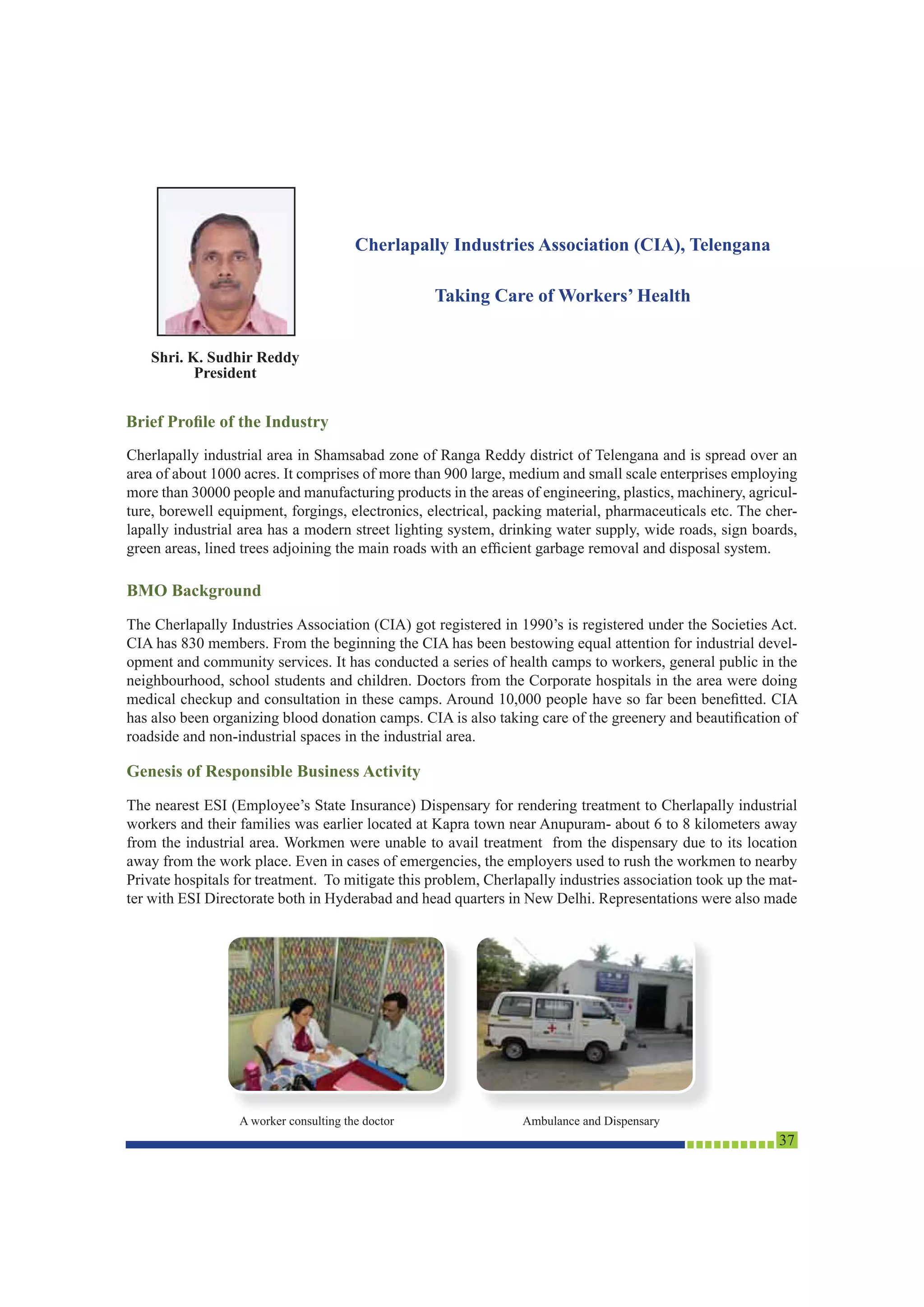
  • 334.
  • 335.
  • 336.
    AV%NKG to inspire andmotivate youngsters to become entrepreneurs through a number of Enterpreneurship Devel- AG ancillary enterprises. Developing Responsible Business Activity %
  • 337.
  • 338.
  • 339.
    municipal as wellas industrial waste entering it from various places. The drain on entering Sutlej river about +8 N
  • 340.
  • 341.
    : ||- tan. Thus, heavilypolluted water is carried forward for agriculture and drinking purposes in the downstream
  • 342.
  • 343.
  • 344.
    of villages goteffected in the region. JJ@
  • 345.
  • 346.
  • 347.
  • 348.
  • 349.
  • 350.
  • 351.
  • 352.
  • 353.
  • 354.
  • 355.
  • 356.
  • 357.
  • 358.
  • 359.
  • 360.
  • 361.
  • 362.
  • 363.
  • 364.
  • 365.
  • 366.
    downstream areas ofSutlej and Beas rivers. Seminar on reducing polution Seminar on reducing polution N
  • 367.
  • 368.
  • 369.
  • 371.
  • 372.
    awareness in industriesabout ill effects of this problem. ‚ q
  • 373.
    ? - luter of heavymetals. 9 9
  • 374.
    37 Cherlapally Industries Association(CIA), Telengana Taking Care of Workers’ Health Shri. K. Sudhir Reddy President Cherlapally industrial area in Shamsabad zone of Ranga Reddy district of Telengana and is spread over an area of about 1000 acres. It comprises of more than 900 large, medium and small scale enterprises employing more than 30000 people and manufacturing products in the areas of engineering, plastics, machinery, agricul- ture, borewell equipment, forgings, electronics, electrical, packing material, pharmaceuticals etc. The cher- lapally industrial area has a modern street lighting system, drinking water supply, wide roads, sign boards, ? BMO Background *J
  • 375.
  • 376.
  • 377.
    - opment and communityservices. It has conducted a series of health camps to workers, general public in the neighbourhood, school students and children. Doctors from the Corporate hospitals in the area were doing
  • 378.
  • 379.
    roadside and non-industrialspaces in the industrial area. Genesis of Responsible Business Activity * A ;
  • 380.
  • 381.
  • 382.
  • 383.
  • 384.
  • 385.
    away from thework place. Even in cases of emergencies, the employers used to rush the workmen to nearby * J
  • 386.
  • 387.
  • 388.
  • 389.
  • 390.
    38 9 9 On an averageabout 500 workers and their family members visit the dispensary for treatment and medicine that are provided under the ESI scheme free of cost. Since the total responsibility to run the dispensary is with
  • 391.
  • 392.
  • 393.
  • 394.
  • 395.
  • 396.
  • 397.
    to exclusively caterto the workers of Cherlapally industrial units subject to the condition that necessary
  • 398.
  • 399.
  • 400.
    JJ U Industrial Municipality, thenodal agency responsible for maintaining all infrastructural facilities created in
  • 401.
  • 402.
  • 403.
  • 404.
    - cated for easyaccess to workers from all enterprises. The furniture, electrical and equipments required were
  • 405.
  • 406.
  • 407.
  • 408.
  • 409.
  • 410.
  • 411.
  • 412.
    39 Coimbatore District SmallScale Industries Association (CODISSIA), Tamil Nadu Inspiring Youth to Become Entrepreneurs J
  • 413.
  • 414.
  • 415.
  • 416.
    - ing sector. Traditionallyit is famous for textile and motors and pump sets industry. It is the oldest and biggest textile spinning hub in the south. Even today, inspite of development of motors and pump sets production and exports elsewhere Coimbatore is the leader. The district has lately emerged as a leader in the manufacturing and export of wet grinders, garments, electronic products, jewellery, castings and auto components. BMO Background J
  • 417.
  • 418.
  • 419.
    # been very active.It has done a lot of work for the development of entrepreneurship, growth and development of new and existing enterprises. It has also created and managing a huge Trade fair centre and planning to establish two industrial parks. Genesis of Responsible Business Activity
  • 420.
  • 422.
    done in stageswith hand holding support to ensure that the activity resulted in creation of new enterprises and employment. It decided that training should be done in four stages so that at the end of the programme, the budding entrepreneurs are fully conversant with the formalities for starting enterprises, assistance available +7
  • 423.
    Mentoring of entrepreneursby faculty 1. http://tamilnadugim.com 1 Shri. E. K. Ponnuswamy President 9
  • 424.
  • 425.
  • 426.
  • 427.
  • 428.
    - tional support. Toserve this objective an Entrepreneurship Development Cell (EDC) headed by one of the ƒ J 6[^^@
  • 429.
    become entrepreneurs areinvited through newspaper advertisements, colleges and other sources to attend the K J
  • 430.
    L- perience and interactwith the participants. Interested youngsters thereafter go through a four stage intensive training program. Implementation and Sustainability %+86++86XJ
  • 431.
  • 432.
  • 433.
    and sourcing oftechnology is also given. Visit to trade fairs in India and abroad is also arranged for interested trainees availing assistance under market development schemes. Importance of responsible business prac- UWP
  • 434.
  • 435.
  • 436.
  • 437.
  • 438.
  • 439.
  • 440.
  • 441.
    - vices provided byEDC coupled with general awareness programmes on all aspects of industrial growth and
  • 442.
  • 443.
  • 444.
    41 Cottage and SmallScale Industries Association (CSSIA), West Bengal Caring for Health of Workers in MSMEs Shri. Sukumar Ghosh President There are a number of prominent clusters in the areas of agarbatti, surgical instruments, jewellery, textiles, rubber etc. cumulatively accommodating thousands of MSMEs and providing employment opportunities for large number of workers. The district is also home to a number of large scale enterprises. BMO Background J ‡
  • 445.
  • 446.
  • 447.
  • 448.
  • 449.
  • 450.
    Genesis of ResponsibleBusiness Activity
  • 451.
  • 452.
    J most of themwere tiny in nature, the units could not render any medical assistance to their workers to take care of their health. Consequently, quite a number of units were suffering from shortage of work force due to
  • 453.
  • 454.
  • 455.
  • 456.
    of workers andconsequent absenteeism. Doctor examining a patient and other patients waiting 9
  • 457.
  • 458.
  • 459.
  • 460.
    / = - J : a mass campaignwill be done about the clinic and the services would be also open for the workers from the non member units of the locality. Dr.S.S.Bhowmick, Homeopath consultant agreed to offer his services once J
  • 461.
    Every Saturday theclinic is open from 4 pm till all the waiting patients are treated. Consultation, medicines
  • 462.
  • 463.
    J* +86+ and is stillcontinuing with great success. The member units also took an active role in making the programme
  • 464.
  • 465.
  • 466.
  • 467.
  • 468.
  • 469.
    #q J 9 9 * +8 week. So farmore than 3000 people have got treatment from the clinic. Obviously, the members have also
  • 470.
    % charges Rs.150/- perpatient along with medicine. But in the clinic he charges Rs.20/- only per patient without #688_|
  • 471.
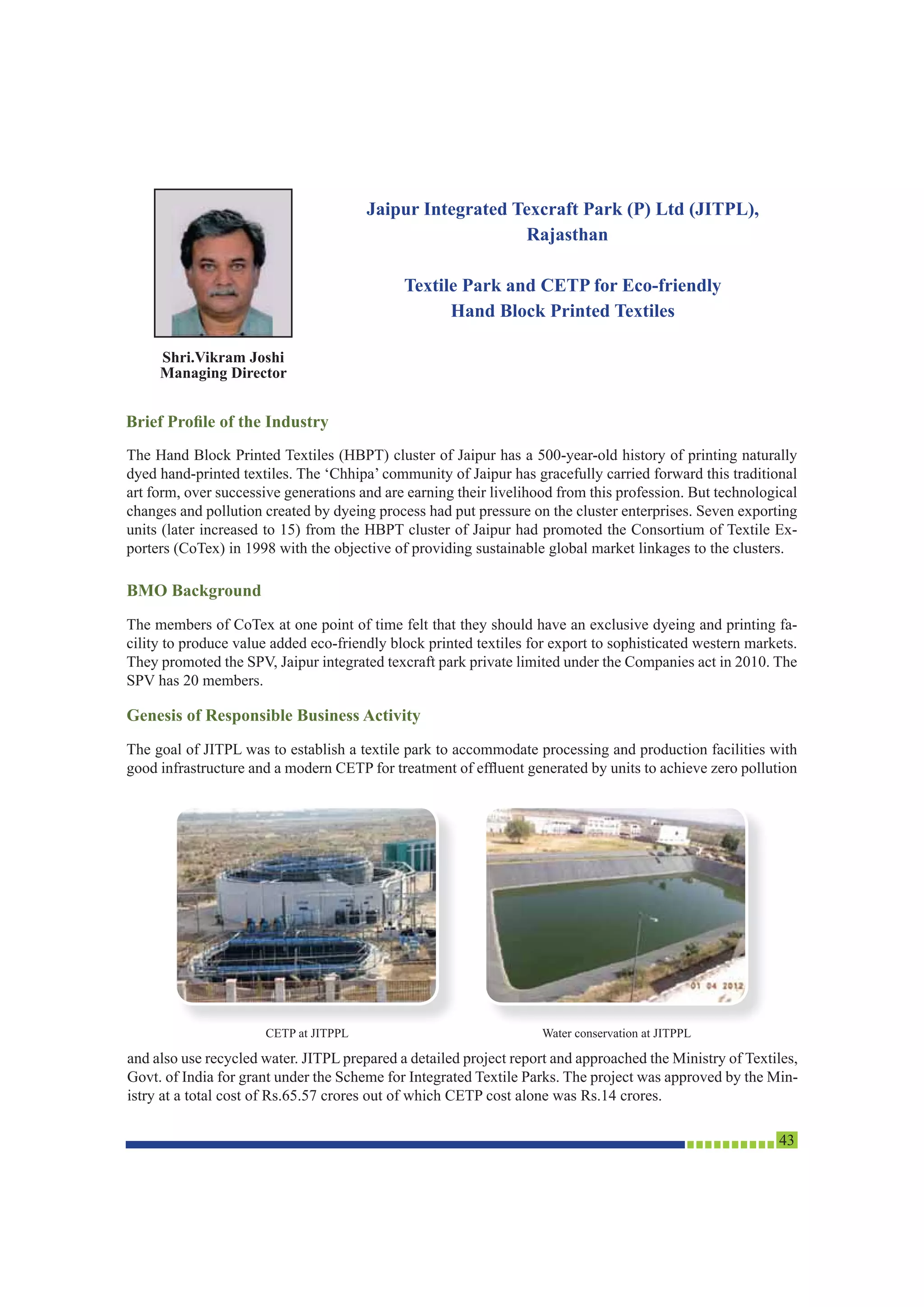
    43 Jaipur Integrated TexcraftPark (P) Ltd (JITPL), Rajasthan Textile Park and CETP for Eco-friendly Hand Block Printed Textiles Shri.Vikram Joshi Managing Director *:% *L A:%*G
  • 472.
  • 473.
  • 474.
  • 475.
  • 476.
    art form, oversuccessive generations and are earning their livelihood from this profession. But technological changes and pollution created by dyeing process had put pressure on the cluster enterprises. Seven exporting
  • 477.
  • 478.
  • 479.
  • 480.
    *L L- porters (CoTex) in1998 with the objective of providing sustainable global market linkages to the clusters. BMO Background The members of CoTex at one point of time felt that they should have an exclusive dyeing and printing fa- cility to produce value added eco-friendly block printed textiles for export to sophisticated western markets. * Wƒ
  • 481.
  • 482.
    J +868* W+8 Genesis of ResponsibleBusiness Activity * ƒ*N L
  • 483.
  • 484.
  • 485.
  • 486.
  • 487.
  • 488.
  • 489.
  • 490.
  • 491.
  • 492.
  • 493.
  • 494.
  • 495.
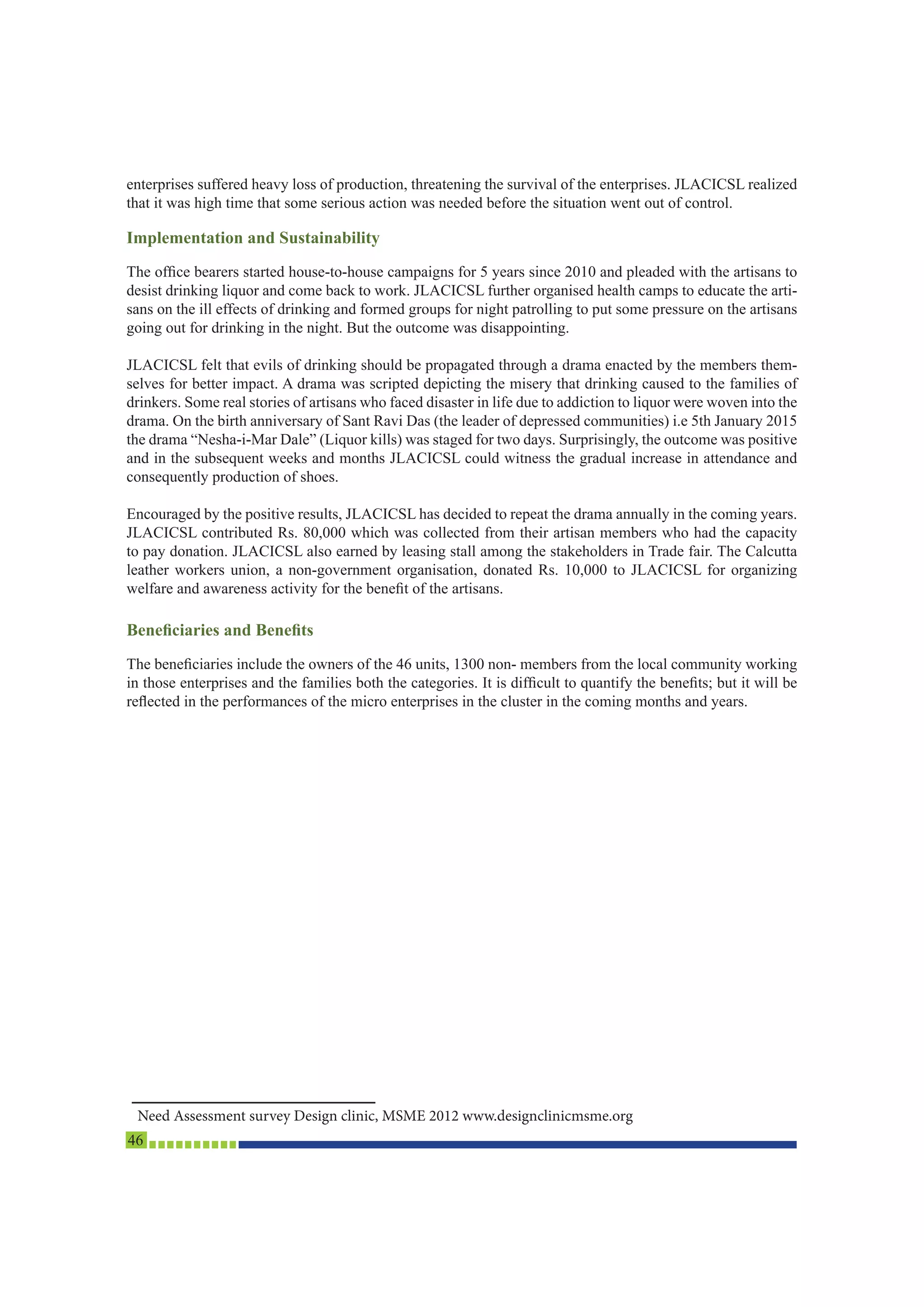
    J* Q liquid discharge andrecycling treated water for dyeing and other uses. Factory building with proper lighting,
  • 496.
    were completed andthe project was inaugurated in July 2013. J* * * : - J** L !
  • 497.
  • 498.
  • 499.
  • 500.
  • 501.
  • 502.
  • 503.
    | block printed textilesfor which there is huge market in western countries. These members have been able to
  • 504.
  • 505.
    - take job workfrom the 20 members and thousands of workers employed in the member units and suppliers
  • 506.
  • 507.
    45 Janbazar LeatherArtisans ClusterIndustrial Co-operative Society Ltd (JLACICSL), West Bengal Real Life Stories changed LiquorAddiction among LeatherArtisans Shri. M. L. Prasad Chairman * 6X88 _ ƒ/ N
  • 508.
    | * % ƒ 4 Bengal. Many arealso seasonal agricultural workers, leaving their villages to work as farmhands. The cluster produces pure leather and synthetic leather shoes that are manually made by the artisans using machines for cutting, sewing, and stitching. By an average 3000 to 3500 pairs of shoes are produced every day in this clus- *
  • 509.
    †ƒ/ ; BMO Background Though thecluster is in existence for a long time, the artisans, most of them belonging to scheduled castes, never thought of forming into an association due to the low level of literacy, lack of awareness and lack of leadership. It is only after interventions by cluster development organizations that the micro enterprises have ƒNJJN+86q
  • 510.
  • 511.
    / ƒNJJN / upgradation training, healthcamps, design clinics, participation in industrial trade fairs, buyer-seller meets etc. It is also planning to establish a common facility centre. Genesis of Responsible Business Activity The enterprises faced several challenges including high dependence on money lenders at high rates of in- terest, poor earnings, low and delayed wages etc., leading to a lot of sufferings. Many of them had also cultivated drinking habits resulting in extreme suffering of their families. This peaked in 2010, and micro $U| | 'AN !
  • 512.
  • 513.
  • 514.
  • 515.
  • 516.
  • 517.
  • 518.
  • 519.
  • 520.
  • 521.
    ƒNJJN / that it washigh time that some serious action was needed before the situation went out of control. Implementation and Sustainability *
  • 522.
  • 523.
  • 524.
  • 525.
    - sans on theill effects of drinking and formed groups for night patrolling to put some pressure on the artisans going out for drinking in the night. But the outcome was disappointing. ƒNJJN
  • 526.
  • 527.
    drinkers. Some realstories of artisans who faced disaster in life due to addiction to liquor were woven into the drama. On the birth anniversary of Sant Ravi Das (the leader of depressed communities) i.e 5th January 2015 $U| | 'AN !
  • 528.
  • 529.
  • 530.
  • 531.
  • 532.
  • 533.
  • 534.
  • 535.
    | #68888 ƒNJJN / Need Assessment surveyDesign clinic, MSME 2012 www.designclinicmsme.org
  • 536.
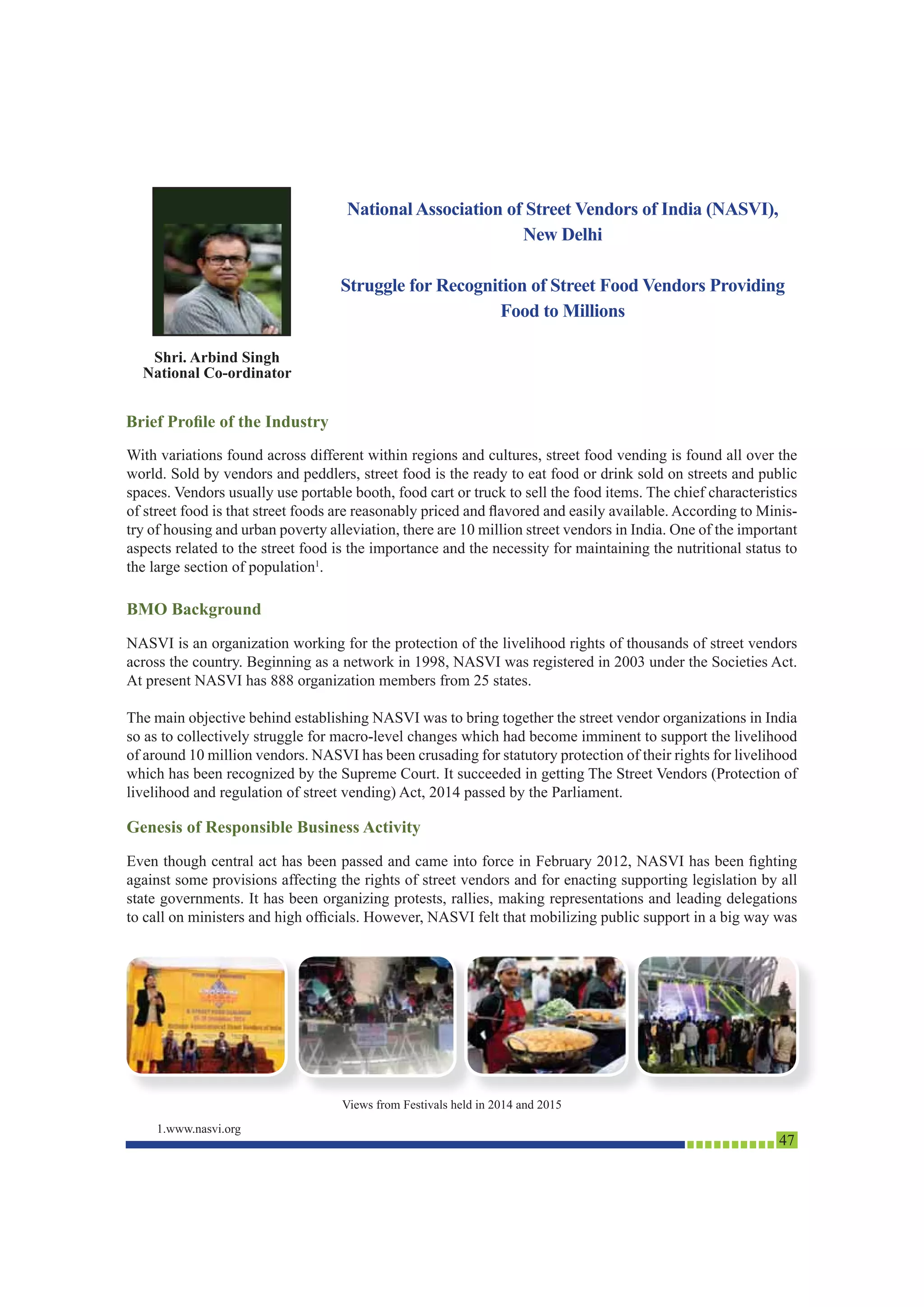
    47 National Association ofStreet Vendors of India (NASVI), New Delhi Struggle for Recognition of Street Food Vendors Providing Food to Millions Shri. Arbind Singh National Co-ordinator 4
  • 537.
    world. Sold byvendors and peddlers, street food is the ready to eat food or drink sold on streets and public spaces. Vendors usually use portable booth, food cart or truck to sell the food items. The chief characteristics Y - try of housing and urban poverty alleviation, there are 10 million street vendors in India. One of the important aspects related to the street food is the importance and the necessity for maintaining the nutritional status to the large section of population1 . BMO Background UW /
  • 538.
  • 539.
    UW^^^ / +X * ? UW / so as tocollectively struggle for macro-level changes which had become imminent to support the livelihood
  • 540.
  • 541.
  • 542.
  • 543.
  • 544.
  • 545.
  • 546.
    +86+UW against some provisionsaffecting the rights of street vendors and for enacting supporting legislation by all state governments. It has been organizing protests, rallies, making representations and leading delegations : UW /
  • 547.
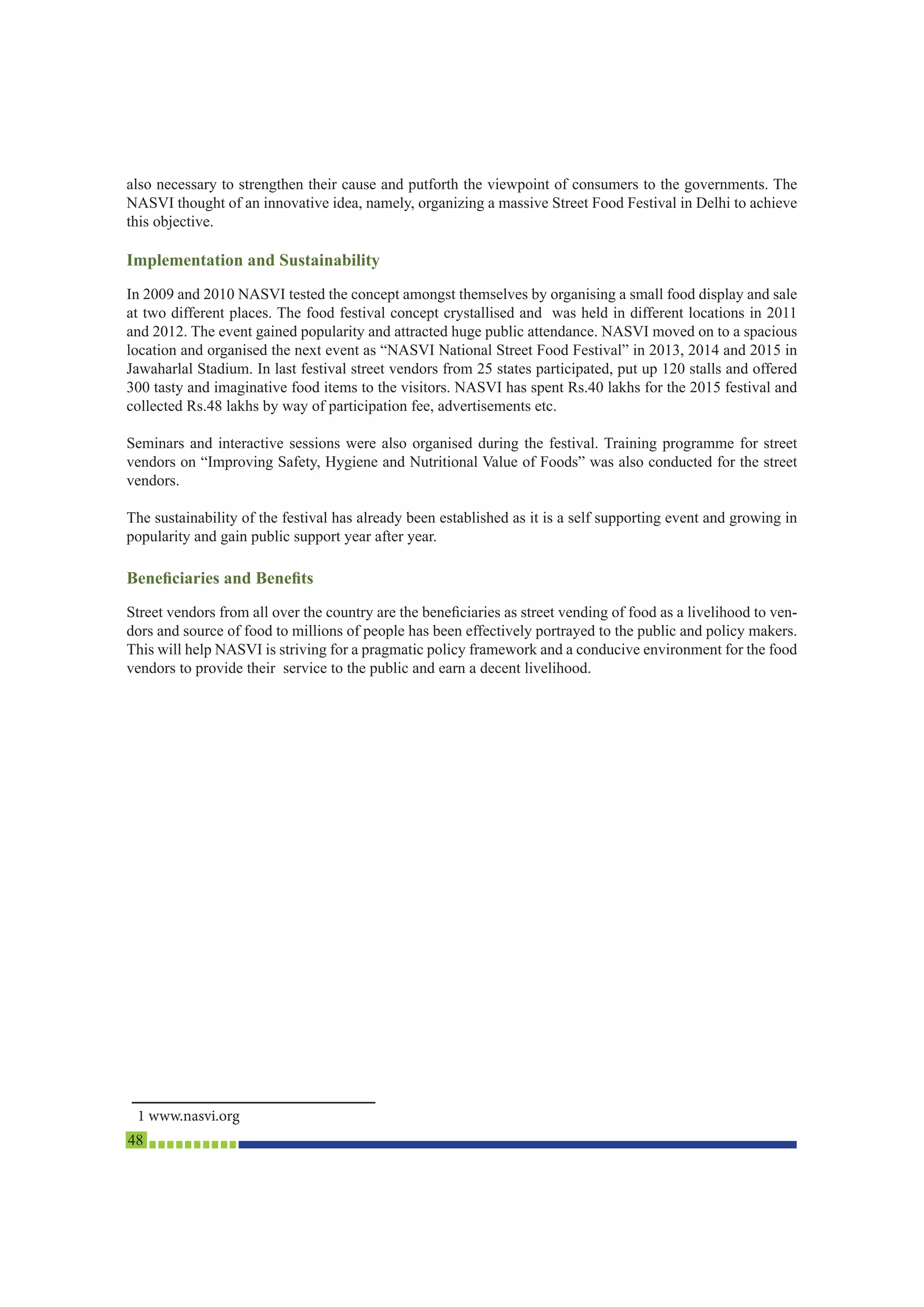
    Views from Festivalsheld in 2014 and 2015 1.www.nasvi.org 9
  • 548.
  • 549.
  • 550.
    - dors and sourceof food to millions of people has been effectively portrayed to the public and policy makers. * UW
  • 551.
    vendors to providetheir service to the public and earn a decent livelihood. also necessary to strengthen their cause and putforth the viewpoint of consumers to the governments. The UW
  • 552.
    / K K this objective. Implementation andSustainability +88[+868UW at two different places. The food festival concept crystallised and was held in different locations in 2011 +86+*
  • 553.
  • 554.
    L$UWU K K ' +86q+86`+86X Jawaharlal Stadium. Inlast festival street vendors from 25 states participated, put up 120 stalls and offered q88 UW#`8 +86X collected Rs.48 lakhs by way of participation fee, advertisements etc. Seminars and interactive sessions were also organised during the festival. Training programme for street $ : U
  • 555.
  • 556.
  • 557.
    vendors. The sustainability ofthe festival has already been established as it is a self supporting event and growing in popularity and gain public support year after year. 1 www.nasvi.org
  • 558.
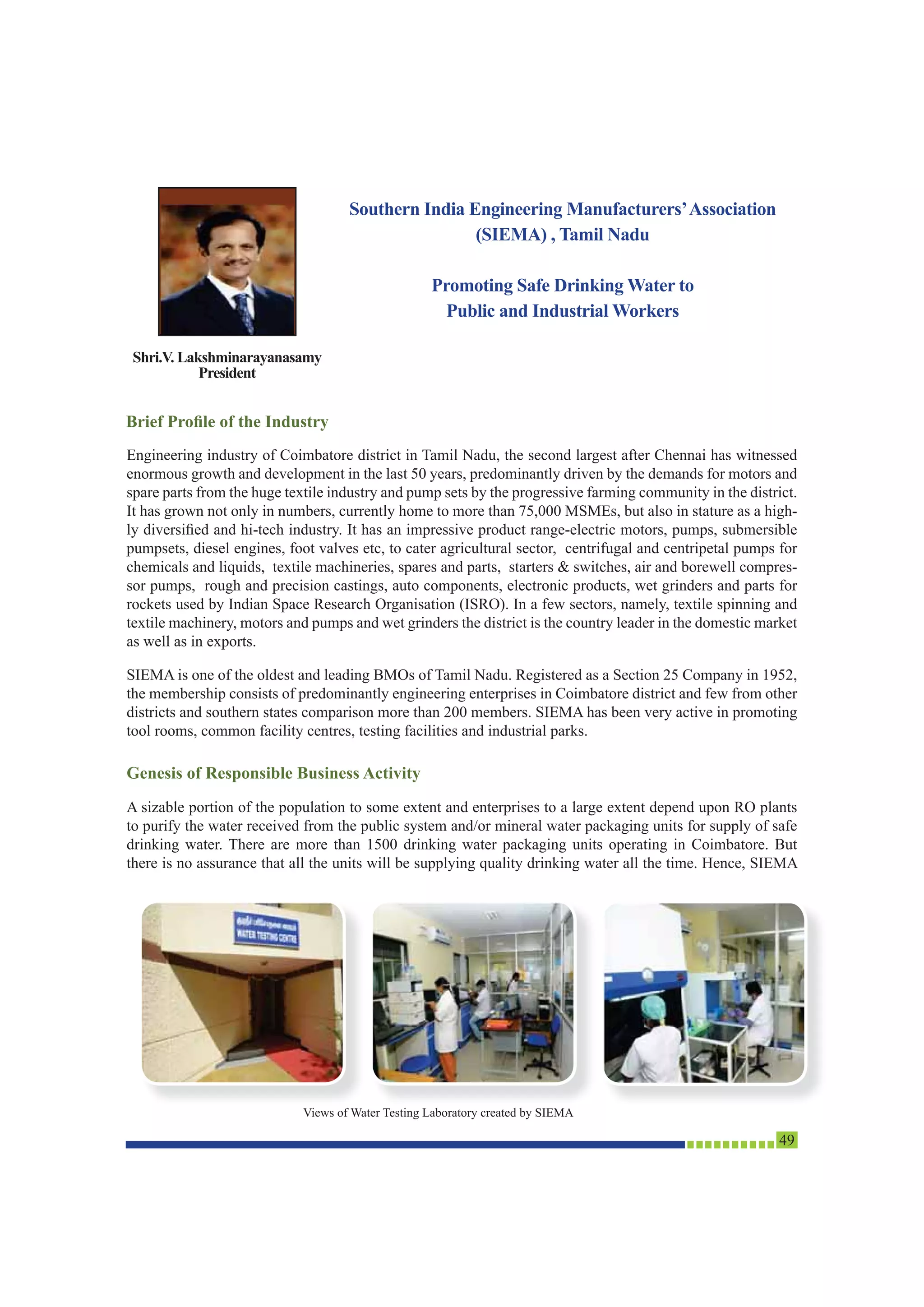
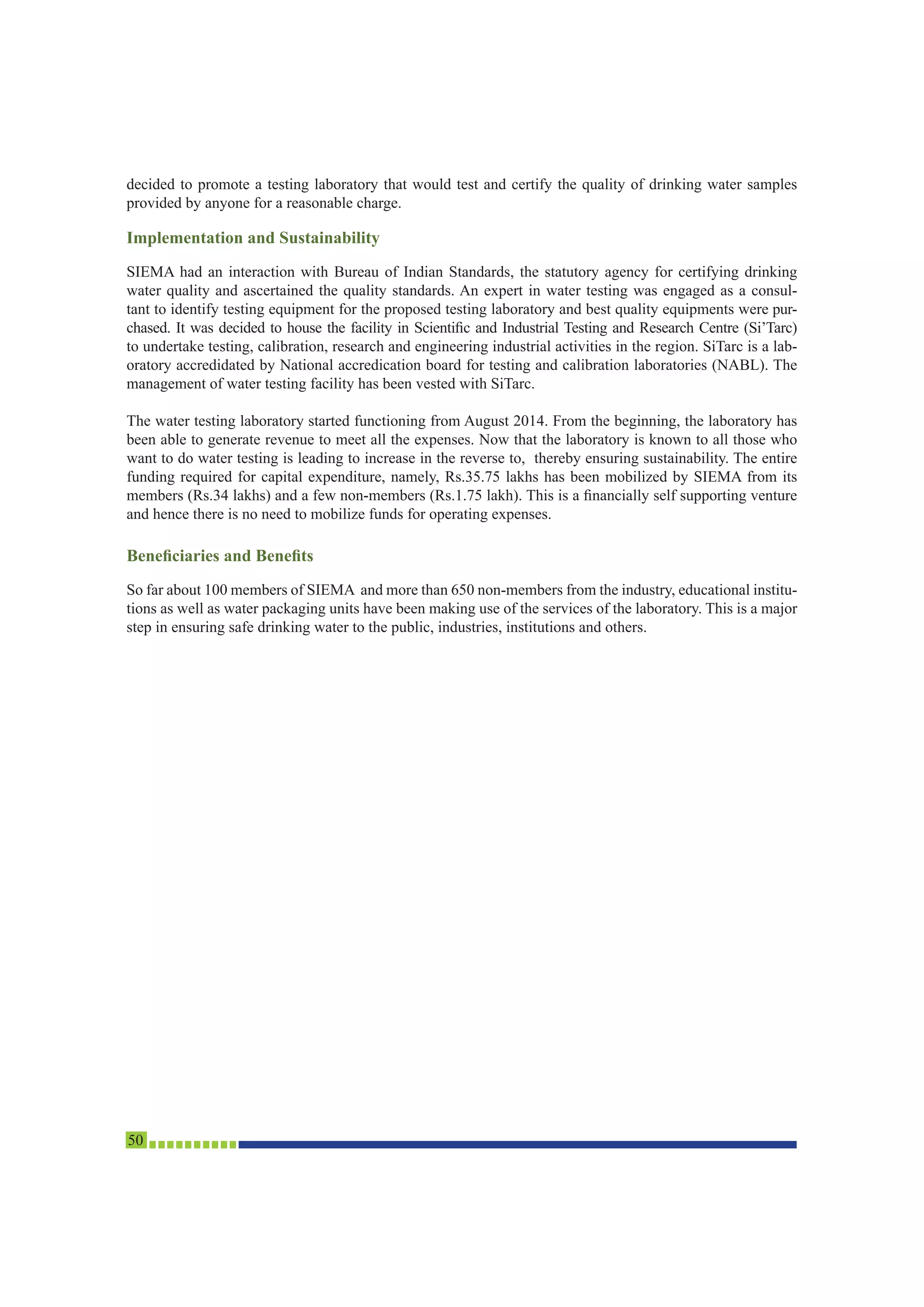
    49 Southern India EngineeringManufacturers’Association (SIEMA) , Tamil Nadu Promoting Safe Drinking Water to Public and Industrial Workers Shri.V. Lakshminarayanasamy President
  • 559.
  • 560.
    J enormous growth anddevelopment in the last 50 years, predominantly driven by the demands for motors and spare parts from the huge textile industry and pump sets by the progressive farming community in the district. It has grown not only in numbers, currently home to more than 75,000 MSMEs, but also in stature as a high- |
  • 561.
  • 562.
    pumpsets, diesel engines,foot valves etc, to cater agricultural sector, centrifugal and centripetal pumps for chemicals and liquids, textile machineries, spares and parts, starters switches, air and borewell compres- sor pumps, rough and precision castings, auto components, electronic products, wet grinders and parts for rockets used by Indian Space Research Organisation (ISRO). In a few sectors, namely, textile spinning and textile machinery, motors and pumps and wet grinders the district is the country leader in the domestic market as well as in exports. % * U
  • 563.
    # +XJ 6[X+ the membership consistsof predominantly engineering enterprises in Coimbatore district and few from other
  • 564.
    +88 tool rooms, commonfacility centres, testing facilities and industrial parks. Genesis of Responsible Business Activity /
  • 565.
  • 566.
    # to purify thewater received from the public system and/or mineral water packaging units for supply of safe drinking water. There are more than 1500 drinking water packaging units operating in Coimbatore. But
  • 567.
  • 568.
  • 569.
  • 570.
  • 571.
  • 572.
    - tions as wellas water packaging units have been making use of the services of the laboratory. This is a major step in ensuring safe drinking water to the public, industries, institutions and others. decided to promote a testing laboratory that would test and certify the quality of drinking water samples provided by anyone for a reasonable charge. Implementation and Sustainability %
  • 573.
  • 574.
  • 575.
  • 576.
    - tant to identifytesting equipment for the proposed testing laboratory and best quality equipments were pur-
  • 577.
    * # J A ;* G to undertake testing,calibration, research and engineering industrial activities in the region. SiTarc is a lab- U AU%NG* management of water testing facility has been vested with SiTarc. *
  • 578.
  • 579.
    LU want to dowater testing is leading to increase in the reverse to, thereby ensuring sustainability. The entire
  • 580.
  • 581.
  • 582.
  • 583.
    and hence thereis no need to mobilize funds for operating expenses.
  • 584.
    51 Sports Goods Foundationof India (SGFI), Punjab Rehabilitating Child Labour through Literacy and Vocational Skills Shri. Ravinder S. Purewal Director *
  • 585.
  • 586.
  • 587.
  • 588.
  • 589.
  • 590.
  • 591.
  • 592.
    games like caromand chess boards and different kinds of protective equipment. The major export destina- @ = @ P K
  • 593.
  • 594.
    weaker sections ofthe society and also employs a large number of women . BMO Background * P K APKG 6[[[
  • 595.
  • 596.
    development of sportsindustry as well as social causes like education, health, social security, child labour and women empowerment. Genesis of Responsible Business Activity
  • 597.
  • 598.
    |- tive measures totackle this problem. However, considering the magnitude and extent of the problem and its
  • 599.
  • 600.
  • 601.
  • 602.
  • 603.
    ?AUJNG 6[[^@ children in theage group of 5-8 years, employed in businesses are to be withdrawn from their work places PK J 9
  • 604.
  • 605.
  • 606.
  • 607.
    [|6` are to berehabilitated through special schools as they cannot be put in formal schools. The special schools function in the evenings only for 3 hours per day for 5 days in a week and provide non-formal/bridge educa- _ q +888PK
  • 608.
  • 609.
    over and run8 schools, each school accommodating 50 children. Implementation and Sustainability PK
  • 610.
  • 611.
    ^ J 7 were provided bythe state government in government schools. The families of a child labour cannot afford to meet the expenses of his/her schooling. The families further loose some income from child labour. Hence the scheme took care of the cost of education and also provide a stipend to compensate the loss of income to LPK L
  • 612.
    rooms hired fromnormal schools, salary of teachers, administrative expenses, expenses of one meal and stipend of Rs.150 per month per child labour. PK
  • 613.
    than 3 yearsthere are positive signs of sustainability. 9 9 `888 +86+ +86Xq88
  • 614.
  • 615.
  • 616.
    - dren have becomeliterates, trained in vocational skills are now well equipped to get gainful employment at an appropriate time.
  • 617.
  • 618.
  • 619.
  • 620.
  • 621.
    traders in agriculturalproduce play a very vital and crucial role in distributing the huge volume of agricultural products to the nooks and corners of the country. BMO Background ** U
  • 622.
  • 623.
  • 624.
    Even though tradinghas been the main activity, the association has been thinking for a long time to create a link between growers of foodgrains (including cereals and pulses) at the one end and consumers at another * 6[[qW|* U
  • 625.
    J - bership of 305micro enterprises. Genesis of Responsible Business Activity * *KPV
  • 626.
  • 627.
  • 628.
    But this remaineda distant dream because of the huge investment required. The opportunity came in the form of
  • 629.
  • 630.
  • 631.
  • 632.
  • 633.
    54 tage of thescheme, prepared the detailed project report and got it approved by the government in 2004. Implementation and Sustainability *KPV!
  • 634.
  • 635.
    pre-processing centre withcleaning grading and sortexing services, packaging centre, research and develop- ment laboratory, container terminal and container weighbridge. Seminar hall,agri-business ICT centre, goods display centre and auction centre are some of the special features of the yard. *
  • 636.
    +88[ and sortexing, packingand analytical testing, cold storagewere added in the subsequent 3 years and made into
  • 637.
  • 638.
    P of India grantRs.29.07 crores, SBT term loan Rs.3.99 crores and members contribution Rs.8.18 crores. The
  • 639.
  • 640.
  • 641.
    X88 ‹q7Œ - force is womenand 34% from scheduled communities. It has also created indirect employment for about 1000 persons. The facilities and services are utilized by 200 stakeholder members and 105 utility members. It is reported that about a lakh of persons-farmers, small traders, consumers and service providers would have +88[
  • 642.
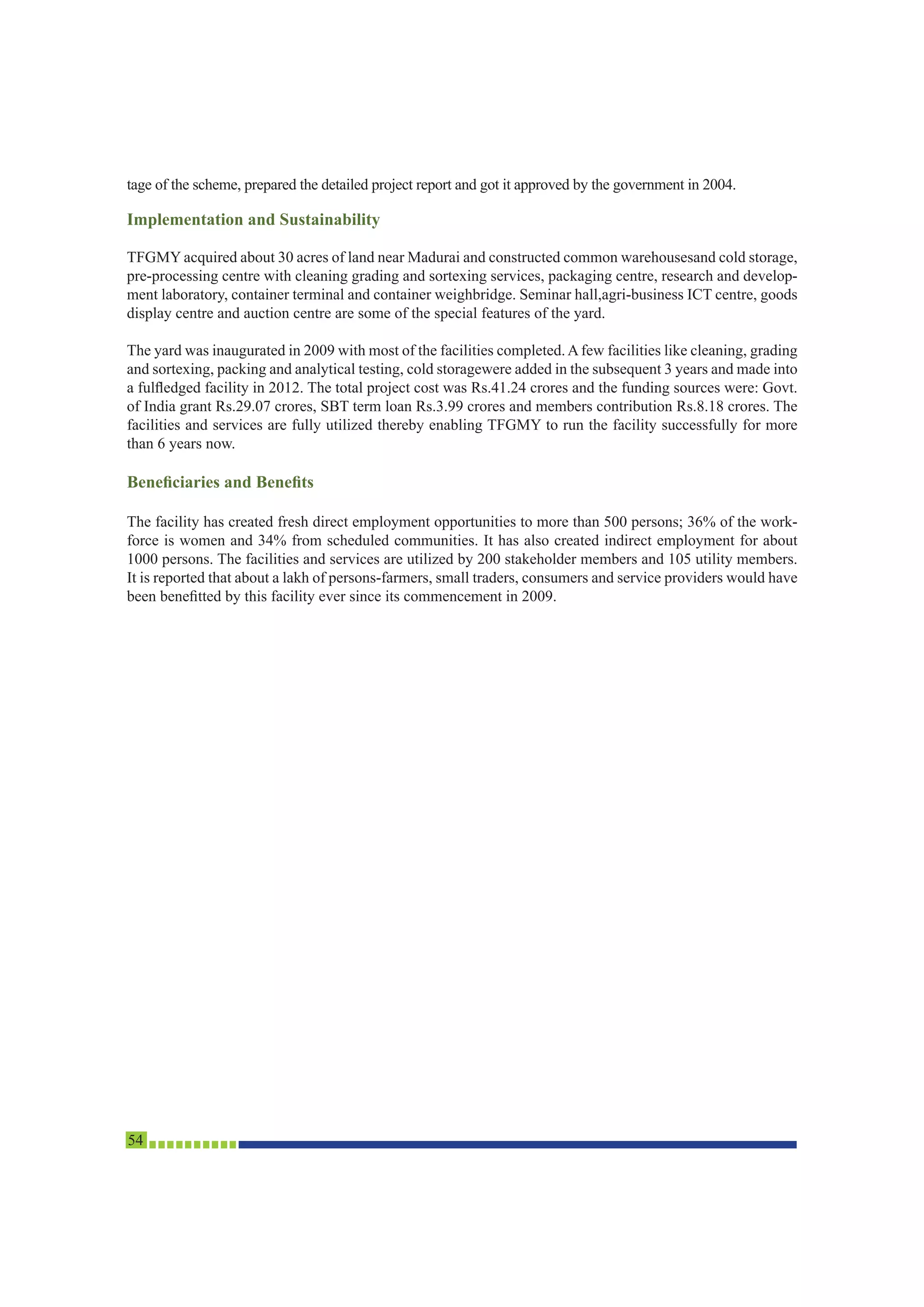
    55 ThenginaNarinaKushalKaigarigaSahakaraSangha,(TNKKSS) Karnataka CoconutHuskBoardasa SubstituteforWoodtoSaveTrees Shri. T. S.Kidigannappa President Coir Industry is one among the agro based traditional industries of the country that is predominantly located
  • 643.
    7X % - come to thecoconut farmers, the industry earns valuable foreign exchange through export of value added coir
  • 644.
  • 645.
  • 646.
  • 647.
  • 648.
  • 649.
  • 650.
  • 651.
  • 652.
  • 653.
  • 654.
  • 655.
  • 656.
  • 657.
  • 658.
  • 659.
    Extensive use ofwood for furniture and other purposes has resulted in alarming deforestation and environ-
  • 660.
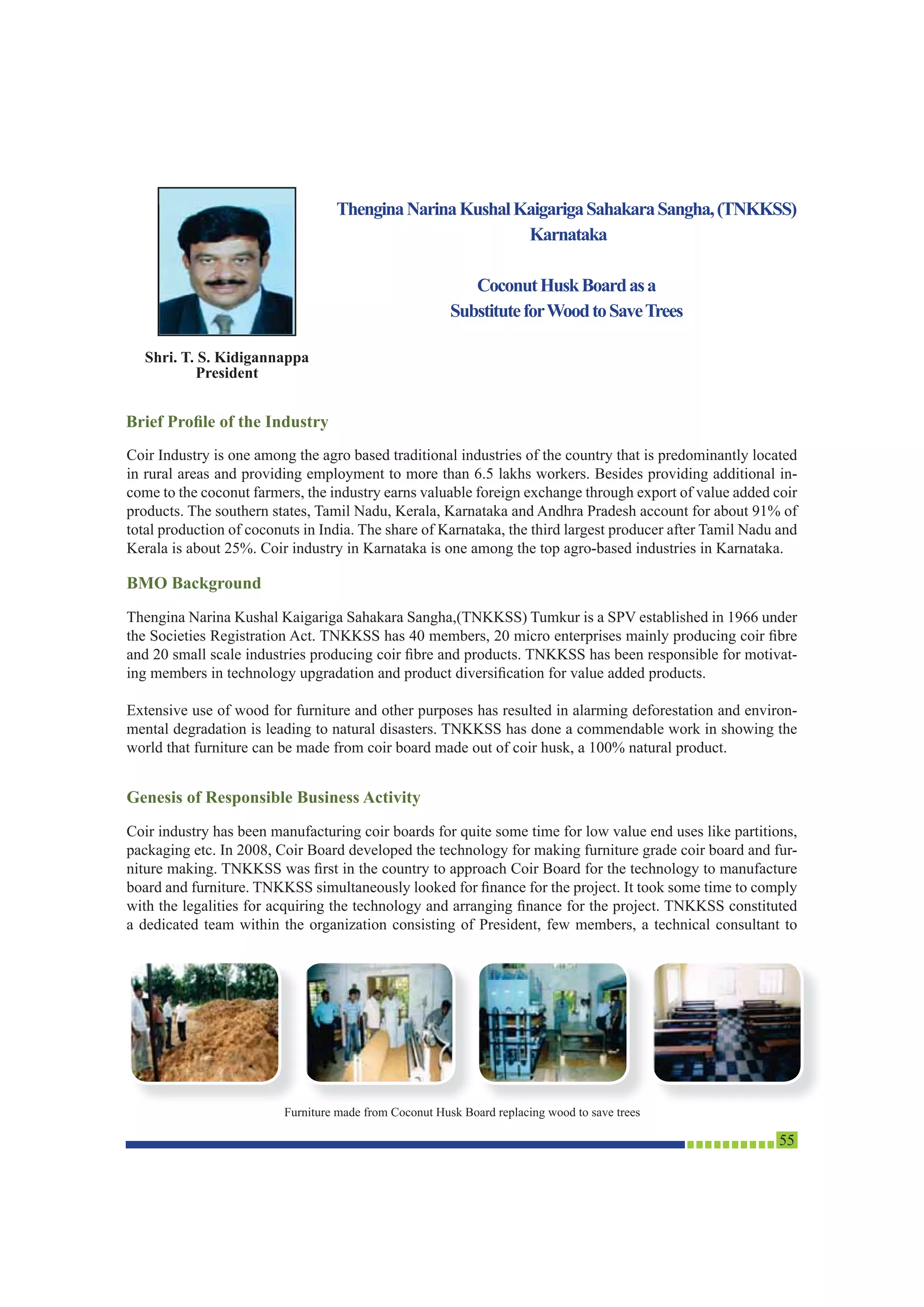
    *U== world that furniturecan be made from coir board made out of coir husk, a 100% natural product. Genesis of Responsible Business Activity Coir industry has been manufacturing coir boards for quite some time for low value end uses like partitions, packaging etc. In 2008, Coir Board developed the technology for making furniture grade coir board and fur-
  • 661.
  • 662.
  • 663.
  • 664.
  • 665.
  • 666.
  • 667.
    Furniture made fromCoconut Husk Board replacing wood to save trees 9
  • 668.
  • 669.
  • 670.
  • 671.
  • 672.
  • 673.
  • 674.
  • 675.
  • 676.
    enviroment. ?* *U== K@#* ?*U== submitted the Detailedproject report under the scheme to the Ministry. The Ministry approved the project and sanctioned grant. The members contributed Rs.205.45 lakhs towards the cost of project and the balance #+{^^` J P Implementation and Sustainability @
  • 677.
    procedural formalities. Buildingswere constructed, machinery was installed, power supply was obtained and trial
  • 678.
  • 679.
    +86+* facility is nowrunning successfully. There are already proposals from a few other coir clusters to replicate this suc-
  • 680.
  • 681.
    year the projectis expected to reach a turnover of Rs.80 lakhs.
  • 682.
  • 683.
  • 684.
  • 685.
  • 686.
  • 687.
    fabric are suitableraw material for making jute handicrafts for a wide range of end use, interior decoration and show case items. BMO Background V
  • 688.
  • 689.
  • 690.
  • 691.
  • 692.
  • 693.
  • 694.
  • 695.
    development, organic agricultureetc., spread over 27 mandals of the district. Genesis of Responsible Business Activity
  • 696.
    in search ofemployment for living. The idea was to promote and generate jute based handicraft activities
  • 697.
    VJ% skills to thepoor people to make handicrafts from locally available raw material, especially jute and support them with backward and forward linkages so that women empowerment and poverty reduction can go hand
  • 698.
  • 699.
  • 700.
  • 701.
  • 702.
    sourcing of rawmaterials, developing new designs, using new tools and common marketing.
  • 703.
    | Jute productsof artisans in an exhibition 9
  • 704.
  • 705.
  • 706.
  • 707.
  • 708.
  • 709.
  • 710.
  • 711.
  • 712.
    67 :P +^8 from 14 villages.227 prototypes were developed in the design and technical development workshops. To lessen
  • 713.
  • 714.
  • 715.
  • 716.
  • 717.
    | and supplied toagriculturists in villages. For marketing of products, artisans mostly depend on local market, urban based exhibitions, trade fairs and Crafts / /P / 6+:- L ` K `
  • 718.
  • 719.
  • 720.
  • 721.
  • 722.
  • 723.
  • 724.
  • 725.
  • 726.
    #XX88 the socio-economic activitiesthat it has accomplished in the district. In the last few years the co-operative society has gained experience in managing the full value chain in jute handi-
  • 727.
    U%#J - sequently, the turnoverof the society has been continuously increasing-an important yardstick for sustainability.
  • 728.
    59 MSME TECHNOLOGY DEVELOPMENTCENTRE, AGRA A NATIONAL CENTRE FOR PROMOTING FOUNDRY FORGING INDUSTRIES IN MSME SECTOR SERVICES OFFERED 1) SPARE CAPACITY AVAILABLE – a) Investing Casting b) Forge shop Foundry Shop 2) CONSULTANCY SERVICES – a) Energy Conservation Air Pollution Control b) Lean Manufacturing / Lean Practices c) Cluster Development d) Project Consultancy Plant Modernization 3) TRAINING PROFESSIONAL SKILL DEVELOPMENT – a) Short/ Long term Training Programmes on Foundry Forging/ Engineering b) CAD/CAM training. c) NCVT affiliated long term training courses. d) High End Management Programme such as Six Sigma, Project Management, Logistic Supply Chain Management etc. e) Other short term training programme, Digital Marketing, Export Documentation Marketing, MS Project, Solar PV Technology, Robotics Automation, 3 D Printing, TQM, Internal Auditor, Energy Management etc. f) Tailor-made corporate training programme. 4) TESTING SERVICES a) Physical, Chemical Metallurgical Testing of Engineering components b) Defect Investigation Studies 5) PRODUCT DEVELOPMENT – a) Rapid Product Development manufacturing of Castings Forgings b) Design Development Manufacturing of Dies Patterns c) Conventional CNC Machining of Cast Forged components d) Investment Casting For details , Please contact- MSME-Technology Development Centre (PPDC) Foundry Nagar, Agra- 282006, Ph- 0562-2344006, 2344673, Fax: 0562-2344381 Email: info@ppdcagra.in, Website: www.ppdcagra.in
  • 729.
  • 730.
    76 National Small IndustriesCorporation NSIC Bhawan, Okhla Industrial Estate, Phase-III, New Delhi-110020 Ph.: +91-11-26926275 Toll Free No. : 1800 111 955 Email: feedback@nsic.co.in Website-http://www.nsic.co.in National Small Industries Corporation (A Govt. of India Enterprise) Be a Part of NSIC Consortia and Expand Borders of Your Business Consortia Tender Marketing NSIC promotes Micro Small Enterprises (MSEs) by way of:
  • 731.
  • 732.
  • 733.
  • 734.
  • 735.
  • 736.
  • 737.
  • 738.
  • 739.
  • 740.
  • 741.
  • 742.
    % = KJ L / the development ofMSMEs with the help of cluster development approach. FMC has rich experience of working with MSMEs and has provided services in the areas of advocacy, implementation and coordination, training and research to more than 150 clusters nationally and globally across 12 countries. KJ @U ? Small Medium Enterprises (MSMEs), their representative Business Membership Organisations (BMOs),
  • 743.
  • 744.
  • 745.
    MSME sector acrossvarious thematic areas of specialisation that include productivity competitiveness,
  • 746.
  • 747.
    - tion. FMC hasprovided training and policy advisory services both nationally and internationally in the area of MSME development and helped draft a number of schemes of assistance followed by training of policy makers practitioners to then implement those schemes effectively. FMC has experience in working for different institutions globally, its national clientele includes Department * A*G 4%=
  • 748.
  • 749.
    J A=WJG Coir Board etc.and it has also worked with international clients which includes International Finance Cor- AKJGAKG J AJG@ U
  • 750.
  • 751.
  • 752.
  • 753.
  • 754.
  • 755.
    V%N JJ# FMC has sofar provided its services across 12 countries in different continents besides strong track record within India. FMC has a strong outreach mechanism while implementation of any program in a cluster as it focuses on those activities which have replicating effect on a large number of stakeholders in the cluster. It also establish- es strong linkages with the local associations which help in collective execution of the planned activities and strengthening the trust between different stakeholders of the cluster through its database of 1500 BMOs in India. It therefore helps FMC domineering strength to visualise and conceptualise MSME related challenges from multiple perspectives and suggest execute remedial measures that are practical with as sustainable outreach.
  • 756.