Project Risk Management - Week 2: Individual Assignment
Overview and Rationale
In order to demonstrate proficiency with the content in this
course we will complete a number of different assignments to
validate your learning – and allow you to implement relevant
practices a real-world setting.
Program Level - Student Learning Outcomes:
Create a risk management plan to determine how both positive
and negative risks will be identified, analyzed and
managedArticulate the value and benefits of creating an
effective approach to planning for project risk
managementIdentify project related risks and their drivers by
integrating best practices, tools and techniques
Analyze risks using qualitative methods for the purpose of risk
exposure and prioritization and communicate their impact to the
stakeholdersAnalyze risks using quantitative methods for the
purpose of risk exposure and prioritization and communicate
their impact to the stakeholdersRecommend risks for risk
response planning or watch listDevise a risk response plan
based on appropriate techniques and strategies that would
meetStakeholders’ expectationsExecute the risk management
plan to continuously monitor risks and risk responsesDescribe
how organizational and cultural factors may undermine
implementation of effective risk management and develop
strategies to overcome these factors
Week 2 Learning Objectives
Integrate best practices, tools and techniques to identify project
related risks
Perform Stakeholders analysis to identify stakeholders to
include in Risk Identification (and how)
Identify Risk identification tools &techniques
Craftqualityriskstatementsthatclarifyriskdrivers,eventsandimpac
ts
CreateariskregisterthatalignstoRiskManagementPlanandstakehol
derneeds
Explain the process of using-Delphi technique, brainstorming,
nominal group, affinity diagramming (group creativity) to
identify risks
The next step in risk management is identifying the risks that
may impact the progress or success of your project. For this
assignment, you will begin to populate the risk register and
identify the risks that may occur in the project. For this
assignment you will complete and submit:
RiskRegisterthatincludesacomprehensivelistofidentifiedrisks.
A minimum (“meets requirements”) of 15 risks should
beidentified
Toensuretheriskidentificationincludesthebreadthanddepthnecess
aryforsuccess,besuretoincludeatleast2risksfrom:
1 project-level/ businessrisks
2risksperphaseoftheproject(so,iftheprojecthas5phases,thiswould
betwoperphaseor10risks)
1 project-specific resourcerisks
1 schedule risks (criticalpath)
1 project-specific costrisks
2 implementationrisks
2opportunities
Risk statements must be written in the cause-condition-
conclusion format. Additionally, you should identify the risk
owner and the trigger event for eachrisk.
For this assignment, do not work to analyze or determine
handling actions for the risks – this assignment is to identify the
risks only- later weeks will analyze and plan for how to manage
therisks.
Includeasummaryparagraphsharinghowriskswereidentified,what
waseffectiveabouttheprocessandwhatyoumightdodifferently
movingforward.
RefertotheRubricattachedtotheassignmentforadditionalcriteriafo
revaluation.
Please post any general questions that you might have on the
Ask the Instructor DB so that the information can be clarified
for everyone.Cite any sources. The writing style should be
concise and straightforward. Please use a 12 point font.The
format for this is your risk register – an excel-type tool works
well for this. Cite any sources. The writing style should be
concise and straightforward.
This week’s work will inform additions that you will make to
your draft Risk Management Plan that was started in Week 1
and will be completed over the term and submitted in Week 5.
Assignment Rubric
Category
Above Standard
Meets Standards
Approaching Standards
Below Standards
Not Evident
Assignment
Goes well above the
Goes above the
Meets minimum
Meets some
Does not meet the
requirements (70%)
requirements of the assignment.
minimum requirements of the
assignment requirements
requirements of the assignment.
Provides new
assignment
information, tools,
and/or techniques
Critical Thinking
Professional insights
Comprehensive
Includes an explanation
Includes a general
Does not explain the
(15%)
into depth and breadth
explanation of the
of the issue;
explanation of the issue
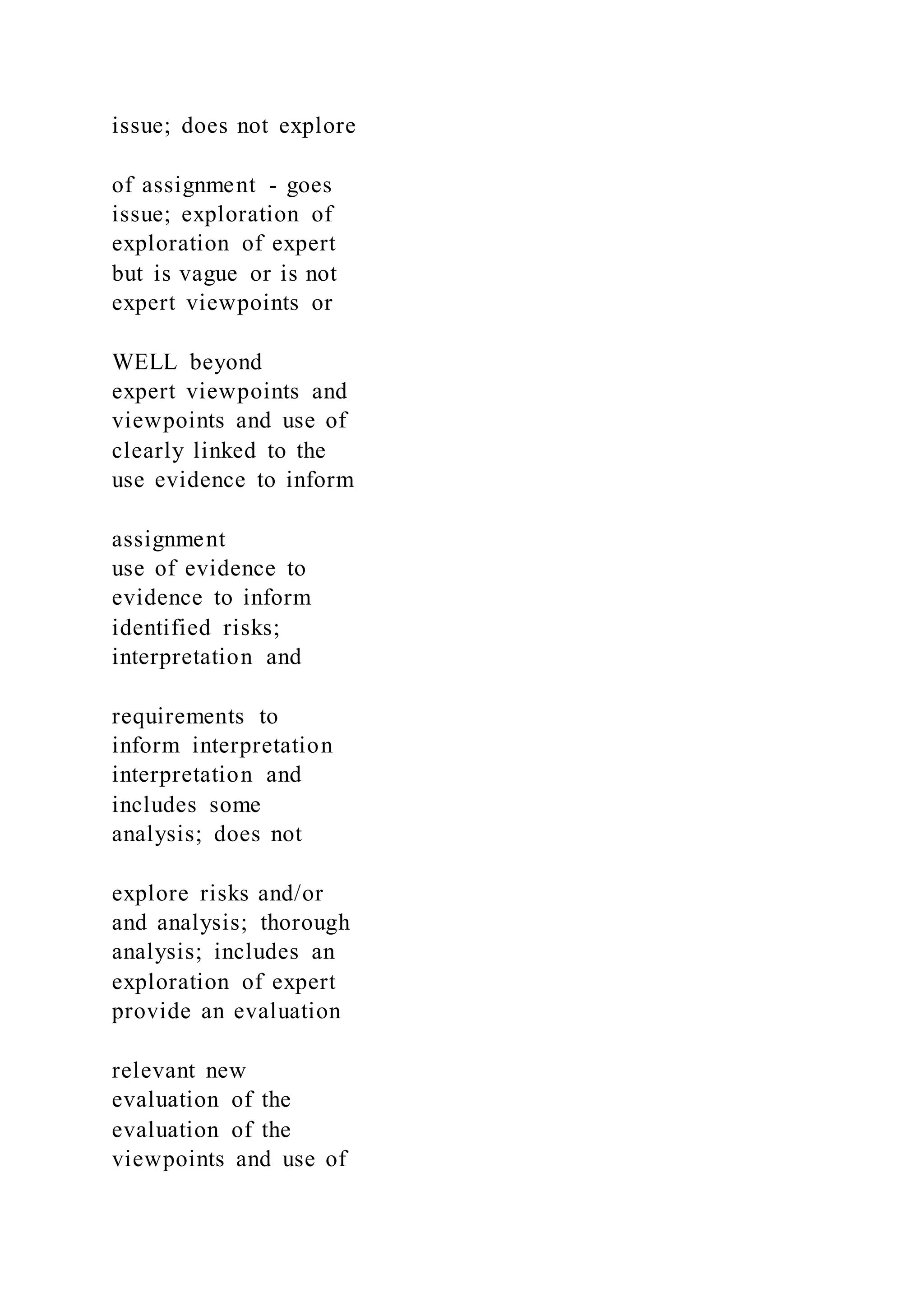
issue; does not explore
of assignment - goes
issue; exploration of
exploration of expert
but is vague or is not
expert viewpoints or
WELL beyond
expert viewpoints and
viewpoints and use of
clearly linked to the
use evidence to inform
assignment
use of evidence to
evidence to inform
identified risks;
interpretation and
requirements to
inform interpretation
interpretation and
includes some
analysis; does not
explore risks and/or
and analysis; thorough
analysis; includes an
exploration of expert
provide an evaluation
relevant new
evaluation of the
evaluation of the
viewpoints and use of
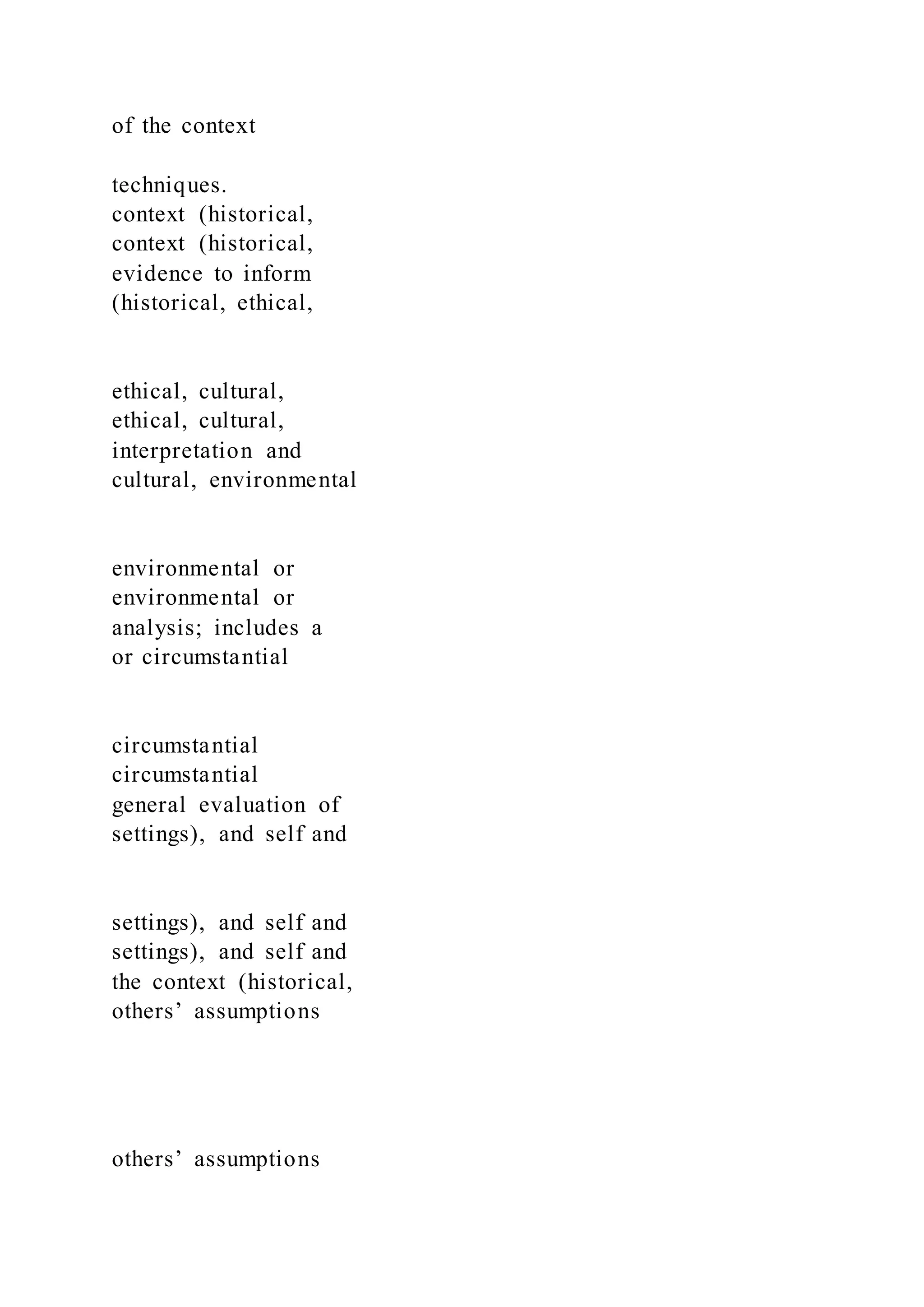
of the context
techniques.
context (historical,
evidence to inform
(historical, ethical,
ethical, cultural,
ethical, cultural,
interpretation and
cultural, environmental
environmental or
environmental or
analysis; includes a
or circumstantial
circumstantial
circumstantial
general evaluation of
settings), and self and
the context (historical,
others’ assumptions
others’ assumptions
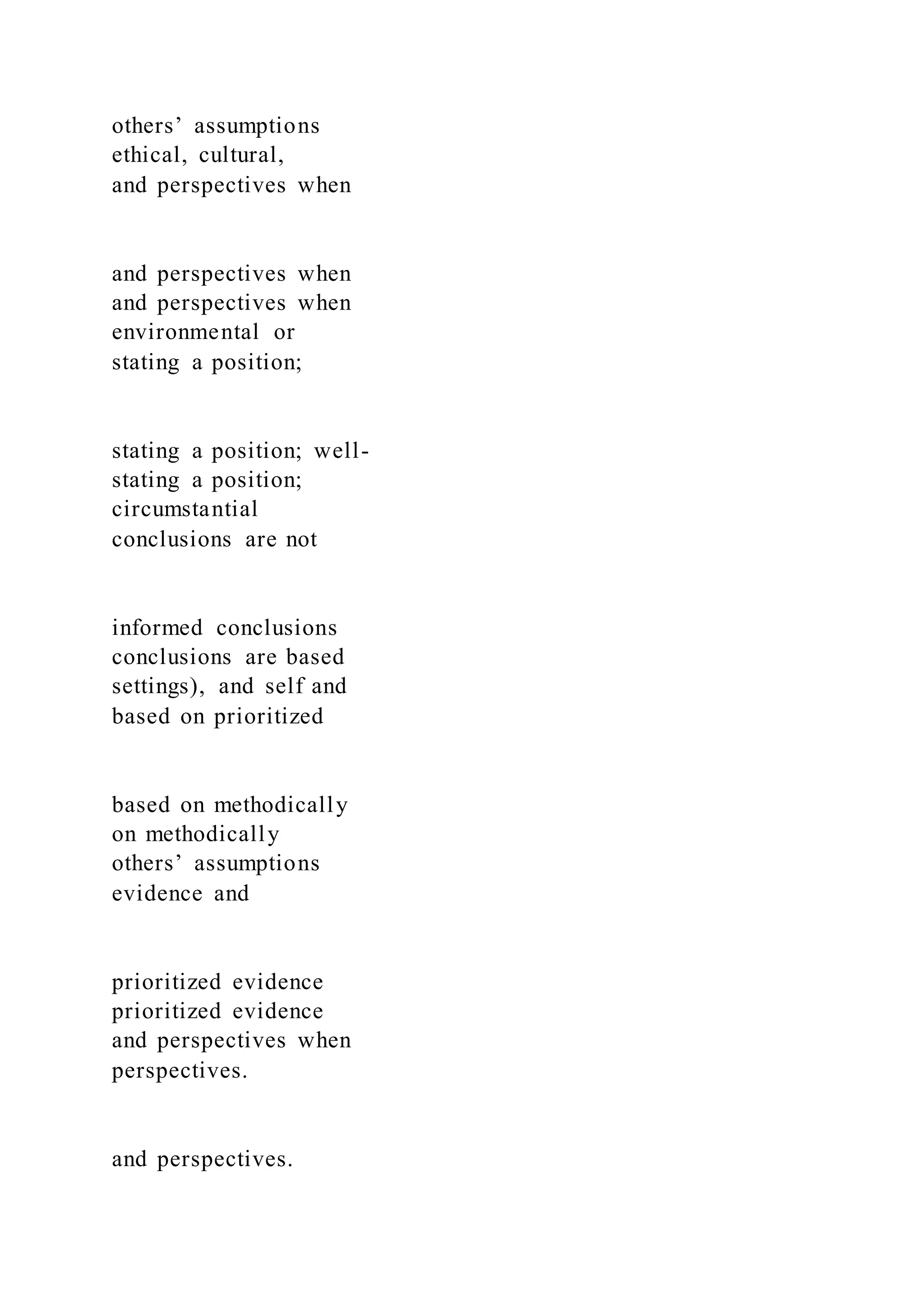
others’ assumptions
ethical, cultural,
and perspectives when
environmental or
stating a position;
stating a position; well-
stating a position;
circumstantial
conclusions are not
informed conclusions
conclusions are based
settings), and self and
based on prioritized
based on methodically
on methodically
others’ assumptions
evidence and
prioritized evidence
and perspectives when
perspectives.
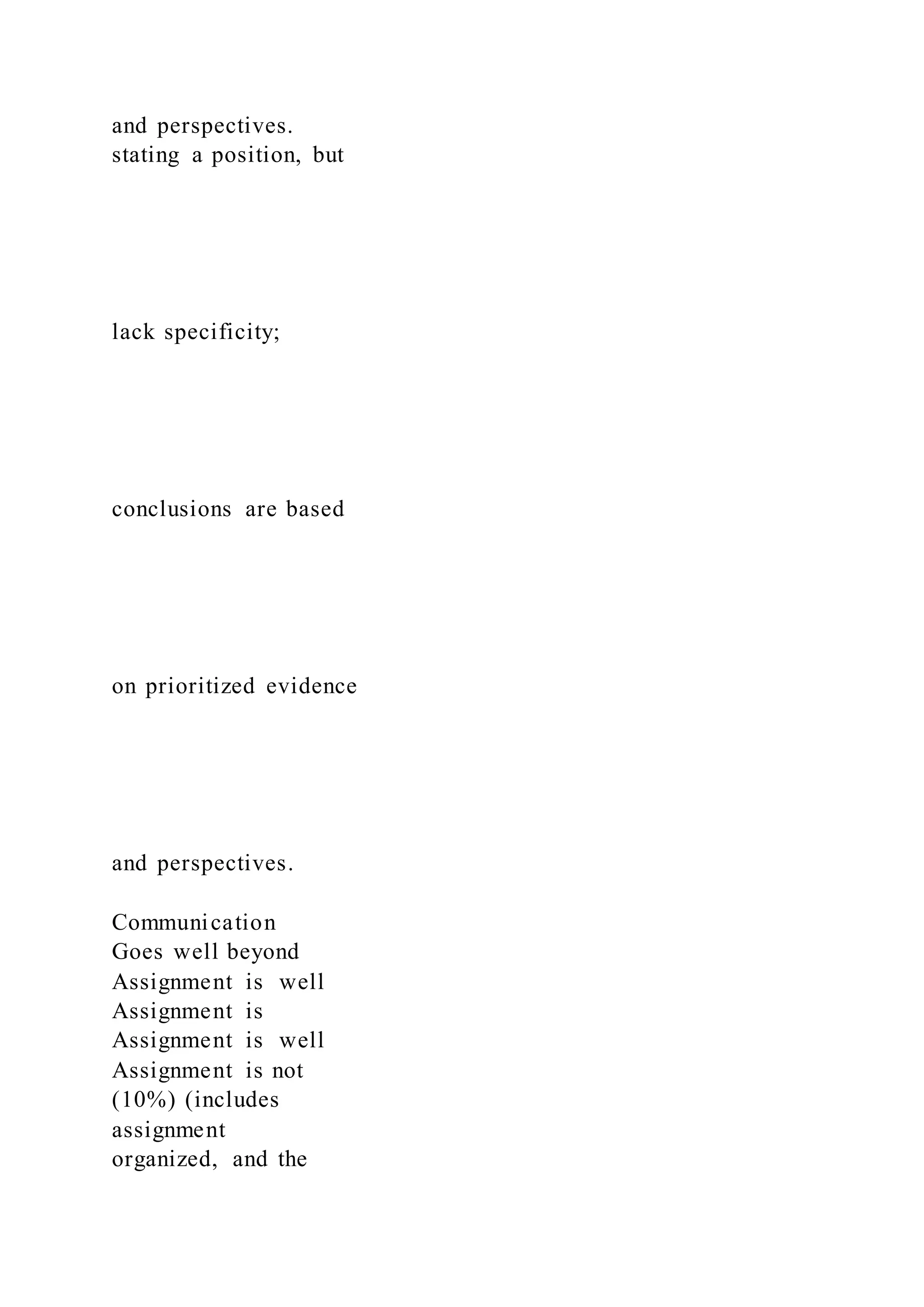
and perspectives.
and perspectives.
stating a position, but
lack specificity;
conclusions are based
on prioritized evidence
and perspectives.
Communication
Goes well beyond
Assignment is well
Assignment is
Assignment is well
Assignment is not
(10%) (includes
assignment
organized, and the
organized, and the
organized, and the
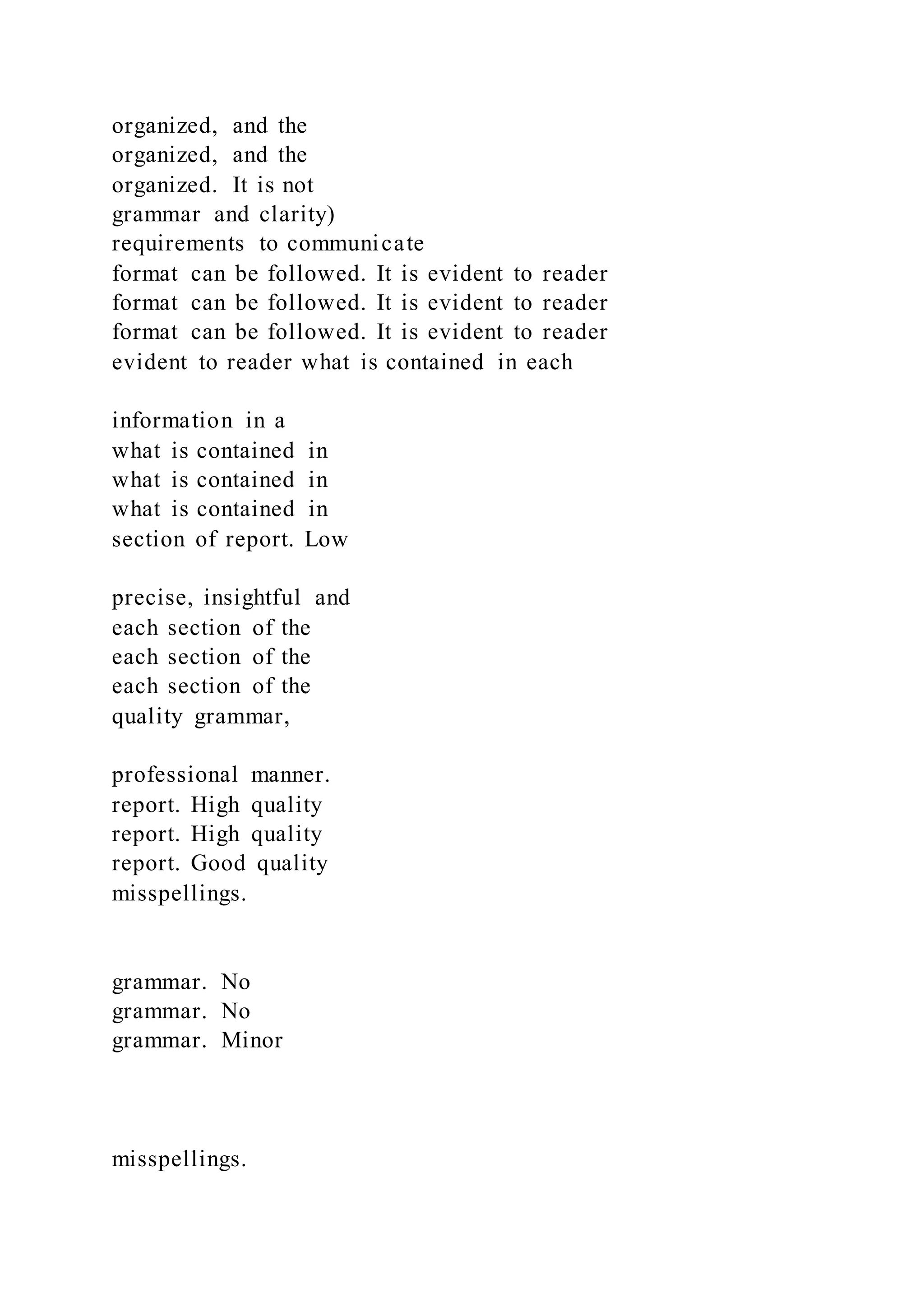
organized. It is not
grammar and clarity)
requirements to communicate
format can be followed. It is evident to reader
evident to reader what is contained in each
information in a
what is contained in
section of report. Low
precise, insightful and
each section of the
each section of the
each section of the
quality grammar,
professional manner.
report. High quality
report. Good quality
misspellings.
grammar. No
grammar. No
grammar. Minor
misspellings.
misspellings.
misspellings.
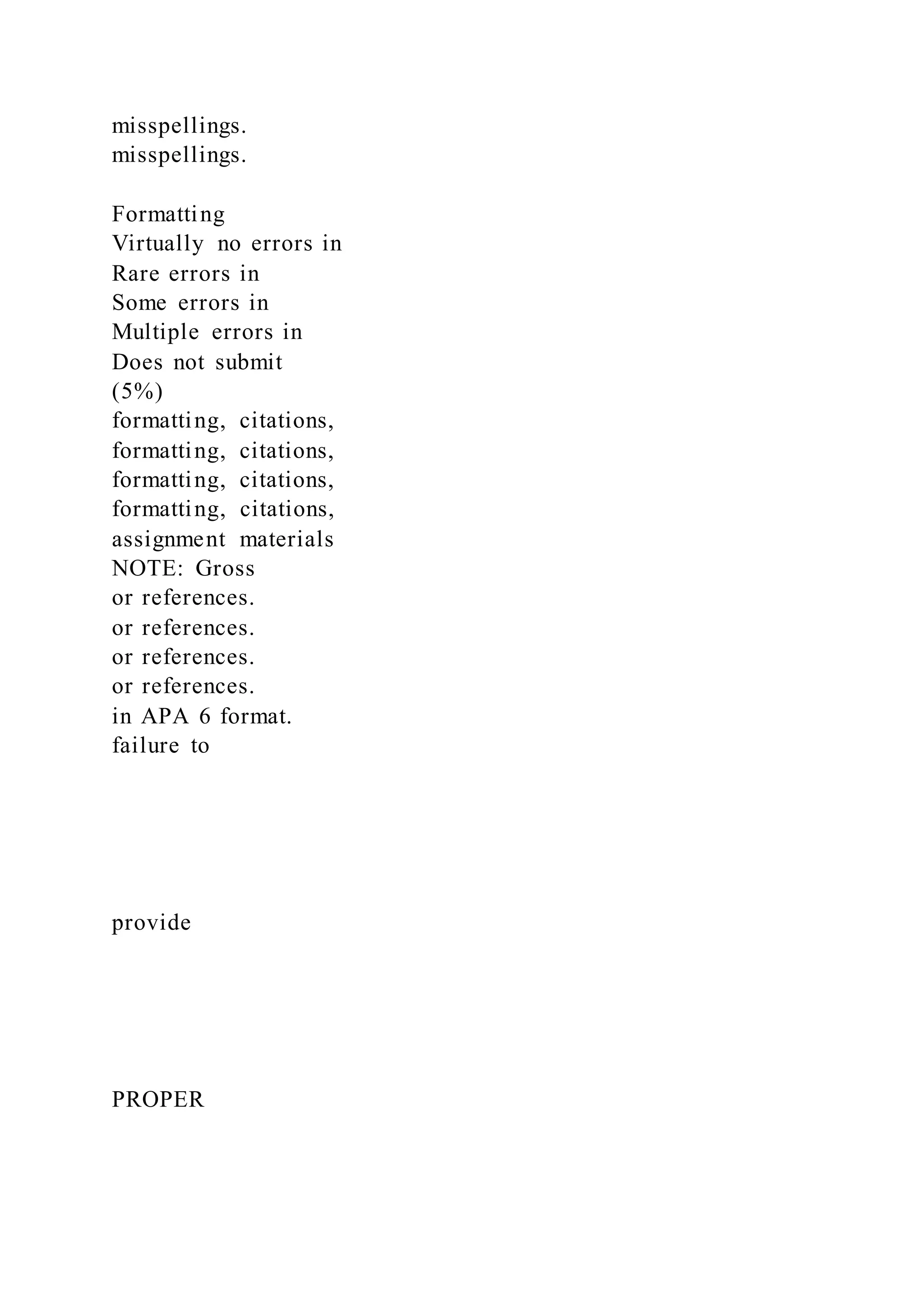
Formatting
Virtually no errors in
Rare errors in
Some errors in
Multiple errors in
Does not submit
(5%)
formatting, citations,
assignment materials
NOTE: Gross
or references.
or references.
or references.
or references.
in APA 6 format.
failure to
provide
PROPER
citations and
references –
particularly
with regard to
direct quotes – will result in sanctions as outlined in the
academic honesty policy
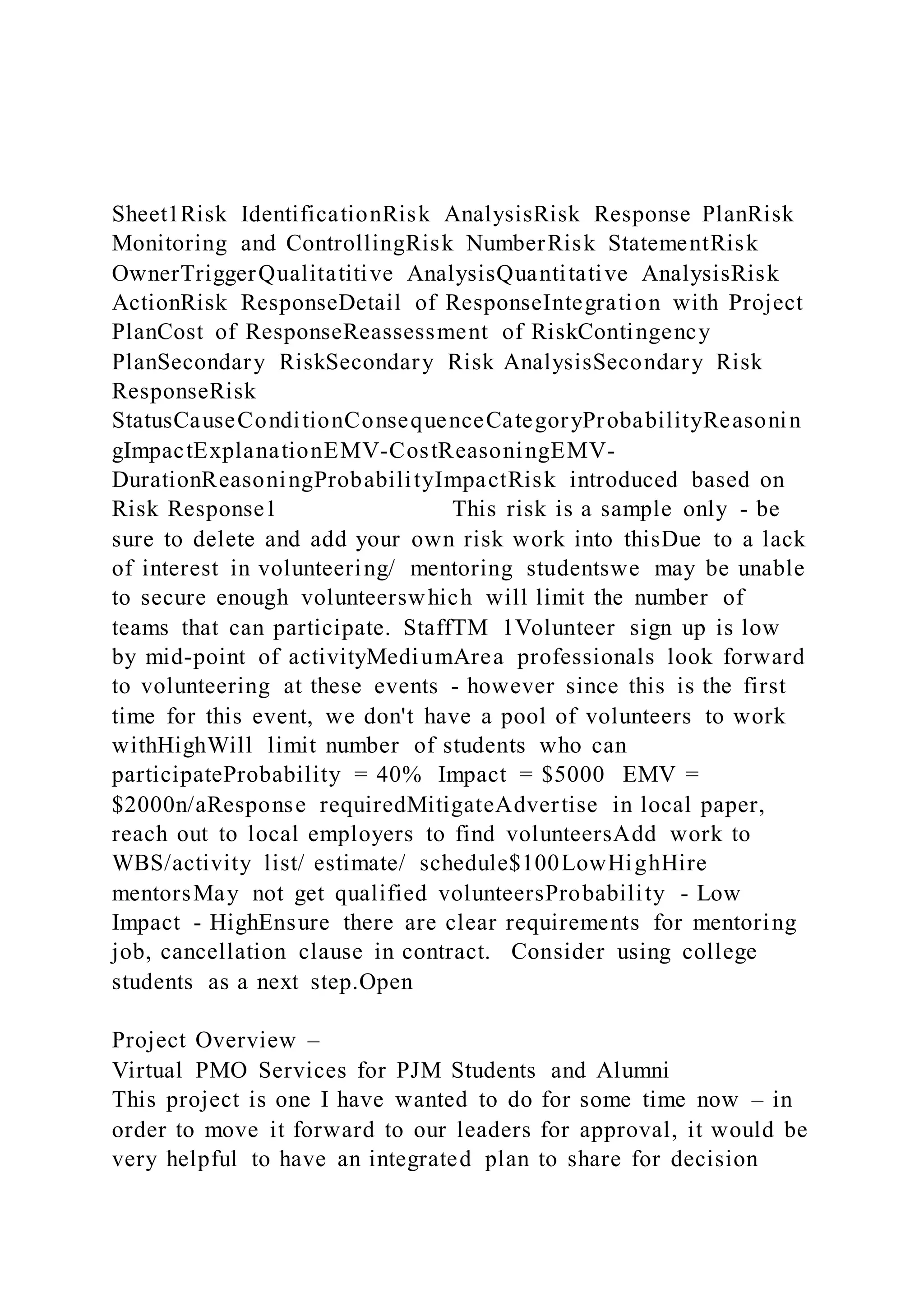
Sheet1Risk IdentificationRisk AnalysisRisk Response PlanRisk
Monitoring and ControllingRisk NumberRisk StatementRisk
OwnerTriggerQualitatitive AnalysisQuantitative AnalysisRisk
ActionRisk ResponseDetail of ResponseIntegration with Project
PlanCost of ResponseReassessment of RiskContingency
PlanSecondary RiskSecondary Risk AnalysisSecondary Risk
ResponseRisk
StatusCauseConditionConsequenceCategoryProbabilityReasonin
gImpactExplanationEMV-CostReasoningEMV-
DurationReasoningProbabilityImpactRisk introduced based on
Risk Response1 This risk is a sample only - be
sure to delete and add your own risk work into thisDue to a lack
of interest in volunteering/ mentoring studentswe may be unable
to secure enough volunteerswhich will limit the number of
teams that can participate. StaffTM 1Volunteer sign up is low
by mid-point of activityMediumArea professionals look forward
to volunteering at these events - however since this is the first
time for this event, we don't have a pool of volunteers to work
withHighWill limit number of students who can
participateProbability = 40% Impact = $5000 EMV =
$2000n/aResponse requiredMitigateAdvertise in local paper,
reach out to local employers to find volunteersAdd work to
WBS/activity list/ estimate/ schedule$100LowHighHire
mentorsMay not get qualified volunteersProbability - Low
Impact - HighEnsure there are clear requirements for mentoring
job, cancellation clause in contract. Consider using college
students as a next step.Open
Project Overview –
Virtual PMO Services for PJM Students and Alumni
This project is one I have wanted to do for some time now – in
order to move it forward to our leaders for approval, it would be
very helpful to have an integrated plan to share for decision
making – a draft charter/ scope statement and workplan has
been created for this project. The next planning step is to
complete the risk work.
Project Background
Currently, each faculty within our PJM program shares a
number of project management templates used in their own
project management work for use within their courses. The
intent is to collect and share these templates across all sections
of a course so that all students have access to a number of
potential templates in that subject area and can then create their
own version of the template that best meets the needs of their
assignment projects. This will also store all templates in one
place for easy access – regardless of the course that one is in it
is convenient to locate other templates that might be helpful for
the work in any course.
We also would like to make this available to alumni of the
program – to allow them to benefit from our inventory of
templates and also to allow them to contribute templates to the
NU PJM community. This provides yet another opportunity for
industry alignment and maintains a connection with our
esteemed alumni.
This project is still considered to be at the beginning of its
efforts. It will be a visible project within the Northeastern
community – for faculty, current students and alumni.
Work to date – currently, there are many project management
templates floating around our program. There has not been a
coordinated effort to locate, vet and store these templates – nor
have we considered if there are gaps in the templates provided.
Work includes understanding the needs of faculty, students and
alumni and then creating a shared repository solution that will
meet these needs. At minimum, the project will identify all
available templates from faculty, reviewing these to ensure they
are comprehensive, clear and ready for use and well as to
review the inventory of templates against good practices in
project management and the PMBOK - and that there are no
copyright issues with posting on our shared site. Both faculty
and students near the end of the program should be included in
the review of the templates.
The shared site tool needs to be selected – this will require
understanding the needs of faculty, students and alumni as well
as standards to be followed in the IT constraints. The site needs
to be designed and the templates uploaded.
A process needs to be created and implemented for upkeep on
the templates as well as how additional templates are submitted
for consideration, vetted and the site updated.
• • •
Ÿ 1
A plan for transition and sustainment needs to be created and
implemented – how will students and alumni find out about this
site? Who do they contact if they have questions on the site?
Who will maintain it? It would seem that setting up an
internship or co-op opportunity for a PJM student to do this
work for 3 – 6 months and then transition the work to another
student would be an option.
I have provided preliminary information in the (very rough)
draft Scope Document, below. Preliminary planning has been
done – see the overview information below as well as the
attached (separate document) schedule. I have volunteered our
PJM 6015 course to build the risk management plan and risk
register for this work. This will finalize the draft plan for the
project for project review and approval.
Project Objective/ Success Criteria (Charter):
To design, build and implement a shared repository for project
management templates that will meet the needs of faculty,
current students and PJM alumni. In addition, to create and
implement an operating plan for the transition and sustainment
of the site.
Assigned Risk Manager (Charter): Members of PJM 6015
Sponsor (Charter): PJM Faculty member
Project Scope Description: The work of this project is to create
shared repository for PJM templates that is then implemented
within PJM CPS (Project Management at College of
Professional Studies).
Work Includes
Work Does Not Include
Creation of integrated project plan and project management of
project – biweekly reporting to begin after Planning approved
through project end
Ongoing maintenance of site
Finalized requirements
Training on use of templates
Selection of technology
Collection, refinement and approval of templates
Communication to faculty, students and alumni
Upload of templates to shared repository
Job aides for faculty and students prepared/ Integration into
courses
Process for maintaining site with industry aligned templates
Process for bringing on co-op/ intern student to manage site
Retrospective (Lessons Learned)
Acceptance Criteria
Faculty, students and alumni are prepared to use siteTemplates
are industry aligned and availableIT is prepared to support the
product from a technology perspectiveProcesses and site are
ready for Fall 2020 Project Exclusions – see out of scope above
Project Constraints
Schedule – work complete and ready for full implementation
Fall Quarter 2020 Project Assumptions:The core project team
(you) may only devote 50 percent of available effort to this
projectOther project resources will be negotiated per integrated
project plan.Hourly pay rate for each team member is $75.00
Major Milestones:
See project workplan

Project Risk Management - Week 2 Individual Assignmen

  • 1.
    Project Risk Management- Week 2: Individual Assignment Overview and Rationale In order to demonstrate proficiency with the content in this course we will complete a number of different assignments to validate your learning – and allow you to implement relevant practices a real-world setting. Program Level - Student Learning Outcomes: Create a risk management plan to determine how both positive and negative risks will be identified, analyzed and managedArticulate the value and benefits of creating an effective approach to planning for project risk managementIdentify project related risks and their drivers by integrating best practices, tools and techniques Analyze risks using qualitative methods for the purpose of risk exposure and prioritization and communicate their impact to the stakeholdersAnalyze risks using quantitative methods for the purpose of risk exposure and prioritization and communicate their impact to the stakeholdersRecommend risks for risk response planning or watch listDevise a risk response plan based on appropriate techniques and strategies that would meetStakeholders’ expectationsExecute the risk management plan to continuously monitor risks and risk responsesDescribe how organizational and cultural factors may undermine implementation of effective risk management and develop strategies to overcome these factors
  • 2.
    Week 2 LearningObjectives Integrate best practices, tools and techniques to identify project related risks Perform Stakeholders analysis to identify stakeholders to include in Risk Identification (and how) Identify Risk identification tools &techniques Craftqualityriskstatementsthatclarifyriskdrivers,eventsandimpac ts CreateariskregisterthatalignstoRiskManagementPlanandstakehol derneeds Explain the process of using-Delphi technique, brainstorming, nominal group, affinity diagramming (group creativity) to identify risks The next step in risk management is identifying the risks that may impact the progress or success of your project. For this assignment, you will begin to populate the risk register and identify the risks that may occur in the project. For this assignment you will complete and submit: RiskRegisterthatincludesacomprehensivelistofidentifiedrisks. A minimum (“meets requirements”) of 15 risks should beidentified Toensuretheriskidentificationincludesthebreadthanddepthnecess aryforsuccess,besuretoincludeatleast2risksfrom: 1 project-level/ businessrisks 2risksperphaseoftheproject(so,iftheprojecthas5phases,thiswould betwoperphaseor10risks) 1 project-specific resourcerisks 1 schedule risks (criticalpath) 1 project-specific costrisks 2 implementationrisks 2opportunities Risk statements must be written in the cause-condition- conclusion format. Additionally, you should identify the risk
  • 3.
    owner and thetrigger event for eachrisk. For this assignment, do not work to analyze or determine handling actions for the risks – this assignment is to identify the risks only- later weeks will analyze and plan for how to manage therisks. Includeasummaryparagraphsharinghowriskswereidentified,what waseffectiveabouttheprocessandwhatyoumightdodifferently movingforward. RefertotheRubricattachedtotheassignmentforadditionalcriteriafo revaluation. Please post any general questions that you might have on the Ask the Instructor DB so that the information can be clarified for everyone.Cite any sources. The writing style should be concise and straightforward. Please use a 12 point font.The format for this is your risk register – an excel-type tool works well for this. Cite any sources. The writing style should be concise and straightforward. This week’s work will inform additions that you will make to your draft Risk Management Plan that was started in Week 1 and will be completed over the term and submitted in Week 5. Assignment Rubric Category Above Standard Meets Standards Approaching Standards Below Standards Not Evident Assignment Goes well above the Goes above the Meets minimum Meets some
  • 4.
    Does not meetthe requirements (70%) requirements of the assignment. minimum requirements of the assignment requirements assignment requirements requirements of the assignment. Provides new assignment information, tools, and/or techniques Critical Thinking Professional insights Comprehensive Includes an explanation Includes a general Does not explain the (15%) into depth and breadth explanation of the of the issue; explanation of the issue
  • 5.
    issue; does notexplore of assignment - goes issue; exploration of exploration of expert but is vague or is not expert viewpoints or WELL beyond expert viewpoints and viewpoints and use of clearly linked to the use evidence to inform assignment use of evidence to evidence to inform identified risks; interpretation and requirements to inform interpretation interpretation and includes some analysis; does not explore risks and/or and analysis; thorough analysis; includes an exploration of expert provide an evaluation relevant new evaluation of the evaluation of the viewpoints and use of
  • 6.
    of the context techniques. context(historical, context (historical, evidence to inform (historical, ethical, ethical, cultural, ethical, cultural, interpretation and cultural, environmental environmental or environmental or analysis; includes a or circumstantial circumstantial circumstantial general evaluation of settings), and self and settings), and self and settings), and self and the context (historical, others’ assumptions others’ assumptions
  • 7.
    others’ assumptions ethical, cultural, andperspectives when and perspectives when and perspectives when environmental or stating a position; stating a position; well- stating a position; circumstantial conclusions are not informed conclusions conclusions are based settings), and self and based on prioritized based on methodically on methodically others’ assumptions evidence and prioritized evidence prioritized evidence and perspectives when perspectives. and perspectives.
  • 8.
    and perspectives. stating aposition, but lack specificity; conclusions are based on prioritized evidence and perspectives. Communication Goes well beyond Assignment is well Assignment is Assignment is well Assignment is not (10%) (includes assignment organized, and the
  • 9.
    organized, and the organized,and the organized. It is not grammar and clarity) requirements to communicate format can be followed. It is evident to reader format can be followed. It is evident to reader format can be followed. It is evident to reader evident to reader what is contained in each information in a what is contained in what is contained in what is contained in section of report. Low precise, insightful and each section of the each section of the each section of the quality grammar, professional manner. report. High quality report. High quality report. Good quality misspellings. grammar. No grammar. No grammar. Minor misspellings.
  • 10.
    misspellings. misspellings. Formatting Virtually no errorsin Rare errors in Some errors in Multiple errors in Does not submit (5%) formatting, citations, formatting, citations, formatting, citations, formatting, citations, assignment materials NOTE: Gross or references. or references. or references. or references. in APA 6 format. failure to provide PROPER
  • 11.
    citations and references – particularly withregard to direct quotes – will result in sanctions as outlined in the academic honesty policy
  • 12.
    Sheet1Risk IdentificationRisk AnalysisRiskResponse PlanRisk Monitoring and ControllingRisk NumberRisk StatementRisk OwnerTriggerQualitatitive AnalysisQuantitative AnalysisRisk ActionRisk ResponseDetail of ResponseIntegration with Project PlanCost of ResponseReassessment of RiskContingency PlanSecondary RiskSecondary Risk AnalysisSecondary Risk ResponseRisk StatusCauseConditionConsequenceCategoryProbabilityReasonin gImpactExplanationEMV-CostReasoningEMV- DurationReasoningProbabilityImpactRisk introduced based on Risk Response1 This risk is a sample only - be sure to delete and add your own risk work into thisDue to a lack of interest in volunteering/ mentoring studentswe may be unable to secure enough volunteerswhich will limit the number of teams that can participate. StaffTM 1Volunteer sign up is low by mid-point of activityMediumArea professionals look forward to volunteering at these events - however since this is the first time for this event, we don't have a pool of volunteers to work withHighWill limit number of students who can participateProbability = 40% Impact = $5000 EMV = $2000n/aResponse requiredMitigateAdvertise in local paper, reach out to local employers to find volunteersAdd work to WBS/activity list/ estimate/ schedule$100LowHighHire mentorsMay not get qualified volunteersProbability - Low Impact - HighEnsure there are clear requirements for mentoring job, cancellation clause in contract. Consider using college students as a next step.Open Project Overview – Virtual PMO Services for PJM Students and Alumni This project is one I have wanted to do for some time now – in order to move it forward to our leaders for approval, it would be very helpful to have an integrated plan to share for decision
  • 13.
    making – adraft charter/ scope statement and workplan has been created for this project. The next planning step is to complete the risk work. Project Background Currently, each faculty within our PJM program shares a number of project management templates used in their own project management work for use within their courses. The intent is to collect and share these templates across all sections of a course so that all students have access to a number of potential templates in that subject area and can then create their own version of the template that best meets the needs of their assignment projects. This will also store all templates in one place for easy access – regardless of the course that one is in it is convenient to locate other templates that might be helpful for the work in any course. We also would like to make this available to alumni of the program – to allow them to benefit from our inventory of templates and also to allow them to contribute templates to the NU PJM community. This provides yet another opportunity for industry alignment and maintains a connection with our esteemed alumni. This project is still considered to be at the beginning of its efforts. It will be a visible project within the Northeastern community – for faculty, current students and alumni. Work to date – currently, there are many project management templates floating around our program. There has not been a coordinated effort to locate, vet and store these templates – nor have we considered if there are gaps in the templates provided. Work includes understanding the needs of faculty, students and alumni and then creating a shared repository solution that will
  • 14.
    meet these needs.At minimum, the project will identify all available templates from faculty, reviewing these to ensure they are comprehensive, clear and ready for use and well as to review the inventory of templates against good practices in project management and the PMBOK - and that there are no copyright issues with posting on our shared site. Both faculty and students near the end of the program should be included in the review of the templates. The shared site tool needs to be selected – this will require understanding the needs of faculty, students and alumni as well as standards to be followed in the IT constraints. The site needs to be designed and the templates uploaded. A process needs to be created and implemented for upkeep on the templates as well as how additional templates are submitted for consideration, vetted and the site updated. • • • Ÿ 1 A plan for transition and sustainment needs to be created and implemented – how will students and alumni find out about this site? Who do they contact if they have questions on the site? Who will maintain it? It would seem that setting up an internship or co-op opportunity for a PJM student to do this work for 3 – 6 months and then transition the work to another student would be an option. I have provided preliminary information in the (very rough) draft Scope Document, below. Preliminary planning has been done – see the overview information below as well as the attached (separate document) schedule. I have volunteered our PJM 6015 course to build the risk management plan and risk register for this work. This will finalize the draft plan for the
  • 15.
    project for projectreview and approval. Project Objective/ Success Criteria (Charter): To design, build and implement a shared repository for project management templates that will meet the needs of faculty, current students and PJM alumni. In addition, to create and implement an operating plan for the transition and sustainment of the site. Assigned Risk Manager (Charter): Members of PJM 6015 Sponsor (Charter): PJM Faculty member Project Scope Description: The work of this project is to create shared repository for PJM templates that is then implemented within PJM CPS (Project Management at College of Professional Studies). Work Includes Work Does Not Include Creation of integrated project plan and project management of project – biweekly reporting to begin after Planning approved through project end Ongoing maintenance of site Finalized requirements Training on use of templates Selection of technology Collection, refinement and approval of templates Communication to faculty, students and alumni Upload of templates to shared repository Job aides for faculty and students prepared/ Integration into courses
  • 16.
    Process for maintainingsite with industry aligned templates Process for bringing on co-op/ intern student to manage site Retrospective (Lessons Learned) Acceptance Criteria Faculty, students and alumni are prepared to use siteTemplates are industry aligned and availableIT is prepared to support the product from a technology perspectiveProcesses and site are ready for Fall 2020 Project Exclusions – see out of scope above Project Constraints Schedule – work complete and ready for full implementation Fall Quarter 2020 Project Assumptions:The core project team (you) may only devote 50 percent of available effort to this projectOther project resources will be negotiated per integrated project plan.Hourly pay rate for each team member is $75.00 Major Milestones: See project workplan