Project Management The Managerial Process 7th Edition Larson Test Bank
Project Management The Managerial Process 7th Edition Larson Test Bank
Project Management The Managerial Process 7th Edition Larson Test Bank
Project Management The Managerial Process 7th Edition Larson Test Bank
Project Management The Managerial Process 7th Edition Larson Test Bank
1.
Project Management TheManagerial Process 7th
Edition Larson Test Bank download
https://testbankdeal.com/product/project-management-the-
managerial-process-7th-edition-larson-test-bank/
Explore and download more test bank or solution manual
at testbankdeal.com
2.
We have selectedsome products that you may be interested in
Click the link to download now or visit testbankdeal.com
for more options!.
Project Management The Managerial Process 7th Edition
Larson Solutions Manual
https://testbankdeal.com/product/project-management-the-managerial-
process-7th-edition-larson-solutions-manual/
Project Management The Managerial Process 6th Edition
Larson Test Bank
https://testbankdeal.com/product/project-management-the-managerial-
process-6th-edition-larson-test-bank/
Project Management The Managerial Process 5th Edition
Larson Test Bank
https://testbankdeal.com/product/project-management-the-managerial-
process-5th-edition-larson-test-bank/
Auditing Assurance Services and Ethics in Australia 9th
Edition Arens Solutions Manual
https://testbankdeal.com/product/auditing-assurance-services-and-
ethics-in-australia-9th-edition-arens-solutions-manual/
3.
Trigonometry 1st EditionBlitzer Solutions Manual
https://testbankdeal.com/product/trigonometry-1st-edition-blitzer-
solutions-manual/
Introductory Statistics 10th Edition Weiss Solutions
Manual
https://testbankdeal.com/product/introductory-statistics-10th-edition-
weiss-solutions-manual/
Dynamic Business Law 4th Edition Kubasek Test Bank
https://testbankdeal.com/product/dynamic-business-law-4th-edition-
kubasek-test-bank/
Becoming A Critical Thinker Canadian 1st Edition Diestler
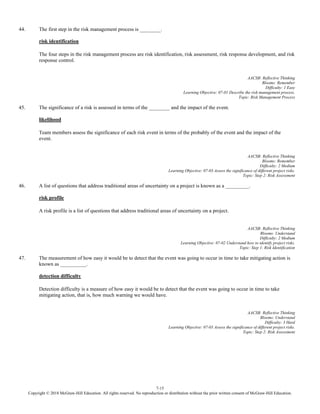
Solutions Manual
https://testbankdeal.com/product/becoming-a-critical-thinker-
canadian-1st-edition-diestler-solutions-manual/
Management 9th Edition Daft Test Bank
https://testbankdeal.com/product/management-9th-edition-daft-test-
bank/
4.
Western Experience 10thEdition Chambers Test Bank
https://testbankdeal.com/product/western-experience-10th-edition-
chambers-test-bank/
throw in onepiece of plank, which had drifted down from the mill,
and which was too large and heavy for them to lift alone. They
watched this for some time, as it floated away far down the stream.
At last, it was time to go home; and they all went back, very
carefully, over the stones, until they got back to the shore; and then
they walked home by a new way, over a hill, where they had a
beautiful prospect.
That night, just before sundown, when Royal and Lucy went out
to see their chickens, Royal told Lucy that she might have the little
black chicken and two others for her own.
“Well,” said Lucy, clapping her hands, “and will you let me keep
them in your coop?”
“Yes,” replied Royal; “or I will let you own the coop with me;—you
shall have a share in the coop, in proportion to your share of the
chickens.”
“In proportion?” said Lucy; “what does that mean?”
“Why, just as much of the coop as you have of the chickens,” said
Royal.
“Well,” said Lucy, “how much of the coop will it be, for three
chickens?”
“O, I don’t know,” said Royal.
“So much?” said Lucy, putting her hand upon the side of the coop,
so as to mark off a small portion of it.
“O, I don’t mean,” said Royal, “to divide it. We will own it all
together, in partnership; only you shall have a small share, just in
proportion to your chickens.”
23.
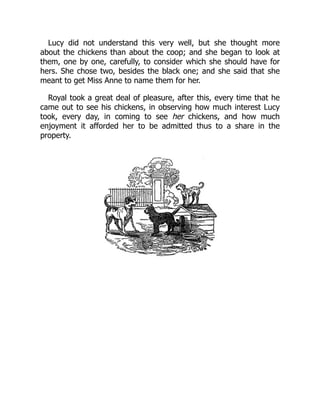
Lucy did notunderstand this very well, but she thought more
about the chickens than about the coop; and she began to look at
them, one by one, carefully, to consider which she should have for
hers. She chose two, besides the black one; and she said that she
meant to get Miss Anne to name them for her.
Royal took a great deal of pleasure, after this, every time that he
came out to see his chickens, in observing how much interest Lucy
took, every day, in coming to see her chickens, and how much
enjoyment it afforded her to be admitted thus to a share in the
property.
25.
CONVERSATION XI.
GETTING LOST.
Oneafternoon, a short time after dinner, Lucy was sitting upon a
seat under a trellis, near the door which led towards the garden,
when her mother came out.
“Lucy,” said she, “I have got some rather bad news for you.”
“What is it?” said Lucy.
“I am rather afraid to tell you, for fear it will make you cry.”
“O no, mother; I shall not cry,” said Lucy.
“Well,” said her mother, “we shall see. The news is, that we are all
going away this afternoon, and are going to leave you at home.”
“What, all alone?” said Lucy.
“Not quite alone; for Joanna will be here,” said her mother.
“Where are you going?” said Lucy.
“We are going away, to ride.”
“Why can’t I go too?” said Lucy.
“I can explain the reason better when we come back,” answered
her mother.
Lucy did not cry; though she found it very hard to refrain. Her
father and mother, and Miss Anne and Royal, were all going, and she
26.
had to remainat home. They were going, too, in a kind of barouche;
and when it drove up to the door, Lucy thought there would be
plenty of room for her. She found it hard to submit; but submission
was made somewhat easier by her mother’s not giving her any
reasons. When a mother gives a girl reasons why she cannot have
something which she is very strongly interested in, they seldom
satisfy her, for she is not in a state of mind to consider them
impartially. It only sets her to attempting to answer the reasons, and
thus to agitate and disturb her mind more than is necessary. It is
therefore generally best not to explain the reasons until afterwards,
when the mind of the child is in a better condition to feel their force.
After the barouche drove away, Lucy went out into the kitchen to
see Joanna; and she asked Joanna what she should do. Joanna
advised her to go out and play in the yard until she had got her work
done, and then to come in and sit with her. Lucy did so. She played
about in the grass until Joanna called from the window, and told her
that she was ready.
Then Lucy came in. She found the kitchen all arranged in good
order, and Joanna was just sitting down before a little table, at the
window, to sew. Lucy got her basket of blocks, and began to build
houses in the middle of the floor.
“Joanna,” said she, after a little while, “I wish you would tell me
something more about when you were a farmer’s daughter.”
“Why, I am a farmer’s daughter now,” said Joanna.
“But I mean when you were a little girl, and lived among the
stumps,” said Lucy.
“Well,” said Joanna,—“what shall I tell you about? Let me see.—O,
I’ll tell you how I got lost in the woods, one day.”
“Ah, yes,” said Lucy, “I should like to hear about that very much
indeed.”
27.
“One day,” saidJoanna, “my father was going a fishing, and my
brother was going with him.”
“The same one that made your hen-coop?” asked Lucy.
“No, he was a bigger one than that. I asked my father to let me
go too. At first he said I was too little; but afterwards he said I might
go.”
“How big were you?” said Lucy.
“I was just about your age,” said Joanna. “My mother said I could
not possibly walk so far; but father said I should not have to walk
but a little way, for he was going down the brook in a boat.
“So father concluded to let me go, and we started off,—all three
together. We went across the road, and then struck right into the
woods.”
“Struck?” said Lucy.
“Yes; that is, we went right in.”
“O,” said Lucy.
“We walked along by a sort of cart-road a little while, until we
came to a place where I just began to see some water through the
trees. Father said it was the brook.
“When we got down to it, I found that it was a pretty wide brook;
and the water was deep and pretty still. There was a boat in the
brook. The boat was tied to a tree upon the shore; my brother got
in, and then my father put me in; and afterwards he untied the boat,
and threw the rope in, and then got in himself. Then there were
three of us in.”
“Wasn’t you afraid?” said Lucy.
28.
“Yes, I wasafraid that the boat would tip over; but father said that
it wouldn’t. But he said that I must sit still, if I didn’t want the boat
to upset. So I sat as still as I could, and watched the trees and
bushes, moving upon the shore.”
“I wish I could go and sail in a boat,” said Lucy.
“It is very pleasant,” said Joanna, “when the water is smooth and
still. The branches of the trees hung over the water where we were
sailing along, and one time we sailed under them, and my brother
broke me off a long willow stick.
“After a time, we came to the end of the brook, where it emptied
into the pond.”
“Emptied?” said Lucy.
“Yes; that is, where it came out into the pond.”
“Do brooks run into ponds?” asked Lucy.
“Not always,” said Joanna; “sometimes they run into other larger
brooks, and sometimes into rivers, and sometimes into ponds. This
brook ran into a pond; and when we came to the end of the brook,
our boat sailed right out into a pond. This pond was the place where
they were going to catch the fishes.”
“Why didn’t they catch the fishes in the brook?” asked Lucy.
“I believe they could not catch such large fishes there,” said
Joanna. “At any rate, they went out into the pond. There was a point
of land at the mouth of the brook, and when my father had got out
around this point, he began to fish.”
“Did he catch any?” asked Lucy.
29.
“He caught one,and my brother caught one; and after that, they
could not catch any more for some time. At last, my father said it
was not worth while for them both to stay there all the afternoon,
and that my brother might go back home by a road across through
the woods, and he would stay and see what luck he should have
himself. He said, too, that I might stay with him, if I chose.”
“And did you?” asked Lucy.
“No,” replied Joanna. “At first, I thought I should like to stay with
father; but then I had already become pretty tired of sitting in the
boat with nothing to do, and so I concluded to go with my brother.
Besides, I wanted to see what sort of a road it was across through
the woods.
“My father then took his line in, and paddled the boat to the
shore, to let me and my brother get out. Then he went back to his
fishing-ground again, and let down his line. As for my brother and
myself, we went along a little way, until we came to a large pine-
tree, which stood not very far from the shore of the pond; and there
we turned into the woods, and walked along together.”
“And was it in these woods that you got lost?” said Lucy.
“Not exactly,” said Joanna; “but I will tell you all about it. We went
along a little way without any difficulty, but presently we came to a
bog.”
“What is a bog?” asked Lucy.
“Why, it is a low, wet place, where wild grass and rushes grow.
The path led through this bog, and brother said he did not think that
I could get along very well.”
“I should not think that he could get along himself,” said Lucy.
30.
“Yes,” answered Joanna,“he could get along by stepping upon the
stones and hummocks of grass; and he tried to carry me, at first;
but he soon found that it would be a great deal of work, and he said
that I had better go back to my father, and get into the boat, and
stay with him.
“I said, ‘Well;’ and he carried me back as far as to hard ground;
and then he told me to go back by the path, until I came to the
pine-tree; and then he said I should only have to follow the shore of
the pond, a short distance, when I should come in sight of father’s
boat.”
“Yes, but how could you get into the boat,” said Lucy, “without
getting wet, when it was so far from the shore?”
“O, I could call to my father, and he would come to the shore and
take me in,” said Joanna.
“Well,” said Lucy, “tell on.”
“I walked along the path, without any trouble, until I came to the
great pine-tree, where I saw a woodpecker.”
“A woodpecker?” said Lucy.
“Yes; that is, a kind of a bird which pecks the bark and wood of
old trees, to get bugs and worms out of it, to eat.”
“I should not think that bugs and worms would be good to eat,”
said Lucy.
“They are good for woodpeckers,” said Joanna. “This woodpecker
was standing upon the side of the great pine-tree, clinging to the
bark. He has sharp claws, and can cling to the bark upon the side of
a tree. I looked at him a minute, and then went on.
31.
“I followed theshore of the pond, until I came to the place where
we had left my father fishing; but when I looked out upon the water
there, the boat was nowhere to be seen. I was very much
frightened.”
“Where was he gone?” said Lucy.
“I did not know then,” said Joanna; “but I learned afterwards that
he had found that he could not catch any fishes there, and so he
concluded to go up the brook again, and see if he could not catch
any there. I did not know this then, and I could not think what had
become of him. I was frightened. I did not see how I could ever find
my way home again. What do you think I did first?”
“I don’t know,” said Lucy. “What was it?”
“I called out, Father! Father! Father! as loud as I could call; and
then I listened for a reply,—but I could not hear any.”
“Then what did you do?” asked Lucy.
“Why, I began to consider whether I could not go home the way
that my brother had gone, by walking along through the mud, even
if it was deep. I thought I had better get my feet wet and muddy
than stay there in the woods and starve.”
“Well, did you go that way?” asked Lucy.
“No,” said Joanna; “on thinking more of it, I was afraid to go. I did
not know but that the mud would be deep enough somewhere to
drown me; and then, besides, I did not know that I could find the
way, any farther than I had gone with my brother.
32.
“The next planI thought of, was to follow the shore of the brook
up. You remember that we came down the brook, in the boat; and
of course I knew that, if I went up the brook, either on the water or
close to it, upon the shore, I should be going back towards home. I
tried this way, but I found that I could not get along.”
“Why couldn’t you get along?” asked Lucy.
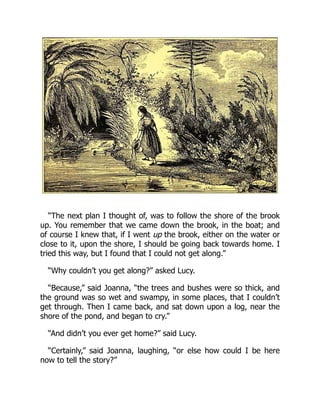
“Because,” said Joanna, “the trees and bushes were so thick, and
the ground was so wet and swampy, in some places, that I couldn’t
get through. Then I came back, and sat down upon a log, near the
shore of the pond, and began to cry.”
“And didn’t you ever get home?” said Lucy.
“Certainly,” said Joanna, laughing, “or else how could I be here
now to tell the story?”
33.
“O!—yes,” said Lucy.“But how did you get home?”
“Why, pretty soon I thought that the best plan would be for me to
stay just where I was, for I thought that as soon as my father and
brother should both get home, and find that I was not there, they
would come after me; and if they came after me, I knew they would
come, first of all, to the place where my brother had told me to go,
near the mouth of the brook. So I concluded that I would wait
patiently there until they came.
“I waited all the afternoon, and they did not come; and at last the
sun went down, and still I was there alone.”
“Why did not they come for you sooner?” asked Lucy.
“Why, the reason was, that my father did not get home until night.
When he went up the brook, he found a place where he could catch
fishes quite fast; and so he staid there all the afternoon. He thought
I was safe at home with my brother. And my brother, who was at
home all this time, thought that I was safe in the boat with my
father.
“When it began to grow dark, I thought I should have to stay in
the woods all night; but then I thought that, at any rate, they would
come for me the next morning; and I began to look around for a
good place to lie down and go to sleep. But, just then, I heard a
noise, like a noise in the water, through the woods; and I looked that
way, and saw a light glancing along through the trees. It was my
father and brother coming down the brook in the boat. I called out
to them as loud as I could, and they heard me and answered. They
came round the point of land, and then up to the shore where I was,
and took me in. And so I got home.”
Here Lucy drew a long breath, very much relieved to find that
Joanna was safe home again.
“What did you do when you got home?” said she.
34.
“I don’t recollectvery well,” said Joanna, “only I remember that
my mother let me sit up pretty late, and eat some of father’s fishes,
which she fried for supper.”
When Miss Anne came home that night, Lucy told her the story
which Joanna had related to her. She told her while Miss Anne was
putting her to bed. Lucy said that she should like to be lost in the
woods.
“O no,” said Miss Anne, “you would not like the reality. It makes an
interesting story to relate, but the thing itself must be very
distressing.”
“Well, at any rate,” said Lucy, “I should like to sail under the trees
in a boat.”
“Yes,” said Miss Anne, “that would be pleasant, no doubt.”
“And to see a woodpecker,” said Lucy.
“Yes, very likely,” said Miss Anne.
36.
CONVERSATION XII.
LUCY’S SCHOLAR.
Afterthis, Lucy often “played boat” for amusement. She built her
boat of chairs and crickets, and had the hearth brush for a paddle.
One evening, just after tea, when she was playing in this way, in
the parlor, Royal looking on, she said to Miss Anne,
“I wish we had a real boat.”
“A real boat,” said Miss Anne, “would do no good, unless you had
a place to sail it in.”
“Couldn’t we sail it in our brook?” asked Lucy.
“No, indeed,” said Royal; “there is scarcely water enough in our
brook to float my turtle.”
“O Royal,” said Lucy, “it is a great deal too deep for your turtle.”
“In some places,” said Miss Anne; “but to sail a boat, you must
have a long extent of deep water. I should think, however, that you
might have a better boat than you can make of chairs and crickets.”
“How could we make it?” said Lucy.
“Why, Royal might find a long box, out behind the barn; or two
common boxes, and put them together, end to end, out in the yard.
You might put two boards across for seats, and have poles for
paddles.”
“But it would not sail any,” said Royal.
37.
“If you wantit to sail, you must put some rollers under it, and
then you can push it along a little.”
Royal said that that was an excellent plan, and that he meant to
go and make such a boat the very next day. He said he did not
believe but that he could put a mast in, and hoist up a sail; or at
least a flag or a streamer.
“Well,” said Lucy, “we will.”
“I mean to go now and see if there is a box,” said Royal; “it is just
light enough.”
So Royal went off out of the room.
“Miss Anne,” said Lucy, “how much does a real boat cost?”
“I don’t know, exactly, how much,” said Miss Anne.
“I don’t suppose I should have money enough to buy a boat, even
if we had a deep brook to sail it in,” added Lucy.
“I don’t know,” said Miss Anne; “how much money have you got?”
“I have not got but a little; it is a dollar, or else a half a dollar; or a
sixpence; I don’t know exactly. Royal has got more than I.”
Miss Anne merely said, “Has he?” and then the conversation
dropped. She had just taken her seat at her work table, and began
to be busy.
“I wish I knew of some way that I could earn money,” said Lucy.
“Do you know of any way, Miss Anne?”
“What did you say?” asked Miss Anne.
“Don’t you know of some way that I could earn money?”
38.
“Why, I don’tknow; earning money is rather hard work, as I’ve
heard people say. I believe young ladies generally earn money by
teaching.”
“Well,” said Lucy, “if I could only get any scholars.”
“Why, you must be your own scholar; teach yourself to read.
Come, I think that will be an excellent plan.”
“Can I earn any money so?” said Lucy.
“Yes, I should think so. It would take you three months, at a
school, to learn your letters, and three months is twelve weeks.
Now, I suppose that your father would have to pay about sixpence a
week for you to go to school, and that would make twelve
sixpences; and I presume he would be willing to give you as much
as eight of the sixpences, if you would learn to read yourself.”
“Why not all the twelve?” asked Lucy.
“Because you would not do quite all yourself. Somebody would
have to answer your questions, and show you what the letters were,
at first; so that you could not do it all yourself. I should think that
perhaps you might earn eight out of the twelve sixpences. That
would be one sixpence for every three letters.”
“Well,” said Lucy, “I mean to try.”
“If you think you would like to try,” said Miss Anne, “I’ll form a
plan for you, so that you can begin to-morrow.”
Lucy said she should like to try, and accordingly Miss Anne
reflected upon the subject that evening, endeavoring to contrive
some plan by which Lucy might sit down by herself and study her
letters, half an hour every day, until she had learned them all. She
thought of a plan which she hoped might answer pretty well; and
39.
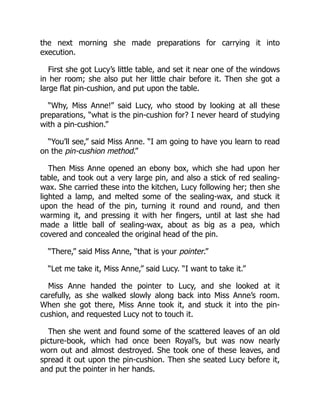
the next morningshe made preparations for carrying it into
execution.
First she got Lucy’s little table, and set it near one of the windows
in her room; she also put her little chair before it. Then she got a
large flat pin-cushion, and put upon the table.
“Why, Miss Anne!” said Lucy, who stood by looking at all these
preparations, “what is the pin-cushion for? I never heard of studying
with a pin-cushion.”
“You’ll see,” said Miss Anne. “I am going to have you learn to read
on the pin-cushion method.”
Then Miss Anne opened an ebony box, which she had upon her
table, and took out a very large pin, and also a stick of red sealing-
wax. She carried these into the kitchen, Lucy following her; then she
lighted a lamp, and melted some of the sealing-wax, and stuck it
upon the head of the pin, turning it round and round, and then
warming it, and pressing it with her fingers, until at last she had
made a little ball of sealing-wax, about as big as a pea, which
covered and concealed the original head of the pin.
“There,” said Miss Anne, “that is your pointer.”
“Let me take it, Miss Anne,” said Lucy. “I want to take it.”
Miss Anne handed the pointer to Lucy, and she looked at it
carefully, as she walked slowly along back into Miss Anne’s room.
When she got there, Miss Anne took it, and stuck it into the pin-
cushion, and requested Lucy not to touch it.
Then she went and found some of the scattered leaves of an old
picture-book, which had once been Royal’s, but was now nearly
worn out and almost destroyed. She took one of these leaves, and
spread it out upon the pin-cushion. Then she seated Lucy before it,
and put the pointer in her hands.
40.
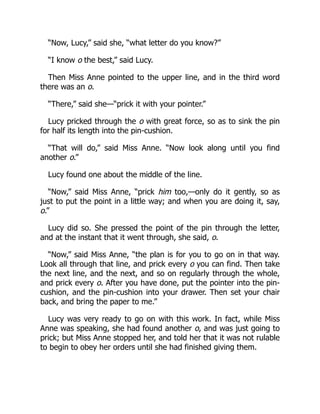
“Now, Lucy,” saidshe, “what letter do you know?”
“I know o the best,” said Lucy.
Then Miss Anne pointed to the upper line, and in the third word
there was an o.
“There,” said she—“prick it with your pointer.”
Lucy pricked through the o with great force, so as to sink the pin
for half its length into the pin-cushion.
“That will do,” said Miss Anne. “Now look along until you find
another o.”
Lucy found one about the middle of the line.
“Now,” said Miss Anne, “prick him too,—only do it gently, so as
just to put the point in a little way; and when you are doing it, say,
o.”
Lucy did so. She pressed the point of the pin through the letter,
and at the instant that it went through, she said, o.
“Now,” said Miss Anne, “the plan is for you to go on in that way.
Look all through that line, and prick every o you can find. Then take
the next line, and the next, and so on regularly through the whole,
and prick every o. After you have done, put the pointer into the pin-
cushion, and the pin-cushion into your drawer. Then set your chair
back, and bring the paper to me.”
Lucy was very ready to go on with this work. In fact, while Miss
Anne was speaking, she had found another o, and was just going to
prick; but Miss Anne stopped her, and told her that it was not rulable
to begin to obey her orders until she had finished giving them.
41.
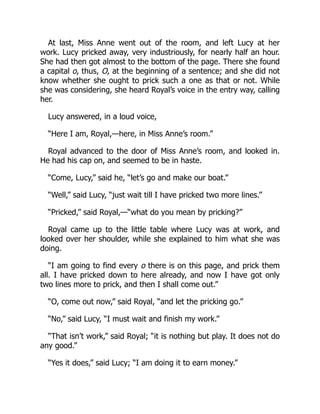
At last, MissAnne went out of the room, and left Lucy at her
work. Lucy pricked away, very industriously, for nearly half an hour.
She had then got almost to the bottom of the page. There she found
a capital o, thus, O, at the beginning of a sentence; and she did not
know whether she ought to prick such a one as that or not. While
she was considering, she heard Royal’s voice in the entry way, calling
her.
Lucy answered, in a loud voice,
“Here I am, Royal,—here, in Miss Anne’s room.”
Royal advanced to the door of Miss Anne’s room, and looked in.
He had his cap on, and seemed to be in haste.
“Come, Lucy,” said he, “let’s go and make our boat.”
“Well,” said Lucy, “just wait till I have pricked two more lines.”
“Pricked,” said Royal,—“what do you mean by pricking?”
Royal came up to the little table where Lucy was at work, and
looked over her shoulder, while she explained to him what she was
doing.
“I am going to find every o there is on this page, and prick them
all. I have pricked down to here already, and now I have got only
two lines more to prick, and then I shall come out.”
“O, come out now,” said Royal, “and let the pricking go.”
“No,” said Lucy, “I must wait and finish my work.”
“That isn’t work,” said Royal; “it is nothing but play. It does not do
any good.”
“Yes it does,” said Lucy; “I am doing it to earn money.”
42.
Welcome to ourwebsite – the perfect destination for book lovers and
knowledge seekers. We believe that every book holds a new world,
offering opportunities for learning, discovery, and personal growth.
That’s why we are dedicated to bringing you a diverse collection of
books, ranging from classic literature and specialized publications to
self-development guides and children's books.
More than just a book-buying platform, we strive to be a bridge
connecting you with timeless cultural and intellectual values. With an
elegant, user-friendly interface and a smart search system, you can
quickly find the books that best suit your interests. Additionally,
our special promotions and home delivery services help you save time
and fully enjoy the joy of reading.
Join us on a journey of knowledge exploration, passion nurturing, and
personal growth every day!
testbankdeal.com