Project Management The Managerial Process 5th Edition Larson Test Bank
Project Management The Managerial Process 5th Edition Larson Test Bank
Project Management The Managerial Process 5th Edition Larson Test Bank
Project Management The Managerial Process 5th Edition Larson Test Bank
Project Management The Managerial Process 5th Edition Larson Test Bank
1.
Project Management TheManagerial Process 5th
Edition Larson Test Bank download pdf
https://testbankfan.com/product/project-management-the-managerial-
process-5th-edition-larson-test-bank/
Visit testbankfan.com to explore and download the complete
collection of test banks or solution manuals!
2.
We have selectedsome products that you may be interested in
Click the link to download now or visit testbankfan.com
for more options!.
Project Management The Managerial Process 5th Edition
Larson Solutions Manual
https://testbankfan.com/product/project-management-the-managerial-
process-5th-edition-larson-solutions-manual/
Project Management The Managerial Process 7th Edition
Larson Test Bank
https://testbankfan.com/product/project-management-the-managerial-
process-7th-edition-larson-test-bank/
Project Management The Managerial Process 6th Edition
Larson Test Bank
https://testbankfan.com/product/project-management-the-managerial-
process-6th-edition-larson-test-bank/
South Western Federal Taxation 2013 Individual Income
Taxes 36th Edition Hoffman Solutions Manual
https://testbankfan.com/product/south-western-federal-
taxation-2013-individual-income-taxes-36th-edition-hoffman-solutions-
manual/
3.
Organizational Behaviour Understandingand Managing Life
at Work Canadian 10th Edition Johns Solutions Manual
https://testbankfan.com/product/organizational-behaviour-
understanding-and-managing-life-at-work-canadian-10th-edition-johns-
solutions-manual/
Operations Management Canadian 6th Edition Stevenson Test
Bank
https://testbankfan.com/product/operations-management-canadian-6th-
edition-stevenson-test-bank/
Principles of Financial Accounting 12th Edition Needles
Test Bank
https://testbankfan.com/product/principles-of-financial-
accounting-12th-edition-needles-test-bank/
Macroeconomics 2nd Edition Hubbard Test Bank
https://testbankfan.com/product/macroeconomics-2nd-edition-hubbard-
test-bank/
Taxation for Decision Makers 2019 9th Edition Escoffier
Test Bank
https://testbankfan.com/product/taxation-for-decision-makers-2019-9th-
edition-escoffier-test-bank/
Chapter 07 -Managing Risk
7-1
Chapter 07
Managing Risk
Multiple Choice Questions
1. An uncertain event or condition that, if it occurs, has a positive or negative effect on a
project objectives is termed.
A. Random chance
B. A disaster
C. Risk
D. Hazard
E. Bad luck
2. The chances of a risk event occurring as a project proceeds through its life cycle tends to
A. Slowly rise
B. Drop sharply and then level out
C. Rise sharply and then level out
D. Remain about the same
E. Slowly drop
3. The cost impact of a risk event occurring as a project proceeds through its life cycle tends
to
A. Slowly rise
B. Drop sharply and then level out
C. Rise sharply and then level out
D. Remain about the same
E. Slowly drop
4. The attempt to recognize and manage potential and unforeseen trouble spots that may occur
when a project is implemented is known as
A. Risk forecasting
B. Risk management
C. Contingency planning
D. Scenario analysis
E. Disaster protection
6.
Chapter 07 -Managing Risk
7-2
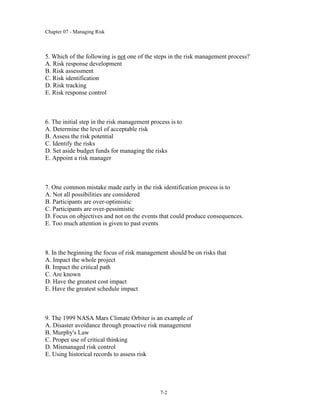
5. Which of the following is not one of the steps in the risk management process?
A. Risk response development
B. Risk assessment
C. Risk identification
D. Risk tracking
E. Risk response control
6. The initial step in the risk management process is to
A. Determine the level of acceptable risk
B. Assess the risk potential
C. Identify the risks
D. Set aside budget funds for managing the risks
E. Appoint a risk manager
7. One common mistake made early in the risk identification process is to
A. Not all possibilities are considered
B. Participants are over-optimistic
C. Participants are over-pessimistic
D. Focus on objectives and not on the events that could produce consequences.
E. Too much attention is given to past events
8. In the beginning the focus of risk management should be on risks that
A. Impact the whole project
B. Impact the critical path
C. Are known
D. Have the greatest cost impact
E. Have the greatest schedule impact
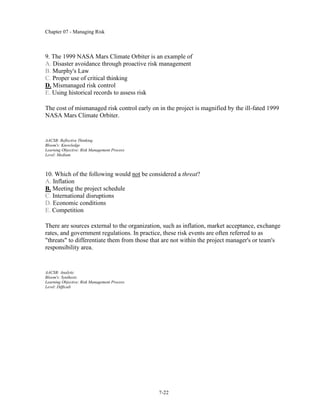
9. The 1999 NASA Mars Climate Orbiter is an example of
A. Disaster avoidance through proactive risk management
B. Murphy's Law
C. Proper use of critical thinking
D. Mismanaged risk control
E. Using historical records to assess risk
7.
Chapter 07 -Managing Risk
7-3
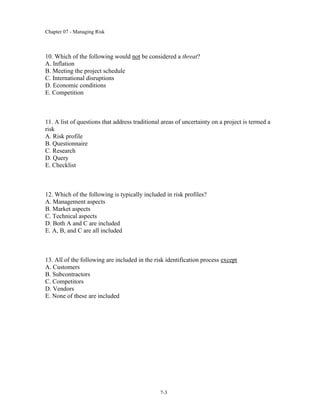
10. Which of the following would not be considered a threat?
A. Inflation
B. Meeting the project schedule
C. International disruptions
D. Economic conditions
E. Competition
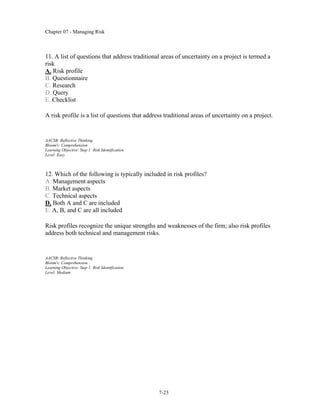
11. A list of questions that address traditional areas of uncertainty on a project is termed a
risk
A. Risk profile
B. Questionnaire
C. Research
D. Query
E. Checklist
12. Which of the following is typically included in risk profiles?
A. Management aspects
B. Market aspects
C. Technical aspects
D. Both A and C are included
E. A, B, and C are all included
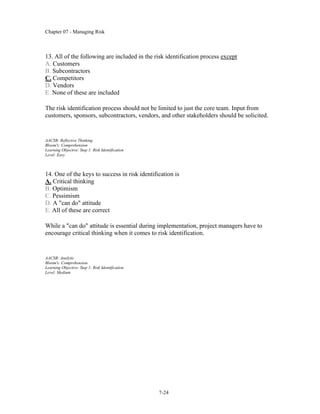
13. All of the following are included in the risk identification process except
A. Customers
B. Subcontractors
C. Competitors
D. Vendors
E. None of these are included
8.
Chapter 07 -Managing Risk
7-4
14. One of the keys to success in risk identification is
A. Critical thinking
B. Optimism
C. Pessimism
D. A "can do" attitude
E. All of these are correct
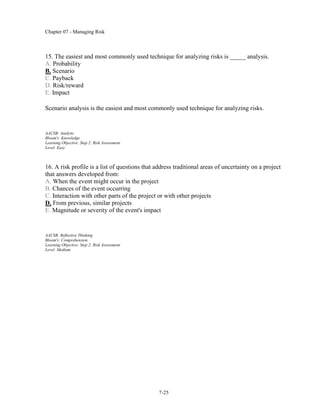
15. The easiest and most commonly used technique for analyzing risks is _____ analysis.
A. Probability
B. Scenario
C. Payback
D. Risk/reward
E. Impact
16. A risk profile is a list of questions that address traditional areas of uncertainty on a project
that answers developed from:
A. When the event might occur in the project
B. Chances of the event occurring
C. Interaction with other parts of the project or with other projects
D. From previous, similar projects
E. Magnitude or severity of the event's impact
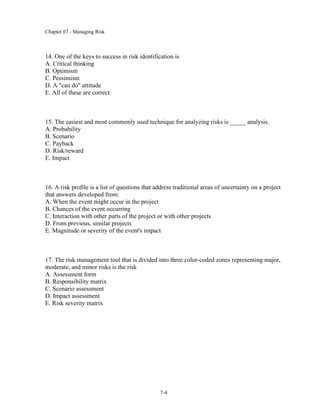
17. The risk management tool that is divided into three color-coded zones representing major,
moderate, and minor risks is the risk
A. Assessment form
B. Responsibility matrix
C. Scenario assessment
D. Impact assessment
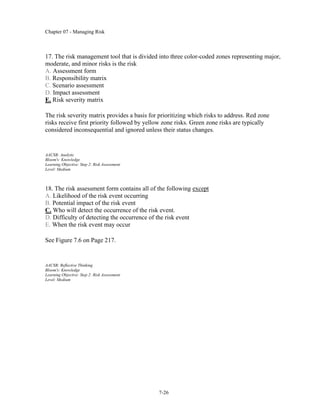
E. Risk severity matrix
9.
Chapter 07 -Managing Risk
7-5
18. The risk assessment form contains all of the following except
A. Likelihood of the risk event occurring
B. Potential impact of the risk event
C. Who will detect the occurrence of the risk event.
D. Difficulty of detecting the occurrence of the risk event
E. When the risk event may occur
19. The two scales of a risk severity matrix measure
A. Time, cost
B. Cost, schedule
C. Impact, cost
D. Time, impact
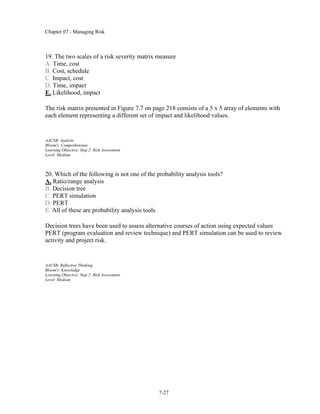
E. Likelihood, impact
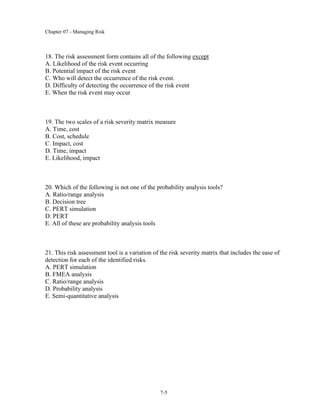
20. Which of the following is not one of the probability analysis tools?
A. Ratio/range analysis
B. Decision tree
C. PERT simulation
D. PERT
E. All of these are probability analysis tools
21. This risk assessment tool is a variation of the risk severity matrix that includes the ease of
detection for each of the identified risks.
A. PERT simulation
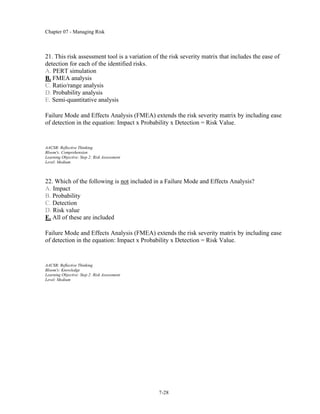
B. FMEA analysis
C. Ratio/range analysis
D. Probability analysis
E. Semi-quantitative analysis
10.
Chapter 07 -Managing Risk
7-6
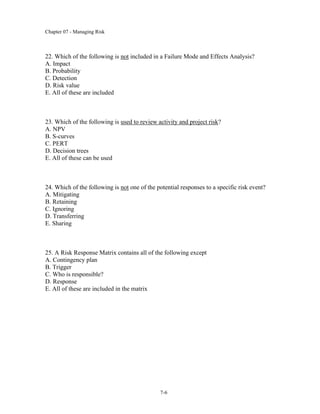
22. Which of the following is not included in a Failure Mode and Effects Analysis?
A. Impact
B. Probability
C. Detection
D. Risk value
E. All of these are included
23. Which of the following is used to review activity and project risk?
A. NPV
B. S-curves
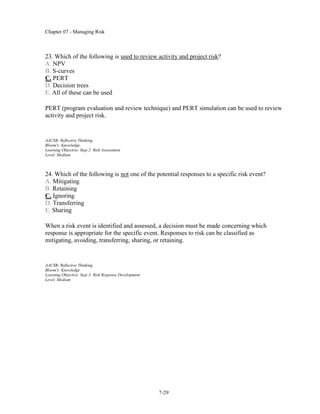
C. PERT
D. Decision trees
E. All of these can be used
24. Which of the following is not one of the potential responses to a specific risk event?
A. Mitigating
B. Retaining
C. Ignoring
D. Transferring
E. Sharing
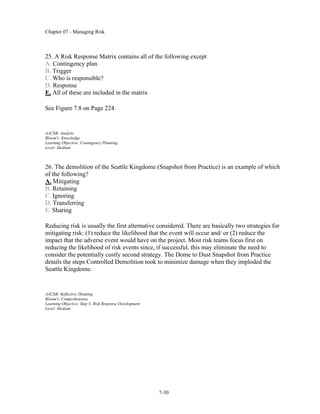
25. A Risk Response Matrix contains all of the following except
A. Contingency plan
B. Trigger
C. Who is responsible?
D. Response
E. All of these are included in the matrix
11.
Chapter 07 -Managing Risk
7-7
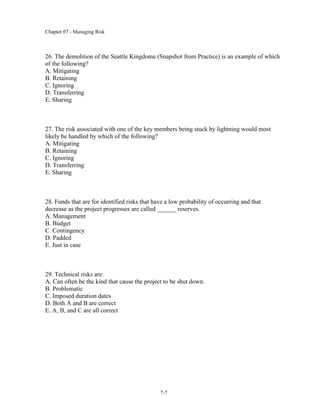
26. The demolition of the Seattle Kingdome (Snapshot from Practice) is an example of which
of the following?
A. Mitigating
B. Retaining
C. Ignoring
D. Transferring
E. Sharing
27. The risk associated with one of the key members being stuck by lightning would most
likely be handled by which of the following?
A. Mitigating
B. Retaining
C. Ignoring
D. Transferring
E. Sharing
28. Funds that are for identified risks that have a low probability of occurring and that
decrease as the project progresses are called ______ reserves.
A. Management
B. Budget
C. Contingency
D. Padded
E. Just in case
29. Technical risks are:
A. Can often be the kind that cause the project to be shut down.
B. Problematic
C. Imposed duration dates
D. Both A and B are correct
E. A, B, and C are all correct
12.
Chapter 07 -Managing Risk
7-8
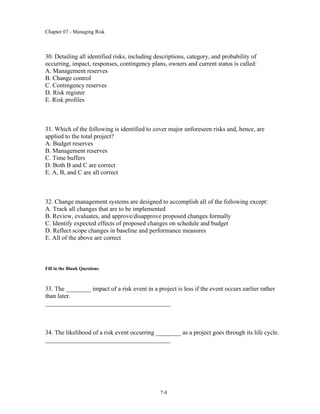
30. Detailing all identified risks, including descriptions, category, and probability of
occurring, impact, responses, contingency plans, owners and current status is called:
A. Management reserves
B. Change control
C. Contingency reserves
D. Risk register
E. Risk profiles
31. Which of the following is identified to cover major unforeseen risks and, hence, are
applied to the total project?
A. Budget reserves
B. Management reserves
C. Time buffers
D. Both B and C are correct
E. A, B, and C are all correct
32. Change management systems are designed to accomplish all of the following except:
A. Track all changes that are to be implemented
B. Review, evaluates, and approve/disapprove proposed changes formally
C. Identify expected effects of proposed changes on schedule and budget
D. Reflect scope changes in baseline and performance measures
E. All of the above are correct
Fill in the Blank Questions
33. The ________ impact of a risk event in a project is less if the event occurs earlier rather
than later.
________________________________________
34. The likelihood of a risk event occurring ________ as a project goes through its life cycle.
________________________________________
13.
Chapter 07 -Managing Risk
7-9
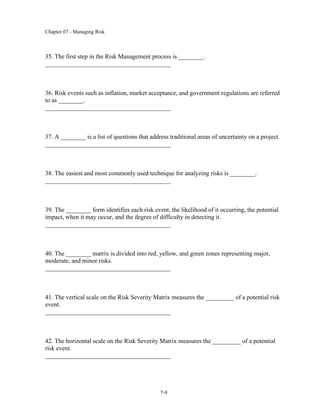
35. The first step in the Risk Management process is ________.
________________________________________
36. Risk events such as inflation, market acceptance, and government regulations are referred
to as ________.
________________________________________
37. A ________ is a list of questions that address traditional areas of uncertainty on a project.
________________________________________
38. The easiest and most commonly used technique for analyzing risks is ________.
________________________________________
39. The ________ form identifies each risk event, the likelihood of it occurring, the potential
impact, when it may occur, and the degree of difficulty in detecting it.
________________________________________
40. The ________ matrix is divided into red, yellow, and green zones representing major,
moderate, and minor risks.
________________________________________
41. The vertical scale on the Risk Severity Matrix measures the _________ of a potential risk
event.
________________________________________
42. The horizontal scale on the Risk Severity Matrix measures the _________ of a potential
risk event.
________________________________________
14.
Chapter 07 -Managing Risk
7-10
43. In __________ the Risk Severity Matrix is extended by including the ease of detecting a
risk event occurring.
________________________________________
44. In a ________, three different estimates of activity times are used to statistically predict
the time an activity will take to complete.
________________________________________
45. The "Snapshot from Practice" case where Ellipsus Systems developed parallel prototype
systems (WAP and JAVA) is an example of _________ a risk.
________________________________________
46. Testing a new project on a smaller isolated area prior to installing it for the entire
organization is an example of ________ a risk.
________________________________________
47. Performance bonds, warranties, and insurance are examples of ________ a risk.
________________________________________
48. When the entertainment industry formed a consortium to define a common operating
format for DVD it was ________ the risk.
________________________________________
49. If a risk event is very unlikely to occur the project owner would probably ________ the
risk.
________________________________________
15.
Chapter 07 -Managing Risk
7-11
50. A ________ identifies what to do if a potential risk event actually occurs.
________________________________________
51. ________ reserves are identified for specific work packages and cover risks that have a
low probability of occurring.
________________________________________
52. ________ reserves are controlled by the project manager and used to cover major
unforeseen risks to the entire project.
________________________________________
53. A ____________ is an alternative that will be used if a possible foreseen risk event
becomes a reality.
________________________________________
54. A ____________ is useful for summarizing how the project team plans to manage risks
that have been identified.
________________________________________
True / False Questions
55. The probability that a risk event will occur is higher during the initial stages of a project.
True False
56. Due to the impact over a long period of time, risk events that occur in the early stages of a
project will have a greater cost impact than those that occur in later stages.
True False
16.
Chapter 07 -Managing Risk
7-12
57. During risk identification the smaller risks should be identified first because they will
naturally lead to identifying the larger risks.
True False
58. One common mistake that is made early on in the risk identification process is to focus on
consequences and not on the events that could produce consequences.
True False
59. Risks such as inflation and monetary exchange rates are not usually included in a project's
risk assessment.
True False
60. The first step in the risk management process is Risk Assessment.
Refer to Figure 7.2
True False
61. A risk profile is a list of questions that have been developed and refined from previous,
similar projects.
True False
62. The risk identification process should be limited to just the core project team.
True False
63. Since the goal is to find problems before they happen, the project manager should
encourage critical thinking when it comes to risk identification.
True False
17.
Chapter 07 -Managing Risk
7-13
64. The Risk Severity Matrix rates risk events based upon schedule and cost.
Refer to Figure 7.7
True False
65. In a Risk Severity Matrix a green zone risk is considered inconsequential and ignored
unless their status changes.
True False
66. The quality and credibility of the risk analysis process requires that different levels of risk
probabilities and impacts be defined.
True False
67. Adopting proven technology instead of experimental technology is an example of
mitigating a risk.
True False
68. The FMEA method calculates a risk value by assigning ease of detection ratings to the key
risk elements.
True False
69. Performance bonds, warranties, and guarantees are financial instruments used to share
risk.
True False
70. Fixed price contracts are an example of transferring risk from an owner to a contractor.
True False
18.
Chapter 07 -Managing Risk
7-14
71. Scheduling outdoor work in the summer, investing in up front safety training, and
choosing high quality materials are examples of retaining a risk.
True False
72. Budget reserves are setup to cover identified risks associated with specific segments of a
project while management reserves are set up to cover unidentified risks associated with the
total project.
True False
73. Change management systems involve reporting, controlling, and recording changes to the
project baseline.
True False
74. Project managers need to establish an environment in which participants feel comfortable
raising concerns and admitting mistakes.
True False
75. Contingency funding is made up of budget reserves and management reserves.
True False
Short Answer Questions
76. Describe the relationship between the likelihood of a risk event occurring and the cost of
fixing the risk event as a project proceeds through its life cycle.
19.
Chapter 07 -Managing Risk
7-15
77. Identify and briefly describe the four steps in risk management.
78. Describe the process for identifying project risks.
79. What is a risk profile and what benefits does it provide to risk management?
80. Identify at least six items that may be included on a Risk Profile.
20.
Chapter 07 -Managing Risk
7-16
81. How should a risk assessment be conducted?
82. What is a Risk Severity Matrix and what does it do?
83. Identify and briefly describe the five ways to respond to identified risks.
84. What is the difference between budget reserves and management reserves?
21.
Chapter 07 -Managing Risk
7-17
85. What is Change Control Management and what function does it perform?
86. Identify and briefly describe the parts of a Risk Response Matrix and explain how one
would be used.
87. Compare and contrast budget reserves and management reserves.
22.
Chapter 07 -Managing Risk
7-18
Chapter 07 Managing Risk Answer Key
Multiple Choice Questions
1. An uncertain event or condition that, if it occurs, has a positive or negative effect on a
project objectives is termed.
A. Random chance
B. A disaster
C. Risk
D. Hazard
E. Bad luck
In the context of projects, risk is an uncertain event or condition that, if it occurs, has a
positive or negative effect on project objectives.
AACSB: Reflective Thinking
Bloom's: Comprehension
Learning Objective: Risk Management Process
Level: Easy
2. The chances of a risk event occurring as a project proceeds through its life cycle tends to
A. Slowly rise
B. Drop sharply and then level out
C. Rise sharply and then level out
D. Remain about the same
E. Slowly drop
See Figure 7.1 on Page 212.
AACSB: Reflective Thinking
Bloom's: Knowledge
Learning Objective: Risk Management Process
Level: Medium
23.
Chapter 07 -Managing Risk
7-19
3. The cost impact of a risk event occurring as a project proceeds through its life cycle tends
to
A. Slowly rise
B. Drop sharply and then level out
C. Rise sharply and then level out
D. Remain about the same
E. Slowly drop
The cost impact of a risk event in the project is less if the event occurs earlier rather than later.
AACSB: Reflective Thinking
Bloom's: Knowledge
Learning Objective: Risk Management Process
Level: Medium
4. The attempt to recognize and manage potential and unforeseen trouble spots that may occur
when a project is implemented is known as
A. Risk forecasting
B. Risk management
C. Contingency planning
D. Scenario analysis
E. Disaster protection
Risk management attempts to recognize and manage potential and unforeseen trouble spots
that may occur when the project is implemented.
AACSB: Analytic
Bloom's: Comprehension
Learning Objective: Risk Management Process
Level: Easy
24.
Chapter 07 -Managing Risk
7-20
5. Which of the following is not one of the steps in the risk management process?
A. Risk response development
B. Risk assessment
C. Risk identification
D. Risk tracking
E. Risk response control
See Figure 7.2 on Page 213.
AACSB: Reflective Thinking
Bloom's: Knowledge
Learning Objective: Risk Management Process
Level: Medium
6. The initial step in the risk management process is to
A. Determine the level of acceptable risk
B. Assess the risk potential
C. Identify the risks
D. Set aside budget funds for managing the risks
E. Appoint a risk manager
See Figure 7.2 on Page 213.
AACSB: Reflective Thinking
Bloom's: Comprehension
Learning Objective: Risk Management Process
Level: Easy
25.
Chapter 07 -Managing Risk
7-21
7. One common mistake made early in the risk identification process is to
A. Not all possibilities are considered
B. Participants are over-optimistic
C. Participants are over-pessimistic
D. Focus on objectives and not on the events that could produce consequences.
E. Too much attention is given to past events
One common mistake that is made early in the risk identification process is to focus on
objectives and not on the events that could produce consequences.
AACSB: Analytic
Bloom's: Knowledge
Learning Objective: Step 1: Risk Identification
Level: Easy
8. In the beginning the focus of risk management should be on risks that
A. Impact the whole project
B. Impact the critical path
C. Are known
D. Have the greatest cost impact
E. Have the greatest schedule impact
The focus at the beginning should be on risks that can affect the whole project as opposed to a
specific section of the project or network.
AACSB: Analytic
Bloom's: Knowledge
Learning Objective: Step 1: Risk Identification
Level: Medium
26.
Chapter 07 -Managing Risk
7-22
9. The 1999 NASA Mars Climate Orbiter is an example of
A. Disaster avoidance through proactive risk management
B. Murphy's Law
C. Proper use of critical thinking
D. Mismanaged risk control
E. Using historical records to assess risk
The cost of mismanaged risk control early on in the project is magnified by the ill-fated 1999
NASA Mars Climate Orbiter.
AACSB: Reflective Thinking
Bloom's: Knowledge
Learning Objective: Risk Management Process
Level: Medium
10. Which of the following would not be considered a threat?
A. Inflation
B. Meeting the project schedule
C. International disruptions
D. Economic conditions
E. Competition
There are sources external to the organization, such as inflation, market acceptance, exchange
rates, and government regulations. In practice, these risk events are often referred to as
"threats" to differentiate them from those that are not within the project manager's or team's
responsibility area.
AACSB: Analytic
Bloom's: Synthesis
Learning Objective: Risk Management Process
Level: Difficult
27.
Chapter 07 -Managing Risk
7-23
11. A list of questions that address traditional areas of uncertainty on a project is termed a
risk
A. Risk profile
B. Questionnaire
C. Research
D. Query
E. Checklist
A risk profile is a list of questions that address traditional areas of uncertainty on a project.
AACSB: Reflective Thinking
Bloom's: Comprehension
Learning Objective: Step 1: Risk Identification
Level: Easy
12. Which of the following is typically included in risk profiles?
A. Management aspects
B. Market aspects
C. Technical aspects
D. Both A and C are included
E. A, B, and C are all included
Risk profiles recognize the unique strengths and weaknesses of the firm; also risk profiles
address both technical and management risks.
AACSB: Reflective Thinking
Bloom's: Comprehension
Learning Objective: Step 1: Risk Identification
Level: Medium
28.
Chapter 07 -Managing Risk
7-24
13. All of the following are included in the risk identification process except
A. Customers
B. Subcontractors
C. Competitors
D. Vendors
E. None of these are included
The risk identification process should not be limited to just the core team. Input from
customers, sponsors, subcontractors, vendors, and other stakeholders should be solicited.
AACSB: Reflective Thinking
Bloom's: Comprehension
Learning Objective: Step 1: Risk Identification
Level: Easy
14. One of the keys to success in risk identification is
A. Critical thinking
B. Optimism
C. Pessimism
D. A "can do" attitude
E. All of these are correct
While a "can do" attitude is essential during implementation, project managers have to
encourage critical thinking when it comes to risk identification.
AACSB: Analytic
Bloom's: Comprehension
Learning Objective: Step 1: Risk Identification
Level: Medium
29.
Chapter 07 -Managing Risk
7-25
15. The easiest and most commonly used technique for analyzing risks is _____ analysis.
A. Probability
B. Scenario
C. Payback
D. Risk/reward
E. Impact
Scenario analysis is the easiest and most commonly used technique for analyzing risks.
AACSB: Analytic
Bloom's: Knowledge
Learning Objective: Step 2: Risk Assessment
Level: Easy
16. A risk profile is a list of questions that address traditional areas of uncertainty on a project
that answers developed from:
A. When the event might occur in the project
B. Chances of the event occurring
C. Interaction with other parts of the project or with other projects
D. From previous, similar projects
E. Magnitude or severity of the event's impact
AACSB: Reflective Thinking
Bloom's: Comprehension
Learning Objective: Step 2: Risk Assessment
Level: Medium
30.
Chapter 07 -Managing Risk
7-26
17. The risk management tool that is divided into three color-coded zones representing major,
moderate, and minor risks is the risk
A. Assessment form
B. Responsibility matrix
C. Scenario assessment
D. Impact assessment
E. Risk severity matrix
The risk severity matrix provides a basis for prioritizing which risks to address. Red zone
risks receive first priority followed by yellow zone risks. Green zone risks are typically
considered inconsequential and ignored unless their status changes.
AACSB: Analytic
Bloom's: Knowledge
Learning Objective: Step 2: Risk Assessment
Level: Medium
18. The risk assessment form contains all of the following except
A. Likelihood of the risk event occurring
B. Potential impact of the risk event
C. Who will detect the occurrence of the risk event.
D. Difficulty of detecting the occurrence of the risk event
E. When the risk event may occur
See Figure 7.6 on Page 217.
AACSB: Reflective Thinking
Bloom's: Knowledge
Learning Objective: Step 2: Risk Assessment
Level: Medium
31.
Chapter 07 -Managing Risk
7-27
19. The two scales of a risk severity matrix measure
A. Time, cost
B. Cost, schedule
C. Impact, cost
D. Time, impact
E. Likelihood, impact
The risk matrix presented in Figure 7.7 on page 218 consists of a 5 x 5 array of elements with
each element representing a different set of impact and likelihood values.
AACSB: Analytic
Bloom's: Comprehension
Learning Objective: Step 2: Risk Assessment
Level: Medium
20. Which of the following is not one of the probability analysis tools?
A. Ratio/range analysis
B. Decision tree
C. PERT simulation
D. PERT
E. All of these are probability analysis tools
Decision trees have been used to assess alternative courses of action using expected values
PERT (program evaluation and review technique) and PERT simulation can be used to review
activity and project risk.
AACSB: Reflective Thinking
Bloom's: Knowledge
Learning Objective: Step 2: Risk Assessment
Level: Medium
32.
Chapter 07 -Managing Risk
7-28
21. This risk assessment tool is a variation of the risk severity matrix that includes the ease of
detection for each of the identified risks.
A. PERT simulation
B. FMEA analysis
C. Ratio/range analysis
D. Probability analysis
E. Semi-quantitative analysis
Failure Mode and Effects Analysis (FMEA) extends the risk severity matrix by including ease
of detection in the equation: Impact x Probability x Detection = Risk Value.
AACSB: Reflective Thinking
Bloom's: Comprehension
Learning Objective: Step 2: Risk Assessment
Level: Medium
22. Which of the following is not included in a Failure Mode and Effects Analysis?
A. Impact
B. Probability
C. Detection
D. Risk value
E. All of these are included
Failure Mode and Effects Analysis (FMEA) extends the risk severity matrix by including ease
of detection in the equation: Impact x Probability x Detection = Risk Value.
AACSB: Reflective Thinking
Bloom's: Knowledge
Learning Objective: Step 2: Risk Assessment
Level: Medium
33.
Chapter 07 -Managing Risk
7-29
23. Which of the following is used to review activity and project risk?
A. NPV
B. S-curves
C. PERT
D. Decision trees
E. All of these can be used
PERT (program evaluation and review technique) and PERT simulation can be used to review
activity and project risk.
AACSB: Reflective Thinking
Bloom's: Knowledge
Learning Objective: Step 2: Risk Assessment
Level: Medium
24. Which of the following is not one of the potential responses to a specific risk event?
A. Mitigating
B. Retaining
C. Ignoring
D. Transferring
E. Sharing
When a risk event is identified and assessed, a decision must be made concerning which
response is appropriate for the specific event. Responses to risk can be classified as
mitigating, avoiding, transferring, sharing, or retaining.
AACSB: Reflective Thinking
Bloom's: Knowledge
Learning Objective: Step 3: Risk Response Development
Level: Medium
34.
Chapter 07 -Managing Risk
7-30
25. A Risk Response Matrix contains all of the following except
A. Contingency plan
B. Trigger
C. Who is responsible?
D. Response
E. All of these are included in the matrix
See Figure 7.8 on Page 224.
AACSB: Analytic
Bloom's: Knowledge
Learning Objective: Contingency Planning
Level: Medium
26. The demolition of the Seattle Kingdome (Snapshot from Practice) is an example of which
of the following?
A. Mitigating
B. Retaining
C. Ignoring
D. Transferring
E. Sharing
Reducing risk is usually the first alternative considered. There are basically two strategies for
mitigating risk: (1) reduce the likelihood that the event will occur and/ or (2) reduce the
impact that the adverse event would have on the project. Most risk teams focus first on
reducing the likelihood of risk events since, if successful, this may eliminate the need to
consider the potentially costly second strategy. The Dome to Dust Snapshot from Practice
details the steps Controlled Demolition took to minimize damage when they imploded the
Seattle Kingdome.
AACSB: Reflective Thinking
Bloom's: Comprehension
Learning Objective: Step 3: Risk Response Development
Level: Medium
payments must bepaid within 60 days following each date on
which you prepare (or are legally required to prepare) your
periodic tax returns. Royalty payments should be clearly marked
as such and sent to the Project Gutenberg Literary Archive
Foundation at the address specified in Section 4, “Information
about donations to the Project Gutenberg Literary Archive
Foundation.”
• You provide a full refund of any money paid by a user who
notifies you in writing (or by e-mail) within 30 days of receipt
that s/he does not agree to the terms of the full Project
Gutenberg™ License. You must require such a user to return or
destroy all copies of the works possessed in a physical medium
and discontinue all use of and all access to other copies of
Project Gutenberg™ works.
• You provide, in accordance with paragraph 1.F.3, a full refund of
any money paid for a work or a replacement copy, if a defect in
the electronic work is discovered and reported to you within 90
days of receipt of the work.
• You comply with all other terms of this agreement for free
distribution of Project Gutenberg™ works.
1.E.9. If you wish to charge a fee or distribute a Project
Gutenberg™ electronic work or group of works on different
terms than are set forth in this agreement, you must obtain
permission in writing from the Project Gutenberg Literary
Archive Foundation, the manager of the Project Gutenberg™
trademark. Contact the Foundation as set forth in Section 3
below.
1.F.
1.F.1. Project Gutenberg volunteers and employees expend
considerable effort to identify, do copyright research on,
transcribe and proofread works not protected by U.S. copyright
37.
law in creatingthe Project Gutenberg™ collection. Despite these
efforts, Project Gutenberg™ electronic works, and the medium
on which they may be stored, may contain “Defects,” such as,
but not limited to, incomplete, inaccurate or corrupt data,
transcription errors, a copyright or other intellectual property
infringement, a defective or damaged disk or other medium, a
computer virus, or computer codes that damage or cannot be
read by your equipment.
1.F.2. LIMITED WARRANTY, DISCLAIMER OF DAMAGES - Except
for the “Right of Replacement or Refund” described in
paragraph 1.F.3, the Project Gutenberg Literary Archive
Foundation, the owner of the Project Gutenberg™ trademark,
and any other party distributing a Project Gutenberg™ electronic
work under this agreement, disclaim all liability to you for
damages, costs and expenses, including legal fees. YOU AGREE
THAT YOU HAVE NO REMEDIES FOR NEGLIGENCE, STRICT
LIABILITY, BREACH OF WARRANTY OR BREACH OF CONTRACT
EXCEPT THOSE PROVIDED IN PARAGRAPH 1.F.3. YOU AGREE
THAT THE FOUNDATION, THE TRADEMARK OWNER, AND ANY
DISTRIBUTOR UNDER THIS AGREEMENT WILL NOT BE LIABLE
TO YOU FOR ACTUAL, DIRECT, INDIRECT, CONSEQUENTIAL,
PUNITIVE OR INCIDENTAL DAMAGES EVEN IF YOU GIVE
NOTICE OF THE POSSIBILITY OF SUCH DAMAGE.
1.F.3. LIMITED RIGHT OF REPLACEMENT OR REFUND - If you
discover a defect in this electronic work within 90 days of
receiving it, you can receive a refund of the money (if any) you
paid for it by sending a written explanation to the person you
received the work from. If you received the work on a physical
medium, you must return the medium with your written
explanation. The person or entity that provided you with the
defective work may elect to provide a replacement copy in lieu
of a refund. If you received the work electronically, the person
or entity providing it to you may choose to give you a second
opportunity to receive the work electronically in lieu of a refund.
38.
If the secondcopy is also defective, you may demand a refund
in writing without further opportunities to fix the problem.
1.F.4. Except for the limited right of replacement or refund set
forth in paragraph 1.F.3, this work is provided to you ‘AS-IS’,
WITH NO OTHER WARRANTIES OF ANY KIND, EXPRESS OR
IMPLIED, INCLUDING BUT NOT LIMITED TO WARRANTIES OF
MERCHANTABILITY OR FITNESS FOR ANY PURPOSE.
1.F.5. Some states do not allow disclaimers of certain implied
warranties or the exclusion or limitation of certain types of
damages. If any disclaimer or limitation set forth in this
agreement violates the law of the state applicable to this
agreement, the agreement shall be interpreted to make the
maximum disclaimer or limitation permitted by the applicable
state law. The invalidity or unenforceability of any provision of
this agreement shall not void the remaining provisions.
1.F.6. INDEMNITY - You agree to indemnify and hold the
Foundation, the trademark owner, any agent or employee of the
Foundation, anyone providing copies of Project Gutenberg™
electronic works in accordance with this agreement, and any
volunteers associated with the production, promotion and
distribution of Project Gutenberg™ electronic works, harmless
from all liability, costs and expenses, including legal fees, that
arise directly or indirectly from any of the following which you
do or cause to occur: (a) distribution of this or any Project
Gutenberg™ work, (b) alteration, modification, or additions or
deletions to any Project Gutenberg™ work, and (c) any Defect
you cause.
Section 2. Information about the Mission
of Project Gutenberg™
39.
Project Gutenberg™ issynonymous with the free distribution of
electronic works in formats readable by the widest variety of
computers including obsolete, old, middle-aged and new
computers. It exists because of the efforts of hundreds of
volunteers and donations from people in all walks of life.
Volunteers and financial support to provide volunteers with the
assistance they need are critical to reaching Project
Gutenberg™’s goals and ensuring that the Project Gutenberg™
collection will remain freely available for generations to come. In
2001, the Project Gutenberg Literary Archive Foundation was
created to provide a secure and permanent future for Project
Gutenberg™ and future generations. To learn more about the
Project Gutenberg Literary Archive Foundation and how your
efforts and donations can help, see Sections 3 and 4 and the
Foundation information page at www.gutenberg.org.
Section 3. Information about the Project
Gutenberg Literary Archive Foundation
The Project Gutenberg Literary Archive Foundation is a non-
profit 501(c)(3) educational corporation organized under the
laws of the state of Mississippi and granted tax exempt status
by the Internal Revenue Service. The Foundation’s EIN or
federal tax identification number is 64-6221541. Contributions
to the Project Gutenberg Literary Archive Foundation are tax
deductible to the full extent permitted by U.S. federal laws and
your state’s laws.
The Foundation’s business office is located at 809 North 1500
West, Salt Lake City, UT 84116, (801) 596-1887. Email contact
links and up to date contact information can be found at the
Foundation’s website and official page at
www.gutenberg.org/contact
40.
Section 4. Informationabout Donations to
the Project Gutenberg Literary Archive
Foundation
Project Gutenberg™ depends upon and cannot survive without
widespread public support and donations to carry out its mission
of increasing the number of public domain and licensed works
that can be freely distributed in machine-readable form
accessible by the widest array of equipment including outdated
equipment. Many small donations ($1 to $5,000) are particularly
important to maintaining tax exempt status with the IRS.
The Foundation is committed to complying with the laws
regulating charities and charitable donations in all 50 states of
the United States. Compliance requirements are not uniform
and it takes a considerable effort, much paperwork and many
fees to meet and keep up with these requirements. We do not
solicit donations in locations where we have not received written
confirmation of compliance. To SEND DONATIONS or determine
the status of compliance for any particular state visit
www.gutenberg.org/donate.
While we cannot and do not solicit contributions from states
where we have not met the solicitation requirements, we know
of no prohibition against accepting unsolicited donations from
donors in such states who approach us with offers to donate.
International donations are gratefully accepted, but we cannot
make any statements concerning tax treatment of donations
received from outside the United States. U.S. laws alone swamp
our small staff.
Please check the Project Gutenberg web pages for current
donation methods and addresses. Donations are accepted in a
number of other ways including checks, online payments and
41.
credit card donations.To donate, please visit:
www.gutenberg.org/donate.
Section 5. General Information About
Project Gutenberg™ electronic works
Professor Michael S. Hart was the originator of the Project
Gutenberg™ concept of a library of electronic works that could
be freely shared with anyone. For forty years, he produced and
distributed Project Gutenberg™ eBooks with only a loose
network of volunteer support.
Project Gutenberg™ eBooks are often created from several
printed editions, all of which are confirmed as not protected by
copyright in the U.S. unless a copyright notice is included. Thus,
we do not necessarily keep eBooks in compliance with any
particular paper edition.
Most people start at our website which has the main PG search
facility: www.gutenberg.org.
This website includes information about Project Gutenberg™,
including how to make donations to the Project Gutenberg
Literary Archive Foundation, how to help produce our new
eBooks, and how to subscribe to our email newsletter to hear
about new eBooks.
42.
Welcome to ourwebsite – the perfect destination for book lovers and
knowledge seekers. We believe that every book holds a new world,
offering opportunities for learning, discovery, and personal growth.
That’s why we are dedicated to bringing you a diverse collection of
books, ranging from classic literature and specialized publications to
self-development guides and children's books.
More than just a book-buying platform, we strive to be a bridge
connecting you with timeless cultural and intellectual values. With an
elegant, user-friendly interface and a smart search system, you can
quickly find the books that best suit your interests. Additionally,
our special promotions and home delivery services help you save time
and fully enjoy the joy of reading.
Join us on a journey of knowledge exploration, passion nurturing, and
personal growth every day!
testbankfan.com