1
Nahedul Islam
ID: 18132546
Project Management
Following topics defined or determined in the Little Mirrless approach
Accounting Price of
Non-Traded Goods
Accounting Rate of
Return
Shadow Price of
Traded Goods
Shadow Wage Rate
Shadow Price of Traded Goods
❑ The shadow price of traded goods is simply its border price
❑ If a good exported its shadow price is its FOB price
❑ If a good is imported its shadow price is its CIF price
❑ The logic for using border prices for traded goods is fairly straight-forward:
border prices represent the correct social opportunity costs or benefits of
using or producing a traded good.
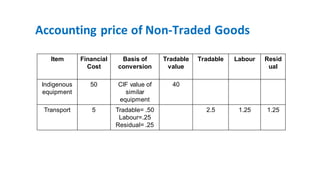
Accounting price of Non-Traded Goods
❑ Some goods and services like land, building, transportation, and electricity
are not amenable to foreign trade. Hence, there is no border price
observable for them. Accounting prices for nontraded items are defined in
terms of marginal social cost and marginal social benefit.
❑ The marginal social cost of a good is the value in terms of accounting prices
of the resources required to produce an extra unit of the good. For example,
the marginal social cost of a bus trip is roughly equal to the cost of material
inputs (fuel, oil, wear and tear of the bus, etc.) evaluated at border prices
plus the social wage of the driver and the conductor.
Accounting price of Non-Traded Goods
❑ The marginal social benefit is the value of an extra unit of the good from the
social point of view. When a good is not taxed and is consumed by only one
income group, its marginal social benefit is equal to its market price
multiplied by a factor which represents the value assigned to an increase in
the income of that group vis-a-vis an equal increase in uncommitted social
income.
❑ Accounting price of non-traded goods= 2/3 marginal social cost + 1/3
marginal social benefit.
Accounting price of Non-Traded Goods
❑ Use of Conversion Factors Ideally, the accounting price of a non-traded item
is defined in terms of marginal social cost and marginal social benefit. In
practice, the calculation of marginal social cost and marginal social benefit
is often a difficult task.
❑ As a practical expedient, L-M suggest that the monetary cost of a non-traded
item be broken down into tradable, labour, and residual components.
❑ The tradable and residual components may be converted into social cost by
applying suitable social conversion factors; the labour component's social
cost can be obtained by using shadow wage rate.
Accounting price of Non-Traded Goods
Item Financial
Cost
Basis of
conversion
Tradable
value
Tradable Labour Resid
ual
Indigenous
equipment
50 CIF value of
similar
equipment
40
Transport 5 Tradable= .50
Labour=.25
Residual= .25
2.5 1.25 1.25
Shadow Wage Rate
❑ The shadow wage rate is an important but difficult-to determine element in
social cost benefit analysis. It is a function of several factors: (i) the
marginal productivity of labour, (ii) the cost associated with urbanisation
(cost of transport, urban overheads, etc.), and (iii) the cost of having an
additional amount committed to consumption when the consumption of the
worker increases as a result of the higher income he enjoys in urban
employment.
Shadow Wage Rate
❑ SWR= c`-1/s (c-m)
✓ C’= additional resources devoted to consumption
✓ 1/s= unit of committed resources
✓ C= consumption of wage earner
✓ M= marginal product of wage earner
Accounting Rate of Return (ARR)
❑ The accounting rate of return (interest) is the rate used for discounting
social profits.
❑ Experience is the best guide to the choice of ARR
❑ ARR should be such that all mutually compatible projects with positive
present social value can be undertaken.
❑ ARR= Average annual profit/ Average investment
❑ Where, Average profit= Total profit over investment period/ Number of years
❑ Average investment= (Book value at year 1+ Book value at end of useful
life)/ 2
Mathematical Problem and Solution
Problem: XYZ company is considering investing in a project that requires an
initial investment of Tk. 1,00,000 for some machinery.
There will be net flow of Tk. 20,000 in first two years, Tk.10,000 in year 3 and 4,
and Tk. 30,000 in year 5. Finally the machine salvage value of Tk. 25,000.
Solution:
Step-1: Calculate Average Annual Profit
Inflow, Years 1 & 2= (20,000*2)= Tk. 40,000
Inflow, Years 3 & 4= (10,000*2)= Tk. 20,000
Inflow, Year 5 = Tk. 30,000
Total profit= (40,000+20,000+30,000+25,000-1,00,000)= Tk. 15,000
Average Annual Profit= (15000/5)= 3,000
Mathematical Problem and Solution
Step-2: Calculate Average Investment
Average investment= (1,00,000+25000)/2
= Tk. 62,500
Step-3: Use ARR formula:
ARR= 3,000/62,500
= 4.8%

Project Management slides for presentation.pdf

  • 1.
  • 2.
    Following topics definedor determined in the Little Mirrless approach Accounting Price of Non-Traded Goods Accounting Rate of Return Shadow Price of Traded Goods Shadow Wage Rate
  • 3.
    Shadow Price ofTraded Goods ❑ The shadow price of traded goods is simply its border price ❑ If a good exported its shadow price is its FOB price ❑ If a good is imported its shadow price is its CIF price ❑ The logic for using border prices for traded goods is fairly straight-forward: border prices represent the correct social opportunity costs or benefits of using or producing a traded good.
  • 4.
    Accounting price ofNon-Traded Goods ❑ Some goods and services like land, building, transportation, and electricity are not amenable to foreign trade. Hence, there is no border price observable for them. Accounting prices for nontraded items are defined in terms of marginal social cost and marginal social benefit. ❑ The marginal social cost of a good is the value in terms of accounting prices of the resources required to produce an extra unit of the good. For example, the marginal social cost of a bus trip is roughly equal to the cost of material inputs (fuel, oil, wear and tear of the bus, etc.) evaluated at border prices plus the social wage of the driver and the conductor.
  • 5.
    Accounting price ofNon-Traded Goods ❑ The marginal social benefit is the value of an extra unit of the good from the social point of view. When a good is not taxed and is consumed by only one income group, its marginal social benefit is equal to its market price multiplied by a factor which represents the value assigned to an increase in the income of that group vis-a-vis an equal increase in uncommitted social income. ❑ Accounting price of non-traded goods= 2/3 marginal social cost + 1/3 marginal social benefit.
  • 6.
    Accounting price ofNon-Traded Goods ❑ Use of Conversion Factors Ideally, the accounting price of a non-traded item is defined in terms of marginal social cost and marginal social benefit. In practice, the calculation of marginal social cost and marginal social benefit is often a difficult task. ❑ As a practical expedient, L-M suggest that the monetary cost of a non-traded item be broken down into tradable, labour, and residual components. ❑ The tradable and residual components may be converted into social cost by applying suitable social conversion factors; the labour component's social cost can be obtained by using shadow wage rate.
  • 7.
    Accounting price ofNon-Traded Goods Item Financial Cost Basis of conversion Tradable value Tradable Labour Resid ual Indigenous equipment 50 CIF value of similar equipment 40 Transport 5 Tradable= .50 Labour=.25 Residual= .25 2.5 1.25 1.25
  • 8.
    Shadow Wage Rate ❑The shadow wage rate is an important but difficult-to determine element in social cost benefit analysis. It is a function of several factors: (i) the marginal productivity of labour, (ii) the cost associated with urbanisation (cost of transport, urban overheads, etc.), and (iii) the cost of having an additional amount committed to consumption when the consumption of the worker increases as a result of the higher income he enjoys in urban employment.
  • 9.
    Shadow Wage Rate ❑SWR= c`-1/s (c-m) ✓ C’= additional resources devoted to consumption ✓ 1/s= unit of committed resources ✓ C= consumption of wage earner ✓ M= marginal product of wage earner
  • 10.
    Accounting Rate ofReturn (ARR) ❑ The accounting rate of return (interest) is the rate used for discounting social profits. ❑ Experience is the best guide to the choice of ARR ❑ ARR should be such that all mutually compatible projects with positive present social value can be undertaken. ❑ ARR= Average annual profit/ Average investment ❑ Where, Average profit= Total profit over investment period/ Number of years ❑ Average investment= (Book value at year 1+ Book value at end of useful life)/ 2
  • 11.
    Mathematical Problem andSolution Problem: XYZ company is considering investing in a project that requires an initial investment of Tk. 1,00,000 for some machinery. There will be net flow of Tk. 20,000 in first two years, Tk.10,000 in year 3 and 4, and Tk. 30,000 in year 5. Finally the machine salvage value of Tk. 25,000. Solution: Step-1: Calculate Average Annual Profit Inflow, Years 1 & 2= (20,000*2)= Tk. 40,000 Inflow, Years 3 & 4= (10,000*2)= Tk. 20,000 Inflow, Year 5 = Tk. 30,000 Total profit= (40,000+20,000+30,000+25,000-1,00,000)= Tk. 15,000 Average Annual Profit= (15000/5)= 3,000
  • 12.
    Mathematical Problem andSolution Step-2: Calculate Average Investment Average investment= (1,00,000+25000)/2 = Tk. 62,500 Step-3: Use ARR formula: ARR= 3,000/62,500 = 4.8%