PROJECT LIFE CYCLE
MODELS
Life cycle model
•There are different types of project life cycles, teams can make use of
depending on the type of project they’re working on.
•A project life cycle decides the way the project will deliver the deliverable.
•To put it simply, a project life cycle is the project progression through each
step from beginning to end. The number of cycles of stages and their order
may fluctuate based on the organization and the type of project.
•The PM & team should have clear understanding of these phases
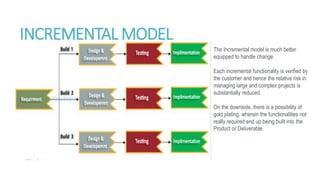
INCREMENTAL MODEL
The Incremental model is much better
equipped to handle change.
Each incremental functionality is verified by
the customer and hence the relative risk in
managing large and complex projects is
substantially reduced.
On the downside, there is a possibility of
gold plating, wherein the functionalities not
really required end up being built into the
Product or Deliverable.
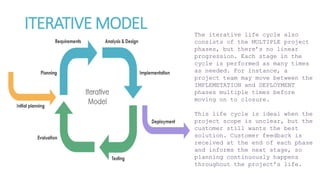
ITERATIVE MODEL The iterative life cycle also
consists of the MULTIPLE project
phases, but there’s no linear
progression. Each stage in the
cycle is performed as many times
as needed. For instance, a
project team may move between the
IMPLEMETATION and DEPLOYMENT
phases multiple times before
moving on to closure.
This life cycle is ideal when the
project scope is unclear, but the
customer still wants the best
solution. Customer feedback is
received at the end of each phase
and informs the next stage, so
planning continuously happens
throughout the project’s life.
PROJECT LIFE CYCLE MODELS. data &analytics pptx

PROJECT LIFE CYCLE MODELS. data &analytics pptx

  • 1.
  • 2.
    Life cycle model •Thereare different types of project life cycles, teams can make use of depending on the type of project they’re working on. •A project life cycle decides the way the project will deliver the deliverable. •To put it simply, a project life cycle is the project progression through each step from beginning to end. The number of cycles of stages and their order may fluctuate based on the organization and the type of project. •The PM & team should have clear understanding of these phases
  • 4.
    INCREMENTAL MODEL The Incrementalmodel is much better equipped to handle change. Each incremental functionality is verified by the customer and hence the relative risk in managing large and complex projects is substantially reduced. On the downside, there is a possibility of gold plating, wherein the functionalities not really required end up being built into the Product or Deliverable.
  • 5.
    ITERATIVE MODEL Theiterative life cycle also consists of the MULTIPLE project phases, but there’s no linear progression. Each stage in the cycle is performed as many times as needed. For instance, a project team may move between the IMPLEMETATION and DEPLOYMENT phases multiple times before moving on to closure. This life cycle is ideal when the project scope is unclear, but the customer still wants the best solution. Customer feedback is received at the end of each phase and informs the next stage, so planning continuously happens throughout the project’s life.