UPULIE PATHIRANA

 Children’s Health Queensland (CHQ) is a State wide network of hospital and
community health services committed to provide high quality paediatric
services to every children and young people in Queensland.
INTRODUCTION
 PROJECT DEFINITION AND
CONTRIBUTION
 Environmental Scan designed for,
Analyzing the external and internal
drivers and their impact on supply
and demand issues of nursing
workforce and support for future
workforce forecasting and
planning.
 Workforce planning process is
integrated with service and
financial planning processes of
CHQ
Environmental Scan as a part of workforce
planning cycle
CHQ
Executive Management team
Executive Sponsor
Shelly Nowlen
Executive Nursing Director
Project Manager - Wendy Fennah
Nursing Director
Learning & workforce development
Project Supervisor
Geoff Murphy
Nurse Manager
Project Officer
Upulie Pathirana
Student of Griffith University
STRUCTURE OF PROJECT TEAM

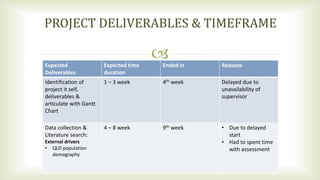
PROJECT DELIVERABLES & TIMEFRAME
Expected
Deliverables
Expected time
duration
Ended in Reasons
Identification of
project it self,
deliverables &
articulate with Gantt
Chart
1 – 3 week 4th week Delayed due to
unavailability of
supervisor
Data collection &
Literature search:
External drivers
• QLD population
demography
4 – 8 week 9th week • Due to delayed
start
• Had to spent time
with assessment
Continued
Expected Deliverables Expected time
duration
Ended in Reasons
Identification of health
risks/ trends and causes
of death in target
consumer groups
4 – 8 week 9th week Difficulties in Data
collection
Local & global industry
trends
4 – 8 week Not achieved Limited time duration
Political environment 4 – 8 week Not achieved Limited time duration
Internal drivers:
CHQ current nursing
workforce profile &
Nursing education
8 – 11 week 13th week Had to wait for
updated MOHRI raw
data set from
supervisor
Current workforce
related issues
8 – 11 week 11th week Completed on time
Continued
Expected Deliverables Expected time
duration
Ended in Reasons
Data analysing 9 – 12 week 15th week Had to spent more
time for collecting
most recent and
reliable data and
compare different
data set.
Final project report 12 – 14 week 16th week Had to take extra time
for preparing the
presentation and
deliverable report
 Current CHQ Nursing Workforce
profile:
• CHQ consists with 1530 nursing
headcount and 1261 occupied FTE
positions as the largest single
professional team within CHQ (By
March 2015).
• As a ratio, which represents 43%
of total workforce and 55% of
clinical workforce.
PROJECT OUTCOMES SNAPSHOTS
4.17%
48.9…
46.91%
Total
Casual
Full-time
Part-time
Population & trends
0
50
100
150
200
250
300
350
male death Female death total
Annual child death amount 2011
0- 1y 1- 14y 14- 25y
 Workforce supply factor analysis will help to recognise:
• Current clinical and service groups capacity
• Workforce growth
• Retirement projection
• Turnover rates
• Working efficiency and skill mix levels
• Annual Nursing student output from Universities
PROJECT BENIFITS
 Demand factor analysis will help to:
• Identification of target population projection and diversity
• Consumer needs and expectations
 Identification of supply and demand factors will enable to forecast what type of staff
and amount of staff they need in future for meet the supply and demand gap.
 Identification of higher demand divisions, will help to place the correct people in
correct place in correct time.
 Analytical outcomes of nursing workforce related issues can utilise for implement the
new strategies and policies to attract and retain skilled professionals with minimum
turnover rates.
PROJECT BENIFITS
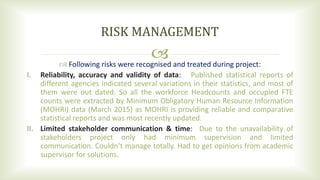
 Following risks were recognised and treated during project:
I. Reliability, accuracy and validity of data: Published statistical reports of
different agencies indicated several variations in their statistics, and most of
them were out dated. So all the workforce Headcounts and occupied FTE
counts were extracted by Minimum Obligatory Human Resource Information
(MOHRI) data (March 2015) as MOHRI is providing reliable and comparative
statistical reports and was most recently updated.
II. Limited stakeholder communication & time: Due to the unavailability of
stakeholders project only had minimum supervision and limited
communication. Couldn’t manage totally. Had to get opinions from academic
supervisor for solutions.
RISK MANAGEMENT

 Workforce and service delivery
structures and culture were identified
 Nursing workforce issues (skill
shortage/ aging workforce/ workload
& cultural) were identified
 Target population projection,
consumer needs identified
Achieved goals
 Identifying the business objectives,
strategies, stakeholders and
business culture
 Strengths and weaknesses related
with current nursing workforce
 Opportunities and threats related
with external elements such as
social, technological, economic,
ecological, political and regulatory
factors
Project Goals
Quality Assurance
Performance Against Goals
 Most of the goals were achieved.
 CHQ can forecast the supply and demand gap by using the project out
comes
 Report provides the snapshot of entire CHQ nursing workforce and its
consumer demography, which can use to strategy and policy making
processes
 Environmental scan project outcomes may be a resource for other
integrated service and financial planning projects
Quality Assurance
Performance Against Goals
How was project quality measured?
• Project was conducted inline with CHQ quality standards
• Information were collected via government agencies and scholarly
journal articles
• Used standard MS Excel analytical tools for data analyzing
Key lessons learnt from project
• Data collecting, comparing and analyzing skills
• Problem solving ability with different vision & mission
• Performing the duties under minimum supervision
• Achieving the goals with time management
Quality Assurance

 Hardly concentrated on project plan to make a clear guidance
 Tried to lineup with work breakdown sheet for effective time management
 Discussed with supervisor to get assistance and clear view of their goals
 Used reliable, accurate and up to date data resources
 Referenced previous projects on similar fields to observe their footprints
To maximize the probability of achieving
goals!
 Environmental scan of current Nursing Workforce in Children’s Health Queensland was
a critical part of ‘CHQ Nursing Workforce Planning’ project based on LCCH. It was
conducted over 16 weeks.
 Project was designed to identification of CHQ Nursing Workforce supply and demand
factors and their impact on it. Most of the deliverables were achieved and few of
them were not.
 Current workforce headcounts, demography, skill mix, retirement trends & workforce
projection, Nursing education issues, migrant nursing issues, aging issues were
discussed with final deliverables.
 Population demography, common risk for child death and statewide disease
prevalence trends and consumer expectation were included in final deliverables
 Finally the expectations of CHQ were achieved successfully
Conclusion

 Recommended future researches:
• Political changes and its impact on workforce planning strategies
• Global market trends and values for Nurses
• Effectiveness of previous strategic plans
• Technological invasion and Nursing workforce
Further research

THANK YOU
Questions & Comments

project final presentation

  • 1.
  • 2.
      Children’s HealthQueensland (CHQ) is a State wide network of hospital and community health services committed to provide high quality paediatric services to every children and young people in Queensland. INTRODUCTION
  • 3.
     PROJECT DEFINITIONAND CONTRIBUTION  Environmental Scan designed for, Analyzing the external and internal drivers and their impact on supply and demand issues of nursing workforce and support for future workforce forecasting and planning.  Workforce planning process is integrated with service and financial planning processes of CHQ Environmental Scan as a part of workforce planning cycle
  • 4.
    CHQ Executive Management team ExecutiveSponsor Shelly Nowlen Executive Nursing Director Project Manager - Wendy Fennah Nursing Director Learning & workforce development Project Supervisor Geoff Murphy Nurse Manager Project Officer Upulie Pathirana Student of Griffith University STRUCTURE OF PROJECT TEAM
  • 5.
     PROJECT DELIVERABLES &TIMEFRAME Expected Deliverables Expected time duration Ended in Reasons Identification of project it self, deliverables & articulate with Gantt Chart 1 – 3 week 4th week Delayed due to unavailability of supervisor Data collection & Literature search: External drivers • QLD population demography 4 – 8 week 9th week • Due to delayed start • Had to spent time with assessment
  • 6.
    Continued Expected Deliverables Expectedtime duration Ended in Reasons Identification of health risks/ trends and causes of death in target consumer groups 4 – 8 week 9th week Difficulties in Data collection Local & global industry trends 4 – 8 week Not achieved Limited time duration Political environment 4 – 8 week Not achieved Limited time duration Internal drivers: CHQ current nursing workforce profile & Nursing education 8 – 11 week 13th week Had to wait for updated MOHRI raw data set from supervisor Current workforce related issues 8 – 11 week 11th week Completed on time
  • 7.
    Continued Expected Deliverables Expectedtime duration Ended in Reasons Data analysing 9 – 12 week 15th week Had to spent more time for collecting most recent and reliable data and compare different data set. Final project report 12 – 14 week 16th week Had to take extra time for preparing the presentation and deliverable report
  • 8.
     Current CHQNursing Workforce profile: • CHQ consists with 1530 nursing headcount and 1261 occupied FTE positions as the largest single professional team within CHQ (By March 2015). • As a ratio, which represents 43% of total workforce and 55% of clinical workforce. PROJECT OUTCOMES SNAPSHOTS 4.17% 48.9… 46.91% Total Casual Full-time Part-time
  • 10.
    Population & trends 0 50 100 150 200 250 300 350 maledeath Female death total Annual child death amount 2011 0- 1y 1- 14y 14- 25y
  • 11.
     Workforce supplyfactor analysis will help to recognise: • Current clinical and service groups capacity • Workforce growth • Retirement projection • Turnover rates • Working efficiency and skill mix levels • Annual Nursing student output from Universities PROJECT BENIFITS
  • 12.
     Demand factoranalysis will help to: • Identification of target population projection and diversity • Consumer needs and expectations  Identification of supply and demand factors will enable to forecast what type of staff and amount of staff they need in future for meet the supply and demand gap.  Identification of higher demand divisions, will help to place the correct people in correct place in correct time.  Analytical outcomes of nursing workforce related issues can utilise for implement the new strategies and policies to attract and retain skilled professionals with minimum turnover rates. PROJECT BENIFITS
  • 13.
     Following riskswere recognised and treated during project: I. Reliability, accuracy and validity of data: Published statistical reports of different agencies indicated several variations in their statistics, and most of them were out dated. So all the workforce Headcounts and occupied FTE counts were extracted by Minimum Obligatory Human Resource Information (MOHRI) data (March 2015) as MOHRI is providing reliable and comparative statistical reports and was most recently updated. II. Limited stakeholder communication & time: Due to the unavailability of stakeholders project only had minimum supervision and limited communication. Couldn’t manage totally. Had to get opinions from academic supervisor for solutions. RISK MANAGEMENT
  • 14.
      Workforce andservice delivery structures and culture were identified  Nursing workforce issues (skill shortage/ aging workforce/ workload & cultural) were identified  Target population projection, consumer needs identified Achieved goals  Identifying the business objectives, strategies, stakeholders and business culture  Strengths and weaknesses related with current nursing workforce  Opportunities and threats related with external elements such as social, technological, economic, ecological, political and regulatory factors Project Goals Quality Assurance Performance Against Goals
  • 15.
     Most ofthe goals were achieved.  CHQ can forecast the supply and demand gap by using the project out comes  Report provides the snapshot of entire CHQ nursing workforce and its consumer demography, which can use to strategy and policy making processes  Environmental scan project outcomes may be a resource for other integrated service and financial planning projects Quality Assurance Performance Against Goals
  • 16.
    How was projectquality measured? • Project was conducted inline with CHQ quality standards • Information were collected via government agencies and scholarly journal articles • Used standard MS Excel analytical tools for data analyzing Key lessons learnt from project • Data collecting, comparing and analyzing skills • Problem solving ability with different vision & mission • Performing the duties under minimum supervision • Achieving the goals with time management Quality Assurance
  • 17.
      Hardly concentratedon project plan to make a clear guidance  Tried to lineup with work breakdown sheet for effective time management  Discussed with supervisor to get assistance and clear view of their goals  Used reliable, accurate and up to date data resources  Referenced previous projects on similar fields to observe their footprints To maximize the probability of achieving goals!
  • 18.
     Environmental scanof current Nursing Workforce in Children’s Health Queensland was a critical part of ‘CHQ Nursing Workforce Planning’ project based on LCCH. It was conducted over 16 weeks.  Project was designed to identification of CHQ Nursing Workforce supply and demand factors and their impact on it. Most of the deliverables were achieved and few of them were not.  Current workforce headcounts, demography, skill mix, retirement trends & workforce projection, Nursing education issues, migrant nursing issues, aging issues were discussed with final deliverables.  Population demography, common risk for child death and statewide disease prevalence trends and consumer expectation were included in final deliverables  Finally the expectations of CHQ were achieved successfully Conclusion
  • 19.
      Recommended futureresearches: • Political changes and its impact on workforce planning strategies • Global market trends and values for Nurses • Effectiveness of previous strategic plans • Technological invasion and Nursing workforce Further research
  • 20.

Editor's Notes

  • #10 CHQ workforce growth indicates 03 significant variations in 2012, 2013 & 2015. In 2012 19% increment due to creation of CYCHS, slight reduction in 2013 due to workforce reforms and 47% rapid growth due to LCCH commissioning. Generally CHQ have female predominant younger workforce generation compare with national workforce (MOHRI Data. March 2015)