WWW.EJTA.EU
Project: FACTBAR.EU
A European fact-checking project for journalism
students
EJTA AGM June 2016 1
• cooperation of different fact-checking projects
• by 10-15 EJTA members
• coached by staff
• involving Journalism students actively
• creating a fact-checking course / module
• with a similar methodology
• final result: EJTA network with parallel fact-checking
sites
EJTA AGM June 2016 2
Factbar.eu in a nutshell
• check statements from politicians
• correct factual mistakes in the media
• for citizens with questions about political
statements
• on online, open sources
• using social media
• pilots: during elections (regional / national)
EJTA AGM June 2016 3
Factbar.eu in a nutshell
• Importance of fact checking
o Fast journalism; 24/7 news production
o Double checking
• Credibility of ‘new’ media
o Everybody journalist?
• Journalism education and reliability
o Most important asset?
EJTA AGM June 2016 4
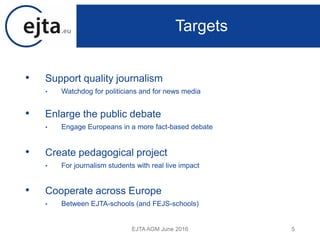
Context
• Support quality journalism
• Watchdog for politicians and for news media
• Enlarge the public debate
• Engage Europeans in a more fact-based debate
• Create pedagogical project
• For journalism students with real live impact
• Cooperate across Europe
• Between EJTA-schools (and FEJS-schools)
EJTA AGM June 2016 5
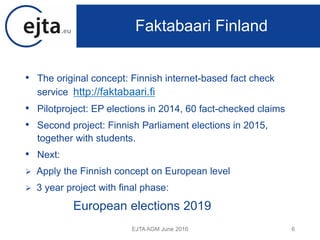
Targets
• The original concept: Finnish internet-based fact check
service http://faktabaari.fi
• Pilotproject: EP elections in 2014, 60 fact-checked claims
• Second project: Finnish Parliament elections in 2015,
together with students.
• Next:
 Apply the Finnish concept on European level
 3 year project with final phase:
European elections 2019
EJTA AGM June 2016 6
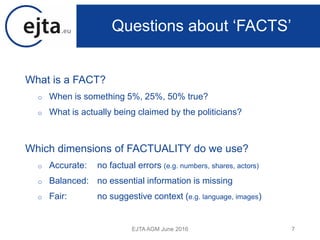
Faktabaari Finland
What is a FACT?
o When is something 5%, 25%, 50% true?
o What is actually being claimed by the politicians?
Which dimensions of FACTUALITY do we use?
o Accurate: no factual errors (e.g. numbers, shares, actors)
o Balanced: no essential information is missing
o Fair: no suggestive context (e.g. language, images)
EJTA AGM June 2016 7
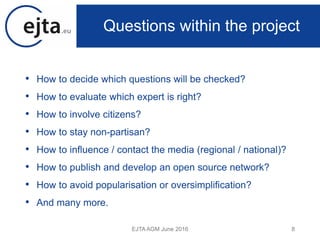
Questions about ‘FACTS’
• How to decide which questions will be checked?
• How to evaluate which expert is right?
• How to involve citizens?
• How to stay non-partisan?
• How to influence / contact the media (regional / national)?
• How to publish and develop an open source network?
• How to avoid popularisation or oversimplification?
• And many more.
EJTA AGM June 2016 8
Questions within the project
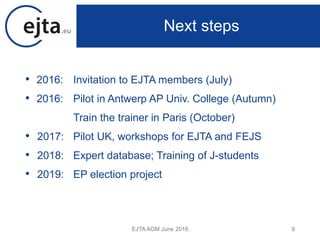
• 2016: Invitation to EJTA members (July)
• 2016: Pilot in Antwerp AP Univ. College (Autumn)
Train the trainer in Paris (October)
• 2017: Pilot UK, workshops for EJTA and FEJS
• 2018: Expert database; Training of J-students
• 2019: EP election project
EJTA AGM June 2016 9
Next steps
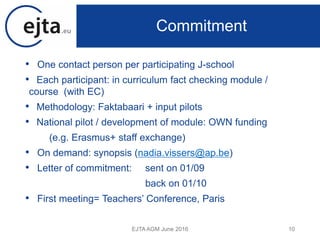
• One contact person per participating J-school
• Each participant: in curriculum fact checking module /
course (with EC)
• Methodology: Faktabaari + input pilots
• National pilot / development of module: OWN funding
(e.g. Erasmus+ staff exchange)
• On demand: synopsis (nadia.vissers@ap.be)
• Letter of commitment: sent on 01/09
back on 01/10
• First meeting= Teachers’ Conference, Paris
EJTA AGM June 2016 10
Commitment

Project Factbar AGM 2016

  • 1.
    WWW.EJTA.EU Project: FACTBAR.EU A Europeanfact-checking project for journalism students EJTA AGM June 2016 1
  • 2.
    • cooperation ofdifferent fact-checking projects • by 10-15 EJTA members • coached by staff • involving Journalism students actively • creating a fact-checking course / module • with a similar methodology • final result: EJTA network with parallel fact-checking sites EJTA AGM June 2016 2 Factbar.eu in a nutshell
  • 3.
    • check statementsfrom politicians • correct factual mistakes in the media • for citizens with questions about political statements • on online, open sources • using social media • pilots: during elections (regional / national) EJTA AGM June 2016 3 Factbar.eu in a nutshell
  • 4.
    • Importance offact checking o Fast journalism; 24/7 news production o Double checking • Credibility of ‘new’ media o Everybody journalist? • Journalism education and reliability o Most important asset? EJTA AGM June 2016 4 Context
  • 5.
    • Support qualityjournalism • Watchdog for politicians and for news media • Enlarge the public debate • Engage Europeans in a more fact-based debate • Create pedagogical project • For journalism students with real live impact • Cooperate across Europe • Between EJTA-schools (and FEJS-schools) EJTA AGM June 2016 5 Targets
  • 6.
    • The originalconcept: Finnish internet-based fact check service http://faktabaari.fi • Pilotproject: EP elections in 2014, 60 fact-checked claims • Second project: Finnish Parliament elections in 2015, together with students. • Next:  Apply the Finnish concept on European level  3 year project with final phase: European elections 2019 EJTA AGM June 2016 6 Faktabaari Finland
  • 7.
    What is aFACT? o When is something 5%, 25%, 50% true? o What is actually being claimed by the politicians? Which dimensions of FACTUALITY do we use? o Accurate: no factual errors (e.g. numbers, shares, actors) o Balanced: no essential information is missing o Fair: no suggestive context (e.g. language, images) EJTA AGM June 2016 7 Questions about ‘FACTS’
  • 8.
    • How todecide which questions will be checked? • How to evaluate which expert is right? • How to involve citizens? • How to stay non-partisan? • How to influence / contact the media (regional / national)? • How to publish and develop an open source network? • How to avoid popularisation or oversimplification? • And many more. EJTA AGM June 2016 8 Questions within the project
  • 9.
    • 2016: Invitationto EJTA members (July) • 2016: Pilot in Antwerp AP Univ. College (Autumn) Train the trainer in Paris (October) • 2017: Pilot UK, workshops for EJTA and FEJS • 2018: Expert database; Training of J-students • 2019: EP election project EJTA AGM June 2016 9 Next steps
  • 10.
    • One contactperson per participating J-school • Each participant: in curriculum fact checking module / course (with EC) • Methodology: Faktabaari + input pilots • National pilot / development of module: OWN funding (e.g. Erasmus+ staff exchange) • On demand: synopsis (nadia.vissers@ap.be) • Letter of commitment: sent on 01/09 back on 01/10 • First meeting= Teachers’ Conference, Paris EJTA AGM June 2016 10 Commitment