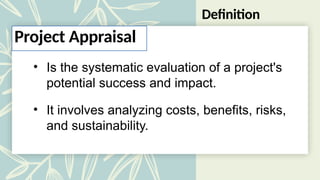
Definition
• Is thesystematic evaluation of a project's
potential success and impact.
• It involves analyzing costs, benefits, risks,
and sustainability.
Project Appraisal
4.
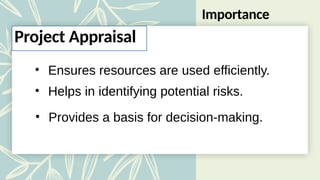
Importance
• Ensures resourcesare used efficiently.
• Helps in identifying potential risks.
• Provides a basis for decision-making.
Project Appraisal
5.
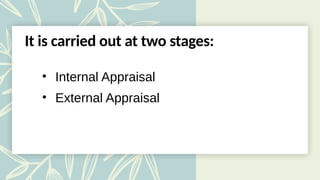
It is carriedout at two stages:
• Internal Appraisal
• External Appraisal
6.
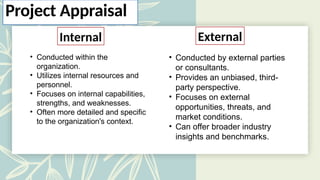
• Conducted withinthe
organization.
• Utilizes internal resources and
personnel.
• Focuses on internal capabilities,
strengths, and weaknesses.
• Often more detailed and specific
to the organization's context.
• Conducted by external parties
or consultants.
• Provides an unbiased, third-
party perspective.
• Focuses on external
opportunities, threats, and
market conditions.
• Can offer broader industry
insights and benchmarks.
Internal External
Project Appraisal
7.
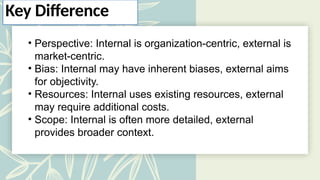
• Perspective: Internalis organization-centric, external is
market-centric.
• Bias: Internal may have inherent biases, external aims
for objectivity.
• Resources: Internal uses existing resources, external
may require additional costs.
• Scope: Internal is often more detailed, external
provides broader context.
Key Difference
8.
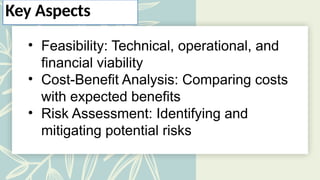
• Feasibility: Technical,operational, and
financial viability
• Cost-Benefit Analysis: Comparing costs
with expected benefits
• Risk Assessment: Identifying and
mitigating potential risks
Key Aspects
9.
Types of ProjectAppraisal
• Financial Appraisal
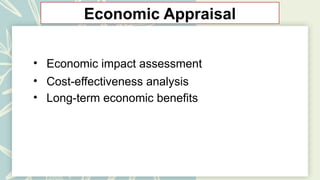
• Economic Appraisal
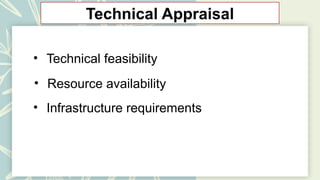
• Technical Appraisal
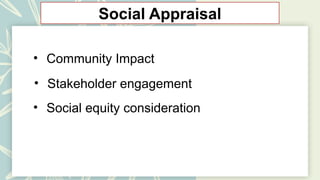
• Social Appraisal
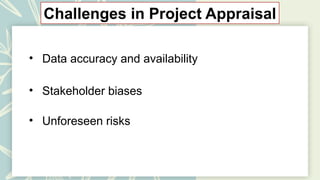
Challenges in ProjectAppraisal
• Data accuracy and availability
• Stakeholder biases
• Unforeseen risks
19.
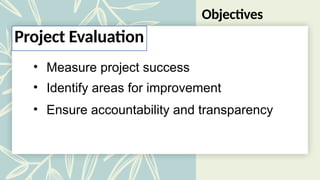
Objectives
• Measure projectsuccess
• Identify areas for improvement
Project Evaluation
• Ensure accountability and transparency
20.
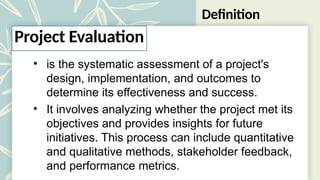
Definition
• is thesystematic assessment of a project's
design, implementation, and outcomes to
determine its effectiveness and success.
• It involves analyzing whether the project met its
objectives and provides insights for future
initiatives. This process can include quantitative
and qualitative methods, stakeholder feedback,
and performance metrics.
Project Evaluation
21.
Types of ProjectEvaluation
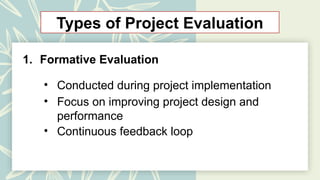
1. Formative Evaluation
• Conducted during project implementation
• Focus on improving project design and
performance
• Continuous feedback loop
22.
Types of ProjectEvaluation
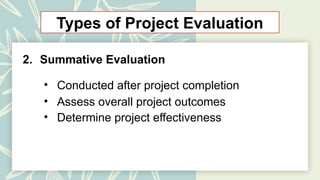
2. Summative Evaluation
• Conducted after project completion
• Assess overall project outcomes
• Determine project effectiveness
23.
Types of ProjectEvaluation
3. Process Evaluation
• Examine project implementation
• Identify operational strengths and weaknesses
• Ensure adherence to planned activities
24.
Types of ProjectEvaluation
4. Impact Evaluation
• Assess long-term effects of the project
• Measure changes in educational outcomes
• Evaluate sustainability of project benefits
25.
Steps in ProjectEvaluation
1. Defining Evaluation Objectives
• Clarify what you want to achieve
• Align with educational goals
• Set specific, measurable, achievable, relevant,
and time-bound (SMART) objectives
26.
Steps in ProjectEvaluation
2. Developing an Evaluation Plan
• Outline evaluation methodology
• Identify data sources and collection methods
• Establish timeline and responsibilities
27.
Steps in ProjectEvaluation
3. Data Collection Methods
• Surveys and questionnaires
• Interviews and focus groups
• Observations and site visits
28.
Steps in ProjectEvaluation
4. Data Analysis Techniques
• Quantitative analysis
• Qualitative analysis
• Mixed-methods approach
29.
Steps in ProjectEvaluation
5. Reporting Findings
• Structure of evaluation report
• Key findings and insights
• Recommendations for future projects
30.
Tools for ProjectEvaluation
1. Logic Models
• Visual representation of project components
• Link inputs, activities, outputs, and outcomes
• Facilitate understanding of project processes
31.
Tools for ProjectEvaluation
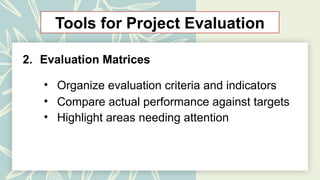
2. Evaluation Matrices
• Organize evaluation criteria and indicators
• Compare actual performance against targets
• Highlight areas needing attention
Continuous Improvement
• Useevaluation findings to enhance future
projects
• Foster a culture of learning and adaptation
• Encourage ongoing professional
development
37.
References
Boardman, A. E.,Greenberg, D. H., Vining, A. R., &
Weimer, D. L. (2018). Cost-Benefit Analysis: Concepts
and Practice. Cambridge University Press.
Gittinger, J. P. (1982). Economic Analysis of Agricultural
Projects. Johns Hopkins University Press.
Drummond, M. F., Sculpher, M. J., Claxton, K.,
Stoddart, G. L., & Torrance, G. W. (2015). Methods for
the Economic Evaluation of Health Care Programmes.
Oxford University Press.
38.
References
Rossi, P. H.,Lipsey, M. W., & Henry, G. T. (2018).
Evaluation: A Systematic Approach. SAGE Publications.
Patton, M. Q. (2015). Qualitative Research &
Evaluation Methods. SAGE Publications.
Scriven, M. (1991). Evaluation Thesaurus. SAGE
Publications.
39.
Questions
1. What keyperformance indicators should a school head use to
evaluate the success of a project, and how can these indicators be
aligned with institutional goals?
2. How can the school head ensure that the evaluation process for
projects is transparent and engages all relevant stakeholders,
including teachers, administrators, and students?
3. In what ways can cost-benefit analysis be applied to educational
projects to assess their financial viability and impact on resource
allocation?
4. How can data collection methods be optimized in the evaluation of
projects to ensure accurate and actionable insights?
5. What role does continuous improvement play in the evaluation of
educational projects, and how can feedback loops be effectively
integrated into project management practices?
Editor's Notes
#2
1. Assess project feasibility: This involves evaluating whether the project can realistically be completed given available resources, time constraints, and other practical considerations.
2. Evaluate potential benefits: This step examines the positive outcomes or advantages that could result from successfully implementing the project.
3. Identify risks and challenges: This involves anticipating and analyzing potential obstacles, problems, or threats that might arise during the project's execution.
"this is a structured evaluation process used to determine the viability and value of a proposed project before committing significant resources to it.
This type of appraisal is commonly used in business, government, and non-profit sectors to make informed decisions about which projects to pursue and how to allocate resources effectively.
#4
1. "Ensures resources are used efficiently."
Project appraisal helps make sure that money, time, and other resources are not wasted. It's like planning a budget for your household to make sure you're spending money wisely.
2. "Helps in identifying potential risks."
This process allows you to spot possible problems before they happen. It's similar to checking the weather forecast before planning an outdoor event, so you can prepare for rain if needed.
3. "Provides a basis for decision-making."
Project appraisal gives you the information you need to make good choices. It's like researching different cars before buying one, so you can make an informed decision.
In simpler terms, project appraisal is important because:
- It helps you use your resources (like money and time) in the best way possible.
- It lets you see potential problems ahead of time, so you can plan for them.
- It gives you solid information to help you decide whether to go ahead with a project or not.
Think of project appraisal as a careful planning stage that helps prevent wasted resources, reduces surprises, and leads to better decisions. It's a way of thinking things through thoroughly before jumping into action.
#6
Internal Project Appraisal:
1. Conducted within the organization itself.
2. Uses the company's own resources and staff.
3. Focuses on the organization's internal capabilities, strengths, and weaknesses.
4. Is usually more detailed and specific to the organization's unique situation.
Think of this as a self-evaluation, where the company looks at itself closely using its own people and knowledge.
External Project Appraisal:
1. Carried out by outside experts or consultants.
2. Provides an unbiased, third-party view of the project.
3. Looks at external factors like market opportunities, threats, and overall conditions.
4. Can offer broader insights about the industry and how the company compares to others (benchmarks).
This is like getting a second opinion from an expert who isn't part of the company, bringing a fresh perspective.
The key difference is the perspective: internal appraisal looks inward at the company's own abilities and situation, while external appraisal brings an outside view and considers how the project fits into the larger market or industry context.
Both types of appraisal are valuable and often used together to get a complete picture of a project's potential success and challenges.
#7
1. Perspective:
- Internal is organization-centric: Focused on the company's internal workings and goals.
- External is market-centric: Focused on the broader market, competitors, and customers.
2. Bias:
- Internal may have inherent biases: Those within the organization might have preconceived notions or blind spots.
- External aims for objectivity: Outside perspectives are expected to provide a more impartial view.
3. Resources:
- Internal uses existing resources: Leverages resources already available within the organization.
- External may require additional costs: Might need to bring in outside expertise or tools, incurring extra expenses.
4. Scope:
- Internal is often more detailed: Can dive deep into specific aspects of the organization.
- External provides broader context: Offers a wider perspective, potentially comparing to industry standards or competitors.
These differences highlight the value of considering both internal and external viewpoints in decision-making processes. Internal perspectives offer depth and familiarity with the organization, while external perspectives can provide fresh insights and a broader market context. Balancing both can lead to more comprehensive and effective strategies or evaluations.
#8 1. Feasibility
Think of feasibility as answering the question: "Can we actually do this?"
It's like checking if you have everything you need to bake a cake:
- Do you have the right tools? (Technical feasibility)
- Do you know how to bake and have the time? (Operational feasibility)
- Can you afford all the ingredients? (Financial viability)
For an education project, you'd ask:
- Do we have the right materials and technology?
- Do we have skilled teachers and time to run the program?
- Can we afford to start and keep the project running?
2. Cost-Benefit Analysis
This is like weighing pros and cons, but with numbers.
Imagine you're deciding whether to buy a car:
- Costs: Price of the car, gas, insurance, maintenance
- Benefits: Time saved, convenience, ability to travel further
For an education project:
- Costs: Money spent on teachers, books, buildings
- Benefits: More educated students, better job prospects, improved community
You want the benefits to be worth more than the costs.
3. Risk Assessment
This is about looking out for potential problems and planning for them.
It's like planning an outdoor event:
- What could go wrong? (It might rain)
- How likely is it? (Check weather forecast)
- What would happen if it did? (Event ruined)
- How can we prepare? (Have a backup indoor location)
For an education project, you might consider:
- What if we can't find enough teachers?
- What if fewer students enroll than expected?
- What if our funding gets cut?
Then you make plans to either prevent these problems or deal with them if they happen.
By thinking through these three areas, you can get a good idea of whether your education project is likely to succeed and be prepared for challenges along the way. Does this explanation make more sense? Would you like me to clarify anything further?
#9
1. Financial Appraisal
2. Economic Appraisal
3. Technical Appraisal
4. Social Appraisal
In the context of education projects, these types of appraisal would typically involve:
1. Financial Appraisal: This evaluates the financial viability and sustainability of an educational project. It looks at costs, funding sources, expected revenues (if any), and overall financial impact. For example, assessing the budget for building a new school, ongoing operational costs, and potential funding streams.
2. Economic Appraisal: This examines the broader economic impacts and benefits of the educational project. It might consider factors like potential improvements in workforce skills, increased productivity, or long-term economic growth resulting from better education.
3. Technical Appraisal: This assesses the technical feasibility and appropriateness of the project. In education, this could involve evaluating proposed teaching methodologies, curriculum design, use of educational technology, or the physical design of learning spaces.
4. Social Appraisal: This considers the social impacts and benefits of the educational project. It might look at factors such as improved access to education, reduction in inequality, community development, or cultural impacts.
Each type of appraisal provides a different perspective on the potential value and impact of an educational project. Together, they offer a comprehensive evaluation to help decision-makers determine if a project should proceed and how it might be optimized.
Would you like me to elaborate on any specific aspect of project appraisal in education?
#10 1. Cost-benefit analysis: This involves evaluating the potential costs and benefits of a project or investment. It helps determine if the expected benefits outweigh the costs, aiding in decision-making about whether to proceed with a project or investment.
2. Budgeting and funding sources: This step focuses on creating a detailed budget for the project or initiative and identifying where the necessary funds will come from. It may involve exploring various funding options such as internal resources, loans, investors, or grants.
3. Financial sustainability: This aspect considers the long-term financial viability of the project or organization. It examines whether the project can generate enough revenue or value to sustain itself over time, and if it aligns with the organization's overall financial health and goals.
Financial appraisal is a critical process in business and project management. It helps organizations make informed decisions about investments, projects, or strategic initiatives by thoroughly examining their financial implications. This process ensures that resources are allocated efficiently and that financial risks are properly assessed and managed.
#11
1. Economic impact assessment:
this could involve evaluating how a new educational program, policy, or institution might affect the local or broader economy. For example, assessing how a new vocational training program might impact employment rates, income levels, or industry growth in a region.
2. Cost-effectiveness analysis:
this involves comparing different educational interventions or programs to determine which provides the best outcomes relative to its costs. For instance, comparing the costs and benefits of implementing a new technology-based learning system versus traditional teaching methods.
3. Long-term economic benefits:
This looks at the extended economic advantages of educational initiatives. In education, this could include analyzing how improved literacy rates or higher education attainment might lead to increased productivity, innovation, and economic growth over time.
Economic appraisal in education is crucial for several reasons:
- It helps policymakers and educational administrators make informed decisions about resource allocation.
- It can justify investments in education by demonstrating the broader economic returns.
- It aids in identifying the most effective educational interventions, ensuring that limited resources are used optimally.
- It can highlight the societal and economic importance of education, potentially leading to increased support and funding.
By applying economic appraisal techniques to educational projects and policies, decision-makers can ensure that educational investments are not only beneficial for students but also contribute positively to broader economic development goals.
#12
1. Technical feasibility: This involves assessing whether the project can be implemented successfully from a technical standpoint. In an educational context, this might include evaluating proposed teaching methodologies, curriculum design, or educational technologies to ensure they are practical and can achieve the desired learning outcomes.
2. Resource availability: This aspect examines whether the necessary resources are available to implement and sustain the project. For an educational project, this could include assessing the availability of qualified teachers, educational materials, technology, or specialized equipment needed for certain programs.
3. Infrastructure requirements: This looks at the physical and technological infrastructure needed to support the project. In education, this might involve evaluating classroom space, laboratory facilities, IT infrastructure, or other physical requirements necessary for the project's success.
Technical Appraisal is crucial in education projects as it ensures that the proposed project is not only desirable but also practically achievable given the available technology, resources, and infrastructure. It helps identify potential technical challenges early in the planning process, allowing for adjustments or solutions to be developed before implementation begins.
Would you like me to elaborate on how these aspects of Technical Appraisal might apply to a specific type of educational project?
#13
1. Community Impact: This involves assessing how the project will affect the local community. In an educational context, this could include evaluating potential benefits such as increased literacy rates, improved job prospects, or enhanced community knowledge and skills. It might also consider potential challenges like changes in local dynamics or increased traffic around a new school.
2. Stakeholder engagement: This aspect focuses on involving and considering the perspectives of all parties affected by or interested in the project. For an educational project, stakeholders might include students, parents, teachers, local businesses, and government officials. Engaging these groups helps ensure the project meets community needs and gains necessary support.
3. Social equity consideration: This examines how the project impacts different social groups and whether it promotes fairness and equality. In education, this might involve assessing whether the project improves access to education for underserved populations, addresses gender disparities, or provides resources for students with disabilities.
Social Appraisal is crucial in educational projects as it ensures that the project not only achieves its educational goals but also contributes positively to the broader community and promotes social justice. It helps identify potential social benefits and challenges, allowing planners to maximize positive outcomes and mitigate negative impacts.
This type of appraisal is particularly important in education, as educational projects often have far-reaching social implications beyond just academic outcomes. They can influence community development, social mobility, and long-term societal progress.
Would you like me to elaborate on how these aspects of Social Appraisal might apply to a specific type of educational project?
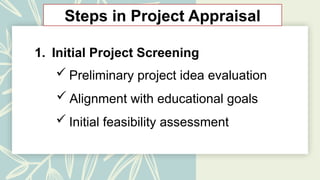
#14 Initial Project Screening. This crucial early stage involves three key components:
1. Preliminary project idea evaluation: This involves assessing the initial concept of the project. For an educational project, this might include examining the basic premise, such as introducing a new curriculum, implementing a technology-based learning system, or establishing a new educational facility. The evaluation at this stage is broad, aiming to determine if the idea has merit and potential.
2. Alignment with educational goals: This step ensures that the proposed project aligns with broader educational objectives. These could be institutional goals (like a university's strategic plan), local educational priorities, or national education policies. It's crucial to verify that the project contributes to and supports these overarching aims.
3. Initial feasibility assessment: This involves a high-level examination of whether the project can realistically be implemented. It might consider factors such as rough cost estimates, potential funding sources, basic technical requirements, and any obvious challenges or constraints.
The Initial Project Screening stage is critical as it acts as a filter, helping to identify promising projects that warrant further investigation and resources. It prevents wasting time and effort on projects that are misaligned with educational goals or clearly unfeasible from the outset.
This stage sets the foundation for more detailed appraisal steps that follow, ensuring that only potentially viable and beneficial educational projects progress to more comprehensive evaluation stages.
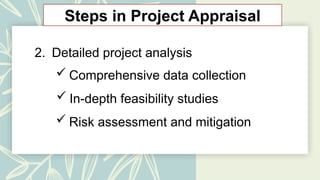
#15 Detailed Project Analysis. This step involves a more thorough examination of the project proposal and includes three key components:
1. Comprehensive data collection: This involves gathering all relevant information needed to make informed decisions about the project. For an educational project, this might include:
- Demographic data of the target student population
- Current educational outcomes and gaps
- Resource availability (financial, human, technological)
- Relevant educational policies and regulations
- Best practices from similar projects elsewhere
2. In-depth feasibility studies: These studies assess whether the project can be successfully implemented and sustained. They typically cover:
- Technical feasibility: Evaluating if the proposed educational methods, technologies, or infrastructure can be effectively implemented
- Financial feasibility: Detailed cost-benefit analysis, funding sources, and long-term financial sustainability
- Operational feasibility: Assessing if the project can be integrated into existing educational systems and processes
- Legal feasibility: Ensuring the project complies with all relevant laws and regulations
3. Risk assessment and mitigation: This involves identifying potential risks that could impact the project's success and developing strategies to address them. For an educational project, risks might include:
- Resistance to change from stakeholders (teachers, parents, students)
- Technological challenges or obsolescence
- Funding shortfalls or budget overruns
- Changes in educational policies or priorities
- Unexpected implementation challenges
For each identified risk, mitigation strategies are developed to minimize their potential impact.
This detailed analysis phase is crucial as it provides a comprehensive understanding of the project's potential benefits, challenges, and risks. It forms the foundation for making informed decisions about whether to proceed with the project and how to optimize its implementation for maximum educational impact.
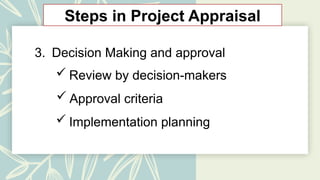
#16 step 3 in the project appraisal process, focusing on "Decision Making and approval" in the context of project management, which can be applied to educational projects as well. Let me explain how this relates to project appraisal in education:
1. Review by decision-makers:
In an educational context, this would involve key stakeholders like school administrators, department heads, or educational board members reviewing the proposed project. They would examine the project's goals, methodologies, resource requirements, and potential impact on students and the educational institution.
2. Approval criteria:
For an educational project, approval criteria might include:
- Alignment with curriculum standards and educational goals
- Cost-effectiveness and budget considerations
- Potential to improve student learning outcomes
- Feasibility of implementation within the school or educational system
- Compliance with educational policies and regulations
3. Implementation planning:
Once a project is approved, this step involves creating a detailed plan for putting the educational project into action. This could include:
- Setting timelines for different phases of the project
- Allocating resources (human, financial, and material)
- Designing training programs for teachers or staff involved
- Creating evaluation metrics to measure the project's success
In education, project appraisal is crucial for ensuring that new initiatives, programs, or changes are thoroughly evaluated before implementation. This process helps educational institutions make informed decisions about which projects to pursue, how to allocate limited resources, and how to maximize the positive impact on student learning and overall educational outcomes.
Would you like me to elaborate on any specific aspect of project appraisal in education?
#18 three key challenges in project appraisal:
1. Data accuracy and availability:
This challenge refers to the difficulty in obtaining reliable, complete, and up-to-date information needed to assess a project properly. In project appraisal, decision-makers rely heavily on data to evaluate feasibility, potential outcomes, and risks. Inaccurate or incomplete data can lead to flawed analyses and poor decision-making.
2. Stakeholder biases:
This refers to the preconceived notions, personal interests, or subjective viewpoints that various stakeholders might bring to the project appraisal process. These biases can influence how information is interpreted, potentially skewing the evaluation of a project's merits or drawbacks. Stakeholders might include project managers, executives, investors, or other parties with vested interests in the project's outcome.
3. Unforeseen risks:
This challenge acknowledges that no matter how thorough the appraisal process, there will always be potential risks that are difficult or impossible to predict. These could include sudden market changes, natural disasters, technological disruptions, or other external factors that weren't accounted for in the initial assessment.
These challenges highlight the complexity of project appraisal and the need for a comprehensive, objective approach that attempts to mitigate these issues. Addressing these challenges often requires a combination of robust data collection methods, diverse stakeholder input, and rigorous risk assessment techniques.
#19 the key objectives of project evaluation:
1. Measure project success:
This objective focuses on assessing the outcomes and impacts of the project against its initial goals and targets. It involves collecting and analyzing data to determine whether the project has achieved its intended results. This could include quantitative metrics (e.g., financial returns, completion time) and qualitative assessments (e.g., stakeholder satisfaction, quality of deliverables).
2. Identify areas for improvement:
This objective aims to pinpoint aspects of the project that did not perform as well as expected or areas where processes could be optimized. By identifying these areas, organizations can learn from their experiences and apply these lessons to future projects, fostering continuous improvement.
3. Ensure accountability and transparency:
This objective emphasizes the importance of clear communication and responsibility throughout the project lifecycle. It involves documenting decisions, actions, and outcomes, and making this information available to relevant stakeholders. This helps build trust, supports informed decision-making, and allows for proper allocation of resources and recognition of efforts.
Project evaluation is crucial for organizations to learn from their experiences, improve their project management practices, and demonstrate the value of their initiatives to stakeholders. By focusing on these objectives, organizations can enhance their project performance, make better-informed decisions, and increase the overall success rate of their projects.
#21 Formative Evaluation, which is one of the types of project evaluation. Let me explain its key characteristics:
1. Conducted during project implementation:
Formative evaluation takes place while the project is ongoing, not after it's completed. This allows for real-time assessment and adjustments.
2. Focus on improving project design and performance:
The main goal is to enhance the project as it progresses. It looks at how well the project is being executed and identifies areas that can be improved immediately.
3. Continuous feedback loop:
This type of evaluation establishes an ongoing process of gathering information, analyzing it, and using the insights to make improvements. It's not a one-time assessment but a constant cycle of evaluation and refinement.
Formative evaluation is particularly valuable because it allows project managers and stakeholders to make course corrections while the project is still in progress. This can lead to better outcomes, more efficient use of resources, and increased likelihood of project success.
It's worth noting that formative evaluation is typically contrasted with summative evaluation, which occurs at the end of a project to assess its overall impact and success. While the image doesn't mention summative evaluation, it's an important counterpart to formative evaluation in the broader context of project management and assessment.
#22 Summative Evaluation, which is another important type of project evaluation. Here's an explanation of its key characteristics:
1. Conducted after project completion:
Unlike formative evaluation, summative evaluation occurs once the project has finished. This allows for a comprehensive assessment of the entire project lifecycle and its outcomes.
2. Assess overall project outcomes:
The primary focus is on evaluating the final results of the project. This involves measuring the project's achievements against its initial goals and objectives, and determining whether the intended outcomes were realized.
3. Determine project effectiveness:
Summative evaluation aims to gauge how well the project performed overall. This includes assessing the project's impact, efficiency, and value in relation to the resources invested.
Summative evaluation is crucial for several reasons:
- It provides a final judgment on the project's success or failure.
- It offers valuable insights for future projects and organizational learning.
- It helps stakeholders understand the project's overall impact and return on investment.
- It can inform decisions about whether to continue, modify, or terminate similar projects in the future.
While formative evaluation (described in the previous image) focuses on ongoing improvement during the project, summative evaluation offers a comprehensive look at the project's results and effectiveness after its completion. Both types of evaluation are important and complementary in project management, providing different perspectives and serving different purposes in the project lifecycle.





![Definations for Learning 24 July 2022 [Autosaved].pptx](https://cdn.slidesharecdn.com/ss_thumbnails/definationsforlearning24july2022autosaved-220906064038-bdcc3fe0-thumbnail.jpg?width=640&height=640&fit=bounds)


![Monitoring & evaluation presentation[1]](https://cdn.slidesharecdn.com/ss_thumbnails/monitoringevaluationpresentation1-110509033357-phpapp02-thumbnail.jpg?width=640&height=640&fit=bounds)


