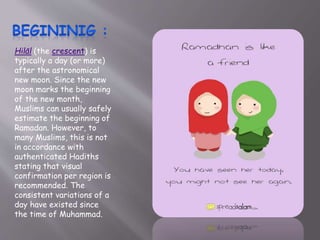
Ramadan is the ninth month of the Islamic calendar where Muslims fast from dawn to sunset. It commemorates the first revelation of the Quran to Muhammad. The end of Ramadan is marked by the holiday of Eid al-Fitr, where Muslims celebrate fasting successfully for a month and are permitted to eat and drink during the day again. Eid al-Fitr falls on the first day of Shawwal after sighting the new crescent moon and involves special prayers, acts of charity, greeting others, and showing forgiveness.

![I.Definition :
Ramadan (/ˌræməˈdɑːn/; Arabic: رمضان Ramaḍān, Persian: ضانَمَر Ramazān; Urdu:
ضانْمَر Ramzān; Turkish: Ramazan; Indonesian/Malay:Ramadan) is the ninth
month of the Islamic calendar;[2] Muslims worldwide observe this as a month
of fasting.[3][4] This annual observance is regarded as one of the Five Pillars of
Islam.[5] The month lasts 29–30 days based on the visual sightings of
the crescent moon, according to numerous biographical accounts compiled in
thehadiths.[6][7] The word Ramadan comes from the Arabic root ramiḍa or ar-
ramaḍ, which means scorching heat or dryness.[8] Fasting
is fardh ("obligatory") for adult Muslims, except those who are suffering from
an illness, travelling, are elderly, pregnant, breastfeeding, diabetic or going
through menstrual bleeding.[9] Fasting the month of Ramadan was made
obligatory (wājib) during the month of Sha'aban, in the second year after the
Muslims migrated from Mecca to Medina. Fatwas have been issued declaring
that Muslims who live in regions with natural phenomenon such as the midnight
sun or polar night should follow the timetable of Mecca.[10] While fasting from
dawn until sunset, Muslims refrain from consuming food, drinking liquids,
smoking, and engaging in sexual relations; in some interpretations, Muslims also
refrain from other behavior that could be perceived as sinful, such as
swearing, engaging in disagreements, backbiting and procrastination. Food and
drink is served daily, before dawn and after sunset.[11][12] Spiritual
rewards thawab for fasting are also believed to be multiplied within the month
of Ramadan.[13] Fasting for Muslims during Ramadan typically includes the
increased offering of salat (prayers) and recitation of the Quran.
](https://image.slidesharecdn.com/shaima-150509210214-lva1-app6892/85/Project-3-320.jpg)
![Laylat al-Qadr, which in Arabic
means "the night of power" or
"the night of decree", is
considered the holiest night of
the year.This is the night in
which Muslims believe the first
revelation of the Quran was sent
down to Muhammad stating that
this night was "better than one
thousand months [of proper
worship], as stated in Chapter
97:3 of the Qu'ran.
Also, generally, Laylat al-Qadr is
believed to have occurred on an
odd-numbered night during the
last ten days of Ramadan, i.e., the
night of the 21st, 23rd, 25th,
27th or 29th. The Dawoodi Bohra
Community believe that the 23rd
night is laylat al Qadr.](https://image.slidesharecdn.com/shaima-150509210214-lva1-app6892/85/Project-5-320.jpg)
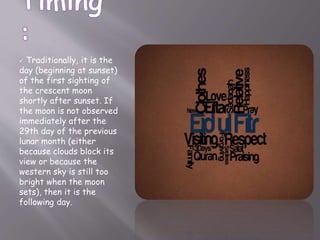
![The holiday of Eid al-
Fitr [(Arabic: الفطر عيد),( Bengali: ঈদুল
ফিতর), "festivity of breaking
the fast"] marks the end of
Ramadan and the beginning of the
next lunar month, Shawwal. This
first day of the following month
is declared after another
crescent new moon has been
sighted or the completion of 30
days of fasting if no visual
sighting is possible due to
weather conditions. This first day
of Shawwal is called Eid al-
Fitr. Eid al-Fitrmay also be a
reference towards the festive
nature of having endured the
month of fasting successfully and
returning to the more natural
disposition (fitra) of being able to
eat, drink and resume intimacy
with spouses during the day.](https://image.slidesharecdn.com/shaima-150509210214-lva1-app6892/85/Project-6-320.jpg)
![ Eid al-Fitr (Arabic: ألفطر عيدʻ Īd al-Fiṭr, IPA: [ʕiːd al fitˤr], "festival of breaking
of the fast"), also called Feast of Breaking the Fast, the Sugar
Feast, Bayram (Bajram), Festival[1] and the Lesser Eid, is an
important religious holiday celebrated by Muslims worldwide that marks the
end of Ramadan, the Islamic holy month offasting (sawm). The religious Eid is
a single day during which Muslims are not permitted to fast. The holiday
celebrates the conclusion of the 29 or 30 days of dawn-to-sunset fasting
during the entire month of Ramadan. The day of Eid, therefore, falls on the
first day of the month of Shawwal. The date for the start of any lunar
Hijri month varies based on the observation of new moon by local religious
authorities, so the exact day of celebration varies by locality. However, in
most countries, it is generally celebrated on the same day as Saudi Arabia. Eid
al-Fitr has a particular Salat (Islamic prayer) consisting of two Rakats (units)
and generally offered in an open field or large hall.[2] It may be performed only
in congregation (Jama’at) and, has an additional extra six Takbirs (raising of
the hands to the ears while saying "Allāhu Akbar", literally "God is greatest"),
three of them in the beginning of the first raka'ah and three of them just
before Ruku' in the second raka'ah in the Hanafi school of Sunni
Islam.[3] Other Sunni schools usually have twelve Takbirs, seven in the first,
and five at the beginning of the second raka'ah. This Eid al-Fitr salat is,
depending on which juristic opinion is
followed, Fard (obligatory),Mustahabb (strongly recommended, just short of
obligatory) or mandoob (preferable).
Muslims believe that they are commanded by Allah, as mentioned in the Quran,
to continue their fast until the last day of Ramadan[4] and pay
the Zakat and fitra before offering the Eid prayers.](https://image.slidesharecdn.com/shaima-150509210214-lva1-app6892/85/Project-7-320.jpg)
![ Before the advent of Islam in Arabia, there is mention of
festivals as well as some others among the Arabs. The
Israelites had festivals as well, but as is evident from the Old
Testament and other scriptures, these festivals related more
to commemorating certain days of their history.
Eid al-Fitr was originated by the Islamic prophet Muhammad.
It is observed on the first of the month of Shawwal at the
end of the month of Ramadan, during which Muslims undergo a
period of fasting.[6]
According to certain traditions, these festivals were initiated
in Madinah after the migration of Muhammad from
Mecca. Anas reports:
When the Prophet arrived in Madinah, he found people
celebrating two specific days in which they used to entertain
themselves with recreation and merriment. He asked them
about the nature of these festivities at which they replied
that these days were occasions of fun and recreation. At this,
the Prophet remarked that the Almighty has fixed two days
[of festivity] instead of these for you which are better than
these: Eid al-Fitr and Eid al-Adha[7]For Muslims, both the
festivals of Eid al-Fitr and Eid al-Adha are occasions for
showing gratitude to God and remembering Him, and are an
occasion of entertainment. ‘Aishah narrates that when on an
Eid day her father Abu Bakr stopped young girls from singing,
Muhammad said: Abu Bakr! [Let them sing]; every nation has an
‘id and [this day] is our Eid.](https://image.slidesharecdn.com/shaima-150509210214-lva1-app6892/85/Project-9-320.jpg)
![ Eid al-Fitr is celebrated for one, two or
three days. Common greetings during this
holiday are the Arabic greeting ‘Eid
Mubārak ("Blessed Eid") or ‘Eid Sa‘īd ("Happy
Eid"). In addition, many countries have their
own greetings in the local language – in
Turkey, for example, a typical saying might
be Bayramınız kutlu olsun or "May
your Bayram – Eid – be blessed." Muslims are
also encouraged on this day to forgive and
forget any differences with others or
animosities that may have occurred during
the year.
Typically, practicing Muslims wake up early in
the morning—always before sunrise— offer
Salatul Fajr (the pre-sunrise prayer), and in
keeping with the traditions of the Prophet
Muhammad clean their teeth with a
toothbrush, take a shower before prayers,
put on new clothes (or the best available), and
apply perfume.[8]
It is forbidden to fast on the Day of
Eid.[9] It is customary to acknowledge this
with a small sweet breakfast, preferably of
date (fruit), before attending a special Eid
prayer (known as salaat).
](https://image.slidesharecdn.com/shaima-150509210214-lva1-app6892/85/Project-10-320.jpg)
![As an obligatory act of charity, money is paid
to the poor and the needy (Arabic: Sadaqat-
ul-fitr) before performing the ‘Eid
prayer.[10] The following list contains some
general rituals:
•To show happiness
•To give as much charity as is possible
•To pray Fajr in the local Masjid
•To go early for Eid salaat
•To read the takbirat in an open field.
•Go to the Eid prayer on foot
•Do not speak one word other than words
that remember Allah or anything Islamic
terms before and after Eid Salaat. You can
speak once you've left the Masjid,
or Mosque or any other place you were
praying
•Say Eid Mubarak to other Muslims
•Muslims recite the following incantation in a
low voice while going to the Eid
prayer: Allāhu Akbar, Allāhu Akbar, Allāhu
Akbar. Lā ilāha illà l-Lāh wal-Lāhu akbar,
Allahu akbar walil-Lāhi l-ḥamd. Recitation
ceases when they get to the place of Eid or
once the Imam commences activities.[11]
•Muslims are recommended to use separate
routes to and from the prayer grounds.[12]](https://image.slidesharecdn.com/shaima-150509210214-lva1-app6892/85/Project-11-320.jpg)
![As an obligatory act of charity, money is paid to
the poor and the needy (Arabic: Sadaqat-ul-fitr)
before performing the ‘Eid prayer.[10] The
following list contains some general rituals:
To show happiness
To give as much charity as is possible
To pray Fajr in the local Masjid
To go early for Eid salaat
To read the takbirat in an open field.
Go to the Eid prayer on foot
Do not speak one word other than words that
remember Allah or anything Islamic terms before
and after Eid Salaat. You can speak once you've
left the Masjid, or Mosque or any other place you
were praying
Say Eid Mubarak to other Muslims
Muslims recite the following incantation in a low
voice while going to the Eid prayer: Allāhu Akbar,
Allāhu Akbar, Allāhu Akbar. Lā ilāha illà l-Lāh wal-
Lāhu akbar, Allahu akbar walil-Lāhi l-ḥamd.
Recitation ceases when they get to the place of
Eid or once the Imam commences activities.[11]
Muslims are recommended to use separate routes
to and from the prayer grounds.[12]
Women are encouraged to join Salat of Eid](https://image.slidesharecdn.com/shaima-150509210214-lva1-app6892/85/Project-12-320.jpg)


![Muslim festivals[slideshare]](https://cdn.slidesharecdn.com/ss_thumbnails/muslimfestivalsslideshare-101124100137-phpapp01-thumbnail.jpg?width=640&height=640&fit=bounds)


