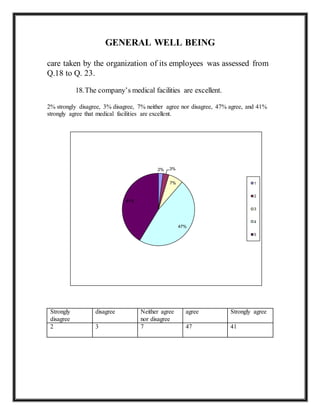
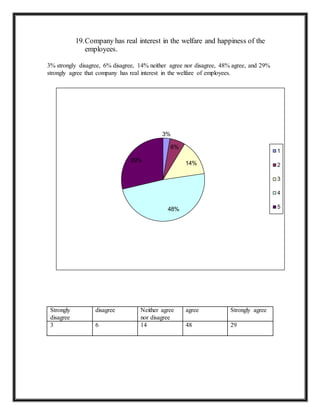
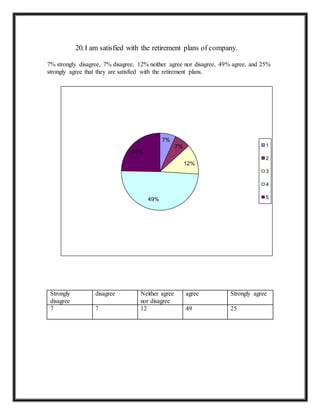
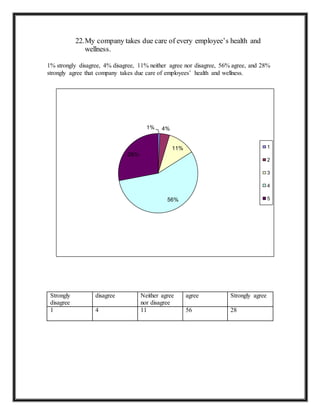
A
PR OJ E C T R E POR T
On
“ANALYTICAL STUDY ON
QUALITY OF WORK LIFE”
IN
“PAROVI SYSTEM PVT. LTD”
Subm i tted by :
GAURAV KUMAR
(Enroll. no. 01696988813)
In partial fulfillment of the requirement
For the award of degree
Of
Bache lor In Comme rc e (H onor s )
Under Supervisio n of:
Ms. GUNJAN BUDHLANI
SANT HARI DASS COLLEGE OF HIGHER EDUCATION
Bani Camp , Najafgarh, New Delhi-110045
(Affiliated To Guru Gobind Singh Indraprastha University)
SANT HARI DASS COLLEGE OF HIGHER EDUCATION
(Affiliated to: Guru Gobind Singh indraprasth University, Delhi )
Bani camp, Najafgarh New Delhi - 110043
TO WHOMSOVER IT MAY COCERN
This is certifying that Mr. / Miss.......................................................................
a student ofB.COM (hons.) fifth semester, has done his / her summer training
Project at................................... from ................................ to
............................
The project entitled “.............................................................................”
Embodies the original work doneby him / her for the partial fulfillment ofthe
Award of the B.COM (hons.) degree.
I wish him all the best for his / her future endeavor.
Project guide
PERFORMANCE APPRAISAL
Summer Training
Student’s Name:
Programme:
You are requested to provide your opinion on the following parameters.
Outstanding Good Satisfactory
Unsatisfactory
A B C D
1. Technical knowledge gathered about the industry and the job he/she was involved.
2. Communication Skills: Oral / Written / Listening skills
3. Ability to work in a team
4. Ability to take initiative
5. Ability to develop a healthy long term relationship with client
6. Ability to relate theoretical learning to the practical training
7. Creativity and ability to innovate with respect to work methods & procedures
8. Ability to grasp new ideas and knowledge
9. Presentations skills
10. Documentation skills
11. Sense of Responsibility
12. Acceptability (patience, pleasing manners, the ability to instill trust, etc.)
13. His/her ability and willingness to put in hard work
14. In what ways do you consider the student to be valuable to the organization?
Consider the student’s value in term of: (a) Qualification
(b) Skills and abilities
(c) Activities/ Roles performed
15. Punctuality
Any other
comments_____________________________________________________.
Assessor’s Overall rating
Assessor’s Name:
Designation:
Organization name and address:
Email id/ Contact No:
Acknowledgement
It gives me immense pleasure to present this report a written testimony of a very rewarding
practical experience. Firstly, I would like to thank PAROVI SYSTEM for allowing me to
carry out the project in the organization.
Any project cannot succeed without the help and guidance of the Teachers, guides and
mentors. This one is no exception. I extend my heartfelt gratitude to my mentor without
whom the project would not have been a success. His guidance and counseling helped me
at each phase of the project.
I am indebted to all the respondents who took out time from their busy schedule and filled
my questionnaire, gave valuable insights and suggestions, leading to the successful
completion of the project.
Last but not the least; I shall fail in my duty, if I don’t thank all those concerned people
who have directly or indirectly contributed in the completion of this entire Summer
Internship Project.
GAURAV KUMAR
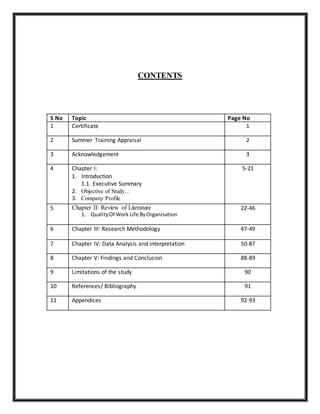
CONTENTS
S No Topic Page No
1 Certificate 1
2 Summer Training Appraisal 2
3 Acknowledgement 3
4 Chapter I:
1. Introduction
1.1. Executive Summary
2. Objective of Study…
3. Company Profile
5-21
5 Chapter II: Review of Literature
1. QualityOf Work Life ByOrganisation
22-46
6 Chapter III: Research Methodology 47-49
7 Chapter IV: Data Analysis and interpretation 50-87
8 Chapter V: Findings and Conclusion 88-89
9 Limitations of the study 90
10 References/ Bibliography 91
11 Appendices 92-93
CHAPTER- 1
INTRODUCTION
INTRODUCTION ABOUT THE STUDY
EXECUTIVE SUMMARY
This project aims at studying quality of work life at PAROVI SYSTEM Pvt. Ltd. This
project contains five chapters.
.
 The first chapter contains the introduction including objectives of the study and
copany profile.
 Second chapter Literature Review contains information about the quality of work
life- The aim of QWL is to respond to employee needs for developing
mechanisms to allow them to share fully in making the decisions that design
their lives at work. QWL can be defined as "The quality of relationship between
employees and the total working environment within an organization.” Quality of
Working Life is a term that had been used to describe the broader job-related
experience an individual has.
 Third chapter is the research methododlogy which contain scope of the study and
research design.
 The forth chapter is the analysis and interpretation, which is shown with the help
of pie charts.
 Fifth chapter may contain the project findings,limitation and conclusion and at last
bibliography and annexure.
The data has been collected by the researcher using questionnaire and it has been
analyzed.
OBJECTIVES OF STUDY:
a. To assess the Job satisfaction among employees.
b. To assess the General Well Being care taken by company of the employees.
c. To assess the work stress experienced by employees during work.
d. To assess the work life balances of the employees.
e. To assess the working environment.
COMPANY
PROFILE
INTRODUCTION
 TYPE : WIRE MANUFACTURING
MACHINES PROVIDER.
 AVAILABILITY : COUNTRY WIDE
 OWNER : MR. VINEET SACHDEVA
 KEY PEOPLE : CHAIRMAN & DIRECTOR-
Mr. VINEET
 FOUNDED : In year 1994
 WEBSITE : WWW. PAROVI SYSTEM. COM
 OVERVIEW OF THE PAROVI SYSTEM
Parovi system is the largest wire manufacturing machines and tools Provider
that are used in manufacturing ofwire. Parovi systemhas good Customer base
it has footprints throughout the India .The customers of parovi Systems are
increase day by day and the parovi system establishes a well goodwill in
market. Today the parovi system is the India's one of the fastest growing
company by increasing their sales and by making good customer base the
company has well authorized capital after the foundation ofparovi system the
company brings various new technology in wire manufacturing sector in
Indian market. The machines or tools which is provided by parovi system
increase the productivity because the machines are new in technology to
comparewith old machines which are present in Indian market parovisystem
also trade at global level or in international market also. The parovi system
import their machines and tools from china and sell in Indian market.
 PROFILE OF ORGANIZATION
 over view of organization
History:
‘Parovi Systems’ is a total technical solution provider for cable and wire
industry. We are helping the manufacturers of cables and wires to upgrade
their production line by providing ‘State-of-the-art’ machinery and
accessories. Using the machines and accessories provided by ‘Parovi
Systems’, not only the production cost is reduced considerably but also the
quality ofthe productis enhanced. Parovi Systems has gained a well-deserved
reputation in the Indian market since it’s founding in 1994. Parovi Systems is
providing the Indian wire & cable industry with the highest quality & most
cost effective equipment, consulting, training & service to achieve the
optimum in production performance.
We guarantee one hundred percent customer satisfaction through
properequipment selection, unsurpassed after sales service & prompt
technical support.
Parovi Systems is proud to present the latest advances in wire drawing,
annealing, bunching & cable printing that have made us the leader in Indian
market. We have taken decisive steps into the future of non-ferrous wire &
cable processing by offering dependable local manufacturing capability &
customerservice, leading-edge technology & state-of-the-art quality levels for
our machinery & turn-key systems.
An extensive Customer Service department offers assistance from the Delhi
facilities to the customers all over the country. Our Engineering Department
supports customers’ special requests and answers their particular needs and
demands. Our Resident Service Engineers handle new equipment
commissioning, customers’ personnel training, and equipment
troubleshooting as well preventive and defective maintenance support. In
addition to the demonstration equipment, Parovi Systems also stocks most
commonly used spare parts that are available for immediate delivery.
Competent staff supports our customers in identifying and supplies the
required spare parts. Our advanced remote diagnostic capabilities, via
telephone modems designed into the equipment’s electrical controls, allow for
quick and precise troubleshooting.
Parovi Systems’ products include single and multi-wire drawing machines,
automatic pack coilers for bare, plated and insulated wire, ultra fine wire
drawing machines, continuous resistance annealers, spoolers, re-spoolers,
coilers, double twist bunching machines, extruding machines, laser dia
controllers, bunchers, cutting and stripping machines, printing machines and
printing accessories (Ink, printing wheels etc.), loader and hoppers, crushers,
cold weld tools, lubricant supply and filtration systems, and automation of all
wire productionprocesses. The companyis capable of supplying one hundred
percent turnkey production systems in India.
We are unique in many aspects:
 ‘Parovi Systems’ is a Total Technical Solution Provider for wire and
cable manufacturers.
 ‘Parovi Systems’ offers ready stock of all range of machines and
accessories it offers.
 ‘Parovi Systems’ provides After-Sales-Service backup for the
machines and accessories.
MAIN PRODUCT OR SERVICES BY PAROVI SYSTEM
Parovi system provided almost every machines and tools which are required
in the manufacturing of wires.
 WIRE DRAWING MACHINE
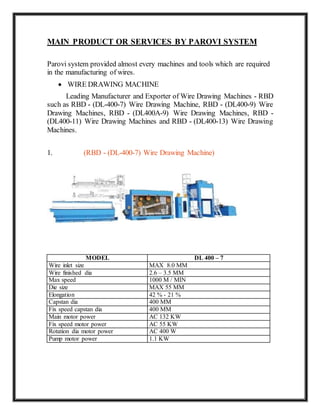
Leading Manufacturer and Exporter of Wire Drawing Machines - RBD
such as RBD - (DL-400-7) Wire Drawing Machine, RBD - (DL400-9) Wire
Drawing Machines, RBD - (DL400A-9) Wire Drawing Machines, RBD -
(DL400-11) Wire Drawing Machines and RBD - (DL400-13) Wire Drawing
Machines.
1. (RBD - (DL-400-7) Wire Drawing Machine)
MODEL DL 400 – 7
Wire inlet size MAX 8.0 MM
Wire finished dia 2.6 – 3.5 MM
Max speed 1000 M / MIN
Die size MAX 55 MM
Elongation 42 % - 21 %
Capstan dia 400 MM
Fix speed capstan dia 400 MM
Main motor power AC 132 KW
Fix speed motor power AC 55 KW
Rotation dia motor power AC 400 W
Pump motor power 1.1 KW
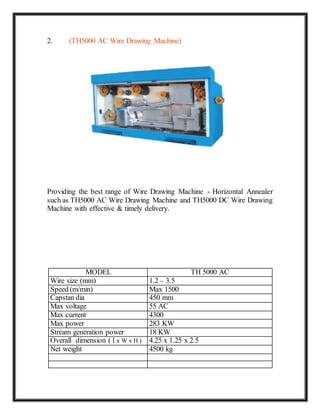
2. (TH5000 AC Wire Drawing Machine)
Providing the best range of Wire Drawing Machine - Horizontal Annealer
such as TH5000 AC Wire Drawing Machine and TH5000 DC Wire Drawing
Machine with effective & timely delivery.
MODEL TH 5000 AC
Wire size (mm) 1.2 – 3.5
Speed (m/min) Max 1500
Capstan dia 450 mm
Max voltage 55 AC
Max current 4300
Max power 283 KW
Stream generation power 18 KW
Overall dimension ( l x W x H ) 4.25 x 1.25 x 2.5
Net weight 4500 kg
3. (WF800 Wire Drawing Machine)
Our range of products includes Wire Drawing Machines - Coiler Machines
such as WF800 Wire Drawing Machine and WF650 Wire Drawing Machine.
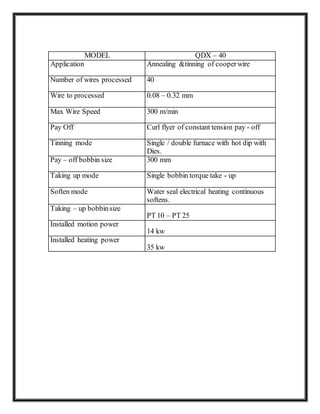
 ( QDX 40 Annealing and Tinning Machine )
Our range of products include - Annealing and
Tinning machines such as QDX 40 Annealing and Tinning Machine.
MODEL WF 800
Wire size (mm) 1.2 – 4.0
Speed (m/min) Max 1200
Coiler dia (min) 800 mm
Taking – up stand size 580 x 1050 x 1600
Taking – up stand capacity Max 1800 kg
Coiler motor power AC 15 kw
Spooling motor power 0.75 kw
Overall dimension (L x W x H ) 4.28 x 3.8 x 4.55 M
Net weight 5000 kg
MODEL QDX – 40
Application Annealing &tinning of cooperwire
Number of wires processed 40
Wire to processed 0.08 – 0.32 mm
Max Wire Speed 300 m/min
Pay Off Curl flyer of constant tension pay - off
Tinning mode Single / double furnace with hot dip with
Dies.
Pay – off bobbin size 300 mm
Taking up mode Single bobbin torque take - up
Soften mode Water seal electrical heating continuous
softens.
Taking – up bobbinsize
PT 10 – PT 25
Installed motion power
14 kw
Installed heating power
35 kw
 Parovi system present & future
Since its corporatisation in 1994. parovi system has been actively providing
machines in India and outside India efficiency of the company has drastically
improved from the days when the company started parovi system also
unveiled very cost effective machines which are used in wire manufacturing
industry the target of parovi system are small and big wire manufacturer all
over in country.
The future parovi system is bright because the client are satisfied from the
services provided by the parovi system and the customers of parovi system
is increasing to compare with some previous year in future the parovi system
brings new technology for wire manufacturer in India to make wire in
effective and efficient way. In future the parovi system increases their
customer care services to provide satisfaction to their customer so, the future
of parovi system is bright but there are some challenges in future also.
Challenges:
Presently there is an intense competition in Indian wire industry sector and
various other companies are rolling out attractive schemes and other pro-
grammes that attract customers although in recent past there have been
tremendous improvement in working of parovi system but still it is much
below the industry expectations.
The main challenge is increasing competition in Indian market and to
complete this challenges the parovi system increase their customer care
services and make effective objectives to fulfill the future needs of wire
manufacturer.
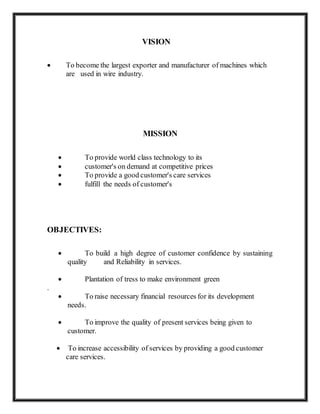
VISION
 To become the largest exporter and manufacturer of machines which
are used in wire industry.
MISSION
 To provide world class technology to its
 customer's on demand at competitive prices
 To provide a good customer's care services
 fulfill the needs of customer's
OBJECTIVES:
 To build a high degree of customer confidence by sustaining
quality and Reliability in services.
 Plantation of tress to make environment green
.
 To raise necessary financial resources for its development
needs.
 To improve the quality of present services being given to
customer.
 To increase accessibility of services by providing a good customer
care services.
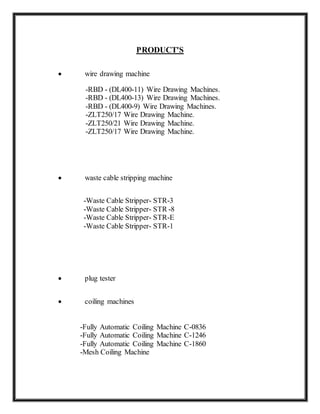
PRODUCT'S
 wire drawing machine
-RBD - (DL400-11) Wire Drawing Machines.
-RBD - (DL400-13) Wire Drawing Machines.
-RBD - (DL400-9) Wire Drawing Machines.
-ZLT250/17 Wire Drawing Machine.
-ZLT250/21 Wire Drawing Machine.
-ZLT250/17 Wire Drawing Machine.
 waste cable stripping machine
-Waste Cable Stripper- STR-3
-Waste Cable Stripper- STR -8
-Waste Cable Stripper- STR-E
-Waste Cable Stripper- STR-1
 plug tester
 coiling machines
-Fully Automatic Coiling Machine C-0836
-Fully Automatic Coiling Machine C-1246
-Fully Automatic Coiling Machine C-1860
-Mesh Coiling Machine
 high speed extruder's line
-High Speed Extruder Line - Building Wire
-Teflon Extruder's
-Auxiliary/ Pilot Extruder's
-Electrical and Electronic Wire Extrusion Line
-3 Layer Winding Wire Extruder Line
-Industrial and Power Cable Extruder's
 cold weld tools and dies
-Hand Held Cold Welder-PD-10
-Hand Held Cold Welder-PD 2
-Bench Cold Welder- P2-B
-Cold Weld ToolDies
-Cold Weld ToolDies
 waste grinder crusher
-Waste Grinder CD-180-E
-Waste Grinder CD-250-E
 hopper dryer
-Hopper Drier PA-HD25
-Hopper Dryer PA-HD50
-Hopper Dryer PA-HD100
-Hopper Dryer PA-HD150
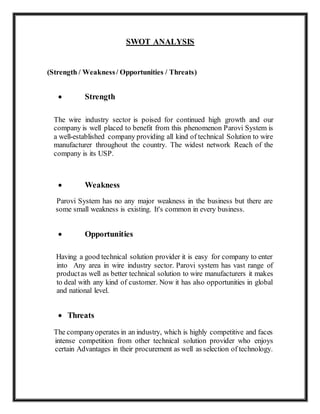
SWOT ANALYSIS
(Strength / Weakness/ Opportunities / Threats)
 Strength
The wire industry sector is poised for continued high growth and our
company is well placed to benefit from this phenomenon Parovi System is
a well-established company providing all kind of technical Solution to wire
manufacturer throughout the country. The widest network Reach of the
company is its USP.
 Weakness
Parovi System has no any major weakness in the business but there are
some small weakness is existing. It's common in every business.
 Opportunities
Having a good technical solution provider it is easy for company to enter
into Any area in wire industry sector. Parovi system has vast range of
productas well as better technical solution to wire manufacturers it makes
to deal with any kind of customer. Now it has also opportunities in global
and national level.
 Threats
The companyoperates in an industry, which is highly competitive and faces
intense competition from other technical solution provider who enjoys
certain Advantages in their procurement as well as selection of technology.
CHAPTER-2
REVIEW OF
LITERATURE
QUALITY OF WORK
LIFE
QUALITY OF WORK LIFE
QWL can be defined as "The quality of relationship between employees and the total
working environment within an organization.” Quality of Working Life is a term that had
been used to describe the broader job-related experience an individual has.
According to J Richard and J Loy QWL is “The degree to which members of a work
organization are able to satisfy important personnel needs through their experience in the
organization.”
The aim of QWL is to respond to employee needs for developing mechanisms to allow
them to share fully in making the decisions that design their lives at work. Quality of
work life (QWL) is viewed as an alternative to the control approach of managing people.
The QWL approach considers people as an ‘asset' to the organization rather than as ‘costs'.
It believes that people perform better when they are allowed to participate in managing
their work and make decisions.
Quality of Work Life (QWL) is both a goal and an on-going process for achieving it. As a
goal, QWL is the commitment of any organization to work improvement — the creation
of more involving, satisfying and effective jobs and work environment for people at all
levels of the organization. As a process, QWL calls for efforts to realiZE this goal through
the active involvement of people throughout the organization. It may help to think of QWL
as an umbrella concept that encompasses literally dozens of specific interventions that have
a common goal of humanizing the work place. The safe work environment provides the
basis for the person to enjoy working. The work should not pose a health hazard for the
person. The employer and employee, aware of their risks and rights, could achieve a lot in
their mutually beneficial dialogue.
Work represents such a role in life which has been designated to it by the person himself.
On the one hand work is an earning of one’s living for the family, on the other hand it could
be a self-realization providing enjoyment and satisfaction.
This approach motivates people by satisfying not only their economic needs but also their
social and psychological ones. To satisfy the new generation workforce, organizations need
to concentrate on job designs and organization of work. Further, today's workforce is
realizing the importance of relationships and is trying to strike a balance between career
and personal lives.
Successful organizations support and provide facilities to their people to help them to
balance the scales. In this process, organizations are coming up with new and innovative
ideas to improve the quality of work and quality of work life of every individual in the
organization. Various programs like flex time, alternative work schedules, compressed
work weeks, telecommuting etc., are being adopted by these organizations.
Technological advances further help organizations to implement these programs
successfully. Organizations are enjoying the fruits of implementing QWL programs in the
form of increased productivity, and an efficient, satisfied, and committed workforce which
aims to achieve organizational objectives. The future work world will also have more
women entrepreneurs and they will encourage and adopt QWL programs. It is a process to
identify and implement alternative programs to improve the quality of professional as well
as personal life of an organization’s employees.
QWL HISTORICAL BACKGROUND
Various authors and researchers have proposed models of Quality of working life which
include a wide range of factors. Selected models are reviewed below.
Hackman and Oldham (1976) drew attention to what they described as psychological
growth needs as relevant to the consideration of Quality of working life. Several such needs
were identified; Skill variety, Task Identity, Task significance, Autonomy and Feedback.
They suggested that such needs have to be addressed if employees have to experience high
quality of working life.
In contrast to such theory based models, Taylor (1979) more pragmatically identified the
essential components of Quality of working life as; basic extrinsic job factors of wages,
hours and working conditions, and the intrinsic job notions of the nature of the work itself.
He suggested that a number of other aspects could be added, including; individual power,
employee participation in the management, fairness and equity, social support, use of one’s
present skills, self-development, a meaningful future at work, social relevance of the work
or product, effect on extra work activities. Taylor suggested that relevant Quality of
working life concepts may vary according to organization and employee group.
Warr and colleagues (1979), in an investigation of Quality of working life, considered a
range of apparently relevant factors, including work involvement, intrinsic job motivation,
higher order need strength, perceived intrinsic job characteristics, job satisfaction, life
satisfaction, happiness, and self-rated anxiety. They discussed a range of correlations
derived from their work, such as those between work involvement and job satisfaction,
intrinsic job motivation and job satisfaction, and perceived intrinsic job characteristics and
job satisfaction. In particular, War found evidence for a moderate association between total
job satisfaction and total life satisfaction and happiness, with a less strong, but significant
association with self-rated anxiety.
Thus, whilst some authors have emphasized the workplace aspects in Quality of working
life, others have identified the relevance of personality factors, psychological well being,
and broader concepts of happiness and life satisfaction.
Factors more obviously and directly affecting work have, however, served as the main
focus of attention, as researchers have tried to tease out the important influences on Quality
of working life in the workplace.
Mirvis and Lawler (1984) suggested that Quality of working life was associated with
satisfaction with wages, hours and working conditions, describing the “basic elements of a
good quality of work life” as; safe work environment, equitable wages, equal employment
opportunities and opportunities for advancement.
Baba and Jamal (1991) listed what they described as typical indicators of quality of
working life, including: job satisfaction, job involvement, work role ambiguity, work role
conflict, work role overload, job stress, organizational commitment and turn-over
intentions. Baba and Jamal also explored routinisation of job content, suggesting that this
facet should be investigated as part of the concept of quality of working life.
Some have argued that quality of working life might vary between groups of workers. For
example, Ellis and Pompli (2002)(10) identified a number of factors contributing to job
dissatisfaction and quality of working life in nurses, including: Poor working
environments, Resident aggression, Workload, Unable to deliver quality of care preferred,
Balance of work and family, Shiftwork, Lack of involvement in decision making,
Professional isolation, Lack of recognition, Poor relationships with supervisor/peers, Role
conflict, Lack of opportunity to learn new skills.
Sirgy; (2001)(11) suggested that the key factors in quality of working life are: Need
satisfaction based on job requirements, Need satisfaction based on Work environment,
Need satisfaction based on Supervisory behavior, Need satisfaction based on Ancillary
programmers, Organizational commitment. They defined quality of working life as
satisfaction of these key needs through resources, activities, and outcomes stemming from
participation in the workplace. Maslow’s needs were seen as relevant in underpinning this
model, covering Health & safety, Economic and family, Social, Esteem, Actualization,
Knowledge and Aesthetics, although the relevance of non-work aspects is play down as
attention is focused on quality of work life rather than the broader concept of quality of
life.
These attempts at defining quality of working life have included theoretical approaches,
lists of identified factors, correlation analyses, with opinions varying as to whether such
definitions and explanations can be both global, or need to be specific to each work setting.
Bearfield, (2003) used 16 questions to examine quality of working life, and distinguished
between causes of dissatisfaction in professionals, intermediate clerical, sales and service
workers, indicating that different concerns might have to be addressed for different groups.
The distinction made between job satisfaction and dissatisfaction in quality of working life
reflects the influence of job satisfaction theories. Herzberg at al., (1959) used “Hygiene
factors” and “Motivator factors” to distinguish between the separate causes of job
satisfaction and job dissatisfaction. It has been suggested that Motivator factors are intrinsic
to the job, that is; job content, the work itself, responsibility and advancement. The Hygiene
factors or dissatisfaction-avoidance factors include aspects of the job environment such as
interpersonal relationships, salary, working conditions and security. Of these latter, the
most common cause of job dissatisfaction can be company policy and administration,
whilst achievement can be the greatest source of extreme satisfaction.
An individual’s experience of satisfaction or dissatisfaction can be substantially rooted in
their perception, rather than simply reflecting their “real world”. Further, an individual’s
perception can be affected by relative comparison – am I paid as much as that person - and
comparisons of internalized ideals, aspirations, and expectations, for example, with the
individual’s current state (Lawler and Porter, 1966.
In summary, where it has been considered, authors differ in their views on the core
constituents of Quality of Working Life (e.g. Sirgy, Efraty, Siegel & Lee, 2001 and Warr,
Cook & Wall, 1979).
It has generally been agreed however that Quality of Working Life is conceptually similar
to well-being of employees but differs from job satisfaction which solely represents the
workplace domain (Lawler, 1982).
Quality of Working Life is not a unitary concept, but has been seen as incorporating a
hierarchy of perspectives that not only include work-based factors such as job satisfaction,
satisfaction with pay and relationships with work colleagues, but also factors that broadly
reflect life satisfaction and general feelings of well-being (Danna & Griffin, 1999). More
recently, work-related stress and the relationship between work and non-work life domains
(Loscocco & Roschelle, (1991) have also been identified as factors that should
conceptually be included in Quality of Working Life.
MEASUREMENT
There are few recognized measures of quality of working life, and of those that exist few
have evidence of validity and reliability, that is, there is a very limited literature based on
peer reviewed evaluations of available assessments. A recent statistical analysis of a new
measure, the Work-Related Quality of Life scale (WRQoL), indicates that this assessment
device should prove to be a useful instrument, although further evaluation would be useful.
The WRQoWL measure uses 6 core factors to explain most of the variation in an
individual’s quality of working life: Job and Career Satisfaction; Working Conditions;
General Well-Being; Home-work interface; Stress at Work and Control at Work.
The Job & Career Satisfaction Job and Career satisfaction scale of the Work-Related
Quality of Life scale is said to reflect an employee’s feelings about, or evaluation of, their
satisfaction or contentment with their job and career and the training they receive to do it.
Within the WRQoL measure, JCS is reflected by questions asking how satisfied people
feel about their work. It has been proposed that this Positive Job Satisfaction factor is
influenced by various issues including clarity of goals and role ambiguity, appraisal,
recognition and reward, personal development career benefits and enhancement and
training needs.
The General well-being scale of the Work-Related Quality of Life scale (WRQoL), aims
to assess the extent to which an individual feels good or content in themselves, in a way
which may be independent of their work situation. It is suggested that general well-being
both influences, and is influenced by work. Mental health problems, predominantly
depression and anxiety disorders, are common, and may have a major impact on the general
well-being of the population. The WRQoL factor assesses issues of mood, depression and
anxiety, life satisfaction, general quality of life, optimism and happiness.
The WRQoL Stress at Work sub-scale reflects the extent to which an individual
perceives they have excessive pressures, and feel stressed at work. The WRQoL SAW
factor is assessed through items dealing with demand and perception of stress and actual
demand overload. Whilst it is possible to be pressured at work and not be stressed at work,
in general, high stress is associated with high pressure.
The Control at Work subscale of the WRQoL scale addresses how much employees feel
they can control their work through the freedom to express their opinions and being
involved in decisions at work. Perceived control at work as measured by the Work-Related
Quality of Life scale (WRQoL) is recognized as a central concept in the understanding of
relationships between stressful experiences, behaviour and health. Control at work, within
the theoretical model underpinning the WRQoL, is influenced by issues of communication
at work, decision making and decision control.
The WRQoL Home-Work Interface scale measures the extent to which an employer is
perceived to support the family and home life of employees. This factor explores the
interrelationship between home and work life domains. Issues that appear to influence
employee HWI include adequate facilities at work, flexible working hours and the
understanding of managers.
The Working Conditions scale of the WRQoL assesses the extent to which the employee
is satisfied with the fundamental resources, working conditions and security necessary to
do their job effectively. Physical working conditions influence employee health and safety
and thus employee Quality of working life. This scale also taps into satisfaction with the
resources provided to help people do their jobs.
FOR HR STRATEGY
As far as HR involvement is concerned, there needs to be a time and place to hear people’s
needs. Be interested in their lives away from work. EX: Be aware of anniversaries,
birthdays, births of babies, illnesses in the family and more. (Sending cards or
announcements on bulletin boards.) People want to be appreciated and noticed. Giving
people time to attend important events in their life away from work will have a positive
effect on them as well as the business. As a company gives attention to this the employee
is more willing to work smarter keeping in mind that the company cares about me and that
they should care about the company. While making sure that the employee has enough time
to meet his social requirement, the quality of life at the work place itself can be improved
through simple HR initiatives. For instance - arranging short trips or annual sports events
etc. This would let the employee take-off his mind from work for once and enjoy himself
with his colleagues. It’ll also be a good team building exercise. Again, introducing
performance rewards and giving of monetary benefits like insurances, medical
reimbursement, and schemes for family will also help motivate an employee to perform
better. The better your HR policies are, lesser will be your attrition rate. In fact, if HR
practices offer a good quality of life to employees, it should always publicize. There are
many institutes giving HR awards. You can apply to them and get you company’s HR
policies recognized. Eg: SAIL’s HR excellence award.
 JOB SATISFACTION
Job satisfaction has been defined as a pleasurable emotional state resulting from the
appraisal of one’s job; an affective reaction to one’s job; and an attitude towards
one’s job.
Weiss (2002) has argued that job satisfaction is an attitude but points out that researchers
should clearly distinguish the objects of cognitive evaluation which are affect (emotion),
beliefs and behaviors.
Job satisfaction describes how content an individual is with his or her job. There are a
variety of factors that can influence a person's level of job satisfaction; some of these
factors include the level of pay and benefits, the perceived fairness of the promotion system
within a company, the quality of the working conditions, leadership and social
relationships, and the job itself (the variety of tasks involved, the interest and challenge the
job generates, and the clarity of the job description/requirements.
Two-Factor Theory (Motivator-Hygiene Theory)
Frederick Herzberg’s two factor theory (also known as Motivator Hygiene Theory)
attempts to explain satisfaction and motivation in the workplace. This theory states that
satisfaction and dissatisfaction are driven by different factors – motivation and hygiene
factors, respectively. Motivating factors are those aspects of the job that make people want
to perform, and provide people with satisfaction, for example achievement in work,
recognition, promotion opportunities. These motivating factors are considered to be
intrinsic to the job, or the work carried out. Hygiene factors include aspects of the working
environment such as pay, company policies, supervisory practices, and other working
conditions. Furthermore, the theory does not consider individual differences, conversely
predicting all employees will react in an identical manner to changes in motivating/hygiene
factors.
 WORK LIFE BALANCE
Work life and personal life are the two sides of the same coin.
Sometimes employees have to make tough choices even when their work and personal life.
Traditionally creating and managing a balance between the work-life was considered to be
a woman's issue. But increasing work pressures, globalization and technological
advancement have made it an issue with both the sexes.
Work life and personal life are inter-connected and interdependent. Spending more time in
office, dealing with clients and the pressures of job can interfere and affect the personal
life, sometimes making it impossible to even complete the household chores. Work-
personal life conflict occurs when the burden, obligations and responsibilities of work and
family roles become incompatible. Obligation of one can force an individual to neglect the
other.
Changing & increasing work pressures
Now professionals find themselves working even when they are on vacations.
The ever-increasing working hours leave the individuals with less time for themselves and
to pursue his hobbies or leisure activities. This hinders the growth of the person as an
individual in terms of his personal and spiritual growth.
Reasons of imbalance
There are various reasons for this imbalance and conflicts in the life of an employee.
Individual career ambitions
Pressure to cope up with family or work
The speed of advancement of information technology
The increasing competition in the talent supply market
"Performance-Driven" culture creates pressures
Effects
Constant struggle and effort to maintain a balance between the work and personal life can
have serious implications on the life of an individual. The pressures of the work or personal
life can lead to stress which can take a toll on the person's health both physiologically and
psychologically. Heart ailments, cardiovascular problems, sleep disorders, depression,
irritability, jumpiness, insecurity, poor concentration and even nervous breakdowns are
becoming common among the victims of such imbalance. Pressure, stress or tension in
work life can lead to bad social life and vice versa
Balancing life and wok assumes relevance when both husband and wife are employed.
Travails of a working housewives are more than a working husband. Work life balance is
becoming a major challenge for them as more women are taking up jobs to add to finances
of their families or to become careerists. The number is growing as more girls are coming
out of colleges and universities with degrees in their hands.
Organizations should undertake work-life balance programmes, as in their absence men
and women will be exposed to stress, depression and anxiety. Programmes aiming at work-
life balance includes the following:
• Childcare at or near the workplace.
• Job sharing
• Care for sick children and employees
• On-site summer camp
• Training supervisors to respond to work and family needs of employees
• Flexible working schedules
• Sick leave policies
• Variety of errands from dry cleaning, dropping children at schools, making dinner
reservations and the like.
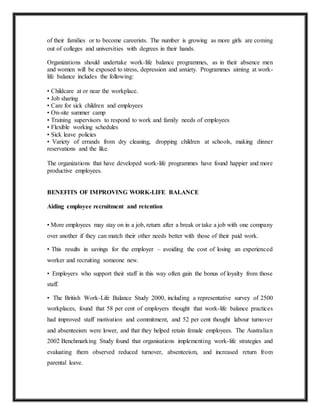
The organizations that have developed work-life programmes have found happier and more
productive employees.
BENEFITS OF IMPROVING WORK-LIFE BALANCE
Aiding employee recruitment and retention
• More employees may stay on in a job, return after a break or take a job with one company
over another if they can match their other needs better with those of their paid work.
• This results in savings for the employer – avoiding the cost of losing an experienced
worker and recruiting someone new.
• Employers who support their staff in this way often gain the bonus of loyalty from those
staff.
• The British Work-Life Balance Study 2000, including a representative survey of 2500
workplaces, found that 58 per cent of employers thought that work-life balance practices
had improved staff motivation and commitment, and 52 per cent thought labour turnover
and absenteeism were lower, and that they helped retain female employees. The Australian
2002 Benchmarking Study found that organisations implementing work-life strategies and
evaluating them observed reduced turnover, absenteeism, and increased return from
parental leave.
Reducing absenteeism
• Many companies that have introduced family-friendly or flexible working practices have
seen benefits through reductions in absenteeism. Sickness rates may fall as pressures are
managed better, while employees may have better methods of dealing with work-life
conflicts than taking unplanned leave.
• Workers (including their managers) who are healthy and not over-stressed may be more
efficient.
Improving the quality of people's working lives
• Minimizing work-life role conflict can help prevent role overload and help people have a
more satisfying working life, fulfilling their potential both in paid work and outside it.
• Work life balance can minimize stress and fatigue at work, enabling people to have safer
and healthier working lives. Workplace stress and fatigue can contribute to injuries at work
and at home.
• Self-employed people control their own work time to some extent. Most existing
information on work-life balance is targeted at those in employment relationships.
However, the self-employed too may benefit from maintaining healthy work habits and
developing strategies to manage work-flows which enable them to balance work with other
roles in their lives.
Matching people who wouldn’t otherwise work with jobs
• Parents and carers, people with disabilities and those nearing retirement are among those
who may increase their workforce participation if more flexible work arrangements are
possible. Employment has positive individual and social benefits beyond the financial
rewards.
• Employers may also benefit from a wider pool of talent to draw from – this is particularly
to their benefit when skill shortages exist.
• The Baseline Study of Work-Life Balance Practices in Great Britain found that there was
strong demand amongst lone parents, carers and disabled people for flexible working time
arrangements.
Benefiting families and communities
• In a situation of conflict between work and family, one or other suffers. Overseas studies
have found that family life can interfere with paid work, and the reverse. At the extreme,
if family life suffers this may have wider social costs.
• Involvement in community, cultural, sporting or other activities can be a benefit to
community and civil society at large. For instance, voluntary participation in school boards
of trustees can contribute to the quality of our children's education. While such activities
are not the responsibility of individual employers, they may choose to support them
actively, since community activities can demonstrate good corporate citizenship, as well
as helping develop workers' skills which can be applied to the workplace.
 WORK ENVIRONMENT
Perfect work environment is the one which provides a feeling that organization is second
home to the employee. Organization environment includes
 Culture
 Company reputation
 Quality of people in the organization
 Employee development and career growth
 Risk taking
 Cutting-edge technologies
 Trust
TYPES OF ENVIRONEMENT EMPLOYEE NEEDS IN ORGANIZATION
● learning organization: It includes continuous learning and improvement of individual,
certifications, and provision for higher studies etc.
● Support environment: Organization can provide support in the form of work life
balance, which includes flexible hours, telecommuting, dependent care, alternative work
schedules, vacations, and wellness.
Work environment includes efficient managers, supportive co-workers, challenging work,
involvement in decision making, clarity of work and responsibilities and recognition.
Employees want to work in the organization which provides such type of work
environment:
● Appreciation for the work done
● Opportunities to grow
● Friendly and cooperative
The above all points stressed are essential to improve the quality of work life. Lack of such
environment pushes the employees to look for new opportunities. The environment should
be such that the employee feels connected to the organization in every respect. It is about
managing people. If an organization manages people well, employee retention will take
care of itself. Organizations should focus on managing the work environment to make
better use of human assets. Conditions in the work environment should be the one where
employees have freedom from fear of losing their jobs. A system must be created in which
there are healthy working conditions with optimum financial security.
With a view to tackle job boredom, modern organizations have been experimenting with
several forms of alternate work schedules such as four-day work week, flexi-time, and part-
time work. Compressed work week is a work schedule in which a trade is made between
the number of hours worked per day and the number of days worked per week, or order to
work the standard length hours-four days, 10-hours each day or three day, or 12-hours each
day are example of QWL schedule. Increased productivity, lower unit labor costs, and
improved morale have been attributed to flexi-time.
MEASURES TO IMPROVE WORK ENVIRONMENT AT WORK
• Neighborhood cleanliness and safety.
• Housekeeping; up keeping of premises- compound walls, lawns, gardens, passages and
doors, white washing of walls and floor maintenance.
• Workshop cleanliness and sanitation, temperature, humidity, ventilation, lighting,
elimination of dust, smoke, fumes, and gases.
• Control of effluents.
• Comfort and control during work that is operatives’ posture, seating arrangements.
• Distribution of work hours and provision for rest hours, meal times and breaks.
• Workmen’s safety measures.
• Notice boards; posters, pictures, slogans; information and communication.
 CONVENIENCES
• Rest rooms, wash basins, bathrooms, provision for spittoons; waste disposal.
• Provision for clean drinking water and water coolers.
• Canteen services: full meals, mobile canteens.
• Management of workers’ cloak room, rest rooms, reading room and library.
 STRESS
“Stress is a dynamic condition in which an individual is confronted with an opportunity,
constraints, or demand related to what he desires and for which the outcome is perceived
to be both uncertain and important.”
Stress is the general term applied to the pressures people feel in life. The presence of stress
at work is almost inevitable in many jobs. Stress is an individual’s response to a disturbing
factor in the environment and the consequence of such reaction. It is response to an external
situation that results in physical, psychological, or behavioural deviations. The physical or
psychological demands from the environment that cause stress are called stressors. Stress
can manifest itself in both a positive or negative way. Stress is said to be positive when
situation offers an opportunity for one to gain something. Eustress is the term used to
describe positive stress. But negative stress is when the pressure begins to built up, it can
cause adverse strain on the one’s emotions, thought process, and physical conditions. When
stress becomes excessive, employees develop various symptoms of stress that can harm,
their job performance and health, and even threaten their ability to cope up with the
environment like mental disturbance, anxiety, depression, heart disease, increased
cholesterol, blood pressure, drug addict, smoker, organizational and emotional problems.
POTENTIAL CAUSES OF STRESS
Organizational forces
▪ Pressures to avoid errors or complete tasks in a limited time period, overload work,
demanding and insensitive superior, and unpleasant co-workers are few examples.
▪ Task demands are factors related to a person’s job. They include the design of the
individual’s job autonomy, task variety, degree of automation, working conditions, and
physical work layout. Assembly lines can put pressure on people when their speed is
perceived as excessive, the more interdependence between the person’s tasks of others, the
more potential stress there is. Autonomy on the other hand, tends to lessen stress. Jobs,
where temperatures, noise, or other working conditions are dangerous or undesirable, can
increase anxiety, so, too working in an overcrowded room or in a visible location where
interruptions are constant.
Role demands
Relates to pressures placed on a person as a function of the particular role he or she plays
in the organization. Role conflicts create expectations that may be hard to reconcile or
satisfy. Role overload is experienced when the employee is expected to do more than time
permits. Role ambiguity is created when role expectations are not clearly understood and
the employee is not sure what he is to do.
Interpersonal demands:
These are pressures created by other employees. Lack of social support from colleagues
and poor interpersonal relationships can cause considerable stress especially among
employees with a high social need.
Organization structure
Defines the level of differentiation in the organization, the degree of rules and regulations,
and where decisions are made. Excessive rules and lack of participation in decisions, that
affect an employee, are examples of structural variables that might be potential sources of
stress.
Organizational leadership:
Represents the managerial style of the organization’s senior executives. Some chief
executive officers create a culture characterized by tension fear and anxiety. They establish
unrealistic pressures to perform in the short run, impose excessively tight controls, and
routinely fire employees.
INDIVIDUAL FACTORS
These factors include family issues, personal economic problems, and inherent personality
characteristics.
Family Issues distresses are the marital difficulties, breaking off a relationship and
discipline troubles with children that create stress of employees and they aren’t left at front
door when they arrive at work.
Economic problems created by individuals overextending their financial resources are
another set of personal troubles that can create stress for employees and distract their
attention from their work.
Role overload with too much work causes stress to an employee.
Role conflicts occur when people face competing demands.
Task characteristics: Tasks are more stressful when they involve the decision-making,
monitoring equipments, or exchanging information with others. Eg traffic congestion is
major stressor for sales people and drivers. Night shift workers face health risks and stress
for sleeping patterns, emotional problems, and sometimes little social support.
STRESS MANAGEMENENT STRATEGIES
Individual approach: An employee can take personal responsibility for reducing his
stress level. Individual strategies that have proved effective are:
▪ Time management: Many people manage time poorly. The things they have to
accomplish in any given day are not necessarily beyond completion if they manage their
time properly. Time management includes
→ making daily list of activities to be accomplished
→ prioritizing activities by importance and urgency
→ scheduling activities according to priorities set
→ Know daily cycle and handle the most demanding part of job during high part of cycle
when most alert and productive.
▪ Physical exercise: Aerobics, jogging, swimming can be used as a way to deal with
excessive stress levels.
▪ Relaxation training: Meditation, hypnosis, and bio-feedback. The biofeedback is a
machine used to train the employees to detect and control stress related symptoms such as
tense muscles and increased blood pressure. The objective is to reach at deep relaxation
when one feels physically relaxed somewhat detached from body sensations. Deep
relaxation releases tension and provide a person with pronounced sense of peacefulness.
▪ Social support: Having friends, family, or work colleagues talks provides an outlet when
stress level becomes excessive. A social support network can reduce the tension
considerably.
 ORGANIZATIONAL APPROACH
▪ Job redesign: Redesigning jobs to give employees more responsibilities, more meaningful
work, more autonomy and increased feedback can reduce stress, because these factors give
the employee greater control over work activities and lesser dependence on others. But this
fact is also true that not all employees want enriched jobs. The right job design, then for
employees with a low need for growth might be less responsibilities and increased division
of labour.
▪ Goal setting: Individuals perform better when they have specific and challenging goals
and receive feedback on how well they are progressive toward these goals. The use of goals
can reduce stress as well as provide motivation. Specific goals that are perceived as
attainable, clarify performance expectations. Additionally, goal feedback reduces
uncertainties as to actual job performance. The result is less employee frustration, role
ambiguity, and stress.
▪ Organizational communication: Increased formal communication with employees
reduces uncertainties by lessening role ambiguity and role conflicts. Effective
communication can be used as a means to shape employee perception.
▪ Participative decision making: Role stress is detrimental to a large extent because
employees feel uncertain about goals, expectations, how they will be evaluated and the
like. By giving these employees a voice in those decisions that directly affects their
performance management can increase employee control and reduce this role stress. So,
managers should consider increasing employee participation in decision making.
▪ Changes in work schedules, more flexible hours and sabbaticals.
▪ Workshops dealing with role clarity and role analysis.
 EMPLOYEE ASSISTANCE PROGRAMS
EAP are designed to deal with a wide range of stress related problems both work and work
related. EAP tend to be based on medical approach to treatment and involves the following:
▪ Diagnosis: Employees with a problem ask for help. EAP staff attempts to diagnose the
problem.
▪ Treatment: Counseling or supportive therapy is provided. If in-house EAP staff are
unable to help then may be referred to appropriate professionals.
▪ Screening: Periodic examination of employees in highly stressful jobs is provided to
detect early indicators of problems.
▪ Prevention: Education and persuasion are used to convince employees at high risk that
something must be done to assist them in effectively coping with stress.
 GENERAL WELL BEING OF EMPLOYEES
A glance at various organizational websites and annual reports reveal that lack of a
comprehensive health plan for the employees has resulted in indirect, recurring losses for
companies. A sizeable portion of employees suffer from health problems that are mostly
work generated and that well-planned, comprehensive health promotion programmes can
help in reducing such ailments. This would in turn pave the way for rise in overall
productivity. “While at first, corporations may appear to benefit from workers’ added effort
during long, stress-filled days, rising health care premiums may show otherwise. One study
based on the Multiple Risk Factor Intervention Trial, for instance, showed men who
skipped their annual vacation were more likely to die from coronary heart disease than
were couch potatoes or smokers who do get away for a little annual rest and relaxation,”
wrote Wendy D Lynch in Business Health about the American work scenario. The scene
back home is also not good. Taking cue from the workaholic west born companies, Indian
corporate houses too can be seen flooded with over-stressed employees trying to attain
strength from their cups of coffee and puffs of cigarettes. Many employees report for work
on time and work for unlimited hours that the company stands to earn more if employees
put in additional work hours are only a myth.
Problems Galore
Poor eyesight, spondylitis, discomfort, fatigue, tension, depression, irritability and obesity
are only a few of the problems. Lack of care can lead to long-term ailments, wherein not
only the person concerned, but his entire family has to suffer. Another problem that has a
direct implication on the employee’s psyche is lack of a feeling of belonging to his/her
organization. “There is much more an employee expects from his organization, beyond a
work-salary relationship. A sense of attachment to his company is very important,” opine
employees by and large. Agrees Prof B M Hedge, Vice-Chancellor, Mani pal Academy of
Higher Education, “Japan has the lowest rate of heart attacks in the world. One of the
reasons is the absence of differences between the boss and workers. So a sense of belonging
helps!” Health education programmes improves overall productivity and quality of
employees. “Companies might do a lot for the medical care of employees, but precious
little for preventive healthcare,” says Dr Prathap Reddy, chairman, Apollo Hospitals
Group, stressing on the importance of preventive healthcare for diseases like cancer and
heart attack.
The Right Approach
“Most human resources managers and corporate directors intuitively understand that
neither the sleep-deprived employee nor her caffeine-powered manager who hasn’t taken
a day off in three years is working at peak capacity. But what is “peak?” Lacking a
definition, Americans have fallen into the “more is better” rut, with untold implications for
their health,” says Lynch. Employers should realize the fact that more work-hours need
not necessarily mean more output, to maintain that, they need to adopt their employees’
well-being as a business strategy. “It is very important to allocate not only an appropriate
budget for the company’s healthcare plan. With an appropriate budget for the company’s
healthcare activities in place, it is also imperative that a professional set-up and approach
be followed for the implementation of the same. In other words, the healthcare vision must
be total - promotive, preventive and curative,” says Captain Dr Rakesh Dullu, deputy
manager health and medical services, Hero Honda.
“At the same time, we must not lose sight of the fact that if we are able to take care of the
families’ health too, we are actually reducing the stress of the employees and can expect
better productivity and quality from them,” he adds. But according to the current scenario
there are only countable organizations that have any health plans for their employees’
families. Ideally, the focus should be on prevention rather than cure. Small things like low-
fat balanced meals in cafeterias and occasional serving of fresh fruits or juices can go a
long way in helping the workers maintain a healthy mind and body. However, this is not
the least a company can do. Considering the long working hours, die hard competition and
mounting pressure, experts suggest a few “must haves” for any organization:
Worker’s health services: Health centre, dispensary, dispensary, ambulance, emergency
aid, medical examinations for workers, health education, health research, and family
planning services.
Visiting doctor: Right advice at the right time saves both time and money. A good doctor
not only prescribes medicines but also counsels his patients to a state of wellness. Many
ailments like back pains, etc. which go unattended till the time they don’t start disrupting
the day to day work (and hence work output) can be resolved in the very start.
Sports events or recreation: Such activities do not give a break from work but also help
in re-energizing the mind. In short, they keep one’s mind and body fit.
Health club facilities/ Gym: Big companies like GE, LG, and Infosys etc. have a well-
equipped gym for their employees. Such a facility not only helps a person keep fit, but also
serves as a de-stressing factor.
Right infrastructure: Ergonomics of the furniture, user-friendly computers, right air-
conditioning and amount of light, height of roof, space around the work area, are all factors
that affect the health and therefore the productivity of an individual.
QWL
INTERVENTIONS
BY
ORGANIZATIONS
QWL INTERVENTIONS
QWL THROUGH EMPLOYEE INVOLVEMENT (EI)
One of the most common methods used to create QWL is employee involvement.
Employee involvement (EI) consists of a variety of systematic methods that empower
employees to participate in the decisions that affect them and their relationship with the
organization. Through (EI), employees feel a sense of responsibility, even “ownership” of
decisions in which they participate. To be successful, however, EI must be more than just
a systematic approach; it must become part of the organization’s culture by being part of
management’s philosophy. Some companies have had this philosophy ingrained in their
corporate structure for decades; Hewlett-Packard, IBM, General Motors, Ford, etc.
Pygmalion Effect
The implications for managers and human resource specialists are to create an
organizational culture that truly treats people as though they are experts at their jobs and
empowers them to use that expertise. When management does this, a Pygmalion effect may
result, which occurs when people live up to the high expectations that others have of them.
If management further assumes that people want to contribute and seek ways to tap that
contribution, better decisions, improved productivity and a higher QWL are likely.
A wide variety of companies have undertaken interventions to create employee
involvement or improved QWL. Examples include Motorola’s participative management
approach, Boeing’s tiger teams, etc.
Boeing’s ‘Tiger Teams’
Quality Circles
Quality circles are small groups of employees who meet regularly with their common
leader to identify and solve work-related problems. Quality circle is a participative
Boeing uses a single-focus task force approach called ‘tiger teams’.
Generally these teams are assembled to solve some production-delaying
problem that the supervisor and employees cannot overcome. Various
approaches to team building share a common underlying philosophy. Groups
of people usually are better at solving problems than an individual. And even
though the “purpose” of these approaches may be to find a solution, a by-
product is improved quality of work life.
management approach. They are a highly specific form of team building, which are
common in Japan and gained popularity in North America in the late 1970s and early
1980s. This effort began as a quality improvement program but has since become a routine
procedure and a cornerstone of QWL efforts.
MEANING AND CONCEPT
“A quality is a voluntary group of people who meet together on a regular basis to identify,
analyze and solve quality, productivity, cost reduction, safety and other problems in their
work area leading to improvement in their performance and enrichment of their work life.”
The generally regarded ideal size of a quality circle is around ten members. As every
member of the circle is expected to actively participate in the Quality circle meetings.
Ideally members of a particular circle should be from the same work area or who do similar
work so that problems they discuss will be familiar to all of them. When employees are
allowed to select the problems they want to work on, they are likely to be more motivated
to find solutions. And they are also more likely to be motivated to stay on as members of
the circle and solve additional problems in the future.
STEP 1— Identification of problem —the members may be able to find several problems
in their areas like quality, productivity, cost reduction, housekeeping, and safety are some
of the general categories of problems which may be identified by quality circles.
Techniques such as brain storming may be used.
STEP 2— Problem selection —When several problems are identified, a selection of
problem for further process of the quality circle may become necessary.
STEP 3— Problem analysis — The circle members analyse the selected problems. If
needed, the circle may take the assistance of experts and consultants.
STEP 4— Recommendations to the top management — The circle makes its
recommendations to its departmental heads in the first instance, normally once in 7-8
weeks, and selected cases of all circles are presented to the top management, normally once
in 2-3 months.
Sociotechnical Systems
Another intervention to improve QWL is the use of sociotechnical systems. Sociotechnical
systems are interventions in the work situation that restructure the work, the work groups,
and the relationship between workers and the technologies they use to do their jobs. More
than just enlarging or enriching a job, these approaches may result in more radical changes
in the work environment.
Job Redesign
It refers to the change of tasks or the way work is performed in an existing job. It results in
modifying employee’s job responsibilities and tasks. It involves
Job Simplification: It involves simplifying a job. It may involve eg frequent use of time
and motion studies.
Job enrichment takes a different approach by adding more motivators to make a job to
make it more rewarding. It was developed by Frederick Herzberg on the basis of his studies
that most effective way to motivate workers was by focusing on their higher-order needs.
It increases the challenge at work and make it more interesting. It also increases the
personal freedom and autonomy of the employees and hence job satisfaction.
Applying Job Enrichment
Viewed in terms of Herzberg’s motivational factors, job enrichment occurs when the work
itself is more challenging, when achievement is encouraged, when there is opportunity for
growth and when responsibility, feedback and recognition are provided. However,
employees are the final judges of what enriches their jobs. All that management can do is
gather information about what tend to enrich jobs, try those changes in the job system and
then determine whether employees feel that enrichment has occurred. In trying to build
motivational factors, management also gives attention to maintenance factors. It attempts
to keep maintenance factors constant or higher as the motivational factors are increased. If
maintenance factors are allowed to decline during an enrichment program, then employees
may be less responsive to the enrichment program because they are distracted by
inadequate maintenance. The need for a systems approach in job enrichment is satisfied by
the practice of gain sharing.
Since job enrichment must occur from each employee’s personal viewpoint, not all
employees will choose enriched jobs if they have an option. A contingency relationship
exists in terms of different job needs, and some employees prefer the simplicity and
security of more routine jobs.
Autonomous Work Groups
A more common, albeit still rare, approach to employee involvement is the use of
autonomous work groups. These are teams of workers, without a formal company-
appointed leader, who decide among themselves most decisions traditionally handled by
supervisors. The key feature of these groups is a high degree of self-determination by
employees in the management of their day-to-day work. Typically this includes collective
control over the pace of work, distribution of tasks, organization of breaks, and collective
participation in the recruitment and training of new members. Direct supervision is often
necessary. QWL is more likely to improve as workers demand jobs with more behavioral
elements. These demands will probably emerge from an increasingly diverse and educated
work force that expects more challenges and more autonomy in its jobs – such as worker
participation in decisions traditionally reserved for management.
CHAPTER-3
RESEARCH
METHODOLOGY
Scope of the study:
The scope of this study is to manipulate the QUALITY OF WORK LIFE among the
employees of the company.
Research design:
 Sampling unit- the survey was carried out on the employees from various
department of head office of the company.
 Sample size- 100 employees
 Type of research- Exploratory research
Exploratory research is research conducted for a problem that has not been clearly
defined. It often occurs before we know enough to make conceptual distinctions or
posit an explanatory relationship. Exploratory research helps determine the best
research design, data collection method and selection of subjects. It should draw
definitive conclusions only with extreme caution. Given its fundamental nature,
exploratory research often concludes that a perceived problem does not actually
exist.
 Sampling techniques- random sampling is applied to the sample from all the
employees in the company.
In a simple random sample (SRS) of a given size, all such subsets of the frame are
given an equal probability. Furthermore, any given pair of elements has the same
chance of selection as any other such pair (and similarly for triples, and so on). This
minimises bias and simplifies analysis of results. In particular, the variance between
individual results within the sample is a good indicator of variance in the overall
population, which makes it relatively easy to estimate the accuracy of results.
 Data collection sources-
The study is based on both primary and secondary data.
 Primary data:
The primary data were collected through structured questionnaire.
 Secondary data:
The required secondary data was collected from books, magazines and web-
sites.
Method of collecting data:
The questionnaire has been designed and supplied for collecting primary data from
employees.
Method of analyzing data:
Pie charts
CHAPTER-4
DATA ANALYSIS
&
INTERPRETATION
FIRST FACTOR: JOB SATISFACTION
Q.1 to Q.10. Its analysis is given as follows:
1. My work gives me a feeling of achievement
4% of the employees strongly disagree, 5% disagree, 15% neither agree nor disagree,
55% agree, and 21% strongly agree that their work gives them a feeling of achievement.
Strongly
disagree
disagree Neither agree
nor disagree
agree Strongly agree
4 5 15 55 21
4%
5%
15%
55%
21%
1
2
3
4
5
2. I am satisfied with the promotion policy of the company
Almost 39% employees are dissatisfied with promotion policy and 50% agree that they
are satisfied with their promotion policies.
Strongly
disagree
disagree Neither agree
nor disagree
agree Strongly agree
15 24 11 15 35
15%
24%
11%
35%
15% 1
2
3
4
5
3. My job utilizes my special skills and abilities
4% strongly disagree, 10% disagree, 21% neither agree nor disagree, 49% agree, and
16% strongly agree that their job utilizes their special skills and abilities.
Strongly
disagree
disagree Neither agree
nor disagree
agree Strongly agree
4 10 21 49 16
4%
10%
21%
49%
16%
1
2
3
4
5
4. The management appreciate my skills, abilities ,and
performances.
5% strongly disagree, 14% disagree, 21% neither agree nor disagree, 45% agree, and
15% strongly agree that the management appreciates their special skills, abilities, and
performances.
Strongly
disagree
disagree Neither agree
nor disagree
agree Strongly agree
5 15 21 49 15
5%
14%
21%
45%
15% 1
2
3
4
5
5. My job has given me a feeling of status in society.
5% strongly disagree, 7% disagree, 15% neither agree nor disagree, 46% agree, and 27%
strongly agree that their job has given a feeling of status in society.
Strongly
disagree
disagree Neither agree
nor disagree
agree Strongly agree
5 7 15 46 27
5%
7%
15%
46%
27%
1
2
3
4
5
6. I devote myself to the work.
3% strongly disagree, 1% disagrees, 6% neither agree nor disagree, 53% agree, and 37%
strongly agree that they devote themselves to the work.
Strongly
disagree
disagree Neither agree
nor disagree
agree Strongly agree
3 1 6 53 37
3% 1%
6%
53%
37%
1
2
3
4
5
7. My job to keeps me motivated
3% strongly disagree, 6% disagree, 12% neither agree nor disagree, 55% agree, and 24%
strongly agree that their jobs keep them motivated.
Strongly
disagree
disagree Neither agree
nor disagree
agree Strongly agree
3 6 12 55 24
3%
6%
12%
55%
24%
1
2
3
4
5
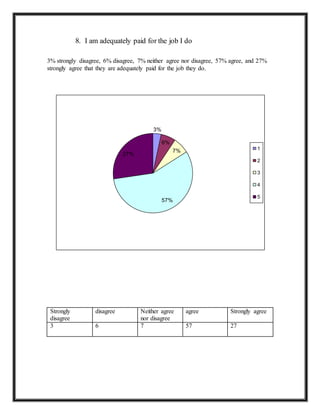
8. I am adequately paid for the job I do
3% strongly disagree, 6% disagree, 7% neither agree nor disagree, 57% agree, and 27%
strongly agree that they are adequately paid for the job they do.
Strongly
disagree
disagree Neither agree
nor disagree
agree Strongly agree
3 6 7 57 27
3%
6%
7%
57%
27%
1
2
3
4
5
9. My company takes care of my future career plans.
11% strongly disagree, 15% disagree, 19% neither agree nor disagree, 36% agree, and
19% strongly agree that the company takes care of their future plans.
Strongly
disagree
disagree Neither agree
nor disagree
agree Strongly agree
11 15 19 36 19
11%
15%
19%
36%
19% 1
2
3
4
5
10.I get recognisation for the work I do.
5% strongly disagree, 13% disagree, 16% neither agree nor disagree, 52% agree, and
14% strongly agree that they get recognition for the work they do.
Strongly
disagree
disagree Neither agree
nor disagree
agree Strongly agree
5 13 16 52 14
5%
13%
16%
52%
14% 1
2
3
4
5
WORKING ENVIRONMENT:
Q.11 to 17 were used to assess the working environment.
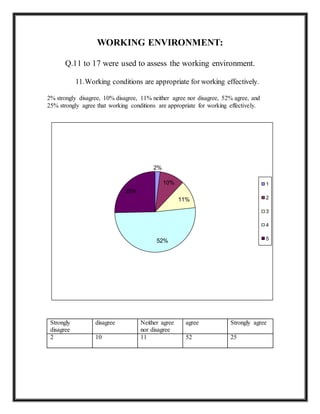
11.Working conditions are appropriate for working effectively.
2% strongly disagree, 10% disagree, 11% neither agree nor disagree, 52% agree, and
25% strongly agree that working conditions are appropriate for working effectively.
Strongly
disagree
disagree Neither agree
nor disagree
agree Strongly agree
2 10 11 52 25
2%
10%
11%
52%
25%
1
2
3
4
5
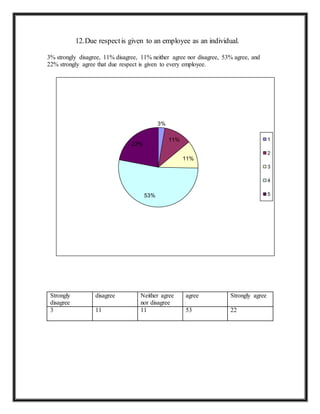
12.Due respectis given to an employee as an individual.
3% strongly disagree, 11% disagree, 11% neither agree nor disagree, 53% agree, and
22% strongly agree that due respect is given to every employee.
Strongly
disagree
disagree Neither agree
nor disagree
agree Strongly agree
3 11 11 53 22
3%
11%
11%
53%
22%
1
2
3
4
5
13.Working environment encourages me to work hard .
4% strongly disagree, 10% disagree, 15% neither agree nor disagree, 52% agree, and
19% strongly agree that working environment encourages them to work hard.
Strongly
disagree
disagree Neither agree
nor disagree
agree Strongly agree
4 10 15 52 19
4%
10%
15%
52%
19% 1
2
3
4
5
14.My fellow workers are very cooperative.
5% strongly disagree, 7% disagree, 11% neither agree nor disagree, 57% agree, and 20%
strongly agree that fellow workers are very cooperative.
Strongly
disagree
disagree Neither agree
nor disagree
agree Strongly agree
5 7 11 57 20
5%
7%
11%
57%
20%
1
2
3
4
5
15.My supervisor offers new ideas for solving job related
problems.
5% strongly disagree, 5% disagree, 10% neither agree nor disagree, 56% agree, and 24%
strongly agree that supervisor offers new ideas for solving job related problems.
Strongly
disagree
disagree Neither agree
nor disagree
agree Strongly agree
5 5 10 56 24
5%
5%
10%
56%
24%
1
2
3
4
5
16.I enjoy my all job related activities.
5% strongly disagree, 7% disagree, 11% neither agree nor disagree, 57% agree, and 20%
strongly agree that they enjoy all job related activities.
Strongly
disagree
disagree Neither agree
nor disagree
agree Strongly agree
5 7 11 57 20
5%
7%
12%
56%
20%
1
2
3
4
5
17.Organization tries to improve the working conditions.
5% strongly disagree, 14% disagree, 13% neither agree nor disagree, 49% agree, and
19% strongly agree that organization tries to improve the working conditions.
Strongly
disagree
disagree Neither agree
nor disagree
agree Strongly agree
5 14 13 49 19
5%
14%
13%
49%
19% 1
2
3
4
5
GENERAL WELL BEING
care taken by the organization of its employees was assessed from
Q.18 to Q. 23.
18.The company’s medical facilities are excellent.
2% strongly disagree, 3% disagree, 7% neither agree nor disagree, 47% agree, and 41%
strongly agree that medical facilities are excellent.
Strongly
disagree
disagree Neither agree
nor disagree
agree Strongly agree
2 3 7 47 41
2% 3%
7%
47%
41%
1
2
3
4
5
19.Company has real interest in the welfare and happiness of the
employees.
3% strongly disagree, 6% disagree, 14% neither agree nor disagree, 48% agree, and 29%
strongly agree that company has real interest in the welfare of employees.
Strongly
disagree
disagree Neither agree
nor disagree
agree Strongly agree
3 6 14 48 29
3%
6%
14%
48%
29%
1
2
3
4
5
20.I am satisfied with the retirement plans of company.
7% strongly disagree, 7% disagree, 12% neither agree nor disagree, 49% agree, and 25%
strongly agree that they are satisfied with the retirement plans.
Strongly
disagree
disagree Neither agree
nor disagree
agree Strongly agree
7 7 12 49 25
7%
7%
12%
49%
25%
1
2
3
4
5
21.Maternity leave policies are excellent.
3% strongly disagree, 7% disagree, 17% neither agree nor disagree, 50% agree, and 23%
strongly agree that maternity leave policies are excellent.
Strongly
disagree
disagree Neither agree
nor disagree
agree Strongly agree
3 7 17 50 23
3%
7%
17%
50%
23%
1
2
3
4
5
22.My company takes due care of every employee’s health and
wellness.
1% strongly disagree, 4% disagree, 11% neither agree nor disagree, 56% agree, and 28%
strongly agree that company takes due care of employees’ health and wellness.
Strongly
disagree
disagree Neither agree
nor disagree
agree Strongly agree
1 4 11 56 28
1% 4%
11%
56%
28%
1
2
3
4
5
23.Sports and recreational activities should be organized by our
company occasionally.
4% strongly disagree, 7% disagree, 15% neither agree nor disagree, 49% agree, and 25%
strongly agree that sports and recreational activities should organized.
Strongly
disagree
disagree Neither agree
nor disagree
agree Strongly agree
4 7 15 49 25
4%
7%
15%
49%
25%
1
2
3
4
5
WORK-LIFE BALANCE
was determined from the Q.24 to Q.30.
24.I think and worry about work even when not at work .
3% Never, 12% Rarely, 10% Sometimes, 50% Often, and 25% Always think and worry
about work even if not at work.
25.3
Strongly
disagree
disagree Neither agree
nor disagree
agree Strongly agree
3 12 10 50 25
3%
12%
10%
50%
25%
1
2
3
4
5
25. I miss spending quality time with family or friends due to
work pressure.
1% Never, 2% Rarely, 5% Sometimes, 50% Often, and 42% Always miss spending
quality time with family or friends due to work pressure.
Never rarely sometimes often always
1 2 5 50 42
1%
2%
5%
50%
42%
1
2
3
4
5
26.It will be helpful for me if I can work from home.
13% Never, 15% rarely, 31% Sometimes, 28% Often, and 13% Always states that it will
be helpful for them to work from home.
never rarely sometimes often always
13 15 31 28 13
13%
15%
31%
28%
13% 1
2
3
4
5
27.Laptops/Internet use can help in doing work from home.
10% Never, 6% Rarely, 23% Sometimes, 36% Often, and 25% Always states that
laptops/internet will be in doing work from home.
never rarely sometimes often always
10 6 23 36 25
10%
6%
23%
36%
25%
1
2
3
4
5
28.Supportfrom colleagues at work helps me in balancing work-
life.
2% Never, 6% Rarely, 25% Sometimes, 48% Often, and 19% Always states that support
from colleagues helps them in balancing work life.
never rarely sometimes often always
2 6 25 49 19
2%
6%
25%
48%
19% 1
2
3
4
5
29.If provided a child care/crèche near workplace it is going to be
beneficial.
1% Never, 6% Rarely, 25% Sometimes, 49% Often, and 19% Always states that if a
child care/crèche is near workplace it will be beneficial.
never rarely sometimes often always
1 6 25 49 19
1% 6%
25%
49%
19%
1
2
3
4
5
30. Children at workplace occasionally help me.
32% Never, 21% Rarely, 25% Sometimes, 17% Often, and 5% Always states that
bringing children at workplace occasionally will help them.
never rarely sometimes often always
32 21 25 17 5
32%
21%
25%
17%
5%
1
2
3
4
5
STRESS AT WORK
was assessed through Q. 31, Q. 32, Q.33, and Q. 37.
31.My job makes me nervous.
57% Never, 16% Rarely, 17% Sometimes, 7% Often, and 3% Always states that their job
makes them nervous.
never rarely sometimes often always
57 16 17 7 3
57%
16%
17%
7% 3%
1
2
3
4
5
32.The job difficulty usually brings me sleeplessness.
47% Never, 27% Rarely, 21% Sometimes, 3% Often, and 2% Always states that their job
difficulty bring sleeplessness.
never rarely sometimes often always
47 27 21 3 2
47%
27%
21%
3%
2%
1
2
3
4
5
33.I feel exhausted after daily work.
29% Never, 23% Rarely, 29% Sometimes, 16% Often, and 3% Always states that they
get exhausted after daily work.
never rarely sometimes often always
29 23 29 16 3
29%
23%
29%
16%
3%
1
2
3
4
5
37. I feel stressed at work.
46% Never, 21% Rarely, 22% Sometimes, 8% Often, and 3% Always states that they feel
stressed at work.
never rarely sometimes often always
47 21 22 8 3
46%
21%
22%
8%
3%
1
2
3
4
5
HAPPINESS
at work was assessed by Q.34, Q. 35, and Q. 36.
34.I feel happy at workplace.
7% Never, 9% Rarely, 13% Sometimes, 44% Often, and 27% Always states that they feel
happy at work place.
never rarely sometimes often always
7 9 13 44 27
7%
9%
13%
44%
27%
1
2
3
4
5
35.I feel calm and peaceful at work.
5% Never, 6% Rarely, 13% Sometimes, 55% Often, and 21% Always states that they feel
calm and peaceful at work.
never rarely sometimes often always
5 6 13 55 21
5%
6%
13%
55%
21%
1
2
3
4
5
36.I do meditation/yoga/exercise.
21% Never, 15% Rarely, 17% Sometimes, 31% Often, and 16% Always states that they
do yoga/meditation/exercise.
never rarely sometimes often always
21 15 17 31 16
21%
15%
17%
31%
16% 1
2
3
4
5
CHAPTER-5
MAJOR
FINDINGS
AND
CONCLUSIONS:
FINDINGS
1. Almost 2/3 employees agree that they are satisfied with their Jobs.
2. Almost 70% of the employees satisfied with their working environment.
3. Almost 50% agree that they are able to maintain personal and professional lives
effectively.
4. Almost 78% employees do not feel stress at work and almost 80% are happy at
work.
5. Almost 60% agree that the company takes care of their General Well Being.
6. 4% of the employees strongly disagree, 5% disagree, 15% neither agree nor
disagree, 55% agree, and 21% strongly agree that their work gives them a feeling
of achievement.
7. 21% Never, 15% rarely, 17% sometimes, 31% often, and 16% always states that
they do yoga/meditation/exercise.
8. 1% Never, 6% Rarely, 25% Sometimes, 49% Often, and 19% Always states that
if a child care/crèche is near workplace it will be beneficial.
9. 2% Never, 6% Rarely, 25% Sometimes, 48% Often, and 19% Always states that
support from colleagues helps them in balancing work life.
10. 3% Never, 12% Rarely, 10% Sometimes, 50% Often, and 25% Always think and
worry about work even if not at work.
CONCLUSION
Promotion policy dissatisfaction, company’s not taking care of future career plans,
and no recognition for the work done are the reasons for not Job satisfaction among
the employees.
Majority agrees that support from colleagues helps them in maintaining work life
balance and if provided child care/crèche near workplace it is going to helpful for
females.
The result of the Questionnaire indicates that overall employees are satisfied with the
Quality of Work Life at PAROVI SYSTEM and all those five factors affect the
Quality of their Work Life.
So, null hypothesis is being rejected as all of these factors affect and determines the
Quality of Work Life.
LIMITATIONS OF THE STUDY
 The research exercise was conducted within a limited duration. So a detailed
study could not be made.
 The result would be varying according to the individuals as well as time.
 Some respondents hesitated to give the actual situation; they feared that
management would take any action against them.
 The findings and conclusions are based on knowledge and experience of the
respondents sometime may subject to bias.
BIBLIOGRAPHY
Books Text
•Kothari, C.R. ( Reprint Edition 2005), Research Methodology Methods and Techniques,
New Age International (P) Ltd., Publishers, Delhi, Pp -196- 205.
•Aswathappa, K., (2010), Human Resource Management, McGraw Hill Education,
Publishers, Pp-145-150.
•Gupta, C. B, (2006), Human Resource Management, Sultan Chand & Sons, Pp-7.16-
7.31.
Web-Sites
 http://www.shrm.org/hrdisciplines/employeerelations/Pages/jobsat.aspx
 http://www.surveymonkey.com/mp/job-satisfaction-survey/
 http://www.yourarticlelibrary.com/employee-management/quality-of-work-life-
its-meaning-and-definition-employee-management/26112/
 http://in.viadeo.com/en/search/rcl/in/PAROVI
SYSTEM%20Colors%20Pvt%20Ltd/en/
 http://www.mbaskool.com/business-concepts/human-resources-hr-terms/2390-
quality-of-work-life-qwl.html
 http://uva.ulb.ac.be/cit_courseware/research/chapter6.htm
APPENDICES
QUESTIONNAIRE ON QUALITY OF WORK LIFE
Indications: Please tick 1 for strongly disagree; 2 for disagree; 3 for neither agree
nor disagree; 4 for agree; and 5 for strongly agree
Q. no Question /Statement 1 2 3 4 5
JOB SATISFACTION
1 My work gives me a feeling of achievement.
2 I am satisfied with the promotion policy of
my company.
3 My job utilizes my special skills and abilities.
4 The management appreciates my skills,
abilities, and performances.
5 My job has given me a feeling of status in
society.
6 I devote myself to the work.
7 My job to keeps me motivated.
8 I am adequately paid for the job I do.
9 My company takes care of my future career
plans.
10 I get recognition for the work I do.
WORK ENVIRONMENT
11 Working conditions are appropriate for
working effectively.
12 Due respect is given to an employee as an
individual.
13 Work environment encourages me to work
hard.
14 My fellow workers are very cooperative.
15 My supervisor offers new ideas for solving
job related problems.
16 I enjoy my all job related activities.
17 Organization tries to improve the working
conditions.
GENERAL WELL BEING
18 The company’s medical facilities are
excellent.
19 Company has real interest in the welfare and
happiness of the employees.
20 I am satisfied with the retirement plans of the
company.
Q. no Question /Statement 1 2 3 4 5
21 Maternity leave policies are excellent.
(Optional)
22 My company takes due care of every
employee’s health and wellness.
23 Sports and recreational activities should be
organized by our company occasionally.
Indications: Please tick 1 for Never; 2 for Rarely; 3 for sometimes; 4 for often; and
5 for always
Q. no Question /Statement 1 2 3 4 5
WORK-LIFE BALANCE
24 I think and worry about work even when not
at work.
25 I miss spending quality time with family or
friends due to work pressure.
26 It will be helpful for me if I can work from
home.
27 Laptops/Internet use can help in doing work
from home.
28 Support from colleagues at work helps me in
balancing work-life.
29 If provided a child care/crèche near
workplace it is going to be beneficial.
30 Bringing children at workplace occasionally
helps me.
1 2 3 4 5
STRESS AND HAPPINESS
31 My job makes me nervous.
32 The job difficulty usually brings me
sleeplessness.
33 I feel exhausted after daily work.
34 I feel happy at workplace.
35 I feel calm and peaceful at work.
36 I do meditation/yoga/exercise.
37 I feel stressed at work.

Proj

  • 1.
    A PR OJ EC T R E POR T On “ANALYTICAL STUDY ON QUALITY OF WORK LIFE” IN “PAROVI SYSTEM PVT. LTD” Subm i tted by : GAURAV KUMAR (Enroll. no. 01696988813) In partial fulfillment of the requirement For the award of degree Of Bache lor In Comme rc e (H onor s ) Under Supervisio n of: Ms. GUNJAN BUDHLANI SANT HARI DASS COLLEGE OF HIGHER EDUCATION Bani Camp , Najafgarh, New Delhi-110045 (Affiliated To Guru Gobind Singh Indraprastha University)
  • 2.
    SANT HARI DASSCOLLEGE OF HIGHER EDUCATION (Affiliated to: Guru Gobind Singh indraprasth University, Delhi ) Bani camp, Najafgarh New Delhi - 110043 TO WHOMSOVER IT MAY COCERN This is certifying that Mr. / Miss....................................................................... a student ofB.COM (hons.) fifth semester, has done his / her summer training Project at................................... from ................................ to ............................ The project entitled “.............................................................................” Embodies the original work doneby him / her for the partial fulfillment ofthe Award of the B.COM (hons.) degree. I wish him all the best for his / her future endeavor. Project guide
  • 3.
    PERFORMANCE APPRAISAL Summer Training Student’sName: Programme: You are requested to provide your opinion on the following parameters. Outstanding Good Satisfactory Unsatisfactory A B C D 1. Technical knowledge gathered about the industry and the job he/she was involved. 2. Communication Skills: Oral / Written / Listening skills 3. Ability to work in a team 4. Ability to take initiative 5. Ability to develop a healthy long term relationship with client 6. Ability to relate theoretical learning to the practical training 7. Creativity and ability to innovate with respect to work methods & procedures 8. Ability to grasp new ideas and knowledge 9. Presentations skills 10. Documentation skills 11. Sense of Responsibility 12. Acceptability (patience, pleasing manners, the ability to instill trust, etc.) 13. His/her ability and willingness to put in hard work 14. In what ways do you consider the student to be valuable to the organization? Consider the student’s value in term of: (a) Qualification (b) Skills and abilities (c) Activities/ Roles performed 15. Punctuality Any other comments_____________________________________________________. Assessor’s Overall rating Assessor’s Name: Designation: Organization name and address: Email id/ Contact No:
  • 4.
    Acknowledgement It gives meimmense pleasure to present this report a written testimony of a very rewarding practical experience. Firstly, I would like to thank PAROVI SYSTEM for allowing me to carry out the project in the organization. Any project cannot succeed without the help and guidance of the Teachers, guides and mentors. This one is no exception. I extend my heartfelt gratitude to my mentor without whom the project would not have been a success. His guidance and counseling helped me at each phase of the project. I am indebted to all the respondents who took out time from their busy schedule and filled my questionnaire, gave valuable insights and suggestions, leading to the successful completion of the project. Last but not the least; I shall fail in my duty, if I don’t thank all those concerned people who have directly or indirectly contributed in the completion of this entire Summer Internship Project. GAURAV KUMAR
  • 5.
    CONTENTS S No TopicPage No 1 Certificate 1 2 Summer Training Appraisal 2 3 Acknowledgement 3 4 Chapter I: 1. Introduction 1.1. Executive Summary 2. Objective of Study… 3. Company Profile 5-21 5 Chapter II: Review of Literature 1. QualityOf Work Life ByOrganisation 22-46 6 Chapter III: Research Methodology 47-49 7 Chapter IV: Data Analysis and interpretation 50-87 8 Chapter V: Findings and Conclusion 88-89 9 Limitations of the study 90 10 References/ Bibliography 91 11 Appendices 92-93
  • 6.
  • 7.
    INTRODUCTION ABOUT THESTUDY EXECUTIVE SUMMARY This project aims at studying quality of work life at PAROVI SYSTEM Pvt. Ltd. This project contains five chapters. .  The first chapter contains the introduction including objectives of the study and copany profile.  Second chapter Literature Review contains information about the quality of work life- The aim of QWL is to respond to employee needs for developing mechanisms to allow them to share fully in making the decisions that design their lives at work. QWL can be defined as "The quality of relationship between employees and the total working environment within an organization.” Quality of Working Life is a term that had been used to describe the broader job-related experience an individual has.  Third chapter is the research methododlogy which contain scope of the study and research design.  The forth chapter is the analysis and interpretation, which is shown with the help of pie charts.  Fifth chapter may contain the project findings,limitation and conclusion and at last bibliography and annexure. The data has been collected by the researcher using questionnaire and it has been analyzed.
  • 8.
    OBJECTIVES OF STUDY: a.To assess the Job satisfaction among employees. b. To assess the General Well Being care taken by company of the employees. c. To assess the work stress experienced by employees during work. d. To assess the work life balances of the employees. e. To assess the working environment.
  • 9.
  • 10.
    INTRODUCTION  TYPE :WIRE MANUFACTURING MACHINES PROVIDER.  AVAILABILITY : COUNTRY WIDE  OWNER : MR. VINEET SACHDEVA  KEY PEOPLE : CHAIRMAN & DIRECTOR- Mr. VINEET  FOUNDED : In year 1994  WEBSITE : WWW. PAROVI SYSTEM. COM
  • 11.
     OVERVIEW OFTHE PAROVI SYSTEM Parovi system is the largest wire manufacturing machines and tools Provider that are used in manufacturing ofwire. Parovi systemhas good Customer base it has footprints throughout the India .The customers of parovi Systems are increase day by day and the parovi system establishes a well goodwill in market. Today the parovi system is the India's one of the fastest growing company by increasing their sales and by making good customer base the company has well authorized capital after the foundation ofparovi system the company brings various new technology in wire manufacturing sector in Indian market. The machines or tools which is provided by parovi system increase the productivity because the machines are new in technology to comparewith old machines which are present in Indian market parovisystem also trade at global level or in international market also. The parovi system import their machines and tools from china and sell in Indian market.  PROFILE OF ORGANIZATION  over view of organization History: ‘Parovi Systems’ is a total technical solution provider for cable and wire industry. We are helping the manufacturers of cables and wires to upgrade their production line by providing ‘State-of-the-art’ machinery and accessories. Using the machines and accessories provided by ‘Parovi Systems’, not only the production cost is reduced considerably but also the quality ofthe productis enhanced. Parovi Systems has gained a well-deserved reputation in the Indian market since it’s founding in 1994. Parovi Systems is providing the Indian wire & cable industry with the highest quality & most cost effective equipment, consulting, training & service to achieve the optimum in production performance. We guarantee one hundred percent customer satisfaction through properequipment selection, unsurpassed after sales service & prompt technical support.
  • 12.
    Parovi Systems isproud to present the latest advances in wire drawing, annealing, bunching & cable printing that have made us the leader in Indian market. We have taken decisive steps into the future of non-ferrous wire & cable processing by offering dependable local manufacturing capability & customerservice, leading-edge technology & state-of-the-art quality levels for our machinery & turn-key systems. An extensive Customer Service department offers assistance from the Delhi facilities to the customers all over the country. Our Engineering Department supports customers’ special requests and answers their particular needs and demands. Our Resident Service Engineers handle new equipment commissioning, customers’ personnel training, and equipment troubleshooting as well preventive and defective maintenance support. In addition to the demonstration equipment, Parovi Systems also stocks most commonly used spare parts that are available for immediate delivery. Competent staff supports our customers in identifying and supplies the required spare parts. Our advanced remote diagnostic capabilities, via telephone modems designed into the equipment’s electrical controls, allow for quick and precise troubleshooting. Parovi Systems’ products include single and multi-wire drawing machines, automatic pack coilers for bare, plated and insulated wire, ultra fine wire drawing machines, continuous resistance annealers, spoolers, re-spoolers, coilers, double twist bunching machines, extruding machines, laser dia controllers, bunchers, cutting and stripping machines, printing machines and printing accessories (Ink, printing wheels etc.), loader and hoppers, crushers, cold weld tools, lubricant supply and filtration systems, and automation of all wire productionprocesses. The companyis capable of supplying one hundred percent turnkey production systems in India. We are unique in many aspects:  ‘Parovi Systems’ is a Total Technical Solution Provider for wire and cable manufacturers.  ‘Parovi Systems’ offers ready stock of all range of machines and accessories it offers.  ‘Parovi Systems’ provides After-Sales-Service backup for the machines and accessories.
  • 13.
    MAIN PRODUCT ORSERVICES BY PAROVI SYSTEM Parovi system provided almost every machines and tools which are required in the manufacturing of wires.  WIRE DRAWING MACHINE Leading Manufacturer and Exporter of Wire Drawing Machines - RBD such as RBD - (DL-400-7) Wire Drawing Machine, RBD - (DL400-9) Wire Drawing Machines, RBD - (DL400A-9) Wire Drawing Machines, RBD - (DL400-11) Wire Drawing Machines and RBD - (DL400-13) Wire Drawing Machines. 1. (RBD - (DL-400-7) Wire Drawing Machine) MODEL DL 400 – 7 Wire inlet size MAX 8.0 MM Wire finished dia 2.6 – 3.5 MM Max speed 1000 M / MIN Die size MAX 55 MM Elongation 42 % - 21 % Capstan dia 400 MM Fix speed capstan dia 400 MM Main motor power AC 132 KW Fix speed motor power AC 55 KW Rotation dia motor power AC 400 W Pump motor power 1.1 KW
  • 14.
    2. (TH5000 ACWire Drawing Machine) Providing the best range of Wire Drawing Machine - Horizontal Annealer such as TH5000 AC Wire Drawing Machine and TH5000 DC Wire Drawing Machine with effective & timely delivery. MODEL TH 5000 AC Wire size (mm) 1.2 – 3.5 Speed (m/min) Max 1500 Capstan dia 450 mm Max voltage 55 AC Max current 4300 Max power 283 KW Stream generation power 18 KW Overall dimension ( l x W x H ) 4.25 x 1.25 x 2.5 Net weight 4500 kg
  • 15.
    3. (WF800 WireDrawing Machine) Our range of products includes Wire Drawing Machines - Coiler Machines such as WF800 Wire Drawing Machine and WF650 Wire Drawing Machine.
  • 16.
     ( QDX40 Annealing and Tinning Machine ) Our range of products include - Annealing and Tinning machines such as QDX 40 Annealing and Tinning Machine. MODEL WF 800 Wire size (mm) 1.2 – 4.0 Speed (m/min) Max 1200 Coiler dia (min) 800 mm Taking – up stand size 580 x 1050 x 1600 Taking – up stand capacity Max 1800 kg Coiler motor power AC 15 kw Spooling motor power 0.75 kw Overall dimension (L x W x H ) 4.28 x 3.8 x 4.55 M Net weight 5000 kg
  • 17.
    MODEL QDX –40 Application Annealing &tinning of cooperwire Number of wires processed 40 Wire to processed 0.08 – 0.32 mm Max Wire Speed 300 m/min Pay Off Curl flyer of constant tension pay - off Tinning mode Single / double furnace with hot dip with Dies. Pay – off bobbin size 300 mm Taking up mode Single bobbin torque take - up Soften mode Water seal electrical heating continuous softens. Taking – up bobbinsize PT 10 – PT 25 Installed motion power 14 kw Installed heating power 35 kw
  • 18.
     Parovi systempresent & future Since its corporatisation in 1994. parovi system has been actively providing machines in India and outside India efficiency of the company has drastically improved from the days when the company started parovi system also unveiled very cost effective machines which are used in wire manufacturing industry the target of parovi system are small and big wire manufacturer all over in country. The future parovi system is bright because the client are satisfied from the services provided by the parovi system and the customers of parovi system is increasing to compare with some previous year in future the parovi system brings new technology for wire manufacturer in India to make wire in effective and efficient way. In future the parovi system increases their customer care services to provide satisfaction to their customer so, the future of parovi system is bright but there are some challenges in future also. Challenges: Presently there is an intense competition in Indian wire industry sector and various other companies are rolling out attractive schemes and other pro- grammes that attract customers although in recent past there have been tremendous improvement in working of parovi system but still it is much below the industry expectations. The main challenge is increasing competition in Indian market and to complete this challenges the parovi system increase their customer care services and make effective objectives to fulfill the future needs of wire manufacturer.
  • 19.
    VISION  To becomethe largest exporter and manufacturer of machines which are used in wire industry. MISSION  To provide world class technology to its  customer's on demand at competitive prices  To provide a good customer's care services  fulfill the needs of customer's OBJECTIVES:  To build a high degree of customer confidence by sustaining quality and Reliability in services.  Plantation of tress to make environment green .  To raise necessary financial resources for its development needs.  To improve the quality of present services being given to customer.  To increase accessibility of services by providing a good customer care services.
  • 20.
    PRODUCT'S  wire drawingmachine -RBD - (DL400-11) Wire Drawing Machines. -RBD - (DL400-13) Wire Drawing Machines. -RBD - (DL400-9) Wire Drawing Machines. -ZLT250/17 Wire Drawing Machine. -ZLT250/21 Wire Drawing Machine. -ZLT250/17 Wire Drawing Machine.  waste cable stripping machine -Waste Cable Stripper- STR-3 -Waste Cable Stripper- STR -8 -Waste Cable Stripper- STR-E -Waste Cable Stripper- STR-1  plug tester  coiling machines -Fully Automatic Coiling Machine C-0836 -Fully Automatic Coiling Machine C-1246 -Fully Automatic Coiling Machine C-1860 -Mesh Coiling Machine
  • 21.
     high speedextruder's line -High Speed Extruder Line - Building Wire -Teflon Extruder's -Auxiliary/ Pilot Extruder's -Electrical and Electronic Wire Extrusion Line -3 Layer Winding Wire Extruder Line -Industrial and Power Cable Extruder's  cold weld tools and dies -Hand Held Cold Welder-PD-10 -Hand Held Cold Welder-PD 2 -Bench Cold Welder- P2-B -Cold Weld ToolDies -Cold Weld ToolDies  waste grinder crusher -Waste Grinder CD-180-E -Waste Grinder CD-250-E  hopper dryer -Hopper Drier PA-HD25 -Hopper Dryer PA-HD50 -Hopper Dryer PA-HD100 -Hopper Dryer PA-HD150
  • 22.
    SWOT ANALYSIS (Strength /Weakness/ Opportunities / Threats)  Strength The wire industry sector is poised for continued high growth and our company is well placed to benefit from this phenomenon Parovi System is a well-established company providing all kind of technical Solution to wire manufacturer throughout the country. The widest network Reach of the company is its USP.  Weakness Parovi System has no any major weakness in the business but there are some small weakness is existing. It's common in every business.  Opportunities Having a good technical solution provider it is easy for company to enter into Any area in wire industry sector. Parovi system has vast range of productas well as better technical solution to wire manufacturers it makes to deal with any kind of customer. Now it has also opportunities in global and national level.  Threats The companyoperates in an industry, which is highly competitive and faces intense competition from other technical solution provider who enjoys certain Advantages in their procurement as well as selection of technology.
  • 23.
  • 24.
  • 25.
    QUALITY OF WORKLIFE QWL can be defined as "The quality of relationship between employees and the total working environment within an organization.” Quality of Working Life is a term that had been used to describe the broader job-related experience an individual has. According to J Richard and J Loy QWL is “The degree to which members of a work organization are able to satisfy important personnel needs through their experience in the organization.” The aim of QWL is to respond to employee needs for developing mechanisms to allow them to share fully in making the decisions that design their lives at work. Quality of work life (QWL) is viewed as an alternative to the control approach of managing people. The QWL approach considers people as an ‘asset' to the organization rather than as ‘costs'. It believes that people perform better when they are allowed to participate in managing their work and make decisions. Quality of Work Life (QWL) is both a goal and an on-going process for achieving it. As a goal, QWL is the commitment of any organization to work improvement — the creation of more involving, satisfying and effective jobs and work environment for people at all levels of the organization. As a process, QWL calls for efforts to realiZE this goal through the active involvement of people throughout the organization. It may help to think of QWL as an umbrella concept that encompasses literally dozens of specific interventions that have a common goal of humanizing the work place. The safe work environment provides the basis for the person to enjoy working. The work should not pose a health hazard for the person. The employer and employee, aware of their risks and rights, could achieve a lot in their mutually beneficial dialogue. Work represents such a role in life which has been designated to it by the person himself. On the one hand work is an earning of one’s living for the family, on the other hand it could be a self-realization providing enjoyment and satisfaction. This approach motivates people by satisfying not only their economic needs but also their social and psychological ones. To satisfy the new generation workforce, organizations need to concentrate on job designs and organization of work. Further, today's workforce is realizing the importance of relationships and is trying to strike a balance between career and personal lives. Successful organizations support and provide facilities to their people to help them to balance the scales. In this process, organizations are coming up with new and innovative ideas to improve the quality of work and quality of work life of every individual in the organization. Various programs like flex time, alternative work schedules, compressed work weeks, telecommuting etc., are being adopted by these organizations. Technological advances further help organizations to implement these programs
  • 26.
    successfully. Organizations areenjoying the fruits of implementing QWL programs in the form of increased productivity, and an efficient, satisfied, and committed workforce which aims to achieve organizational objectives. The future work world will also have more women entrepreneurs and they will encourage and adopt QWL programs. It is a process to identify and implement alternative programs to improve the quality of professional as well as personal life of an organization’s employees. QWL HISTORICAL BACKGROUND Various authors and researchers have proposed models of Quality of working life which include a wide range of factors. Selected models are reviewed below. Hackman and Oldham (1976) drew attention to what they described as psychological growth needs as relevant to the consideration of Quality of working life. Several such needs were identified; Skill variety, Task Identity, Task significance, Autonomy and Feedback. They suggested that such needs have to be addressed if employees have to experience high quality of working life. In contrast to such theory based models, Taylor (1979) more pragmatically identified the essential components of Quality of working life as; basic extrinsic job factors of wages, hours and working conditions, and the intrinsic job notions of the nature of the work itself. He suggested that a number of other aspects could be added, including; individual power, employee participation in the management, fairness and equity, social support, use of one’s present skills, self-development, a meaningful future at work, social relevance of the work or product, effect on extra work activities. Taylor suggested that relevant Quality of working life concepts may vary according to organization and employee group. Warr and colleagues (1979), in an investigation of Quality of working life, considered a range of apparently relevant factors, including work involvement, intrinsic job motivation, higher order need strength, perceived intrinsic job characteristics, job satisfaction, life satisfaction, happiness, and self-rated anxiety. They discussed a range of correlations derived from their work, such as those between work involvement and job satisfaction, intrinsic job motivation and job satisfaction, and perceived intrinsic job characteristics and job satisfaction. In particular, War found evidence for a moderate association between total job satisfaction and total life satisfaction and happiness, with a less strong, but significant association with self-rated anxiety. Thus, whilst some authors have emphasized the workplace aspects in Quality of working life, others have identified the relevance of personality factors, psychological well being, and broader concepts of happiness and life satisfaction. Factors more obviously and directly affecting work have, however, served as the main focus of attention, as researchers have tried to tease out the important influences on Quality of working life in the workplace.
  • 27.
    Mirvis and Lawler(1984) suggested that Quality of working life was associated with satisfaction with wages, hours and working conditions, describing the “basic elements of a good quality of work life” as; safe work environment, equitable wages, equal employment opportunities and opportunities for advancement. Baba and Jamal (1991) listed what they described as typical indicators of quality of working life, including: job satisfaction, job involvement, work role ambiguity, work role conflict, work role overload, job stress, organizational commitment and turn-over intentions. Baba and Jamal also explored routinisation of job content, suggesting that this facet should be investigated as part of the concept of quality of working life. Some have argued that quality of working life might vary between groups of workers. For example, Ellis and Pompli (2002)(10) identified a number of factors contributing to job dissatisfaction and quality of working life in nurses, including: Poor working environments, Resident aggression, Workload, Unable to deliver quality of care preferred, Balance of work and family, Shiftwork, Lack of involvement in decision making, Professional isolation, Lack of recognition, Poor relationships with supervisor/peers, Role conflict, Lack of opportunity to learn new skills. Sirgy; (2001)(11) suggested that the key factors in quality of working life are: Need satisfaction based on job requirements, Need satisfaction based on Work environment, Need satisfaction based on Supervisory behavior, Need satisfaction based on Ancillary programmers, Organizational commitment. They defined quality of working life as satisfaction of these key needs through resources, activities, and outcomes stemming from participation in the workplace. Maslow’s needs were seen as relevant in underpinning this model, covering Health & safety, Economic and family, Social, Esteem, Actualization, Knowledge and Aesthetics, although the relevance of non-work aspects is play down as attention is focused on quality of work life rather than the broader concept of quality of life. These attempts at defining quality of working life have included theoretical approaches, lists of identified factors, correlation analyses, with opinions varying as to whether such definitions and explanations can be both global, or need to be specific to each work setting. Bearfield, (2003) used 16 questions to examine quality of working life, and distinguished between causes of dissatisfaction in professionals, intermediate clerical, sales and service workers, indicating that different concerns might have to be addressed for different groups. The distinction made between job satisfaction and dissatisfaction in quality of working life reflects the influence of job satisfaction theories. Herzberg at al., (1959) used “Hygiene factors” and “Motivator factors” to distinguish between the separate causes of job satisfaction and job dissatisfaction. It has been suggested that Motivator factors are intrinsic to the job, that is; job content, the work itself, responsibility and advancement. The Hygiene factors or dissatisfaction-avoidance factors include aspects of the job environment such as interpersonal relationships, salary, working conditions and security. Of these latter, the most common cause of job dissatisfaction can be company policy and administration, whilst achievement can be the greatest source of extreme satisfaction.
  • 28.
    An individual’s experienceof satisfaction or dissatisfaction can be substantially rooted in their perception, rather than simply reflecting their “real world”. Further, an individual’s perception can be affected by relative comparison – am I paid as much as that person - and comparisons of internalized ideals, aspirations, and expectations, for example, with the individual’s current state (Lawler and Porter, 1966. In summary, where it has been considered, authors differ in their views on the core constituents of Quality of Working Life (e.g. Sirgy, Efraty, Siegel & Lee, 2001 and Warr, Cook & Wall, 1979). It has generally been agreed however that Quality of Working Life is conceptually similar to well-being of employees but differs from job satisfaction which solely represents the workplace domain (Lawler, 1982). Quality of Working Life is not a unitary concept, but has been seen as incorporating a hierarchy of perspectives that not only include work-based factors such as job satisfaction, satisfaction with pay and relationships with work colleagues, but also factors that broadly reflect life satisfaction and general feelings of well-being (Danna & Griffin, 1999). More recently, work-related stress and the relationship between work and non-work life domains (Loscocco & Roschelle, (1991) have also been identified as factors that should conceptually be included in Quality of Working Life. MEASUREMENT There are few recognized measures of quality of working life, and of those that exist few have evidence of validity and reliability, that is, there is a very limited literature based on peer reviewed evaluations of available assessments. A recent statistical analysis of a new measure, the Work-Related Quality of Life scale (WRQoL), indicates that this assessment device should prove to be a useful instrument, although further evaluation would be useful. The WRQoWL measure uses 6 core factors to explain most of the variation in an individual’s quality of working life: Job and Career Satisfaction; Working Conditions; General Well-Being; Home-work interface; Stress at Work and Control at Work. The Job & Career Satisfaction Job and Career satisfaction scale of the Work-Related Quality of Life scale is said to reflect an employee’s feelings about, or evaluation of, their satisfaction or contentment with their job and career and the training they receive to do it. Within the WRQoL measure, JCS is reflected by questions asking how satisfied people feel about their work. It has been proposed that this Positive Job Satisfaction factor is influenced by various issues including clarity of goals and role ambiguity, appraisal, recognition and reward, personal development career benefits and enhancement and training needs. The General well-being scale of the Work-Related Quality of Life scale (WRQoL), aims to assess the extent to which an individual feels good or content in themselves, in a way
  • 29.
    which may beindependent of their work situation. It is suggested that general well-being both influences, and is influenced by work. Mental health problems, predominantly depression and anxiety disorders, are common, and may have a major impact on the general well-being of the population. The WRQoL factor assesses issues of mood, depression and anxiety, life satisfaction, general quality of life, optimism and happiness. The WRQoL Stress at Work sub-scale reflects the extent to which an individual perceives they have excessive pressures, and feel stressed at work. The WRQoL SAW factor is assessed through items dealing with demand and perception of stress and actual demand overload. Whilst it is possible to be pressured at work and not be stressed at work, in general, high stress is associated with high pressure. The Control at Work subscale of the WRQoL scale addresses how much employees feel they can control their work through the freedom to express their opinions and being involved in decisions at work. Perceived control at work as measured by the Work-Related Quality of Life scale (WRQoL) is recognized as a central concept in the understanding of relationships between stressful experiences, behaviour and health. Control at work, within the theoretical model underpinning the WRQoL, is influenced by issues of communication at work, decision making and decision control. The WRQoL Home-Work Interface scale measures the extent to which an employer is perceived to support the family and home life of employees. This factor explores the interrelationship between home and work life domains. Issues that appear to influence employee HWI include adequate facilities at work, flexible working hours and the understanding of managers. The Working Conditions scale of the WRQoL assesses the extent to which the employee is satisfied with the fundamental resources, working conditions and security necessary to do their job effectively. Physical working conditions influence employee health and safety and thus employee Quality of working life. This scale also taps into satisfaction with the resources provided to help people do their jobs.
  • 30.
    FOR HR STRATEGY Asfar as HR involvement is concerned, there needs to be a time and place to hear people’s needs. Be interested in their lives away from work. EX: Be aware of anniversaries, birthdays, births of babies, illnesses in the family and more. (Sending cards or announcements on bulletin boards.) People want to be appreciated and noticed. Giving people time to attend important events in their life away from work will have a positive effect on them as well as the business. As a company gives attention to this the employee is more willing to work smarter keeping in mind that the company cares about me and that they should care about the company. While making sure that the employee has enough time to meet his social requirement, the quality of life at the work place itself can be improved through simple HR initiatives. For instance - arranging short trips or annual sports events etc. This would let the employee take-off his mind from work for once and enjoy himself with his colleagues. It’ll also be a good team building exercise. Again, introducing performance rewards and giving of monetary benefits like insurances, medical reimbursement, and schemes for family will also help motivate an employee to perform better. The better your HR policies are, lesser will be your attrition rate. In fact, if HR practices offer a good quality of life to employees, it should always publicize. There are many institutes giving HR awards. You can apply to them and get you company’s HR policies recognized. Eg: SAIL’s HR excellence award.  JOB SATISFACTION Job satisfaction has been defined as a pleasurable emotional state resulting from the appraisal of one’s job; an affective reaction to one’s job; and an attitude towards one’s job. Weiss (2002) has argued that job satisfaction is an attitude but points out that researchers should clearly distinguish the objects of cognitive evaluation which are affect (emotion), beliefs and behaviors. Job satisfaction describes how content an individual is with his or her job. There are a variety of factors that can influence a person's level of job satisfaction; some of these factors include the level of pay and benefits, the perceived fairness of the promotion system within a company, the quality of the working conditions, leadership and social relationships, and the job itself (the variety of tasks involved, the interest and challenge the job generates, and the clarity of the job description/requirements. Two-Factor Theory (Motivator-Hygiene Theory) Frederick Herzberg’s two factor theory (also known as Motivator Hygiene Theory) attempts to explain satisfaction and motivation in the workplace. This theory states that satisfaction and dissatisfaction are driven by different factors – motivation and hygiene factors, respectively. Motivating factors are those aspects of the job that make people want to perform, and provide people with satisfaction, for example achievement in work, recognition, promotion opportunities. These motivating factors are considered to be intrinsic to the job, or the work carried out. Hygiene factors include aspects of the working
  • 31.
    environment such aspay, company policies, supervisory practices, and other working conditions. Furthermore, the theory does not consider individual differences, conversely predicting all employees will react in an identical manner to changes in motivating/hygiene factors.  WORK LIFE BALANCE Work life and personal life are the two sides of the same coin. Sometimes employees have to make tough choices even when their work and personal life. Traditionally creating and managing a balance between the work-life was considered to be a woman's issue. But increasing work pressures, globalization and technological advancement have made it an issue with both the sexes. Work life and personal life are inter-connected and interdependent. Spending more time in office, dealing with clients and the pressures of job can interfere and affect the personal life, sometimes making it impossible to even complete the household chores. Work- personal life conflict occurs when the burden, obligations and responsibilities of work and family roles become incompatible. Obligation of one can force an individual to neglect the other. Changing & increasing work pressures Now professionals find themselves working even when they are on vacations. The ever-increasing working hours leave the individuals with less time for themselves and to pursue his hobbies or leisure activities. This hinders the growth of the person as an individual in terms of his personal and spiritual growth. Reasons of imbalance There are various reasons for this imbalance and conflicts in the life of an employee. Individual career ambitions Pressure to cope up with family or work The speed of advancement of information technology The increasing competition in the talent supply market "Performance-Driven" culture creates pressures Effects Constant struggle and effort to maintain a balance between the work and personal life can have serious implications on the life of an individual. The pressures of the work or personal life can lead to stress which can take a toll on the person's health both physiologically and psychologically. Heart ailments, cardiovascular problems, sleep disorders, depression, irritability, jumpiness, insecurity, poor concentration and even nervous breakdowns are becoming common among the victims of such imbalance. Pressure, stress or tension in work life can lead to bad social life and vice versa Balancing life and wok assumes relevance when both husband and wife are employed. Travails of a working housewives are more than a working husband. Work life balance is becoming a major challenge for them as more women are taking up jobs to add to finances
  • 32.
    of their familiesor to become careerists. The number is growing as more girls are coming out of colleges and universities with degrees in their hands. Organizations should undertake work-life balance programmes, as in their absence men and women will be exposed to stress, depression and anxiety. Programmes aiming at work- life balance includes the following: • Childcare at or near the workplace. • Job sharing • Care for sick children and employees • On-site summer camp • Training supervisors to respond to work and family needs of employees • Flexible working schedules • Sick leave policies • Variety of errands from dry cleaning, dropping children at schools, making dinner reservations and the like. The organizations that have developed work-life programmes have found happier and more productive employees. BENEFITS OF IMPROVING WORK-LIFE BALANCE Aiding employee recruitment and retention • More employees may stay on in a job, return after a break or take a job with one company over another if they can match their other needs better with those of their paid work. • This results in savings for the employer – avoiding the cost of losing an experienced worker and recruiting someone new. • Employers who support their staff in this way often gain the bonus of loyalty from those staff. • The British Work-Life Balance Study 2000, including a representative survey of 2500 workplaces, found that 58 per cent of employers thought that work-life balance practices had improved staff motivation and commitment, and 52 per cent thought labour turnover and absenteeism were lower, and that they helped retain female employees. The Australian 2002 Benchmarking Study found that organisations implementing work-life strategies and evaluating them observed reduced turnover, absenteeism, and increased return from parental leave.
  • 33.
    Reducing absenteeism • Manycompanies that have introduced family-friendly or flexible working practices have seen benefits through reductions in absenteeism. Sickness rates may fall as pressures are managed better, while employees may have better methods of dealing with work-life conflicts than taking unplanned leave. • Workers (including their managers) who are healthy and not over-stressed may be more efficient. Improving the quality of people's working lives • Minimizing work-life role conflict can help prevent role overload and help people have a more satisfying working life, fulfilling their potential both in paid work and outside it. • Work life balance can minimize stress and fatigue at work, enabling people to have safer and healthier working lives. Workplace stress and fatigue can contribute to injuries at work and at home. • Self-employed people control their own work time to some extent. Most existing information on work-life balance is targeted at those in employment relationships. However, the self-employed too may benefit from maintaining healthy work habits and developing strategies to manage work-flows which enable them to balance work with other roles in their lives. Matching people who wouldn’t otherwise work with jobs • Parents and carers, people with disabilities and those nearing retirement are among those who may increase their workforce participation if more flexible work arrangements are possible. Employment has positive individual and social benefits beyond the financial rewards.
  • 34.
    • Employers mayalso benefit from a wider pool of talent to draw from – this is particularly to their benefit when skill shortages exist. • The Baseline Study of Work-Life Balance Practices in Great Britain found that there was strong demand amongst lone parents, carers and disabled people for flexible working time arrangements. Benefiting families and communities • In a situation of conflict between work and family, one or other suffers. Overseas studies have found that family life can interfere with paid work, and the reverse. At the extreme, if family life suffers this may have wider social costs. • Involvement in community, cultural, sporting or other activities can be a benefit to community and civil society at large. For instance, voluntary participation in school boards of trustees can contribute to the quality of our children's education. While such activities are not the responsibility of individual employers, they may choose to support them actively, since community activities can demonstrate good corporate citizenship, as well as helping develop workers' skills which can be applied to the workplace.  WORK ENVIRONMENT Perfect work environment is the one which provides a feeling that organization is second home to the employee. Organization environment includes  Culture  Company reputation  Quality of people in the organization  Employee development and career growth  Risk taking  Cutting-edge technologies  Trust
  • 35.
    TYPES OF ENVIRONEMENTEMPLOYEE NEEDS IN ORGANIZATION ● learning organization: It includes continuous learning and improvement of individual, certifications, and provision for higher studies etc. ● Support environment: Organization can provide support in the form of work life balance, which includes flexible hours, telecommuting, dependent care, alternative work schedules, vacations, and wellness. Work environment includes efficient managers, supportive co-workers, challenging work, involvement in decision making, clarity of work and responsibilities and recognition. Employees want to work in the organization which provides such type of work environment: ● Appreciation for the work done ● Opportunities to grow ● Friendly and cooperative The above all points stressed are essential to improve the quality of work life. Lack of such environment pushes the employees to look for new opportunities. The environment should be such that the employee feels connected to the organization in every respect. It is about managing people. If an organization manages people well, employee retention will take care of itself. Organizations should focus on managing the work environment to make better use of human assets. Conditions in the work environment should be the one where employees have freedom from fear of losing their jobs. A system must be created in which there are healthy working conditions with optimum financial security. With a view to tackle job boredom, modern organizations have been experimenting with several forms of alternate work schedules such as four-day work week, flexi-time, and part- time work. Compressed work week is a work schedule in which a trade is made between the number of hours worked per day and the number of days worked per week, or order to work the standard length hours-four days, 10-hours each day or three day, or 12-hours each day are example of QWL schedule. Increased productivity, lower unit labor costs, and improved morale have been attributed to flexi-time. MEASURES TO IMPROVE WORK ENVIRONMENT AT WORK • Neighborhood cleanliness and safety. • Housekeeping; up keeping of premises- compound walls, lawns, gardens, passages and doors, white washing of walls and floor maintenance. • Workshop cleanliness and sanitation, temperature, humidity, ventilation, lighting, elimination of dust, smoke, fumes, and gases. • Control of effluents. • Comfort and control during work that is operatives’ posture, seating arrangements. • Distribution of work hours and provision for rest hours, meal times and breaks. • Workmen’s safety measures. • Notice boards; posters, pictures, slogans; information and communication.
  • 36.
     CONVENIENCES • Restrooms, wash basins, bathrooms, provision for spittoons; waste disposal. • Provision for clean drinking water and water coolers. • Canteen services: full meals, mobile canteens. • Management of workers’ cloak room, rest rooms, reading room and library.  STRESS “Stress is a dynamic condition in which an individual is confronted with an opportunity, constraints, or demand related to what he desires and for which the outcome is perceived to be both uncertain and important.” Stress is the general term applied to the pressures people feel in life. The presence of stress at work is almost inevitable in many jobs. Stress is an individual’s response to a disturbing factor in the environment and the consequence of such reaction. It is response to an external situation that results in physical, psychological, or behavioural deviations. The physical or psychological demands from the environment that cause stress are called stressors. Stress can manifest itself in both a positive or negative way. Stress is said to be positive when situation offers an opportunity for one to gain something. Eustress is the term used to describe positive stress. But negative stress is when the pressure begins to built up, it can cause adverse strain on the one’s emotions, thought process, and physical conditions. When stress becomes excessive, employees develop various symptoms of stress that can harm, their job performance and health, and even threaten their ability to cope up with the environment like mental disturbance, anxiety, depression, heart disease, increased cholesterol, blood pressure, drug addict, smoker, organizational and emotional problems. POTENTIAL CAUSES OF STRESS Organizational forces
  • 37.
    ▪ Pressures toavoid errors or complete tasks in a limited time period, overload work, demanding and insensitive superior, and unpleasant co-workers are few examples. ▪ Task demands are factors related to a person’s job. They include the design of the individual’s job autonomy, task variety, degree of automation, working conditions, and physical work layout. Assembly lines can put pressure on people when their speed is perceived as excessive, the more interdependence between the person’s tasks of others, the more potential stress there is. Autonomy on the other hand, tends to lessen stress. Jobs, where temperatures, noise, or other working conditions are dangerous or undesirable, can increase anxiety, so, too working in an overcrowded room or in a visible location where interruptions are constant. Role demands Relates to pressures placed on a person as a function of the particular role he or she plays in the organization. Role conflicts create expectations that may be hard to reconcile or satisfy. Role overload is experienced when the employee is expected to do more than time permits. Role ambiguity is created when role expectations are not clearly understood and the employee is not sure what he is to do. Interpersonal demands: These are pressures created by other employees. Lack of social support from colleagues and poor interpersonal relationships can cause considerable stress especially among employees with a high social need. Organization structure Defines the level of differentiation in the organization, the degree of rules and regulations, and where decisions are made. Excessive rules and lack of participation in decisions, that affect an employee, are examples of structural variables that might be potential sources of stress. Organizational leadership: Represents the managerial style of the organization’s senior executives. Some chief executive officers create a culture characterized by tension fear and anxiety. They establish unrealistic pressures to perform in the short run, impose excessively tight controls, and routinely fire employees. INDIVIDUAL FACTORS These factors include family issues, personal economic problems, and inherent personality characteristics.
  • 38.
    Family Issues distressesare the marital difficulties, breaking off a relationship and discipline troubles with children that create stress of employees and they aren’t left at front door when they arrive at work. Economic problems created by individuals overextending their financial resources are another set of personal troubles that can create stress for employees and distract their attention from their work. Role overload with too much work causes stress to an employee. Role conflicts occur when people face competing demands. Task characteristics: Tasks are more stressful when they involve the decision-making, monitoring equipments, or exchanging information with others. Eg traffic congestion is major stressor for sales people and drivers. Night shift workers face health risks and stress for sleeping patterns, emotional problems, and sometimes little social support. STRESS MANAGEMENENT STRATEGIES Individual approach: An employee can take personal responsibility for reducing his stress level. Individual strategies that have proved effective are: ▪ Time management: Many people manage time poorly. The things they have to accomplish in any given day are not necessarily beyond completion if they manage their time properly. Time management includes → making daily list of activities to be accomplished → prioritizing activities by importance and urgency → scheduling activities according to priorities set → Know daily cycle and handle the most demanding part of job during high part of cycle when most alert and productive. ▪ Physical exercise: Aerobics, jogging, swimming can be used as a way to deal with excessive stress levels. ▪ Relaxation training: Meditation, hypnosis, and bio-feedback. The biofeedback is a machine used to train the employees to detect and control stress related symptoms such as tense muscles and increased blood pressure. The objective is to reach at deep relaxation when one feels physically relaxed somewhat detached from body sensations. Deep relaxation releases tension and provide a person with pronounced sense of peacefulness. ▪ Social support: Having friends, family, or work colleagues talks provides an outlet when stress level becomes excessive. A social support network can reduce the tension considerably.
  • 39.
     ORGANIZATIONAL APPROACH ▪Job redesign: Redesigning jobs to give employees more responsibilities, more meaningful work, more autonomy and increased feedback can reduce stress, because these factors give the employee greater control over work activities and lesser dependence on others. But this fact is also true that not all employees want enriched jobs. The right job design, then for employees with a low need for growth might be less responsibilities and increased division of labour. ▪ Goal setting: Individuals perform better when they have specific and challenging goals and receive feedback on how well they are progressive toward these goals. The use of goals can reduce stress as well as provide motivation. Specific goals that are perceived as attainable, clarify performance expectations. Additionally, goal feedback reduces uncertainties as to actual job performance. The result is less employee frustration, role ambiguity, and stress. ▪ Organizational communication: Increased formal communication with employees reduces uncertainties by lessening role ambiguity and role conflicts. Effective communication can be used as a means to shape employee perception. ▪ Participative decision making: Role stress is detrimental to a large extent because employees feel uncertain about goals, expectations, how they will be evaluated and the like. By giving these employees a voice in those decisions that directly affects their performance management can increase employee control and reduce this role stress. So, managers should consider increasing employee participation in decision making. ▪ Changes in work schedules, more flexible hours and sabbaticals. ▪ Workshops dealing with role clarity and role analysis.  EMPLOYEE ASSISTANCE PROGRAMS EAP are designed to deal with a wide range of stress related problems both work and work related. EAP tend to be based on medical approach to treatment and involves the following: ▪ Diagnosis: Employees with a problem ask for help. EAP staff attempts to diagnose the problem. ▪ Treatment: Counseling or supportive therapy is provided. If in-house EAP staff are unable to help then may be referred to appropriate professionals. ▪ Screening: Periodic examination of employees in highly stressful jobs is provided to detect early indicators of problems. ▪ Prevention: Education and persuasion are used to convince employees at high risk that something must be done to assist them in effectively coping with stress.  GENERAL WELL BEING OF EMPLOYEES
  • 40.
    A glance atvarious organizational websites and annual reports reveal that lack of a comprehensive health plan for the employees has resulted in indirect, recurring losses for companies. A sizeable portion of employees suffer from health problems that are mostly work generated and that well-planned, comprehensive health promotion programmes can help in reducing such ailments. This would in turn pave the way for rise in overall productivity. “While at first, corporations may appear to benefit from workers’ added effort during long, stress-filled days, rising health care premiums may show otherwise. One study based on the Multiple Risk Factor Intervention Trial, for instance, showed men who skipped their annual vacation were more likely to die from coronary heart disease than were couch potatoes or smokers who do get away for a little annual rest and relaxation,” wrote Wendy D Lynch in Business Health about the American work scenario. The scene back home is also not good. Taking cue from the workaholic west born companies, Indian corporate houses too can be seen flooded with over-stressed employees trying to attain strength from their cups of coffee and puffs of cigarettes. Many employees report for work on time and work for unlimited hours that the company stands to earn more if employees put in additional work hours are only a myth. Problems Galore Poor eyesight, spondylitis, discomfort, fatigue, tension, depression, irritability and obesity are only a few of the problems. Lack of care can lead to long-term ailments, wherein not only the person concerned, but his entire family has to suffer. Another problem that has a direct implication on the employee’s psyche is lack of a feeling of belonging to his/her organization. “There is much more an employee expects from his organization, beyond a work-salary relationship. A sense of attachment to his company is very important,” opine employees by and large. Agrees Prof B M Hedge, Vice-Chancellor, Mani pal Academy of Higher Education, “Japan has the lowest rate of heart attacks in the world. One of the reasons is the absence of differences between the boss and workers. So a sense of belonging helps!” Health education programmes improves overall productivity and quality of employees. “Companies might do a lot for the medical care of employees, but precious little for preventive healthcare,” says Dr Prathap Reddy, chairman, Apollo Hospitals
  • 41.
    Group, stressing onthe importance of preventive healthcare for diseases like cancer and heart attack. The Right Approach “Most human resources managers and corporate directors intuitively understand that neither the sleep-deprived employee nor her caffeine-powered manager who hasn’t taken a day off in three years is working at peak capacity. But what is “peak?” Lacking a definition, Americans have fallen into the “more is better” rut, with untold implications for their health,” says Lynch. Employers should realize the fact that more work-hours need not necessarily mean more output, to maintain that, they need to adopt their employees’ well-being as a business strategy. “It is very important to allocate not only an appropriate budget for the company’s healthcare plan. With an appropriate budget for the company’s healthcare activities in place, it is also imperative that a professional set-up and approach be followed for the implementation of the same. In other words, the healthcare vision must be total - promotive, preventive and curative,” says Captain Dr Rakesh Dullu, deputy manager health and medical services, Hero Honda. “At the same time, we must not lose sight of the fact that if we are able to take care of the families’ health too, we are actually reducing the stress of the employees and can expect better productivity and quality from them,” he adds. But according to the current scenario there are only countable organizations that have any health plans for their employees’ families. Ideally, the focus should be on prevention rather than cure. Small things like low- fat balanced meals in cafeterias and occasional serving of fresh fruits or juices can go a long way in helping the workers maintain a healthy mind and body. However, this is not the least a company can do. Considering the long working hours, die hard competition and mounting pressure, experts suggest a few “must haves” for any organization: Worker’s health services: Health centre, dispensary, dispensary, ambulance, emergency aid, medical examinations for workers, health education, health research, and family planning services. Visiting doctor: Right advice at the right time saves both time and money. A good doctor not only prescribes medicines but also counsels his patients to a state of wellness. Many
  • 42.
    ailments like backpains, etc. which go unattended till the time they don’t start disrupting the day to day work (and hence work output) can be resolved in the very start. Sports events or recreation: Such activities do not give a break from work but also help in re-energizing the mind. In short, they keep one’s mind and body fit. Health club facilities/ Gym: Big companies like GE, LG, and Infosys etc. have a well- equipped gym for their employees. Such a facility not only helps a person keep fit, but also serves as a de-stressing factor. Right infrastructure: Ergonomics of the furniture, user-friendly computers, right air- conditioning and amount of light, height of roof, space around the work area, are all factors that affect the health and therefore the productivity of an individual.
  • 43.
  • 44.
    QWL INTERVENTIONS QWL THROUGHEMPLOYEE INVOLVEMENT (EI) One of the most common methods used to create QWL is employee involvement. Employee involvement (EI) consists of a variety of systematic methods that empower employees to participate in the decisions that affect them and their relationship with the organization. Through (EI), employees feel a sense of responsibility, even “ownership” of decisions in which they participate. To be successful, however, EI must be more than just a systematic approach; it must become part of the organization’s culture by being part of management’s philosophy. Some companies have had this philosophy ingrained in their corporate structure for decades; Hewlett-Packard, IBM, General Motors, Ford, etc. Pygmalion Effect The implications for managers and human resource specialists are to create an organizational culture that truly treats people as though they are experts at their jobs and empowers them to use that expertise. When management does this, a Pygmalion effect may result, which occurs when people live up to the high expectations that others have of them. If management further assumes that people want to contribute and seek ways to tap that contribution, better decisions, improved productivity and a higher QWL are likely. A wide variety of companies have undertaken interventions to create employee involvement or improved QWL. Examples include Motorola’s participative management approach, Boeing’s tiger teams, etc. Boeing’s ‘Tiger Teams’ Quality Circles Quality circles are small groups of employees who meet regularly with their common leader to identify and solve work-related problems. Quality circle is a participative Boeing uses a single-focus task force approach called ‘tiger teams’. Generally these teams are assembled to solve some production-delaying problem that the supervisor and employees cannot overcome. Various approaches to team building share a common underlying philosophy. Groups of people usually are better at solving problems than an individual. And even though the “purpose” of these approaches may be to find a solution, a by- product is improved quality of work life.
  • 45.
    management approach. Theyare a highly specific form of team building, which are common in Japan and gained popularity in North America in the late 1970s and early 1980s. This effort began as a quality improvement program but has since become a routine procedure and a cornerstone of QWL efforts. MEANING AND CONCEPT “A quality is a voluntary group of people who meet together on a regular basis to identify, analyze and solve quality, productivity, cost reduction, safety and other problems in their work area leading to improvement in their performance and enrichment of their work life.” The generally regarded ideal size of a quality circle is around ten members. As every member of the circle is expected to actively participate in the Quality circle meetings. Ideally members of a particular circle should be from the same work area or who do similar work so that problems they discuss will be familiar to all of them. When employees are allowed to select the problems they want to work on, they are likely to be more motivated to find solutions. And they are also more likely to be motivated to stay on as members of the circle and solve additional problems in the future. STEP 1— Identification of problem —the members may be able to find several problems in their areas like quality, productivity, cost reduction, housekeeping, and safety are some of the general categories of problems which may be identified by quality circles. Techniques such as brain storming may be used. STEP 2— Problem selection —When several problems are identified, a selection of problem for further process of the quality circle may become necessary. STEP 3— Problem analysis — The circle members analyse the selected problems. If needed, the circle may take the assistance of experts and consultants. STEP 4— Recommendations to the top management — The circle makes its recommendations to its departmental heads in the first instance, normally once in 7-8 weeks, and selected cases of all circles are presented to the top management, normally once in 2-3 months.
  • 46.
    Sociotechnical Systems Another interventionto improve QWL is the use of sociotechnical systems. Sociotechnical systems are interventions in the work situation that restructure the work, the work groups, and the relationship between workers and the technologies they use to do their jobs. More than just enlarging or enriching a job, these approaches may result in more radical changes in the work environment. Job Redesign It refers to the change of tasks or the way work is performed in an existing job. It results in modifying employee’s job responsibilities and tasks. It involves Job Simplification: It involves simplifying a job. It may involve eg frequent use of time and motion studies. Job enrichment takes a different approach by adding more motivators to make a job to make it more rewarding. It was developed by Frederick Herzberg on the basis of his studies that most effective way to motivate workers was by focusing on their higher-order needs. It increases the challenge at work and make it more interesting. It also increases the personal freedom and autonomy of the employees and hence job satisfaction. Applying Job Enrichment Viewed in terms of Herzberg’s motivational factors, job enrichment occurs when the work itself is more challenging, when achievement is encouraged, when there is opportunity for growth and when responsibility, feedback and recognition are provided. However, employees are the final judges of what enriches their jobs. All that management can do is gather information about what tend to enrich jobs, try those changes in the job system and then determine whether employees feel that enrichment has occurred. In trying to build motivational factors, management also gives attention to maintenance factors. It attempts to keep maintenance factors constant or higher as the motivational factors are increased. If maintenance factors are allowed to decline during an enrichment program, then employees
  • 47.
    may be lessresponsive to the enrichment program because they are distracted by inadequate maintenance. The need for a systems approach in job enrichment is satisfied by the practice of gain sharing. Since job enrichment must occur from each employee’s personal viewpoint, not all employees will choose enriched jobs if they have an option. A contingency relationship exists in terms of different job needs, and some employees prefer the simplicity and security of more routine jobs. Autonomous Work Groups A more common, albeit still rare, approach to employee involvement is the use of autonomous work groups. These are teams of workers, without a formal company- appointed leader, who decide among themselves most decisions traditionally handled by supervisors. The key feature of these groups is a high degree of self-determination by employees in the management of their day-to-day work. Typically this includes collective control over the pace of work, distribution of tasks, organization of breaks, and collective participation in the recruitment and training of new members. Direct supervision is often necessary. QWL is more likely to improve as workers demand jobs with more behavioral elements. These demands will probably emerge from an increasingly diverse and educated work force that expects more challenges and more autonomy in its jobs – such as worker participation in decisions traditionally reserved for management.
  • 48.
  • 49.
    Scope of thestudy: The scope of this study is to manipulate the QUALITY OF WORK LIFE among the employees of the company. Research design:  Sampling unit- the survey was carried out on the employees from various department of head office of the company.  Sample size- 100 employees  Type of research- Exploratory research Exploratory research is research conducted for a problem that has not been clearly defined. It often occurs before we know enough to make conceptual distinctions or posit an explanatory relationship. Exploratory research helps determine the best research design, data collection method and selection of subjects. It should draw definitive conclusions only with extreme caution. Given its fundamental nature, exploratory research often concludes that a perceived problem does not actually exist.  Sampling techniques- random sampling is applied to the sample from all the employees in the company. In a simple random sample (SRS) of a given size, all such subsets of the frame are given an equal probability. Furthermore, any given pair of elements has the same chance of selection as any other such pair (and similarly for triples, and so on). This minimises bias and simplifies analysis of results. In particular, the variance between individual results within the sample is a good indicator of variance in the overall population, which makes it relatively easy to estimate the accuracy of results.
  • 50.
     Data collectionsources- The study is based on both primary and secondary data.  Primary data: The primary data were collected through structured questionnaire.  Secondary data: The required secondary data was collected from books, magazines and web- sites. Method of collecting data: The questionnaire has been designed and supplied for collecting primary data from employees. Method of analyzing data: Pie charts
  • 51.
  • 52.
    FIRST FACTOR: JOBSATISFACTION Q.1 to Q.10. Its analysis is given as follows: 1. My work gives me a feeling of achievement 4% of the employees strongly disagree, 5% disagree, 15% neither agree nor disagree, 55% agree, and 21% strongly agree that their work gives them a feeling of achievement. Strongly disagree disagree Neither agree nor disagree agree Strongly agree 4 5 15 55 21 4% 5% 15% 55% 21% 1 2 3 4 5
  • 53.
    2. I amsatisfied with the promotion policy of the company Almost 39% employees are dissatisfied with promotion policy and 50% agree that they are satisfied with their promotion policies. Strongly disagree disagree Neither agree nor disagree agree Strongly agree 15 24 11 15 35 15% 24% 11% 35% 15% 1 2 3 4 5
  • 54.
    3. My jobutilizes my special skills and abilities 4% strongly disagree, 10% disagree, 21% neither agree nor disagree, 49% agree, and 16% strongly agree that their job utilizes their special skills and abilities. Strongly disagree disagree Neither agree nor disagree agree Strongly agree 4 10 21 49 16 4% 10% 21% 49% 16% 1 2 3 4 5
  • 55.
    4. The managementappreciate my skills, abilities ,and performances. 5% strongly disagree, 14% disagree, 21% neither agree nor disagree, 45% agree, and 15% strongly agree that the management appreciates their special skills, abilities, and performances. Strongly disagree disagree Neither agree nor disagree agree Strongly agree 5 15 21 49 15 5% 14% 21% 45% 15% 1 2 3 4 5
  • 56.
    5. My jobhas given me a feeling of status in society. 5% strongly disagree, 7% disagree, 15% neither agree nor disagree, 46% agree, and 27% strongly agree that their job has given a feeling of status in society. Strongly disagree disagree Neither agree nor disagree agree Strongly agree 5 7 15 46 27 5% 7% 15% 46% 27% 1 2 3 4 5
  • 57.
    6. I devotemyself to the work. 3% strongly disagree, 1% disagrees, 6% neither agree nor disagree, 53% agree, and 37% strongly agree that they devote themselves to the work. Strongly disagree disagree Neither agree nor disagree agree Strongly agree 3 1 6 53 37 3% 1% 6% 53% 37% 1 2 3 4 5
  • 58.
    7. My jobto keeps me motivated 3% strongly disagree, 6% disagree, 12% neither agree nor disagree, 55% agree, and 24% strongly agree that their jobs keep them motivated. Strongly disagree disagree Neither agree nor disagree agree Strongly agree 3 6 12 55 24 3% 6% 12% 55% 24% 1 2 3 4 5
  • 59.
    8. I amadequately paid for the job I do 3% strongly disagree, 6% disagree, 7% neither agree nor disagree, 57% agree, and 27% strongly agree that they are adequately paid for the job they do. Strongly disagree disagree Neither agree nor disagree agree Strongly agree 3 6 7 57 27 3% 6% 7% 57% 27% 1 2 3 4 5
  • 60.
    9. My companytakes care of my future career plans. 11% strongly disagree, 15% disagree, 19% neither agree nor disagree, 36% agree, and 19% strongly agree that the company takes care of their future plans. Strongly disagree disagree Neither agree nor disagree agree Strongly agree 11 15 19 36 19 11% 15% 19% 36% 19% 1 2 3 4 5
  • 61.
    10.I get recognisationfor the work I do. 5% strongly disagree, 13% disagree, 16% neither agree nor disagree, 52% agree, and 14% strongly agree that they get recognition for the work they do. Strongly disagree disagree Neither agree nor disagree agree Strongly agree 5 13 16 52 14 5% 13% 16% 52% 14% 1 2 3 4 5
  • 62.
    WORKING ENVIRONMENT: Q.11 to17 were used to assess the working environment. 11.Working conditions are appropriate for working effectively. 2% strongly disagree, 10% disagree, 11% neither agree nor disagree, 52% agree, and 25% strongly agree that working conditions are appropriate for working effectively. Strongly disagree disagree Neither agree nor disagree agree Strongly agree 2 10 11 52 25 2% 10% 11% 52% 25% 1 2 3 4 5
  • 63.
    12.Due respectis givento an employee as an individual. 3% strongly disagree, 11% disagree, 11% neither agree nor disagree, 53% agree, and 22% strongly agree that due respect is given to every employee. Strongly disagree disagree Neither agree nor disagree agree Strongly agree 3 11 11 53 22 3% 11% 11% 53% 22% 1 2 3 4 5
  • 64.
    13.Working environment encouragesme to work hard . 4% strongly disagree, 10% disagree, 15% neither agree nor disagree, 52% agree, and 19% strongly agree that working environment encourages them to work hard. Strongly disagree disagree Neither agree nor disagree agree Strongly agree 4 10 15 52 19 4% 10% 15% 52% 19% 1 2 3 4 5
  • 65.
    14.My fellow workersare very cooperative. 5% strongly disagree, 7% disagree, 11% neither agree nor disagree, 57% agree, and 20% strongly agree that fellow workers are very cooperative. Strongly disagree disagree Neither agree nor disagree agree Strongly agree 5 7 11 57 20 5% 7% 11% 57% 20% 1 2 3 4 5
  • 66.
    15.My supervisor offersnew ideas for solving job related problems. 5% strongly disagree, 5% disagree, 10% neither agree nor disagree, 56% agree, and 24% strongly agree that supervisor offers new ideas for solving job related problems. Strongly disagree disagree Neither agree nor disagree agree Strongly agree 5 5 10 56 24 5% 5% 10% 56% 24% 1 2 3 4 5
  • 67.
    16.I enjoy myall job related activities. 5% strongly disagree, 7% disagree, 11% neither agree nor disagree, 57% agree, and 20% strongly agree that they enjoy all job related activities. Strongly disagree disagree Neither agree nor disagree agree Strongly agree 5 7 11 57 20 5% 7% 12% 56% 20% 1 2 3 4 5
  • 68.
    17.Organization tries toimprove the working conditions. 5% strongly disagree, 14% disagree, 13% neither agree nor disagree, 49% agree, and 19% strongly agree that organization tries to improve the working conditions. Strongly disagree disagree Neither agree nor disagree agree Strongly agree 5 14 13 49 19 5% 14% 13% 49% 19% 1 2 3 4 5
  • 69.
    GENERAL WELL BEING caretaken by the organization of its employees was assessed from Q.18 to Q. 23. 18.The company’s medical facilities are excellent. 2% strongly disagree, 3% disagree, 7% neither agree nor disagree, 47% agree, and 41% strongly agree that medical facilities are excellent. Strongly disagree disagree Neither agree nor disagree agree Strongly agree 2 3 7 47 41 2% 3% 7% 47% 41% 1 2 3 4 5
  • 70.
    19.Company has realinterest in the welfare and happiness of the employees. 3% strongly disagree, 6% disagree, 14% neither agree nor disagree, 48% agree, and 29% strongly agree that company has real interest in the welfare of employees. Strongly disagree disagree Neither agree nor disagree agree Strongly agree 3 6 14 48 29 3% 6% 14% 48% 29% 1 2 3 4 5
  • 71.
    20.I am satisfiedwith the retirement plans of company. 7% strongly disagree, 7% disagree, 12% neither agree nor disagree, 49% agree, and 25% strongly agree that they are satisfied with the retirement plans. Strongly disagree disagree Neither agree nor disagree agree Strongly agree 7 7 12 49 25 7% 7% 12% 49% 25% 1 2 3 4 5
  • 72.
    21.Maternity leave policiesare excellent. 3% strongly disagree, 7% disagree, 17% neither agree nor disagree, 50% agree, and 23% strongly agree that maternity leave policies are excellent. Strongly disagree disagree Neither agree nor disagree agree Strongly agree 3 7 17 50 23 3% 7% 17% 50% 23% 1 2 3 4 5
  • 73.
    22.My company takesdue care of every employee’s health and wellness. 1% strongly disagree, 4% disagree, 11% neither agree nor disagree, 56% agree, and 28% strongly agree that company takes due care of employees’ health and wellness. Strongly disagree disagree Neither agree nor disagree agree Strongly agree 1 4 11 56 28 1% 4% 11% 56% 28% 1 2 3 4 5
  • 74.
    23.Sports and recreationalactivities should be organized by our company occasionally. 4% strongly disagree, 7% disagree, 15% neither agree nor disagree, 49% agree, and 25% strongly agree that sports and recreational activities should organized. Strongly disagree disagree Neither agree nor disagree agree Strongly agree 4 7 15 49 25 4% 7% 15% 49% 25% 1 2 3 4 5
  • 75.
    WORK-LIFE BALANCE was determinedfrom the Q.24 to Q.30. 24.I think and worry about work even when not at work . 3% Never, 12% Rarely, 10% Sometimes, 50% Often, and 25% Always think and worry about work even if not at work. 25.3 Strongly disagree disagree Neither agree nor disagree agree Strongly agree 3 12 10 50 25 3% 12% 10% 50% 25% 1 2 3 4 5
  • 76.
    25. I missspending quality time with family or friends due to work pressure. 1% Never, 2% Rarely, 5% Sometimes, 50% Often, and 42% Always miss spending quality time with family or friends due to work pressure. Never rarely sometimes often always 1 2 5 50 42 1% 2% 5% 50% 42% 1 2 3 4 5
  • 77.
    26.It will behelpful for me if I can work from home. 13% Never, 15% rarely, 31% Sometimes, 28% Often, and 13% Always states that it will be helpful for them to work from home. never rarely sometimes often always 13 15 31 28 13 13% 15% 31% 28% 13% 1 2 3 4 5
  • 78.
    27.Laptops/Internet use canhelp in doing work from home. 10% Never, 6% Rarely, 23% Sometimes, 36% Often, and 25% Always states that laptops/internet will be in doing work from home. never rarely sometimes often always 10 6 23 36 25 10% 6% 23% 36% 25% 1 2 3 4 5
  • 79.
    28.Supportfrom colleagues atwork helps me in balancing work- life. 2% Never, 6% Rarely, 25% Sometimes, 48% Often, and 19% Always states that support from colleagues helps them in balancing work life. never rarely sometimes often always 2 6 25 49 19 2% 6% 25% 48% 19% 1 2 3 4 5
  • 80.
    29.If provided achild care/crèche near workplace it is going to be beneficial. 1% Never, 6% Rarely, 25% Sometimes, 49% Often, and 19% Always states that if a child care/crèche is near workplace it will be beneficial. never rarely sometimes often always 1 6 25 49 19 1% 6% 25% 49% 19% 1 2 3 4 5
  • 81.
    30. Children atworkplace occasionally help me. 32% Never, 21% Rarely, 25% Sometimes, 17% Often, and 5% Always states that bringing children at workplace occasionally will help them. never rarely sometimes often always 32 21 25 17 5 32% 21% 25% 17% 5% 1 2 3 4 5
  • 82.
    STRESS AT WORK wasassessed through Q. 31, Q. 32, Q.33, and Q. 37. 31.My job makes me nervous. 57% Never, 16% Rarely, 17% Sometimes, 7% Often, and 3% Always states that their job makes them nervous. never rarely sometimes often always 57 16 17 7 3 57% 16% 17% 7% 3% 1 2 3 4 5
  • 83.
    32.The job difficultyusually brings me sleeplessness. 47% Never, 27% Rarely, 21% Sometimes, 3% Often, and 2% Always states that their job difficulty bring sleeplessness. never rarely sometimes often always 47 27 21 3 2 47% 27% 21% 3% 2% 1 2 3 4 5
  • 84.
    33.I feel exhaustedafter daily work. 29% Never, 23% Rarely, 29% Sometimes, 16% Often, and 3% Always states that they get exhausted after daily work. never rarely sometimes often always 29 23 29 16 3 29% 23% 29% 16% 3% 1 2 3 4 5
  • 85.
    37. I feelstressed at work. 46% Never, 21% Rarely, 22% Sometimes, 8% Often, and 3% Always states that they feel stressed at work. never rarely sometimes often always 47 21 22 8 3 46% 21% 22% 8% 3% 1 2 3 4 5
  • 86.
    HAPPINESS at work wasassessed by Q.34, Q. 35, and Q. 36. 34.I feel happy at workplace. 7% Never, 9% Rarely, 13% Sometimes, 44% Often, and 27% Always states that they feel happy at work place. never rarely sometimes often always 7 9 13 44 27 7% 9% 13% 44% 27% 1 2 3 4 5
  • 87.
    35.I feel calmand peaceful at work. 5% Never, 6% Rarely, 13% Sometimes, 55% Often, and 21% Always states that they feel calm and peaceful at work. never rarely sometimes often always 5 6 13 55 21 5% 6% 13% 55% 21% 1 2 3 4 5
  • 88.
    36.I do meditation/yoga/exercise. 21%Never, 15% Rarely, 17% Sometimes, 31% Often, and 16% Always states that they do yoga/meditation/exercise. never rarely sometimes often always 21 15 17 31 16 21% 15% 17% 31% 16% 1 2 3 4 5
  • 89.
  • 90.
    FINDINGS 1. Almost 2/3employees agree that they are satisfied with their Jobs. 2. Almost 70% of the employees satisfied with their working environment. 3. Almost 50% agree that they are able to maintain personal and professional lives effectively. 4. Almost 78% employees do not feel stress at work and almost 80% are happy at work. 5. Almost 60% agree that the company takes care of their General Well Being. 6. 4% of the employees strongly disagree, 5% disagree, 15% neither agree nor disagree, 55% agree, and 21% strongly agree that their work gives them a feeling of achievement. 7. 21% Never, 15% rarely, 17% sometimes, 31% often, and 16% always states that they do yoga/meditation/exercise. 8. 1% Never, 6% Rarely, 25% Sometimes, 49% Often, and 19% Always states that if a child care/crèche is near workplace it will be beneficial. 9. 2% Never, 6% Rarely, 25% Sometimes, 48% Often, and 19% Always states that support from colleagues helps them in balancing work life. 10. 3% Never, 12% Rarely, 10% Sometimes, 50% Often, and 25% Always think and worry about work even if not at work. CONCLUSION Promotion policy dissatisfaction, company’s not taking care of future career plans, and no recognition for the work done are the reasons for not Job satisfaction among the employees. Majority agrees that support from colleagues helps them in maintaining work life balance and if provided child care/crèche near workplace it is going to helpful for females. The result of the Questionnaire indicates that overall employees are satisfied with the Quality of Work Life at PAROVI SYSTEM and all those five factors affect the Quality of their Work Life. So, null hypothesis is being rejected as all of these factors affect and determines the Quality of Work Life.
  • 91.
    LIMITATIONS OF THESTUDY  The research exercise was conducted within a limited duration. So a detailed study could not be made.  The result would be varying according to the individuals as well as time.  Some respondents hesitated to give the actual situation; they feared that management would take any action against them.  The findings and conclusions are based on knowledge and experience of the respondents sometime may subject to bias.
  • 92.
    BIBLIOGRAPHY Books Text •Kothari, C.R.( Reprint Edition 2005), Research Methodology Methods and Techniques, New Age International (P) Ltd., Publishers, Delhi, Pp -196- 205. •Aswathappa, K., (2010), Human Resource Management, McGraw Hill Education, Publishers, Pp-145-150. •Gupta, C. B, (2006), Human Resource Management, Sultan Chand & Sons, Pp-7.16- 7.31. Web-Sites  http://www.shrm.org/hrdisciplines/employeerelations/Pages/jobsat.aspx  http://www.surveymonkey.com/mp/job-satisfaction-survey/  http://www.yourarticlelibrary.com/employee-management/quality-of-work-life- its-meaning-and-definition-employee-management/26112/  http://in.viadeo.com/en/search/rcl/in/PAROVI SYSTEM%20Colors%20Pvt%20Ltd/en/  http://www.mbaskool.com/business-concepts/human-resources-hr-terms/2390- quality-of-work-life-qwl.html  http://uva.ulb.ac.be/cit_courseware/research/chapter6.htm
  • 93.
    APPENDICES QUESTIONNAIRE ON QUALITYOF WORK LIFE Indications: Please tick 1 for strongly disagree; 2 for disagree; 3 for neither agree nor disagree; 4 for agree; and 5 for strongly agree Q. no Question /Statement 1 2 3 4 5 JOB SATISFACTION 1 My work gives me a feeling of achievement. 2 I am satisfied with the promotion policy of my company. 3 My job utilizes my special skills and abilities. 4 The management appreciates my skills, abilities, and performances. 5 My job has given me a feeling of status in society. 6 I devote myself to the work. 7 My job to keeps me motivated. 8 I am adequately paid for the job I do. 9 My company takes care of my future career plans. 10 I get recognition for the work I do. WORK ENVIRONMENT 11 Working conditions are appropriate for working effectively. 12 Due respect is given to an employee as an individual. 13 Work environment encourages me to work hard. 14 My fellow workers are very cooperative. 15 My supervisor offers new ideas for solving job related problems. 16 I enjoy my all job related activities. 17 Organization tries to improve the working conditions. GENERAL WELL BEING 18 The company’s medical facilities are excellent. 19 Company has real interest in the welfare and happiness of the employees. 20 I am satisfied with the retirement plans of the company.
  • 94.
    Q. no Question/Statement 1 2 3 4 5 21 Maternity leave policies are excellent. (Optional) 22 My company takes due care of every employee’s health and wellness. 23 Sports and recreational activities should be organized by our company occasionally. Indications: Please tick 1 for Never; 2 for Rarely; 3 for sometimes; 4 for often; and 5 for always Q. no Question /Statement 1 2 3 4 5 WORK-LIFE BALANCE 24 I think and worry about work even when not at work. 25 I miss spending quality time with family or friends due to work pressure. 26 It will be helpful for me if I can work from home. 27 Laptops/Internet use can help in doing work from home. 28 Support from colleagues at work helps me in balancing work-life. 29 If provided a child care/crèche near workplace it is going to be beneficial. 30 Bringing children at workplace occasionally helps me. 1 2 3 4 5 STRESS AND HAPPINESS 31 My job makes me nervous. 32 The job difficulty usually brings me sleeplessness. 33 I feel exhausted after daily work. 34 I feel happy at workplace. 35 I feel calm and peaceful at work. 36 I do meditation/yoga/exercise. 37 I feel stressed at work.