﷽
‫ہے‬ ‫واال‬ ‫کرنے‬ ‫رحم‬ ‫مہربان‬ ‫بڑا‬ ‫جو‬ ‫سے‬ ‫نام‬ ‫کے‬ ‫ہللا‬ ‫شروع‬
Solar Module
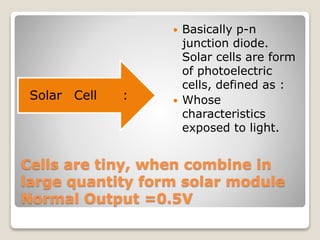
Cells are tiny, when combine in
large quantity form solar module
Normal Output =0.5V
:
Cell
Solar
 Basically p-n
junction diode.
Solar cells are form
of photoelectric
cells, defined as :
 Whose
characteristics
exposed to light.
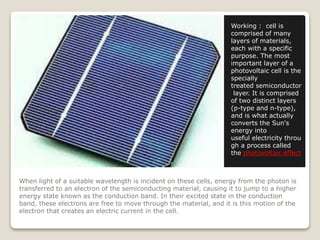
When light of a suitable wavelength is incident on these cells, energy from the photon is
transferred to an electron of the semiconducting material, causing it to jump to a higher
energy state known as the conduction band. In their excited state in the conduction
band, these electrons are free to move through the material, and it is this motion of the
electron that creates an electric current in the cell.
Working : cell is
comprised of many
layers of materials,
each with a specific
purpose. The most
important layer of a
photovoltaic cell is the
specially
treated semiconductor
layer. It is comprised
of two distinct layers
(p-type and n-type),
and is what actually
converts the Sun's
energy into
useful electricity throu
gh a process called
the photovoltaic effect
Materials & Criteria
 Materials to be Used
in Solar Cell
 Must have band gap
from 1ev to 1.8ev.
 It must have high
optical absorption.
 It must have high
electrical conductivity.
 The raw material must
be available in
abundance and the cost
of the material must be
low.
 Materials
 The materials which are
used for this purpose
must have band gap
close to 1.5ev.
Commonly used
materials are-
 Silicon.
 GaAs.
 CdTe.
 CuInSe2
PV MODULE
A numbers of solar cells
combine to form a Solar
Module.
A solar module is normally
series connected sufficient
number of solar cells to
provide required standard
output voltage and power.
One solar module can be
rated from 3 watts to 300
watts.
Standard Condition :
25 Degree Temperature
1000w/m2 Irradiation
 Actually a single solar PV
cell generates very tiny
amount that is around 0.1
watt to 2 watts. But it is
not practical to use such
low power unit as building
block of a system. So
required number of such
cells are combined
together to form a
practical commercially
available solar unit which
is known as solar
module or PV module.
Number of Cells in
Module
No. of Solar cells =
Standard output voltage/Voc-
Vd
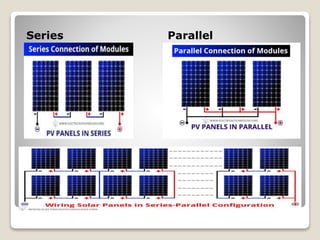
 String of PV
Modules
 When N-number of PV modules are
connected in series. The entire string
of series-connected modules is
known as the PV module string. The
modules are connected in series to
increase the voltage in the system.
 PV Module Array
 To increase the current N-number of PV
modules are connected in parallel.
Such a connection of modules in a
series and parallel combination is
known as “PV Module Array”.
Series Parallel
Progress Presentation Week 1.pptx

Progress Presentation Week 1.pptx

  • 1.
    ﷽ ‫ہے‬ ‫واال‬ ‫کرنے‬‫رحم‬ ‫مہربان‬ ‫بڑا‬ ‫جو‬ ‫سے‬ ‫نام‬ ‫کے‬ ‫ہللا‬ ‫شروع‬
  • 2.
  • 4.
    Cells are tiny,when combine in large quantity form solar module Normal Output =0.5V : Cell Solar  Basically p-n junction diode. Solar cells are form of photoelectric cells, defined as :  Whose characteristics exposed to light.
  • 5.
    When light ofa suitable wavelength is incident on these cells, energy from the photon is transferred to an electron of the semiconducting material, causing it to jump to a higher energy state known as the conduction band. In their excited state in the conduction band, these electrons are free to move through the material, and it is this motion of the electron that creates an electric current in the cell. Working : cell is comprised of many layers of materials, each with a specific purpose. The most important layer of a photovoltaic cell is the specially treated semiconductor layer. It is comprised of two distinct layers (p-type and n-type), and is what actually converts the Sun's energy into useful electricity throu gh a process called the photovoltaic effect
  • 8.
    Materials & Criteria Materials to be Used in Solar Cell  Must have band gap from 1ev to 1.8ev.  It must have high optical absorption.  It must have high electrical conductivity.  The raw material must be available in abundance and the cost of the material must be low.  Materials  The materials which are used for this purpose must have band gap close to 1.5ev. Commonly used materials are-  Silicon.  GaAs.  CdTe.  CuInSe2
  • 10.
    PV MODULE A numbersof solar cells combine to form a Solar Module. A solar module is normally series connected sufficient number of solar cells to provide required standard output voltage and power. One solar module can be rated from 3 watts to 300 watts. Standard Condition : 25 Degree Temperature 1000w/m2 Irradiation  Actually a single solar PV cell generates very tiny amount that is around 0.1 watt to 2 watts. But it is not practical to use such low power unit as building block of a system. So required number of such cells are combined together to form a practical commercially available solar unit which is known as solar module or PV module.
  • 11.
    Number of Cellsin Module No. of Solar cells = Standard output voltage/Voc- Vd  String of PV Modules  When N-number of PV modules are connected in series. The entire string of series-connected modules is known as the PV module string. The modules are connected in series to increase the voltage in the system.  PV Module Array  To increase the current N-number of PV modules are connected in parallel. Such a connection of modules in a series and parallel combination is known as “PV Module Array”.
  • 14.