Programming Microsoft Dynamics 365 Business Central Seventh Edition Marije Brumme
Programming Microsoft Dynamics 365 Business Central Seventh Edition Marije Brumme
Programming Microsoft Dynamics 365 Business Central Seventh Edition Marije Brumme
Programming Microsoft Dynamics 365 Business Central Seventh Edition Marije Brumme
Programming Microsoft Dynamics 365 Business Central Seventh Edition Marije Brumme
1.
Programming Microsoft Dynamics365 Business
Central Seventh Edition Marije Brumme download
https://ebookbell.com/product/programming-microsoft-
dynamics-365-business-central-seventh-edition-marije-
brumme-200620232
Explore and download more ebooks at ebookbell.com
2.
Here are somerecommended products that we believe you will be
interested in. You can click the link to download.
Programming Microsoft Dynamics 365 Business Central Build Powerful
Robust And Scalable Extensions Customized For Your Business
Requirements Seventh Edition 7th Marije Brumme
https://ebookbell.com/product/programming-microsoft-
dynamics-365-business-central-build-powerful-robust-and-scalable-
extensions-customized-for-your-business-requirements-seventh-
edition-7th-marije-brumme-69365042
Programming Microsoft Dynamics 365 Business Central 6th Edition Mark
Brummel David Studebaker Chris Studebaker
https://ebookbell.com/product/programming-microsoft-
dynamics-365-business-central-6th-edition-mark-brummel-david-
studebaker-chris-studebaker-11145972
Programming Microsoft Dynamics 365 Business Central 7th Marije Brummel
https://ebookbell.com/product/programming-microsoft-
dynamics-365-business-central-7th-marije-brummel-82204100
Programming Microsoft Dynamics 365 Business Central Build Powerful
Robust And Scalable Extensions Customized For Your Business
Requirements Marije Brumme
https://ebookbell.com/product/programming-microsoft-
dynamics-365-business-central-build-powerful-robust-and-scalable-
extensions-customized-for-your-business-requirements-marije-
brumme-77734842
3.
Programming Microsoft DynamicsNav 2009 David Studebaker
https://ebookbell.com/product/programming-microsoft-dynamics-
nav-2009-david-studebaker-4641316
Programming Microsoft Dynamics Nav David Studebaker
https://ebookbell.com/product/programming-microsoft-dynamics-nav-
david-studebaker-4644050
Programming Microsoft Dynamics Nav 2015 David Studebaker Christopher
Studebaker
https://ebookbell.com/product/programming-microsoft-dynamics-
nav-2015-david-studebaker-christopher-studebaker-5323242
Programming Microsoft Dynamics Nav 5th Edition Mark Brummel
Christopher D Studebaker David A Studebaker
https://ebookbell.com/product/programming-microsoft-dynamics-nav-5th-
edition-mark-brummel-christopher-d-studebaker-david-a-
studebaker-11145968
Programming Microsoft Dynamics Nav Mark Brummel
https://ebookbell.com/product/programming-microsoft-dynamics-nav-mark-
brummel-61232826
could not dreamof entering Spain with the intention of living by
plunder and requisitions, as the French habitually did.
Wellington’s ambition at the moment did not go beyond the hope
of recovering Almeida, which he conceived to be doomed to fall, and
possibly Ciudad Rodrigo also, if the enemy should be forced to fall
back towards Salamanca. But Almeida, at least, he was determined
to make his own, and the first necessity was to clear away the 9th
Corps from its neighbourhood. He was convinced that Drouet would
retreat when he heard that Masséna had retired to the Agueda, and
thought that his motions might be quickened by a demonstration.
The 6th Division and Pack’s Portuguese were destined for the
blockade of Almeida, but they would not be up for some days, and
meanwhile Trant’s Militia, which was already on the lower Coa, was
directed to push in boldly upon the place, and promised the support
of Slade’s cavalry brigade on the 7th. Trant, always daring and full of
enterprise, pressed forward to Val de Mula, on the further side of
Almeida, and met there Claparéde’s division on its way towards the
Agueda—Conroux had already departed. The Militia engaged in an
irregular fight with the French, who turned promptly round upon
them, and seemed likely to make havoc of them near the village of
Aldea do Obispo. But just as the attack grew threatening Slade’s
dragoons appeared from the south, with Bull’s horse artillery battery,
and drew up on the flank of the enemy’s troops. The artillery were
already beginning to enfilade them, when Claparéde, forming his
division into battalion squares, made a hasty retreat towards the
Agueda, and passed it at the bridge of Barba del Puerco. Erskine,
who was in command of the expedition, did not press him hard, and
the French, according to their own account, only lost 7 killed and 4
officers and 24 men wounded, all by cannon shot, for the dragoons
were not allowed to charge home[255]
. Slade captured, however,
some baggage and a good many stragglers, marauders, and guards
of small convoys, who were surprised in the open rolling country
before they could get over the Agueda.
Wellington could now surround and blockade Almeida; he had
been nourishing some hopes that the French might evacuate it,
7.
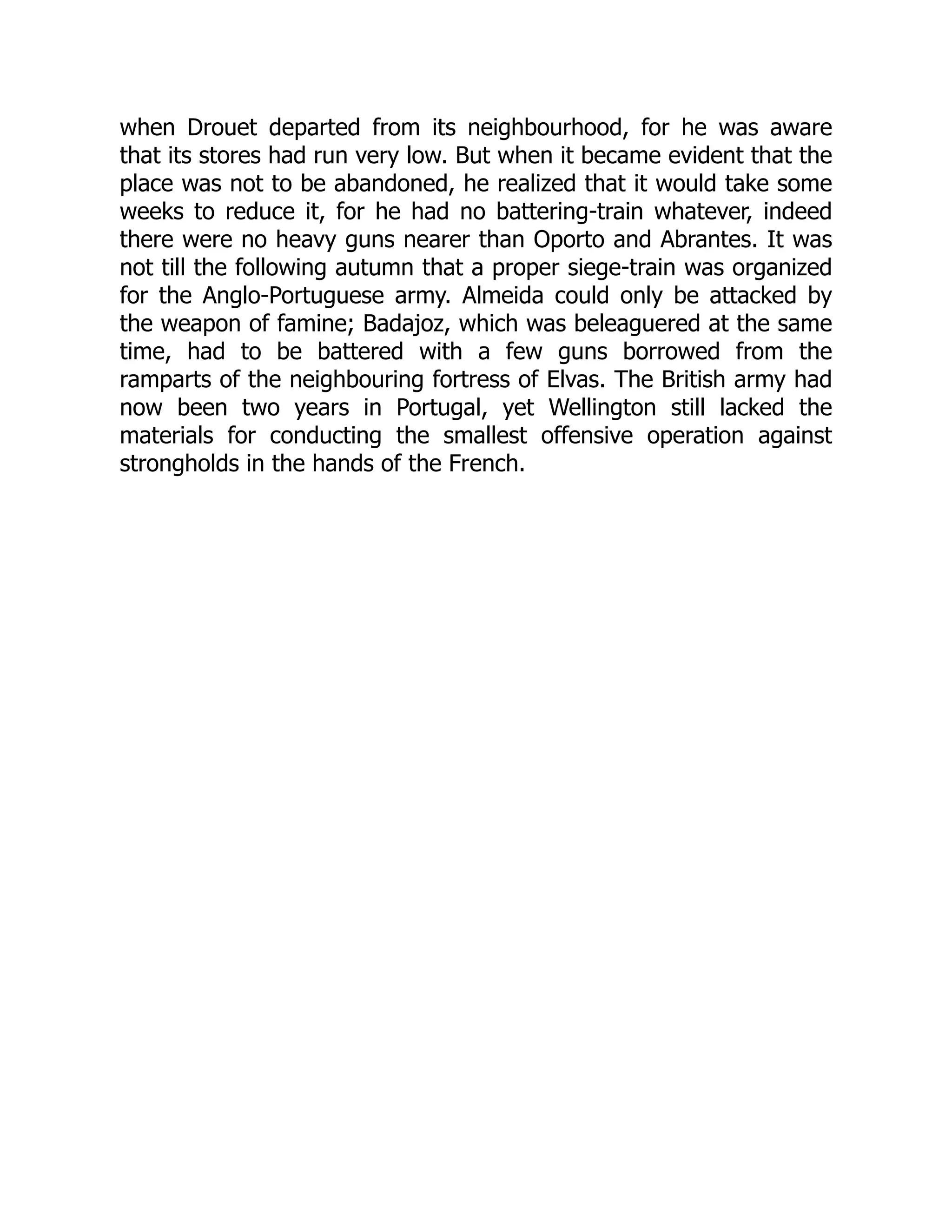
when Drouet departedfrom its neighbourhood, for he was aware
that its stores had run very low. But when it became evident that the
place was not to be abandoned, he realized that it would take some
weeks to reduce it, for he had no battering-train whatever, indeed
there were no heavy guns nearer than Oporto and Abrantes. It was
not till the following autumn that a proper siege-train was organized
for the Anglo-Portuguese army. Almeida could only be attacked by
the weapon of famine; Badajoz, which was beleaguered at the same
time, had to be battered with a few guns borrowed from the
ramparts of the neighbouring fortress of Elvas. The British army had
now been two years in Portugal, yet Wellington still lacked the
materials for conducting the smallest offensive operation against
strongholds in the hands of the French.
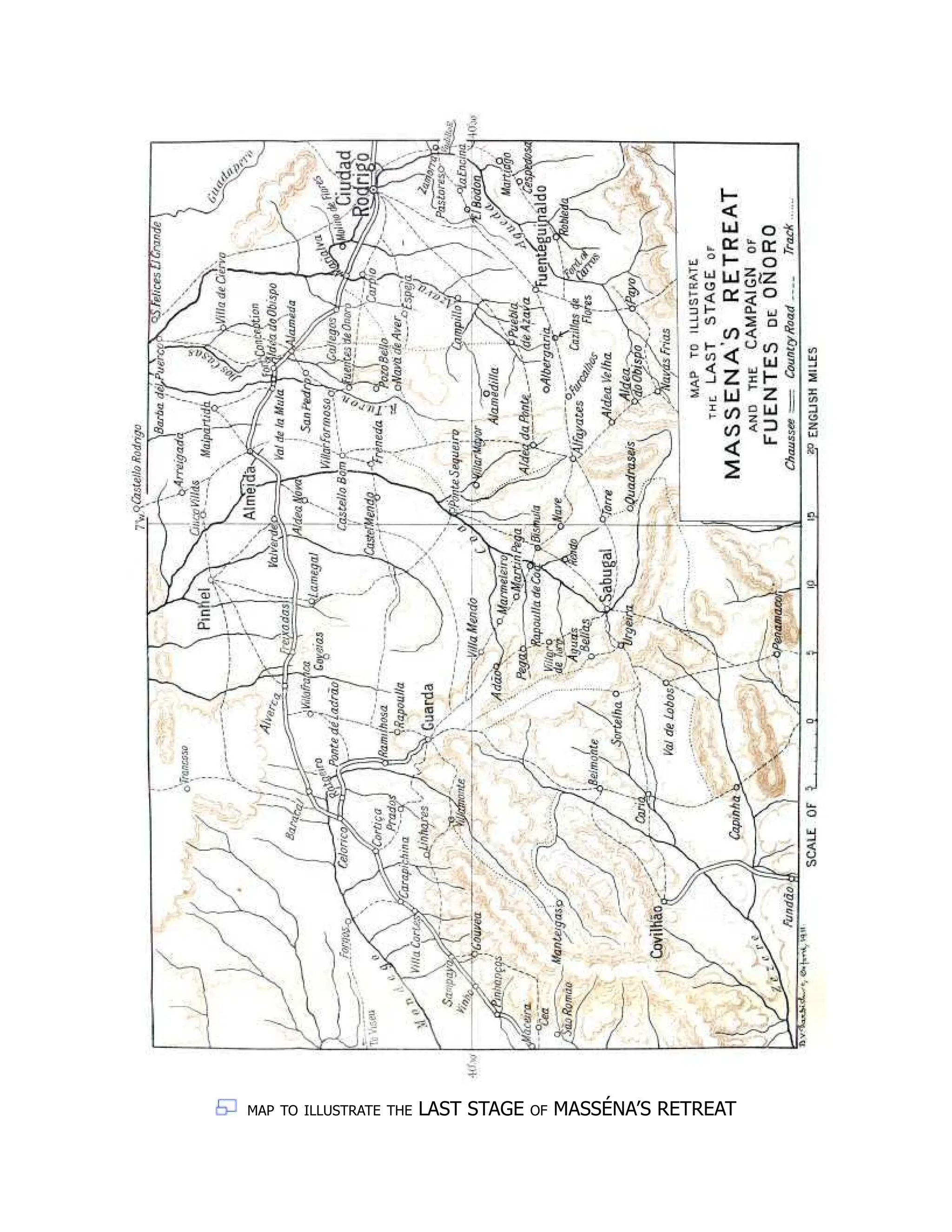
and the CAMPAIGNof FUENTES de OÑORO
It was known, however, that the stores in Almeida had run low,
for the 9th Corps had been consuming them while it lay close by, in
spite of Masséna’s strict directions to the contrary. But starvation
knows no laws. As a matter of fact there were still over thirty days’
rations in the magazines, though it had been reported both to
Wellington and to Masséna that the stock had run down much lower;
[256]
Drouet had falsely stated on one occasion that there was only
enough to last for fifteen days. The British general fancied that four
weeks’ blockade might reduce the place, and thought that he was
quit of the Army of Portugal for a much longer space of time. He
even hoped to effect something against Ciudad Rodrigo[257]
, which
was also under-victualled, for on reaching the frontier Masséna had
been forced to indent upon it for supplies for his broken host. If the
French retired to Salamanca, as seemed quite probable, Wellington
had hopes that he might be able to starve out Rodrigo. But he was
not intending to throw his troops around it; they were to remain on
the Dos Casas and the Azava, covering the siege of Almeida, but
only observing the Spanish fortress with cavalry. For the cutting of
the road between it and Salamanca only irregular forces were to be
used: Wellington would not send any of his own divisions forward
beyond Rodrigo, but requested the daring and resourceful guerrillero
chief Julian Sanchez to throw his bands in this direction, the moment
that the French army should have retired from the Agueda. Sanchez
had been for many months already occupied in similar work, having
spent all the winter in raids to cut off convoys and small parties
passing from Salamanca to Ciudad Rodrigo, or from that place to
Almeida. He had been hunted, often but vainly, by General
Thiébault, the governor of the province, whose columns he had
usually succeeded in avoiding, while he was always at hand to fall on
weak or incautious detachments on the march[258]
.
On April 8th, as Wellington had expected, the Army of Portugal
resumed its march into the interior of the kingdom of Leon, all the
three corps passing the Agueda, and retiring, Reynier to San Felices
10.
el Grande, Junotto Santi Espiritus, Loison to Alba de Yeltes. Junot,
while passing, had been ordered to send into Rodrigo a
reinforcement for the garrison; he detached a battalion of the 15th
and another of the Irish Legion, which brought up the troops in the
place to 3,000 men. From the 8th to the 11th the retreat continued,
till at last the 6th Corps went into cantonments at Salamanca, Alba
de Tormes, and other neighbouring places, the 2nd at and about
Ledesma, and the 8th at Toro, behind the others. Drouet and his two
divisions held the line of observation against the Anglo-Portuguese,
with head quarters at San Muñoz. So ended, fifty miles within the
borders of Spain, the movement that had begun at Santarem and
Punhete.
The effective of Masséna’s army, was on April 15th 39,546 sabres
and bayonets. It had started in September 1810 with 65,050 officers
and men, and had numbered 44,407 on March 15th. The exact loss,
however, was not the mere difference between its force of
September 15, 1810, and of April 15, 1811 (25,504), for it had
received at midwinter two drafts under Gardanne and Foy,
amounting to 3,225 men in all[259]
. On the other hand, the figures of
April 15th do not include two convoys of sick sent back into Spain,
one of 82 officers and 833 men dispatched under the charge of
Drouet from the Alva on March 11, and a second and larger one sent
back from Celorico to Almeida on March 22, along with which went
some dismounted cavalry, and some artillery which could no longer
follow the army. The whole may have amounted to 3,000 men. Both
of these convoys dropped large numbers of dead and stragglers by
the way, but it is impossible to ascertain their total. We must also
deduct the escort of an officer, Major Casabianca, sent from the
front to Ciudad Rodrigo on 21st January, who took 400 men[260]
with
him and never returned. Deducting the 4,315 thus sent back to
Spain, and setting them against the 3,225 received from thence, it
appears that Masséna’s total loss must have been just under 25,000
men, or 38 per cent. of his original force. Of these Wellington had
some 8,000 as prisoners, including the 4,000 captured in the
hospital of Coimbra on October 7th, 1810. The remainder had
11.
perished—not more than2,000 in action, the rest by the sword of
famine. Wellington’s scheme had justified itself, though its working
out had taken many more weeks than he expected. Nor was the
mere loss in men all that the Army of Portugal had suffered. It
returned to Leon stripped of everything—without munitions,
uniforms, or train. It had lost 5,872 horses of the 14,000 which it
had brought into Portugal, and practically all its wheeled vehicles;
there were precisely 36 waggons left with the army. The men were
still ready to fight fiercely when they saw the necessity for it, but
were sulky, discontented, and perpetually carping against the
Commander-in-Chief, whose last unhappy inspiration—the projected
march from Guarda to Plasencia—had filled up the measure of their
wrath. And indeed they had good reason to be disgusted at it, for it
was wholly insane and impracticable. But every misfortune of the
last six months—the bloody repulse at Bussaco, the loss of the
hospitals and magazines at Coimbra, the long starvation at
Santarem, the slow and circuitous course of the retreat, was
imputed to Masséna’s account by his chief subordinates as well as by
his rank and file. What the generals muttered in the morning was
loudly discussed around every camp-fire at night. The whole army
had lost in morale from six months of systematic marauding, was
quite out of hand in the way of discipline, and had no confidence in
its leader, who was absolutely detested. The departure of Ney, who
was liked and admired by all ranks, had been a great
discouragement, because his skilful handling of the rearguard during
the retreat had been understood and appreciated, while Masséna
was cried down as a tactician no less than as a strategist on the
general results of the campaign. A general whose troops no longer
rely on him cannot get the best out of his army, and for this reason
alone Napoleon was justified in removing the old Marshal from his
command in April, when the full tale of the retreat had reached him.
Yet there can be no doubt that Masséna was hardly treated. That
the expedition of Portugal failed was, in the main, no fault of his.
Neither he nor his master, nor any one else on the French side, had
foreseen Wellington’s plans—the devastation of the country-side,
12.
which rendered itimpossible for the invader to live long by
marauding, and the systematic fortification of the long front of the
Lisbon Peninsula. For the actual game that was set before him,
Masséna had not been given sufficient pieces by the Emperor. As
Wellington had said more than a year before[261]
, the French could
not turn him out of Portugal with less than 100,000 men, and
Napoleon had only provided 65,000. Moreover, as the British general
had added, he should so manage affairs that 100,000 French could
not live in the country if they did appear; and this was no vain boast.
Masséna, then, was sent to accomplish an impossible task, and
his merit was that he came nearer to his end than Wellington had
believed possible, before he was forced to recoil. Many of the French
marshals would never have got to Coimbra: certainly none of them
would have succeeded in holding on at Santarem for three months.
There can be no doubt that the Prince of Essling did not exaggerate
when he wrote to Berthier[262]
, on March 31st, that it was his own
iron will alone which had kept the army so long and so far to the
front—that but for him it would have recoiled on to Spain many
weeks earlier. His heroic obstinacy gave his adversary many an
uneasy day, while it seemed in January and February as if the
calculation for famishing the French had failed. Masséna, in short,
had done all that was possible, and the general failure of the
campaign was not his fault, any more than it was that of Soult, on
whom the blame has always been laid by the elder marshal’s
advocates. We have shown in an earlier chapter[263]
that Soult did all
and more than all that Napoleon had directed him to accomplish. If
he had literally obeyed the tardy orders that reached him from Paris
he would only have exposed the 5th Corps to defeat, if not to
destruction. The ex post facto rebukes that the Emperor sent him
were unjust. We are once more driven back to our old conclusion
that the determining factors in the failure of the campaign of
Portugal were firstly that Napoleon refused to appoint a single
commander-in-chief in the Peninsula, to whose orders all the other
marshals should be strictly subordinate, and secondly that he
persisted in sending plans and directions from Paris founded on facts
13.
that were sevenweeks late, or more, when his dispatches reached
the front. On this we have enlarged at sufficient length on an earlier
page.
14.
SECTION XXV
EVENTS INNORTHERN, EASTERN, AND
CENTRAL SPAIN
CHAPTER I
KING JOSEPH AND HIS TROUBLES
While following the fortunes of Wellington and Masséna, during
the first four months of 1811, we have been compelled to leave
almost untouched the sequence of events in the rest of Spain; not
only the doings of Suchet and Macdonald in the far east, which had
no practical connexion with the campaign of Portugal, but also the
minor affairs of the southern and central provinces. Only Soult’s
expedition to Estremadura, which came into close touch with
Wellington, has been dealt with. It is time to explain the general
posture of the war in the Peninsula, during the time when its critical
point lay between Lisbon and Abrantes, where Masséna and
Wellington stood face to face, each waiting for the other to move.
What was going on in Portugal was, as we have already seen,
practically a secret to the French in Spain. For the Portuguese
Ordenança and the Spanish guerrilleros had done their work of
blocking the roads so well, that no accurate information penetrated
to Madrid, Valladolid, or Seville from Santarem. It was only at rare
intervals, when Foy and other officers cut their way through this ‘fog
of war’ that the condition of affairs on the Tagus became known for
15.
a moment. Thefog descended again when they had passed through
on their way to Paris, and given their information as to the fortunes
of the Army of Portugal during the weeks that preceded their
departure. The gaps in the narrative were very long—nothing got
through between the departure of Masséna from Almeida on
September 15, 1810, and Foy’s first arrival at Ciudad Rodrigo on
November 8th. There was another lacuna in the knowledge of the
situation between that date and the passage of Masséna’s second
successful messenger, Casabianca, from Santarem to Rodrigo in the
earliest days of February. And after Casabianca had passed by, the
next news came out through Foy’s second mission, when he started
to announce the oncoming retreat on March 5, and got to the
borders of Leon on March 13. The only way in which King Joseph at
Madrid, or the generals of the ‘military governments’ of Old Castile,
or Soult in Andalusia, felt the course of the war on its most
important theatre, was that they were for many months freed from
any anxiety about the movements of Wellington. He was ‘contained’
by Masséna, and, however he might be faring, he had no power to
interfere by armed force in the affairs of Spain. The French for all
this time had to deal only with the armies of the Cortes, and with
their old and irrepressible enemies the guerrilleros of the mountains.
While the fate of the Portuguese expedition was still uncertain,
while it seemed possible to Napoleon that Masséna might cling to his
position at Santarem till Soult came up to join him on the Tagus, a
considerable change was made with regard to the French troops in
northern Spain. Convinced at last there was little to be said in favour
of that system of many small ‘military governments’, in Old Castile
and the neighbouring provinces, which he had created in 1810, the
Emperor resolved to put them all under a single commander. This
would give him six less independent generals to communicate with,
and would ensure for the future a much better co-operation between
the divisions which occupied the valley of the Douro and the
Pyrenean regions. The six military governors had been each playing
his own game, and taking little notice of that of his neighbours.
Their enemies were mostly the guerrillero bands of the Cantabrian
16.
hills and ofNavarre. Each general did his best to hunt these elusive
enemies out of his own department, but took little heed of their
trespasses on his neighbours’ territory. Evasive and indomitable
partisans like Mina in Navarre, Julian Sanchez in Old Castile, and
Porlier and Longa in the Cantabrian sierras, found it comparatively
easy to shift their positions when the pressure on one region was
too great for them, and to move on into another—they were sure
that the hunt would soon slacken, and that they could return at their
leisure to their old haunts. The Emperor thought that it would be
possible to make an end of them, if all his garrisons and movable
columns in northern Spain were put under a single commander and
moved in unison under a single will. Hence came the decree of
January 8, 1811, creating the ‘Army of the North,’ and handing it
over to Marshal Bessières, whose name was still remembered in
those regions owing to his old victory of Medina de Rio Seco. His
authority extended over the troops stationed in Navarre, Biscay,
Burgos, Valladolid, Salamanca, the Asturias, and Santander, including
not only the regular garrisons of those provinces but the two
divisions of the Young Guard, which had replaced Drouet’s corps in
Old Castile, and the division under Serras which watched Galicia
from the direction of Benavente and Astorga. The total of the forces
placed under his orders amounted to 70,000 men, of whom 59,000
were ‘présents sous les armes,’ the rest being in hospital, or
detached outside the limits of the territory assigned to the Army of
the North.
Considerable as was this force, it did not accomplish all that the
Emperor hoped, even when directed by a single commander of solid
military talents. Bessières, though a capable officer, was not a
genius, and the tasks assigned to him were so multifarious that after
a short time he began to grow harassed and worried, and to cavil at
every order that was sent him. He was directed to ‘suppress
brigandage,’ i. e. to put down the guerrilleros, to support the Army
of Portugal against Wellington whenever necessary, to keep an eye
upon the Spanish regular forces in Galicia and the Asturias. This, he
declared, was more than could be accomplished with the forces at
17.
his disposal. ‘IfI concentrate 20,000 men all communications are
lost, and the insurgents will make enormous progress. The coast
would be lost as far as Bilbao. We are without resources, because it
is only with the greatest pains that the troops can be fed from day to
day. The spirit of the population is abominably bad: the retreat of
the Army of Portugal has turned their heads. The bands of
insurgents grow larger, and recruit themselves actively on every
side.... The Emperor is deceived about Spain: the pacification of
Spain does not depend on a battle with the English, who will accept
it or refuse it as they please, and who have Portugal behind them for
retreat. Every one knows the vicious system of our operations. Every
one allows that we are too widely scattered. We occupy too much
territory, we use up our resources without profit and without
necessity: we are clinging on to dreams. Cadiz and Badajoz absorb
all our means—Cadiz because we cannot take it, Badajoz because it
requires a whole army to support it. We ought to blow up Badajoz,
and to abandon the siege of Cadiz for the present. We ought to draw
in, get solid bases for our magazines and hospitals, and regard two-
thirds of Spain as a vast battlefield, which a battle may give us or
cause us to lose, till the moment that we change our system and
take in hand the real conquest and pacification of the country,’ &c.
[264]
All this means that Bessières found it impossible to pacify the
North, and concluded that it was useless to try to complete the
conquest of Andalusia or Portugal, when that of Navarre and
Santander was so far from being secure that no small party could go
two miles from a garrison town, without a large probability of being
cut off by the insurgents. He would have had his master abandon
Andalusia and Estremadura, in order to concentrate such masses of
troops in the north that the guerrilleros should be smothered by
mere numbers, that every mountain village should have its garrison.
There was small likelihood that his views would find favour at Paris;
the Emperor knew well enough the effect on his prestige that would
result from the abandonment of the siege of Cadiz, following upon
the retreat of Masséna from Santarem. It would look like a
18.
confession of defeat,a renunciation of the great game of conquest;
if the French armies retired beyond the Sierra Morena, the results of
eighteen months of victorious campaigning in the south would be
lost, and the Cortes at Cadiz would once more have a realm to
administer. Hence all that Napoleon did for Bessières was to send
him in June two new divisions for the strengthening of the garrisons
of the North[265]
, and to bid him fortify every important station on the
high-road to Madrid, and even the main bridges of the upper Ebro. A
few months later he recalled him, partly because he considered him
a pessimist, partly because Bessières quarrelled with King Joseph,
who was continually soliciting his removal. But before the Duke of
Istria departed he had many more troubles to go through, as will be
seen.
The main difficulties of the Army of the North arose from
geographical facts. While the plains of Leon and Old Castile could be
scoured by cavalry, and easily traversed by flying columns, so that it
was not impossible to keep some sort of order in them, this flat
upland was bordered on the north by the long chain of the
Cantabrian sierras and their foot-hills, broad, rugged, and nearly
roadless. Behind these again lay the narrow and difficult coast-land
of Asturias and Santander, cut up into countless petty valleys each
drained by its own small river, and parted from its neighbours by
spurs of the great sierras. How was this mountain region, seventy
miles broad and two hundred long, to be dealt with? The French had
no permanent garrisons on the coast between Gijon, the port of
Oviedo, which was generally occupied by a detachment of Bonnet’s
division, and Santander, not far from the borders of Biscay[266]
. This
last Bessières describes as ‘a bad post from every point of view, only
to be defended by covering it with large bodies of troops,’ and only
accessible by a series of difficult defiles. In the Cantabrian highlands
dwelt Longa and Porlier, with bands which had assumed the
proportions of small armies; they could communicate with the sea at
any one of a dozen petty ports, and draw arms and supplies from
the British cruisers of the Bay of Biscay. Even Mina would
occasionally get in touch with the sea through this coast-land,
19.
though his mainsphere of operations was in Navarre. There were
dozens of smaller bands, each based on its own valley, but capable
of joining its neighbours for a sudden stroke. Again and again
French columns worked up into these sierras from the plain of the
Douro, and went on a hunt after the patriots. Sometimes they
caught them and inflicted severe loss; more often they were eluded
by their enemies, who fled by paths that regular troops could not
follow, into some distant corner of the mountains. It was impossible
to garrison each upland valley with a force that could resist a general
levy of the insurgents. Even little towns like Potes, in the Liebana,
Longa’s usual head quarters, which were repeatedly taken, could not
be kept. The ‘Army of the North’ would have required 150,000 men
instead of the 70,000 whom Bessières actually commanded, if it was
to master the whole of this difficult region. Indeed, Cantabria could
only have been conquered by an enemy possessing a sea force to
attack it in the rear, and occupy all its little ports, as well as an
overwhelming land army operating from all sides. To the end of the
war Longa and Porlier, often hunted but never destroyed, maintained
themselves without any great difficulty in their fastnesses. Nothing
but the general despair and demoralization that might have followed
the extinction of the patriotic cause in the whole of the rest of Spain,
could have brought the war in this region to an end. Nothing of the
kind occurred: the Cantabrians kept a high spirit; they won many
small successes, and they were perpetually helped by the British
from the side of the sea. Bessières had a hopeless problem before
him in this quarter, considering the size of his army.
But this was not his only trouble; Bonnet in Asturias was holding
Oviedo and the district immediately round it with a strong division,
which varied at one time and another from 6,000 to 8,000 men. He
was very useful in his present position, because he cut the Spanish
line of defence along the north coast in two, and because he seemed
to threaten Galicia from the north-east. The threat was not a very
real one, for he had not enough men to deliver an attack on eastern
Galicia and at the same time to hold Oviedo and its neighbourhood.
But he was a source of trouble as well as of strength to his
20.
superiors, for itwas very difficult to keep in touch with him through
the pass of Pajares, and if he were to be attacked at once by the
Galicians and by a British landing-force, his position would be a very
dangerous one. He had been put to great trouble by Renovales’s
naval expedition in October 1810[267]
, though this was but a small
force and had not received any real help from Galicia along the land
side. Bessières, after he had been a few months in authority, was
inclined to withdraw Bonnet to the south side of the sierras, and to
abandon Oviedo, but was warned against such a move by his
master, who said that this would be ‘a detestable operation,’ as it
would relieve Galicia from the threat of invasion, allow of the re-
formation of a Junta and an army in Asturias, and necessitate a
heavy concentration at Santander[268]
. Nevertheless the Marshal did
at one crisis withdraw the division from Oviedo.
Between Bonnet in the Asturias and Ciudad Rodrigo, the long
front against Galicia was occupied by a single weak French division,
that of Serras, whose head quarters were at Benavente, his
advanced post at Astorga, and his flank-guards at Leon and
Zamora[269]
. If the army of Galicia had been in good order this force
would have been in great danger, for it was not strong enough to
hold the ground allotted to it. But when Del Parque in 1809 drew off
to Estremadura the old Army of the North, he had left behind him
only a few skeleton corps, and the best of these had been destroyed
in defending Astorga in the following year. The formation of a new
Galician army of 20,000 men had been decreed, and the cadres left
behind in the country had been filled up in 1810, but the results
were not satisfactory. The Captain-General, Mahy, was a man of little
energy, and spent most of it in quarrels with the local Junta, whom
he accused of conspiracy against him, and charged with secret
correspondence with La Romana and his party. He seized their
letters in the post and imprisoned two members, whereupon riots
broke out, and complaints were sent to the Regency at Cadiz. This
led to Mahy’s recall, and the captain-generalship was given to the
Duke of Albuquerque, then on his mission to London. He died
without having returned to Spain, so that the appointment was
21.
nugatory, and theRegency then gave it to Castaños, who was at the
same time made Captain-General of Estremadura, after the death of
La Romana and the disaster at the Gebora. Castaños went to the
Tagus, to rally the poor remnants of the Estremaduran army, and
while retaining the nominal command in Galicia never visited that
province, but deputed the command in it to Santocildes, the young
general who had so bravely defended Astorga in the preceding
spring. He had been sent prisoner to France, but was adroit enough
to escape from his captivity, and to make his way back to Corunna.
His appointment was popular, but he got no great service out of the
Galician army, which was in a deplorable condition, and hopelessly
scattered. The Junta kept many battalions to garrison the harbour-
fortresses of Corunna, Vigo, and Ferrol, and the main body, whose
head quarters lay at Villafranca in the Vierzo, did not amount to
more than 7,000 men, destitute of cavalry (which Galicia could never
produce) and very poorly provided with artillery. There was another
division, under General Cabrera, some 4,000 strong, at Puebla de
Senabria, and a third under Barcena and Losada on the borders of
the Asturias, opposite Bonnet. The whole did not amount to 16,000
raw troops—yet this was sufficient to hold Serras in observation and
to watch Bonnet, who was too much distracted by the Cantabrian
bands to be really dangerous. But in the spring of 1811 the Galicians
could do no more, and Wellington was much chagrined to find that
he could get no effective assistance from them, after he had driven
Masséna behind the Agueda, and so shaken the hold of the French
on the whole kingdom of Leon. It was not till June that Santocildes
found it possible to descend from the hills and threaten Serras. This
led to a petty campaign about Astorga and on the Orbigo river,
which will be narrated in its due place.
While affairs stood thus in the north, King Joseph and his ‘Army
of the Centre’ were profiting for many months from the absence of
any danger upon the side of Portugal. Indeed, the period between
September 1810 and April 1811 were the least disturbed of any in
the short and troublous reign of the Rey Intruso, so far as regular
military affairs went. There was no enemy to face save the
22.
guerrilleros, yet thesebold partisans, of whom the best known were
the Empecinado and El Medico (Dr. Juan Palarea) on the side of the
eastern mountains, and Julian Sanchez more to the west, on the
borders of Leon, sufficed to keep the 20,000 men of whom King
Joseph could dispose[270]
in constant employment. Such a force was
not too much when every small town, almost every village, of New
Castile had to be provided with a garrison. Roughly speaking, each
province absorbed a division: the Germans of the Rheinbund
occupied La Mancha, Lahoussaye’s dragoons and the incomplete
division of Dessolles[271]
held Toledo and its district, the King’s
Spaniards the Guadalajara country, leaving only the Royal Guards
and some drafts and detachments to garrison the capital. It was
with considerable difficulty that Joseph collected in January 1811 a
small expeditionary force of not over 3,500 men[272]
, with which
Lahoussaye went out, partly to open up communications with Soult
in Estremadura, but more especially to search for any traces of the
vanished army of Masséna in the direction of the Portuguese frontier.
Lahoussaye started from Talavera on February 1, communicated by
means of his cavalry with Soult’s outposts between Truxillo and
Merida, and then went northward across the Tagus to Plasencia,
from which his cavalry searched in vain, as far as Coria and
Alcantara, for any news of the Army of Portugal. From Plasencia he
was soon driven back to Toledo by want of supplies. Joseph had
directed him to seize Alcantara, re-establish its broken bridge, and
place a garrison there; but this turned out to be absolutely
impossible, for it would have been useless to leave a small force in
this remote spot, when it was certain that it must ere long retire for
lack of food, and might well be cut off by the guerrilleros before it
could reach Talavera, the nearest occupied point[273]
.
The Army of the Centre just sufficed to occupy the kingdom of
New Castile, and was unable to do more. At least, however, it could
maintain its position, and was in no danger. The King was even able
to make state visits to places in the close neighbourhood of Madrid,
such as Alcala and Guadalajara[274]
, and seems to have regarded the
23.
possibility of sucha modest tour as a sign of the approaching
pacification of this region.
But just at the moment when Joseph Bonaparte’s military
situation was safe, if not satisfactory, he was passing through a
diplomatic crisis which absorbed all his attention and reduced him to
the verge of despair. We have already alluded, in an earlier chapter,
to Napoleon’s insane resolve to annex all Spain beyond the Ebro to
the French Empire[275]
, in return for which he was proposing to hand
over Portugal, when it should be conquered, to his brother. The
proclamation announcing this strange resolve, which was to make
Frenchmen of Mina and all the guerrilleros of Navarre, no less than
of the Catalan armies which were still striving so hard against
Macdonald, was delayed in publication. For the Emperor wished to
wait till Lisbon was in the hands of Masséna, before he made known
his purpose. But Joseph was aware that the proclamation had been
drawn up, and had been sent out to the governors of the northern
provinces, who were only waiting for orders to issue it. The news
that the English had evacuated Portugal might any day arrive, and
would be the signal for the dismemberment of Spain. He had sent in
succession to Paris his two most trusted Spanish adherents, the
Duke of Santa-Fé and the Marquis of Almenara, to beg the Emperor
to forgo his purpose; all was to no effect. Santa-Fé came back in
December absolutely crushed by the reception that he had been
given; the Emperor had delivered to him an angry diatribe, in which
he complained that his brother forgot that he was a French prince,
and remarked that ‘many other European sovereigns, who had
received much harder measure, did not make nearly so much noise
about it as the King of Spain[276]
.’ Almenara reached Madrid about a
week later to report an equally characteristic interview with
Napoleon. He had been directed to inform his master that he should
be given one more chance. Let him open negotiations with the
Cortes at Cadiz, making them the offer that if they would recognize
him as King of Spain, he would recognize them as lawful
representatives of the nation, and rule them according to the
constitution drawn up at Bayonne. Cadiz and the other fortresses
24.
held by thetroops of the Regency must open their gates, and
Napoleon would then promise to make no annexations of Spanish
soil; he would even guarantee the integrity of the kingdom. If the
Cortes refused to treat, the Emperor would regard himself as free
from any previous engagements made with his brother or the
Spanish nation. The provinces beyond the Ebro would become part
of France. He added that if affairs in Portugal went badly, it would
not be wise to open negotiations with Cadiz at all, for fear that the
Spaniards might take the mere fact that proposals had been made to
them as a token of growing fear and depression on the part of
Joseph.
The King and his ministers knew well the impracticability of
making any offer to the government of Cadiz, which (with all its
faults and internal dissensions) was determined to fight to the death,
and had never shown the least intention of recognizing Napoleon’s
nominee as King of Spain. They looked upon the scheme as merely a
preliminary to the publication of the edict for the annexation of the
provinces beyond the Ebro. King Joseph was to be made to
demonstrate his own futility, since he would receive an angry and
contemptuous reply, or no reply at all, and it would then be open to
his brother to declare that the attempt to govern a united Spain by a
king had failed, and that it was necessary to dismember it—perhaps
to cut it up into a number of French military governments. This
seems to have been Joseph’s own impression; in the council at
which the Emperor’s proposal was discussed, he broke out into
violent reproaches and bitter complaints against his brother, and
explained with tears to his ministers that he and they were betrayed.
He was now for abdicating, and this would have been the most
dignified course to take. He talked of buying an estate in France,
and settling down, far from Paris, as a private person. He had indeed
charged his wife’s nephew, Marius Clary, to cross the Pyrenees, and
purchase a castle and lands for him in Touraine or the South, where
he might hide his disgrace and disappointment.
This move provoked Napoleon’s wrath. He signified his
displeasure. ‘The members of the Imperial family could not legally
25.
make any acquisitionof land in France without the formal consent of
the Emperor. In addition, it was impossible for the King of Spain, or
the commander of the Army of the Centre, to quit his post without
having received the Imperial authorization. Painful as the declaration
must be, if the King took such a hazardous step, he should be
arrested at Bayonne on crossing the frontier. There must be no more
talk about the constitution of Bayonne: the Emperor could dispose of
Spain at his good pleasure, and in the interests of the French Empire
alone.’ If Joseph persisted in the idea of abdication, he must first
make a formal statement to that effect to the French ambassador at
Madrid, and, provided that it was considered that the step would
cause no dangerous results, nor give rise to any slanderous reports,
he might come to his estate of Morfontaine near Paris and ‘finish the
matter en règle[277]
.’
Joseph at first seemed inclined to accept any terms by which he
might emerge from his present ignominious position, and actually
had several interviews with Laforest, in which they discussed the
drafting of a deed of abdication. But it seemed that Napoleon would
prefer the prolongation of the present state of affairs, and for his
own purposes intended that a puppet king should continue at
Madrid. By the ambassador’s advice the document ultimately took
the shape of a letter in which Joseph, instead of abdicating in
definitive form, merely stated his wish to do so, and referred it to his
brother. His confidant, Miot de Melito, with whom he talked over the
whole matter, expresses his opinion that at the last moment the
fascination of the crown overpowered his master’s full sense of
resentment. ‘The King’s note was a good piece of writing, but I
consider that it did not state clearly enough that the course to which
he inclined, and which he preferred to all others, was abdication. I
wished that he had made a stronger affirmation of this, and told him
so, but to no effect. It was easy to see that the name of King had
still a powerful attraction, from which Joseph could not escape, and I
wondered at the glamour and intoxication which (as it seems) hangs
about supreme power, since the mere shadow of that power could
overweigh with him so many rebuffs and so much resentment[278]
.’
26.
Welcome to ourwebsite – the perfect destination for book lovers and
knowledge seekers. We believe that every book holds a new world,
offering opportunities for learning, discovery, and personal growth.
That’s why we are dedicated to bringing you a diverse collection of
books, ranging from classic literature and specialized publications to
self-development guides and children's books.
More than just a book-buying platform, we strive to be a bridge
connecting you with timeless cultural and intellectual values. With an
elegant, user-friendly interface and a smart search system, you can
quickly find the books that best suit your interests. Additionally,
our special promotions and home delivery services help you save time
and fully enjoy the joy of reading.
Join us on a journey of knowledge exploration, passion nurturing, and
personal growth every day!
ebookbell.com





![could not dream of entering Spain with the intention of living by
plunder and requisitions, as the French habitually did.
Wellington’s ambition at the moment did not go beyond the hope
of recovering Almeida, which he conceived to be doomed to fall, and
possibly Ciudad Rodrigo also, if the enemy should be forced to fall
back towards Salamanca. But Almeida, at least, he was determined
to make his own, and the first necessity was to clear away the 9th
Corps from its neighbourhood. He was convinced that Drouet would
retreat when he heard that Masséna had retired to the Agueda, and
thought that his motions might be quickened by a demonstration.
The 6th Division and Pack’s Portuguese were destined for the
blockade of Almeida, but they would not be up for some days, and
meanwhile Trant’s Militia, which was already on the lower Coa, was
directed to push in boldly upon the place, and promised the support
of Slade’s cavalry brigade on the 7th. Trant, always daring and full of
enterprise, pressed forward to Val de Mula, on the further side of
Almeida, and met there Claparéde’s division on its way towards the
Agueda—Conroux had already departed. The Militia engaged in an
irregular fight with the French, who turned promptly round upon
them, and seemed likely to make havoc of them near the village of
Aldea do Obispo. But just as the attack grew threatening Slade’s
dragoons appeared from the south, with Bull’s horse artillery battery,
and drew up on the flank of the enemy’s troops. The artillery were
already beginning to enfilade them, when Claparéde, forming his
division into battalion squares, made a hasty retreat towards the
Agueda, and passed it at the bridge of Barba del Puerco. Erskine,
who was in command of the expedition, did not press him hard, and
the French, according to their own account, only lost 7 killed and 4
officers and 24 men wounded, all by cannon shot, for the dragoons
were not allowed to charge home[255]
. Slade captured, however,
some baggage and a good many stragglers, marauders, and guards
of small convoys, who were surprised in the open rolling country
before they could get over the Agueda.
Wellington could now surround and blockade Almeida; he had
been nourishing some hopes that the French might evacuate it,](https://image.slidesharecdn.com/100310116-250516064336-0e9231c9/75/Programming-Microsoft-Dynamics-365-Business-Central-Seventh-Edition-Marije-Brumme-6-2048.jpg)
![and the CAMPAIGN of FUENTES de OÑORO
It was known, however, that the stores in Almeida had run low,
for the 9th Corps had been consuming them while it lay close by, in
spite of Masséna’s strict directions to the contrary. But starvation
knows no laws. As a matter of fact there were still over thirty days’
rations in the magazines, though it had been reported both to
Wellington and to Masséna that the stock had run down much lower;
[256]
Drouet had falsely stated on one occasion that there was only
enough to last for fifteen days. The British general fancied that four
weeks’ blockade might reduce the place, and thought that he was
quit of the Army of Portugal for a much longer space of time. He
even hoped to effect something against Ciudad Rodrigo[257]
, which
was also under-victualled, for on reaching the frontier Masséna had
been forced to indent upon it for supplies for his broken host. If the
French retired to Salamanca, as seemed quite probable, Wellington
had hopes that he might be able to starve out Rodrigo. But he was
not intending to throw his troops around it; they were to remain on
the Dos Casas and the Azava, covering the siege of Almeida, but
only observing the Spanish fortress with cavalry. For the cutting of
the road between it and Salamanca only irregular forces were to be
used: Wellington would not send any of his own divisions forward
beyond Rodrigo, but requested the daring and resourceful guerrillero
chief Julian Sanchez to throw his bands in this direction, the moment
that the French army should have retired from the Agueda. Sanchez
had been for many months already occupied in similar work, having
spent all the winter in raids to cut off convoys and small parties
passing from Salamanca to Ciudad Rodrigo, or from that place to
Almeida. He had been hunted, often but vainly, by General
Thiébault, the governor of the province, whose columns he had
usually succeeded in avoiding, while he was always at hand to fall on
weak or incautious detachments on the march[258]
.
On April 8th, as Wellington had expected, the Army of Portugal
resumed its march into the interior of the kingdom of Leon, all the
three corps passing the Agueda, and retiring, Reynier to San Felices](https://image.slidesharecdn.com/100310116-250516064336-0e9231c9/75/Programming-Microsoft-Dynamics-365-Business-Central-Seventh-Edition-Marije-Brumme-9-2048.jpg)
![el Grande, Junot to Santi Espiritus, Loison to Alba de Yeltes. Junot,
while passing, had been ordered to send into Rodrigo a
reinforcement for the garrison; he detached a battalion of the 15th
and another of the Irish Legion, which brought up the troops in the
place to 3,000 men. From the 8th to the 11th the retreat continued,
till at last the 6th Corps went into cantonments at Salamanca, Alba
de Tormes, and other neighbouring places, the 2nd at and about
Ledesma, and the 8th at Toro, behind the others. Drouet and his two
divisions held the line of observation against the Anglo-Portuguese,
with head quarters at San Muñoz. So ended, fifty miles within the
borders of Spain, the movement that had begun at Santarem and
Punhete.
The effective of Masséna’s army, was on April 15th 39,546 sabres
and bayonets. It had started in September 1810 with 65,050 officers
and men, and had numbered 44,407 on March 15th. The exact loss,
however, was not the mere difference between its force of
September 15, 1810, and of April 15, 1811 (25,504), for it had
received at midwinter two drafts under Gardanne and Foy,
amounting to 3,225 men in all[259]
. On the other hand, the figures of
April 15th do not include two convoys of sick sent back into Spain,
one of 82 officers and 833 men dispatched under the charge of
Drouet from the Alva on March 11, and a second and larger one sent
back from Celorico to Almeida on March 22, along with which went
some dismounted cavalry, and some artillery which could no longer
follow the army. The whole may have amounted to 3,000 men. Both
of these convoys dropped large numbers of dead and stragglers by
the way, but it is impossible to ascertain their total. We must also
deduct the escort of an officer, Major Casabianca, sent from the
front to Ciudad Rodrigo on 21st January, who took 400 men[260]
with
him and never returned. Deducting the 4,315 thus sent back to
Spain, and setting them against the 3,225 received from thence, it
appears that Masséna’s total loss must have been just under 25,000
men, or 38 per cent. of his original force. Of these Wellington had
some 8,000 as prisoners, including the 4,000 captured in the
hospital of Coimbra on October 7th, 1810. The remainder had](https://image.slidesharecdn.com/100310116-250516064336-0e9231c9/75/Programming-Microsoft-Dynamics-365-Business-Central-Seventh-Edition-Marije-Brumme-10-2048.jpg)
![which rendered it impossible for the invader to live long by
marauding, and the systematic fortification of the long front of the
Lisbon Peninsula. For the actual game that was set before him,
Masséna had not been given sufficient pieces by the Emperor. As
Wellington had said more than a year before[261]
, the French could
not turn him out of Portugal with less than 100,000 men, and
Napoleon had only provided 65,000. Moreover, as the British general
had added, he should so manage affairs that 100,000 French could
not live in the country if they did appear; and this was no vain boast.
Masséna, then, was sent to accomplish an impossible task, and
his merit was that he came nearer to his end than Wellington had
believed possible, before he was forced to recoil. Many of the French
marshals would never have got to Coimbra: certainly none of them
would have succeeded in holding on at Santarem for three months.
There can be no doubt that the Prince of Essling did not exaggerate
when he wrote to Berthier[262]
, on March 31st, that it was his own
iron will alone which had kept the army so long and so far to the
front—that but for him it would have recoiled on to Spain many
weeks earlier. His heroic obstinacy gave his adversary many an
uneasy day, while it seemed in January and February as if the
calculation for famishing the French had failed. Masséna, in short,
had done all that was possible, and the general failure of the
campaign was not his fault, any more than it was that of Soult, on
whom the blame has always been laid by the elder marshal’s
advocates. We have shown in an earlier chapter[263]
that Soult did all
and more than all that Napoleon had directed him to accomplish. If
he had literally obeyed the tardy orders that reached him from Paris
he would only have exposed the 5th Corps to defeat, if not to
destruction. The ex post facto rebukes that the Emperor sent him
were unjust. We are once more driven back to our old conclusion
that the determining factors in the failure of the campaign of
Portugal were firstly that Napoleon refused to appoint a single
commander-in-chief in the Peninsula, to whose orders all the other
marshals should be strictly subordinate, and secondly that he
persisted in sending plans and directions from Paris founded on facts](https://image.slidesharecdn.com/100310116-250516064336-0e9231c9/75/Programming-Microsoft-Dynamics-365-Business-Central-Seventh-Edition-Marije-Brumme-12-2048.jpg)

![his disposal. ‘If I concentrate 20,000 men all communications are
lost, and the insurgents will make enormous progress. The coast
would be lost as far as Bilbao. We are without resources, because it
is only with the greatest pains that the troops can be fed from day to
day. The spirit of the population is abominably bad: the retreat of
the Army of Portugal has turned their heads. The bands of
insurgents grow larger, and recruit themselves actively on every
side.... The Emperor is deceived about Spain: the pacification of
Spain does not depend on a battle with the English, who will accept
it or refuse it as they please, and who have Portugal behind them for
retreat. Every one knows the vicious system of our operations. Every
one allows that we are too widely scattered. We occupy too much
territory, we use up our resources without profit and without
necessity: we are clinging on to dreams. Cadiz and Badajoz absorb
all our means—Cadiz because we cannot take it, Badajoz because it
requires a whole army to support it. We ought to blow up Badajoz,
and to abandon the siege of Cadiz for the present. We ought to draw
in, get solid bases for our magazines and hospitals, and regard two-
thirds of Spain as a vast battlefield, which a battle may give us or
cause us to lose, till the moment that we change our system and
take in hand the real conquest and pacification of the country,’ &c.
[264]
All this means that Bessières found it impossible to pacify the
North, and concluded that it was useless to try to complete the
conquest of Andalusia or Portugal, when that of Navarre and
Santander was so far from being secure that no small party could go
two miles from a garrison town, without a large probability of being
cut off by the insurgents. He would have had his master abandon
Andalusia and Estremadura, in order to concentrate such masses of
troops in the north that the guerrilleros should be smothered by
mere numbers, that every mountain village should have its garrison.
There was small likelihood that his views would find favour at Paris;
the Emperor knew well enough the effect on his prestige that would
result from the abandonment of the siege of Cadiz, following upon
the retreat of Masséna from Santarem. It would look like a](https://image.slidesharecdn.com/100310116-250516064336-0e9231c9/75/Programming-Microsoft-Dynamics-365-Business-Central-Seventh-Edition-Marije-Brumme-17-2048.jpg)
![confession of defeat, a renunciation of the great game of conquest;
if the French armies retired beyond the Sierra Morena, the results of
eighteen months of victorious campaigning in the south would be
lost, and the Cortes at Cadiz would once more have a realm to
administer. Hence all that Napoleon did for Bessières was to send
him in June two new divisions for the strengthening of the garrisons
of the North[265]
, and to bid him fortify every important station on the
high-road to Madrid, and even the main bridges of the upper Ebro. A
few months later he recalled him, partly because he considered him
a pessimist, partly because Bessières quarrelled with King Joseph,
who was continually soliciting his removal. But before the Duke of
Istria departed he had many more troubles to go through, as will be
seen.
The main difficulties of the Army of the North arose from
geographical facts. While the plains of Leon and Old Castile could be
scoured by cavalry, and easily traversed by flying columns, so that it
was not impossible to keep some sort of order in them, this flat
upland was bordered on the north by the long chain of the
Cantabrian sierras and their foot-hills, broad, rugged, and nearly
roadless. Behind these again lay the narrow and difficult coast-land
of Asturias and Santander, cut up into countless petty valleys each
drained by its own small river, and parted from its neighbours by
spurs of the great sierras. How was this mountain region, seventy
miles broad and two hundred long, to be dealt with? The French had
no permanent garrisons on the coast between Gijon, the port of
Oviedo, which was generally occupied by a detachment of Bonnet’s
division, and Santander, not far from the borders of Biscay[266]
. This
last Bessières describes as ‘a bad post from every point of view, only
to be defended by covering it with large bodies of troops,’ and only
accessible by a series of difficult defiles. In the Cantabrian highlands
dwelt Longa and Porlier, with bands which had assumed the
proportions of small armies; they could communicate with the sea at
any one of a dozen petty ports, and draw arms and supplies from
the British cruisers of the Bay of Biscay. Even Mina would
occasionally get in touch with the sea through this coast-land,](https://image.slidesharecdn.com/100310116-250516064336-0e9231c9/75/Programming-Microsoft-Dynamics-365-Business-Central-Seventh-Edition-Marije-Brumme-18-2048.jpg)
![superiors, for it was very difficult to keep in touch with him through
the pass of Pajares, and if he were to be attacked at once by the
Galicians and by a British landing-force, his position would be a very
dangerous one. He had been put to great trouble by Renovales’s
naval expedition in October 1810[267]
, though this was but a small
force and had not received any real help from Galicia along the land
side. Bessières, after he had been a few months in authority, was
inclined to withdraw Bonnet to the south side of the sierras, and to
abandon Oviedo, but was warned against such a move by his
master, who said that this would be ‘a detestable operation,’ as it
would relieve Galicia from the threat of invasion, allow of the re-
formation of a Junta and an army in Asturias, and necessitate a
heavy concentration at Santander[268]
. Nevertheless the Marshal did
at one crisis withdraw the division from Oviedo.
Between Bonnet in the Asturias and Ciudad Rodrigo, the long
front against Galicia was occupied by a single weak French division,
that of Serras, whose head quarters were at Benavente, his
advanced post at Astorga, and his flank-guards at Leon and
Zamora[269]
. If the army of Galicia had been in good order this force
would have been in great danger, for it was not strong enough to
hold the ground allotted to it. But when Del Parque in 1809 drew off
to Estremadura the old Army of the North, he had left behind him
only a few skeleton corps, and the best of these had been destroyed
in defending Astorga in the following year. The formation of a new
Galician army of 20,000 men had been decreed, and the cadres left
behind in the country had been filled up in 1810, but the results
were not satisfactory. The Captain-General, Mahy, was a man of little
energy, and spent most of it in quarrels with the local Junta, whom
he accused of conspiracy against him, and charged with secret
correspondence with La Romana and his party. He seized their
letters in the post and imprisoned two members, whereupon riots
broke out, and complaints were sent to the Regency at Cadiz. This
led to Mahy’s recall, and the captain-generalship was given to the
Duke of Albuquerque, then on his mission to London. He died
without having returned to Spain, so that the appointment was](https://image.slidesharecdn.com/100310116-250516064336-0e9231c9/75/Programming-Microsoft-Dynamics-365-Business-Central-Seventh-Edition-Marije-Brumme-20-2048.jpg)
![guerrilleros, yet these bold partisans, of whom the best known were
the Empecinado and El Medico (Dr. Juan Palarea) on the side of the
eastern mountains, and Julian Sanchez more to the west, on the
borders of Leon, sufficed to keep the 20,000 men of whom King
Joseph could dispose[270]
in constant employment. Such a force was
not too much when every small town, almost every village, of New
Castile had to be provided with a garrison. Roughly speaking, each
province absorbed a division: the Germans of the Rheinbund
occupied La Mancha, Lahoussaye’s dragoons and the incomplete
division of Dessolles[271]
held Toledo and its district, the King’s
Spaniards the Guadalajara country, leaving only the Royal Guards
and some drafts and detachments to garrison the capital. It was
with considerable difficulty that Joseph collected in January 1811 a
small expeditionary force of not over 3,500 men[272]
, with which
Lahoussaye went out, partly to open up communications with Soult
in Estremadura, but more especially to search for any traces of the
vanished army of Masséna in the direction of the Portuguese frontier.
Lahoussaye started from Talavera on February 1, communicated by
means of his cavalry with Soult’s outposts between Truxillo and
Merida, and then went northward across the Tagus to Plasencia,
from which his cavalry searched in vain, as far as Coria and
Alcantara, for any news of the Army of Portugal. From Plasencia he
was soon driven back to Toledo by want of supplies. Joseph had
directed him to seize Alcantara, re-establish its broken bridge, and
place a garrison there; but this turned out to be absolutely
impossible, for it would have been useless to leave a small force in
this remote spot, when it was certain that it must ere long retire for
lack of food, and might well be cut off by the guerrilleros before it
could reach Talavera, the nearest occupied point[273]
.
The Army of the Centre just sufficed to occupy the kingdom of
New Castile, and was unable to do more. At least, however, it could
maintain its position, and was in no danger. The King was even able
to make state visits to places in the close neighbourhood of Madrid,
such as Alcala and Guadalajara[274]
, and seems to have regarded the](https://image.slidesharecdn.com/100310116-250516064336-0e9231c9/75/Programming-Microsoft-Dynamics-365-Business-Central-Seventh-Edition-Marije-Brumme-22-2048.jpg)
![possibility of such a modest tour as a sign of the approaching
pacification of this region.
But just at the moment when Joseph Bonaparte’s military
situation was safe, if not satisfactory, he was passing through a
diplomatic crisis which absorbed all his attention and reduced him to
the verge of despair. We have already alluded, in an earlier chapter,
to Napoleon’s insane resolve to annex all Spain beyond the Ebro to
the French Empire[275]
, in return for which he was proposing to hand
over Portugal, when it should be conquered, to his brother. The
proclamation announcing this strange resolve, which was to make
Frenchmen of Mina and all the guerrilleros of Navarre, no less than
of the Catalan armies which were still striving so hard against
Macdonald, was delayed in publication. For the Emperor wished to
wait till Lisbon was in the hands of Masséna, before he made known
his purpose. But Joseph was aware that the proclamation had been
drawn up, and had been sent out to the governors of the northern
provinces, who were only waiting for orders to issue it. The news
that the English had evacuated Portugal might any day arrive, and
would be the signal for the dismemberment of Spain. He had sent in
succession to Paris his two most trusted Spanish adherents, the
Duke of Santa-Fé and the Marquis of Almenara, to beg the Emperor
to forgo his purpose; all was to no effect. Santa-Fé came back in
December absolutely crushed by the reception that he had been
given; the Emperor had delivered to him an angry diatribe, in which
he complained that his brother forgot that he was a French prince,
and remarked that ‘many other European sovereigns, who had
received much harder measure, did not make nearly so much noise
about it as the King of Spain[276]
.’ Almenara reached Madrid about a
week later to report an equally characteristic interview with
Napoleon. He had been directed to inform his master that he should
be given one more chance. Let him open negotiations with the
Cortes at Cadiz, making them the offer that if they would recognize
him as King of Spain, he would recognize them as lawful
representatives of the nation, and rule them according to the
constitution drawn up at Bayonne. Cadiz and the other fortresses](https://image.slidesharecdn.com/100310116-250516064336-0e9231c9/75/Programming-Microsoft-Dynamics-365-Business-Central-Seventh-Edition-Marije-Brumme-23-2048.jpg)
![make any acquisition of land in France without the formal consent of
the Emperor. In addition, it was impossible for the King of Spain, or
the commander of the Army of the Centre, to quit his post without
having received the Imperial authorization. Painful as the declaration
must be, if the King took such a hazardous step, he should be
arrested at Bayonne on crossing the frontier. There must be no more
talk about the constitution of Bayonne: the Emperor could dispose of
Spain at his good pleasure, and in the interests of the French Empire
alone.’ If Joseph persisted in the idea of abdication, he must first
make a formal statement to that effect to the French ambassador at
Madrid, and, provided that it was considered that the step would
cause no dangerous results, nor give rise to any slanderous reports,
he might come to his estate of Morfontaine near Paris and ‘finish the
matter en règle[277]
.’
Joseph at first seemed inclined to accept any terms by which he
might emerge from his present ignominious position, and actually
had several interviews with Laforest, in which they discussed the
drafting of a deed of abdication. But it seemed that Napoleon would
prefer the prolongation of the present state of affairs, and for his
own purposes intended that a puppet king should continue at
Madrid. By the ambassador’s advice the document ultimately took
the shape of a letter in which Joseph, instead of abdicating in
definitive form, merely stated his wish to do so, and referred it to his
brother. His confidant, Miot de Melito, with whom he talked over the
whole matter, expresses his opinion that at the last moment the
fascination of the crown overpowered his master’s full sense of
resentment. ‘The King’s note was a good piece of writing, but I
consider that it did not state clearly enough that the course to which
he inclined, and which he preferred to all others, was abdication. I
wished that he had made a stronger affirmation of this, and told him
so, but to no effect. It was easy to see that the name of King had
still a powerful attraction, from which Joseph could not escape, and I
wondered at the glamour and intoxication which (as it seems) hangs
about supreme power, since the mere shadow of that power could
overweigh with him so many rebuffs and so much resentment[278]
.’](https://image.slidesharecdn.com/100310116-250516064336-0e9231c9/75/Programming-Microsoft-Dynamics-365-Business-Central-Seventh-Edition-Marije-Brumme-25-2048.jpg)