Programmable
Logic Array: An
Introduction
Programmable Logic Arrays (PLAs) are versatile integrated circuits that
allow users to configure and implement custom digital logic functions.
They offer a flexible and cost-effective solution for a wide range of
applications in electronics and computer science.
SW
by Shravani W
What is a Programmable Logic Array?
1 Customizable Logic
PLAs enable users to program
and configure their own unique
logic circuits by selectively
connecting input and output
lines.
2 Efficient Design
The matrix-based architecture of
PLAs allows for compact and
efficient implementation of
complex Boolean functions.
3 Rapid Prototyping
PLAs facilitate quick design
iterations and rapid prototyping
of digital circuits, reducing time-
to-market.
History and Evolution of PLAs
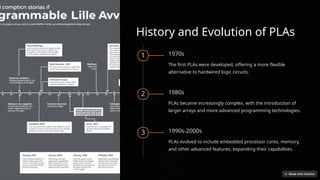
1 1970s
The first PLAs were developed, offering a more flexible
alternative to hardwired logic circuits.
2 1980s
PLAs became increasingly complex, with the introduction of
larger arrays and more advanced programming technologies.
3 1990s-2000s
PLAs evolved to include embedded processor cores, memory,
and other advanced features, expanding their capabilities.
Basic Architecture and Components
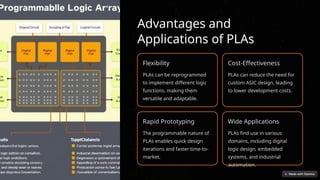
AND Array
The AND array is responsible for
implementing the product terms of
Boolean functions.
OR Array
The OR array combines the product
terms to generate the final output
signals.
Programmable
Interconnections
Programmable switches and fuses
allow users to customize the logic
circuit connections.
Advantages and
Applications of PLAs
Flexibility
PLAs can be reprogrammed
to implement different logic
functions, making them
versatile and adaptable.
Cost-Effectiveness
PLAs can reduce the need for
custom ASIC design, leading
to lower development costs.
Rapid Prototyping
The programmable nature of
PLAs enables quick design
iterations and faster time-to-
market.
Wide Applications
PLAs find use in various
domains, including digital
logic design, embedded
systems, and industrial
automation.
Programming and Configuring PLAs
Software Tools
PLAs are programmed using specialized software that allows users to define and configure
the logic circuits.
Hardware Interfaces
Programming is typically done through dedicated hardware interfaces, such as JTAG or in-
system programming.
Programmable Connections
The connections within the PLA are programmed by selectively blowing or preserving fuses or
antifuses.
Implementing Logic
Functions with PLAs
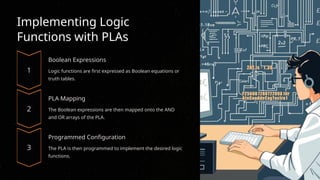
Boolean Expressions
Logic functions are first expressed as Boolean equations or
truth tables.
PLA Mapping
The Boolean expressions are then mapped onto the AND
and OR arrays of the PLA.
Programmed Configuration
The PLA is then programmed to implement the desired logic
functions.
Future Trends and
Advancements in PLAs
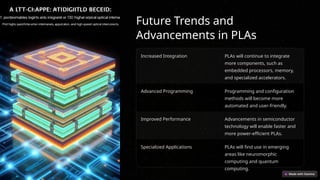
Increased Integration PLAs will continue to integrate
more components, such as
embedded processors, memory,
and specialized accelerators.
Advanced Programming Programming and configuration
methods will become more
automated and user-friendly.
Improved Performance Advancements in semiconductor
technology will enable faster and
more power-efficient PLAs.
Specialized Applications PLAs will find use in emerging
areas like neuromorphic
computing and quantum
computing.

Programmable-Logic-Array-An-Introduction.pptx

  • 1.
    Programmable Logic Array: An Introduction ProgrammableLogic Arrays (PLAs) are versatile integrated circuits that allow users to configure and implement custom digital logic functions. They offer a flexible and cost-effective solution for a wide range of applications in electronics and computer science. SW by Shravani W
  • 2.
    What is aProgrammable Logic Array? 1 Customizable Logic PLAs enable users to program and configure their own unique logic circuits by selectively connecting input and output lines. 2 Efficient Design The matrix-based architecture of PLAs allows for compact and efficient implementation of complex Boolean functions. 3 Rapid Prototyping PLAs facilitate quick design iterations and rapid prototyping of digital circuits, reducing time- to-market.
  • 3.
    History and Evolutionof PLAs 1 1970s The first PLAs were developed, offering a more flexible alternative to hardwired logic circuits. 2 1980s PLAs became increasingly complex, with the introduction of larger arrays and more advanced programming technologies. 3 1990s-2000s PLAs evolved to include embedded processor cores, memory, and other advanced features, expanding their capabilities.
  • 4.
    Basic Architecture andComponents AND Array The AND array is responsible for implementing the product terms of Boolean functions. OR Array The OR array combines the product terms to generate the final output signals. Programmable Interconnections Programmable switches and fuses allow users to customize the logic circuit connections.
  • 5.
    Advantages and Applications ofPLAs Flexibility PLAs can be reprogrammed to implement different logic functions, making them versatile and adaptable. Cost-Effectiveness PLAs can reduce the need for custom ASIC design, leading to lower development costs. Rapid Prototyping The programmable nature of PLAs enables quick design iterations and faster time-to- market. Wide Applications PLAs find use in various domains, including digital logic design, embedded systems, and industrial automation.
  • 6.
    Programming and ConfiguringPLAs Software Tools PLAs are programmed using specialized software that allows users to define and configure the logic circuits. Hardware Interfaces Programming is typically done through dedicated hardware interfaces, such as JTAG or in- system programming. Programmable Connections The connections within the PLA are programmed by selectively blowing or preserving fuses or antifuses.
  • 7.
    Implementing Logic Functions withPLAs Boolean Expressions Logic functions are first expressed as Boolean equations or truth tables. PLA Mapping The Boolean expressions are then mapped onto the AND and OR arrays of the PLA. Programmed Configuration The PLA is then programmed to implement the desired logic functions.
  • 8.
    Future Trends and Advancementsin PLAs Increased Integration PLAs will continue to integrate more components, such as embedded processors, memory, and specialized accelerators. Advanced Programming Programming and configuration methods will become more automated and user-friendly. Improved Performance Advancements in semiconductor technology will enable faster and more power-efficient PLAs. Specialized Applications PLAs will find use in emerging areas like neuromorphic computing and quantum computing.