Profiling for
     Gr!w"#p$

       (107 slides to go ... )
H%!


Hi Everybody! Nice to be here in berlin!
L&'‘$ w(%' #"'%) &v&r*b!+* %$ $&('&+ - !r )&, :-)


Let‘s wait until everybody is here. Actually i haven‘t enough slides, so i try to spend some
time useless slides.
H%, -r&(' '! $&& Y!# .&r&!


A, so that‘s why we waited. Great you came, too.
H&* -!!+ )!!/%"‘!
I am only in software business for all the pretty people around
G!!+ 0!r"%"-!


Who is tired?
Y&(., % (0 '%r&+, '!!


Yep, me too. That‘s the bad thing about berlin. In munich - where i am from - you get
enough sleep because there is no
O/, )&'‘$ $'(r'


But let‘s start anyway
W%'. ( $.!r' $'!r*.


I am old. And you know what old people do. They tell you war stories
A1'#())* 'w! $.!r' $'!r*$.


two war stories, actually.
War Story 1
The first one, already some years ago.
Big On-Demand
             V%+&! S'r&(0%"- Platform


It was one of the first video on demand platforms around. Large scale, with some unique
licensed live events that were only streamed using this platform.
B($&+ !" (" &"'&rpr%$&
   &1!00&r1& $!)#'%!"

To build a solid solution they decided to use an enterprise ecommerce solution as the core.
So basic performance problems shouldn‘t happen, since it was already enterprise.
W& (r&
                                            pr!f&$$%!"()$!
The other reason it should scale was us. they wanted to have mayflower in the team to care
about performance und scaling issues.
+!"& r%-.'


                       Server Setup


So we cared about the server setup. We implemented a small testing environment,
benchmarked the resource usage and calculated that we‘d need 12 4-core machines for a
start.
Performance Testing

                                                            +!"& r%-.', '!!


When the cluster was ready. We did a classic check to see if it does scale.
root@local:/# ab2 -n 50000 -c 500 http://lb.ours.tld/start
  This is ApacheBench, Version 2.3 <$Revision: 655654 $>
  Copyright 1996 Adam Twiss, Zeus Technology Ltd, http://
  www.zeustech.net/
  Licensed to The Apache Software Foundation, http://
  www.apache.org/
  ...
  Requests per second:    A_LOT       [#/sec] (mean)
  Time per request:       REALLY_FAST [ms] (mean)
  Time per request:       EVEN_FASTER [ms] (mean, across all
  concurrent requests)


We first run Apache-Bench. Everything looked pretty good.
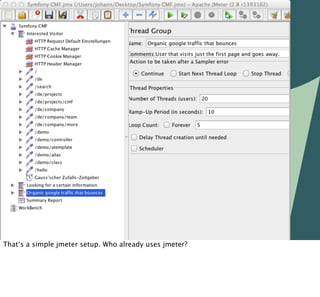
Then we simulated user traffic using jmeter to create realistic traffic.
Pr!2)%"-
                                            %"1)#+&+!


So we tough: hey, how professional we are
Everything was 2"&.


Until   10 minutes before the life event.
               Then everything was $'#1/.
O!p$.


That wasn‘t this brilliant
War Story 2
Second war story, not this long ago.
C)!#+ Pr!3&1'


                               100% Hipster
It was a classic hipster cloud project. Yes, there is a memcache, a rabbitmq,mogilefs,
ejabberd, varnish, nginx and cloud! Uh, and a deployment pipeline, of course, all managed by
puppet.
I"'&r"() C)!#+


We started on our internal cloud - based on eucalyptus 1.6. Anybody else worked with
eucalyptus? Hate it?
However, we developed it there. It was fast and snappy. We were happy, and so was our
customer.
At some day it went live, and it worked great. Just like we expected it to work. Just a bit less
snappy. Responsivity wasn‘t as good.
F$1/%"- S)!w


Actually, it was very slow, more than 2 seconds for the start page, more than a second for
every logged in page.
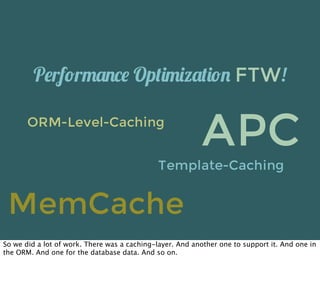
P&rf!r0("1& Op'%04('%!" FTW!

       ORM-Level-Caching
                                                          APC
                                             Template-Caching


 MemCache
So we did a lot of work. There was a caching-layer. And another one to support it. And one in
the ORM. And one for the database data. And so on.
S'%)) $)!!!!!!w.


But it still was slow. We tried it again at our local cloud, where it was fast.
T&$':
 Put it on
 1 Laptop
So we took an really old Lenovo R61 Laptop, and installed everything on it. MySQL, MogileFS,
RabbitMQ, eJabberD, and the whole set of production data.
B)5%"-)* f($'
(-(%".


And it was blazingly fast again. On a laptop, with 4G ram, not even a SSD was installed.
And we were like „What the fuck?“ This was a solid medium sized amazon ec2 installation,
mostly based on large vms. and it was slower than an old laptop?
S!, '.('‘$ w.(' '.%$ '()/ %$ (b!#'.


                  Stuff about profiling
             we never wanted to know.
That were the stories i wanted to tell. It‘s about the things i never wanted to know about
profiling
J!.(""-P&'&r H(r'0("":
                   H(1/&r-'#r"&+-M("(-&r
                      H(1/&r (' .&(r'.

                    C!0p("*:
                M(*6!w&r G0bH
         (f!#"+&+ S&/'%!"E%"$ G0bH, '!!)

I am actually an old school php hacker, i even did a talk at the first php conference ever in
2000. Now i am the CTO of mayflower gmbh, we do php development. a number of php
release manager has been working for our company. we love php.
I founded sektioneins together with stefan esser, too. Ask me about security.
A"+ '.%$ %$ !#r
 )!-! +!"& w%'.
 b(1!".


And this is the mayflower logo, done with bacon! We do agile, devops, slacktime with
nodecopter projects.
Ev&r* "&w %0p!r'("' pr!3&1' %$ +!"& w%'. $*0f!"* 2.

We do every new, important project with symfony 2.
S*0f!"* 2:
                       I‘v& -!' !")* b($%1 /"!w)&+-&


                        S*0f!"* CMF $("+b7 w($
                       '.& !ffi1%() )(b r(' f!r '.%$ '()/

But i don‘t know a lot about it. My colleagues do, like paul, who is going to do a short talk
about fancy reactive programming symfony stutt tomorrow.
Z&"+ Fr(0&w!r/ 1:
                         ( )!' !f /"!w)&+-&


i did a lot of stuff with zend framework, though, maybe that‘s the reason i end up with a
profiling talk here :-)
For sure it‘s one of the reasons we do symfony now :-)
Pr!2)%"-

Who in here uses the zend Profiler?
Who uses XDebug?
Who xhprof?
Symfony web debug toolbar?
Web Debug toolbar with xhprof?
Server site profiling like Valgrind? Sysprof? oprofile?
W.* pr!2)%"- ("*w(*?


Why are you doing it? Imho there are two major reasons:
Reason No 1
                       T! 2-#r& !#' .!w '! $#rv%v& '.&
                      )(#"1. / #p+('& / "&w p!p#)(r%'*


First, you really want to survive the launch. or a new version update. or a tv spot for your
website tonight.
Reason No 2
  T! 2-#r& !#' w.* *!# +%+ "!' $#rv%v& '.&
         )(#"1. / #p+('& / "&w p!p#)(r%'*


Second reason: you want to know why it did not work out.
9& #-)* 'r#'. (b!#' pr!2)%"-:


         The first moment You are certain
      about your applications performance is
             one day after the launch


The bad thing about profiling is that you really, really want to know if your website stays
online, all of your customers are happy and everything is up and running. Even with a
television campaign. But you won‘t get a guarantee anyway, and in fact everybody knows this.
9('$ w.* *!#r b:$ '.%"/$ %'‘$ '.&
             r&$p!"$%b%)%'* !f '.& $!,w(r& -#*$.
And that‘s why your boss thinks you are the one to blame. Maybe some very stupid feature
just needs a lot of computation work to be done, the reason for a bad responsivity of the
server is always slow code, not a slow feature.
9('$ w.* *!# '.%"/ %'‘$ '.&
            r&$p!"$%b%)%'* !f '.& !p&r('%!" -#*$.
And, of course, there is the operations team and the operations infrastructure. If the system
slows down, it‘s their job to make it fast again. So if their hardware is not fast enough, they
should get some faster iron.
O" '.& !'.&r .("+ $%+&, '.&
      !p&r('%!" -#*$ '.%"/ '.& +&v&)!p&r$
   +!"‘' 1(r& (b!#' p&rf!r0("1& ("*w(*.
On the other hand site the ops guys thinks that the software developers simply write slow
code. which, in a lot of cases, they actually do.
Strategy No 1
  M(/& %' .(r+ '! b)(0& Y!#.
Cr&('& (" %0pr&$$%v& pr&$&"'('%!"!


So we use a common, well established strategy: CYA.
W& +!             300 R&q/$!

And we do a little benchmark based on apachebench. And we prove that we are able to
service 300 requests in one second. How great we are!
N!, *!# +!"‘'


Actually, we did not. You measured something that does not exist.
U")&$$ $!0&b!+* ...

... .(1/&+ *!#r "&'w!r/

... $'(r'&+ 50 w30 %" p(r())&) ("+

... pr&$$&+ „r&)!(+“ 6 '%0&$ ( $&1!"+
W.(' &v&r*"b!+*
r&())* w("'$ '! /"!w
1
W.(' (r& '.& !++$ '.(' &v&r*'.%"- %$
#p ("+ r#""%"- (,&r '.& )(#"1.?
2
I$ '.&r& ("*'.%"- w& $.!#)+
; b&f!r& w& )(#"1.?
3
D! w& /"!w .!w '! ; ("*
p&rf!r0("1& %$$#& f($'?
1
      Real Test
      Scenario
B&1(#$&
1 r&q#&$' != 1 !#' !f 1000 r&q#&$'$
First you need a test scenario that is close to your current or expected reality.
1
                       JMeter
               Virtual Users
                (Personas)

First: use a proper Load generation tool like jmeter, webload, silk performer or similar. Create
different thread groups . Personas: In marketing and user-centered design, personas are fictional characters created to
represent the different user types within a targeted demographic, attitude and/or behavior set that might use a site, brand or product in a
similar way.
That‘s a simple jmeter setup. Who already uses jmeter?
                                                         1
Ar& 0* '&$'$ r&()%$'%1?
If *!#‘r& ()r&(+*


                                                                            1
  !")%"&


If you already launched it‘s easy to answer. Simply take a look at your existing web traffic.
Google Analytics

              Webalizer


              W&bA"()*'%1$ f!r V()%+('%!"

                                                     Analog
                AWStats

If you already know what is happening on your website: great.Just do a webalizer or analogue
run on the access_log of a normal hour, and another one done with your benchmark. If the
result looks similar, you are generating the right kind of traffic.
C!rr&)('%!":                99,5%

In a few cases we did some validation using proper statistics, where we did analyzed the
correlation.
If *!# .(v&"‘'


                                                                           1
      )(#"1.&+ *&'


If you haven‘t got any data, and we are not talking about an intranet application for exactly
50 people who start working at 9 am, than you have to guess was is going to happen
1
    Create Scenarios based on Personas:


     1 Worst Case
        Users doing all the expensive stuff

    2 Expected Average
        „Normal“ user behavior


Since you don‘t know where you are going to end up, simply create 3 scenarios that try to
show the range of your applications performance.
Monitoring


                                                                          1
          M#"%"
                                                 C(1'%


                 JM&'&r-P&rf0!"


On the other hand side you need to figure out what happens on the server side. Maybe you
already got a monitoring solution installed, like cacti or munin. Cacti anybody? Planning to
change? Jmeter provides an agent based monitoring solution, it‘s part of the jmeter plugin
package.
Most of the time we use munin, since it‘s imply already there
                                                                M#"%"
source: http://www.methodsandtools.com/tools/jmeterplugins.php
You can configure perfmon to show graphs like „CPU load based on number of users“ and the
like
Interesting Stuff


CPU User, System, IOWait, Interrupts,
Context switches, Forks


M&0!r* PageFaults, Swap, Free Memory

IO Network,Connections, Harddisk, SSD
A     lot of consoles.

And of course a lot of consoles. To monitor everything. I am not talking about game
consoles, btw. :_
T!!)$ '! +! $!0& ("()*$%$:

                                                          top
                                                        iotop
                                                      vmstat
                                                      sysprof
Top - everybody should know this one. iotop: a small python script, already part of all mayor
distributions
vmstat display was originally about virtual memory statistics (hence the name), but does
processes, interrupts, paging, block io and a lot of device statistics as well. Sysprof is a
statistical, systemwide profiler i‘ll show later.
Ramp up? app/console does the cache warming!


Now test all your scenarios. you don‘t need any ramp up since your favourite framework
already does the cache warmup :-)
P:%'%v& !#'1!0&
                      Application still works

                      System is stable

                      Good service quality


Maybe there is some high load at the beginning, but maybe the systems get stable again. If
everything is alright, we probably bought too much hardware.
N!w w& .(v& ( $&'#p
            f!r r&()%$'%1 pr!2)%"-
But that‘s cool, that‘s the perfect starting point for realistic profiling.
N&-('%v& !#'1!0&
                       Application still works

                       System is stable

                       Good service quality


But what happens if it goes wrong? if we are not able to provide the scalability or
responsitivity needed?
N!w w& .(v& ( "&&+
            f!r r&()%$'%1 pr!2)%"-
Now we have to do some profiling anyway :-)
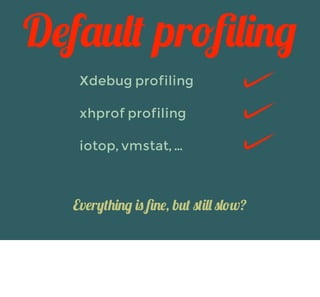
Default

                   H&*, %'‘$ ()r&(+* %" 0* IDE!

                                    A"+ !" 0* Server!
By default you do the profiling while development in your IDE. Who has a profiler enabled? On
your local or on a close-to-production system? Lets have a closer look.
S%"-)& R&q#&$' %" 30&'&r: 2230$
S%"-)& R&q#&$' %" X+&b#-: 14080$
Ev&r*'.%"- %$ #p '!                       12 '%0&$ $)!w&r
                       A' )&($' '.('‘$ w.(' !#r b&"1.0(r/$ '&)).

                                     B#' .&*, %'‘$ r&)('%v& p&rf!r0("1&!

We did some benchmarking in different environments, and the slowdown caused by xdebug
was up to 12 times. That‘s quite a big difference. Now you could say: yeah, but that is just
relative.
20 0$ +('(b($& q#&r* %" ( 100 0$ r&q#&$'
                                  v$
               20 0$ +('(b($& q#&r* %" ( 1.200 0$ r&q#&$'


                                   20% vs 1.6 %
The problem is, that this makes it close to impossible to find race conditions. or to measure
the influence of external inout. See the example: a slow query my result in 20% of the request
time, or in below 2% in yur profiling environment.
Y!#r PHP pr!2)&r )%&$.
What does really happen
          in your application?


                                                    H&*, %'‘$ '.& A#'!)!(+&r!
So, what does really happen in your application. You can see it here - xdebugs callgrind-
format export.
Who knows this one? Obviously most of the time is spend inside the autoloader. That‘s
wellknown, i know.
So, do we know everything that is happening there?
Wall Clock Time


                         W& /"!w '.(' '%0& w($ $p&"',
                                  b#' w& +!"‘' /"!w
                              .!w '.& '%0& w($ $p&"'
xdebug measures wall clock time, and that is fine. but that means you only know that time
was spent, not how it was spent.
O"& )&v&) +&&p&r
I"$'()) v()-r%"+ ("+ ()) "&&+&+ +&b#--%"--$*0b!)$


                                                               $'(r' '.& 30&'&r '&$'

                                          r#" !"& (p(1.& 1.%)+ $&p(r('&)*
        valgrind --tool=callgrind /usr/sbin/apache2 -f /etc/apache2/apache2_single.conf -X


So let‘s have a look at valgrind / callgrind /cachegrind.
It‘s nice to have all debugging symbols installed to see what‘s happening. Start a single
apache child in valgrind while the jmeter test is running. Attention: this single request is a lot
slower, just like xdebug.
What does really happen
          in your application?


                                                        H&*, %'‘$ '.& P(r$&r!
Again we see what really happens - now most of the (self) time is spend inside the parser.
APC FTW!


Luckily both issues can be fixed with APC and the ApcUniversalClassLoader
O"& )&v&) +&&p&r


But anyway, there is more way to go.
Sysprof
Pr!2)%"- '.& &"'%r& )%"< $*$'&0,
#$&r- ("+ /&r"&)$p(1&


                     f($' pr!2)&r w%'. )!w 2"-&rpr%"'
Sysprof tells you about everything that is happening inside your cpu. and, the performance
impact is okeyish
root@local:/# sysprof-cli myoutfile

   ... wait some seconds to gather enough data ...

   ... stop with ctrl-c when you are done ...

   root@local:/# sysprof myoutfile


And that‘s how it works: when the jmeter test is running, sysprof-cli is started for some time.
It‘s stopped with ctrl-c and writes the data to the filesystem. this file can be viewed with
sysprof itself, which is a X11 software.
T&$' r#" w%'. =+&b#- )!(+&+

   18% of the time spent to look at the watch?!
Most of the time is spent within PHP, and that‘s expected to happe. but half of the time is
spent within gettimeofday, a system call that is rather slow, especially when used in 32bit
environments. so 18% of the whole cpu time is used to look at the wallclock.
perf
S(0p)%"- 1#rr&"' 1())$ !r &v&"'$ &v&r* f&w
$&1!"+$


         f($' pr!2)&r w%'. )!w 2"-&rpr%"'
root@local:/# perf record -a -F 10000 sleep 60
   ... creates 600.000 samples ...
   ... saving result in perf.data ...
   root@local:/# perf report


Because the memory bus is slow ...
War Story 2
Now we have got the toolset to look at our war stories.
L&"!v! R61: f($'
E"'&rpr%$& C)!#+ C)#$'&r: $)!w
D&f(#)' pr!2)%"-
   Xdebug profiling

   xhprof profiling

   iotop, vmstat, ...


  Ev&r*'.%"- %$ 2"&, b#' $'%)) $)!w?
$*$pr!f
          page_fault is the reason?!


            R&($!": XEN 0&0!r* $.(r%"- !" (05!" &12

We saw a lot of page_faults. but there was no swapping. So this should not happen?!
_very_ expensive page_faults due to memory sharing in XEN
Solution: memory sharing, pages marked as read_only -> page_fault
and this very page_fault was slow in 32bit guests in 64bit hosts.
War Story 1
The first one, already some years ago.
Everything was 2"&.


  Until      10 minutes before the life event.
                               Then everything was $'#1/.


You remember? Where we went not only live, but dead.
D&f(#)' pr!2)%"-
                     Xdebug profiling

                     xhprof profiling

                     iotop, vmstat, ...

                     cacti monitoring ...

      Ev&r*'.%"- %$ 2"&, b#' $'%)) $'#1/ w.&" %' 0(''&r$?

And we have had the same problem - everything looked fine in normal profiling.
W(%' f!r 'r!#b)&


                                                     50 terminals running
                                         top, atop, htop, iotop, mytop etc

And we waited, and when the next wave hit us we could see it in mytop: next slide
source: http://www.mysqlfanboy.com/2010/06/mytop/
suddenly a lot of mysql queries waiting for a lock
$0(r' 0*$q)-pr7*-)!--%"-

                                             See
https://github.com/patrickallaert/MySQL-Proxy-scripts-for-devs


   root@local:/# mysql-proxy -P 192.168.178.32:4400 
    --admin-username=root --admin-password=mypw 
    --admin-lua-script=/usr/share/mysql-proxy/admin.lua 
    -s /usr/share/mysql-proxy/debug-blind.luaab2 -n 50000 
    -c 500 http://lb.ours.tld/start
   12,345678 ms select * from mytable ...
    2,123456 ms insert into mytable ...


This creates a mysql proxy listener on port 4400, that forwards all request to the local server.
Logging all queries with execution time, removing all unneeded whitespaces. for the _whole_
system, nod for a single process.
> 500 r&-%$'&r%"- ("+ > 1000 )!--%"- %" #$&r$
                   %" '.& $(0& 0%"#'&
                            ==
                       T(b)& )!1/#p

(Yep, solution was simple: MyISAM -> InnoDB)
O'.&r w(r $'!r%&$:

            IBM /&r"&) 0!+#)& $1r&w%"- IO %" 1!"1#rr&"1*,
                        b#' .%+%"- ("* %!w(%'

                        I"-0&0!r*-C(1.%"- )(*&r$ +!&$
                             0!r& b(+ '.(" -!!+


We‘ve got more war stories of this kind, mostly fixed with tools like oprofile, sysprof, vmstat
and the like.
W.* $.!#)+ % 1(r&?
   B&1(#$&:

   T!+(*$ $*$'&0 (r1.%'&1'#r& %$ 1r&('&+ b* +&v&)!p&r$

   D&vOp$: Y!# (r& r&$p!"$%b)& f!r pr!+#1'%!", '!!

   Y!# 1("‘' ; ( !p&r('%!"() b#-
   1(#$&+ b* (pp)%1('%!" 1!+& !'.&rw%$&
Now you might ask: why should i care? i am a developer, not a system administrator?
Because:
W.('‘$ %" f!r *!#?

   A recommended setup
  (but not very surprising)


                            Setup:
           Symfony CMF sandbox
 1400 requests with concurrency 20
Pure PHP                      With APC
                    With Xdebug 6 APC             With APC, with New Relic
                    With APC,XHProf


                                                                             5000
                                                               2698

                                                                             3750


                                                                             2500


                                                                             1250


                                                                             0
              Low               Average             High


new relic is too slow for production right now.
Pr!2)%"-?
          T(/& '.& r&+ p%))
                   Thanks!


Sysprof Perf Valgrind/Callgrind
Mytop Mysql-proxy Xdebug          9("/$!

Profiling for Grown-Ups

  • 1.
    Profiling for Gr!w"#p$ (107 slides to go ... )
  • 2.
    H%! Hi Everybody! Niceto be here in berlin!
  • 3.
    L&'‘$ w(%' #"'%)&v&r*b!+* %$ $&('&+ - !r )&, :-) Let‘s wait until everybody is here. Actually i haven‘t enough slides, so i try to spend some time useless slides.
  • 4.
    H%, -r&(' '!$&& Y!# .&r&! A, so that‘s why we waited. Great you came, too.
  • 5.
    H&* -!!+ )!!/%"‘! Iam only in software business for all the pretty people around
  • 6.
  • 7.
    Y&(., % (0'%r&+, '!! Yep, me too. That‘s the bad thing about berlin. In munich - where i am from - you get enough sleep because there is no
  • 8.
    O/, )&'‘$ $'(r' Butlet‘s start anyway
  • 9.
    W%'. ( $.!r'$'!r*. I am old. And you know what old people do. They tell you war stories
  • 10.
    A1'#())* 'w! $.!r'$'!r*$. two war stories, actually.
  • 11.
    War Story 1 Thefirst one, already some years ago.
  • 12.
    Big On-Demand V%+&! S'r&(0%"- Platform It was one of the first video on demand platforms around. Large scale, with some unique licensed live events that were only streamed using this platform.
  • 13.
    B($&+ !" ("&"'&rpr%$& &1!00&r1& $!)#'%!" To build a solid solution they decided to use an enterprise ecommerce solution as the core. So basic performance problems shouldn‘t happen, since it was already enterprise.
  • 14.
    W& (r& pr!f&$$%!"()$! The other reason it should scale was us. they wanted to have mayflower in the team to care about performance und scaling issues.
  • 15.
    +!"& r%-.' Server Setup So we cared about the server setup. We implemented a small testing environment, benchmarked the resource usage and calculated that we‘d need 12 4-core machines for a start.
  • 16.
    Performance Testing +!"& r%-.', '!! When the cluster was ready. We did a classic check to see if it does scale.
  • 17.
    root@local:/# ab2 -n50000 -c 500 http://lb.ours.tld/start This is ApacheBench, Version 2.3 <$Revision: 655654 $> Copyright 1996 Adam Twiss, Zeus Technology Ltd, http:// www.zeustech.net/ Licensed to The Apache Software Foundation, http:// www.apache.org/ ... Requests per second: A_LOT [#/sec] (mean) Time per request: REALLY_FAST [ms] (mean) Time per request: EVEN_FASTER [ms] (mean, across all concurrent requests) We first run Apache-Bench. Everything looked pretty good.
  • 18.
    Then we simulateduser traffic using jmeter to create realistic traffic.
  • 19.
    Pr!2)%"- %"1)#+&+! So we tough: hey, how professional we are
  • 20.
    Everything was 2"&. Until 10 minutes before the life event. Then everything was $'#1/.
  • 21.
  • 22.
    War Story 2 Secondwar story, not this long ago.
  • 23.
    C)!#+ Pr!3&1' 100% Hipster It was a classic hipster cloud project. Yes, there is a memcache, a rabbitmq,mogilefs, ejabberd, varnish, nginx and cloud! Uh, and a deployment pipeline, of course, all managed by puppet.
  • 24.
    I"'&r"() C)!#+ We startedon our internal cloud - based on eucalyptus 1.6. Anybody else worked with eucalyptus? Hate it? However, we developed it there. It was fast and snappy. We were happy, and so was our customer.
  • 25.
    At some dayit went live, and it worked great. Just like we expected it to work. Just a bit less snappy. Responsivity wasn‘t as good.
  • 26.
    F$1/%"- S)!w Actually, itwas very slow, more than 2 seconds for the start page, more than a second for every logged in page.
  • 27.
    P&rf!r0("1& Op'%04('%!" FTW! ORM-Level-Caching APC Template-Caching MemCache So we did a lot of work. There was a caching-layer. And another one to support it. And one in the ORM. And one for the database data. And so on.
  • 28.
    S'%)) $)!!!!!!w. But itstill was slow. We tried it again at our local cloud, where it was fast.
  • 29.
    T&$': Put iton 1 Laptop So we took an really old Lenovo R61 Laptop, and installed everything on it. MySQL, MogileFS, RabbitMQ, eJabberD, and the whole set of production data.
  • 30.
    B)5%"-)* f($' (-(%". And itwas blazingly fast again. On a laptop, with 4G ram, not even a SSD was installed.
  • 31.
    And we werelike „What the fuck?“ This was a solid medium sized amazon ec2 installation, mostly based on large vms. and it was slower than an old laptop?
  • 32.
    S!, '.('‘$ w.(''.%$ '()/ %$ (b!#'. Stuff about profiling we never wanted to know. That were the stories i wanted to tell. It‘s about the things i never wanted to know about profiling
  • 33.
    J!.(""-P&'&r H(r'0("": H(1/&r-'#r"&+-M("(-&r H(1/&r (' .&(r'. C!0p("*: M(*6!w&r G0bH (f!#"+&+ S&/'%!"E%"$ G0bH, '!!) I am actually an old school php hacker, i even did a talk at the first php conference ever in 2000. Now i am the CTO of mayflower gmbh, we do php development. a number of php release manager has been working for our company. we love php. I founded sektioneins together with stefan esser, too. Ask me about security.
  • 34.
    A"+ '.%$ %$!#r )!-! +!"& w%'. b(1!". And this is the mayflower logo, done with bacon! We do agile, devops, slacktime with nodecopter projects.
  • 35.
    Ev&r* "&w %0p!r'("'pr!3&1' %$ +!"& w%'. $*0f!"* 2. We do every new, important project with symfony 2.
  • 36.
    S*0f!"* 2: I‘v& -!' !")* b($%1 /"!w)&+-& S*0f!"* CMF $("+b7 w($ '.& !ffi1%() )(b r(' f!r '.%$ '()/ But i don‘t know a lot about it. My colleagues do, like paul, who is going to do a short talk about fancy reactive programming symfony stutt tomorrow.
  • 37.
    Z&"+ Fr(0&w!r/ 1: ( )!' !f /"!w)&+-& i did a lot of stuff with zend framework, though, maybe that‘s the reason i end up with a profiling talk here :-) For sure it‘s one of the reasons we do symfony now :-)
  • 38.
    Pr!2)%"- Who in hereuses the zend Profiler? Who uses XDebug? Who xhprof? Symfony web debug toolbar? Web Debug toolbar with xhprof? Server site profiling like Valgrind? Sysprof? oprofile?
  • 39.
    W.* pr!2)%"- ("*w(*? Whyare you doing it? Imho there are two major reasons:
  • 40.
    Reason No 1 T! 2-#r& !#' .!w '! $#rv%v& '.& )(#"1. / #p+('& / "&w p!p#)(r%'* First, you really want to survive the launch. or a new version update. or a tv spot for your website tonight.
  • 41.
    Reason No 2 T! 2-#r& !#' w.* *!# +%+ "!' $#rv%v& '.& )(#"1. / #p+('& / "&w p!p#)(r%'* Second reason: you want to know why it did not work out.
  • 42.
    9& #-)* 'r#'.(b!#' pr!2)%"-: The first moment You are certain about your applications performance is one day after the launch The bad thing about profiling is that you really, really want to know if your website stays online, all of your customers are happy and everything is up and running. Even with a television campaign. But you won‘t get a guarantee anyway, and in fact everybody knows this.
  • 43.
    9('$ w.* *!#rb:$ '.%"/$ %'‘$ '.& r&$p!"$%b%)%'* !f '.& $!,w(r& -#*$. And that‘s why your boss thinks you are the one to blame. Maybe some very stupid feature just needs a lot of computation work to be done, the reason for a bad responsivity of the server is always slow code, not a slow feature.
  • 44.
    9('$ w.* *!#'.%"/ %'‘$ '.& r&$p!"$%b%)%'* !f '.& !p&r('%!" -#*$. And, of course, there is the operations team and the operations infrastructure. If the system slows down, it‘s their job to make it fast again. So if their hardware is not fast enough, they should get some faster iron.
  • 45.
    O" '.& !'.&r.("+ $%+&, '.& !p&r('%!" -#*$ '.%"/ '.& +&v&)!p&r$ +!"‘' 1(r& (b!#' p&rf!r0("1& ("*w(*. On the other hand site the ops guys thinks that the software developers simply write slow code. which, in a lot of cases, they actually do.
  • 46.
    Strategy No 1 M(/& %' .(r+ '! b)(0& Y!#.
  • 47.
    Cr&('& (" %0pr&$$%v&pr&$&"'('%!"! So we use a common, well established strategy: CYA.
  • 48.
    W& +! 300 R&q/$! And we do a little benchmark based on apachebench. And we prove that we are able to service 300 requests in one second. How great we are!
  • 49.
    N!, *!# +!"‘' Actually,we did not. You measured something that does not exist.
  • 50.
    U")&$$ $!0&b!+* ... ....(1/&+ *!#r "&'w!r/ ... $'(r'&+ 50 w30 %" p(r())&) ("+ ... pr&$$&+ „r&)!(+“ 6 '%0&$ ( $&1!"+
  • 51.
  • 52.
    1 W.(' (r& '.&!++$ '.(' &v&r*'.%"- %$ #p ("+ r#""%"- (,&r '.& )(#"1.?
  • 53.
    2 I$ '.&r& ("*'.%"-w& $.!#)+ ; b&f!r& w& )(#"1.?
  • 54.
    3 D! w& /"!w.!w '! ; ("* p&rf!r0("1& %$$#& f($'?
  • 55.
    1 Real Test Scenario B&1(#$& 1 r&q#&$' != 1 !#' !f 1000 r&q#&$'$ First you need a test scenario that is close to your current or expected reality.
  • 56.
    1 JMeter Virtual Users (Personas) First: use a proper Load generation tool like jmeter, webload, silk performer or similar. Create different thread groups . Personas: In marketing and user-centered design, personas are fictional characters created to represent the different user types within a targeted demographic, attitude and/or behavior set that might use a site, brand or product in a similar way.
  • 57.
    That‘s a simplejmeter setup. Who already uses jmeter? 1
  • 58.
    Ar& 0* '&$'$r&()%$'%1?
  • 59.
    If *!#‘r& ()r&(+* 1 !")%"& If you already launched it‘s easy to answer. Simply take a look at your existing web traffic.
  • 60.
    Google Analytics Webalizer W&bA"()*'%1$ f!r V()%+('%!" Analog AWStats If you already know what is happening on your website: great.Just do a webalizer or analogue run on the access_log of a normal hour, and another one done with your benchmark. If the result looks similar, you are generating the right kind of traffic.
  • 61.
    C!rr&)('%!": 99,5% In a few cases we did some validation using proper statistics, where we did analyzed the correlation.
  • 62.
    If *!# .(v&"‘' 1 )(#"1.&+ *&' If you haven‘t got any data, and we are not talking about an intranet application for exactly 50 people who start working at 9 am, than you have to guess was is going to happen
  • 63.
    1 Create Scenarios based on Personas: 1 Worst Case Users doing all the expensive stuff 2 Expected Average „Normal“ user behavior Since you don‘t know where you are going to end up, simply create 3 scenarios that try to show the range of your applications performance.
  • 64.
    Monitoring 1 M#"%" C(1'% JM&'&r-P&rf0!" On the other hand side you need to figure out what happens on the server side. Maybe you already got a monitoring solution installed, like cacti or munin. Cacti anybody? Planning to change? Jmeter provides an agent based monitoring solution, it‘s part of the jmeter plugin package.
  • 65.
    Most of thetime we use munin, since it‘s imply already there M#"%"
  • 66.
    source: http://www.methodsandtools.com/tools/jmeterplugins.php You canconfigure perfmon to show graphs like „CPU load based on number of users“ and the like
  • 67.
    Interesting Stuff CPU User,System, IOWait, Interrupts, Context switches, Forks M&0!r* PageFaults, Swap, Free Memory IO Network,Connections, Harddisk, SSD
  • 68.
    A lot of consoles. And of course a lot of consoles. To monitor everything. I am not talking about game consoles, btw. :_
  • 69.
    T!!)$ '! +!$!0& ("()*$%$: top iotop vmstat sysprof Top - everybody should know this one. iotop: a small python script, already part of all mayor distributions vmstat display was originally about virtual memory statistics (hence the name), but does processes, interrupts, paging, block io and a lot of device statistics as well. Sysprof is a statistical, systemwide profiler i‘ll show later.
  • 70.
    Ramp up? app/consoledoes the cache warming! Now test all your scenarios. you don‘t need any ramp up since your favourite framework already does the cache warmup :-)
  • 71.
    P:%'%v& !#'1!0& Application still works System is stable Good service quality Maybe there is some high load at the beginning, but maybe the systems get stable again. If everything is alright, we probably bought too much hardware.
  • 72.
    N!w w& .(v&( $&'#p f!r r&()%$'%1 pr!2)%"- But that‘s cool, that‘s the perfect starting point for realistic profiling.
  • 73.
    N&-('%v& !#'1!0& Application still works System is stable Good service quality But what happens if it goes wrong? if we are not able to provide the scalability or responsitivity needed?
  • 74.
    N!w w& .(v&( "&&+ f!r r&()%$'%1 pr!2)%"- Now we have to do some profiling anyway :-)
  • 75.
    Default H&*, %'‘$ ()r&(+* %" 0* IDE! A"+ !" 0* Server! By default you do the profiling while development in your IDE. Who has a profiler enabled? On your local or on a close-to-production system? Lets have a closer look.
  • 76.
    S%"-)& R&q#&$' %"30&'&r: 2230$
  • 77.
    S%"-)& R&q#&$' %"X+&b#-: 14080$
  • 78.
    Ev&r*'.%"- %$ #p'! 12 '%0&$ $)!w&r A' )&($' '.('‘$ w.(' !#r b&"1.0(r/$ '&)). B#' .&*, %'‘$ r&)('%v& p&rf!r0("1&! We did some benchmarking in different environments, and the slowdown caused by xdebug was up to 12 times. That‘s quite a big difference. Now you could say: yeah, but that is just relative.
  • 79.
    20 0$ +('(b($&q#&r* %" ( 100 0$ r&q#&$' v$ 20 0$ +('(b($& q#&r* %" ( 1.200 0$ r&q#&$' 20% vs 1.6 % The problem is, that this makes it close to impossible to find race conditions. or to measure the influence of external inout. See the example: a slow query my result in 20% of the request time, or in below 2% in yur profiling environment.
  • 80.
  • 81.
    What does reallyhappen in your application? H&*, %'‘$ '.& A#'!)!(+&r! So, what does really happen in your application. You can see it here - xdebugs callgrind- format export. Who knows this one? Obviously most of the time is spend inside the autoloader. That‘s wellknown, i know. So, do we know everything that is happening there?
  • 82.
    Wall Clock Time W& /"!w '.(' '%0& w($ $p&"', b#' w& +!"‘' /"!w .!w '.& '%0& w($ $p&"' xdebug measures wall clock time, and that is fine. but that means you only know that time was spent, not how it was spent.
  • 83.
  • 84.
    I"$'()) v()-r%"+ ("+()) "&&+&+ +&b#--%"--$*0b!)$ $'(r' '.& 30&'&r '&$' r#" !"& (p(1.& 1.%)+ $&p(r('&)* valgrind --tool=callgrind /usr/sbin/apache2 -f /etc/apache2/apache2_single.conf -X So let‘s have a look at valgrind / callgrind /cachegrind. It‘s nice to have all debugging symbols installed to see what‘s happening. Start a single apache child in valgrind while the jmeter test is running. Attention: this single request is a lot slower, just like xdebug.
  • 85.
    What does reallyhappen in your application? H&*, %'‘$ '.& P(r$&r! Again we see what really happens - now most of the (self) time is spend inside the parser.
  • 86.
    APC FTW! Luckily bothissues can be fixed with APC and the ApcUniversalClassLoader
  • 87.
    O"& )&v&) +&&p&r Butanyway, there is more way to go.
  • 88.
    Sysprof Pr!2)%"- '.& &"'%r&)%"< $*$'&0, #$&r- ("+ /&r"&)$p(1& f($' pr!2)&r w%'. )!w 2"-&rpr%"' Sysprof tells you about everything that is happening inside your cpu. and, the performance impact is okeyish
  • 89.
    root@local:/# sysprof-cli myoutfile ... wait some seconds to gather enough data ... ... stop with ctrl-c when you are done ... root@local:/# sysprof myoutfile And that‘s how it works: when the jmeter test is running, sysprof-cli is started for some time. It‘s stopped with ctrl-c and writes the data to the filesystem. this file can be viewed with sysprof itself, which is a X11 software.
  • 90.
    T&$' r#" w%'.=+&b#- )!(+&+ 18% of the time spent to look at the watch?! Most of the time is spent within PHP, and that‘s expected to happe. but half of the time is spent within gettimeofday, a system call that is rather slow, especially when used in 32bit environments. so 18% of the whole cpu time is used to look at the wallclock.
  • 91.
    perf S(0p)%"- 1#rr&"' 1())$!r &v&"'$ &v&r* f&w $&1!"+$ f($' pr!2)&r w%'. )!w 2"-&rpr%"'
  • 92.
    root@local:/# perf record-a -F 10000 sleep 60 ... creates 600.000 samples ... ... saving result in perf.data ... root@local:/# perf report Because the memory bus is slow ...
  • 93.
    War Story 2 Nowwe have got the toolset to look at our war stories.
  • 94.
    L&"!v! R61: f($' E"'&rpr%$&C)!#+ C)#$'&r: $)!w
  • 95.
    D&f(#)' pr!2)%"- Xdebug profiling xhprof profiling iotop, vmstat, ... Ev&r*'.%"- %$ 2"&, b#' $'%)) $)!w?
  • 96.
    $*$pr!f page_fault is the reason?! R&($!": XEN 0&0!r* $.(r%"- !" (05!" &12 We saw a lot of page_faults. but there was no swapping. So this should not happen?! _very_ expensive page_faults due to memory sharing in XEN Solution: memory sharing, pages marked as read_only -> page_fault and this very page_fault was slow in 32bit guests in 64bit hosts.
  • 97.
    War Story 1 Thefirst one, already some years ago.
  • 98.
    Everything was 2"&. Until 10 minutes before the life event. Then everything was $'#1/. You remember? Where we went not only live, but dead.
  • 99.
    D&f(#)' pr!2)%"- Xdebug profiling xhprof profiling iotop, vmstat, ... cacti monitoring ... Ev&r*'.%"- %$ 2"&, b#' $'%)) $'#1/ w.&" %' 0(''&r$? And we have had the same problem - everything looked fine in normal profiling.
  • 100.
    W(%' f!r 'r!#b)& 50 terminals running top, atop, htop, iotop, mytop etc And we waited, and when the next wave hit us we could see it in mytop: next slide
  • 101.
    source: http://www.mysqlfanboy.com/2010/06/mytop/ suddenly alot of mysql queries waiting for a lock
  • 102.
    $0(r' 0*$q)-pr7*-)!--%"- See https://github.com/patrickallaert/MySQL-Proxy-scripts-for-devs root@local:/# mysql-proxy -P 192.168.178.32:4400 --admin-username=root --admin-password=mypw --admin-lua-script=/usr/share/mysql-proxy/admin.lua -s /usr/share/mysql-proxy/debug-blind.luaab2 -n 50000 -c 500 http://lb.ours.tld/start 12,345678 ms select * from mytable ... 2,123456 ms insert into mytable ... This creates a mysql proxy listener on port 4400, that forwards all request to the local server. Logging all queries with execution time, removing all unneeded whitespaces. for the _whole_ system, nod for a single process.
  • 103.
    > 500 r&-%$'&r%"-("+ > 1000 )!--%"- %" #$&r$ %" '.& $(0& 0%"#'& == T(b)& )!1/#p (Yep, solution was simple: MyISAM -> InnoDB)
  • 104.
    O'.&r w(r $'!r%&$: IBM /&r"&) 0!+#)& $1r&w%"- IO %" 1!"1#rr&"1*, b#' .%+%"- ("* %!w(%' I"-0&0!r*-C(1.%"- )(*&r$ +!&$ 0!r& b(+ '.(" -!!+ We‘ve got more war stories of this kind, mostly fixed with tools like oprofile, sysprof, vmstat and the like.
  • 105.
    W.* $.!#)+ %1(r&? B&1(#$&: T!+(*$ $*$'&0 (r1.%'&1'#r& %$ 1r&('&+ b* +&v&)!p&r$ D&vOp$: Y!# (r& r&$p!"$%b)& f!r pr!+#1'%!", '!! Y!# 1("‘' ; ( !p&r('%!"() b#- 1(#$&+ b* (pp)%1('%!" 1!+& !'.&rw%$& Now you might ask: why should i care? i am a developer, not a system administrator? Because:
  • 106.
    W.('‘$ %" f!r*!#? A recommended setup (but not very surprising) Setup: Symfony CMF sandbox 1400 requests with concurrency 20
  • 107.
    Pure PHP With APC With Xdebug 6 APC With APC, with New Relic With APC,XHProf 5000 2698 3750 2500 1250 0 Low Average High new relic is too slow for production right now.
  • 108.
    Pr!2)%"-? T(/& '.& r&+ p%)) Thanks! Sysprof Perf Valgrind/Callgrind Mytop Mysql-proxy Xdebug 9("/$!