Sheffield Fairness
Commission
Professor Alan Walker
Health and Wellbeing Board
12th December 2013
Today
1. Brief Recap of the Commission’s Work
2. Responses
3. Next Steps

2
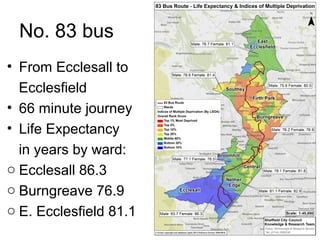
No. 83 bus
• From Ecclesall to
Ecclesfield
• 66 minute journey
• Life Expectancy
in years by ward:
o Ecclesall 86.3
o Burngreave 76.9
o E. Ecclesfield 81.1
3
A Bold Vision
A city that is eventually free from damaging
disparities in living conditions and life
chances, and free from stigmatising
discrimination and prejudice, a place in
which every citizen and community knows
and feels that they will be treated fairly. We
aspire to be the fairest city in the country.
4
Sheffield Fairness Framework
1.
2.

Those in greatest need should take priority
Those with the most resources should make the
biggest contributions
3. The commitment to fairness must be a long-term one
4. The commitment to fairness must be city-wide
5. Prevention is better than cure
6. Be seen to act in a fair way as well as acting fairly
7. Civic responsibility for fairness
8. An open continuous campaign for fairness in the city
9. Fairness must be a matter of balance
10. The city’s commitment to fairness must be both
demonstrated and monitored in an annual report.
5
Themes
•
•
•
•
•
•
•
•

Health and Wellbeing for All
Fair Access to High Quality Jobs and Pay
Fair Access to Benefits and Credit
Aspiration and Opportunities for All
Housing and a Better Environment
A Safe City
Transport for All
What Communities and Citizens Can Do
6
Four Specific Targets Within the
Health Theme
• Tackling the wider determinants of poor
health
• Inequalities in the health system
• Mental health and Wellbeing
• Carers

7
Positive Responses
• Clinical Commissioning Group:
“fully supports the work of the Commission and
its recommendations. Contributing to reducing
health inequalities is one of our four priorities”

• Sheffield City Council
“We are committed to tackling health
inequalities and the public health strategy will
outline our planned actions to achieve this.”
8
Positive Responses II
• Sheffield Teaching Hospitals:
“very much welcomes the Fairness Commission
report both as an important contribution to
promoting health and wellbeing within the city
and because it aligns well with the Trust’s
strategy ‘Making a Difference’.”

• Sheffield Health and Social Care Trust
“welcomes the report and the Commission’s
vision … we endorse the principles”
9
Positive Responses III
Health and Wellbeing Strategy:
•Principle on fairness & tackling inequality
– “Fairness and tackling inequalities will
underpin all that we do.”

•Action
– “Those groups especially impacted by health
inequalities to have early support and
sensitive and appropriate services that meet
their needs and improve their health and
wellbeing”
10
Some questions
• Some recommendations not being picked
up. Gap analysis as part of the Annual
Review to look at which recommendations
need an owner.
• Have the fairness principles been
embedded? i.e. are they part of everyday
decision making?

11
Annual Review - February 2014
• Assessment one year on following
publication of the Commission’s Report:
• Are the principles being used?
• Are the recommendations being
implemented?
• Do the headline outcome indicators
show the city becoming fairer?
12
Summary
• Very positive responses to the Fairness
Commission report
• We all need to ensure that welcoming
words are turned into action
– Are you and your organisation using the
Fairness Framework in decision making?
– Are you going as far as you can, as fast as
you can, in trying to make Sheffield a fairer
city?
13
Challenge to the Health &
Wellbeing Board
“Health and Wellbeing Board (HWB) members
must fully utilise their individual and collective
position, influence and resources to achieve
better health outcomes for Sheffielders in most
need. … The Board must act to address the
wider determinants, champion and challenge
Government and partners in the city (e.g.
employers) to contribute to a holistic approach
to wellbeing in Sheffield and stand up for the
city’s health needs.”
14

The Fairness Commission and Health Inequalities

  • 1.
    Sheffield Fairness Commission Professor AlanWalker Health and Wellbeing Board 12th December 2013
  • 2.
    Today 1. Brief Recapof the Commission’s Work 2. Responses 3. Next Steps 2
  • 3.
    No. 83 bus •From Ecclesall to Ecclesfield • 66 minute journey • Life Expectancy in years by ward: o Ecclesall 86.3 o Burngreave 76.9 o E. Ecclesfield 81.1 3
  • 4.
    A Bold Vision Acity that is eventually free from damaging disparities in living conditions and life chances, and free from stigmatising discrimination and prejudice, a place in which every citizen and community knows and feels that they will be treated fairly. We aspire to be the fairest city in the country. 4
  • 5.
    Sheffield Fairness Framework 1. 2. Thosein greatest need should take priority Those with the most resources should make the biggest contributions 3. The commitment to fairness must be a long-term one 4. The commitment to fairness must be city-wide 5. Prevention is better than cure 6. Be seen to act in a fair way as well as acting fairly 7. Civic responsibility for fairness 8. An open continuous campaign for fairness in the city 9. Fairness must be a matter of balance 10. The city’s commitment to fairness must be both demonstrated and monitored in an annual report. 5
  • 6.
    Themes • • • • • • • • Health and Wellbeingfor All Fair Access to High Quality Jobs and Pay Fair Access to Benefits and Credit Aspiration and Opportunities for All Housing and a Better Environment A Safe City Transport for All What Communities and Citizens Can Do 6
  • 7.
    Four Specific TargetsWithin the Health Theme • Tackling the wider determinants of poor health • Inequalities in the health system • Mental health and Wellbeing • Carers 7
  • 8.
    Positive Responses • ClinicalCommissioning Group: “fully supports the work of the Commission and its recommendations. Contributing to reducing health inequalities is one of our four priorities” • Sheffield City Council “We are committed to tackling health inequalities and the public health strategy will outline our planned actions to achieve this.” 8
  • 9.
    Positive Responses II •Sheffield Teaching Hospitals: “very much welcomes the Fairness Commission report both as an important contribution to promoting health and wellbeing within the city and because it aligns well with the Trust’s strategy ‘Making a Difference’.” • Sheffield Health and Social Care Trust “welcomes the report and the Commission’s vision … we endorse the principles” 9
  • 10.
    Positive Responses III Healthand Wellbeing Strategy: •Principle on fairness & tackling inequality – “Fairness and tackling inequalities will underpin all that we do.” •Action – “Those groups especially impacted by health inequalities to have early support and sensitive and appropriate services that meet their needs and improve their health and wellbeing” 10
  • 11.
    Some questions • Somerecommendations not being picked up. Gap analysis as part of the Annual Review to look at which recommendations need an owner. • Have the fairness principles been embedded? i.e. are they part of everyday decision making? 11
  • 12.
    Annual Review -February 2014 • Assessment one year on following publication of the Commission’s Report: • Are the principles being used? • Are the recommendations being implemented? • Do the headline outcome indicators show the city becoming fairer? 12
  • 13.
    Summary • Very positiveresponses to the Fairness Commission report • We all need to ensure that welcoming words are turned into action – Are you and your organisation using the Fairness Framework in decision making? – Are you going as far as you can, as fast as you can, in trying to make Sheffield a fairer city? 13
  • 14.
    Challenge to theHealth & Wellbeing Board “Health and Wellbeing Board (HWB) members must fully utilise their individual and collective position, influence and resources to achieve better health outcomes for Sheffielders in most need. … The Board must act to address the wider determinants, champion and challenge Government and partners in the city (e.g. employers) to contribute to a holistic approach to wellbeing in Sheffield and stand up for the city’s health needs.” 14

Editor's Notes

  • #4 FC report uses ward data as it wanted to show inequality on a geographical basis Taken from report to HWB Board: “The difference in life expectancy at birth for females, as measured by the Slope Index of Inequality, is 7.3 years, ranging from 78.7 years in the most deprived areas of the City to 86 years in the least.”
  • #12 The most obvious gap is no organisation is leading on developing a voluntary ‘Fair Employer’ code of practice. Some organisations saying they are willing to consider it once it is developed. Justice reinvestment model. From South Yorkshire Probation Trust: “The Trust supports the principles of justice re-investment models … However the Ministry of Justice is currently tendering the South Yorkshire prisons and plans to tender much of the work done by the Trust. The letting of lengthy contracts to private providers of prison and probation services makes the journey towards a re-investment model significantly harder as the funds will be bound into contracts and specifications.
  • #13 Outcome Indicators link into and will be a part of State of Sheffield